

The mystery, madness and magic of memory…

Which buttons? In which order? Aieeeee!
My friend Priscilla, visiting recently, said that my memory was remarkable. This is only partly true: I can never remember how to get into my online banking account and dread the mandatory six-monthly tussle to open it, a necessary process to stop the bank from discontinuing access via my chosen password (that I also can’t remember); I never know which of the buttons on the dashboard of my car releases the locking petrol-cap and have on at least one occasion had to resort to asking a complete stranger, the obliging but clearly exasperated man waiting behind me on the garage forecourt, for help; and, somewhat to my shame, I admit that I can’t turn on my own television. I hasten to point out that, in our household, this isn’t a simple case of clicking one button and then a channel number on a remote: my husband, who is practicality personified, insists that its performance and picture are better if the controls are run through the DVD player. This involves pressing manually a button at the back of the set and using the controls of two separate remotes in the right order to bring up a channel. On the only occasion that I have managed to switch it on, all but a two-inch border at the edge of the screen was obscured by a giant bright green rectangle, as if the programme had been censored by a Martian.
However, Priscilla, who was my flat-mate and closest friend during my university years, is correct that, when it comes to people and what they wore and said, even decades ago, my memory tends not to let me down. I can remember, for example, almost all the clothes that she owned at that period: the turquoise reversible cape; the beautiful green and black floor-length dress she wore to parties the year that everyone turned twenty-one; the red belted sweater that she was wearing on the day that we first met (out of character, this – I don’t think I’ve ever seen her wearing anything else in red); the pink checked Marks and Spencer shirt that she took home for her mother to repair when she ripped the sleeve and many other of her garments.
I’m not sure why I have this kind of selective memory. It’s certainly not something that I’ve tried to cultivate. It may have something to do with the fact that, from a young age, I’ve always intended to write and have therefore sub-consciously filed away a ragbag of material (this is not a pejorative representation of Priscilla’s student wardrobe, I hasten to add!) that might come in useful one day, whereas it’s highly unlikely that I shall ever want to introduce into my novels the mechanics of online banking, filling the car with petrol or turning on the television; yet I think it might also be related to the way that the two generations before my own spoke and behaved. I grew up in the last few years before the half-generation ahead of mine decided that it was a good idea to ‘let it all hang out’. My childhood was dominated by my grandmothers’, rather than my parents’ generation, simply because there were so many of them: one of my grandmothers had six sisters and a brother and the other four brothers (and both had had other siblings who had died in infancy). By contrast, my mother was an only child and my father had one sister, who emigrated while I was still at primary school. There were many family gatherings and I also spent quite a lot of time with each of my grandmothers on her own.
People of that generation – the last to be born before the First World War – didn’t tell you what they thought in so many words, particularly if it was something disagreeable. You had to figure it out for yourself. For example, I very clearly remember standing on the landing of my father’s mother’s house – it had a big oval window edged with squares of coloured glass in blue, red and green, and the sunlight was streaming through it – while my grandmother folded sheets and stowed them in the linen cupboard with the deft efficiency of an automaton. Standing on the windowsill was a black and white photograph of my parents on their wedding day. It was very familiar to me: the same picture, in various frames, adorned mantle-pieces and windowsills in the homes of all my great-uncles and great-aunts, my other grandmother and, of course, my own home. My father was wearing a dapper double-breasted suit; my mother, slightly taller than he in her white platform soles, a drooping full-length white dress (it certainly wasn’t a meringue) which looked as if it might originally have had quite a low neckline but had been primly filled in with a layer of net that almost reached my mother’s chin. Her hair was parted in the middle and almost concealed by the heavy headdress that anchored her floor-length veil. My father was grinning from ear to ear, but my mother wasn’t quite smiling. On the spur of the moment, I asked my grandmother whether she thought my mother had looked pretty on her wedding day.
My grandmother pursed her lips.
“Different folk thought different things. It was all a long time ago, and I’m not going to drag it up again now,” she said, folding the linen ever more ferociously. I was astonished at this remark, but I knew better than to pursue it further: I’d simply have been ‘put in my place’ and certainly would not have elicited a more enlightening comment. However, I still ponder what she said and wonder what it meant. Did my grandmother not like the dress? Was it she who had insisted on doing something about the ‘immodest’ neckline? Did she think my mother should have worn flatter shoes, so as not to emphasise my father’s shortness? An outsider might think that it was just a typical bitchy mother-in-law remark, but my mother and grandmother always seemed to get on well together: in fact, I observed that often they were allies and knew that my grandmother was naturally a generous, not a spiteful, woman.
For a writer, though, these two sentences are like gold. It’s been worth filing them away in my memory for more than four decades. I still enjoy working out possible solutions to the puzzle that they represent. I may even base a whole book on them at some point, whereas I’m unlikely to get much mileage (sorry!) out of a petrol cap. But the man who helped me with that, now, he’s of an entirely different ranking in the memory stakes: he was thick-set, slightly balding and wore a Huddersfield Town shirt with grey jogging bottoms. He had a Barnsley accent. “Now, lass,” he said ….
On your marks, get set, raddle!

Terence the tup eagerly anticipating the harness… no, the ewes…
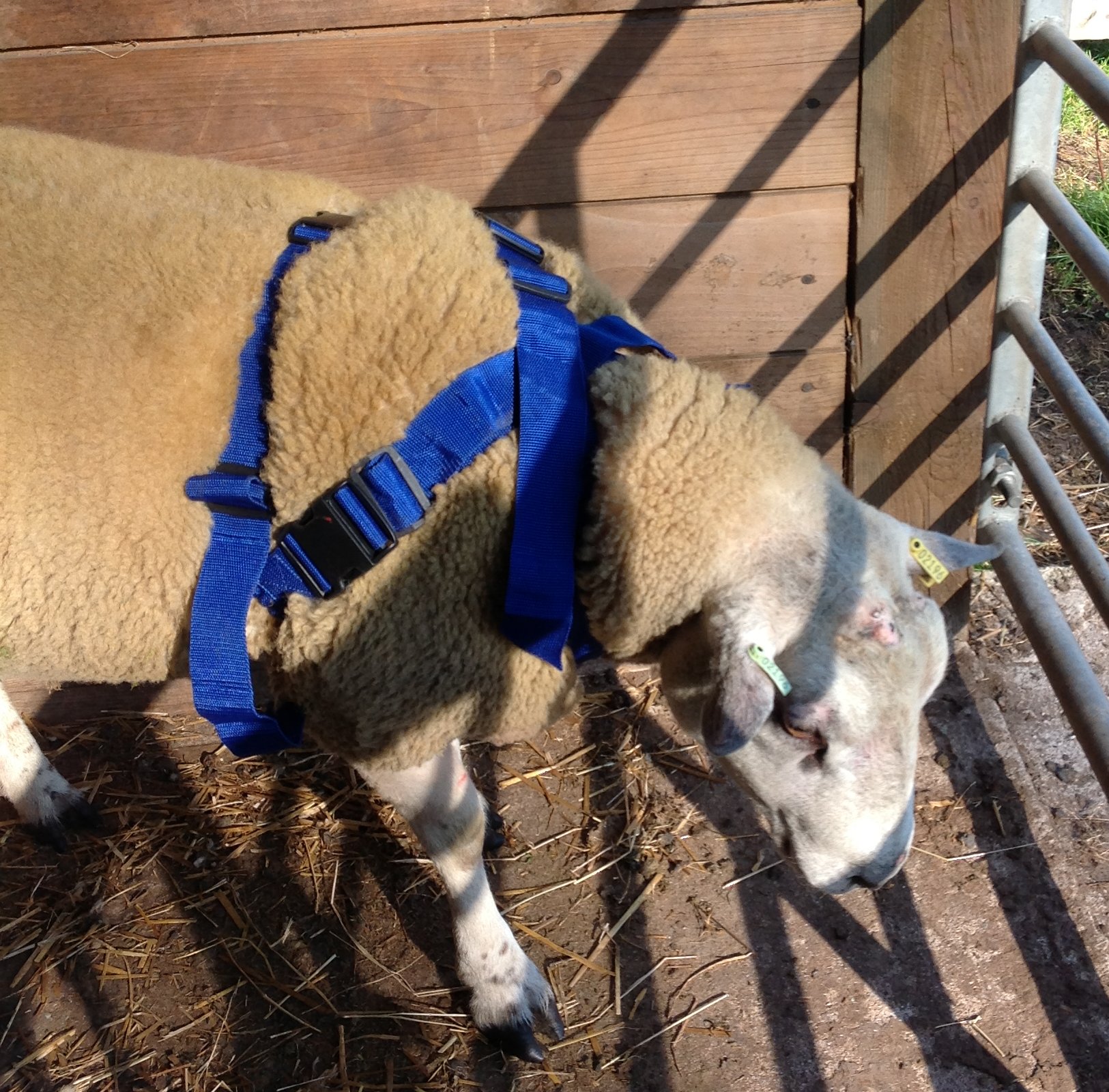
Yesterday our friends Priscilla and Rupert from Lancashire (the ones who showed us Pendle Hill earlier in the summer) visited to accompany us on one of our local Yorkshire walks. They have a smallholding (an idyllic place) and keep chickens, geese and sheep. The conversation turned to ram harnesses. They’ve just bought a shearling ram to service their eight ewes.
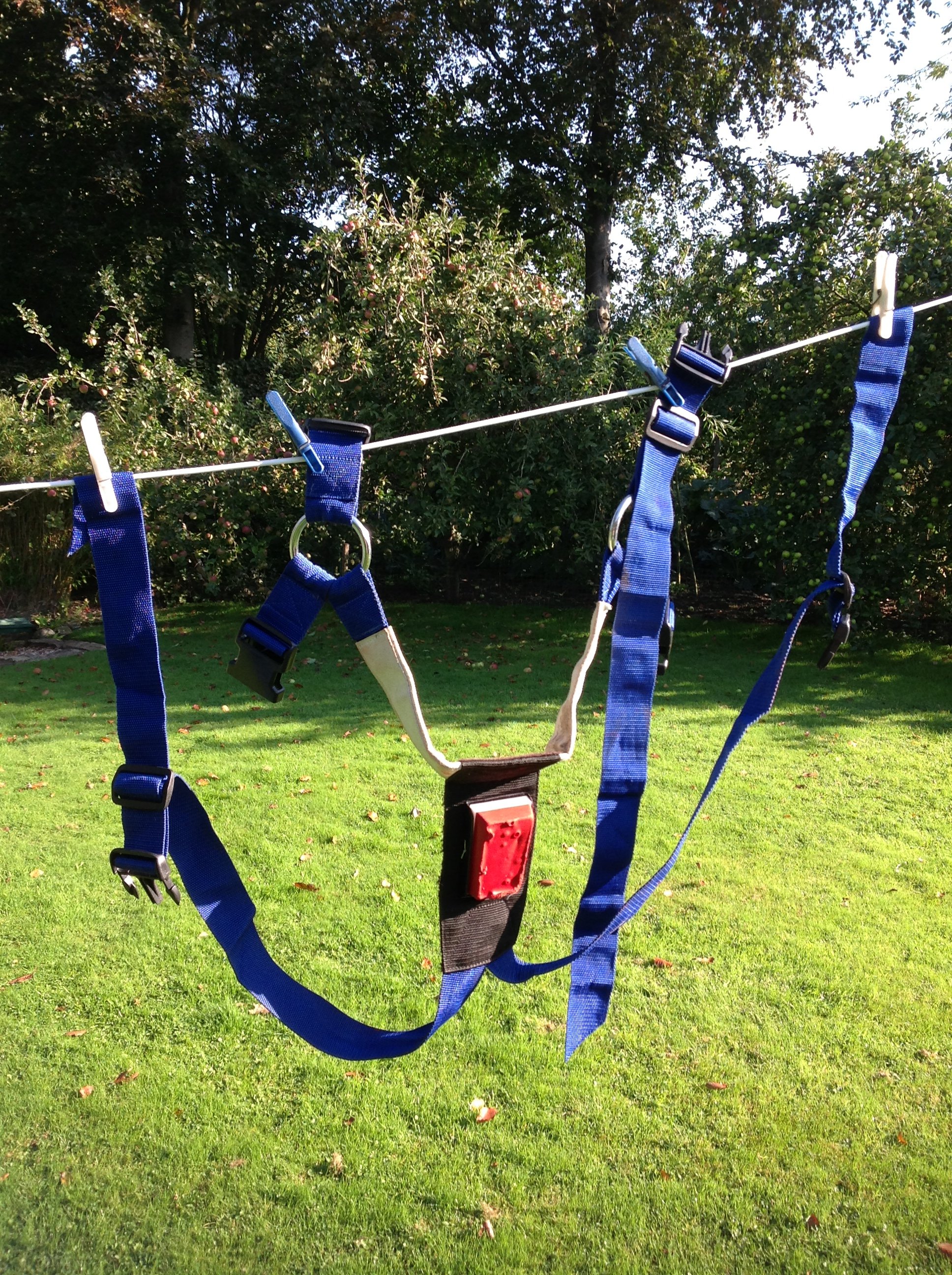
Rupert had spent Friday afternoon trying to get the ram harness on, but without success. It wasn’t that the ram was being obstreperous: named Terence the Tup, he’s as docile, Rupert says, as rams come. The problem was that the harness, which is an elaborate contraption made up of multiple straps and clips, came with no instructions. Not only was it almost impossible to put on, but Terence several times managed to step calmly out of it as soon as their backs were turned. Priscilla said that Rupert was a typical man in not wanting to ask for help (I suggested that he called the NFU, but he frowned that that would be totally demeaning), so we compromised by looking up ‘fitting ram harnesses’ online.
The riddle of the raddle…
It seems that Rupert is not alone in experiencing this difficulty: there are farmers’ forums that devote many pages to harness complaints, mostly without providing the answers and, even when they do, they’re about as comprehensible as the instructions from a Scandinavian flat-pack. One respondent even said, just look for the mud marks on the ewe – it’s cheaper! I should have explained that the purpose of the harness, which is fitted with a coloured crayon, is to let the farmer know when the ram has mated. When the ram mounts the ewe, the crayon leaves a mark which shows that the deed has been completed; so sophisticated is this method that there are soft, medium and hard crayons, according to the number of ewes; soft doesn’t sound much good. As the same effect can be achieved simply by daubing the ram daily with raddle paint (red ochre powder mixed with a little cooking oil, apparently!), it’s impossible not to believe that whoever invented these devices was having a laugh. The harnesses seem to have caught on, however: at this time of year, masochistic sheep farmers may be observed across the countryside, struggling with their own bucolic version of Rubik’s cube.
Terence is not amused… but success for Rupert!
Chuckling over our conversation again this morning, I wondered what Friday afternoon’s episode looked like from Terence’s point of view?
I knew when I saw Rupert’s place it’d be a good billet. He’d sorted me with eight wives, a nice number for a harem, and it means I get them all to myself. I’m not so keen on the bigger gigs where I’d have to share a twohundredsome with some other blokes. It’s not that I’m anti-social, just that team ramming tends to encourage inappropriate equipment and performance comparisons and it’s definitely dodgy to find an old tup leering sideways around the manger to measure you up. There’s one such ram in particular I can’t abide: his name is Fuchsia (What kind of a name is that for a straight fella?). My name is Terence the Tup, so you can imagine what people call him. Classie business
Another reason that I’m keen on coming to Rupert’s is that he strikes me as a sensible chap. Like me, he’s a bit lugubrious, but underneath we both have a wicked sense of humour. I credited him at first with quite a lot of common sense, too, because he played a tight game of it at the auction; when he got me home, he turned me right out with the girls and didn’t bother with one of those ridiculous harnesses that I’ve seen used elsewhere. I was a bit surprised, therefore, when I’d no sooner got comfy in his field last Friday and was just beginning to have a sniff round the ladies when I saw him approaching, brandishing one of those things. Baaaaaaa, I thought. Last time I had a close encounter with one of these, being fitted on a friend of mine, it made me blush to see a self-respecting ram looking like a bondage freak. But the straps were all over the shop and the air was blue, I’m not exaggerating. ‘Mister,’ I bleated at the farmer, ‘kindly remember that there are ladies present.’ But he was too cross to listen.
Anyway, since it was Rupert and obviously not a man with a chicken’s brain, I decided to co-operate, at least up to a point. Wasn’t there an old fella called Gandhi who invented something called ‘passive resistance’? Very effective, I’ve always thought. So I just stood there, chewing on a piece of turnip to alleviate the boredom, while Rupert endeavoured to truss me up.
The first time, he put it on upside down. I didn’t let on, of course, but it wasn’t very bright of him. For one thing, the crayon was squashed up against my brisket, pointing inwards, whereas a lamb could see that it’s meant to face outwards, to put some colour on to the lady. He soon realised that it was wrong and had another go. This time he ended up with two straps spare: those two are supposed to be crossed over my shoulders, but again I didn’t say. Would you help a chap if he was trying to push you into a strait-jacket?
Then the real fun and games started. Priscilla and Rupert have a dog. She’s a sleek black little thing and a bit of a minx, but friendly enough. She’s not one of those rogue dogs that chase sheep. Classie, I think her name is. Anyway, she showed up at this point and, for some reason best known to himself, Rupert decided to have a practice on her.

Catching her was something else. Once he’d finally got her in his grip she squirmed and wriggled while Rupert tried to hold her down with one hand and stick the harness on her with the other. Why he thought this would help was beyond me. Eventually, she ran off with the harness dangling and with Rupert in pursuit. I just stood and chewed my turnip.
Priscilla came out then to catch the dog. She put its lead on and tied it to the fence. Rupert was back with me by this time and beckoned Priscilla over. I must admit that I was slightly bemused when he asked her to kneel down on the grass and started clipping the straps in various permutations on her. But I’m broad-minded: ‘Whatever turns you on,’ I thought.
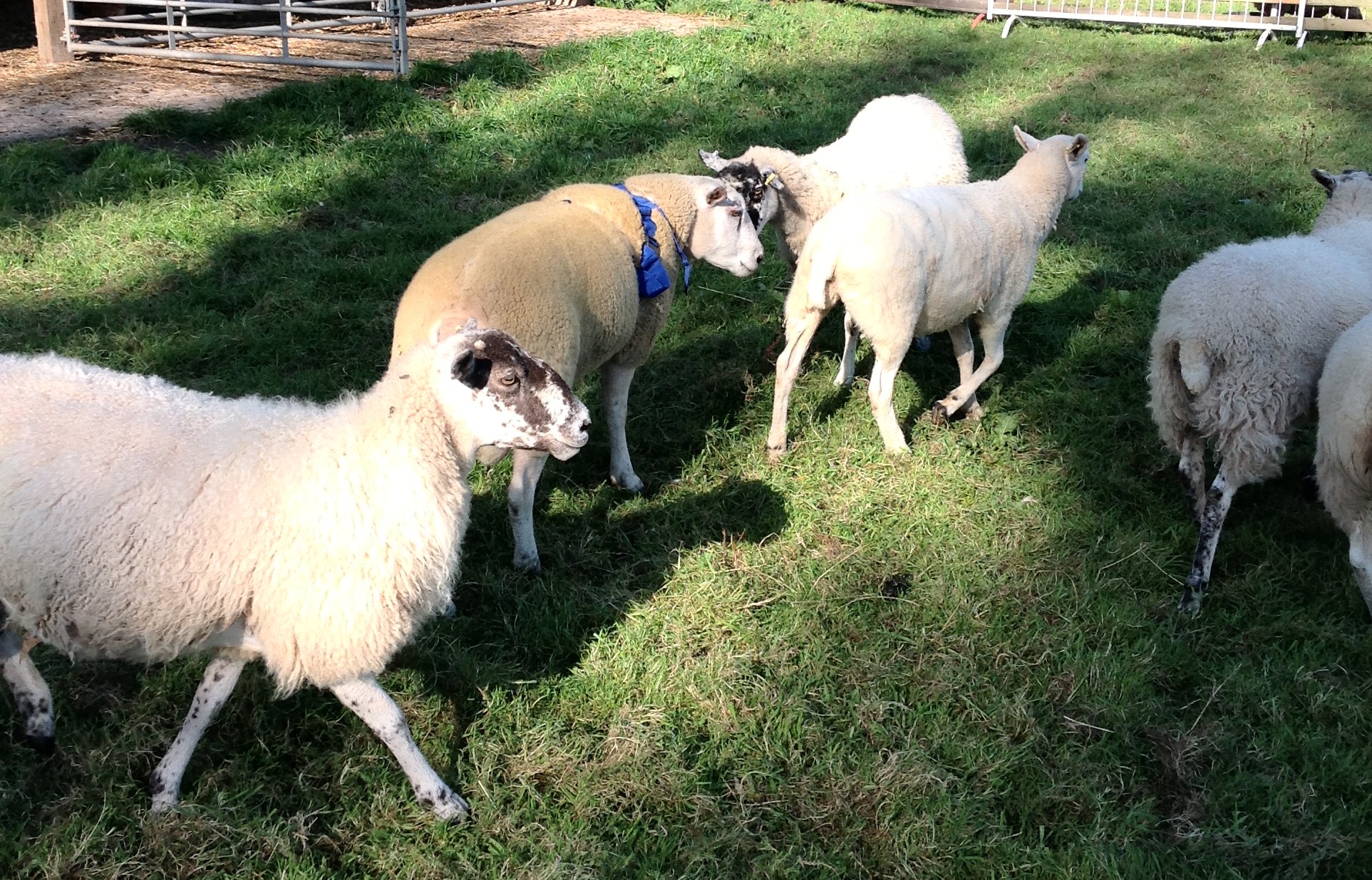
They must have come up with some new ideas by doing this, because Priscilla stood up and came across to hold me while Rupert had another go on me. By Larry, he was sweating. ‘I think that’s right, now,’ he said, ‘but it probably needs to be tighter.’ Shucks, I thought, he’s getting the hang of it. ‘Don’t hurt him! Don’t hurt him!’ Priscilla said, sweetly panicky. I smirked. Rupert tightened the straps a little, but gingerly. He slapped me on my rump and I walked forward a few paces, nonchalantly displaying the harness as I went. ‘I think that’s done the trick,’ said Rupert, and they both went into the house.
I walked over to the far side of the field, where most of my ladies had gathered, and stepped out of the bloody thing. I gave it a well-aimed kick. I didn’t quite manage to flip it into the ditch, but I trampled it down into the mud. Put yourself in my position: wearing that’s like having someone peeping through the keyhole of your bedroom door every night.
As I ambled towards my ladies, I had a look through a gap in the hedge and glimpsed Fuchsia in the next field with some ladies of his own. I met his eye and wondered why he was looking so sheepish: he’s usually a cocky so-and-so. Then I realised: he’d got a harness on and he’d been trussed into it good and proper. Seeing him like that made my day, I can tell you; he looked a right flower.
Now, Fuchsia, this is how to do it! Pity about this bloody harness, though.
BOOKS ARE MY BAG… and it’s a goody!

BA goody bag
[This is the second of my posts about BOOKS ARE MY BAG. You might like some background to the campaign here.]
I spent yesterday at the Booksellers Association Conference, which was held for the second year running on the campus of Warwick University. It was a wonderfully upbeat occasion and celebrated the many successes of the BOOKS ARE MY BAG campaign (now also known as BAMB), which was launched to the industry at the London Book Fair in April. All the activities that were built on this afterwards culminated in the public launch on 14th September.

Patrick Neale, President of the Booksellers Association
Patrick Neale, current President of the BA (and also proprietor of a wonderful bookshop in Oxfordshire – and also, incidentally, a former colleague of mine) listed some of the many triumphs of 14th September. Here are a few of the key ones:
• The BAMB campaign ‘trended’ on social media.
• Footfall in bookshops increased by 17.4% and sales by 18.5%. Booksellers everywhere said that it ‘felt like Christmas.’
• The most pleasing thing of all was that everyone in the industry – booksellers and publishers alike – realised that this was just the start of celebrating the unique attributes of the physical bookshop.
Dame Gail Rebuck, CEO of Random House, who visited Patrick’s shop on 14th and cut his BAMB cake, said that she loved the sense of energy that the campaign has brought. She said, ‘Of course publishers care about bookshops; they are the lifeblood of our culture.’ She was not the only celebrated person to visit Patrick’s bookshop on that day. First of all, Samantha Cameron came in with her daughter (so the staff decided not to pester her); then the Prime Minister himself followed and the staff, deciding that he was fair game, asked if they could take his photograph. He said that he was in favour of the campaign and obliged (all memories of Jimmy Wales and the ‘free’ information in Wikipedia evidently forgotten!).
I shall write more about the conference – which was full of good ideas for authors as well as for publishers and booksellers – and about the campaign. For now, though, I’d just like to share with you the contents of the wonderful goody bag that I received at the end of the day, along with another BOOKS ARE MY BAG bag, which I shall carry with the same pride as its two predecessors, now grubby from a whole summer of being paraded everywhere I’ve been. I’m doubly proud that a postcard about Almost Love was included.
Oh, and in case you’re interested, here’s that photo of the PM outside Patrick’s shop!

Cameron booking a place in history
Cheek to cheek with London at night…

Waterloo midnight’s fine…
I’ve just been in London for three days. It was mostly for the day job: I’m afraid the lazy days of August are now a distant dream. Autumn, with its increased workload and vigorous round of conferences and exhibitions, has now kicked in with a vengeance. The nights are also getting longer, of course, and on Wednesday evening there was a decided nip in the air. Nevertheless, I was having a wonderful time. After five meetings with colleagues and friends (none of them arduous, it should be said, and all of them interesting), I rounded off the day in style by meeting my friend Sally, with whom, as I’ve mentioned before, I stay when I’m in London, and going to see Top Hat at the Aldwych.
Although I’ve seen many (probably too many!) amateur musical productions, I don’t think I’ve ever been to one in the West End before. It was truly breathtaking. Top Hat was made famous by Fred Astaire and Ginger Rogers, for whom it was written, and first produced in 1935. The Aldwych version is faithful to the original – I’m glad to say that it’s not a spiky modern take on what has always been intended to be a slice of sumptuous fantasia – and I’d guess, although I don’t know, probably even follows the same choreography. The dancing was superb. The lead roles were played by Kristen Beth Williams and Gavin Lee, and to my eye – although I daresay this will be considered sacrilege in some quarters – their dancing was every bit as fluid, graceful and amazing as Fred’s and Ginger’s (which I’ve seen on film). The dancing by every member of the cast was of the same high standard. The costumes were magnificent – Williams wore at least ten outfits on stage, each one more glamorous than the last – and the two-tiered set was extremely clever, a brilliant way of making the most out of what is in fact quite a small early twentieth century stage.
The theatre was packed, and not just with people of a certain age. It set me wondering why a musical with no ‘hidden message’, whose appeal resides in the extravagance of everything about it, from the virtuoso performances to the clothes and make-up, should be so popular. I thought that it might be because we’re all fed up with so-called austerity, and seeking a break from it. Spending the evening in a make-believe world where money is no object and everyone is talented and beautiful certainly did the trick for me. I guess that this may be the reason why the original Top Hat went down such a storm, too. The glamour and genius of Fred and Ginger were obviously powerless to dispel the dark shadows that were gathering over Europe in 1935, but they must have given their audiences a night off from thinking about them.
Understandably, the Aldwych doesn’t allow photographs to be taken during performances, so I hope that my words and your imagination will supply the deficit. I have, however, included a photograph of another heart-stirrer, the view from Waterloo Bridge. It was approaching midnight when I was walking over the bridge to catch the train back to Sally’s, so I managed to capture only a fraction of its magic. It’s a place that never ceases to delight me when I’m there. The sweeping views of the Thames, the elegant and floodlit buildings, the reflection of the lights on the water and the London Eye (which is larger and more substantial than the other Ferris wheels I’ve written about) always make me feel proud of our capital city. London can be grey and dingy, mean and impoverished, just like all big cities, I suppose: but on Waterloo Bridge it twinkles and shimmers with the same aplomb and grace that the dancers showed in Top Hat.
Barry Forshaw, @CrimeTimeUK, interviews Christina James


Today, I’m honoured to be given space on Barry Forshaw’s CrimeTime site. He has interviewed me about myself and Almost Love. Very many thanks, Barry! 🙂
Follow CrimeTime on Twitter
Follow @CrimeTimeUK
Visit the CrimeTime site!
Golf and a gnomic utterance
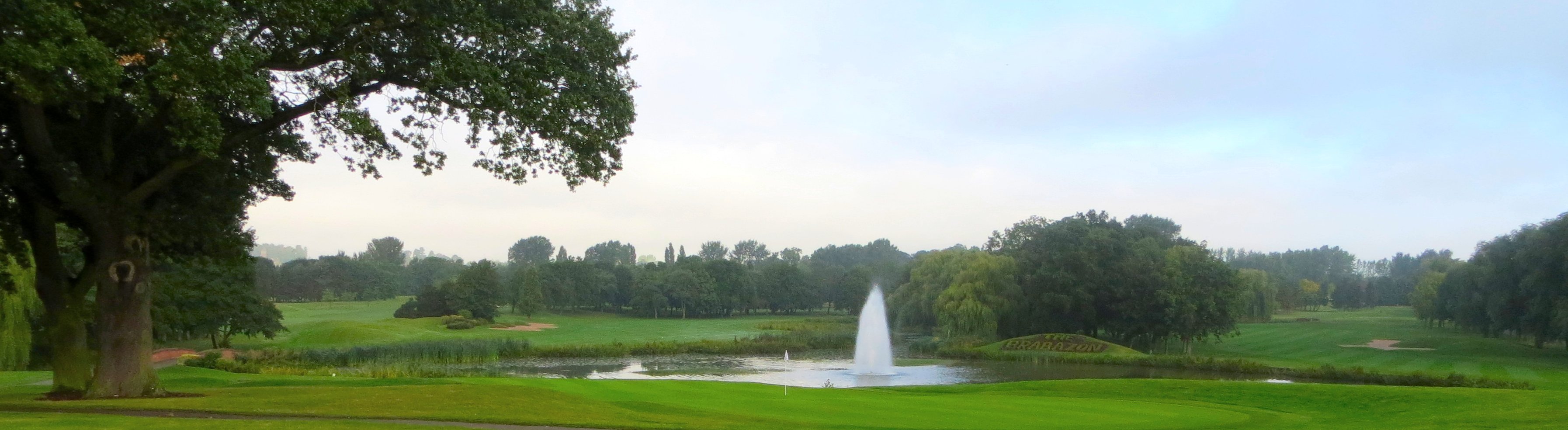
The conference that I attended last week was held at The Belfry, the hotel and golf complex situated close to Birmingham and venue, quick internet research tells me, for at least four Ryder Cup tournaments. I know little about golf, so this was quite an experience, enhanced even further by the fact that the hotel was undergoing some refurbishment, with the result that the conference itself was held in a marquee. As someone who put her foot down about camping about a quarter of a century ago, I viewed this latter development with some trepidation; however, despite intermittent rain, the marquee was neither damp nor draughty (rather the reverse) and in fact quite luxuriously appointed. It even had a small ante-room that had been kitted out with proper flushing loos.
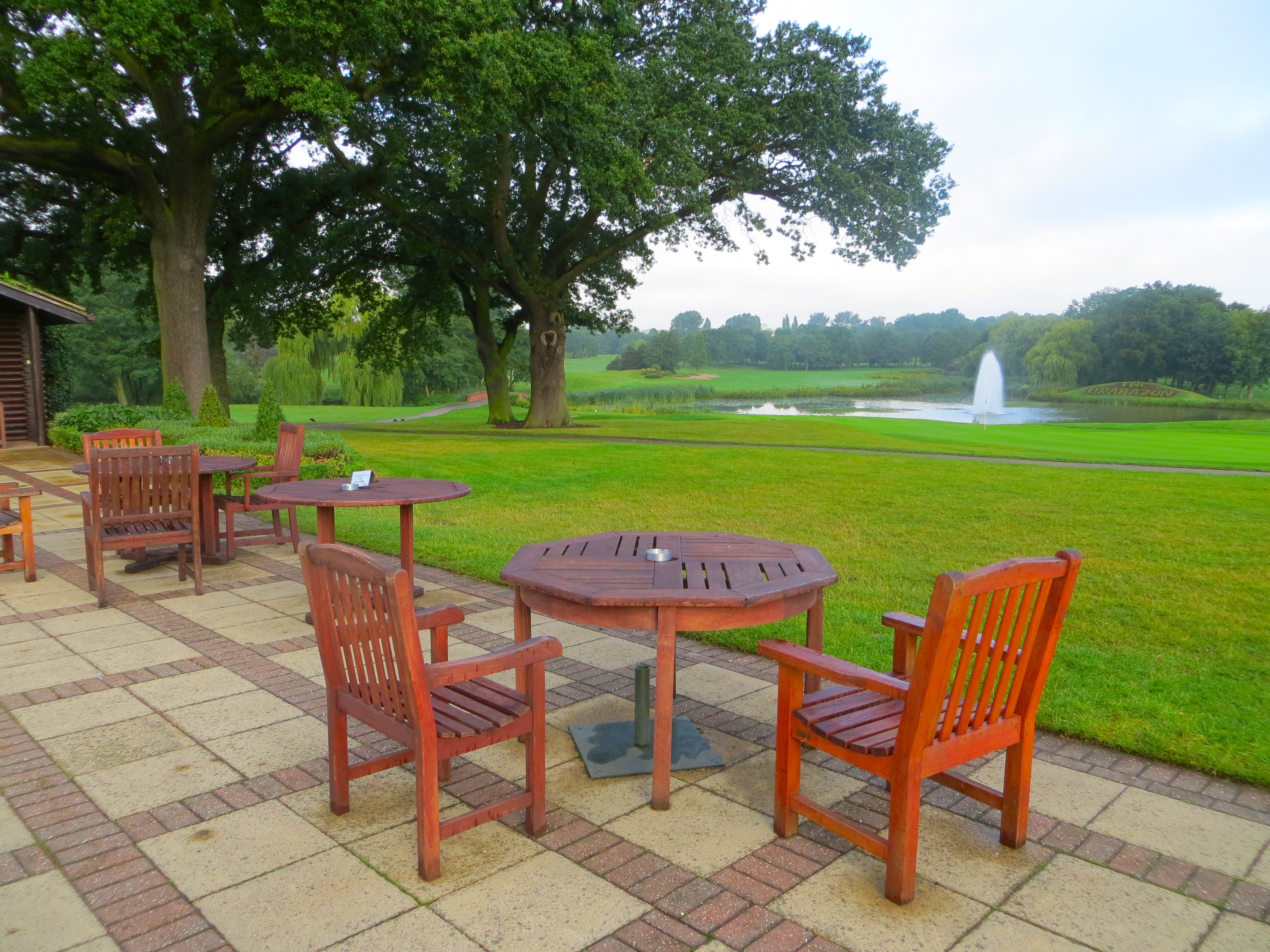
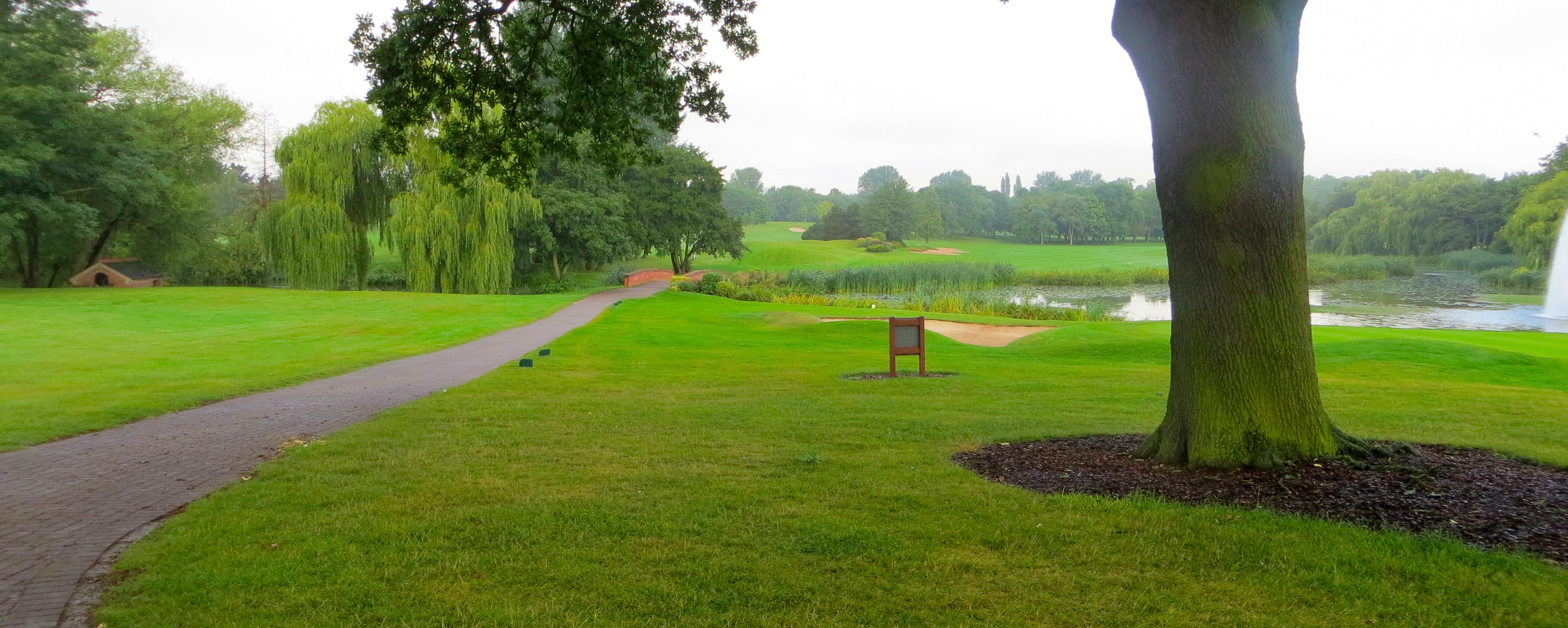
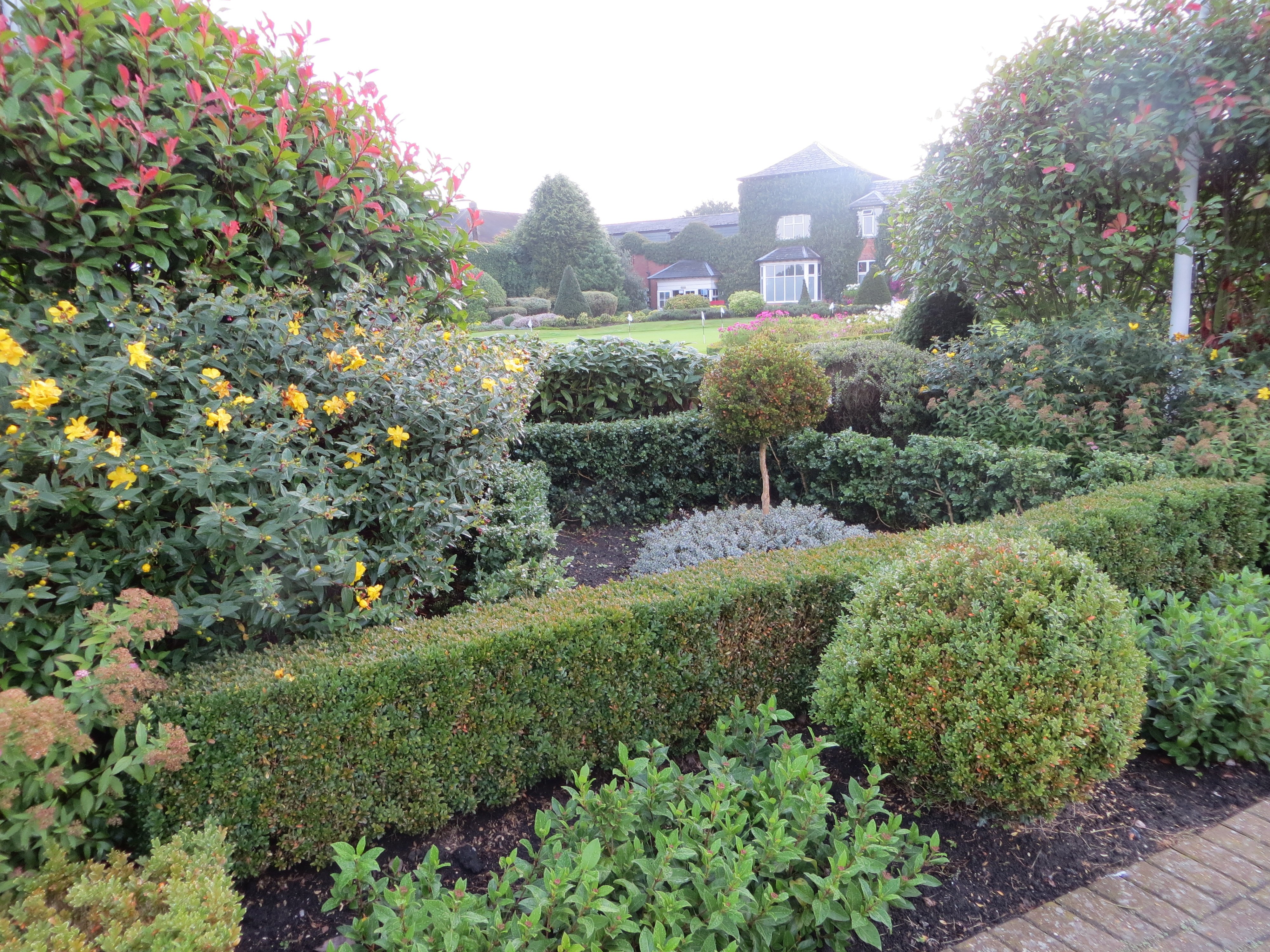
I still felt that I was the temporary inhabitant of a somewhat alien landscape, however. The golf course (It is actually three golf courses, the most difficult of which, the ‘Brabazon’, I was reliably informed, is a legend of its kind; this must have been true, as assorted men could at most times be seen gazing across at it, some taking photographs, others just lost in a trance of admiration) is perfect in every way. The acres of lush grass are flawless, manicured and bright green. The trees are symmetrical, the fountains crystal clear, the pathways pristine. It looks like a film set, rather than a managed slice of English countryside, but for a particular kind of film. It’s not the sort of place where you might encounter Mr Darcy striding across the greensward (though there would be some convenient lakes for him to jump into if he were so inclined) and you’d certainly not be able to imagine the muffled screams of a madwoman in the attic (in any case, the hotel itself is rather a low-lying, stubby building and may not have attics). It would probably be most suitable as the backdrop of a romantic comedy. I could conceive of Cameron Diaz, running across the course in a pair of Jimmy Choos to get to her lover, a posse of infuriated golfers in her wake; or Pop Larkin, annoying the staider representatives of middle England by turning up with his noisy and unpredictable brood. (Several golfers staying at the hotel were accompanied by young families, but all the children seemed to be behaving impeccably.)
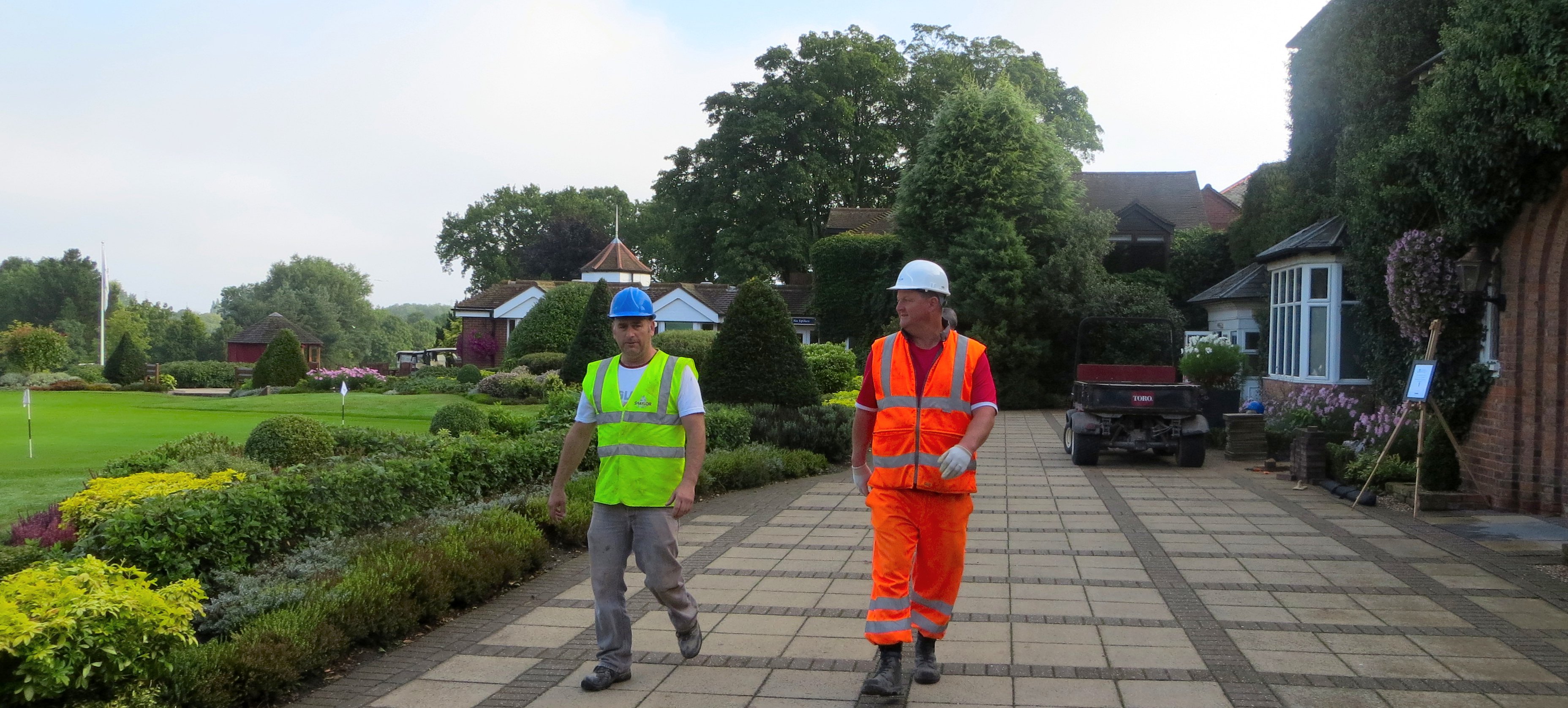
This is not to say that no dangers are to be encountered in a place that exists largely for golf. The Belfry boasts a whole fleet of motorised golfing buggies. To me, they seemed to be extra large, a type of off-road version of the ones I’ve seen in Yorkshire. They came bowling round the pathways at some speed, making walking hazardous for the unsuspecting. Either one of the hotel’s attractions is the fringe sport of potting conference-goers, or the drink-driving laws don’t apply in its grounds. An additional, temporary, danger was caused by the gangs of workmen employed on the renovations. They were frequently to be encountered striding about purposefully, balancing what looked like iron girders on their shoulders. I tried to photograph two of them engaged in this activity, but a bevy of passing buggies got in the way. I did manage to snap them on their way back for more girders, however. The one on the left stuck his tongue out at me, too late for my picture: I felt like Just William, establishing good relations by means of a skirmish.
What is beyond dispute is that The Belfry is a very photogenic place. This whole blog-post is therefore just an excuse to show you some pictures of it. I won’t say anything about the conference, as that belongs firmly in the compartment of my life marked ‘day-job’ – except to offer you a rather extraordinary sentence delivered by one of the speakers, which may amuse you and has already sown the seeds of a possible plot in my mind: “We uncover the discordant voice of dentistry – all dentists hate each other!”
Happy golfing!
Bodies and what to do with them…
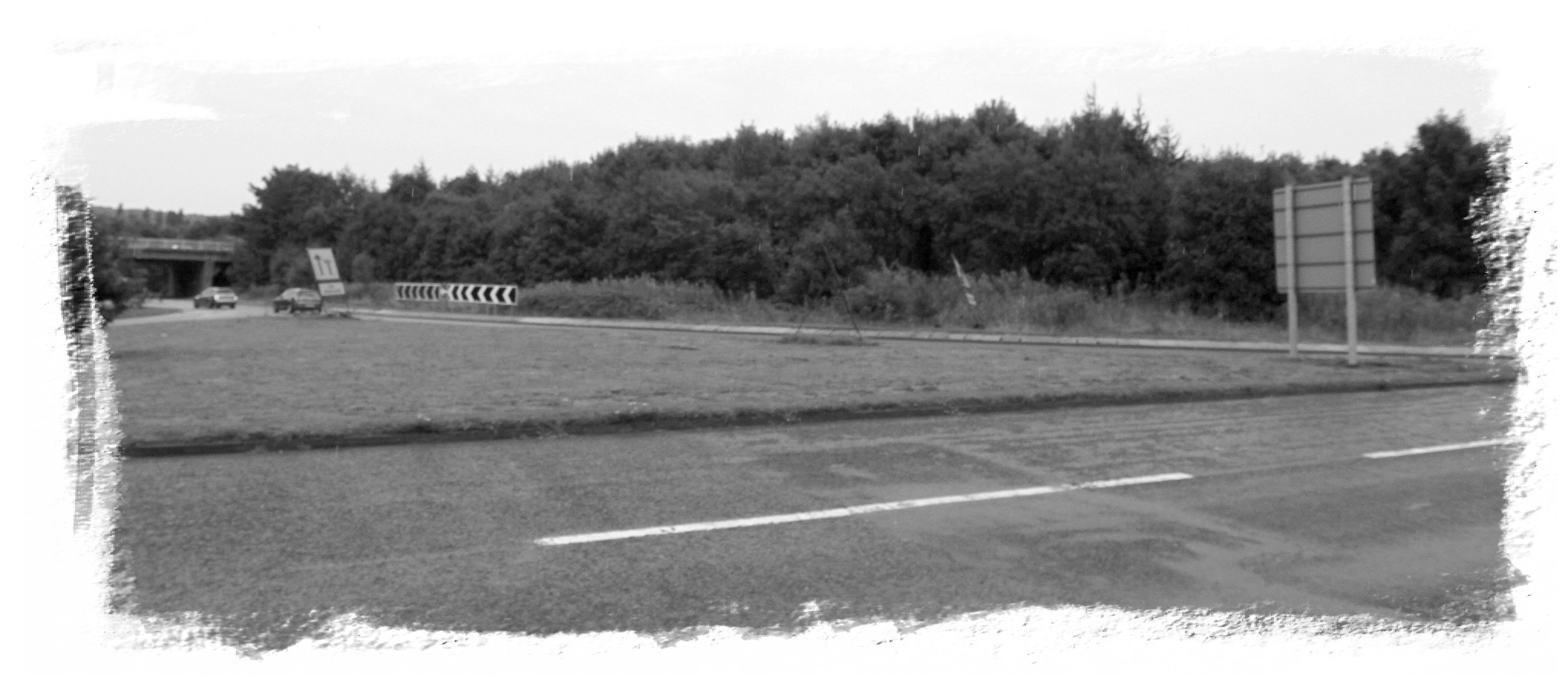
Handy off-road parking under that bridge over there… and oodles of space under the roundabout’s trees…
My husband drove me to the station yesterday morning. I was on my way to yet another (day-job) conference. On the way, we noticed that the slip road that takes us on to the motorway was once again half-closed for repairs. This led to a re-run of one of our favourite conversations – which, incidentally, I capitalised on at the beginning of In the Family. Murdering your victim is fine (so to speak), but how you dispose of the body is a much trickier problem.
Unless they live deep in the Russian steppes, this is a perennial problem for murderers. Some have resorted to ingenious solutions, yet still been found out. I’m thinking of Haigh, the acid bath murderer, or the ‘lady in the lake’ killer (the woman’s husband, Gordon Park, was eventually found guilty: he got away with it for half an adult lifetime, but was still caught in the end, when divers found the body). In certain rare circumstances, justice has not required the discovery of the body in order to convict the killer. Muriel McKay’s body was never found (there was a gruesome theory that she was fed to pigs on the farm where she was held captive), but the two brothers responsible for her death were imprisoned nevertheless.
There are many ways of disposing of a body, especially if the killer isn’t squeamish, but on a crowded island like ours there is always the danger of being spotted, even in the middle of the night. This brings me to my husband’s preferred method of victim disposal. He says that if he were to commit his hypothetical murder, he would bury the body in the middle of a large roundabout. There are two not so very far from where we live that might do nicely. The larger of these is overgrown with a wild thicket of shrubs and trees that is never penetrated by the Council’s gardeners. A body buried there would not be discovered for many years, unless a decision were to be taken to change the route of the motorway. Potentially there would be two problems to overcome, however: the ground might be very hard and unyielding (like our garden, which had virtually no topsoil until we imported some) and therefore it might take a long time to dig a large, deep hole; furthermore, situated as the roundabout is, near a hotel and the beginnings of a large conurbation, the danger of being discovered in the act of digging there would be great. This hazard would be compounded by the fact that there is nowhere inconspicuous to park adjacent to this roundabout. My husband would therefore have to risk parking on the hard shoulder and pretend to have broken down, which might prompt an interesting conversation with the inevitable helpful passing police patrolman:
‘Why did you leave your car unattended, sir?’
‘I was just digging a hole on this roundabout.’
‘Why was that, sir?’
Alternatively he would need to park in one of the nearby streets and lug the body several hundred yards, crossing a busy road and the motorway slip-road in order to reach the roundabout. He’d also have to be strong enough to carry a dead weight of, probably, nine stone or so (assuming that his victim was a woman) or half that much again if a man. You begin to see why some murderers resort to the ghoulish job of cutting up their victims.
No, my husband decided, the smaller of the two roundabouts, which is still large and overgrown in the middle, would be a better bet. A hole could easily be dug in advance there, for the undergrowth is thick and, in the leafy season, impenetrable to the eye. It has the advantage of being accessible from a long, poorly-lit slip-road that is often deserted at night, with a lay-by very close to it. Unfortunately, the lay-by itself is the popular haunt of men in vans during the day (I’ve never been able to fathom why, but judging from what I’ve seen, I wouldn’t be surprised if a few dodgy transactions took place there) and sometimes used as an overnight stop by truck drivers. My husband would therefore have to make sure that there were no truckers there on the night he buried the body. Much more convenient, he said, is the hard standing underneath the motorway bridge, right on the roundabout, where many a time we’ve seen lorries and cars parked, sometimes overnight. Twenty yards maximum for the heavy lifting. Then, he said, he’d dump the body quickly and drive the car away, so that the vehicle would be there for no more than five minutes, if that. He’d already have had the body in the freezer, wrapped in plastic, so it would be a neat and clinical affair. A pair of heavy duty gloves and an ex-military trenching tool (this latter he has had for some time – it folds neatly into a small case that can be attached to a belt) would complete his kit for an inconspicuous return on foot to complete the job. He’d be able to take his time to put the body in the hole, replace the soil and cover the grave well with the dead leaves that lie there so that no-one would notice that the earth had been disturbed before it grew over properly again. Simple.
I was not convinced. For one thing, there’d still be a chance of the ubiquitous police patrolman spotting the car and stopping to investigate. Or a lorry driver might turn up late. Then there’s Sierra Yankee Nine-Nine, South Yorkshire’s proudly-owned police helicopter. What if the pilot were out for a late night recce, and spotted him from above? There is also the forensics to consider: even wrapped in plastic, the body might leave some traces in his car and, if the remains were found sooner than he expected, he’d have to explain why soil matching that on the roundabout had clung to the soles of his boots. But for me the insurmountable obstacle would be the corpse’s necessary, if temporary, residence in my freezer. I have not spent the latter part of the summer freezing vegetables to have them jostle with a grisly cadaver; nor could I ever feel the same about Ben and Jerry’s Dough-ble Whammy ice-cream if I’d seen a lifeless hand nestling against the carton.
No, it’s back to the drawing-board for my husband. He’ll have to find a less domesticated way of getting rid of his victim. He says we could have a trial run with me as a dummy corpse, but I’m not to be taken in by that one. The journey to the station, however, passed very quickly.
An extraordinary woman

Bess of Hardwick
Last Saturday we had visitors and the weather looked very uncertain. We therefore abandoned plans to take them to the cotton mill at Styal (which involves quite a lot of walking about outside) and instead headed for Hardwick Hall.
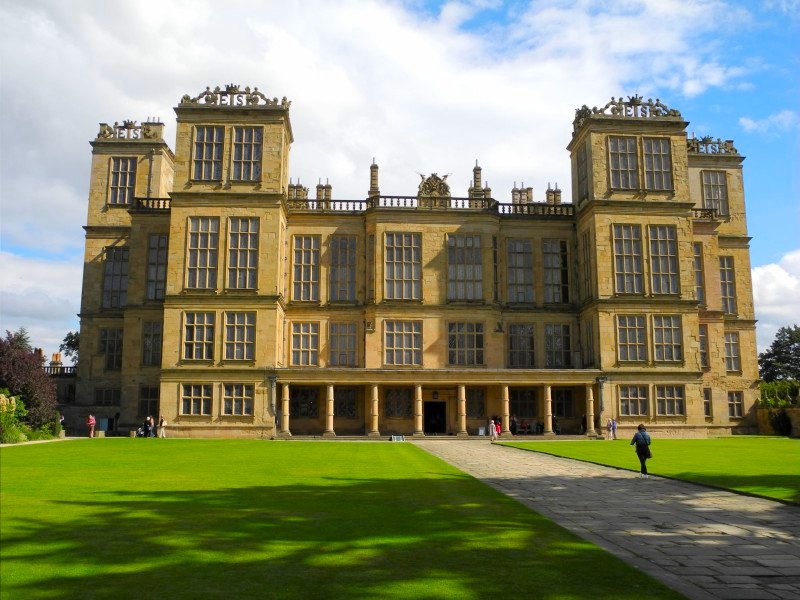
Hardwick Hall
As it happens, this is one of my favourite old houses. I’ve visited it several times, on the first occasion as a schoolgirl. I was surprised on this latest visit to learn that it was acquired by the National Trust shortly after its last domestic resident, the Duchess Evelyn, died in 1960, as I had assumed that I’d originally seen it before the Trust got to work on it (it was very run-down and gloomy then), but I must have been wrong. I suppose it must take years to restore an old house as large as this. Actually, I loved it when it was a bit dirty and dilapidated, though I appreciate that it couldn’t have been left like that. Yet it was very atmospheric; I really felt as if I might have met Bess of Hardwick herself coming down the stairs.
Bess would have been an extraordinary woman at any time, but her achievement was unique in the Elizabethan age during which she flourished (she died when she was 81, and actually spanned almost the whole of the Tudor period). She was born during the early years of Henry VIII’s reign and died five years after James I succeeded to the throne. Of relatively humble background – her family were minor gentry – she gradually made herself one of the most powerful women in England through her four marriages, each husband being richer and more influential than the previous one. I’m not sure how she managed to circumvent the laws about women’s property actually belonging to their husbands that pertained at the time (and for centuries afterwards), but I suppose it must have been something to do with the terms of her widow’s jointures. However she managed it, by middle age she was a very wealthy woman in her own right, with an income of £9,500 p.a., of which we are told that she spent £8,500. By comparison, the humblest labourers on her estate were paid a penny a day.
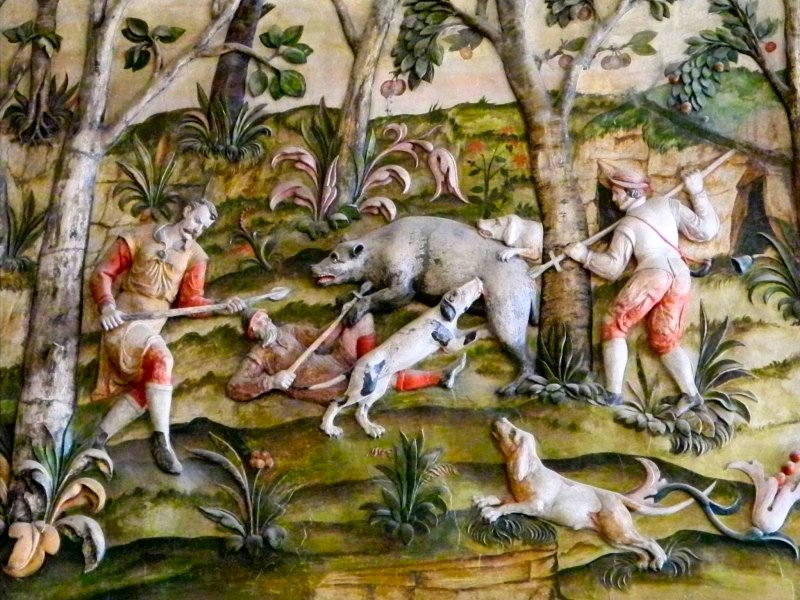
A graphic detail from the frieze around the grand reception room
Bess’s last husband, George Talbot, the Earl of Shrewsbury, was for many years gaoler to Mary Stuart (an unenviable task), and Hardwick contains examples of embroideries that Bess and the exiled Scottish queen worked on together. She and Mary clearly got on well. One of the most famous portraits of Mary hangs in the gallery at Hardwick. Bess also succeeded in maintaining good relations with Elizabeth I. There is another portrait there of Elizabeth, wearing an elaborate dress that Bess presented to her as a New Year’s gift.
I’m certain that Bess would have been a very difficult woman to live with. Obviously always a strong-minded character, by the time she married Talbot her character had hardened into obduracy. Hardwick Hall was indisputably her house, not her husband’s (they also owned the forerunner of Chatsworth). She proclaimed this by having the initials ‘ES’ (for Elizabeth Shrewsbury) carved on its castellations. Hardwick was built right next to the old Hardwick Hall, a much less splendid house, where she had lived as a child. Although she took some of the stone from the old hall to use in the new one, the old one was never demolished: its ruin still stands. She and George Talbot (he also proud and intransigent) did not enjoy a happy marriage and at one point were formally separated. Elizabeth I instructed them to live together again, to set a good example, but it is doubtful if this instruction was carried out in the spirit, if indeed it was observed in the letter.
Bess eventually became the grandmother of Arbella Stuart, who had strong claims to the throne and grew up at Hardwick. As a young woman, she was a semi-prisoner there. Recent excavations have discovered an Elizabethan exercise book which may have belonged to Arbella. This item, obviously, had lain concealed for very many years, but almost everything there is contemporary with the building of the house. The reason that I like Hardwick Hall so much is that the wall-hangings, artefacts and furnishings are more or less as they were in Bess’s time. This is because it was successively used as a hunting-lodge and to accommodate a younger branch of the family, especially after the later Chatsworth was built.
Hardwick is evidently one of the most popular of the National Trust houses; it is almost always thronged with visitors and has been impressively restored by the Trust over the last half century; the loss, especially to me, of its former compelling ambience is a very small price to pay for preserving such a beautiful old house. And I’m certain that, if it were possible to visit it late on a dark winter’s night, it would still be easy to imagine Bess moving down the broad, shallow stone stairs, her rich silk dress swishing slightly as she went.

I really felt as if I might have met Bess of Hardwick herself coming down the stairs.
A woman at last, on my first visit and on the last night…
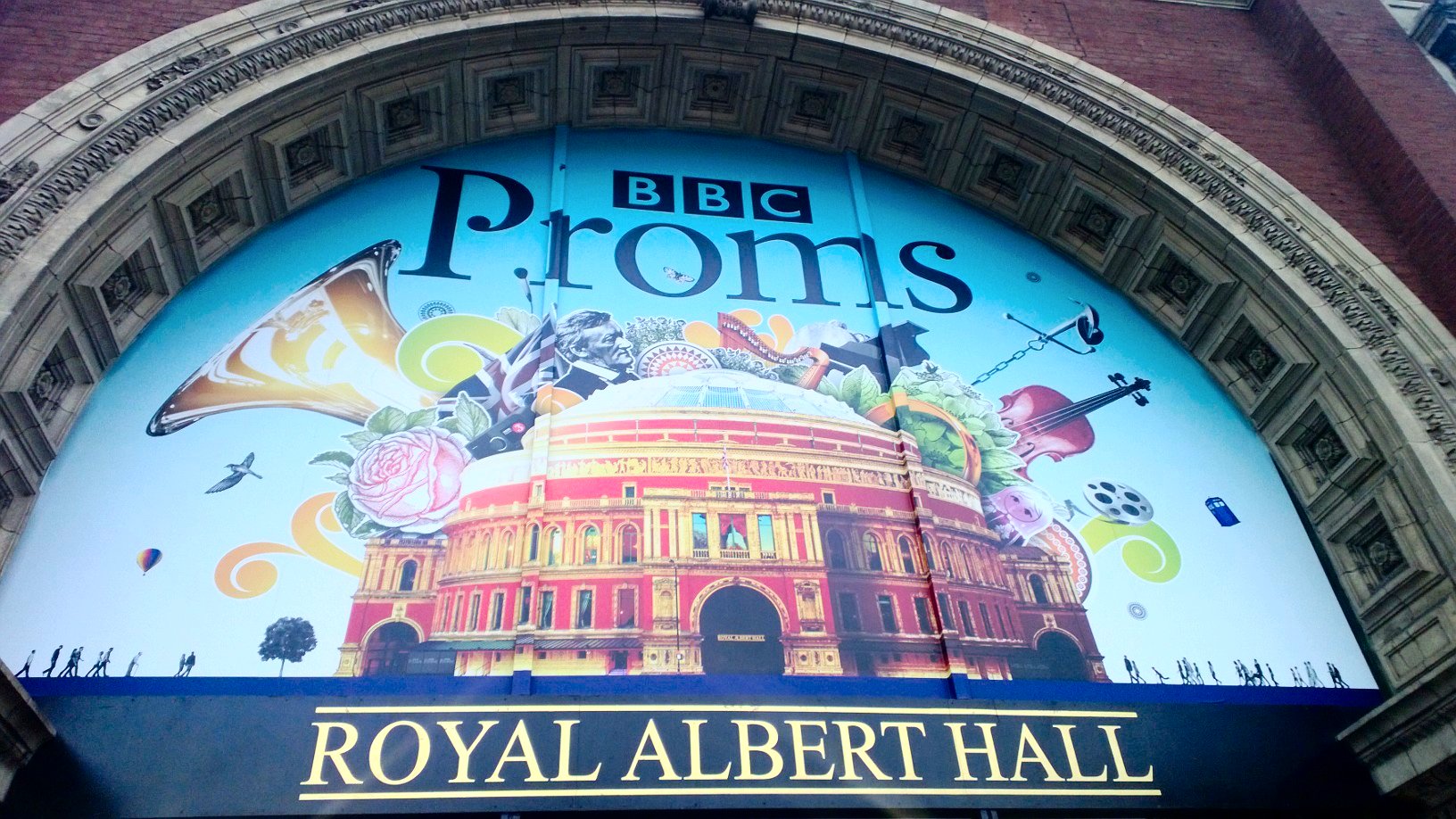
I meant to write about my first visit to the BBC Proms, on Saturday 17th August, shortly after it happened, but I mislaid my programme for a few days and then decided that I’d wait until I’d watched the televised version of the Last Night before posting this account.
The two events had in common that they were conducted by Marin Alsop, a female American conductor who is one of the very few women to have penetrated her almost imperviously masculine profession and the first woman ever to have conducted the Last Night of the Proms concert. She referred to this herself when she gave a short but eloquent speech after the Last Night performance, saying that when she told her parents at the age of nine that she wanted to be a conductor they always encouraged her and that her message to other young people, especially musicians, with ‘impossible’ aspirations was ‘Never give up.’
Almost inevitably, male reaction to her appointment ranged from the overtly hostile (the Russian conductor Vasily Petrenko called her a ‘cute girl’; since she is twenty years his senior, I can only conclude that he was suffering from a small prod from the green-eyed god) to the vaguely patronising (although it’s understandable that newspaper accounts emphasised the fact that she was the first woman, less commendable was innuendo from some of them that she was very good ‘for a woman’), compared with Alsop’s own business-like declaration that Sir Henry Wood would have felt that her selection as conductor demonstrated ‘natural progress to more inclusion in classical music.’
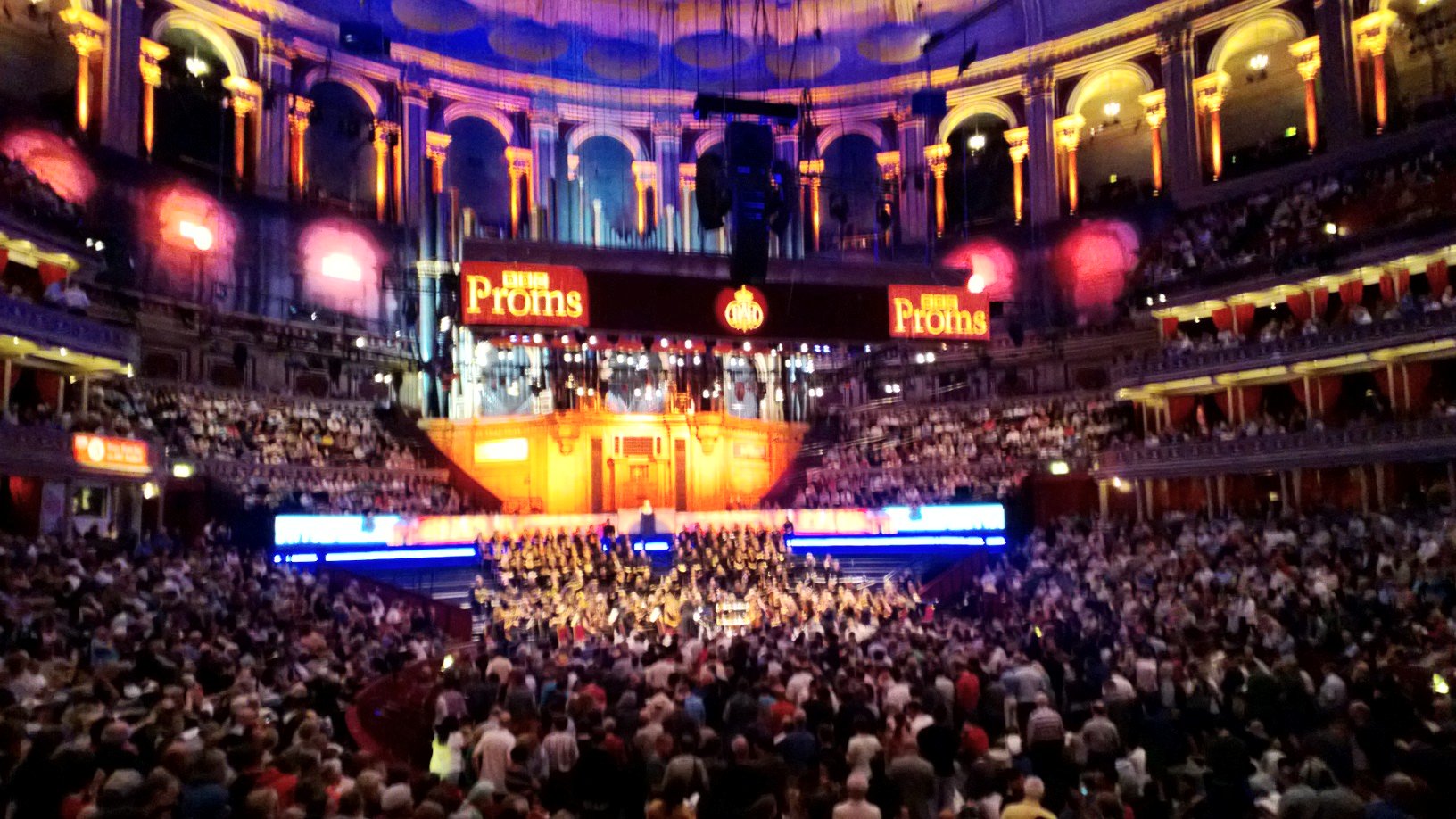
All I have to add to this is that she was brilliant. It’s an over-used adjective, but the only one that fits. She conducted both the concert that I attended (No. 47, which featured works by German composers Brahms and Schumann and was also distinguished by being performed by the Orchestra of the Age of Enlightenment, whose members use only genuine period instruments, and the Choir of the Enlightenment) and the Last Night with an energy, fluidity of movement and grace that was more evocative of the performance of a distinguished ballerina than that of a conductor. She obviously lived every note of the music with passion as it was played under her tutelage. It was clear, also, that the orchestra loved her, and she quickly struck a rapport with the audience, too. I particularly admired the way she greeted us, with her hand on her heart, and the understated clothes that she wore (sober tailored trouser suits with just a touch of colour). She was elegant without being flamboyant, a genius imbued with genuine modesty. She also had a sense of humour, and clearly enjoyed conducting Nigel Kennedy as he treated the Last Night audience to his rich repertoire of improvised and impeccably-timed virtuoso antics.
Finally realising my ambition of attending one of the Proms in person and making my first visit to the Royal Albert Hall was even better than I had anticipated. The Hall itself is a monument to Victorian hubris, yet it is impossible not to revel in its magnificence. Above all, it stands as the symbol of hope in an age of expansion and continues to represent the best of culture that civilised society has to offer. The famous portraits of Albert and Victoria in their youth which hang in the foyer have a lightness and optimism about them which would later be all but eclipsed in memory by his early death and her dour widowhood. The Albert Hall was a sumptuous place for those who could afford to go there, yet it was Sir Henry Wood’s dream to make classical music available to all and he certainly, at the Queen’s Hall, enabled a much wider stratum of society to enjoy the performances. This still obtains today: those who are prepared to risk disappointment and don’t mind standing throughout the performances can still pick up tickets at short notice for only a few pounds.
The tongue-in-cheek jingoism of the second half of the Last Night never ceases to delight me, though it becomes more anachronistic year by year (and, worryingly, some of the audience seem to embrace it without quite enough irony). That it has become a meeting of nations, whose flags swirl colourfully, is the ultimate irony. I particularly enjoyed all the solos by Joyce DiDonato. Apparently her costumes were by Vivienne Westwood, which strikes me as very appropriate. However, for my money, it was Marin Alsop herself who stole the show.
Over the road from the Royal Albert Hall stands the massive gilded statue of ‘Royal Albert’ himself. I’d never seen this before, and found it quite disturbing. There’s nothing playful or democratic about this. It’s a construction intended to awe and impress, a monument beyond ostentation that celebrates the British Empire and this scion of its imperial family and, much as if he belonged to some ancient Egyptian dynasty, implicitly raises him to the status of demi-god. Sir Henry Wood may have brought fine music to the petit-bourgeoisie of his day, but at the same time others were busy building and legitimising the British Empire, carefully both ignoring and concealing the fact that it was being constructed on the labours of a British industrial class that could barely afford to feed its children and dependent on the suppression of many other fine civilisations throughout the world. It is difficult to believe that this was happening only three or four generations ago, that Britain only began the long road to true democracy with the introduction of universal suffrage in 1918 and, yet more surprisingly, that it only ‘gave back’ most of its overseas colonies within living memory.
A short York walk

York Minster and scaffolders
For the past two days, I’ve been attending a conference in York. I used to visit the city regularly when we lived in Leeds. It was a favourite place to take our son when he was young: we’ve been boating on the river there, visited the Jorvik Museum and the Railway Museum and, of course, explored the Minster. We’ve been to the pantomime and plays at the repertory theatre and we’ve always also enjoyed simply walking through the streets. In the summer, York is full of tourists; in the winter, there may be fewer, though still plenty, and there’s often a more local festive atmosphere: we’ve seen jugglers and fire-eaters performing in the shopping precinct in Stonegate, where there are also chestnut sellers when Christmas gets close. Some time ago, relatives of friends of ours lived in one of the houses in Stonegate and kept a shop there. They had to carry out some repair work and discovered that the foundations of their house included beams from an Anglo-Saxon tithe barn.
That’s the magic of York: it’s steeped in history. The people of York have handled their historical past magnificently, too. Old buildings have been repaired but not ‘restored’: there are several roofless ruins that have been tidied up but not renovated with the dubious help of ‘artist’s impressions’ of what they might have looked like in the past.
I don’t think that until Wednesday I’d visited York for the best part of ten years (apart from an ill-fated train journey home from London one Friday evening, when a signals problem meant that all trains North were diverted to York and I was dumped there in the middle of a very cold February evening, reliant on my husband’s driving more than thirty miles to pick me up – which it has to be said he did with a very bad grace, as if I’d personally invented a way of spoiling Friday night. A venial crime on his part, perhaps!). I didn’t have much spare time, but I was determined to spend at least an hour revisiting old haunts.
Reassuringly little has changed. I saw the obligatory crowd of American tourists – mainly ladies of a certain age (and size!) – who were listening avidly to their guide. I listened to her as well for a few minutes, as she told them about the Plantagenet royal family and its strong association with York. What she said was only approximately correct, but I suppose that wasn’t the point! She captured the mystery and glamour right enough. The Minster was swathed in scaffolding, as ever, as was the Dean Court Hotel that stands opposite it. I’ve stayed in that hotel and spoken there at past conferences. It’s a picturesque place, but its fabric seems to suffer from perennial crises! I walked as far as Bootham Bar and took a picture of a plaque that I’d not noticed before, dedicated to a Civil War Royalist, and another, in Monkgate, of the ornate entrance of St. Wilfrid’s, the Roman Catholic church.

Petergate plaque York

And so back to my hotel for more sessions about libraries (yesterday’s covered cataloguing, which is not the most exciting topic in the world, especially on the last perfect sunny day before the rain set in). The Royal Hotel stands adjacent to the station, so is very convenient for conferences. It is also right next to the only major innovation that I spotted during my short walk: a giant Ferris wheel, apparently named the ‘York Eye’ (I immediately thought, ‘pork pie’!). I scrutinised this from several angles, and decided that I wasn’t all that keen on it. Since the London Eye was erected to celebrate the Millennium, these wheels have become popular. I’m sure that they help the tourist industry, but I can’t help hoping that, like the Manchester Eye and the Birmingham Eye before it, this one will be a temporary installation. To me it was incongruous to see this monster looming over such an ancient city. There doesn’t seem to be much practical point to it, either. The argument for building these structures in other cities has been that they provide sightseers with a panoramic view: but in York this can be achieved simply by taking a turn on the wonderfully-preserved city walls.
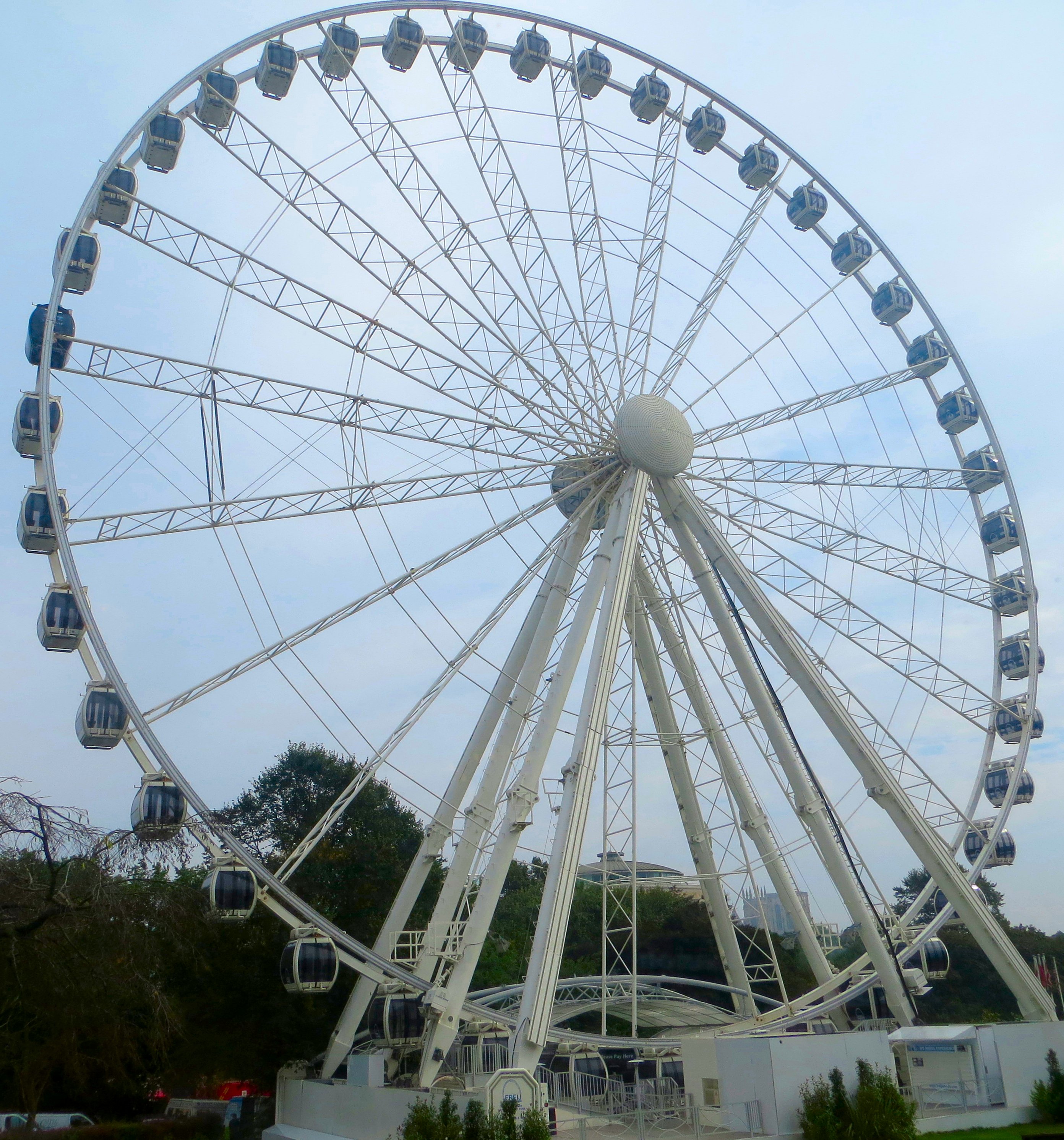
York Eye
 Christina James, crime novelist