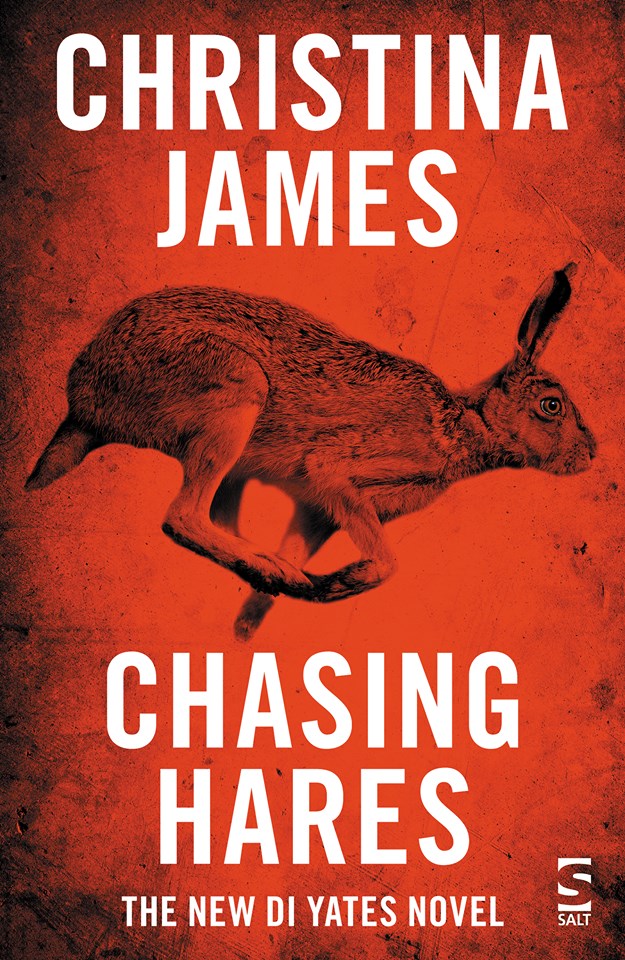


Stimulus for a story…

In South Lincolnshire on the afternoon of 28th January 1970, the countryside was enveloped in thick, freezing fog. It made the roads treacherous and there were protracted delays on the trains. Driving in country lanes was especially hazardous. Although some level crossings had already been fitted with so-called ‘continental barriers’, with relatively sophisticated warning systems, most were still simple five-barred gates operated manually. The practice in country districts where there wasn’t much traffic was to leave the gates closed against the road. Vehicles wishing to cross had to summon the crossing-keeper, who usually resided in an adjacent lodge-house tied to the job. Such an arrangement existed at Sutterton Dowdyke, a tiny hamlet a few miles south of Boston and east of the A16.
On 28th January, the regular Peterborough to Skegness train was considerably delayed by the fog. The driver of a tanker lorry owned by the council who regularly travelled on Dowdyke Road rang the bell to summon the crossing keeper to open the gates. The driver and his mate had been sent to empty a cesspit in the area and, task completed, were now returning to their depot. The crossing keeper, a woman in late middle age, came out and chatted with them briefly before opening the gates. The driver eased the lorry onto the crossing (most crossings at the time were notoriously bumpy) and was sitting right in the middle of it when the train came thundering through the fog, which had muffled the noise it was making until this moment, and flung the lorry into the air. The train was derailed. It ploughed into the lodge-house and turned the building one hundred and eighty degrees on its foundations. The lorry driver’s mate was killed instantly; the lorry driver himself was taken to hospital, critically injured.
Miraculously, the crossing-keeper was not hurt, but collapsed at the scene and was also taken to hospital, badly shocked.
My family and I first learned of the accident when watching the nine o’clock news that evening. The site of the accident wasn’t named, but my father recognised the lodge-house. We drove there immediately and then on to the Pilgrim Hospital to visit the crossing keeper. She was my father’s aunt and my own great-aunt.
My memories of that night sowed the first seeds of the plot of The Crossing, the fourth DI Yates novel, which I have just completed.
Compellingly unsettling: Catherine Eisner’s ‘A Bad Case’, from @saltpublishing …
 I first encountered the work of Catherine Eisner in 2008, when I read Sister Morphine (also published by Salt) and it absolutely blew me away. I was convinced at the time that it was a major, very important novel and the comparatively modest success that it has enjoyed since then has not caused me to change my mind. I still believe that it will be ‘discovered’ by a much larger audience, including some discerning and influential critics, much in the same way as John Kennedy Toole’s A Confederacy of Dunces finally achieved the (sadly posthumous) attention it deserved.
A Bad Case has strong links to Sister Morphine, picking up on some of the same themes and even exploring further the lives of some of the same characters. Both works consist of a series of discrete but linked short stories, a format which I find very appealing. It enables the author to expand the sometimes constricting form of the short story whilst taking advantage of the fine discipline that it imposes, simultaneously giving the characters more depth by setting them in a shared context.
I have to confess that, although I by no means belong to the school of thought that opines that an author’s biography and his or her work are inextricably linked (i.e., you can’t understand the one without the other, a wonderful excuse for prying), Eisner herself intrigues me almost as much as her work. This is because she is profoundly knowledgeable in so many different fields: she understands the pop scene of the 1960s; she obviously knows a lot about the publishing industry; she exhibits more than a passing acquaintance with a wide range of ‘mind-altering substances’; she is erudite, although she wears her learning lightly, pronouncing telling mots justes upon the giants (and some of the minnows) of Western civilisation’s authors, artists and musicians across many centuries; she understands Latin and several European languages besides English; she has an acute ear for dialect (in A Bad Case, southern Irish, especially) as well as the varying cadences of speech that derive from differences in social standing; and, if she has not lived among the British aristocracy, she has clearly had opportunities to observe it at first hand. Wow!
But it is not Eisner’s accomplishments as a polymath that most fascinate me. I am hooked on her work because she writes with a vigour that both contributes to and has pushed the boundaries of an outstanding literary tradition. I don’t have a single word that encapsulates what this tradition stands for, but I can list some of its luminaries. They are Jonathan Swift (though Eisner’s indignatio is more of the jocosa than the saeva variety); Somerville & Ross and Samuel Beckett. Elements of A Bad Case also remind me of Molly Keane’s Good Behaviour. It is not lost on me that all of these writers are Irish, but although Eisner is clearly interested in Ireland and Irish characters, I doubt that it is because she has Irish blood herself. I think it is because her strong sense of the inescapable absurdity of fate, her ability to communicate the disgusting terribleness of the human condition, her knack of pulling off some elements of the supernatural while staying just this side of credibility and her wonderful power with words, all interlaced with robust black humour, happily also epitomise the best of Anglo-Irish writing.
So to the writing itself. Eisner may often be tongue-in-cheek, but the subjects she chooses are harsh. They include false imprisonment (I found A Room to the End of Fall, the first story in the volume, of particular interest, because my next novel, The Crossing, also explores false imprisonment, though in quite a different way.), paedophilia, treason, espionage, adultery, suicide and madness. The cover of A Bad Case quotes Kate Clanchy, who says that Eisner’s writing is ‘slightly, scarily deranged’. Although I understand perfectly what Clanchy means, this is not my reading of Eisner’s work. The characters may be deranged, but not the author. She pays them the compliment of presenting their world through the prism of their own outlook and sentiments, which have been conditioned by their often adverse experiences. If the reader can’t keep up, that is too bad: if there is one thing Eisner never does, it is patronise her readers by pandering to some notion of sparing their refined sensibilities. If the reader feels unsettled, that is good. If, despite understanding the richly conflicting, occasionally brutal and always uncompromising world that Eisner paints, the reader also laughs out loud, that is perfect. I have no better words to express my admiration than to say again: Wow!
Over the past few years I have played an Eisner guessing game with a friend. (I do hope that if Catherine Eisner reads this, she won’t be offended!) It’s only half serious and has its roots in our first reading of Sister Morphine, when we were each convinced that ‘Catherine Eisner’ was a pseudonym for someone much better known in the world of literature. If we’d taken bets on it, he would have lost, because his preferred candidate has since died. I’m still half-convinced that my own prospect is the correct one: I may never find out the truth. However, if you are also intrigued, I know that there is only one way for you to get closer to it: by reading Sister Morphine and A Bad Case, if possible in that order. I heartily recommend both of them to you, as I am certain you will not be faint-hearted.
A-less-than-favourite favourite rail journey…

Cross Country train approaching Wakefield Westgate
I’m writing this on the train to Glasgow, where I’m about to attend a conference. It’s a Cross Country train. Though I haven’t had a duff experience on Cross Country trains before, on this occasion I’m finding the service a little less than up to snuff. I’ve got a first class ticket (cheap weekend deal) and have been looking forward to being pampered in the way I have enjoyed so much on GNER / East Coast trains. The last time I travelled first class on one of the latter (cheap weekday deal, unsociable hours), I was regaled with tea, biscuits, vodka and tonic, sparkling water, pasta arrabbiata with salad garnish, a packet of crisps, fruit, some date and walnut cake, a glass of wine and coffee. And a free copy of The Times. All included in the price of the ticket! By the time I staggered off that train, some two hours after I had boarded it, I’d have been happy to phone the Prime Minister and tell him how wonderful the experience was, if any of the crew had asked me to.
The standards on the present train are a little different. When I boarded, First Class was jammed with people, including one occupying my reserved seat. To add insult to injury, he was wearing a purple jumper. I was told that there were no seat reservations operative on the train, ‘as the system is down, but we have some boffins trying to fix it’. I was advised to grab or fight for a seat, on a may-the-best-woman-win type of basis. I decided to keep close watch on a man who hadn’t taken off his coat – a tell-tale sign that he wasn’t planning a long journey (I’m not a crime writer for nothing; I can read clues!). Sure enough, he ‘alighted’ (I’ve no idea why all train guards use this poncy term – perhaps they have a vision of the gossamer-winged traveller, wand in hand, floating like a dandelion seed from train to platform) at the next station, possibly relieved that I didn’t try to follow him, as he might have thought I was a stalker, and I hopped into his seat sharpish before another crowd of people with worthless seat reservations got on.
If I’m sounding like a grumpy old woman so far, that’s probably because by this time I’ve had a glimpse of the at-seat menu. The ‘complimentary’ food available consists of tea, coffee, water, fruit cake, biscuits and crisps. And there are lots of ‘ors’ on the menu, implying that two choices maximum would be seemly. I haven’t got to my age without knowing how to push the envelope, so I have demanded tea, water, fruit cake (which turns out to be one inch square and plastic-wrapped) and crisps in short order, in a very firm, dowager sort of voice. To this I’ve added an egg-and-cress sandwich and a tiny bottle of Pinot Grigio from the ‘paying’ menu (no hot food available – that will be £7.95 to you, Madam). There is not a newspaper in sight, although I have seen that a lady seated nearby is doing the crossword in Woman’s Weekly. I doubt if this has been supplied by Management. (I’ve also seen Management – he hides in the still room, guarding his supply of complaints forms, and twitches if anyone barges through to ask him about seat reservations.)
However, now I have eaten my sandwich and drunk my Pinot Grigio, water and tea and inspected the sell-by dates on the cake and crisps to see if they are fit for human consumption, I have to admit that I am quite enjoying myself. For a start, one of my fellow travellers is a man with two collies – I thought there was only one at first, but another peeped round from the seat behind mine and fixed me with her liquid eyes – and he has demanded not one, two or three, but four bottles of still water to put in their water bowl. And he wants free cake, crisps and coffee as well. So he has busted my temporary record of four free items by a margin of three… but I’ve been able to stroke his two lovely dogs to console myself for the disappointment!
And then there’s the journey itself. Of all the journeys I undertake, this one wins hands-down for interest and enjoyment. Already, from this train today, I have seen the innermost secrets of Victorian Leeds and the architectural wonder of York Station and I’m looking forward to the dour but unique crumbling red brick of the station at Darlington, Newcastle’s panoramic kaleidoscope of aesthetically gob-smacking, state-of the-art bridges, stupendous river, industrial buildings and purposeful roads, Alnmouth’s deceptive sleepiness (it lies between the buzzing commuter town of Alnwick and the lovely village of Alnmouth itself, on the gloriously beautiful Northumberland coast) and, best of all, the sight of the majestic, historic, sandstone bridge at Berwick-on-Tweed with the huge sweep of sea beyond it. And after Dunbar (another favourite place, with its Braveheart-style castle) and venerable, stately Edinburgh, I shall eventually arrive in vibrant Glasgow. Not to mention the fact that I’ve had time to map out the next few chapters of The Crossing (D.I. Yates 4).
So what’s not to like? Well, if Arriva’s UK rail Managing Director Chris Burchell is reading this, I have a message for him. At a push, he might get away with this service on the basis that it’s the weekend and the destination is magical, mystical Scotland, but he should know that I’m very glad that it’s Virgin, and not Arriva, which has won the East Coast franchise, because, on the basis of my experience today, the prospect of an Arriva standard for my regular, working week, London-and-return journey would fill me with despair. Next time I board the train at King’s Cross, I’ll be looking forward to what I’ve missed this time: tea, biscuits, vodka and tonic, sparkling water, pasta arrabbiata with salad garnish (or similar), a packet of crisps, fruit, some date and walnut cake (or similar), a glass of wine and coffee. And a free copy of The Times. All included in the price of the ticket. I understand that Arriva’s Cross-Country franchise has been extended to 2019 from the original 2016; that’s a pity, but perhaps Virgin will win it next time around…

From Wakefield to Covent Garden, ‘Sausage Hall’ has found great friends!

Launching ‘Sausage Hall’ at Wakefield
This is the final post on my launch week activities for Sausage Hall. I’m covering the last two events: Tea at Sausage Hall, an imaginative tea-party given last Wednesday by Alison Cassels, Lynne Holroyd, Claire Pickering and their colleagues at the Wakefield Library at Wakefield One, which regular readers of this blog will know has provided me with granite-strength support ever since In the Family was published two years ago,

Tea at Sausage Hall (And yes, there was cake!)
and an evening of conversation and readings at the Covent Garden branch of Waterstones, rounding off the celebrations with a London launch on Thursday.
Ever resourceful, Alison and her team provided sausage rolls, cake (Yes, there was cake!) and biscuits for the tea party. (Her e-mail to me when organising the event reads ‘Can you put chocolate cake in the title of your next book?’)

Lynne Holroyd, the liveliest purveyor of refreshments I’ve ever known!
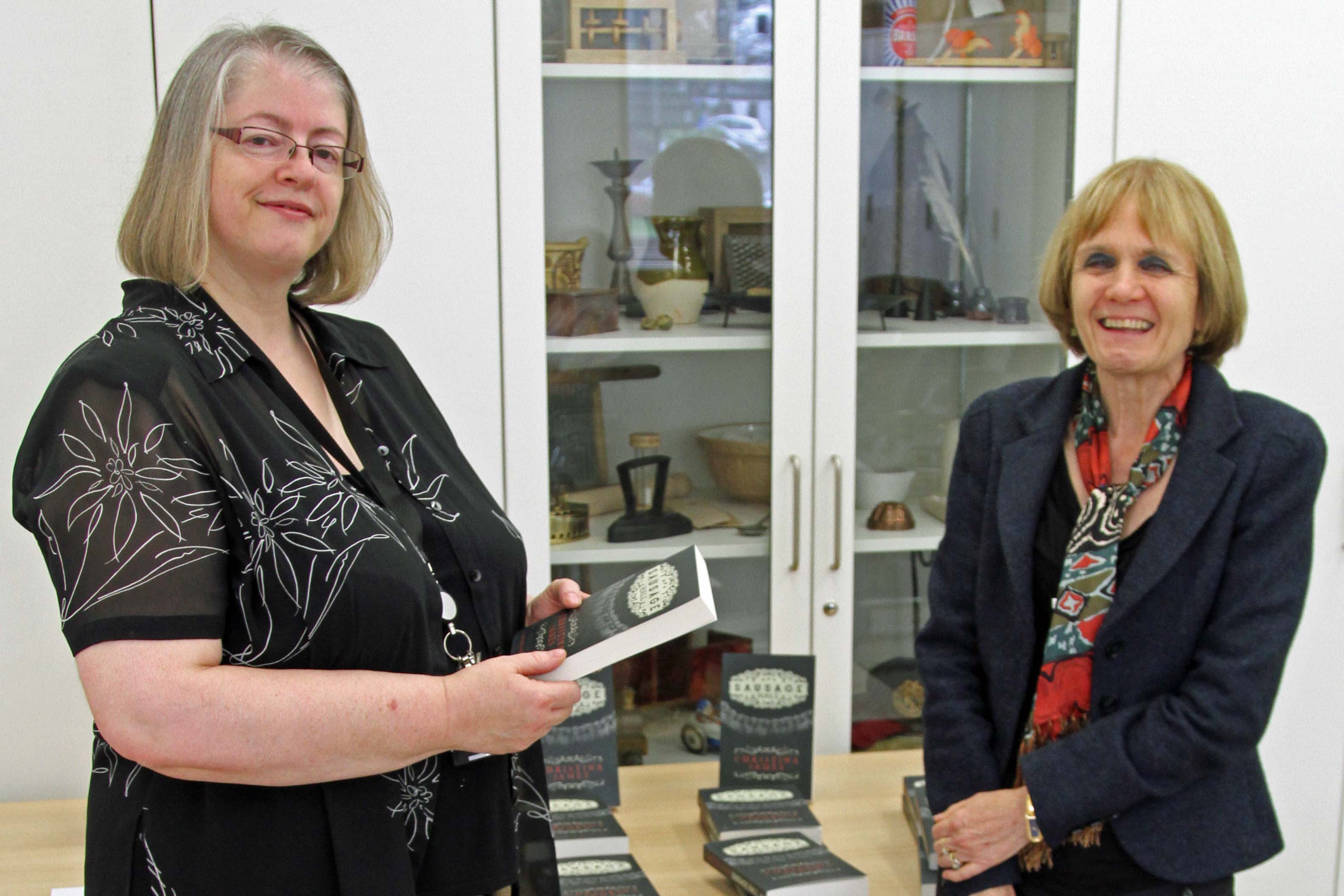
A warm welcome, as always, from Alison Cassels
As always, she promoted the occasion superlatively well and attracted a lively and engaging audience, amongst whom were old friends (such as Marjorie and Pauline – both also fab visitors to my blog) from the library’s book club, as well as many interesting new faces.
There’s obviously a lively and diverse events programme at Wakefield One: under the table bearing the tea-cups was a box containing a plastic skeleton (I was rather disappointed that someone arrived to remove it, as a suitable visual aid never goes amiss), while high on one of the shelves was a stuffed green parrot in a glass case. (My husband dared me to say ‘Norwegian Green? Is it nailed to its perch?’, but, though tempted, I’m afraid I failed to rise to the occasion, having on my mind things other than late parrots gone to meet their maker.)
Wakefield One audiences are truly wonderful.
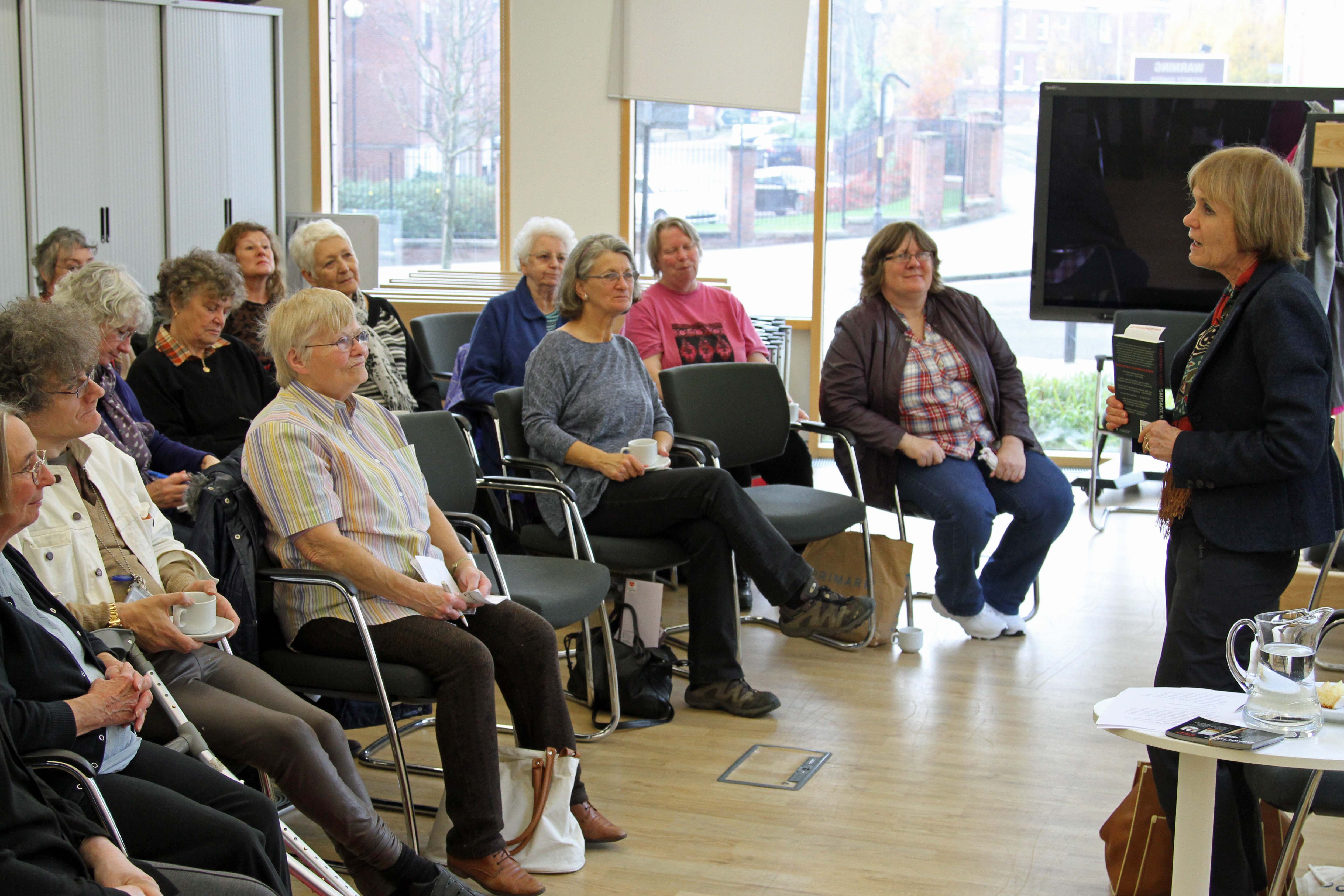

They are united in their love of books and reading, and not afraid to tell it how it is. I’m delighted that they like my novels, because they would certainly tell me if they didn’t – during the course of the afternoon, they told me exactly what they thought of the work of a writer who is much better known than I am! As well as being extremely perspicacious, they’re fun and they like to have fun.

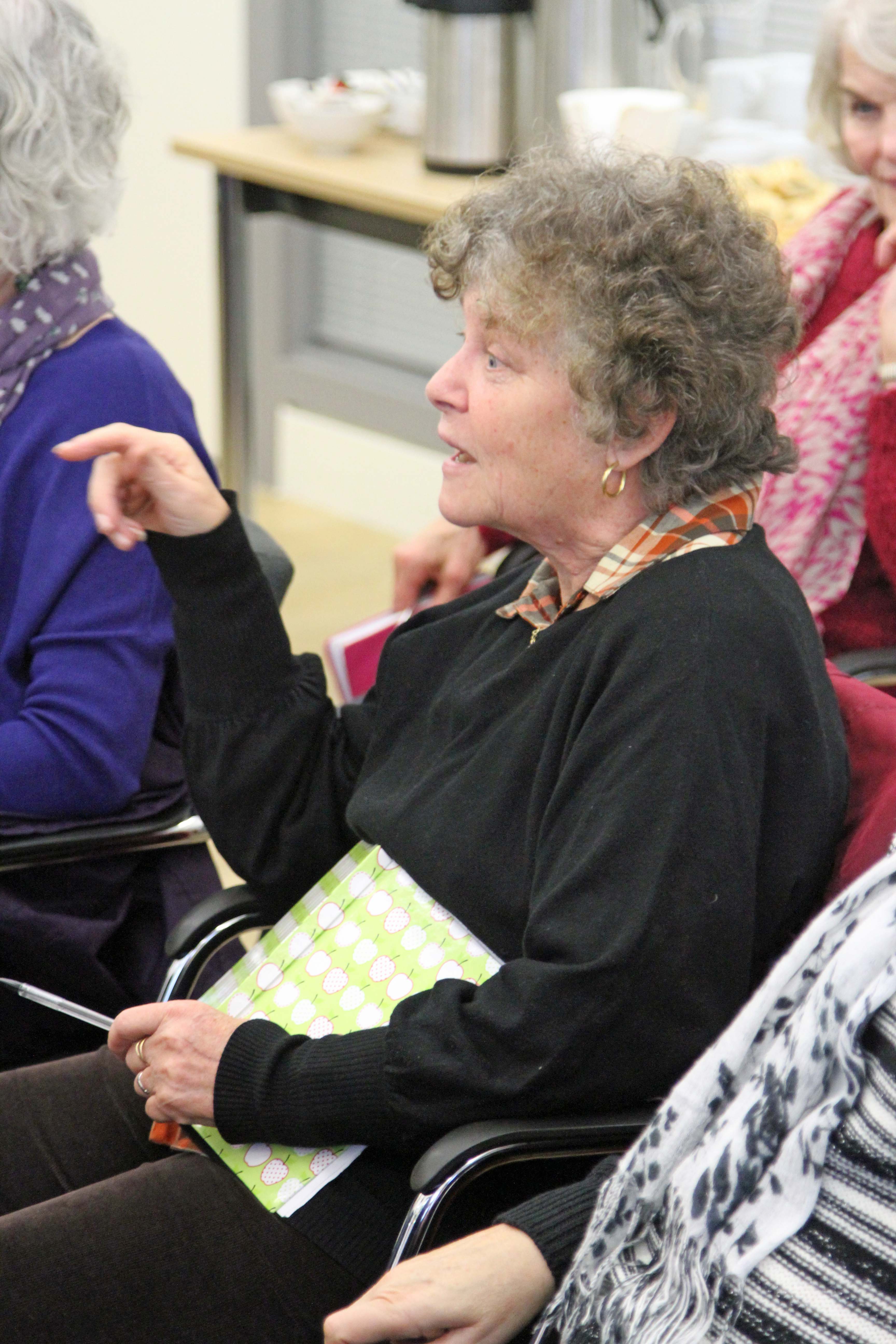
They know what they want and they want more of it: I’ve already promised to return to talk to them about DI Yates numbers 4 and 5. It was my first Wakefield audience that told me how much they enjoyed reading about Juliet Armstrong and that they’d like to see more of her. I hope that they’ll think I’ve done so in Sausage Hall, where Juliet’s story takes a new turn.
Several of the Wakefield readers had already bought Sausage Hall and came armed with it for me to sign. Others bought it during the tea-party; as at my other Wakefield events, the books were kindly supplied by Rickaro Books in Horbury. A man in the audience asked for an interesting, and very relevant, inscription (see caption): apparently, these are the nicknames of his brother and sister-in-law!
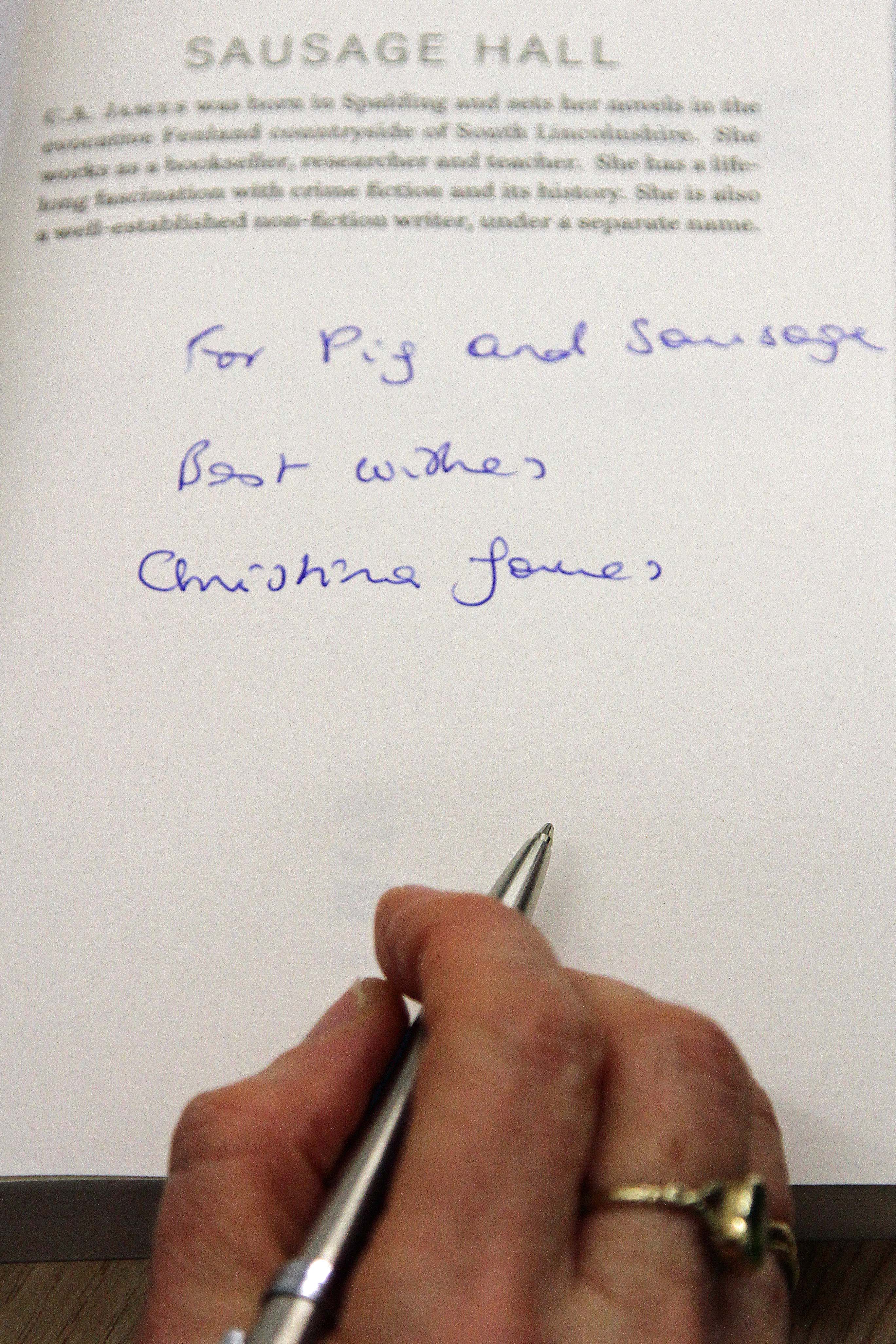
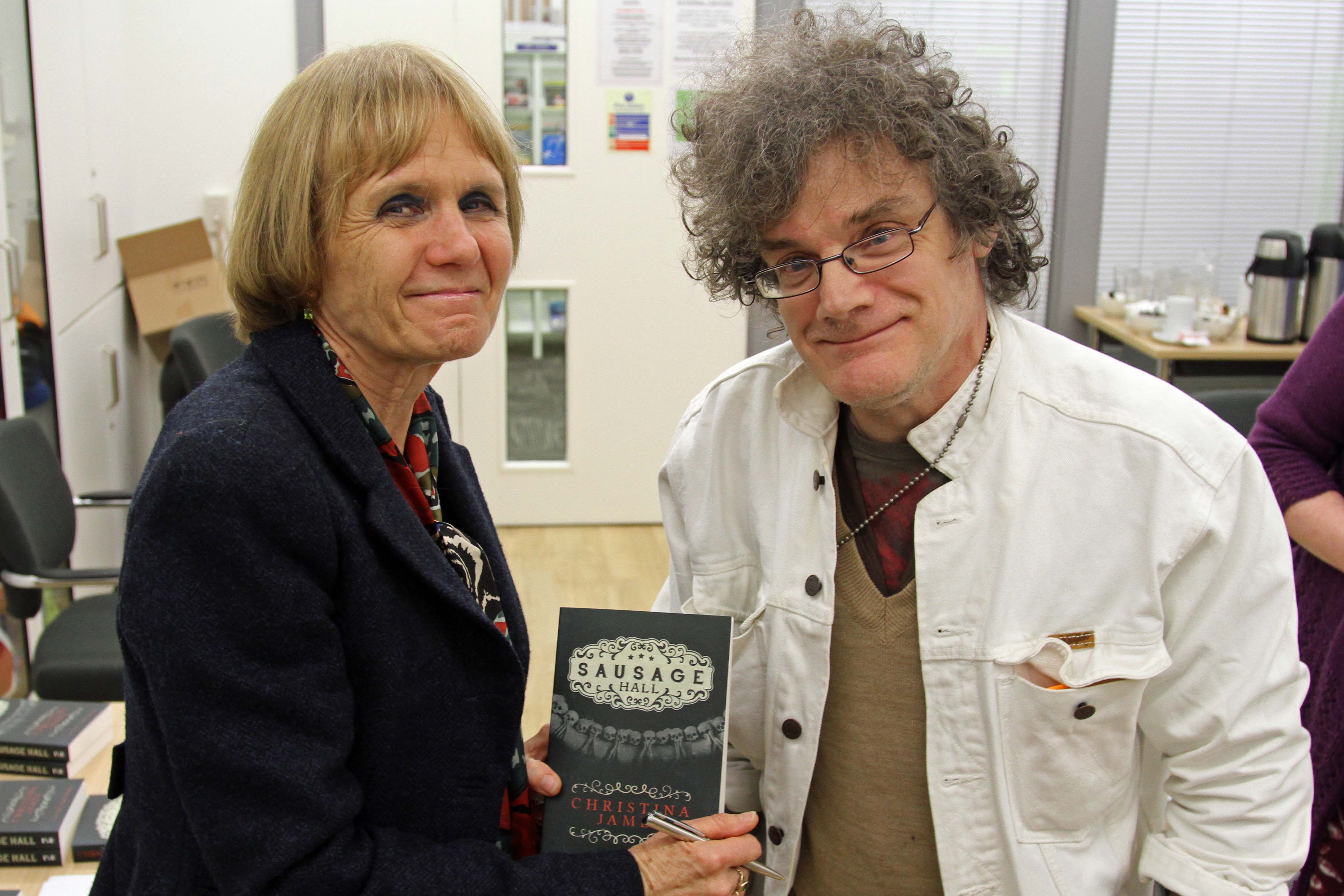
To Pig and Sausage, with love!
The event at Waterstones Covent Garden was masterminded by Jen Shenton, the bookshop’s lovely ‘can-do’ manager.
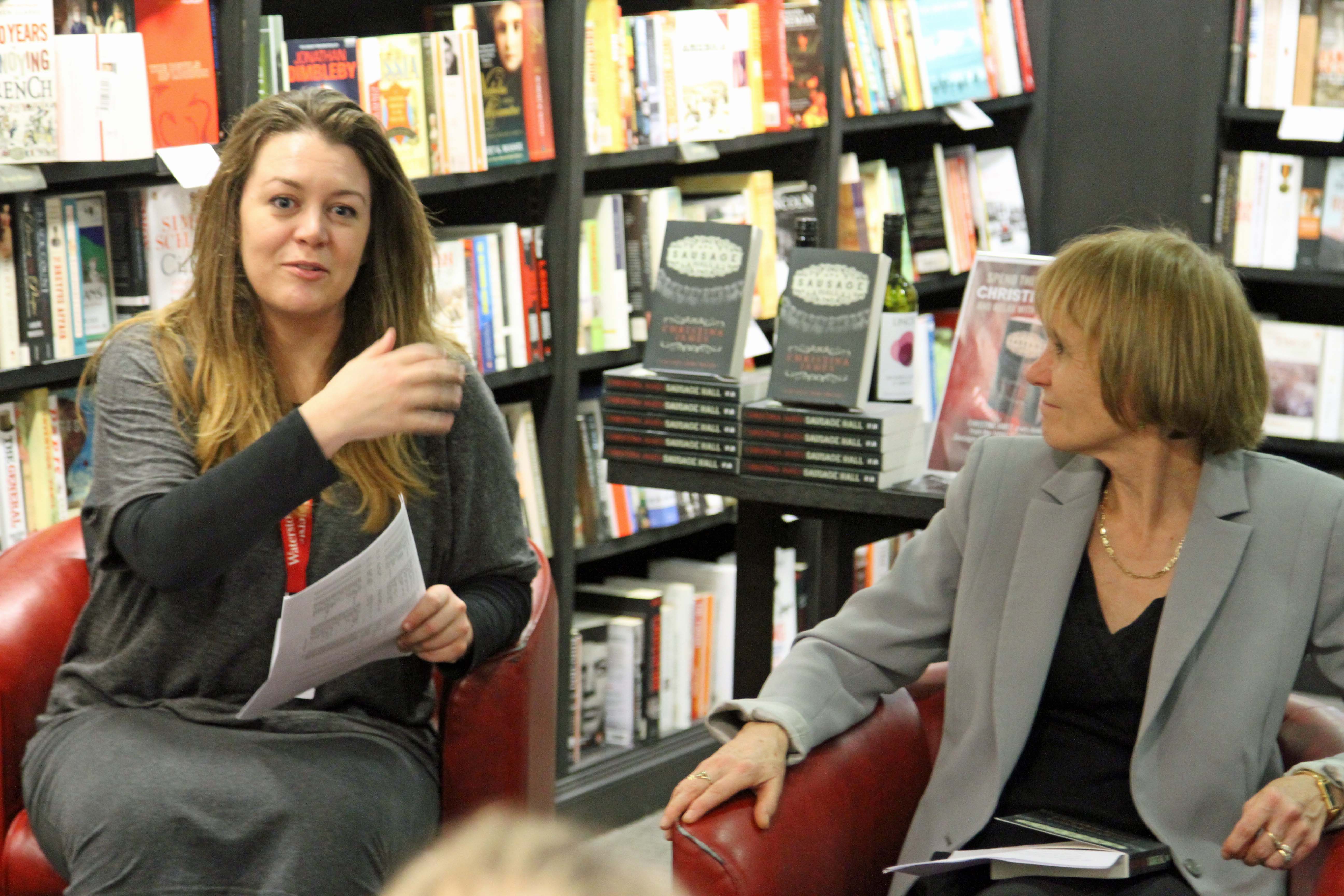
Waterstones Covent Garden Manager Jen Shenton welcomes me to her beautiful bookshop
I hadn’t met her before, but as soon as I saw her I knew what a distinguished bookseller she is. It’s something you can’t fake: I honestly believe that the best booksellers are born, not made, though that’s not to say they don’t work hard all the time in order to stay ahead. I didn’t leave Jen’s shop until almost 9 p.m., and she was still there behind the till, helping customers, smiling and looking as fresh as a daisy, even though she must have been feeling exhausted.
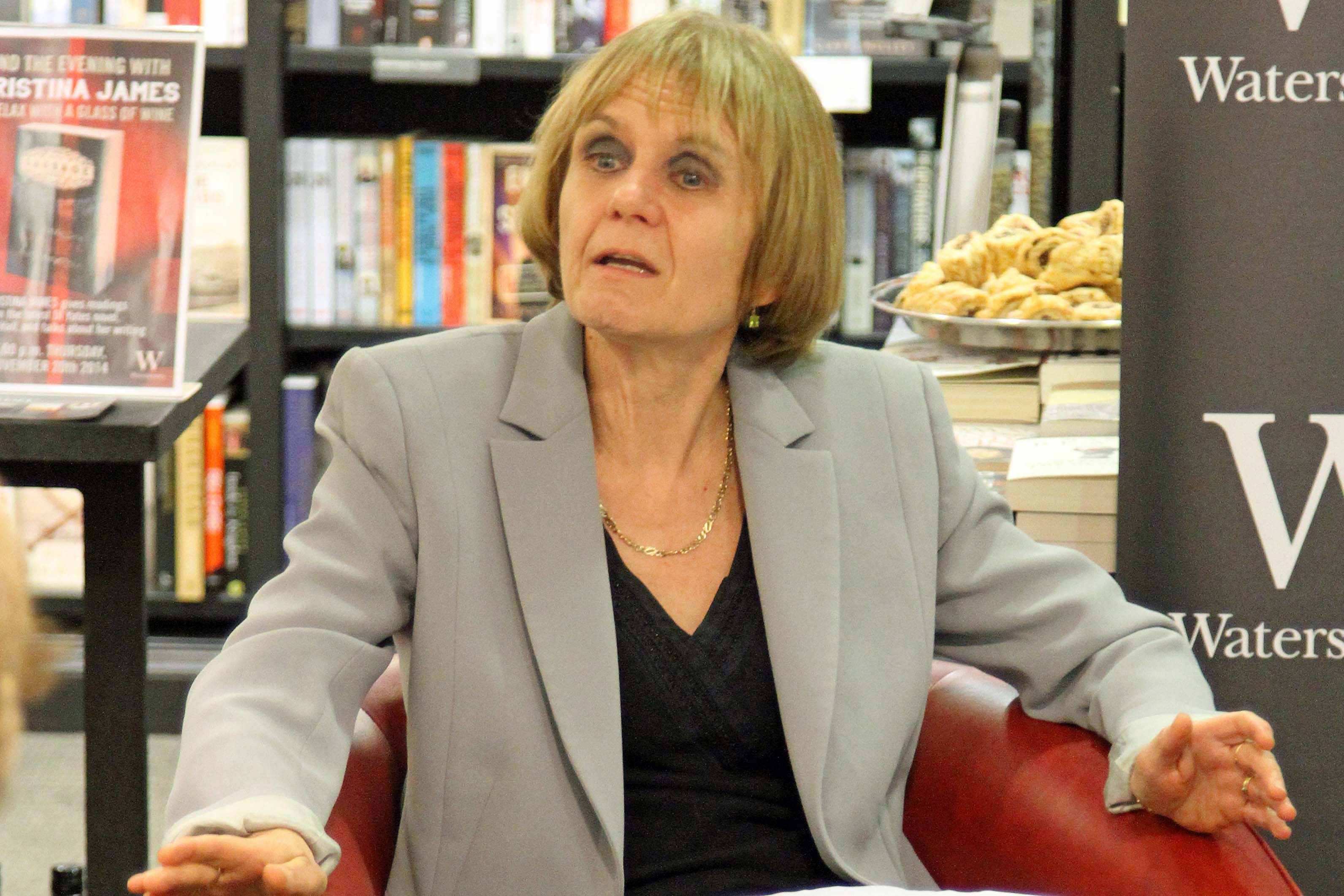
This event also had a wonderful audience.
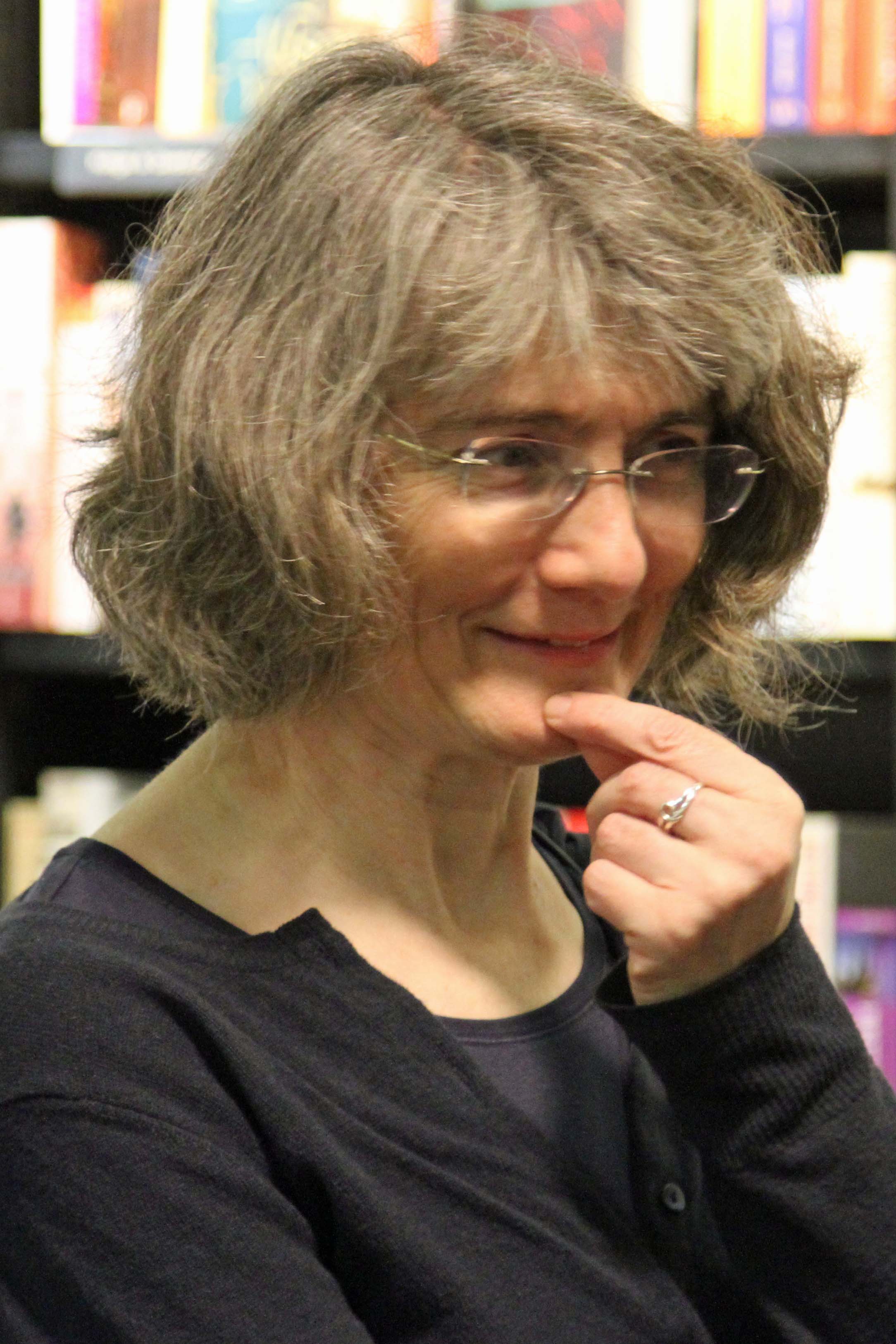


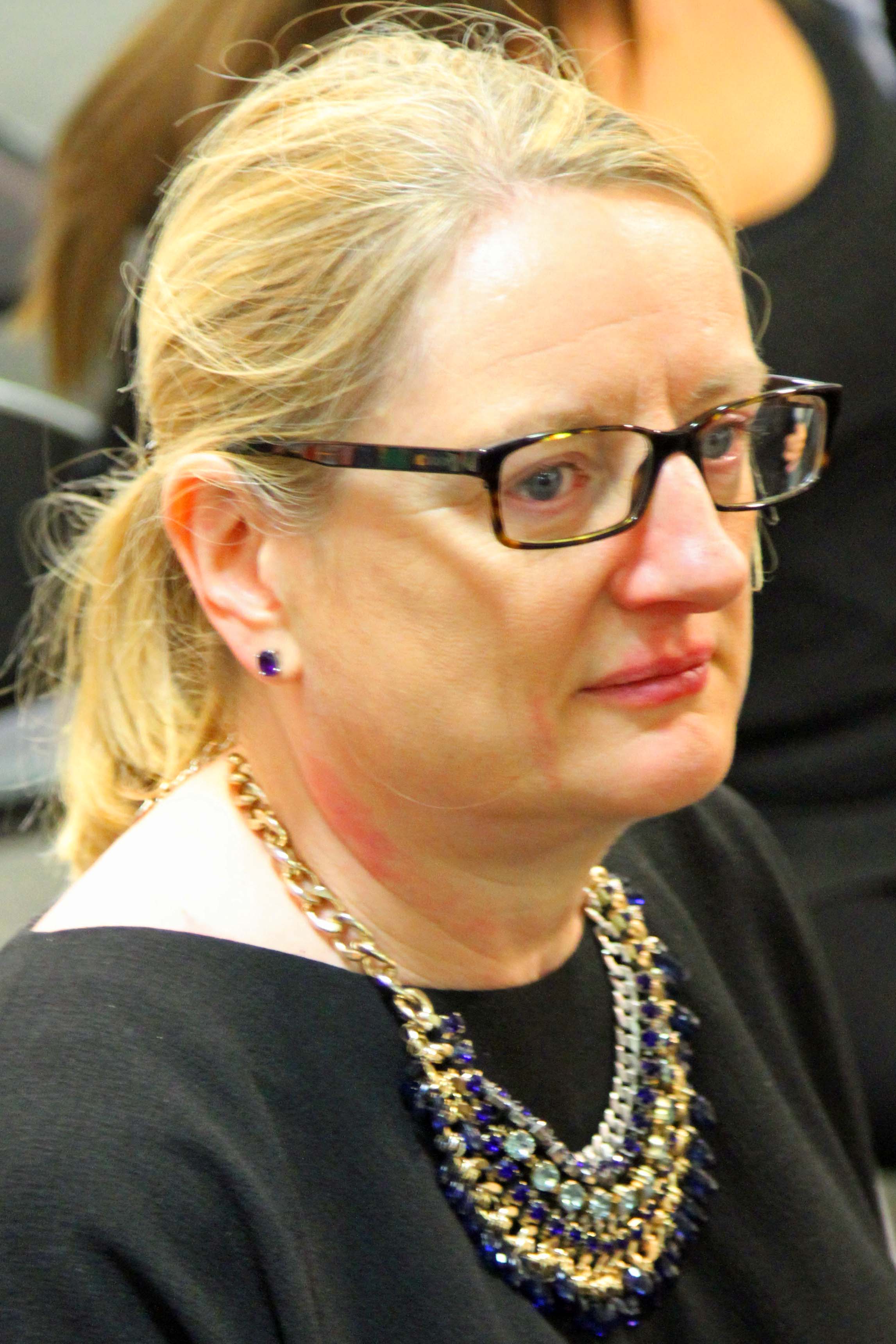

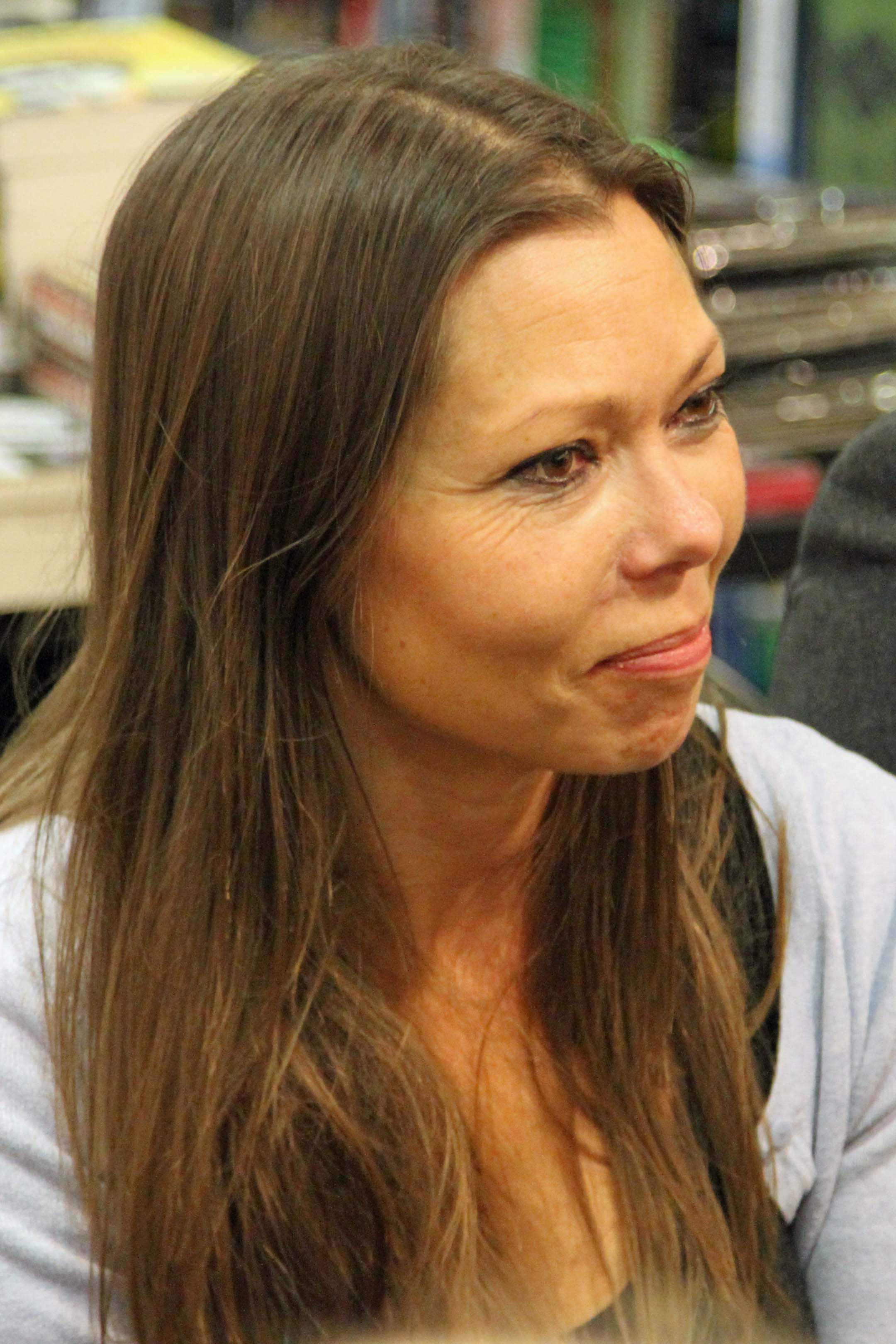


Many of my friends from the book industry came (which meant they bowled me a few googlies when it came to the questions). It was a light-hearted, laughter-filled evening, well lubricated with Waterstones wine and sustained by Adams & Harlow sausage rolls. I was delighted that Tabitha Pelly, who has worked with Salt on PR for Sausage Hall, was able to come. Like Jen Shenton, she seems never to tire or have a negative thought in her head.
I left the shop laden with some book purchases of my own and headed for King’s Cross station to catch the last train. It was the perfect end to an extraordinary week. My only sadness was that Chris and Jen Hamilton-Emery, my publishers at Salt, were unable to come. But I know that they’ve been keen followers of my progress as I’ve sprung Sausage Hall upon the world and I look forward to catching up with them next week. Today is Chris’s birthday: I’d like to take the opportunity to wish him many happy returns!

Grateful thanks, once again, to Adams and Harlow for their wonderful sponsorship of the launch of Sausage Hall.
Two events for Sausage Hall in two amazing bookshops
In this extraordinary Sausage Hall launch week, which I am enjoying so much and for which I am very grateful, I’d like to pay tribute to two amazing bookshops.
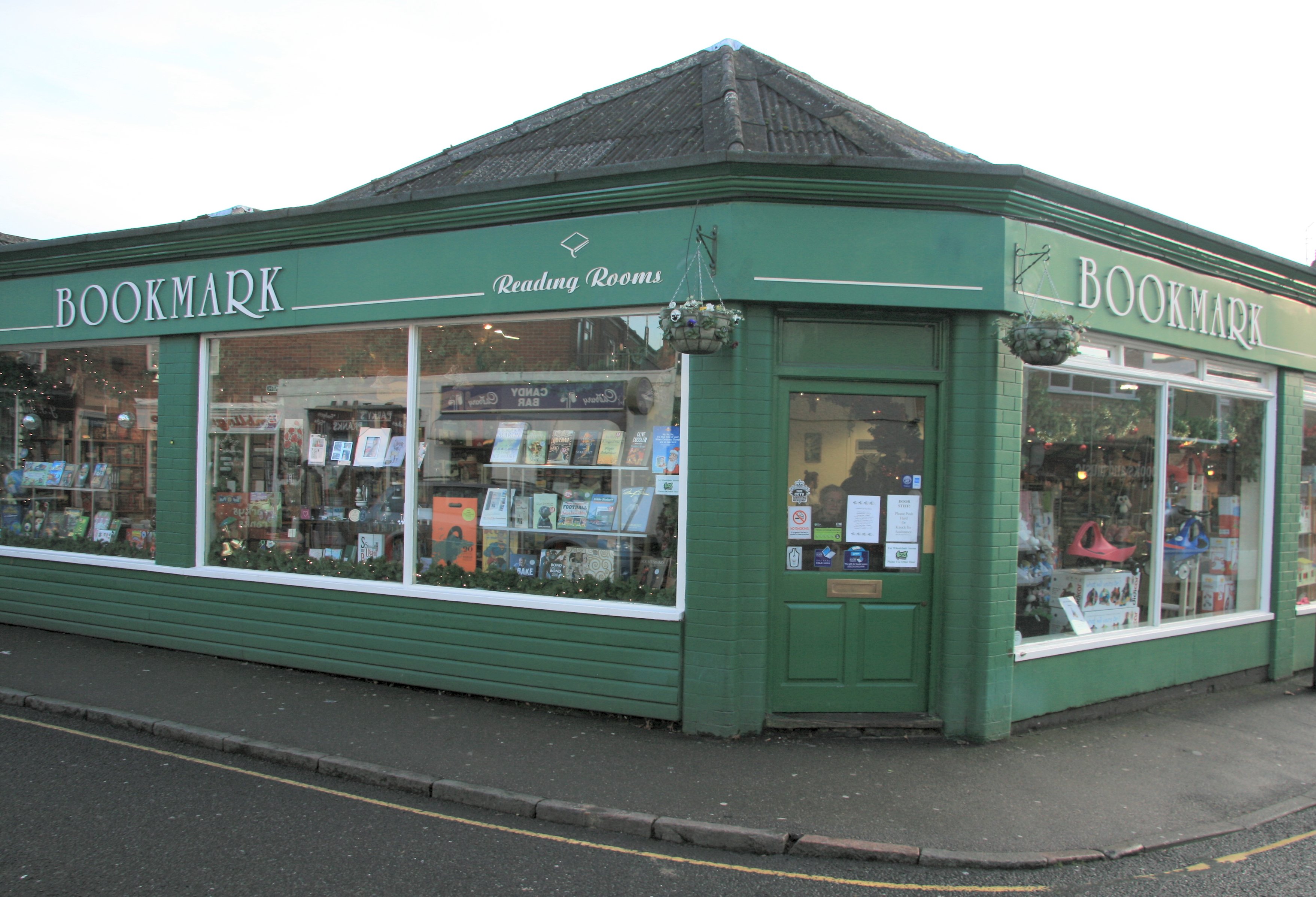
Bookmark, Spalding
The first is Bookmark, Spalding’s very distinguished bookshop (the CEO of the Booksellers Association, Tim Godfray, has even been known to serve behind the till there on occasion). Bookmark very generously offered to host the Sausage Hall publication day party, which took place in the evening of November 17th, after the day that I spent at Spalding High School. The event was masterminded by Christine Hanson, the owner of the shop (who is both practical and imaginative – she fixed both a toilet roll holder and a broken table joint within minutes of my arrival, while the shop itself, resplendent with its Christmas stock and decorations, achieved a standard that I’d have dearly liked to replicate in my bookselling days), and Sam Buckley, also a former pupil of Spalding High School, who organises author sessions at the shop. Equally generously, the launch party was sponsored by Adams and Harlow, the local pork butchers, who supplied sausage rolls for the occasion.

Having fun at Bookmark
This event was attended by members of Bookmark’s lively reading group and some old friends of my own. I was astounded to see Finola, a day-job friend – she had driven for more than an hour from Cambridge in order to support me. I was also staunchly supported by Madelaine, one of my oldest friends, and her husband, Marc, who have both offered me hospitality every time I’ve returned to Spalding as Christina James and also bought many copies of my books as presents for everyone they know who might enjoy them.
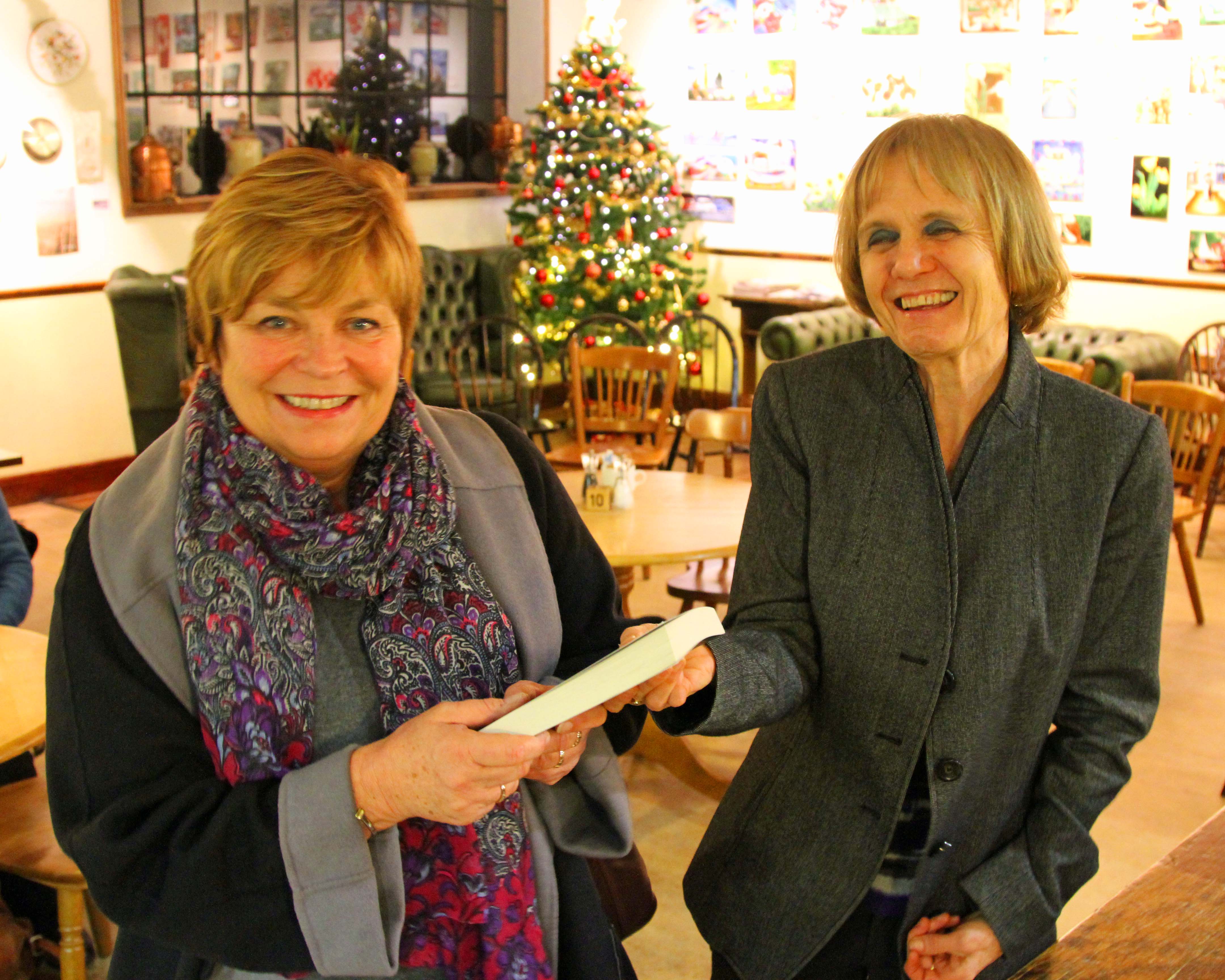
With Madelaine at Bookmark
Madelaine’s contribution to my writing is acknowledged in Sausage Hall. I was also delighted to see Sarah Oliver, whom I first met at the Priory Academy last spring and who came with her husband. The book club members, who lived up to their reputation for being engaged and vivacious, were shrewd and perceptive: as well as listening attentively to two readings from Sausage Hall, they launched into an animated discussion about all three DI Yates novels. Everyone present bought at least one of the books, some more than one. (Sam Buckley later this week let me know that one member of the audience, who had not read any of the novels and took away with her In the Family, returned within forty-eight hours, having read it, to acquire Almost Love and Sausage Hall as well!) And, of course, I couldn’t myself resist making a few purchases in this fairy-tale bookshop.
Having spent the night with my son and daughter-in-law at their house in Cambridgeshire, I arrived in good time on Tuesday November 18th for a signing session at Walkers Bookshop in Stamford. Although I first met Tim Walker, its owner, last year (he’s currently President of the Booksellers Association), I had not visited one of his bookshops before, The one in Stamford is in a listed building in the town centre; he also owns another in Oakham. I was particularly impressed by the huge range of stock in this shop, both the cards and gifts downstairs and the extensive range of books upstairs. Tim and the manager, Jenny Pugh, were respectively at the other shop and taking holiday, but everything had been set up for me and Mandy, the assistant manager on the book floor, couldn’t have made me more welcome.
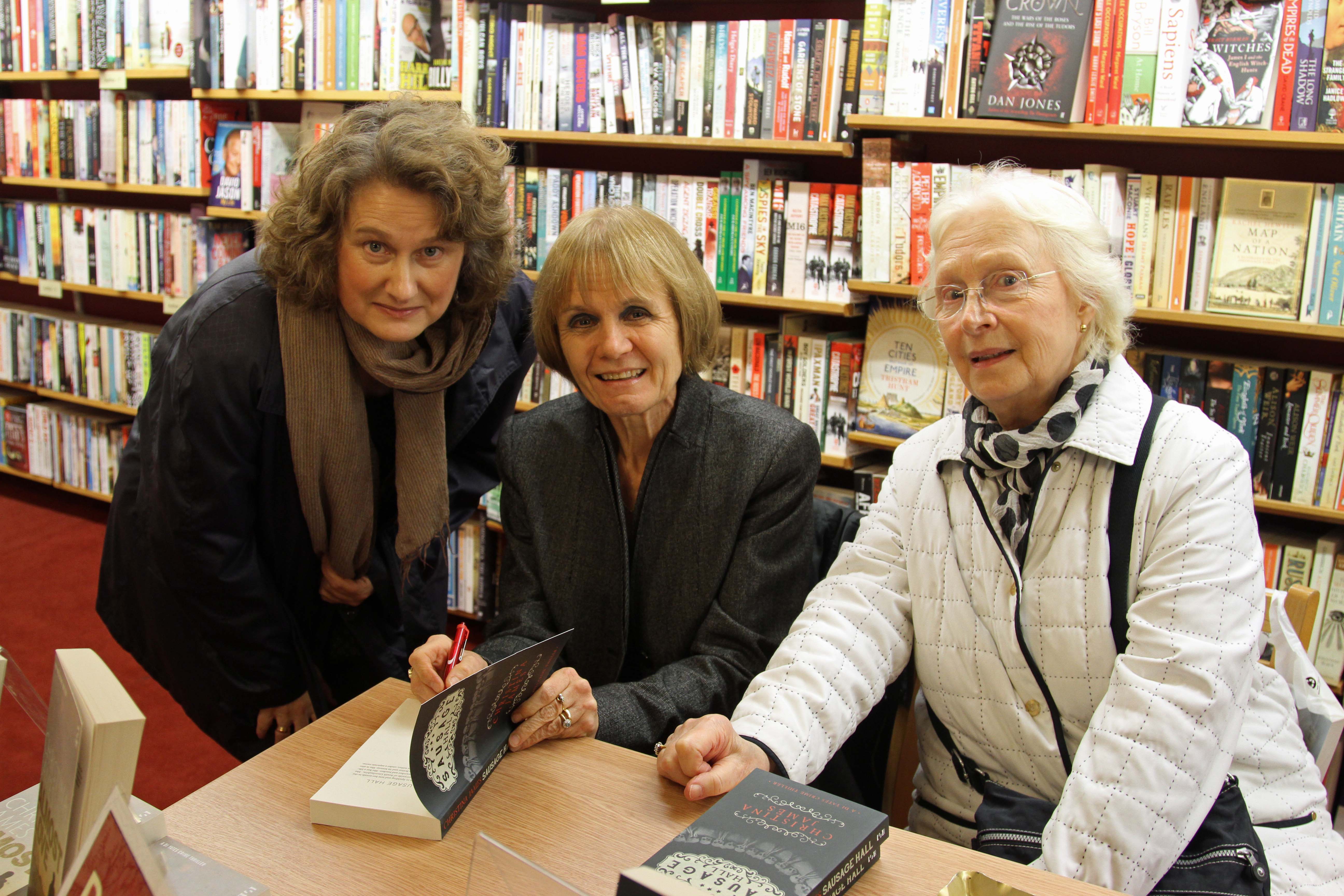
Signing Sausage Hall for Elaine and Sheila at Walkers, Stamford
Bookmark and Walkers are two fine examples of thriving independent bookshops, packed with atmosphere and individual charm and led by brilliantly creative people who understand how to serve their communities very well indeed. It was a privilege and a pleasure for me to have been able to enjoy what they had to offer and I’d very much like to thank Christine and Tim for hosting Sausage Hall events this week.

Walkers, Stamford
One writer looking back… lots of writers looking forwards!

Spalding High School
At first light yesterday, I travelled to Spalding High School, my own former school, to which I had returned only once previously since leaving the sixth form. I received a wonderful welcome from Adrian Isted, the newly-appointed Head of English, who began the day’s activities by showing me round the school.

With Adrian Isted, Head of English
First stop was the office of the headteacher, Mrs. Michele Anderson, who is also fairly new to the school. She was fascinated to hear a little more from me about Mrs. Jeanne Driver, the first married headteacher at the school, who was its leader throughout my school career. Born Jeanne Ouseley, she lived at 10, High Street, a large house of several storeys situated near the River Welland in Spalding. Part of this house was divided into flats and there were usually several other teachers living there, as well as two of my fellow sixth formers, Cheryl Ouseley and Elizabeth Davies, both of whom were her nieces. They called her ‘Auntie Jeanne’, a name that the rest of the sixth form also used affectionately, if unofficially. Mrs. Driver was one of several strong women who influenced me as a girl. She had a strong sense of duty and an even stronger work ethic. We found some of the things she said highly amusing (for example, ‘I stand up whenever I hear the national anthem, even if I’m in the bath.’). Sometimes she took the notion of duty to an extreme. I remember she told us that when her husband, who had been in ill health for some time, finally died, she finished marking a set of books before setting in train the preparations for his funeral. But her influence has lasted all my life.
The school has been added to, but otherwise is little changed. I suppose the thing that struck me most yesterday is how it seems to have shrunk. The corridors seemed longer, the stairways steeper, the ceilings higher when I first attended it as an eleven-year-old, then for only a part of the school week – pupils belonging to the first two school years still spent most of their time at the old school building in London Road, the first home of Spalding High School when it was established in 1920 on the site of its predecessor, the privately-owned ‘Welland Academy for Young Ladies’. (The present school building was completed in 1959, but the London Road property continued to be used by younger pupils for more than twenty years afterwards.) The assembly hall still boasts its luxurious but absurdly impractical parquet floor.

In my day it doubled up as a gym (there is now a separate sports hall) and we were obliged to do PE barefoot, which we all hated, so that the floor wouldn’t become scuffed by gym shoes. The same grand piano stands in the corner, to the left of the stage. In the corridor outside the headteacher’s office are several group photographs taken of all the teachers and pupils at intervals during the school’s history. After some searching, I was able to discover myself on one of these – and I could also name all the other girls in my form and most of the teachers.

Guess which is the young Christina James!
After the tour, I was interviewed by Eleanor Toal and Holly Hetherington for High Quarterly, the school’s completely online magazine (which is streets ahead of the drab, dark-red-covered printed production of my youth). Eleanor, the e-zine’s editor, also writes articles for the Spalding Guardian, carrying on the long-standing relationship between the school and the local newspaper. Eleanor and Holly (who edits Gardening and Food in the mag) knew they were going to be asked to interview me only very shortly before we met, because the intended interviewer was ill, but I wouldn’t have known if they hadn’t told me. I was much struck by the sensitivity and perspicacity of their questions and enjoyed answering them.

Holly, left, and Eleanor interview me for High Quarterly
After lunch, I talked to sixth form English students about how to get published. Jean Hodge, who reports on cultural affairs for the Spalding Guardian, also attended and joined in. It was quite an exciting occasion, because it also took the first steps towards setting up a short-story competition that the Great British Bookshop has agreed to sponsor at the High School. Adrian and his colleagues and I will choose the best ten or twelve stories submitted to be published in a single volume at The Great British Bookshop’s expense. Winners will each receive a free copy of the book, which will then go on sale in TGBB’s extensive distribution network. I’ll be writing more about the competition in this blog very shortly.
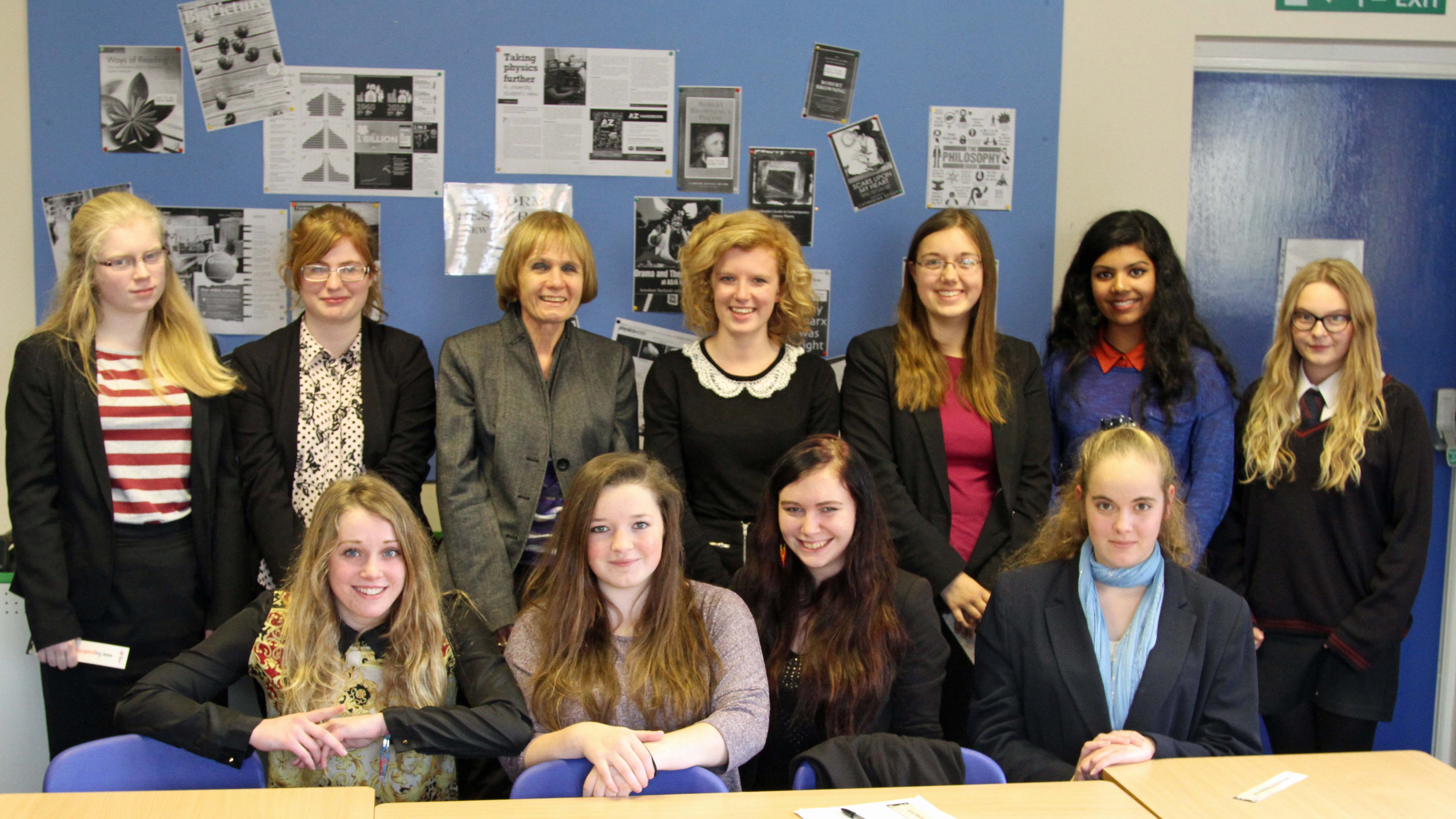
Sixth Form writers
I completed my day at the school with a writers’ workshop for Years 7, 8 and 9 students. The participants explored some of the key elements of crime fiction (they proved to be very well read) and collaborated to put some of those into practice. Their discussion illustrated their excellent grasp of linguistic and literary effects and the results were amazing! Nearly all of these students bought one of my books at the end of the session; some bought all three. Thank you!

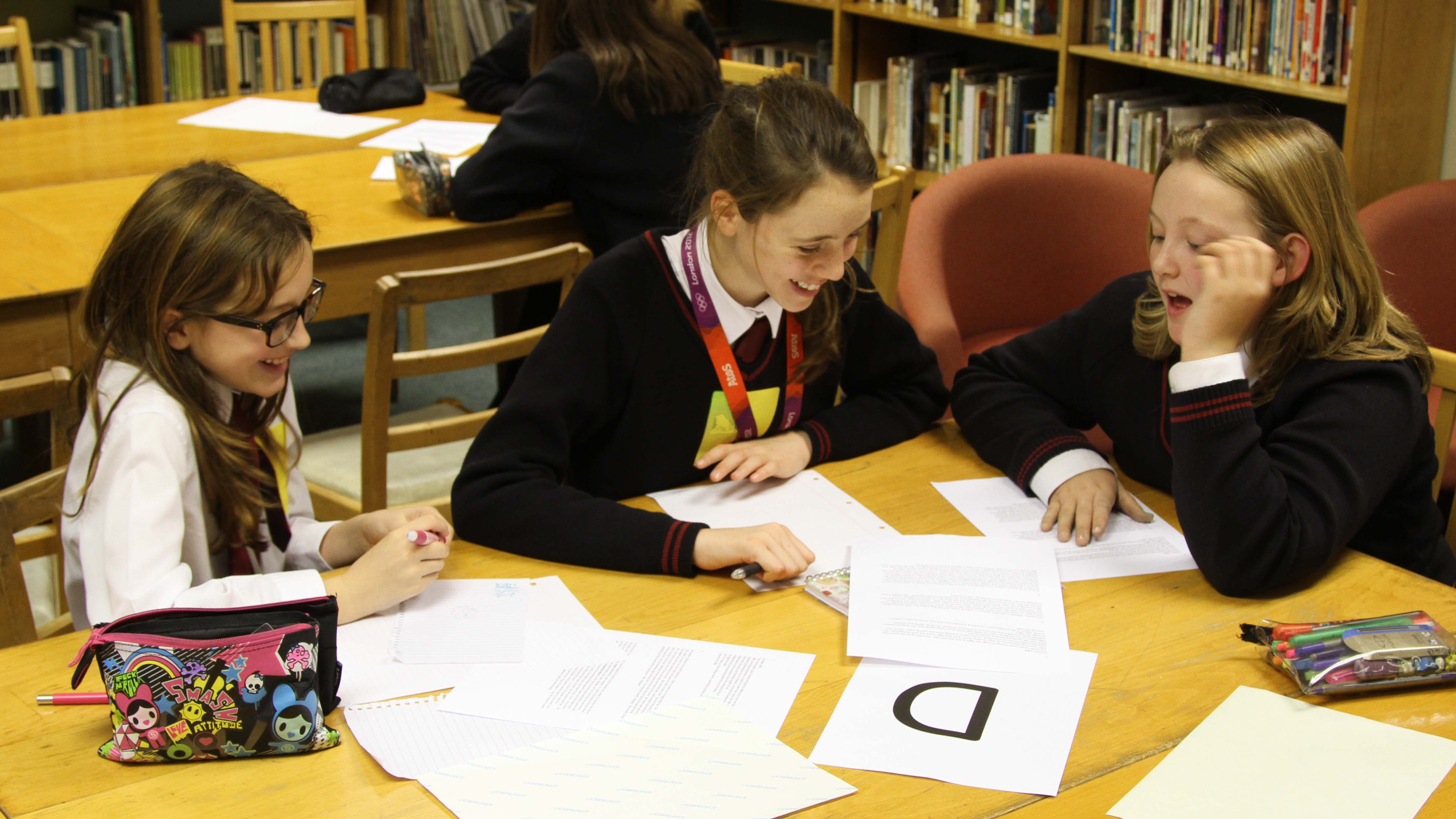


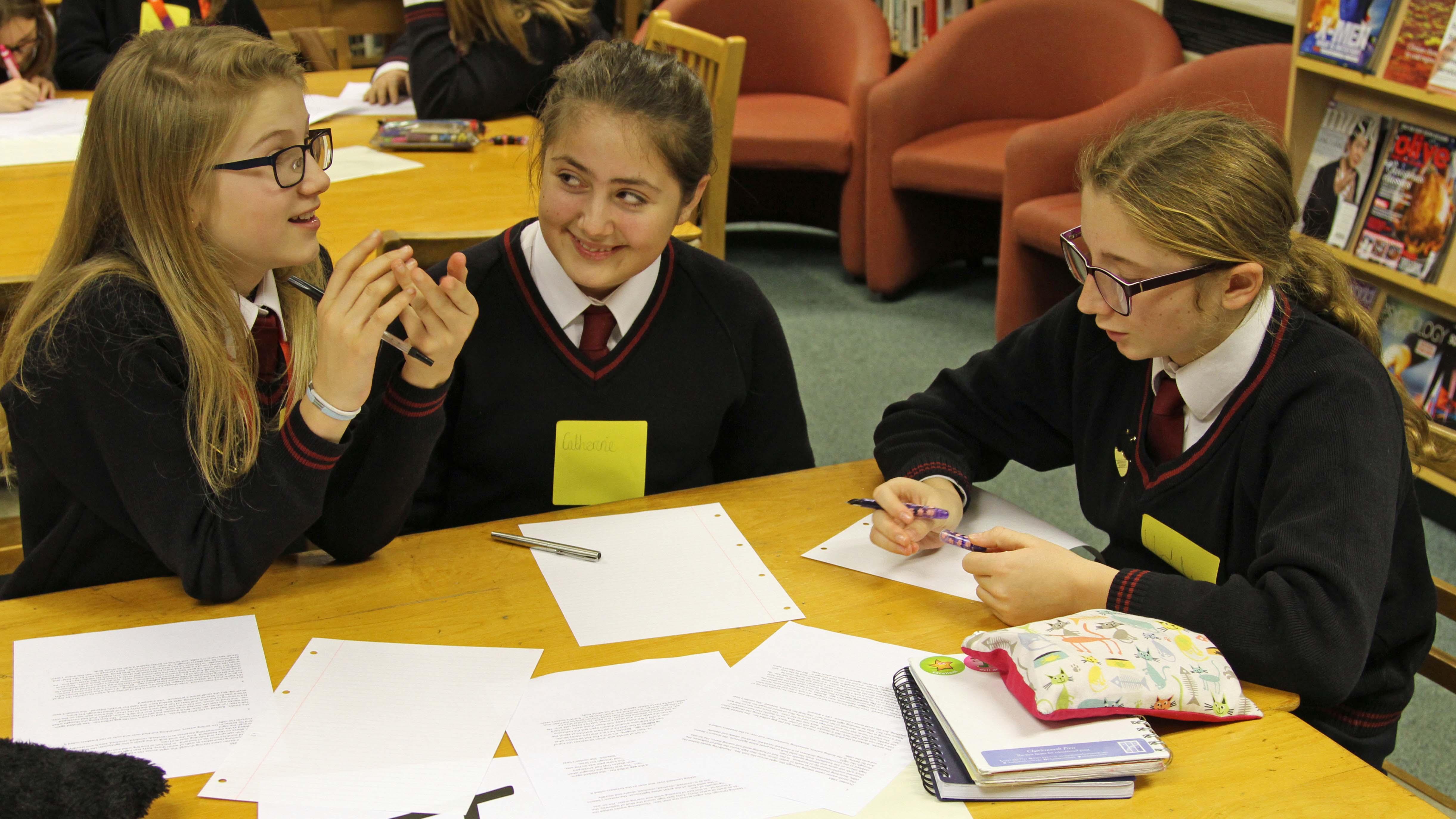
I can’t conclude this post without saying that a remarkable library now exists at Spalding High School. The library is housed in the same room that I knew, but what a difference in the stock! The emphasis is on supplying students with books to read for pleasure. It’s a place of relaxation and also a place where students can go to work in groups. There’s none of the shushing and grim looks that any talking in the library produced when I was a schoolgirl and all the dusty old Latin grammars and ancient editions of Gray’s Anatomy have been disappeared. Hats off in particular to Kirsty Lees, the School Librarian and Learning Resources Manager, and to her team. The school knows how lucky it is to have them and to be able to enjoy the warm and inviting place (complete with crime scene rug featuring a splayed body) that they have turned it into.
It’s almost impossible for me to thank all the people who made this day so special. I’m deeply grateful to Michele Anderson for making it possible; to Adrian Isted and Kirsty, for making it happen; to Eleanor and Holly, for giving me such a delightful interview; to Jean Hodge, for all her support for Sausage Hall both at this event and elsewhere and, especially, to all the students whom I met yesterday, who were such a joy to work with and who were so keen to develop their own writing. Thank you all!
Strong links in the chain to ‘Sausage Hall’, to be published Nov. 17th 2014

I am extremely grateful to you, the readers of this blog, both those of you whom I’ve met in person and those from countries around the world whom I’ve met ‘virtually’, for the huge welcome that you have given Sausage Hall. Thank you very much indeed.
As many of you know, Sausage Hall will be published next Monday, November 17th. My wonderful publishers, Chris and Jen Hamilton-Emery at Salt Publishing,
 their equally stellar PR consultant, Tabitha Pelly, Faber (which now represents Salt titles) and my bookselling and librarian friends have combined to make happen a series of celebration events.
The first of these is today, Thursday November 13th, when Nicola Gilroy will be interviewing me live on Radio Lincolnshire at 14.05. I hope that you will be able to listen; if not, I think the interview will be on iPlayer for twenty-four hours after broadcast.
Monday November 17th is a very special day indeed. I’m spending much of it at Spalding High School,

where I was once a student (Facebook doesn’t know this, having inexplicably assigned me to Wycliffe Senior School and Sixth Form College! I don’t intend to disabuse it!). I’m giving a young writers’ workshop and talking about how I came to write Sausage Hall, but first of all I’m being taken on a tour of the school by Adrian Isted, the present Head of English. I’m really looking forward to this, and especially to meeting the students.
Also on November 17th, in the evening, Bookmark, Spalding’s very distinguished bookshop,
is hosting the official launch event. This will begin at 19.00. I’m delighted to be able to announce that it is being sponsored by Adams and Harlow, the pork butchers, who will supply sausage-themed canapés. Wine will also be served. As well as signing copies of Sausage Hall, I’ll be giving some readings and talking about all the DI Yates novels. I’d like to offer my thanks in advance to Christine Hanson and Sam Buckley, who have supported all the novels as they’ve been published. In conjunction with Spalding Guardian, they’ve also arranged a DI Yates competition, the prizes for which will be four sets of the DI Yates titles.
On November 18th, I’m travelling to Walkers Books in Stamford,

where I’ll be signing copies of Sausage Hall and talking about it informally between 11.00 and 13.00. I’d like to thank Tim Walker and Jenny Pugh for all their support. More about this may be found here.
Wednesday November 19th finds me back at wonderful Wakefield One, where Alison Cassels has organised Tea at Sausage Hall, an informal talk-and-signing session, with refreshments, that will start at 14.30. Regular readers will know that Wakefield One has been a particularly magnificent supporter of mine. Books will be supplied by Richard Knowles of Rickaro Books, another staunch supporter.

Rickaro Books, Horbury
There is more about Tea at Sausage Hall here. If you live in the Wakefield area or are visiting, it would be great to see you at this event.
On Thursday November 20th the Waterstones bookshop in Covent Garden is giving a London launch event. As Adams and Harlow are sponsoring this, too, there will be sausages as well as wine! This reading and signing session will begin at 19.00 and continue until the shop closes. It has already attracted a large audience, so it should be quite a party! The store’s brilliant manager, Jen Shenton, and I would be delighted to see you there. More information can be found here.
And Friday 21st November? At present, nothing is planned, so this will be a rest day… but I’m open to offers!
WriterFest!

Yesterday Jim, my editor, and I enjoyed the immense privilege of running a writers’ workshop at Wakefield One, the City of Wakefield’s wonderful new complex that incorporates the library and other arts and community facilities. Like the event in which I took part at Wakefield One last year, it was part of Wakefield’s LitFest, and impeccably organised by Alison Cassels, who, in my experience, is second to none at enthusing and gathering in intelligent and appreciative audiences for such occasions.
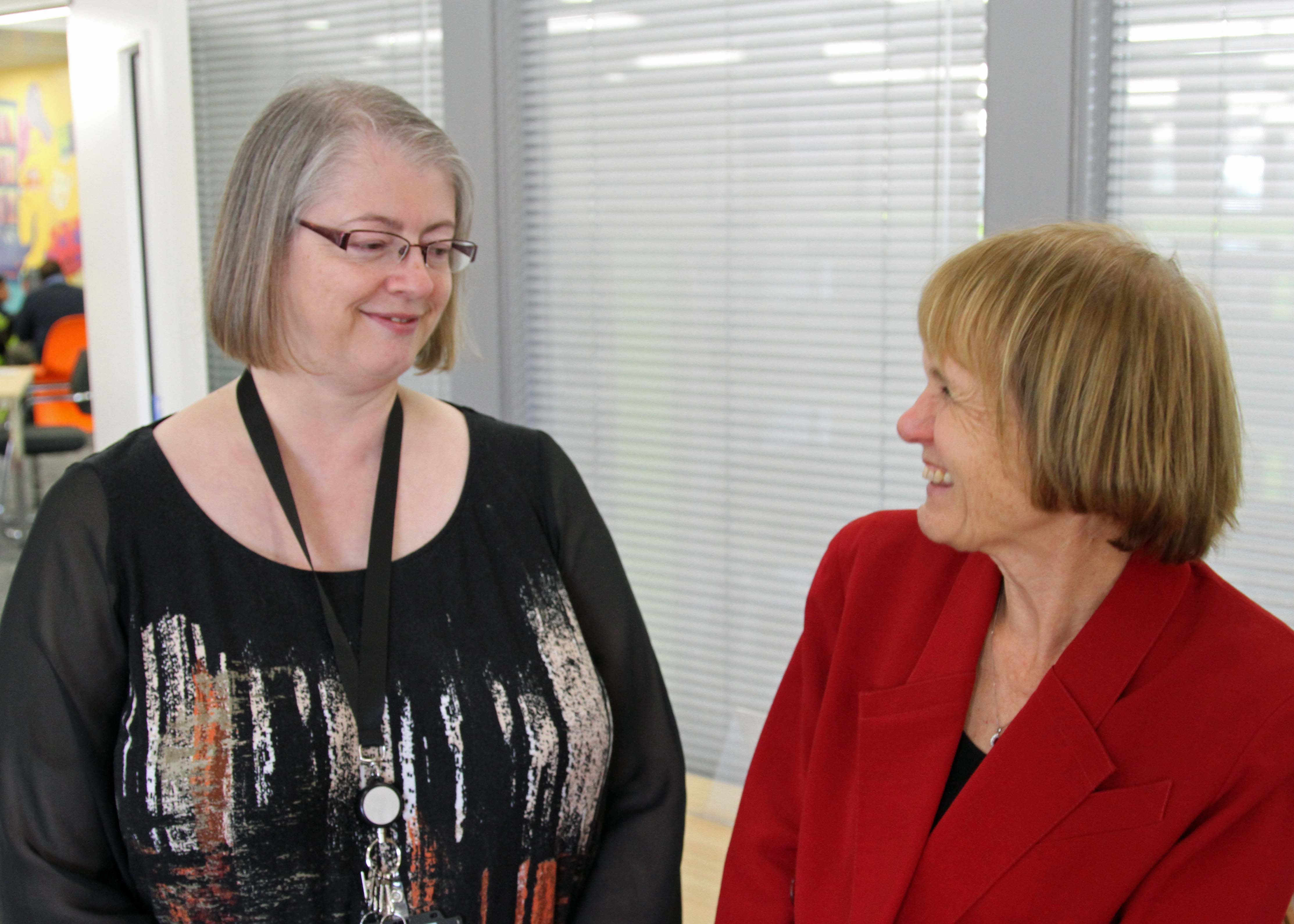
Alison Cassels, organiser par excellence
Eventually, there were twenty-two lively and responsive participants of all ages, from twenty upwards. One recent graduate came with his grandfather.

We began by giving the workshop delegates a sheet containing the opening paragraphs of six novels and asked them to take on the editor’s task of choosing (and providing justification for their selection!) just one that they would personally want to publish. The results were Illuminating: although one of the extracts (actually from a novel by Ruth Rendell) emerged as the clear winner, all six had at least one champion. Everyone was thus able to appreciate the dilemma of choice that an editor faces when sent many different manuscripts. Then, in pairs and against the clock, the group accepted the challenge of producing an opening paragraph that might persuade an editor not to reject it. The results were exceptional: all were coherent, interesting and, most impressively, cliché-free; the activity itself generated wonderful engagement, as you can see in the photographs here.


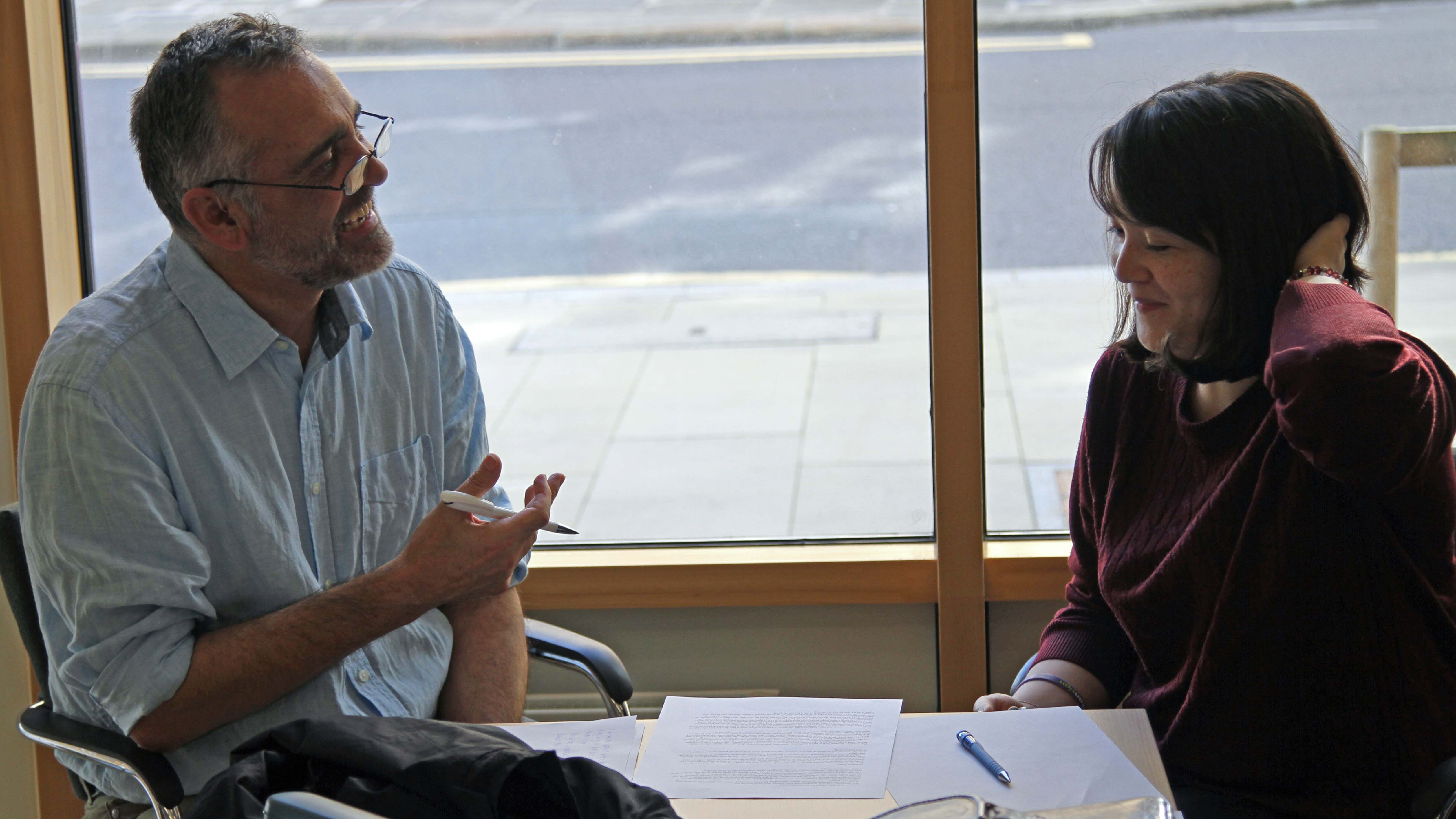

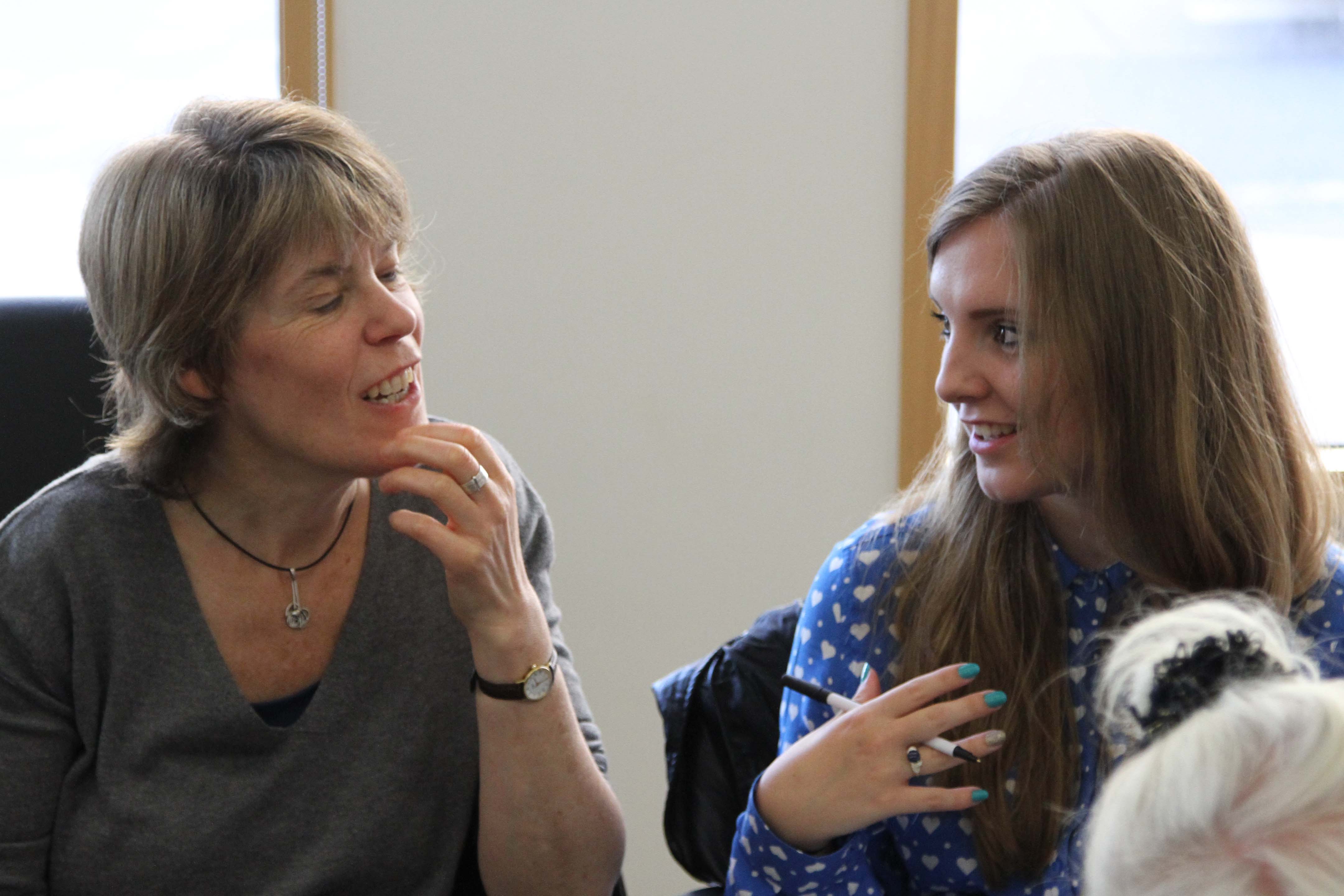
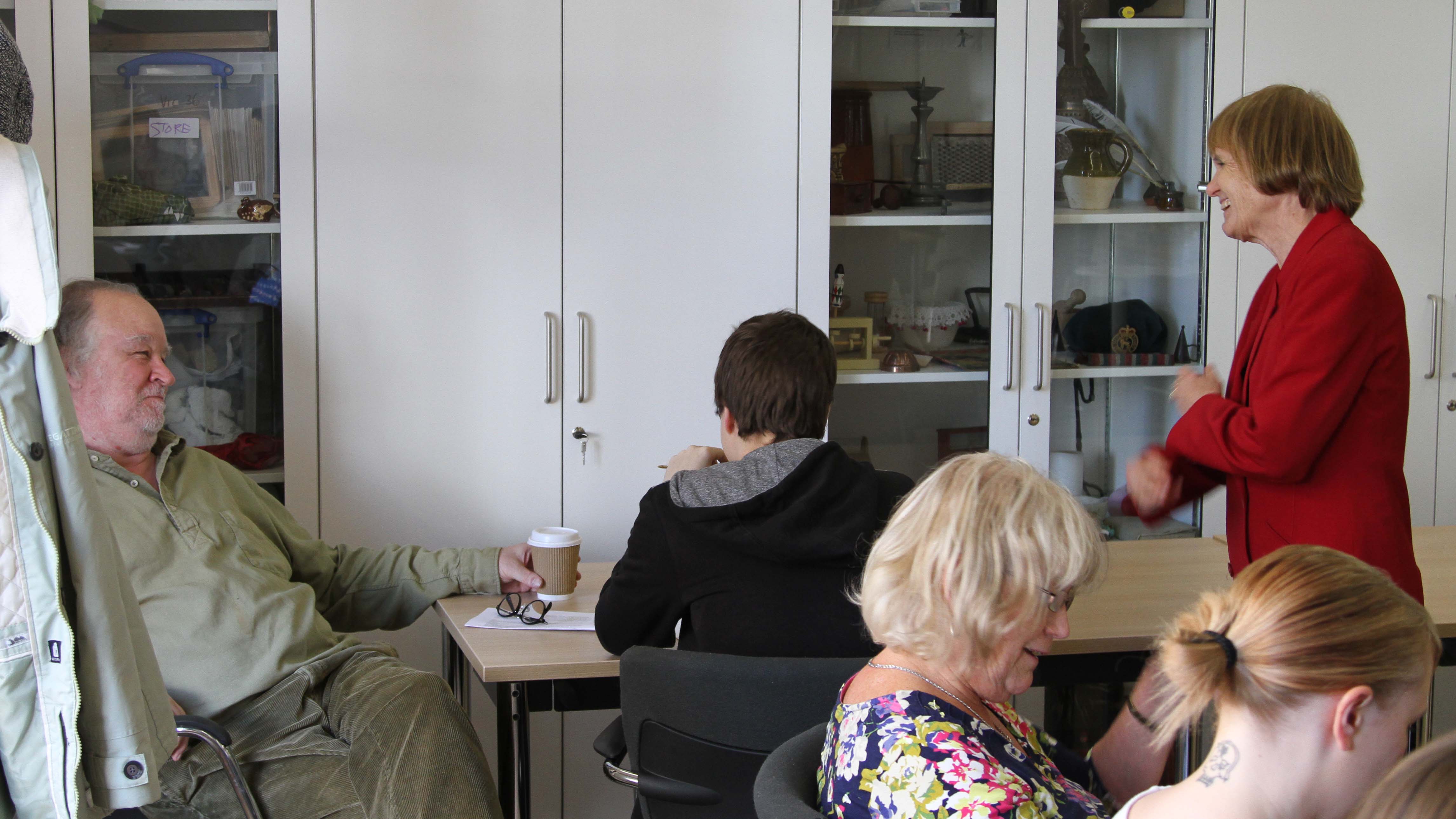
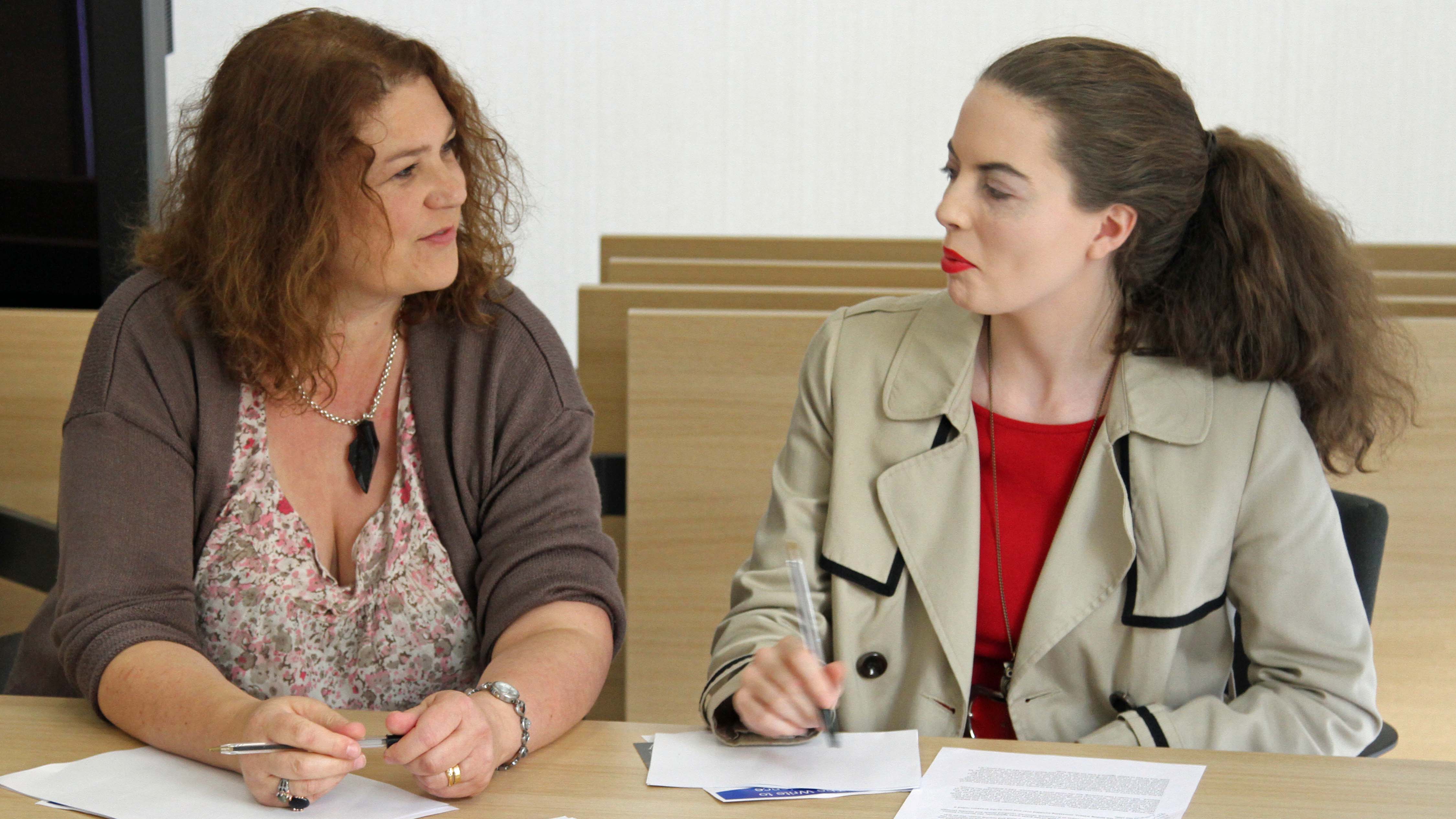

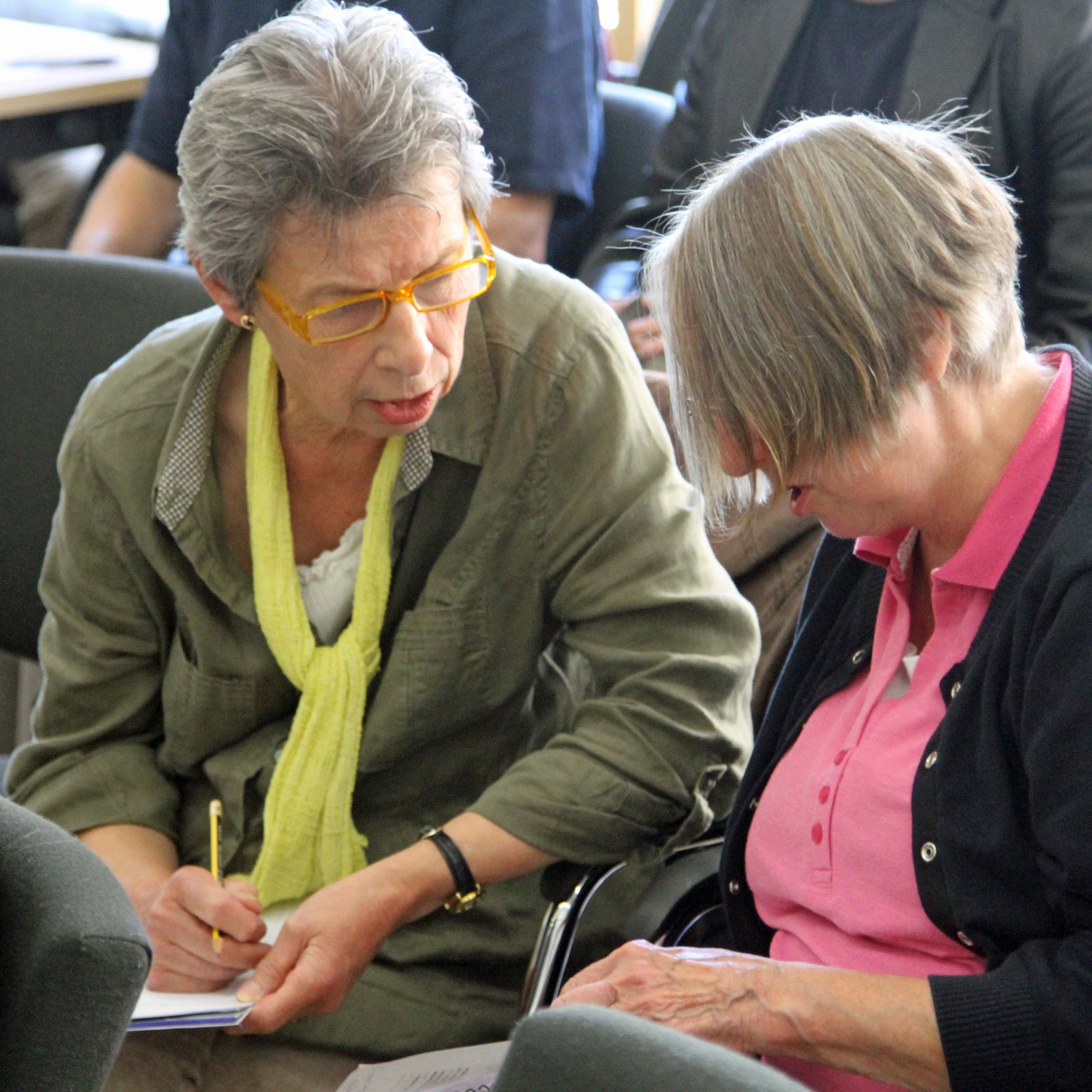


I then went on to explore some of the practicalities of getting published and what new (and, indeed, established) authors need to do in order to engage and keep their readers. This audience was thoughtful as well as appreciative and turned it into a dynamic, interactive session. Finally, I read the opening chapter of Sausage Hall, the third in the DI Yates series, which will be published on 17th November; it was well-received (I’d been holding my breath, as I’m sure all authors do when they give their new ‘baby’ its first airings). The workshop members were generous: many bought copies of In the Family and Almost Love in the signing session at the end; some were kind enough to buy both.
The informal debate continued after the workshop was officially over. Several participants said that they’d been delighted to receive Salt Publishing’s online alerts. If any of the readers of this blog would also like to obtain these, just let me know and I’ll pass on the information.
Very many thanks indeed to Alison Cassels and the rest of the staff at Wakefield One (not forgetting those who work in the Create coffee shop, which produces a mean cappuccino!) and heartfelt gratitude to all those who joined the workshop – I hope that you will become occasional or even regular visitors to this blog.
As good at putting the case for the defence as for the prosecution…
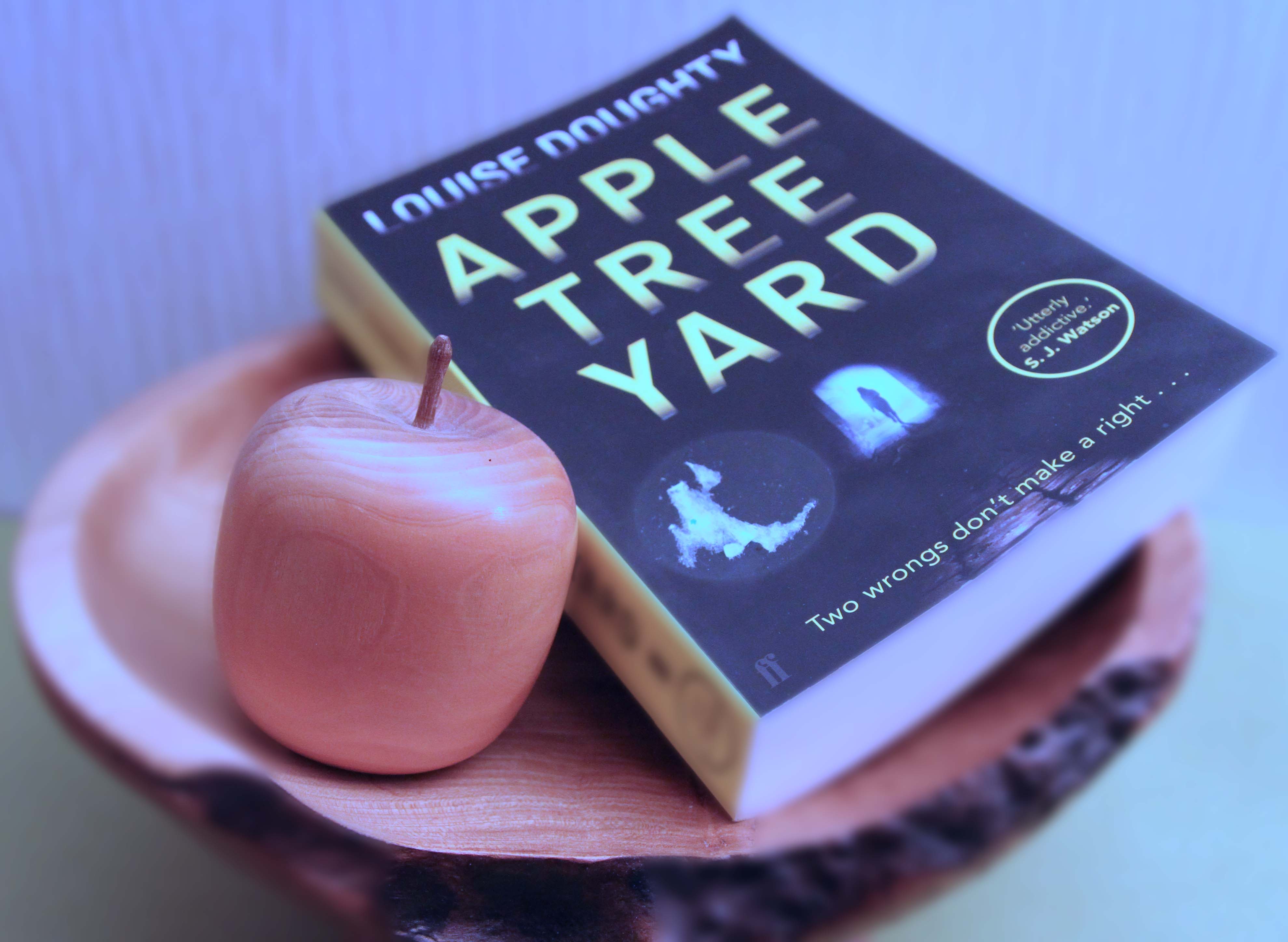
[Please be aware that I’ve included here precise reference to some key events in this novel, though not plot detail. If you fear your future enjoyment in reading Apple Tree Yard may be at risk, read the novel first – you won’t be disappointed – and come back for my review!]
I became a fan of Louise Doughty’s work almost by accident, when I was given a copy of Whatever You Love, a very distinguished novel and a brilliant study of obsessive grief, and was so impressed with it that I reviewed it on this blog. Subsequently, I have read Stone Cradle, set in my native Lincolnshire, and this summer I made a point of buying Apple Tree Yard before I went on holiday.
Apple Tree Yard is a truly magnificent work, shortlisted for the Specsavers National Book Awards 2013, and it certainly merits a prize. It doesn’t exactly fit into the crime genre (just as Stone Cradle isn’t ‘just’ a historical novel), but it is about at least two crimes and, possibly, about several others, depending on how you choose to read it.
This last point holds the vital key to the novel, because this is a book that manages to capture the ambiguities, generosities and tyrannies of the relationships that it describes and also succeeds in conveying that, although no human is perfect and some will commit atrocious acts of perfidy, betrayal, cowardice and cruelty, it is impossible to define anyone as simply good or evil. Even sleazy George Craddock, victim of a horrific murder but also perpetrator of an appallingly brutal crime, is shown to have vulnerabilities and a father who loves him.
The story begins, rather shockingly, with an act of consensual sex between the narrator, Yvonne Carmichael, an attractive middle-aged professional woman, a scientist, and a man who has just picked her up during a visit to the House of Commons. She does not even know his name, but allows him to penetrate her in the vault of the Chapel of St Mary Undercroft, which he has offered to show her on what she understands quite clearly to be a flimsy pretext. There is great skill in the way in which this encounter, which triggers the rest of the plot of the novel, is presented. On the one hand, it could be viewed as a grubby sexual exploit between two people who are addicted to risk; on the other, we don’t question Yvonne’s claim that she believed it was an act of mutual tenderness. Despite the fact that she doesn’t know her lover’s name and at this stage does not expect to meet him again, the reader is persuaded that this is not just a lustful fumble in the dark: it ‘means’ something. Finally, she does not spare herself some wry reflections on the absurd indignity of the situation: how she has to hobble along with one leg out of her tights, one foot out of her (elegant) boot; how her ‘lover’ – she calls him ‘my love’ throughout the novel – wordlessly passes her his handkerchief to enable her to deal with the physical detritus of their congress.
Yvonne could be seen as a woman who has been taken advantage of by a predatory male, a woman naïve in her assumptions about his motives, despite her intelligence and education. Yet she proves not to be entirely wrong about him, even though it becomes evident that at first he did merely regard her as a quick lay, a conquest that he more or less took on as a personal bet with himself that he could do it. As gradually becomes clear, Yvonne makes use of him, too (and in the most extreme of ways, as we discover in the final sentence of the novel). Furthermore, the two other men who are described in detail, Guy, Yvonne’s husband, and George Craddock, who is an academic she meets through her work, both also take advantage of her. Of these three men, Guy is the gentlest, yet also the most selfish. He says that he loves her and is fiercely protective of the family life they have built together, but he refuses to give up the young mistress with whom he is conducting an affair that compromises him professionally. Yet it is Guy who stands by Yvonne when she is accused of being an accessory to murder and Guy who cares for her after the trial, despite the fact that she has done to him the one thing that he always said that he would find unforgiveable: humiliating him in public.
The reader is always on Yvonne’s side, but the author shows that we’re not always expected to think that she is right; it’s clear that she behaves badly, too. There are mitigating circumstances. As the court case unfolds, we discover that her son has bi-polar disorder, that he fights her off when she tries to help him, that she stalled her career for many years (despite, it is implied, being as able as, or more so than, her husband) to raise her family and that now she is the person at the centre of the family who has to try to hold it all together whilst also holding down a demanding and financially insecure job. This sounds a bit like an addition to the already large literary dossier of women’s complaints about being treated unequally, but it is less clear-cut than that, just as the encounter in the vault could be viewed either as a sordid seduction by a stalker or a joyful, life-affirming act of freedom. I don’t know whether Louise Doughty studied rape and stalking cases in order to write this novel, but of one thing I am sure: if she were a barrister, she would be equally good at putting the case for the defence or the prosecution.
Yvonne’s treatment by George Craddock can’t be defended: it is hideous and brutal. The sequence of events that it unleashes reveals the strengths and foibles of all the main characters. The trial is described with forensic accuracy (Louise Doughty acknowledges help from various legal authorities in her depiction); the descriptions of how a jury operates chime exactly with my own experience of jury service earlier this year.
I realise that I may have made Apple Tree Yard sound like a gloomy book, but it isn’t at all. Partly because of the author’s dexterous use of language and partly because there is a rich vein of dark humour underpinning the whole story, it is a bright gem, a novel that captures the privileges and drudgery, the ecstasies and ironies and, above all, the ambiguous moralities of modern middle-class life. If you haven’t read it yet, read it now!
An anniversary I always remember…

Yesterday was the anniversary of my grandmother’s birth. She was born on 9th August 1892, which means that if she were still alive she would be 122 today. That is 164 days younger than the age attained by Jeanne Calment, the oldest verified person who ever lived, who died in 1997 (though a Bolivian man called Carmelo Flores Laura, still living, is reputedly 123). I like to think, therefore, that she could still be alive and vying with Signor Flores Laura for the distinction of being the oldest person in the world.
My grandmother actually died on 9th February 1979, when she was eighty-six and a half. She outlived all of the famous people who are listed as having been born on the same day as she except for one: Thomas Fasti Dinesen. I’ve never heard of him – I’m indebted to Wikipedia for this piece of information – but apparently he was a Danish recipient of the Victoria Cross who died on 10th March 1979, about a month later than my grandmother. Significant events that happened on her actual birthday include that it was the day that Thomas Edison was awarded a patent for a two-way telegraph and (of more interest to me and perhaps to readers of this blog) the first day of the trial of Lizzie Borden, the celebrated American murderess.
Every year when this date comes round, I pay a small, silent tribute to the strong, elegant and feisty woman that my grandmother was. She was in domestic service all her working life, a period which began when she was fourteen and did not end until she was seventy-four, with a very short break for the birth of my mother. She started her career, Tess of the d’Urbervilles fashion, as a poultry maid, working for an elderly lady in her native Kent. During the First World War, she trained as a nursery nurse at Bart’s Hospital and worked in London for more than a decade, looking after the two daughters (one was adopted and much younger than the other) of a Scottish diplomat. She then moved to South Lincolnshire to take up the post of housekeeper to Samuel Frear, the last of the great Lincolnshire sheep farmers. He lived at a large house called The Yews. It’s still standing, just off the main Spalding-Surfleet road. During the Second World War, after Mrs Frear’s death, she moved to Spalding to another housekeeping job, this time working for the Hearnshaw family. They lived in a substantial three-storey house in Pinchbeck Road. Her final post was as lady companion to a very old lady called Mrs James, who lived at The Laurels in Sutterton.
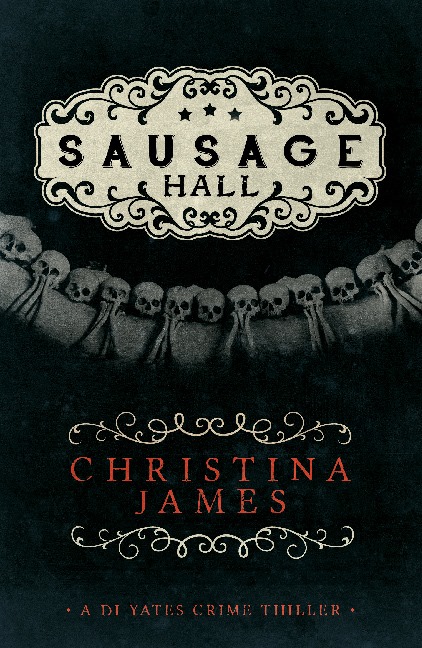
Sausage Hall, the house that features in the next DI Yates novel (to be published on 17th November) is partly based on The Laurels. I can remember visiting my grandmother there when I was a small child.
When Mrs James became too ill to be cared for at home, my grandmother finally retired, to 1 Stonegate in Spalding, one of three mews houses built in 1795. These houses have since been renovated, but when she lived there they had hardly changed since they were new: the toilet was at the end of the short back garden path and, although she had a bath, it had been installed in the kitchen: there was no bathroom as such.

This house (the one on the right of the three in this picture) suited her well, because it was a short walk from Spalding town centre and just over the road from Spalding Parish Church, which she attended several times during the week and up to three times on Sundays (always clad in hat, gloves and stockings, even on the hottest of days).
As it happens, I’m just reading Servants: a downstairs view of twentieth-century Britain, by Lucy Lethbridge. This is a meticulously-researched book. Although accessible, it is much more scholarly than many books I’ve read on the subject, which often fall into the trap of reading like a cross between Upstairs, Downstairs and Downton Abbey.

Many of the things that Lethbridge describes remind me of my grandmother’s accounts of work in the world of domestic service, but with one exception: she clearly never found the work demeaning and, although she must have been respectful towards her employers, she certainly did not kowtow to them. In fact, she gave me the impression that, in her day, trained servants were in such short supply that she could pick and choose whom she worked for and certainly earn a respectable salary.
My guess is that this was not because Lethbridge (or, indeed, my grandmother) has exaggerated the nature of the employer-servant relationship, but because my grandmother generally worked in a stratum of society not much covered by Lethbridge’s book: that of the upper-middle classes. Thus my grandmother was neither subject to the rules and strictures that servants in the grand stately homes had to observe, nor was she obliged to suffer the petty tyrannies and hard labour imposed by a ‘jumped-up’ lower-middle class mistress who could afford only one servant. The people for whom she worked were kind, enlightened, appreciative and wealthy enough to be able to pay for charladies, gardeners, maids-of-all-work and outsourced laundry services.
This is not to say that my grandmother did not work hard; I’m certain that she did. I know, for example, that when she was working for the Hearnshaws, she was accustomed to cook Christmas dinner for sixteen people. But the work that she did was appreciated and she had time to devote to her own preferred leisure activities: reading (especially geography books, a passion with her), fine embroidery and Christian worship. Each year her employers enabled her to take an annual holiday, either at the seaside or walking on the Yorkshire Moors.
She lived a long and useful life and, I think, it was overall a happy one. Reading Lucy Lethbridge’s book (which I thoroughly recommend), I am grateful to those long-gone employers for the way that they treated her.
 Christina James, crime novelist