

Conflicting swirls of belief…

Easter is a curious festival. Claimed by both Christians (to celebrate Christ’s death and resurrection) and Jews (to celebrate the Passover), it has its roots in even more ancient pagan rites that grew up to mark the emergence of the spring. This year, as I sit in my office looking out at a row of icicles, each more than two feet long, and the snowy landscape beyond, nature seems to have played a bizarre trick. The Christian ‘moveable feast’ concept would be perfectly logical if the holiday could be chosen after spring had demonstrably arrived, but I suppose that at some point we – or the government – would have to plump for a date and we might still get caught out by freak snowstorms. I doubt if David Cameron would want to be held responsible for a wet, cold Easter on top of everything else.
Easter is associated with the rising of the moon, the heavenly body worshipped by many prehistoric peoples. In Babylon, it was the feast of the Ashtaroth, the moon-goddess who also represented fertility; yet, paradoxically, there is evidence that babies were slaughtered on her altar. In modern times, Easter, like Christmas, has become a kind of black spot for domestic murders. One of the most notorious was the murder of eleven family members by James Ruppert in Ohio in 1975. A slightly-built, quiet-spoken man, he had no history of violence until he chose this day to lash out at the family that he felt had continually marginalised and despised him.
On a lighter note, Norwegians are apparently busy creating a new tradition of using the leisure offered by the Easter break to engage in their own personal crimefests, or several-day concerted sessions of reading crime novels. I suppose they have the reputation of having produced some of the world’s foremost crime-writers to uphold, but sociologists also attribute the trend to the deeper, more primeval association of Easter with death.
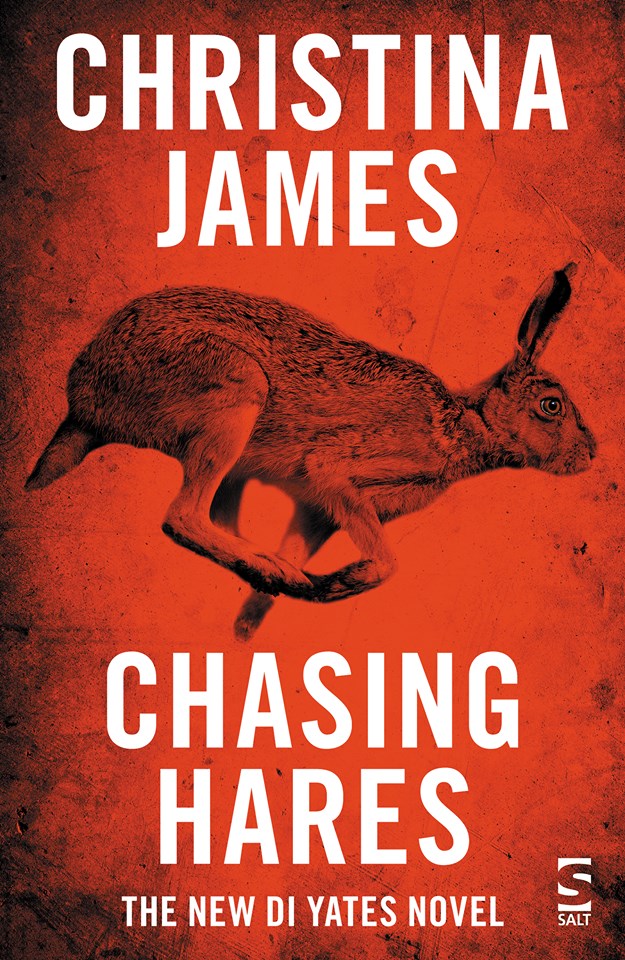
So far I’ve dwelt mainly on Easter’s powerful association with death, but, as I’ve suggested, it is a Janus-like event, intended to celebrate life and death together. Eggs, chicks, lambs, bunnies, Easter hares – all are familiar symbols of hope and regeneration. Personally, the thing that I like best about them is that each is available in chocolate. Chocolate was invented more than three thousand years ago by the Aztecs, another race of people with a penchant for human slaughter. It brings substance to the idea of killing for a box of chocolates. If everyone gives generously of chocolate this Easter, it won’t be necessary – we’ll all have plenty! And peace will break out.
Chaos and casual brutality in Leeds…
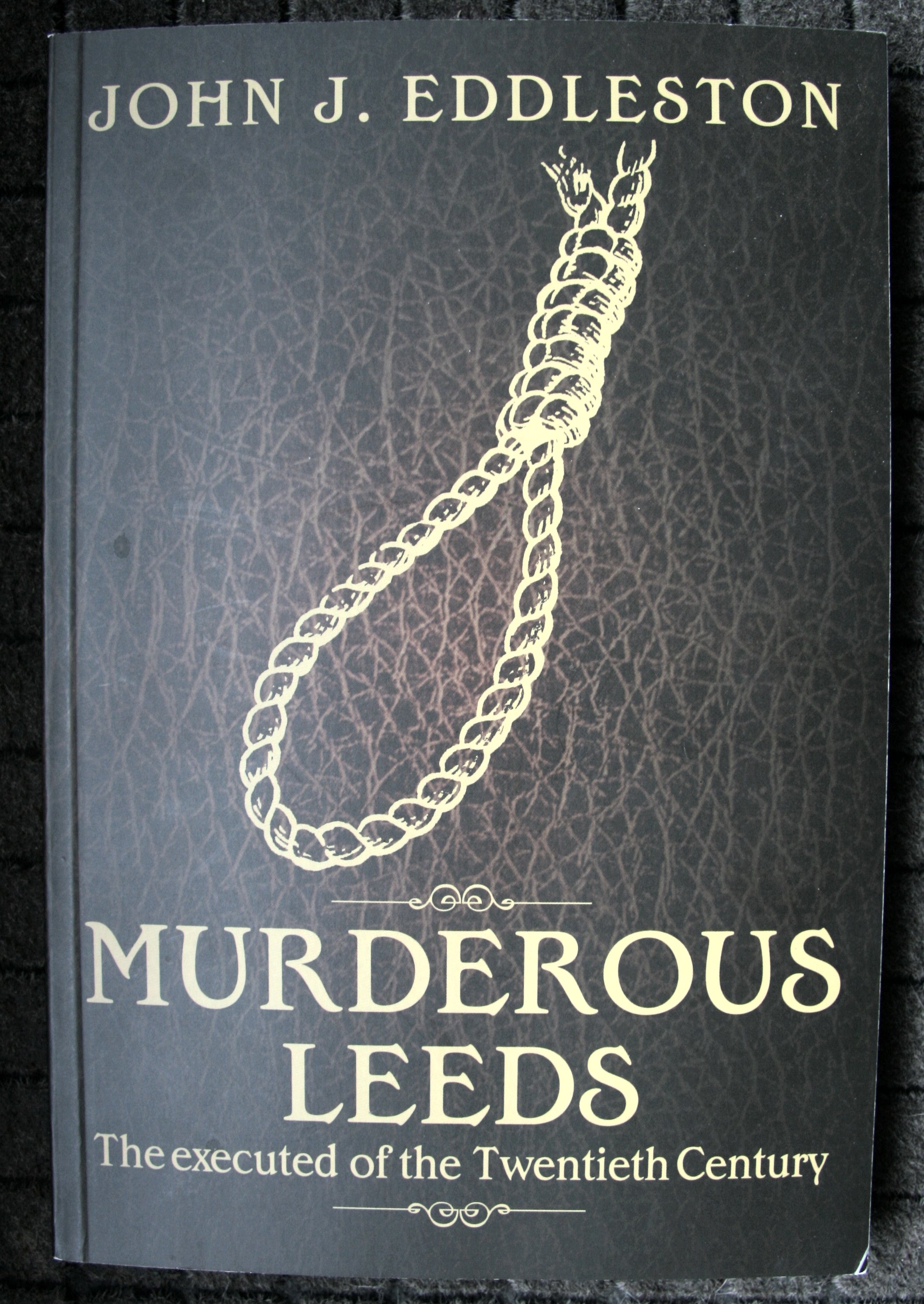
A book that I dip into occasionally is Murderous Leeds, by John J. Eddleston. Subtitled The executed of the Twentieth Century, it is a volume of short case studies, sourced from newspapers and court reports, of the trials of people convicted of murder in the first half of the twentieth century in Leeds.
Some of the murders were horrifically brutal; some were pathetic. The extreme poverty of most of those convicted was usually one of the most significant factors in their turning to crime. Many of these people – most were men, but some of the stories are about women – were of no fixed abode and drifted from one tawdry lodging-house to another or picked up women – or men – who were prepared to take them home. Some of the women paid for their generosity with their lives. Yet most of the convicted had jobs of some kind. It is hard to believe that, just two generations ago, many working men could not earn enough money to pay for a roof over their heads.
The saddest of all the stories is the first. It tells how, in 1900, a man called Thomas Mellor, aged 29, killed his two small daughters because he no longer had the means to support them. The jury that found him guilty commended him for his kindness in rescuing them from destitution in this way. He still paid for the crime with his life.
Among the most horrific tales is that of William Horsely Wardell, who persuaded a woman called Elizabeth Reaney to give him shelter and then brutally battered her to death. Attracted by the small reward on offer, her neighbours fell over themselves to ‘shop’ him.
Some of the accounts are bizarre, some are almost funny and a few exhibit a certain amount of intelligence on the part of the perpetrator. Most, however, portray a depressing picture of the grubby chaos and casual brutality of everyday urban working-class life. Many of the murders were not planned, but the result of drunken arguments, some of them ‘domestics’. The banality of these stories is one of the two reasons why I only dip into the book; I still have not read it all the way through. The other reason is that the author has decided to rely on verbatim accounts given by witnesses and judges’ summings-up. Whilst this is in many ways commendable – a treasure trove of fact of this kind is invaluable to a crime fiction writer – it has the drawback of resulting in a certain sameness if more than two or three of the stories are read in one go.
I do plan to tackle the book in one sitting at some point, though, because, as it spans the period 1900 – 1961, I know that a careful reading of it will show me how police methods improved during that time. It strikes me that, in 1900, real villains (as opposed to the desperate and probably mentally ill Thomas Mellor) could get away with almost anything; on the other hand, the forensic evidence produced in court in 1961 in order to convict Zsiga Pankotia, a Hungarian, of the murder of prosperous market trader Eli Myers was very sophisticated indeed.
When I’m walking through the streets of Leeds, especially in the market area, it often strikes me that the people I see may be the children, grandchildren and great-grandchildren of some of the victims whose fates are described in this book. Some may even be the descendants of their murderers. Sixty-seven people were hanged in Armley Gaol in the sixty-one years that the book covers. Apart from the exotically-named Pankotia and one Wilhelm Lubina (executed in 1954), almost all of them had good, sturdy Yorkshire names. I do hope that their descendants enjoy a more privileged existence than they did.
A role singularly prone to abuse and crime
There is a shop in Wakefield that sells party dresses for little girls. The name over the door is ‘Little Princess’ and its stock is overwhelmingly pink. As well as dresses, it sells shoes, capes, handbags, party bags, toys, napery and little crowns – almost all in pink.
To the girls of my generation, frilly party dresses were a cause for rebellion. I and my contemporaries fought hard to be allowed to wear trousers (‘trews’, as they were called by shop assistants, to make them respectable and distinguish them from what boys wore; I remember that my grandmother almost fainted the first time I appeared in a pair of trousers with flies) and later jeans. When we were a little older, we wanted to be different (like everyone else) by dressing entirely in black. We recognised that, although these battles were trivial in themselves, they were necessary to give us identity, to reject the ideas that we existed to be sweetly dressed up and that we were correspondingly feeble-minded, not to be taken seriously. I think that it is a great shame, therefore, that the current generation of little girls has taken what to me seems to be the retrograde step of favouring the types of apparel that my mother’s generation was all too keen on thrusting upon its daughters.
In case you are wondering, this post is not shaping up to be a feminist piece, however. What I should like to focus on is what is apparently a prevalent ambition amongst today’s little girls: to become a princess.
I have no illusions about my ancestors. I am quite certain that every one of them toiled at some menial occupation. Their very names suggest that they were shepherds, hewers of wood and farm labourers. The ones that I know about were domestic servants and small shopkeepers. I know that their womenfolk led drab work-filled lives which were unfairly skewed towards the service of their men: my paternal grandmother had four brothers and each Saturday night was made to polish the shoes and press the suits of them all, so that they would look smart for church on Sunday. Yet at least it is unlikely that any of my female ancestors suffered the worst possible of fates: I’m pretty certain that none of them was a princess.
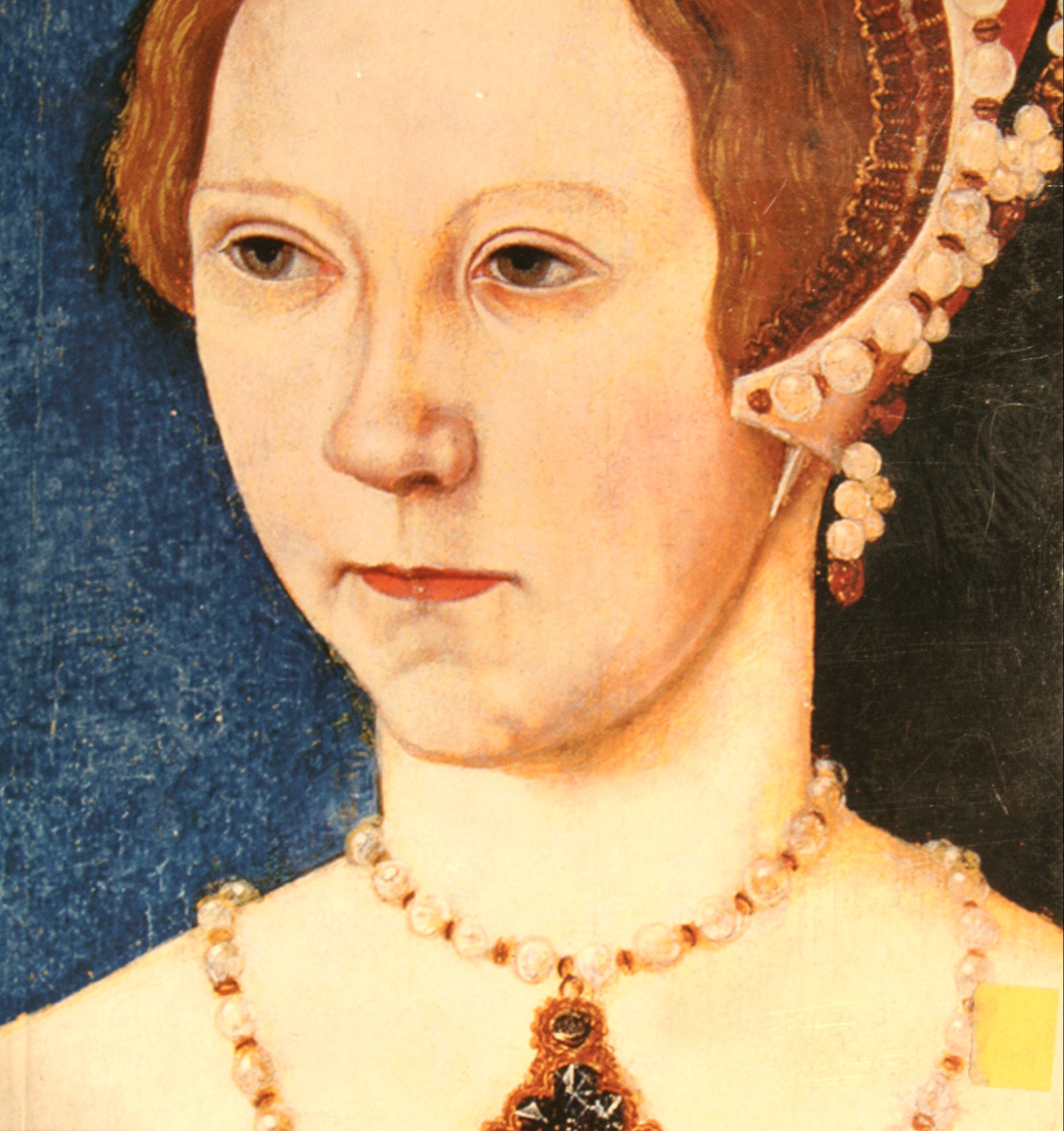
I’ve been prompted to think about this by reading history books for most of the weekend. Princesses were powerless pawns, to be manipulated by their powerful fathers and brothers. Brought up to believe that the men in their families were infallible and that therefore all the wars that they engaged in were just, they were then obliged to perform complete about-turns as these same men married them off to sworn enemies for dynastic advantage or to fulfil the terms of a treaty. Henry VIII repeatedly betrothed his daughter Mary to various crowned heads of Europe during her childhood, then changed his mind as he fell out with them and finally rendered her prospects hopeless when she was of marriageable age by repudiating her mother and denouncing her as a bastard.
Girls whose betrothals culminated in marriage were sent far away from home. Many never saw their families again. They arrived in a strange, hostile country, often unable to speak the language, usually able to keep their accompanying entourage only for a short time, sometimes to be married to a man three times their age, or, conversely, to a boy ten years their junior. Death in childbirth was common and likelier for a royal wife than for a peasant woman, subject as she was to the barbaric quackeries of doctors of any period before the mid-nineteenth century. It was a very exceptional royal husband who was faithful to his wife. He was likely to regard her as a baby-producing machine and reserve his affections for his mistresses. The wife would suffer even greater ignominy if she failed to produce an heir. If she had no children, or all her children were daughters, it was always her fault. Although her father and her brothers may have taken elaborate steps to hedge about her dowry with conditions, captive as she was in a foreign country, she had no wealth that she could call her own and faced destitution if she displeased her husband or he died (like Henry VIII’s elder brother Arthur) and her father-in-law was dubious about her continued usefulness. Discarded or disgraced princesses could hope, at best, to be exiled to a nunnery; more commonly they were executed or died in mysterious circumstances.
Curiously, although widows were often regarded as a nuisance and marginalised, some royal widows managed to become extremely powerful. Isabella of France, Edward II’s wife, was one of these. She almost certainly engineered her own widowhood by arranging to have her royal husband killed and then ruled in his place during her son’s minority. Posterity has denounced her as a wicked murderess, unmindful of the fact that killing was the business of kings. Her son, Edward III, eventually murdered her lover, but he spared his mother and allowed her to continue maintain the lifestyle of a great lady after he took control of his throne.
But Isabellas were few and far between. Most princesses were faceless, downtrodden and decorative: if not dressed in pink (as far as I know never considered to be a regal colour), their other purpose, besides child-bearing, was to look the part.
And that is why I think it is sad that little girls aspire to this ‘ideal’. They want to look the part. They have yet to understand that this particular look, if they don’t grow out of it, may condemn them to life in a gilded cage. As for many footballers’ wives, their idyll may end in divorce – which is a risky way of gaining independence – or it may eventually goad them into committing a crime that removes their freedom forever. Isabella was a fairytale princess who got away with murder. But she lived in the fourteenth century. It is a harder feat to accomplish today.
A brief encounter with Brighton… and a book
Last week I visited Brighton for the first time in perhaps ten years. I was there because The Old Ship Hotel had been chosen as the venue for the annual academic bookselling and publishing conference for which I organise the speaker programme. I discovered that there has been an inn on the site of The Old Ship since Elizabethan times. Originally just called The Ship, it acquired its venerable epithet after another Ship hotel was built nearby – this one a mere stripling dating from the period of the Civil War. Hotels in Brighton can be evocative places. I have also stayed at The Grand, both before and after it was wrecked by the IRA bomb, on both occasions to attend the Booksellers Association Conference (I liked it better before than after) and one year spent several days in a seedy little guest house when the company I was working for forgot to book until the last minute and all the hotels were full.
Brighton itself has not changed much in ten years, although it looked very odd when I arrived, because the streets and seafront were covered in grubby snow. A moderately heavy snowfall on the day before seemed to have caused a local catastrophe in which everything – public transport, the highways, even restaurants and cafés – ground to a halt. I concluded that they’re ‘nesh’ in the South of England; we clear away snow like that in half an hour in Yorkshire! Or perhaps Brightonians – if that’s the right word – are just staggered to see the white stuff at all and it therefore strikes them down with a sort of horrified inertia.
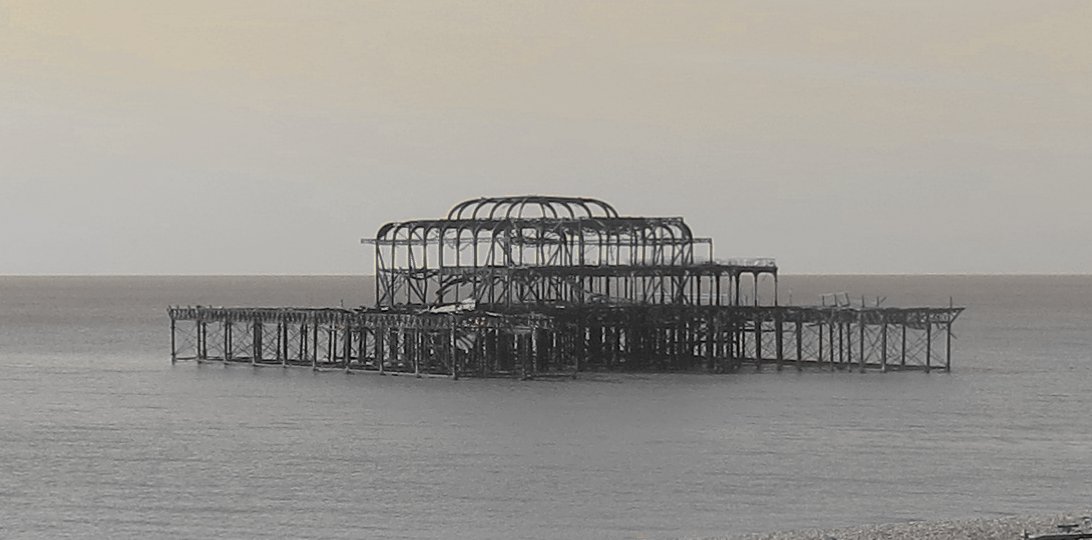
Anyway, by midday, although it was still very cold, the snow had melted and I ventured out from The Old Ship to meet my former English teacher for lunch (more about this on another occasion). Before the conference started, I also managed to take a walk along the promenade and was saddened to see the hideous buckled corpse of the West Pier, still rising up out of the sea like a squashed daddy longlegs. The structure has suffered terminal damage since my last visit.
After presentations, drinks and speeches, dinner, more speeches and more drinks, I went to bed. I was rudely awakened at about 4 a.m. by the noise of a huge crowd outside. I exaggerate only a little when I say that it sounded like the storming of the Bastille! I began to realise that my de luxe room, with its fine view of the sea, came with mixed privileges. Looking discreetly out of the window, I saw a gang of perhaps forty youths running about on the seafront, many of them braying obscenities. And they didn’t move on – they just stayed there! Brighton has obviously degenerated since the days of Pinkie Brown, who was a better class of yob altogether.
Since it was obvious that I would get no more sleep until the mob dispersed or was moved on, I adopted my usual all-purpose tactic for dealing with adversity and took out a book. It was The Mistress of Alderley by Robert Barnard, not a novelist I’d read before. Under normal circumstances, it wasn’t the sort of novel I’d have especially enjoyed. Although the setting is meant to be contemporary, the characters seem to belong to a time warp. The mistress of Alderley herself, a retired actress called Caroline Fawley, seems to me to be straight out of the set of Brief Encounter. However, under any circumstances I should have enjoyed the detailed descriptions of Leeds which number among the novel’s strengths and, while the fracas outside continued to roar, I found the descriptions of Caroline’s genteel rural life quite soothing. The icing on the cake was that it turned out to be a sham, a pretence laid bare by the murder of Caroline’s slippery millionaire lover.
I had almost completed The Mistress of Alderley by breakfast, by which time the louts had melted away and a rosy dawn was launching itself above the dead pier.

Elly Griffiths and Tom Benn in fine form at Breckland!
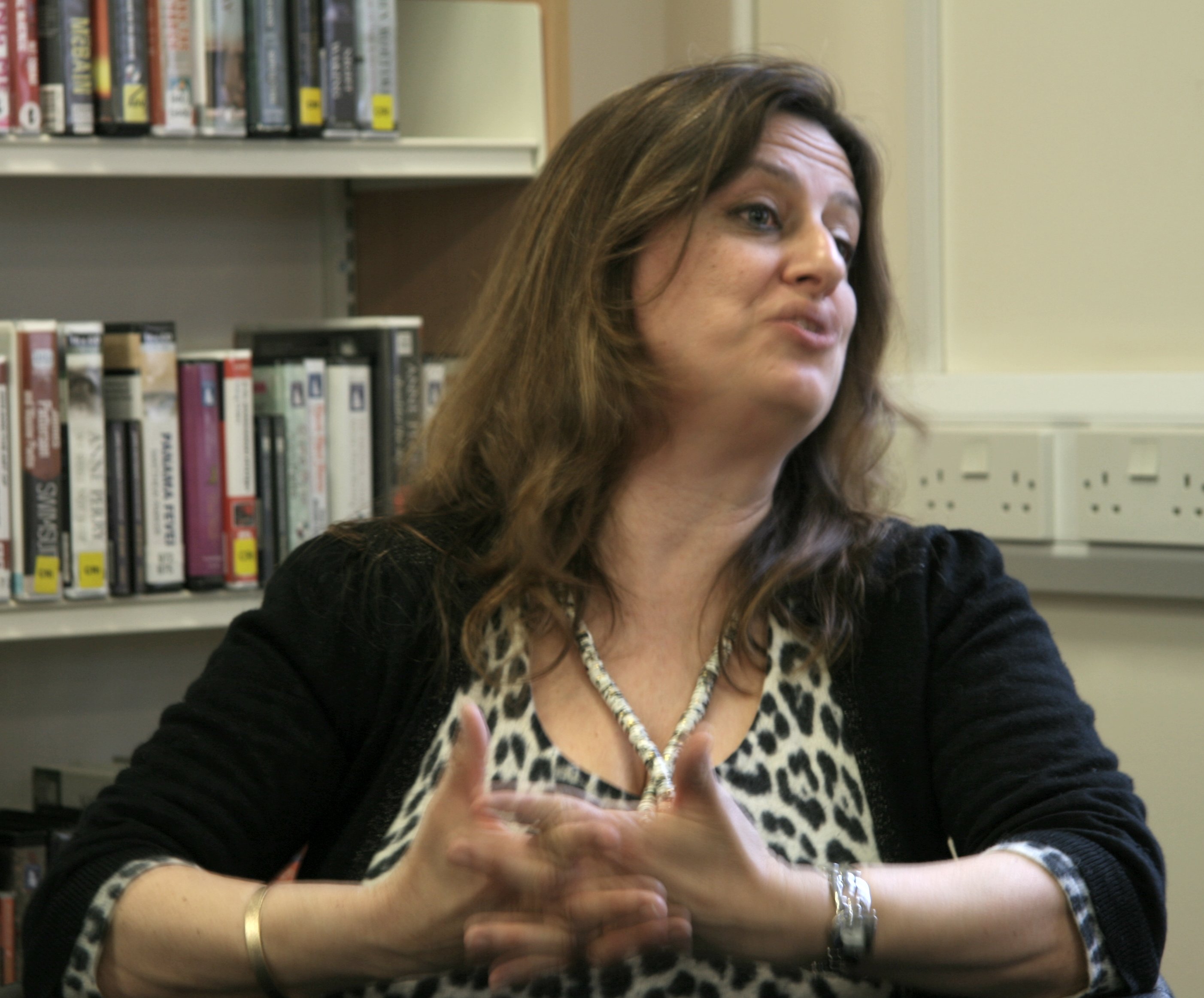


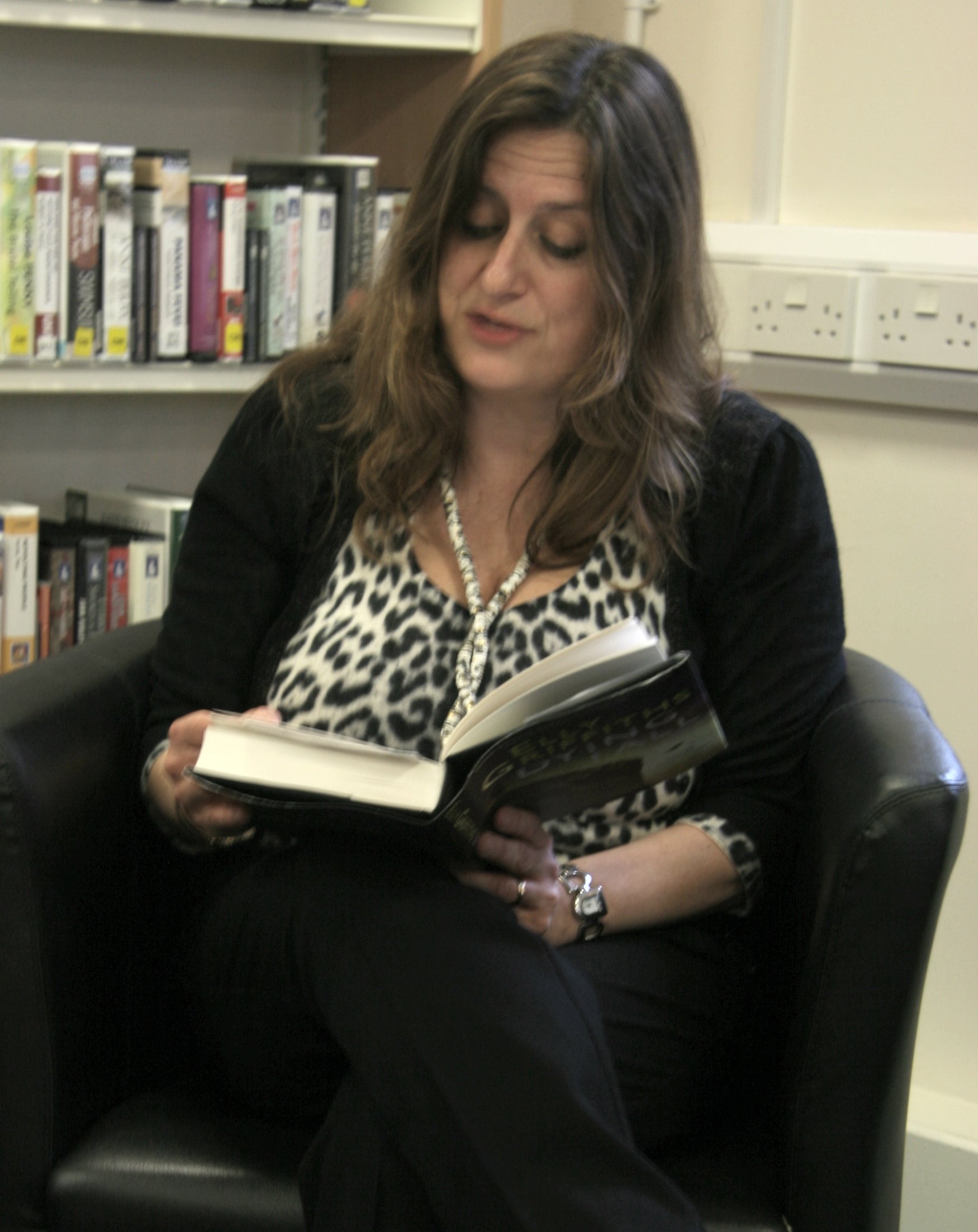
The small Norfolk town of Watton yesterday afternoon braced itself for bleak and squally weather, the rain coming in short eddies between gusts of wind that made the temperature seem even colder than it was. Inside, the library was a haven of warmth and hospitality, as Claire Sharland and her colleagues put the finishing touches to the Breckland Book Festival crime-writing event and offered welcoming cups of tea.
Elly Griffiths, Tom Benn and I all arrived early, as requested, and gathered in a small office to introduce ourselves and get to know each other a little better before we were ‘on’. I was fascinated to discover that Elly also writes novels about the Italian ex-pat community as Domenica de Rosa, her fabulous real name, and that Tom was encouraged to publish by his tutor at UEA, who helped him to place his first novel, The Doll Princess, with Jonathan Cape.
When we emerged from the small office at 3 p.m., the events space in the library had filled completely with people. I estimate that there were about forty in the audience – an impressive turn-out on such a dismal day.
Tom and Elly both read from their latest novels. Tom made the distinctive Mancunian dialect in which he writes come alive with his reading and, by doing so, also brought out the sophisticated humour which runs like a fine thread through the whole of Chamber Music. Elly also chose a humorous piece of dialogue from Dying Fall, and made the audience laugh with her vivacious rendering.
We were fortunate to have such a receptive and intelligent audience. Most had read the work of one of the authors; some had read both. Their comments and questions took in a discussion about the two writers’ very different but, in each case, key use of topography, character development, how each uses his or her writing to explore and develop relationships and the extent to which they feel defined by belonging to the crime writing genre (they don’t). We even managed to get on to some more general topics, such as e-books, authors’ royalties and the Net Book Agreement (the latter introduced, not by me, but by a member of the audience who had been a bookseller in the distinguished Waterstones bookshop at UEA).
Time flew in the company of Elly and Tom and their audience of like-minded lovers of literature. I had not read either Elly’s or Tom’s books before, but shall certainly keep them in my sights from now on. I hope also that we shall meet again in the future.
I can’t conclude without adding that the tea and home-made cakes with which we were rewarded at the start of the signing session were excellent. I’ve discovered that cake and conversation are two things that Norfolk does very well indeed!

Chamber Music, a novel for Breckland Festival

Chamber Music, by Tom Benn, is not the sort of book I’d ever pick out for myself in a bookshop, given a free choice. Why? Because even though I am impressed by the skill of writing a dialect-heavy novel, I find such an approach to dialogue rather painful to read; also, when I’m not very familiar with the dialect, I can’t ‘hear it in my head’. I must admit, too, that the presentation of the seamier side of life for a whole novel is, for me, too much noir in one go! However, as I’ve explained in a recent blog-post, I’m meeting Tom at a Breckland Book Festival crime-writers’ session which I’m chairing. Claire Sharland, the organiser, kindly offered to pay for this book if I acquired it. I should add, hastily, that of course I’d have made sure that I’d read it before meeting Tom, in any case!
Technically speaking, it is a brilliant novel. I don’t quite know how to describe the technique that Tom has used – it is Irving Welsh crossed with William Faulkner, if that makes sense. I know that often writers resent being asked if their books are autobiographical or ‘drawn from life’; and, whilst I have no intention of asking Tom such a question, it seems likely to me that he must have lived and breathed the under-class, criminal-underworld Mancunian society that he depicts – otherwise he would never have been able to write such pitch-perfect dialect or captured the topography of the mean streets of Manchester with such conviction. On occasion, the use of dialect is so rich that the non-Mancunian reader is baffled, but such is Benn’s skill that eventually it is possible to decipher meaning from context. For a simple example, I picked up quite quickly that ‘scran’ is slang for a tasty snack.
This book has very little in common with Elly Griffiths’s Dying Fall, the other book featured in the Breckland session, which is no doubt why these two authors were billed together. However, both do share a pronounced sense of place and in both novels I feel that the crimes act as a vehicle for exploring the characters, rather than themselves being the focal points of the novels. Henry Bane is a complex character who takes a lot of fathoming – I suspect I should learn even more about him if I were to read the book twice; and Roisin is portrayed in an enigmatic and, given the situations in which she is placed, paradoxically delicate way.
I’m particularly looking forward to asking Tom Benn to read a passage from Chamber Music when I meet him next Saturday, for I want to get the authenticity of his voice into my reading of the novel; I’m sure that a live reading will be captivating.

Cake, coffee and crime, a killer combination in The British Library
Ooops! Naughty Christina!
Yesterday, London was in the grip of one of those gloomy, fog-bound days of which Dickens wrote so eloquently. The streets were grey and obscured by swirling mists so heavy that they fell like grubby rain on clothes and hair. People were scurrying about, heads down, doing damage with their umbrellas.
The British Library shone, as always, an oasis of light, heat, calm and coffee… and, importantly, cakes. I went to the café there to meet a colleague and, our business done in ten minutes, we had a wonderful time drinking in the power of George III’s magnificent book collection (which is displayed behind glass and occupies the full height of the building) while eating chocolate pastries.
My colleague had to leave at midday, which gave me an hour to kill before my next meeting. This was just as I had planned, because I had picked up from Twitter that a Crime Writing exhibition is currently on display there.
Sponsored by the Folio Society (which has apparently published quite a lot in the genre, a point to remember when trawling secondhand bookshops for old Folio Society titles), the exhibition takes an alphabetical approach to crime writing. It consists of twenty-six glass showcases, one for each letter of the alphabet, each one showing or explaining some aspect of the crime writer’s craft. Unsurprisingly, ‘A’ is for Agatha Christie; ‘Z’, less obviously, for ‘Zodiac’ – i.e. for crime writing based on the occult.
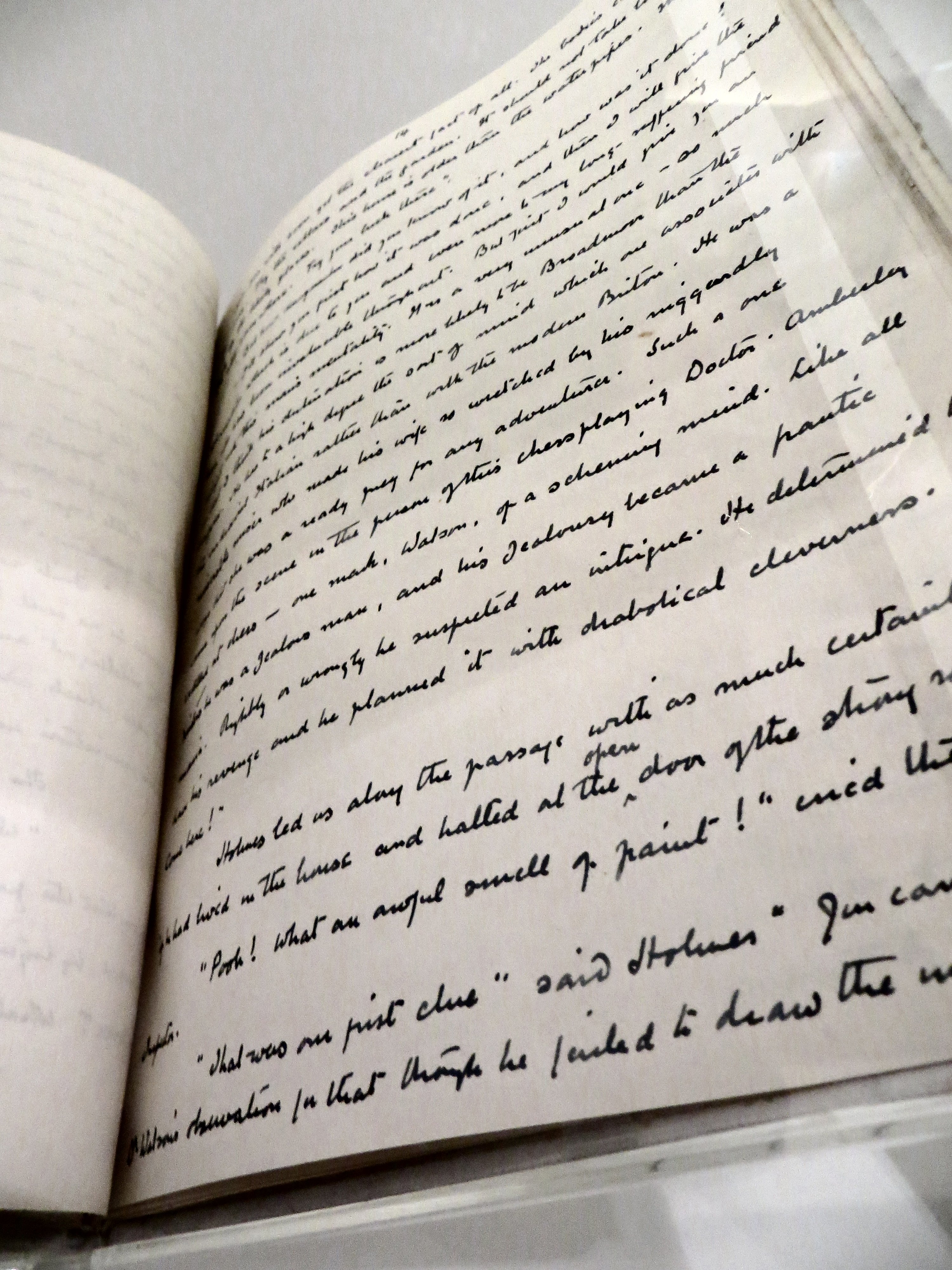
It is an inspired way of celebrating the genre. My favourite letters included ‘L’ for lady crime writers – I had not realised that until P.D. James published her debut crime novel, Cover her Face, in 1962, the fictional lady sleuth had pretty much dropped out of sight since Victorian times – and, of course, ‘B’ for Baker Street. The Holmes showcase included some specimens of Conan Doyle’s manuscripts (which I photographed before I was told to put away my camera by a security guard – I honestly had not realised that photography was not allowed!). I revisited many crime-related topics that I’ve researched myself, often presented in ways that made me regard them anew, and discovered some fascinating facts; for example, that Wilkie Collins’ estimated annual income from The Woman in White (published in 1860) was £60,000 p.a.
This equates to about £4.5m today. It and many of the other exhibits served to prove that, right from the start of its inception as a genre, crime writing could be made to pay. The exhibition, which is free, takes about half an hour to absorb. I highly recommend a visit if you get the opportunity – especially if it is raining and you are struck down by a pressing need for coffee… and cake.
How creative a fertile imagination, given the opportunity!

A shedful of secrets
Some time ago I wrote about Moon, the chef in the Chinese restaurant where I worked as a student, and how I was convinced that he had it in him to be a latter-day Jack the Ripper.
The summer when Moon and I worked together preceded the so-called ‘Yorkshire Ripper’ era, though there is some evidence that Peter Sutcliffe may already have begun his attacks by then. By the time that I was married and living in a semi-detached house in Leeds, at least twenty women had been injured or murdered by what was believed to be a single perpetrator, and the Ripper investigation was in full swing. During the last few years before Sutcliffe was caught, some of his victims were no longer prostitutes and all women living in Yorkshire were warned not to be out alone in the streets during the evening or in the early hours of the morning. We were even advised not to take the rubbish out after dark. Naturally, this both terrified us and had a substantial effect on the way that we organised our lives. For example, my husband drove me fourteen miles to work every day and came to pick me up in the evening so that I should not have to linger at bus stops or railway stations by myself.
After ‘Wearside Jack’ had played his silly pranks (He sent tapes to the police claiming to be the Ripper, speaking in a strong Geordie accent; it was not until 2006 that he was finally brought to justice.), members of the public were advised to be especially vigilant if they saw anyone acting suspiciously who also spoke Geordie. Our next-door neighbour worked for the Ministry of Defence at Barnbow in Leeds. He was a very shy man in early middle age who hardly ever spoke. He had a large family, but seemed to spend very little time with them. Most evenings and weekends he would hide himself away in a large shed that had been erected between his house and ours. And, when he did speak, it was with a Geordie accent.
My husband and I, who, like almost everyone else we knew, were obsessed with the Ripper case, discussed this neighbour energetically on several occasions and, before too long, had convinced ourselves that he was a likely Ripper candidate. We dithered about what to do about this: after all, we had no evidence to go on besides his accent and his general shiftiness. The police would probably laugh at us and, in any case, we didn’t want to cause trouble for him if he was innocent. Consequently – and fortunately, as it turned out – we had taken no action at all when Sutcliffe was finally apprehended. (Despite having ourselves read and listened to all the Ripper news bulletins for years, it was a friend who lived in King’s Lynn and had seen it on the TV news who rang to tell us that he had been caught.)
Our neighbour continued with his mysterious shed-based life. One day, after our son was old enough to play outside, he was invited into the shed. He told us that the neighbour had built an elaborate radio station in there and was in touch with people all over the world. He had let our son listen to some conversations that he’d had with his contacts in Russia and China.
He was still living next door, still devoting himself to life in the shed, when we moved away from the area. Obviously he turned out not to have been the Yorkshire Ripper. Nevertheless, with hindsight and perhaps a touch of imagination, I wonder if he was just an innocent radio ham, or whether his ‘hobby’ concealed a more sinister purpose. He was, after all, an MOD engineer…
Doing away with your wife…
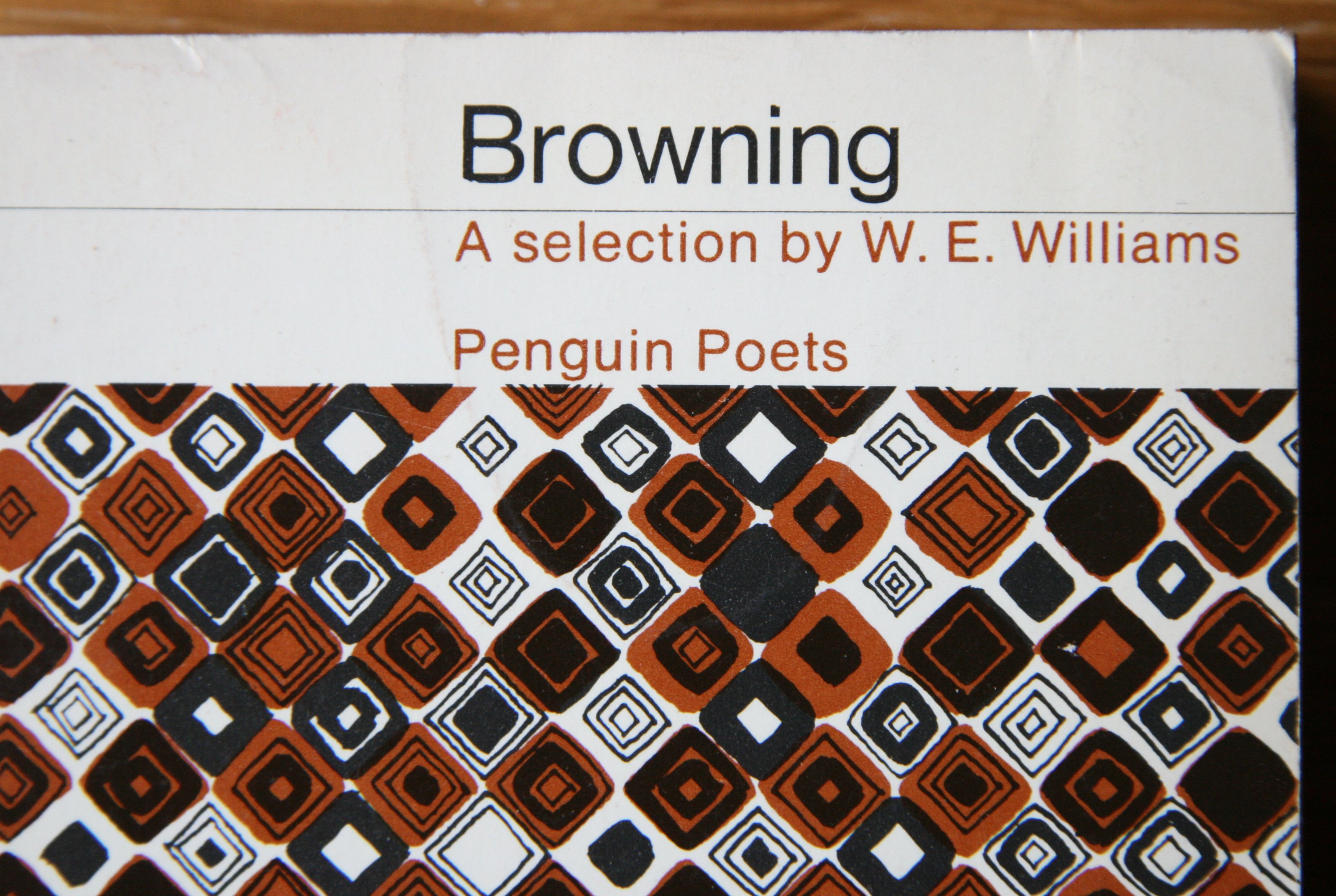
I have written before on this blog on the subject of dramatic monologues and of Browning’s use of them in his poem Porphyria’s Lover. I make no apology for turning once more to Browning’s poetry, which I love (even though Oscar Wilde damned him as a poet: ‘Meredith is a prose Browning, and so is Browning.’), for a glance at the literature which has influenced my own writing and its portrayal of the criminal mind.
My Last Duchess is a poem which works subtly on a psychological level. I remember reading it for the first time and being astonished at the way in which it made me engage with the situation it depicts, a powerful duke’s receiving an emissary and showing him a painting of his previous wife. (It is commonly thought that this man was the fifth Duke of Ferrara, seeking to marry a daughter of the Holy Roman Emperor, Ferdinand I, and coming to marriage terms via her brother, Count of Tyrol, Ferdinand II.) I didn’t need factual historical background to understand the poem, which itself, line by line, gradually led me along a trail of suggestions and clues to the horrified realisation that he had had his wife ‘done away with’.
In fact, the first thing that struck me as I read the opening lines (‘That’s my last Duchess painted on the wall, Looking as if she were alive.’) was that this was like Paulina’s presentation, in The Winter’s Tale, of Queen Hermione’s ‘statue’ (it is really Hermione herself) to the king, Leontes, who believes that his jealousy caused her death. Leontes says, in astonishment at the sculptor’s skill, “The fixture of her eye has motion in’t, As we are mocked with art.” The portraiture of the Italian Renaissance was, of course, sublime in its depiction of looks and character and I was initially lulled by my reading of The Winter’s Tale into thinking that this poem would similarly celebrate artistic achievement. I could not have been more mistaken.
The monologue forces the reader into the shoes of the emissary, listening to the Duke and drawing conclusions about his attitudes, opinions and personality, just as we might upon meeting someone for the first time in real life. Browning’s power lies in his understated use of speech; it is all so matter-of-fact! Line by line, we receive the duke’s description of the cheerful friendliness of this young woman, who smiled on all alike, and we gradually realise that he thought that she should smile for no-one but himself and preserve for the rest a haughty reserve. Then comes the shock: ‘I gave commands; Then all smiles stopped together.’ Now, with a hammer’s clang, we see why only he may draw the curtains which conceal her lifelike, smiling face: he has ensured that she will smile only for him. He passes on, leading the emissary, and talking of another artwork with equal lack of emotion.
I have read this poem countless times and it has itself the freshness of a new painting whenever I come back to it. I look for this psychological detail in the presentation of villains in crime novels and I am delighted when I find it. There is, for me, far less enjoyment in more stereotypical portrayals, which rely more for impact upon the brutality of actions than upon the workings of minds.
Fabulous: a book festival!

I am delighted to have been asked to chair the crime writers’ event (at Watton Library in Norfolk), which takes place as part of the Breckland Book Festival on Saturday 16th March. It’s a session that features Tom Benn and Elly Griffiths.
Yesterday Claire Sharland, one of the organisers of the event, got in touch to suggest that I should read their latest novels, Chamber Music (Tom) and Dying Fall (Elly), before the session and generously added that the festival would pay me for the purchases. I am delighted with this offer – I shall buy the books when I am in London next week. I’m sure that, very shortly, I shall also be reviewing them on this blog!
It’s always nice to be given some books, especially if you buy them all the time. I’ve long been amused by the Booksellers Association’s definition of a ‘heavy book buyer’ as someone who buys twelve or more books a year – most years, I barely get through January without hitting this figure. What really excites me, however, is that someone has prescribed my reading for me. I’m going into this totally blind – I haven’t been prompted by reviews, word-of-mouth recommendations or even by spotting the titles in a bookshop. Aside from examination texts, I can’t remember when I was last instructed in what to read in this way. It might have been during my third year at high school, when the class text was My Family and Other Animals, by Gerald Durrell. My bookish, priggish thirteen-year-old self turned up her nose in disdain when sets of this were distributed. I didn’t think it was suitable ‘serious’ reading for someone who, while still at primary school, had read such classics as Jane Eyre, The Thirty-Nine Steps and Great Expectations, especially as – distasteful innovation – the school copies were in paperback!
It’s a pity that I didn’t adopt such a fastidious approach to every subject. Today I wouldn’t be able to recognise a quadratic equation if it bopped me on the nose; and I’ve never mastered the mysteries of algebra (though it now occurs to me that it could be a useful vehicle for plot construction: let x be the murderer, y the victim, z the wicked stepmother etc.).
I should add that my precious teenage prejudice against My Family was immediately dissipated by reading its delights; I’ve read it several times since and it was one of the books that I read to my young son at bedtime. I’m certain that I shall like Tom’s and Elly’s novels, too, and look forward to making their acquaintance, first through their work and secondly in person. If anyone reading this should happen to be in the vicinity of Watton Library at 3 p.m. on 16th March, I hope perhaps to meet you there, too.

