

The mystery, madness and magic of memory…
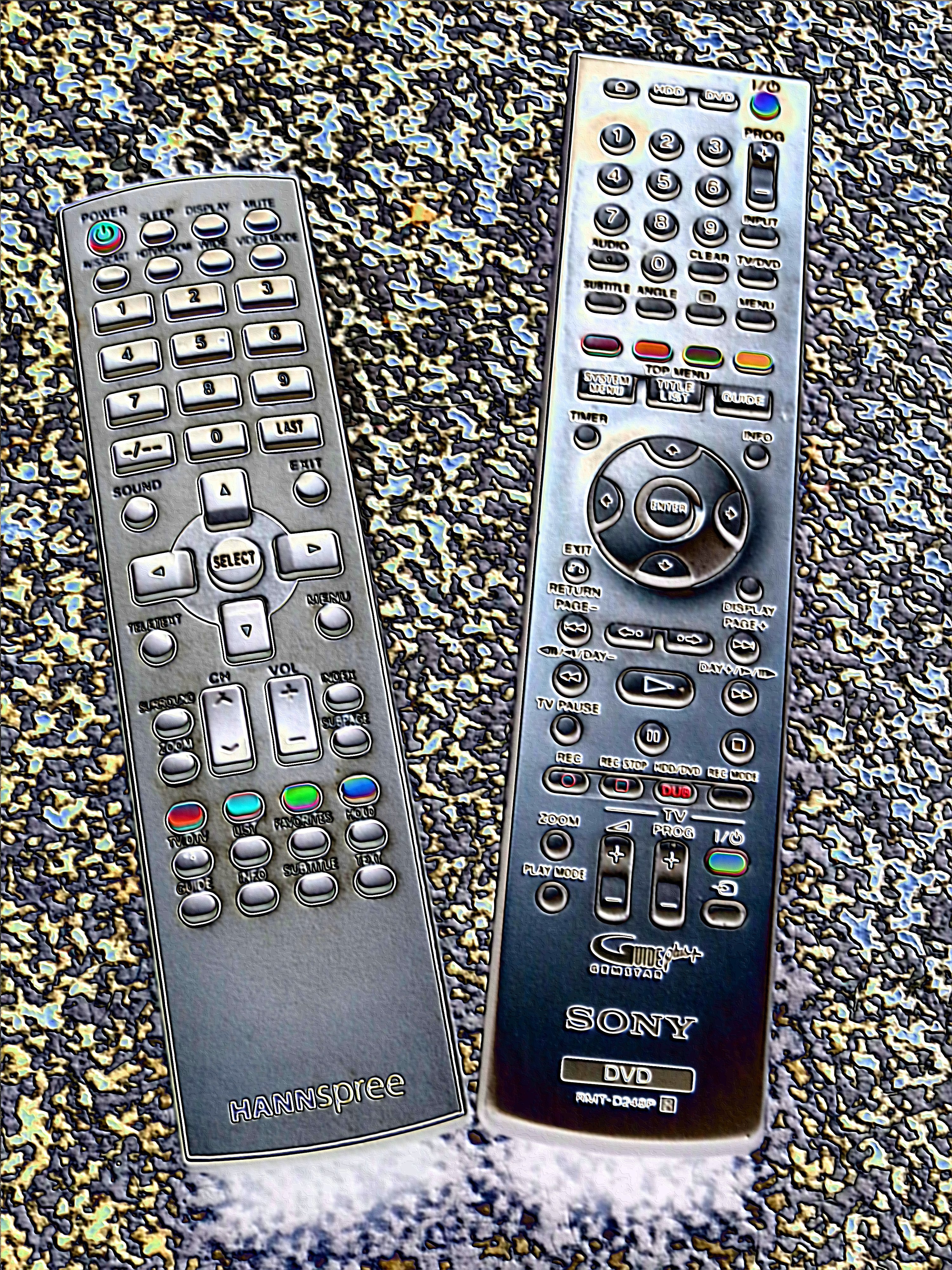
Which buttons? In which order? Aieeeee!
My friend Priscilla, visiting recently, said that my memory was remarkable. This is only partly true: I can never remember how to get into my online banking account and dread the mandatory six-monthly tussle to open it, a necessary process to stop the bank from discontinuing access via my chosen password (that I also can’t remember); I never know which of the buttons on the dashboard of my car releases the locking petrol-cap and have on at least one occasion had to resort to asking a complete stranger, the obliging but clearly exasperated man waiting behind me on the garage forecourt, for help; and, somewhat to my shame, I admit that I can’t turn on my own television. I hasten to point out that, in our household, this isn’t a simple case of clicking one button and then a channel number on a remote: my husband, who is practicality personified, insists that its performance and picture are better if the controls are run through the DVD player. This involves pressing manually a button at the back of the set and using the controls of two separate remotes in the right order to bring up a channel. On the only occasion that I have managed to switch it on, all but a two-inch border at the edge of the screen was obscured by a giant bright green rectangle, as if the programme had been censored by a Martian.
However, Priscilla, who was my flat-mate and closest friend during my university years, is correct that, when it comes to people and what they wore and said, even decades ago, my memory tends not to let me down. I can remember, for example, almost all the clothes that she owned at that period: the turquoise reversible cape; the beautiful green and black floor-length dress she wore to parties the year that everyone turned twenty-one; the red belted sweater that she was wearing on the day that we first met (out of character, this – I don’t think I’ve ever seen her wearing anything else in red); the pink checked Marks and Spencer shirt that she took home for her mother to repair when she ripped the sleeve and many other of her garments.
I’m not sure why I have this kind of selective memory. It’s certainly not something that I’ve tried to cultivate. It may have something to do with the fact that, from a young age, I’ve always intended to write and have therefore sub-consciously filed away a ragbag of material (this is not a pejorative representation of Priscilla’s student wardrobe, I hasten to add!) that might come in useful one day, whereas it’s highly unlikely that I shall ever want to introduce into my novels the mechanics of online banking, filling the car with petrol or turning on the television; yet I think it might also be related to the way that the two generations before my own spoke and behaved. I grew up in the last few years before the half-generation ahead of mine decided that it was a good idea to ‘let it all hang out’. My childhood was dominated by my grandmothers’, rather than my parents’ generation, simply because there were so many of them: one of my grandmothers had six sisters and a brother and the other four brothers (and both had had other siblings who had died in infancy). By contrast, my mother was an only child and my father had one sister, who emigrated while I was still at primary school. There were many family gatherings and I also spent quite a lot of time with each of my grandmothers on her own.
People of that generation – the last to be born before the First World War – didn’t tell you what they thought in so many words, particularly if it was something disagreeable. You had to figure it out for yourself. For example, I very clearly remember standing on the landing of my father’s mother’s house – it had a big oval window edged with squares of coloured glass in blue, red and green, and the sunlight was streaming through it – while my grandmother folded sheets and stowed them in the linen cupboard with the deft efficiency of an automaton. Standing on the windowsill was a black and white photograph of my parents on their wedding day. It was very familiar to me: the same picture, in various frames, adorned mantle-pieces and windowsills in the homes of all my great-uncles and great-aunts, my other grandmother and, of course, my own home. My father was wearing a dapper double-breasted suit; my mother, slightly taller than he in her white platform soles, a drooping full-length white dress (it certainly wasn’t a meringue) which looked as if it might originally have had quite a low neckline but had been primly filled in with a layer of net that almost reached my mother’s chin. Her hair was parted in the middle and almost concealed by the heavy headdress that anchored her floor-length veil. My father was grinning from ear to ear, but my mother wasn’t quite smiling. On the spur of the moment, I asked my grandmother whether she thought my mother had looked pretty on her wedding day.
My grandmother pursed her lips.
“Different folk thought different things. It was all a long time ago, and I’m not going to drag it up again now,” she said, folding the linen ever more ferociously. I was astonished at this remark, but I knew better than to pursue it further: I’d simply have been ‘put in my place’ and certainly would not have elicited a more enlightening comment. However, I still ponder what she said and wonder what it meant. Did my grandmother not like the dress? Was it she who had insisted on doing something about the ‘immodest’ neckline? Did she think my mother should have worn flatter shoes, so as not to emphasise my father’s shortness? An outsider might think that it was just a typical bitchy mother-in-law remark, but my mother and grandmother always seemed to get on well together: in fact, I observed that often they were allies and knew that my grandmother was naturally a generous, not a spiteful, woman.
For a writer, though, these two sentences are like gold. It’s been worth filing them away in my memory for more than four decades. I still enjoy working out possible solutions to the puzzle that they represent. I may even base a whole book on them at some point, whereas I’m unlikely to get much mileage (sorry!) out of a petrol cap. But the man who helped me with that, now, he’s of an entirely different ranking in the memory stakes: he was thick-set, slightly balding and wore a Huddersfield Town shirt with grey jogging bottoms. He had a Barnsley accent. “Now, lass,” he said ….
Barry Forshaw, @CrimeTimeUK, interviews Christina James


Today, I’m honoured to be given space on Barry Forshaw’s CrimeTime site. He has interviewed me about myself and Almost Love. Very many thanks, Barry! 🙂
Follow CrimeTime on Twitter
Follow @CrimeTimeUK
Visit the CrimeTime site!
Faster food and fashion… This irks!

I’ve not had a gripe about words and their usage for some time. However, last night an old irritation re-emerged as I was preparing dinner.
I hate colloquial abbreviations that turn a perfectly serviceable – and sometimes quite beautiful – word or phrase into a much more humdrum, not to say unintelligent, expression. This is an irk (I’ve just made a noun of that!) that goes way back into my childhood. I grew up in an era when the relative affluence of the 1960s was taking consumerism to new levels and my mother frequently sent me on errands to our local shop, which (even then) belonged to Spar. As part of the independent retailer drive against the supermarket chains which, even in towns like Spalding, were just beginning to take hold (my Uncle David, who also kept a shop and didn’t belong to any kind of co-operative, was always railing against them), the shop usually displayed a few items marked ‘special offer’. As a nine-year-old or thereabouts (I admit that I was probably an insufferable little prig!), I remember the strong sense of semantic outrage that I felt on the first occasion that I heard the shopkeeper describe one of these as ‘on offer’. Now, of course, this is such a familiar term that ‘special offer’ has almost disappeared from usage; many retailers even use the term ‘offer’ without a preposition.
Since then, many similar slimmed-down inventions have offended my ear. The term ‘Brussels sprouts’ is a case in point. My father frequently abbreviated this to ‘Brussels’, which I felt gave the vegetable, although it provided good, solid English fare, a hint of continental exoticism. I was not so delighted when I came to live in Yorkshire and found that the locals always call them ‘sprouts’ – a less attractive word I could hardly conceive of!
Then there were ‘high heels’, those potent rites of passage into womanhood that girls aspired to and were once not allowed to wear until well into their teens. I’m not quite sure when this happened – possibly longer ago than I realise – but I note that now they are always called ‘heels’. Ugh! If you’d used this word to my grandmother, who was not particularly enamoured of the male sex, she would immediately have understood that you were referring to a couple of less-than-satisfactory men, not a pair of glamorous shoes.
And, while we’re on the subject, what about ‘mains’, as in ‘main course’? It’s another one that’s crept up on me. When was the second word dropped? Did restaurants not have enough space on menus and billboards to write the whole phrase? It sounds like an apology for a waterworks.
And now – wait for it! – as I discovered yesterday evening, Sainsbury’s is describing its garlic ciabatta bread as ‘a classic and Italian side’. A classic and Italian side of what? Of course, I know that it refers to ‘side dish’, or, as the Americans would say, something to be presented or eaten ‘on the side’. But why not say so? Why mangle the language in this way and diminish both the magic of the words and their sense?
Perhaps I’ve now become an insufferable much older prig… or perhaps I have a point.
I finally get around to reading an author I should have read before…

I’d heard a lot about Ann Cleeves; I had followed her on Twitter, to a kind reciprocation; the reading groups that I joined at Wakefield One had heaped glowing praise upon her work. Yet I had never read her – it was therefore high time that I rectified matters.
I bought two of her books from Rickaro: The Crow Trap, which is set in the Pennines, and Red Bones, one of her Shetland Isles stories (I know that these have been televised, but I haven’t seen any of the programmes). I chose novels set in two different locations, because, as I’ve said before, topography is important to me. I know that Ann Cleeves has a reputation for creating fine atmospheric settings – as one of the reading group members said, Shetland ‘almost becomes a person’ in the books set there – and I wanted to see how she achieved it.
I’m not, however, going to write here about her use of setting, because, although I endorse everything that has been said about it by others, I have nothing new to add. What I’d like to focus on especially, therefore, is her skill at character portrayal, particularly of women. I find her female characters fascinating, not only because of the way she draws them, but because she captures with subtle and skilful nuances some of the ways by which women are still exploited by men – though she is by no means a militant feminist and the male characters in her novels suffer from certain injustices, too. Some of her women characters find their own ways of fighting back: Anne Preece in The Crow Trap tries to make use of both her husband and Godfrey Waugh to provide her with the lifestyle that she craves, although both in their turn exploit her as part of the chess-like game of shifting relationships that forms a fine sub-plot to this novel; and Jimmy Perez, the policeman hero of Red Bones, is continually kept guessing about the depth of feeling that his vivacious, unconventional girlfriend Fran entertains for him.
I enjoyed both of these novels immensely. Ann Cleeves writes quite unlike any other crime novelist whose work I know. If I had to choose between them, I’d say that The Crow Trap has the edge on Red Bones, mainly because, although both are set in remote areas, the Shetland novel offers less scope for variety in characterisation. Both are rural variants of the country house murder convention, each with its own subtle twists that bring new life to this sub-genre. However, Red Bones has a strong archaeological theme, which was of special interest to me because when I read it I had just completed Almost Love, which is in part about the disappearance of a famous female archaeologist and set against the activities of the members of a famous archaeological society.
I see that Ann Cleeves is a prolific writer who has written many books. I can therefore look forward to many more hours of happy reading in her company.
Oh, poison again… in my blog, just a little at a time!
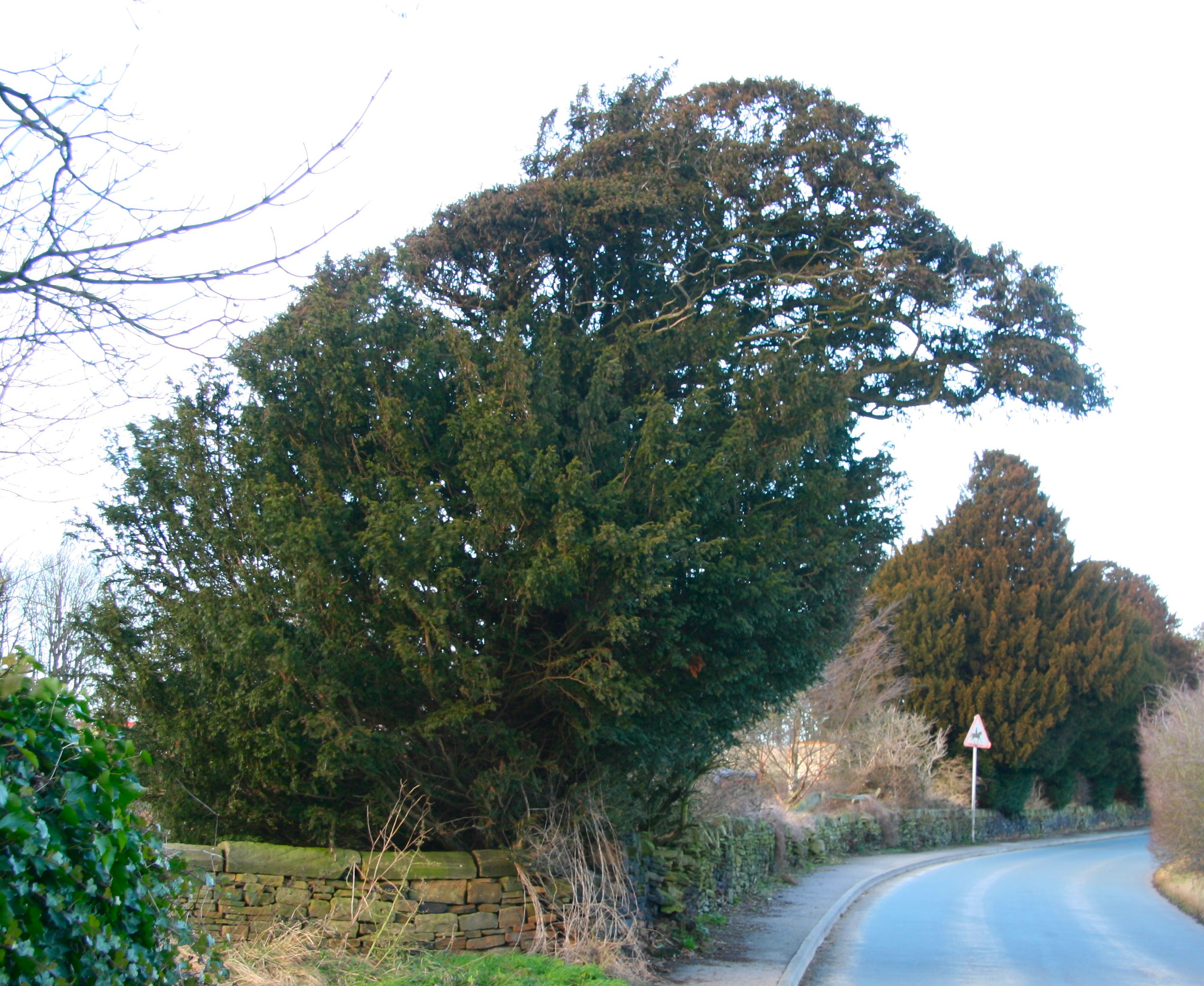
The yew, source of very poisonous seeds and leaves
I had such interest yesterday in the post about digitalis that I hope you will indulge my taking the subject of poison a little further today; poison little and often, then!
I’ve said several times that I’m not a blood-and-guts writer. Most of the murders in my books take place off-stage. Sometimes, if it is a cold case crime, the method that the murderer has chosen cannot be established. When murders do happen on set, as it were, I don’t dwell on the details: I don’t describe the brutal physiological results of a stabbing or shooting. I choose not to do this from personal preference and have recently had my choice endorsed by the reading groups whose meetings I have had the privilege to attend. I’m certain that there are readers who enjoy graphic accounts of violence, but I haven’t met many and, in this respect at least, my novels don’t cater for them.
Murders have to come about by some means, even so, and there are many methods I have yet to explore. I guess that if I were to put my imagination to work on them full-time, the possibilities would be endless. The literary canon is studded with outlandish murders, from George Duke of Clarence’s drowning in a butt of Malmsey wine to Hannibal Lecter’s grotesque destruction of his guards and Jo Nesbø’s Leopard’s inventive use of a ‘Leopold’s apple’. Murders tend to fall into categories, nevertheless. And one of them is poison.
Of course there are some famous male poisoners, both in fact and fiction, but, used as an instrument for plotting and arranging death, poisoning is supposed to be a peculiarly feminine choice; think arsenic and old lace as the stereotype. I’m not quite sure why. It’s true that it doesn’t require the force that stabbing, strangling and bludgeoning dictate, nor is it as a rule as messy (though this isn’t inevitable: nux vomica is very aptly named). Yet, if remoteness from the deed is the most prized attribute when the murderer is considering the best MO, shooting wins outright. The victim and murderer don’t have to speak, touch or engage with each other in any way for a fatal shooting to take place. If s/he is careful, the shooter leaves no forensic evidence except the bullet itself; the gun that fired the bullet can be matched to it if discovered, but disposing of a gun is not difficult. This is obviously why shooting is favoured by contract killers, but it demands both a particular skill-set and the possession of a gun, which can be daunting, if you’re not a member of the underworld.
By contrast, poisons are all around us. The average household must contain several dozen potentially murderous poisons, from items that only become dangerous if taken in excess, such as analgesics and alcohol, to paraquat (Susan Barber’s weapon of choice for disposing of her husband, Michael, in 1981), bleach and the multitude of cleaning fluids which are only safe in a domestic setting because the average adult would not dream either of ingesting them or of putting them in the way of the naïve or unsuspecting. Then there is the garden, a veritable hotbed of powerful poisons, from the tall and handsome purple and white foxgloves I wrote about yesterday to the exquisite scarlet yew berries or arils, the seeds in which are highly poisonous, as are the yew’s leaves. One of the best television crime series that I’ve seen was Mother Love, which featured Diana Rigg as the spurned first wife who killed her husband’s second wife with home-made biscuits sandwiched together with mashed yew-berries.
Perhaps I’ve just hit on why there seems to be a particular affinity between poison and female killers. It requires premeditation: a master-plan that is ruthlessly adhered to even as the victim is suffering terrible agonies and could perhaps still be saved by a would-be killer overcome by compassion. The poisoner has to have nerves of steel and a strong motive to murder, as well as excellent organisational powers. Revenge is the most likely motive to have spawned the crime, a revenge born of a long and brooding grievance that the perpetrator has fed and nurtured until the murder seems to be not only an act of justice, but unavoidable. Poisoning is an act of pure malice. No mitigating circumstances can be offered: it is never spur-of-the-moment. It cannot be attributed to a sudden access of anger, outrage or grief, unlike the more ‘masculine’ crimes of shooting and stabbing. In order to get away with the deed, poisoners need to be reflective, good at research, possessed of a chillingly high order of intelligence. I’ve listed some common poisons in the paragraph that precedes this one. Identifying poison is not difficult, but choosing and applying the one that achieves the desired effect before the victim seeks medical help, one that also cannot be traced back to the poisoner, may be tricky. It demands sustained effort, application of knowledge, scrupulous attention to detail and a high IQ.
Consider this for a moment. It is an apt description of many a multi-tasking mother and wife who is running a home and at the same time successfully holding down a job. The only difference is that, typically, she has neither the time nor the inclination to murder. In short, it’s a good thing that most of us don’t carry the murder gene in our DNA. If we did, there would be a population implosion!
Beauty and death…
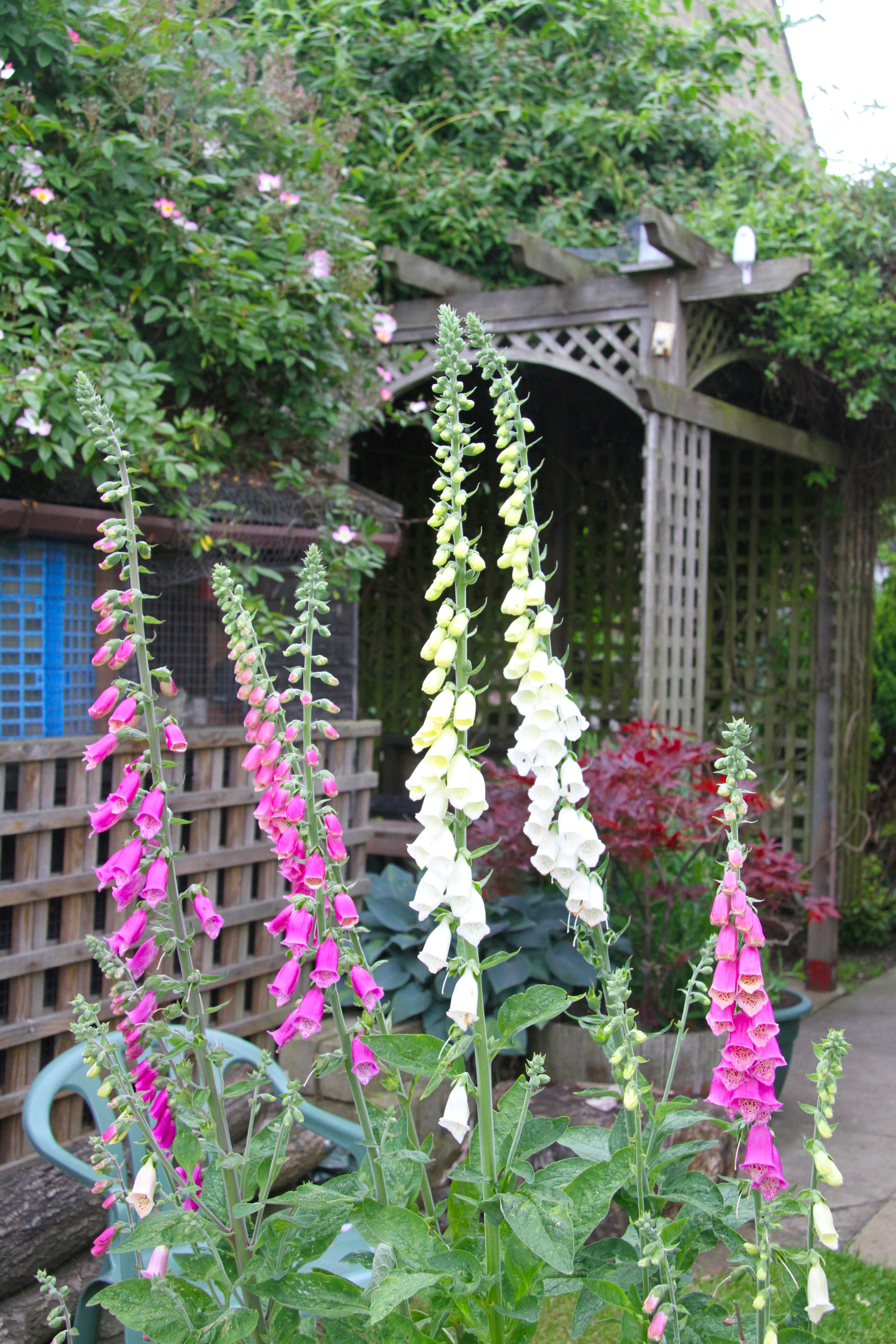
Digitalis, the foxglove
After rain and sun, the garden is a gloriously abundant and colourful mini-paradise; great wafts of scent sweep in through the open windows and still evenings are a sumptuous sensory banquet as I wander and fondle leaves and taste the herbs, sniff the honeysuckle and roses, listen to the chatter of the housemartins under the eaves and have my eyes caught and held by bee and moth and bird and flower.
Most striking of all, at this time of year, are the self-seeded digitalis, foxgloves, their pink and white spires climbing to the sky out of the dense green foliage at their feet, graceful forms in the dusk, their finger-fitting flowers even this late sucking in the bumble bees. I recall that every single part of this ‘witch’s gloves’ plant is toxic, with poisonous leaves, stem, flowers, roots and seeds, and find myself thinking of belladonna, the deadly nightshade, and strychnos nux-vomica, the strychnine tree of India, both of which also have the ability in all or most of their parts to kill humans and animals. There are two superbly symbolic passages about the deadly nightshade in L.P. Hartley’s The Go-Between, where the young and naïve Leo finds himself fascinated by and drawn to a rampant specimen in a ruined outhouse, an emblem of the enduring destructive power of the fabulously-seductive and forbidden adult relationship to which Leo plays pander.
It is interesting, however, that all of these plants, though lethal, are amongst the most potent and efficacious remedies for the homeopath, their toxicity refined almost out of existence by a shaking process called succussion. I consult my materia medica, and remind myself of what I did already know, that, in its homeopathic form, digitalis can be an effective remedy for diseases of the heart, while belladonna works on the nervous system and nux vomica has wide-ranging impact, especially on men!
A crime writer with an interest in natural poisons – in past centuries, I might have been burned as a witch! Now, I might weave such plants into a plot, as L.P. Hartley did so cleverly, and harness the evil within them for a good purpose, like a homeopath. Crime novels are packed with death-dealing stuff, but they clearly have a cathartic purpose and, as a result, are very popular.
Excuse me while I get out my pestle and mortar and crush a bit of digitalis into a story.

Personal pet hates! Ten things to eradicate…
I’ve read a lot of crime novels over the past few weeks and I’ve also started writing the third book in the Tim Yates series. As a result, I’ve thought a lot about writing practices that I particularly dislike, including ones occurring in my own work before (and sometimes, I suspect, also after) I’ve revised it as ruthlessly as I can. Here is a list of ten of my ‘hates’.
- Over-use of the word ‘cheap’. The effectiveness of this adjective as shorthand to describe a character’s clothes and personal effects, and by extension his or her personality, has long since staled. A more specific word almost always works better: tawdry, poor, shoddy, flimsy, badly-made, ill-fitting, shabby, dingy or threadbare.
- Use of ‘here’ to denote the person standing next to the speaker, as in ‘Mrs Smith here,’ or ‘Detective Constable Jones here’. It’s almost become a convention in detective stories. Why? I’ve never heard anyone say it in real life.
- Over-striving for effect by the writer, resulting in sentences that are too long and made ungainly by too many subordinate clauses.
- Over-striving for effect by the writer, resulting in the expression of conflicting ideas, sometimes within the same sentence. For example, I’ve recently read in the same sentence that because it was market day, a restaurant was full and that the waitress moved quickly among the half-empty tables.
- Trotting out the same phrase or catchword time and again to describe the same character. All characters need to have traits and foibles which differentiate them and capture the reader’s imagination, but I’d suggest that you can’t get away with using exactly the same expression more than twice.
- The use of a particularly arcane or unusual word more than once, unless it is integral to the main plot or theme of the novel or is made to occur several times as a deliberate irony.
- Parading of knowledge, either by introducing whole paragraphs or even pages of the author’s unreconstructed research into the novel (authors who have researched medical practices and conditions seem particularly susceptible to this) or by the more casual dropping of the names of obscure artists and musicians or the titles of little-known art films or pieces of music into descriptive passages for the sake of it. It has the unfortunate effect of seeming to chalk up a score against the reader. “The view resembled a sky-scape from the later blue period of the early twentieth-century Argentinian Cubist painter Mazzo Prisellio.”
- Making several different characters repeatedly use the same common phrase or exclamation. ‘Of course.’ (Guilty!) ‘My God!’ ‘Actually…’
- Changing a minor character’s name mid-novel. I’ve mentioned this one before, partly because I know I’m particularly guilty of it, partly because I’ve encountered it in the work of other writers so many times.
- Weakening descriptive passages too many times by using tentative words that dilute the impact: perhaps, rather, possibly, a little, maybe.
Apologies for sounding curmudgeonly! It’s a long time since I’ve read a book that I couldn’t finish, but these minor flaws tend to have a disproportionate effect on the reader’s enjoyment of the novel… or on this reader’s enjoyment, at least. That’s why I thought it might be helpful to list them.
The flavour of Salt crime fiction…


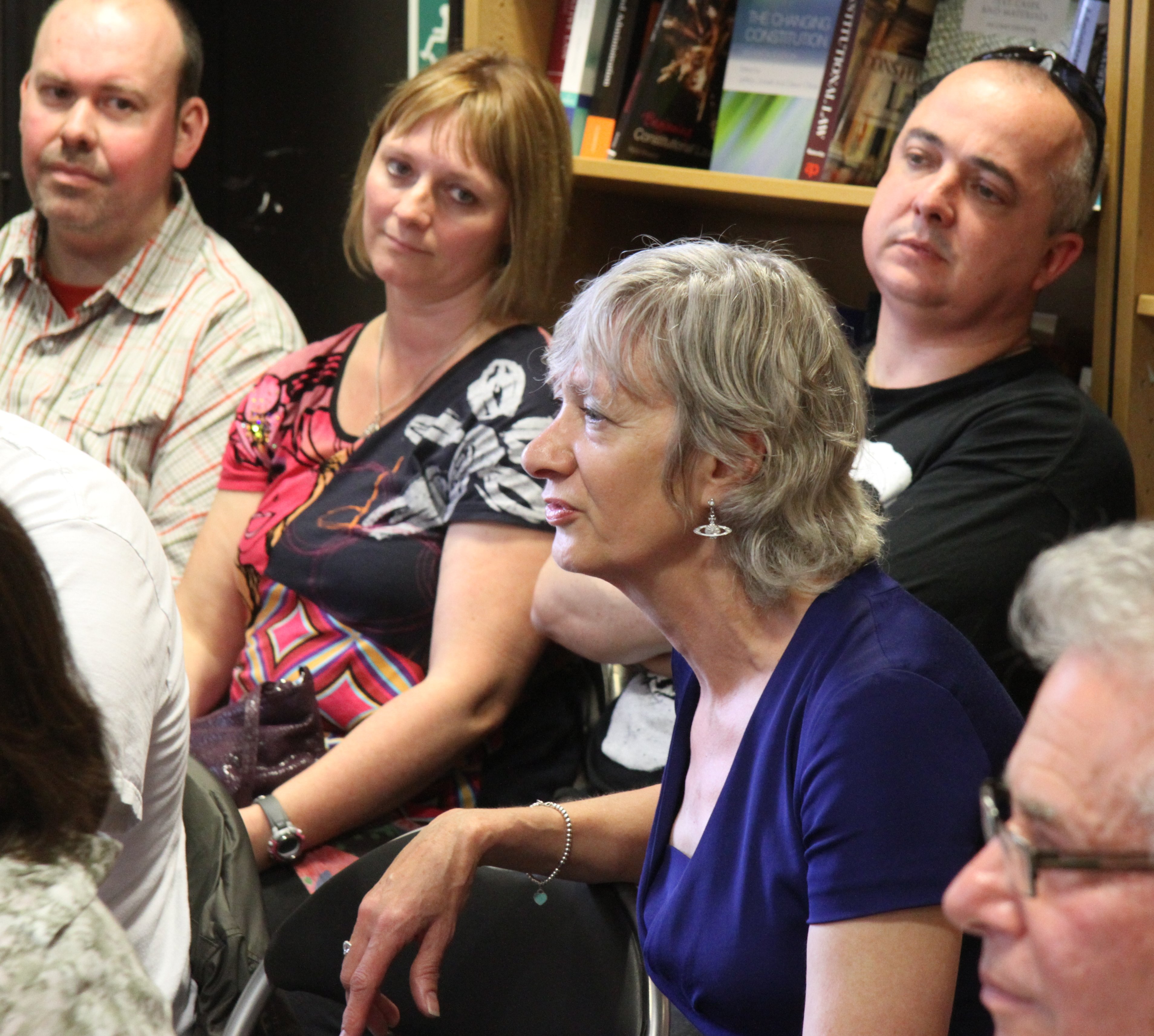
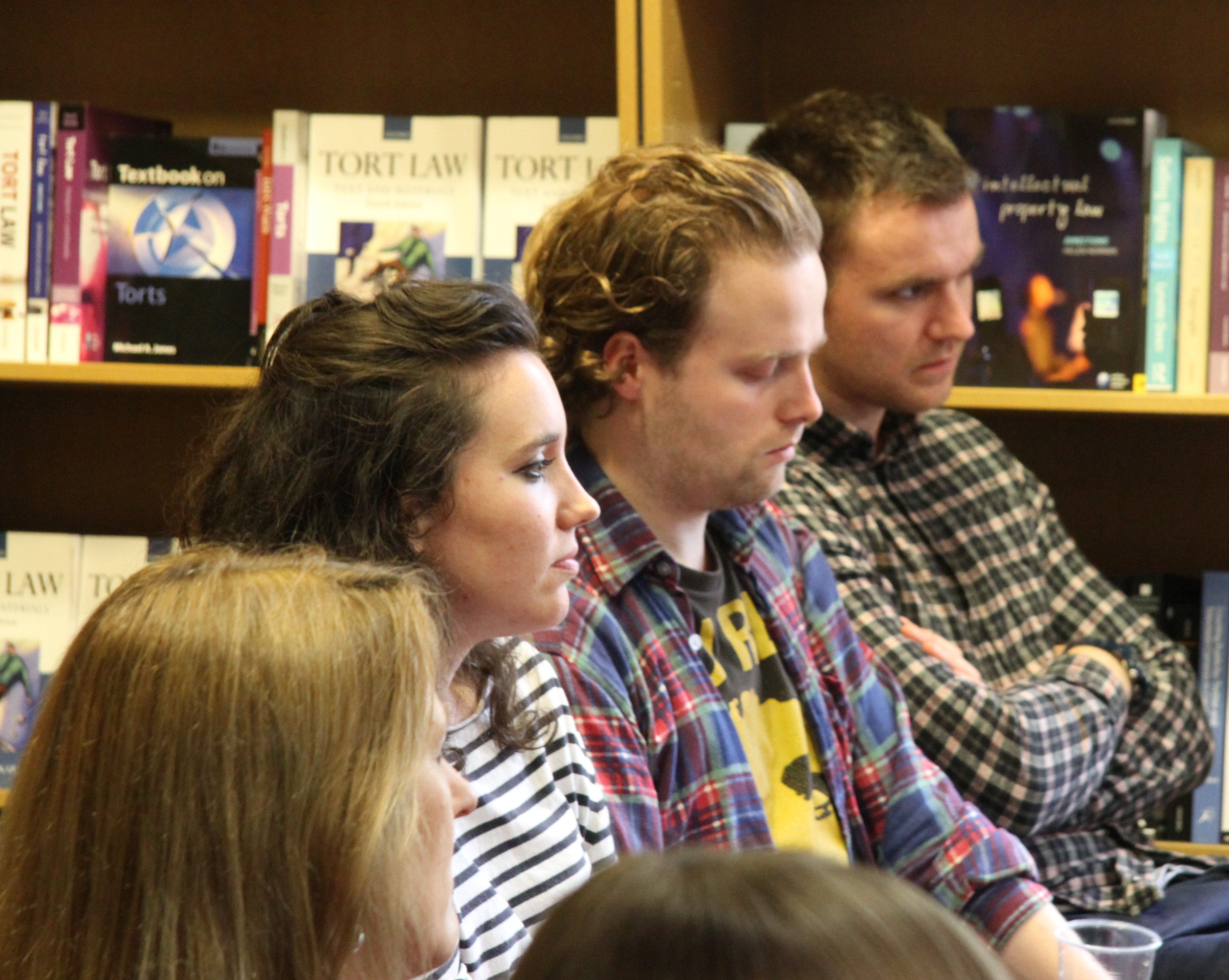
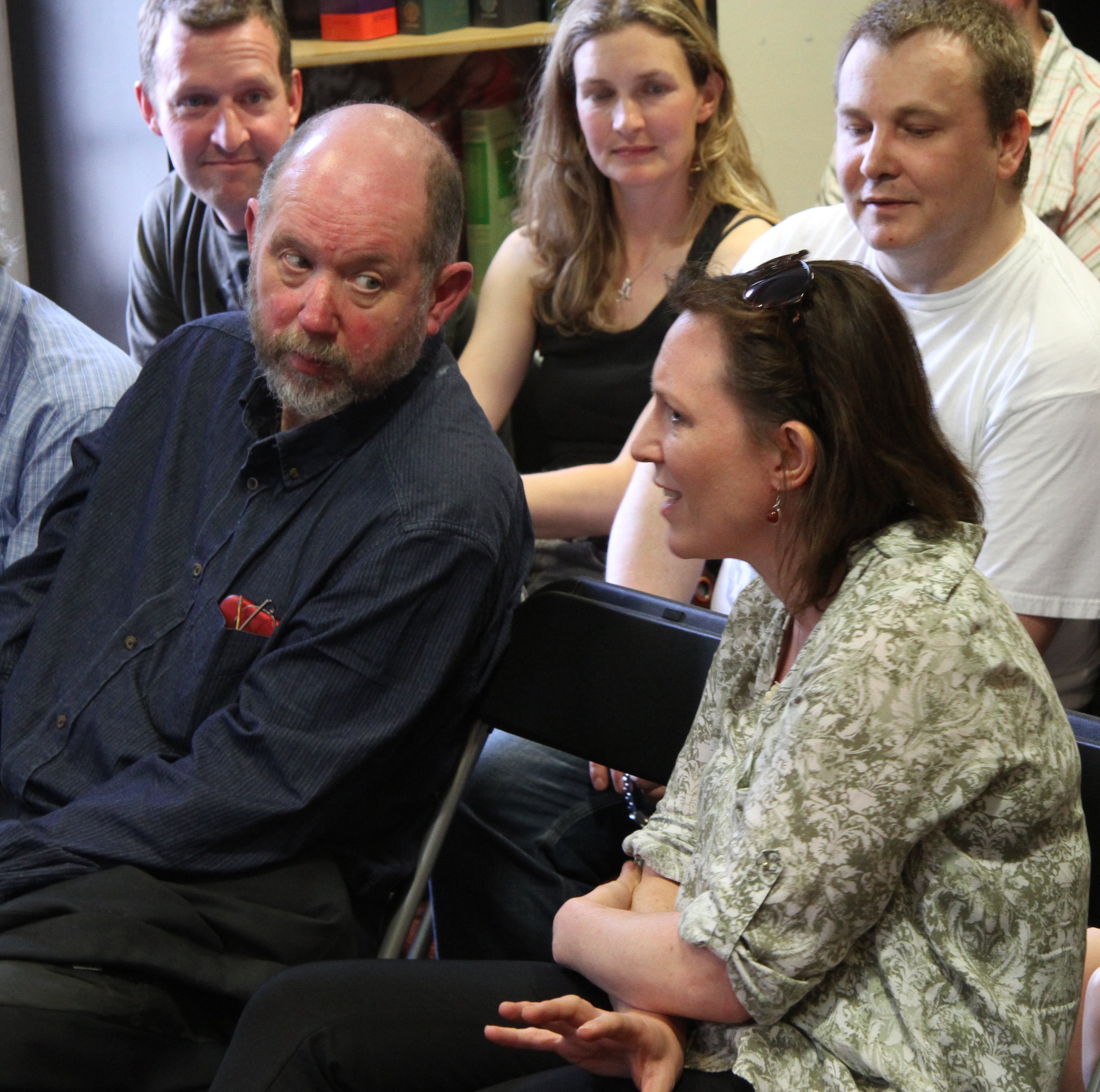


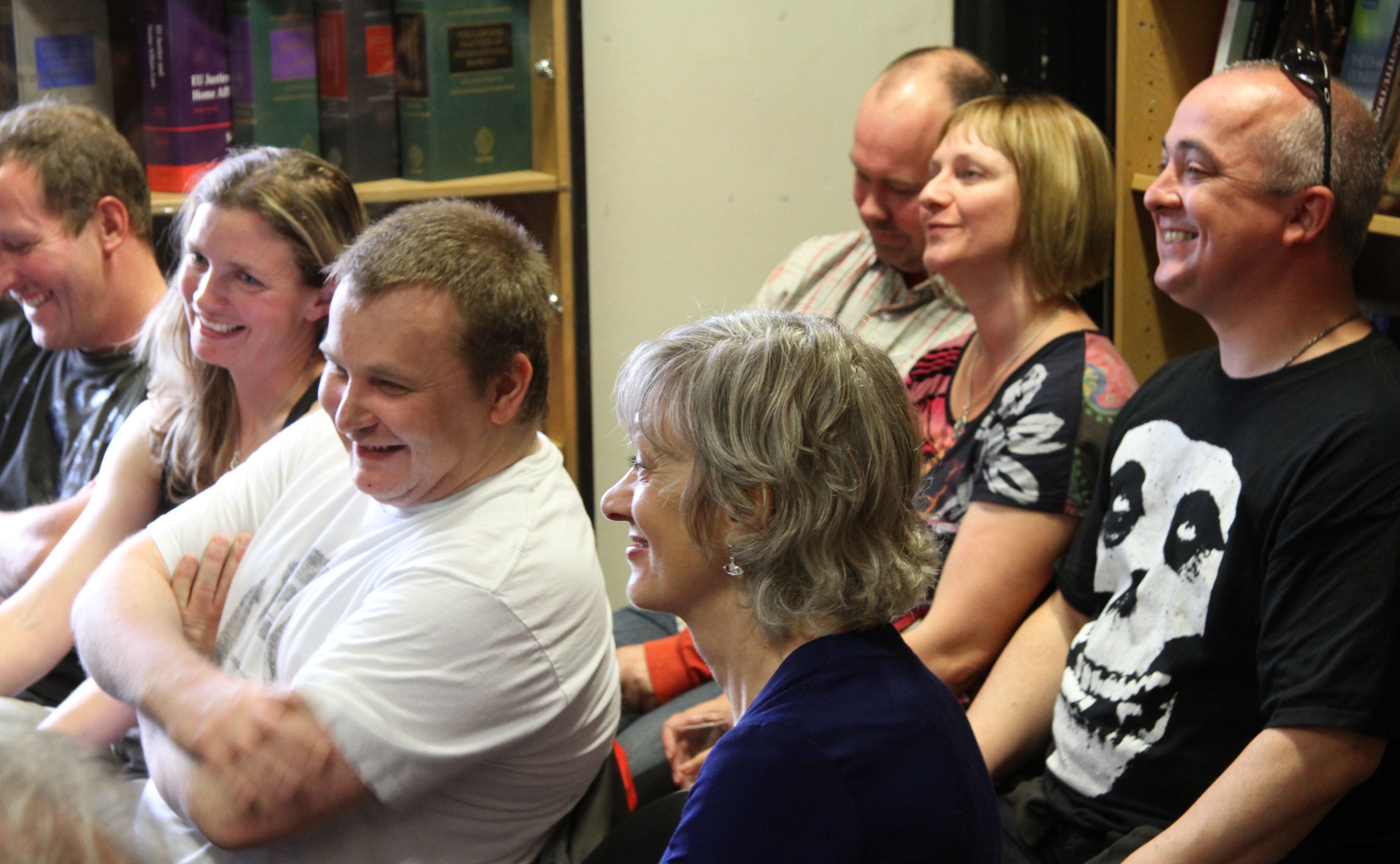

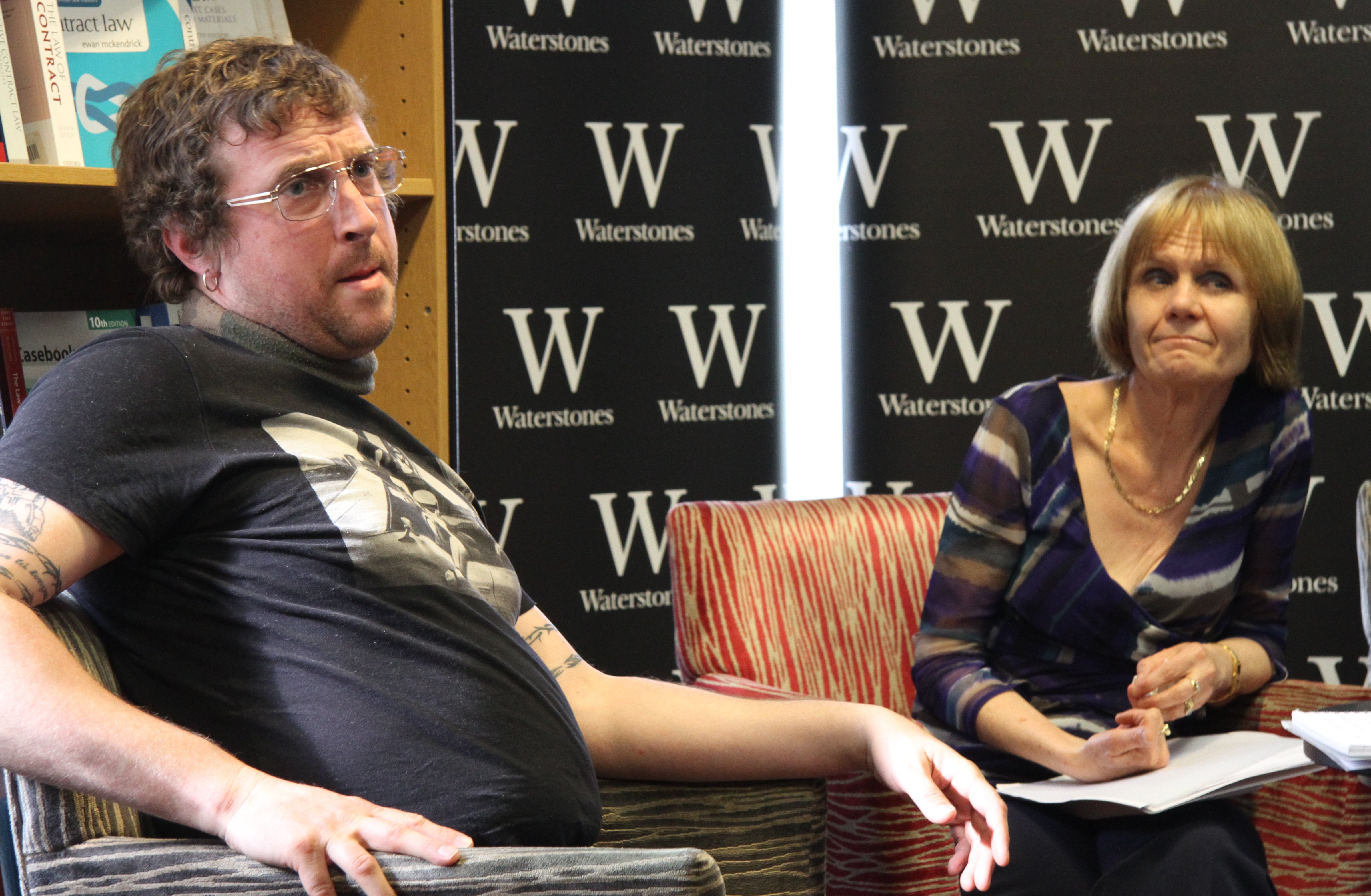


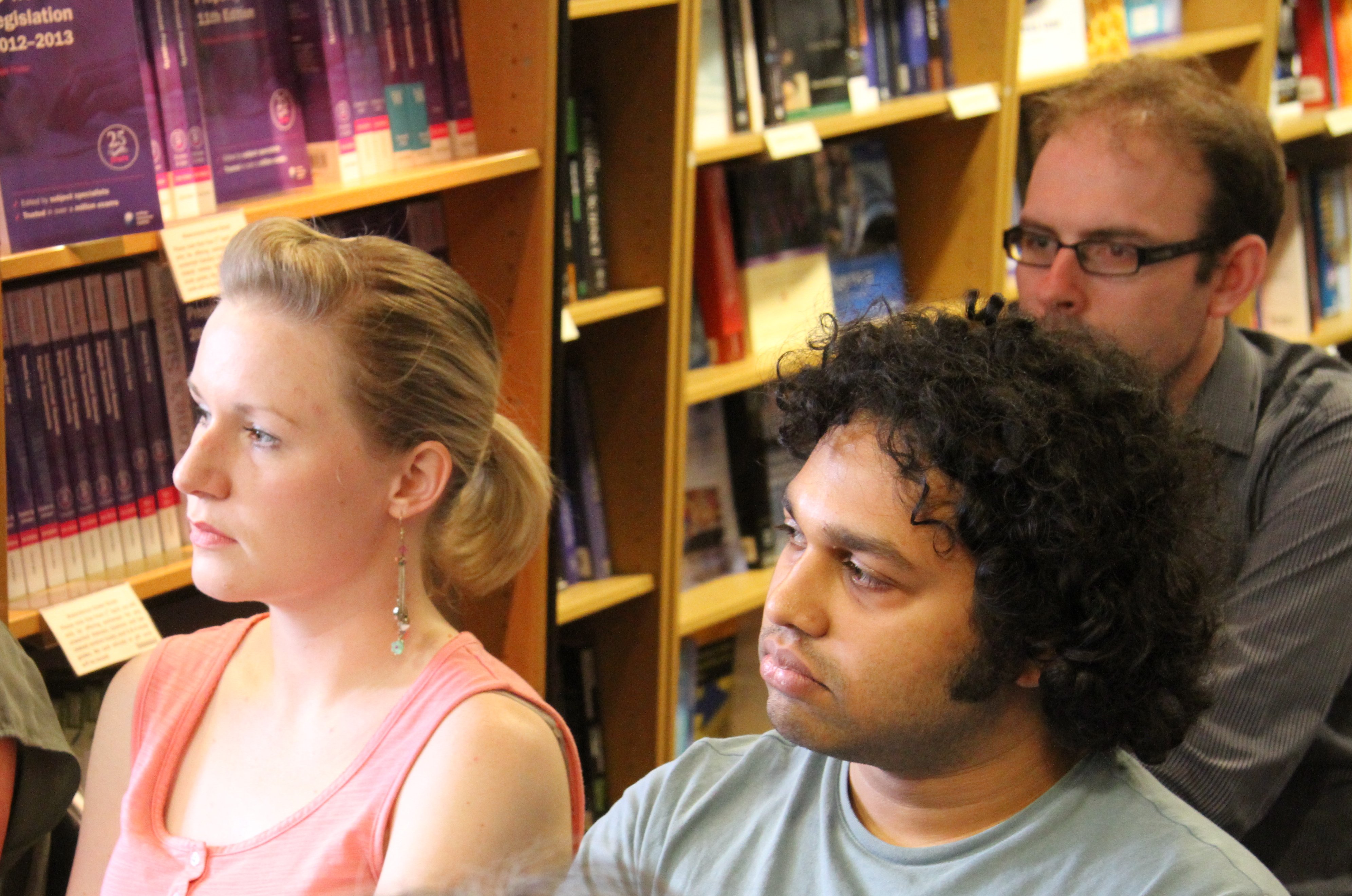


The Salt crime writing event that took place at Waterstones Gower Street yesterday was a very festive occasion. Sam Rahman, the Events Manager at the shop, her colleagues and a large and appreciative audience combined to make it a great success.
Laura Ellen Joyce, Matthew Pritchard and I each gave readings from our books. Laura read from The Museum of Atheism, which (jointly with In the Family) launched the Salt crime list last November. I read from Almost Love and Matthew from Scarecrow, which Salt will publish in September. Afterwards, I chaired a discussion with Laura and Matthew about their writing. The audience joined in, offering many lively and perceptive comments.
Both Matthew and Laura agreed that a sense of place was important to their writing. Laura chose to set her book in small-town America in the dead of winter – there is no daylight in the novel – to epitomise the corruption that it portrays. Matthew writes powerfully about Andalucia, which he knows well, having lived and worked there for twelve years. Laura agreed with the suggestion that she describes a rudderless society in which no character is able to provide a moral yardstick or compass. Matthew said that the corruption captured in his work derives more directly from his knowledge of shady Spanish officialdom. Danny Sanchez, the protagonist of Scarecrow, is a journalist who bravely tries to expose the fraudulence and self-interest upon which he sees that Spanish politics is based.
Laura had deliberately left vague the identity of the killer in her book, because, in a sense, she was indicating that society as a whole was to blame. Matthew had had the intention right from the start to write about a serial killer, but the character of the killer took shape in his mind gradually as he worked on the book and continued to read about real-life murders. An account of how the head of one of Fred and Rosemary West’s victims had been swathed in gaffer tape had left a particularly lasting impression on his imagination.
There was much laughter from the audience at Matthew’s anecdote about how, when the shop below his flat caught fire recently, the police broke into the flat and discovered his large collection of books about serial killers and Nazism scattered over the floor. There was even more laughter when I persistently made the mistake of calling him ‘Danny’, after his hero, rather than Matthew! (Apparently, it is a mistake that his agent makes, too!)
Laura confirmed that she will continue to write crime because she has a profound interest in why people commit evil or anti-social acts. She’s also interested in pushing out the boundaries of fiction. When, in response to a question from one of the audience about what I thought the ‘next big thing’ in crime writing would be, I said that I’ve seen several books lately that mix genres and I’m not sure that it works, Laura said that this idea appealed to her and that she would like to experiment with it. I do think that it would take a very good writer to pull it off, but Laura is so accomplished that she is one of the few people I know who might succeed at it.
I was asked why most crime novels are about murder, rather than other types of crime, such as theft or fraud. I said that there are some novels based on theft – there is quite a strong sub-genre relating to crimes associated with works of fine art, for example – but it is difficult to write about crimes other than murder unless you are a police procedural author. This sub-genre has never appealed to me; I’m more interested in the psychological aspect of crime-writing.
We were all asked whether we’d come to writing ‘lately’, or whether we’ve always been writers. We agreed that we’ve all been writing ever since we can remember. Asked also whether we had to let a novel ‘fade’ from our imaginations after we’d finished it before we could embark upon another, we each offered different responses: Matthew writes all the time and is usually working on several books at once – he knocks out 2,000 words a day, even if sometimes he knows it is rubbish and he will have to discard some of it; Laura writes regularly, but in different genres – she writes short stories between novels and also said that she was very organised when writing The Museum of Atheism which, with a detailed outline on a spreadsheet, she wrote in twenty-four days, a chapter a day, all in November, following the NaNoWriMo concept; I usually take a brief break after completing a novel, but I’ve started on the next DI Yates book now. I feel that being an author is a bit like being a member of the fashion industry: your mind is already on the next season’s work while your readers are still consuming this season’s product.
We all paid tribute to Salt Publishing, which we agreed is an uncompromising publisher setting high standards. We were also united in saying that we aren’t interested in the ‘blood-and-guts’ style of crime writing.
On behalf of the three of us, I’d like to thank Sam and the staff at Gower Street for their wonderful hospitality. I’d especially like to thank all of you who attended for being such a generous and receptive audience, for making such constructive contributions to the discussion and, of course, for buying or ordering our books! It was good to meet some new friends – some of whom I’ve only previously ‘met’ through Twitter. Finally, a big thank-you to numerous well-wishers who were unable to come (some of you based in countries very far away), but who sent kind and encouraging messages and helped to advertise the occasion. We hope to meet you all one day at future events.
All in all, it was a very memorable evening indeed!
A towering giant of a book on a special day…

I tend not to write down dates of birthdays, wedding anniversaries etc., but I think I’m quite good at remembering them – although I have just had to ask one of my friends the date on which her daughter was born. One date that I never forget each year, however, is a fictional one: Bloomsday. As all James Joyce aficionados will know, it is today, June 16th. It was on this date in 1904 that Leopold Bloom made his day-long perambulations around Dublin and, by describing it in Ulysses, first published in Paris in 1922, Joyce captured the history, customs, beliefs and prejudices, not only of his own country, but of the whole of European culture. His masterstroke was to present it from the viewpoint of the perennial outsider, a modern version of the Wandering Jew. A life in the day, indeed! There was a personal irony in the choice of date, too, as it was on this day that Joyce’s liaison with Nora Barnacle, who was to become his long-suffering common law wife and eventually his legal wife, began.
Picking up my tattered Penguin edition of the book, I resolve to read it again very soon. Because of the range and depth of the literary styles that it covers, and Joyce’s wonderful manipulation of language, it is a complete writer’s handbook in itself. It needs no gloss or laboriously explained sets of rules – although the book can be read at many levels and is amazingly erudite. I don’t usually write in books, but I see that against one passage my younger and more studious self has written ‘Traherne: Centuries of Meditation. 3rd Century’. It’s impossible for anyone else to write like Joyce, but admiring and appreciating his work certainly makes you think about how to use language.
It was Joyce who first taught me the magic of lists. The ones that he creates appear to be off-the-cuff, but I’m sure their sparkling apparent spontaneity cost him many hours of effort. Take this one, for example, which is only a third of one in a series that appears towards the end of the book to sum up Bloom’s condition: Mendicancy: that of the fraudulent bankrupt with negligible assets paying 1s 4d in the £, sandwichman, distributor of throwaways, nocturnal vagrant, insinuating sycophant, maimed sailor, blind stripling, superannuated bailiff’s man, marfeast, lickplate, spoilsport, pickthank, eccentric public laughing stock seated on bench of public park under discarded perforated umbrella. It was through Joyce’s work also that I came to realise the importance of evoking all of the senses, not just the visual: his description of Leopold Bloom’s lunchtime cheese sandwich is a classic still to be surpassed, in my experience. Then there is his satirical juxtaposition of the sacrosanct (and, he indicates, probably humbug) with the absurd: And they beheld Him, even Him, ben Bloom Elijah, amid clouds of angels ascend to the glory of the brightness at an angle of fortyfive degrees over Donohoe’s in Little Green Street like a shot off a shovel. Like avid readers both before and after him, Joyce read everything: cereal packets, handbills, magazines and potboilers as well as more European literature than almost anyone else could cram into a lifetime. Unlike other learned writers, however, he didn’t make judgments about the ‘quality’ of what he read. The Nausicaa episode (Chapter 13 of Ulysses) is not only a brilliant pastiche of the style of writing of women’s magazines of the time, but also reveals Joyce’s sneaking admiration for a genre that could get away with so much hyperbole. Gerty MacDowell, its naïve and rather tragic heroine, is a fine portrait of a dreamy young woman whose head is filled with romantic notions of how she can shape her life. Although she is portrayed only once, in a tiny snapshot of time, Joyce conveys to the reader through this medium of ‘magazinese’ that her life will be much bleaker than she supposes. Today’s ‘filmstar for a day’ brides are her modern equivalents.
It’s difficult to say what I like best about Ulysses, but, if pushed, I’d say that it’s the portrait of Molly Bloom. Hers is a timeless portrait of almost everything that it has meant to be a woman through the ages: she is a sensuous earth mother, fascinating femme fatale, sexy but not a whore, capable of great sympathy but also self-centred, perceptive, ‘genteel’ and coarse. She belongs to a long tradition of female characters that stretches back in time, even beyond Cleopatra, to Homer’s sorceress Scylla. Molly lives through her senses; the one attribute that she doesn’t possess is intelligence of the formal, schooled kind. In this, she is the antithesis of Leopold, who thinks about everything, applies his knowledge to everything, and therefore, like Hamlet, is unable to act. Apparently she was modelled at least in part on Nora Barnacle. Some feminist readers have found her portrayal insulting to women and, mixing life with fiction again for a moment, it’s true that Joyce held some curious views about the female sex. But Molly is above all the great force for the positive in the novel. It is she who has the very last word. It is, simply, Yes.
The book’s title is pronounced YouLISSease, by the way, not YOUlissease. I was taught this by an Irish professor, who said that I could mispronounce it if I liked, but, if so, I’d never get to grips with Finnegans Wake, which is all about pronunciation. I’ve found this to be true. Although still a difficult work, ‘the Wake’ becomes comprehensible if you read it aloud in a Dublin accent.
Joyce eventually stretched language to the point at which all but his most determined supporters find his work too much of an effort to read. He may perhaps have been a genius on the verge of madness. Nevertheless, what he managed to wrest from language changed the course of fiction writing forever. A much more insignificant James salutes the author – and you all – on Bloomsday 2013!
Almost Love: Publication Day
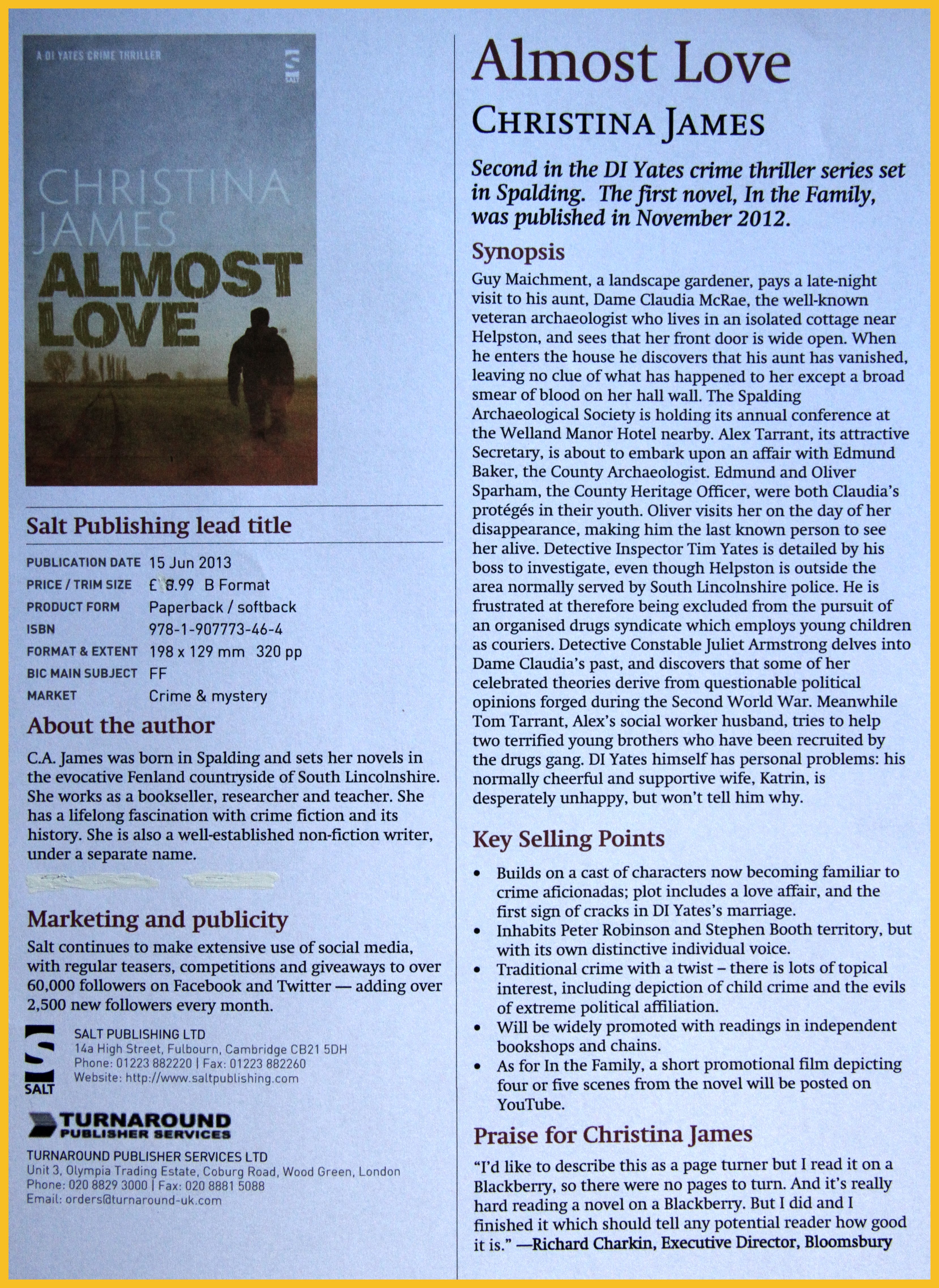
Today is the official publication date of Almost Love. It is almost midsummer and the sun is shining; the cuckoos are still here, though they’ve changed to cuk-cuk mode now (it’s been a particularly good year for cuckoos in Yorkshire this year). It’s a complete contrast to the day on which In the Family was published, when the leaves had fallen, the shooting season was in full swing and we were heading for the winter solstice. November seemed a good time to publish then, because it was still far enough away from Christmas for the book to feature (as I know it did, and am grateful) on some Christmas wish-lists. June also seems a good time, as I’m hoping that at least a few people might want to take Almost Love on holiday with them.
Some authors talk about their books as if they’re babies. This particular baby, although it’s been born today, is still in the incubator. The books were delivered to Salt and its distributor yesterday, but have yet to be despatched to the shops; this will happen on Monday. Yet I’m not impatient or disappointed that I don’t yet have a copy in my hand; on the contrary, I’m profoundly grateful to both Chris and Jen at Salt and to TJ International Printers of Padstow for pulling out the stops so quickly after MPG Printers went into receivership just as Almost Love was going through the press. Thanks to their Herculean efforts, the delay has been minimal – much slighter than we’d feared. And yesterday’s blog-post attracted so much interest that I feel that it acted as a ‘virtual’ launch. Thank you very much to everyone who read it, spread it or contributed comments.
Thinking again about The English Bookshop and Jan’s explanation of why he chose Almost Love brought home to me the crucial role of Advance Information (AI) sheets in helping authors and publishers to sell their books. AIs have improved tremendously over the years. They started out as Gestetnered sheets. (Does anyone remember Gestetners? They took ages to set up and usually suffered a paper-jam within five minutes; you got ink all over your hands and, if you were unlucky, your clothes. The only good thing about them was the pink correction fluid, which could give you a temporary high if you applied it when standing in a confined space.) These were sometimes almost illegible and contained little except the ISBN, a two-sentence blurb and the publication date. There was no picture of the jacket. However, by no means all publishers used to produce AIs. Those who didn’t often sent out spares of the actual jacket with the date of publication stamped inside. Booksellers therefore never received a complete set of information: you either got an insubstantial blurb with no jacket, or the jacket and not much else.
By contrast, today’s AIs – at least the ones that Salt produces – are works of art. Author and publisher work closely together in order to wrest benefit from every centimetre of the space on a single A4 sheet. They include a fine picture of the jacket and all the information that the bookseller needs, yet can be read in less than a minute. Sometimes several hours are spent on developing an AI.
I thought that you might be interested to see the AI that was used to sell Almost Love into the shops, so I’ve included it here. I hope that you will like it.
 Christina James, crime novelist