WriterFest!

W20

Yesterday Jim, my editor, and I enjoyed the immense privilege of running a writers’ workshop at Wakefield One, the City of Wakefield’s wonderful new complex that incorporates the library and other arts and community facilities. Like the event in which I took part at Wakefield One last year, it was part of Wakefield’s LitFest, and impeccably organised by Alison Cassels, who, in my experience, is second to none at enthusing and gathering in intelligent and appreciative audiences for such occasions. 

Alison Cassels, organiser par excellence

Alison Cassels, organiser par excellence


Eventually, there were twenty-two lively and responsive participants of all ages, from twenty upwards.  One recent graduate came with his grandfather.
W18

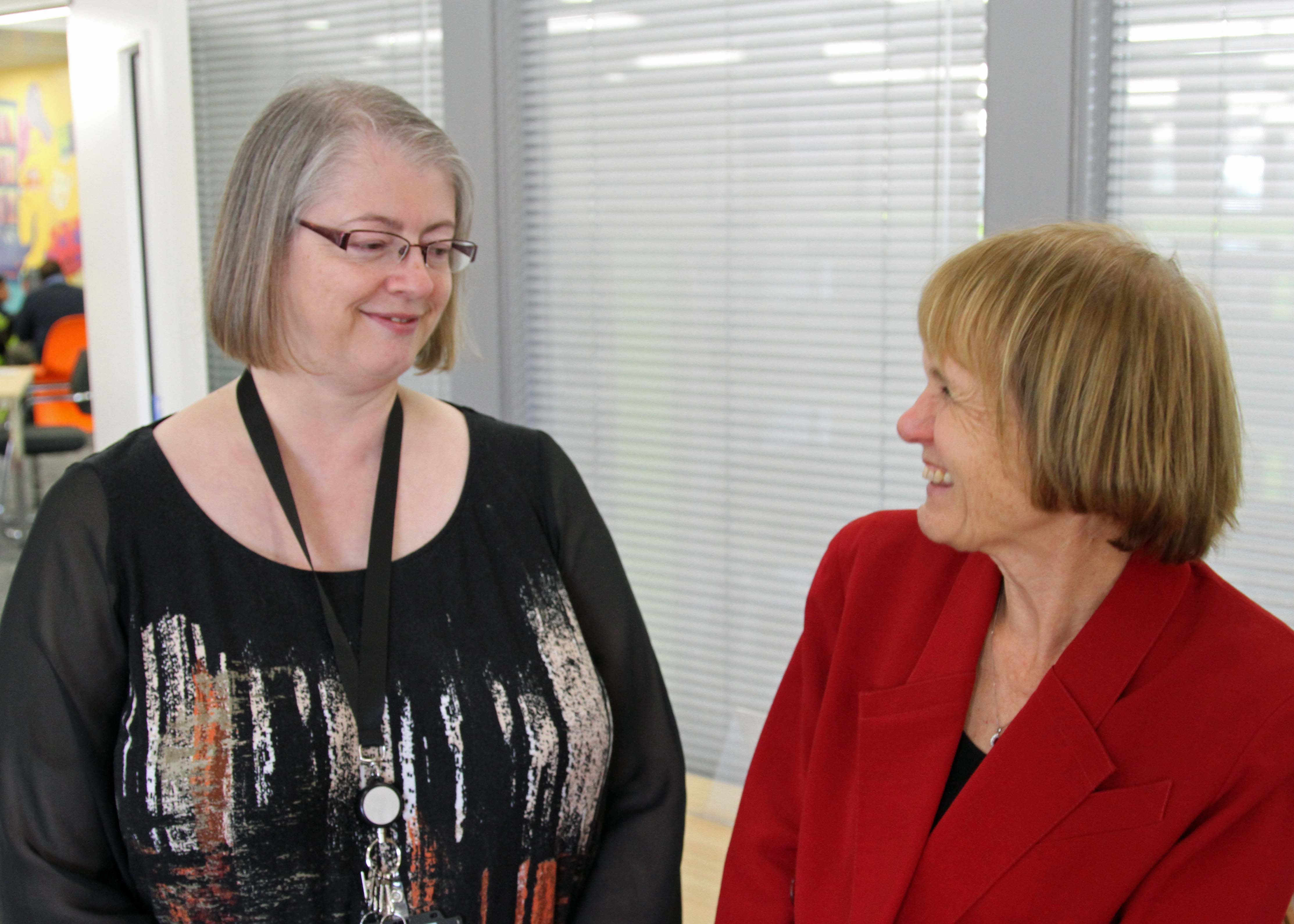
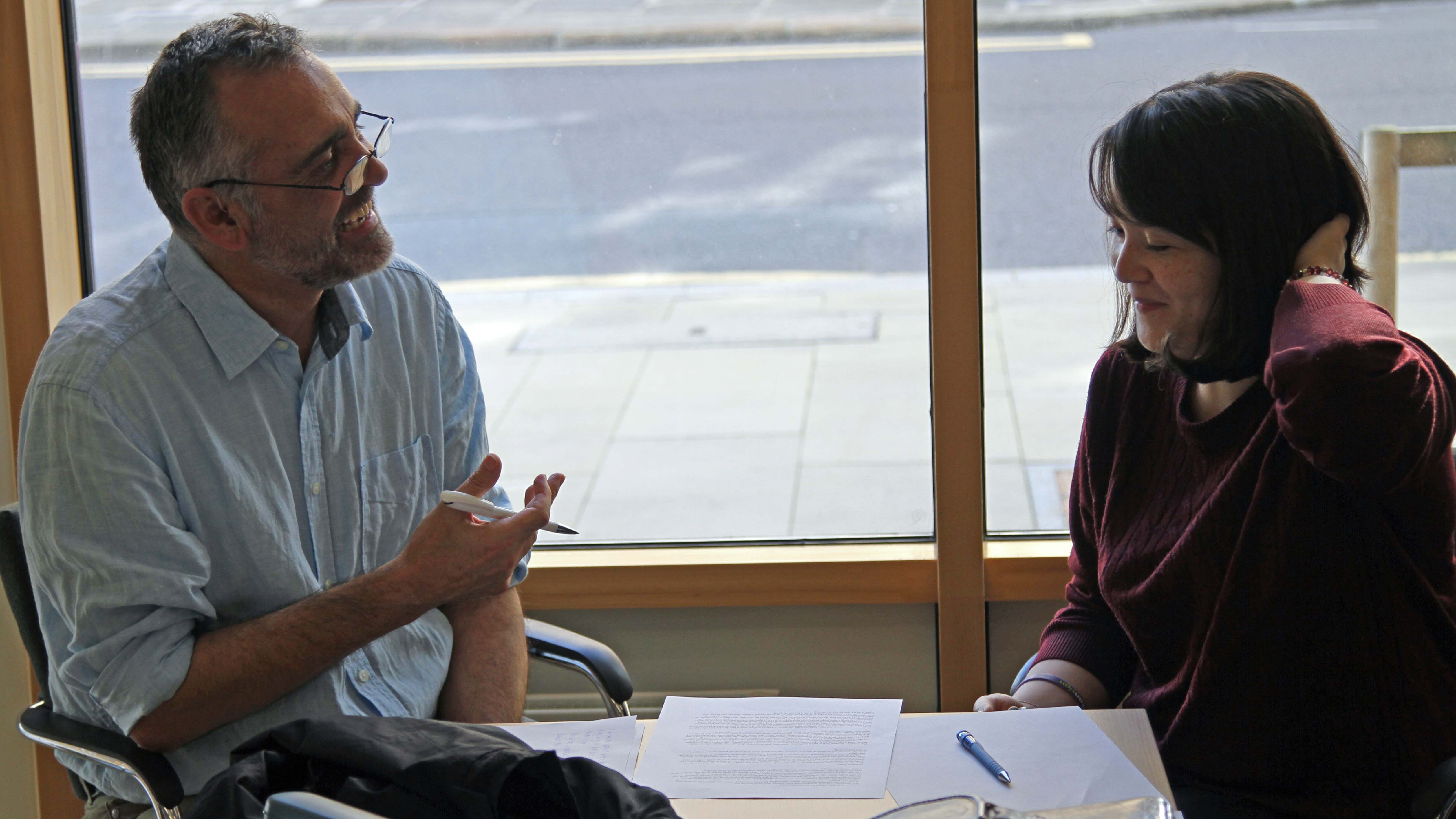
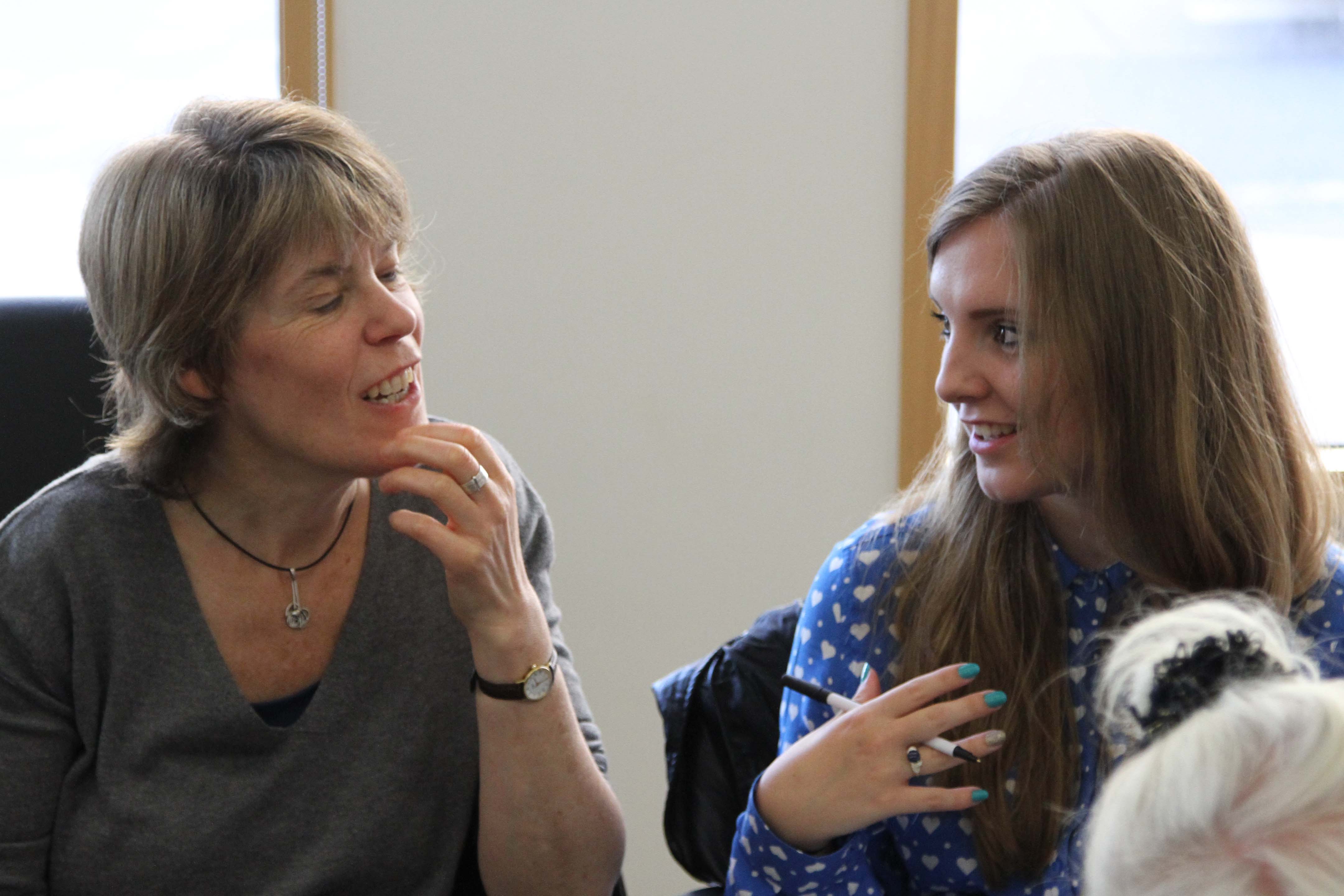
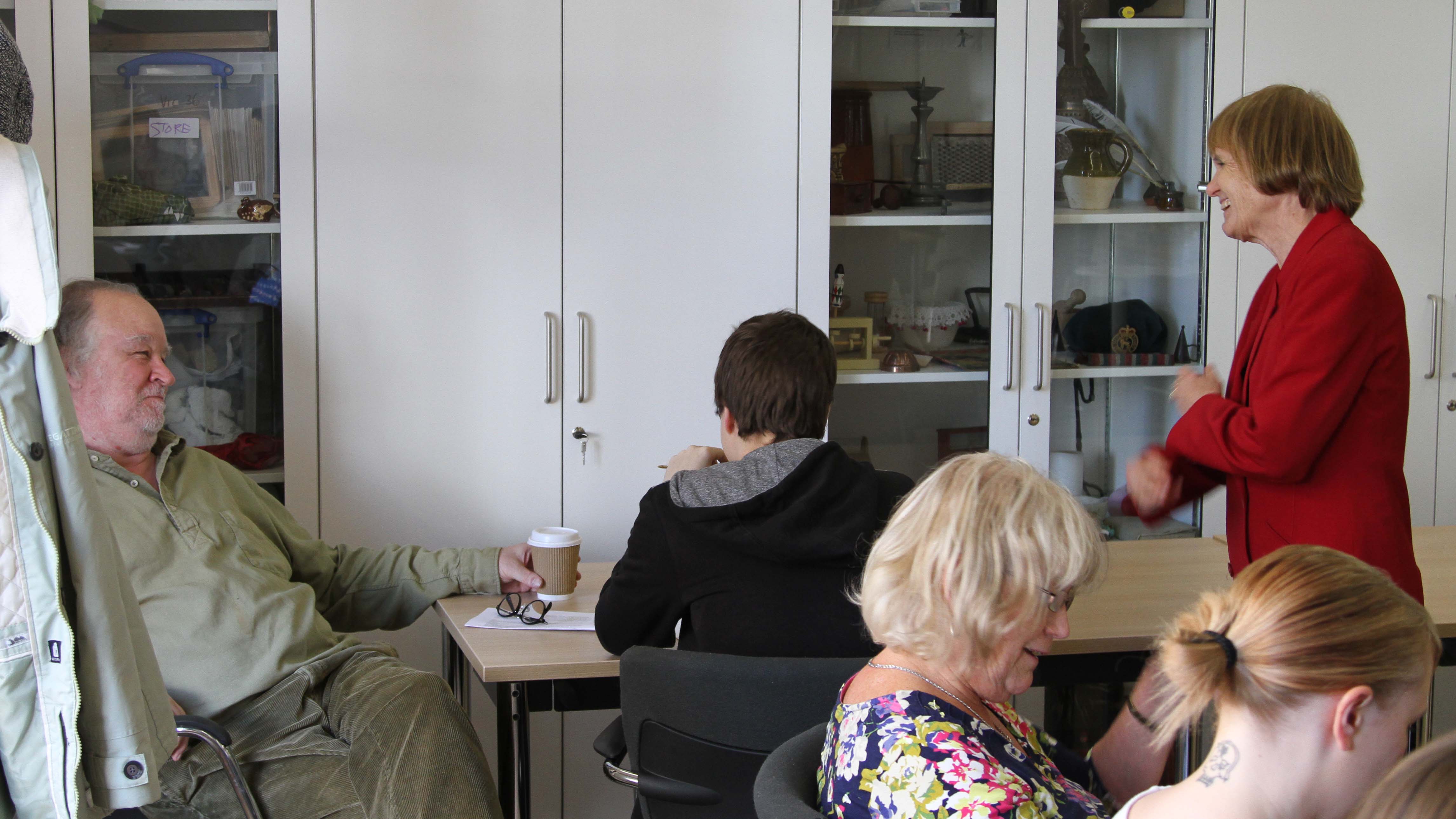
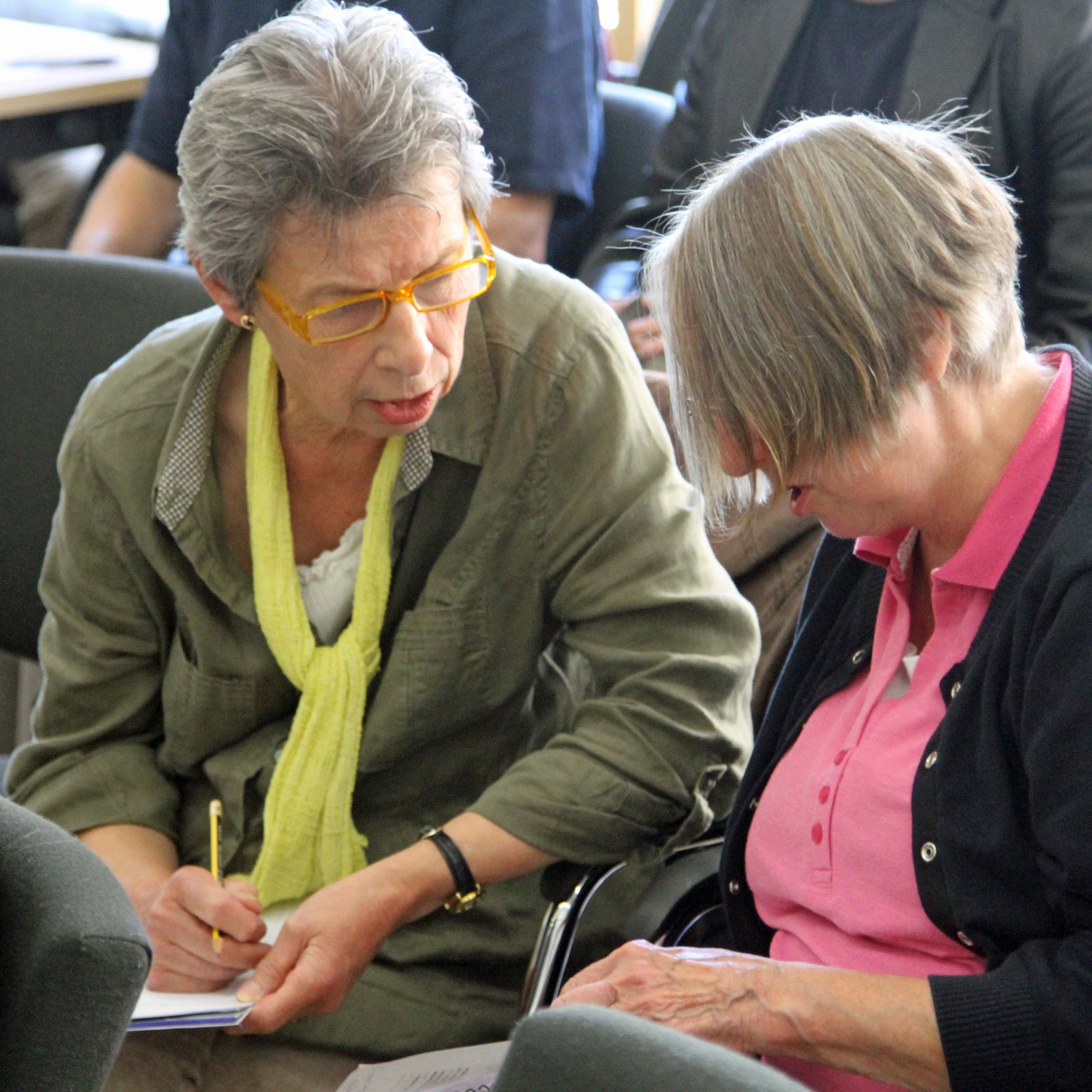
We began by giving the workshop delegates a sheet containing the opening paragraphs of six novels and asked them to take on the editor’s task of choosing (and providing justification for their selection!) just one that they would personally want to publish. The results were Illuminating: although one of the extracts (actually from a novel by Ruth Rendell) emerged as the clear winner, all six had at least one champion.  Everyone was thus able to appreciate the dilemma of choice that an editor faces when sent many different manuscripts.  Then, in pairs and against the clock, the group accepted the challenge of producing an opening paragraph that might persuade an editor not to reject it. The results were exceptional: all were coherent, interesting and, most impressively, cliché-free; the activity itself generated wonderful engagement, as you can see in the photographs here.
W13
W12
W11
W10
W9
W8
W7
W6
W5
W2
Wakefield 1

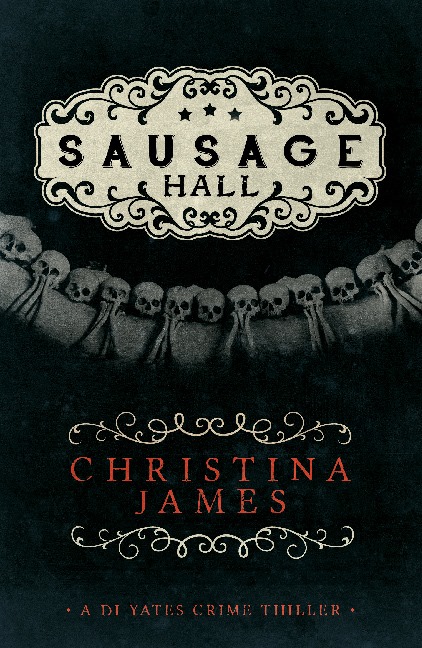
I then went on to explore some of the practicalities of getting published and what new (and, indeed, established) authors need to do in order to engage and keep their readers. This audience was thoughtful as well as appreciative and turned it into a dynamic, interactive session.  Finally, I read the opening chapter of Sausage Hall, the third in the DI Yates series, which will be published on 17th November; it was well-received (I’d been holding my breath, as I’m sure all authors do when they give their new ‘baby’ its first airings).  The workshop members were generous: many bought copies of In the Family and Almost Love in the signing session at the end; some were kind enough to buy both.

The informal debate continued after the workshop was officially over. Several participants said that they’d been delighted to receive Salt Publishing’s online alerts.  If any of the readers of this blog would also like to obtain these, just let me know and I’ll pass on the information.

Very many thanks indeed to Alison Cassels and the rest of the staff at Wakefield One (not forgetting those who work in the Create coffee shop, which produces a mean cappuccino!) and heartfelt gratitude to all those who joined the workshop – I hope that you will become occasional or even regular visitors to this blog.

Saying ‘thank you’ to @jennyoldhouse and @JennyBurnley1, two lovely Jennies!

9781844718771frcvr.indd
9781907773464frcvr.indd
This summer, events and commitments have seemed to conspire to restrict the time I had become used to spending on blog posts and engaging with others on the social media, by which I really mean Twitter, because, try as I might to be active with it, I can’t feel very comfortable with the lumbering mode of global communication that Facebook always proves to be to me.   Even Twitter has found me out as a tweeting dilettante, never spending long at all up there amongst the flocks in the branches, but flitting in and out in sharp bursts like a swallow.  So, first, may I apologise to loyal  friends who must think me at best unreliable and, at worst, not a friend to them at all.  Some of you (you know who you are) have put up with my scant regard for relationship consistency with huge patience and unstinting support in my absences, for which, please do accept huge thanks for keeping this bird in flight.

In the context of all this, I should like to make as public a declaration of thanks as this blog permits to a wonderful pair of Jennies, who, separately and at different times, could almost be assumed to have been acting in collusion to make me feel good about myself and about my novels.  They have joined a wonderful group of reviewers of the first two DI Yates books who have taken much trouble both to read them and then to provide splendidly constructive and insightful commentary upon them.  The DI Yates page on this site quotes them verbatim, which is my best way of saying ‘thank you’.   However, Jenny Lloyd, who has reviewed both books, and Jenny Burnley, who has just reviewed Almost Love, have yet to find their comments transferred here (I’ve been remiss about this and I’ll be rectifying it shortly!) and I’m thus giving them a post to themselves by way of appreciation.

Both Jennies have been absolutely consistent in their celebration of other writers’ and bloggers’ work, mine included, and I’d like them to know just how much I value such selfless enthusiasm for writing about and spreading what they read, which helps so many people on the networks.  I’d also like to say how much I enjoy their work, too.  Thankfully, their qualities are shared by many of my virtual friends and acquaintances; they do epitomise the best of good social media practice, which means that they are always a pleasure to talk to.

I imagine that readers of this post will readily understand how I feel upon reading such reviews as these two, not just because they are so positive, but because their insights are so very thoughtful.  Here they are:

Jenny Lloyd, on In the Family:

While laid up with an injury, the days can seem interminably long. What I needed was a book that would take my mind off the pain in my knee and the stultifying boredom that comes from sitting in one place for too long. I’d just finished reading The Luminaries (an 800 plus page book I would never have got round to tackling if I hadn’t been laid up). Then my daughter found the lost charger for my Kindle while looking for something else (as always happens). Browsing through some of the titles, I came across In the Family by Christina James, a book I’d bought some time ago, immediately following my reading of the author’s other book, Almost Love.
There is always a risk, after reading a really good book by an author, that one’s expectations will be disappointed by the next one. So it was with fingers crossed that I began In the Family, hoping I would enjoy it as much as Almost Love. I needn’t have worried, though. If anything, I enjoyed this one more.
In the Family has all the ingredients which one expects from a crime-thriller but it is the author’s skill which takes these ingredients and turns them into a crime-story bristling with mystery and suspense, written with intelligence and deep psychological insights. And the characters! Some of this family’s characters you would not want to meet, let alone be related to, but the author portrays them so well I now feel I have met them all and they linger in my memory still. Essentially, I felt the central theme of this story explored how damaged people can result in damaged families with devastating consequences for any children involved.
The gist of the story; a skeleton is found buried alongside a road and Inspector Tim Yates is called in to investigate. The remains are that of a young woman, Kathryn Sheppard, who disappeared thirty years before. As Tim and his team unravel what happened to Kathryn, the Atkins family’s past comes back to haunt them.
I devoured this book in two days; not because I had little else to do but because I honestly couldn’t stop reading it. My measure of a good read is: how much I don’t want to stop reading to go and do something else; how much I relish picking it up again; and how much I don’t want it to end. In the Family scored top marks on all counts.
I feel I must thank Mrs James for the thoroughly enjoyable two days I spent captivated by her story. The Luminaries may have won the Booker Prize last year, but for me In the Family was the better read. Mrs James has a third novel coming soon; I will be first in the queue to buy!

Jenny Burnley, on Almost Love:

This excellent crime thriller weaves a complex story around the main characters of Detective Inspector Tim Yates and Alex Tarrant, following the inexplicable disappearance of Dame Claudia, a celebrated archaeologist with a mysterious past. In a weak, alcohol-fuelled moment, Alex, married to the boring, but dependable Tom, allows herself to be seduced by the dastardly Edmund, a dangerous, unlikeable character. This adulterous liaison is central to the story, which moves along at a cracking pace. The reader is drawn along deeper into the story, demanding to know the all-important answer to ‘whodunit’ and how. This quest required reading late into the night to unravel the mystery and see what happened next. Suspects abound in Almost Love and there is plenty of action, tension and suspense, with many clever twists and turns. The characters are exceptionally well-drawn, with close attention paid to human foibles and weaknesses. As the story unfolds, a dramatic late twist leaves the reader breathlessly awaiting the next D.I. Yates novel.

Thank you, Jenny and Jenny.  You have jointly ‘made my summer’ and I know that your good offices as discriminating reviewers benefit many authors and make them feel very good about what they do.  Thank you, too, to all those other wonderful reviewers and readers who have supported my books so far.

As good at putting the case for the defence as for the prosecution…

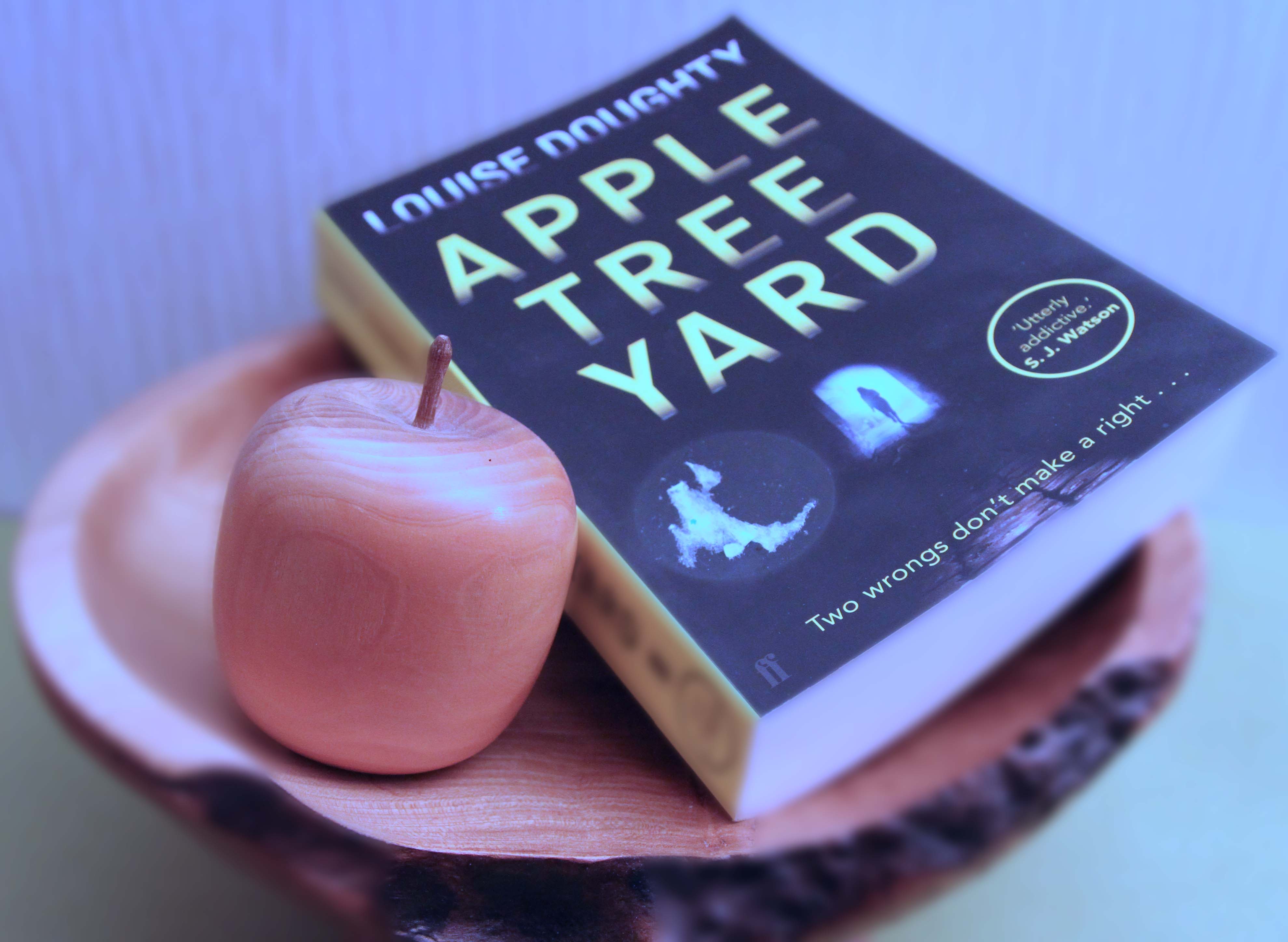
Apple Tree Yard

[Please be aware that I’ve included here precise reference to some key events in this novel, though not plot detail.  If you fear your future enjoyment in reading Apple Tree Yard may be at risk, read the novel first – you won’t be disappointed – and come back for my review!] 

I became a fan of Louise Doughty’s work almost by accident, when I was given a copy of Whatever You Love, a very distinguished novel and a brilliant study of obsessive grief, and was so impressed with it that I reviewed it on this blog.  Subsequently, I have read Stone Cradle, set in my native Lincolnshire, and this summer I made a point of buying Apple Tree Yard before I went on holiday.

Apple Tree Yard is a truly magnificent work, shortlisted for the Specsavers National Book Awards 2013, and it certainly merits a prize.  It doesn’t exactly fit into the crime genre (just as Stone Cradle isn’t ‘just’ a historical novel), but it is about at least two crimes and, possibly, about several others, depending on how you choose to read it.

This last point holds the vital key to the novel, because this is a book that manages to capture the ambiguities, generosities and tyrannies of the relationships that it describes and also succeeds in conveying that, although no human is perfect and some will commit atrocious acts of perfidy, betrayal, cowardice and cruelty, it is impossible to define anyone as simply good or evil. Even sleazy George Craddock, victim of a horrific murder but also perpetrator of an appallingly brutal crime, is shown to have vulnerabilities and a father who loves him.

The story begins, rather shockingly, with an act of consensual sex between the narrator, Yvonne Carmichael, an attractive middle-aged professional woman, a scientist, and a man who has just picked her up during a visit to the House of Commons. She does not even know his name, but allows him to penetrate her in the vault of the Chapel of St Mary Undercroft, which he has offered to show her on what she understands quite clearly to be a flimsy pretext.  There is great skill in the way in which this encounter, which triggers the rest of the plot of the novel, is presented.  On the one hand, it could be viewed as a grubby sexual exploit between two people who are addicted to risk; on the other, we don’t question Yvonne’s claim that she believed it was an act of mutual tenderness.  Despite the fact that she doesn’t know her lover’s name and at this stage does not expect to meet him again, the reader is persuaded that this is not just a lustful fumble in the dark: it ‘means’ something.  Finally, she does not spare herself some wry reflections on the absurd indignity of the situation: how she has to hobble along with one leg out of her tights, one foot out of her (elegant) boot; how her ‘lover’ – she calls him ‘my love’ throughout the novel – wordlessly passes her his handkerchief to enable her to deal with the physical detritus of their congress.

Yvonne could be seen as a woman who has been taken advantage of by a predatory male, a woman naïve in her assumptions about his motives, despite her intelligence and education. Yet she proves not to be entirely wrong about him, even though it becomes evident that at first he did merely regard her as a quick lay, a conquest that he more or less took on as a personal bet with himself that he could do it.  As gradually becomes clear, Yvonne makes use of him, too (and in the most extreme of ways, as we discover in the final sentence of the novel).  Furthermore, the two other men who are described in detail, Guy, Yvonne’s husband, and George Craddock, who is an academic she meets through her work, both also take advantage of her.  Of these three men, Guy is the gentlest, yet also the most selfish.  He says that he loves her and is fiercely protective of the family life they have built together, but he refuses to give up the young mistress with whom he is conducting an affair that compromises him professionally.  Yet it is Guy who stands by Yvonne when she is accused of being an accessory to murder and Guy who cares for her after the trial, despite the fact that she has done to him the one thing that he always said that he would find unforgiveable: humiliating him in public.

The reader is always on Yvonne’s side, but the author shows that we’re not always expected to think that she is right; it’s clear that she behaves badly, too. There are mitigating circumstances.  As the court case unfolds, we discover that her son has bi-polar disorder, that he fights her off when she tries to help him, that she stalled her career for many years (despite, it is implied, being as able as, or more so than, her husband) to raise her family and that now she is the person at the centre of the family who has to try to hold it all together whilst also holding down a demanding and financially insecure job.  This sounds a bit like an addition to the already large literary dossier of women’s complaints about being treated unequally, but it is less clear-cut than that, just as the encounter in the vault could be viewed either as a sordid seduction by a stalker or a joyful, life-affirming act of freedom.  I don’t know whether Louise Doughty studied rape and stalking cases in order to write this novel, but of one thing I am sure: if she were a barrister, she would be equally good at putting the case for the defence or the prosecution.

Yvonne’s treatment by George Craddock can’t be defended: it is hideous and brutal. The sequence of events that it unleashes reveals the strengths and foibles of all the main characters.  The trial is described with forensic accuracy (Louise Doughty acknowledges help from various legal authorities in her depiction); the descriptions of how a jury operates chime exactly with my own experience of jury service earlier this year.

I realise that I may have made Apple Tree Yard sound like a gloomy book, but it isn’t at all.  Partly because of the author’s dexterous use of language and partly because there is a rich vein of dark humour underpinning the whole story, it is a bright gem, a novel that captures the privileges and drudgery, the ecstasies and ironies and, above all, the ambiguous moralities of modern middle-class life.  If you haven’t read it yet, read it now!

Fine theatre!

Skylight
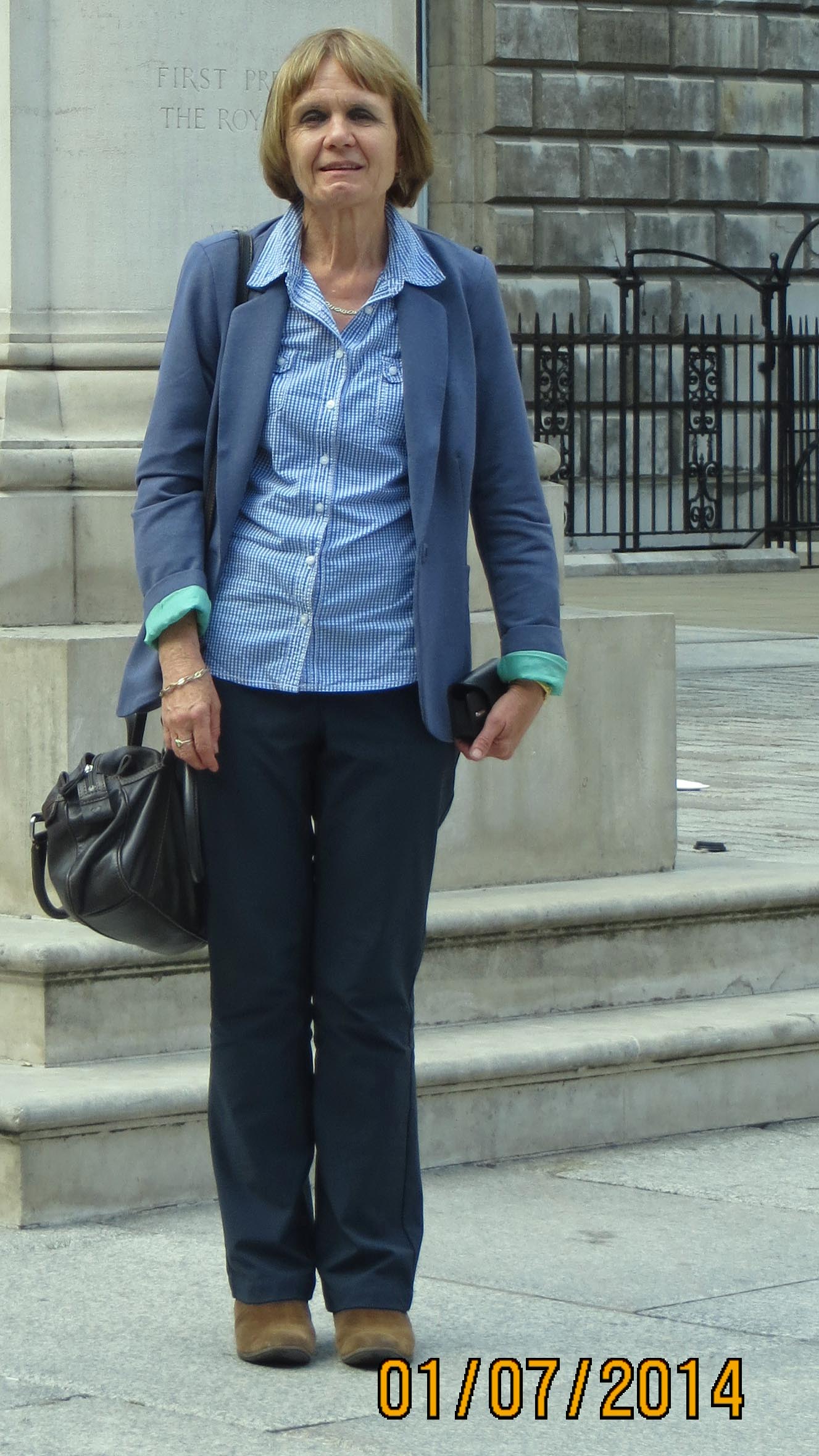
I have a confession to make: On July 1st, I went to see Skylight, the play by David Hare that has been performing at Wyndham’s Theatre this summer, and have been meaning to write about it ever since!  Sic transit gloria aestatis!  It stars Carey Mulligan and Bill Nighy – and in fact, apart from two short appearances by Matthew Beard as Nighy’s son Edward, they have the stage to themselves for the whole two-hour performance, which must require considerable stamina, especially as both play their characters with enormous energy and verve.

First performed in 1995, Skylight tells the story of an extra-marital affair between Tom Sergeant (Nighy) and Kyra Hollis (Mulligan) that draws to an abrupt close after Tom’s wife Alice finds out.  The termination is at Kyra’s insistence, not Alice’s; but reconciliation is made virtually impossible for Tom after Alice develops a terminal illness shortly afterwards.  He nurses her until she dies, an event taking place some time before the action of the play.  Kyra, who somewhat implausibly had not only been working for Tom’s business but also sharing his and Alice’s house, leaves precipitately, trains as a teacher and builds a new life for herself teaching deprived children in a run-down part of London.  Her flat, in another bleak London borough, is a long journey from the school where she works.  The action takes place just before Christmas.  The flat is cold and it is snowing.  Edward appears unexpectedly out of the blue to tell Kyra of his mother’s death.  He appears not to know why she ceased to live with his family.
Skylight set
A few hours after Edward’s departure, just after Kyra has taken a bath in an attempt to get warm, Tom shows up.  He gives more details about Alice’s death, but the real reason for his visit is to try to find out why Kyra abandoned him and perhaps – though he does not state this explicitly – to persuade her to return to him.  Kyra treats him warily and with irony, though a certain fondness begins to creep through.  At first, the audience is entirely on her side.  Tom comes across as a self-centred self-apologist who believes that his money can usually get him what he wants.  He is disparaging about Kyra’s job, her pupils, her lifestyle and her Spartan flat.  However, the genius of the play lies in the fact that the emphasis then gradually shifts to reveal Kyra’s shortcomings, as well as Tom’s.  This yo-yoing of sympathy for one or the other character happens more rapidly as the play goes on.  The conceits, the posturing, some element of lying or at least disregard for the truth and, through it all, the essential decency of both Kyra and Tom are exposed as the two actors deliver David Hare’s sparkling lines with convincing vehemence and wit.  The onlooker hopes against hope that they will revive their relationship.

Skylight is a miracle of good casting.  Kyra is older, more sophisticated and less waif-like than the Jenny of An Education, yet Mulligan’s performance shows something of the obstinate naiveté and acceptance of face values at odds with reality that she created in the earlier role.  Nighy’s depiction of Tom is unlike any other role that I have seen him play, though Tom’s wit, his irony, his rather louche outlook on life and the sense of melancholy vying with humour are all Nighy trademarks.  Throughout the whole performance, the actors create with consummate skill the presence of an invisible third character – Alice, for whom Tom made a skylight when she was lying in bed, too ill to look out of a conventional window.  Perhaps it is Alice who triumphs in the end.

When I attended the performance on July 1st, the theatre was packed.  I’m not sure if tickets are available for the remaining few performances before the play closes, but if you are able to get hold of one, snatch at the opportunity – plays of this calibre are rare indeed, even in the West End!

Wyndham's Theatre, Charing Cross Road

Wyndham’s Theatre, Charing Cross Road

An anniversary I always remember…

Elizabeth Wood

Yesterday was the anniversary of my grandmother’s birth.  She was born on 9th August 1892, which means that if she were still alive she would be 122 today.  That is 164 days younger than the age attained by Jeanne Calment, the oldest verified person who ever lived, who died in 1997 (though a Bolivian man called Carmelo Flores Laura, still living, is reputedly 123).  I like to think, therefore, that she could still be alive and vying with Signor Flores Laura for the distinction of being the oldest person in the world.

My grandmother actually died on 9th February 1979, when she was eighty-six and a half.  She outlived all of the famous people who are listed as having been born on the same day as she except for one: Thomas Fasti Dinesen.  I’ve never heard of him – I’m indebted to Wikipedia for this piece of information – but apparently he was a Danish recipient of the Victoria Cross who died on 10th March 1979, about a month later than my grandmother.  Significant events that happened on her actual birthday include that it was the day that Thomas Edison was awarded a patent for a two-way telegraph and (of more interest to me and perhaps to readers of this blog) the first day of the trial of Lizzie Borden, the celebrated American murderess.

Every year when this date comes round, I pay a small, silent tribute to the strong, elegant and feisty woman that my grandmother was.  She was in domestic service all her working life, a period which began when she was fourteen and did not end until she was seventy-four, with a very short break for the birth of my mother.  She started her career, Tess of the d’Urbervilles fashion, as a poultry maid, working for an elderly lady in her native Kent.  During the First World War, she trained as a nursery nurse at Bart’s Hospital and worked in London for more than a decade, looking after the two daughters (one was adopted and much younger than the other) of a Scottish diplomat.  She then moved to South Lincolnshire to take up the post of housekeeper to Samuel Frear, the last of the great Lincolnshire sheep farmers.  He lived at a large house called The Yews.  It’s still standing, just off the main Spalding-Surfleet road.  During the Second World War, after Mrs Frear’s death, she moved to Spalding to another housekeeping job, this time working for the Hearnshaw family.  They lived in a substantial three-storey house in Pinchbeck Road.  Her final post was as lady companion to a very old lady called Mrs James, who lived at The Laurels in Sutterton. 
Sausage Hall
Sausage Hall, the house that features in the next DI Yates novel (to be published on 17th November) is partly based on The Laurels.  I can remember visiting my grandmother there when I was a small child.

When Mrs James became too ill to be cared for at home, my grandmother finally retired, to 1 Stonegate in Spalding, one of three mews houses built in 1795.  These houses have since been renovated, but when she lived there they had hardly changed since they were new: the toilet was at the end of the short back garden path and, although she had a bath, it had been installed in the kitchen: there was no bathroom as such.
Stonegate
This house (the one on the right of the three in this picture) suited her well, because it was a short walk from Spalding town centre and just over the road from Spalding Parish Church, which she attended several times during the week and up to three times on Sundays (always clad in hat, gloves and stockings, even on the hottest of days).

As it happens, I’m just reading Servants: a downstairs view of twentieth-century Britain, by Lucy Lethbridge.  This is a meticulously-researched book.  Although accessible, it is much more scholarly than many books I’ve read on the subject, which often fall into the trap of reading like a cross between Upstairs, Downstairs and Downton Abbey.
Servants
Many of the things that Lethbridge describes remind me of my grandmother’s accounts of work in the world of domestic service, but with one exception: she clearly never found the work demeaning and, although she must have been respectful towards her employers, she certainly did not kowtow to them.  In fact, she gave me the impression that, in her day, trained servants were in such short supply that she could pick and choose whom she worked for and certainly earn a respectable salary.

My guess is that this was not because Lethbridge (or, indeed, my grandmother) has exaggerated the nature of the employer-servant relationship, but because my grandmother generally worked in a stratum of society not much covered by Lethbridge’s book: that of the upper-middle classes.  Thus my grandmother was neither subject to the rules and strictures that servants in the grand stately homes had to observe, nor was she obliged to suffer the petty tyrannies and hard labour imposed by a ‘jumped-up’ lower-middle class mistress who could afford only one servant.  The people for whom she worked were kind, enlightened, appreciative and wealthy enough to be able to pay for charladies, gardeners, maids-of-all-work and outsourced laundry services.

This is not to say that my grandmother did not work hard; I’m certain that she did.  I know, for example, that when she was working for the Hearnshaws, she was accustomed to cook Christmas dinner for sixteen people.  But the work that she did was appreciated and she had time to devote to her own preferred leisure activities: reading (especially geography books, a passion with her), fine embroidery and Christian worship.  Each year her employers enabled her to take an annual holiday, either at the seaside or walking on the Yorkshire Moors.

She lived a long and useful life and, I think, it was overall a happy one.  Reading Lucy Lethbridge’s book (which I thoroughly recommend), I am grateful to those long-gone employers for the way that they treated her.


John le Carré on top form… but I still miss Smiley!

A Delicate Truth

I’ve been a fan of John le Carré’s for a very long time, especially of the Smiley novels.  I know that Smiley had to be put out to grass when the Cold War finished, but – I imagine like le Carré himself – I mourned his eclipse and secretly I’ve always hoped that Smiley will enjoy some kind of reinvention one day.  In the meantime, his creator has had to tackle the problem of how to write about espionage and amoral acts of skulduggery without the wonderfully ambiguous backdrop of East-West relations to sustain him.  (This leads me to hope, in passing, that perhaps in some future book he may take as his topic Putin’s Russia and its significance for present-day relations between the East and the West.)

Meantime, I’ve been a faithful reader of the post-Smiley le Carré novels, but I have to confess that, although every one of them is skilfully put together and tells a cracking tale of intrigue, mystery, vice and complicated modern moral issues, I haven’t enjoyed any of them as much as the chronicles of the lugubrious George Smiley and his flawed but semi-likeable nemesis, Karla.  It was therefore not exactly with misgiving, but with a resigned knowledge of knowing more or less what to expect, that I began to read A Delicate Truth.

Oh me of little faith!  This novel is a masterpiece.  It begins in Gibraltar, with a man who is only half in the know masquerading as someone called ‘Paul’.  He has been persuaded to carry out an assignment that seems to consist of very little except several days of near-terminal boredom spent in a seedy hotel, followed by one burst of swift, strenuous activity, handsome remuneration and repatriation.  Paul is mostly in the dark about the true nature of the assignment, yet he accomplishes it (rather gracelessly), picks up his financial reward and goes home to his comfortable middle-class, Middle England existence.  He is a little uneasy that something about the assignment didn’t exactly go as planned, but he soon persuades himself to forget about it.

Fast forward three years.  Paul’s identity and his home circumstances are gradually revealed.  Another man who was involved in the assignment turns up at his house and his club and then mysteriously ‘commits suicide’.  Paul is challenged with some uncomfortable assertions about what it was that went wrong in Gibraltar and has to swallow his cowardice and inclination to turn a blind eye to find out if they are true.

I won’t reveal any more of the plot, as that would spoil it for those who have not yet read the book – which I recommend them to do at the earliest opportunity.  I’ll therefore conclude by saying that A Delicate Truth shows le Carré in top form again.  He’s created a subtle and complex group of characters who together grapple with that most fundamental of issues, the nature of good and evil.  As I’ve said, it’s a masterpiece.

Nevertheless, I’d still love to believe that one day I might enjoy a further dose of old Smiley!

Liverpool, making virtual a reality, with panache…

Way in Wowfest

Yesterday I was privileged to attend the Writing on the Wall (WoW) literary festival in Liverpool.  It was held in Liverpool’s wonderful new (it opened to the public just over a year ago) central library, which has been expertly refurbished so that it combines the best of the old, classically-built library exterior with a stunning, light-filled new building, the atrium of which is awe-inspiring in its use of space and light.

Liverpool Central Library, atrium and skylight dome

Liverpool Central Library, atrium and skylight dome

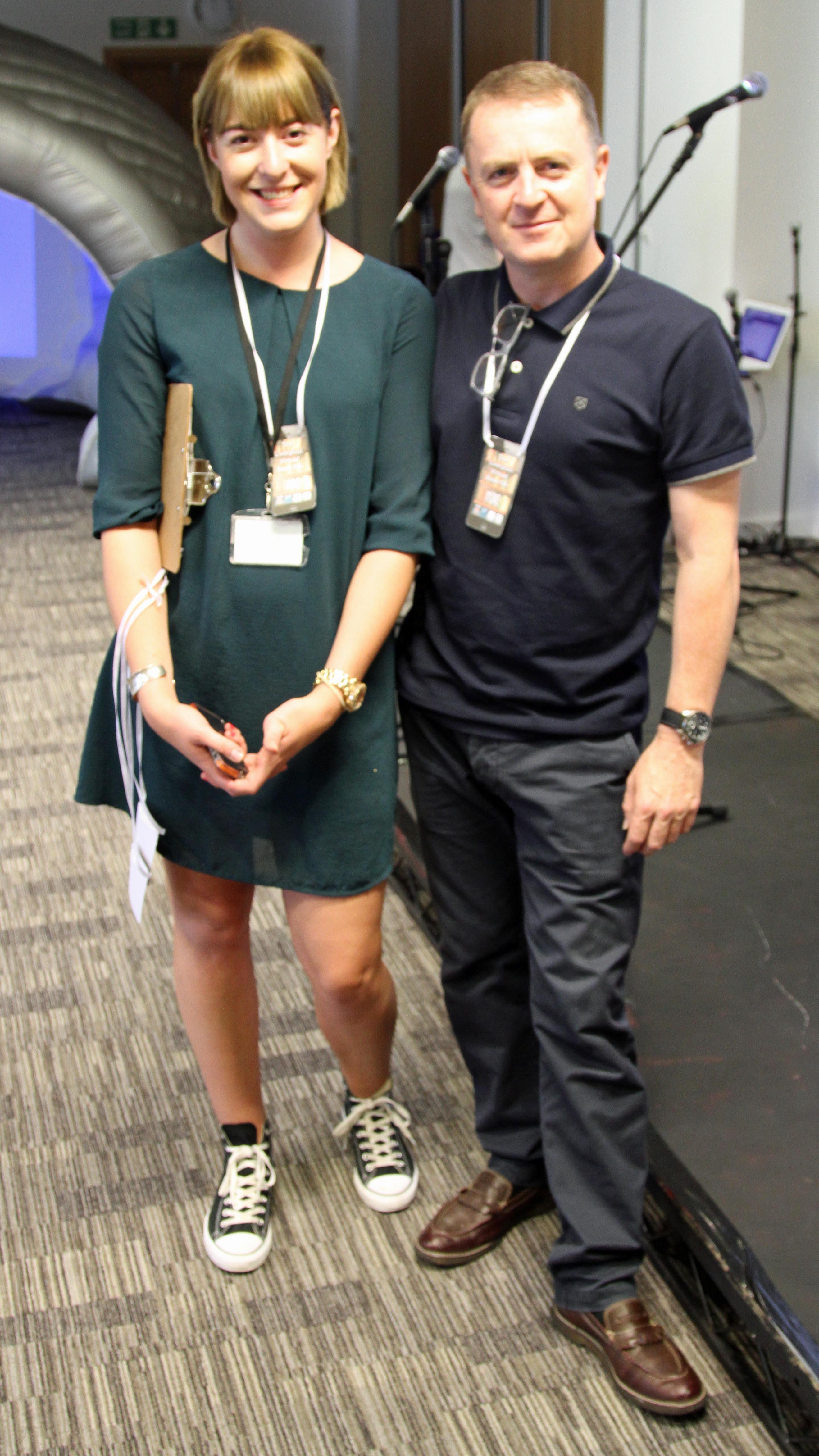
Yesterday’s event was superlatively well organised by Abi Inglis, a recent graduate of Liverpool John Moores University, who runs her own online magazine (Heroine) for women and has been helping with or running literary events in the city for several years.  Madeline Heneghan was the overall festival director and Mike Morris the operations director.

Abi Inglis, Wowfest organiser

Abi Inglis, Wowfest organiser

Abi Inglis and Mike Morris, completely confident of the impact of Writing on the Wall!

Abi Inglis and Mike Morris, completely confident of the impact of Writing on the Wall!

Festival Director Madeline Heneghan opens Wowfest

Festival Director Madeline Heneghan opens Wowfest

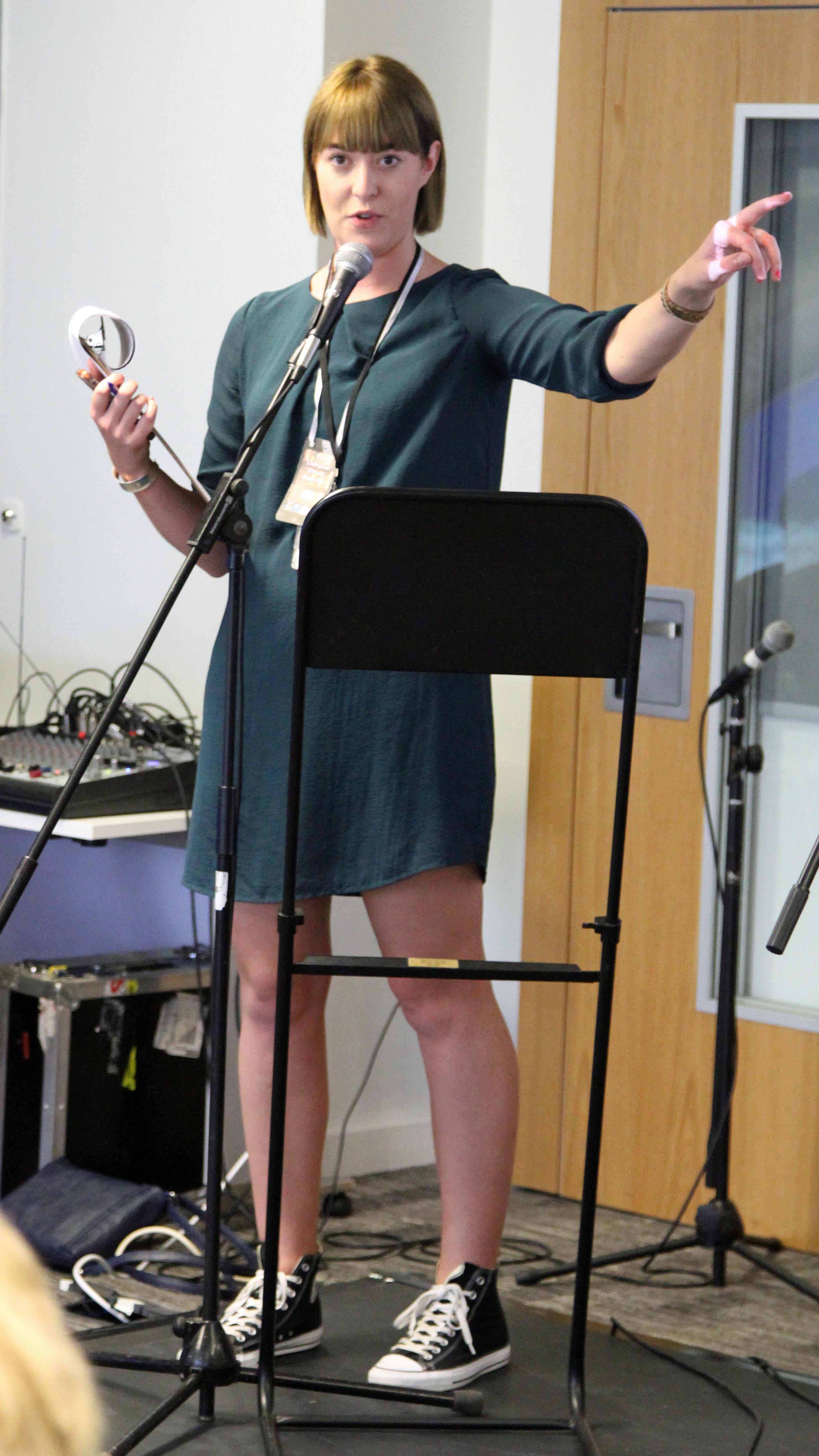
I was doubly grateful to Abi, because, as well as inviting me to talk at the festival about how to get published, she also gave me a short slot to read the opening chapter of my next DI Yates novel, Sausage Hall, which will be published on 17th November.  This was Sausage Hall’s first public outing, and marks the start of a series of events that Salt and I are planning both in the lead-up to the publication date and immediately afterwards.

Giving 'Sausage Hall' its first outing

Giving ‘Sausage Hall’ its first outing

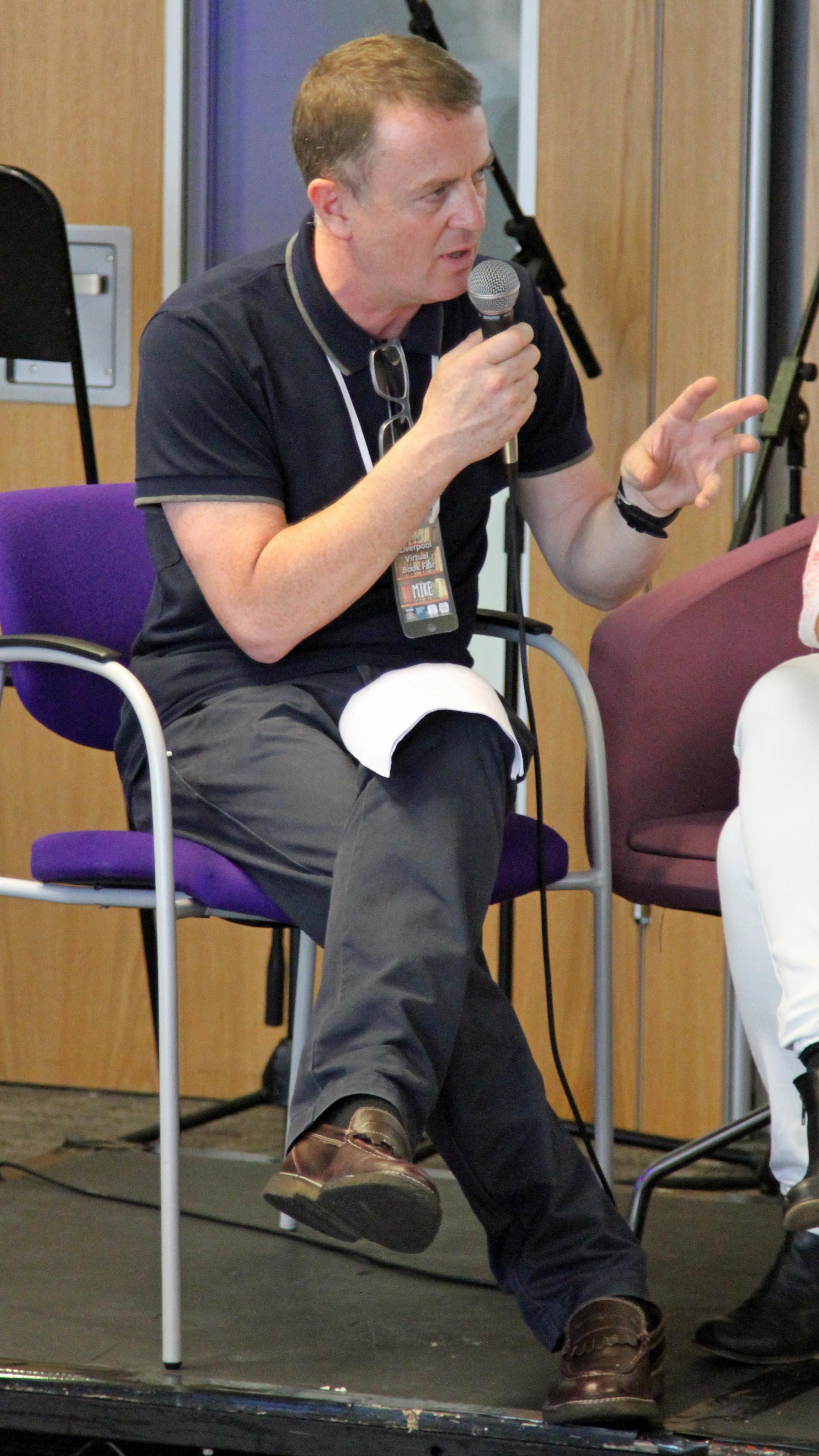
Even better, Abi devoted a large part of yesterday afternoon to Salt and Salt authors.  Mike Morris, himself a published playwright, interviewed Jon Gale, a young Liverpudlian author whom he obviously admires greatly and whose novella Albion was recently published by Salt as part of the Modern Dreams series.

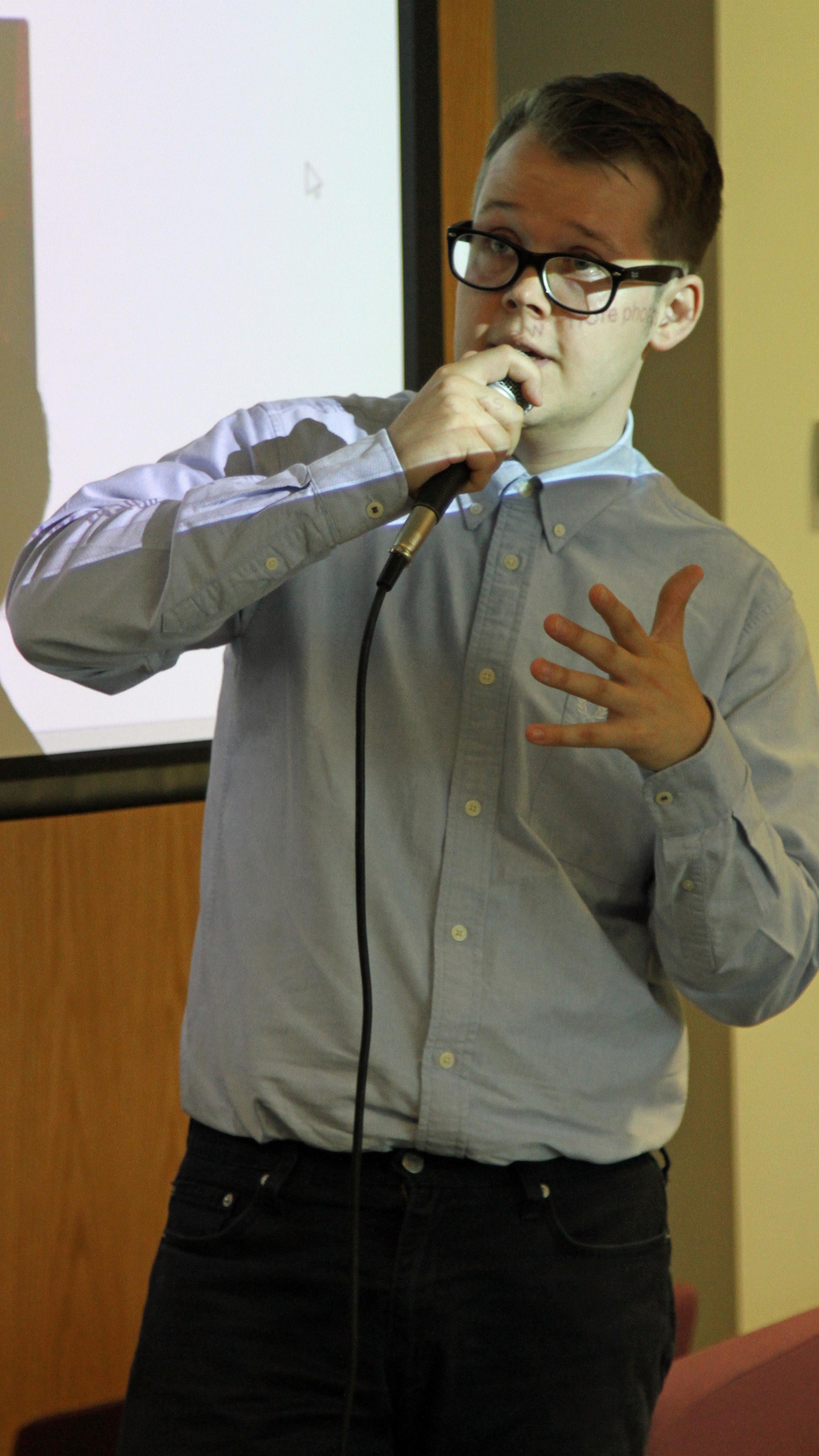
Jon Gale in animated response to Mike Morris' questions

Jon Gale in animated response to Mike Morris’ questions

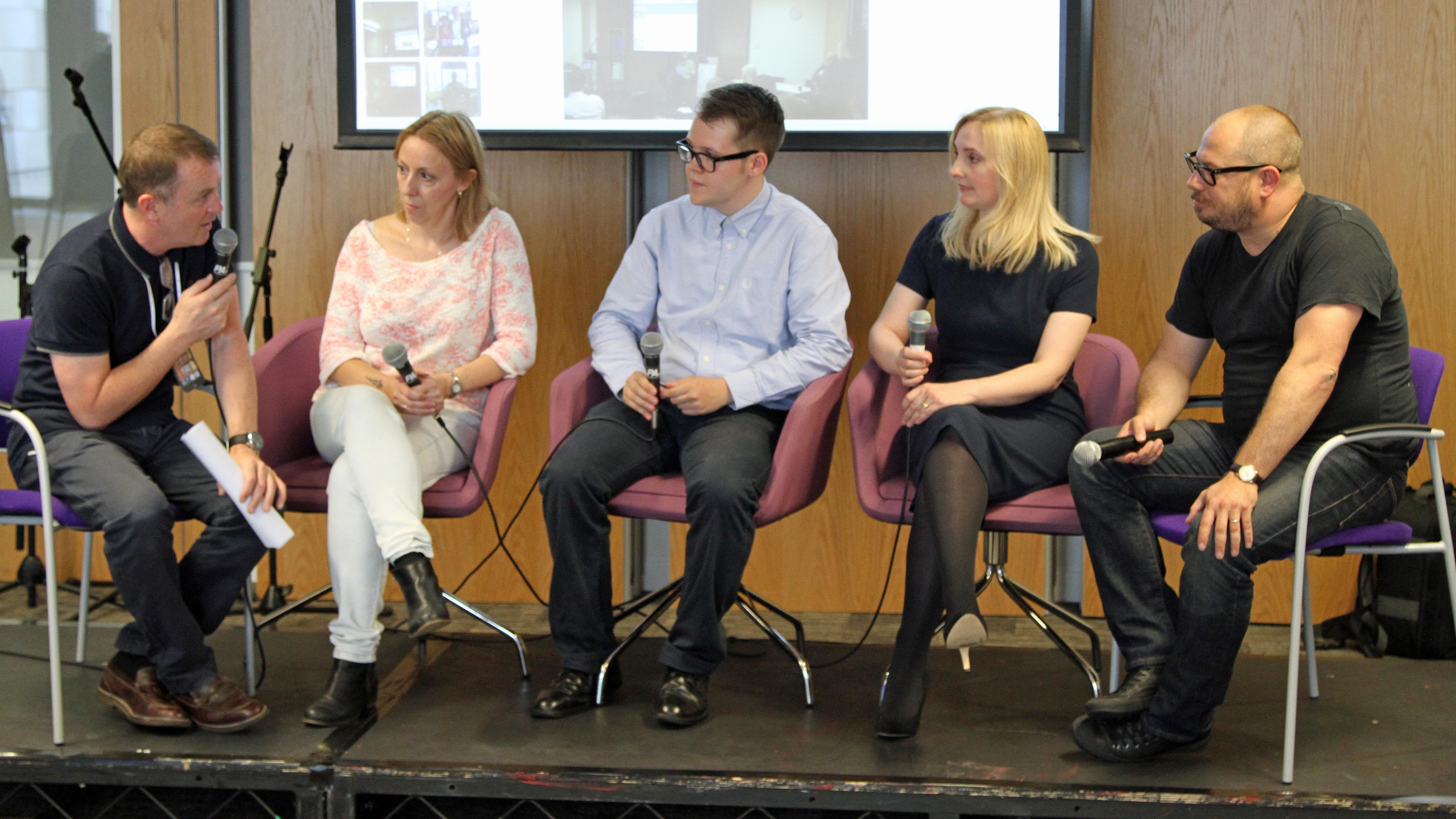
Mike then chaired a panel session of four Modern Dreams authors: Jon Gale, Denny Brown, Michelle Flatley and Jones Jones.  This was one of the best panel sessions I’ve ever seen conducted at a literary festival.  Mike elicited comments from each of the authors with great skill, giving them each an equal opportunity to talk, and they were all courteous, articulate and extremely interested in each other’s work.  It was a proud day for Salt!

Mike Morris and the Salt Publishing 'Modern Dreams' panel

Mike Morris and the Salt Publishing ‘Modern Dreams’ panel


Mike in fine form, drawing out the best from the panel members

Mike in fine form, drawing out the best from the panel members

Knowing that I was going to meet them, I read each of these authors’ novellas before the event, and was hugely impressed by them (Denny Brown’s is called Devil on your Back,

Denny Brown

Denny Brown

Michelle Flatley’s Precious Metal,

Michelle Flatley

Michelle Flatley

and Jones Jones’ Marg).

Jones Jones

Jones Jones

They all had an interesting story to tell about their journeys towards being published by Salt: Denny Brown, a mother of five, was the victim of an abusive marriage; Michelle Flatley is an artist who teaches refugees; Jones Jones is a journalist who has recently felt the compelling need to write fiction; Jon Gale has struggled for several years to find a publisher since leaving university.  I recommend all their novellas: they’re ideal for commutes or train journeys, or simply for rainy evenings at home – I’m certain you’ll find that the time spent reading them will be more entertaining than watching TV.  All are available as e-books from a variety of channel providers, including Amazon, which has just launched a promotion for the whole Modern Dreams series.

A privilege to sit at the feet of so much talent

A privilege to sit at the feet of so much talent

I was sponsored to talk about ‘How to get Published’ by PrintonDemandWorldWide, whose new venture, The Great British Bookshop, provides authors with an alternative to Amazon if they want to self-publish but need help with sales channels.

'How to get published', talk sponsored by PrintonDemandWorldWide

‘How to get published’, talk sponsored by PrintonDemandWorldWide

PODWW gave me some notebooks, pens and guidelines for authors to distribute at the festival, which proved to be extremely popular.

I can’t conclude this post without mentioning what a wonderful public audience the city of Liverpool produced for this event.

Snapshot view of an ever-changing but ever-attentive and supportive Liverpudlian audience

Snapshot view of an ever-changing but ever-attentive and supportive Liverpudlian audience

It was one of the most diverse audiences I’ve met at a literary festival: families brought their children; there were many teenagers and young adults;  quite a few senior citizens and some people with disabilities took advantage of the easy access to the library to join in the festival fun.  All listened keenly, welcomed the authors enthusiastically and asked great questions.  The main festival arena was packed at all times and the ante-rooms, where authors’ surgeries and DVD presentations about apps took place, were also always full.  An inflatable ‘pod’, another of Abi’s brainwaves, which offered a range of activities for children, was also very popular – and frequented by children of all ages!

Well done, the festival team and the city of Liverpool, for an absolutely stunning event.

Framed by Wowfest!

Framed by Wowfest!

Footnote:  If you’re organising a literary event this autumn and would like me to give a reading from Sausage Hall and explain how I came to write it, please let me know.  Salt is also offering a limited number of reading copies and there will be a competition later in the autumn to help to promote it.  More details will appear here and on the Salt website.

The Liverpool Central Library roof terrace and skylight dome

The Liverpool Central Library roof terrace and skylight dome

One of the views from the roof terrace

One of the views from the roof terrace

A summary of the keynote speech at this year’s meeting of the Publishers Licensing Society

On my way to the annual meeting of the Publishers Licensing Society.

On my way to the annual meeting of the Publishers Licensing Society.

Last week, I attended the annual meeting of the Publishers Licensing Society [PLS], which this year was held for the first time at Burlington House, Piccadilly – a wonderful venue at which I’ve found myself on several occasions and which I wrote about last year.
Hands down, the keynote speaker at the meeting, William Sieghart, stole the show. The founder of Forward Publishing, he has recently been asked to conduct a review of public libraries in England and map out a plan of what their future might look like.
He began by saying that there are 151 library authorities in England, which is ‘an awful lot’. Anyone wishing to appraise the public library service has to engage with all of them and also the two central government departments involved, the DCMS and Arts Connect. The money for libraries comes from the Department for Communities and Local Government (DCLG), but ultimately the organisations that influence them the most are the 151 local authorities around the country. In order to carry out his review, William Sieghart has been obliged to place himself at the centre of a very complex set of problems. His thoughts on the task so far completed are as follows:
1. Any review can only make a set of recommendations that essentially skirt around the dysfunctionality of the public library service, as there seems to be no appetite to change the way it is set up.
2. Fifteen years ago the government invested in ‘The People’s Network’, which involved placing computers in libraries for people visiting them to use. It was very exciting at the time; is less so now. Currently, only 37% of the libraries in England have wi-fi. The dysfunctionality that he referred to applies not only to the governance of libraries, but also to the way in which they buy goods and services. For example, the average commercial organisation would expect to pay £200 – £500 for setting up wi-fi, but, because of the way that they procure things, libraries can spend several thousand pounds on it.
3. “The Pub is the Hub”. This is an initiative that has taken place in local communities where the shop and all other amenities except the pub have disappeared. Its rationale is based on the fact that many pubs have a spare room that can be devoted to community activities. Libraries could and should occupy the same role within their respective communities, and some do, but because of the ‘hollowing-out’ of the system, this concept isn’t as widespread as it might be. Somewhat grimly, William Sieghart said, ‘It’s been a revelation to me over the past few months how Britain doesn’t work.’ He compared the closure of so many libraries with Beeching’s closure of much of the rail network in the 1960s, and said that we shall regret it. Andrew Carnegie founded libraries (in the late nineteenth and early twentieth centuries) as centres of self-improvement and, essentially, this function hasn’t changed. All sorts of things go on in libraries that have nothing to do with books and reading. Libraries are a haven for children, students, old people and the unemployed. For example, most jobs now require online applications, but 13% of unemployed people have no access to a computer; the public library is the only place they can go, either for this or for help with digital and literacy skills. ‘Give a library coffee and wi-fi and it will be packed.’ The problem is, said William Sieghart, that ‘joined up’ is not a term that is readily recognised in Whitehall; there is a failure of imagination to identify the many services that libraries could be used for. It is the system of management in so many places that has allowed public libraries to descend in a downward spiral, but in many others an upward spiral has been achieved.
4. We as members of the public have no stake in public libraries. William Sieghart advocates a system similar to that operated by school governing bodies. He said that Suffolk, for various complicated reasons, had to confront public library closures before anywhere else in the country (essentially, it ran out of money). All forty-two libraries in Suffolk are now run as community partnerships. One of the reasons that so many communities are in a panic about the future of their library service is because they ‘haven’t got their head around what Suffolk has done’. William Sieghart said that there should be a professional body ‘out there’ in a country like ours to make sure that this happens. Currently he’s lobbying government and big business to buy wi-fi and a digital network for every library.
5. William Sieghart also believes that there should be a ‘Librarian-first’ training campaign, run along the same lines as the ‘Teach-first’ campaign intended to attract young, energetic recruits to teaching.
The combined thrust of all his recommendations will be that a national support network for libraries should be created that is both inward- and outward-facing. More controversially, he suggested that this might, perhaps, include a ‘single content management system’. (There was little reaction from the publishers present to this, despite the unspoken effect on ‘economies of scale’ to their revenues.)
William Sieghart’s was an impassioned and eloquent speech. At the end of it, he made a plea for the creation of a ‘Library-Plus’ library service that will enable libraries to operate from a position of strength, instead of the ‘tragic, tragic position we’re in at the moment.’ He was an unusual choice for the PLS annual meeting keynote, but his speech made all the more impact because of that. Happily for me, he not only articulated many of my own deeply-held beliefs about the importance of the public library service, but outlined an ambitious and energetic plan that, if adopted, should help it not only to survive, but also to thrive.

Flirting with the M5 – in love with your hard shoulder… Feel my soft verges…

Summit tunnel, Smethwick, Birmingham Canal Navigations

Summit tunnel, Smethwick, Birmingham Canal Navigations


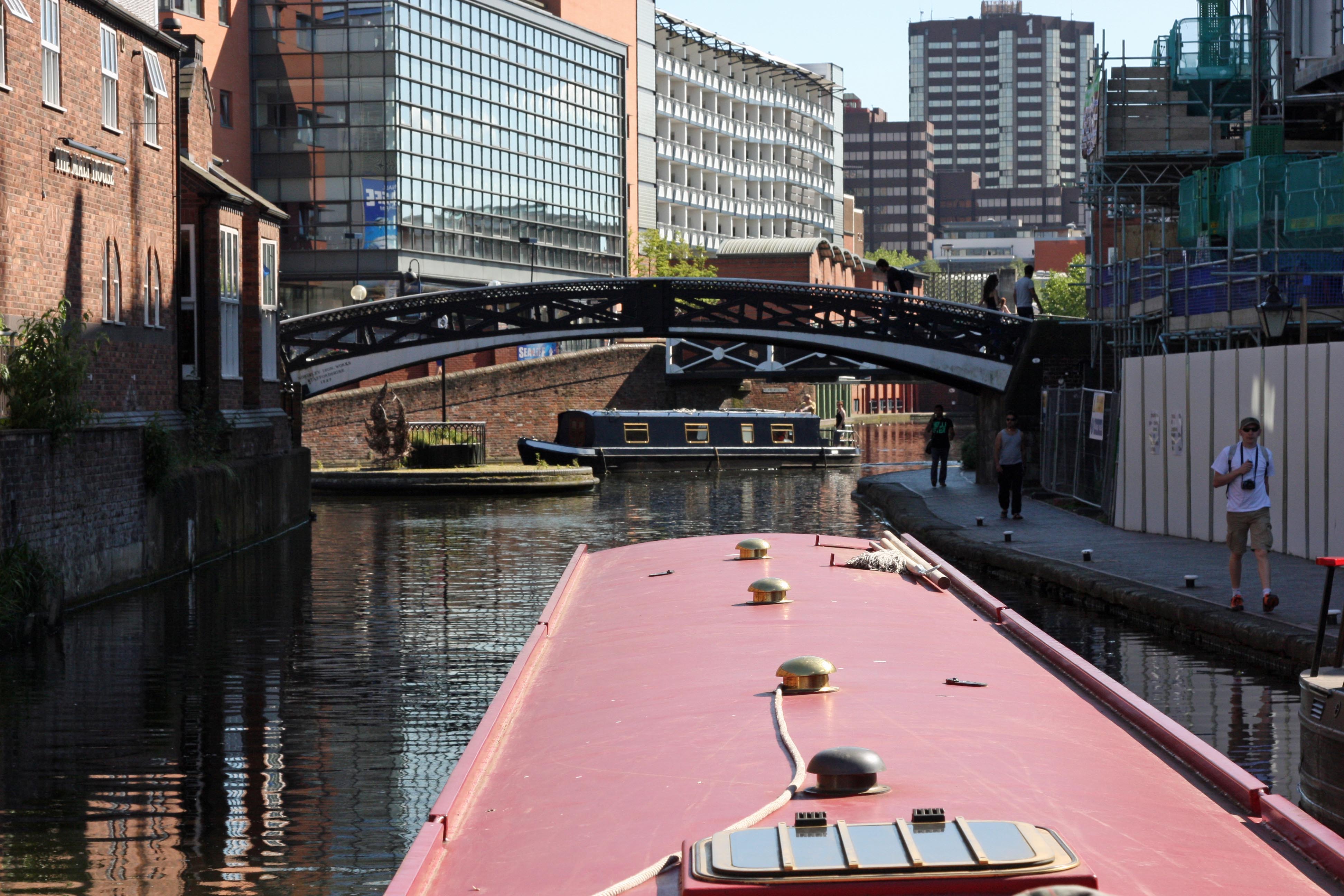
Head northwest out of Birmingham City Centre towards Wolverhampton along Thomas Telford’s ‘new’ main line, a canal designed to replace James Brindley’s wandering minstrel of a waterway (he was a man who followed contours) with an uncompromisingly direct route to Tipton, and you are, before too long, faced with the choice of old or new. We once came from Wolverhampton on Telford’s route, which may have resolved the needs of the working boat traffic of his day in reducing distance by a third, overcoming dreadful congestion at locks and replacing worn-out towpaths, but the experience did nothing for me as a 21st century tourist boater looking for interest; the straight miles of tedious and unrewarding scrubland were about as delightful as a purposeful motorway drive compared to a romantic dalliance with a B road. I of course admit that each serves its turn, according to need. Chacun à son goût! Telford’s dramatic cutting through the Smethwick Summit, with the magnificent Galton Bridge bestriding it, is an astonishing engineering achievement which one can admire, and we did, that time, but this year we had no difficulty in pursuing our favourite right turn in celebration of Brindley along the ‘old’ main line.
Now you will have deduced that I am an incurably poetic soul, who hankers after historical roses, but, if that is the case, you’ve jumped right… to the wrong conclusion. The thing about this old Brindley canal is that it has become touched with modern magic, in the form of juicy juxtapositions of modes of transport (and other things), and I hope from our photographs that you will see what I mean.
Turning right at Smethwick Junction provided us with some welcome diversion from quite a long horizontal journey (from the King’s Norton Junction south of Birmingham) in the form of the three locks which take the boater up to a stretch of canal that is, for me, just wonderful. I don’t expect everyone to share my taste.
Passing the Grade II listed pumping house between the two main lines at Brasshouse Lane bridge (If you get the chance to go inside, you’ll find, as I did, a Victorian marvel of a machine on different levels, one of the original two which were capable of lifting 200 locks of water a day; it replaced the earlier pumping houses on the ‘Engine Arm’ of the canal.), the old line leads under the Summit Tunnel. Though it all seems very rural just here, the thundering traffic of an A road dual carriageway passes unseen over this concrete underpass! There’s your first juxtaposition!
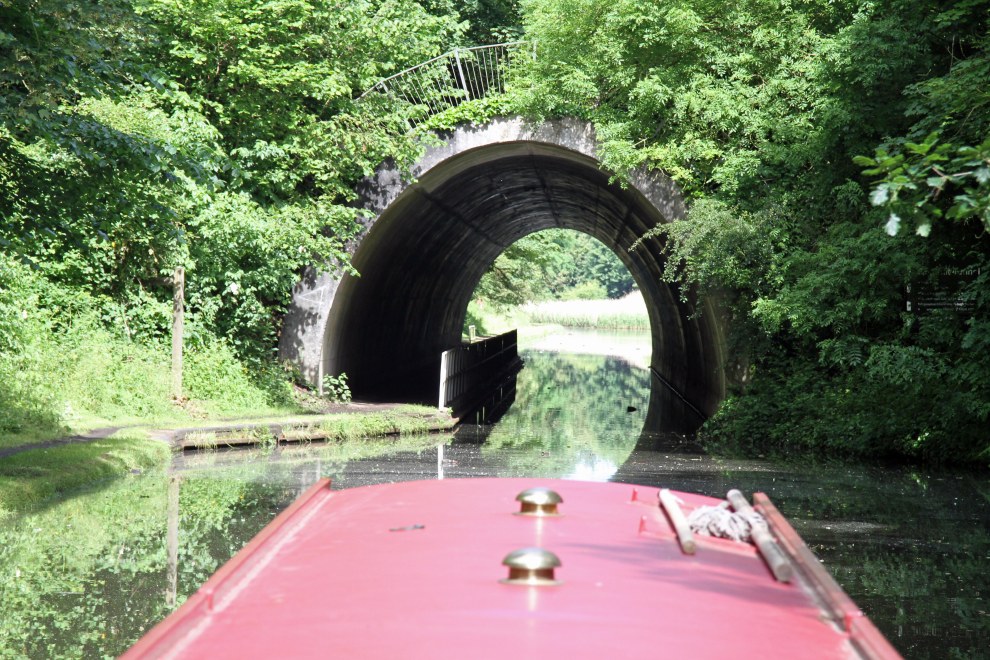
Yes, here we are in rural Birmingham.

Yes, here we are in rural Birmingham.


A heron, cranking itself from the towpath and lifting itself high into the air above us, is proof of the richness of canals, supporting wildlife as they do here, in the most unpromising terrain of urban and industrial Birmingham.
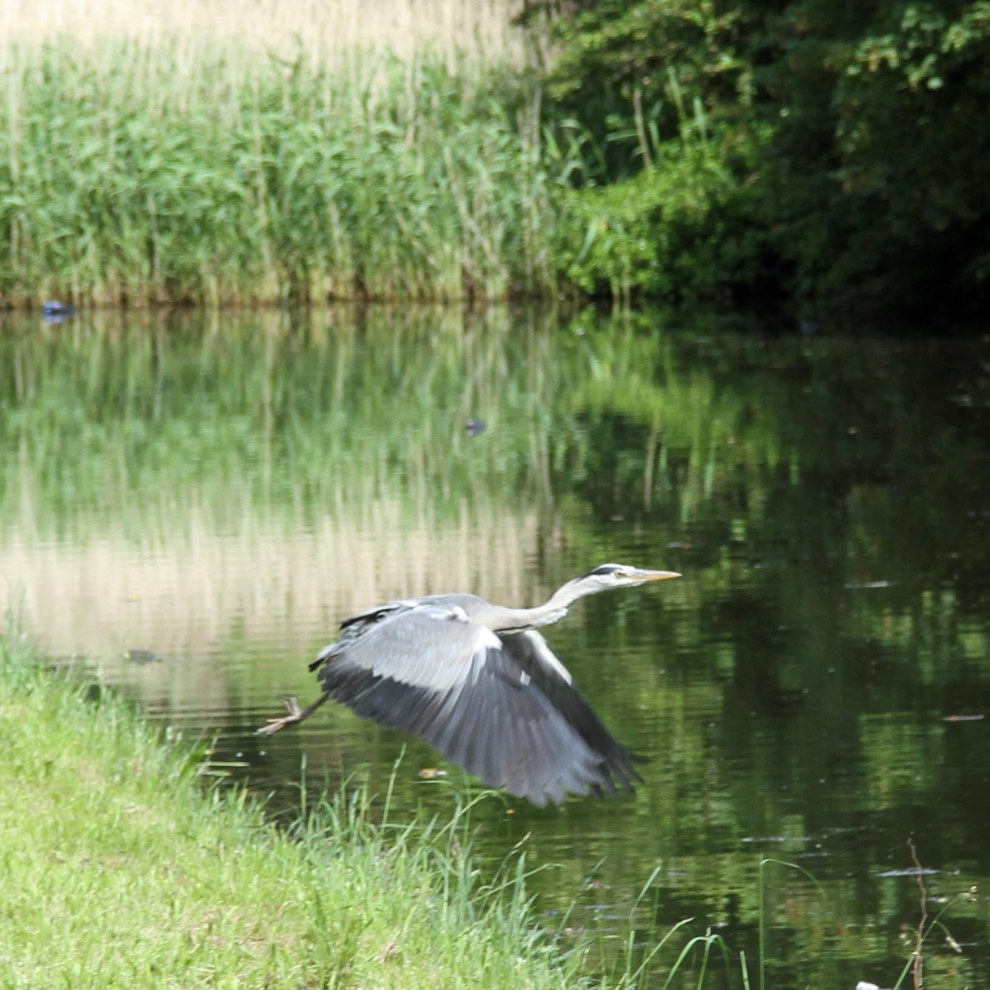
Flight of the heron

Flight of the heron


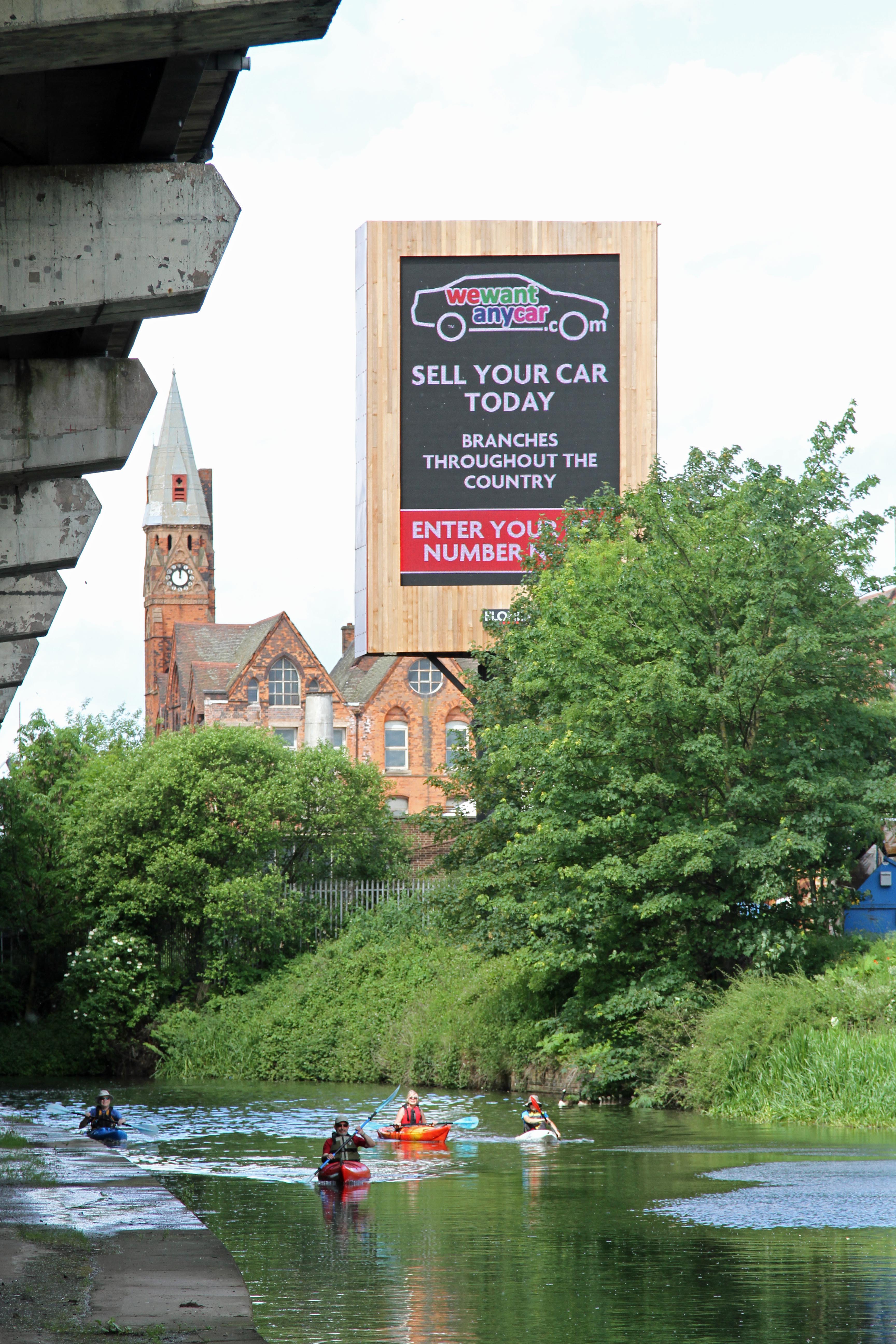
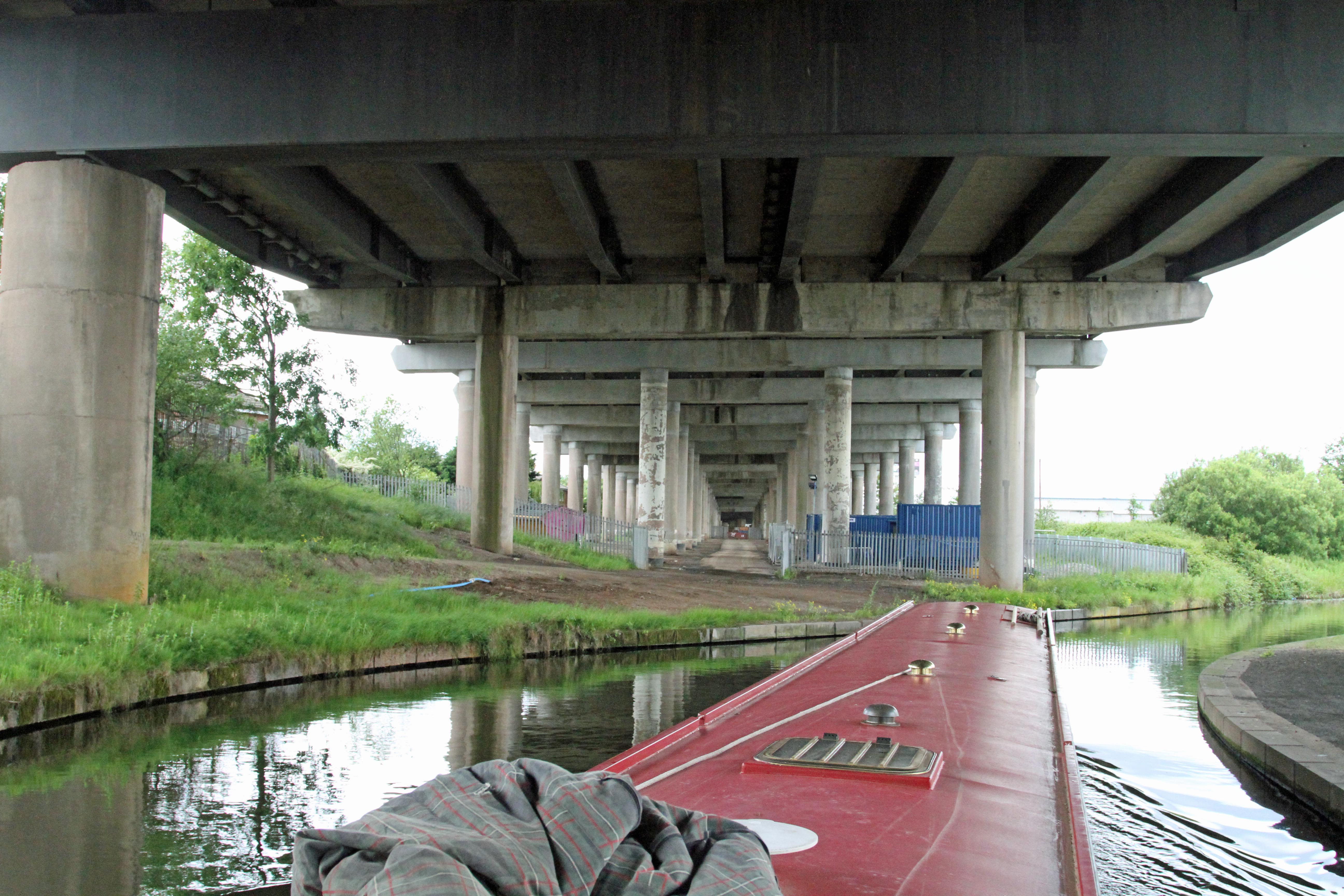
And now we meet the majestic (Yes, I mean it!) M5, a contrast to this beautiful canal (Yes, I certainly mean it!), with a pleasant moment of inconsistency as four kayakers pass by. The skyline, too, has a splendid coherence here.
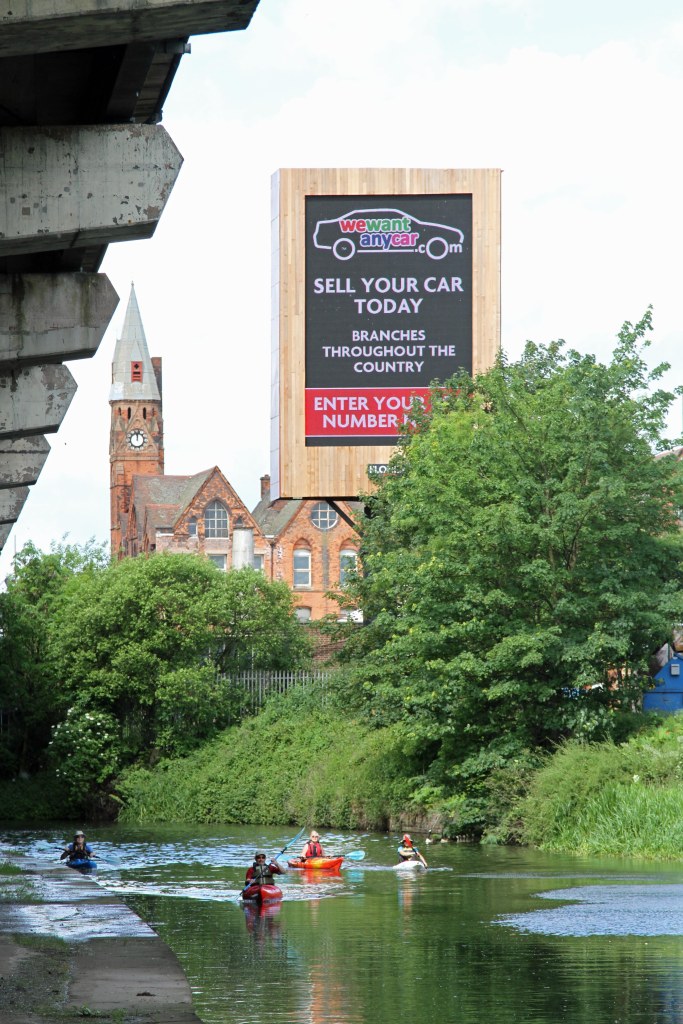
M5 cantilever and kayaks

M5 cantilever and kayaks


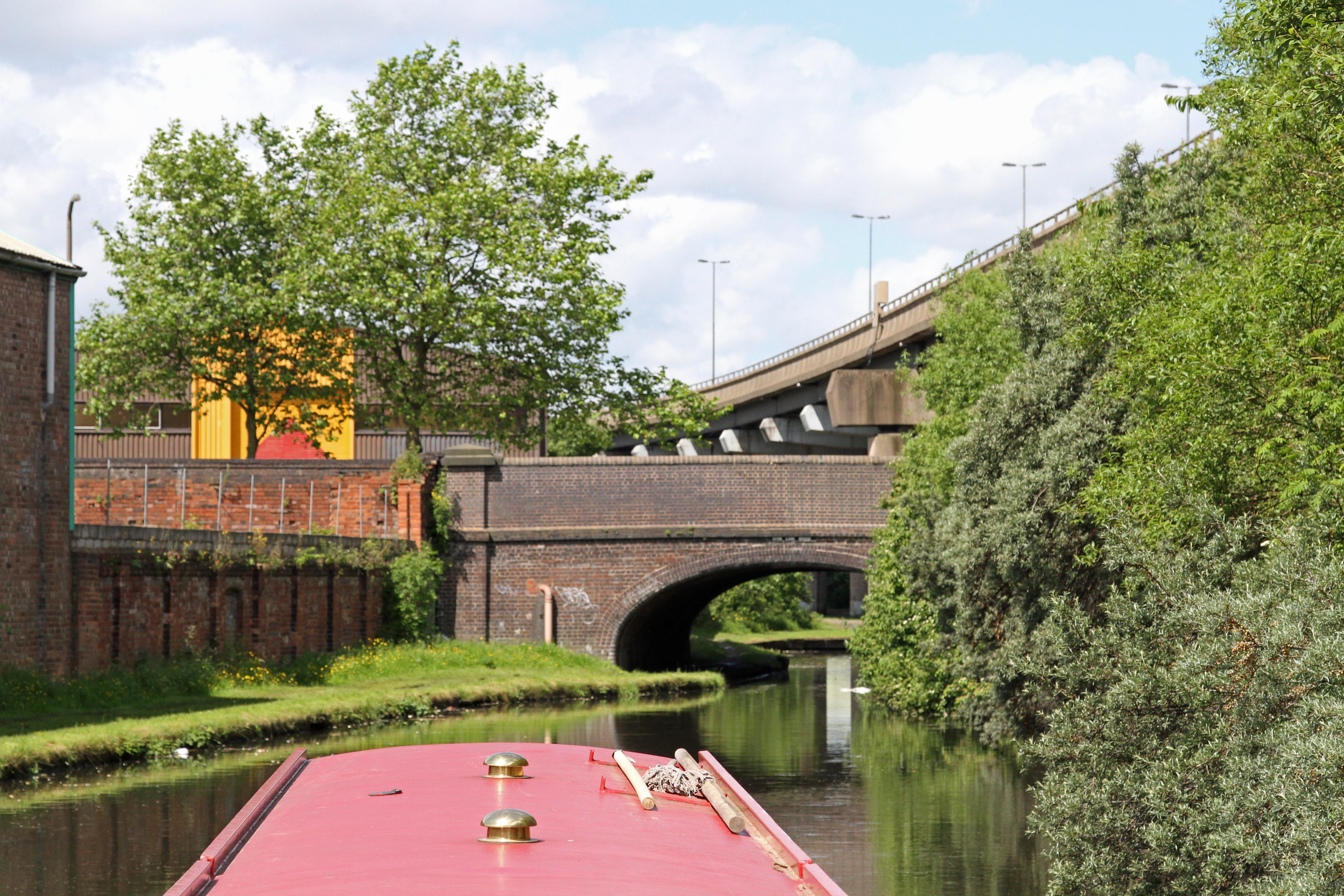
Up above, the juggernauts carry their loads in a roar, but we can barely hear them as our boat quietly transports us into a dream.
Here we come; there they go, through the M5 portico!

Here we come; there they go, through the M5 portico!


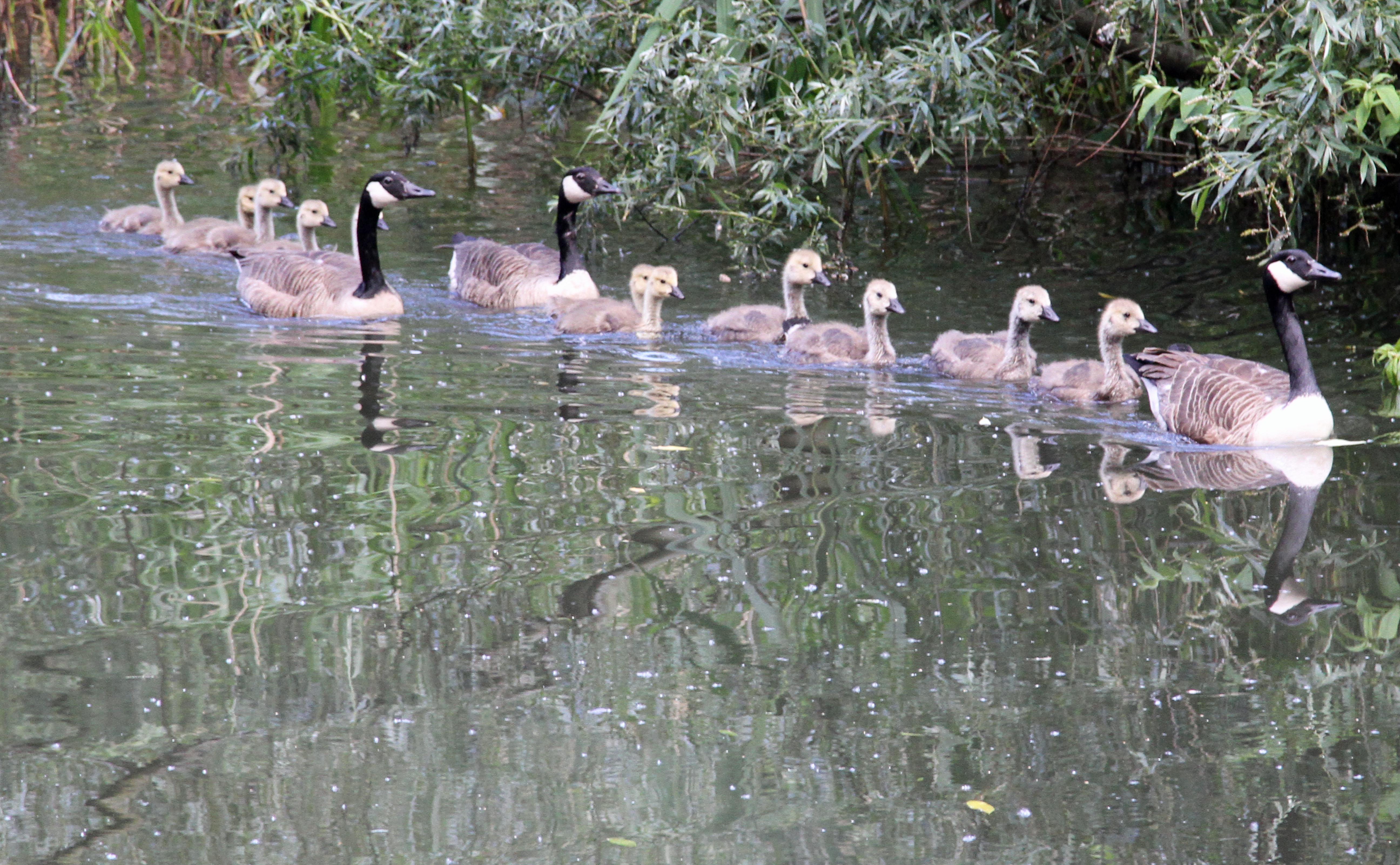
Wild life flourishes and Smethwick adds to the population of Canada geese, we note, as this crèche bobs by.
Canada goose creche

Canada goose creche


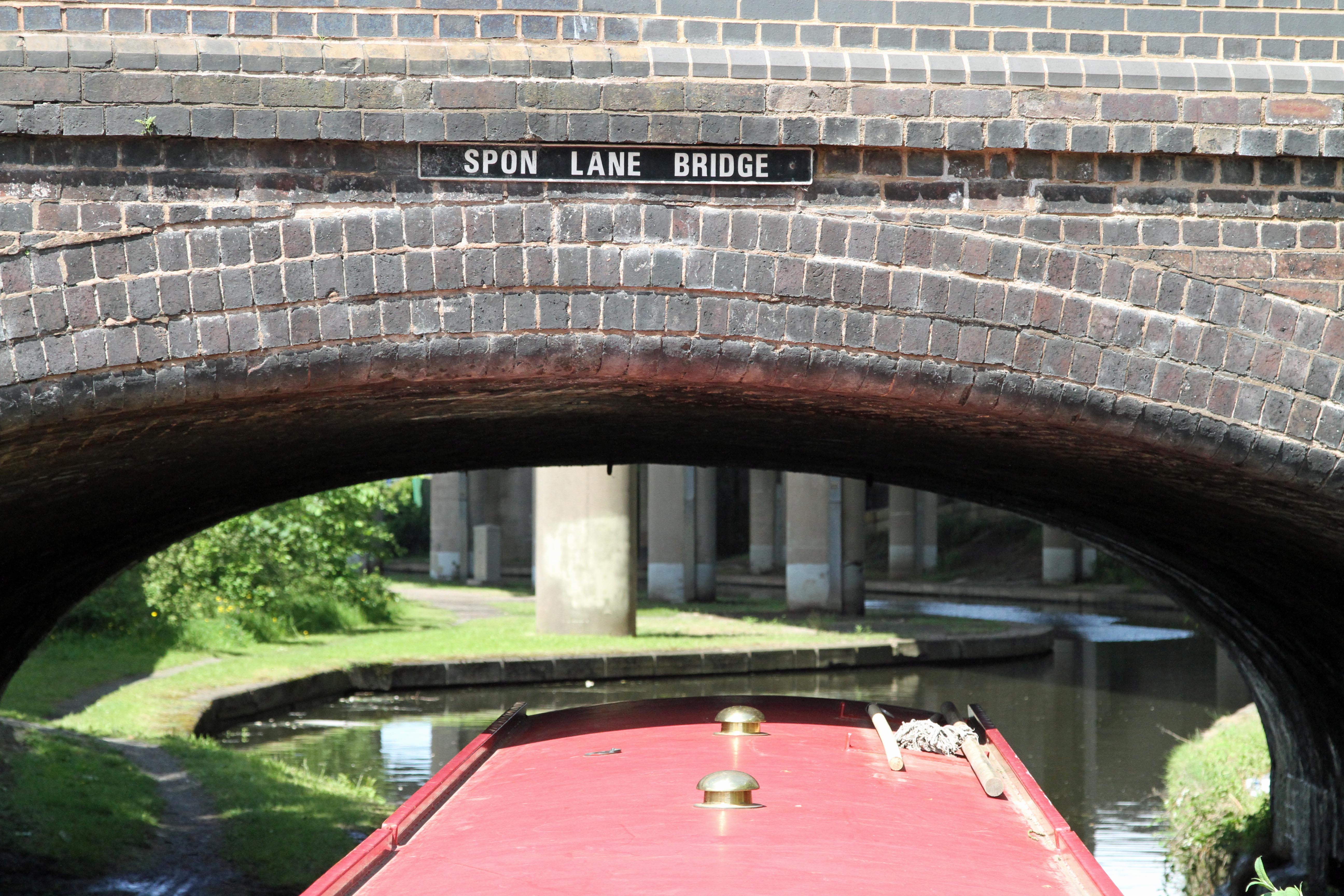
Straight lines and verticals abound in this motorway underworld, but our waterway winds deliciously, refusing to comply, and we wander willingly with it, from side to side.
And under we go again.

And under we go again.


I think that Brindley would have delighted in this, a towering sandwich of route ways. I should love to be able to show him and watch his reaction!
Triple decker - canal, road, motorway.

Triple decker – canal, road, motorway.
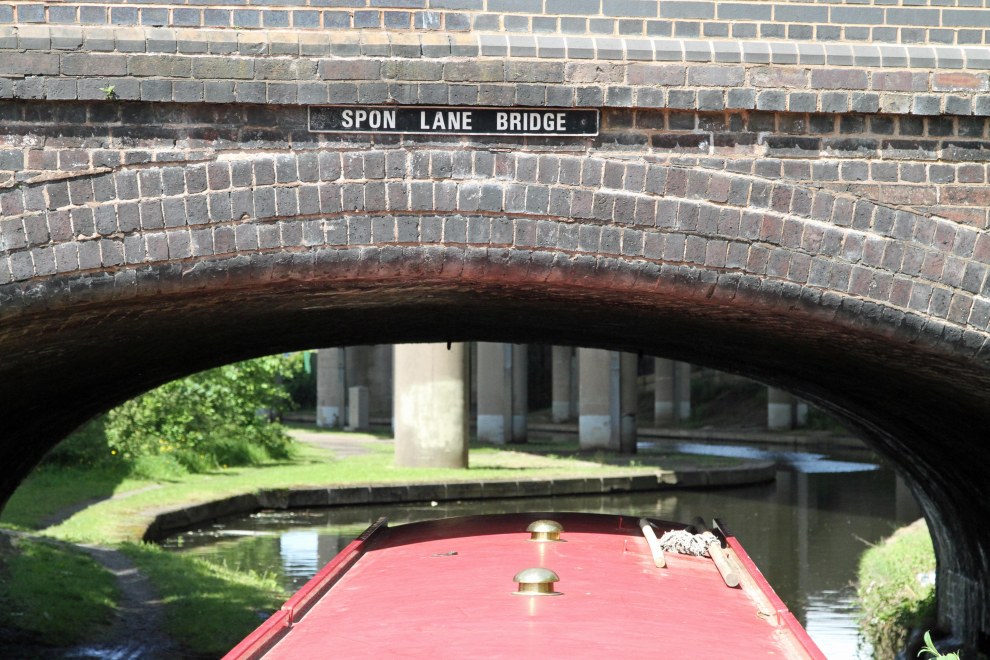

Spon Lane Bridge

Spon Lane Bridge


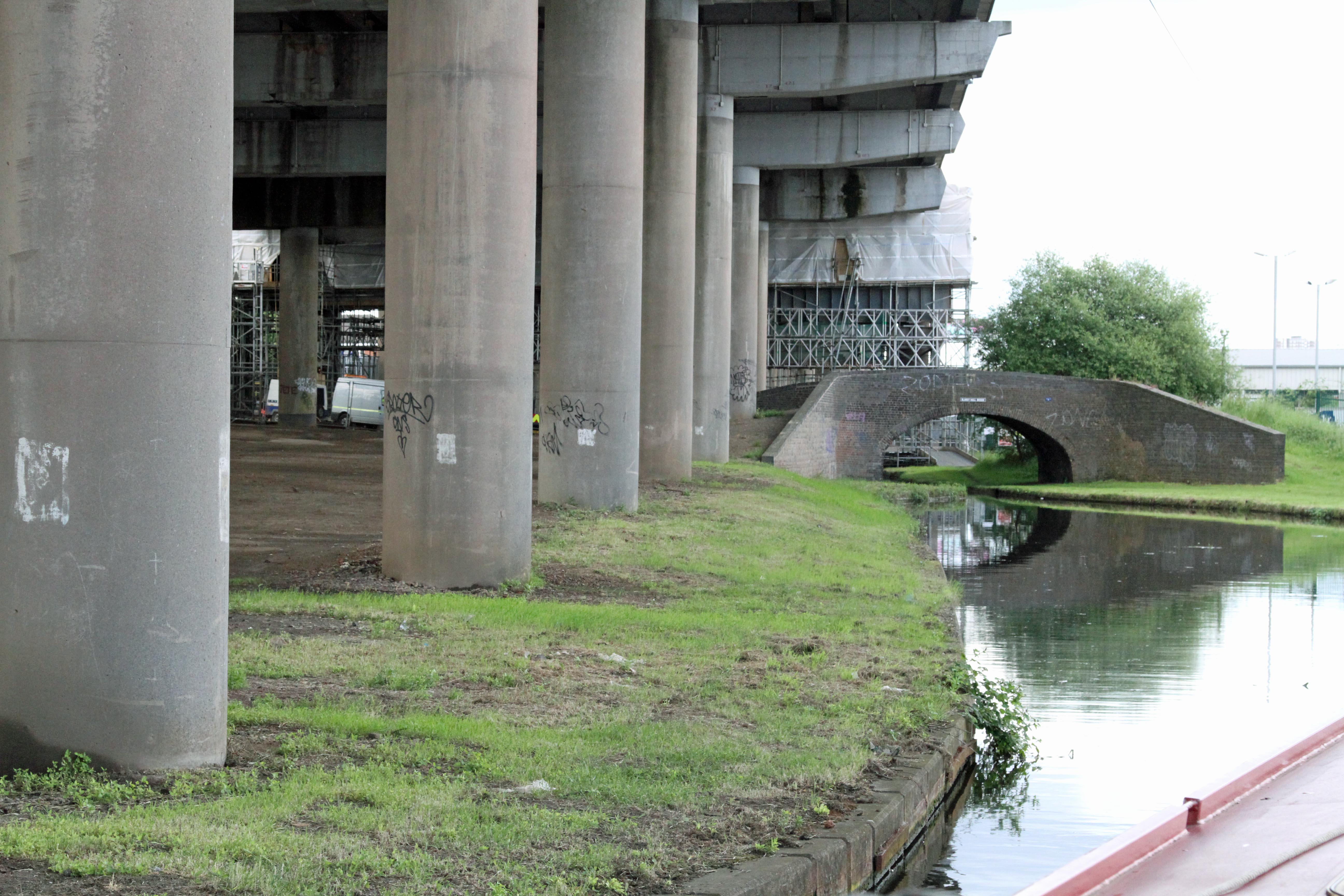
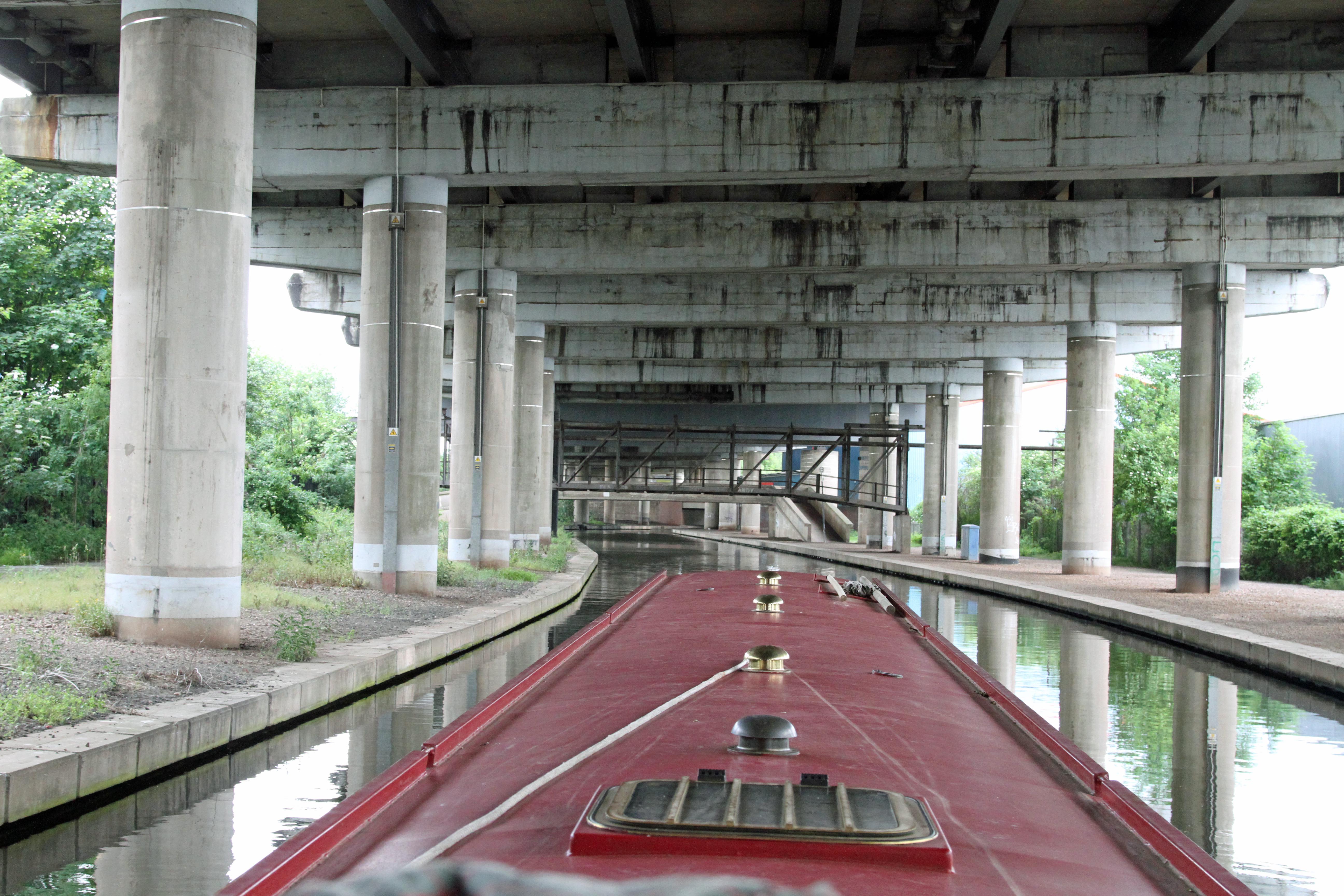
These colonnades may be formed from steel and concrete, but there is peace here for those of a contemplative frame of mind; the numbing noise of the carriageway above seems far away.
Cloister

Cloister


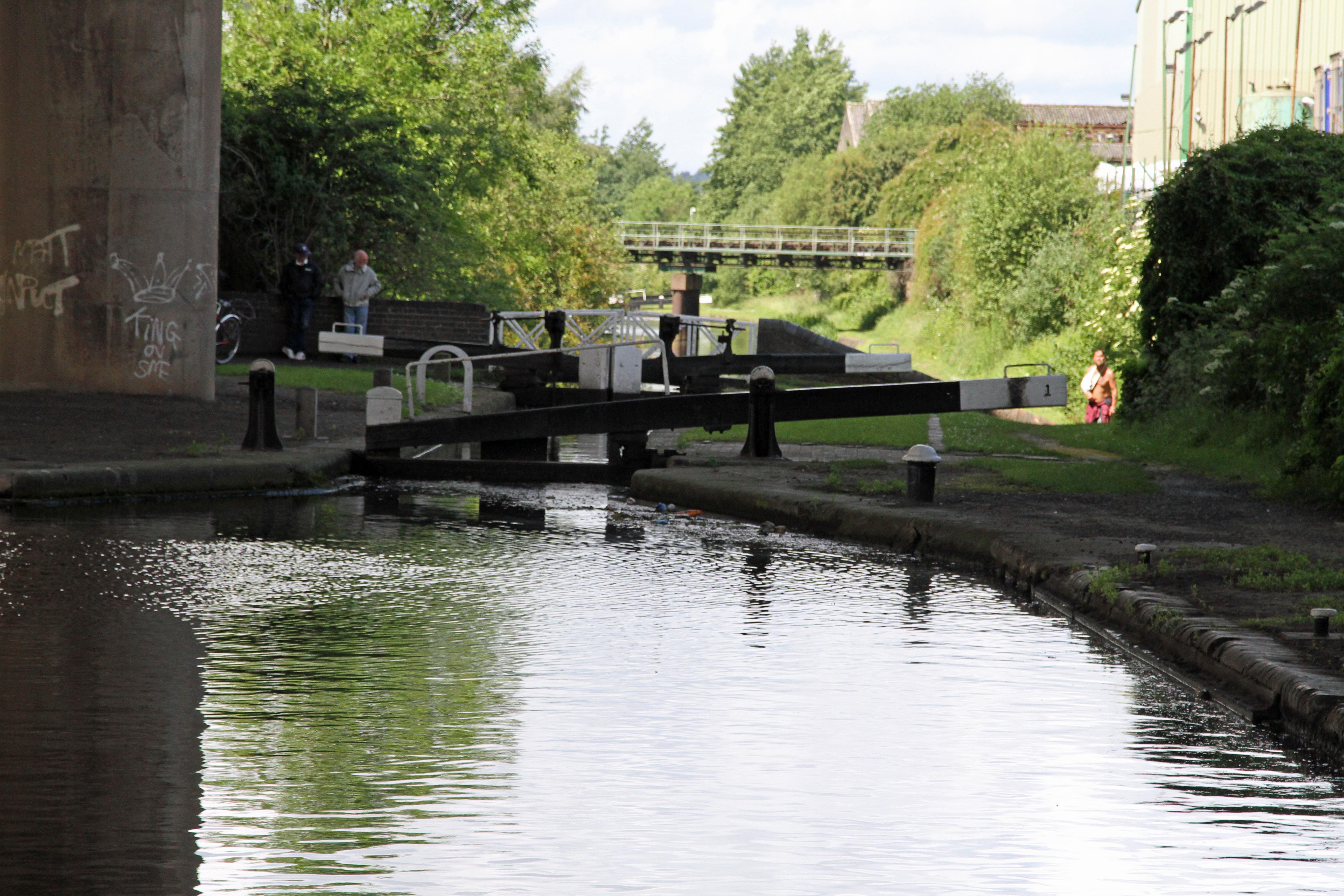
We’ve come up through Spon Lane locks before and marvelled at the contrast between the new and old main lines; we’re not at all tempted to lock down this flight of three, as we know how much more there is to see along this refurbished section of Brindley’s canal.
Spon Lane Locks: chance to rejoin the new main line.  No thanks!

Spon Lane Locks: chance to rejoin the new main line. No thanks!


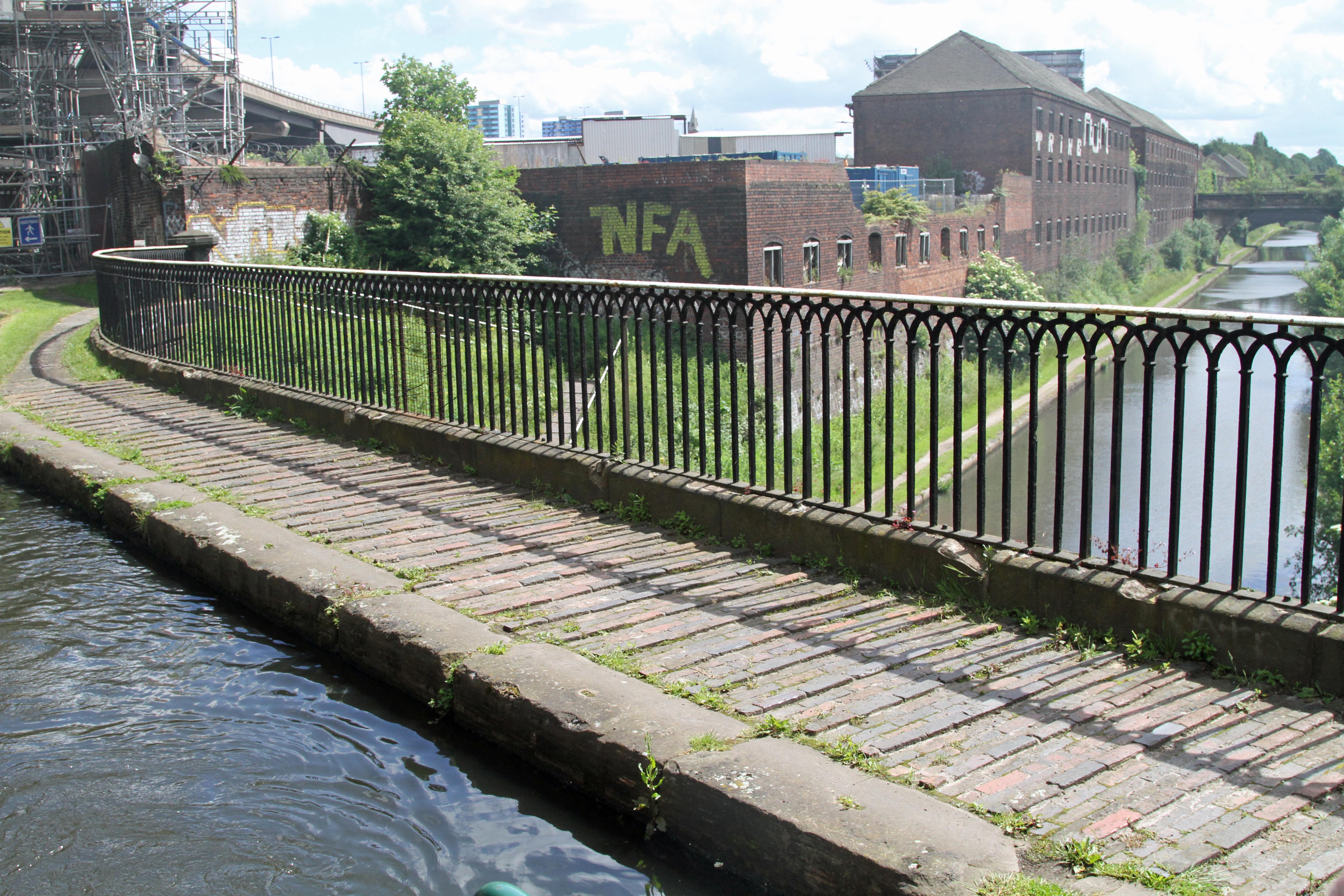
Three locks back at Smethwick Junction gave us this much height above Telford’s cut.
Stewart aqueduct: Below, the new main line heads for Galton Bridge.

Stewart aqueduct: Below, the new main line heads for Galton Bridge.


I’m rather sorry that it’s impossible to get all four levels of transport into one photograph from the vantage point of a narrowboat just here… and three must do.
Four levels of transport: New main line below, old main line, Birmingham-Wolverhampton railway, M5!

Four levels of transport: New main line below, old main line, Birmingham-Wolverhampton railway, M5!


For those of us who prefer the language of a bygone age of transport! Train station? Hah!
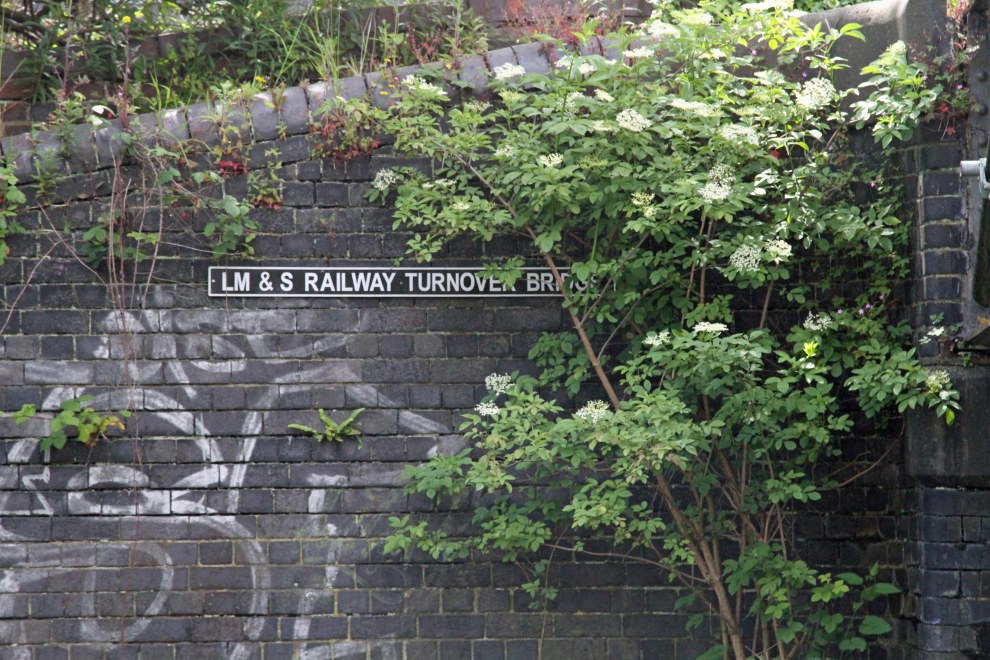
A magical name to conjure with...

A magical name to conjure with…


I wonder what Blakey Hall was like and whether the owner rode on horseback over this bridge. I love the whimsical shape in this, its contemporary context.
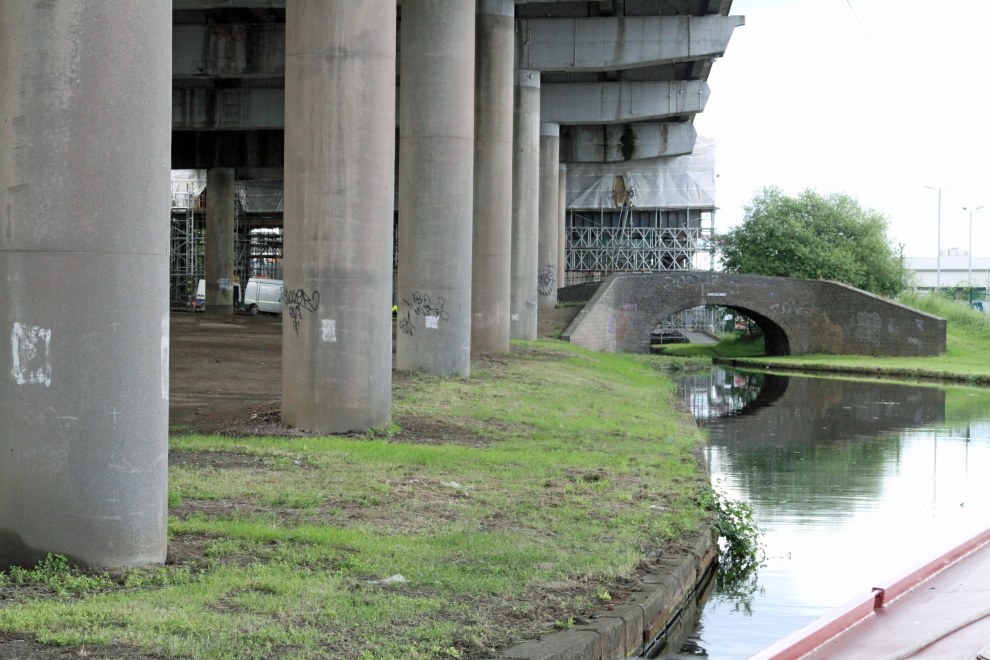
Blakey Hall Bridge - a matter of age and scale...

Blakey Hall Bridge – a matter of age and scale…


A sixty-eight foot narrowboat isn’t the easiest vessel to steer through tight spaces, but get the line right and you’re through.
Judgement matters at Blakey Hall Bridge.

Judgement matters at Blakey Hall Bridge.


Sorry, I couldn’t miss the opportunity for this pun. 😉
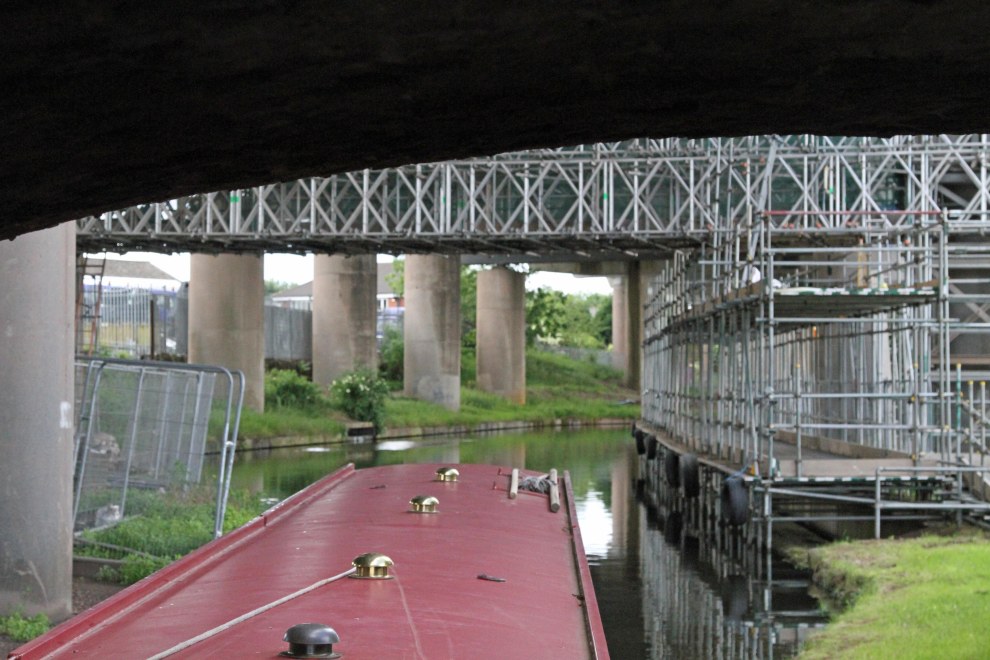
A view from the bridge...

A view from the bridge…


If you have an artistic eye, there’s plenty here to entertain it.
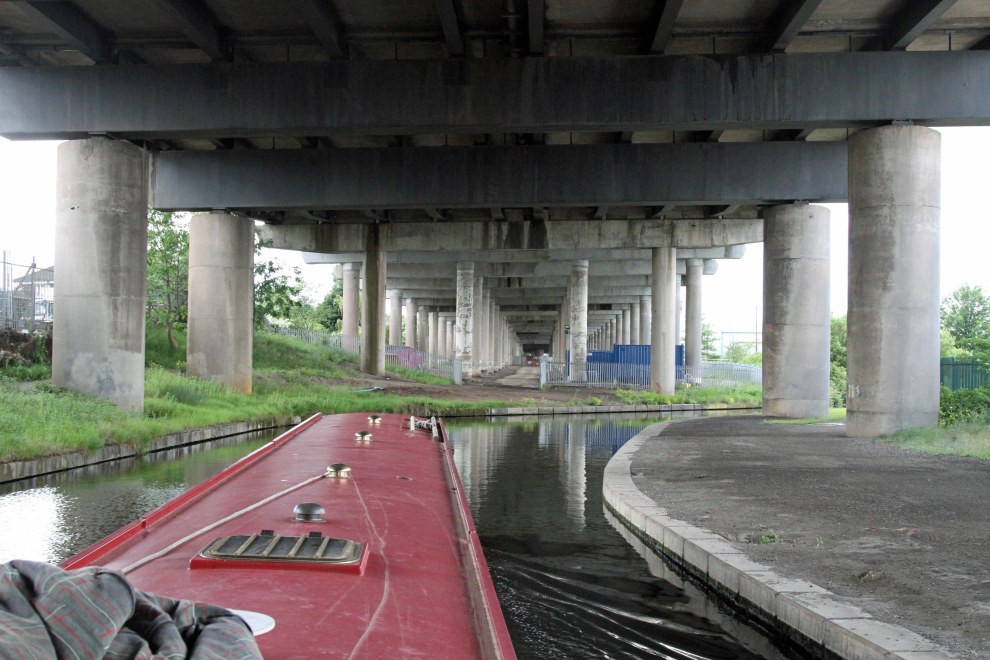
Perspective

Perspective


Hopkins’ “skate’s heel sweep[ing] smooth on a bow bend”? Perhaps, but in slow motion!
Into the curve...

Into the curve…


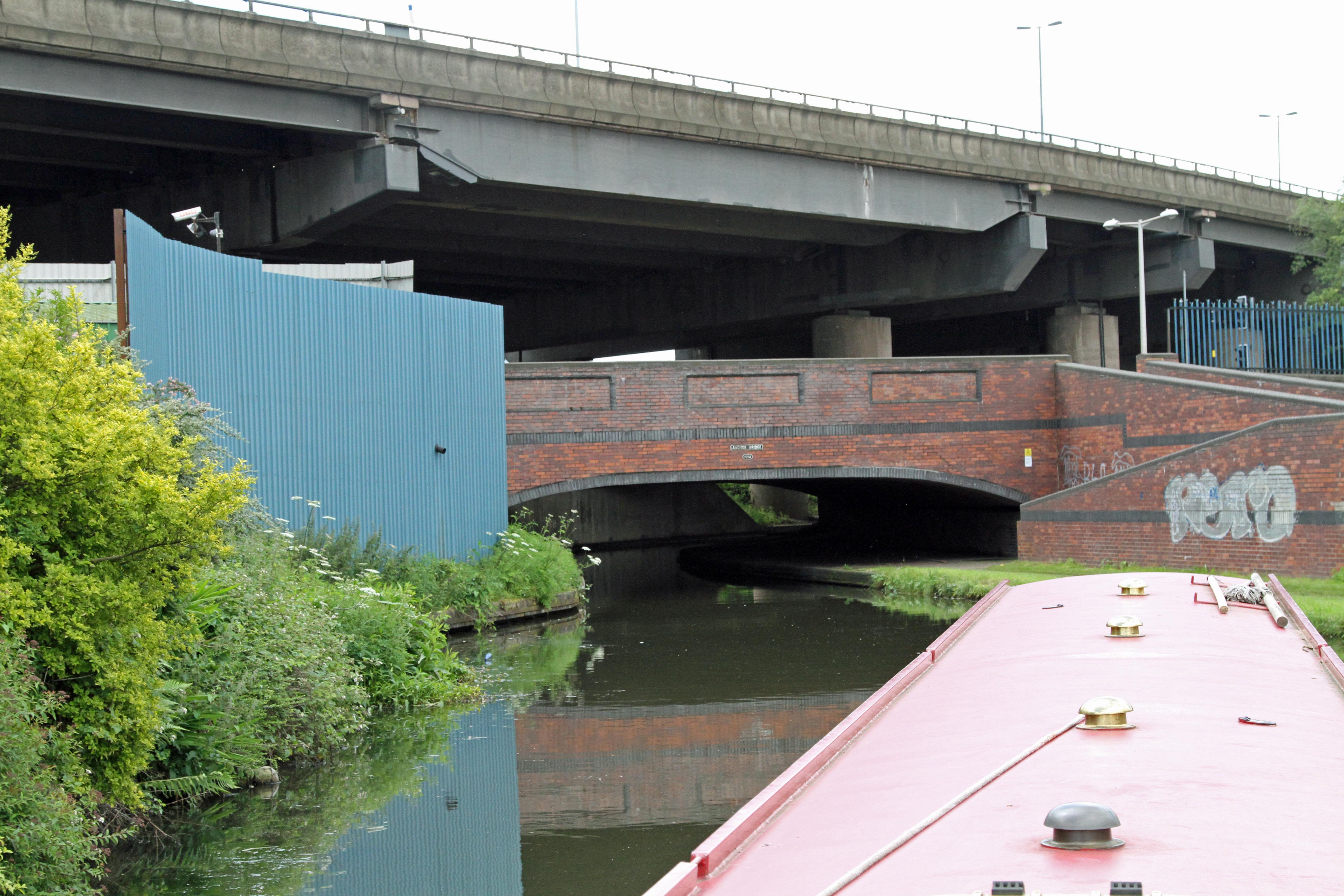
Modern canal bridge design, with a slight brickwork salute to the past.
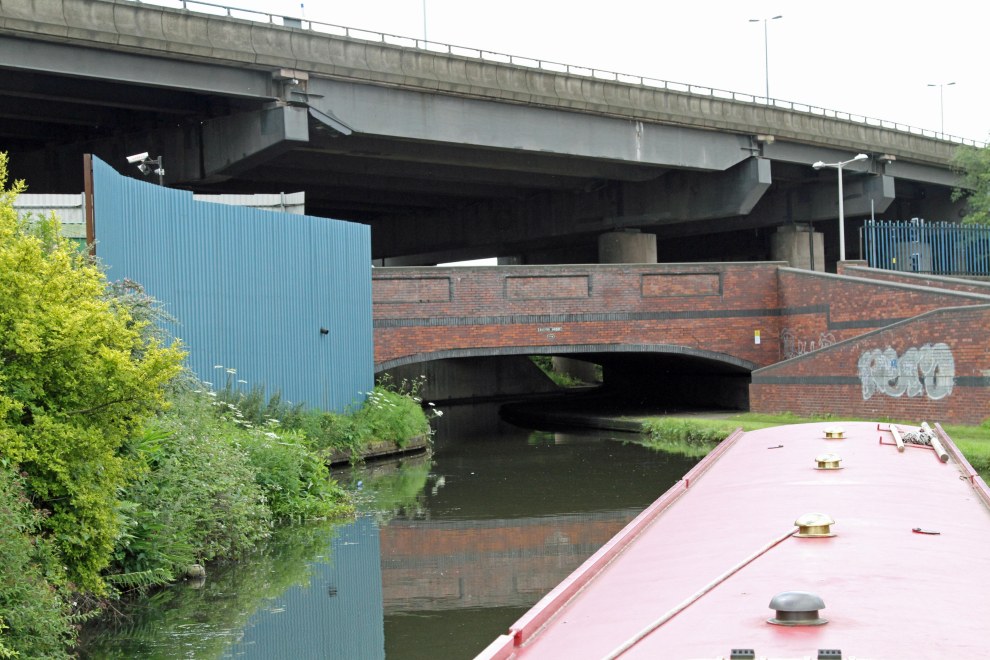
Anchor Bridge 1994

Anchor Bridge 1994


Once again, there’s definitely a line to take to make the turn.
Swing wide, sweet narrowboat...

Swing wide, sweet narrowboat…


Telford wanted us to hold the tiller straight!
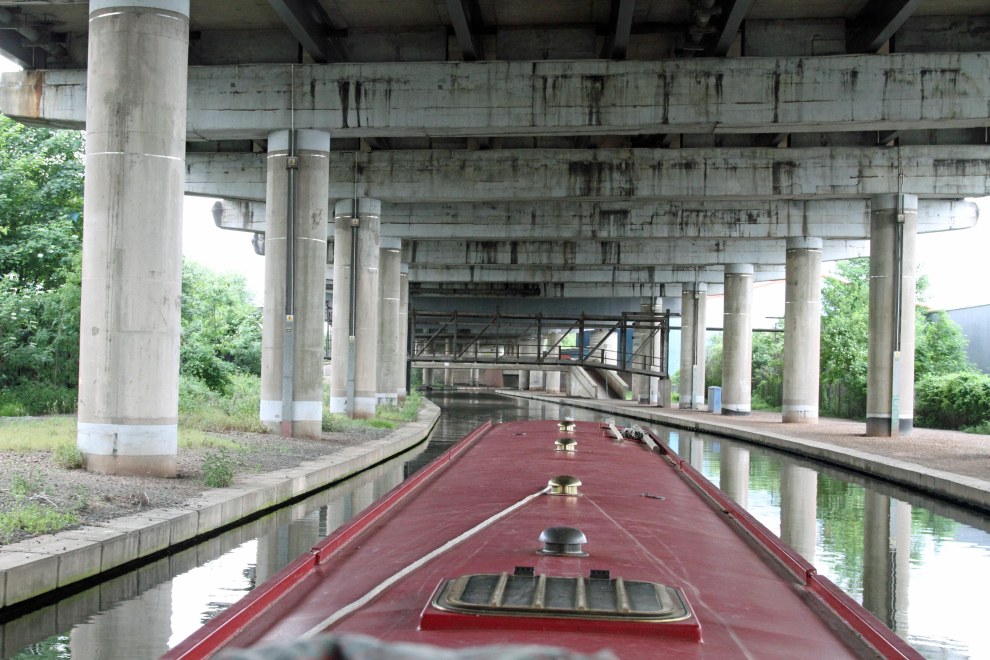
You swing it to the left, then you swing it to the right...

You swing it to the left, then you swing it to the right…


Here’s one we’re saving for the future: up to Titford Pool and back.
Oldbury Junction and the Titford Canal

Oldbury Junction and the Titford Canal


Graffiti interest? Well, of course!
Fancy taking a ride along the towpath or down the M5?

Fancy taking a ride along the towpath or down the M5?


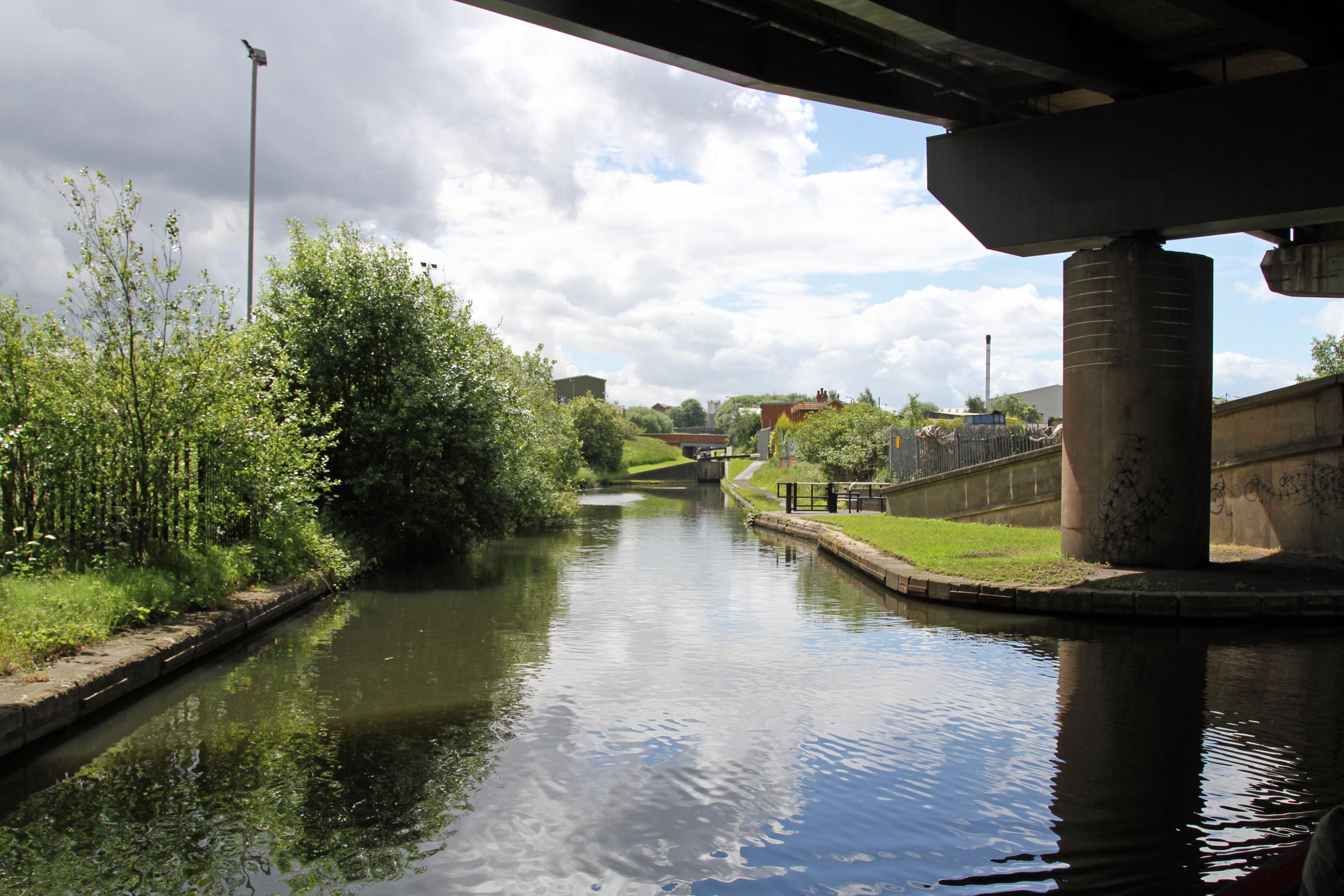
And now we say goodbye to the M5, with sadness at the end of a romantic encounter. We’ve dillied and dallied all the way.
Stone Street Bridge 2001

Stone Street Bridge 2001


Thank you for joining me on this narrowboat ride. Perhaps you will admit to being at least surprised to find what lies beneath the M5, even if you can’t find it in you to love it as much as we do!

All text and photographs on this website © Christina James
A new acquaintance, on a fascinating flight…

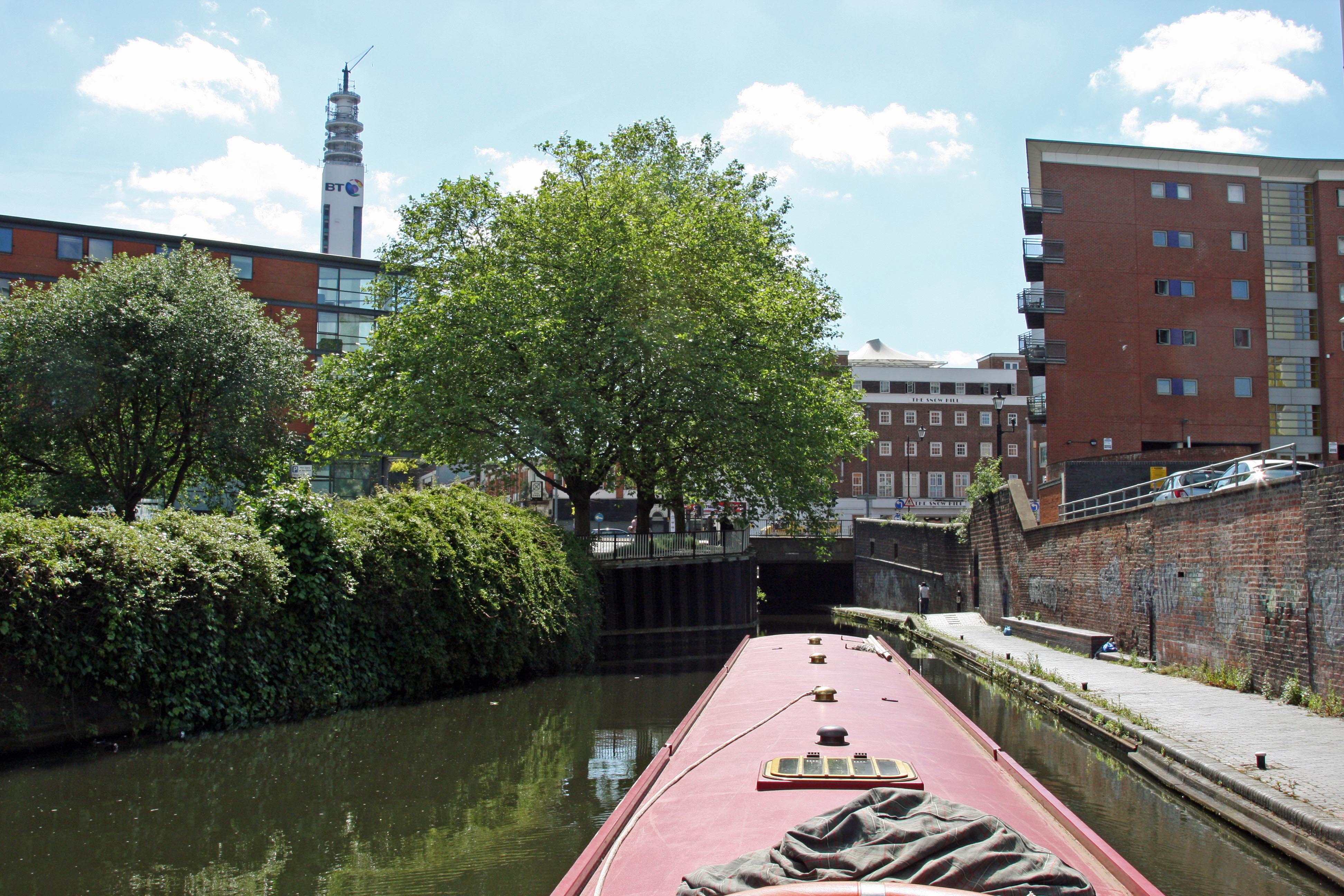
See that British Telecom tower up there?  We're going UNDER it.

See that British Telecom tower up there? We’re going UNDER it.


I’ve been planning several posts about my recent narrowboat holiday, but have been struggling to find the time to write them! Today, I’m determined to start, not only because that whole week provided some wonderful experiences that I’d like to share, but also because I want to celebrate a brief meeting with an extraordinary volunteer.
Under Snow Hill Bridge and nosing into lock 13 of the Farmer's Bridge flight.

Under Snow Hill Bridge and nosing into lock 13 of the Farmer’s Bridge flight.


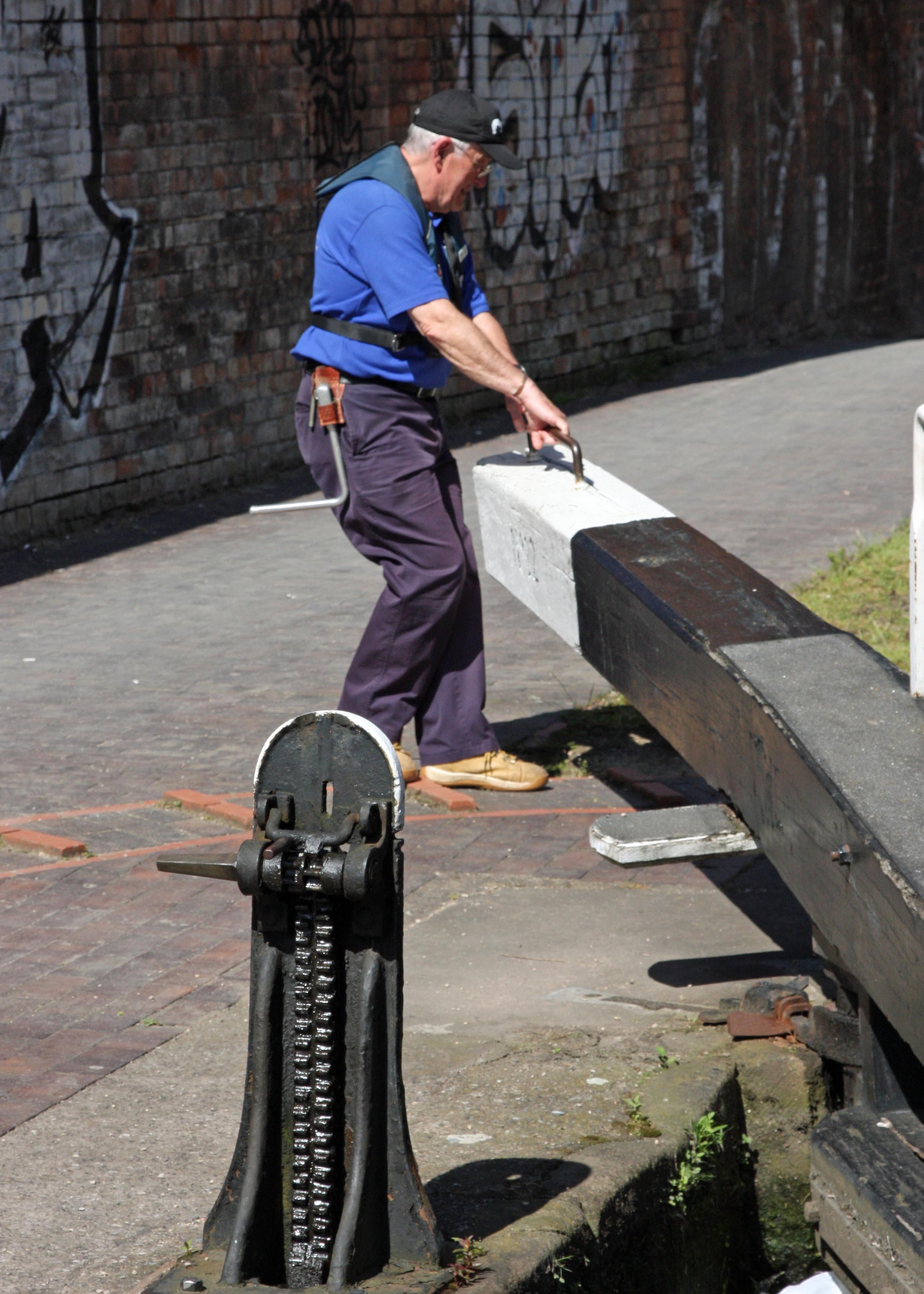
The background circumstances of our meeting were inauspicious, but it might never have taken place without them. It was a baking hot Thursday afternoon and our boat (endearingly named ‘Short-toed Eagle’) was approaching Birmingham City Centre, gradually being steered by my husband up the thirteen Farmer’s Bridge Locks, the final steep (eighty feet) flight into the city’s heart, while I manipulated the lock-gates; not far into the flight, we heard an explosive argument taking place, just out of sight, on the towpath. I should explain that this particular section of the BCN (Birmingham Canal Navigations) is a very public place to be negotiating locks, as office and shop workers take their lunches here and joggers, cyclists and families compete for space on the restored towpath. We were accompanied some of the way by a group of locals on bikes, who watched the whole process of ‘locking up’ several times over, but didn’t volunteer (sadly, for moving the gates is a hard job on a hot day!) to help!
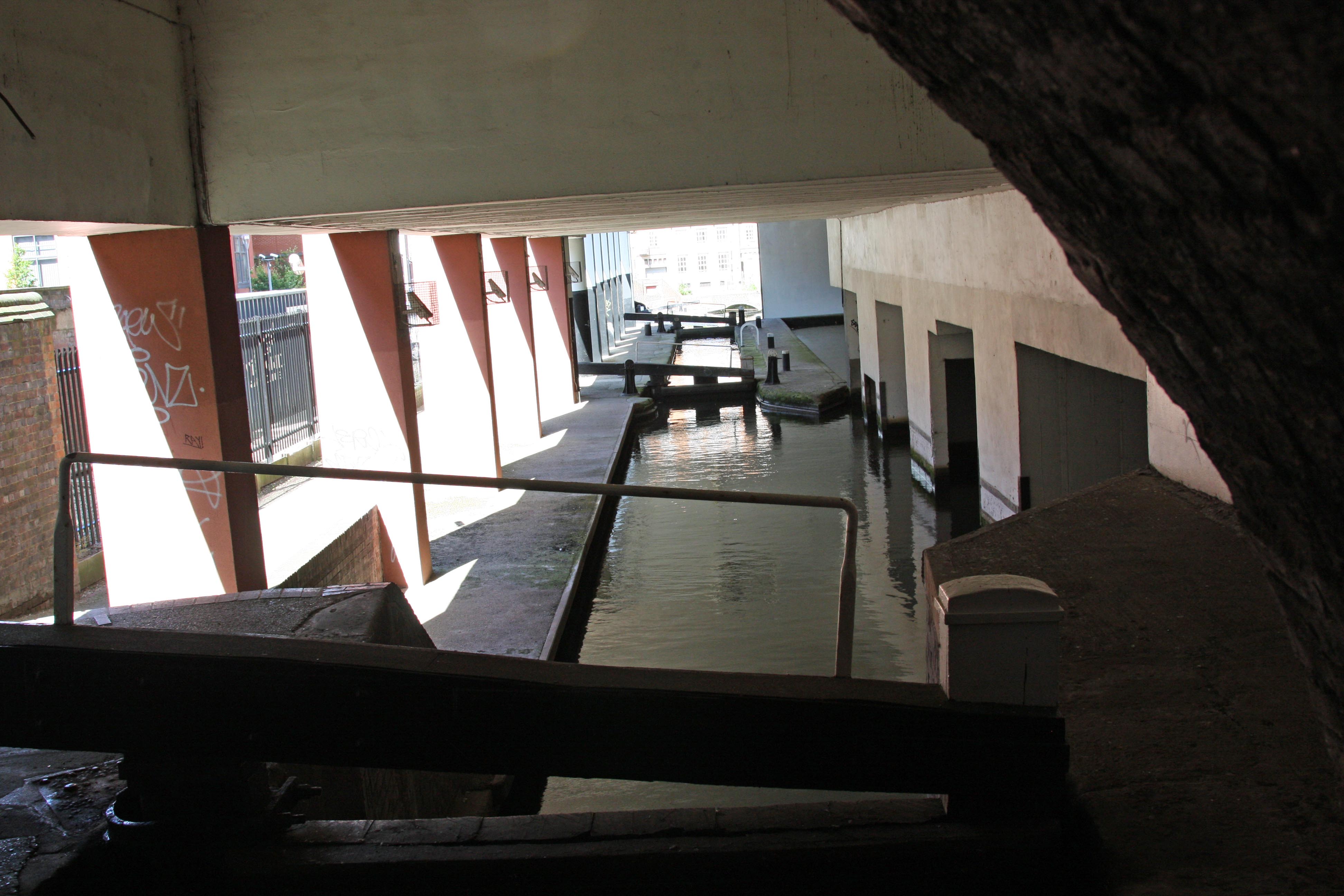
Rising out of lock 13, with, ahead, the huge cavern of Snow Hill railway station bridge and urban scenery in layers.

Rising out of lock 13, with, ahead, the huge cavern of Snow Hill railway station bridge and urban scenery in layers.


Have to get this... through there...  under Livery Street Bridge and into lock 12.

Have to get this… through there… under Livery Street Bridge and into lock 12.


This lock flight, as I hope you can see from the photographs, is an astonishing blend of old and new, for it passes through (and under!) the commercial centre of Birmingham.
Anyway, back to the ‘tiff’: The vocabulary of the two participants was ferocious but limited. ‘**** you!’ bellowed one. ‘**** off!’ screamed the other. After a few minutes, a couple in their early twenties strode into view: she, tanned with dark hair, wearing a short but chic black dress accompanied by stiletto heels; he, less surprisingly, perhaps, sporting a baggy T-shirt, jeans and baseball cap. The tirade continued. Sixteen or so rounds of expletives were spat back and forth with very little sub-text, ricocheting off the walls of the tall buildings around the canal. Eventually it became clear that he wanted to borrow her mobile phone to get a score from his dealer and she wasn’t having it (although she actually seemed higher on something than he was).
Their mood was volatile, so I thought it best to be discreet; as they passed me, I focused on trying to shift the paddles on my lock-gate, the ratchets of which were ancient and troublesome. As I was leaning my full weight on my windlass, I became aware of a man standing beside me. I looked up to see an athletic and well-preserved gentleman in his sixties. He offered to help. I saw that he was also carrying a windlass, and thought that he must have come from a boat further up.
Waiting for lock 12 to fill... a moment of quiet contemplation with my new acquaintance...

Waiting for lock 12 to fill… a moment of quiet contemplation with my new acquaintance…


Closing the lock gate behind the boat, whilst I go forward to prepare the paddles to fill the lock.

Closing the lock gate behind the boat, whilst I go forward to prepare the paddles to fill the lock.


Locks 11 and 10 are right underneath the British Telecom tower!

Locks 11 and 10 are right underneath the British Telecom tower!


The view out of the BT vault...

The view out of the BT vault…


...and the view back down!

…and the view back down!


He was very anxious to tell me that the incident that I’d just witnessed was not typical and that the towpaths were safe places. He was obviously quite proud of the local canal complex and even more of Birmingham itself. He told me that his name was Michael Payne and that since his retirement he had worked a few shifts each week as a volunteer for the Canals and Rivers Trust. I asked him if he also had a boat and he replied that he had a part-share in one, which was currently moored at Royston in Leicestershire.
Something surreal about this setting, but the conversation flows as the lock fills...

Something surreal about this setting, but the conversation flows as the lock fills…


Michael was a mine of information. As we worked our way up the remaining locks in the flight, he pointed out to me an offshoot of the canal that had been buried in the 1950s and rediscovered during excavations for a new office block and showed me an impressive building that had once housed a large coffee-importing business in Birmingham. This had been abandoned decades ago and opened up only recently, when the copper industrial coffee-grinding machinery had been found there, still intact. He said that all this has been restored and the building will shortly be opened as a museum dedicated to coffee. I was fascinated by this story and wondered under what circumstances a building could be left like this. Did no-one own it? Had all the owners died? Why hadn’t the machinery been sold off when it ceased trading? Perhaps the answers will come from the museum itself.
Locking up is a great way to get to know people... and Michael Payne is a man worth knowing.

Locking up is a great way to get to know people… and Michael Payne is a man worth knowing.


Wow!  Birmingham re-creating itself, but properly valuing this wonderful historic waterway at its heart.

Wow! Birmingham re-creating itself, but properly valuing this wonderful historic waterway at its heart.


Michael’s shift was due to end, but he said that he’d carry on helping me until we reached the top of the flight. I was grateful, as all the lock mechanisms were misshapen, old and extremely unyielding. My husband, who was joining in the conversation from the narrowboat, told him that I was a crime fiction writer (not sparing my blushes!) and Michael said that he was a big Donna Leon fan. Apparently he and his wife have visited Venice several times, where they’ve joined the walking tours that are arranged to allow devotees to follow in Inspector Brunetti’s footsteps.
I thought that this was a very intriguing idea. Should I myself organise walking tours in order to introduce my readers to the Spalding (and South Lincolnshire) of DI Yates? I’m not sure, however, that it would help me to curry favour with my Fenland friends and fans who have been so hospitable and generous with their support since DI Yates was born! On the whole, I think I’d sooner organise a walking tour of the Farmer’s Bridge Flight, but I’d have to engage Michael to lead it.
It all happens here: we get caught up in a fashion shoot!  Canals are great locations.

It all happens here: we get caught up in a fashion shoot! Canals are great locations.


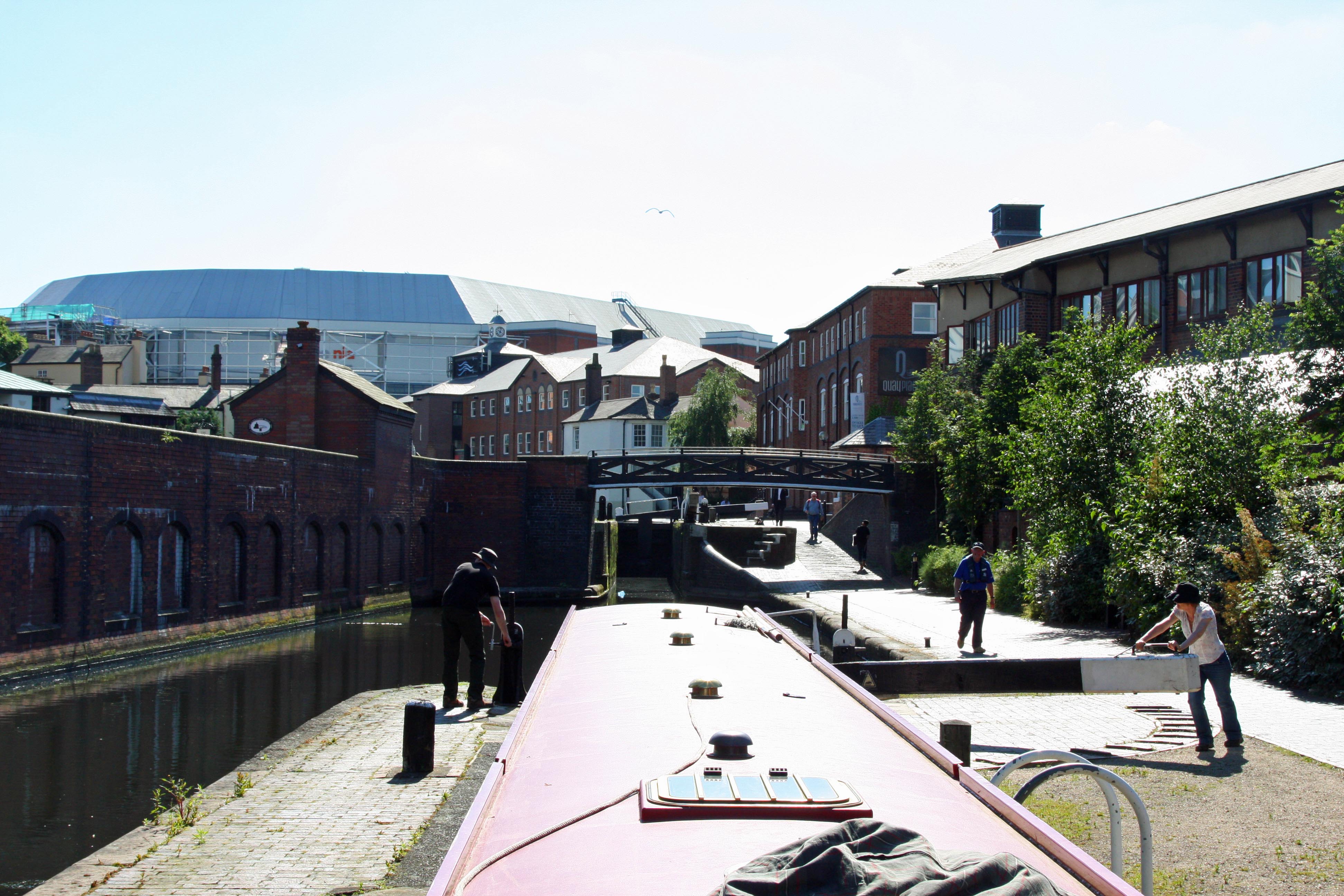
Michael returns from opening Lock 1, whilst I open lock 2.  Rising above us, the National Indoor Arena.

Michael returns from opening Lock 1, whilst I open lock 2. Rising above us, the National Indoor Arena.


If you’re reading this, Michael, may I just say that it was a great pleasure to meet you and to have the benefit of your conversation for an hour or two. We owe you a very great debt of gratitude for your skilful management of the (to me) troublesome ratchets of the Farmer’s Bridge flight. And if there ever is a DI Yates walking tour of Spalding, I shall make sure that you hear of it.
Here we are at Old Turn Junction at the top of the Farmer's Bridge flight: it's the very heart of the Birmingham Canal Navigations and of the city itself.

Here we are at Old Turn Junction at the top of the Farmer’s Bridge flight: it’s at the heart of the Birmingham Canal Navigations and of the city itself.

[Thanks to my husband for all the pictures, which he managed with his camera in one hand and the tiller in the other!]

All text and photographs on this website © Christina James

O' Canada

Reflections on Canadian Culture From Below the Border

oliverstansfieldpoetry

A collection of free verse poetry.

Easy Michigan

Moving back home

Narrowboat Mum

Fun, Frugal and Floating somewhere in the country!

Maria Haskins

Writer & Translator

lucianacavallaro

Myths are more than stories

Murielle's Angel

A novel set on the Camino de Santiago

jennylloydwriter

Jenny Lloyd, Welsh author of the Megan Jones trilogy; social history, genealogy, Welsh social history, travel tales from Wales.
Chris Hill, Author

I'm Chris Hill - author of novels Song of the Sea God and The Pick-Up Artist

littlelise's journey

Sharing experiences of writing

unpublishedwriterblog

Just another WordPress.com site

Les Reveries de Rowena

Now I see the storm clouds in your waking eyes: the thunder , the wonder, and the young surprise - Langston Hughes

Diary of a Wimpy Writer

The story of a writer who didn't like to disturb.

Rebecca Bradley

Murder Down To A Tea

Helen Carey Books

Helen Carey Books