


What I’d like, knitted up and sorted, once and for all…
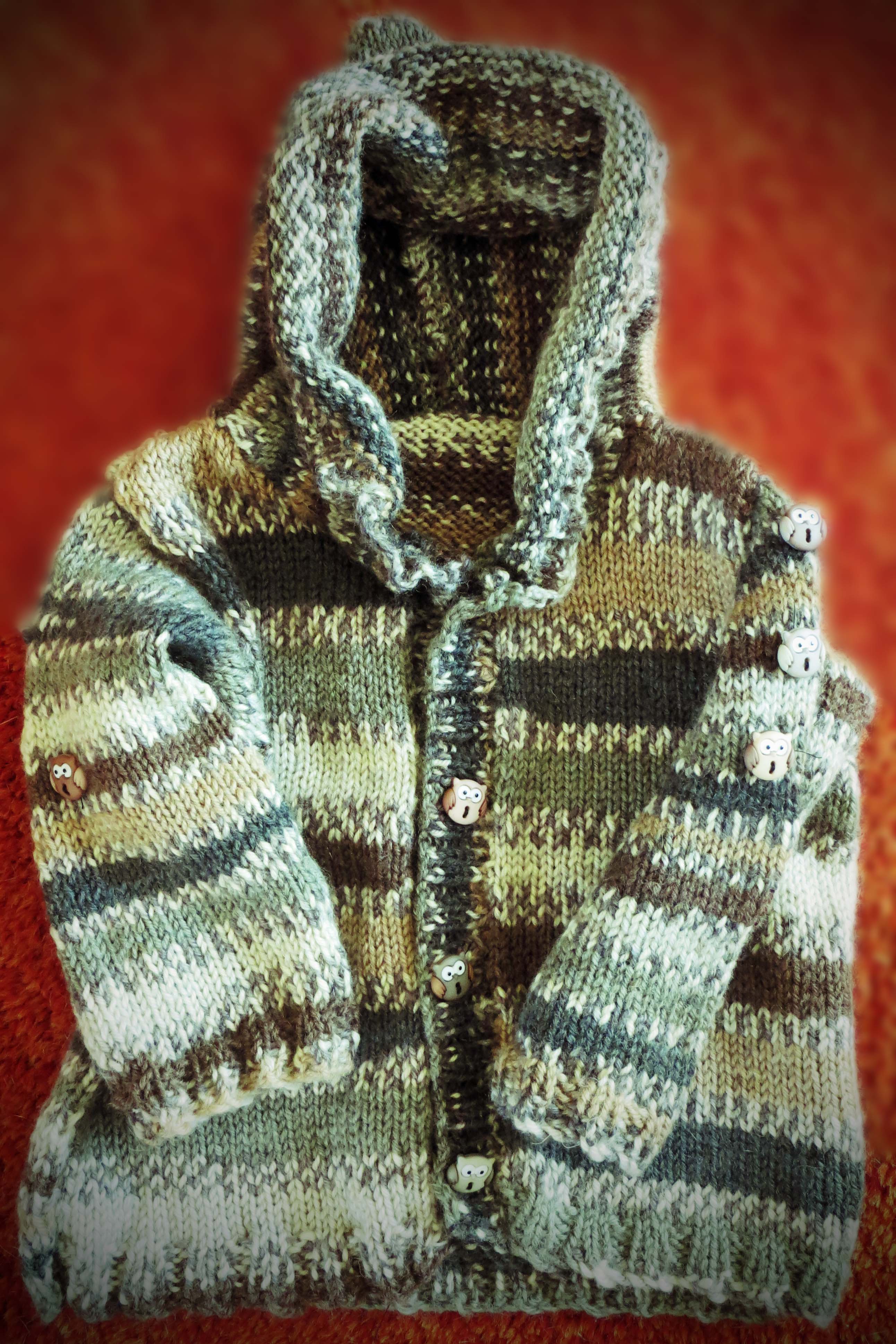
I made the cardigan in the photograph for a small friend of mine and I have to admit I am quite proud of it. The small friend is a she who likes owls (the multi-shaded wool is called ‘Owl’ by its suppliers) and I found the owl buttons online. I was even more delighted when they arrived and I discovered that they’d come from an online retailer based at Gedney, a small village close to my native Spalding.
This particular little girl owns very few clothes in pink. Her mother, whilst objective enough to include some pink in her daughter’s wardrobe, is determined not to turn her into a ‘princess’ and, in any case, I had other ideas for this project (pink not having been a very popular colour for girls during my own childhood, I should never have considered this colour as a must for any daughter of mine, had I had one); I like owls myself and have noticed that they tend not to shine brightly pink as they silently flit between the trees at dusk. And, if you follow me on Twitter, you’ll know that my chosen header picture there hasn’t a trace of pink in it. When looking for other garments with which to indulge the small friend, my worst expectations were quickly confirmed by what I found, that many are not only pink, but pink in a very sexist way. I’ve discovered (but not been tempted to buy) pink tops printed with patterns of cupcakes and hearts, pale pink coats adorned with dark pink bows and little pink socks with lacy ruffled tops. Most retailers of children’s clothing stock their racks with boy-girl equivalents and I’ve found that the boy equivalents are almost always much more interesting and, generally, much less narrowly stereotyped by colour. For example, at Monsoon, I found some beautiful long-sleeved T-shirts in green and gold, decorated respectively with wild animals on a prairie and a train packed with animal passengers. Some of the motifs were appliquéd or embroidered, making the fabric fascinating for a small girl already interested in all things tactile. I bought them for her: there was nothing overtly masculine about them and they were much more fun than the horizon-narrowing pink-iced buns on a darker pink ground topped with scarlet glacé cherries. Her mum has also bought beautiful boys’ clothes for her which look as good on her as on any boy. Based on my limited recent experience as a shopper for infants, I’m astonished that the racks of sickly pink fairy-frocks sell: I had fondly assumed that at least some of the clear message thinking women (and men!) have been sending for so many years now to the producers and buyers of children’s goods would have got through; I’d have expected to see the ‘pretty-in-pink’ clothes bunched in limp, unconsidered crowds during the sales. But in all the shops where I browsed, the pink princess outfits seemed to be disappearing like hot cakes – or cupcakes!
What I especially don’t understand is the logic behind dressing little girls in clothes like these. In the past, girls wore skirts and boys wore trousers or shorts (I belong to the first generation of girls to have made a big push first to be allowed to wear trousers and later to have them accepted as smart workwear), but there were few other concessions to gender except whether buttons were placed on the left or the right of the garment (a confusing convention that thankfully seems largely to have died out). Girls and boys wore the same styles and colours in coats, jumpers, cardigans, shirts, vests and socks. Only swimwear and footwear were different, and then not always: small girls often wore the same (hideously uncomfortable when wet) knitted swimming trunks as boys and stout lace-up shoes in the winter or bar-sandals in the summer were fairly universal. Granted, colours were often drab (browns, greens and greys didn’t show the dirt, swatches of cloth and hanks of wool were often left over from the making of adult garments) and choosing ‘unisex’ clothes may partly have been inspired by the domestic economics of hand-me-downs. I acknowledge there was also quite a lot to put up with before the advent of man-made materials and truly waterproof clothes. Most children had only one school coat and often had to wear it damp on the day following a downpour. All but the wealthiest grew heartily sick of their clothes before they grew out of them: two school skirts, two jumpers and two or three shirts, plus a dress ‘for best’, was the norm and, although I didn’t think of it then, this must have meant mothers, and sometimes fathers (not all fathers ensconced themselves behind their newspapers when they returned home) were engaged in a constant round of washing and ironing. I’m not trying to hark back to some kind of golden age.
But still, as far as our clothing went, girls and boys were pretty much equal. I certainly never wore anything that suggested that my future would be focused on baking cup-cakes and wearing lipstick (though I happen to enjoy both), nor did my brother’s clothes indicate that he was destined to be a footballer, astronaut or mechanic. I make these points tongue-in-cheek, but underlying them is a very serious principle indeed: that of achieving true equality between the sexes and removing the glass ceiling once and for all. How are the women and men of the future going to be inspired to exercise a completely free choice, electing to become engineers or hairdressers, electricians or fashion designers, bus drivers or nurses – or indeed, bakers or make-up artists – because they’ve thought about it and this is what they want to be, if at the age of a few months they have already been placed in a gender pigeon-hole created by parents in cahoots with clothing manufacturers?
I began by saying that I’m proud of the owl cardigan. It’s been a long time since I knitted a garment and, though the pattern was simple, I enjoyed making it and felt a sense of achievement when it was finished – especially as its owner seems to like it. It’s a unisex cardigan, suitable equally for a girl or a boy, and could equally have been made by a man or a woman. One of the people who taught me to knit was my stepfather, a burly fifteen-stone builder with hands as big as soup tureens. Boys – and girls – and parents – take note.
Tablet

Some years ago, when I attended a Scottish Library Association dinner, I was seated with a Scotsman who, while consuming his third double Scotch, was castigating me for eating carrots, on the grounds that they are very calorific. “Ye need to watch carrots,” he said. “They make ye fat.” (To save readers of this blog the chore of carrying out any additional research, I am reliably informed by Google that a large carrot contains about eighty calories and an average cooked helping about forty. A double Scotch contains 110.)
I was reminded about this conversation during my visit to Glasgow, from which I have just returned. One of the most endearing things about the Scots is their love of all kinds of ‘unhealthy’ food and drink and their ability to justify this completely with no trace of guilt whatsoever. When I worked for a Scottish library supplier in Dumfries (not for nothing the home of the deep-fried Mars Bar – and I understand that ice-cream and frozen butter have now been added to the town’s repertoire), we had a fully-working canteen staffed by two stalwart ladies who believed that the way to cope with Scottish winters was to look after the inner man (or woman). The menu was always robust: lasagne and chips, pie and chips, and mince, neeps and tatties (often also including chips, though I never experienced triple potato dishes on the same plate in Scotland, as I have several times in Ireland), always followed by a pudding.
Visiting customers were also fed by the canteen, although they took their meals in the boardroom. On one occasion I suggested that a bowl of salad might make a nice change for some of our less valiant guests, instead of tatties or chips. The ladies looked at me in horror: “Salad? In the winter, hen?” The compromise was substantial plated salads (ham and egg pie, Scotch eggs or cold beef) with potato salad and… chips. The two canteen ladies were perfectly aware of health and fitness regimes, but, like most Scots of my acquaintance, simply not interested in them. “We know what we should eat,” as another Scot once said to me. “We just don’t like it.” I once discovered the canteen ladies, neither of whom was much more than five feet tall, running round the outside of the building before they served lunch. Both were scarlet in the face and dangerously out of breath. “We’re trying to get down below fourteen stone before Christmas,” explained one. “Aye, so we can have plenty to drink,” the other added.
So, by this gently circuitous route, to the main topic of today’s post, which is… ta da: TABLET! If you haven’t been to Scotland, it may be helpful to provide a definition at this point. Tablet is a cross between toffee and fudge. My guess is that it’s made mainly with lots of sugar and butter. It melts in your mouth and gives you an energy boost to die for. It’s as integral a part of Scottish life as Irn-Bru, Tunnock’s Milk Chocolate Coated Caramel Wafer Biscuit and shortbread. And at least as ‘bad’ for you.
But you wouldn’t know that either from the upright Scots attitude towards it or the name ‘tablet’ itself. Not only is the name majestic, imbued with ancient wisdom – think Moses and the ten commandments or Sumerian cuneiform script, both inscribed on tablets – but it has an authoritative ring, as if the product were essential to your health. It’s a word that conveys much more gravitas than ‘pill’, with its undertones of neurosis, hypochondria and birth control. Mention ‘tablet’ to a party of Scots men and women and they’ll know immediately what you mean: a joyous feast of what in other lands might be forbidden fruit, often consumed in quite large quantities. Full of northern promise.
Nowadays, tablet has an additional, very modern meaning: the name the IT industry has given to the small, streamlined machine with various multi-functional capabilities (Don’t ask me the difference between a tablet and a laptop, as I shall get very confused, even though I now own one of each, but I’m sure that one exists.). If anything, I feel, the advent of this chichi newcomer enhances the reputation and the possibilities of traditional Scottish tablet even further: how prescient of ancient Scots confectioners to come up with a name that would also epitomise sexy technology to upwardly-mobile thirty-something educated men and, by extension, their baffled but trusting mothers and fathers.
And hats off to the Cambridge University Press marketing team – as you would expect, no slouches when it comes to words and their meanings – for picking up the potential of both meanings of the word and, at the same time, providing joy to everyone passing by their stand at the conference by dispensing unlimited quantities of this Scottish toffee-fudge to maintain energy levels during three days of worthy but occasionally soporific talks.
A-less-than-favourite favourite rail journey…

Cross Country train approaching Wakefield Westgate
I’m writing this on the train to Glasgow, where I’m about to attend a conference. It’s a Cross Country train. Though I haven’t had a duff experience on Cross Country trains before, on this occasion I’m finding the service a little less than up to snuff. I’ve got a first class ticket (cheap weekend deal) and have been looking forward to being pampered in the way I have enjoyed so much on GNER / East Coast trains. The last time I travelled first class on one of the latter (cheap weekday deal, unsociable hours), I was regaled with tea, biscuits, vodka and tonic, sparkling water, pasta arrabbiata with salad garnish, a packet of crisps, fruit, some date and walnut cake, a glass of wine and coffee. And a free copy of The Times. All included in the price of the ticket! By the time I staggered off that train, some two hours after I had boarded it, I’d have been happy to phone the Prime Minister and tell him how wonderful the experience was, if any of the crew had asked me to.
The standards on the present train are a little different. When I boarded, First Class was jammed with people, including one occupying my reserved seat. To add insult to injury, he was wearing a purple jumper. I was told that there were no seat reservations operative on the train, ‘as the system is down, but we have some boffins trying to fix it’. I was advised to grab or fight for a seat, on a may-the-best-woman-win type of basis. I decided to keep close watch on a man who hadn’t taken off his coat – a tell-tale sign that he wasn’t planning a long journey (I’m not a crime writer for nothing; I can read clues!). Sure enough, he ‘alighted’ (I’ve no idea why all train guards use this poncy term – perhaps they have a vision of the gossamer-winged traveller, wand in hand, floating like a dandelion seed from train to platform) at the next station, possibly relieved that I didn’t try to follow him, as he might have thought I was a stalker, and I hopped into his seat sharpish before another crowd of people with worthless seat reservations got on.
If I’m sounding like a grumpy old woman so far, that’s probably because by this time I’ve had a glimpse of the at-seat menu. The ‘complimentary’ food available consists of tea, coffee, water, fruit cake, biscuits and crisps. And there are lots of ‘ors’ on the menu, implying that two choices maximum would be seemly. I haven’t got to my age without knowing how to push the envelope, so I have demanded tea, water, fruit cake (which turns out to be one inch square and plastic-wrapped) and crisps in short order, in a very firm, dowager sort of voice. To this I’ve added an egg-and-cress sandwich and a tiny bottle of Pinot Grigio from the ‘paying’ menu (no hot food available – that will be £7.95 to you, Madam). There is not a newspaper in sight, although I have seen that a lady seated nearby is doing the crossword in Woman’s Weekly. I doubt if this has been supplied by Management. (I’ve also seen Management – he hides in the still room, guarding his supply of complaints forms, and twitches if anyone barges through to ask him about seat reservations.)
However, now I have eaten my sandwich and drunk my Pinot Grigio, water and tea and inspected the sell-by dates on the cake and crisps to see if they are fit for human consumption, I have to admit that I am quite enjoying myself. For a start, one of my fellow travellers is a man with two collies – I thought there was only one at first, but another peeped round from the seat behind mine and fixed me with her liquid eyes – and he has demanded not one, two or three, but four bottles of still water to put in their water bowl. And he wants free cake, crisps and coffee as well. So he has busted my temporary record of four free items by a margin of three… but I’ve been able to stroke his two lovely dogs to console myself for the disappointment!
And then there’s the journey itself. Of all the journeys I undertake, this one wins hands-down for interest and enjoyment. Already, from this train today, I have seen the innermost secrets of Victorian Leeds and the architectural wonder of York Station and I’m looking forward to the dour but unique crumbling red brick of the station at Darlington, Newcastle’s panoramic kaleidoscope of aesthetically gob-smacking, state-of the-art bridges, stupendous river, industrial buildings and purposeful roads, Alnmouth’s deceptive sleepiness (it lies between the buzzing commuter town of Alnwick and the lovely village of Alnmouth itself, on the gloriously beautiful Northumberland coast) and, best of all, the sight of the majestic, historic, sandstone bridge at Berwick-on-Tweed with the huge sweep of sea beyond it. And after Dunbar (another favourite place, with its Braveheart-style castle) and venerable, stately Edinburgh, I shall eventually arrive in vibrant Glasgow. Not to mention the fact that I’ve had time to map out the next few chapters of The Crossing (D.I. Yates 4).
So what’s not to like? Well, if Arriva’s UK rail Managing Director Chris Burchell is reading this, I have a message for him. At a push, he might get away with this service on the basis that it’s the weekend and the destination is magical, mystical Scotland, but he should know that I’m very glad that it’s Virgin, and not Arriva, which has won the East Coast franchise, because, on the basis of my experience today, the prospect of an Arriva standard for my regular, working week, London-and-return journey would fill me with despair. Next time I board the train at King’s Cross, I’ll be looking forward to what I’ve missed this time: tea, biscuits, vodka and tonic, sparkling water, pasta arrabbiata with salad garnish (or similar), a packet of crisps, fruit, some date and walnut cake (or similar), a glass of wine and coffee. And a free copy of The Times. All included in the price of the ticket. I understand that Arriva’s Cross-Country franchise has been extended to 2019 from the original 2016; that’s a pity, but perhaps Virgin will win it next time around…

No place like home?

Sheep Market, Spalding
My son called me yesterday evening to gloat because of the outcome for him of a BBC quiz he’d just completed, entitled ‘Where would you be happiest in Britain?’ (The quiz can be found here, if you’re interested. I assume, for readers of this blog who live outside Britain, that it will guide your choice should you wish to emigrate from your country. 😉 I should add that, since the way into it is by selection of a miserable three photographic choices, I rather suspect that it has an equal paucity of possible places to put participants!) It told him that the place in which he’d be happiest is Lewes, in East Sussex (also its choice for my husband – QED my point about the limitations of the quiz), but his reason for calling was to let me know it also forecast the place in which he’d be most miserable. The prediction for him was ….Spalding! Where, apparently, the inhabitants are bereft of several character traits that those of other places have in spades, including friendliness. My son was delighted because he’s always affirmed that I, a native of Spalding, was born among bog-dwellers with webbed feet (and, in point of fact, my paternal aunt did have webbed feet!), whereas he is one of God’s Yorkshiremen.
Not willing to take this lying down, I decided to complete the quiz myself. It told me quite firmly that the place I’d be happiest living in would be Oxford (where there is, allegedly, a very high ratio of ‘cultured, conscientious and’ … ahem… ‘neurotic ’ people, just like me, apparently). And the place in which I’d be least happy? You may have guessed it already: Spalding!
Now, apart from pointing out the obvious – that the BBC must have a real down on my home town; so much so, that I wonder if the quiz might have been compiled by Jeremy Clarkson after he found out that all the restaurants serving food (hot or cold!) there are closed by 10 p.m. – I’d like to take issue with this.
First of all, I know Oxford well and have never considered it to be my idea of residential heaven. It’s pleasant enough and I’ve been to some good concerts there and eaten some excellent food in its (largely overpriced) restaurants. I have a significant number of friends and acquaintances who live or work there, most of whom are cultured and conscientious and some of whom are undoubtedly neurotic.
But, over the years, I’ve also had some pretty duff experiences in Oxford. Here are a couple of examples:
When I was working for a Scottish library supplier, I was once booked into a hotel (called Green Gables, but there, its resemblance to the home of L.M.Montgomery’s heroine ended), a turn-of-the-twentieth-century building that sat right in the middle of a run-down housing estate containing a maze of roads through which feral dogs and glue sniffers roamed at large. The hotel didn’t serve food and I didn’t dare to go out after dark in search of any, so I dined on a cereal bar that I had in my brief case and a glass of tap water. My room looked as if it hadn’t been decorated since 1930 (the décor was bottle green and cream) and the ‘en suite shower’ (cunningly concealed behind a clear plastic curtain) was fitted with a rubber mat which, when lifted, revealed a thriving family of wood lice. Not very Oxford as Oxford conceives of itself!
My second example, however, is quintessentially Oxonian. I was visiting a publisher who persuaded me to attend an evening soirée featuring a ‘traditional African music ensemble’. Intrigued, I changed my train ticket and turned up at the event, hoping to feast on some of the exotic music and dancing I’d seen executed by a visiting troupe from Zimbabwe when I worked in Huddersfield (another awful town, according to the BBC). Imagine my chagrin when the ensemble turned out to consist of a quartet of upper middle class white Oxford ladies of a certain age playing its own arrangement of ‘native’ music on some very European instruments! I couldn’t capture my idea of Oxford better than by telling this tale, which does indeed demonstrate that Oxford is conscientious (if self-consciously so), cultured (in its own inimitable way) and neurotic (possibly).
When I think of places which have made me miserable, therefore, I’d have to include Oxford in the list. There are more deserving candidates, however. Among these, I’d cite Rotherham, a town that seems to have had nothing going for it since its magical (definitely, then, before the Industrial Revolution snapped it into its jaws!) ‘merry England’ manifestation, described by Sir Walter Scott in Ivanhoe; Solihull, for several years home of the HQ of Dillons and Waterstones, a place which never seemed to have anything to recommend it except a larger-than-average number of dress shops catering for ‘the fuller figure’; its much bigger and uglier sister, Birmingham (though I admit the canal system there is superb and worth a visit); Bridgnorth, a place so benighted that even the local copper didn’t know where the library was; and, last but not least in the misery-making-for-me stakes, Middlesbrough, which I’ve visited twice and where I had my car broken into on both occasions.
And places where I’ve been happiest? Sometimes in London, spending delightful evenings with friends, though I’d hate to live there; often in Surbiton or Mawdesley, basking in special friends’ wonderful hospitality; at my God’s-own-Yorkshireman son’s various homes over time, both entertained and amused by him and his wife; and – yes – in Spalding; certainly, in Spalding, that sink of human baseness by BBC reckoning. I spent the first seventeen years of my life there, so I’d have experienced a childhood of Dickensian deprivation if I hadn’t been very happy some of that time, and an unusual teenager if I hadn’t also sometimes felt melodramatically sad. Finally, I do actually like the place I live in now – otherwise, why would I have chosen it? – even though the BBC thinks it is only 54% suitable for a person with my character traits.
Which brings me to my final point. Supposing that I do exhibit more than average conscientiousness, cultural awareness and neuroticism, why should I want to ghettoise myself with a massive bunch of people just like me? My immediate neighbours are as unlike me as possible. They include a racehorse trainer, a physiotherapist, a lawyer, a doctor and several businessmen, as well as a number of retired people. Their passions include horseracing, greyhound racing, playing the harp, planting rare snowdrops and keeping bees, in none of which I have more than a passing interest. Some are bluff, hearty, hail-fellow-well-met and extrovert; others are quieter, more reserved, but fascinating once engaged in conversation. Some take three holidays a year; one lives in the South of France for six months out of the twelve; others never have a holiday and hardly leave the village at all. We all appreciate the surrounding countryside. We all like being within a short drive of several major cities and towns. Other than these common points of consensus, mutual variety is the spice of our lives in so far as we share them.
So there you are, BBC. Mood and character createth the individual woman… or man; but not the place. In my book, anyway.
Up t’ pub… with spring in the step…
I’d like to celebrate this, the first weekend of spring, by offering homage to my local pub. It’s been there all winter (and, I guess, for several centuries of winters, as it’s a former inn on an old drovers’ road), a perennial stalwart, dispensing warmth, hospitality and good cheer on the coldest and most miserable of evenings. It boasts an open fire and its own generator, which means that when there’s a power cut or the water supply fizzles out (not infrequent events in this village) we and all our neighbours can rely on the pub to produce heart-warming soup and sustenance in our hour of need. There are no other buildings in the village except houses and a deconsecrated church – we don’t even have a shop – so the pub also does sterling service as a polling station for both local and general elections. Not surprisingly, this village always achieves a high turn-out. Most of us vote in the evening, which gives us a chance to catch up with each other and sample the beverages on offer at the same time.
Yesterday evening was light and clear. The trees across the valley had just begun to bud and were glowing with promise in the hazy sunshine of the early evening. The local sheep have now had their lambs, which were bleating softly. The towns across the valley were also tinged with the glow of the setting sun. As on many first days of spring, however, there was a fierce wind and some of winter’s chills still lingered in the air. My husband and I, out with the dog on his evening perambulation, decided to call in at the pub.
It is only a slight exaggeration to say that all human life was there. A group of four beer-bellied blokes occupying a corner table hilariously trooped out together every half hour or so for a cigarette break, and then trooped back in. A large family, complete with granddad (who seemed to be footing the bill) had just finished an early supper. Also eating supper was a morose middle-aged couple who appeared not to be speaking to each other. A largish hen party came in, evidently consisting of the bride and her mates plus her mother and several of hers. She was wearing a sash proclaiming her a bride to be, a crown of tinsel and, somewhat incongruously, some red ‘Rudolph’ felt antlers left over from Christmas. A little later, an extremely thin, elderly woman arrived, the advance reconnoitring party for another group of ladies, these somewhat older. She left the pub briefly before returning to usher them all in, so it must have passed her selection criteria for acceptable hostelries. The usual old cronies were seated on high stools at the end of the bar, putting the world to rights. More young men braved the trestle tables outside, clearly finding the cold preferable to the prospect of losing seats inside whilst out for fag breaks. And there were several ‘casuals’ in for a swift pint before departing, all of whom stooped to stroke the dog. The landlord, a dog-lover, brought him a handful of chews.
And, of course, included in the number, a pair of wellie-wearing eccentrics with an amiable hound, all three a little miry around the edges.
City pubs have an aura of their own, a suave immaculateness inspired by fierce competition and, for the most part, a shifting clientele that harbours no sentiments of loyalty. There is something quite different, timeless as well as uplifting, about a country pub and its dynamic. Dressed in mediaeval clothes, the patrons of my local yesterday evening might have been encountered by Chaucer and his pilgrims, in an inn en route to Canterbury. And I’m sure they’d all have had a tale to tell…
The turn of the season…

The last of the Brussels sprouts
Last Saturday, I helped my husband to prepare his allotment, for sowing with a new cycle of plants and seeds. He needed some assistance, because during the long winter months the shelter that he and his partner-in-grime had built over it last year to foil the pigeons (it succeeded) had collapsed under the weight of an unexpectedly heavy fall of snow. Carefully, we untied some dozens of pieces of binder twine and rolled up long lengths of chicken wire to ready them for the grand rebuilding. Improved design, he says, will help to prevent the same happening again; we shall see!

Red cabbage in a winter shroud
Partly because they were pretty difficult to reach amongst the debris of broken timbers and chicken wire, and partly because we’d had some over-supply, leftovers of last year’s crop remained, a brassica graveyard. Eight or so stalks of blackening Brussels sprouts tilted in a broken rank towards the boundary fence, a row of wounded soldiers at their last gasp. Several misshapen kohl rabi poked from the earth like a giantess’s bunions.

Kohl rabi bunion
Some heads of red cabbage, severed from their stalks, lay on the ground, broken and rotting, their outer layers turned into slimy winding sheets. Their lone companion, still growing, had grown a new rosette of small heads after the original cabbage had been cut, twisting itself into three dark petalled shapes, a macabre bouquet paying last respects at the funeral. Dried sticks of weed poked through the soil, which glistened unhealthily with a scattering of glossy green clumps of over-wintered willowherb and expanding whorls of nipplewort.
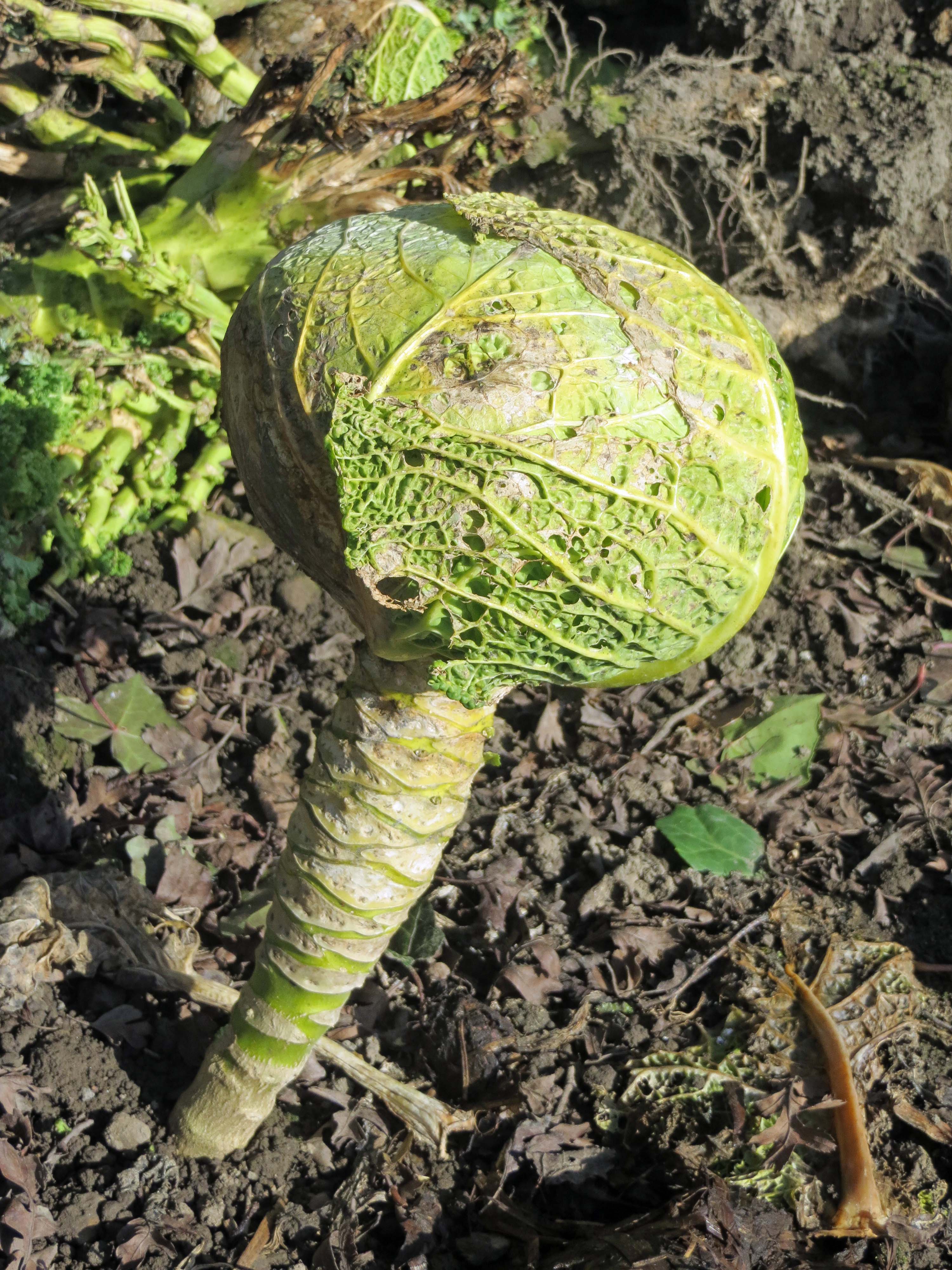
Savoy cabbage in terminal decline
Overhead, the sun shone with real warmth. New purple buds were swelling on the tangle of hawthorn twigs in the gateway. The bees in the adjoining apiary were flying, great tits were two-toning in the hedge and a lone hare loped away over the meadow. Spring was on its way, but I don’t recollect having ever been so vividly aware of the round of decay that must precede renewal.
Oddly, I found it comforting: it was as it should be. And somehow it made me feel more philosophical about death. Each plant and creature has its time. Then comes the Grim Reaper. It is only seemly. And there is something wonderful about the soil which is both grave and nursery; now it is manured and turned, I am reminded of the beauty of Gerard Manley Hopkins’ ‘shining-shot furls’ of ploughed land, from which will spring new life.
Do buy…
January and February have been almost wall-to-wall work, with a great deal of travel to boot. I have already written here about my trip to Malaysia. The following week I was in Dubai (or ‘Do buy’, as the locals call it, with a fine mixture of wit and cynicism). As I returned to the UK two weeks ago, I realise that it’s a little late to write something newsworthy about my visit, but, since it was a fascinating experience – and Dubai is quite different from anywhere else I have been – perhaps you will indulge me by allowing this very belated post.
Dubai is about bling. Not out-for-the-day, cheap-and-cheerful Blackpool and Skegness bling, but the real thing – although I realise that I may be drumming an oxymoron into service by saying so, much as if I’d asserted that Tinseltown was genuine. I’ll revise that a little, therefore. Dubai is expensive. It’s not a place to visit unless a) you have plenty of money (or someone else is footing the bill) and b) you don’t mind paying through the nose for everything, including items that come either cheap or free in other places. The £20 charge for twenty-four hours of Internet access is but a minor example. Most things, from bottled water to chocolates to dinner, cost roughly one and a half times as much as in the UK; and you don’t even think about buying alcohol! A tiny bottle of brandy from the mini-bar will set you back 120 dirhans (that’s about £25); the cheapest bottle of wine in the restaurant that I visited was 270 dirhans, or more than £50. Sure, certain pleasures, some not even legal in the West, are openly available. For example, the second hotel in which I stayed had a private beach, at the top of which were, sitting in a circle, several gentlemen resplendent in djellabas and smoking hookahs. I can’t be entirely certain, but the substance they were exhaling smelled suspiciously like skunk.
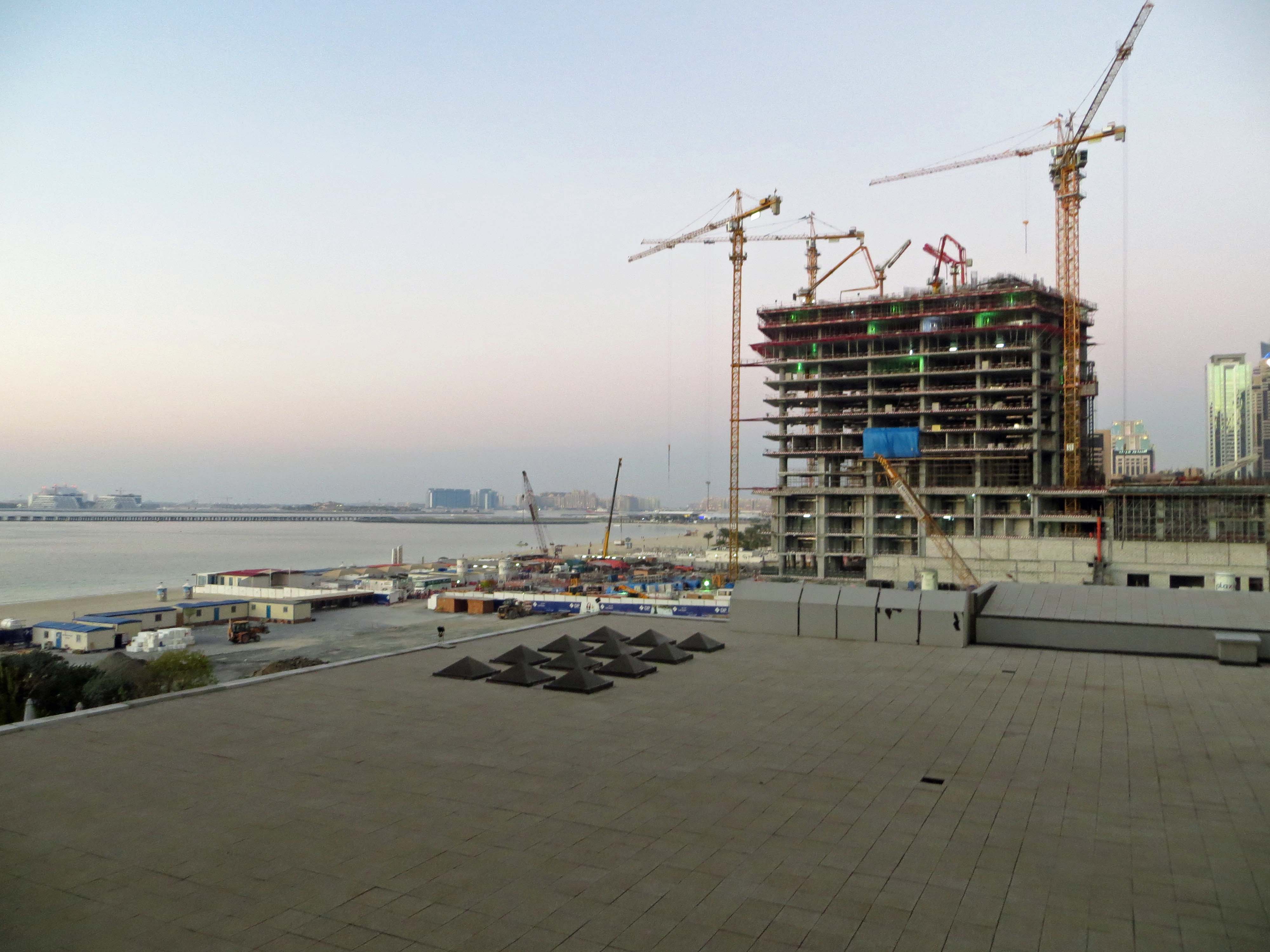
Despite the cost and the noise – the place is like a giant building site and, indeed, is said to house one third of the world’s cranes at any one time – Dubai is immensely popular. The serried ranks of hotels stretch for mile upon mile – all the major international chains are represented – so that you’d think there would certainly be over-capacity. However, when by mistake I was booked into my business hotel for two nights instead of three and had to find another, it took several attempts to discover one that wasn’t fully-booked. This second hotel was an eye-opener. It was aimed at holidaymakers rather than business people, so my room, of very modest size, contained two double beds, a balcony overlooking a giant red crane that presided over yet another building site, a well-stocked and exorbitantly expensive mini-bar (with a ‘free’ plastic bag in which to collect ice from the machine in the corridor) and the most magnificent range of ‘free’ toiletries I have ever encountered in a hotel. These included a ‘bath massaging bar’ and ‘moisture infusion facial bar’ (soap to you and me), some mega-rich body cleaner (alias shower gel) and an after-sun cool-and-calm gel (this item accurately described). I must admit that I’m a sucker for toiletries, and these went some small way towards selling me the Dubai dream – or should I say, mirage?
So what is the attraction of this place, which one hundred years ago was just a little village in a rather uninteresting, out-of-the way bit of desert? Put succinctly, what Dubai has to offer, especially to those from more northern climes when the end of January has yet to arrive, is sun, sea, sand and shopping. Oh, and ‘sophistication’. However sceptical I may be – and I tend to choose holiday destinations for their potential for providing either exercise or some insight into culture and history, so Dubai would never have been a natural choice for me – the entrepreneurs who have brought and are still bringing their many cranes and pile-drivers to Dubai have achieved a spectacular success. They’ve created the illusion that a sun-kissed paradise and moneyed leisure are temporarily within the reach of those who aren’t mega-rich, but merely a little better off, or rather a lot better at saving up for holidays, than the average.
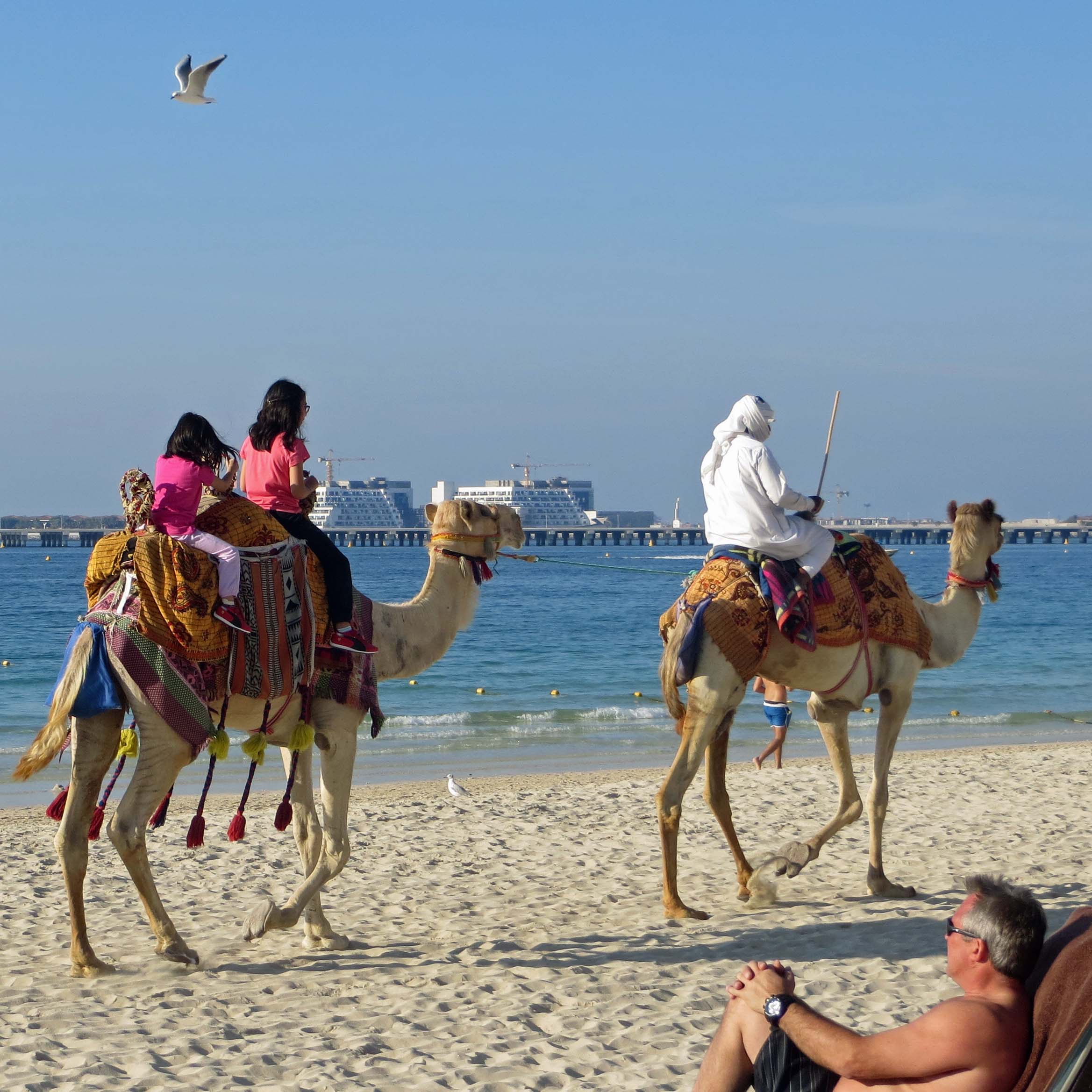
What to do in Dubai becomes a challenge if you don’t go with the flow. This consists of lying on the beach (the second hotel had a tennis-court-sized patch of ‘private’ beach, which it thought entitled it to a certain cachet), paddling in the sea and swimming in the pool, in between ordering drinks and burgers from the liveried black stewards who hover solicitously. Oh, and if you fancy something a little more exotic, a man swathed from head to foot in white, like an extra from The English Patient, passes by on his camel every ten minutes or so. He is leading another camel, on which you can buy a ride. I watched several portly, middle-aged English and American men engaged in this activity, and concluded that they must have been deprived of donkey rides as children.
What did I do? I arrived at the second hotel mid-afternoon, having spent more than a day and a half working quite intensely. Venturing out to explore the private beach, where I was able to exchange the token given to me by the hotel receptionist for a bath sheet, I was escorted by one of the liveried stewards to a sun-lounger, across which he carefully angled an umbrella so that I wouldn’t burn. I then stretched out and fell asleep, waking only an hour and a half later. It was the first time I’d sun-bathed on a beach since I took a summer 1977 holiday in Brittany (where the weather was a good deal more chancy) with some beach-loving friends. When I woke up, I enjoyed myself watching people passing (including those on the camel) for half an hour or so. When two hours were up, I was bored and returned to my hotel room to use my absurdly-expensive Internet connection to send some e-mails.
It was an experience, certainly, and one enhanced by a star-lit al fresco dinner (They weren’t really stars, but the lights on the ceaselessly toiling cranes; however, by removing my spectacles and exercising my imagination a little, I could convince myself that the Milky Way was smiling down on me.) in a roof-top restaurant where the food was delicious and the company (I was with two very congenial colleagues) even better. So, if you were to ask me whether I enjoyed my free half-day in Dubai, the answer would be, unequivocally, yes. But if you’d told me that I’d hit the jackpot and earned another six days of leisure there before I could go home, I’m not sure my sanity would have been equal to the privilege.
Assalamu alaikum, people of Kuala Lumpur
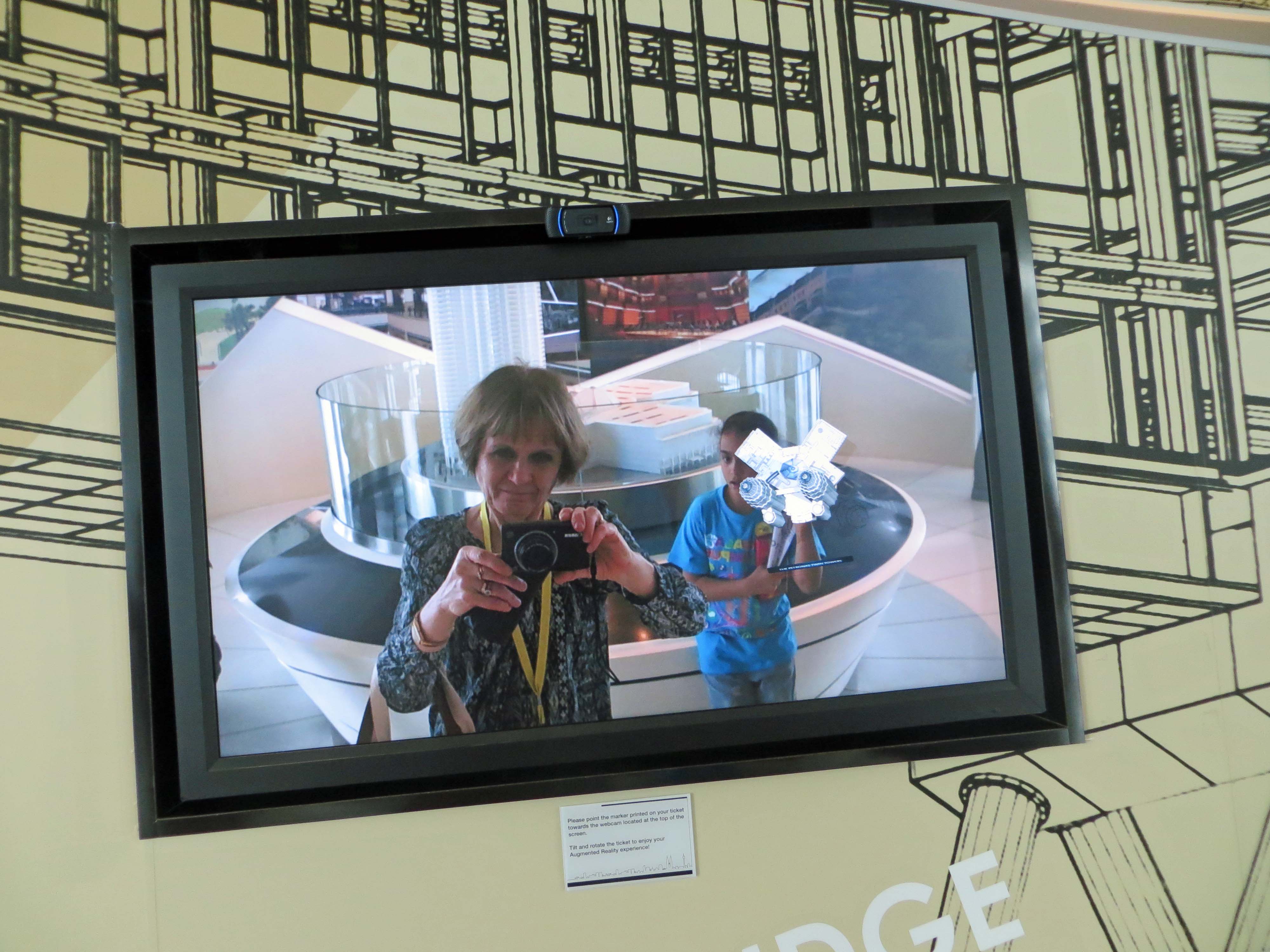
Composing oneself at the top of Petronas Towers

“It’s only a model!”
Last week, the day job took me to Kuala Lumpur. I was away for five days, two of which were spent travelling almost around the clock (mad, I know, but I assure you it was worth it!). Once I had arrived, I was privileged to be the honoured and somewhat overwhelmed guest of two universities in the city. My impressions of the country and its people during so short a stay, although vivid, are therefore inevitably sketchy, so I apologise in advance for any observations that may strike those who know Malaysia better than I do as either incomplete or simply wrong.
Malaysia is a young (just over half a century since independence), very proud country, and also a thrustingly ambitious one. All of these qualities are epitomised by the twin towers – the Petronas Towers – that were built in the KLC district of the city in 1998 and are now the tallest twin towers in the world. Following many recommendations from my Asian colleagues, I chose to spend most of my single free half-day travelling to them and taking the tourists’ trip to the top. As the Towers are eighty-eight storeys high, this provides a panoramic view of Kuala Lumpur and delivers a 360-degree demonstration of just how much development work is taking place there. High-rise buildings are everywhere and many, although dwarfed by the Petronas Towers themselves, are giants by UK standards. Nor is it all about size: most of the buildings are beautifully designed and Malaysians are increasingly strict about the standards of architecture they consider acceptable for their capital city. Whilst at the top of one of the Petronas Towers, I was lucky enough to see an inferior skyscraper being demolished: it collapsed in clouds of black dust.

In the race to the top, one down… and more, I think, to go.
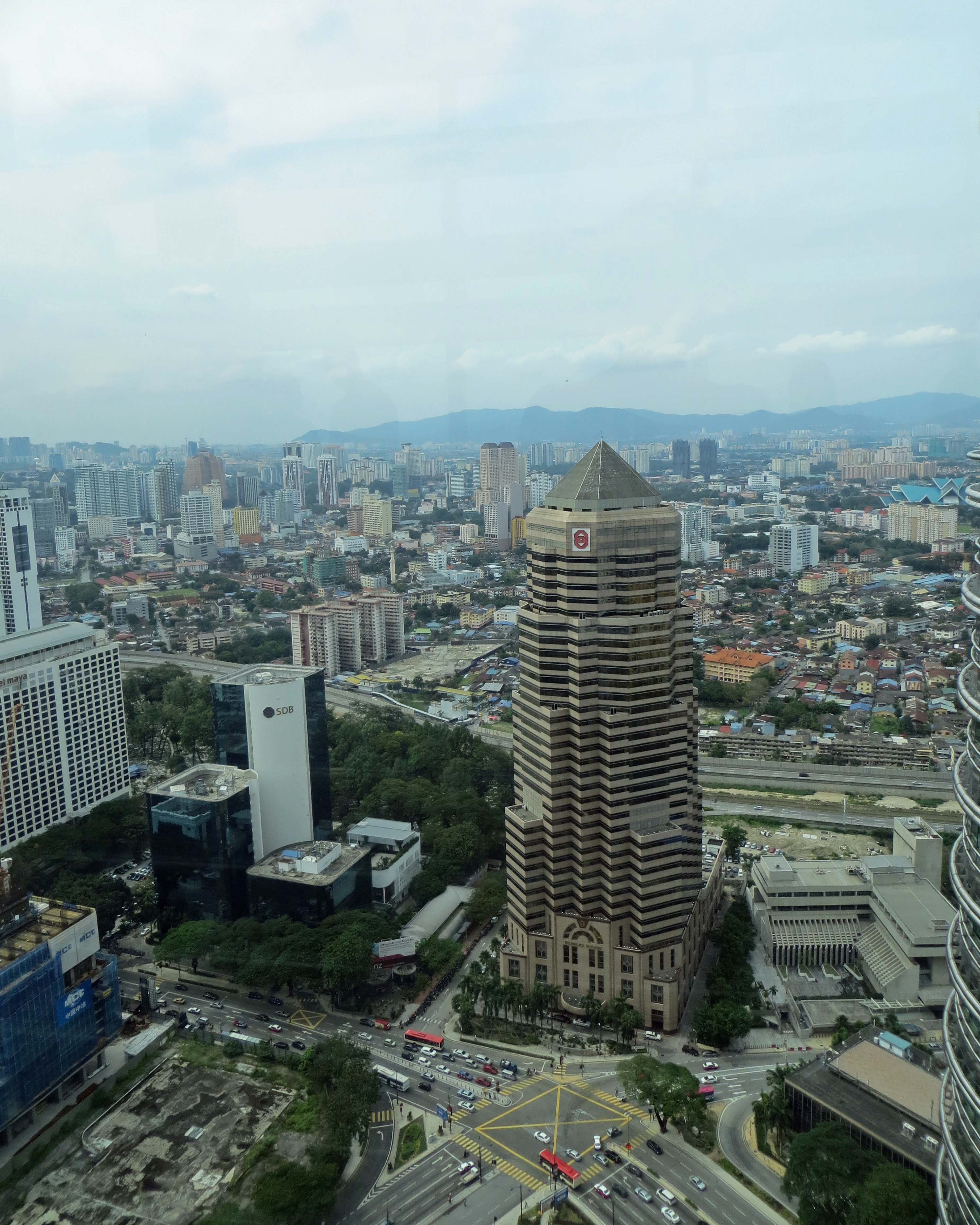
A view from the bridge… between the towers

Another view from the bridge
As I’ve said, my impressions are based on only a little information, but it did strike me that Kuala Lumpans are in such a hurry to become world leaders that they are in danger of destroying not just their immediate past, but also their much older heritage; and this notion resonated with some of my colleagues when I voiced it. I saw little architecture in the city that was more than thirty years old and nothing at all that was likely to have pre-dated my own birth.
Yet, paradoxically, despite their keenness to ‘get on’, the overwhelming majority of Malaysians whom I met, almost all of whom were extremely well-educated, were gentle, polite, courteous, humorous and modest. They were not ‘go-getters’ in the sharp-elbowed sense. They have their own, highly honourable, way of making progress in today’s world. Much of this stems from the fact that they are also very devout. At both of the universities that I visited, the call to prayers sounded five times each day. The prayer rooms hold only twenty to thirty people and those not able to take part exactly on the hour await their turn patiently, but they make it quite clear, whatever the task in which they are engaged or the conference or focus group to which they are contributing, that prayer comes first.
Despite this apparent unanimity about how things should be done, I did observe some collisions as Eastern values met Western ones; not, however, at the universities, where highly-qualified librarians and academics have no problem with reconciling traditional dress and customs with exacting, high-profile jobs. The suite of rooms in which our meetings took place are normally occupied by eminent doctors and surgeons and are designed to help them relax from cutting-edge medical research and surgical operations. That we were very privileged to have had them generously give up these quarters to us for a whole day was not lost upon us.
Most of the men and women employed by the university wear traditional dress. This is at once exuberant and dignified. The men’s tunics and the women’s shalwar kameezes (they call them this, even though mostly the garments consist of three-quarter-length tunics and long skirts, rather than trousers) are beautifully made, often embroidered or sequined, and frequently in very bright colours. Sometimes the women wear tailored versions in heavy silk. The more austere outfits are a little more nun-like, and stick to plainer cloth – usually cotton – in light blues, greys and navy. But all these advocates of traditional dress wear their clothes with pride and often the women fasten their hijabs with many-jewelled brooches or enhance them with a framework of pearls. I saw no black burqas or niqabs at the universities.
Where I did see one such outfit was at the Petronas Towers. Since these are frequented by tourists, its owner may not have been Malaysian. I could see from her eyes and deduce from the age of her husband that she was very young – probably a girl still in her teens. And she didn’t look unhappy: he was holding her hand and they were walking along together, laughing. What was striking was the difference between this couple and another Asian couple (again, of course, I cannot make an accurate guess at their nationality), also taking the Twin Towers tour and also holding hands. The girl, also probably in her late teens, was wearing a short-sleeved black T-shirt and immaculate, but very short, white shorts.
How will Malaysia’s future unfold? From now on, I shall be fascinated to observe and find out. I hope that it will prosper as it wishes, and I also hope that it will at the same time manage to preserve its heritage and its traditions. I think that its most prominent religion may be the key: this week I was extremely honoured to have been able to immerse myself in how true Islam – tolerant, humorous, friendly, hospitable and forgiving – makes a huge contribution to the world in which we live.
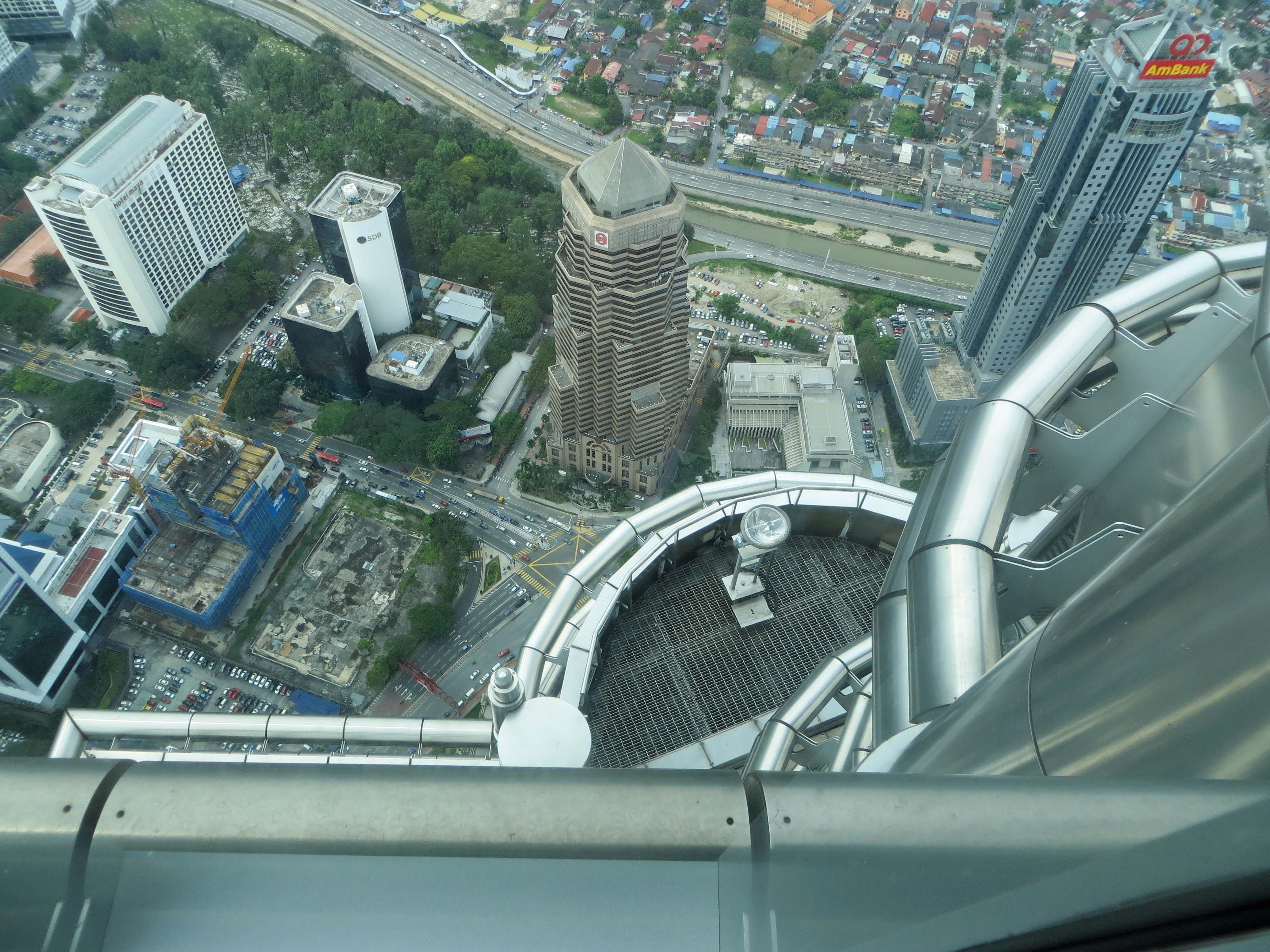
A sense of proportion?

And a sense of scale

And so high above all those!

A few degrees of the 360
Welcome to The Heidelberg Project

I have an excuse, albeit possibly a feeble one, for the recent lack of posts. The day job took me back to Michigan again during the second week of December and after that I was running to stand still all the way to Christmas (not aided by some ‘organised power cuts’, courtesy of the local Pennine lumber industry). However, I have been thinking of my readers, whose support I appreciate so much, while trying hard to find time to do justice to what became for me one of the outstanding experiences of 2014: my visit to Detroit.
On my first trip to Michigan, at the end of September, I saw nothing of Detroit except the airport and some of the industrial hinterland that lines the motorway en route to Ann Arbor. But, in December, my day-job meetings took place on Wednesday – Friday instead of Monday – Wednesday, so my hosts kindly offered me the opportunity to stay for the weekend in order to explore Michigan a little more. I’m particularly indebted to Jacqui, who generously gave up her Saturday to show Detroit to me and two colleagues.
I have some very hazy childhood memories of television coverage of the race riots that took place in the USA in the 1960s. The one that sticks out was that in Birmingham, Alabama – I remember the newscasters of the day enunciating the two words, always with the emphasis on the second, as if Alabama had only a secondary right to the name ‘Birmingham’. The others seemed to blend into a sense of unrest across the States and the person of Martin Luther King became more vividly real to me than the places where riots occurred. I don’t remember – or perhaps never knew – that there were serious riots in Detroit as well. There, in 1967, more than forty people were killed, hundreds were injured and thousands of properties were destroyed by fire.
Detroit was, of course, home to the American automobile industry. Henry Ford set up his headquarters there and inhabited a huge mansion in the city. Scores of other motor companies had factories and offices there and many famous marques were included among their number: Chrysler, Chevrolet, Oldsmobile, Pontiac and Studebaker-Packard are just some of the ones that I recognise. The race riots didn’t destroy what had been a flourishing motor-car industry, but they certainly pitched it into what became a very steep decline. This was accelerated, no doubt, by the simultaneous rise of its Japanese competitors, but essentially Detroit was a city that inflicted life-changing wounds upon itself.

The wounds themselves can still be seen today. It is no exaggeration to say that Detroit is one of the most extraordinary places I have ever visited. As you approach the city from the west, you suddenly notice that some of the houses perched on the bank above the motorway have holes in their roofs. Some of the roofs are actually caving in, or the porches to the front or sides of the houses are leaning at drunken angles, in the process of breaking away from the main structure. At first, you may think that you’re just driving through a neighbourhood that’s being redeveloped and (although some of the houses are huge and were obviously once lovely old clapboard homes) assume some kind of slum clearance is taking place. As this continues for mile after mile, it gradually dawns that this IS Detroit: it’s what the city looks like, or, to use a currently popular expression in a less usual context, this is ‘who Detroit is’.
These houses were abandoned in the aftermath of the race riots and they have been left ever since as they were when their owners fled. Some are still owned by the families who vacated them or by their descendants; the legal owners of others can no longer be traced. Some are occupied by squatters or used as crack dens. In some areas, the buildings are being bought up by developers, but it is a slow process. Detroit was bankrupt for very many years (by a wonderful coincidence, it actually emerged from bankruptcy during the week of my visit) and it is only latterly that the municipal authorities have begun in earnest to reinvent the city. A major part of their strategy is to reduce its vast, sprawling conurbation to a more manageable size, but this is a challenging task: many a street contains half a dozen proudly-owned and beautifully-maintained houses interspersed with two or three derelict ones. They lurk like ghouls at a wedding, their windows blind and broken, their beams and rafters exposed like bones peeking through flesh, their crooked limbs gradually causing them to sink to their knees, each one mocking the beauty of its own lost youth. The residents of the street go about their business almost oblivious of the existence of these stricken dwellings and certainly have no intention of moving out in order to oblige town planners by supporting logical but soulless schemes for making the city more compact.
Yet there is also beauty to be found in the dereliction itself and, even where there is ugliness, rather than beauty, the ruins tell a fascinating tale. One man who recognised this early on was Tyree Guyton, a native of Detroit, who was twelve years old when the riots exploded. He decided to take an area of the city in which most of the buildings were derelict and create a series of art installations, using dwellings and objects recovered from them to tell the story of what happened there. Now called The Heidelberg Project, it has gained international renown, though not without its own struggle: the municipal authorities twice destroyed the installations before they finally understood that Guyton was bringing hope and inspiration and a sense of identity to the broken and impoverished communities worst hit by Detroit’s decline.
I’ve taken some photographs of the Heidelberg Project, which I’m proud to be able to share with my readers. However, because of the size and scope of the installations, no individual pictures can really do the whole project justice. The Heidelberg Project is a living work of art: it changes continually. I have never seen anything quite like it, though it carries echoes and reverberations of many other kinds of art, and other tragedies captured by art, that I have been privileged to witness. The ways in which some of the buildings are decorated are reminiscent both of Gaudi and Hundertwasser. Some of the murals must have been inspired by Picasso. Most striking of all is the huge pile of shoes of all types and sizes that comprises one of the installations. I mean no disrespect when I say that immediately it reminded me of the glass case of shoes at Auschwitz. In many cases, the fates of the owners of the Detroit shoes will have been grim, though neither as harsh nor as hopeless as those of the Auschwitz victims: The Heidelberg Project is about renewal as well as remembrance. But no item of apparel is as evocative as the shoe: all of these shoes represent the journeyings of mankind; each of them is lost, discarded, stolen or defunct. The journey has gone on, or been cut short, without them.
If you are ever in Detroit, I’d encourage you to visit The Heidelberg Project. I think it will transform, if not your life, then certainly the way in which you think about people, cities and regeneration. Take a peek at it here. Why all the polka dots? Tyree’s grandpa was fond of jellybeans; Tyree thought these looked like people, all similar, but different in colour, and he transposed them into dots celebrating colour, diversity and harmony. Magic!
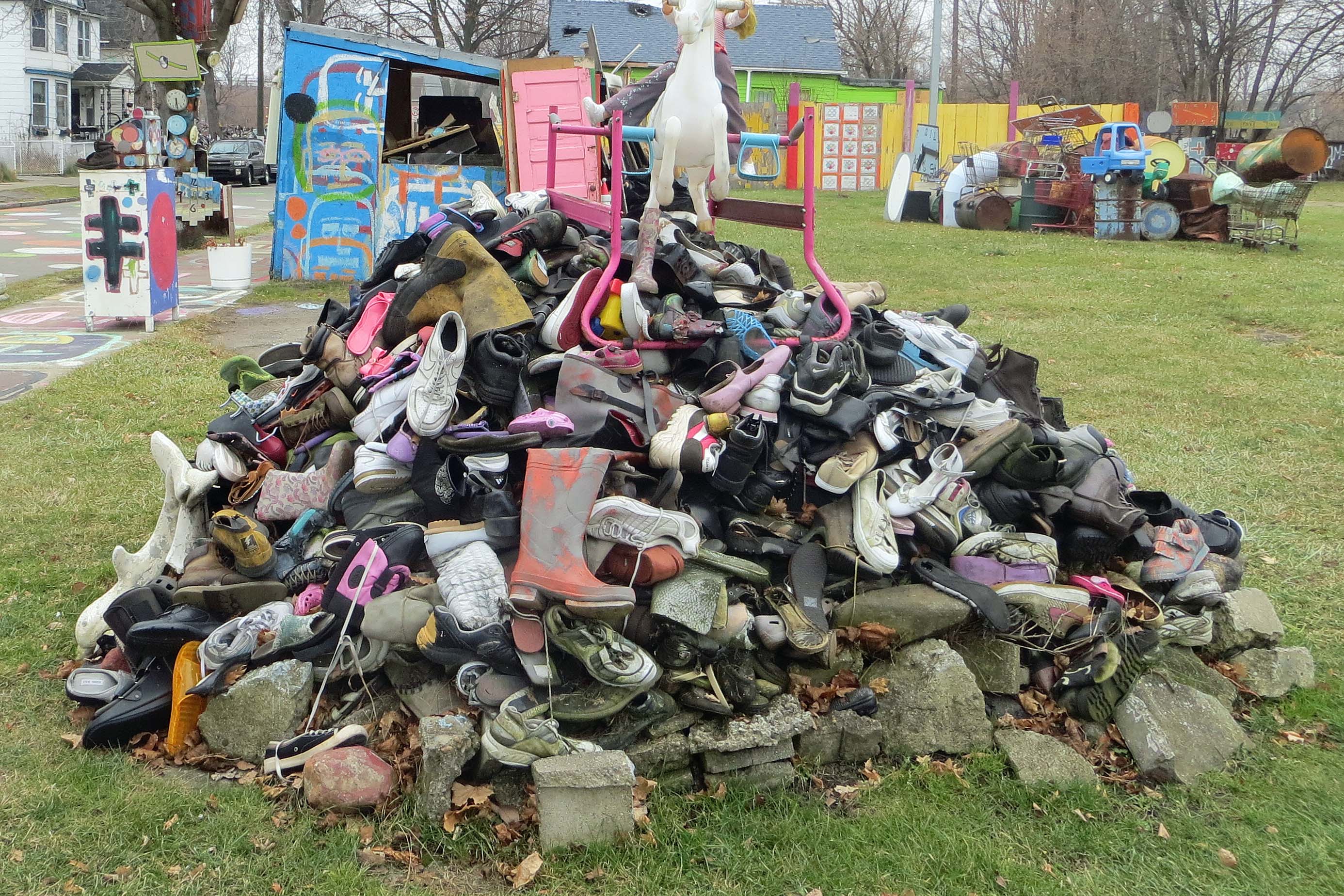


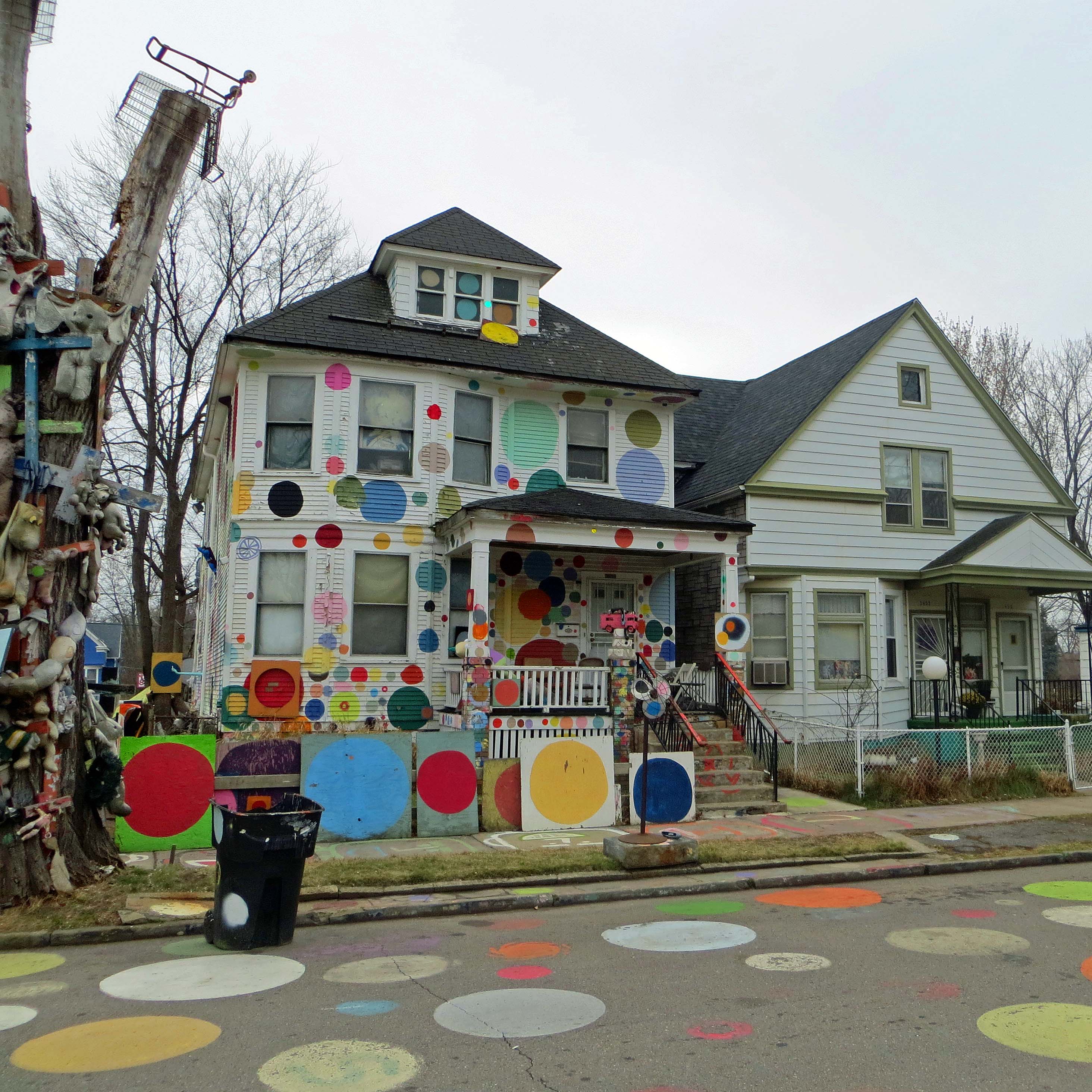


In my cups…

I recently had a conversation with my daughter-in-law, who is not at present able to drink much alcohol, about what alternatives there were for people who dislike soft drinks because they are usually too sweet. By chance, the topic was picked up again when my friend Priscilla visited yesterday and we were reminiscing about the (few and far between) forays into drinking alcohol that we ventured into when students. Yes, I was a student at the height of the student power era and, no, we didn’t all spend our time getting drunk and bed-hopping, as I explained to my son in his adolescent years (somewhat to his disappointment).
The two conversations (and this delightful post by Jacy Brean which recently caught the imagination of lots of blog readers, including me) have started me thinking about beverages generally. When I was a child, tea was the drink of choice for virtually every occasion. We drank tea at every meal, tea when my grandmothers and other relatives visited, tea when the milkman and postman called in on cold days and tea when we went to the seaside – the cafés close to the beach were all fitted with serving hatches in one wall where parents could send their children (i.e., my brother and me!) to buy a pot of tea and carry it on a tray, together with cups, saucers, milk jug and sugar basin, all in in thick white or blue-and-white pottery, down to the sands; the cafés relied on customers to return the crockery when they’d finished with it and clearly almost everyone obliged, as I don’t recall ever being asked for a deposit. Tea was also served with seaside fish and chips, together with thick hunks of white bread and butter, a meal polished off with a generous helping of ice-cream. We were quite innocent of any knowledge of ‘balanced diets’, cholesterol, the cause of coronary heart disease or obesity. We were, in any case, as skinny as rakes, despite, as a family, consuming 4 lbs of white sugar each week, most of it stirred into tea. I gave up adding sugar to drinks only when I reached the sixth form.
The tea we drank at home during my primary school years was not branded. It came from Hannam & Blackbourn, the grocer’s shop in Spalding (long since closed following the advent of the supermarkets). It was weighed out in quarters from a wooden tea chest and wrapped in dark blue ‘sugar paper’. (Sugar, dried fruit, rice and dried pulses were bought and wrapped in the same way.) By the time we had a television, my mother was buying the brands of tea that still flourish today, mainly PG Tips and Typhoo (their branding has changed over the years, but only subtly). We enjoyed watching the PG Tips chimps’ tea parties in the adverts, although I do remember feeling uneasy even then about seeing primates dressed in human clothes. Typhoo adverts were annoying: ‘You-hoo, Typhoo!” I liked the chimps better.
Alternatives to tea were limited. My parents didn’t drink coffee until I was in my teens, though they sometimes rounded off a meal with a cup of “Camp”(sic) Coffee, a chicory-based liquid substitute for coffee which fascinated me because of the picture on the bottle of a hirsute Sikh servant in full national dress serving an equally hairy and rugged Scots soldier wearing a kilt. I assume that the product was invented for consumption by the armed forces in the colonies. I didn’t then understand that the word ‘camp’ had various meanings; looking back, I wonder if that picture was a joke, or at least intended as a double entendre. Nescafé arrived towards the end of my childhood and was reserved for such festivities as whist drives and church fetes. The good ladies who provided refreshments on these occasions considered that the proper way to serve it was by adding a mixture of hot milk diluted with hot water to a sparing teaspoonful of the powder. The result was drinkable, if nothing like coffee. My grandmother would give me a cup of Nescafé if I visited her on a Saturday morning. She didn’t drink it herself, so bought a tiny tin – about the size of the very smallest tin of beans obtainable – and reserved it for my use. I didn’t graduate from powdered coffee to the real thing until I was married, and then only via the percolator, popularised in the 1970s for what I can only describe as the emasculation of the coffee bean. Coffee makers followed some time later, and it is to this period I date my addiction to good coffee.
But I’m getting ahead of myself. Other childhood drinks, aside from water from the tap (none of my parents’ generation would have dreamt of paying for water) included the weekly treat of being able to choose a bottle of pop from the pop man (the Corona lorry did the rounds of the local streets: I always chose Dandelion and Burdock and, I recall, my brother liked Cideapple), Ovaltine on cold winters’ nights, milk (which I hated – I never drank my free third pint at school – Margaret Thatcher would have been welcome any time to snatch it from me) and Lucozade, which was strictly reserved for aiding recovery from colds, ‘flu and bronchitis. Occasionally, if we stopped at a pub on the way home from the coast, we were allowed a very weak shandy. This was another hatch-in-the-wall job, my father returning to the car with one beer, three shandies and four packets of crisps, but I remember that we were mainly excited because the break in the journey meant we would overshoot bedtime by at least half an hour.
My father came from a family of Methodists and, though he did not practise the religion himself, he’d grown up in a household where alcohol was banned. It was therefore only when I was a teenager that he began to buy alcohol to drink at home, and then only at Christmas. Each year he would invest in a bottle of sherry, a bottle of whisky and perhaps two bottles of wine. We were allowed a glass of the latter with our Christmas lunch. It was not unusual for some of a year’s quota of whisky and sherry to come out the following Christmas, not having been consumed in the meantime.
Priscilla’s family was a little more convivial, but still not exactly what you would call topers. Her mother introduced me to Asti Spumante. As students (she reminded me yesterday), Priscilla and I experimented by buying a bottle of Barsac, which we managed to make last three or four days. I can’t remember what we drank most of the time, but I suspect it was once again largely tea and tap-water.
So, to revisit the conversation with my daughter-in-law, what do you drink with a meal when you want to cut down on alcohol or it’s entirely off-limits? Given my background, finding alternatives shouldn’t be a problem. I must confess, though, water and tea don’t seem nearly as alluring as an accompaniment to an evening meal as my parents seemed to find it (I still enjoy tea in the afternoon, as you’ll know from here) and, over the years, I’ve become conditioned to appreciate a carefully-cooked dinner much more if it is accompanied by a glass of good wine. (My Barsac days are over: I like a good Pinot Grigio, Bourgogne or Chablis now.) One answer which I intend to explore is to follow the Chinese example and experiment with more unusual kinds of tea. I have no excuse for putting this off, as I already have quite a collection, either supplied by my son on his travels or collected myself on mine, like the ones I brought back from China.
So here’s a toast to tea! And to being in my (tea-) cups often during the course of this winter, if I can find the right ones! I may not carry you or members of my family along with me.
 Christina James, crime novelist