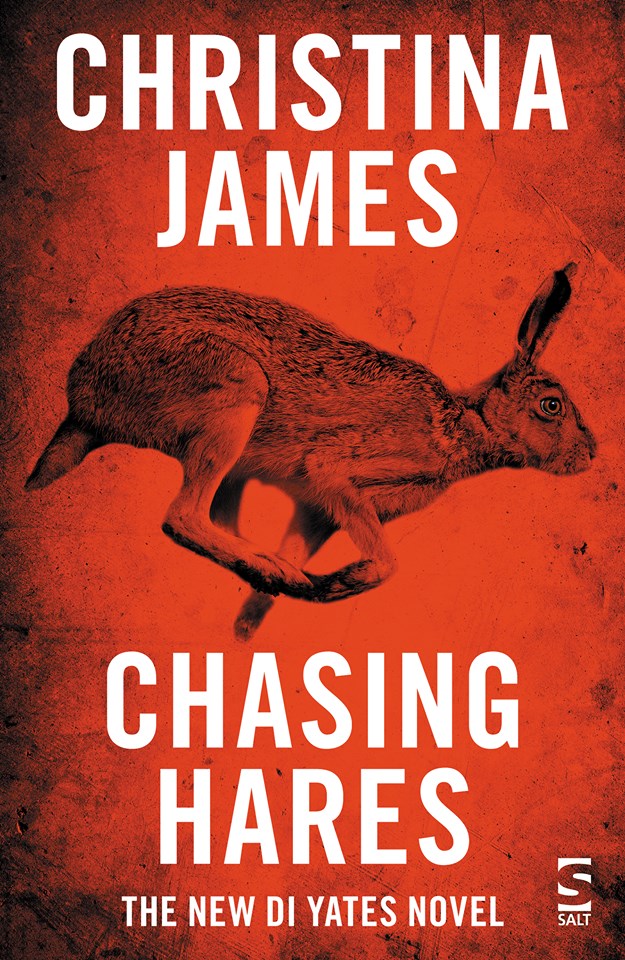


Ms James, in the dining room, with the rhubarb crumble…

I’ve spent a great deal of the bank holiday weekend cooking: two types of muffin, cheesecake, bread, meringues, fish pie, quiche and barbecue sauces, since you ask. And today, Sunday-style lunch for my guests before they depart, with rhubarb crumble.
I live just outside what is known as the ‘rhubarb triangle’, a smallish area near Wakefield in West Yorkshire famous for early ‘forced’ rhubarb. In Lincolnshire, too, rhubarb has always thrived. It seems to like cold, wet regions with severe winters. When I was growing up, every garden had a crown or two of rhubarb. The forced rhubarb industry uses heated, dark, forcing sheds to encourage the rhubarb plants to mature early and pickers have traditionally harvested the stalks by candlelight to preserve their sweetness; but generations of amateurs have employed the simpler method of planting it in a sheltered spot and placing an old tin bucket or a more picturesque terracotta bell over one of the crowns.
Rhubarb was a family staple; even though my mother detested it, she would cook it for everyone else. Her first job, in 1945, was quality control technician at the local canning factory, where rhubarb was processed in bulk. (It was war-time, and jobs were plentiful: I believe her main qualification for this was that her school leaving certificate said that she’d studied biology!) Years later she confessed that she’d never had known if there was something wrong with the rhubarb, because it all tasted poisonous to her. I think that it’s one of those foods, like Marmite and peanut butter, that you either adore or loathe.
I’ve always found it rather an enigmatic – fruit or vegetable? I’m not sure which it is. To me, there’s always been something rather mysterious and exotic about it. There’s even poetry in the names of many of the varieties: German Wine, Riverside Giant, Valentine, Sunrise.
One thing’s certain: you eat the stalks and not the leaves, which contain such poisons as oxalic acid. You’d have to eat a lot of very unpalatable leaves to die, however, though boiling the leaves with soda apparently increases their toxicity.
My imagination is caught: the means by which a murderer might do away with someone by serving up a tasty crumble, laced with pulped rhubarb leaves and soda. Ms. James, in the dining room, with neither rope nor lead piping in sight. 😉
A walk into the past… and a request for anecdote!

Yesterday my husband and I drove to the Newmillerdam Country Park near Wakefield and, from there, walked to Waterton Park Hotel via old railways and canal towpaths. We were accompanied by our son and daughter-in-law, who were married at the hotel almost two years ago. It’s a favourite place for weddings, because the building, a Palladian mansion house, is situated on an island in a lake, which makes it extremely photogenic. The house was built by Charles Waterton, the famous early nineteenth century naturalist, who was Yorkshire’s answer to Audubon. Ahead of Walter Potter, he was also a celebrated taxidermist, although, as far as I know, he didn’t indulge in creating the sentimental yet ghoulish animal tableaux that made Potter famous. Waterton was a serious naturalist at a time when naturalism was only just emerging from the status of appropriate hobby for benighted clergymen who had taken up their livings in rural areas to becoming recognised as a ‘proper’ science. I’ve just looked Waterton up and now discover that, unusually for Yorkshire gentry of the period, his family was Catholic. Waterton himself claimed an impressive ancestry that stretches credibility – among other famous luminaries from the distant past, he claimed descent from Ailric, King’s Thane to Edward the Confessor, Vladimir the Great and Sir Thomas More. (Interestingly, George Moore, whom I wrote about last week, also annexed Sir Thomas. Perhaps he represented a kind of badge of honour to nineteenth century Catholic gentlemen, much as some modern Americans may believe they can have no better pedigree than their family’s having arrived on the Mayflower, or Australians than being able to boast descent from convicts.)
Back to the present. There was a wedding taking place at Waterton Park Hotel yesterday. The bride and groom had taken their vows and were strolling with their guests on the lawns prior to adjourning for their wedding breakfast. I was much impressed by the hotel staff, who were as attentive to them as they were to my son and daughter-in-law two years ago. As I’ve written before, I’m fascinated by those whose jobs consist of providing a service to others, whether they are booksellers, restaurateurs or hoteliers. The best of them make every customer and every guest feel special, day in and day out. It is quite a feat.
As the hotel is not so very far from home, I’ve never had reason to stay there, although I’ve eaten there on many occasions. Passing through the foyer to the bar on my way to buy drinks, I noticed that the hotel offers a murder mystery weekend later in the year. I’ve wondered several times about trying out one of these events, but in the end I’ve always been deterred by the risk that I might be bored. In such a setting as Waterton Park, though, I might be tempted to try it. I wonder if any readers of this blog have indulged in one of these contrived adventures? If so, I should love to hear some anecdotes from your experiences, to help in my decision to give Waterton mystery a try.
Raising the bar…

Yesterday evening, I went with my husband to our favourite local Italian restaurant. It’s quite an amazing place to find in a small city like Wakefield: housed in a large building with two floors, it has been handsomely fitted out. The tables have marble tops; there are tasteful pictures and mirrors on the walls. The waiters are impeccably polite and wear a crisp informal uniform of white shirts and black trousers. The menu has always been varied, the prices reasonable. This restaurant has succeeded in combining professionalism with a personal touch.
For the past three years or so, its appeal has been enhanced by the services of an inspired and dedicated Portuguese manager. He told us that he brought his family to Wakefield because there was no work in Portugal; that he had tried Putney, but found the cost of living in London too high; that he was proud to be running what has many times been described as the best restaurant in the city; and that, aside from returning to Portugal once a year for a family reunion, he is not interested in holidays. Under his aegis were instituted a daily ‘specials’ board, cheaper prices for pasta dishes and pizzas on weekdays and free hors d’oeuvres for diners while consulting the menu. For regular customers like us, he always added something extra: free tomato bread with the main course, or a complimentary limoncello with the coffee.
Yesterday he wasn’t there. He could have been taking a day off – it was Monday, after all, and the restaurant wasn’t busy. I don’t think so, however. We had more than an inkling that he had moved on, attracted perhaps by the higher salaries on offer in a bigger city, or snapped up by one of the big Yorkshire hotels. We didn’t ask the waiter, who was as attentive and polite as ever, but subtle changes suggested that the Portuguese manager was no longer influencing operations. There was no ‘specials’ board; there were fewer choices on the menu (the vegetable-based pizzas had disappeared and several types of pasta were no longer on offer); there were no weekday reductions. Although the waiter recognised us and gave us a friendly greeting, we received no complimentary extras.
The food was as good and as well presented as ever, the service faultless. If it had been our first time dining at this restaurant, we’d have left well-pleased, extolling its virtues. As it was, we felt slightly short-changed… and more than a little sad that we’ll probably never meet the Portuguese manager again; conversations with him meant much more than the extras. It made me think that, although it’s true that excellence creates its own rewards, each time you set the bar higher you are creating more demanding expectations from your loyal customers. For every writer (and every blogger!), that is a challenging thought.
An old love of mine, a case of kiss and tell…

Some months ago I wrote a piece about the books on my bookshelves. I chose a shelf at random and described how I came by the books on it and whether or not I had read them. As I said then, for the most part my books have been shelved in a fairly random way. The exceptions are the two shelves devoted to books about and by George Moore and his contemporaries.
I’m not referring to George Edward Moore, the philosopher, but George Augustus Moore, the writer. As a postgraduate student, I based my research on the latter Moore and his writing career. When I was first interested in him, only Esther Waters, his most famous book, was in print. (Later the Anglo-Irish publisher Colin Smythe reprinted three or four more of his novels.) As a consequence, I spent many happy hours in secondhand bookshops and leafing through antiquarian catalogues in pursuit of his works.
Moore was an extraordinary character. Born into the largely Protestant Anglo-Irish Ascendancy, he came from a family of Catholics. (This lends some credence to their claim that they were descended from Sir Thomas More, a tale Moore himself loved to retail, though there is no positive proof that it’s true.) The Moores were, in fact, members of the more modest, untitled squirearchy. Setting little store by education and the Arts, they spent their time managing or mismanaging their estates and racing horses. The only one of Moore’s ancestors who had shown the remotest interest in literature had lived as a recluse in the second half of the eighteenth century, spending his days writing a history book that was never published – not a propitious precedent when Moore himself began to exhibit literary leanings.
His first love was painting, or at least he used that as his pretext for travelling abroad. Like many Irish artists and writers, he felt stifled by his country. When he came into his inheritance at the age of twenty-one, he departed pretty swiftly for Paris to enrol himself as a pupil at the Académie Julian. There he became an early appreciator of the French Impressionists and actually struck up a friendship with Édouard Manet. Moore was a kind of nineteenth-century gentleman’s equivalent of a groupie: he insinuated himself into the Impressionists’ consciousness by spending many hours at Les Deux Magots, the café that they frequented. He was later to pursue Zola and other authors of the school of French Naturalism in the same way.
Eventually realising that he hadn’t the talent to become a painter, Moore took up writing as very much a second-best profession. He wrote several passable, if bleak, novels in naturalistic mode, the best of which is, in my opinion, not Esther Waters, but A Drama in Muslin, a captivating satire on the Dublin marriage market. In common with other exiled Irishmen, Moore was often at his most eloquent when he wrote about Ireland. He was also an observant early adopter: Another of his Parisian acquaintances was Édouard du Jardin, who had written a book entitled Les Lauriers Sont Coupés; it embodied a style that has been dubbed ‘the melodic line’ and was actually the forerunner of the stream-of-consciousness technique; Moore wrote several evocative novels that employed this device, including The Lake, the haunting story of a priest who loses his faith and orchestrates his own disappearance by leaving his clothes on the banks of Lough Carra as if he had drowned, swimming across the lake and escaping to take passage for America (Moore Hall, Moore’s ancestral home, was built on the shores of this lake.).
After many years in exile, Moore was persuaded by W.B. Yeats to return to Ireland to take part in the so-called ‘Gaelic Revival’. Moore’s own account of this sojourn telescopes the length of time that it took; in fact, he spent most of the first decade of the twentieth century back in Ireland, working with Yeats and other luminaries, including J.M. Synge and the Irish mystic poet AE. Not that Moore ever really worked very closely with anyone: he was a past master at ‘doing his own thing’. His true masterpiece dates from this period. It is a two-part work entitled Ave Atque Vale (later changed to Hail and Farewell; the original title was simultaneously designed to poke fun at Moore’s own lack of Latin and the pretentiousness of his literary colleagues). It purports to be a factual history of the Gaelic Revival, but is really a highly-polished satire of how it unfolded in spirit. Once it was published, Ireland became too hot to hold Moore once again. He retreated to London, where, in his later years, he devoted his energies to writing whimsically discursive stories based on Greek and Roman mythology and Christianity. These were produced in beautiful limited editions that were sold by subscription. I am the proud possessor of two of them, Aphrodite in Aulis and The Brook Kerith. It was typical of Moore that the latter, his account of the life of Christ, was based not on the Gospels, but on the writings of the Essene heretics. To the end, Moore loved to stir up controversy whenever he could.
This was true also of his private life, which was possibly more blameless than he would have had people believe. He never married, but conducted a number of clandestine affairs with well-born women, the most scandalous of which took place with Maud Alice Burke, an American heiress, prior to her marriage to Bache Cunard, heir to the shipping line. Later, transformed into the society hostess ‘Emerald’ Cunard, she resumed the affair, until Moore was ousted from her affections by Sir Thomas Beecham. Moore was widely reputed to be the father of her daughter, Nancy Cunard, herself a writer and friend of Hemingway and Ezra Pound. He encouraged his friends and acquaintances, including Nancy herself, to believe in the truth of this rumour. However, the gossip went that his sexual prowess was in some doubt. When he was still a young man, a contemporary had jibed that ‘some men kiss and never tell; Moore tells but never kisses’. He never lived this down.
Sadly, Moore Hall was burnt down in 1923 in one of the recurring cycles of the Irish troubles, not because Moore was an absentee landlord, but because his younger brother, Colonel Maurice Moore, served in the British army. I have visited the ruin twice. It is one of those unhappily poignant roofless Irish mansions, its walls still standing foursquare, the windows blank, the floorless interior home only to the spinney of gangling trees that poke above the parapet in their quest for light.
What do my thoughts about George Moore have to do with crime fiction? He certainly doesn’t write about crime, except obliquely: he is less incisive than Dickens, but as a young man he was concerned with and wrote about the social ills of his day. His works are perhaps not of the first rank, though Hail and Farewell comes pretty close. He is not my favourite writer – that is certainly Jane Austen – nor even one whose works I re-read many times. But I feel that George is part of me; decades ago, he succeeded in getting under my skin. In some way, therefore, I am certain that he has also inveigled himself into the fabric of my writing.
When right seems wrong…

The farmers I knew in Lincolnshire were mostly millionaires. They lived in huge houses, set proudly in the midst of their many acres, and were rarely seen on tractors; they drove luxury limousines with personalised number-plates; they made their money from growing crops on what is perhaps the richest arable land in the country.
Farming is quite different where I live now, in the foothills of the Pennines. Most of the farmers are tenants, the land they hold carved from estates that were parcelled up generations ago. Today, the farms are small by modern standards; mostly devoted to animal husbandry, they are barely large enough to sustain the families owning them, some of whom have been working them for many years. One farmer told me that his lease entitles the family to hold the land for five generations, of which he represents the fourth. I am impressed by this family’s loyalty both to its landlord and to farming as an occupation, and fearful for its future. What will happen to it when the present incumbent’s son dies?
In reality, the family may have to quit long before then. Modern farming is a scientific business. Farmers are not, in the main, scientists; therefore, as farming methods become more sophisticated, they have to rely on the trained representatives of, say, the feed manufacturing companies to give them advice. A couple of years ago the farmer I have mentioned (who is still in his twenties) was rebuilding his dairy herd after inadvertently buying two tubercular cows from a neighbour and consequently having to slaughter his whole herd (in accordance with DEFRA regulations). Building up a new herd was expensive. He had always farmed in the traditional way, keeping the cows in byres in the winter and allowing them into the fields to graze in the late spring and summer months. The feed manufacturer advised him that this was inefficient, because cows use up energy wandering about and trample much of what they feed on. The modern way is to improve milk yields by keeping them in the byres the year round and feeding them on corn. The company’s representative paid visits to advise him on the quality of the corn he should use and how much to give each cow. The cows were kept in.
Yesterday, I was therefore surprised – but delighted – to see that the whole herd was out in the fields. Anyone who has seen a cow skip and dance when it is first released into a meadow after a long winter can be in no doubt that, although fastening them up in byres may not actually be cruel, they surely value their freedom.
When the farmer is about he usually stops for a chat. He was there yesterday and told me that he’d had to abandon the corn-feeding regime over the summer months because the cost of the corn was bankrupting him. Milk yields had dropped, too. During the winter, his milk cheque had covered barely half the amount he’d had to pay for feed. As he commented in his laconic way, “Something’s not right here.”
If he is right, this sounds to me like a case of legitimised fraud. It reminds me of how communities in Africa have been devastated after being persuaded by large companies to grow cash crops, destroying traditional self-sufficiency and yoking people to an artificial dependency. This Pennine farmer’s case is not as irrevocable, of course: he has still the option of going back to more conventional farming methods, which he’s chosen to do. Nevertheless, he is still repaying the loan to replace his herd, which is not yet back to its former size, and now has to bear the additional millstone of debt for the corn. The investment in the extra feed has been counter-productive; his business has taken a big step backwards. No-one will be brought to account for this, except, perhaps, the farmer himself, if he is unable to pay the debt quickly enough. The feed manufacturer will have all the weight of the law – and of ‘science’ – on its side.
Crime and legality are sometimes difficult to distinguish.

‘even MPs fail to speak properly’ – Oh, the glorious irony of that word ‘even’!

I was amused to read in today’s paper that standards of grammar are slipping ‘even‘ among MPs. I’m amazed that the author considers the linguistic prowess of politicians to be the yardstick for the nation’s performance in this respect. For years I have been entertained by the dreadful but often hilarious ways by which MPs mangle the language. Those most self-consciously aware of the way in which they speak are prone to make the worst gaffes. Mrs Thatcher’s Tudoresque announcement “We have become a grandmother” is etched on the national memory. Very recently, Michael Gove, that staunch advocate of traditional grammar school education who now wants to extend the length of school days to workhouse proportions, explained his rationale thus: “If you look at the length of the school day in England, the length of the summer holiday, and we compare it to the extra tuition and support that children are receiving elsewhere, then we are fighting or actually running in this global race in a way that ensures that we start with a significant handicap.” Crystal clear, mellifluous, grammatically rigorous and beautifully structured, isn’t it?
I’m not sure that I agree with the hypothesis that this slip in standards, if indeed it exists universally, is caused by shortcomings in our formal education; there may be a more profound cultural change at work. My grandmother left school at the age of fourteen with no formal qualifications. Although she was deeply interested in learning and continued to read widely throughout her long life, the number of days that she actually spent at school was pitifully small, because she was the eldest of nine children and expected to stay at home, sometimes for months, whenever her mother had another baby or one of her siblings was ill. ‘In service’ for the whole of her working life (which began when she was fourteen and finished when she was seventy-four), she prided herself on speaking ‘properly’. I remember what she said to have been always grammatically correct and exquisitely enunciated, although it was not delivered in what came to be known as ‘Received Pronunciation’, because she always retained the slight burr and elongated vowels of her native county, Kent.
Her speech was picturesque in ways that have almost been lost. I think she must have thought in pictures and she had a fund of sayings for every occasion. Not one to suffer fools gladly, she used these sayings to convey her opinion (relatively) politely, but with disarming directness: “Who’s upset your apple-cart?” she would say, fixing me with a bright eye if I were behaving in a sulky fashion; “No fool like an old fool,” she would trot out summarily if one of her sisters related a mishap that she believed had been the consequence of a stupid decision; “Cleanliness is next to godliness”, she rapped out at her neighbour, an old man to whom she always referred as ‘Hicks’ (she regarded him as not quite her social equal), when he told her that he was unable to perform his usual weekly task of carrying out her dustbin to the street because he had a painful boil on his neck. “Red hat, no drawers,” she proclaimed in a penetrating whisper when a lady sporting this outré headgear passed us in the street.
One of the most fascinating things about language is that it is a living thing. Like all living things, it changes and evolves. We seem to be experiencing a rapid period of change in our use of language at present. I don’t think that this means that it is in terminal decline. What will emerge will be a new set of ‘rules’. (How the rules change over time can be demonstrated by consulting early editions of Fowler’s Modern English Usage.) The reasons for the present shifts in usage seem to me to be complex: Some can indeed be blamed on ‘poor’ education, but, as my grandmother’s example demonstrates, adopting a lifelong reading habit is the most effective way of understanding language and using it well; some owe themselves to a rapid influx of imported words and sayings, predominantly (such is the power of media) from the USA; some happen because the speaker (e.g. Mr Gove), although well-educated, does not take care to present a series of related thoughts in a logical sequence. As any writer knows, when you have something complex to convey, crafting a series of short, simple sentences may be the best approach to take. Of course, we need to pay attention to these things, but above all we need to guard against allowing the lifeblood to be drained from our speech by becoming too ‘PC’. I’m not talking about being rude or slanderous, but, like my grandmother, we must continue to harness the power of the language itself to convey our true opinions, not hide behind some anaemic gobbledygook that has been dreamed up by the thought police, or politicians!
As a totally irrelevant aside, it was my grandmother who first taught me about irony. Visiting my mother one day, she announced that my Great-Uncle Arthur was in hospital with a chest infection and that my Great-Aunt Lily had ‘fallen up the steps’ on her way to see him and cracked three of her ribs. Both she and my mother were then overcome by a burst of spontaneous laughter. I was shocked at the time, but realised later that it was the irony of the situation that amused them, not poor Lily’s misfortune. Jane Austen, not herself the product of a formal education but the mistress of irony, would have smiled.
Mr. Gove, perhaps you may pontificate when you have acquired the verbal skills to do so!
Taraxacum, much maligned…

In my lifetime, dandelions seem to have been always despised. My father, a keen gardener who also kept an allotment, would survey his realm with gimlet eye and hoik out offending juveniles before they could take hold. My husband does the same. Although my friends and I, as children, presented bunches of wildflowers to our mothers, they never included dandelions. Later, my son was similarly selective. Playground wisdom used to say that touching a dandelion in bloom made you wet the bed – though picking them to blow away the ‘clocks’ later in the year was not deemed to have a similar effect. (It occurs to me now that the products of this latter activity must have sprung up afterwards to annoy my father.) We picked the daisies and buttercups that grew in profusion on the banks of the Coronation Channel that skirted Spalding, then an excitingly isolated place to play (mothers in those days worried neither about accidental drowning nor ‘stranger danger’), but not the dandelions. The only time that I took any interest in a dandelion was when someone told me it would make a good meal for my tortoise, but, accustomed as he was to a townie’s diet of chopped tomato and lettuce, he turned up his nose at it. Suspicion confirmed: dandelions were weeds, and useless.
As I said earlier this week, we’ve had a very strange spring. Some plants have flowered late, others early. Some seem to have flourished; others have struggled to survive. Dandelions are hardy plants – they keep on flowering for many months, their succession of new buds clinging close to the soil and evading even the mower’s blades; the tiniest portion of root becoming a new plant within days. A couple of years ago, I even saw one blooming a few days into the new year, its head poking through a dusting of snow. They are stubborn survivors. But this spring they haven’t needed to put up a fight to survive: instead, they have been having a ball! They must have relished all that snow and rain. They are popping up everywhere, their dark leaves glossy and luxuriant, their perfect heads glimmering like star-cut diamonds. I am reminded of the beautiful picture of a dandelion and hare in Kit Williams’ gorgeous puzzle book Masquerade, a botanically accurate depiction so lovingly executed that the artist must have valued the plant. One of the fields that the dog and I walk through daily is luminous gold, the dandelions so profuse that they might have been planted deliberately as a crop. (When he saw the glorious vision, he became puppyish with excitement and whirled round amongst the flowers, coming back to me with legs stained with their colour!) Their beauty is captivating, though I know their days are numbered: the farmer who owns the field will either cut them down with the grass or send in the cows to do the job.
Drinking in their splendour, I wondered how a farmer’s wife of two or three hundred years ago might have reacted to this sight. Dandelions first flower at the time of year that earlier generations dreaded as the notorious ‘hungry gap’, the period when all the fresh produce grown for the winter months was exhausted and the current year’s crop of vegetables had yet to mature. Diets became meagre and unbalanced; sometimes people suffered from hallucinations or showed other signs of malnutrition. I have no proof, but my guess is that such a woman would not have despised this fine display, nor turned her back upon it. I’ve just looked up ‘dandelion’ in my herbal, and discovered that the leaves can be used in salads, or cooked in soups and stews. The heads can be fried, or dried and then crushed as condiments. Dandelion wine has a powerful kick. Dandelion infusion makes a fine herbal tea. Dandelion roots, roasted and ground, can be used as a substitute for coffee, much like chicory roots. Dandelions are also reputed to have medicinal properties and, for generations, were used to cure or alleviate a wide range of ailments. I discover that the dandelion was only downgraded to the status of ‘weed’ at the end of the nineteenth century. Like the tortoise, we have turned into townies. Will the twenty-first century let the tide of fashion turn again and restore the reputation of the dandelion?
In the meantime, I’m going to enjoy the spectacle of their blooming profusion and look for a hare (quite common here) leaping over them.
Slaughtered before their time?
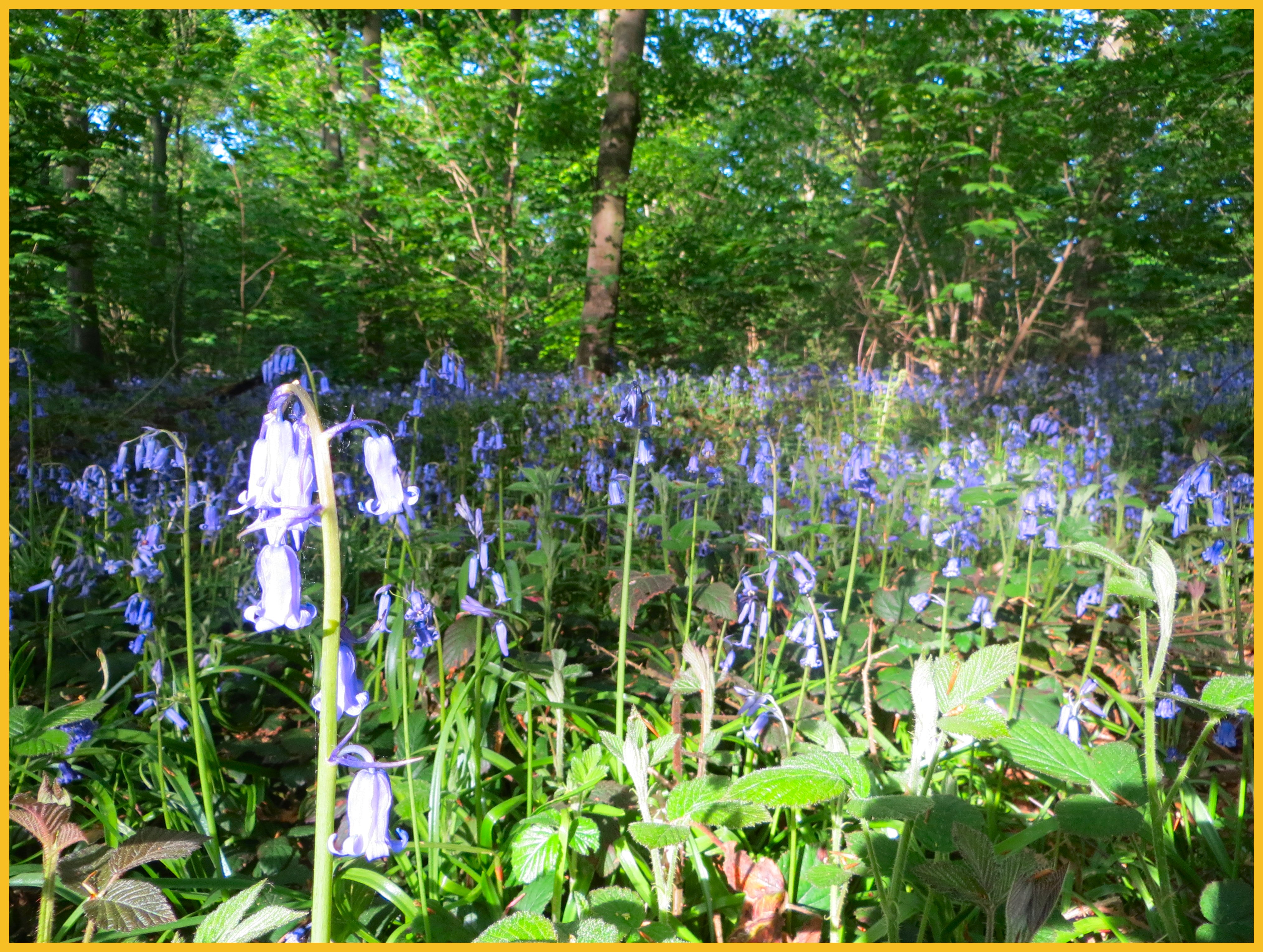
As I walked down in the woods today, there were no bears, but dark forces were threatening beauty, as they do every year at this time… but this May is different, for the beauty is still young.
The cold, snowy winter and even snowier March, following a brief spell of mild weather that fooled both the birds and the very early flowers, upset the order of the usual harbingers of spring, as many are late: the daffodils have collided with the tulips; flowering currant and cherry are blooming together. Perhaps ironically, the fruit trees are full of promise; up here in the hills, they often succumb to the devious daggers of frost, but their blossom has arrived so late that it has dodged the devastating chill. I’m anticipating a late summer and early autumn laden with bounty.
Anyway, back to the woods, where normality is not well: the bluebells, one of my favourite wild flowers, have been cautious, dithering in the cold and arriving at least two weeks later than usual. The trees, by contrast, are embracing the spring in a rush. Perhaps nurtured by the continuous snow and rain of the endless winter months, their green leaves are burgeoning unusually thickly and very fast for the time of year. The bluebells, in their huge swathes, have yet to reach perfection, that moment when the understorey is carpeted so richly with their violet-blue that all the trees appear to be floating in an indigo haze. This year, however, they will have to make haste if they are to work their customary mood magic, for the woodland canopy is fast closing over. It seems that they will be slaughtered before their time, starved of light and stifled. In most years, by mid-May, they are bedraggled by a month in flower, their loveliness fulfilled and their seeds set. But not this year.
The phases of woodland plant life are delicately juxtaposed, each species adapted to take advantage of the moment. But now the time is out of joint and there is nothing to be done to set it right.
An ethical question…

From The Sunday Times May 12th 2013
One of my big treats is to read the book reviews in the Sunday newspapers. I’m always slightly sulky if, as occasionally happens, the review pages have been given over to the programme of a forthcoming literary festival or, worse, column after column of disappointingly brief paragraphs on ‘holiday reading’ or ‘books for Christmas’.
Yesterday’s review pages in The Sunday Times were particularly entertaining. Most of the reviews were interesting and several books were featured that I’ve made a mental note to buy. I’m not sure that this will include the lead title, however: The Anatomy of Violence: the Biological Roots of Crime, by Adrian Raine, reviewed by Jenni Russell. Raine, now a professor at an American university, has spent ten years studying violent criminals and their motivation and concludes that they are shaped by a combination of biological and social factors that are beyond their control. He is particularly keen to emphasise the ungovernableness of the biological factors that are at work, claiming that the brains of psychopaths and sociopaths are actually different from those of ‘normal’ people (though he confounds his argument somewhat by saying that the children of criminals, even if they are adopted, are more likely to commit crimes than other children).
As someone who is also interested in how the criminal mind works, though without the medical background, my instinct is to find this argument repellent. To me, it seems to be too closely related to the specious ‘insanity’ plea to which murderers and rapists often resort in order to obtain a lighter sentence or treatment at a secure hospital instead of jail, and to deserve about as much credence. I think that it is very dangerous indeed to suggest that sane adults are not responsible for their actions. As a girl, I had a close relative who would fly into terrible rages over some trivial mishap, such as when one of his children accidentally dropped a jar of honey on the floor, or the fire went out and he had to relight it. His frequent complaint would be: ‘I was in a good mood until you upset me!’ or: ‘I was perfectly all right until that happened!’ Even as a very young child, I remember the disdain that I felt that a grown man would try to duck responsibility for his vicious temper in this way.
I’m also more than a little disturbed by some of the experiments that Professor Raine describes. The review states (without comment): ‘In an experiment on almost 1,800 three-year-olds in Mauritius, children were measured on their bodies’ ability to anticipate that a particular tone would be followed by an unpleasant sound. It took only three trials for most children to sweat in anticipation of the harsh noise.’ I don’t like the sound of this at all. It raises all sorts of questions about the ethics of carrying out experiments with children, especially experiments that involve pain or fear. I realise that the experimentation described in Raine’s book involved fairly mild discomfort, yet it registers on a spectrum at whose extremity looms the terrible spectre of Mengele. I am reminded also of the ethical questions that arose concerning the Milgram experiment.
Professor Raine is more engaging when he writes about himself. From the review, it is not clear whether he is writing in a spirit of wry self-knowledge or simply being matter-of-fact when he reveals that, when he was seriously injured by an intruder while staying in a hotel room in Turkey, he felt a fierce, instinctive desire for revenge. Jenni Russell tells us: ‘He just wanted to see his assailant punished, and at moments he wanted that punishment to exactly match his own terrifying experience.’
I’d say that this eclipsing of Raine’s humanitarian tendencies by his more universally human ones is completely normal. It also illustrates why we need laws: in a civilised country, a judge and jury will dispassionately apply the law that prescribes fit punishment for the crime. Usually, it won’t be of the ‘an eye for an eye, a tooth for a tooth’ variety that injured parties like Raine sometimes passionately, and perfectly understandably, desire. Conversely, although a case may certainly be made for using the results of research into the criminal’s brain – and his or her background – in order to provide therapy, I don’t think that it should count as ‘mitigating evidence’. Anyone can try to justify appalling behaviour – from childish rages to much more serious crimes – by blaming circumstance, biological or otherwise. The fact that most of us don’t is what makes society work.
An admission of guilt…

How time changes our attitudes!
My husband’s father had a rather posh employer, a titled aristocrat with a substantial estate in the south of England; his ancestors genuinely did arrive with William the Conqueror – he had (still has) the family tree and the lands (albeit diminished over the centuries) to prove it.
My father-in-law was an absolutely loyal retainer of the old school. Totally committed to the ‘big house’, he would brook no criticism of its inmates. His children were of a different mould. They looked across the class divide that separated the aristocrat’s mansion and the pretty tied cottage where they lived more surely than if there had been a ten-foot fence between them and, as well-educated young people of the sixties, viewed their neighbours with amiable scepticism.
When we were married, perhaps more out of a sense of duty to a loyal servant than a genuine regard for his child, the aristocrat and his wife (also from a titled family) presented us with a set of eighteen tumblers. They were tinted a smoky grey, fashionable for glassware then. My husband, a principled opponent of the landed classes, laughed with some cynicism when he saw them, because they bore a very close resemblance to the glasses that were being given away as part of a well-known petrol promotion of the time, though the glasses did come packaged in a box bearing the logo of a local department store. My own reaction, unused to the aristocracy as I was, was one of astonishment that anyone could think that a couple starting life with only the meagre collection of mismatched cups and plates that they had gathered as students could possibly have need of eighteen of anything!
But of course we did use the tumblers. And continued to use them over the decades. Unloading the dishwasher the other day, I realised that only three of them are now left, scarred and pitted, loyal old servants who have borne witness to many years of family life and always been stalwart in their duty. They have obliged as water glasses at both family suppers and more festive dinners; held my son’s breakfast milk when he outgrew his feeding-cup; done service at children’s parties once plastic beakers were rejected as too babyish; been used to mix Lem-sip, stomach powders and other medicines; hosted the occasional late-night whisky and even been pressed into tasks beyond normal expectations: singly, they have stood in as a makeshift vase for a solitary torn-off rose, a storage receptacle for leftovers, a pot for germinating seeds.
And so it turns out that this once rather naughtily despised present has become more a part of the everyday fabric of our lives than almost anything else that we own and certainly more than any of the other wedding presents that we received. Coming over sentimental, I feel inclined to retire these last three ageing retainers, and let them live out the rest of their lives – which would then, probably, equate to the rest of our lives – in peace. (I can imagine that whoever clears away our possessions when we’ve ‘passed on’ will get rid of these three precipitately.) However, when I remember my father-in-law, who served with pride and continued to serve until his death, aged seventy-five, I think perhaps that, if they could speak, these glasses would tell me that they don’t want to be relegated to the top of the cupboard and left, literally, on the shelf. Like old soldiers, they will want to carry on until, one by one, they disappear.
We are both, my husband and I, very much aware of our early crime of ingratitude and quite probably of injustice to the actual sentiments of the givers, who may never discover just how attached to these incredibly loyal retainers we are, nor (irony of ironies) that their nephew and our son followed the same course at university together, without knowing each other’s origins.
 Christina James, crime novelist