

Where sheep may safely graze…

Terence the tup

Most of Terence’s flock

Brave new world
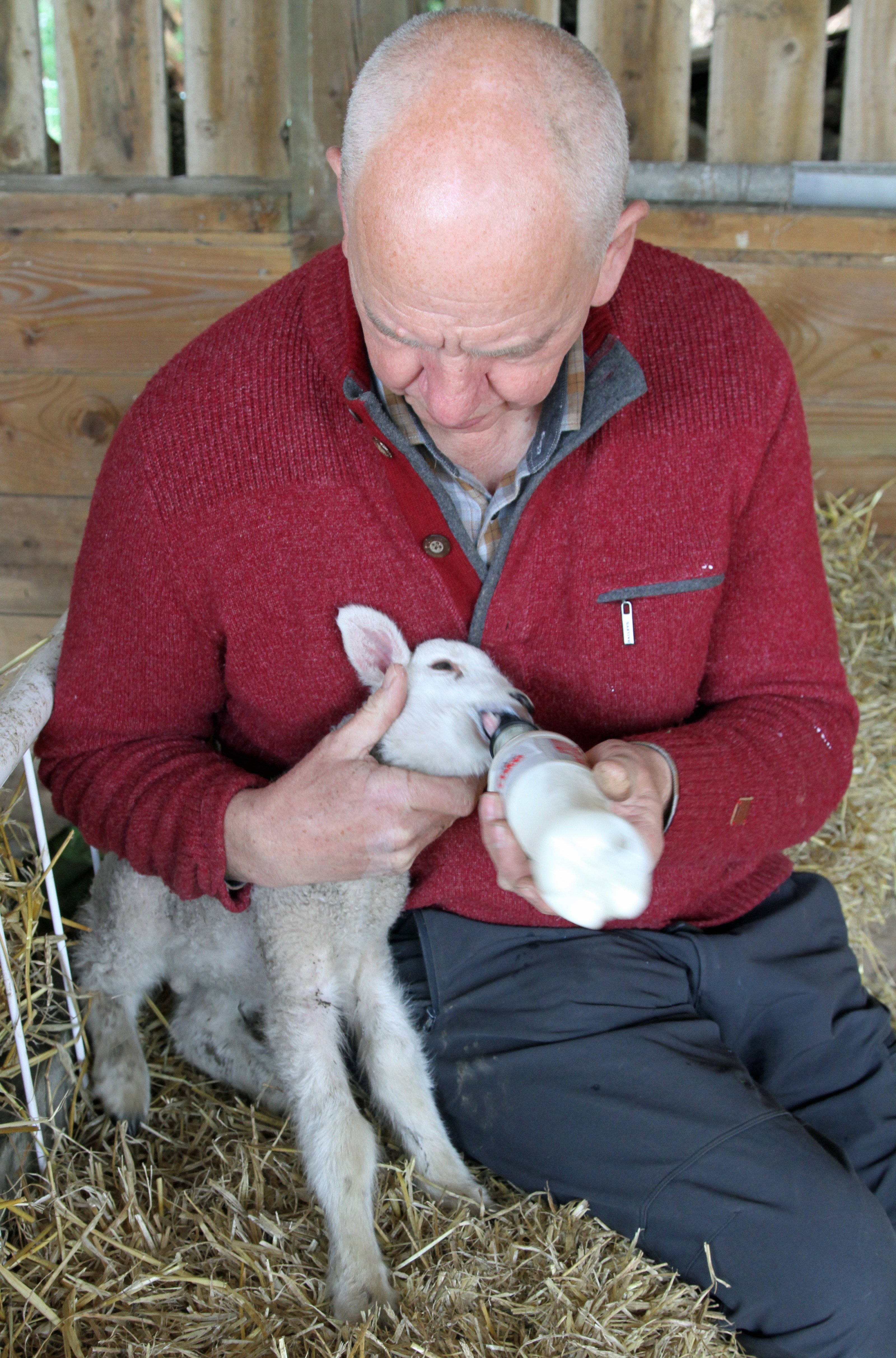
Supplement for the smallest triplet, to help mum…
We celebrated the start of spring this weekend by paying our friends Priscilla and Rupert a visit. We were looking forward to seeing their new-born lambs. They have eight ewes altogether, of whom four have borne a total of nine lambs (three sets of twins and one of triplets). They don’t know whether the other ewes are in lamb or not – apparently it is very difficult to tell whether a ewe is pregnant unless she undergoes the ovine equivalent to a scan, which for most farmers would be prohibitively expensive. (It occurs to me that an enterprising entrepreneur should come up with a ewe’s pregnancy testing kit!)
Whether or not the remaining ewes have been successfully impregnated, one thing is certain: Terence the Tup is in clover. Some of my readers will remember that Terence had a few runs-in with a mating harness at the beginning of the winter. Once Rupert had finally figured out how to put it on, it chafed Terence, so he was allowed to step out of it forever. This meant that his virility could not be measured. All that Priscilla and Rupert could do was wait and hope that he had triumphed.
Terence takes over the story:
You wouldn’t believe this, but that Rupert has fitted up a telescope in his bedroom so that he can spy on me. Prurient, that’s what I call it. If a ram tried that, he’d be locked up. It’s bad enough trying to get a bit of privacy when you’ve eight ladies to look after, without him butting in. He says he’s doing it on humanitarian grounds. Pah!
Everyone seems to think that I’ve struck it lucky here, that it’s an easy billet for me, with just eight women and no other blokes trying to muscle in. I’ll have you know it’s not a straightforward as it looks. For one thing, some of my girls are quite flighty. They’ll argue with each other over who should be next for my favours and then, when I pick one and take her side, they’ll all turn on me. Sometimes, that means I don’t get anywhere with any of them and I have to wait until things have settled down before I try again. Then Rupert comes out (having, I imagine, been glued to his bedroom window – you’d think he’d have better things to do) and says he’ll get rid of me if I don’t perform. You can’t win.
And another thing… Rupert and Priscilla bought special fodder for the ewes once they thought they were in lamb, to give them the right nourishment. I’d no objection to that, but they were downright stingy when it came to letting me eat it as well. I didn’t get any of it ‘officially’. They didn’t seem to understand that I was as busy making lambs as the ladies were – busier, in fact. I’m a dad of nine now, and counting, not just a mum of two or three. They should have seen that I needed the victuals to keep my strength up.
I found a way round this eventually. I decided to cold-shoulder any lady who wouldn’t share her provender with me. It worked a treat: they all gave me some. They might not have minded ganging up on me sometimes, but if there was one thing that none of them could stand, it was being ignored. I should have tried it in the first place: they’d all have been in the club in no time. Rupert thinks that I’m getting a bit fat now, but what does he know about BMIs for sheep?
Once the lambs started to come, though, I got the boot. Seriously, it’s the truth: I know it sounds outrageous. They used some hurdles to fence off part of the field to segregate me from the girls, and fastened me in with one of last year’s lambs, ‘to keep me company’. Little whippersnapper. I give him a good head-on crack, skull to skull, whenever I think no-one’s looking. Fortunately, the telescope has been trained on the girls who’ve yet to give birth, so Rupert doesn’t see it if I’m careful. I ask you, though, what kind of maternity unit does he think he’s running here? I’m certain there are no telescopes involved in ‘Call the Midwife’.
By the way, eight of my nine are boys; they could use me in China. ‘Ramming it’, I call it.
Surprises come in threes at Oadby Library!

During the latter part of last Thursday afternoon, after a sun-splashed if chilly week, the heavens opened and the rain came bouncing down. The gate that leads into our garden was sodden in no time. The M1, which we had just joined to begin our journey to the event at Oadby Library, quickly became waterlogged: there were treacherous sheets of water to negotiate as the traffic on the approaches to the various cities that we passed built up towards rush hour. By the time that we reached the Leicester ring-road, we’d encountered virtual gridlock. Irate drivers were crawling along for a few yards at five mph before juddering once again to a standstill, their progress and tempers not helped by the rain, Leicester’s amazingly laid-back traffic lights system and the fact that in several places on the dual carriageway two lanes merge into one (every driver being reluctant to yield to another).
This was not an auspicious start to an event that had been planned months in advance and strenuously published, by Chris and Jen at Salt Publishing, by myself and by various other kind tweeters along the way. I had known not to expect too much, as the library had already warned me that only three tickets had been sold – and indeed would have ‘pulled’ the event had I not insisted that I should be happy to speak even if only one person turned up to hear me.
I arrived precisely on time, at 6.30 p.m., later than intended, and my audience – consisting indeed of just three people – had all got there before me. I barely had time to notice that Oadby has a lovely library before I hastened into the ante-room where they had assembled, together with the librarian, Anne Sharpe. However, by this time I had already experienced the first of several wonderful surprises. The first person that I met after Anne was Rosalind Adam. We are mutual bloggers and Twitter friends – I’ve been enjoying Rosalind’s blog for some time, though we had not met before. It was a delight to be able to talk to Rosalind in the flesh. We each agreed that the other was exactly what we had expected – and that this was not always the case when meeting someone previously encountered only through the ether. At the moment, I’m particularly excited about a book for children on Richard III that Ros has just finished writing and hope to be able to review it on this blog in due course.
I was a bit slow on the uptake at registering the second surprise. I’ll have to excuse myself by offering the explanation that I was busy sorting out my books and papers for the readings. I’m also quite short-sighted, but I prefer to wear my spectacles only when I’m driving. Anyway, the event was about to start when I looked up and recognised that the only male member of the audience was Colin Marshall, for many years the manager of the campus bookshop at Leicester University and still employed by the university today, although he has now ascended to a higher plane and is in charge of all the retail operations on the campus there. Colin’s presence introduced one of those occasions when my life as a novelist collides with the day job – and this time it was the most enjoyable collision imaginable. Colin has for several decades attended the conference for which I have organised for some fourteen years the speaker programme. He was also awarded the Booksellers Association’s Lifetime Achievement Award in 2013. His presence at the event was not entirely a coincidence, as he had been kindly told about it by Professor Christine Fyfe, the Pro-Vice-Chancellor in charge of Teaching and Learning – and the Library – at Leicester University, whom we both know. However, there was also a real coincidence at work: Colin and his wife Sandra live in Oadby and she had quite separately seen the event advertised by the library and decided that she would like to attend. Having the opportunity to meet Sandra was the third lovely surprise of the evening: she’s funny, sensitive, extremely well-read, loves dogs and cats (she told me that she and Colin have managed to organise their lives with such symmetry that they have four children, three dogs and two cats), is a great companion and raconteur and furthermore is living proof that Colin is a dark horse!
Ros, Colin, Sandra and Anne therefore constituted my audience at Oadby. It was the smallest audience I’ve ever had. I’ve attended other writers’ events that have managed to attract only small audiences and I’ve found that they divide into two categories: small and dismal, and small and select. I’d like to state unequivocally that, thanks to Ros, Colin, Sandra and Anne, this event was of the latter type. It began quite formally with a reading from In the Family and a Q & A session, but before long had turned into a lively debate about writing, literature, other crime writers and future events at Oadby Library. We overshot the allotted time by half an hour, so that I had barely time to conclude with my ‘world première’ reading of the first chapter of Sausage Hall, third title in the DI Yates series, which I’m grateful to be able to say was very well-received.
At the end of the evening, we took a quick look round the library and had our photograph taken there. Ros had to leave at this point: she has kindly already written about the evening on her blog. We said goodbye to Anne, our charming and extremely well-read hostess, and retired to the car park to release our dog, who had accompanied us for the ride. Then Sandra, Colin, my husband, the dog and I adjourned to the pub down the road (The Fox) to continue the conversation. Eventually, Sandra and Colin went home and we headed back North through the rain-sodden night.
There are some evenings, unfortunately all too rare, when, as a writer, you really feel that you are making progress in the most worthwhile of ways, by talking to a group of sympathetic and interested readers. (The size of the group is immaterial.) For me, the event at Oadby Library was such an occasion. Anne said that she would invite me back again later in the year. I’m looking forward to it already. I’d like to thank her for her wonderful hospitality, and to thank Ros, Sandra and Colin for braving the elements to visit the library last Thursday and for contributing to the marvellous conversation that took place there.
To Brighton again, with spring in step…

As you can tell from the date of the picture I took from the train window just over a week ago, this post is a little behindhand. I was then, and am now, heading south on East Coast rail. What a lot has changed in one week! The temperatures have soared, high pressure has established itself over the whole of the UK and the train Wifi is working for once! I’m conference-bound today, with all the lightness of heart that good weather brings. Here’s what I wrote last week:
I’m on the train to London again, for the first time in quite a while. It’s just after 7 a.m. and broad daylight – a luxury that I haven’t experienced on this journey at this time since last October. It’s chilly: the fields are damp, still drying out after the rains, and a low mist rises from the earth as it warms up for the day. The sky is oyster-coloured and fretted with a complex pattern of clouds that seem to form the shape of the skeleton of a whale, or some long-dead prehistoric beast; I see a dog running across the grass, but can’t spot its owner. Mostly the land in this area is flat and arable, but occasional huddles of cows or solitary horses tethered in a paddock, grazing peacefully, flash by.
As usual, there is a problem with the train’s WiFi, but mercifully the electrical sockets are working, so I can still use my laptop. This is just as well, because, try as I might, I’m struggling to find my fellow passengers interesting. Opposite me sits a burly man reading the Metro newspaper. He licks his finger to get a purchase every time he turns the page, an unhygienic habit that I’ve always found irritating (particularly when employed by bank tellers counting out notes that I must then grasp). I wonder how much newsprint he swallows each week? The man sitting opposite is slenderer, younger and quite geeky. He’s wearing square, heavy-framed spectacles and is immersed in his iPad. I can just see that he is reading the Financial Times (and can tell that he is familiar with East Coast – he’s downloaded the paper before getting on the train!). At least there’s not much prospect of his sucking on his thumb and index finger as he scrolls down the articles!
Looking round, I see that all my fellow passengers are men. The ones behind me, each seated at a separate table, are all reading documents and making notes: weekend work that didn’t get done, I guess.
Now the train is approaching Newark Northgate. The sun is riding quite high in the sky, but is still watery and pale. Newark is this train’s last stop before King’s Cross. Quite a crowd of people is waiting to embark, but again not a woman in sight. Smarter than I, perhaps – they’ve managed to stay at home to enjoy what promises to be a bright early spring day.
Breakfast arrives (I’m travelling first class, though on a very cheap ticket, because I ordered it weeks ago). It’s a smoked salmon omelette. Porridge and fruit compote, which was what I really wanted, has apparently ‘sold out’. I’m sceptical about how this could happen on a Monday morning. Someone forgot to fill in an order form, perhaps? The omelette is OK, but the half-bagel on which it sits looks tough and rubbery. I decide to give it a miss.
All of this, I’m sure you’ll agree, is quite humdrum. The journey is one that I’ve made scores of times before, usually, but not always, with more promising travelling companions. (I’m hoping that the rest of it will be as uneventful and that the train will arrive on time, as I have only forty minutes to cross the city to get my connection at Victoria.) But my spirits are lifting. I feel the old magic that I’ve always associated with train journeys since I was a child. It’s been dulled by the dreariness of winter, but today it has returned, in full strength.
It’s 8.10 a.m. and the sunlight is streaming through the train window, flinging a glare of orange across the computer screen so that I can hardly see these words. Spring is here. When I arrive in London, spring will be burgeoning there, too. It is the beginning of March and at last it seems as if the year has really started. There is the whole of the spring to sip at as if it were a delicacy and the almost-certainty that it will be followed by the feast of summer. It will be eight whole months before we shall arrive at the end of October and watch with dismay the withering of the trees and the light as winter approaches again.
Today, I am travelling to London, then on to Eastbourne: an ordinary work-day expedition. But it is part of a much bigger, more exciting journey: my odyssey into 2014.
Today, I am travelling to Brighton, where this year there will be no heaps of snow on the promenade and I’ll be interested to see just how little the storms have left of the West Pier skeleton, which I wrote about and photographed twelve months ago.
Have a lovely week of spring weather, everyone.
The verse venue: Matthew Hedley Stoppard and Ralph Dartford at Rickaro Books

Matthew at Rickaro Books

Ralph at Rickaro Books
Rickaro Books, of Horbury, is one of our most distinguished independent bookshops and, like all distinguished independent booksellers, Richard Knowles knows that events don’t just happen: you have to work at them. Therefore, although World Book Day – and, by extension, World Book Week – is getting a huge amount of support from the Booksellers Association and individual publishers, with lots of media coverage, whether or not a bookseller succeeds in making it work is down in the end to himself or herself.
Richard has arranged events for almost every day of this week, leading up to World Book Day itself, which is tomorrow, Thursday March 6th. (If you’re interested in finding out more, please click here.) Tomorrow, he is entertaining a group of schoolchildren in the shop, all wearing fancy dress, and is even going to dress up himself! (I find this amusing: Richard has obviously mellowed since I worked with him all those years ago, when, if not exactly child-unfriendly, he was certainly selective about the children that he liked!)
However, when I read about Richard’s celebrations for World Book Week, the Rickaro Books event that most intrigued me was the one that took place yesterday. I made plans to attend it immediately. It was a live poetry evening, with Ralph Dartford and Matthew Hedley Stoppard (who refers to himself on Twitter as ‘the poor man’s Benedict Cumberbatch’, a soubriquet that immediately endeared him to me). The shop has an excellent track record at organising poetry readings (I’ve written about them on this blog before) and I knew that yesterday’s would not disappoint.
The two poets recited alternately with the fluency and skill which comes from complete command of the material. Both were consummate performance artists, but what really impressed me was the quality of the poetry itself. It is my experience that many live poets are performers first, poets second, but both Ralph and Matthew are exceptional poets as well as being brilliant at engaging with a bookshop audience. The latter was pretty special, too, and included a small boy named George who was dressed as Peter Pan.
If you are not familiar with Ralph’s and Matthew’s work and you like poetry, I recommend that you invest in the two books (AND Matthew’s lovely green vinyl record!) that I bought last night. Cigarettes, Beer and Love, by Ralph, takes the form of a chapbook that has been beautifully produced by the Ossett Observer on hand-made paper. Matthew’s A Family Behind Glass, published by Valley Press, has all the elegance of a classic ‘slim volume’. Which poems did I enjoy most last night?
Well, the Co-op store in Ossett will never be quite the same to me again, now that Ralph has given me ‘Co-op Live Art Fiasco’, which describes his effort to show the individuals in the checkout queue that their investment in the Lottery pays for art (and his wages)… by stripping stark naked and doing some ‘live art’ with a Lucozade bottle. The constable summoned to the event says: “I once saw something like this in Berlin. A scratch card paid for the trip. I quite liked it.” (Ralph was led away at 08.46.) As readers of this blog know well, I’m game for a laugh, but there’s serious stuff behind Ralph’s humour.
Ralph describes Matthew as the ‘cerebral’ one of the pair (but all their poems last night were ‘thinky’, even the most superficially frivolous of them!). In fact, one poem of Matthew’s touched me a lot and spoke to me very clearly from my own past in our first rented marital flat in Leeds.
He set the context of a rented house in Rothwell, his and his wife’s first home, at a time when, he said, they weren’t really ready to be adults, yet. I’ll give you the first stanza, so that you may be touched as well:
Now that the streetlamps have stolen the stars
From the afternoon sky, sleep, content
And lovely as custard, pours over us. We sit
With winter on the settee, arm in arm –
Our legs interlaced like denim snakes,
Bedlam pressed between our palms. [From ‘The Wendy House’]
Matthew is about to take up a post with Leeds City Libraries: I’d like to wish him well with this. Ralph works for the Arts Council, and knows Chris and Jen Hamilton-Emery of Salt Publishing. He observed, unsurprisingly, that they are both ‘lovely people’. He kindly bought In the Family before he left the shop, which gave what had already been a very enjoyable evening a considerable extra fillip for me!
I wish Richard every success with World Book Day. (I’d love to be a fly on the wall when he receives the schoolchildren tomorrow, but unfortunately I have to travel to London instead.) And I hope very much indeed that I shall meet Matthew and Ralph again. In the meantime, I shall enjoy reading their poetry for myself. Thanks to them for introducing me so beautifully to it.
 Precious poetry pack
 How to get a book signed by two priceless poets
Whitelocks

Whitelocks in Turk’s Head Yard, Leeds
I’ve always had a strong affection for the very heart of Leeds and first knew it when the buildings were still black with soot and vehicles could go everywhere in what is now a huge pedestrian precinct. I particularly remember shopping here before Christmas in the early seventies and finding it almost impossible to make my way along the pavements, which were packed with shoppers because the roads were likewise thronged with cars. It is much more pleasant now, with space for pedestrians as well as pavement cafés (one in a street completely covered with a glass roof that seals it from the weather and gives it the feel of the various Victorian arcades that lead off Briggate) and talented buskers; the several covered shopping centres (the latest, Trinity Leeds, adjoining Boar Lane) are a magnet to thousands of visitors from across Yorkshire and beyond.
The casual visitor, however, will probably miss the ‘ginnels’ (passageways) and ‘yards’ that preserve the history of Victorian Leeds and that thread their way through the buildings a breath away from the main shopping streets. The entrance to the far-famed ‘City Varieties’ theatre is in one such, though it has been considerably changed and modernised. And in one of these, leading off Briggate and cheek by jowl with the Trinity Centre, is the oldest pub in the city, Whitelocks. I suppose that I, too, should have missed it, but my husband, who seemed as a student to manage to find his way to most of the hostelries in town, took me there many years ago. I went back with him to enjoy lunch there on my return from China.
Here, indeed, is local Leeds. Sitting alongside us were a grandfather (his accent marking him out as a Leeds man) and his two grand-daughters, both of them students, who bought him lunch and beer, put him in the picture about their mother, his daughter, and bid him a merry farewell as they headed off to afternoon lectures; to my left, during the time we were there, a succession of elderly Horsforth (I asked!) couple, a market trader I recognised from many years’ enjoyable shopping in Vicar Lane’s Leeds City Market and a younger man who came in to sup his pint and put the working day aside for a while. The long bar was crowded with suits on lunchbreak and large groups of city workers of one kind or another.
Whitelocks has to be seen and experienced first-hand: it is a jewel of Victorian/Edwardian décor, replete with brass and copper and marble and coloured tile and mirrors and stained glass and ironwork. It gleams with a sociable splendour that makes ‘having a drink’ into an occasion of moment. For the contemporary cognoscenti, the range of real ales is special, the food traditional and beautifully prepared. Here is an inn which cherishes its guests and makes them feel warm inside.

Whitelocks bar tiles
It opened as an inn in 1715, serving local traders and customers in what was then a Briggate market; its original name, The Turk’s Head, lives on as the name of the yard, but the inn was rebuilt and (as its blue plaque confirms) extended to absorb a row of Georgian working men’s dwellings by the first of the Whitelock family, who took over the licence in 1867 and transformed it. Fortunately, it has been preserved for future generations of Leeds folk to enjoy.
My imagination was caught by my first visit there, on a foggy November evening; there may not have been gas lamps, but there was gloom in the ginnel and a warmth of welcome within. The past reached out and drew me in, to think of the divide between the relatively wealthy Victorian and Edwardian customers of ‘Whitelocks First City Luncheon Bar’ and the vagabonds and urchins and footpads outside in the sooty darkness, who no doubt relieved some of them of their wallets and purses. For a crime writer, pubs with character and a powerful history have huge potential. I’m sure that Whitelocks could very easily find its way into a story and may very well already have done.
Memory the only takeaway from a magical Chinese experience…

The Emperor’s Palace, Beijing
It’s impossible to conclude my blog-posts about China without writing about the food. I’m not actually a big fan of Chinese food when I’m in England, principally because so many Chinese restaurants here adulterate their cuisine with monosodium glutamate. (The Chinese restaurant in which I worked when I was a student, which was home to the cook called Moon, star of a previous post, was an honourable exception.) If I consume this substance, which I believe is also called ‘Chinese taste powder’, I invariably get a headache and feel dizzy the following day.
However, I was assured that monosodium glutamate is never used in restaurants in China and I certainly didn’t detect it in any of the food there. I was very honoured to be treated with the utmost hospitality throughout my stay and, as food plays a big part in Chinese standards of courtesy, I was presented with what was effectively a banquet every night. Although when at home the Chinese usually confine themselves to three or four dishes, which in Shanghai always includes a soup (It was explained to me that soup helps to regulate the body temperature if the climate is hot and dry or if other foods are spicy.), when guests are taken out to eat it is not uncommon for ten or twelve main dishes to be ordered, as well as many appetisers and side dishes. These don’t all appear at once: the waiting staff bring them in one by one and place them on a huge circular glass ‘lazy Susan’ (the Chinese use the same words), which is spun slowly round by each diner in turn, with all the tantalising magic of what felt like a place at a gastronomic ouija board.
All the food that I ate in China was delicious: without exception, it was very fresh and featured many different kinds of vegetable (though an actual vegetarian would have a tough time there, as most dishes also include meat or fish of some kind). At every dinner there was also a whole sea bass garnished with herbs and spices – an expensive treat, presented to guests as part of the impeccable code of hospitality. I was only once offered a delicacy that I was reluctant to try: on my last evening in Shanghai, the pièce de resistance was a dish of pickled ducks’ tongues. One of my fellow diners told me that they tasted like mackerel, but I was too cowardly to find out if this was true!
Among my favourite foods were the exquisitely-crafted dumplings that usually appear after the main entrées. The smaller ones contain meat, the larger ones a special soup: they require eating with great care, so that none of the soup is lost.

Soup (large) and meat (small) dumplings
Rice and noodles are served separately at the end of the meal, because guests are encouraged to eat their fill of the finer dishes before filling up on these staples. Desserts are simple and light, consisting usually of sweet soups (plum is a favourite) or yogurt and honey. Tea is the main beverage. Light beer is also served, but drunk sparingly. Wine was not served at any of the dinners that I ate and no alcohol was ever served at lunch.
My two Beijing dinners were particularly special. The first was at the original Peking Duck restaurant, which is close to the main campus of Peking University (The University retains the name ‘Peking’, choosing not to call itself ‘Beijing University’ because it is proud of its heritage. It is China’s oldest and most prestigious university.). This restaurant has been serving Peking Duck since the 1930s, when it invented the recipe.

My number’s up for this Peking duck…
Each diner is given small dishes of cucumber, chopped spring onion and plum sauce and a round box of steamed pancakes. I discovered that Peking Duck is one of the most authentic dishes served in Chinese restaurants in England. In Beijing, the duck itself was oilier and therefore richer than in the UK, but apart from that the taste of all the ingredients was similar: the key difference was the dexterity with which the waitress demonstrated how to flip the pancake on to the plate with chopsticks, fill it and form it into a neatly-wrapped parcel. None of my parcels looked like hers! As they leave, diners are given a certificate to prove that they have eaten genuine Peking Duck in this restaurant.

Proof of the eating in the original Peking Duck restaurant
On my last night in Beijing I enjoyed the most special dinner of all. It was a banquet held in the ‘Emperor’s Palace’, a restaurant whose real name is the Bai’s Home Courtyard. It was originally the palace home of Prince Li of the Qing Dynasty. The courtyard is in fact a succession of formally laid-out gardens, each one containing a single-story building that once formed part of the Emperor’s palace and has now been converted into a dining-room. The buildings are guarded by young men dressed in the traditional garb of Imperial soldiers, and the waitresses are young women attired in beautiful traditional silken costumes and head-dresses.

Waiting at table in the Emperor’s Palace
On their feet they wear tall pattens – the platforms of these, on which the centre only of the foot is balanced, are about four inches off the ground. One of the girls told me that it takes a week to learn how to walk in these shoes. Twelve of us ate that evening and we were served throughout by four silk-clad waitresses. Our dining-room was dedicated to longevity, symbolised in the detail of the wall-hangings.

Opulence and longevity in the Emperor’s Palace
The table was round, for equality, and all the chairs except one richly covered in yellow silk; this single chair was made of intricately-carved wood. Originally, it would have been the one in which the Emperor sat. No woman ever sat in the Emperor’s chair – at least, not then!

No woman may sit in the Emperor’s chair – ha!
We were served perhaps two dozen dishes at the Emperor’s Palace, some of them tiny, all of them delicious and beautifully presented. My favourites were a very special kind of smoked fish and venison stewed with chillies. The banquet lasted for about three hours. Once outside again, we discovered that it had turned bitterly cold – some of the fountains in the gardens had frozen over and the walkways as we made our way back to the street were lit with bright orange lanterns that picked out the tiny dots of silver frost on the profusion of plants flourishing on the small ponds and spilling over the low formal walls designed to contain them.

A cold night in the Emperor’s Palace garden
It was a magical, almost an enchanted, evening, a marvellous culmination to eight days of extraordinary new experiences. If I did not have the photographs, I might believe that I had dreamt it.
All text and photographs on this website © Christina James
Mighty river…

Across the Huangpu from the Bund
On my travels in other countries, some of the most evocative moments have been spent contemplating rivers. I’ve stood on O’Connell Bridge in Dublin and watched the (on that occasion very murky) waters of the Liffey and remember thinking, as I looked into its Guinness-coloured depths, that it must have been entirely James Joyce’s poetic imagination that produced such a beautiful name as Anna Livia Plurabelle. I’ve seen dhows swooping along the Nile, their single white sails bending gracefully to the breeze. I’ve marvelled at the massive businesslike barges speeding along the Danube, powerful and swift as crocodiles on the move. The bridges and embankments of the Seine are still vividly precious for their romance on our honeymoon. Closer to home, as I’ve written in a previous post, I’ve admired the spectacular night-time views from Waterloo Bridge in London as the Thames makes its sudden sweep to the East. And I still feel great affection for the dear, dirty River Welland that threads its way through the town of Spalding, much humbler than these great waterways, though still, in its day, a significant bringer of prosperity to the people who dwelt nearby, just like all the great rivers of the world.
Unsurprising then, that I should have been captivated by the magic of the great Yangtze, the fourth longest river in the world, as it pours itself at Shanghai into the East China Sea. Wide and fast-flowing, the Yangtze has brought traders to Shanghai for thousands of years, making it one of the world’s great cosmopolitan cities long before the rest of China emerged from its self-imposed insularity.
Even the Yangtze’s much smaller tributary, the Huangpu River that cuts right through the city centre, is a majestic waterway, which I visited first on a cold but sunny Sunday afternoon when people were promenading along the Bund, the waterfront area opposite Pudong, on a built-up walkway that enables walkers to get close to the river’s banks and where festive street food stalls abound.

All lit up on the river!
Two days later, on a bitterly frosty but fine, clear evening, I was taken to the Huangpu’s junction with the Yangtze. On both occasions I was able to watch barge after nimble barge (they are longer and slenderer than the ones on the Danube) power by, almost as if in convoy, while the waters displaced by their passage lapped energetically against the shore. The barges and other ships are lit up in the evening, as is the spectacular Shanghai skyline that forms a backdrop to the Yangtze. The result is a profusion of golden lights that disport themselves against the inky blackness of the waters. The scene is dynamic, full of energy and passion, the legacy of very many years of trade, hard-won prosperity, daring, risk and chance and, I’m certain, not a little skulduggery and murder. The effect is by no means cosy, but it is exhilarating! At the back of my mind lurked the half-remembered knowledge that, in years gone by, to be ‘Shanghaied’ meant to be kidnapped and forced to serve as a sailor on board one of the many ships that plied their trade to the East and, ultimately, to Shanghai. I could imagine someone creeping up on a strong young man as he stood, unsuspecting, and rendering him unconscious; imagine his anguish as he awoke, his head sore, far out at sea, unable to tell his family and friends what had befallen him… that he was on his way to China.
Every river has a personality, which I think was James Joyce’s point about the Liffey. The Yangtze’s is particularly complex: on the one hand, it courses past Shanghai, bearing its gift to this great city of enterprise and generations of toleration for many creeds and cultures; on the other, it penetrates deep into a country that until recent times was secret, withdrawn, enclosed and shut away from all outside influence.
All text and photographs on this website © Christina James
For all the tea in China, I’d need several fortunes…
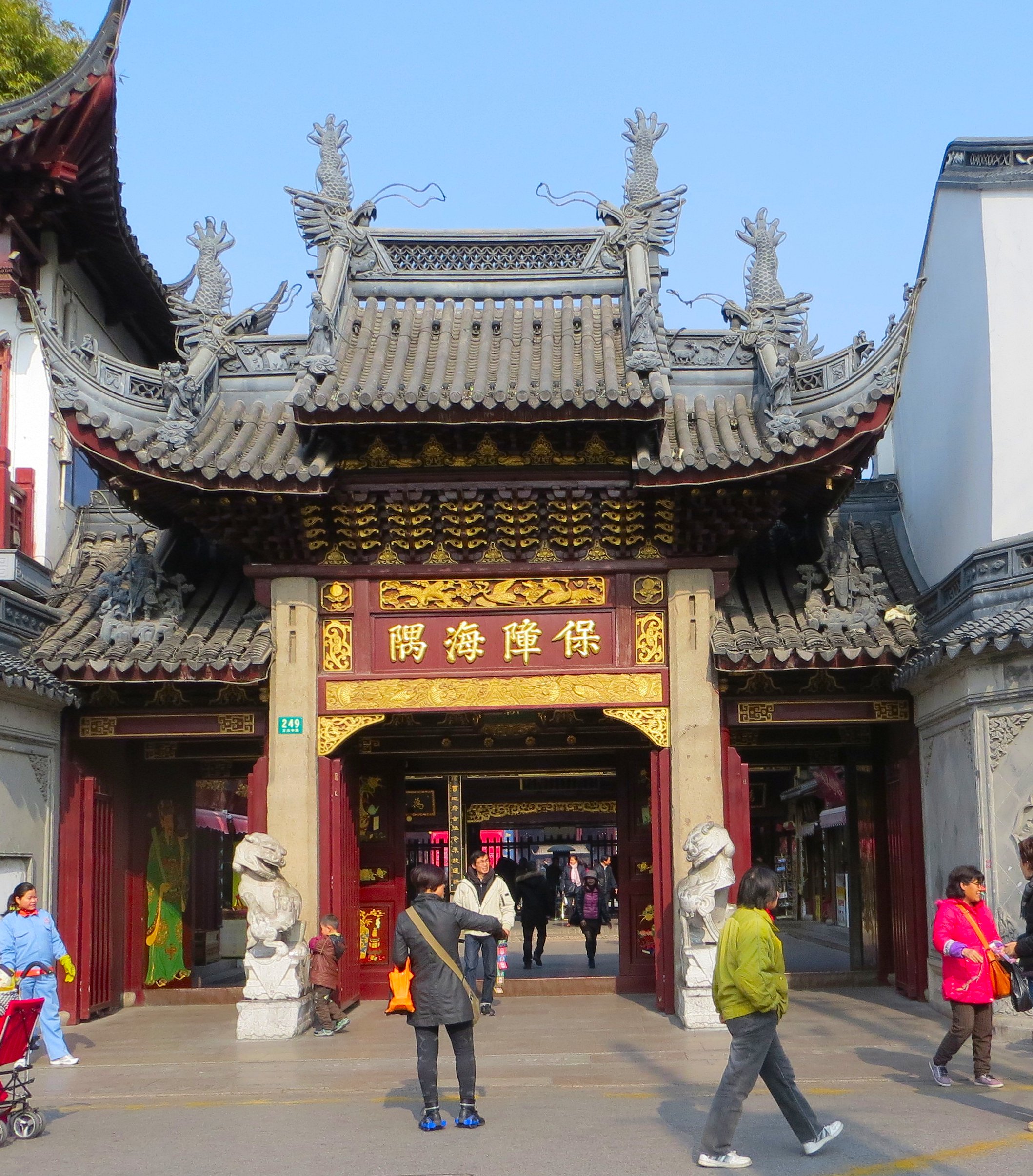
Entrance to Yu Garden, Shanghai
This is my first full day at home after my visit to China, and I’ve just enjoyed a nice cup of tea. Tea is one of our national clichés – the universal British remedy for everything, from broken hearts to bereavement, and also the beverage that most Brits look forward to the most when returning home from foreign adventures. However, I can hardly claim to have been tea-deprived during my five-day sojourn in Shanghai or the two days I spent in Beijing. Tea is what you drink with every meal in China, and there are hundreds of different kinds. I managed to sample a few of them, sometimes in very special surroundings. It is served with some ceremony in restaurants: waiters hover with teapots and fill your cup again as soon as you’ve drained it. As with wine, special kinds of tea are recommended for some types of food: for example, a rich, smoky tea accompanied the duck that I ate in the original Peking Duck restaurant in Beijing (more of this in a separate post). Tea is also used in very traditional restaurants to cleanse crockery and cutlery at the table.
I had only two half-days to myself, as mine was a business trip, not a holiday, but, aided by some kind Asian colleagues, I was able to make the most of them. On the Sunday after I arrived in Shanghai, I took a taxi to the Yu Garden,

Temple courtyard in Yu Garden, Shanghai
a mesmerising complex of temples, waterways and ancient shops, and, after an hour or two of sightseeing, found myself standing outside the fabled Huxinting Tea House, the oldest tea house in Shanghai (the building is about 230 years old, becoming a tea house in 1855).
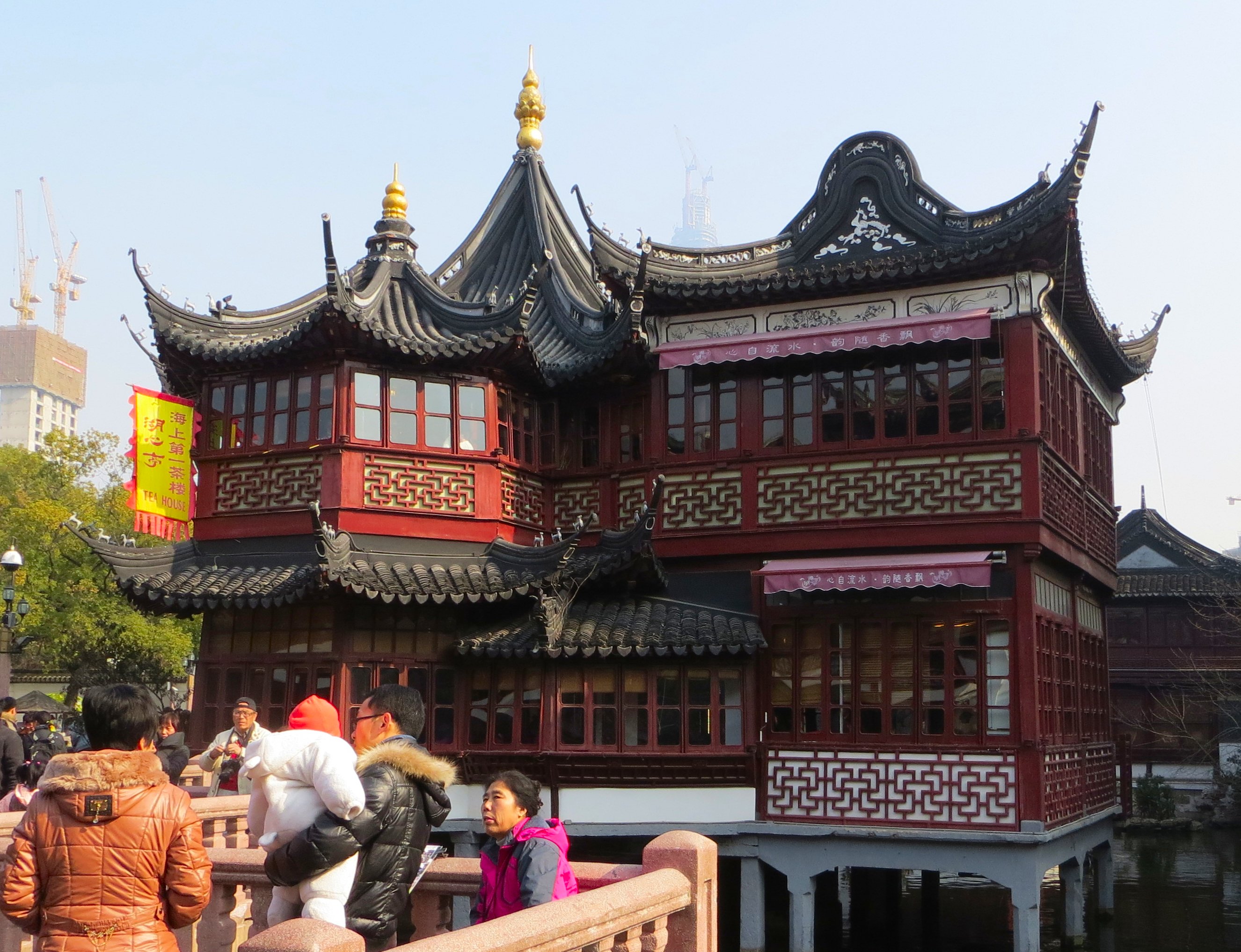
Huxinting Tea House, Yu Garden
Naturally, I went in and was delighted to find that I’d chanced upon a mid-afternoon lull in business, so it wasn’t too crowded.
Inside, the tea house is opulent but not flamboyant. The waitresses are dressed in a uniform based on one of the many forms of Chinese national dress and they are attentive but unobtrusive. There are scores of types of tea to choose from, some of them extremely expensive. I chose jasmine, which came in a glass jug and was accompanied by two aromatic sweetmeats.
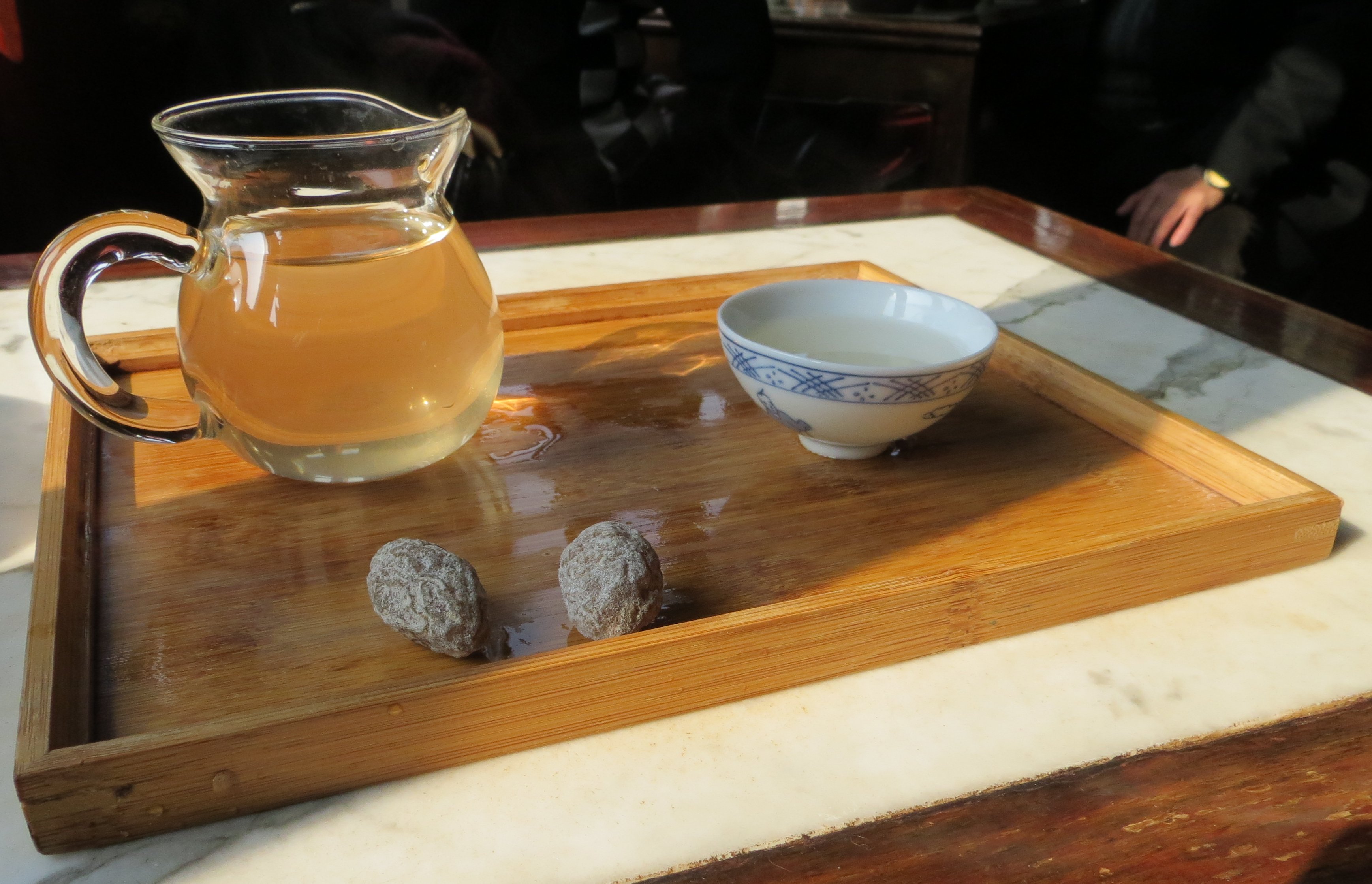
Jasmine tea for one, please…
It was quite delicious: fragrant and refreshing, exotic without being strange. It wasn’t cheap, either: it cost the same as a couple of lattes from Starbucks would have cost in the UK, which by Chinese standards is very expensive indeed. But it was well worth the price: I understand why Chinese people think that the tea house is so special and come here for a treat. It’s not only the ambience inside the building itself that gives so much pleasure; it is also being able to look out across the water of the lake in which it stands on stilts to the picturesque buildings beyond. The paths and walkways are always teeming with people and the tea house itself offers a haven of tranquillity from which to observe them, as well as a feeling of privilege. The elderly couple sitting next to me were obviously savouring every moment, whilst also engaging in a very animated conversation.

Or tea for two…
Each type of tea is served in a different type of vessel and theirs was in terracotta pots with lids, which they had refilled more than once. I’d have loved to have been able to ask them what their choice had been.
Since I came home, I’ve read about the Huxinting Tea House online and discovered that the Queen has visited it. I don’t suppose that she had to worry about the cost of her tea, but I do wonder if, having imbibed its product, Her Maj was constrained to use the establishment’s facilities. If so, I’d like to know what she made of the shaft-style convenience,

For the convenience of the tea house customer…
which was the first, but by no means the last, of this type of porcelain that I encountered in China. (I should add that the one in the Huxinting Tea House was spotless.)
I wanted to bring some tea home with me, but was advised against buying it from one of the specialist purveyors of tea or at the airport as being prohibitively expensive in either. On my last day in Beijing, I therefore walked to a local supermarket and bought two types of tea there, one of them a chrysanthemum tea that I’d first seen earlier in the week when it was ordered by a librarian during a conference that took place at Shanghai Jiao Tong University. On that occasion, it was served in a tall glass mug with a mash of dried chrysanthemum flowers floating on the surface of the hot water. More prosaically, I think that my own purchase will consist of more conventional-looking tea leaves, albeit made out of chrysanthemums. Chrysanthemum tea sounds unpleasant – I was sceptical until I tried it, thinking that it might taste as the half-dead ‘chrysanths’ which I remember adorning the graves in Spalding Cemetery used to smell, but in fact it is delicate to the taste-buds and very refreshing.
Going to the supermarket offered me one of only a few rare opportunities to encounter ordinary Chinese people as they went about their business. I was grateful for this experience. Once again, I was also astounded by how expensive the tea was and how greatly prized. In the supermarket where I bought mine, it was kept upstairs with the alcohol and closely guarded by a security man. It cost about three times as much as a packet of ‘builder’s tea’ in England. I wonder what Chinese builders drink? I’d like to think that their day is fuelled by an infusion of chrysanthemums!
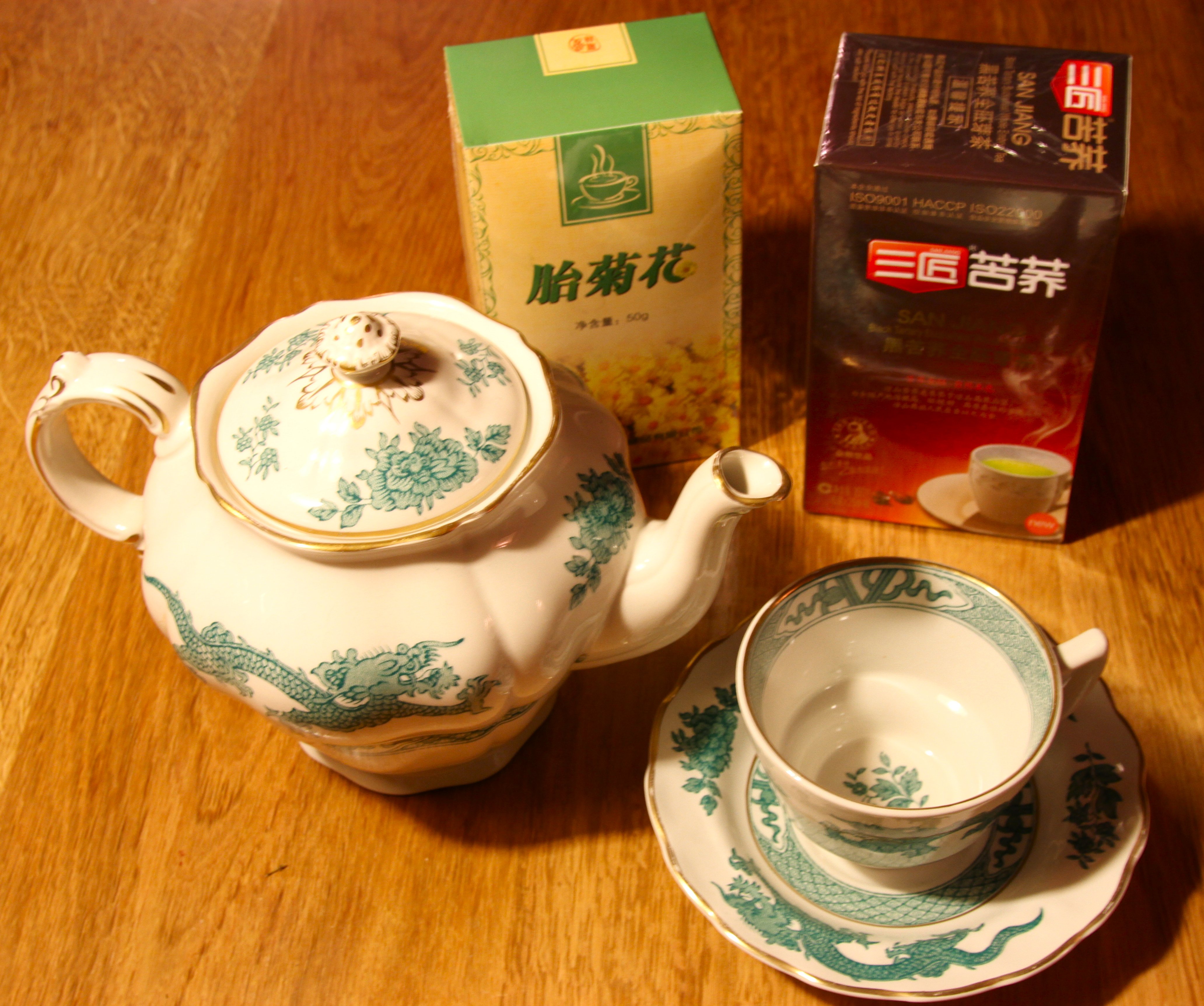
China tea at home…
All text and photographs on this website © Christina James
2014, starting at the pace of a skeleton bob…
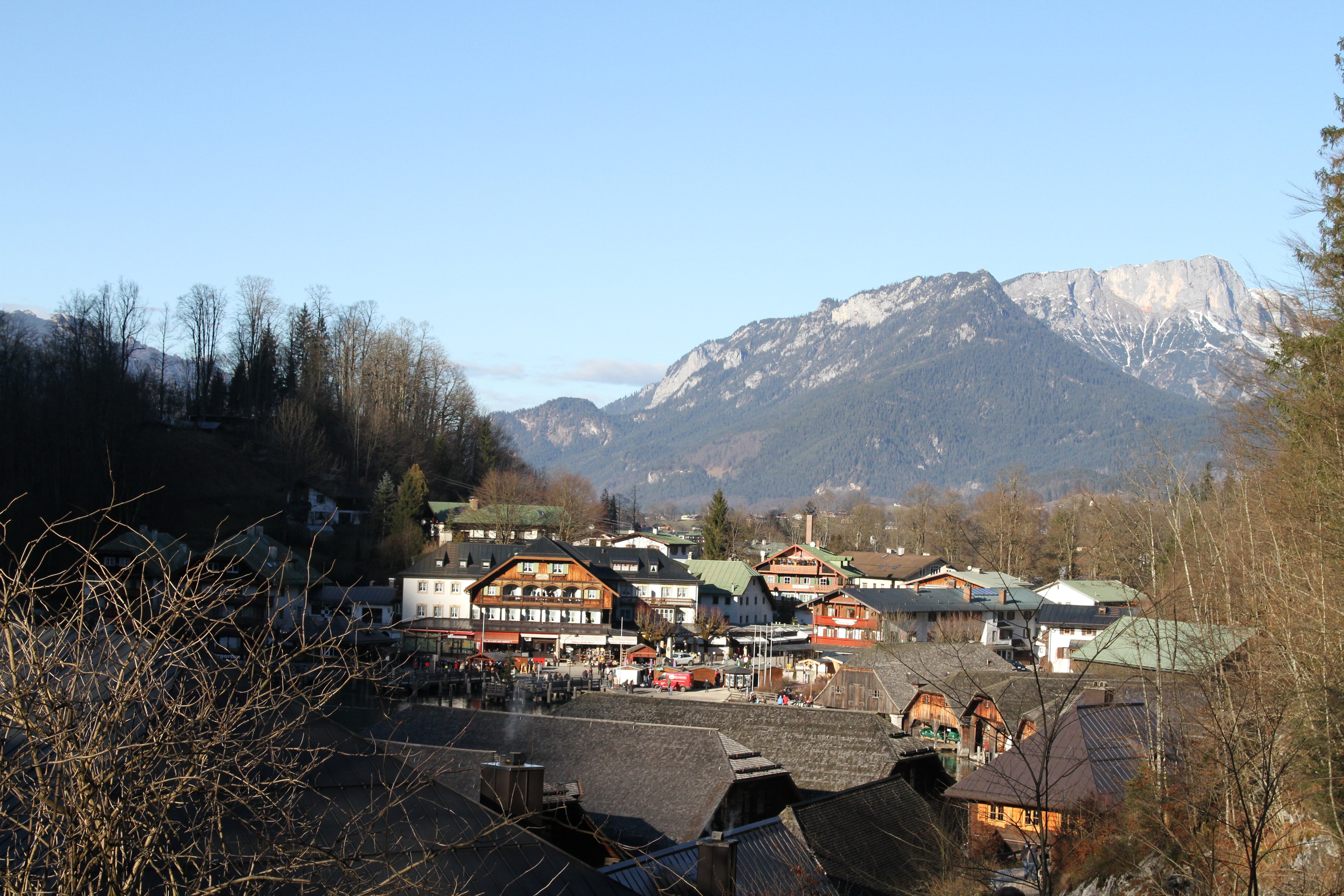
Schönau am Königsee
New Year’s Day 2014 was one of the most varied and interesting I have ever experienced. It began with breakfast in Bad Reichenhall, a small Bavarian town that nestles among the mountains on the Austrian border, on a cold but sunlit morning. My friends and I then drove to Schönau am Königsee, a traditional Alpine town just south of Berchtesgaden that has become a winter sports resort, and took a small circular walk around part of the Königssee, a lake etched so deep into the landscape that it looks like a Norwegian fjord; it’s Germany’s third deepest and well known for the echo created by its rocky walls. There is a church on the other side of this lake, but the sun was shining so brightly, with its light reflected so brilliantly on the surface of the water, that it was impossible to see through the glare.

Königssee in winter sunshine
Towards the end of the circular walk is a ski slope which is in constant use, thanks to snow machines. (Somewhat bizarrely, there is a hen-run to one side of it, complete with a wooden chicken coop on wheels and several brightly-plumaged hens.) Unable to ski myself, I marvelled at the grace and speed with which the skiers descended. There were some snowboarders, too: mostly children, who were tackling the challenge of the swift descent with extraordinary confidence and fluidity of movement.

Enjoying winter at Schönau am Königsee
The town itself is a bit of a tourist trap (I’m not sure what kind of Alpine souvenir a fluffy pink teddy bear represents), complete with live ever-so-genuine-Bavarian volksmusic, but by climbing beyond the car park and the town we swiftly reached the Olympic-standard permanent sled run.

Welcome to bobsleigh!
The World Cup 2013-14 season for both skeleton and bobsleigh ends here on January 26th 2014, and by chance and great good fortune we were able to watch several of the national teams practising solo skeleton, which is an even hairier version of bobsleighing: the competitor lies face up, feet first, on a small sledge as it zooms down the ice track. His entire journey takes less than a minute.
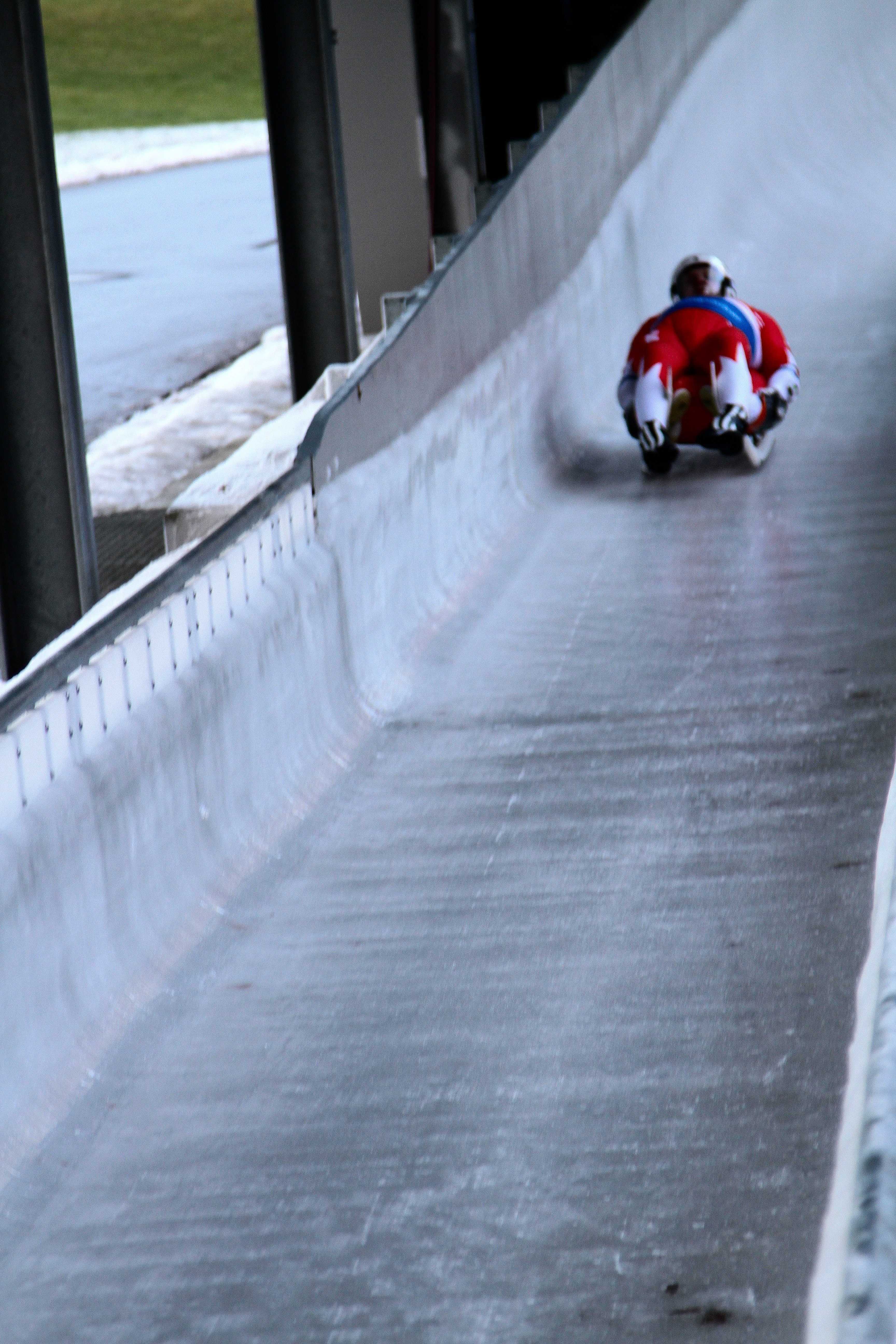
Solo skeleton bob – phew!
One rider came to grief as he passed us and skithered on his side to the final bend, where he came to an ignominious halt and clambered in ungainly fashion over the barrier, clutching his sledge. He was embarrassed and annoyed, but otherwise unharmed.

Boathouses at Königssee
By this time, it was getting dark, but we were keen to complete our excursion by making a short detour to the site of the Berghof, Hitler’s Alpine home and headquarters. Beyond this lies the Eagle’s Nest, the bolt-hole to which he planned to withdraw in the event of a defeat while he was in residence at the Berghof. Of course, he was in his Berlin bunker when the Allies finally closed in on him, but I was interested to be informed that, although the Berghof was first bombed by the RAF and then torched by the SS troops just before their departure, the Allies decided to leave the Eagle’s Nest itself intact. It still stands to this day, as a café-restaurant, though cannot be reached in the winter.
The Berghof itself has been reinvented as a ‘documentation centre’. It is also now a small tourist attraction, with some access to the bunker system, together with a car park, a restaurant and a shop. The ascent to it from Berchtesgaden is steep, and the road precarious: there is no barrier for much of the way and the drops below the bends are lethal. I imagined the people of Berchtesgaden and the Obersalzberg area going about their business over seventy years ago, prevented by a closely-patrolled security cordon from their earlier nineteen-thirties jaunts up the mountain to catch sight of Hitler, only vaguely aware that something ‘important’ was going on above them when Hitler’s soldier aides descended upon the town to buy supplies.
Unfortunately, the document centre was closed on New Year’s Day, so we were unable to view the grim records of the Third Reich that it houses. It may have been because of this, or perhaps owing to the beauty and almost sacred tranquillity of the place – which, save for that one short period of depraved activity, has obtained almost since the dawn of mankind – that I could gather no real sense of the evil that once lurked there. It is true that there are clues for those who care to look for them: for example, the distinctive archways that now form the windows of the shop were once part of Hitler’s garage complex, as the footage from old films, shown on a constant ‘newsreel’ in one of those windows, illustrates, but I experienced none of the deathly despair and outrage that visits to other wartime sites have prompted in me. I suppose that that in itself is a triumph: a sign that the bedrock of primeval goodness in this place has triumphed over the temporary evil that it once harboured and then cast out.
Happy New Year, everyone!
All text and photographs on this website © Christina James
Salt and I inextricably linked, even on holiday…

Salzach River, Salzburg
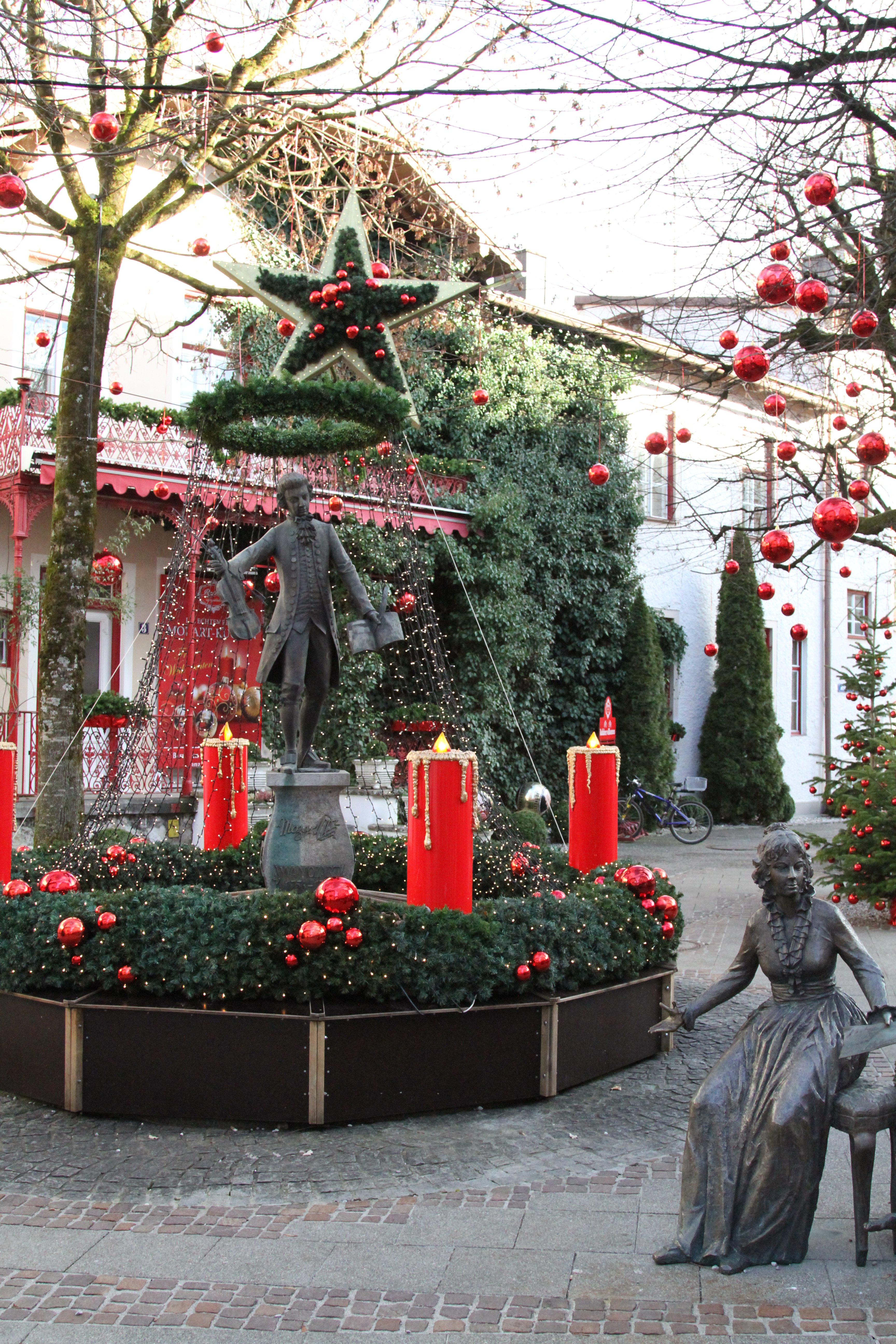
Chocolatiers’ Mozart Christmas grotto, Bad Reichenhall

Salzburg skyline in December
Salzburg is a breathtakingly beautiful city that seems to exist mainly to ensure the immortality of one man: the child prodigy composer Wolfgang Amadeus Mozart. There are Mozart cafés, Mozart restaurants and Mozart museums – and even tourist gift shops where you can buy Mozart rubber ducks and flying birds with Mozart’s face, all wearing powdered wigs. There is a spectacular concert hall where the programme includes the work of many composers, foremost among whom is – Mozart. There are Mozart chocolates, made by two rival companies: the original chocolatiers, whose business is very small and still confined mainly to the Salzburg region, and a younger, upstart firm whose aggressive marketing has been so successful that its distinctive round, filled chocolates, individually-wrapped in red foil, can now be purchased in many countries besides Austria. This company has created a Mozart grotto next to its main shop over the border in Bad Reichenhall, which features a statue of the composer, a fountain and bushes hung with winking red lights and huge baubles in its trademark silvery red.
Today, the city’s prosperity depends very much on Mozart tourism, but it was a wealthy place long before the composer’s birth. As its name suggests, its fortune was built on salt. This, of course, resonates with me, because Salt, good fortune and creativity are very much linked in my mental map. There is a famous salt mine close by the city which offers tours to visitors. We decided not to visit, as we have recently been to a similar attraction in Kraków. The Austrian one, apparently, makes a particular attempt to please family parties: its offers include enabling children to dress up as eighteenth-century peasant salt-workers.
The river that runs through the city also takes its name from salt: tolls on the salt-carrying barges created some of its wealth. Walking along the boulder-strewn riverside is a pleasing experience and there are several picturesque bridges, one of which is hung all the way along with lovers’ padlocks.
The Salzburg area has been unseasonably warm between Christmas and the New Year. There is snow here, but only high in the mountains. The local people are amazed at how mild the weather has been. Nevertheless, the people in the streets all wear hats, scarves, boots and quilted jackets or loden coats. Babies in buggies are muffled to the eyebrows. It is possible to stand in the sun and feel real warmth on your face, but as soon as you step into one of the many alleyways or just enter the shadows of the tall terraced buildings, the cold bites. There may be no snow at the moment, but you feel that it is only biding its time. February is the coldest month here: the Austrian mountain winter has really only just begun.
What does Salzburg have to offer in the way of inspiration for a crime fiction writer? On the face of it, this bright, industrious city, peopled with serene residents and laughing holidaymakers, does not seem a promising setting for dark deeds. However, in the alleyway marked ‘Juden Gasse’, with its stolpersteine or brass commemorative cobblestones, we stumble upon some of the darkest deeds that man has ever perpetrated upon man; and, not many kilometres away, lurks the Eagle’s Nest, mountain retreat of one of the world’s most sinister fantasists and almost the most prolific murderer of all time.
 Christina James, crime novelist