

BOOKS ARE MY BAG… and it’s a goody!

BA goody bag
[This is the second of my posts about BOOKS ARE MY BAG. You might like some background to the campaign here.]
I spent yesterday at the Booksellers Association Conference, which was held for the second year running on the campus of Warwick University. It was a wonderfully upbeat occasion and celebrated the many successes of the BOOKS ARE MY BAG campaign (now also known as BAMB), which was launched to the industry at the London Book Fair in April. All the activities that were built on this afterwards culminated in the public launch on 14th September.

Patrick Neale, President of the Booksellers Association
Patrick Neale, current President of the BA (and also proprietor of a wonderful bookshop in Oxfordshire – and also, incidentally, a former colleague of mine) listed some of the many triumphs of 14th September. Here are a few of the key ones:
• The BAMB campaign ‘trended’ on social media.
• Footfall in bookshops increased by 17.4% and sales by 18.5%. Booksellers everywhere said that it ‘felt like Christmas.’
• The most pleasing thing of all was that everyone in the industry – booksellers and publishers alike – realised that this was just the start of celebrating the unique attributes of the physical bookshop.
Dame Gail Rebuck, CEO of Random House, who visited Patrick’s shop on 14th and cut his BAMB cake, said that she loved the sense of energy that the campaign has brought. She said, ‘Of course publishers care about bookshops; they are the lifeblood of our culture.’ She was not the only celebrated person to visit Patrick’s bookshop on that day. First of all, Samantha Cameron came in with her daughter (so the staff decided not to pester her); then the Prime Minister himself followed and the staff, deciding that he was fair game, asked if they could take his photograph. He said that he was in favour of the campaign and obliged (all memories of Jimmy Wales and the ‘free’ information in Wikipedia evidently forgotten!).
I shall write more about the conference – which was full of good ideas for authors as well as for publishers and booksellers – and about the campaign. For now, though, I’d just like to share with you the contents of the wonderful goody bag that I received at the end of the day, along with another BOOKS ARE MY BAG bag, which I shall carry with the same pride as its two predecessors, now grubby from a whole summer of being paraded everywhere I’ve been. I’m doubly proud that a postcard about Almost Love was included.
Oh, and in case you’re interested, here’s that photo of the PM outside Patrick’s shop!

Cameron booking a place in history
Happy coincidences and old friends at Bookmark, Spalding…

Fine car; finer bookshop

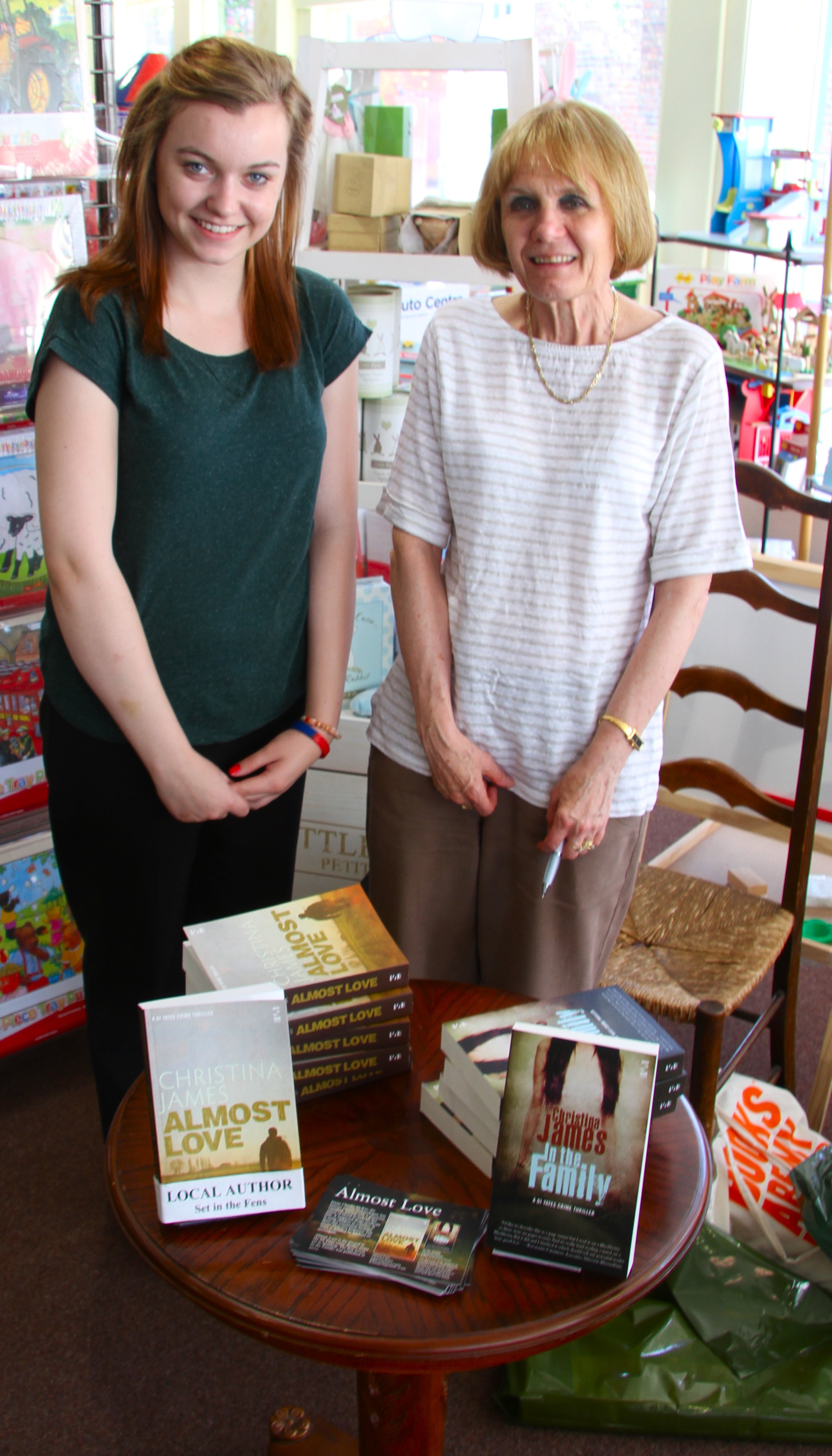
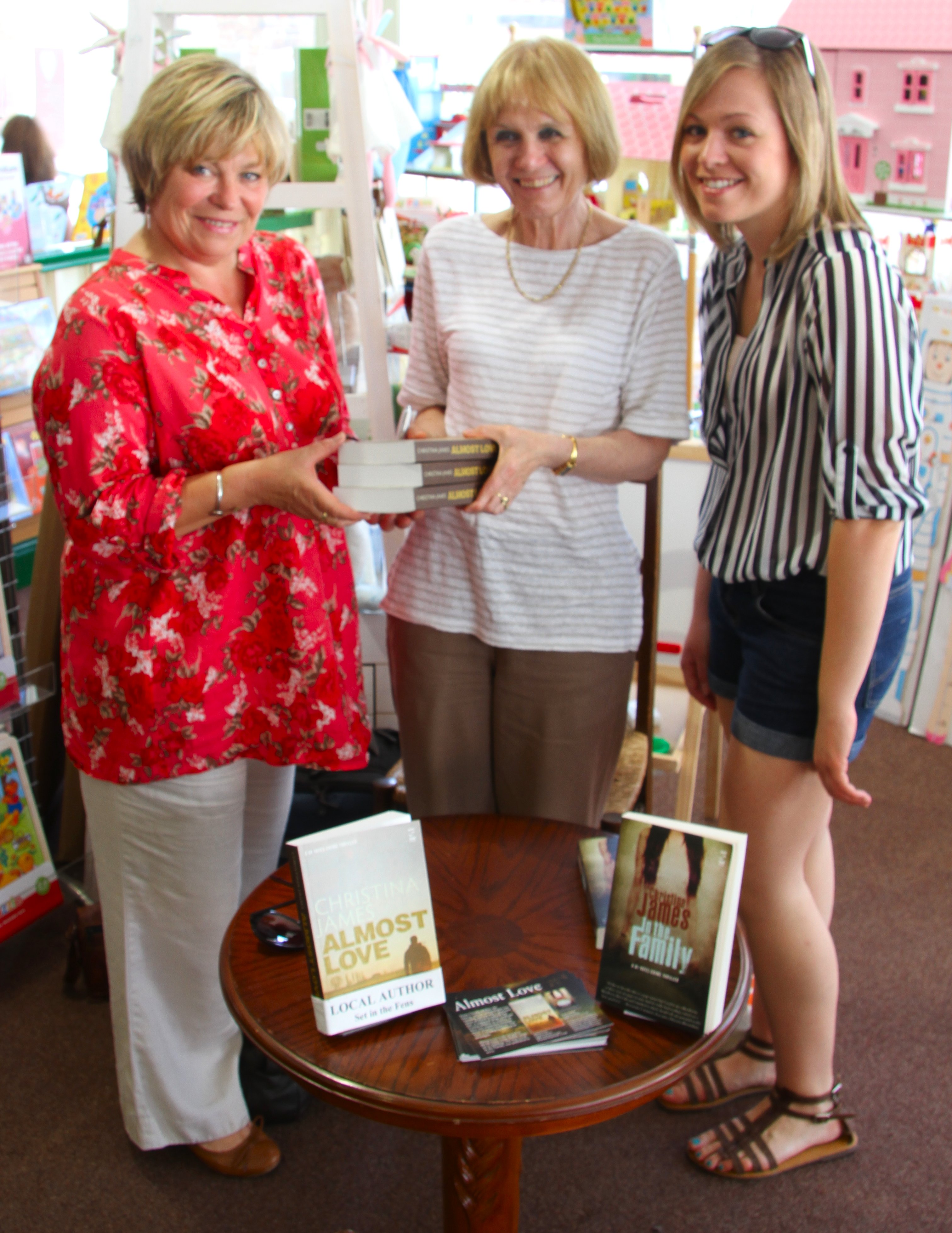


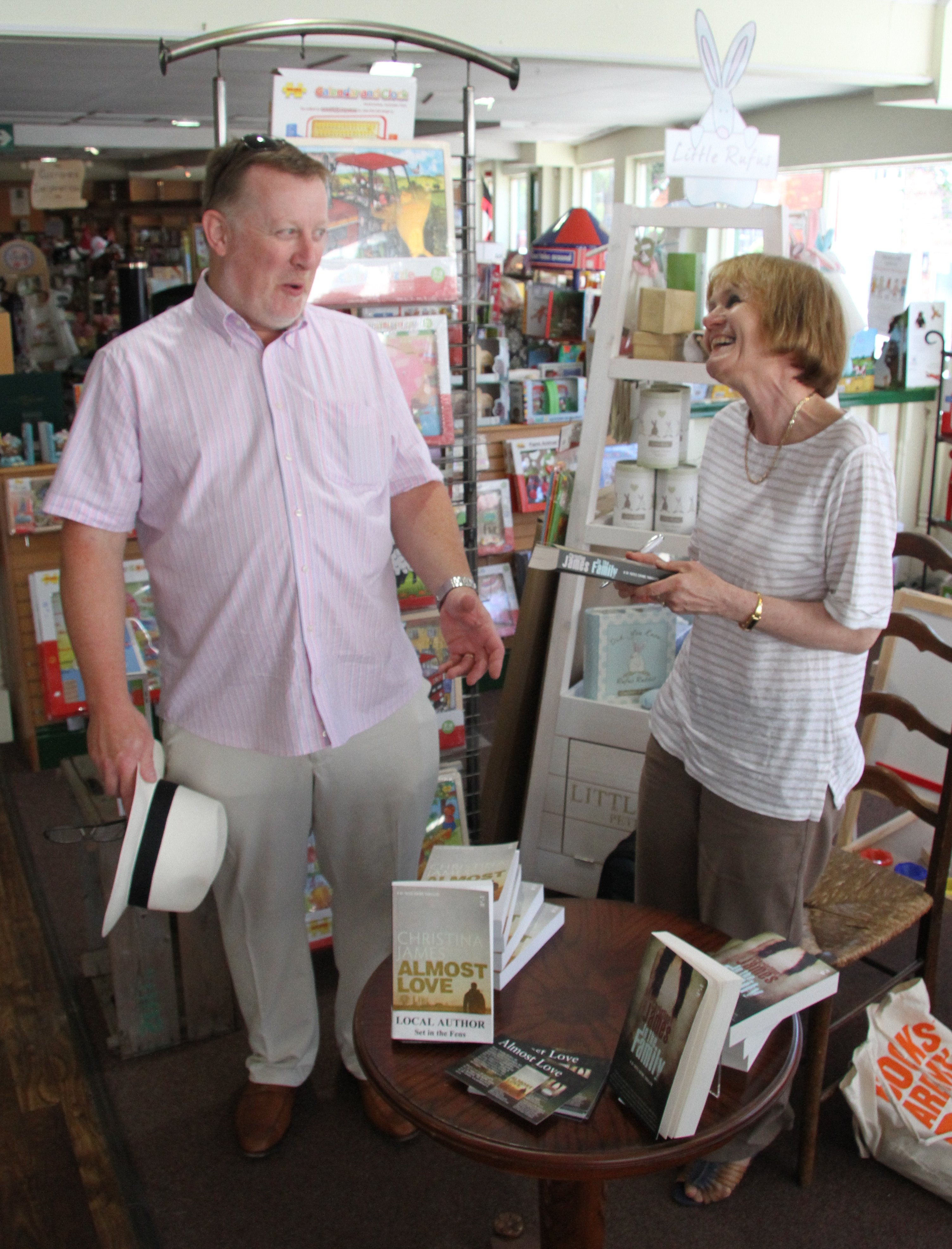


Bookmark’s creative owner, Christine Hanson
Yesterday was one of those perfect days that become legendary in memory. I had travelled to Spalding, having been invited to give a signing session at Bookmark, a very distinguished bookshop which I also visited and wrote about just before Christmas last year.
There was a carnival atmosphere in the town. Christine Hanson, Bookmark’s owner, was feeling particularly happy, because hers and other businesses in Spalding had banded together to offer fun activities to passers-by in one of the yards in the Hole-in-the-Wall passageway. Christine said that it marked a significant step forward in the town’s initiative not only to save the high street but also to ensure that it thrives. She flitted back and forth between the shop and the Hole-in-the-Wall all afternoon and, despite being so busy, still provided my husband and me with her customary wonderful hospitality.
My signing session began with a remarkable and totally unexpected coincidence. Two ladies who had been paying for books at the till came over to speak to me. Noticing their accents, I asked if they were American. One of them said that she’d been born in Spalding, but had lived in America for twenty-five years. She now teaches environmental science at the University of California. Judging her to be about my age, I asked if I knew her. She said that her name was Carol Shennan. I knew the name immediately; she had lived about five doors away from me in Chestnut Avenue when we were both growing up. She said that her mother, who is eighty-nine, still lives in Spalding, and that she was just there for the week to visit her. It was an unbelievable stroke of luck that we should meet in Bookmark. Carol bought In the Family, and I look forward very much to receiving a future contribution to this blog from her when she’s read it.
Several babies came into the shop. I was introduced to Oliver, who arrived with his grandmother and aunt, who each kindly bought both books, and Harry, who came with his grandparents. His grandfather (I’m sorry that I can’t remember his name: his wife’s name is Carole) is a keen local historian and said that he doubted that my novels would cover villages as remote as Sutterton, which is where he was born and still lives. By another strange quirk of coincidence, I was able to tell him that my third novel, which I’ve just started writing, is set in Sutterton. I hope that Harry’s grandparents also will contribute to the blog when they’ve read the copy of In the Family that they bought.
My very dear old friend Mandy came in and bought an armful of books to give other friends as presents, just as she did at Christmas. At the end of the afternoon, she returned to guide us to her house, where we spent an idyllic evening eating supper and drinking wine in her garden with her husband Marc and her friends Anthony and Marcus. We ate new potatoes, broad beans and strawberries from her allotment and talked about books, teaching and cooking (Marcus is a chef). Afterwards, we drove home through the twilight. The fields of South Lincolnshire were looking at their best: the corn was just turning, and in one place acres of linseed coloured the landscape blue-mauve. The skies were as big and beautiful as always.
An idyllic day, as I said. I’d especially like to thank Sam at Bookmark for arranging the signing session, and Christine, Sally and Shelby for looking after me so well and for providing a great welcome: I heartily recommend the café at Bookmark, if you’re ever in the area. Many thanks also to the many people who stopped to speak to me – the conversations were fascinating – and for buying the books. And thank you, Mandy and Marc, for being amazing hosts and for introducing us to Anthony and Marcus, who provided me with their suggestion for DI Yates 4!
Copyright

I’ve been in London for three days, at two conferences that have each dealt, inter alia, with copyright. I’m going to write more about copyright at intervals over the next two weeks, as it has reached a crossroads in its history. I think it vital that all writers understand what is going on and, if they wish, contribute to the debate.
Today’s post is not about opinion, however. It reports a presentation given by Ben White, Head of Intellectual Property at the British Library, last Monday afternoon at the JISC Conference on Open Access for Books. Ben was asked to summarise copyright law as it stands at the moment. Despite the fact that it is a complex subject, his talk was wonderfully succinct and clear. I’ve arranged my report in bullet-points, in an attempt to offer a step-by-step account.
• Copyright sits with the author, unless s/he is an employee (in the sense of having been paid by the publisher, for example to edit a collection of poems and contribute a preface). It is automatic and lasts for life plus seventy years.
• Since 1988, the author has also been able to assert her/his ‘Moral Right’ to be identified as author. As well as being acknowledged as the copyright-holder, this entitles the author not to be misattributed in works that quote or are about her/his work; to object to ‘derogatory treatment’ of his or her work (though what actually constitutes this is necessarily subjective); and, under UK copyright law, to ‘lend, sell, give and waive’ copyright, just as if the work were a physical possession. European jurisdictions take a slightly different approach.
• Exclusive rights would mean that the author had sole control over her/his work – that s/he would exercise de facto monopoly. In fact, few jurisdictions give the author absolute control; most allow ‘exemptions’. In the educational sphere, in particular, these are very important; they allow a specified amount of copying by schools, etc. Publishers have been criticised for interpreting what is meant by exemption too narrowly. Scholars, teachers and others have asserted that when they want to use excerpts from the works of authors for purposes of criticism, review, etc., publishers have been too restrictive in what they will allow.
• One result of the technological innovation made possible by new media is that copyright holders have become more sensitive about defending their rights.
• Copyright can be ‘simple, complex and structured however you want.’ A survey carried out by the Association of Learned, Professional and Society Publishers [ALPSP] in 2008 found that 26% of the publishers who took part no longer required authors to transfer their copyright to the publisher (the remaining 74% still enforced this requirement).
• Copyright can be assigned. This keeps it simple for the publisher.
• Moral rights cannot be assigned, but they can be waived and may or may not have been asserted by the publisher. They can also be asserted for a limited period of time – e.g. for one edition or one printing of the book.
• Creative Commons Licences have been devised in order to allow authors to make their work available free of charge if they wish. Usually, but not always, this means making the work available ‘free’ digitally. Academics may have been directed by their institution to place works created in ‘working hours’ in the institution’s digital repository.
• By making a work available free, the author is not relinquishing her/his rights. Copyright still applies for the standard duration (author’s lifetime plus seventy years); the author can still assert his or her moral right and require that the work is attributed to her/him; limitations and exceptions still apply; and the author can specify that the work is only available free for non-commercial use; anyone who wishes to use a published work in order to develop a business proposition can still be asked to pay for it. This sometimes introduces a complex tiered system of charging that can be confusing and is open to misinterpretation.
I hope that this is useful, and look forward perhaps to engaging with you in a debate on copyright issues over the next few weeks.
Crime Fiction Month and National Group Reading Day in Wakefield, West Yorkshire
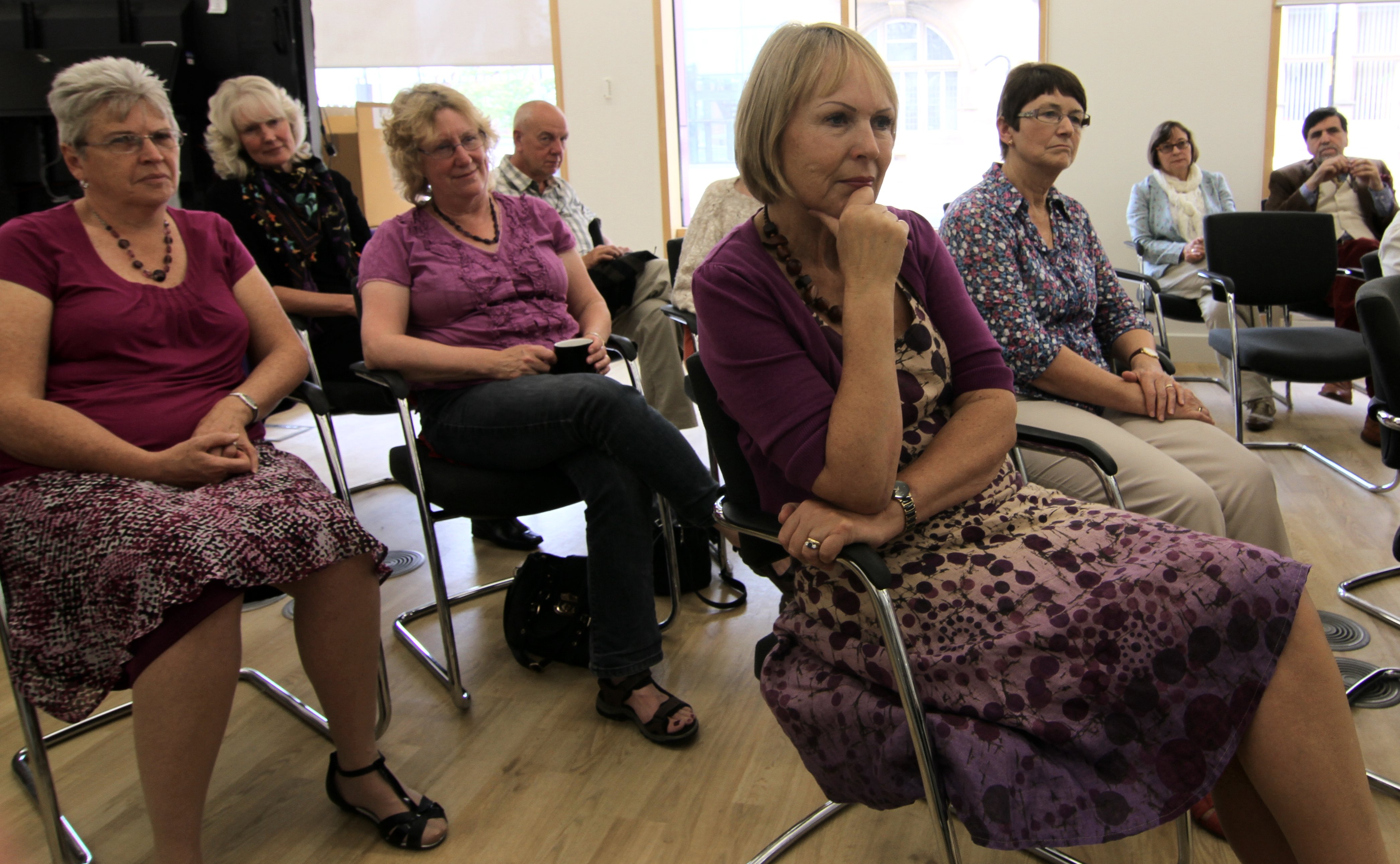
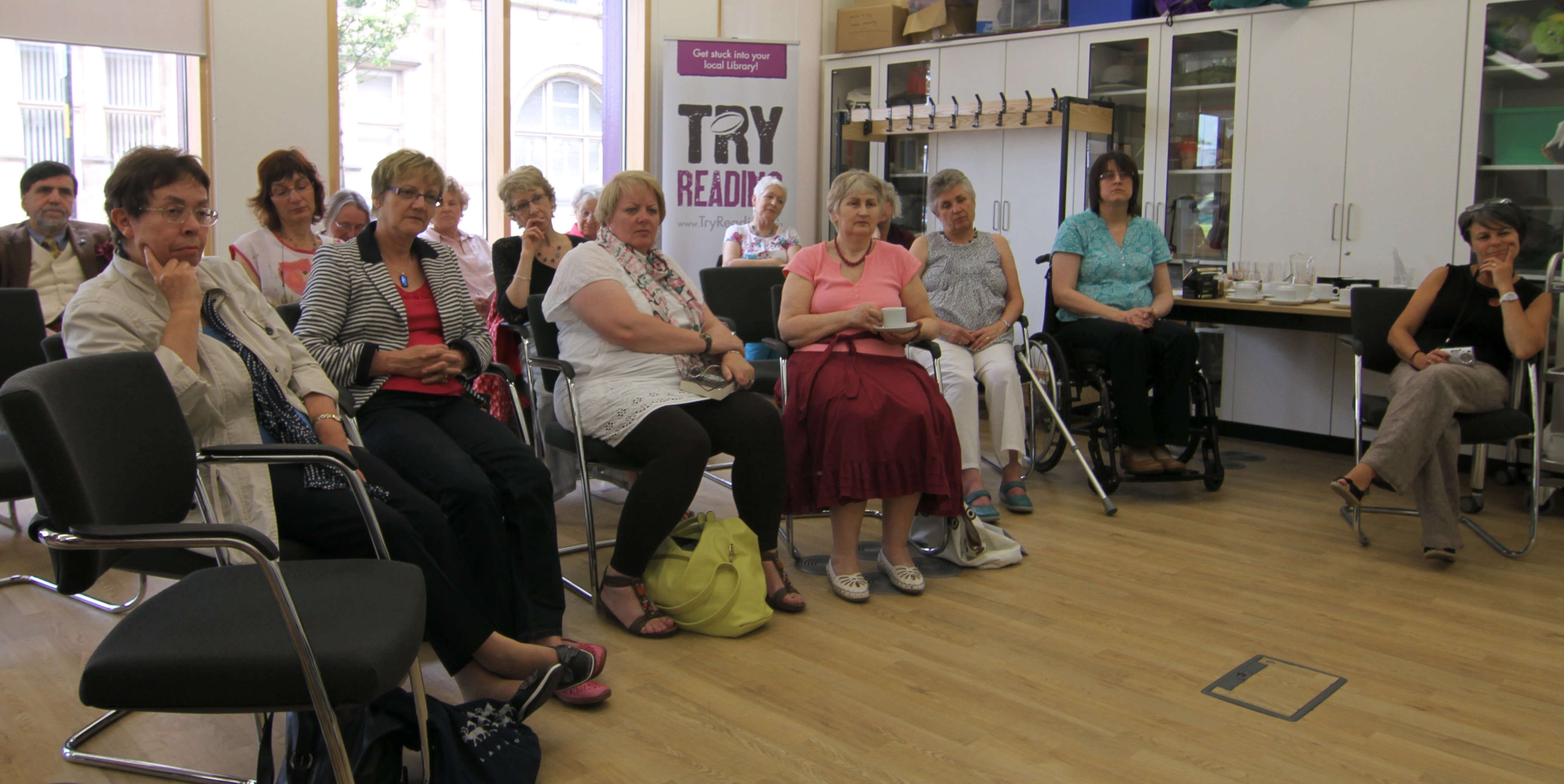
Wakefield Library audience listening to
a reading from ‘In the Family’
I was very privileged yesterday to have been invited to the event arranged by Wakefield Library Service as a joint celebration of National Reading Group Day and Crime Fiction Month. It was organised by Alison Cassels, Library Officer for Reading at Wakefield, and lasted almost the whole day. It was held at Wakefield One, the wonderful new library and museum complex which was opened last November by Jarvis Cocker. The day’s activities were built around the interests of Wakefield Libraries’ eighteen reading groups. When they are in everyday mode, the reading groups choose books that they wish to read from a selection provided; the library service then buys sets of these and distributes them. In itself, this must constitute an impressive feat of complex organisation and canny budget allocation.
About twenty members from various Wakefield reading groups attended. The morning began with refreshments, during which participants were given the opportunity to examine the next round of suggested titles and make their choices. We then split into three groups. Three books were being discussed, Peter May’s The Blackhouse, Wilkie Collins’ The Moonstone and my own In the Family. The facilitators were Alison Cassels’ colleague, Lynn, Julie Walker, Operations and Development Manager for Kirklees Library Service, and myself.
It turned out that so many of the participants had read all three novels that I and my fellow facilitators led consecutive sessions with all three groups. At the end of the morning, Julie chaired a wrap-up session about crime fiction more generally and we discussed our favourite books in the genre. We then broke for lunch. In the afternoon, more people joined the groups to listen to my reading of two short excerpts from In the Family and Almost Love, as part of a session during which we discussed how I write and how I originally managed to get published; the audience put to me more questions (some of them very searching indeed) about my novels. At the close, Richard Knowles of Rickaro Books, in Horbury, sold copies of both books.
I don’t recall having enjoyed an event – whether or not it featured other authors or myself and my own writing – more than I enjoyed yesterday’s. I say this, not from reasons of vanity, but because I have never before had the opportunity to get as close to readers and what they really think. The eloquence and perceptiveness of the reading group members, and the fact that they had spent so much time on really engaging with In the Family, was truly humbling. I took much pleasure in listening to Pauline when she explained why she enjoyed the passages of dialogue – particularly that which takes place during Hedley Atkins’ and Peter Prance’s train journey to Scotland – and how much she identified with Hedley’s frustration when he missed the train to Liverpool, in spite of his sinister intent; and to Jane, for taking the trouble to create a family tree for the Atkins family. Other reading group members quizzed me for more information about Salt Publishing, about the history of Lincolnshire, about how DI Tim Yates will develop in subsequent books and – in true, straightforwardly friendly, Yorkshire fashion – about what I could say to persuade them to buy Almost Love! I said that it does develop Tim’s character further, as they’d hoped, and that it contains quite a lot of history and more of the dialogue that they’d obviously enjoyed.
If any of yesterday’s participants are reading this, I’d like you to know that I think you are amazing. I was grateful beyond words for your generosity in investing so much time, both in the event itself and in reading the books, as well as, of course, for your buying them. I do hope that I shall have the opportunity to meet you again.
I’d like to conclude with a special thank-you to Alison, who provided me with excellent hospitality. Wakefield Library Service is an old friend, with which I first became acquainted in the late 1970s. It has always enjoyed a fine reputation as a distinguished and innovative library authority. From the start, therefore, I knew that yesterday would succeed, but the magic of the day, created by a combination of impeccable organisation by Alison, Lynn and their colleagues and the wonderful enthusiasm of all the participants involved, both from the reading groups and other members of the public, made it truly unforgettable.
Congratulations, Wakefield!

Pauline and I continue our discussion after the event
The flavour of Salt crime fiction…


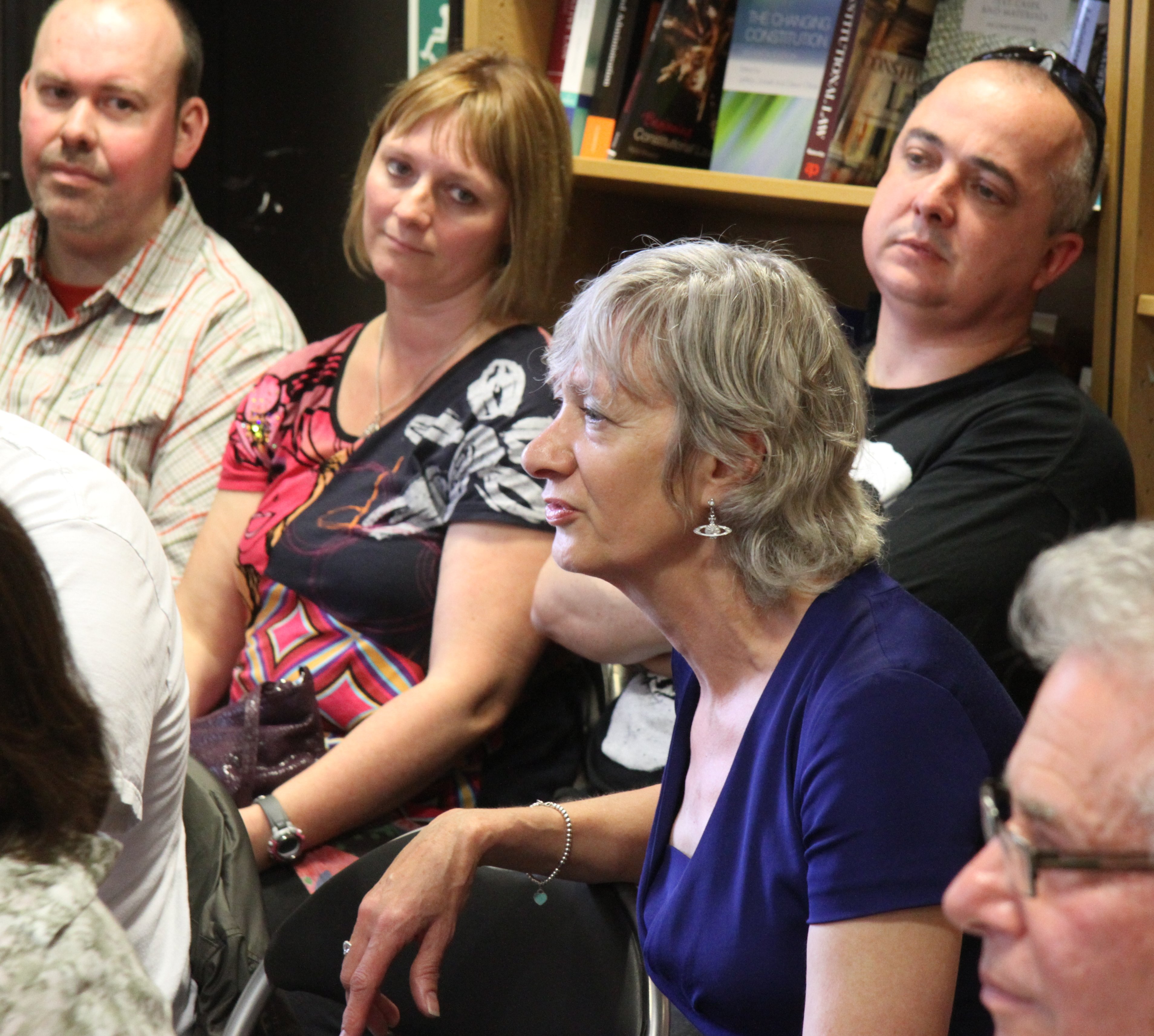
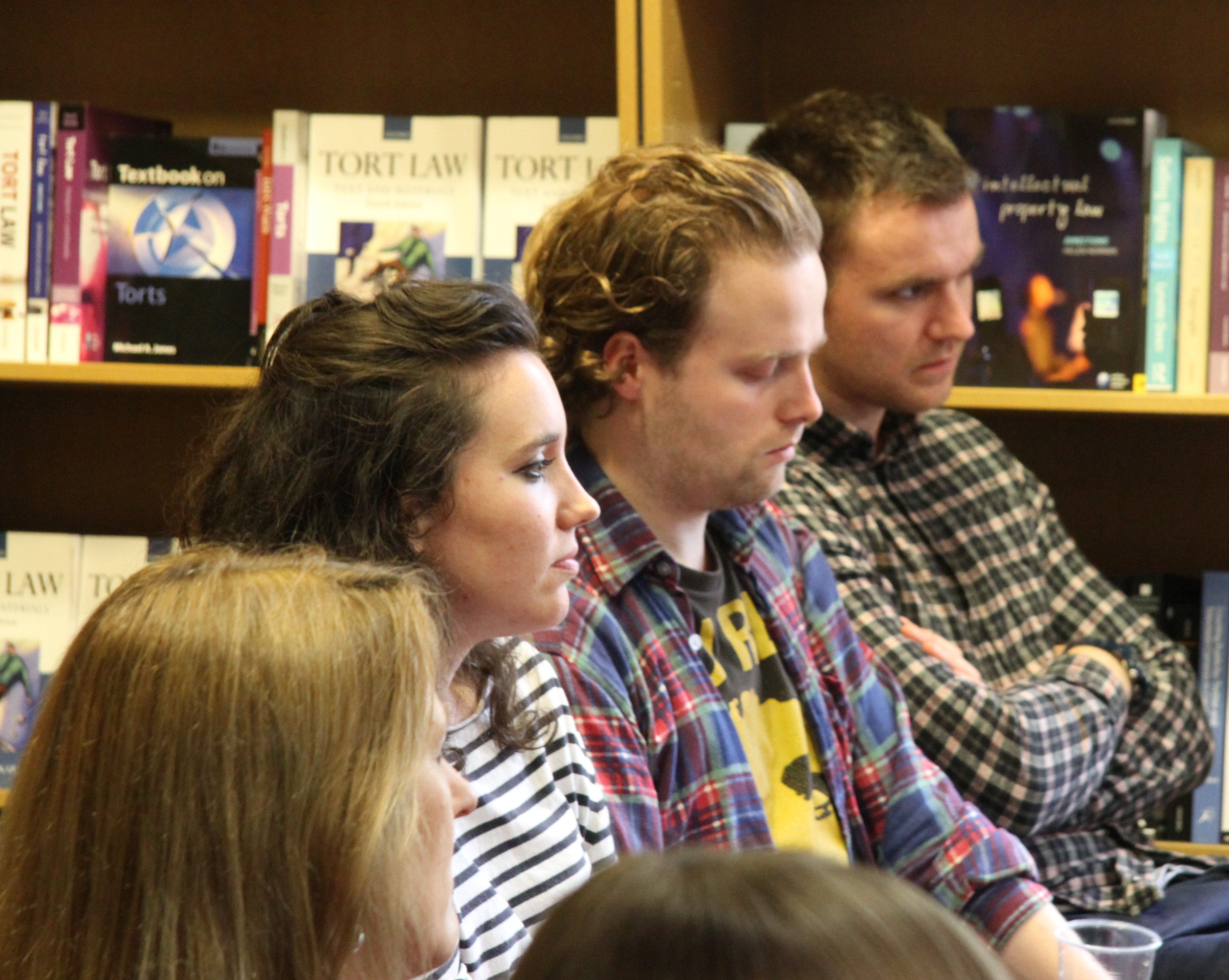
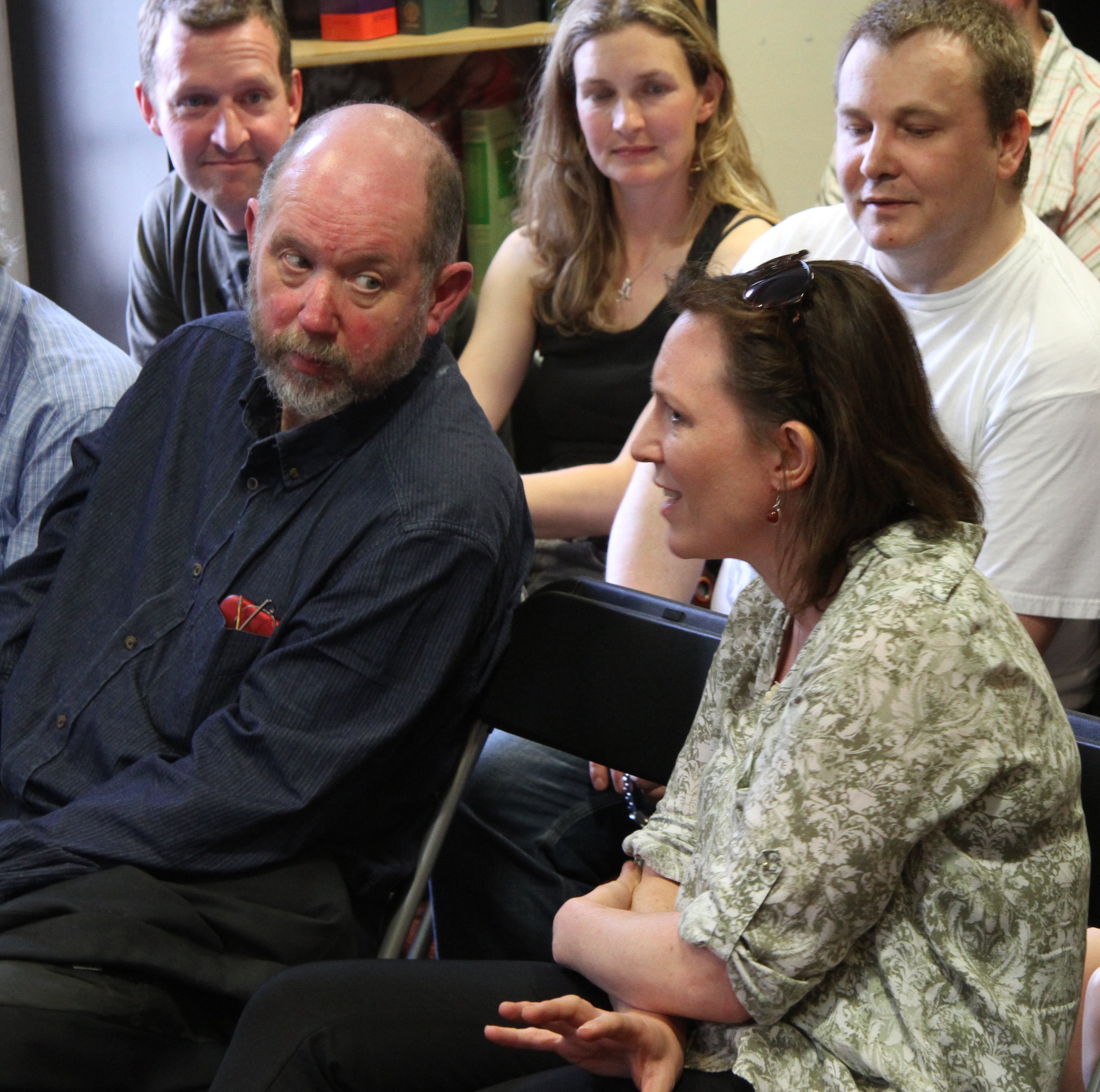


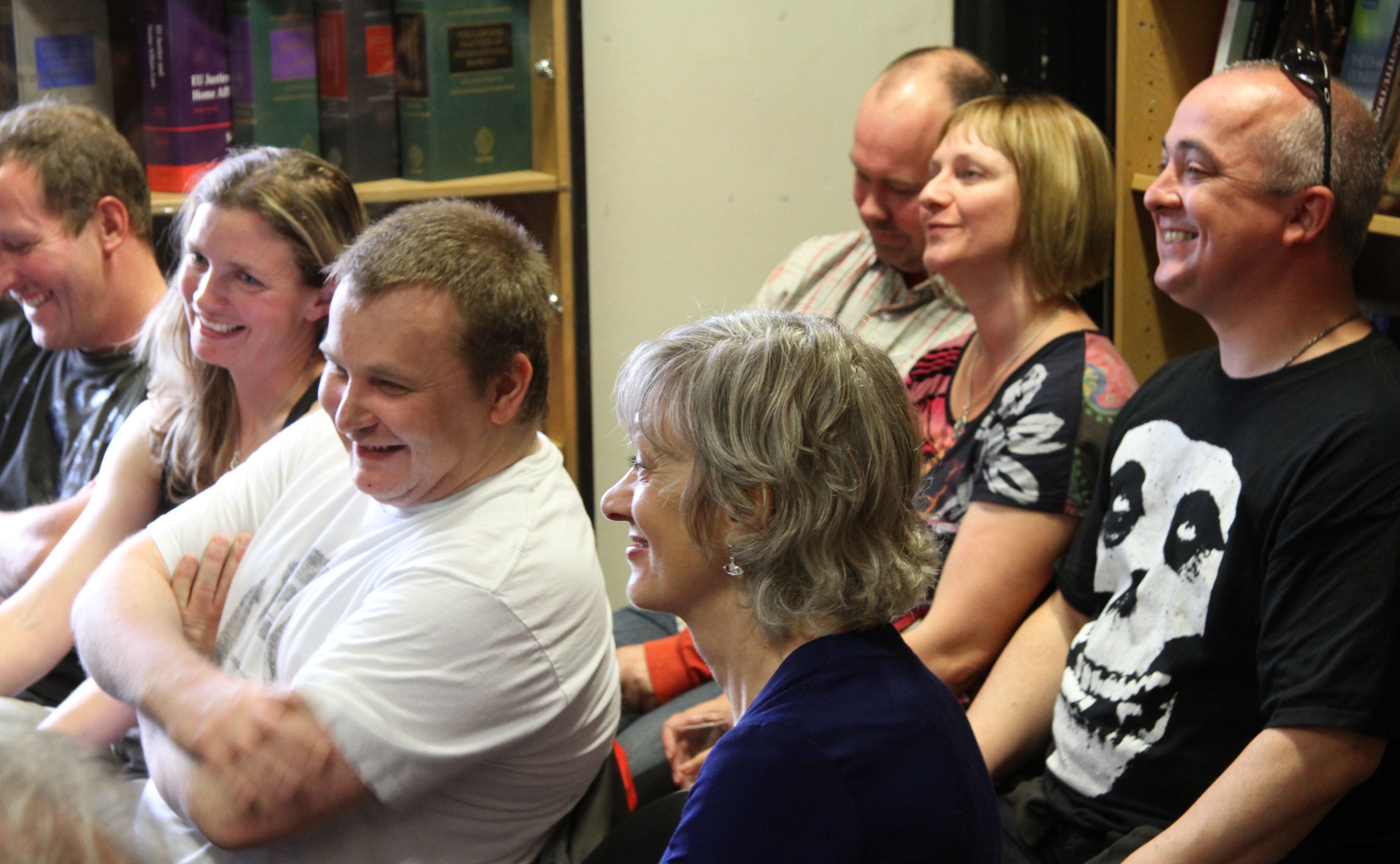

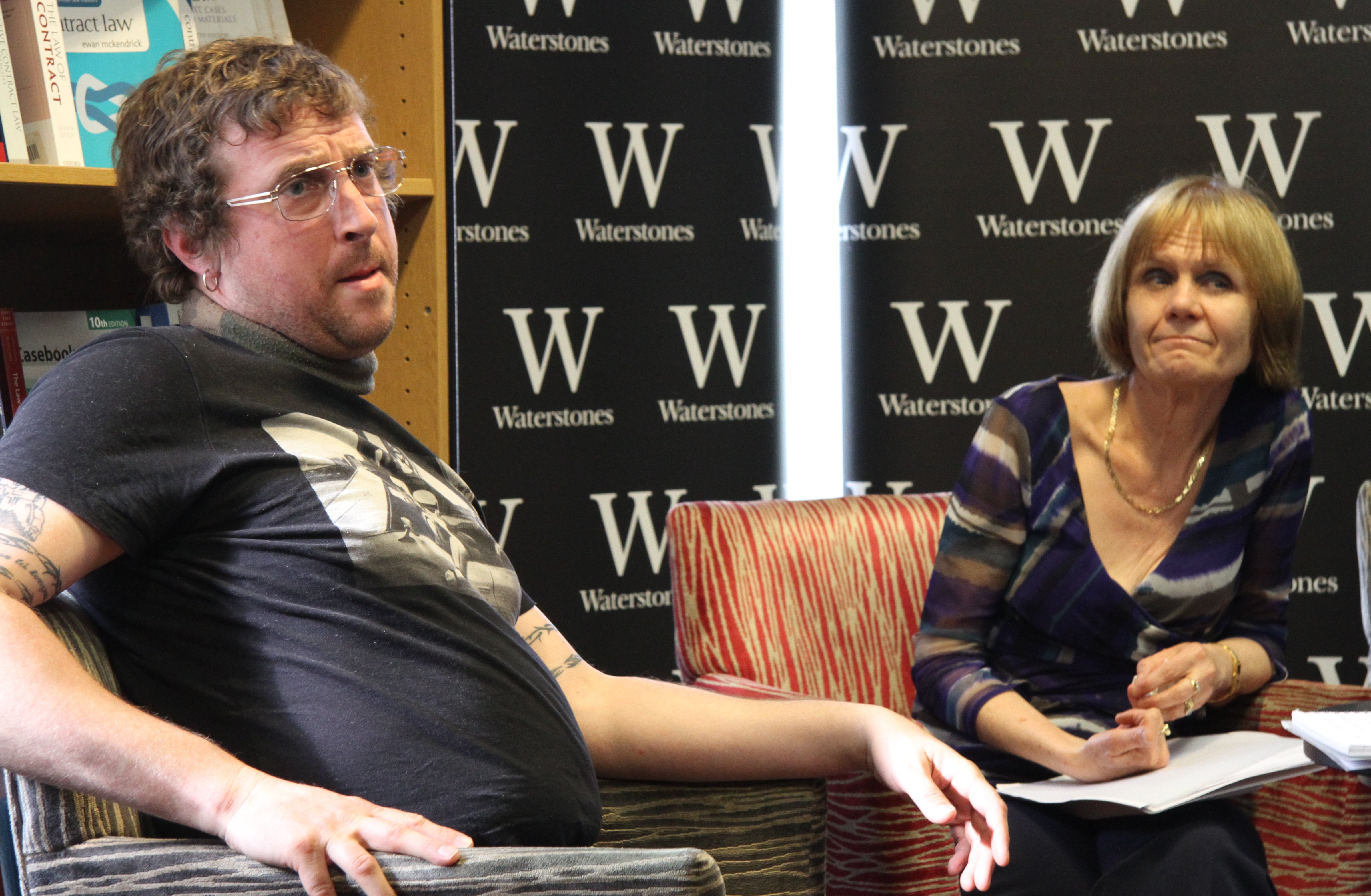


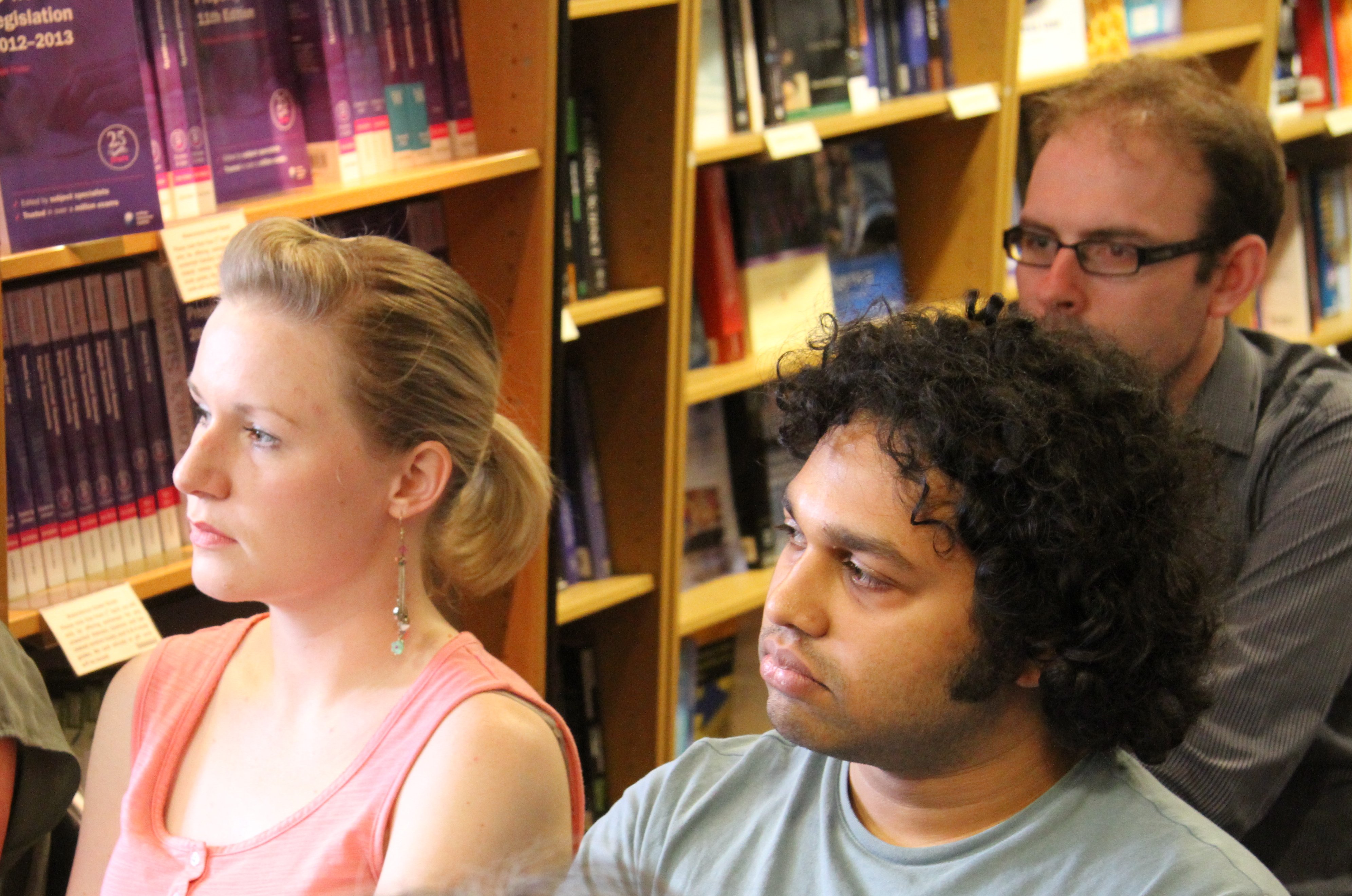


The Salt crime writing event that took place at Waterstones Gower Street yesterday was a very festive occasion. Sam Rahman, the Events Manager at the shop, her colleagues and a large and appreciative audience combined to make it a great success.
Laura Ellen Joyce, Matthew Pritchard and I each gave readings from our books. Laura read from The Museum of Atheism, which (jointly with In the Family) launched the Salt crime list last November. I read from Almost Love and Matthew from Scarecrow, which Salt will publish in September. Afterwards, I chaired a discussion with Laura and Matthew about their writing. The audience joined in, offering many lively and perceptive comments.
Both Matthew and Laura agreed that a sense of place was important to their writing. Laura chose to set her book in small-town America in the dead of winter – there is no daylight in the novel – to epitomise the corruption that it portrays. Matthew writes powerfully about Andalucia, which he knows well, having lived and worked there for twelve years. Laura agreed with the suggestion that she describes a rudderless society in which no character is able to provide a moral yardstick or compass. Matthew said that the corruption captured in his work derives more directly from his knowledge of shady Spanish officialdom. Danny Sanchez, the protagonist of Scarecrow, is a journalist who bravely tries to expose the fraudulence and self-interest upon which he sees that Spanish politics is based.
Laura had deliberately left vague the identity of the killer in her book, because, in a sense, she was indicating that society as a whole was to blame. Matthew had had the intention right from the start to write about a serial killer, but the character of the killer took shape in his mind gradually as he worked on the book and continued to read about real-life murders. An account of how the head of one of Fred and Rosemary West’s victims had been swathed in gaffer tape had left a particularly lasting impression on his imagination.
There was much laughter from the audience at Matthew’s anecdote about how, when the shop below his flat caught fire recently, the police broke into the flat and discovered his large collection of books about serial killers and Nazism scattered over the floor. There was even more laughter when I persistently made the mistake of calling him ‘Danny’, after his hero, rather than Matthew! (Apparently, it is a mistake that his agent makes, too!)
Laura confirmed that she will continue to write crime because she has a profound interest in why people commit evil or anti-social acts. She’s also interested in pushing out the boundaries of fiction. When, in response to a question from one of the audience about what I thought the ‘next big thing’ in crime writing would be, I said that I’ve seen several books lately that mix genres and I’m not sure that it works, Laura said that this idea appealed to her and that she would like to experiment with it. I do think that it would take a very good writer to pull it off, but Laura is so accomplished that she is one of the few people I know who might succeed at it.
I was asked why most crime novels are about murder, rather than other types of crime, such as theft or fraud. I said that there are some novels based on theft – there is quite a strong sub-genre relating to crimes associated with works of fine art, for example – but it is difficult to write about crimes other than murder unless you are a police procedural author. This sub-genre has never appealed to me; I’m more interested in the psychological aspect of crime-writing.
We were all asked whether we’d come to writing ‘lately’, or whether we’ve always been writers. We agreed that we’ve all been writing ever since we can remember. Asked also whether we had to let a novel ‘fade’ from our imaginations after we’d finished it before we could embark upon another, we each offered different responses: Matthew writes all the time and is usually working on several books at once – he knocks out 2,000 words a day, even if sometimes he knows it is rubbish and he will have to discard some of it; Laura writes regularly, but in different genres – she writes short stories between novels and also said that she was very organised when writing The Museum of Atheism which, with a detailed outline on a spreadsheet, she wrote in twenty-four days, a chapter a day, all in November, following the NaNoWriMo concept; I usually take a brief break after completing a novel, but I’ve started on the next DI Yates book now. I feel that being an author is a bit like being a member of the fashion industry: your mind is already on the next season’s work while your readers are still consuming this season’s product.
We all paid tribute to Salt Publishing, which we agreed is an uncompromising publisher setting high standards. We were also united in saying that we aren’t interested in the ‘blood-and-guts’ style of crime writing.
On behalf of the three of us, I’d like to thank Sam and the staff at Gower Street for their wonderful hospitality. I’d especially like to thank all of you who attended for being such a generous and receptive audience, for making such constructive contributions to the discussion and, of course, for buying or ordering our books! It was good to meet some new friends – some of whom I’ve only previously ‘met’ through Twitter. Finally, a big thank-you to numerous well-wishers who were unable to come (some of you based in countries very far away), but who sent kind and encouraging messages and helped to advertise the occasion. We hope to meet you all one day at future events.
All in all, it was a very memorable evening indeed!
A very old bookselling friend revisited…

Richard Knowles and Christina James at Rickaro Books, Horbury
I went to Wakefield One last Friday, in order to discuss the details of the programme for 29th June with Alison Cassels, the librarian who’s in charge of events there. It’s a truly spectacular new library and events centre and well worth a visit if you’re in the area. It’s heart-warming to think that in these days of austerity and cutbacks there is still investment being made in such buildings, so important for promoting reading and holding local communities together.
During the course of our conversation, Alison mentioned that she’d ordered copies of both my books for the event. The library has itself bought copies of In the Family for its reading group (a very generous action which I applaud!) and has also ordered copies of it and Almost Love for those attending the session to purchase if they want to. I asked Alison who was supplying them and she said it was Rickaro Books of Horbury. It’s a bookshop that I’ve long been meaning to visit, because its proprietor is Richard Knowles, who many moons ago was my first boss. I e-mailed Richard to ask him if I could drop in with some Christina James postcards and he got back to me immediately. We agreed that I would call yesterday.
It seems particularly fitting that my visit should have taken place this week, which marks the thirty-fifth anniversary of my appointment to the library supply company in Normanton where my bookselling career started. Richard, then the manager, had many idiosyncratic interests which married well with bookselling: he was an authority on mediaeval armour and effigies and both wrote about and collected books on them. He liked antiquarian and private press books and had a fine collection of these, and read everything that he could lay his hands on about or by T.E. Lawrence. He was also fond of the poetry of Edward Thomas. Other interests included motor-bikes and collie dogs. He had a small child’s aversion to vegetables and liked nothing better than a currant bun filled with cheese for lunch, bought from the bakery on the corner. Main courses he could take or leave, but he loved puddings and chocolate. I once walked nine miles to work through snow drifts after the bus failed to materialise; he must have been impressed, because he gave me the chocolate bar he had earmarked for his elevenses!
I last saw him about twenty years ago (at the Scottish Library Association Conference in Peebles), but truly he hasn’t changed very much. A little more ‘distinguished’, perhaps, and now wearing spectacles, but otherwise he could have stepped straight out of 1978.
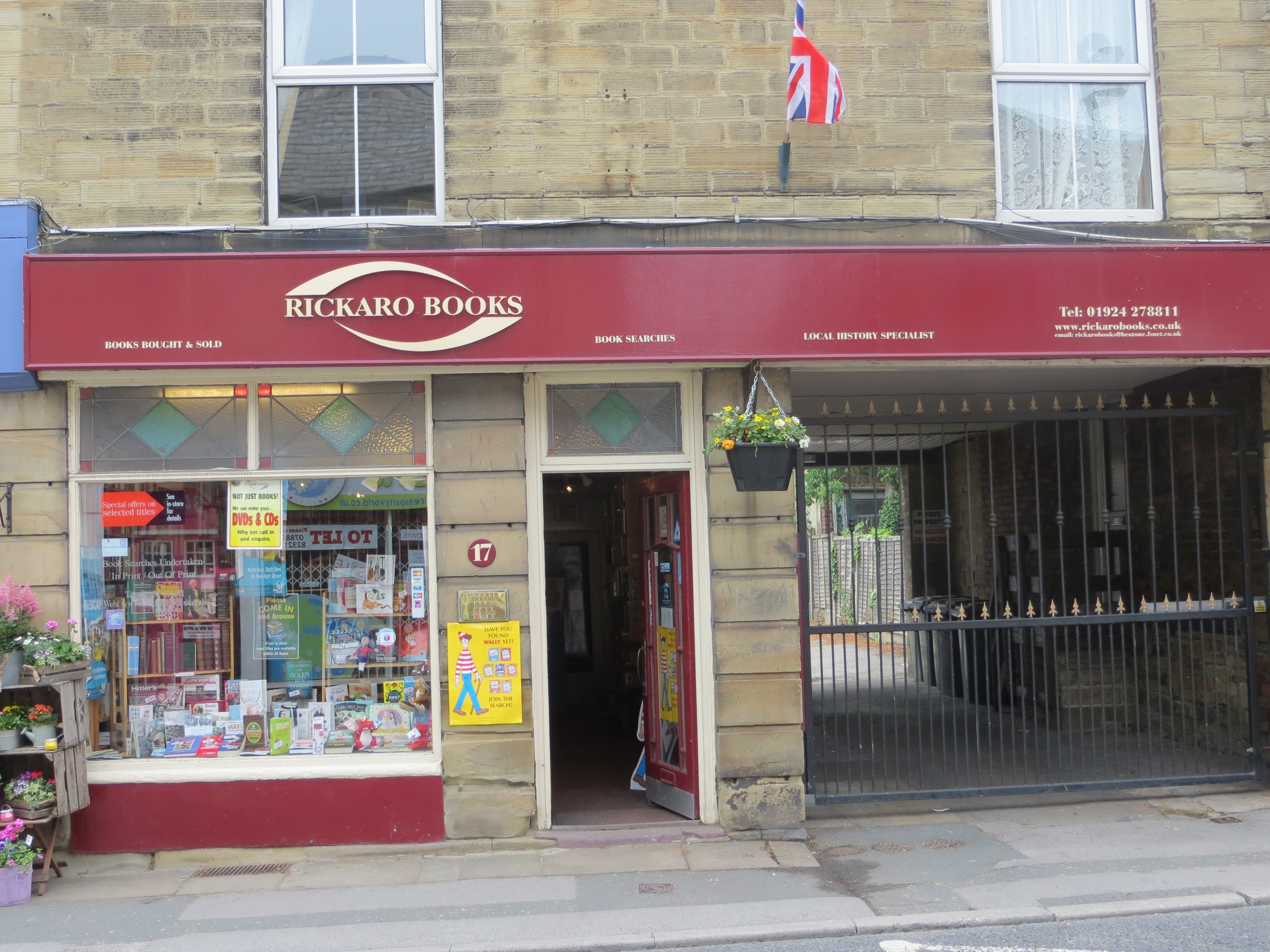
Rickaro Books, Horbury
Rickaro Books is exactly what I had expected: a deep Aladdin’s Cave of intriguing antiquarian and second-hand books, with a smaller but select stockholding of new titles. It even has a resident collie dog – Tilly – who lies under the cash desk. I didn’t ask him whether he comes to work on a motorbike; I suppose that Tilly would make this difficult, but otherwise I wouldn’t be surprised. I note with amusement that there is a baker’s shop just a few doors away and wonder whether its currant buns are up to the mark.
Richard said that he’d set up the shop thirteen years ago. He has a loyal local following and the library business, for special orders of new titles, is important to him. His customers for the antiquarian books are scattered throughout the world. He spends much of his time packing parcels to despatch to them. I didn’t buy any of the antiquarian books, but I did leave with two of Anne Cleeves’ titles, having been encouraged to read her by comments on the social networks.
Rickaro Books is a delightful place and one that I shall certainly visit again. I’ve already threatened to present myself for duty in the run-up to Christmas! It’s encouraging that booksellers like Richard can not only survive, but thrive, by building a business such as this, almost entirely on traditional lines; excellent also that Rickaro’s worth is recognised by the local library service.
Richard says that he and his wife plan to come to the event at Wakefield One on 29th June. I am pleased and touched that they are going to the trouble of rearranging their afternoon. After a gap of twenty years, two meetings in the space of two weeks! Like fine old books, old bookselling friendships mellow with age and perhaps get a little dusty, but they don’t disintegrate.
If anyone reading this would like to attend the event at Wakefield One, it starts at 2 p.m. on Saturday 29th June. I shall be giving readings from both books and talking about how I came to write them, as well as offering tips on how to get published.

Tilly, the bookshop collie
Almost Love: Publication Day
Today is the official publication date of Almost Love. It is almost midsummer and the sun is shining; the cuckoos are still here, though they’ve changed to cuk-cuk mode now (it’s been a particularly good year for cuckoos in Yorkshire this year). It’s a complete contrast to the day on which In the Family was published, when the leaves had fallen, the shooting season was in full swing and we were heading for the winter solstice. November seemed a good time to publish then, because it was still far enough away from Christmas for the book to feature (as I know it did, and am grateful) on some Christmas wish-lists. June also seems a good time, as I’m hoping that at least a few people might want to take Almost Love on holiday with them.
Some authors talk about their books as if they’re babies. This particular baby, although it’s been born today, is still in the incubator. The books were delivered to Salt and its distributor yesterday, but have yet to be despatched to the shops; this will happen on Monday. Yet I’m not impatient or disappointed that I don’t yet have a copy in my hand; on the contrary, I’m profoundly grateful to both Chris and Jen at Salt and to TJ International Printers of Padstow for pulling out the stops so quickly after MPG Printers went into receivership just as Almost Love was going through the press. Thanks to their Herculean efforts, the delay has been minimal – much slighter than we’d feared. And yesterday’s blog-post attracted so much interest that I feel that it acted as a ‘virtual’ launch. Thank you very much to everyone who read it, spread it or contributed comments.
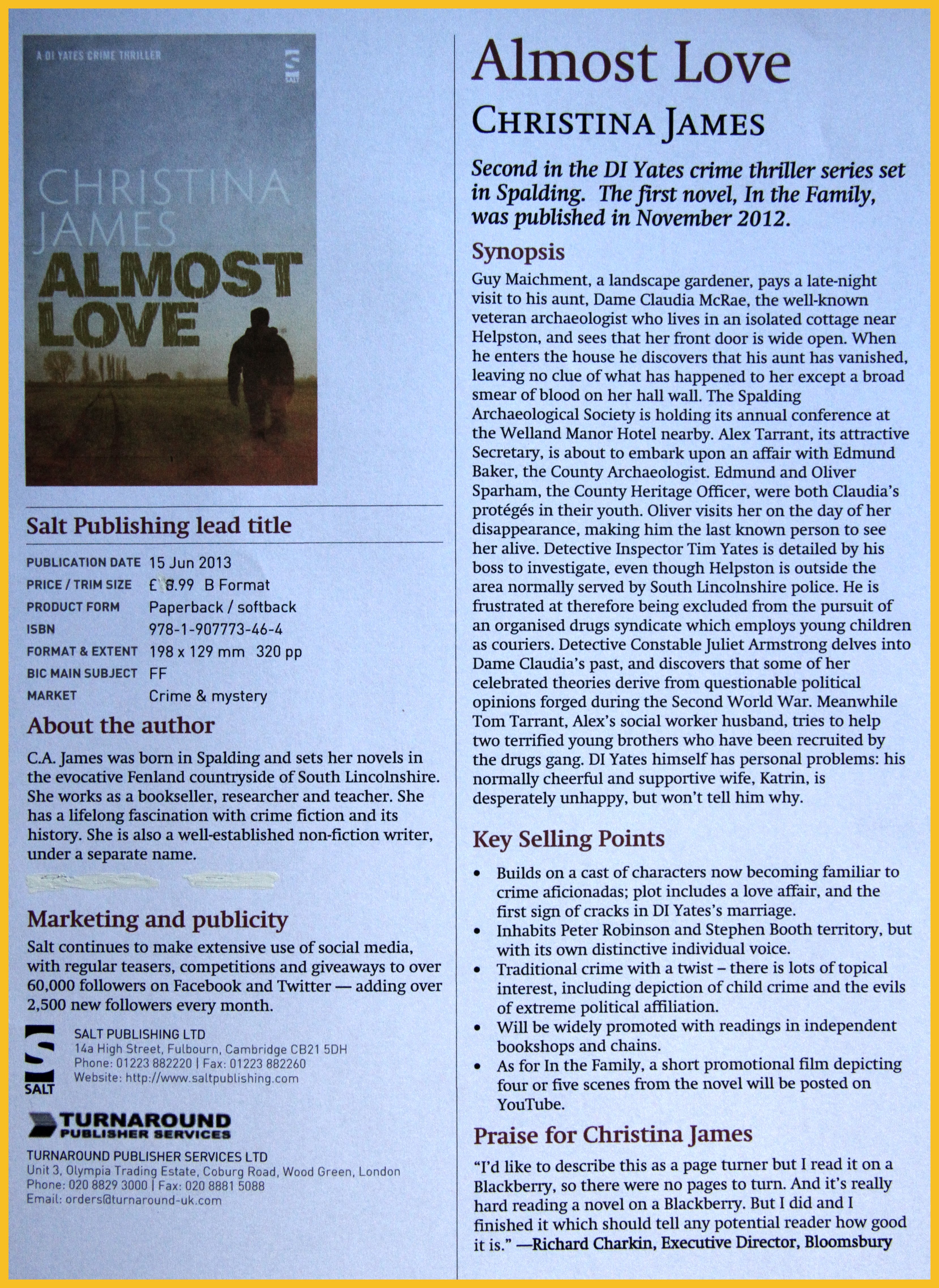
Thinking again about The English Bookshop and Jan’s explanation of why he chose Almost Love brought home to me the crucial role of Advance Information (AI) sheets in helping authors and publishers to sell their books. AIs have improved tremendously over the years. They started out as Gestetnered sheets. (Does anyone remember Gestetners? They took ages to set up and usually suffered a paper-jam within five minutes; you got ink all over your hands and, if you were unlucky, your clothes. The only good thing about them was the pink correction fluid, which could give you a temporary high if you applied it when standing in a confined space.) These were sometimes almost illegible and contained little except the ISBN, a two-sentence blurb and the publication date. There was no picture of the jacket. However, by no means all publishers used to produce AIs. Those who didn’t often sent out spares of the actual jacket with the date of publication stamped inside. Booksellers therefore never received a complete set of information: you either got an insubstantial blurb with no jacket, or the jacket and not much else.
By contrast, today’s AIs – at least the ones that Salt produces – are works of art. Author and publisher work closely together in order to wrest benefit from every centimetre of the space on a single A4 sheet. They include a fine picture of the jacket and all the information that the bookseller needs, yet can be read in less than a minute. Sometimes several hours are spent on developing an AI.
I thought that you might be interested to see the AI that was used to sell Almost Love into the shops, so I’ve included it here. I hope that you will like it.
A lovely Friday conversation with Jan Smedh, joint proprietor of The English Bookshop in Uppsala, a thriving independent business…

I’m delighted and very proud to discover that Almost Love has been chosen as the British Crime novel of the month by The English Bookshop in Uppsala. I asked Jan Smedh, who, with his business partner Christer, is joint proprietor of the shop, if I could call him. He kindly agreed to talk to me today, although he was busy making final preparations for his absence: he and his wife and three sons are about to leave for a holiday in Greece.
Jan told me that every month he chooses books for his reading groups and his book club. There are three reading groups: one for the Book of the Month, one for classics and (in Stockholm – he and Christer have just opened another shop there) one for children’s books. The book club operates as a subscription service. It has between fifty and sixty members scattered throughout Sweden. They choose the category to which they wish to subscribe and are each month sent a book in that category that Jan has chosen. They do not know in advance what the title will be.
He chooses titles from six categories altogether: the Book of the Month, which is always a literary novel; British Crime, ‘Tough’ Crime, Paranormal, Fantasy and Science Fiction. He tries to introduce a spread of themes and to get a balance between male and female authors and authors from different countries; for example, he has featured Asian authors who write in English. His choices are pretty unerring: his customers always seem to like them.
Jan said that when he read the description of Almost Love, he ‘loved it at once’. (I’m blushing as I write!) He tries to pick books by authors from small publishers that aren’t necessarily well-known, rather than blockbusters. The subject of Almost Love seems to be exactly what his readers are looking for: it has a bit of history, a bit of archaeology, some local background, a good plot and a strong psychological element. He says that his favourite customer is ‘someone who leaves the shop with a book that they didn’t know that they wanted.’ His copies of Almost Love have yet to arrive (there has been a slight delay in the printing, caused by MPG’s having gone into receivership two weeks ago), but they should reach the shop next Monday, so he didn’t know until I told him that there is also a Scandinavian element to the plot. He was delighted about this.
Jan learned about Almost Love from a Scottish publishers’ rep who carries titles from several independent publishers. His name is Stuart Siddall. I had not heard of him before, but I shall certainly get in touch with him now and I should like to take this opportunity to thank him.
I asked Jan about the inspiration for The English Bookshop. He said that he and Christer came up with the idea for it in 1995. They received no financial backing; they raised all the money themselves. Christer was already working in the bookselling industry (largely in the academic sector), so he had the contacts with UK publishing companies, who were therefore prepared to set up accounts for the new venture. It would not have been possible without their support. Jan’s own background is in communications and the business has benefited a great deal from this. It is he who designs the graphics for the website. He is prolific on the social networks and the shop has very active Facebook and Twitter accounts. He says that the key thing with social networking is to be consistent. He has worked hard to build up a loyal customer following and he knows he must maintain their interest by continually being there for them. His own love of books goes back to his childhood. He also speaks impeccable English: he explained that he has lived in Cork and has also visited the UK (he would like to see much more of it) and the USA.
95% of The English Bookshop’s customers are Swedish, though there is an ex-pat community in Uppsala, which is a university town (Jan describes it as ‘the Oxbridge of Sweden’). Most Swedes read English, and Jan’s customers are getting younger: some twelve-year-olds now buy books in English. Uppsala is also Sweden’s religious centre and the city in which the Monarch is crowned. It is Sweden’s fourth largest city and not huge, but it has the weight of history behind it and is home to many very well-educated people. Jan and Christer made the conscious decision to stay away from university course texts: they wanted their bookshop to provide leisure reading. By this, he doesn’t mean that all the books he sells are ‘light’: his readers like books about many subjects, as well as fiction. British history, books about war and books about psychology are all popular. Sales of non-fiction titles are growing; also crime fiction and children’s titles. The Swedish government has now set up English language schools, which means that parents are looking for books in English for their children. The English Bookshop tries hard to keep abreast of the continually changing interests of the local community and its unique stockholding reflects this. Jan says that ‘other bookshops aren’t doing this any more; there’s often a drab uniformity about what’s available from the big chains.’ Smaller publishers often complain that it’s difficult to get a proper presence in them. This view would certainly resonate with Salt, whose many distinguished authors often struggle to get adequate shelf-space in chain bookshops. It would also be endorsed by the UK’s many excellent independent booksellers, some of whom Jan knows. He has met Jane Streeter, a former President of the Booksellers Association, and is himself a member of the BA, for which he has a high regard.
In the last six years the turnover of The English Bookshop in Uppsala has doubled, enabling it to open the second shop in Stockholm. Jan says that this ‘goes against the grain’ of Swedish bookselling generally, so he feels that he and Christer ‘must be doing something right.’ I’d say they were doing a great deal right! The business is now eighteen years old.
It was delightful to have the opportunity to talk to Jan, and I am very grateful to him for giving me so much of his time and as well, of course, for choosing Almost Love. I now have an open invitation to visit The English Bookshop, which I am determined to take up. I’d like to visit the one in Stockholm, too! I wish Jan and his family a very happy holiday indeed in Greece. If any of his customers should read this, I’d also like offer you a big thank you and to say that I very much hope that you will enjoy Almost Love. Perhaps we may meet in the bookshop one day.

My ten top tips for revising text for publication

I was recently asked how much I revise when I’m working on a novel, and when I do it. The answer is: always several times; sometimes many times. If I’m not too tired, I look over the day’s effort again immediately I’ve finished writing. Whether I do this or not, I always scrutinise it the following day before I start writing again and make minor changes. Books usually fall into natural sections, and I’ll devote a day or two to working through a whole section in one go once I’ve finished it, to make sure that it hangs together and that I’ve been consistent. Finally, I revise the whole MS before I send it to my editor, sometimes more than once.
I’ve been asked for my ten top revision tips, so here goes!
- Make sure you get both the tense and the mood of verbs correct. This may sound easy, and it may even make me look stupid for saying it, but it’s surprising how often I read novels that have been marred by this mistake. And yes, I catch myself out sometimes.
- Scrutinise the word order in each sentence that you write. I don’t just mean taking care with words like ‘only’ which have different meanings depending on where they appear in the sentence – I believe that achieving the optimum word order is essential to good writing. If you look at the sentence structure and word order used by a writer whom you really admire, you’ll see what I mean.
- Be descriptive, but sparingly. It’s true what people say about purple passages!
- Try really hard to make the dialogue sound natural. Think your way into how the character who is speaking phrases his or her speech and listen to the voice. At the same time, be aware that making it sound natural doesn’t mean copying nature! I’ve just been reading a novel in which two of the main characters engage in the kind of desultory breakfast conversation that I often have with my husband. Not only does it not go anywhere, it unfocuses the reader’s attention and dissipates the tension that the author has built up in the preceding chapters.
- If you create an interior monologue for one or more of your main characters, ensure that you give it enough depth. It’s easy to fall into the trap of making it too brittle or superficial. It’s quite a hard technique to work with and so, if you’re not sure whether you’ve succeeded, abandon it!
- Apply my last point to all of your work, quite ruthlessly. Be your own fiercest critic. If you’re not completely happy with something, or think that it might not be working, it probably isn’t.
- Check that you have used the same names for your characters throughout and haven’t introduced some subtle changes along the way. This may sound an unlikely mistake, but it’s certainly one that I’ve made – for example, in the first complete draft of In the Family, Ronald Atkins was also called Roland and Rodney on some occasions – and, having talked to other authors about it, I’ve discovered that it’s quite a common fault. Readers are bound to be irritated by it!
- If you write a fairly detailed outline of the plot – as I usually do – you don’t have to stick to this slavishly if you’re inspired by some better ideas once you’ve started writing. However, be certain that these work within the context of the whole and don’t present you with a lot of inconsistencies that require making many changes, or force you to offer outlandish explanations that stretch credibility.
- Also on the subject of plot construction, try to write the chapters in chronological sequence, even if you plan to present them in a different order in the final version. If you don’t, you are almost bound to introduce anachronisms that will need ironing out afterwards. This is perhaps my own greatest fault. I’m trying really hard to practise what I preach, now that I’ve started my third DI Yates novel!
- Turn off the spell-checker, which has a nasty habit of introducing US spellings or unexpected quirks!
I refer to [Judith] Butcher’s Copy-editing: The Cambridge Handbook for Editors, Copy-editors and Proofreaders, which is an invaluable resource for ensuring consistency and proper presentation of material for publication.
Finally, may I add that I take very seriously the comments of readers about my writing. When I weigh them up, I find that they tend to have objectivity and honesty and I value their constructive and helpful insights.
An unashamedly anecdotal account of a visit to the House of Commons…

Yesterday, I was in London again for the day job. I had four meetings, all of which went according to plan, and topped off the day by attending the Author Publisher Dialogues, sponsored by the All Party Publishing Group and the All Party Writers Group, which took place at Portcullis House in the early evening. I have attended author events in the House of Commons before, but I hadn’t previously visited Portcullis House. It is an ultra-modern construction of steel and glass that faces the House, apparently used as a kind of overflow building.
Unsurprisingly, security was tight. There was an airport-style scanner, through which my bags and jacket had to be passed, and several security officials were on duty. (I wonder what they made of the contents of my laptop bag, which by that stage in the day contained not only the computer, but also three books acquired from the wonderful help-yourself stash that sits permanently in the basement of one of the publishers I visit, an assortment of toiletries from Boots, some greetings cards from a nice shop that I know and two packets of apple and cinnamon hot cross buns from the Marks and Spencers in Chancery Lane.) Belongings retrieved, I was asked to wear a lanyard with a time-stamped badge proclaiming that I had been checked. Now labelled with this cross between kitemark and sell-by date, I was directed upstairs to a sort of glass-enclosed gallery, the walls of which were decorated with portraits of eminent politicians. I recognised Harold Wilson, Margaret Thatcher and Shirley Williams, all painted to look remarkably like each other, if that doesn’t sound too far-fetched.
The event took place in the Macmillan Room, named presumably after Harold Macmillan, who was both publisher and politician (I met him once, but that’s a different story!). It was chaired by Tristram Hunt MP, who is Chair of the APPG; he’s also a journalist and broadcaster. One of the speakers, Kwasi Kwarteng, is also an MP as well as being a published author: his most recent book is entitled Ghosts of Empire. (The two other author speakers were Professor Peter Atkins and Susan Standring, who has been responsible for several of the most recent editions of Gray’s Anatomy.) Hunt is a Labour politician and Kwarteng a Tory, but they seemed to be fairly united in their views on how much government should contribute to publishing. They were careful to say that the publishing industry is so successful that it needs no financial help from government, but they also indicated that they are staunch supporters of copyright law. As both are published writers, this was to be expected, but also what the audience wanted to hear. One of the reasons why publishers have stepped up their presence at such events in recent years is that there are certain factions in government which would like to pass legislation distinctly threatening to copyright as we know it. I shall write about this in a separate post and I’ll also report on the event itself at a later date, too. This is meant to be a light-hearted account!
As in the House of Commons itself, each room in Portcullis House is fitted with a television screen that tells the occupants which MP is speaking and on what subject. A shrill bell rings for several minutes when it is time for them to vote. Our two MPs rushed off when this happened, leaving the other speakers to hold the fort. Stoically, they kept on speaking throughout the din and, although it was impossible to hear what they said, their Dunkirk spirit filled me with pride. Theirs was such a very British approach.
The end of the event coincided with a mass exodus of MPs. When I emerged from the Macmillan Room, there was a long crocodile of them walking two-by-two down the glass corridor at funereal pace, feet turned outwards, murmuring inaudibly to each other. Young or old, each was exhibiting this same distinctive behaviour. It reminded me of the sequences in Jurassic Park of the dinosaur herbivores moving peacefully and slowly through the undergrowth. I wondered if MPs need training to walk in this way or whether it comes naturally when you are Running the Country.
It was unsettling on my way out to encounter, standing at the exit, a policeman who was carrying what looked like a small Kalashnikov (sorry, I’m not well up on guns). That policemen in European countries are routinely armed seems unexceptional – it helps that sometimes their guns look like toys – but I’ve always found it disquieting to see officials on UK soil bearing arms. I remember the sense of shock I felt when I bumped into a group of paratroopers in Northern Ireland once, their weapons at the ready. This policeman was friendly, though. When I said, ‘Don’t shoot!’, he replied, ‘No, I won’t, I’m not in the mood tonight!’
The government has been claiming that the recession is ending for so long now that its statistics have lost every shred of credibility as far as I’m concerned. However, I do have my own very scientific way of taking the temperature of the economic climate. It involves London taxi drivers. For at least the past two years, hailing a taxi in London has been easier than falling off a log. You’ve only needed to step out into the road and six have appeared, their yellow ‘cab free’ lights twinkling. The successful cabbie has then regaled me for the entire journey with his views on the direness of the economy and his considered opinion that Armageddon has arrived. It may have been partly because I was in the, for me, more chi-chi than normal environs of Westminster that a good two dozen cabs passed me in the space of fifteen minutes, all with their lights switched firmly off. I nevertheless conclude that taxi firms are booming once again – and therefore also the businesses that they serve.
Panicking that I would miss my train, I was forced to double back to the underground. The tube train I boarded chugged along imperturbably, with extra delays at Victoria and Green Park. Eventually I reached King’s Cross with three minutes to spare and sprinted across the concourse before collapsing in my reserved seat in a most unladylike fashion. I was so much revived by a steward bearing tea (and, eventually, a gin-and-tonic) that I was even able to attempt a bit of writing on the two-hour journey home.
It was quite an exhilarating day. At its conclusion, the animals lay in wait, each reacting in his own way to my absence: the dog greeted me ecstatically; the cat turned his back to punish me for my desertion.
 Christina James, crime novelist