

Chamber Music, a novel for Breckland Festival

Chamber Music, by Tom Benn, is not the sort of book I’d ever pick out for myself in a bookshop, given a free choice. Why? Because even though I am impressed by the skill of writing a dialect-heavy novel, I find such an approach to dialogue rather painful to read; also, when I’m not very familiar with the dialect, I can’t ‘hear it in my head’. I must admit, too, that the presentation of the seamier side of life for a whole novel is, for me, too much noir in one go! However, as I’ve explained in a recent blog-post, I’m meeting Tom at a Breckland Book Festival crime-writers’ session which I’m chairing. Claire Sharland, the organiser, kindly offered to pay for this book if I acquired it. I should add, hastily, that of course I’d have made sure that I’d read it before meeting Tom, in any case!
Technically speaking, it is a brilliant novel. I don’t quite know how to describe the technique that Tom has used – it is Irving Welsh crossed with William Faulkner, if that makes sense. I know that often writers resent being asked if their books are autobiographical or ‘drawn from life’; and, whilst I have no intention of asking Tom such a question, it seems likely to me that he must have lived and breathed the under-class, criminal-underworld Mancunian society that he depicts – otherwise he would never have been able to write such pitch-perfect dialect or captured the topography of the mean streets of Manchester with such conviction. On occasion, the use of dialect is so rich that the non-Mancunian reader is baffled, but such is Benn’s skill that eventually it is possible to decipher meaning from context. For a simple example, I picked up quite quickly that ‘scran’ is slang for a tasty snack.
This book has very little in common with Elly Griffiths’s Dying Fall, the other book featured in the Breckland session, which is no doubt why these two authors were billed together. However, both do share a pronounced sense of place and in both novels I feel that the crimes act as a vehicle for exploring the characters, rather than themselves being the focal points of the novels. Henry Bane is a complex character who takes a lot of fathoming – I suspect I should learn even more about him if I were to read the book twice; and Roisin is portrayed in an enigmatic and, given the situations in which she is placed, paradoxically delicate way.
I’m particularly looking forward to asking Tom Benn to read a passage from Chamber Music when I meet him next Saturday, for I want to get the authenticity of his voice into my reading of the novel; I’m sure that a live reading will be captivating.

Dying Fall, a novel for Breckland Festival

Last week, I mentioned that I’d agreed to chair the March 16th crime-writers’ event which forms part of the Breckland Book Festival and that I’d been invited to buy the latest novel of each of the two authors taking part in order to prepare for the session. Consequently, I’ve just completed Dying Fall, by Elly Griffiths. She isn’t an author with whom I’m familiar, but I see from the preface to the book that this is fifth in a series about Ruth Galloway, a forensic archaeologist who becomes involved in the crime mysteries that she is employed to solve.
For me, Ruth’s character and circumstances are the best things about this novel. She is not a conventional heroine: overweight, a single mum, already of early middle-age and, although not poor, not as materially successful as her contemporaries at university. Nelson, the policeman who features in the books, is also unconventional, not least because, although happily married, he is also the father of Ruth’s young illegitimate daughter, Kate.
This is really a book about the dynamics of personal relationships, those between Ruth, Kate and Nelson, of course, but also between the members of Nelson’s family, between Ruth and her friends and even between the mysterious and sinister members of the White Hand, a neo-Nazi group. This exploration of how people relate to each other is certainly more pervasive and compelling than the plot, indispensable though this is to making it a crime novel. There are some wonderful cameo roles as well, especially that of Cathbad, Ruth’s feckless Druid friend, who is also Kate’s godfather.
The author’s use of topography, something in which I am always interested, impresses me. There are some fine descriptions of North Norfolk – I imagine that these feature in all of the series – although most of the novel is set in Blackpool and the Pendle Hills, the descriptions of which places are equally evocative. The research that has gone into archaeology and the occult has been meticulous, but Griffiths never parades her knowledge.
I’m very much looking forward to meeting Elly Griffiths, and also Tom Benn, her co-star at the Breckland event, whose novel, Chamber Music, is equally impressive in a completely different way. It had been my intention to review both books together, but the clock caught up with me before I could finish Tom’s! I hope to write about Chamber Music very soon.
A profoundly moving and informative read…
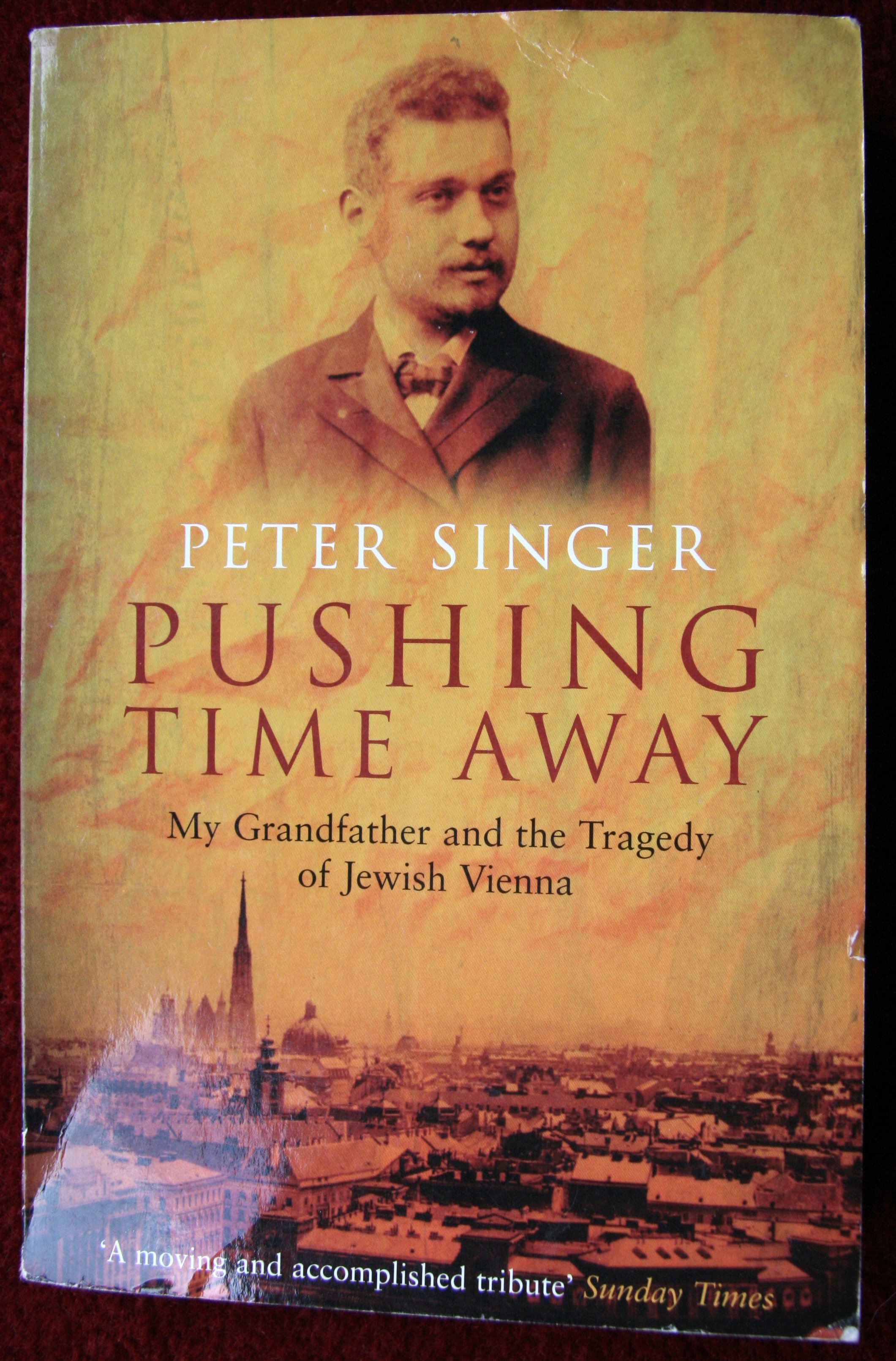 Pushing Time Away, by Peter Singer
When I completed Pushing Time Away, by Peter Singer, I felt as if I had absorbed so much information that I needed a light read to counterbalance it; then, when I tried to get into a novel – and it was an intelligently-written novel – it seemed too lightweight, so I had to put it down and return to it the next day.
Pushing Time Away is another of my son’s books, temporarily purloined when I last visited his house. (As I’ve said before, I love browsing other people’s bookshelves and always find something that I’m desperate to read there.) The author is an Australian academic who was asked to go through his elderly aunt’s papers when she was taken into care. In the process, he discovered a rich treasure trove of information about his grandparents, including hundreds of letters written by his grandfather to his grandmother.
Beautifully written, it is an unusual book in several respects. It provides a graphic account of what life was like for middle-class intellectuals living in Vienna in the first forty years of the twentieth century; it tells how Singer was at first shocked, and then fascinated, to discover that both of his grandparents were bisexual; and it recounts the vicious power struggles that took place between Sigmund Freud and his disciples when they dared to question Freud’s theories. The last of these is well-documented elsewhere, but Singer brings to it a fresh perspective as he shows how David Oppenheim, his grandfather, a gentle scholar who hated conflict, was unwillingly forced to choose between Freud and Adler. That Oppenheim chose Adler at a time when no-one had heard of him, and therefore renounced the scholarly acclaim that working with Freud could have brought him, bears testimony to his selflessness.
Another aspect of the book which has also been recounted many times, but still gains fresh immediacy from being based on the feelings and experiences of one family, is the fact that, until Kristallnacht, Jewish families living in Vienna were so well assimilated that they had no thought of falling victim to Hitler’s ethnic cleansing policies, even though they were aware of them. David Oppenheim had been awarded a medal for bravery for fighting for the Kaiser’s army in the First World War and so, even as Jewish ‘privileges’ in the city were reduced daily (at first Jews weren’t allowed to walk in the woods, then to hold public posts and finally to own bank accounts), he was convinced that the fact that he had fought for his country would save him and his wife. They did not leave for Australia with their two daughters, first because they were still learning English and then out of solidarity with Peter Singer’s father’s parents, who were unable to obtain exit visas. David Oppenheim and his wife, née Amalie Pollak, were eventually sent to Theresienstadt, where he quickly succumbed to the rigours of poor diet and no medication (like his sister, who died aged sixteen, he was a diabetic; one of the many interesting insights that this book offers is how terrible a disease diabetes was before the invention of insulin injections).
The book gains great power from its understated matter-of-factness. At no point does the author resort to sensation; he doesn’t need to, because the facts speak so eloquently for themselves. The only slight quibble I have is with the unadulterated admiration that he displays for the grandfather that he never knew (Amalie survived the war and spent her last years in Australia when he was growing up). What Singer says about David is slightly at odds with the documents that he quotes. Certainly, David was gentle, erudite and earnest. I’m less convinced that he was an early exponent of male / female equality. He may have paid lip-service to this ideal; nevertheless, it was Amalie, a far more brilliant scholar than he and one of the first women to be awarded a degree (in Maths and Physics) by the University of Vienna, who gave up all her career prospects when they married and subsequently dealt with all of the practicalities of their daily lives, while David concentrated on his studies. This sounds to me like par for the course for intelligent women who lived in the early twentieth century. It was also Amalie who showed all the fortitude and resourcefulness as their world collapsed, while David sank into depression (though his ill-health might have been partly responsible for this).
Pushing Time Away is not a comfortable book to read, but it is compelling. It makes a far greater impression than a more polemical exposé of how the Holocaust affected this family would have done. I know that it will stay with me.
Publication day for Chris… and a review to boot!
 At the Dying of the Year
I was not unhappy to be asked to review this, the fifth Richard Nottingham novel by writer Chris Nickson, as I had not read him before and as I knew that the stories are set in eighteenth century Leeds, a place I know in its modern form very well indeed. Having no preconceived ideas whatsoever about the book, I didn’t really know what to expect, though Chris had provided, earlier this year via Twitter, a taster from his text.
The challenge for any historical novelist is to convince the reader of the authenticity of the story within its context; Nickson has researched his period well and gives physical location prominence in his approach. Leeds is depicted in its glories as the rich mercantile centre of the woollen trade and in its seamier squalor and this book focuses on the theme of corruption so precisely summed up by King Lear:
Thorough tatter’d clothes small vices do appear;
Robes and furr’d gowns hide all. Plate sin with gold,
And the strong lance of justice hurtless breaks;
Arm it in rags, a pigmy’s straw does pierce it. [King Lear IV vi 166-9]
By a plot which reminds readers of media accounts of the contemporary abuse of children by adults, we are made vividly aware of the truth of Karr’s well-known epigram “Plus ça change, plus c’est la même chose.” Indeed, as I read, I noted how Nickson also achieves a sense of timelessness in the choice of language, both in dialogue and description, by using colloquial expressions still to be heard in Leeds; there is a feeling of familiarity about it that I am sure reflects the author’s personal Leeds background and ‘feel’ for the place and its people. However, the book has its own historical realism, where the central character, Constable Nottingham, moves in his family and professional worlds with the assurance of a man well created by his maker; indeed, the author establishes a convincing sense of personal emotion and single-minded devotion to his job, in spite of the dreadful clashes that occur between the two. What ultimately comes across to us are the fragility of people’s existences and the uncertain morality of those on both sides of the law; it is not a comfortable world and Nickson doesn’t flinch from demonstrating that there is no fictional control over real life. Yet there are strong signs of goodness and hope, friendship and fellow-feeling, so that the prevailing sombreness of the title and the events is somewhat modified.
The narrative allows for the separate perspectives of Richard Nottingham, his deputy, John Sedgwick, and a young police officer, Rob Lister, who loves the Constable’s daughter, to reveal their inter-related lives and to provide a greater ‘reach’ than a single viewpoint. They provide a formidable triumvirate in their knowledge and understanding of their patch, but they have their vulnerabilities and sensitivities and are not invincible in their work; they are sufficiently well-drawn to generate our sympathy and interest. The character of Leeds itself is strong and breathes into the tale a life of pubs, warehouses, corporation piles, stream and river and street and ginnel. Timble Bridge, over which Nottingham must go from home to work and back again, is a regularly repeated motif, associated with the Constable’s moods and feelings as well as his geographical place in the Leeds landscape.
All in all, I found At the Dying of the Year an engaging if somewhat melancholy read and I anticipate that Nickson’s existing appreciative audience will by swelled by this new novel. Congratulations to Chris on his publication day!
This depiction of grief is brilliant…

I have just finished Whatever You Love, by Louise Doughty. Although I have read some of the author’s journalism, I didn’t realise until recently that she is also a novelist.
Whatever You Love is a highly-accomplished and sensitive novel about a mother’s sorrow after her nine-year-old daughter is knocked down and killed by a careless driver. The novel describes Laura’s progress through grief and how it changes her and her relationships with others, yet nowhere does the account become maudlin, tedious or sentimental. Running like a thread through the story is the history of her relationship with her husband, the child’s father, an impetuous Welshman who has dumped her for one of his work colleagues. A lesser author might not have been able to escape the minefield of clichés offered by this situation, but the intricacies of Laura’s relationship with David are teased out and presented with great subtlety. Although Laura herself tells the story, it is clear that she was not an entirely innocent party when her marriage broke down and that her current relationship with David is not simply inspired by negative emotions of mistrust and jealousy. There is real warmth in some of their encounters.
Although this book doesn’t really belong to the genre of crime fiction, several crimes take place: hit-and-run; dangerous or careless driving (the police down-grade the hit-and-run crime, much to Laura’s chagrin); the sending of poison-pen letters; threatening behaviour. At least one murder is contemplated, though it doesn’t take place (or so, on balance, we believe – the author introduces a certain amount of ambivalence here), but the most profound crimes in the novel are those committed against the soul. Each of the main characters suffers deeply and each is, to a certain extent, the author of his or her own misfortune; overarching this is the sense that they are pawns in a bigger game – to survive, they must adjust to what Fate has given them. Not all of them make it.
I’m delighted to have come across Louise Doughty’s fiction and even more delighted to discover that she also writes about the Fens. I’ve now bought Stone Cradle, a novel set in the late nineteenth century and in the area in which I grew up. Not many writers set their work in this region – Graham Swift and Charles Dickens are the only ones who spring immediately to mind. I’m certain that the power of Louise Doughty’s pen will capture to perfection the unique grandeur of the Fenland landscape.
What my books might say about me…

Since I have heard it said that you can find out a lot about people’s characters from their bookshelves, I thought it would be interesting to put it to the test. Books have always formed a kind of parallel universe in my life; I can usually remember how I came by them and what else I was doing when I read them. This is probably why I find it so difficult to discard them; a recent cull produced only four volumes to send to the jumble sale.
I have homed in on one of my bookshelves at random to see if the books that it contains say anything about me. I should perhaps add that it is one of thirty-six bookshelves in my dining-room, some of them stacked two deep, and there are others in most of the other rooms. This may dilute my objective somewhat, but still it provides a bit of fun on a snowy Saturday! I should also confess that, despite my husband’s best efforts, there is no logical order to the way in which my books are arranged.
Here goes:
- The Gunpowder Plot, Antonia Fraser. I read this in a hotel in Scotland, just after I handed in my notice to go to another job and my old boss was trying to persuade me not to leave. Great account, well-told, in which I was able to lose myself completely.
- Mrs Keppel and her daughter, Diana Souhami. Took this on holiday to France in 1996 and read it in the garden of a gite miles from anywhere (a place called Measnes). Excellent period piece that answered some of my questions about Violet Trefusis (a writer who intrigues me).
- The Bicycle Book, Geoff Apps. Not mine! Bought to support one of my son’s enthusiasms, circa 1999 (at a time when the author could have had no idea how topical his last name would become!).
- Condition Black, Gerald Seymour, and eleven other Gerald Seymours, all dutifully signed by the author, who presented them to me after I organised an author event for him (as a library supplier) in 1991. I have to confess that I haven’t read any of them, though my husband now tells me he has read them all, and I know that they have been popular with visitors.
- Waking: An Irish Protestant Upbringing, Hugh Maxton. I bought this in the late ‘90s from the bookshop at Goldsmith’s College (London) and read it on the train on the way home. My old supervisor, Bill McCormack (see Sheridan Le Fanu article) was teaching at Goldsmith’s at the time. He writes poetry as Hugh Maxton.
- In Praise of Folly, Erasmus. Given to me as a sample by Wordsworth Classics when the imprint was launched. I haven’t read this, either.
- Nothing Except My Genius, Oscar Wilde. A slim volume containing a selection of Wilde’s sayings and aphorisms, for dipping into. Not sure where it came from – maybe a Booksellers Association Conference ‘goody-bag’? Precious wit from one of my favourite writers.
- Restoration, Rose Tremain. In my view, the best novel by another author whom I much admire. A present from colleagues. I read some of it when I couldn’t sleep while staying in a dive of a hotel after a party to celebrate Hatchard’s 200th birthday (which both Princess Margaret and Salman Rushdie, at the time under the threat of the fatwa, attended. Security was tight!).
- Damned to Fame: the Life of Samuel Beckett, James Knowlson. A long and sombre book; well-researched, but for me it fails to capture the essence of Beckett’s genius. I have certainly read all of it, but (unusually) I don’t remember when.
- The Battle of Bosworth, Michael Bennett. One of a small collection of titles published by Alan Sutton about the Wars of the Roses, all of which I have devoured. I acquired them in the 1990s but have read them all again much more recently.
- Nature is Your Guide, Harold Gatty; Dowsing, Tom Graves; Flowering Bulbs, Eva Petrova: None of these is mine. With the exception of Dowsing (an interest of my husband’s for a while) I have no idea where they came from.
- The House, Deborah Devonshire. This is an account of Chatsworth by the Duchess of Devonshire and was given to me in at the launch which took place at Chatsworth. The occasion was memorable for two reasons: Harold Macmillan, the Duchess’s uncle, then a nonagenarian, gave a very witty speech; I fainted – it was a hot thunderstormy day – and had to be carried outside and deposited on one of those pieces of Victorian wicker garden furniture that is half chaise-longue, half bath-chair. (My son was born eight months later.)
- Back to Bologna, Michael Dibdin. A recent read that I much enjoyed, by a favourite author.
- Balzac, by Graham Robb. I was reading this book in 2006 when, by a wonderful piece of serendipity, I found myself sitting next to his wife, at the British Book Awards ceremony (she is a librarian).
- British Greats, John Mitchinson. Another BA Conference goody-bag acquisition. I’ve not opened it before; now I come to do so, it is interesting, in a coffee-table, lazy-afternoon sort of way.
- Kennedy’s Brain, Henning Mankell. I read this while in bed with ‘flu, Christmas 2008. One of Mankell’s most serious novels, it is about Africa, a continent on whose behalf he is a well-known crusader. I enjoy and admire all of his books.
This row of books gives a fragmentary account of some of the things that have happened to me. I’m not sure what it says about my character or brain, except that it certainly exposes me as a magpie! It also suggests that my husband and son are inextricably entwined, for better or worse.
On a beautiful day, an exquisite work…
I apologise to regular readers – and I should like to say here that I am extremely grateful to you for being regular readers – of this blog, for presenting you with a book review two days running. Perhaps as an antidote to my dose of Sheridan Le Fanu (whose works, whatever their good qualities may be, certainly belong to Henry James’ category of ‘loose baggy monsters’), I began last night to read The Cellist of Sarajevo, by Steven Galloway, and did not put it down until I had finished it.
It is a breathtakingly beautiful novel, although it deals with that ugliest of subjects, civil war. It is also very grown-up, with profound layers of meaning that are allowed to speak for themselves; the author does not intrude upon the reader by presenting any kind of moralistic commentary.
At the literal level, the story consists of a portrait of the horrors of the siege of Sarajevo as seen through the eyes of three people over the period of a few days. Fundamentally, the novel is an examination of what it means to be human and what ‘being good’ really consists of. Principles of right and wrong are explored both through the most extreme situations (for example, Arrow, the female sniper working on behalf of the townspeople, finds it increasingly difficult to justify her acts of killing the ‘men of the hills’, even though they are picking off her fellow citizens daily) and more mundane dilemmas, such as that of Kenan, who, when he risks his life to collect water for his family, resents also having to fill up two heavy and awkward water containers for his elderly neighbour, not because he likes her (he doesn’t) or because she has been kind to him (she hasn’t), but because she holds him to a casual promise of help made in happier times.
The cellist is the common thread that unites these characters, as they listen to him; they do not know each other and do not meet. The reader discovers little about him. He is a roughly-dressed, unkempt man with no name who has taken a vow to play his cello every day for twenty-two days in a street where twenty-two people died as the result of a mortar attack. Daily, therefore, he puts himself at risk of murder by one of the snipers in the hills. He is an enigmatic, Christ-like figure. Did he lose someone in the mortar attack or is he making a point about preserving art and maintaining civilised activity in a world grown savagely feral and full of fear? Does he celebrate or mourn humanity?
Almost every sentence that Steven Galloway writes delights with its precision and eloquence. My guess is that he rewrote some of them many times in order to convey the exact descriptions, meaning, undertones and overtones that he intended. However, nowhere is the novel ‘overwritten’.
I believe that this is a very important novel indeed; it belongs to the literary tradition of writing about the juxtaposition of warfare and what it means to be human that stretches back through Tolstoy and Shakespeare to the Icelandic sagas, Virgil and Homer. It is elegiac, timeless and yet very disturbingly modern.
One to hold your interest and, unintentionally, make you smile…

I first heard of Sheridan Le Fanu when I was a postgraduate student. The supervisor of my thesis, Bill McCormack, had just completed his own thesis on Le Fanu and he gave it to me to read; it was a brilliant exegesis which managed to fuse literary criticism with a succinct account of the historical background of Le Fanu’s work (a much more common approach now than it was then). I was impressed and a little cowed by Bill’s accomplishment (as he probably intended).
I did not, however, attempt to read any of Le Fanu’s novels, either then or later, until this winter I embarked upon my project of interspersing my reviews of contemporary crime writers with occasional pieces on the work of some of their predecessors. Wylder’s Hand, which was first published in 1864, is now available from Atlantic Books (Classic Crime series); I discovered it in the bookshop opposite the British Library which I have written about previously.
As a work that sits historically between Jane Austen and the Brontës and George Eliot later in the century, and that was published just after Wilkie Collins’ The Woman in White (1859) and a few years before Dickens died, leaving The Mystery of Edwin Drood (1870) unfinished, it fascinates with the mishmash of old and new fictional devices that Le Fanu manages to embrace.
His heroines, for example. There are two of them: Dorcas Brandon and Rachel Lake. Dorcas is sultrily and mysteriously beautiful (even though her name belongs to a famous literary shepherdess and is made yet more banal by the use of the diminutive ‘Dorkie’, which to modern ears has unfortunate overtones of ‘oddball’ and ‘odd dog’). Rachel is intelligent, independent, strong-minded and in the Jane Austen mould of heroine who thinks nothing of tramping several miles to the next village in a long dress, though also prone to fits of the vapours when accosted by some too-rude reality that distresses her. Then there is Uncle Lorne, who at first convinces as a sinister supernatural wanderer from the Melmoth stable, although he shows up unexpectedly so many times, making dire pronouncements before his keeper leads him away, that he eventually comes to resemble an extra who has wandered in off the set of The Life of Brian. To extend the anachronism, the elderly crone, Tamar, issues repeated dire warnings akin to those of Grandma in Cold Comfort Farm, though the nasty thing that she sees is wandering about, rather than confined to the woodshed.
If the heroines are alternately presented as ‘modern’ and objects of sentiment, there is no similar confusion over the two children who appear in the book. Little Margery ‘courtesies’ and says ‘please’ every other word, especially to gentlemen (no incipient emancipation for her), whilst the portrayal of the Vicar’s son surpasses every other instance of Victorian mawkishness that I can think of. If you find that Tiny Tim turns your stomach and decide to read this book, I recommend that you omit the chapters about ‘Little Fairy’ (his parents’ nickname for him – we never discover his real name) and his cloying relationship with his father (whom he dubs ‘Wapsie’, hilarious to 21st century ears). His mother is always referred to as ‘good’ Dolly, an epithet that she seems to have earned by being extraordinarily plain and not a little silly; she is a paler reflection of Mrs. Palmer in Sense and Sensibility. Also slightly sickly is the way in which Dorcas and Rachel pepper their conversations with each other with extravagant endearments – though this doesn’t worry me too much, because I remember that my grandmother and her friends used to address each other in a similar way. I long ago came to the conclusion that it was born of a kind of guerrilla feminism, a stratagem used by earlier generations of women to shut men out from female confidences as a retort to the way in which they were often excluded from men’s.
Le Fanu’s vocabulary at times shows a certain paucity. At first, I was impressed when he used the verb ‘glided’ to describe the way in which Stanley Lake, the anti-hero, moves, because I thought that it was a skilful way of conveying his insidious grace. However, as the story progresses, almost everyone is said to glide, including Rachel, Dorcas, the ghost/lunatic and the old nurse. I conclude, therefore, that Le Fanu just liked the sound of it!
I’ve been a little harsh in my judgment so far, or at least tongue-in-cheek; yet I finished this long novel and – despite the blemishes that I’ve indicated – was gripped by it to the end. So what do I think its good qualities are? What does it have to offer modern writers in search of example? Well, in the first place, there is Le Fanu’s detailed and convincing depiction of topography and what, for want of a better word, might be called ‘atmosphere’ to convey depth and mood. Secondly, there is the plot itself. It is a murder story which the reader thinks that he or she may have solved in the first quarter of the novel; yet Le Fanu succeeds in maintaining the suspense and keeping you guessing until almost the last page. Then there are the evil characters – basically, all of the men except the silly Vicar and Lord Chelford, who has only a bit-part. Although not fully-rounded in the manner of, say, Trollope’s tortured protagonists, there is an energy and enigmatic quality to their evil – and each exhibits a different kind of evil – that captivates. I particularly admire the portrayal of Jos Larkin, one of a long tradition of rapacious and pompous lawyers whose antecedents include Chaucer’s Man of Law and Dickens’s Tulkinghorn.
Anyone who is interested in crime writing and its history and the history of the novel itself is likely to enjoy and profit from reading Wylder’s Hand. I’m sure that Le Fanu wouldn’t mind our laughing at some of its more obsolete excesses. Perhaps we should leave a message to posterity that we don’t mind if succeeding generations laugh at ours. After all, the worst thing that can befall a writer is to be ignored altogether. I am grateful to Atlantic Books for helping to rescue Le Fanu from this fate.
Donna Leon in sombre mood: Uniform Justice
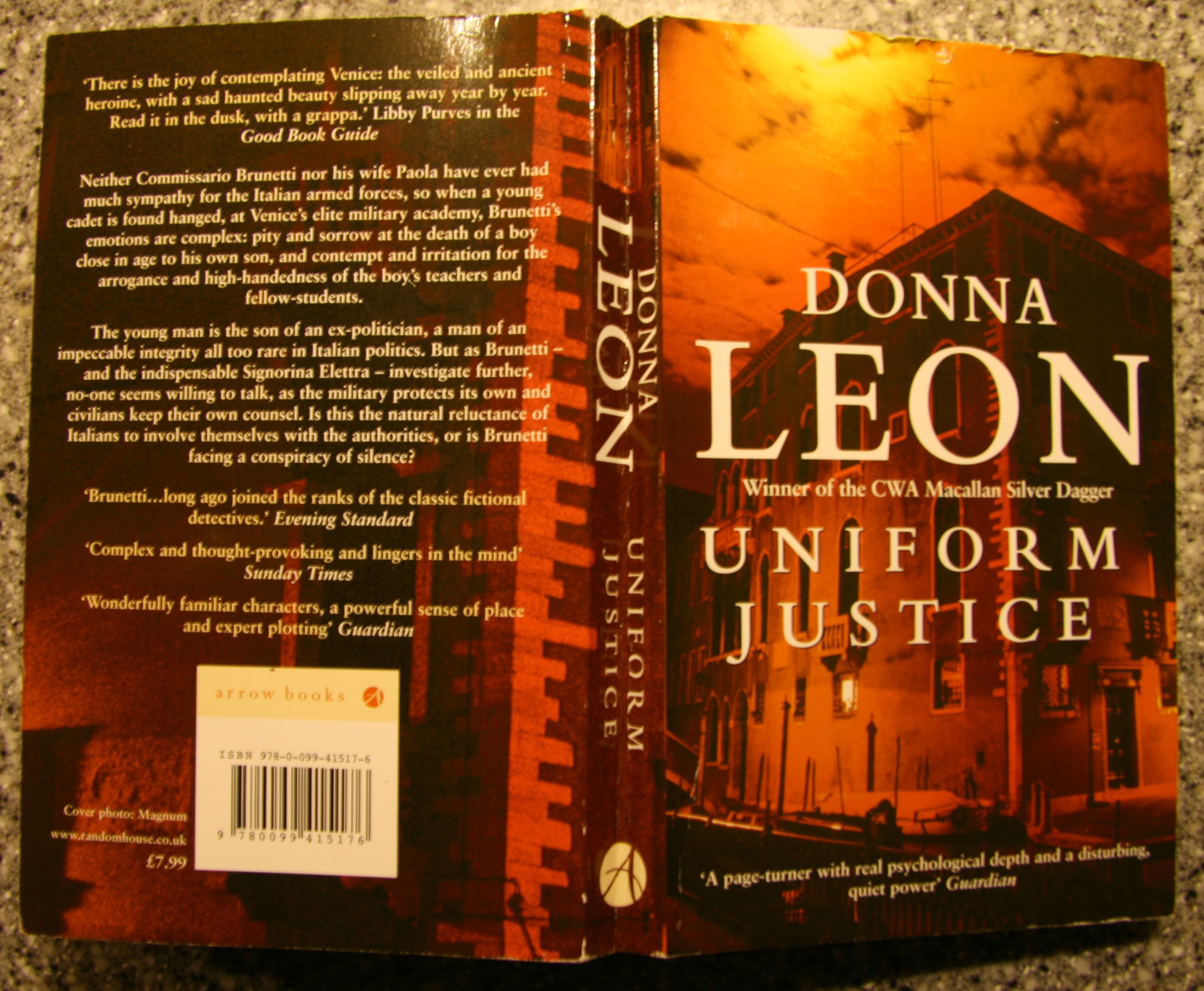
I am a great fan of Donna Leon. I think that she has brought a sophisticated and civilised approach to crime writing and, in the process, proved that a crime novel doesn’t need to be about the most sensational blood-and-guts murders in order to captivate. Uniform Justice, which was first published in 2003, does not disappoint; it meets all her usual standards of excellence. However, it is a very sombre, brooding novel. It is about life in a military academy – the murder victim is a cadet – and the corrupt and unwholesome practices that go on there. It also explores the relationships between parents and children and shows how compassion – or the lack of it – and the dynamics between familial generations can make, mar or even terminate lives. The plot is quite monolithic, with no sub-plot to speak of. Although the novel is certainly crafted with the depth and subtlety that I always associate with Donna Leon, there is little of the exuberance and tapestry-like richness that she usually builds up. It is reminiscent of one of Matisse’s earlier paintings, before he discovered colour: created in hues of brown, grey and black.
As a mother, I found it almost painful to read right to the end. It is a book that I think will stay with me, but I prefer her more baroque works, because in them she succeeds in counterbalancing the squalor and tragedy of death with a brighter vision of human nature in all its many manifestations, from the noble to the sinister, with all the many quirks in between.
Here’s one I’d like you to know about – a new and striking Salt crime novel!

I am both fortunate and privileged to have had an early opportunity to enjoy a reader’s copy of Scarecrow, a novel that Salt Publishing will be adding to its crime fiction list for publication in September.
Fast-paced and compelling, it is set partly in the Andalusian province of Almeria (of spaghetti western fame) and partly in England. Danny Sanchez, a bi-lingual journalist, grew up in England and left for Spain when his mentor and friend on a Hampshire local newspaper committed suicide. Danny is covering the story of a compulsory house demolition in the Almanzora Valley, an ex-pat community populated by thousands of British seekers of sun and self-built paradise. 2009 brought disaster for many of them, whose homes had been identified by the regional government as irregular constructions and who were served with demolition orders.
What the demolition unintentionally reveals leads Danny on a tortuous path of discovery, via thuggish cowboy builders and a missing teenage boy, around Almeria and back to England, as he quests for the scoop of a lifetime. Nineteen years a reporter, eleven of them in England, Danny is hard-bitten but human. The author carefully builds his personality and history, creating a very real and interesting man, skilled in his job and with an instinctive flair for managing people and ferreting out the information that he needs. The narrative moves with a Chandleresque efficiency; the dialogue is stark and often harsh, but most effective in conveying the personalities of the speakers. Pritchard has a good ear.
This is a story unusual for its very adept portrayal of the life of a reporter, especially of one whose career has been shaped by life in two countries; it has lots of graphic descriptive detail, which makes the locations and the events very real and easy to visualise, but without being over-facing or heavy-handed. It also deals brilliantly with the presentation of grotesque crimes. The author is a gifted story-teller and I expect that his future readers will find themselves immediately engaged and compelled to read and read. Matthew Pritchard is a striking new voice in Salt’s crime list and I have no hesitation in recommending Scarecrow to readers of this blog.
 Christina James, crime novelist