

That Summer (Andrew Greig)
 Last week I was laid low with ’flu, which meant that working in more than short stretches was difficult. I didn’t feel well enough to be able to luxuriate in the orgy of reading that can sometimes be the consolation prize of illness, but I did manage to complete one book, That Summer, by Andrew Greig. It is one of the most evocative and delicate accounts of the development of a relationship under shadow of threat (the summer in question is 1941 and the lovers are a Hurricane fighter pilot and a radio intelligence officer) that I have read. Among the many things that Andrew Greig succeeds in doing incredibly well is writing about sex without making it over-sensational, coy or grotesque. The accounts of the doubts and minor disloyalties experienced by the couple as they fall ever more deeply in love are executed with the light stroke of genius. As the book draws to an end, so does the Battle of Britain, and the reader is almost lulled into believing that Len, the male protagonist, will survive …
It is a book that defies genre – it is about a romance, but the novel is certainly not ‘romantic’ in the accepted sense. Nor is it self-consciously literary. It strikes me as being extremely well-researched, but its main thrust is not to capture history, except in the sense of subtly pointing out the perennial destructiveness of human nature. It is not a crime novel, but in some respects it reads like one, with war itself the fearsome psychopath that is made to stalk real people with hopes, ambitions and love, on both sides of the Channel.
It helped me through the week!
Susan Hill: The Mist in the Mirror
 I’ve just finished reading Susan Hill’s The Mist in the Mirror. Although I continued with it to the end, it wasn’t one of those books that grabbed me so much that I resented having to do anything else until I had devoured it. It seemed to me to be the perfect pastiche of the nineteenth-century supernatural novel; the narrator, James Monmouth, a Mr. Lockwood lookalike. I realised that this was the author’s intention and therefore that the novel is a technical success. However, someone once said that pastiche should be better than the original and, as I read, I wasn’t sure that it passed this test.
Two days after completing it, though, I can’t get it out of my mind. It is not the horrific night that James Monmouth spends imprisoned at Kittiscar (the climax of the novel) that haunts me; it is the low-key final chapter that describes how the remaining forty years of his life are wasted, his spirit broken, his nerves jangled, his confidence so wrecked that he dare not marry and have children: a fine description of a curse, indeed, and much more powerful than the spectacular firework display of rot, chaos, physical danger and terror that lesser writers so often deploy for their denouement.
Laura Wilkinson’s review of Sweet Home
 When someone writes well, turning and shaping the words with deft control into an elegant final piece, one may enjoy the result and admire the skill. Words can be as lumpy as wet clay and just as unmanageable; the product is therefore a measure of the creator.
It may seem a touch incestuous for a writer to review the review of a writer, but I am still feeling very happy to have, over the weekend, stumbled upon Laura Wilkinson’s assessment of Carys Bray’s Scott-Prize-winning short story collection, Sweet Home. http://laura-wilkinson.co.uk/ What I look for in a book review is a sense of the scope of the work and the lucid but succinct identification of the qualities which define it. This one does that and also (for me the telling detail) reveals the personal response of the reviewer and her engagement with what she has been reading; it is therefore an excellent encouragement to get hold of the book and read it for oneself. There is, additionally, an interview with the author and, generously, a link to a fuller and very-well-written review by freelance writer Sarah Schofield.
All this, for free! As for Sweet Home, money well spent, I think.
Margaret Yorke and a proof of my guilt
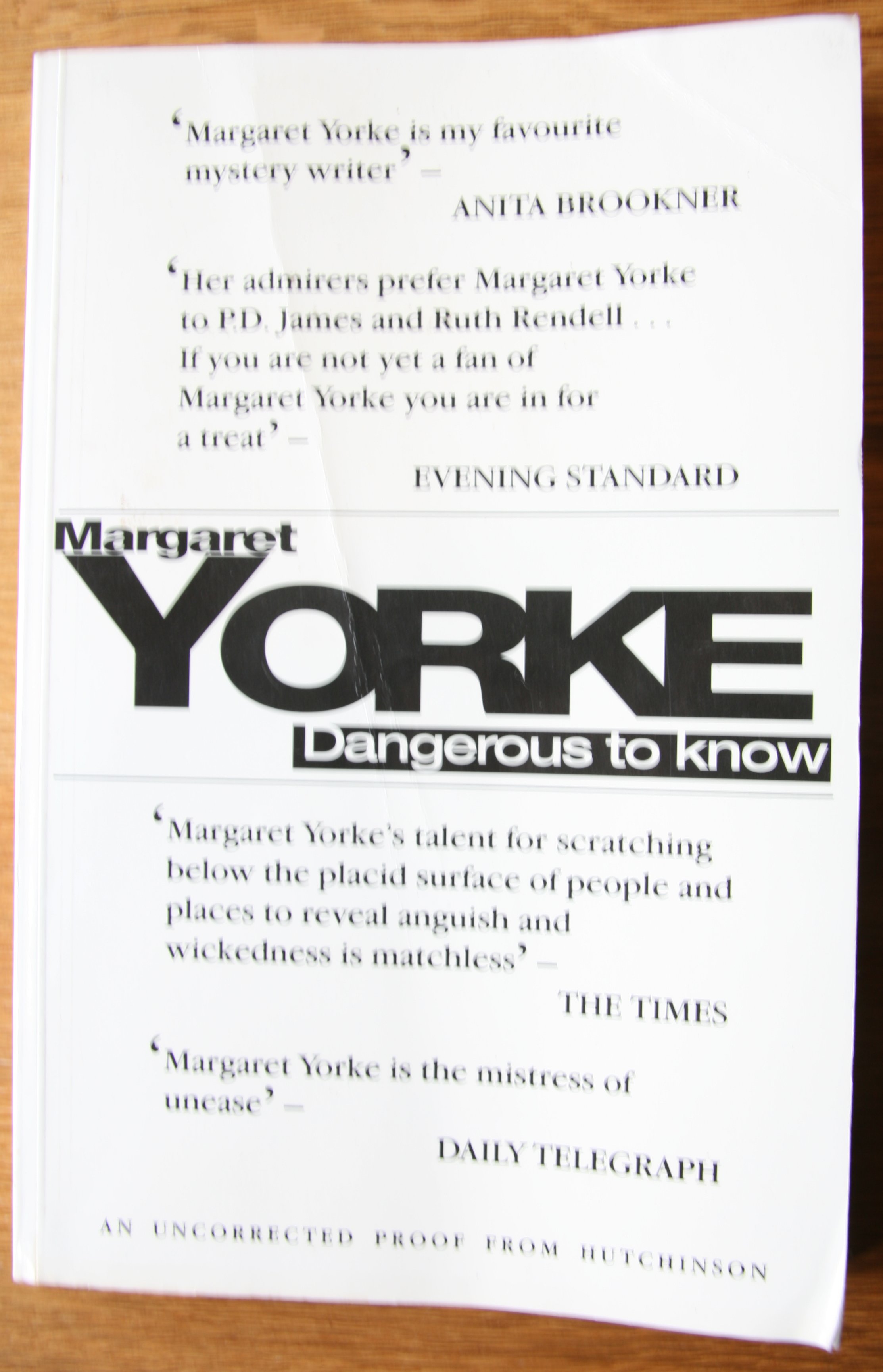
The proof
Margaret Yorke was among the first of the writers whose books I read when I became interested in crime fiction. I ‘discovered’ her and Ruth Rendell at about the same time. Pondering sadly on her death, having read obituaries and blog tributes, I have been thinking about the last time I read one of her books. Called Dangerous to Know, it was published about twenty years ago. I finished it last winter, having finally borrowed it from my friend Sally, who lives in London, after reading it in short bursts each time I went to stay with her over the period of a year or so. It is a psychological thriller about a man with a dangerously-inflated ego who victimises his wife and daughters and eventually turns to murdering women who he believes have slighted him.
Sally’s copy is a proof from her time working as a bookseller. Finding it again has made me blush, for I realise that by still having it in my possession I have myself committed a crime which I abhor, that of borrowing a book and not returning it to its owner! I am penitent. Dangerous to Know will be restored to Sally next time we meet.
Margaret Yorke produced novels almost once a year for over forty years: an incredible achievement.
Anthony Horowitz – The House of Silk
 I’ve just finished reading The House of Silk, by Anthony Horowitz. Published last year, it is a modern addition to the Sherlock Holmes canon that was commissioned by the Conan Doyle estate. Usually I hate prequels and sequels to well-known classics that have been written by present-day authors, so I began this one with a certain amount of scepticism as well as curiosity. However, I finished it in two sittings and I am full of praise. It is excellent! Not only does Anthony Horowitz succeed in capturing exactly the rhythms of Conan Doyle’s prose and in devising a plot that could have come straight from the brain of the master, but his novel also seems to me to be historically accurate; I can find no jarring anachronisms in his depiction of late nineteenth-century London (and I have read many books that were written during this period). Furthermore, the novel resonates with the modern reader by exploring a topic that is, unfortunately, much in the news at the moment: the abuse of vulnerable children.
I still wonder, though, why do it? I can understand why Anthony Horowitz agreed to it, of course! But why did the Conan Doyle estate want this extra book? Why are we so fascinated with modern takes on eras and situations that have already been written about brilliantly by contemporary writers? It is the Downton Abbey syndrome. I can’t explain it.
Anne Zouroudi – a lesson in style
 To read that which is beautifully written is a joy and a burst of unanticipated surprise in these days of abbreviated txt and abrupt communication. I have recently re-visited Anne Zouroudi’s The Messenger of Athens and remain as captivated as ever by the author’s capacity to express the hidden significance of things and to create a mood by magic, for we are barely conscious of her technique, so mesmerised are we by her unaffected style and visual clarity. It is not just the Greek island topography, which is evoked by subtle selection of appropriate detail and diction, but the darker touches of her sharp and cynical delineation of human nature and the sense of people’s insignificance in the wider scheme of things that nudge us into a world which is tellingly harsh; the irony of this in what is a stereotypical tourist setting is striking. A deceptively simple example from the text (four letters) is the paragraph describing how Thodoris Hatzistratis’ ‘Grandpa’ (such a warm and comfortably affectionate term) has been laid out for burial by the women, his appearance rejuvenated in death and by their ministrations. Delicate use of pejorative vocabulary, such as ‘jaundiced’, suggests a darker tone. Then, in a powerfully brief one-sentence paragraph, comes: ‘Around his nostrils, a fat fly crawled.’
Anne doesn’t know me, but I became more interested in her work after I attended a seminar that she gave at Bloomsbury Publishing in June. If you haven’t read her novels, you should.
Trains to Liverpool

I have almost finished reading The Suspect, by Michael Robotham. I hadn’t come across the author before – the book was recommended to me by a friend. I am extremely impressed by Robotham’s skilful characterisation and especially by the way that he gains the reader’s sympathy for the protagonist, who is not a very attractive character. I’m fascinated that one of the pivotal events of the novel involves a train journey to Liverpool. By coincidence, a train journey to Liverpool is also significant in the plot of my own novel, In the Family, although of course for a different purpose and with a very different outcome: Robotham’s Professor O’Loughlin finds evidence that will vindicate him in Liverpool, while my own character, Hedley Atkins, goes there to meet catastrophe. I am also gratified (See my blog entry of October 25th.) to note that the opening chapter of The Suspect gives a detailed account of the history of a cancer patient and his rescue from a suicide attempt and that this character does not appear in the novel again!
Mycology and my recommended read

Amanita muscaria (fly agaric)
It is a clear crisp autumn day today. Although the sunshine is bright, it contains more than a hint of winter. The leaves are falling fast, but the woods are still a kaleidoscope of burnished colours. Walking with the dog (mercifully, early enough to miss the shooters), I noticed that last week’s dismal mists and drizzle have coaxed out some glorious displays of fungi. Most people would have recognised the fly agarics beneath the birches, but particularly impressive to me was a cohort of tiny orange bracket fungi which had formed a symmetrical pattern across the whole of a fallen forked branch. It reminded me immediately of Laura Ellen Joyce’s impressive debut novel The Museum of Atheism. It will be published by Salt on November 15th
and I have been privileged to read an advance copy. It is about the murder of a child beauty queen and its theme is moral decay. Laura reinforces this by opening each chapter with a short description of a species of fungus, which is brilliantly effective. Check it out on the Salt website.
Reading The Riddle
I recently finished reading ‘The Riddle of the Sands’, by Erskine Childers. First published in 1902, it has rarely been out of print since, and has been called the first modern crime novel. (This depends on what ‘modern’ means – I could make a strong case for ‘The Woman in White’, ‘Adam Bede’ and even ‘Moll Flanders’.) ‘The Riddle of the Sands’ is extraordinary for its evocation of the Dutch lowlands, for capturing the taste, smell, companionship and compromise of life on a small boat and above all for its prescience – it imagines a German invasion of England twelve years before the Great War started. But all of this has been said before. What fascinates me is that there is only one woman in the story, and she has a tiny bit part. Nevertheless, it was because of her that the book captivated me. Is she innocent or guilty? Will she betray her father or her lover? Despite the (meagre) descriptions of her strong, brown masculine hands and very serviceable thick woollen clothes, she is convincingly enigmatic and sexually alluring: the modern woman captured in the act of being born, perhaps… and a lasting tribute to the lightness of touch of Childers’ genius.
 Christina James, crime novelist