

My ten top tips for revising text for publication

I was recently asked how much I revise when I’m working on a novel, and when I do it. The answer is: always several times; sometimes many times. If I’m not too tired, I look over the day’s effort again immediately I’ve finished writing. Whether I do this or not, I always scrutinise it the following day before I start writing again and make minor changes. Books usually fall into natural sections, and I’ll devote a day or two to working through a whole section in one go once I’ve finished it, to make sure that it hangs together and that I’ve been consistent. Finally, I revise the whole MS before I send it to my editor, sometimes more than once.
I’ve been asked for my ten top revision tips, so here goes!
- Make sure you get both the tense and the mood of verbs correct. This may sound easy, and it may even make me look stupid for saying it, but it’s surprising how often I read novels that have been marred by this mistake. And yes, I catch myself out sometimes.
- Scrutinise the word order in each sentence that you write. I don’t just mean taking care with words like ‘only’ which have different meanings depending on where they appear in the sentence – I believe that achieving the optimum word order is essential to good writing. If you look at the sentence structure and word order used by a writer whom you really admire, you’ll see what I mean.
- Be descriptive, but sparingly. It’s true what people say about purple passages!
- Try really hard to make the dialogue sound natural. Think your way into how the character who is speaking phrases his or her speech and listen to the voice. At the same time, be aware that making it sound natural doesn’t mean copying nature! I’ve just been reading a novel in which two of the main characters engage in the kind of desultory breakfast conversation that I often have with my husband. Not only does it not go anywhere, it unfocuses the reader’s attention and dissipates the tension that the author has built up in the preceding chapters.
- If you create an interior monologue for one or more of your main characters, ensure that you give it enough depth. It’s easy to fall into the trap of making it too brittle or superficial. It’s quite a hard technique to work with and so, if you’re not sure whether you’ve succeeded, abandon it!
- Apply my last point to all of your work, quite ruthlessly. Be your own fiercest critic. If you’re not completely happy with something, or think that it might not be working, it probably isn’t.
- Check that you have used the same names for your characters throughout and haven’t introduced some subtle changes along the way. This may sound an unlikely mistake, but it’s certainly one that I’ve made – for example, in the first complete draft of In the Family, Ronald Atkins was also called Roland and Rodney on some occasions – and, having talked to other authors about it, I’ve discovered that it’s quite a common fault. Readers are bound to be irritated by it!
- If you write a fairly detailed outline of the plot – as I usually do – you don’t have to stick to this slavishly if you’re inspired by some better ideas once you’ve started writing. However, be certain that these work within the context of the whole and don’t present you with a lot of inconsistencies that require making many changes, or force you to offer outlandish explanations that stretch credibility.
- Also on the subject of plot construction, try to write the chapters in chronological sequence, even if you plan to present them in a different order in the final version. If you don’t, you are almost bound to introduce anachronisms that will need ironing out afterwards. This is perhaps my own greatest fault. I’m trying really hard to practise what I preach, now that I’ve started my third DI Yates novel!
- Turn off the spell-checker, which has a nasty habit of introducing US spellings or unexpected quirks!
I refer to [Judith] Butcher’s Copy-editing: The Cambridge Handbook for Editors, Copy-editors and Proofreaders, which is an invaluable resource for ensuring consistency and proper presentation of material for publication.
Finally, may I add that I take very seriously the comments of readers about my writing. When I weigh them up, I find that they tend to have objectivity and honesty and I value their constructive and helpful insights.
The spurs have it…

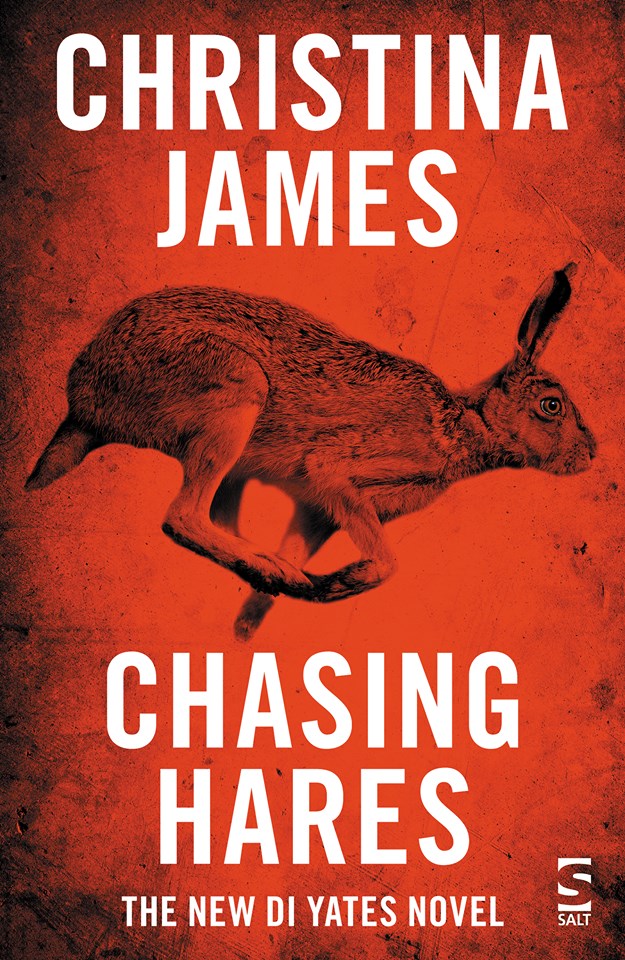
Some creatures capture the human imagination more readily than others. Hares have always been magical, perhaps because of their singular behaviour during the spring, perhaps because of the magnificent way in which they will sit up on their hind legs in a field, catch a whiff or a glimpse of danger and bound away, leaping and weaving, ducking and taking advantage of cover and terrain, to throw any would-be pursuers off the scent; most mystical of all, the near-silent pair dance through a woodland glade, for once so mutually bonding that a standing human watcher is passed unnoticed. By comparison, the rabbit is streets behind in the enigma stakes. He shuffles and bobs about, waving his scut ineffectually and, as soon as he takes fright, scampers off with no pretence at dignity or even of making a measured retreat.
Domestic animals exercise similarly varying effects upon the fancy. I’ve never been close to horses, but I can see why people say that they’re noble. There’s a certain stolid majesty about cows as they stand grazing and gazing; pigs endear with their uncannily human-like squabbles. However, farmyard animals generally don’t bring with them the same depth of historical literary allusion, maybe because writers of earlier generations were more accustomed to draw their metaphors from the wild, maybe because we know that the cows and pigs and horses of, say, late mediaeval England bore only a generic resemblance to the ones that we see today. For at least the last two hundred years animal husbandry has involved the intensively selective breeding of farm animals in order to accentuate their most marketable and productive features: today’s cows and sheep are very different from those that feature in eighteenth century paintings; pigs are bred to yield less fatty meat as dietary preferences change. There’s also often a kind of placidity about the creatures found on the modern farm, as if they understand and have accepted that their purpose in life is to bend to the will of their human masters in return for plenty of good food.
Bulls are an exception, of course. I’ve known some very tricky bulls, especially those unpredictable Channel Islands fellows, only too ready to vent on unwary passers-by their frustration and bad tempers. When a bull catches your eye and rolls his own, stamps his hoof and tosses his head – or makes any of these movements – you know at once that discretion is the better part of valour and that, if there is no stile nearby, your best bet is to dive over the nearest hedge or barbed wire fence, a few nasty scratches being preferable to serious injury or death. Bulls in stalls can be even more irate and the escape routes more limited; during my youth, I knew of several Lincolnshire farmers who were gored by bulls in the byre, one of them fatally. The bull does not take kindly to having his masculinity compromised. Yet still they are domesticated, at least in the sense that they look nothing like their forbears.
One creature, however, that evokes for me all the mystery and romance, the pomp and pride as well as the murderousness, of the Middle Ages, is the cock. I’m well aware that chickens have also been subject to generations of selective breeding techniques designed to improve either the laying-power of the hens or the quality of meat for the pot; yet a proud cock, strutting among his hens, still seems to carry the primeval stamp of his ancient forefathers. He shakes his comb and wattles menacingly at impertinent human observers; he preens and poses in the midst of his harem, spurs sharp and threatening. He is a fighter; barbarously, his fighting instinct has been exploited by men until quite recent times. It is the cock who, through the ages, has serenaded the dawn and it is for this, above all else, that he has secured his pole position in the literary canon. From Aesop’s fighting cocks to the rooster after whose third crow Simon Peter betrayed Christ (unusually, all four Gospels agree about this), to Chaucer’s Chauntecleer to stories from other cultures, such as the generations-old Indian story of the cock and the hen, cocks have always crowed and have always been part of myth and fable, woven by talented narrators into great tall stories.
I met a particularly handsome Chanticleer yesterday, when visiting one of my oldest friends, who lives in Lancashire. I’ve taken his picture. Chaucer would have loved him.

Every word stabs…
Motive is a fascinating part of murder, because it is bound up with the psychology of the killer. I find myself thinking of the motives that have driven people to dispose of others: resentment, hatred, envy, greed, retaliation, revenge, fear, anger… very human emotions that we all experience at one time or another, thankfully without fatalities. But what is it that pushes someone beyond the self-control that limits the majority? If we are to believe some crime fiction and the apparent evidence of real cases, there is sometimes the desire for fame, or notoriety, but this is perhaps very rare, if true at all.
Of course, investigators of murder cases think very closely indeed about motive, as that may well point to the perpetrator, or at least narrow down the possibilities: Who might have had a grudge? Who was close to the victim, by kin- or friendship? Who might have gained from the death?
These days, unfortunately, there are more frequently political motives for murder, when reason is overpowered by belief, and we might well gasp in astonishment that anyone could be fanatical enough to take a life in so public a way as last week in Woolwich. Most murderers seek anonymity.
It’s common to hear people say, “I’d kill for a… beer, a smoke, a cup of tea, a Mars Bar”, but the statement’s intentional hyperbole confirms its lack of seriousness. However, I have heard one person say, quite matter-of-factly and without any obvious intent to shock, that he could kill, full stop. Needless to say, I found his comment quite unnerving and, after considering the kind of person he seemed to be, not beyond the bounds of possibility. I have also turned the focus upon myself and asked myself if I could kill and, if yes, under what circumstances and with what motive? Crime of passion? Maternal defence of child? Revenge for abuse? Being for some reason or another at wits’ end? And if I were to commit murder, would I do it in a calculated way so as to minimise the risk of detection? Here I am, essentially a very pacific person, heading the way madness lies; however, as a crime writer, I do spend time on self-analysis, the better to understand the minds of my fictional characters.
Regular readers of this blog will see a link here with my recent rhubarb post, which of course was tongue-in-cheek stuff, and might now be determining never to cross my path. Fear not, whatever murderous intentions I have will be sated with words.
I admit it: I do like Harry…
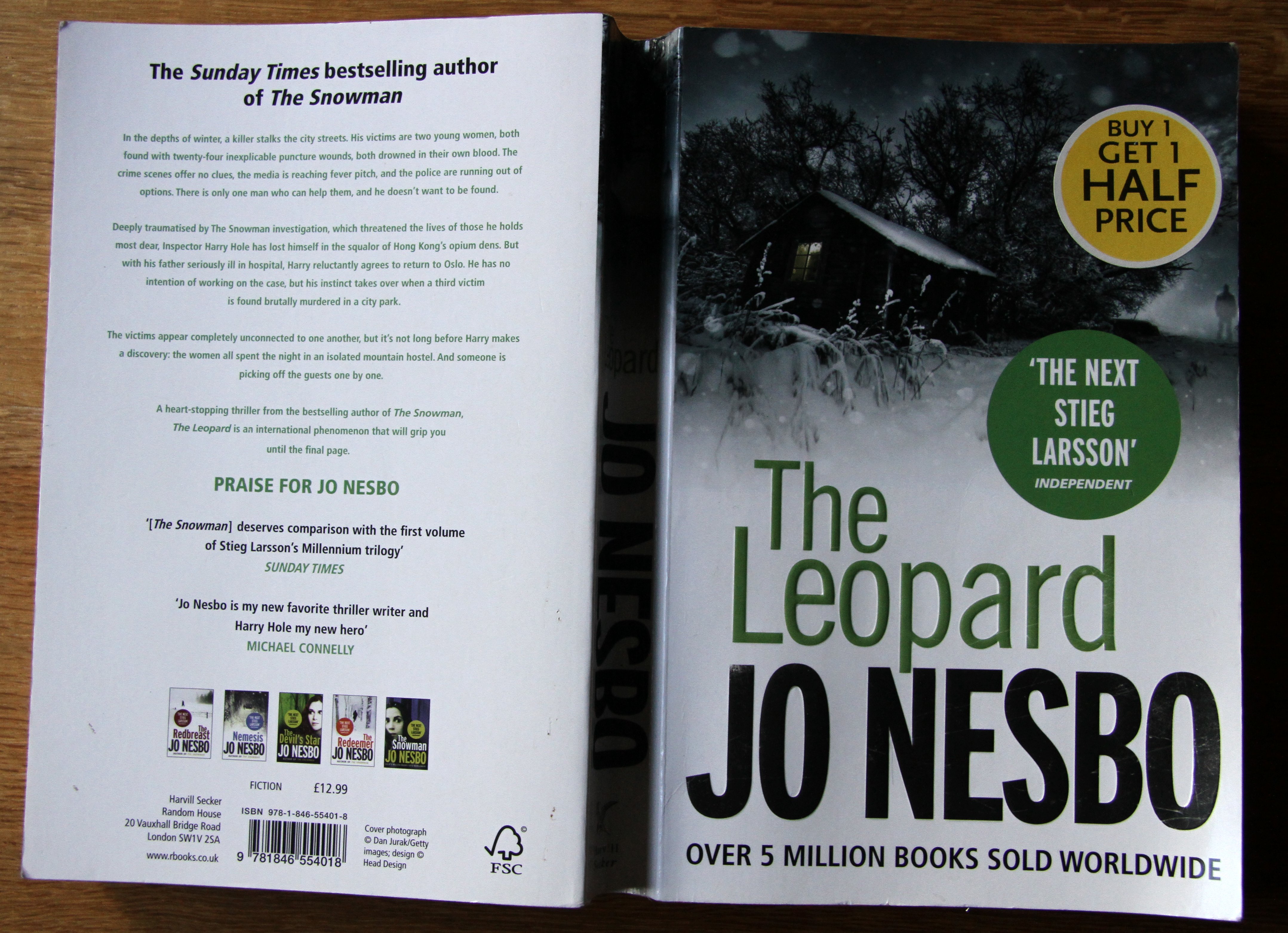
What is it that grabs in a Jo Nesbo? Harry Hole has been very carefully conceived. Part of the strong tradition of flawed heroes, Harry has a Dirty Harry quality which was bound to impress me as soon as I read my first Nesbo. What is it that makes him both insufferable and dead sexy at the same time? He has the capacity to love, to remember, to feel, to empathise, to anticipate, but sacrifices his relationships on the altar of his determination to track down and defeat serial killers; he is scarcely attractive, but lithe and angular, case-hardened, rough – an alcoholic, a loner and an oddball; yet he has integrity, understanding, commitment. He is every thinking girl’s dream bit of rough. And he’s a wizard with the ’cuffs! Nesbo knows that a character who stands up for the morality of honest policing and opposes deceit and hypocrisy in the force has the captivating appeal of Robin Hood, a renegade against the corruption of power. He comes to us with a carefully-wrought family background which makes him essentially human, for he cannot escape his sense of kinship duty; he has inner anger and a wealth of inconsolable regrets; his past haunts him. He is doomed and slowly abusing his body to death.
I could wax lyrical about Nesbo’s plots, but, as regular readers here know, I’m not so struck on the meticulous detail of killer method. Nevertheless, it is Harry I come back to, mesmerised by the depth and range of authorial characterisation that makes him credible and, for fiction, a brilliant creation.
You pronounce Hole ‘Hoola’, by the way; a Norwegian friend told me. But ‘hole’ seems somehow appropriate; he always seems to be in one!
I can’t help myself: when I read Nesbo, I’m a Rakel or a Kaja; nothing like immersion in a good novel… and willing suspension of disbelief!
Salt Publishing crime writer event

May I use today’s post to flag up a Salt Publishing event at Gower Street Waterstones, an evening with Salt’s crime authors, Laura Ellen Joyce, Matthew Pritchard and myself, at which we’ll be sharing both our books and experiences. For those new to this blog, here are some earlier posts which may interest you in relation to the authors and the venue:
Meeting Matthew Pritchard at BAFTA 195
I do hope that you will join us on this occasion, if you are able to do so; all three of us are very much looking forward to meeting you in this very lovely bookshop.
Raising the bar…

Yesterday evening, I went with my husband to our favourite local Italian restaurant. It’s quite an amazing place to find in a small city like Wakefield: housed in a large building with two floors, it has been handsomely fitted out. The tables have marble tops; there are tasteful pictures and mirrors on the walls. The waiters are impeccably polite and wear a crisp informal uniform of white shirts and black trousers. The menu has always been varied, the prices reasonable. This restaurant has succeeded in combining professionalism with a personal touch.
For the past three years or so, its appeal has been enhanced by the services of an inspired and dedicated Portuguese manager. He told us that he brought his family to Wakefield because there was no work in Portugal; that he had tried Putney, but found the cost of living in London too high; that he was proud to be running what has many times been described as the best restaurant in the city; and that, aside from returning to Portugal once a year for a family reunion, he is not interested in holidays. Under his aegis were instituted a daily ‘specials’ board, cheaper prices for pasta dishes and pizzas on weekdays and free hors d’oeuvres for diners while consulting the menu. For regular customers like us, he always added something extra: free tomato bread with the main course, or a complimentary limoncello with the coffee.
Yesterday he wasn’t there. He could have been taking a day off – it was Monday, after all, and the restaurant wasn’t busy. I don’t think so, however. We had more than an inkling that he had moved on, attracted perhaps by the higher salaries on offer in a bigger city, or snapped up by one of the big Yorkshire hotels. We didn’t ask the waiter, who was as attentive and polite as ever, but subtle changes suggested that the Portuguese manager was no longer influencing operations. There was no ‘specials’ board; there were fewer choices on the menu (the vegetable-based pizzas had disappeared and several types of pasta were no longer on offer); there were no weekday reductions. Although the waiter recognised us and gave us a friendly greeting, we received no complimentary extras.
The food was as good and as well presented as ever, the service faultless. If it had been our first time dining at this restaurant, we’d have left well-pleased, extolling its virtues. As it was, we felt slightly short-changed… and more than a little sad that we’ll probably never meet the Portuguese manager again; conversations with him meant much more than the extras. It made me think that, although it’s true that excellence creates its own rewards, each time you set the bar higher you are creating more demanding expectations from your loyal customers. For every writer (and every blogger!), that is a challenging thought.
An old love of mine, a case of kiss and tell…

Some months ago I wrote a piece about the books on my bookshelves. I chose a shelf at random and described how I came by the books on it and whether or not I had read them. As I said then, for the most part my books have been shelved in a fairly random way. The exceptions are the two shelves devoted to books about and by George Moore and his contemporaries.
I’m not referring to George Edward Moore, the philosopher, but George Augustus Moore, the writer. As a postgraduate student, I based my research on the latter Moore and his writing career. When I was first interested in him, only Esther Waters, his most famous book, was in print. (Later the Anglo-Irish publisher Colin Smythe reprinted three or four more of his novels.) As a consequence, I spent many happy hours in secondhand bookshops and leafing through antiquarian catalogues in pursuit of his works.
Moore was an extraordinary character. Born into the largely Protestant Anglo-Irish Ascendancy, he came from a family of Catholics. (This lends some credence to their claim that they were descended from Sir Thomas More, a tale Moore himself loved to retail, though there is no positive proof that it’s true.) The Moores were, in fact, members of the more modest, untitled squirearchy. Setting little store by education and the Arts, they spent their time managing or mismanaging their estates and racing horses. The only one of Moore’s ancestors who had shown the remotest interest in literature had lived as a recluse in the second half of the eighteenth century, spending his days writing a history book that was never published – not a propitious precedent when Moore himself began to exhibit literary leanings.
His first love was painting, or at least he used that as his pretext for travelling abroad. Like many Irish artists and writers, he felt stifled by his country. When he came into his inheritance at the age of twenty-one, he departed pretty swiftly for Paris to enrol himself as a pupil at the Académie Julian. There he became an early appreciator of the French Impressionists and actually struck up a friendship with Édouard Manet. Moore was a kind of nineteenth-century gentleman’s equivalent of a groupie: he insinuated himself into the Impressionists’ consciousness by spending many hours at Les Deux Magots, the café that they frequented. He was later to pursue Zola and other authors of the school of French Naturalism in the same way.
Eventually realising that he hadn’t the talent to become a painter, Moore took up writing as very much a second-best profession. He wrote several passable, if bleak, novels in naturalistic mode, the best of which is, in my opinion, not Esther Waters, but A Drama in Muslin, a captivating satire on the Dublin marriage market. In common with other exiled Irishmen, Moore was often at his most eloquent when he wrote about Ireland. He was also an observant early adopter: Another of his Parisian acquaintances was Édouard du Jardin, who had written a book entitled Les Lauriers Sont Coupés; it embodied a style that has been dubbed ‘the melodic line’ and was actually the forerunner of the stream-of-consciousness technique; Moore wrote several evocative novels that employed this device, including The Lake, the haunting story of a priest who loses his faith and orchestrates his own disappearance by leaving his clothes on the banks of Lough Carra as if he had drowned, swimming across the lake and escaping to take passage for America (Moore Hall, Moore’s ancestral home, was built on the shores of this lake.).
After many years in exile, Moore was persuaded by W.B. Yeats to return to Ireland to take part in the so-called ‘Gaelic Revival’. Moore’s own account of this sojourn telescopes the length of time that it took; in fact, he spent most of the first decade of the twentieth century back in Ireland, working with Yeats and other luminaries, including J.M. Synge and the Irish mystic poet AE. Not that Moore ever really worked very closely with anyone: he was a past master at ‘doing his own thing’. His true masterpiece dates from this period. It is a two-part work entitled Ave Atque Vale (later changed to Hail and Farewell; the original title was simultaneously designed to poke fun at Moore’s own lack of Latin and the pretentiousness of his literary colleagues). It purports to be a factual history of the Gaelic Revival, but is really a highly-polished satire of how it unfolded in spirit. Once it was published, Ireland became too hot to hold Moore once again. He retreated to London, where, in his later years, he devoted his energies to writing whimsically discursive stories based on Greek and Roman mythology and Christianity. These were produced in beautiful limited editions that were sold by subscription. I am the proud possessor of two of them, Aphrodite in Aulis and The Brook Kerith. It was typical of Moore that the latter, his account of the life of Christ, was based not on the Gospels, but on the writings of the Essene heretics. To the end, Moore loved to stir up controversy whenever he could.
This was true also of his private life, which was possibly more blameless than he would have had people believe. He never married, but conducted a number of clandestine affairs with well-born women, the most scandalous of which took place with Maud Alice Burke, an American heiress, prior to her marriage to Bache Cunard, heir to the shipping line. Later, transformed into the society hostess ‘Emerald’ Cunard, she resumed the affair, until Moore was ousted from her affections by Sir Thomas Beecham. Moore was widely reputed to be the father of her daughter, Nancy Cunard, herself a writer and friend of Hemingway and Ezra Pound. He encouraged his friends and acquaintances, including Nancy herself, to believe in the truth of this rumour. However, the gossip went that his sexual prowess was in some doubt. When he was still a young man, a contemporary had jibed that ‘some men kiss and never tell; Moore tells but never kisses’. He never lived this down.
Sadly, Moore Hall was burnt down in 1923 in one of the recurring cycles of the Irish troubles, not because Moore was an absentee landlord, but because his younger brother, Colonel Maurice Moore, served in the British army. I have visited the ruin twice. It is one of those unhappily poignant roofless Irish mansions, its walls still standing foursquare, the windows blank, the floorless interior home only to the spinney of gangling trees that poke above the parapet in their quest for light.
What do my thoughts about George Moore have to do with crime fiction? He certainly doesn’t write about crime, except obliquely: he is less incisive than Dickens, but as a young man he was concerned with and wrote about the social ills of his day. His works are perhaps not of the first rank, though Hail and Farewell comes pretty close. He is not my favourite writer – that is certainly Jane Austen – nor even one whose works I re-read many times. But I feel that George is part of me; decades ago, he succeeded in getting under my skin. In some way, therefore, I am certain that he has also inveigled himself into the fabric of my writing.
‘even MPs fail to speak properly’ – Oh, the glorious irony of that word ‘even’!

I was amused to read in today’s paper that standards of grammar are slipping ‘even‘ among MPs. I’m amazed that the author considers the linguistic prowess of politicians to be the yardstick for the nation’s performance in this respect. For years I have been entertained by the dreadful but often hilarious ways by which MPs mangle the language. Those most self-consciously aware of the way in which they speak are prone to make the worst gaffes. Mrs Thatcher’s Tudoresque announcement “We have become a grandmother” is etched on the national memory. Very recently, Michael Gove, that staunch advocate of traditional grammar school education who now wants to extend the length of school days to workhouse proportions, explained his rationale thus: “If you look at the length of the school day in England, the length of the summer holiday, and we compare it to the extra tuition and support that children are receiving elsewhere, then we are fighting or actually running in this global race in a way that ensures that we start with a significant handicap.” Crystal clear, mellifluous, grammatically rigorous and beautifully structured, isn’t it?
I’m not sure that I agree with the hypothesis that this slip in standards, if indeed it exists universally, is caused by shortcomings in our formal education; there may be a more profound cultural change at work. My grandmother left school at the age of fourteen with no formal qualifications. Although she was deeply interested in learning and continued to read widely throughout her long life, the number of days that she actually spent at school was pitifully small, because she was the eldest of nine children and expected to stay at home, sometimes for months, whenever her mother had another baby or one of her siblings was ill. ‘In service’ for the whole of her working life (which began when she was fourteen and finished when she was seventy-four), she prided herself on speaking ‘properly’. I remember what she said to have been always grammatically correct and exquisitely enunciated, although it was not delivered in what came to be known as ‘Received Pronunciation’, because she always retained the slight burr and elongated vowels of her native county, Kent.
Her speech was picturesque in ways that have almost been lost. I think she must have thought in pictures and she had a fund of sayings for every occasion. Not one to suffer fools gladly, she used these sayings to convey her opinion (relatively) politely, but with disarming directness: “Who’s upset your apple-cart?” she would say, fixing me with a bright eye if I were behaving in a sulky fashion; “No fool like an old fool,” she would trot out summarily if one of her sisters related a mishap that she believed had been the consequence of a stupid decision; “Cleanliness is next to godliness”, she rapped out at her neighbour, an old man to whom she always referred as ‘Hicks’ (she regarded him as not quite her social equal), when he told her that he was unable to perform his usual weekly task of carrying out her dustbin to the street because he had a painful boil on his neck. “Red hat, no drawers,” she proclaimed in a penetrating whisper when a lady sporting this outré headgear passed us in the street.
One of the most fascinating things about language is that it is a living thing. Like all living things, it changes and evolves. We seem to be experiencing a rapid period of change in our use of language at present. I don’t think that this means that it is in terminal decline. What will emerge will be a new set of ‘rules’. (How the rules change over time can be demonstrated by consulting early editions of Fowler’s Modern English Usage.) The reasons for the present shifts in usage seem to me to be complex: Some can indeed be blamed on ‘poor’ education, but, as my grandmother’s example demonstrates, adopting a lifelong reading habit is the most effective way of understanding language and using it well; some owe themselves to a rapid influx of imported words and sayings, predominantly (such is the power of media) from the USA; some happen because the speaker (e.g. Mr Gove), although well-educated, does not take care to present a series of related thoughts in a logical sequence. As any writer knows, when you have something complex to convey, crafting a series of short, simple sentences may be the best approach to take. Of course, we need to pay attention to these things, but above all we need to guard against allowing the lifeblood to be drained from our speech by becoming too ‘PC’. I’m not talking about being rude or slanderous, but, like my grandmother, we must continue to harness the power of the language itself to convey our true opinions, not hide behind some anaemic gobbledygook that has been dreamed up by the thought police, or politicians!
As a totally irrelevant aside, it was my grandmother who first taught me about irony. Visiting my mother one day, she announced that my Great-Uncle Arthur was in hospital with a chest infection and that my Great-Aunt Lily had ‘fallen up the steps’ on her way to see him and cracked three of her ribs. Both she and my mother were then overcome by a burst of spontaneous laughter. I was shocked at the time, but realised later that it was the irony of the situation that amused them, not poor Lily’s misfortune. Jane Austen, not herself the product of a formal education but the mistress of irony, would have smiled.
Mr. Gove, perhaps you may pontificate when you have acquired the verbal skills to do so!
A publication date and a tribute to two very good friends…
In this blog, I try to write mostly about crime-related topics, people, places and things that interest me, aspects of writing and other writers and their work. It isn’t intended merely as a vehicle to promote my own work; this was a conscious decision that I made right at the start, because I quickly tire of blogs by authors who use them too blatantly for this purpose.
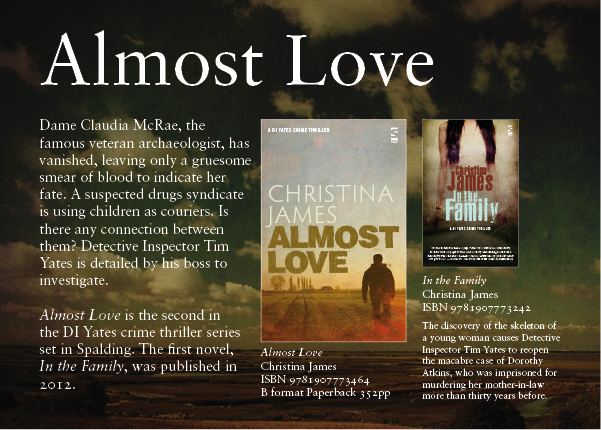
However, I hope that you will look upon today’s post indulgently, because I have to confess that it is indeed about promoting my next book, Almost Love, which will be published on June 15th 2013. It is a promotional piece with a difference, however, because it also celebrates a gift to me by my publisher, Chris Hamilton-Emery of Salt. Before In the Family was published, Chris designed a postcard based on the jacket; I sent this, with a short personal message, to as many people (friends, booksellers, librarians, colleagues) as I thought might be interested in it. I received some lovely replies; it may have helped to generate some interest in the book.
Today, Chris sent a similar promotional postcard for Almost Love. In fact, it features both the novels. I am delighted with it and I think that it is a thing of beauty. I’d like to share it with you; that is why it is the subject of today’s post.
I’d also like to say how much I appreciate Chris and Jen Hamilton-Emery, for their unfailing good-humour and encouragement and also for all their hard work on my behalf. Thank you, both!
Scheherazade… oh, yes!
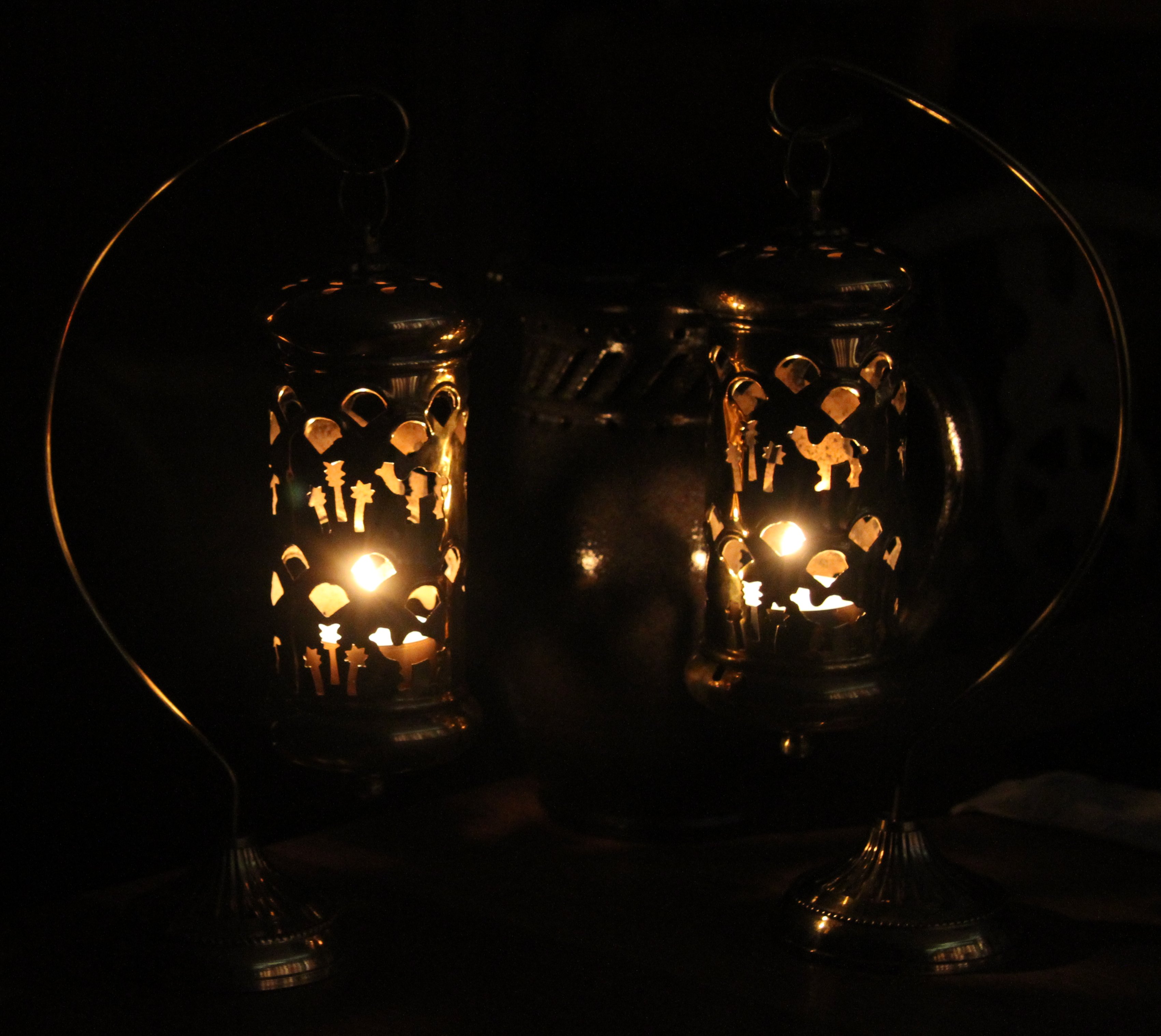
In the course of doing his job, my son visits many countries. Often, all he sees is the inside of airports, offices and hotels, but, if he has a few hours to spare, he always tries to bring back a present. In consequence, I am the appreciative owner of a wide variety of gifts from diverse parts of the world. They include a dressing-gown of old gold silk, beautifully embroidered in blues and reds, from China, and a compelling kingfisher-swallowing-catch, made of pieces of scrap metal, from South Africa.
Before he came to visit this weekend, I had barely registered that his most recent trip away had been to the United Arab Emirates and he told me that in fact he had spent barely forty-eight hours there. Nevertheless, he managed to carve out a few minutes to discover and purchase a very fine pair of brass lamps. Shaped not unlike miners’ lamps, they are decorated with cut-outs, and designed to take household candles.
When I saw them, I was immediately reminded of the smoky corridors and dusky but splendidly-furnished lamp-lit private rooms of the King in One Thousand and One Nights to whom Scheherazade spun her nightly tale, each time leaving the King spellbound until she resumed her narrative the next evening. This is an art that has been somewhat lost to modern storytelling, though it was, of course, practised to perfection by Dickens and other famous Victorian writers who serialised their work in newspapers and magazines. I’ve read that Dickens and Thackeray were often still scribbling frantically while a boy from the magazine in question waited for copy on the other side of the door. I’d love to be able to write a crime novel in this fashion, but I suspect that it would be beyond my powers. I wonder if these writers plotted each work out in its entirety, or just made it up as they went along? And, if the latter, how did they manage to avoid the litany of inconsistencies and anachronisms that I have to iron out of my own novels once the first draft has been completed?
As for Scheherazade, what an example of a very clever woman, refined, charming, witty, knowledgeable across the disciplines and multi-talented! But her most remarkable skill was in her storytelling!
 Christina James, crime novelist