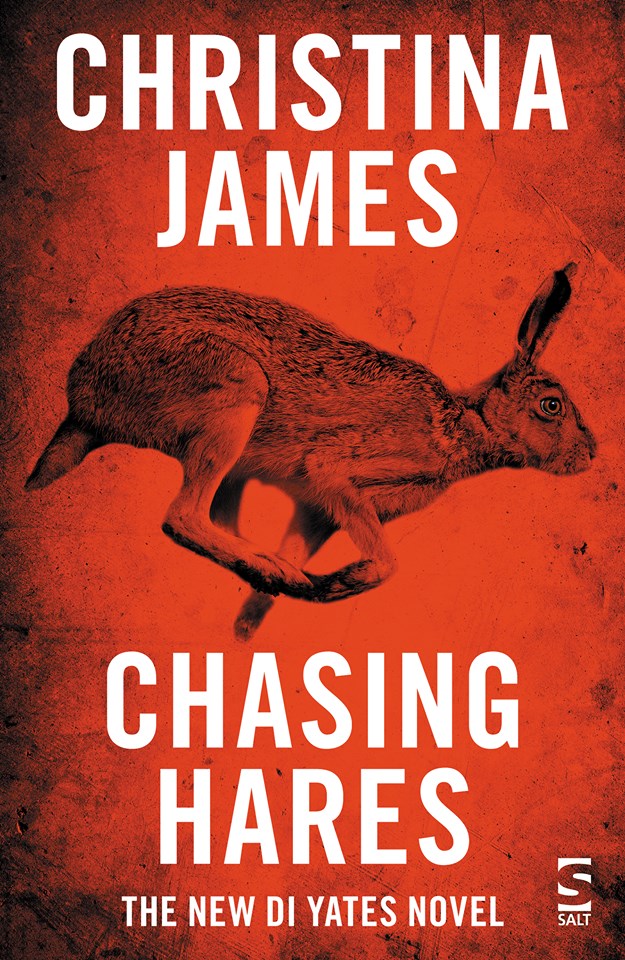


Shades of meaning: how exquisitely delicate are the implications of words!
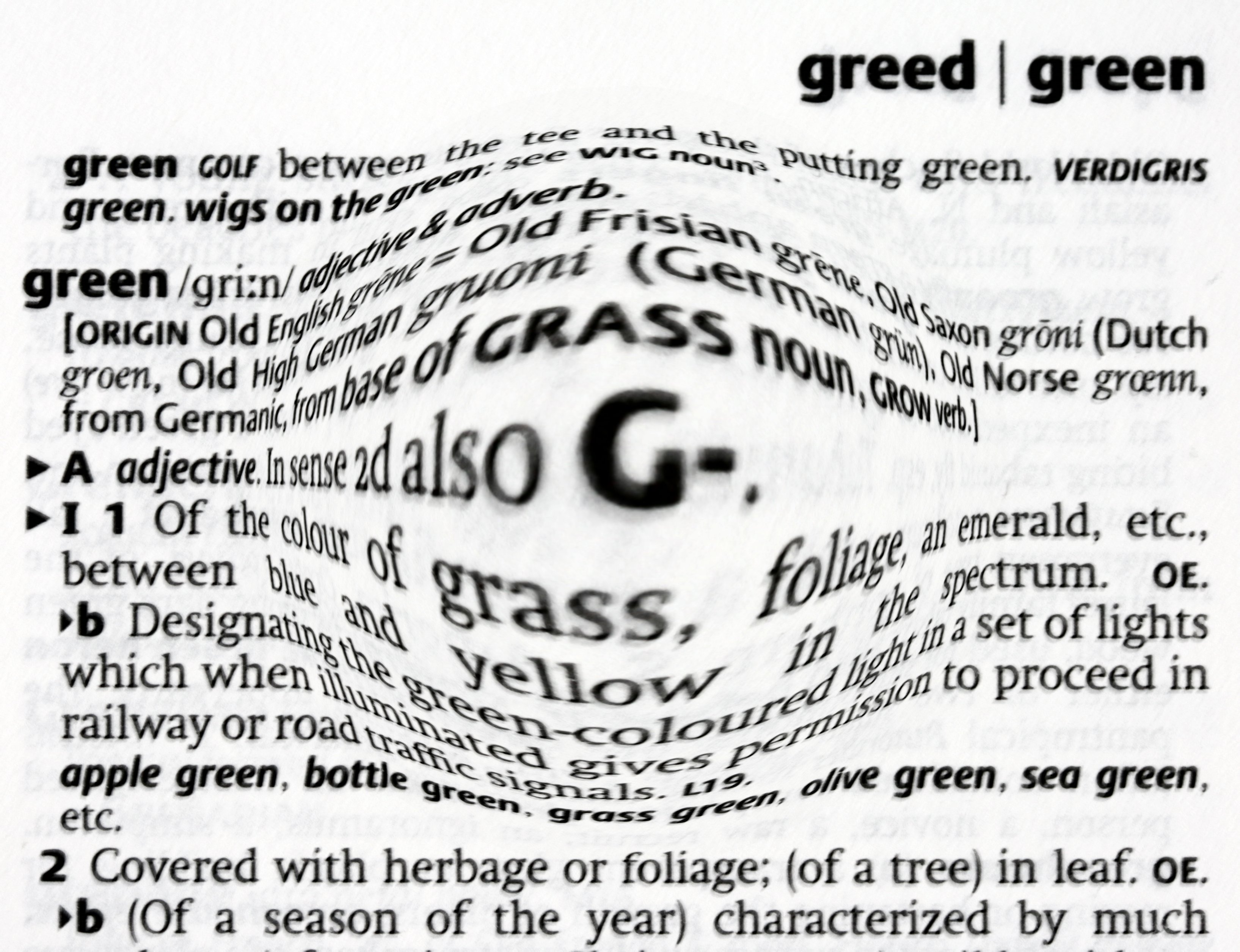
In our household, we often have energetic arguments about colour. I don’t mean that any of us is colour-blind; we can all distinguish between red and green. However, I often say that something is blue when my husband and son think it is green and my husband has a pair of grey trousers that he insists on calling ‘brown’, which doesn’t help me when I’m trying to help him to find them! My daughter-in-law speaks a glorious palette of colours that can nevertheless leave my son mystified.
What I’d dearly like to know is whether each of our optic nerves registers colours differently, or whether we are actually seeing the same colour but using different words to describe it. Is the problem sensual or semantic?
As a writer, I am acutely aware that the same word resonates with different people in quite different ways. A client (from the day-job) was once very offended when I said that some research that he had undertaken was ‘robust’. It is, of course, a term commonly used to indicate that research has been carried out properly, but he thought that it smacked of rudeness.
I acknowledge that, when it comes to particular words, I myself have many preferences and prejudices. For example, I’ve never been much of a fan of the words ‘beauty’ and ‘beautiful’; to me, they carry undertones of full-blown roses, enjoying their last blast of loveliness before withering. I used to like ‘lovely’, but it has been debased by its idiomatic use for everything from ‘nice’ meals out to individual character and personality, especially if the person in question has died. If the deceased was a woman, a newspaper reporter usually manages to dredge up a friend or acquaintance who will describe her as having been ‘lovely’ or, even more frequently, ‘bubbly’, which to me always conjures up an image of her chained to the sink, up to her elbows in soap-suds (‘Hands that do dishes…’). And I think that ‘pleasant’ is a really nastily bland word, although, in its case, I know that I associate it with someone who turned out to be other than he seemed; it was one of his favourite epithets.
Words associated with crime hold particular connotations and resonances for me. ‘Murder’ is a very grand word, sometimes too lofty for the often grubby and chaotic crimes that are committed in its name. ‘Kill’ and ‘killer’ have more immediacy and strike more terror into the heart. Similarly, while ‘murdered’ conjures up the image of a lifeless body, a verb that conveys how the murder has been committed evokes the pity and horror of knowing how the victim suffered before he or she died: used within context, ‘shot’, ‘stabbed’ and ‘poisoned’ can be almost unbearable words, whilst ‘liquidate’ strikes with the fear of knowing that a ruthless and unstoppable mind has been at work… and is still out there. Any description associated with blood and bleeding makes me want to hide behind the sofa, metaphorically speaking, and, while I sometimes have to create blood-stained scenes myself, I try to keep them to a minimum. I am not a blood-and-guts writer from conviction, but I am also not one, I acknowledge, out of squeamishness.
When I think of how words have evolved in the English language, sometimes within small communities largely cut off from the wider world for hundreds of years, it amazes me that, despite the differences in perception of shades of meaning which we all experience, 90% of the time we manage to communicate the same thing with extraordinary efficiency. The remaining, stubbornly ambiguous 10%, consisting of differences in interpretation, different approaches to innuendo, and the bending of the language to just this side of breaking-point to wrest from it a new image of startling freshness and truth, should be cherished. That is what makes us different from each other; it allows us to be surprised and delighted by writers who deploy our language in ways which we ourselves should never have considered.
Let us be nice in our use of words!
Here’s one I prepared earlier…
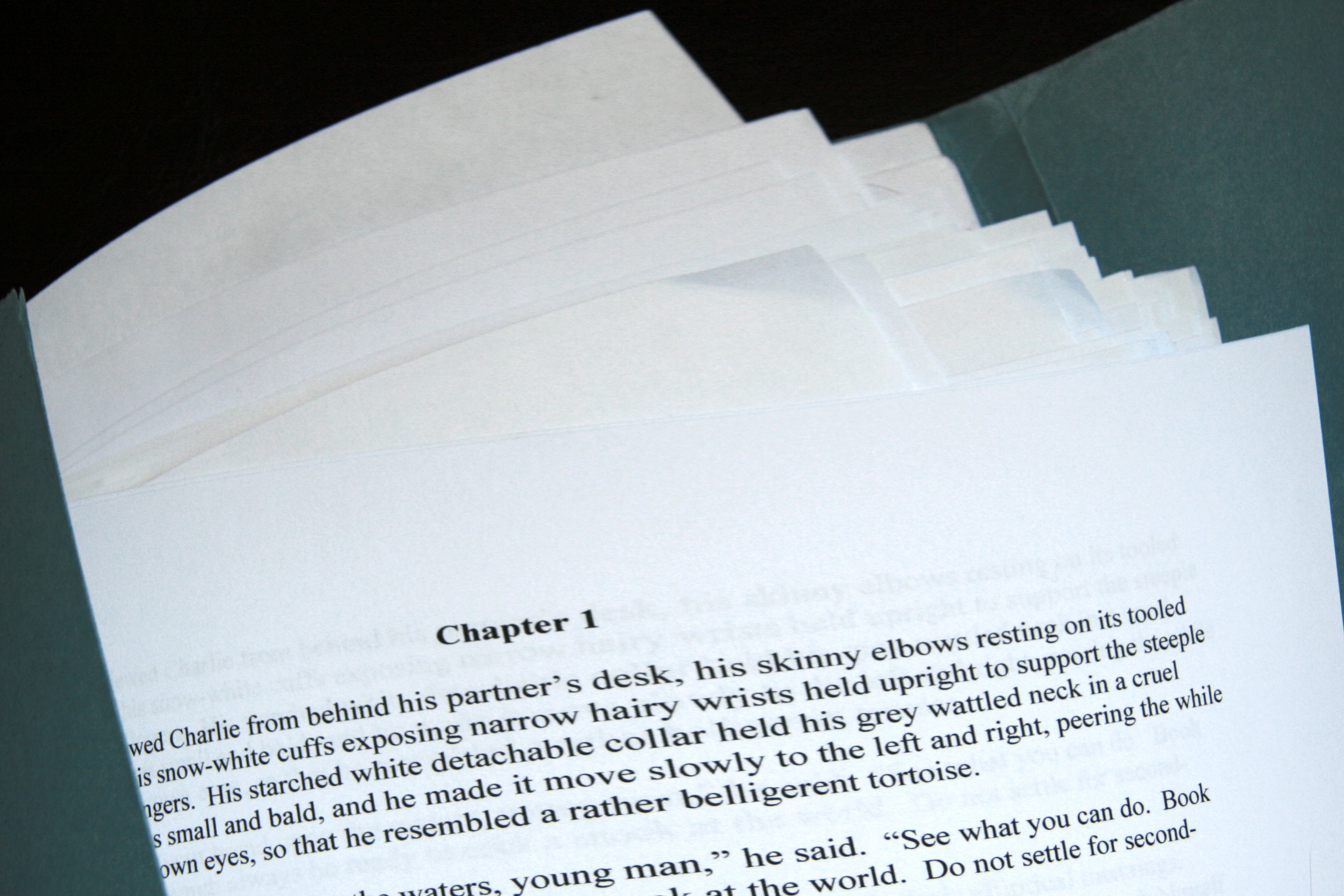
Many published novelists have as many as five or six books which have never made it to the wide open spaces of the reading landscape. They often refer to them, accompanying their remarks with jokes about where the manuscripts now languish, but, unless as authors they achieve mountain stature, that is all the world will know of them. Rather than bewail the fact that this one of mine didn’t ‘make it’, I thought that you might like to rummage in my reject pile for fun. This one, in fact, I never tried to publish; it’s based on the life of my old boss, whom in the novel I call ‘Charlie’, and here are the opening paragraphs:
Uncle Henry viewed Charlie from behind his partner’s desk, his skinny elbows resting on its tooled leather surface, his snow-white cuffs exposing narrow hairy wrists held upright to support the steeple of his wrinkled fingers. His starched white detachable collar held his grey wattled neck in a cruel grip. His head was small and bald, and he made it move slowly to the left and right, peering the while through his dull brown eyes, so that he resembled a rather belligerent tortoise.
“Go forth and cast your bread upon the waters, young man,” he said. “See what you can do. Book yourself into The Grand: always be ready to cock a snook at the world. Do not settle for second-best.”
Charlie was growing used to Uncle Henry’s disjointed homilies, with their elliptical meanings. Working for the old man was actually quite good fun, because he hardly ever did any work himself and left Charlie to get on with the job as best he thought fit. Not to put too fine a point upon it, despite his respectable exterior, Uncle Henry was often blind drunk.
Uncle Henry was a profoundly depressed man who did not see why his depression should get in the way of making lots of money. The causes of his depression were irreproachable: his unspeakable experiences during the First World War, which he still refused to discuss with anyone, though he threw out opaque hints occasionally, and the fact that he and Evadne had no children. Evadne was Charlie’s mother’s eldest sister, and since adulthood had been an invalid in a wheelchair. Charlie did not know why she was unable to walk, nor if her indisposition was related to her childlessness. She was a fearsome woman. She had the heavy Stanningley face and masses of dyed black hair. Charlie disliked going to see her, though he found her liberally-applied make-up quite fascinating.
Uncle Henry, who had already made two fortunes, one running a private school for boys and the other running an hotel (both had now been sold), thought that times were propitious for making a third. The war had been over for almost three years. The wives of the young men who had returned were busy having children and the government was even busier investing in houses, hospitals, clinics, schools and libraries to make the country a better place for these children as they were growing up. The old man did not necessarily approve of the social egalitarianism towards which all this effort seemed to be tending, but he did like the idea of the investment… particularly in libraries.
Uncle Henry had begun to take an interest in libraries before the war, when he was still a headmaster. A councillor friend of his had tipped him the wink, telling him that new reforms would mean that the post of chief librarian in the county would become a proper salaried one, instead of a sinecure with token gratuity attached. As was customary since the library service had been set up in the early years of the century, this post was currently held by a well-connected local lady who did not need to work. Of course, this lady would not be suitable to hold the well-paid position that it was about to become and Uncle Henry was invited to apply.
On a beautiful day, an exquisite work…
I apologise to regular readers – and I should like to say here that I am extremely grateful to you for being regular readers – of this blog, for presenting you with a book review two days running. Perhaps as an antidote to my dose of Sheridan Le Fanu (whose works, whatever their good qualities may be, certainly belong to Henry James’ category of ‘loose baggy monsters’), I began last night to read The Cellist of Sarajevo, by Steven Galloway, and did not put it down until I had finished it.
It is a breathtakingly beautiful novel, although it deals with that ugliest of subjects, civil war. It is also very grown-up, with profound layers of meaning that are allowed to speak for themselves; the author does not intrude upon the reader by presenting any kind of moralistic commentary.
At the literal level, the story consists of a portrait of the horrors of the siege of Sarajevo as seen through the eyes of three people over the period of a few days. Fundamentally, the novel is an examination of what it means to be human and what ‘being good’ really consists of. Principles of right and wrong are explored both through the most extreme situations (for example, Arrow, the female sniper working on behalf of the townspeople, finds it increasingly difficult to justify her acts of killing the ‘men of the hills’, even though they are picking off her fellow citizens daily) and more mundane dilemmas, such as that of Kenan, who, when he risks his life to collect water for his family, resents also having to fill up two heavy and awkward water containers for his elderly neighbour, not because he likes her (he doesn’t) or because she has been kind to him (she hasn’t), but because she holds him to a casual promise of help made in happier times.
The cellist is the common thread that unites these characters, as they listen to him; they do not know each other and do not meet. The reader discovers little about him. He is a roughly-dressed, unkempt man with no name who has taken a vow to play his cello every day for twenty-two days in a street where twenty-two people died as the result of a mortar attack. Daily, therefore, he puts himself at risk of murder by one of the snipers in the hills. He is an enigmatic, Christ-like figure. Did he lose someone in the mortar attack or is he making a point about preserving art and maintaining civilised activity in a world grown savagely feral and full of fear? Does he celebrate or mourn humanity?
Almost every sentence that Steven Galloway writes delights with its precision and eloquence. My guess is that he rewrote some of them many times in order to convey the exact descriptions, meaning, undertones and overtones that he intended. However, nowhere is the novel ‘overwritten’.
I believe that this is a very important novel indeed; it belongs to the literary tradition of writing about the juxtaposition of warfare and what it means to be human that stretches back through Tolstoy and Shakespeare to the Icelandic sagas, Virgil and Homer. It is elegiac, timeless and yet very disturbingly modern.
Wicked Uncle Dick

Yesterday I mentioned that I have recently bought several books about South Lincolnshire to aid my research. One of these is Aspects of Spalding Villages, by Michael J. Elsden. It is a book of photographs with quite an extensive accompanying text drawn from contemporary newspapers and other documents, such as old trade directories.
Among the many fascinating sections is one on Pode Hole, a hamlet between Pinchbeck and Spalding, which became important when a pumping station was set up there in the late eighteenth century to reduce the threat of flooding. It was a place to which I often headed when out on bike rides. Its system of sluices represents a complex and quite awe-inspiring feat of engineering. However, of more interest to me were the rather quaint by-laws relating to the pumping station, which were posted in full on a board in front of the main building. When I visited Spalding shortly before last Christmas, I was intrigued to see that the by-laws notice is still there. It’s a sturdy production, set in stone like a fenlands version of the Ten Commandments.
The section in Michael Elsden’s book that is headed ‘Trades and Business People in Pode Hole in 1937’ includes the entry ‘Sherrard, Rd. Albert, haulage contractor, Pode Hole’. It leapt out at me because Richard Sherrard (whose middle name was also his father’s – I had not previously known that he also bore it) was my Great-Uncle Dick. When I knew him, he led a fairly down-and-out existence. He scraped a living by farming a small-holding at Spalding Common and lived in one of the short streets of council houses there. I don’t recollect having had any meaningful conversations with him as a child; the Sherrard men were not particularly interested in girls. However, my brother, the only boy of our generation, was regaled with all sorts of treats and confidences. When we were both adults, he told me some of the family history that he had gleaned from Uncle Dick and his two surviving brothers (the eldest brother, John, had been gassed in the Great War and died in the 1920s). He said that Uncle Dick had told him that he was once the owner of a thriving haulage business, with a fleet of lorries that carried vegetables and livestock across the Fens. More roguishly, he admitted that he had plied a flourishing black market side-line during the Second World War.
I only half-believed this tale, because the Uncle Dick that I knew was anything but a prosperous businessman. I therefore rather assumed that it had been invented to satisfy a small child’s curiosity and also to imbue his old uncle with a touch of glamour. (‘What did you do in the war, Uncle Dick?’ ‘Oh – ha, ha, ha – I was a bit of a scoundrel; I sold stuff on the black market. It didn’t harm anyone; I just helped people to get the things that they needed.’) Now, however, I have found proof that at least some of Uncle Dick’s story was true: he was indeed a haulage contractor. The question is, did he really own a fleet of lorries, or just one antiquated, clapped-out lorry that was pressed into service for the war effort? And, if the former, what happened to them all? Might they have been confiscated because his nefarious activities were found out? Might the haulage business even have gone downhill because he was disgraced, or sent to prison? I don’t suppose that I shall ever find out and, since my own version of events is probably more colourful than the truth, I’m not sure that I really want to!
Need a good villain? I have one in mind…

A Shakespearean villain I’ve never had much time for is Don John in Much Ado About Nothing. He’s a stock character drafted in to do mischief and to foul up the relationship between the fairly uninspiring Hero and her bland lover Claudio. His villainy is never convincing, though he himself and other characters do their best to establish him in it. The fact is, of course, that the real sparkle of this rollicking romp of a play is the battle between the confirmed bachelor Benedick and the verbally-adversarial Beatrice, whose developing relationship steals the hearts of the audience. Aided by his henchmen, Don John does his worst, runs away and ends up caught; his punishment is postponed beyond the end of the play. I can’t help but feel that Shakespeare missed a trick with him, considering the potential he has in this comedy as a serious knot to be untied. Perhaps the playwright lacked an actor in the company to turn Don John into something much more compelling. I have such a person in mind!
Yesterday, I travelled to London to meet my friend James. He is an entrepreneur, bursting with business ideas, most of them relating to the publishing industry. He’s had the odd failure, but mostly he succeeds. He’s a millionaire several times over, but he keeps on working. I think that this is not only because of his prodigious energy and industriousness (both of which I admire), but because he is addicted to the thrills and spills that each new (ad)venture brings. He is a piratical sort of man. I don’t think that he would break the law, but he certainly isn’t a ‘suit’. He may be obliged to wear one, but I’m sure he’d be happier with long hair and a beard, parading in lace and velvet, hung about with ornaments in the manner of Johnny Depp in Pirates of the Caribbean.
What does he have to do with crime writing? Apart from having sold a great many e-books, some of them fiction, some undoubtedly belonging to the crime genre, nothing, as far as I know. Not yet, anyway. But I feel that it is my duty as a crime fiction writer not to pass up the opportunity offered by such promising raw material. He’s such an extraordinary character that he’d make an excellent hero in an action novel; on the other hand, he’d be an equally good villain.
I know that I said in an earlier post that I wouldn’t betray my friends by making them into recognisable characters, but the fact is that James would love it. (I mentioned the idea to him in passing and he latched on to it at once.) He would dine out for months on telling the tale and, in the process, sell many copies of the book to his extensive circle of friends and many more to readers worldwide on his e-books platform (though, knowing James, he’d extract a keen discount for this service).
And the headline of ‘James, by James’ would be bound to intrigue!
And now for something completely different…

Jonathan Pinnock managed to get a brief, but positive, mention in The Independent last week for Dot Dash. He was delighted at this, but also a bit sorry that Mrs Darcy versus the Aliens did not attract media reviews. Though Mrs Darcy is not a crime novel, it is a crime that newspaper reviewers passed over it. I here redress the balance, for a story in which George Wickham’s character is somewhat redeemed. I should also point out, on this happy 200th anniversary of Pride and Prejudice, that no Jane Austen romance was harmed in the writing of Mrs Darcy versus the Aliens.
This book is to anachronism what well-rotted farmyard manure is to plants: in its fertile whimsical compost , you can expect to find flourishing together such conventionally-unrelated references as Natalie Imbruglia’s Torn and Sir Humphry Davy’s scientific experiments; Colin Firth’s damp Darcy shirt and Kurt Cobain’s Maggot; text (tux’d) messaging (oh-so-beautifully phrased) and carrier pigeons on the ‘superflyway’. If you are a Jane Austen purist, this book may not be for you, but don’t rush to damn it, for it is an ingenious blend of such varied stimuli as the tentacular spectacular Species film, the BBC’s Pride and Prejudice, the Keira Knightley/Matthew Macfadyen Pride and Prejudice, Jane Austen’s Pride and Prejudice, Monty Python’s Flying Circus and The Fast Show, together with a pungent flavour of The Hitchhiker’s Guide to the Galaxy, Ghostbusters and Dr Who. Its wit sparkles, whether echoing (and/or making fun of) the language, characterisation and settings of Jane Austen’s novel, or making satirical references to the absurdities of our contemporary world and its preoccupations. The language of its characters, evoking the streetwalkers of Whitechapel, the rustics of rural England, the servants of big houses and their betters, is splendidly risqué and quite deliberately bad-pun-infested; it is full of sauce.
You can go spotting other references if you wish, for they are there a-plenty, such as a hint of The Good, The Bad and The Ugly’s Lee Van Cleef, merrily moulded into an anachronistic ‘Lee Van Enfield’ rifle, or you can pick up on Jane Austen’s Mr. Bennet’s minor reference to the likely failure of Jane and Bingley to conserve their wealth and to avoid being cheated by their servants, developed into a major outpouring of their resources to scamsters; and, talking of money, Bradford and Bingley and Northern Rock step up to the author’s line to salute us. The dialogue in the dirigible (don’t ask!) has echoes of Sherlock Holmes and Dr. Watson. A satirical swipe at the annual costumed Jane Austen Parade in Bath (and, thereby, at the Janeites of the world as a bunch of zombies) is a pleasing touch to those who value Jane Austen’s work as it is, not as her ‘fans’ would have it be. Jane Austen tourism comes under a blistering attack, too, and an in-joke (with lovely irony at the author’s own expense) slaughters all of us wordmongers: ‘Best to stay clear of them writer types in future – nutters the whole lot of them, apparently.’ Even the cheating tactics of car hire companies come under fire. Glastonbury Festival and its mud is sent wallowing in a cutting thrust at our society’s modern attitudes to drugs, sex and relationships, as well as at the establishment. The two pièces de résistance of the whole book for me, however, are Mrs. Darcy’s eventually wonderfully-assertive and liberated character and, if you’ll forgive a touch of irony from a genuine lover of Jane Austen’s novels, Colin, Lieutenant Pigeon: I didn’t need a satnav ghost to take me back to the seventies and Mouldy old dough (I can hear that gravelly enunciation clearly!).
Like Species, the way is left open for Mrs Darcy II and it will be funny and absurd, like this one: ‘Too, too silly’, but a complete romp. If you haven’t read Mrs Darcy versus the Aliens, you should; it’s a frolic to enjoy on Pride and Prejudice’s birthday.
Oh, I didn’t mention Byron…
The ‘Next Big Thing’ for me…

I’d like to thank Anne Zouroudi for nominating me as one of her choices when she completed the ‘Next Big Thing’ questions. I am a keen admirer of Anne’s novels and also greatly respect her as a writer with a genuine desire to help less established authors than herself. Most readers of this blog will already be familiar with the ‘Next Big Thing’, a blog-hop that spreads the news about what new book authors are working on, via a common set of ten questions. So here I go:
What’s the title of your next book?
It’s Almost Love, to be published in June 2013. There is more information about it here.
Where did the idea come from for the book?
It came partly from the extraordinary venue used for a conference that I attended – a house that had once been owned by Liberace – and partly from my discovery of an unlikely liaison between two people I know.
What genre does your book fall under?
It is a crime novel. Elaine Aldred has kindly described me as a ‘literary’ crime writer. I don’t really like categorising books, but, as a Salt writer, I do try to pay as much attention to the characters and the language that I use as to the plot.
What actors would you choose to play the part of your characters in a movie rendition?
It depends on which characters! Rupert Penry-Jones fits the bill almost exactly for DI Yates; Franka Potente would be excellent as Katrin; Ralph Fiennes would play Guy Maichment, one of the villains, to perfection.
What is the one-sentence synopsis of your book?
The disappearance of an elderly eminent female archaeologist and the simultaneous, but apparently unrelated, start of an illicit love affair between two colleagues together set off a chain of events that results in several murders; as the aspirations of a macabre right wing political group are also re-ignited, catastrophe threatens.
Will your book be self-published or represented by an agency?
Like In the Family, it will be published by Salt Publishing. I don’t have an agent. I’m proud to be a Salt author.
How long did it take you to write the first draft of the manuscript?
I’m still tidying it up in places. I started writing it when on holiday in France in August 2011.
What other books would you compare this story to within your genre?
That’s a very difficult question! I honestly haven’t read anything that resembles it much, partly because, as with In the Family, the South Lincolnshire setting is very important. I suppose it could be described as Michael Dibdin meets Henning Mankell in South Lincs, though that sounds terribly pretentious and more than a little absurd!
Who or what inspired you to write this book?
It was always my intention to write several DI Yates stories. The first seeds of Almost Love were sown by a telephone conversation; it was a piece of gossip, really.
What else about your book might pique the reader’s interest?
I’ve taken a lot of trouble with the archaeological background, which is inspired in part by the existence of the Spalding Gentlemen’s Society, a fascinating three-centuries-old organisation. Readers who’ve already met Tim Yates may be intrigued by some additional complications in his personal life.
I’d now like to pass the Next Big Thing baton to Laura Joyce, a fellow Salt author who has greatly impressed me with her debut novel, The Museum of Atheism.
Murder on the Grand Central Express

Yesterday, making my first real foray from home since the snow came, I travelled by train to London.
I boarded at Wakefield Kirkgate, once a proud Victorian station of almost Downton Abbey proportions, now a sad and sinister derelict shell. It is quite a frightening place, especially after dark, and has been the scene of various robberies and at least one violent rape. However, it is also the station at which the magnificent Grand Central trains halt on their way to London King’s Cross. It is therefore well worth press-ganging my husband into temporary service as bodyguard. He waits on the platform with me so that, later, I can enjoy the luxury of the first class carriage, with coffee, biscuits, newspapers and wifi included, for the modest price of £60.
Perhaps because these trains are so luxurious, I began to think of Murder on the Orient Express, in which Agatha Christie skilfully shows that any of the passengers could have been capable of murder, before inviting the reader to identify who dunnit. I had to invent both a victim and also a motive for each suspect when I began to scrutinise my fellow passengers to guess what their favoured modus operandi for murder might be. Like Agatha Christie, I assumed that every one of them would be capable of the deed.
The man sitting diagonally opposite me was a businessman from Halifax. I know this, because, in a loud voice, he was telling the man sitting directly opposite (evidently a very new buddy) about his various boardroom coups and how he spent the money that he made: Mr. Conspicuous Consumption with a county veneer; he’d kill, to prove that he could do it, and want to ensure that both murder and weapon were as ostentatious as possible; and he’d wriggle out of punishment afterwards. An antique Purdey shotgun and a faked hunting accident would be his choice.
The new buddy, when he could get a word in, proved to be a genial and mellifluous Irishman: short cropped hair, John Lennon spec.s, shabby grey suit; one of the original sleeve buttons had evidently been lost and incongruously replaced with a bright pink one, slightly larger than the others. Conspicuous Consumption should be wary of him if they leave the train together. Mellifluous Irishman’d be capable of taking CC to a deserted spot, withdrawing a long, slender stiletto from one of the baggy inner pockets of that suit and thrusting it into CC’s heart, all the time keeping up the cheerful chatter about dead cert horses and racing greyhounds. Money would be his motive. Afterwards, MI would slip away through the wet and silent streets and fling his stiletto into the canal. The police would never track him down.
What about the Chinese Yummy Mummy, glamorously dressed to keep out the cold in champagne-coloured Rab jacket, fur-lined hood and aubergine leggings, her small feet shod in tiny suede boots? She was accompanied by a little girl of five or six, a mini-version of herself. Her immaculately made-up face had a wary, shut-in look. Once married to a rich man, perhaps; now a single mum determined to preserve their former lifestyle for herself and the child. If the rich man didn’t play ball, he would cop it before the divorce came through, while she was still legally the main beneficiary of his will. She’d have to be careful, though; she wouldn’t want to upset the child and, for her, there would be a double imperative to avoid prison. Poison would be CYM’s agent of choice, administered through some item of food delivered to defaulting rich husband when she was many miles from the scene. The police would suspect her, but they’d never find the proof.
Several seats behind me, an elderly woman wearing a long red coat (which she had not removed, though the carriage was well-heated) lay alternately dozing and looking round her with shrewd blue eyes. She had a mannish face and thick grey hair cut in a cropped, no-nonsense hairstyle; it was relieved from being a short-back-and-sides only by the crimped quiff swept back from her forehead. Mrs. Well-Upholstered Lady. She was a past mistress at her art. She’d had a long and eventful life: plotting her murders carefully; moving all obstacles as she continued on her relentless journey. She would have brooked no opposition along the way, whether it had come from troublesome lovers in her youth, her timid but irritating husband in middle age, or, more recently, the ancient aunt of whom she had been quite fond, but who’d already lived far too long when she’d begun to dissipate Mrs. W-UL’s inheritance on nursing home fees. A different MO every time for her: one of the lovers had been dispatched after she’d tampered with the brakes on his car; the husband had died from carbon monoxide poisoning from a faulty gas fire – she’d happened to be away at the time; she’d visited the aunt in the nursing-home every day, tenderly administering food and medicine, increasing the dose just a little bit on each occasion. Hers were all ‘perfect’ crimes: never suspected; never investigated.
According to my imaginings so far, every one of my train murderers would have got off scot free. Although in my novels not all the perpetrators pay the penalty, some are always caught. Otherwise, that all’s-right-with-the-world denouement of which I’ve previously written could not be achieved; so, I’ll have to re-visit. Which of the train murderers might be apprehended, and by whom? I’d put my money on CC and CYM: he, because he wouldn’t be able to resist boasting of his plans; she, because she’s a nervous novice who’s never committed a crime before (she is overheard on her mobile, spilling her heart out to a friend). MI and Mrs. W-UL? Too fly by far.
And who would catch CC and CYM? The guy serving the free coffees, of course: a detective in disguise all along. They made a fatal mistake: they should have travelled standard class.
My journey to London with Grand Central passed very quickly…
Your good name and character are safe with me!

Today’s photograph shows an extra Christmas present that I received from my daughter-in-law. I am very pleased indeed with it and have just taken it out of its Cellophane wrapper, as it will be going on its first outing tomorrow.
It has made me think about fictional characters and to what extent they are (or should be) drawn from life. There have been some famous court cases in which certain authors’ character portrayals, or their exact use of the names of real people, have been challenged by the ‘victims’. I remember that the first edition of Richard Adams’ The Girl in a Swing had to be withdrawn, because one of the characters had been given the precise name of someone that Adams knew. (I was deeply involved in this, as it meant my having to call just about every public library in the country with the request to return for credit any copies that they held!)
Do most friends of novelists mind seeing themselves portrayed in their work? On the whole, I should hope that they would find it quite flattering (depending on the nature of the portrayal and the quality of the writing!), though I have not asked this question of any of my friends directly, as I don’t wish to alarm them. None of the characters in In the Family is based on a ‘real’ person, though some of them, of course, show the feelings, use the mannerisms and even, on occasion, utter the same words and phrases of people whom I know. I feel that this is an inevitable part of the creative process; otherwise, all my characters would resemble Martians!
Literary works that incorporate ‘real’ authors are always fascinating – at least to other authors. Aldous Huxley, W.B. Yeats, Lady Ottoline Morrell and Nancy Cunard all appeared many times in the fictional works of their large circles of literary friends and acquaintances, sometimes wittily disguised, sometimes barely disguised at all. Some of these portraits have hit home in quite a cruel way. Ottoline Morrell, in particular, was the instantly-recognisable butt of several less-than-generous satirical sketches, though to my knowledge she never resorted to litigation. It is harder for crime writers to ‘steal’ characters in this way, especially for the role of villain! However, Dorothy L. Sayers’ biographer makes a convincing case for Lord Peter Wimsey’s having been based on a man whom she had loved in vain.
You would think it would be easy to avoid taking names from life, as it seems straightforward enough to invent them. However, unless you are a latter-day Charles Dickens and choose your characters’ names to reflect their personalities, it is harder than you might think. They have to sound convincing and be interesting but not banal. J.K. Rowling has said that the name ‘Harry Potter’ originally belonged to someone that she knew at school. In the Family contains the names of several people who lived in Spalding when I was a child, though they have been taken completely out of context in the novel: Atkins, Bertolasso, Frear and Armstrong are all names from that era, as is the first name Giash, which belonged to the only Pakistani I’d met at the time. I knew several Dorises, Elizas and Kathryns; no Bryony, but it is a name that my mother considered giving to me when I was born (I had a lucky escape there, I feel!); no Tirzah, either, but one of my ancestors rejoiced in that name (two others were called Hezekiah and Jeremiah, according to the family bible).
I have yet to mine some of the more picturesque old Lincolnshire surnames: Gotobed, Withyman, Sentance and Berrill. Perhaps they will appear in later books. In scenes I’ve set outside Lincolnshire, I tend to choose the names of real places that I know well. For example, Tim Yates has a sister (who will surface at some point!) who lives in a street in Surbiton that in real life is home to one of my dearest friends, but that is where the similarity will end: Tim’s sister’s appearance and personality will not be stolen from my friend.
So, I think I have answered my own question! I love my new bag, because its message is so witty, but my own message – to all my friends – is that you are safe. I value your friendship too much to try to plunder your character, even for the sake of DI Yates!
Listen, there is something magical in your ear…

Like many people, I have been reading about the collapse of HMV and its departure from the high street, having failed to respond to the migration of consumers to online suppliers. I have already written on this blog about the challenges faced by bookshops and I am sure that this HMV news will only encourage the owners and managers of physical outlets for books to focus even more sharply upon their strategies for survival.
However, though I am obviously interested in the circumstances of the retail world and read this news avidly, it was the His Master’s Voice terrier logo, circulated for nostalgic reasons, which set me off on a train of thought quite unconnected with the story. The terrier is listening to the recorded voice with the characteristic comical cocked-head interest of my own dog, when strenuously trying to pick out the sounds of the words which mean that what he wants (walk and food, mostly!) will materialise.
The quality of word sounds is something that I have always enjoyed in literature (and not just in poetry, either) and I read prose with my ear cocked for the aural signals that a writer is not just thinking about meaning, but is also powerfully aware of the impact of sound upon the reader: patterns of hard and soft consonants, short and long vowels, alliteration, assonance, onomatopoeia, rhythm, rhyme (yes, in prose!) and so on. Fortunately, I think, there is a growing practice of writing of prose for performance reading (such as Salt Publishing’s OVERHEARD, stories to read aloud, edited by Jonathan Taylor) and more and more places to go to listen to prose authors reading or performing their work (Rattletales in Brighton, for example). For me, crimewriters who create really effective atmosphere through sound as well as description have the edge on those who do not, for I love to listen to a book and hear an author in my head.
 Christina James, crime novelist