

Fiona Malby (@FCMalby) offers me the chance to post on her blog today!

Author FC Malby (‘Take Me to the Castle’) has given me a precious place on her blog today, March 11th 2013, to write about something very special to me: The Fine Art of Bookselling. Sincere thanks to her for this hospitality!
All in the mix and the muddle

Plotting the plants
I was amused to read that the judge’s direction to the jury in the Vicky Pryce case included an instruction to avoid taking notice of irrelevant detail so that they ‘could see the wood for the trees’ and therefore ‘avoid red herrings’ when deciding upon their verdict. Mr. Justice Sweeney had good cause for making the point, having already had to discharge one jury for incompetence, even though his use of the English language might have been open to debate. It made me wonder if judges are often guilty of introducing mixed metaphors into their summings-up or directions to juries.
A Google search reveals that, in July 2011 in the USA, Kenton Circuit Court judge Martin Sheehan summed up with the following words his feelings about a trial during which a new (potentially harmonious) development had emerged:
‘Such news of an amicable settlement [has] made this Court happier than a tick on a fat dog because it is otherwise busier than a one-legged cat in a sand box and, quite frankly, would have rather jumped naked off a twelve-foot step ladder into a five-gallon bucket of porcupines than have presided over a two-week trial of the herein dispute, a trial which, no doubt, would have made the jury more confused than a hungry baby in a topless bar and made the parties and their attorneys madder than mosquitoes in a mannequin factory.’
No doubt this judge spent some time on crafting his words in order to achieve the courtroom-stopping hilarity with which he was rewarded. Almost certainly, his mixed metaphors were constructed deliberately, which shows that, pace the correct usage that was taught at grammar schools like my own, the mixed metaphor can be legitimately deployed for colourful and arresting self-expression and, by extension, permitted, if used carefully, in ‘serious’ fiction.
I’m even more inclined to champion my last point after looking up ‘mixed metaphor’ on a scholarly publishing site. Here I found the following:
‘The paper explores the phenomenon of metaphors that occur in a close textual adjacency, i.e. as metaphor clusters, but do not share a similar cognitive basis. Clusters frequently mix ontologies and are thus devoid of coherence that can be explained as emerging from a single conceptual metaphor. Evidence to that effect comes from a British corpus (Sun and Guardian) or 675 newspaper commentaries covering the 2004/05 EU referenda (in all, 2574 metaphors).’
Wow! And what I have quoted is only one third of the abstract of the article! I have not read the full article (a full download has to be paid for with sweat and brass), but it might be worth the subscription price, as it would appear to prove the meat and drift of my argument. Furthermore, I’d be very intrigued to read the author’s comparisons between the texts of two newspapers that have until now (because of the rich and fertile loam of their respective word wombs) seemed to me to occupy the opposing poles of the literary spectrum! Could this be the equivalent of mixing bullshit with champagne? Or a blend of codswallop and caviar? Or the gutter and the galaxy?
Too much lead and levity for one day. Must get back to plotting the plants in my next crime novel.
Cake, coffee and crime, a killer combination in The British Library
Ooops! Naughty Christina!
Yesterday, London was in the grip of one of those gloomy, fog-bound days of which Dickens wrote so eloquently. The streets were grey and obscured by swirling mists so heavy that they fell like grubby rain on clothes and hair. People were scurrying about, heads down, doing damage with their umbrellas.
The British Library shone, as always, an oasis of light, heat, calm and coffee… and, importantly, cakes. I went to the café there to meet a colleague and, our business done in ten minutes, we had a wonderful time drinking in the power of George III’s magnificent book collection (which is displayed behind glass and occupies the full height of the building) while eating chocolate pastries.
My colleague had to leave at midday, which gave me an hour to kill before my next meeting. This was just as I had planned, because I had picked up from Twitter that a Crime Writing exhibition is currently on display there.
Sponsored by the Folio Society (which has apparently published quite a lot in the genre, a point to remember when trawling secondhand bookshops for old Folio Society titles), the exhibition takes an alphabetical approach to crime writing. It consists of twenty-six glass showcases, one for each letter of the alphabet, each one showing or explaining some aspect of the crime writer’s craft. Unsurprisingly, ‘A’ is for Agatha Christie; ‘Z’, less obviously, for ‘Zodiac’ – i.e. for crime writing based on the occult.
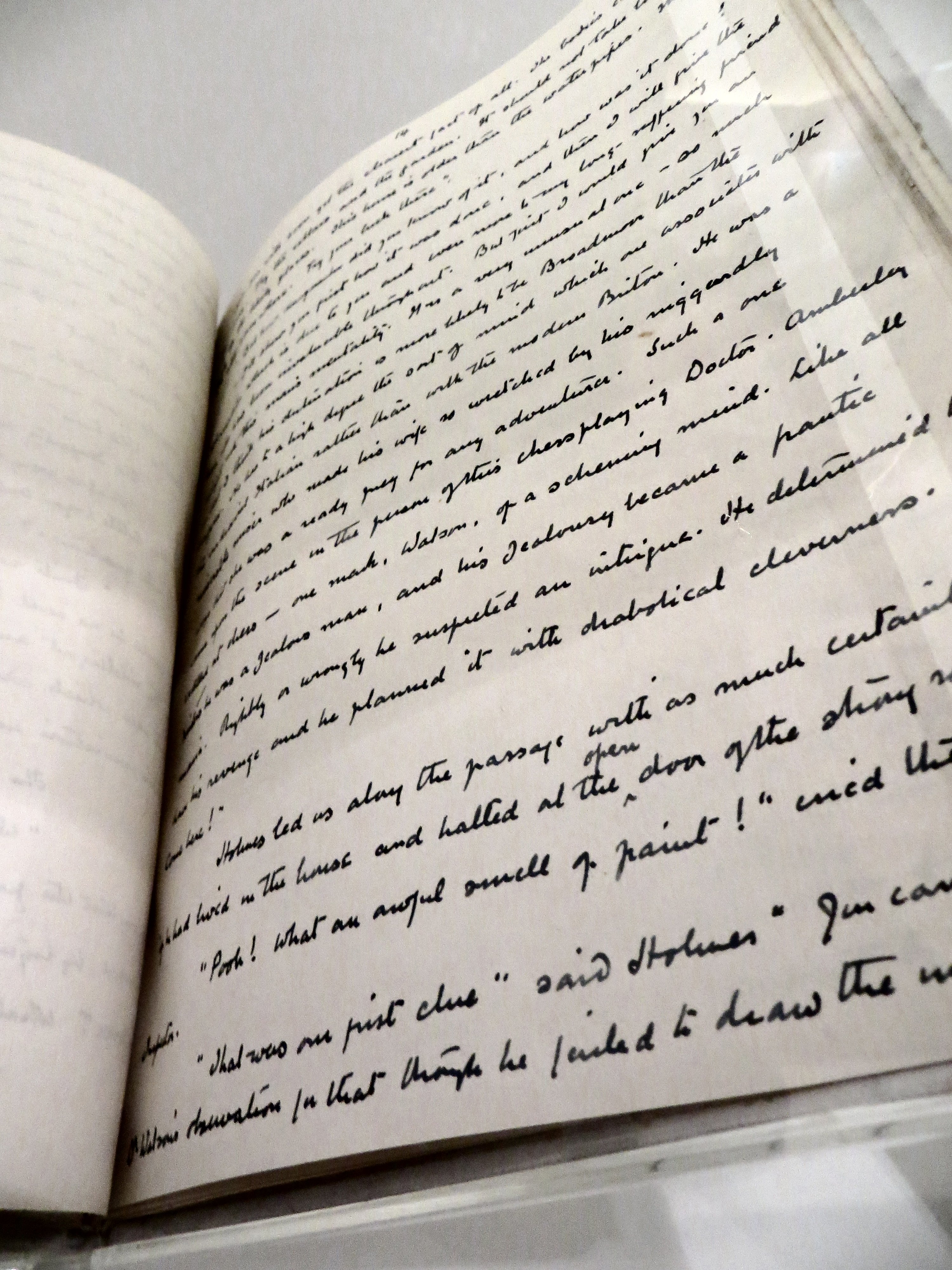
It is an inspired way of celebrating the genre. My favourite letters included ‘L’ for lady crime writers – I had not realised that until P.D. James published her debut crime novel, Cover her Face, in 1962, the fictional lady sleuth had pretty much dropped out of sight since Victorian times – and, of course, ‘B’ for Baker Street. The Holmes showcase included some specimens of Conan Doyle’s manuscripts (which I photographed before I was told to put away my camera by a security guard – I honestly had not realised that photography was not allowed!). I revisited many crime-related topics that I’ve researched myself, often presented in ways that made me regard them anew, and discovered some fascinating facts; for example, that Wilkie Collins’ estimated annual income from The Woman in White (published in 1860) was £60,000 p.a.
This equates to about £4.5m today. It and many of the other exhibits served to prove that, right from the start of its inception as a genre, crime writing could be made to pay. The exhibition, which is free, takes about half an hour to absorb. I highly recommend a visit if you get the opportunity – especially if it is raining and you are struck down by a pressing need for coffee… and cake.
Dying Fall, a novel for Breckland Festival

Last week, I mentioned that I’d agreed to chair the March 16th crime-writers’ event which forms part of the Breckland Book Festival and that I’d been invited to buy the latest novel of each of the two authors taking part in order to prepare for the session. Consequently, I’ve just completed Dying Fall, by Elly Griffiths. She isn’t an author with whom I’m familiar, but I see from the preface to the book that this is fifth in a series about Ruth Galloway, a forensic archaeologist who becomes involved in the crime mysteries that she is employed to solve.
For me, Ruth’s character and circumstances are the best things about this novel. She is not a conventional heroine: overweight, a single mum, already of early middle-age and, although not poor, not as materially successful as her contemporaries at university. Nelson, the policeman who features in the books, is also unconventional, not least because, although happily married, he is also the father of Ruth’s young illegitimate daughter, Kate.
This is really a book about the dynamics of personal relationships, those between Ruth, Kate and Nelson, of course, but also between the members of Nelson’s family, between Ruth and her friends and even between the mysterious and sinister members of the White Hand, a neo-Nazi group. This exploration of how people relate to each other is certainly more pervasive and compelling than the plot, indispensable though this is to making it a crime novel. There are some wonderful cameo roles as well, especially that of Cathbad, Ruth’s feckless Druid friend, who is also Kate’s godfather.
The author’s use of topography, something in which I am always interested, impresses me. There are some fine descriptions of North Norfolk – I imagine that these feature in all of the series – although most of the novel is set in Blackpool and the Pendle Hills, the descriptions of which places are equally evocative. The research that has gone into archaeology and the occult has been meticulous, but Griffiths never parades her knowledge.
I’m very much looking forward to meeting Elly Griffiths, and also Tom Benn, her co-star at the Breckland event, whose novel, Chamber Music, is equally impressive in a completely different way. It had been my intention to review both books together, but the clock caught up with me before I could finish Tom’s! I hope to write about Chamber Music very soon.

Proofs positive…
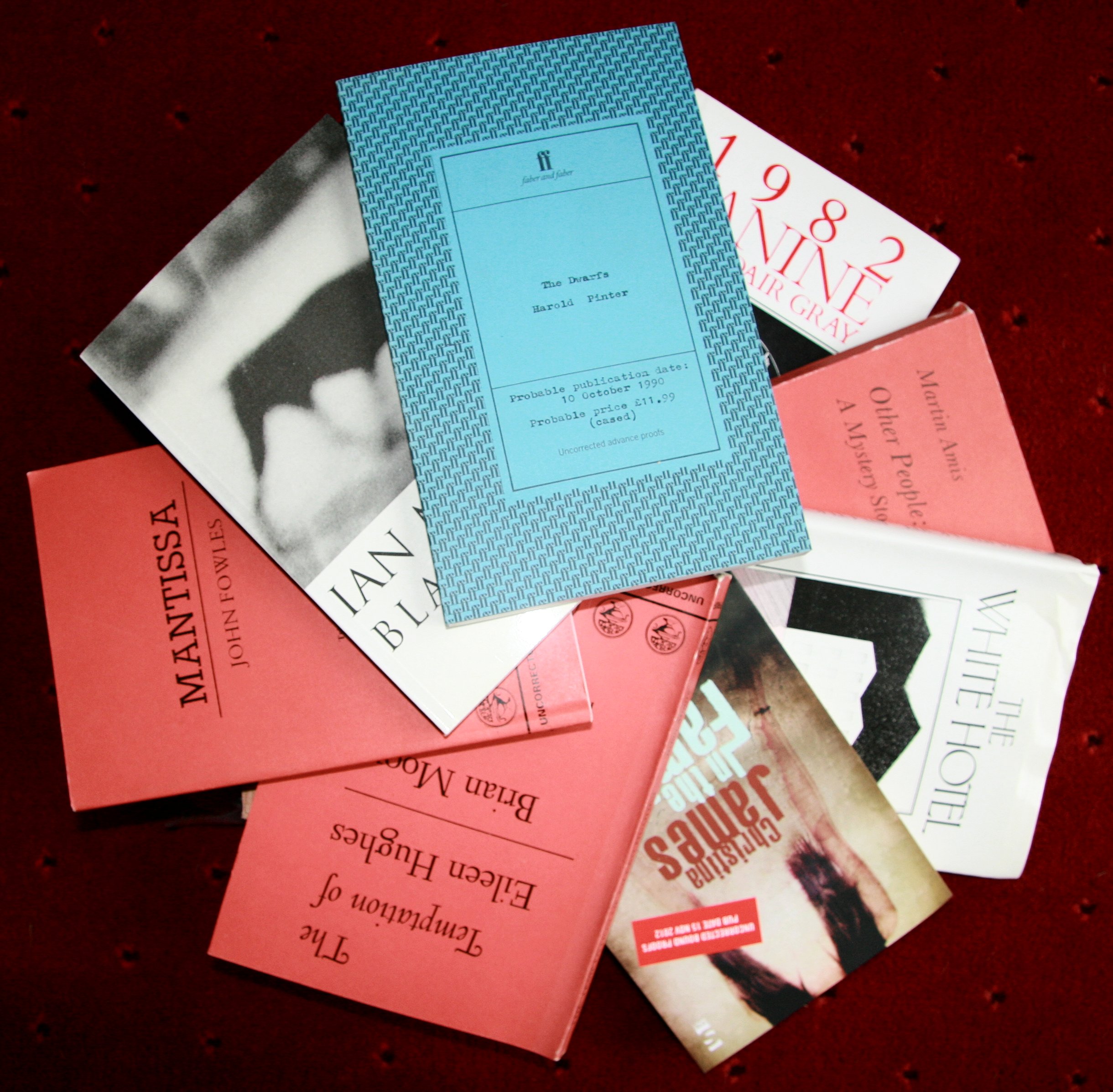
One of the most interesting things about proof copies is that you don’t own them. Most have printed on the cover that they cannot be sold. Some publishers also say: ‘This is the property of the publisher and not for sale.’ Yet I have never heard of a publisher who asked for a proof to be returned. The ones that I have, which represent some of my happiest years, working as the purchaser for a library supplier, will probably stay on my shelves until I die. Then they will be my son’s problem: will he ‘own’ them, or not? I suppose that he will take them on and become their guardian, just as I have been their châtelaine since they were young and untried.
I remember how I acquired some of them. Publishers’ reps get to know their customers’ tastes in literature, of course, and often they would produce two or three proofs from their bags and give them to me; or I would be sent one by post in advance of a launch. The biggest haul always came from Cape, Chatto and Bodley Head. These three companies (which were later swallowed up by Random House) jointly used the same sales team. For a number of years, the representative whom I saw, David Moore, used to drive across the Pennines from his home in Lytham St Annes, spend the night at a hotel in Wakefield and ‘travel’ the Leeds bookshops the next day. As my office was close to the hotel, he would call on me towards the end of the afternoon, just after he’d completed his journey (and in time for a cup of tea). When I’d given him his order, I’d ask if I could have a look in the boot of his car, which always contained two or three boxes of the next season’s titles in proof. I would come away with a rich haul; I was never disappointed.
I keep the proofs on the bookshelves in my study, not downstairs with the finished books. They are actually more precious to me than their suaver counterparts – I have finished copies of some of the titles as well. I have just lifted some of them down. Strange to think that, when they were printed, some of them were obscure titles from young unknown authors who have since become very famous. Of course, some of the authors were famous then: my collection includes The Dwarfs, by Harold Pinter, Mantissa, by John Fowles, Black Dogs, by Ian McEwan and The Temptation of Eileen Hughes, by Brian Moore. I think that all of these writers were well-established at the time. However, I also have 1982, Janine by Alasdair Gray and The White Hotel, by D M Thomas; each of these books catapulted its author into acclaim. Curious to think that I read and liked these brilliant but then unknown works and myself made a small contribution towards launching them upon the world.
I still have a couple of proof copies of In the Family. I don’t flatter myself that in years to come they will be sought after in the way in which some of the titles in my collection are. Nevertheless, it amuses me to allow them to rub shoulders with the great and famous, in some cases in the augenblick before fame came. It is almost like putting In the Family into a time machine.
My favourite bookshop!

Yesterday I visited Waterstone’s Gower Street, which in my mind is called simply ‘Gower Street’ and, in many other people’s, is still indelibly fixed as ‘Dillons’. A great bookshop and, of all the bookshops I have visited (there have been a few), easily my favourite. It’s situated in the heart of Bloomsbury. Approaching from Gordon Square, you come upon it suddenly, an Arts and Crafts enchanted castle before which there is always a litter of student bicycles, as if thrown down in homage at its feet. On an early spring day, especially when the sun is shining, your heart lifts immediately.
The shop was founded by Una Dillon, herself one of the extended ‘Bloomsbury set’. Almost every other door of the houses in Gordon Square and adjoining Fitzroy Square is adorned with a blue plaque celebrating the fact that a Bloomsbury author lived there; Una Dillon created the shop to serve them. The building was originally an early experiment in franchise retailing, a sort of forerunner of the Galeries Lafayette or Selfridges. It was designed to house twenty-four retail units, one of which was initially taken by Una Dillon. Gradually, over a period of years, she expanded until she had bought all of the units and therefore the whole building. (This also lifts my heart: I wonder if there is the remotest possibility that this could still happen today? Could a bookshop oust, say, Zara, Boots, Gap, Marks & Spencer and their ilk from such an ‘emporium’? I have my doubts!) Consequently, behind the scenes, it is a rabbit warren of corridors and small offices. It is also a protected building – of which I’m entirely in favour – although it does mean that not even a nail can be knocked into the wall without English Heritage’s being first consulted.
This shop came under my jurisdiction for several years in the 1990s. At the time, there were booksellers there who could remember Una Dillon’s being wheeled into staff meetings in her wheelchair and who were still in awe of her memory. (I must admit that the image of this is conflated in my mind, unfairly I’m sure, with the image of Jeremy Bentham’s stuffed corpse, similarly wheeled into meetings at UCL nearby, but I’m sure that Una was still alive on the occasions of which they spoke!)
I myself have many excellent memories connected with the shop – for example: the launch for George Soros’s book, which attracted so many people that it had to be held in a lecture theatre at UCL, with a television link to an overspill room; coming out of the manager’s office and finding Will Self chatting to the staff in the reception area; walking back a little dazed to King’s Cross through a summer dawn on a Sunday morning, having – with all of the staff – been up all night stocktaking. And it is still my favourite place for browsing and buying books.
Great bookshops are like people – they have personalities. A great old bookshop like Gower Street also has secrets. As far as I know, there has never been a murder committed there, but there could have been. Maybe someone will write a novel about it!
How creative a fertile imagination, given the opportunity!

A shedful of secrets
Some time ago I wrote about Moon, the chef in the Chinese restaurant where I worked as a student, and how I was convinced that he had it in him to be a latter-day Jack the Ripper.
The summer when Moon and I worked together preceded the so-called ‘Yorkshire Ripper’ era, though there is some evidence that Peter Sutcliffe may already have begun his attacks by then. By the time that I was married and living in a semi-detached house in Leeds, at least twenty women had been injured or murdered by what was believed to be a single perpetrator, and the Ripper investigation was in full swing. During the last few years before Sutcliffe was caught, some of his victims were no longer prostitutes and all women living in Yorkshire were warned not to be out alone in the streets during the evening or in the early hours of the morning. We were even advised not to take the rubbish out after dark. Naturally, this both terrified us and had a substantial effect on the way that we organised our lives. For example, my husband drove me fourteen miles to work every day and came to pick me up in the evening so that I should not have to linger at bus stops or railway stations by myself.
After ‘Wearside Jack’ had played his silly pranks (He sent tapes to the police claiming to be the Ripper, speaking in a strong Geordie accent; it was not until 2006 that he was finally brought to justice.), members of the public were advised to be especially vigilant if they saw anyone acting suspiciously who also spoke Geordie. Our next-door neighbour worked for the Ministry of Defence at Barnbow in Leeds. He was a very shy man in early middle age who hardly ever spoke. He had a large family, but seemed to spend very little time with them. Most evenings and weekends he would hide himself away in a large shed that had been erected between his house and ours. And, when he did speak, it was with a Geordie accent.
My husband and I, who, like almost everyone else we knew, were obsessed with the Ripper case, discussed this neighbour energetically on several occasions and, before too long, had convinced ourselves that he was a likely Ripper candidate. We dithered about what to do about this: after all, we had no evidence to go on besides his accent and his general shiftiness. The police would probably laugh at us and, in any case, we didn’t want to cause trouble for him if he was innocent. Consequently – and fortunately, as it turned out – we had taken no action at all when Sutcliffe was finally apprehended. (Despite having ourselves read and listened to all the Ripper news bulletins for years, it was a friend who lived in King’s Lynn and had seen it on the TV news who rang to tell us that he had been caught.)
Our neighbour continued with his mysterious shed-based life. One day, after our son was old enough to play outside, he was invited into the shed. He told us that the neighbour had built an elaborate radio station in there and was in touch with people all over the world. He had let our son listen to some conversations that he’d had with his contacts in Russia and China.
He was still living next door, still devoting himself to life in the shed, when we moved away from the area. Obviously he turned out not to have been the Yorkshire Ripper. Nevertheless, with hindsight and perhaps a touch of imagination, I wonder if he was just an innocent radio ham, or whether his ‘hobby’ concealed a more sinister purpose. He was, after all, an MOD engineer…
A profoundly moving and informative read…
 Pushing Time Away, by Peter Singer
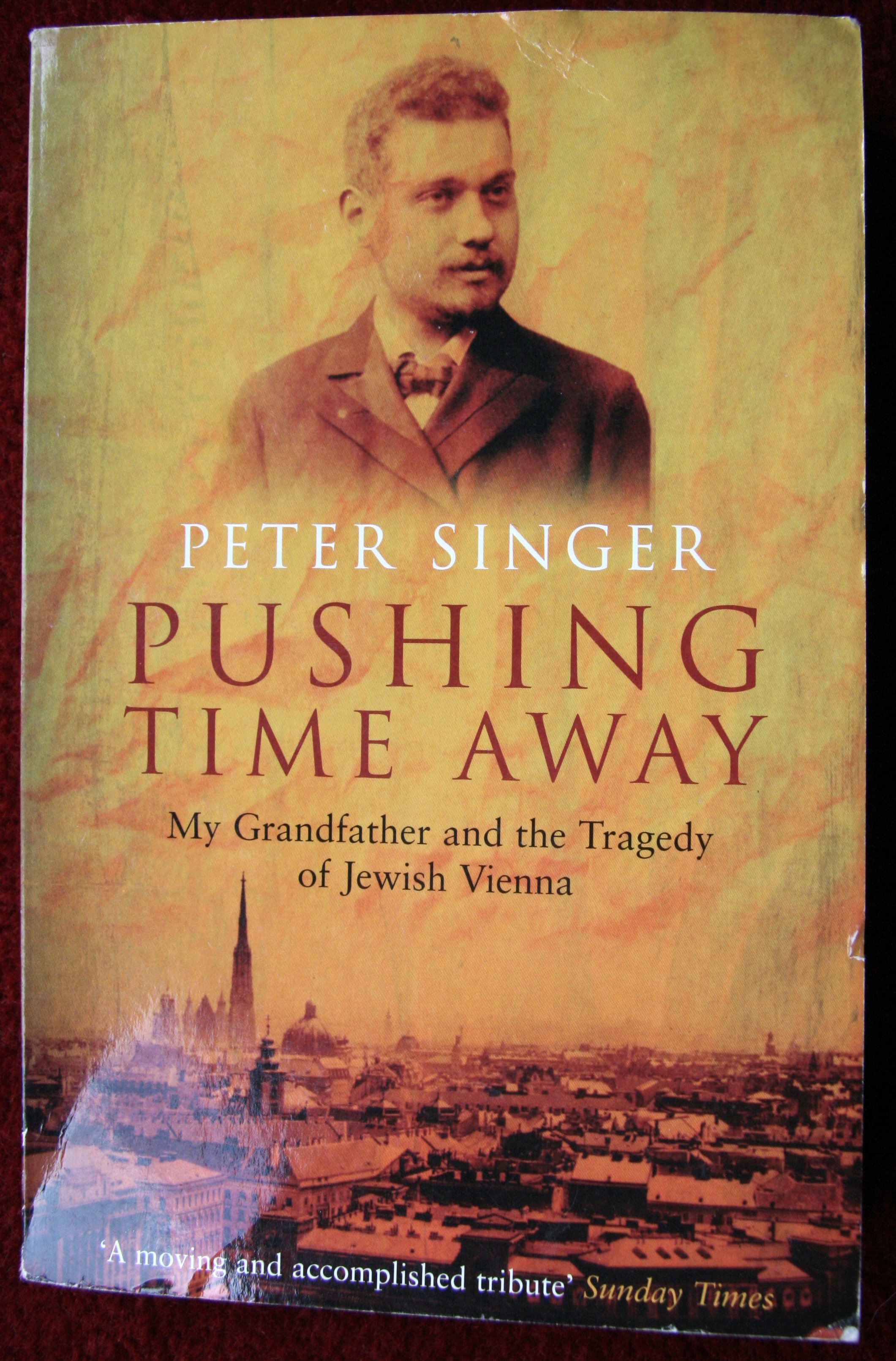
When I completed Pushing Time Away, by Peter Singer, I felt as if I had absorbed so much information that I needed a light read to counterbalance it; then, when I tried to get into a novel – and it was an intelligently-written novel – it seemed too lightweight, so I had to put it down and return to it the next day.
Pushing Time Away is another of my son’s books, temporarily purloined when I last visited his house. (As I’ve said before, I love browsing other people’s bookshelves and always find something that I’m desperate to read there.) The author is an Australian academic who was asked to go through his elderly aunt’s papers when she was taken into care. In the process, he discovered a rich treasure trove of information about his grandparents, including hundreds of letters written by his grandfather to his grandmother.
Beautifully written, it is an unusual book in several respects. It provides a graphic account of what life was like for middle-class intellectuals living in Vienna in the first forty years of the twentieth century; it tells how Singer was at first shocked, and then fascinated, to discover that both of his grandparents were bisexual; and it recounts the vicious power struggles that took place between Sigmund Freud and his disciples when they dared to question Freud’s theories. The last of these is well-documented elsewhere, but Singer brings to it a fresh perspective as he shows how David Oppenheim, his grandfather, a gentle scholar who hated conflict, was unwillingly forced to choose between Freud and Adler. That Oppenheim chose Adler at a time when no-one had heard of him, and therefore renounced the scholarly acclaim that working with Freud could have brought him, bears testimony to his selflessness.
Another aspect of the book which has also been recounted many times, but still gains fresh immediacy from being based on the feelings and experiences of one family, is the fact that, until Kristallnacht, Jewish families living in Vienna were so well assimilated that they had no thought of falling victim to Hitler’s ethnic cleansing policies, even though they were aware of them. David Oppenheim had been awarded a medal for bravery for fighting for the Kaiser’s army in the First World War and so, even as Jewish ‘privileges’ in the city were reduced daily (at first Jews weren’t allowed to walk in the woods, then to hold public posts and finally to own bank accounts), he was convinced that the fact that he had fought for his country would save him and his wife. They did not leave for Australia with their two daughters, first because they were still learning English and then out of solidarity with Peter Singer’s father’s parents, who were unable to obtain exit visas. David Oppenheim and his wife, née Amalie Pollak, were eventually sent to Theresienstadt, where he quickly succumbed to the rigours of poor diet and no medication (like his sister, who died aged sixteen, he was a diabetic; one of the many interesting insights that this book offers is how terrible a disease diabetes was before the invention of insulin injections).
The book gains great power from its understated matter-of-factness. At no point does the author resort to sensation; he doesn’t need to, because the facts speak so eloquently for themselves. The only slight quibble I have is with the unadulterated admiration that he displays for the grandfather that he never knew (Amalie survived the war and spent her last years in Australia when he was growing up). What Singer says about David is slightly at odds with the documents that he quotes. Certainly, David was gentle, erudite and earnest. I’m less convinced that he was an early exponent of male / female equality. He may have paid lip-service to this ideal; nevertheless, it was Amalie, a far more brilliant scholar than he and one of the first women to be awarded a degree (in Maths and Physics) by the University of Vienna, who gave up all her career prospects when they married and subsequently dealt with all of the practicalities of their daily lives, while David concentrated on his studies. This sounds to me like par for the course for intelligent women who lived in the early twentieth century. It was also Amalie who showed all the fortitude and resourcefulness as their world collapsed, while David sank into depression (though his ill-health might have been partly responsible for this).
Pushing Time Away is not a comfortable book to read, but it is compelling. It makes a far greater impression than a more polemical exposé of how the Holocaust affected this family would have done. I know that it will stay with me.
‘Almost Love’ almost flowering…
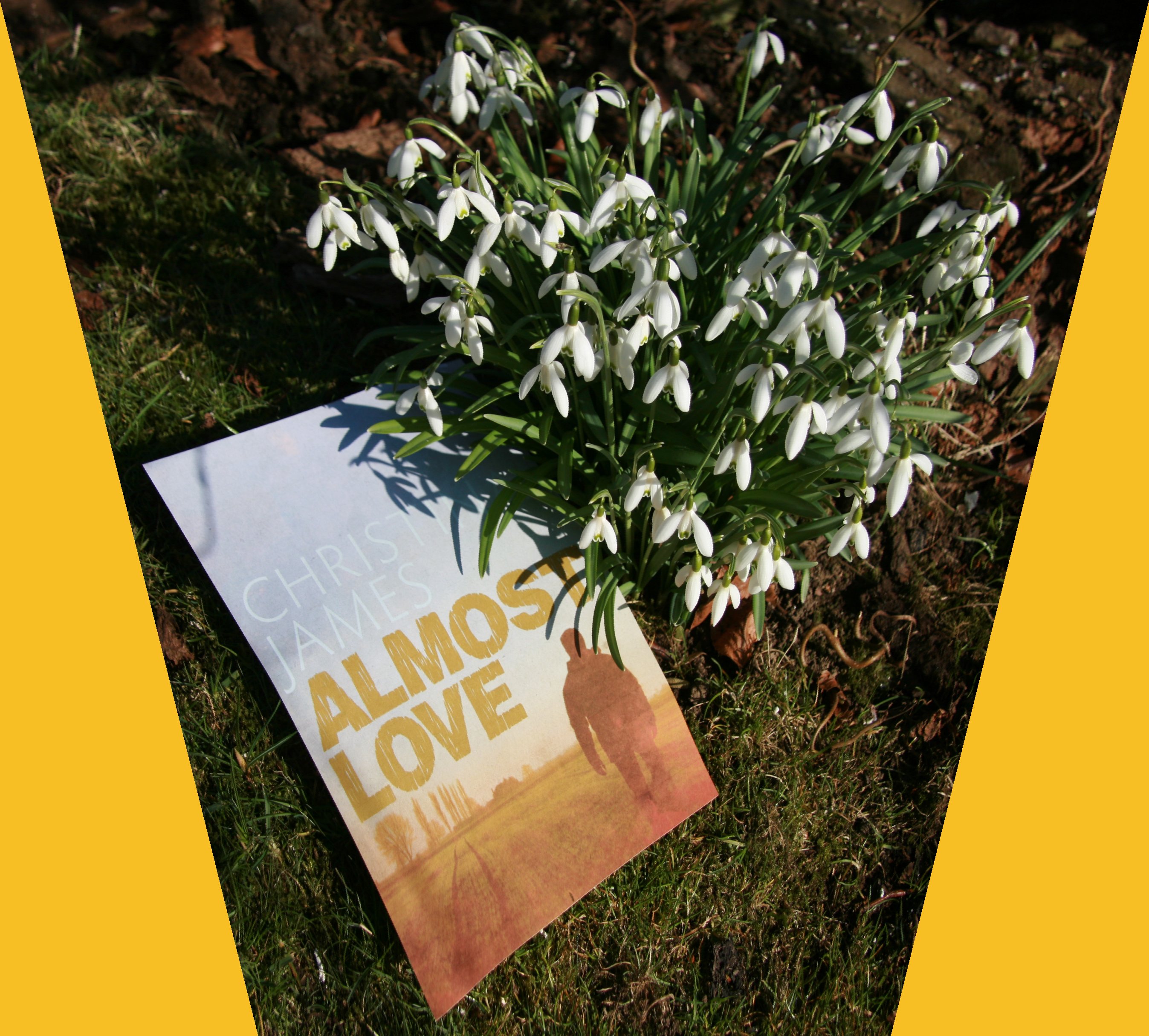
Yesterday was the first of March, St. David’s Day. Although there was frost on the ground, the sun, when it broke through the cloud, was shining brightly and with real warmth. The snowdrops and primulas have already been in flower for some time and yesterday I noticed that the dwarf daffodil buds are swelling. When I drove out at 6.15 p.m., there was still some daylight left. Spring is pushing aside a bleak winter!
Yesterday was also the day on which I wrote the last few sentences of Almost Love. Because of the non-sequential way in which I write (a habit that I am trying to break), they belong to a chapter about one hundred pages from the end; it was a chapter that I’d been trying to finalise for some time. Then, when there was nothing else left to work on (and therefore no way out of attending to it), it almost sorted itself, quietly and relatively quickly.
There’s still revision to be done, of course, although I revise all the time while I’m writing, but rounding off this novel has been quite different from finishing In the Family, which left me feeling battered and dazed. (I remember it well, partly because it was completed on the day of the royal wedding, which gave me more time to myself than usual.) This time I just felt happy in an understated sort of way.
The next novel is germinating at the back of my mind. It will need quite a lot of research, which I shall enjoy. For the moment, however, I shall focus on tending to Almost Love and enjoying the time before it bursts into bloom in June.
Doing away with your wife…
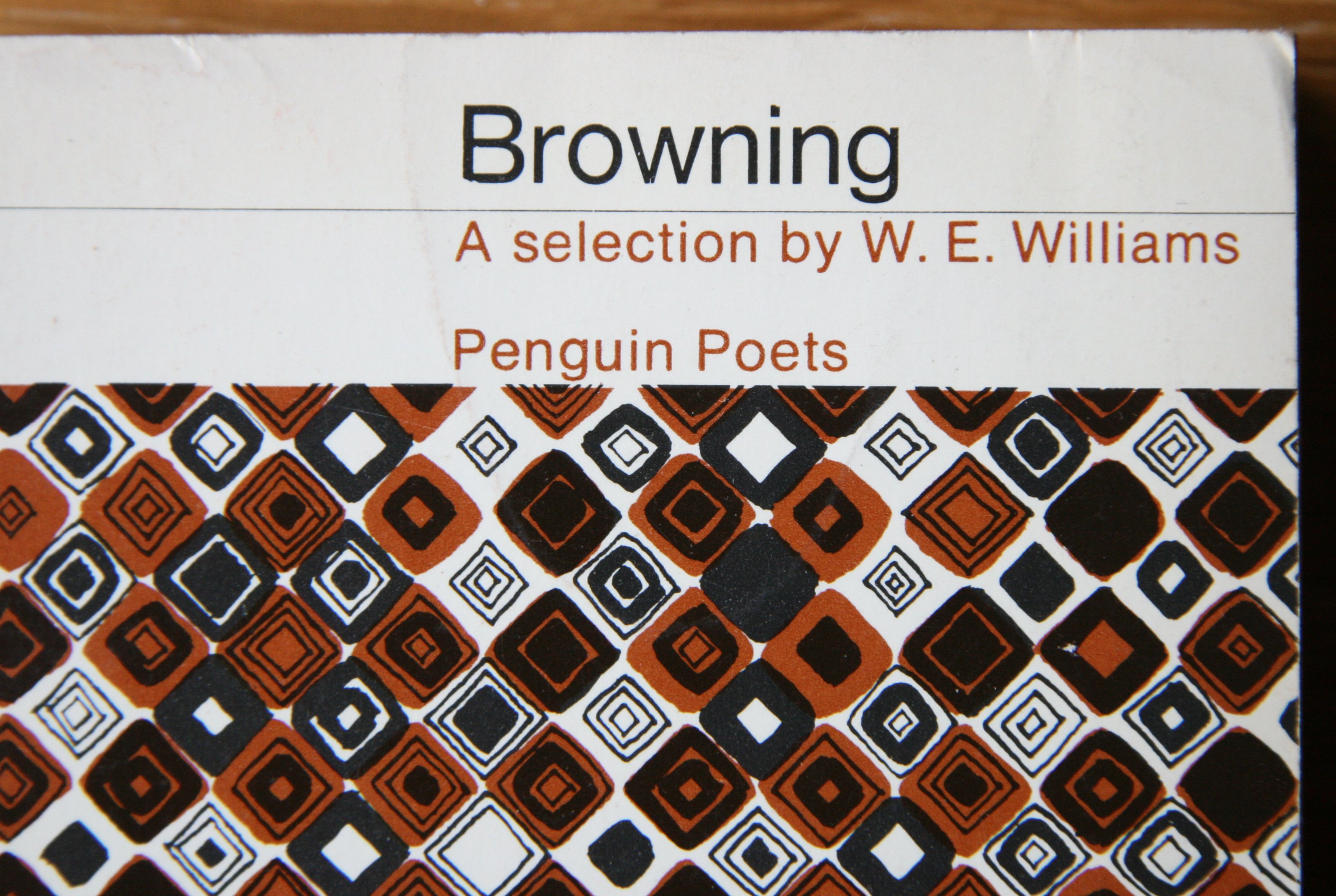
I have written before on this blog on the subject of dramatic monologues and of Browning’s use of them in his poem Porphyria’s Lover. I make no apology for turning once more to Browning’s poetry, which I love (even though Oscar Wilde damned him as a poet: ‘Meredith is a prose Browning, and so is Browning.’), for a glance at the literature which has influenced my own writing and its portrayal of the criminal mind.
My Last Duchess is a poem which works subtly on a psychological level. I remember reading it for the first time and being astonished at the way in which it made me engage with the situation it depicts, a powerful duke’s receiving an emissary and showing him a painting of his previous wife. (It is commonly thought that this man was the fifth Duke of Ferrara, seeking to marry a daughter of the Holy Roman Emperor, Ferdinand I, and coming to marriage terms via her brother, Count of Tyrol, Ferdinand II.) I didn’t need factual historical background to understand the poem, which itself, line by line, gradually led me along a trail of suggestions and clues to the horrified realisation that he had had his wife ‘done away with’.
In fact, the first thing that struck me as I read the opening lines (‘That’s my last Duchess painted on the wall, Looking as if she were alive.’) was that this was like Paulina’s presentation, in The Winter’s Tale, of Queen Hermione’s ‘statue’ (it is really Hermione herself) to the king, Leontes, who believes that his jealousy caused her death. Leontes says, in astonishment at the sculptor’s skill, “The fixture of her eye has motion in’t, As we are mocked with art.” The portraiture of the Italian Renaissance was, of course, sublime in its depiction of looks and character and I was initially lulled by my reading of The Winter’s Tale into thinking that this poem would similarly celebrate artistic achievement. I could not have been more mistaken.
The monologue forces the reader into the shoes of the emissary, listening to the Duke and drawing conclusions about his attitudes, opinions and personality, just as we might upon meeting someone for the first time in real life. Browning’s power lies in his understated use of speech; it is all so matter-of-fact! Line by line, we receive the duke’s description of the cheerful friendliness of this young woman, who smiled on all alike, and we gradually realise that he thought that she should smile for no-one but himself and preserve for the rest a haughty reserve. Then comes the shock: ‘I gave commands; Then all smiles stopped together.’ Now, with a hammer’s clang, we see why only he may draw the curtains which conceal her lifelike, smiling face: he has ensured that she will smile only for him. He passes on, leading the emissary, and talking of another artwork with equal lack of emotion.
I have read this poem countless times and it has itself the freshness of a new painting whenever I come back to it. I look for this psychological detail in the presentation of villains in crime novels and I am delighted when I find it. There is, for me, far less enjoyment in more stereotypical portrayals, which rely more for impact upon the brutality of actions than upon the workings of minds.
 Christina James, crime novelist