

Need a good villain? I have one in mind…

A Shakespearean villain I’ve never had much time for is Don John in Much Ado About Nothing. He’s a stock character drafted in to do mischief and to foul up the relationship between the fairly uninspiring Hero and her bland lover Claudio. His villainy is never convincing, though he himself and other characters do their best to establish him in it. The fact is, of course, that the real sparkle of this rollicking romp of a play is the battle between the confirmed bachelor Benedick and the verbally-adversarial Beatrice, whose developing relationship steals the hearts of the audience. Aided by his henchmen, Don John does his worst, runs away and ends up caught; his punishment is postponed beyond the end of the play. I can’t help but feel that Shakespeare missed a trick with him, considering the potential he has in this comedy as a serious knot to be untied. Perhaps the playwright lacked an actor in the company to turn Don John into something much more compelling. I have such a person in mind!
Yesterday, I travelled to London to meet my friend James. He is an entrepreneur, bursting with business ideas, most of them relating to the publishing industry. He’s had the odd failure, but mostly he succeeds. He’s a millionaire several times over, but he keeps on working. I think that this is not only because of his prodigious energy and industriousness (both of which I admire), but because he is addicted to the thrills and spills that each new (ad)venture brings. He is a piratical sort of man. I don’t think that he would break the law, but he certainly isn’t a ‘suit’. He may be obliged to wear one, but I’m sure he’d be happier with long hair and a beard, parading in lace and velvet, hung about with ornaments in the manner of Johnny Depp in Pirates of the Caribbean.
What does he have to do with crime writing? Apart from having sold a great many e-books, some of them fiction, some undoubtedly belonging to the crime genre, nothing, as far as I know. Not yet, anyway. But I feel that it is my duty as a crime fiction writer not to pass up the opportunity offered by such promising raw material. He’s such an extraordinary character that he’d make an excellent hero in an action novel; on the other hand, he’d be an equally good villain.
I know that I said in an earlier post that I wouldn’t betray my friends by making them into recognisable characters, but the fact is that James would love it. (I mentioned the idea to him in passing and he latched on to it at once.) He would dine out for months on telling the tale and, in the process, sell many copies of the book to his extensive circle of friends and many more to readers worldwide on his e-books platform (though, knowing James, he’d extract a keen discount for this service).
And the headline of ‘James, by James’ would be bound to intrigue!
Here’s one I’d like you to know about – a new and striking Salt crime novel!

I am both fortunate and privileged to have had an early opportunity to enjoy a reader’s copy of Scarecrow, a novel that Salt Publishing will be adding to its crime fiction list for publication in September.
Fast-paced and compelling, it is set partly in the Andalusian province of Almeria (of spaghetti western fame) and partly in England. Danny Sanchez, a bi-lingual journalist, grew up in England and left for Spain when his mentor and friend on a Hampshire local newspaper committed suicide. Danny is covering the story of a compulsory house demolition in the Almanzora Valley, an ex-pat community populated by thousands of British seekers of sun and self-built paradise. 2009 brought disaster for many of them, whose homes had been identified by the regional government as irregular constructions and who were served with demolition orders.
What the demolition unintentionally reveals leads Danny on a tortuous path of discovery, via thuggish cowboy builders and a missing teenage boy, around Almeria and back to England, as he quests for the scoop of a lifetime. Nineteen years a reporter, eleven of them in England, Danny is hard-bitten but human. The author carefully builds his personality and history, creating a very real and interesting man, skilled in his job and with an instinctive flair for managing people and ferreting out the information that he needs. The narrative moves with a Chandleresque efficiency; the dialogue is stark and often harsh, but most effective in conveying the personalities of the speakers. Pritchard has a good ear.
This is a story unusual for its very adept portrayal of the life of a reporter, especially of one whose career has been shaped by life in two countries; it has lots of graphic descriptive detail, which makes the locations and the events very real and easy to visualise, but without being over-facing or heavy-handed. It also deals brilliantly with the presentation of grotesque crimes. The author is a gifted story-teller and I expect that his future readers will find themselves immediately engaged and compelled to read and read. Matthew Pritchard is a striking new voice in Salt’s crime list and I have no hesitation in recommending Scarecrow to readers of this blog.
Marriage and crime: a question of coercion?

The Chris Huhne / Vicky Pryce case raises some interesting questions about marriage, crime and morals. Before the Married Woman’s Property Act of 1870, married women could not own property – after marriage, de facto everything belonged to their husbands. It followed that they could not run up debts and some enterprising ladies wrought their revenge by exercising this loophole in the law! Spinsters and widows could, however, hold wealth in their own right. Wealthy male landowners and other magnates would sometimes devise ingenious trusts and make provisions in their wills for married daughters, so that their husbands could not get their hands on all the cash. Even so, it does make you wonder why any woman of substance consented to marry! At the moment I’m reading Wylder’s Hand, by Sheridan Le Fanu, a mid-nineteenth century crime novel that tells how a beautiful heiress was unscrupulously passed around by several men in her extended family so that each could benefit from her wealth.
In the past, as The Taming of the Shrew illustrates, husbands were expected to be allowed to shape their wives’ views and opinions. Women, economically dependent and physically weaker in eras when even aristocrats would resort to physical force to subdue them, were always guilty if they lost their ‘virtue’. Richardson’s Clarissa died after she was seduced; Hardy’s Tess killed her lover in what nowadays would be called a crime of passion and paid for it with her life.
Until our own times, women have mostly drawn the short straw – though not always. Some, like the Wife of Bath, have prevailed over men through sheer strength of character. However, I imagine that it is because women have habitually been the underdogs of matrimony that laws of ‘spousal privilege’ were conceived. Ostensibly, these were meant to promote marital harmony, but it is also rather self-evidently true that wives, whether because of collusion or coercion, are unlikely to ‘shop’ their husbands. If the court could not rely on their testimony, it was best not to ask for it in the first place.
Today, at least in countries where girls and boys receive a similar education, women have more or less gained equality of opportunity and, unless they are in abusive relationships, there is no question of their having to agree with their husbands’ opinions. Some famous marriages have been built on successfully ‘agreeing to ‘disagree’: that of Denis and Edna Healey, for example. Can a woman of formidable intellect who has a high-profile career in her own right really be coerced by her equally high-profile husband into breaking the law and compromising her own moral integrity because he asks her to? I don’t have the answer to that. Thinking of my own husband, I am convinced that he would not have asked in the first place. But if he had ….?
Richard III: ‘a serviceable villain’?

My interest in Richard III was kindled when I was a young bookseller, because my boss was a member of the Richard III Society. I’ve subsequently read several books about the Wars of the Roses and also visited Richard’s castle at Middleham. That he had strong links with Yorkshire has increased his fascination for me.
Few English kings have inspired such intense posthumous opinion as Richard. Henry VIII, Charles II and George III have all had their fierce supporters and detractors, but none has had vitriol heaped upon him as Richard has. He could hardly have been as wicked as he was reputed to be; his shimmeringly evil reputation, much enhanced by the distorted character that Shakespeare created to please his Tudor mistress, even had the unintentional effect of giving him the same kind of glamour as Milton’s Satan. Shakespeare was also responsible for exaggerating his physical deformities; unlike Dorian Gray three hundred years later, the fictional Richard’s evil soul was supposed to have been made manifest in an ugly face and twisted body.
The Richard III Society was founded to put the record straight, but, like almost all societies that support the memory of controversial historical and literary characters, it quickly became so partisan that some of its published ‘research’ stretched the facts. Nevertheless, it is to one of its present-day members that we are indebted for the discovery of Richard’s remains under a car park in Leicester. Amazingly, modern science, in particular miraculous DNA matching techniques, proves conclusively that the bones did belong to this last Plantagenet king. I am sure that a great book will come out of the story of their discovery and testing (which, as last night’s Channel 4 programme showed, has been meticulous).
In the popular imagination, Richard’s worst act has always been his reputed murder of his two nephews, the so-called ‘princes in the tower’. They were the heirs of Edward IV. The elder of them, Edward V, was never crowned king, but the title was reserved for him, even so; the next King Edward was crowned Edward VI. There is no proof that Richard killed the two princes. It is known that they lived in the Tower of London for many months and gradually disappeared from view; first they were seen playing frequently, then infrequently, then not at all. Although it is fairly certain that bones discovered in the tower in the late 1990s belonged to the princes, there is no conclusive proof of who murdered them. Was it indeed Richard? Or did the order come from Henry VII (the preferred candidate of the Richard III Society) after his accession? Of course, I don’t know, though I’d rather like to think it was Henry myself, partly because Richard has always been such an underdog, partly because Henry was a cruel cold fish of a man. He was certainly capable of killing them.
Whoever it was, the outpouring of emotion that this murderous act has generated is illogical. Perhaps it is because they were children; perhaps because one of them was a king and kings were sacred. Yet there can have been no king between William I and Richard III who did not commit murder, except, perhaps, Henry VI, who was himself murdered for the national good; and, although the Tudors themselves considered the murder of kings to be taboo, Shakespeare’s own queen, Elizabeth I, herself killed an anointed queen, Mary Queen of Scots. I conclude that Richard’s infamy stuck because of the genius of Shakespeare himself. The beauty and the irony of these famous lines have touched every generation since they were written in 1592:
Now is the winter of our discontent
Made glorious summer by this sun of York;
And all the clouds that low’r’d upon our house
In the deep bosom of the ocean buried.
The bones retrieved from the car park were of a slight and delicately-formed man; he did, indeed, suffer from scoliosis, but it probably only made one shoulder appear slightly higher than the other; otherwise, he may have cut an attractive, even a refined, figure. I should never want to lose Shakespeare’s magnificent villain, but perhaps now that the real Richard has been found, he can co-exist with his alter ego. There is surely room in our heritage for both of them.
Fleeing Hitler, France 1940 (Hanna Diamond)

Although I usually have a crime novel on the go, I read a lot of history and biography as well. I’ve almost completed Fleeing Hitler: France 1940, by Hanna Diamond (OUP 2007). This is an extraordinary book about the French flight from Paris after the German invasion of northern France. Although I’ve read many books about the Second World War, I must say that I hadn’t realised the extent of the exodus that took place. Parisians were clearly terrified; millions of them abandoned their homes, in most cases taking only the possessions that they could carry or wheel in carts or on bicycles. A very small minority had cars or vans, but were often forced to abandon these when they ran out of petrol.
Ironically, most of the populace would have been better off staying where they were, unless they were Jewish, as the Germans had no plans to harm them wholesale; in fact, they wanted as many people as possible to carry on working to support the German war effort. Doubly ironic is that, while Parisians and other inhabitants of northern France and Belgium were panic-stricken and took to the roads with little cause, in Berlin and other urban centres in Germany, German Jews believed that they were safe and stayed until it was too late. I have no explanation for the extreme fear amongst the French, unless it was caused by the fact that Paris had been invaded four times within living memory, on the last occasion only about a quarter of a century previously.
Of particular fascination is Hanna Diamond’s account of how the quite sophisticated Parisians (though, in many cases, they were only a generation away from having been peasants themselves) reacted to the extremely basic lifestyles of the peasant communities in which they found shelter. It is a snapshot in time of how two eras, the modern one and the age-old traditional one, collided. Despite bucolic discomforts, however, a significant number of Parisians did not return to Paris after the panic subsided, but stayed in these rural communities, especially if they could find work. Some of the wealthier départements were extremely generous; for example, the inhabitants of the Charente gave refugees ten francs each per day, even though they could obtain accommodation and food (‘including drink’!) for about twelve francs per week. Others – especially those on major routes south, which were assailed by wave after wave of large groups en route – received them with dour suspicion and moved them on as quickly as possible.
I’m not unduly patriotic, but the account in this book of the behaviour of the French government in power at the time of the invasion makes me somewhat proud of the contrasting achievement of the British government of the day. In Britain, the government gave everyone clear orders about rationing, evacuation of children, building of safety shelters and what to do in case of invasion. There were also regular news bulletins (though some were censored in order not to demoralise) about what was going on in the rest of Europe. The French government, by contrast, seemed to be incapable of organising anything at all. The refugees received no directions besides broad advice on which areas further south they should head for, no financial support, no food, no petrol and no information. It is hardly surprising that Marshal Pétain and the Vichy government commanded so much support when they first appeared; theirs was the only leadership on offer.
It is estimated that 100,000 people died during the flight from Paris and the subsequent bedraggled return of most of the refugees; many of these victims were children, the old, the ill and the infirm. Some may actually have starved. I do wonder, though, how many were murdered. There were fights for food along the way; fathers and husbands were forced to prostitute daughters and wives in return for petrol and other basics; and returning families sometimes found that their flats had been occupied by German soldiers or by French people who had taken advantage of their absence. Plenty of scope for nefarious deeds here, I should have thought, including a few undetected murders.
I have found much to interest me in this carefully-researched account of an aspect of the Second World War that does not usually get an airing. I recommend it.
A view of ourselves… in the northern landscape.
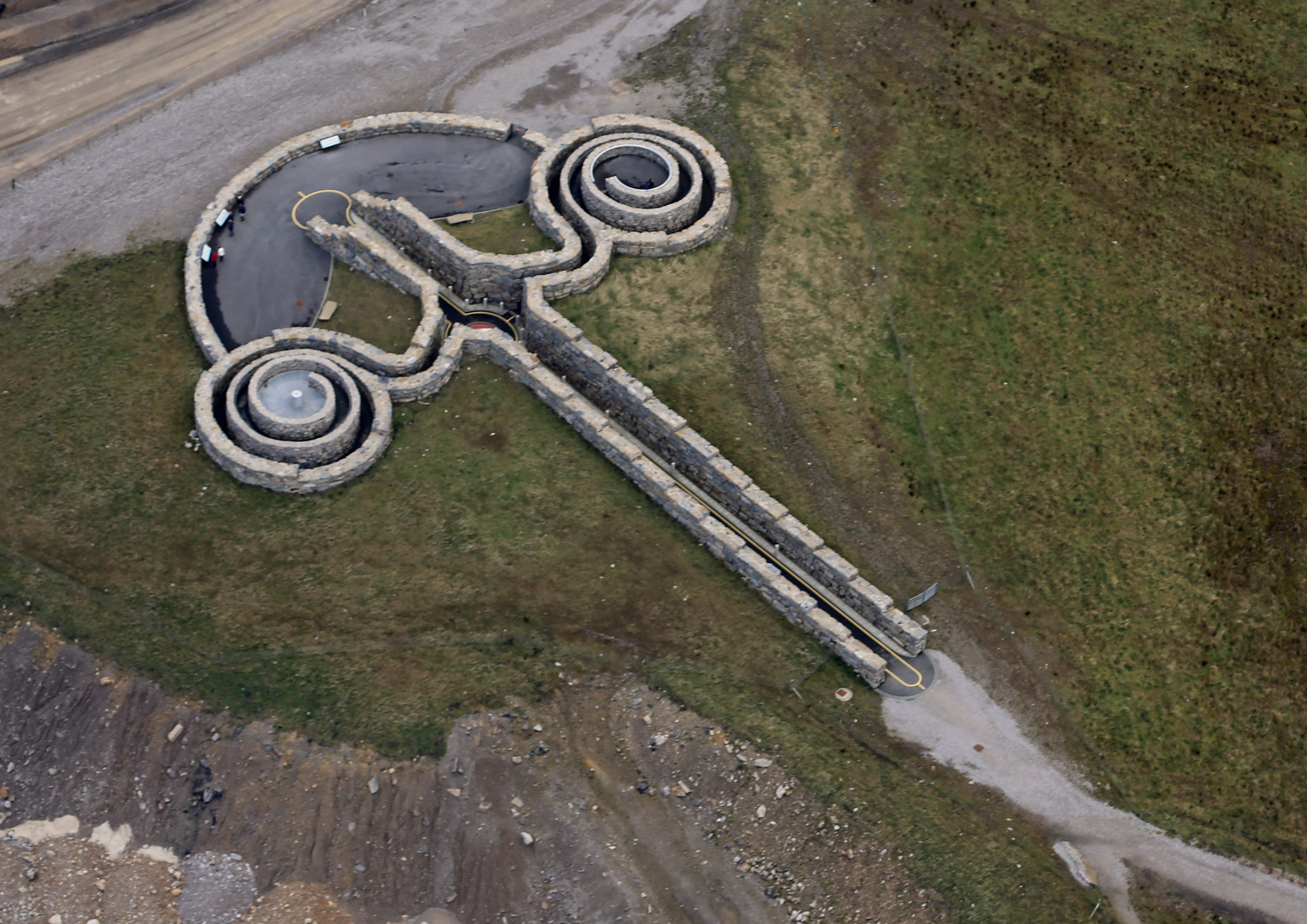
Andy Goldsworthy, Charles Jencks, Anthony Gormley and Andrew Sabin have all changed the way we look at the world, thanks to their vision and landscape-changing sculpture on a monumental scale. Whether we look at the huge tree trunks incorporated into dry-stone walls that Goldsworthy created at the Yorkshire Sculpture Park, the ‘Goddess of the North’, into which Jencks transformed the debris of Shotton surface mine in Northumberland, the ‘Angel of the North’ that Gormley raised upon on a hill near Gateshead or ‘Coldstones Cut’, Sabin’s sculptural symbol overlooking a Nidderdale limestone quarry, we cannot fail to be moved. There is something elemental about the work of these men, which returns us to a land of ancient myth and to stories told around fires from generation to generation; their impact upon our psyche is immeasurable, though we may try to quantify it. We are thrust deep into the earth, forced to look upon the wild ocean’s swelling rages, inspired to peer out from our little world into the universe, led to contemplate the natural processes of time and conjured into the mysteries of legends that have haunted our race over millennia.
I visited ‘Coldstones Cut’ yesterday, on a clear, cold and brutally windy day. I followed the footsteps of the (already!) more than forty thousand visitors that the Sabin sculpture has attracted, although it was completed only two and a half years ago; practically speaking, it is the viewing platform for a stone quarry otherwise visible only from the air, so skilfully has it been hidden in the Pennine landscape. As I took advantage of the chance to view the magnificently clear 360-degree landscape from the tips of the twin ramshorn curls that shake themselves at the sky, I could understand the artist’s presentation of an internal ‘street’ (complete with bollards, yellow lines and humped roundabout) to demonstrate the purpose to which the quarry’s materials are put and, much more beguiling to me, draw my own conclusions about a shape which for me evokes male and female organs and the myths of fertility gods and goddesses. How imaginative the minds which first conceived of this project! How lucky for all of us that there were others to plan and argue for its completion! How monumental the task to bring such a sculptural idea into being!
Here we are, in the 21st Century, still desperately in need of the same sense of purpose as those who, in the far-off lands of our past, cut horses into hills and drew wild beasts on walls of caves. We are one humanity, living with the creative urge of our ancestors and looking for the same answers as they. We may carve, build, draw, paint… or write, but our need is the same: to place ourselves somewhere and to make sense of why we are here.
Thank you, Andrew Sabin and the many people it took to deliver this wonderful artwork to us. It is a living, life-affirming and awe-inspiring emblem of stark, brutal beauty and significance.
A century of posts…
So, one hundred posts since becoming a blogger and I’m still at the crease. I have been bowled over (not out) by the response from my readers, who have so far been very supportive of my innings: cheering me on by their positive comments here and on Twitter; generously sharing my best shots and kindly looking the other way when my technique almost had me out.
I had thought before I started that this game would be a little local affair, with breaks for tea in front of the village pavilion, a close circle of forgiving friends and a relaxing drink in the local afterwards. I thought that I would be familiar with every bump and hollow of the word-wicket and hoped that I wouldn’t be stumped for carelessness. However, I realise now that my sporting efforts are on view to the world, with an already astonishing number of regular spectators from around the globe, and I can tell that they are very knowledgeable and will expect no less than a perfect performance, especially when the standard of the game is so high. As a result, here I am, practising ever more rigorously and maintaining my fitness, worrying about each stroke.
Right now, I’m acutely aware that I’ve stretched to breaking point a very extended and not particularly appropriate metaphor and, before I lose whatever blogging credibility I have, I’ll say how much I have enjoyed writing these hundred posts, reading reactions to them and doing my best to reply. The blogging community is a warm and friendly one, ever willing to communicate and producing entertaining and enjoyable writing; for me, it’s rewarding and stimulating to discover new blogs and new posts.
I’m very grateful for the opportunity to share my experiences, ideas, attitudes, opinions and beliefs with an ever-increasing number of people. I value your responses and hope that you enjoy giving them.
I’ll try very hard to sustain your interest for the next hundred posts!
The old curiosity shop…
I’ve been asked by several readers of In the Family about the shop where Doris Atkins lived; it was also, of course, the place where she was murdered. As I’ve written in a previous post, this shop was drawn almost entirely from my memories of the establishment that my great-uncle kept when I was a child. My grandmother lived there, too, and was effectively the housekeeper. It was the house in which they’d both grown up. My great-grandfather died in the 1930s, but my great-grandmother was still alive when I was born. I have a very vague memory of her sitting up in bed, a tiny frail old lady with waist-length snow-white hair. She died a horrible death by falling on an electric fire.
The shop itself had been the front room of the fairly substantial family home, built, I’d say, in the mid-nineteenth century. It would be incorrect to call it a terraced house; it was rather one of those houses that you still find in some old towns: detached, but snuggling right up to its neighbour. The neighbouring building on one side was a much smaller, newer house; on the other, the Punch Bowl pub (where dancing lessons were held on Saturday mornings: my grandmother tried in vain to persuade me to learn tap-dancing). The address was Westlode Street, as in the novel. I’ve since discovered that this is the only street in the country bearing this name.
The shop itself was relatively modern. Although my great-uncle was a Scrooge-like character (he would give my brother and me packets of out-of-date jelly babies and dolly mixtures at birthdays and Christmas), he had spent some money on modernising it, possibly because he’d once run foul of the environmental health department at Spalding Council. My grandmother was certainly an obsessive cleaner and scrubbed the floor and all the surfaces in the shop every day. The bay windows on either side of the door had been converted into ‘picture windows’ that took displays. There was a tall, glass-fronted cupboard which was filled up every day by the Sunblest man with loaves of bread, tea-cakes and currant loaves. He usually also brought a tray of cream cakes. The cream was all the colours of the rainbow; I shudder now to think of the dyes that must have been used in these creations. Another daily visitor was the pop man: my father told me that his visits had removed the need for the shop to make its own carbonated drinks; as a schoolboy, he and his friends had had fun making fruit sodas three times as effervescent as they should have been!
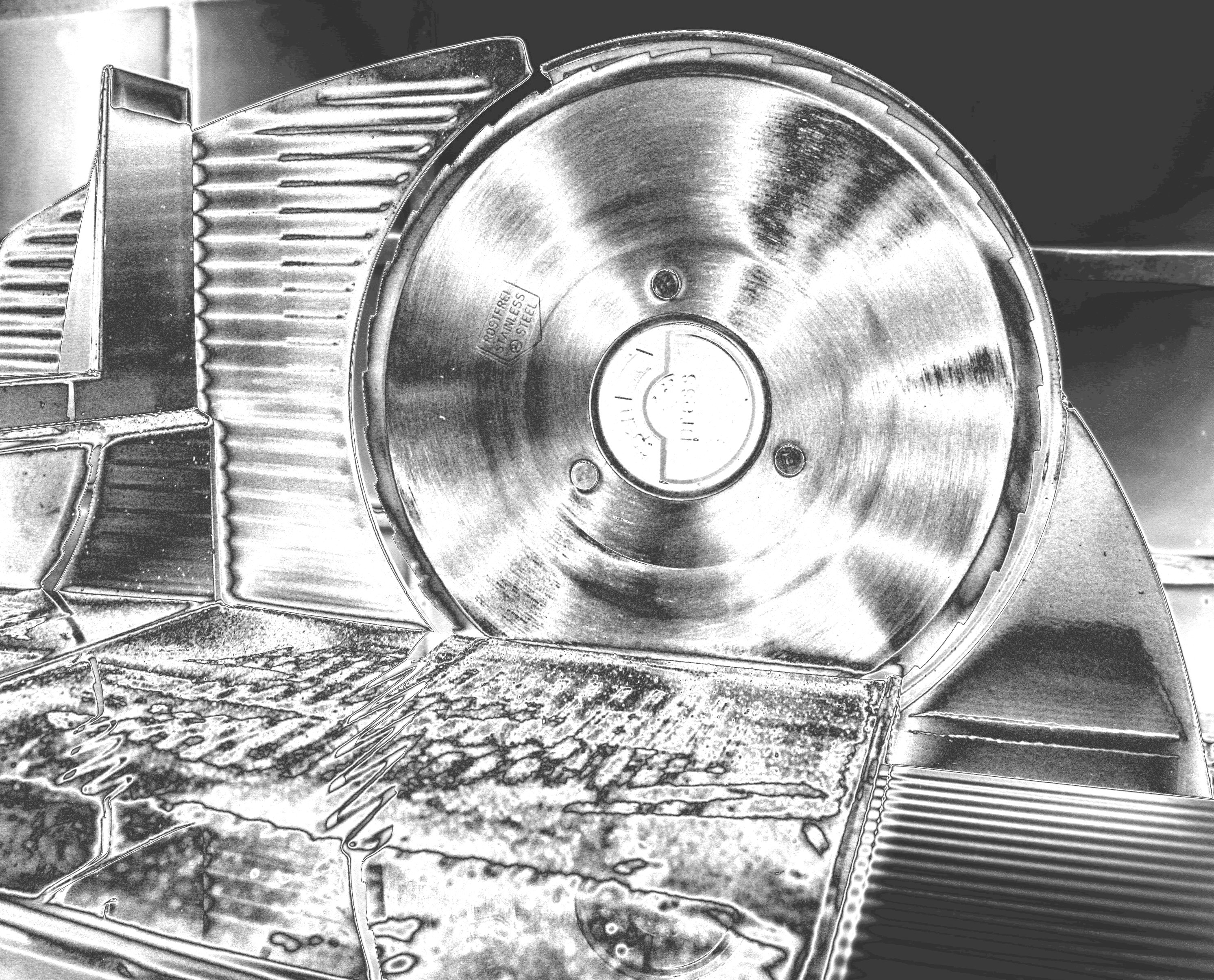
The shop also had a manual ham and bacon slicer – one of those fire-engine red machines with a lethal circular cutting blade to be seen in most general shops of the time – and several fridges, including a shiny rectangular-shaped Frigidaire with a glass display front that was great-uncle’s pride and joy. It did not impress me as much as the squat, square fridge in which he kept ice-cream. I was intrigued less by the contents than by the mystery of its black rubber lid; this was several inches thick – presumably for insulation purposes – and too heavy for a child to lift (which may have been part of its attraction for its owner – there was no risk that his great-nephews and -nieces would plunder the stock).
Pocket-money sweets were laid out in trays near the till, right under great-uncle’s nose. He always wore a long, dun-coloured shopman’s coat and was rarely seen without his trilby hat. When he wasn’t busy serving, he sat in the shop on a tall stool, painstakingly writing out the price-tags that were stuck into meat and vegetables on vicious-looking skewers. He had a few secrets under the counter, too. For years I wondered what the box labelled ‘ONO’ contained and why my mother was so cross when I tried to look inside it. It was only after I had left home that I read in a novel that this was the brand-name of a type of contraceptive.
But the crown jewels of the place, for me and for all children who visited, were the serried ranks of tall sweet jars that stood on shelves along the back wall. They were uniform in size and shape, with thick lids of many colours – perhaps made not of plastic, but of one of its predecessors, such as Bakelite. They contained bulls’ eyes; mint imperials; Fox’s Glacier Mints; Nuttall’s Mintoes; Bluebird liquorice toffee; Milk Maid dairy toffees; aniseed balls; gobstoppers; red liquorice strands; black liquorice strands; winter mixture; chocolate Brazils; Liquorice Allsorts; Payne’s Poppets. I could go on. They looked so beautiful standing there together, a hymn to the confectioner’s craft. Choose a quarter of any of them – it would be conveyed by a tin trowel to a narrow, trough-like pair of scales – and their spell was broken. Their real charm was collective; it resided in their magnificent diversity of shape, colour and size. They inspired a sort of sensory holy grail quest that making no single choice could ever satisfy, because their pull was visual as well as visceral.
I had hoped to write about the house behind the shop, but I’ve probably said enough for now. I’ll come back to it in a future post!
 Christina James, crime novelist