

Let’s sing about the unsung volunteer staff at Bawtry Community Library…
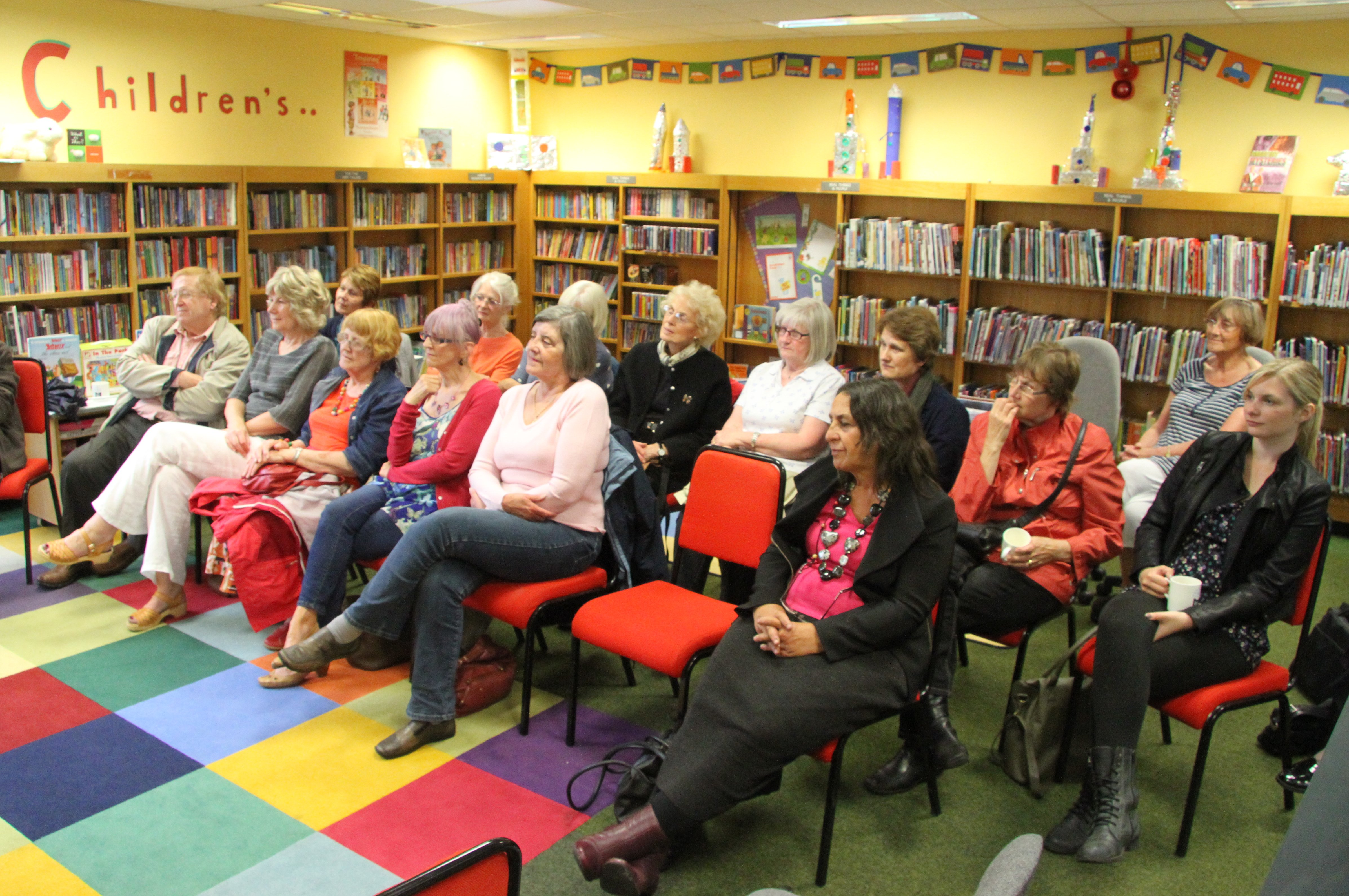
Part of the lovely audience at Bawtry Community Library
I gave my first talk in a library yesterday, at Bawtry Community Library, near Doncaster. It had been requested by Claire Holcroft and George Spencer, of Doncaster Library Service, and immaculately organised by Lesley Gilfedder at the library itself. Despite the rain and the fact that it coincided with the local school play, about twenty people attended. It was a lively and appreciative audience; most of its members had read more crime novels than I have, even though I’m a self-confessed addict, and several of them had detailed personal knowledge of the part of Lincolnshire which I write about. I felt that I learnt at least as much from them as they from me.
I gave two short readings, one from In the Family and one from Almost Love. I was asked about the characters and, especially, about why I’d chosen to make a dysfunctional family the focus of In the Family. We talked a lot about the atmospheric qualities of the Fens and about past writers who have described them, especially Charles Dickens and Dorothy L. Sayers. We discussed plots and plot construction, how to make them work, whether it’s possible to change the plot mid-novel and how to avoid inconsistencies. Several of the audience kindly bought copies of the books.
I took some cakes (I’ve decided to make this one of my trademarks!) and, when the organised part of the evening was over, no-one was in a hurry to leave. Lesley, ever efficient, made tea and coffee and we all stayed to talk.
Of course, I know about public library cutbacks, but I had no idea how swingeing they have been in some authorities or how magnificently local communities have responded in order to save their libraries. Bawtry is a lovely library: it has a cared-for look; there are bright paintings on the walls; the stock is impeccably arranged and there is a large children’s area where the floor has been carpeted in multi-coloured tiles to aid the playing of games and telling of stories. It keeps full opening hours and, as last night, is also sometimes open late. All of this is achieved by volunteers. It has about ninety of them, typically working three-hour shifts. As well as manning the library, they clean it and care for the grounds. They’ve been operating this arrangement for eighteen months and, so far, not one volunteer has dropped out. I understand that most of the other libraries that come under the aegis of the Doncaster local authority are also run in this way, though not all manage to keep such long opening hours as Bawtry.
I am amazed and full of admiration, tinged also with a little bit of shame. The public library charter entitles people to the right to borrow books from a local library, yet the people of Bawtry would not be able to do this if so many of them were not prepared to give up their own time to make it work. It is both a huge local achievement and a national scandal that this state of affairs should exist.
I’d therefore like this post to stand as a tribute to the wonderful people from Bawtry whom I met yesterday and to all their friends and colleagues who continue to make the library the vibrant hub of their community. Thank you. And especial thanks to Lesley, for all your unobtrusive hard work behind the scenes.

Elaine Aldred and Christina James at Bawtry Community Library
A book to take on holiday… by someone I knew before she became a writer

I first learnt of Murielle’s Angel on the social networks. It is the debut novel of Mary Jane Howell, who is married to one of my husband’s university friends. Though I don’t know Mary Jane well, this is the first novel I have read by someone who was an acquaintance before she became a writer. I have friends who are writers, but that is because they are writers, if I may make the distinction.
It is piquant to read a book by someone whom you not only know but of whose circumstances you also have a little knowledge. The book is about Rosemary, a middle-aged woman who undertakes the pilgrimage of Santiago di Compostella. I am aware that the author herself made this pilgrimage some years ago; there are also other aspects of Rosemary’s personal life that seem to coincide with Mary Jane’s. The novel, however, is described as a fictionalised account of the pilgrimage and I won’t therefore be foolish enough to fall into the trap of assuming that it is thinly-disguised autobiography! I recognise from my own writing that characters can display certain traits or characteristics of people that I know, including myself, whilst remaining fictional creations nevertheless, and I’ve been much amused by readers who’ve told me with great certainty that they ‘knew’ who some of my characters were based on. For example, someone told me that she recognised the original of Henry Bevelton in In the Family. To my knowledge, Henry is entirely fictitious and not based on anyone at all!
Cinnamon Press, its publisher, describes Murielle’s Angel as a modern take on The Canterbury Tales. This is true in the sense that it tells of how a disparate group of people are thrown together, united only by the common purpose of making the pilgrimage; but, unlike Chaucer’s, these pilgrims don’t entertain each other by whiling away evenings and rest periods telling stories; instead, each has a story which the author herself outlines and pursues cleverly, drawing out the threads with admirable economy of detail. There is Stefan, who was brought up in an orphanage and has staked his whole career and possessions on producing a film; Ria, a doctor who is a workaholic seeking to restore some balance to her life and using the temporary separation to re-evaluate her relationship with her partner (interesting parallels and contrasts are drawn between her life and Rosemary’s); Dominic, who is a bit of a chancer and of dubious morality – he is a type, someone we have all met on campsites and ferries, the kind of person who latches on to others in a hail-fellow-well-met sort of way and wants something in return – but for Dominic, too, there is a sad story behind the bravado; then there is a host of minor characters who criss-cross the narrative at intervals – two Canadian nurses, a grotesquely amorous widower, two groups of Germans.
Like Chaucer’s, these modern pilgrims have many reasons for committing to the pilgrimage, none of them overtly religious. Each is trying to ‘find’ himself or herself through the combined abandonment of routine and the privations that the journey entails. There is a strong sexual undercurrent throughout, although only one description of sexual consummation, and that between two minor characters. The author shows that the unfamiliarly liberal circumstances created by a group of strangers being thrown together encourages an often unwelcome removal of inhibitions. Rosemary herself is propositioned on several occasions and is sometimes disgusted, sometimes flattered, by these attentions.
For me, the novel dips briefly about two thirds of the way through, when the combination of apparent moral aimlessness and the dissatisfaction of several of the characters with what they are achieving as pilgrims suddenly tipped me into, if not boredom, at least a bewildered questioning of where it was all leading. But I was too impatient, because it is at this point that Murielle, who has been hovering around the periphery for some time, now takes centre stage. Terminally ill, she is unable to continue further on foot (even with the help of a little cheating on public transport) and takes refuge in the house of a priest. The relationship between Murielle and the priest is exquisitely drawn. He is her spiritual guide as she prepares for death, but also, the author hints delicately, totally (although of course hopelessly) in love with her. It is an act of love that unites all the characters of the novel, as they admire the mural that Murielle has painted on the side of the priest’s house to thank him for his care. Their reaction is unanimously of joy and laughter. It is the priest who teaches Murielle that you owe service especially to those who love you more than you love them. It is a lesson that each of the main characters takes on board, each in his or her own way.
Murielle’s Angel is beautifully written; it is sad, yet uplifting; it is a brilliant achievement, one of the best debut novels that I have read. I’d not heard of Cinnamon Press before I bought it, but it is a publisher whose books I shall look out for now. If you’re looking for some fine writing and an extraordinary narrative to take on holiday, I wholeheartedly recommend this book.
The flavour of Salt crime fiction…


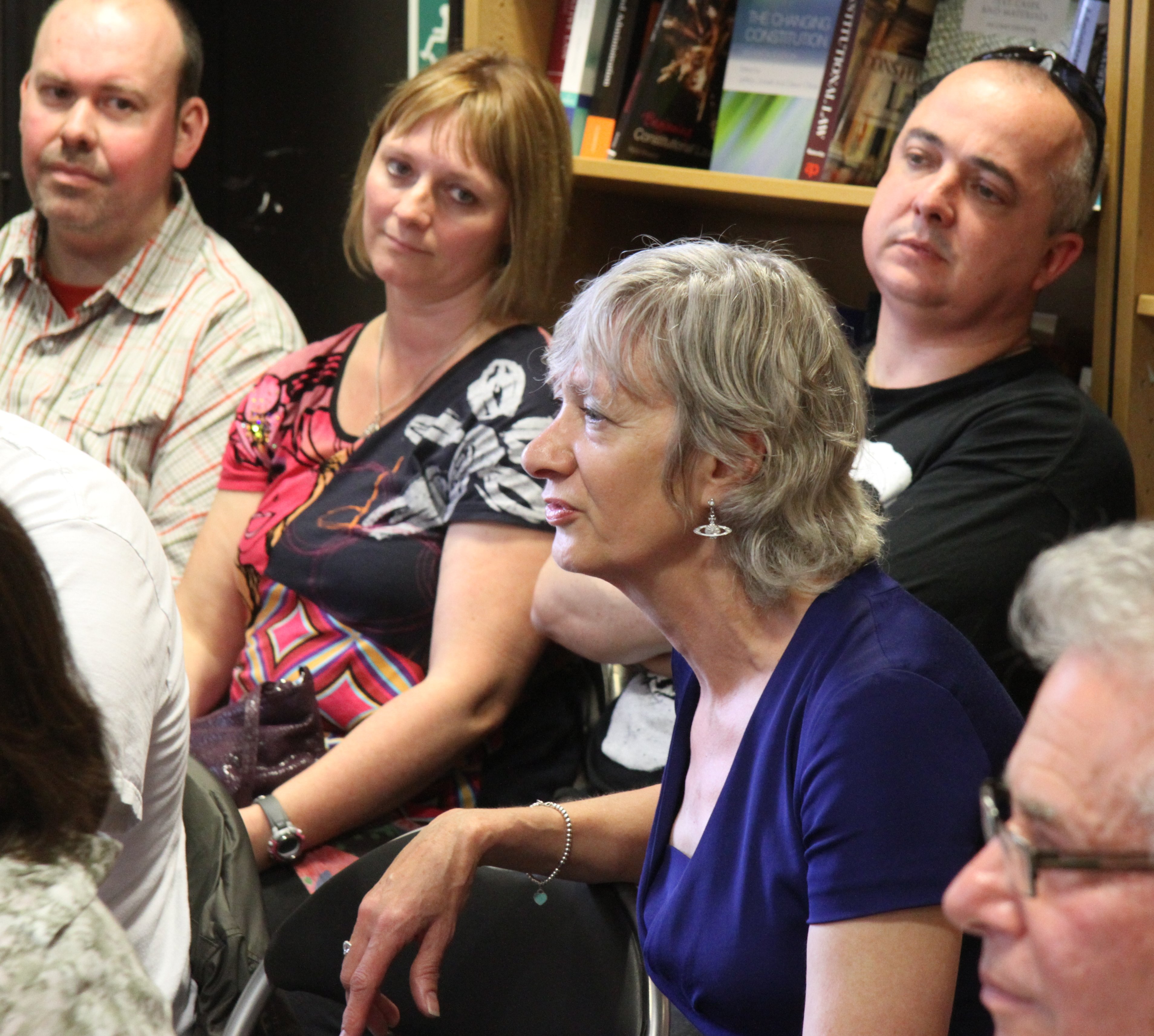
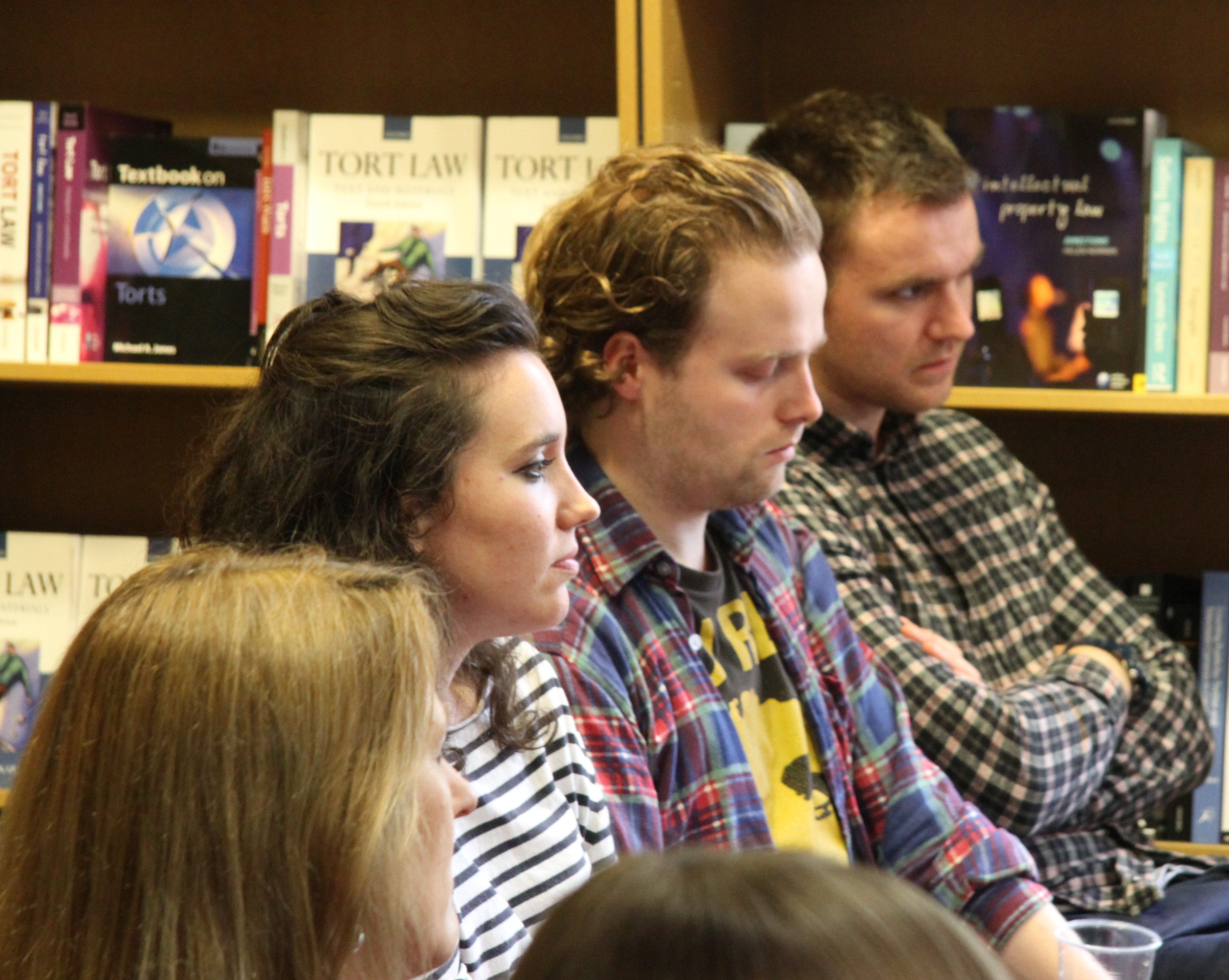
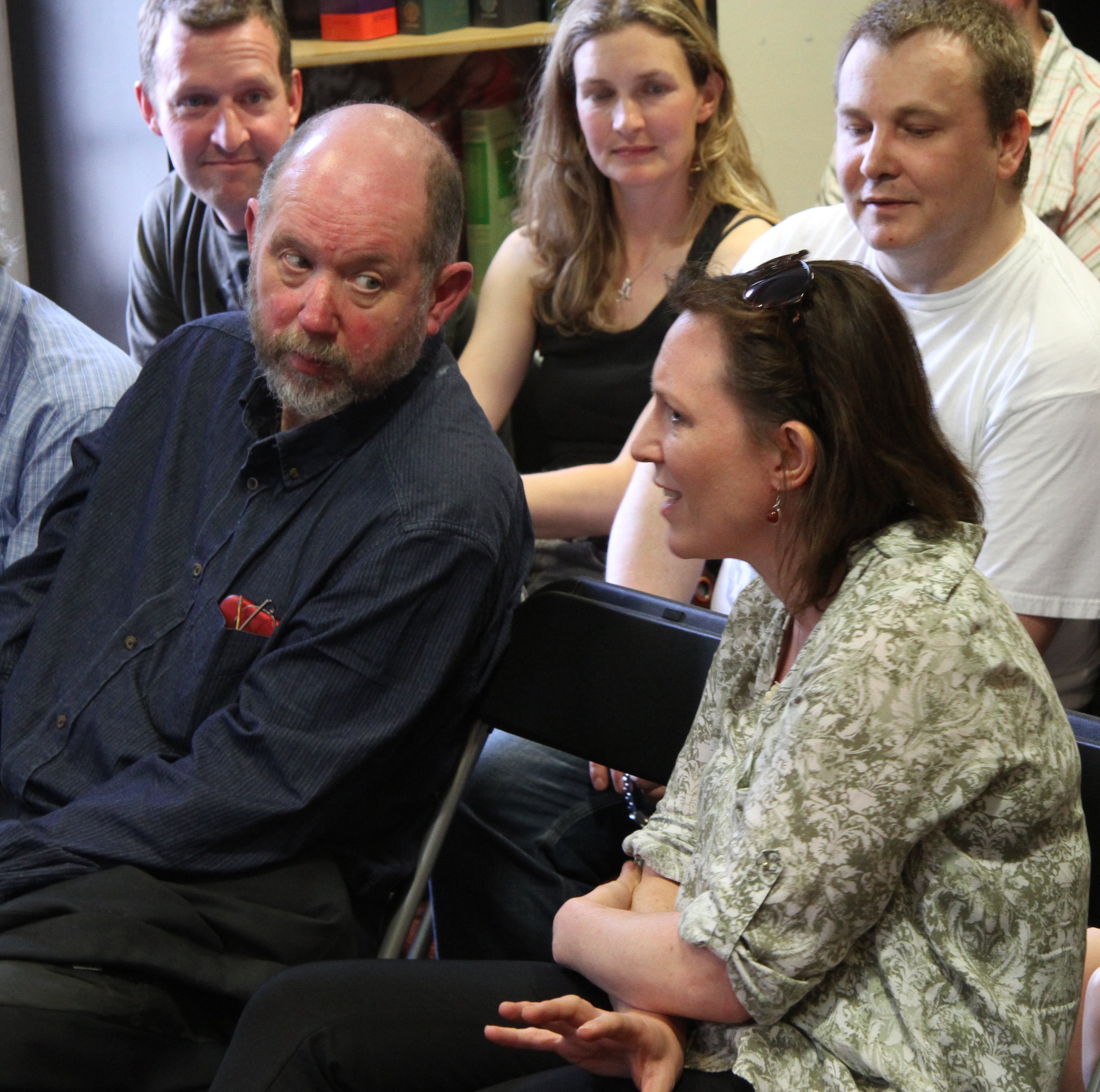


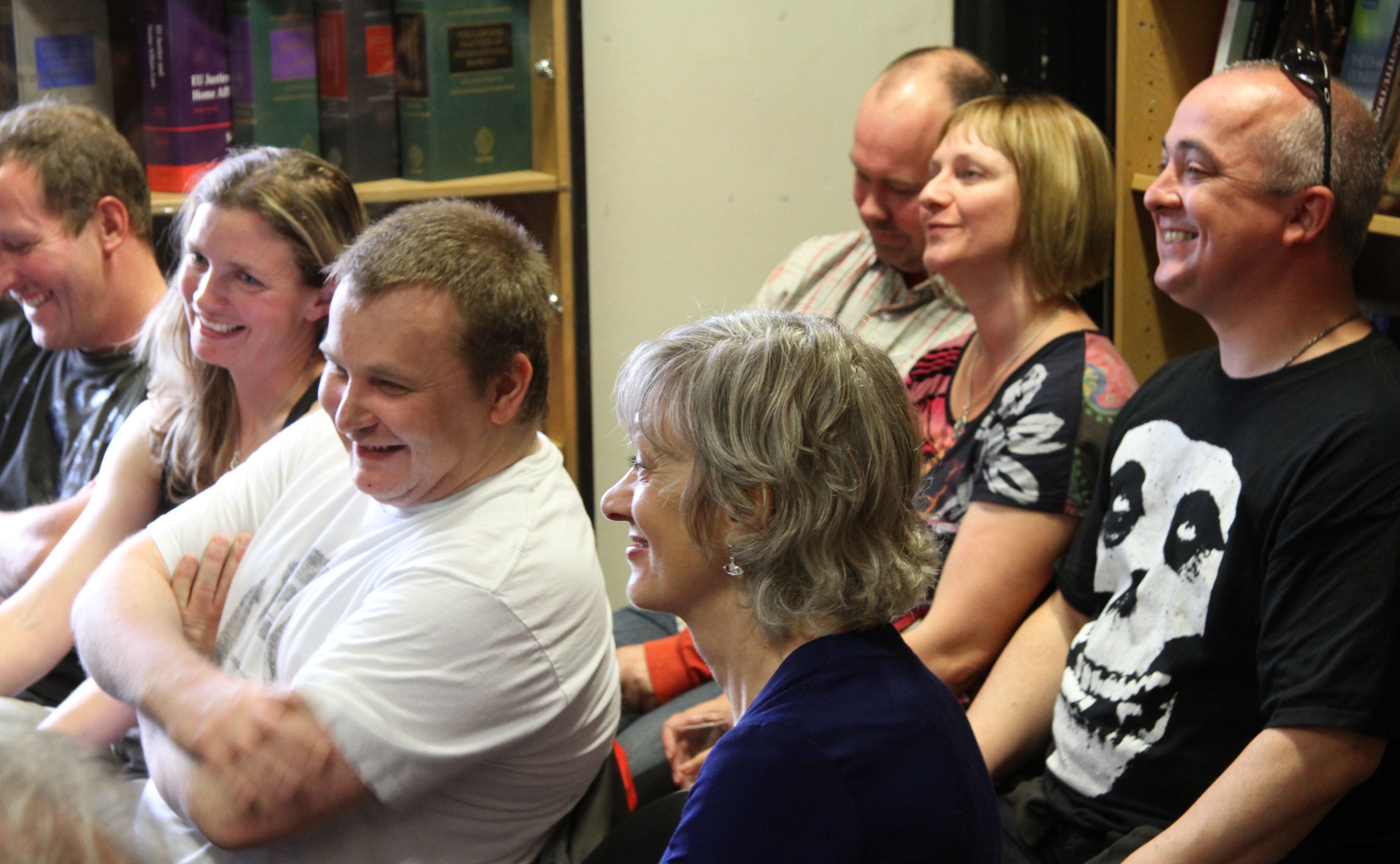

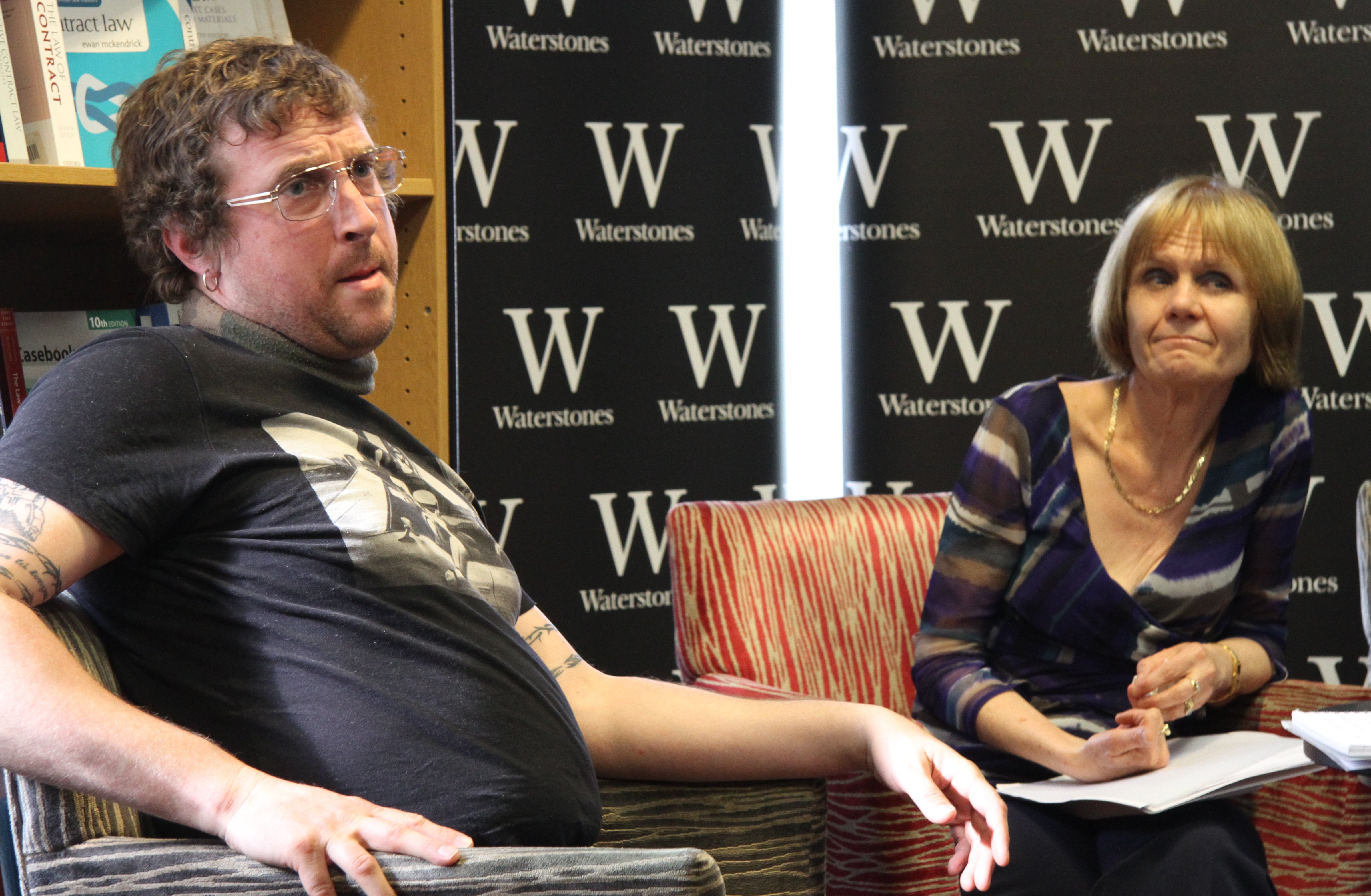


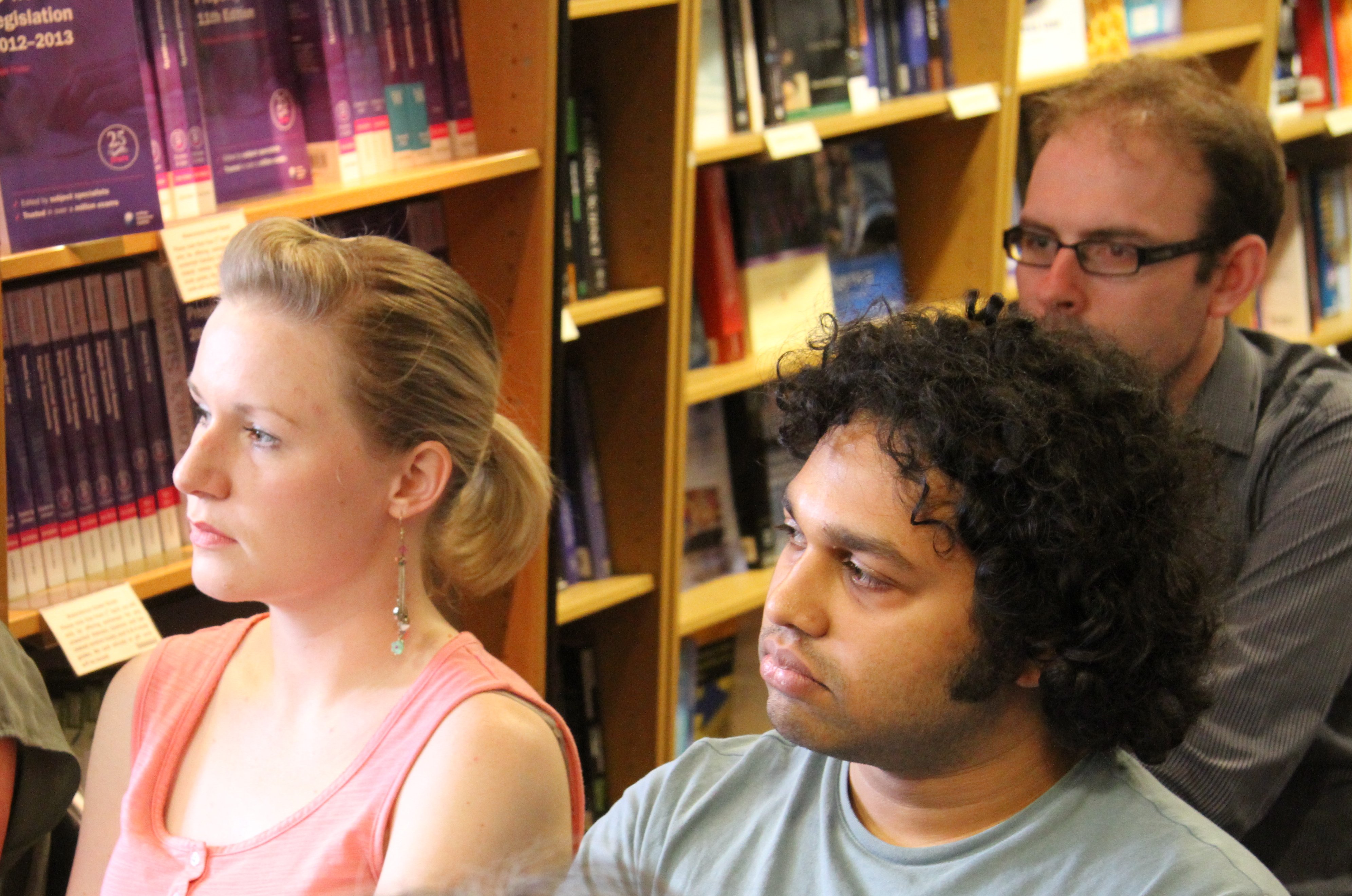


The Salt crime writing event that took place at Waterstones Gower Street yesterday was a very festive occasion. Sam Rahman, the Events Manager at the shop, her colleagues and a large and appreciative audience combined to make it a great success.
Laura Ellen Joyce, Matthew Pritchard and I each gave readings from our books. Laura read from The Museum of Atheism, which (jointly with In the Family) launched the Salt crime list last November. I read from Almost Love and Matthew from Scarecrow, which Salt will publish in September. Afterwards, I chaired a discussion with Laura and Matthew about their writing. The audience joined in, offering many lively and perceptive comments.
Both Matthew and Laura agreed that a sense of place was important to their writing. Laura chose to set her book in small-town America in the dead of winter – there is no daylight in the novel – to epitomise the corruption that it portrays. Matthew writes powerfully about Andalucia, which he knows well, having lived and worked there for twelve years. Laura agreed with the suggestion that she describes a rudderless society in which no character is able to provide a moral yardstick or compass. Matthew said that the corruption captured in his work derives more directly from his knowledge of shady Spanish officialdom. Danny Sanchez, the protagonist of Scarecrow, is a journalist who bravely tries to expose the fraudulence and self-interest upon which he sees that Spanish politics is based.
Laura had deliberately left vague the identity of the killer in her book, because, in a sense, she was indicating that society as a whole was to blame. Matthew had had the intention right from the start to write about a serial killer, but the character of the killer took shape in his mind gradually as he worked on the book and continued to read about real-life murders. An account of how the head of one of Fred and Rosemary West’s victims had been swathed in gaffer tape had left a particularly lasting impression on his imagination.
There was much laughter from the audience at Matthew’s anecdote about how, when the shop below his flat caught fire recently, the police broke into the flat and discovered his large collection of books about serial killers and Nazism scattered over the floor. There was even more laughter when I persistently made the mistake of calling him ‘Danny’, after his hero, rather than Matthew! (Apparently, it is a mistake that his agent makes, too!)
Laura confirmed that she will continue to write crime because she has a profound interest in why people commit evil or anti-social acts. She’s also interested in pushing out the boundaries of fiction. When, in response to a question from one of the audience about what I thought the ‘next big thing’ in crime writing would be, I said that I’ve seen several books lately that mix genres and I’m not sure that it works, Laura said that this idea appealed to her and that she would like to experiment with it. I do think that it would take a very good writer to pull it off, but Laura is so accomplished that she is one of the few people I know who might succeed at it.
I was asked why most crime novels are about murder, rather than other types of crime, such as theft or fraud. I said that there are some novels based on theft – there is quite a strong sub-genre relating to crimes associated with works of fine art, for example – but it is difficult to write about crimes other than murder unless you are a police procedural author. This sub-genre has never appealed to me; I’m more interested in the psychological aspect of crime-writing.
We were all asked whether we’d come to writing ‘lately’, or whether we’ve always been writers. We agreed that we’ve all been writing ever since we can remember. Asked also whether we had to let a novel ‘fade’ from our imaginations after we’d finished it before we could embark upon another, we each offered different responses: Matthew writes all the time and is usually working on several books at once – he knocks out 2,000 words a day, even if sometimes he knows it is rubbish and he will have to discard some of it; Laura writes regularly, but in different genres – she writes short stories between novels and also said that she was very organised when writing The Museum of Atheism which, with a detailed outline on a spreadsheet, she wrote in twenty-four days, a chapter a day, all in November, following the NaNoWriMo concept; I usually take a brief break after completing a novel, but I’ve started on the next DI Yates book now. I feel that being an author is a bit like being a member of the fashion industry: your mind is already on the next season’s work while your readers are still consuming this season’s product.
We all paid tribute to Salt Publishing, which we agreed is an uncompromising publisher setting high standards. We were also united in saying that we aren’t interested in the ‘blood-and-guts’ style of crime writing.
On behalf of the three of us, I’d like to thank Sam and the staff at Gower Street for their wonderful hospitality. I’d especially like to thank all of you who attended for being such a generous and receptive audience, for making such constructive contributions to the discussion and, of course, for buying or ordering our books! It was good to meet some new friends – some of whom I’ve only previously ‘met’ through Twitter. Finally, a big thank-you to numerous well-wishers who were unable to come (some of you based in countries very far away), but who sent kind and encouraging messages and helped to advertise the occasion. We hope to meet you all one day at future events.
All in all, it was a very memorable evening indeed!
A very old bookselling friend revisited…

Richard Knowles and Christina James at Rickaro Books, Horbury
I went to Wakefield One last Friday, in order to discuss the details of the programme for 29th June with Alison Cassels, the librarian who’s in charge of events there. It’s a truly spectacular new library and events centre and well worth a visit if you’re in the area. It’s heart-warming to think that in these days of austerity and cutbacks there is still investment being made in such buildings, so important for promoting reading and holding local communities together.
During the course of our conversation, Alison mentioned that she’d ordered copies of both my books for the event. The library has itself bought copies of In the Family for its reading group (a very generous action which I applaud!) and has also ordered copies of it and Almost Love for those attending the session to purchase if they want to. I asked Alison who was supplying them and she said it was Rickaro Books of Horbury. It’s a bookshop that I’ve long been meaning to visit, because its proprietor is Richard Knowles, who many moons ago was my first boss. I e-mailed Richard to ask him if I could drop in with some Christina James postcards and he got back to me immediately. We agreed that I would call yesterday.
It seems particularly fitting that my visit should have taken place this week, which marks the thirty-fifth anniversary of my appointment to the library supply company in Normanton where my bookselling career started. Richard, then the manager, had many idiosyncratic interests which married well with bookselling: he was an authority on mediaeval armour and effigies and both wrote about and collected books on them. He liked antiquarian and private press books and had a fine collection of these, and read everything that he could lay his hands on about or by T.E. Lawrence. He was also fond of the poetry of Edward Thomas. Other interests included motor-bikes and collie dogs. He had a small child’s aversion to vegetables and liked nothing better than a currant bun filled with cheese for lunch, bought from the bakery on the corner. Main courses he could take or leave, but he loved puddings and chocolate. I once walked nine miles to work through snow drifts after the bus failed to materialise; he must have been impressed, because he gave me the chocolate bar he had earmarked for his elevenses!
I last saw him about twenty years ago (at the Scottish Library Association Conference in Peebles), but truly he hasn’t changed very much. A little more ‘distinguished’, perhaps, and now wearing spectacles, but otherwise he could have stepped straight out of 1978.
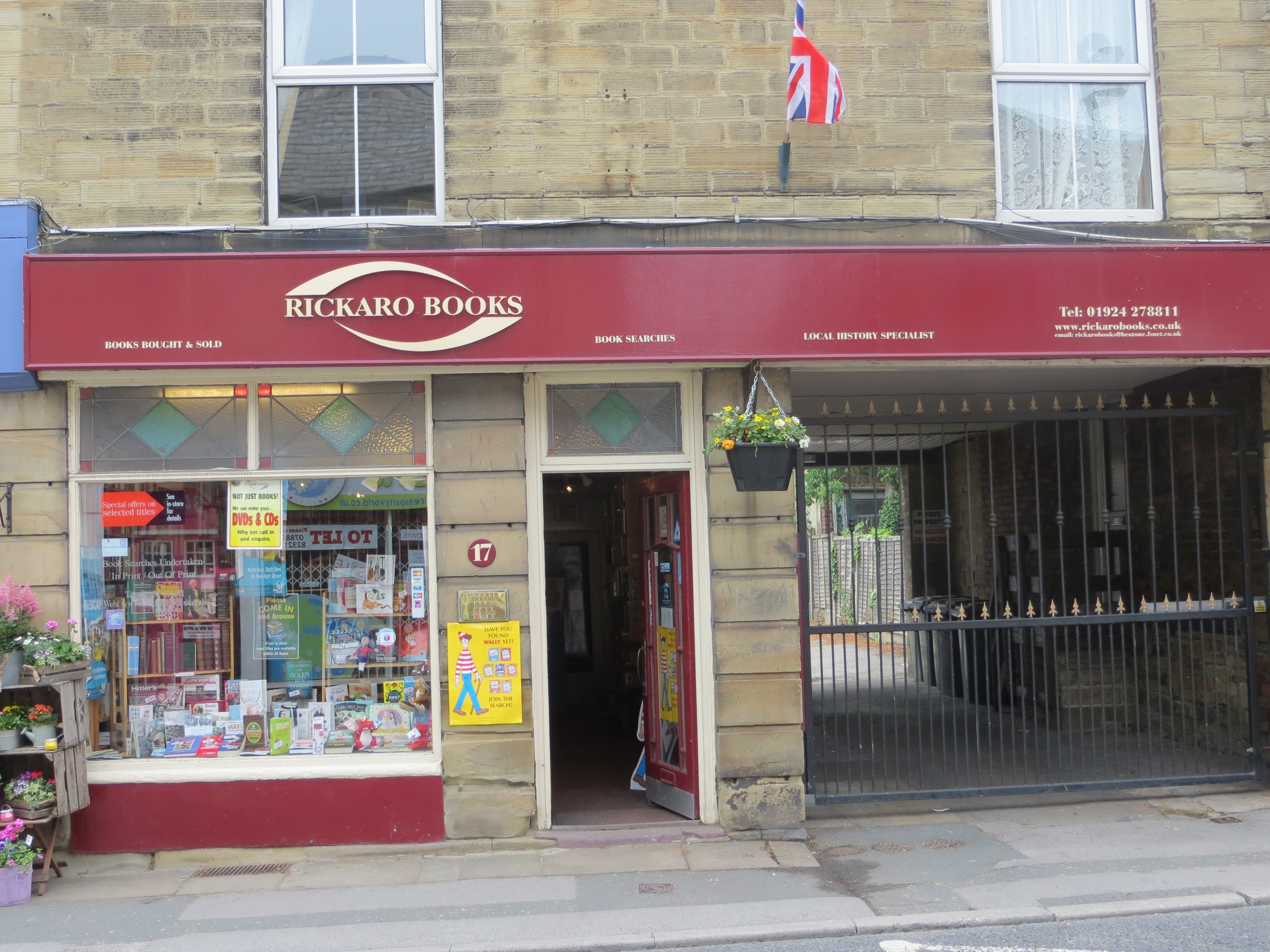
Rickaro Books, Horbury
Rickaro Books is exactly what I had expected: a deep Aladdin’s Cave of intriguing antiquarian and second-hand books, with a smaller but select stockholding of new titles. It even has a resident collie dog – Tilly – who lies under the cash desk. I didn’t ask him whether he comes to work on a motorbike; I suppose that Tilly would make this difficult, but otherwise I wouldn’t be surprised. I note with amusement that there is a baker’s shop just a few doors away and wonder whether its currant buns are up to the mark.
Richard said that he’d set up the shop thirteen years ago. He has a loyal local following and the library business, for special orders of new titles, is important to him. His customers for the antiquarian books are scattered throughout the world. He spends much of his time packing parcels to despatch to them. I didn’t buy any of the antiquarian books, but I did leave with two of Anne Cleeves’ titles, having been encouraged to read her by comments on the social networks.
Rickaro Books is a delightful place and one that I shall certainly visit again. I’ve already threatened to present myself for duty in the run-up to Christmas! It’s encouraging that booksellers like Richard can not only survive, but thrive, by building a business such as this, almost entirely on traditional lines; excellent also that Rickaro’s worth is recognised by the local library service.
Richard says that he and his wife plan to come to the event at Wakefield One on 29th June. I am pleased and touched that they are going to the trouble of rearranging their afternoon. After a gap of twenty years, two meetings in the space of two weeks! Like fine old books, old bookselling friendships mellow with age and perhaps get a little dusty, but they don’t disintegrate.
If anyone reading this would like to attend the event at Wakefield One, it starts at 2 p.m. on Saturday 29th June. I shall be giving readings from both books and talking about how I came to write them, as well as offering tips on how to get published.

Tilly, the bookshop collie
Almost Love: Publication Day
Today is the official publication date of Almost Love. It is almost midsummer and the sun is shining; the cuckoos are still here, though they’ve changed to cuk-cuk mode now (it’s been a particularly good year for cuckoos in Yorkshire this year). It’s a complete contrast to the day on which In the Family was published, when the leaves had fallen, the shooting season was in full swing and we were heading for the winter solstice. November seemed a good time to publish then, because it was still far enough away from Christmas for the book to feature (as I know it did, and am grateful) on some Christmas wish-lists. June also seems a good time, as I’m hoping that at least a few people might want to take Almost Love on holiday with them.
Some authors talk about their books as if they’re babies. This particular baby, although it’s been born today, is still in the incubator. The books were delivered to Salt and its distributor yesterday, but have yet to be despatched to the shops; this will happen on Monday. Yet I’m not impatient or disappointed that I don’t yet have a copy in my hand; on the contrary, I’m profoundly grateful to both Chris and Jen at Salt and to TJ International Printers of Padstow for pulling out the stops so quickly after MPG Printers went into receivership just as Almost Love was going through the press. Thanks to their Herculean efforts, the delay has been minimal – much slighter than we’d feared. And yesterday’s blog-post attracted so much interest that I feel that it acted as a ‘virtual’ launch. Thank you very much to everyone who read it, spread it or contributed comments.
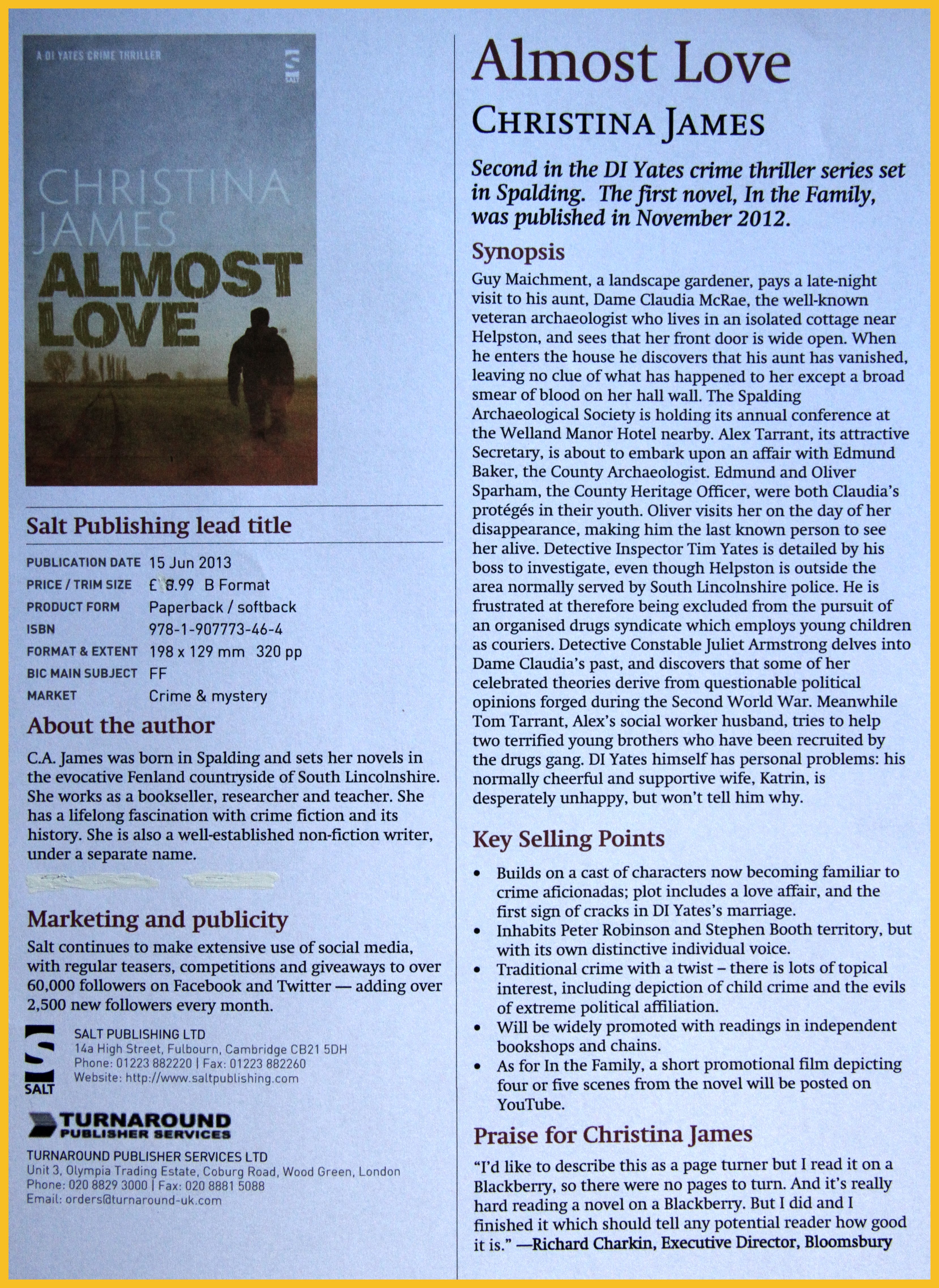
Thinking again about The English Bookshop and Jan’s explanation of why he chose Almost Love brought home to me the crucial role of Advance Information (AI) sheets in helping authors and publishers to sell their books. AIs have improved tremendously over the years. They started out as Gestetnered sheets. (Does anyone remember Gestetners? They took ages to set up and usually suffered a paper-jam within five minutes; you got ink all over your hands and, if you were unlucky, your clothes. The only good thing about them was the pink correction fluid, which could give you a temporary high if you applied it when standing in a confined space.) These were sometimes almost illegible and contained little except the ISBN, a two-sentence blurb and the publication date. There was no picture of the jacket. However, by no means all publishers used to produce AIs. Those who didn’t often sent out spares of the actual jacket with the date of publication stamped inside. Booksellers therefore never received a complete set of information: you either got an insubstantial blurb with no jacket, or the jacket and not much else.
By contrast, today’s AIs – at least the ones that Salt produces – are works of art. Author and publisher work closely together in order to wrest benefit from every centimetre of the space on a single A4 sheet. They include a fine picture of the jacket and all the information that the bookseller needs, yet can be read in less than a minute. Sometimes several hours are spent on developing an AI.
I thought that you might be interested to see the AI that was used to sell Almost Love into the shops, so I’ve included it here. I hope that you will like it.
Salt Publishing crime writer event

May I use today’s post to flag up a Salt Publishing event at Gower Street Waterstones, an evening with Salt’s crime authors, Laura Ellen Joyce, Matthew Pritchard and myself, at which we’ll be sharing both our books and experiences. For those new to this blog, here are some earlier posts which may interest you in relation to the authors and the venue:
Meeting Matthew Pritchard at BAFTA 195
I do hope that you will join us on this occasion, if you are able to do so; all three of us are very much looking forward to meeting you in this very lovely bookshop.
One month to publication!

So here I am, one month away from the publication day for Almost Love, which has reached the proof stage. I have marked the day by putting the ‘milestone’ countdown widget here (as if I needed it!), because that seems a celebratory thing to do, as well as adding the clickable cover picture and link to an interview about Almost Love, both of which are to your right on the sidebar. It’s enormously exciting, and humbling, for me to be able to visit the Salt Publishing home page and to see my second novel there, whirling on the carousel amongst those other glorious titles, including Alison Moore’s latest (The Pre-War House and Other Stories, launching tonight at Waterstones Nottingham), David Gaffney’s More Sawn-Off Tales and Alice Thompson’s new novel, Burnt Island, not forgetting my fellow crimewriter Matthew Pritchard’s Scarecrow (to be published in the autumn).
So much has happened since November 2012, when In the Family came out to face the world, and I am very grateful indeed to the many readers of that book who took the trouble not only to read it but also to comment so favourably on it. I have made many online friends since then, via Facebook, Twitter and this blog; they have been stalwart in their support and their sharing and retweeting has sometimes been so vigorous that I have barely been able to keep up with it. If I missed passing on my thanks to you, please forgive me and accept them from me now.
I’d like to express my appreciation, too, to all those readers who have visited here, pressed the ‘like’ and r.t. buttons, followed and commented. This opportunity to engage with you and your thoughtful comments has been beyond helpful to me in more ways than I could ever have imagined when I started blogging last October. It has also been a lot of fun!
I am indebted to Jen and Chris at Salt Publishing for all their support, which is unfailing and ever-present, as I’m sure all their authors will readily confirm. Their incredible creativity, their capacity for managing the impossible in no time at all and their long-suffering, good-humoured indulgence of human failings are what make them truly top publishers.
May I complete this post by announcing four events connected to the launch of Almost Love:
Waterstones Gower Street
Thursday June 20th, 18.30 – 19.30
An evening with Salt crime writers
Christina James, who reads from her new novel, Almost Love
Laura Joyce, who reads from The Museum of Atheism (published November 2012)
Matthew Pritchard, who reads from Scarecrow (to be published September 2013)
Admission by ticket or at the door. Wine will be served. Books will be on sale.
Bawtry Community Library
Thursday June 27th, 18.30 – 19.30
Christina James gives readings and speaks about crime-writing
Tea, coffee, refreshments. Books will be on sale.
Co-ordinated by Claire Holcroft and George Spencer, Doncaster Library Service
Wakefield City Library, Burton Street, Wakefield
Alison Cassels, Library Officer in Charge of Promoting Reading, writes:
As well as Crime Writing Month, 29th June is National Readers Group day, so we’ll be promoting it to our readers groups too. What we have planned for the day is our Readers Group morning, with coffee 11.00-11.30, then discussion groups 11.30-12.00, discussing three books (including In the Family), then 12.00-12.30 a general discussion on crime novels, followed by people recommending books they love until 13.00. After lunch, Christina James will be presenting her second novel, Almost Love, in a public session, from 14.00-15.00.
Event at Adult Education Centre, North Lincolnshire Libraries
Date and time to be confirmed.
A publication date and a tribute to two very good friends…
In this blog, I try to write mostly about crime-related topics, people, places and things that interest me, aspects of writing and other writers and their work. It isn’t intended merely as a vehicle to promote my own work; this was a conscious decision that I made right at the start, because I quickly tire of blogs by authors who use them too blatantly for this purpose.
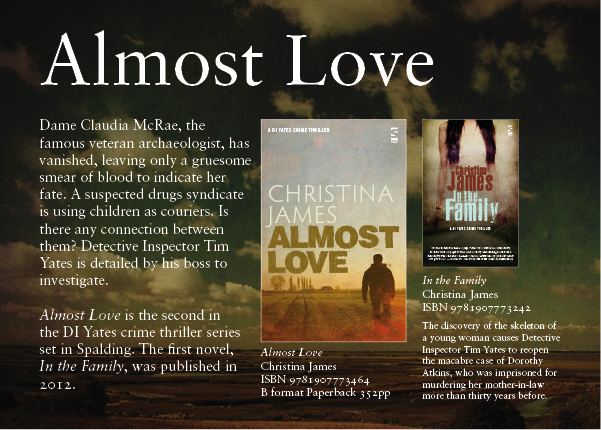
However, I hope that you will look upon today’s post indulgently, because I have to confess that it is indeed about promoting my next book, Almost Love, which will be published on June 15th 2013. It is a promotional piece with a difference, however, because it also celebrates a gift to me by my publisher, Chris Hamilton-Emery of Salt. Before In the Family was published, Chris designed a postcard based on the jacket; I sent this, with a short personal message, to as many people (friends, booksellers, librarians, colleagues) as I thought might be interested in it. I received some lovely replies; it may have helped to generate some interest in the book.
Today, Chris sent a similar promotional postcard for Almost Love. In fact, it features both the novels. I am delighted with it and I think that it is a thing of beauty. I’d like to share it with you; that is why it is the subject of today’s post.
I’d also like to say how much I appreciate Chris and Jen Hamilton-Emery, for their unfailing good-humour and encouragement and also for all their hard work on my behalf. Thank you, both!
A personal expression of thanks…
I should like to use today’s post to express my gratitude to the members of my audience at yesterday’s ‘An Evening With Christina James’ at Waterstones Gower Street. They proved to be attentive, responsive and interactive, as well as very friendly; I was delighted that the occasion developed into a conversation (always much more natural and comfortable) which drew upon the combined personal experiences and expertise of some extremely knowledgeable people.
It was very kind of you all to take the trouble to come to listen to a couple of readings from In the Family and Almost Love and to my personal perspective on approaches to getting published. You are old friends and new and I am privileged as an author to count you as such.
May I also give my warm thanks to Sam and the Gower Street Waterstones for hosting this event!
I’m able to confirm the date of publication of Almost Love as June 15th 2013.





Surbiton – potential (for me) as a crime novel location…

As some of my readers with good memories may recall, DI Tim Yates has a sister who lives in Surbiton. So far, his sister has appeared only in In the Family and has no name; she makes no appearance in Almost Love. However, she is a benign, if shadowy, presence waiting in the wings and (I am certain) will crop up in a more central role in a future book.
As I’ve said before, topography and a sense of place are important to me, both in my own writing and in that of others, and I therefore try to place my characters in settings that I know well. I’m familiar with Surbiton because my long-suffering friend Sally lives there. She has allowed me to stay in her lovely turn-of-the-twentieth-century house on almost all of my visits to London over the past fourteen years and she makes strenuous occasions like the London Book Fair tolerable during the day and a joy when I return to her house in the evenings for conversation, wine and good food.
Surbiton is itself an interesting place. It is the quintessential English suburb – even its name suggests it. If you were to hear of it without knowing its location, you would not conjure up an image of a Fenland village or a rugged Scottish town. It sounds like what it is; it even has an equally suburban twin: Norbiton. The twins have mellowed together, their streets laid out and their houses and gardens maintained much as they were in late Victorian times. Even the shops have old-fashioned façades. You feel you might meet Mr Pooter coming round the corner, or see Jerome K Jerome and his friends boating on Surbiton’s stretch of the Thames. Many of the gardens in the street where Sally lives contain beautiful magnolia trees, a feature I think also of the time when they were first laid out, when magnolias were very popular. I love to see them in bloom and am always glad when the Book Fair coincides with their flowering, as it did this year.
Even Surbiton has to move a little with the times, however. On my latest visit, I was amused to see a sign directing would-be purchasers to a new housing development; amused, because the developers have called it Red Square. Now that is a brave step! I don’t know how established residents of Surbiton might feel about this designation, but, as someone who has visited its more famous Russian namesake, I have to confess I see few points of similarity.
I’ve not yet decided upon the exact street in which Tim’s sister lives. Originally, I had conceived of a rather genteel existence for her, perhaps working as a lecturer at nearby Kingston University and living in one of the pretty, solid, semi-detached houses within walking distance of the station. But perhaps she is not like this at all. Younger than Tim, perhaps she is an undercover agent working for MI5. She may even be about to move into a safe house in Red Square.

 Christina James, crime novelist