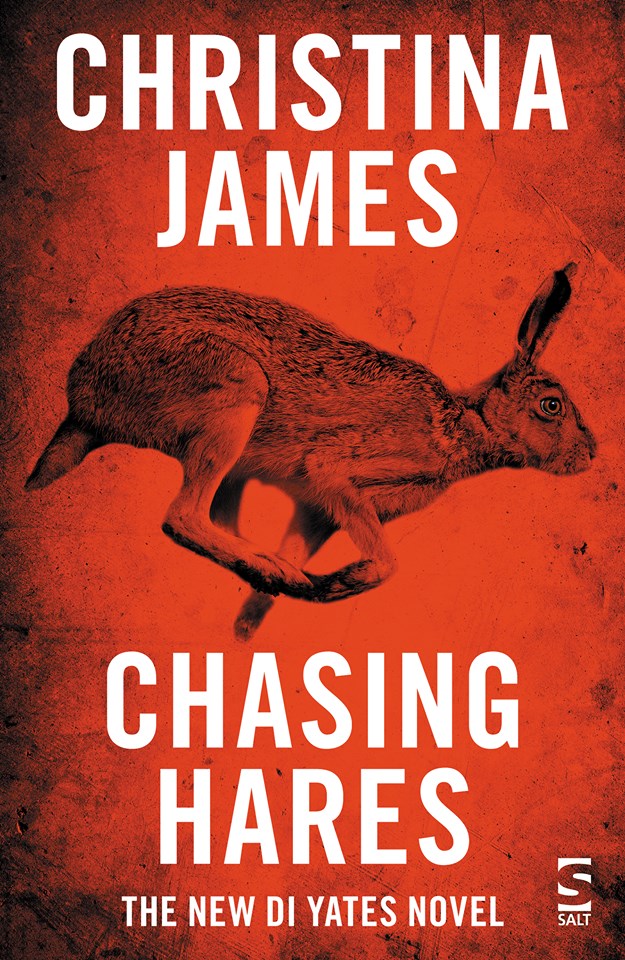


Two events for Sausage Hall in two amazing bookshops
In this extraordinary Sausage Hall launch week, which I am enjoying so much and for which I am very grateful, I’d like to pay tribute to two amazing bookshops.
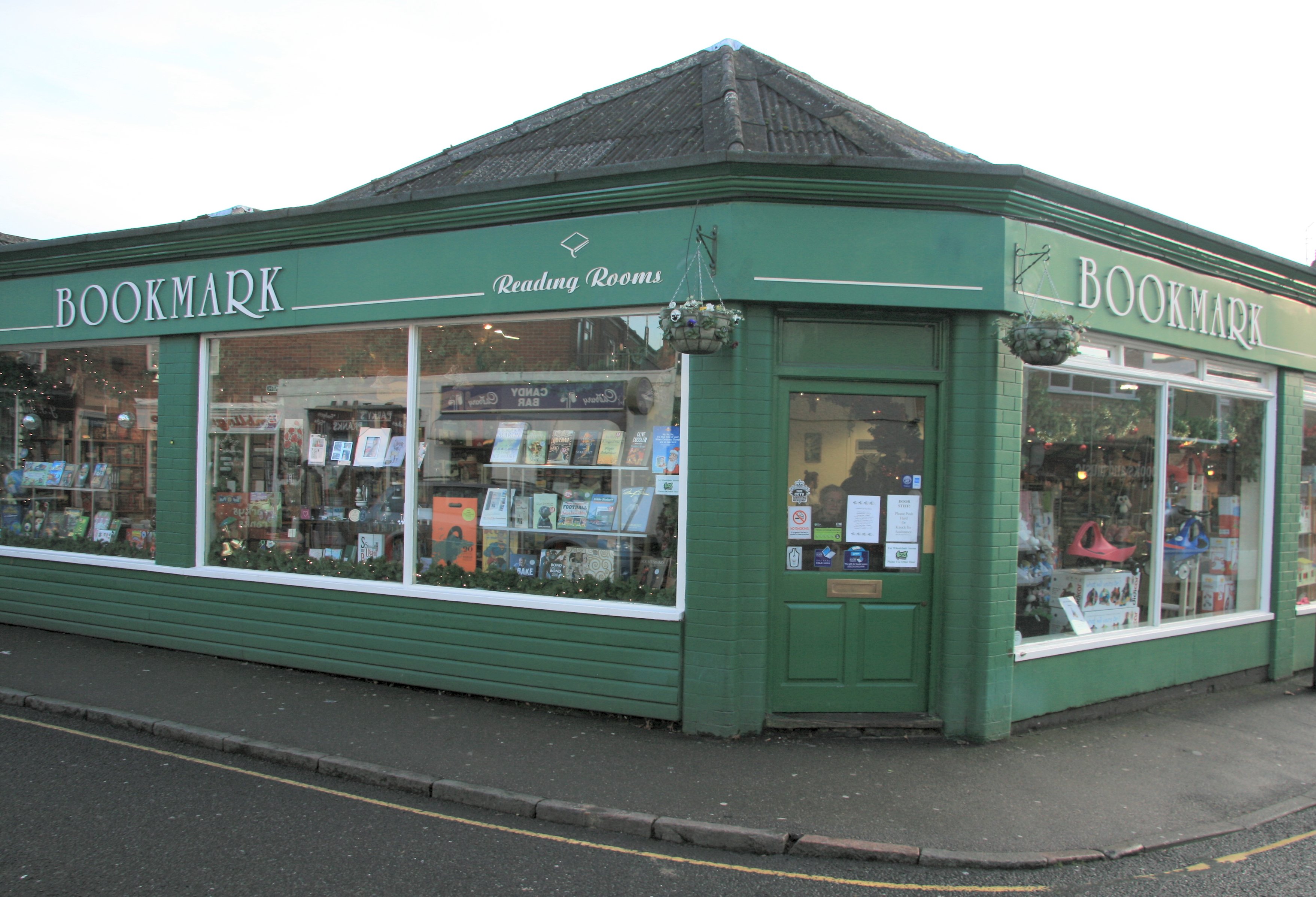
Bookmark, Spalding
The first is Bookmark, Spalding’s very distinguished bookshop (the CEO of the Booksellers Association, Tim Godfray, has even been known to serve behind the till there on occasion). Bookmark very generously offered to host the Sausage Hall publication day party, which took place in the evening of November 17th, after the day that I spent at Spalding High School. The event was masterminded by Christine Hanson, the owner of the shop (who is both practical and imaginative – she fixed both a toilet roll holder and a broken table joint within minutes of my arrival, while the shop itself, resplendent with its Christmas stock and decorations, achieved a standard that I’d have dearly liked to replicate in my bookselling days), and Sam Buckley, also a former pupil of Spalding High School, who organises author sessions at the shop. Equally generously, the launch party was sponsored by Adams and Harlow, the local pork butchers, who supplied sausage rolls for the occasion.

Having fun at Bookmark
This event was attended by members of Bookmark’s lively reading group and some old friends of my own. I was astounded to see Finola, a day-job friend – she had driven for more than an hour from Cambridge in order to support me. I was also staunchly supported by Madelaine, one of my oldest friends, and her husband, Marc, who have both offered me hospitality every time I’ve returned to Spalding as Christina James and also bought many copies of my books as presents for everyone they know who might enjoy them.
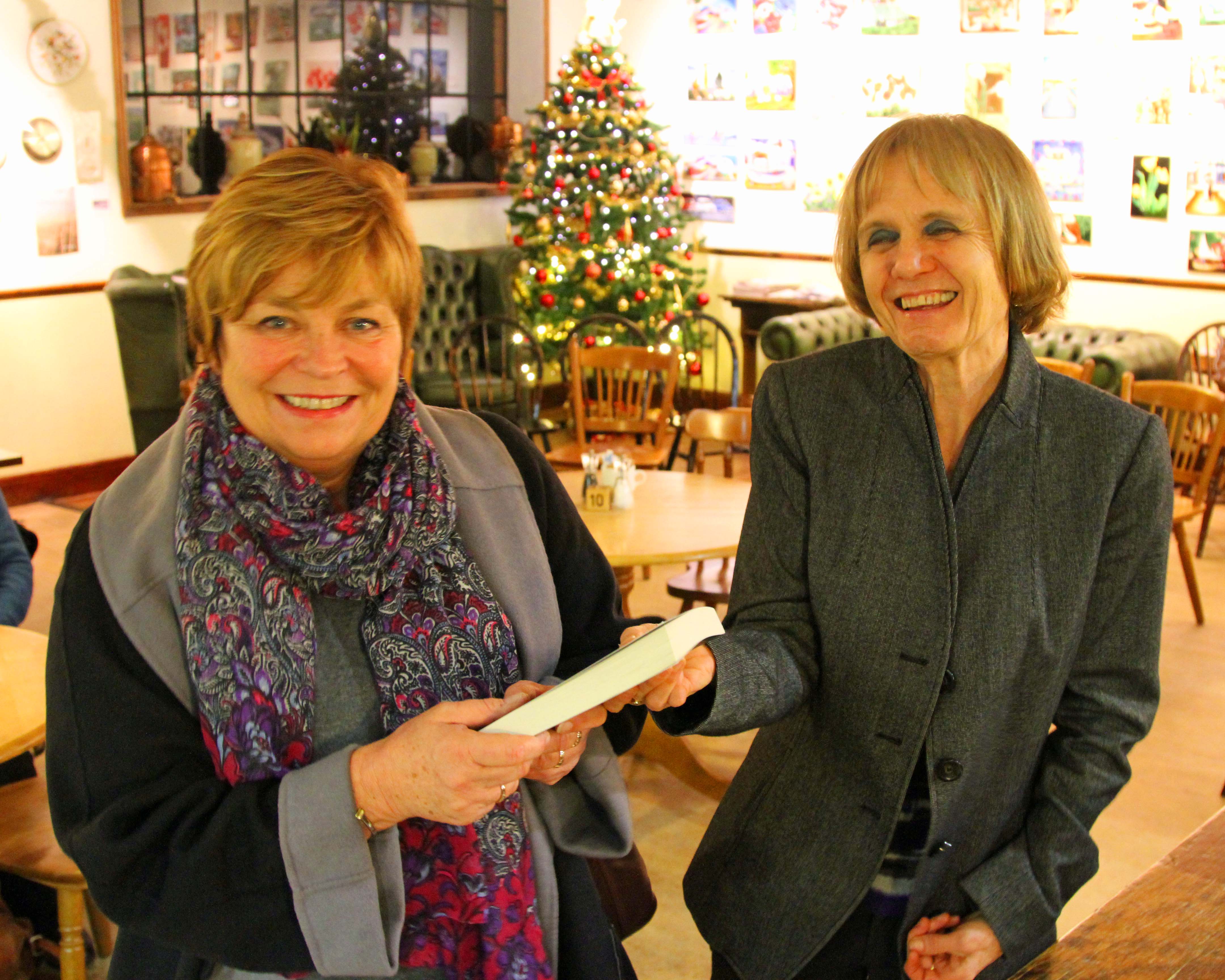
With Madelaine at Bookmark
Madelaine’s contribution to my writing is acknowledged in Sausage Hall. I was also delighted to see Sarah Oliver, whom I first met at the Priory Academy last spring and who came with her husband. The book club members, who lived up to their reputation for being engaged and vivacious, were shrewd and perceptive: as well as listening attentively to two readings from Sausage Hall, they launched into an animated discussion about all three DI Yates novels. Everyone present bought at least one of the books, some more than one. (Sam Buckley later this week let me know that one member of the audience, who had not read any of the novels and took away with her In the Family, returned within forty-eight hours, having read it, to acquire Almost Love and Sausage Hall as well!) And, of course, I couldn’t myself resist making a few purchases in this fairy-tale bookshop.
Having spent the night with my son and daughter-in-law at their house in Cambridgeshire, I arrived in good time on Tuesday November 18th for a signing session at Walkers Bookshop in Stamford. Although I first met Tim Walker, its owner, last year (he’s currently President of the Booksellers Association), I had not visited one of his bookshops before, The one in Stamford is in a listed building in the town centre; he also owns another in Oakham. I was particularly impressed by the huge range of stock in this shop, both the cards and gifts downstairs and the extensive range of books upstairs. Tim and the manager, Jenny Pugh, were respectively at the other shop and taking holiday, but everything had been set up for me and Mandy, the assistant manager on the book floor, couldn’t have made me more welcome.
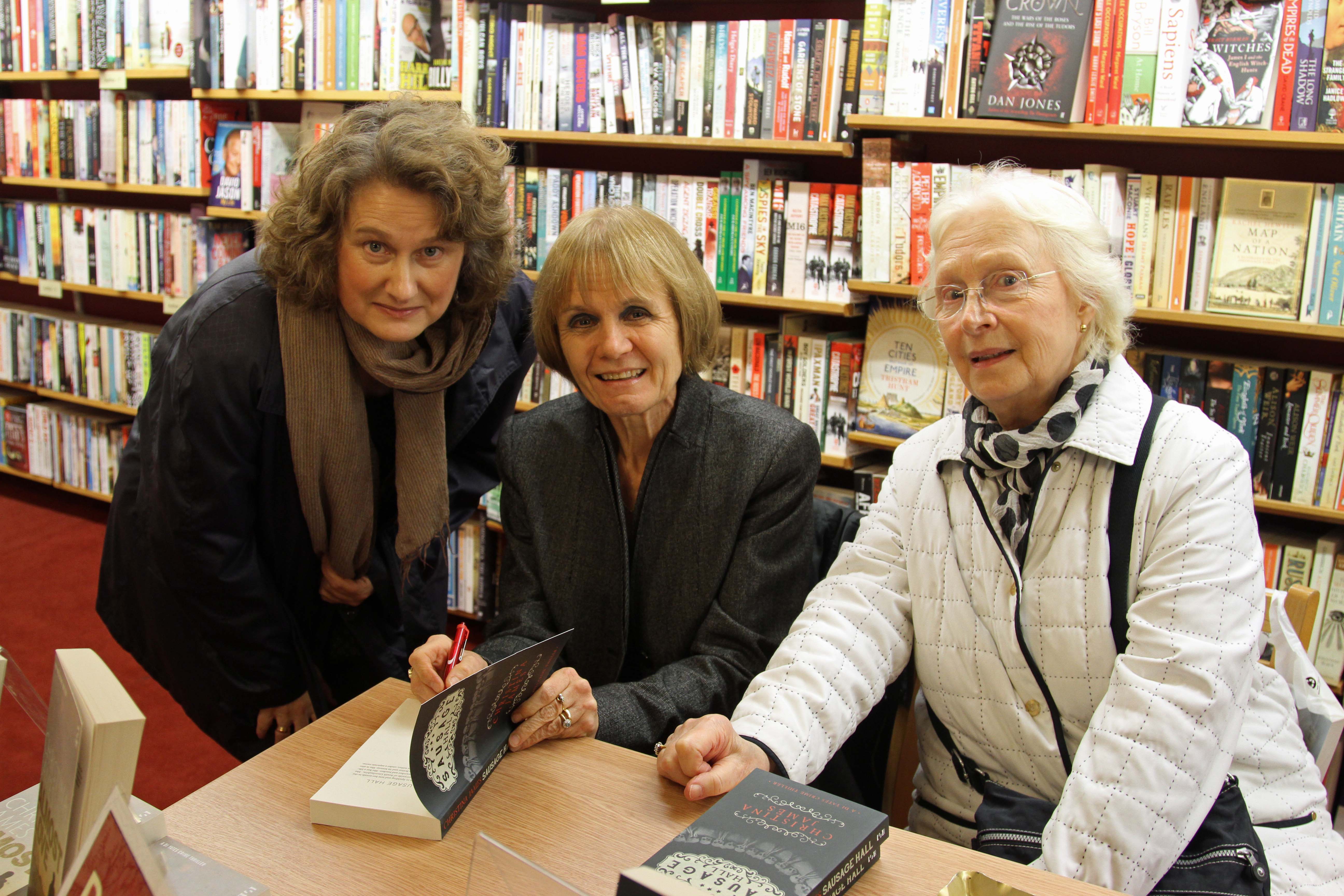
Signing Sausage Hall for Elaine and Sheila at Walkers, Stamford
Bookmark and Walkers are two fine examples of thriving independent bookshops, packed with atmosphere and individual charm and led by brilliantly creative people who understand how to serve their communities very well indeed. It was a privilege and a pleasure for me to have been able to enjoy what they had to offer and I’d very much like to thank Christine and Tim for hosting Sausage Hall events this week.

Walkers, Stamford
WriterFest!

Yesterday Jim, my editor, and I enjoyed the immense privilege of running a writers’ workshop at Wakefield One, the City of Wakefield’s wonderful new complex that incorporates the library and other arts and community facilities. Like the event in which I took part at Wakefield One last year, it was part of Wakefield’s LitFest, and impeccably organised by Alison Cassels, who, in my experience, is second to none at enthusing and gathering in intelligent and appreciative audiences for such occasions.
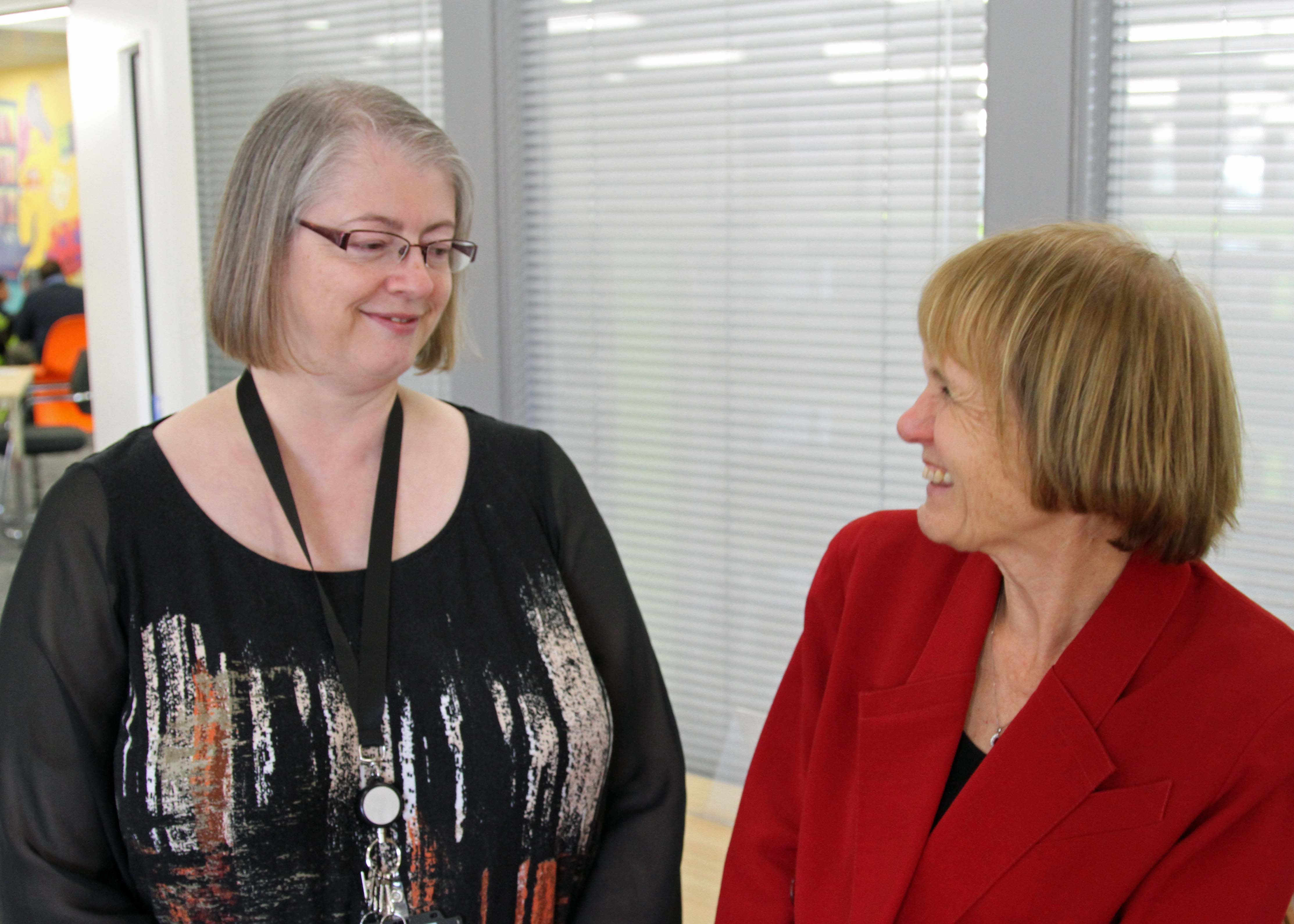
Alison Cassels, organiser par excellence
Eventually, there were twenty-two lively and responsive participants of all ages, from twenty upwards. One recent graduate came with his grandfather.

We began by giving the workshop delegates a sheet containing the opening paragraphs of six novels and asked them to take on the editor’s task of choosing (and providing justification for their selection!) just one that they would personally want to publish. The results were Illuminating: although one of the extracts (actually from a novel by Ruth Rendell) emerged as the clear winner, all six had at least one champion. Everyone was thus able to appreciate the dilemma of choice that an editor faces when sent many different manuscripts. Then, in pairs and against the clock, the group accepted the challenge of producing an opening paragraph that might persuade an editor not to reject it. The results were exceptional: all were coherent, interesting and, most impressively, cliché-free; the activity itself generated wonderful engagement, as you can see in the photographs here.


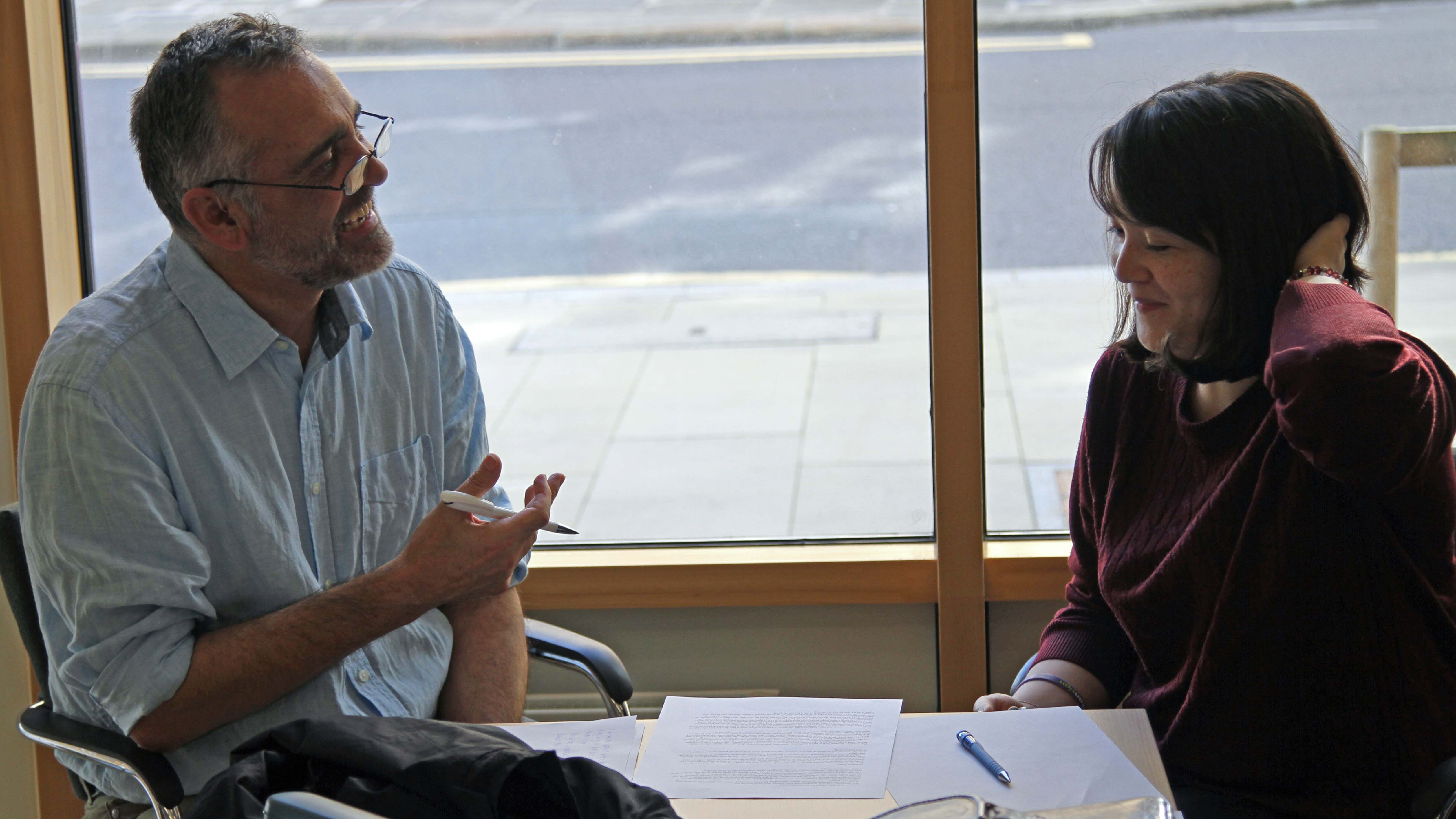

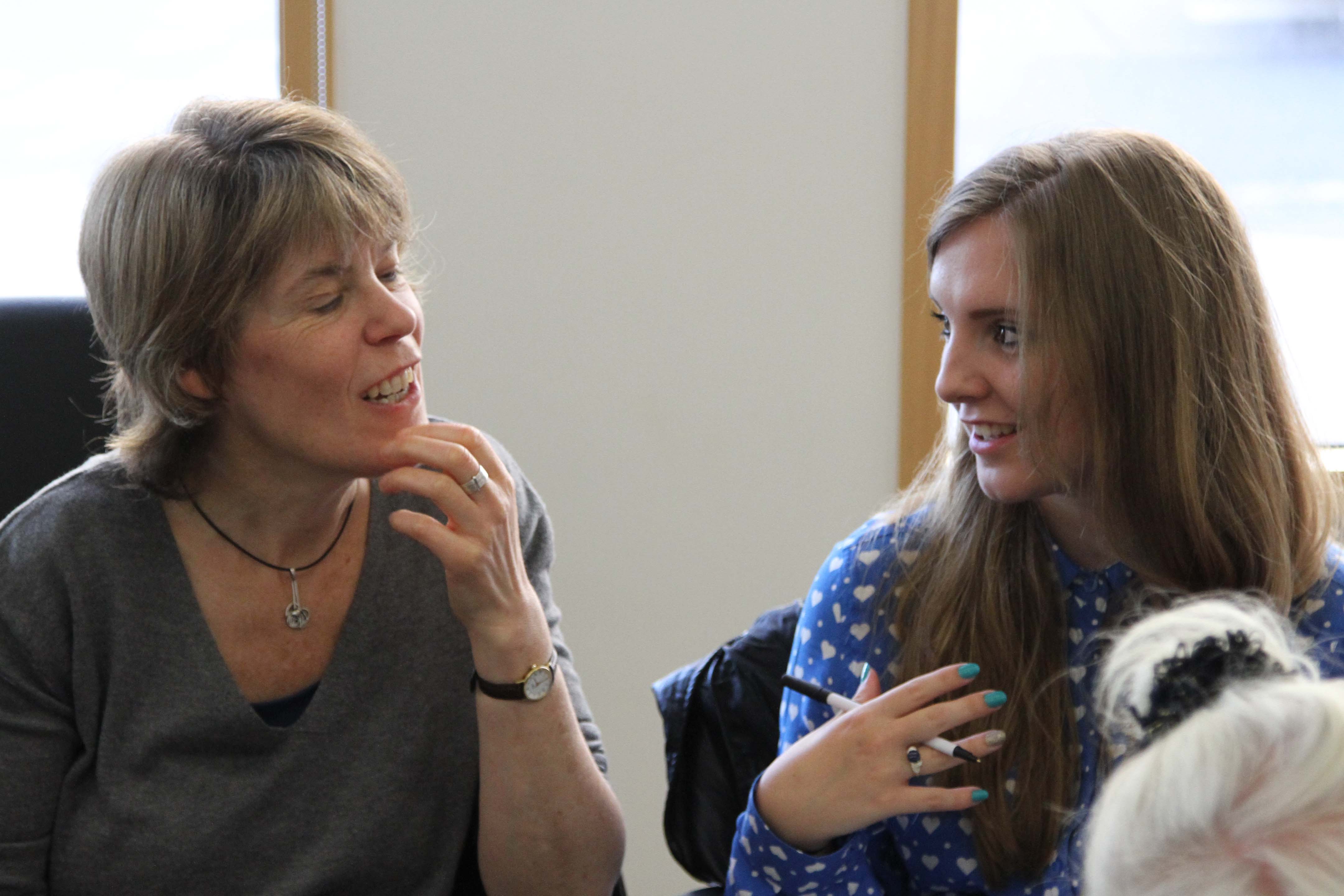
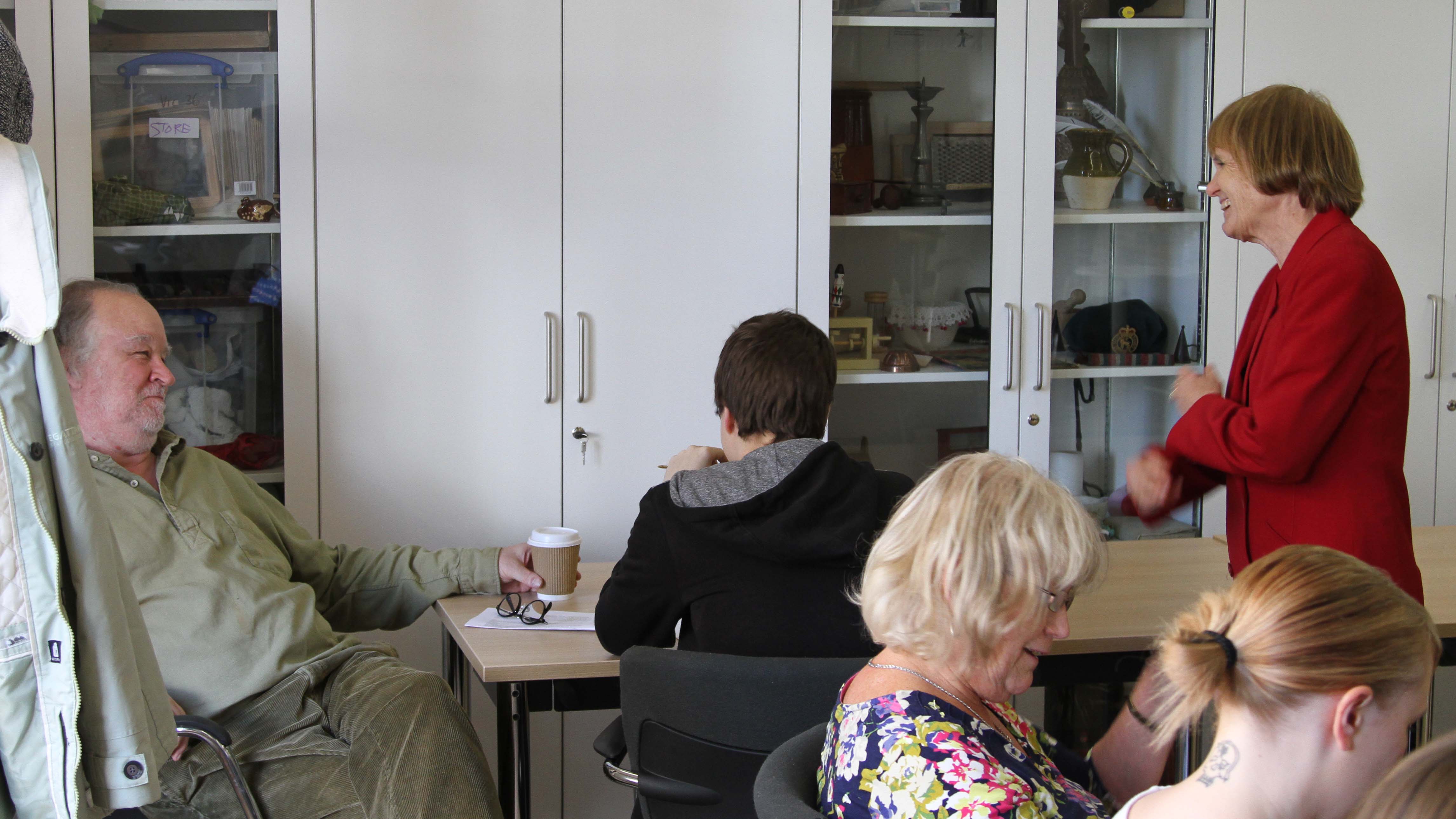
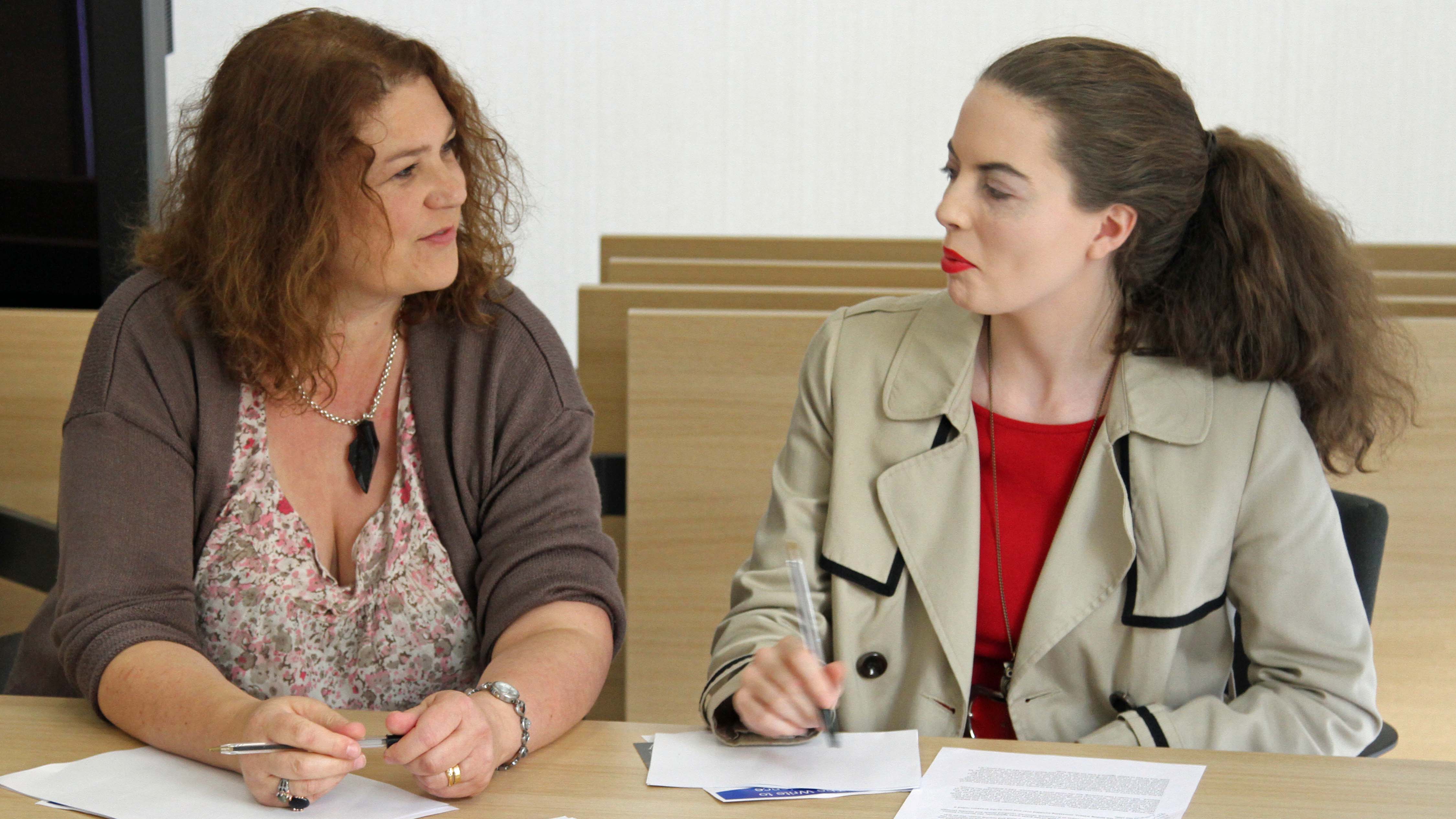

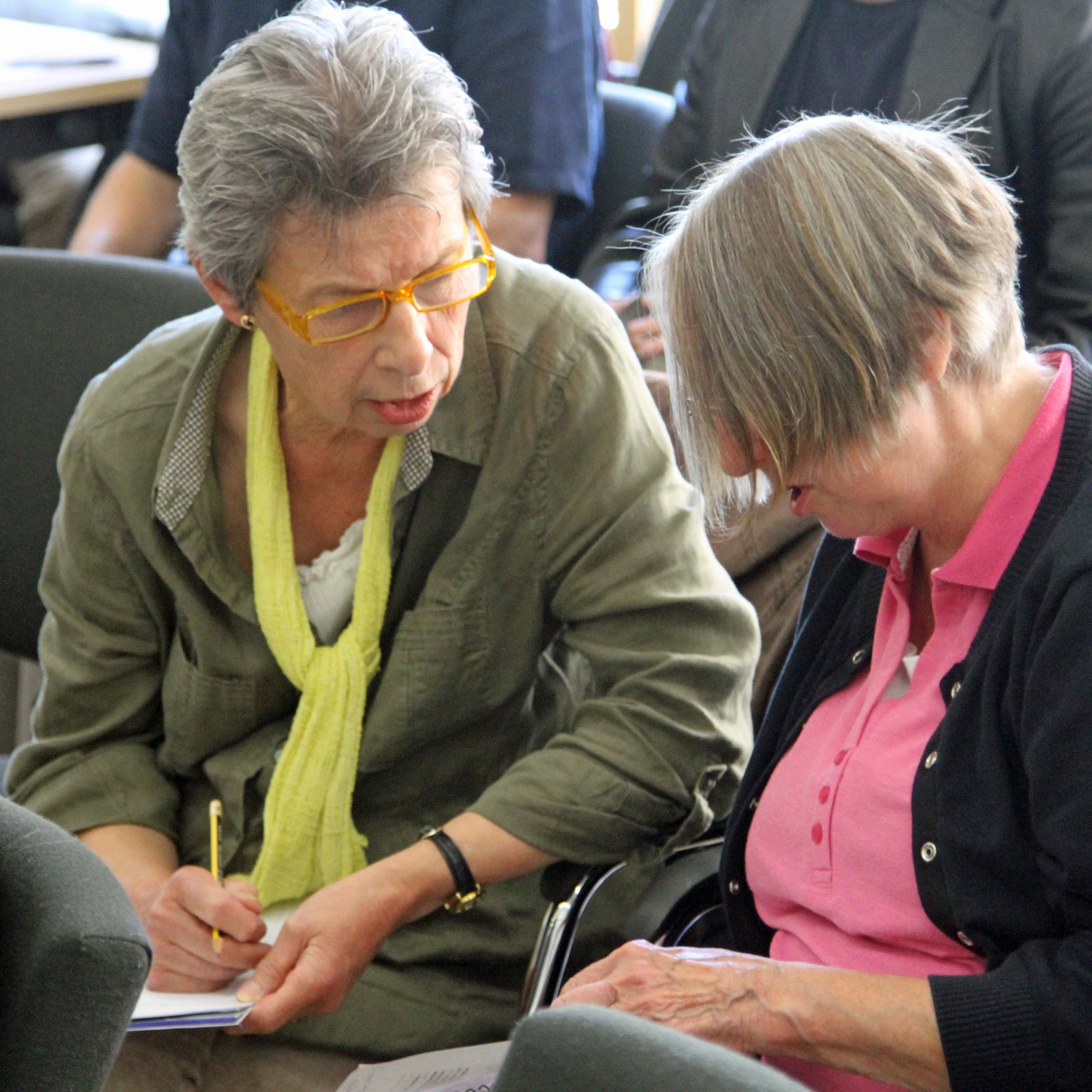


I then went on to explore some of the practicalities of getting published and what new (and, indeed, established) authors need to do in order to engage and keep their readers. This audience was thoughtful as well as appreciative and turned it into a dynamic, interactive session. Finally, I read the opening chapter of Sausage Hall, the third in the DI Yates series, which will be published on 17th November; it was well-received (I’d been holding my breath, as I’m sure all authors do when they give their new ‘baby’ its first airings). The workshop members were generous: many bought copies of In the Family and Almost Love in the signing session at the end; some were kind enough to buy both.
The informal debate continued after the workshop was officially over. Several participants said that they’d been delighted to receive Salt Publishing’s online alerts. If any of the readers of this blog would also like to obtain these, just let me know and I’ll pass on the information.
Very many thanks indeed to Alison Cassels and the rest of the staff at Wakefield One (not forgetting those who work in the Create coffee shop, which produces a mean cappuccino!) and heartfelt gratitude to all those who joined the workshop – I hope that you will become occasional or even regular visitors to this blog.
Saying ‘thank you’ to @jennyoldhouse and @JennyBurnley1, two lovely Jennies!


This summer, events and commitments have seemed to conspire to restrict the time I had become used to spending on blog posts and engaging with others on the social media, by which I really mean Twitter, because, try as I might to be active with it, I can’t feel very comfortable with the lumbering mode of global communication that Facebook always proves to be to me. Even Twitter has found me out as a tweeting dilettante, never spending long at all up there amongst the flocks in the branches, but flitting in and out in sharp bursts like a swallow. So, first, may I apologise to loyal friends who must think me at best unreliable and, at worst, not a friend to them at all. Some of you (you know who you are) have put up with my scant regard for relationship consistency with huge patience and unstinting support in my absences, for which, please do accept huge thanks for keeping this bird in flight.
In the context of all this, I should like to make as public a declaration of thanks as this blog permits to a wonderful pair of Jennies, who, separately and at different times, could almost be assumed to have been acting in collusion to make me feel good about myself and about my novels. They have joined a wonderful group of reviewers of the first two DI Yates books who have taken much trouble both to read them and then to provide splendidly constructive and insightful commentary upon them. The DI Yates page on this site quotes them verbatim, which is my best way of saying ‘thank you’. However, Jenny Lloyd, who has reviewed both books, and Jenny Burnley, who has just reviewed Almost Love, have yet to find their comments transferred here (I’ve been remiss about this and I’ll be rectifying it shortly!) and I’m thus giving them a post to themselves by way of appreciation.
Both Jennies have been absolutely consistent in their celebration of other writers’ and bloggers’ work, mine included, and I’d like them to know just how much I value such selfless enthusiasm for writing about and spreading what they read, which helps so many people on the networks. I’d also like to say how much I enjoy their work, too. Thankfully, their qualities are shared by many of my virtual friends and acquaintances; they do epitomise the best of good social media practice, which means that they are always a pleasure to talk to.
I imagine that readers of this post will readily understand how I feel upon reading such reviews as these two, not just because they are so positive, but because their insights are so very thoughtful. Here they are:
Jenny Lloyd, on In the Family:
While laid up with an injury, the days can seem interminably long. What I needed was a book that would take my mind off the pain in my knee and the stultifying boredom that comes from sitting in one place for too long. I’d just finished reading The Luminaries (an 800 plus page book I would never have got round to tackling if I hadn’t been laid up). Then my daughter found the lost charger for my Kindle while looking for something else (as always happens). Browsing through some of the titles, I came across In the Family by Christina James, a book I’d bought some time ago, immediately following my reading of the author’s other book, Almost Love.
There is always a risk, after reading a really good book by an author, that one’s expectations will be disappointed by the next one. So it was with fingers crossed that I began In the Family, hoping I would enjoy it as much as Almost Love. I needn’t have worried, though. If anything, I enjoyed this one more.
In the Family has all the ingredients which one expects from a crime-thriller but it is the author’s skill which takes these ingredients and turns them into a crime-story bristling with mystery and suspense, written with intelligence and deep psychological insights. And the characters! Some of this family’s characters you would not want to meet, let alone be related to, but the author portrays them so well I now feel I have met them all and they linger in my memory still. Essentially, I felt the central theme of this story explored how damaged people can result in damaged families with devastating consequences for any children involved.
The gist of the story; a skeleton is found buried alongside a road and Inspector Tim Yates is called in to investigate. The remains are that of a young woman, Kathryn Sheppard, who disappeared thirty years before. As Tim and his team unravel what happened to Kathryn, the Atkins family’s past comes back to haunt them.
I devoured this book in two days; not because I had little else to do but because I honestly couldn’t stop reading it. My measure of a good read is: how much I don’t want to stop reading to go and do something else; how much I relish picking it up again; and how much I don’t want it to end. In the Family scored top marks on all counts.
I feel I must thank Mrs James for the thoroughly enjoyable two days I spent captivated by her story. The Luminaries may have won the Booker Prize last year, but for me In the Family was the better read. Mrs James has a third novel coming soon; I will be first in the queue to buy!
Jenny Burnley, on Almost Love:
This excellent crime thriller weaves a complex story around the main characters of Detective Inspector Tim Yates and Alex Tarrant, following the inexplicable disappearance of Dame Claudia, a celebrated archaeologist with a mysterious past. In a weak, alcohol-fuelled moment, Alex, married to the boring, but dependable Tom, allows herself to be seduced by the dastardly Edmund, a dangerous, unlikeable character. This adulterous liaison is central to the story, which moves along at a cracking pace. The reader is drawn along deeper into the story, demanding to know the all-important answer to ‘whodunit’ and how. This quest required reading late into the night to unravel the mystery and see what happened next. Suspects abound in Almost Love and there is plenty of action, tension and suspense, with many clever twists and turns. The characters are exceptionally well-drawn, with close attention paid to human foibles and weaknesses. As the story unfolds, a dramatic late twist leaves the reader breathlessly awaiting the next D.I. Yates novel.
Thank you, Jenny and Jenny. You have jointly ‘made my summer’ and I know that your good offices as discriminating reviewers benefit many authors and make them feel very good about what they do. Thank you, too, to all those other wonderful reviewers and readers who have supported my books so far.
Surprises come in threes at Oadby Library!

During the latter part of last Thursday afternoon, after a sun-splashed if chilly week, the heavens opened and the rain came bouncing down. The gate that leads into our garden was sodden in no time. The M1, which we had just joined to begin our journey to the event at Oadby Library, quickly became waterlogged: there were treacherous sheets of water to negotiate as the traffic on the approaches to the various cities that we passed built up towards rush hour. By the time that we reached the Leicester ring-road, we’d encountered virtual gridlock. Irate drivers were crawling along for a few yards at five mph before juddering once again to a standstill, their progress and tempers not helped by the rain, Leicester’s amazingly laid-back traffic lights system and the fact that in several places on the dual carriageway two lanes merge into one (every driver being reluctant to yield to another).
This was not an auspicious start to an event that had been planned months in advance and strenuously published, by Chris and Jen at Salt Publishing, by myself and by various other kind tweeters along the way. I had known not to expect too much, as the library had already warned me that only three tickets had been sold – and indeed would have ‘pulled’ the event had I not insisted that I should be happy to speak even if only one person turned up to hear me.
I arrived precisely on time, at 6.30 p.m., later than intended, and my audience – consisting indeed of just three people – had all got there before me. I barely had time to notice that Oadby has a lovely library before I hastened into the ante-room where they had assembled, together with the librarian, Anne Sharpe. However, by this time I had already experienced the first of several wonderful surprises. The first person that I met after Anne was Rosalind Adam. We are mutual bloggers and Twitter friends – I’ve been enjoying Rosalind’s blog for some time, though we had not met before. It was a delight to be able to talk to Rosalind in the flesh. We each agreed that the other was exactly what we had expected – and that this was not always the case when meeting someone previously encountered only through the ether. At the moment, I’m particularly excited about a book for children on Richard III that Ros has just finished writing and hope to be able to review it on this blog in due course.
I was a bit slow on the uptake at registering the second surprise. I’ll have to excuse myself by offering the explanation that I was busy sorting out my books and papers for the readings. I’m also quite short-sighted, but I prefer to wear my spectacles only when I’m driving. Anyway, the event was about to start when I looked up and recognised that the only male member of the audience was Colin Marshall, for many years the manager of the campus bookshop at Leicester University and still employed by the university today, although he has now ascended to a higher plane and is in charge of all the retail operations on the campus there. Colin’s presence introduced one of those occasions when my life as a novelist collides with the day job – and this time it was the most enjoyable collision imaginable. Colin has for several decades attended the conference for which I have organised for some fourteen years the speaker programme. He was also awarded the Booksellers Association’s Lifetime Achievement Award in 2013. His presence at the event was not entirely a coincidence, as he had been kindly told about it by Professor Christine Fyfe, the Pro-Vice-Chancellor in charge of Teaching and Learning – and the Library – at Leicester University, whom we both know. However, there was also a real coincidence at work: Colin and his wife Sandra live in Oadby and she had quite separately seen the event advertised by the library and decided that she would like to attend. Having the opportunity to meet Sandra was the third lovely surprise of the evening: she’s funny, sensitive, extremely well-read, loves dogs and cats (she told me that she and Colin have managed to organise their lives with such symmetry that they have four children, three dogs and two cats), is a great companion and raconteur and furthermore is living proof that Colin is a dark horse!
Ros, Colin, Sandra and Anne therefore constituted my audience at Oadby. It was the smallest audience I’ve ever had. I’ve attended other writers’ events that have managed to attract only small audiences and I’ve found that they divide into two categories: small and dismal, and small and select. I’d like to state unequivocally that, thanks to Ros, Colin, Sandra and Anne, this event was of the latter type. It began quite formally with a reading from In the Family and a Q & A session, but before long had turned into a lively debate about writing, literature, other crime writers and future events at Oadby Library. We overshot the allotted time by half an hour, so that I had barely time to conclude with my ‘world première’ reading of the first chapter of Sausage Hall, third title in the DI Yates series, which I’m grateful to be able to say was very well-received.
At the end of the evening, we took a quick look round the library and had our photograph taken there. Ros had to leave at this point: she has kindly already written about the evening on her blog. We said goodbye to Anne, our charming and extremely well-read hostess, and retired to the car park to release our dog, who had accompanied us for the ride. Then Sandra, Colin, my husband, the dog and I adjourned to the pub down the road (The Fox) to continue the conversation. Eventually, Sandra and Colin went home and we headed back North through the rain-sodden night.
There are some evenings, unfortunately all too rare, when, as a writer, you really feel that you are making progress in the most worthwhile of ways, by talking to a group of sympathetic and interested readers. (The size of the group is immaterial.) For me, the event at Oadby Library was such an occasion. Anne said that she would invite me back again later in the year. I’m looking forward to it already. I’d like to thank her for her wonderful hospitality, and to thank Ros, Sandra and Colin for braving the elements to visit the library last Thursday and for contributing to the marvellous conversation that took place there.
The verse venue: Matthew Hedley Stoppard and Ralph Dartford at Rickaro Books

Matthew at Rickaro Books

Ralph at Rickaro Books
Rickaro Books, of Horbury, is one of our most distinguished independent bookshops and, like all distinguished independent booksellers, Richard Knowles knows that events don’t just happen: you have to work at them. Therefore, although World Book Day – and, by extension, World Book Week – is getting a huge amount of support from the Booksellers Association and individual publishers, with lots of media coverage, whether or not a bookseller succeeds in making it work is down in the end to himself or herself.
Richard has arranged events for almost every day of this week, leading up to World Book Day itself, which is tomorrow, Thursday March 6th. (If you’re interested in finding out more, please click here.) Tomorrow, he is entertaining a group of schoolchildren in the shop, all wearing fancy dress, and is even going to dress up himself! (I find this amusing: Richard has obviously mellowed since I worked with him all those years ago, when, if not exactly child-unfriendly, he was certainly selective about the children that he liked!)
However, when I read about Richard’s celebrations for World Book Week, the Rickaro Books event that most intrigued me was the one that took place yesterday. I made plans to attend it immediately. It was a live poetry evening, with Ralph Dartford and Matthew Hedley Stoppard (who refers to himself on Twitter as ‘the poor man’s Benedict Cumberbatch’, a soubriquet that immediately endeared him to me). The shop has an excellent track record at organising poetry readings (I’ve written about them on this blog before) and I knew that yesterday’s would not disappoint.
The two poets recited alternately with the fluency and skill which comes from complete command of the material. Both were consummate performance artists, but what really impressed me was the quality of the poetry itself. It is my experience that many live poets are performers first, poets second, but both Ralph and Matthew are exceptional poets as well as being brilliant at engaging with a bookshop audience. The latter was pretty special, too, and included a small boy named George who was dressed as Peter Pan.
If you are not familiar with Ralph’s and Matthew’s work and you like poetry, I recommend that you invest in the two books (AND Matthew’s lovely green vinyl record!) that I bought last night. Cigarettes, Beer and Love, by Ralph, takes the form of a chapbook that has been beautifully produced by the Ossett Observer on hand-made paper. Matthew’s A Family Behind Glass, published by Valley Press, has all the elegance of a classic ‘slim volume’. Which poems did I enjoy most last night?
Well, the Co-op store in Ossett will never be quite the same to me again, now that Ralph has given me ‘Co-op Live Art Fiasco’, which describes his effort to show the individuals in the checkout queue that their investment in the Lottery pays for art (and his wages)… by stripping stark naked and doing some ‘live art’ with a Lucozade bottle. The constable summoned to the event says: “I once saw something like this in Berlin. A scratch card paid for the trip. I quite liked it.” (Ralph was led away at 08.46.) As readers of this blog know well, I’m game for a laugh, but there’s serious stuff behind Ralph’s humour.
Ralph describes Matthew as the ‘cerebral’ one of the pair (but all their poems last night were ‘thinky’, even the most superficially frivolous of them!). In fact, one poem of Matthew’s touched me a lot and spoke to me very clearly from my own past in our first rented marital flat in Leeds.
He set the context of a rented house in Rothwell, his and his wife’s first home, at a time when, he said, they weren’t really ready to be adults, yet. I’ll give you the first stanza, so that you may be touched as well:
Now that the streetlamps have stolen the stars
From the afternoon sky, sleep, content
And lovely as custard, pours over us. We sit
With winter on the settee, arm in arm –
Our legs interlaced like denim snakes,
Bedlam pressed between our palms. [From ‘The Wendy House’]
Matthew is about to take up a post with Leeds City Libraries: I’d like to wish him well with this. Ralph works for the Arts Council, and knows Chris and Jen Hamilton-Emery of Salt Publishing. He observed, unsurprisingly, that they are both ‘lovely people’. He kindly bought In the Family before he left the shop, which gave what had already been a very enjoyable evening a considerable extra fillip for me!
I wish Richard every success with World Book Day. (I’d love to be a fly on the wall when he receives the schoolchildren tomorrow, but unfortunately I have to travel to London instead.) And I hope very much indeed that I shall meet Matthew and Ralph again. In the meantime, I shall enjoy reading their poetry for myself. Thanks to them for introducing me so beautifully to it.
 Precious poetry pack
 How to get a book signed by two priceless poets
A happy afternoon in Hunstanton, with friends old and new…

With Sue Renwick and the Mayor of King’s Lynn and West Norfolk

On the platform
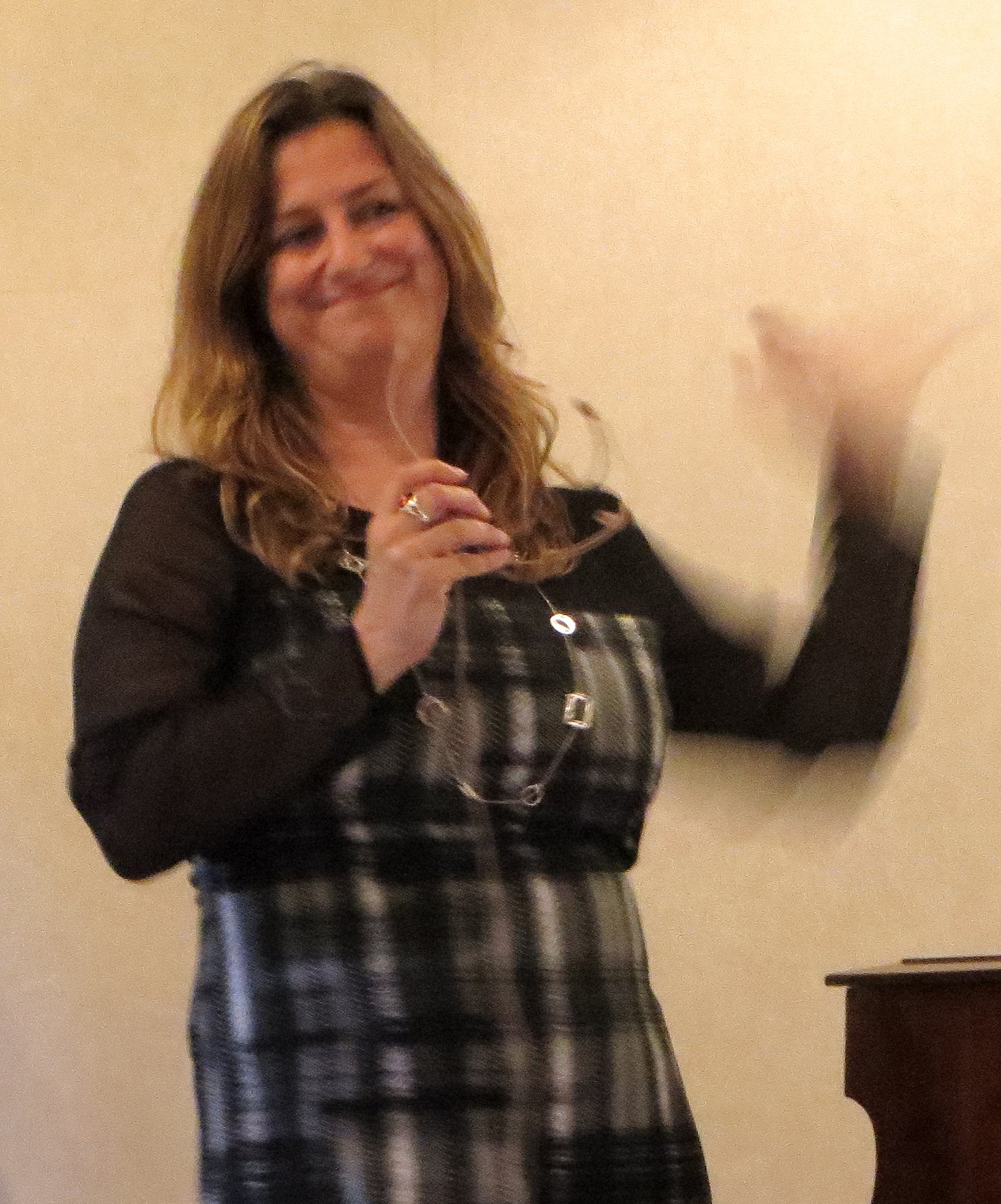
Fellow speaker, the ever-lively Elly Griffiths
Yesterday was a real red-letter day for me. I had been invited to give one of two after-lunch talks at Soroptimist International King’s Lynn annual fund-raising lunch, which was held at the Best Western Le Strange Arms Hotel at Old Hunstanton. I was invited to speak by Sue Renwick, this year’s King’s Lynn Soroptimist President, and her colleague, June Muir. I discovered that my name had been suggested by two of my old school friends, Lyn Lord and Mandy North. Both have been enthusiastic promoters of my books and Mandy has attended both of the signing sessions held at Bookmark in Spalding. I was chosen because my books are set in Spalding – not too far away from King’s Lynn (in fact, my brother was born in the Queen Elizabeth Hospital there) – and the group particularly likes to listen to authors whose books have a local flavour.
This literary lunch was the fourth one held by the King’s Lynn Soroptimists. The speaker at last year’s event was Stella Rimington (who has a house in Norfolk), so I felt honoured indeed! The audience consisted of ninety-nine lunchers, mostly Soroptimists, with a sprinkling of husbands. The Worshipful the Mayor of King’s Lynn and West Norfolk, Councillor Mrs Elizabeth Watson, was there, and I much enjoyed talking to her. I was privileged to be seated next to Sue Renwick’s husband and had a fascinating conversation with him about migrant workers in Norfolk (a topic in which I’m currently immersed as I write my third DI Yates novel). The local press was in attendance: I shall post links to their photographs when I have them.
I had heard of the Soroptimists before, but I didn’t know much about them until I received the invitation, when I made it my business to find out a little more. The first group was set up in the USA, quickly followed by others in the UK. The organisation is now worldwide. Its website explains its mission: We are committed to a world where women and girls together achieve their individual and collective potential, realise aspirations and have an equal voice in creating strong, peaceful communities worldwide. The fund-raising events support particular causes. The money raised from yesterday’s lunch will contribute to respite holidays for Norfolk’s young carers: heartbreakingly, there are children as young as seven looking after infirm or disabled parents.
My fellow-speaker was Elly Griffiths, whom I had already met earlier this year at a very successful literary festival event held at Watton Library. Elly spoke first. I know her to be a witty and eloquent speaker (and therefore a tough act to follow!). She told the audience how she came to create her academic archaeologist, Ruth Galloway, and read an excerpt from the next Ruth Galloway novel. She said that the inspiration for these books had come from her husband, who exchanged a high-profile, lucrative career as a city ‘suit’ to become an archaeologist. The Galloway novels are set in Norfolk because Elly’s aunt lives there and Elly spent holidays there as a child; she also pointed out that Norfolk is full of bones!
My brief asked me how I came to develop the characters in the DI Yates novels. I’ve reproduced some of what I said here in the hope that it may interest readers of this blog, as several of you have asked me similar questions.
When I was thinking about where to set the novels, I revisited the Spalding of my childhood (and incidentally some of my most memorable holidays as a girl were spent in Hunstanton). DI Yates’ Spalding is therefore a ‘perfect’ place in the sense that it exists only in my memory and imagination. Among the many riches that Spalding and the Fens offer to me as a writer is their wonderful place-names – Pode Hole, Quadring Eaudyke, Gosberton Risegate, Pinchbeck: I know that many readers are intrigued by the promise of romance and mystery implicit in the names of these villages.
None of the characters is entirely based on people I know or have known, though they have been influenced by traits I saw in certain individuals or by real events and customs. For example, my great uncle kept a general shop in in Spalding, in Westlode Street. It was the family business for many years: he’d inherited it from his father. My grandmother – my father’s mother – acted as his housekeeper. More or less accurately, this is the shop in which Doris Atkins is murdered in In the Family. Her daughter-in-law, Dorothy Atkins, also known as Tirzah, is convicted of the crime. But Doris Atkins is not a portrayal of my grandmother, nor is Dorothy a portrayal of my mother. Uncle Colin, the hunchback who keeps the shop, is a little more closely based on my own great-uncle, but only in the physical sense: my great-uncle did indeed suffer from curvature of the spine. He did make forays on a grocer’s bicycle to collect cigarettes and bananas to sell in the shop. He did wear a long shopman’s coat and a trilby. But Colin’s character is not his character. (Just as well, considering what Colin gets up to in the novel!)
Moving on to Almost Love, I talked about Alex Tarrant and her role in the novel. Alex is the secretary of the Archaeological Society, a prestigious institution very loosely modelled on Spalding Gentlemen’s Society. Some of my readers have told me that they feel that the Archaeological Society is almost like another character in this novel. The story begins with the unexplained disappearance of a famous archaeologist. Several murders take place during the course of the novel and, although she isn’t involved in them directly, Alex is inadvertently the person who provides the links between the various perpetrators; this is in part because she embarks upon an ill-considered affair. I was interested in exploring the disintegration of character of Edmund Baker, the County Heritage Officer and the instigator of this illicit alliance, as he undoubtedly suffers the guilt of betraying his wife.
I also spoke about my grandmothers and the extraordinary houses they lived in. I’ve already mentioned the shop at Westlode Street where my father’s mother lived. My mother’s mother was employed in domestic service from the age of fourteen to seventy-four, at first (a bit like Hardy’s Tess!) as a poultry maid. Her second employer sent her to Bart’s Hospital to train as a nursery nurse and from this she worked her way up to become housekeeper to Samuel Frear, last of the great Lincolnshire sheep farmers. She was widowed young, so my mother grew up at The Yews, the Frear family home at Surfleet. Just after I was born, my grandmother, now aged sixty, moved to Sutterton, to become companion to a very old lady who lived at a substantial house called The Laurels. She had been the wife of a gentleman farmer who was twenty years her senior, so he must have been born in the mid-nineteenth century.
Like Westlode Street, The Laurels was packed with quaint furnishings, but the most astounding thing about it (though as a child I just accepted it as normal) was that the walls were decorated with many sepia photographs of the old lady’s husband when he’d been on safari in Africa as a young man. These photographs must have been taken in the 1870s or 1880s and in many of them he was accompanied by several black women wearing very little except strings of beads. The book I’m working on now is set in this house. When I began writing it, I had also just discovered that a very famous person was living in the area at the same time, which helped me to construct the plot. It’s about a murder that happens in the present, but is strongly influenced by what happened in the house in the past.
I think that both our talks were well-received: many of the Soroptimists came and spoke to us with great warmth and enthusiasm afterwards, and they were extremely generous in their purchases of our books. We were each presented with a pen in a beautifully crafted wooden box that Sue Renwick had made herself – an unexpected and delightful kindness.
I’d like to take this opportunity to thank most sincerely all of those present for a wonderful day. I shall certainly take a very close interest in all that they do from now on and hope perhaps to be able to help them, both as a writer and a professional woman, in the future. I hope too that they will come to visit here and perhaps comment, too.
Into Lincolnshire, for the Wolds Words Writers’ Workshop…

Louth Library, Lincolnshire
The writers’ workshop that my husband and I jointly led on Friday 18th October was part of the thirteenth Wolds Words Festival. It is a flourishing event that takes place annually in and around the pretty market town of Louth. The workshop was scheduled in the library, an impressively busy place in which the considerable bookstock was displayed most invitingly. The library staff were all great: extremely helpful, both to those attending the workshop and to their regular library users. It’s one of the most successful small libraries I’ve ever visited and clearly the librarians work hard to achieve this.
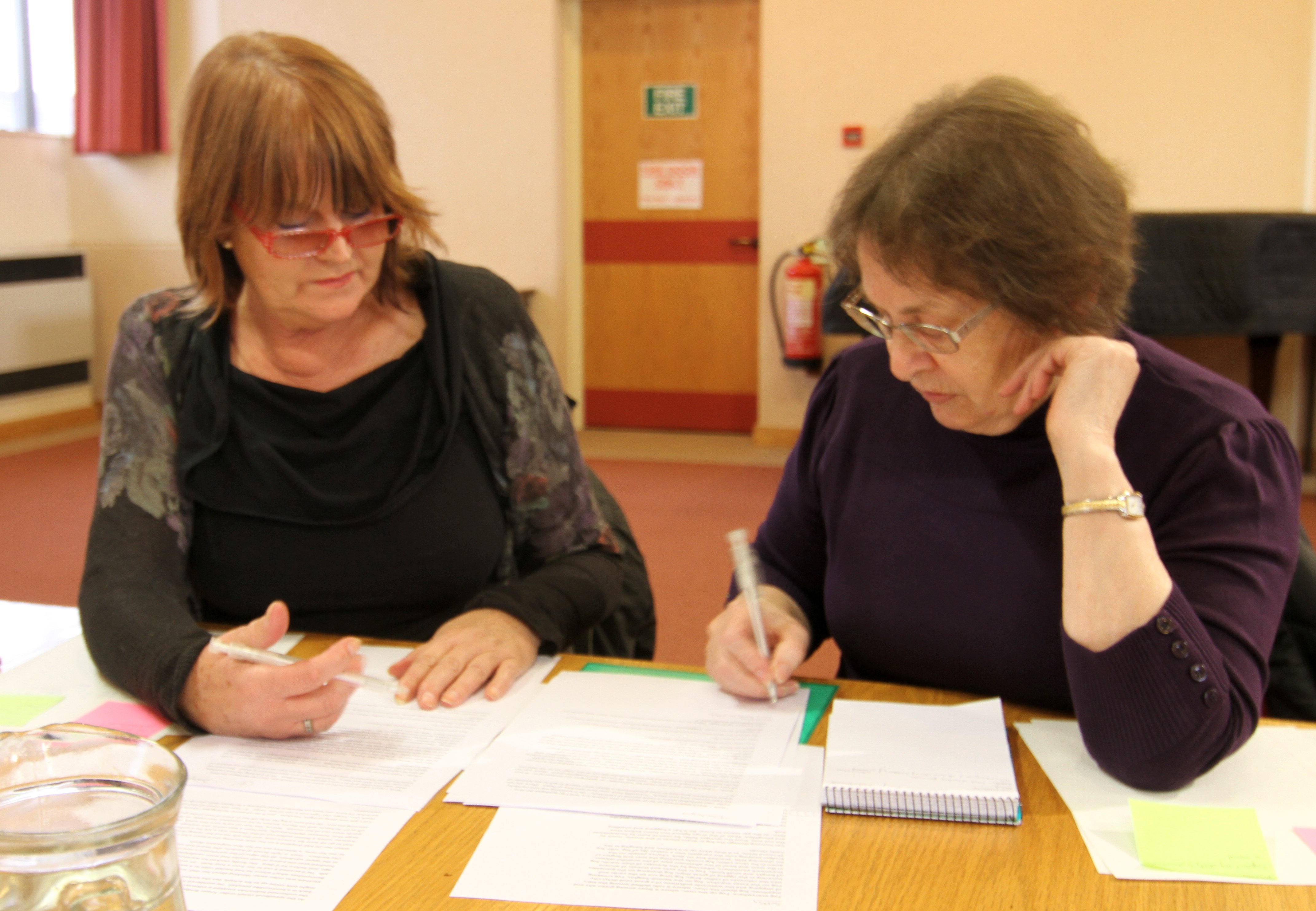
We said that we would work with up to twelve participants and the workshop quickly sold out (though not everyone actually made it on the day). We were asked to focus on two aspects of writing: crime and using local history in fiction. We heard that a workshop on plot construction that had taken place on the previous day had also been very successful.
Wolds Writers’ Workshop
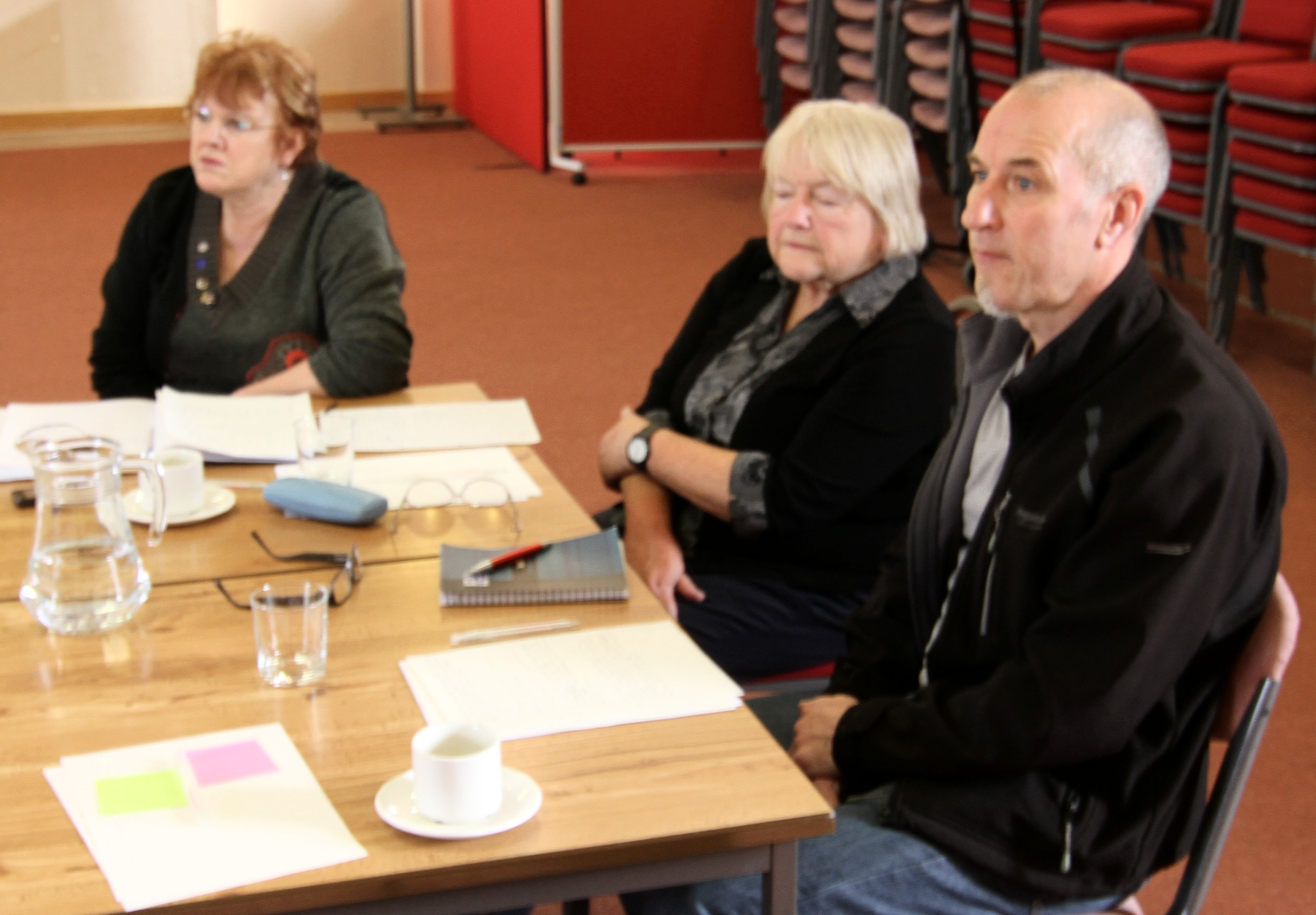
Wolds Writers’ Workshop
As a warming-up exercise, I gave the group some of my own tips on how to get published. As I’ve already offered some of these in this blog and shall be writing about others in more detail in future posts, I’m not covering them again here. Similarly, I’m not including my tips on how to incorporate local history into fiction here, saving them for a separate post.

Wolds Writers’ Workshop
We moved on to discussing why the participants had chosen the workshop and what they hoped to get out of it. Their answers were, perhaps not too surprisingly, very similar, and boiled down to a single joint ambition with three further ‘sub-wishes’. The over-arching goal of everyone present was to see their work published. One of the writers had already had poems published in anthologies; one had published a factual account of the sea some twenty years before and one had contributed short stories to an online magazine. None of the others had had work published. Two had written novels, but neither had been successful in finding a publisher.
The ‘sub-wishes’ were perhaps even more interesting: they each concerned confidence, or the lack of it. They included the expressed desire to write something that was worth reading ‘at all’; the fear that a certain flaw – in one case, an inability to write convincing dialogue – was an insurmountable stumbling-block; and the suspicion that the author’s take on life was too left-field ever to find a publisher. To these doubts, I replied that almost everyone can write something worth reading if they work at it hard enough; that ‘flaws’ can be overcome or minimised, again with hard work; and that many readers prefer a more unusual viewpoint to something more conventional, though I agreed that this may make it more difficult to attract a traditional publisher.

Wolds Writers’ Workshop
Next we read and explored four short passages from very different novels, each demonstrating some particular aspect of writing. We looked at the ‘fog’ passage from Bleak House as an example of creating atmosphere; Virginia Woolf’s description of the Ramsays’ holiday house in To the Lighthouse to establish a sense of place; a passage from Where the Devil Can’t Go, a novel by Anya Lipska, a talented new crime writer whom I’ve written about previously in the blog, that depicts her heroine’s character; and finally a piece of dialogue from my own novel, In the Family. We each took forty minutes to write a short passage following on from one of these, or alternatively any short fictional piece of our own choosing. The writings were shuffled and passed around until we had each read all of the passages; no-one knew who had written which. Each of us then told the others what we liked about the piece that we had in front of us at the end. We all found plenty to praise, which I think confirmed resoundingly that there is a writer in almost everyone. I should very much like to thank all the writers for their really enthusiastic and participative response to the occasion.

Wrights of Louth, Bookshop
Copies of my books were sold at the event by the local bookshop in Louth, which I also visited afterwards. One of its distinguishing features is that its sign hangs upside down! There is a story behind this: The shop used to be a general grocery store of the kind that I remember as a child, but which has completely disappeared now. Its owner, a man called Bill Platt, who ran it for many years from 1913 until he was in his seventies, was famed for his knowledge of local history as well as for the quality of his shop in Little Eastgate. He had business acumen, too. When the sign over his shop doorway blew down in a storm, it was affixed by accident the wrong way up; Bill recognised that it quickly became a talking point and therefore a good advert and simply left it like that. A local businessman, Mick Wright, who, with his wife Carol, turned the store into a newsagent’s and bookshop, has continued the tradition!

In conversation with bookshop owner Dean Wright
I had a long and pleasant conversation with Mick and his joint owner son Dean, and was extremely impressed by their can-do attitude towards running a bookshop in modern times. Their strategy is to diversify without abandoning the bookshop’s essential character and to provide exemplary service; they specialise in books about Lincolnshire. I purchased several by local authors, and was extremely grateful to be given a discount!
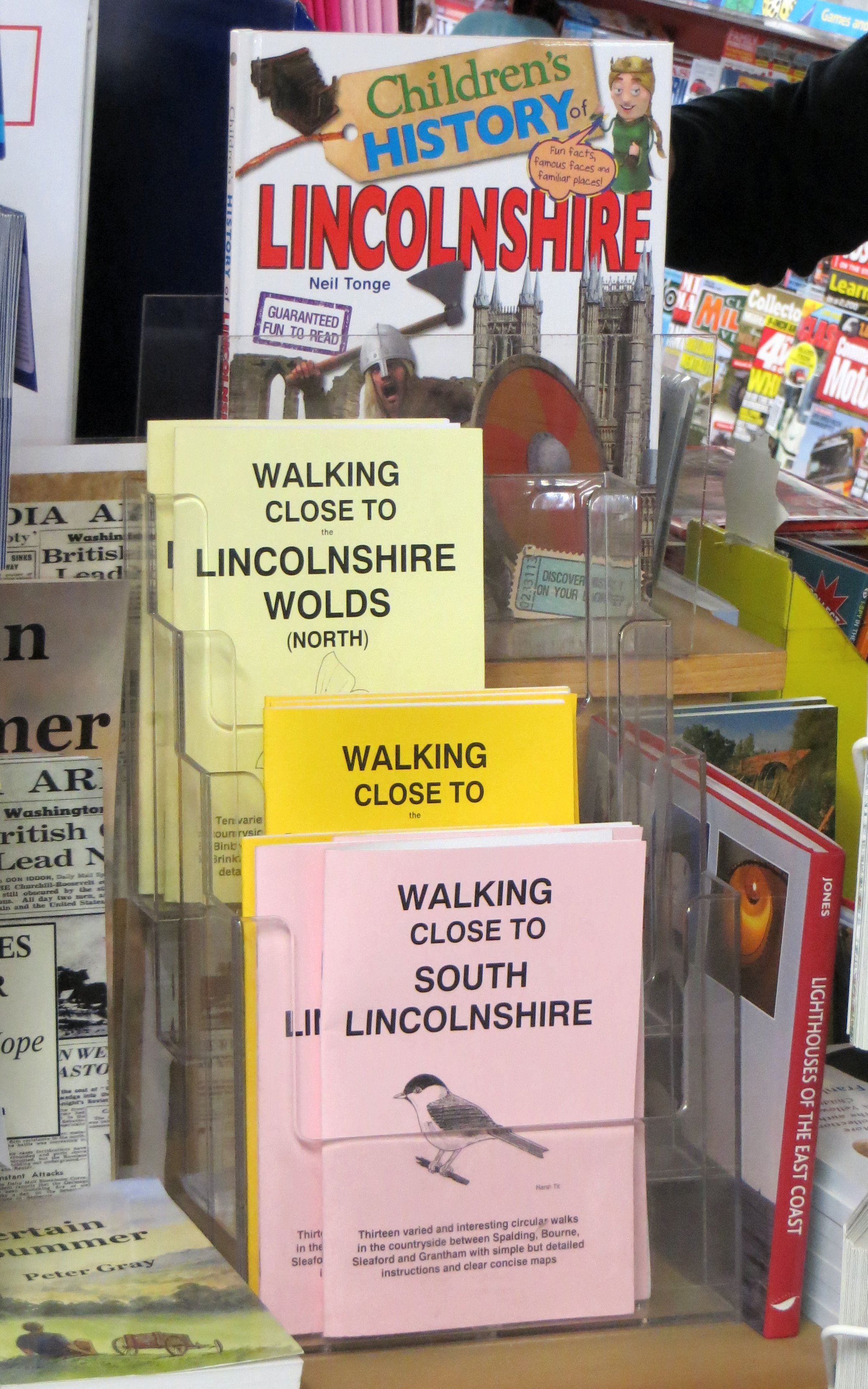
Speciality: Lincolnshire!
As you can see, I’ve included a few pictures of the event, the library and the bookshop. I’d never been to Louth before: it is quite a distance from Spalding. It is a lovely old market town; having now discovered it, I certainly plan to return. If you are ever in the area, it is well worth a visit – and don’t forget to take in the library and the bookshop while you’re there!
Bodies and what to do with them…
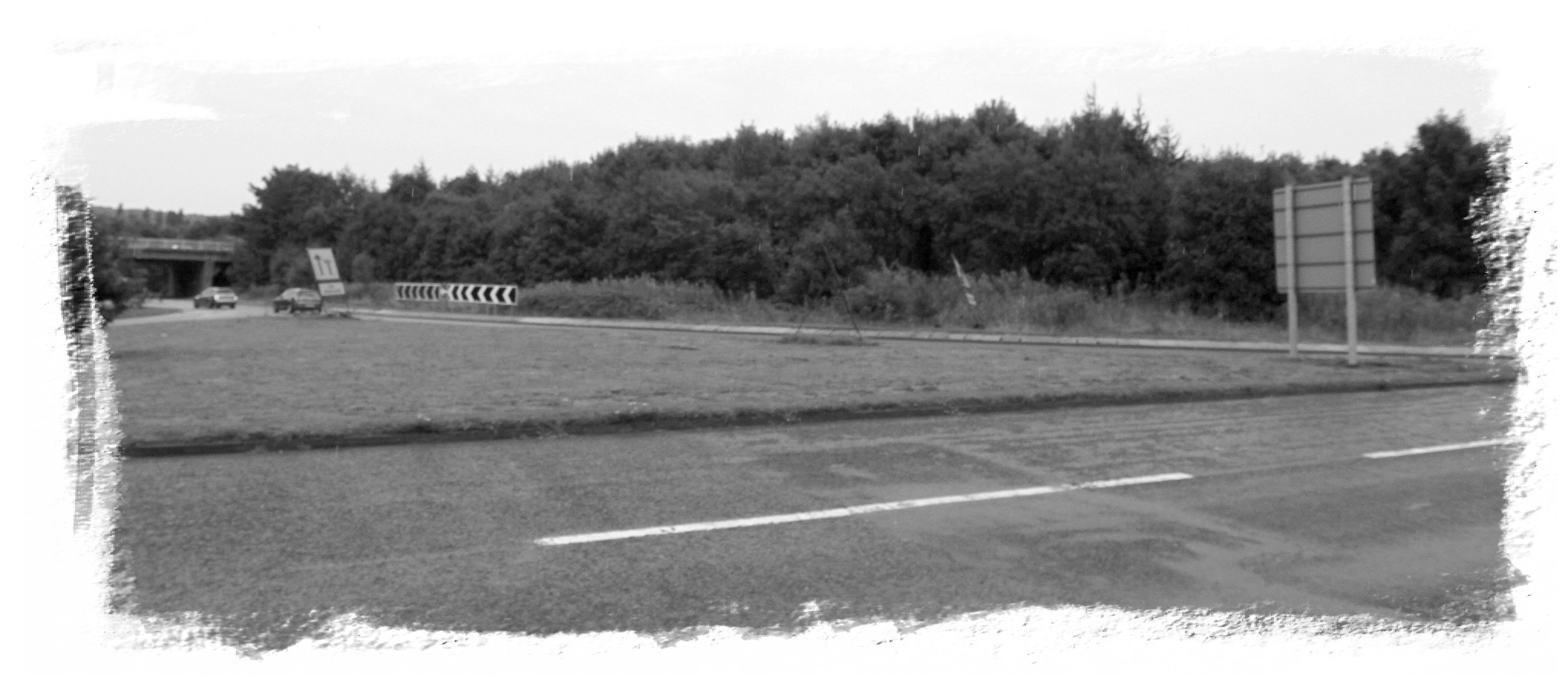
Handy off-road parking under that bridge over there… and oodles of space under the roundabout’s trees…
My husband drove me to the station yesterday morning. I was on my way to yet another (day-job) conference. On the way, we noticed that the slip road that takes us on to the motorway was once again half-closed for repairs. This led to a re-run of one of our favourite conversations – which, incidentally, I capitalised on at the beginning of In the Family. Murdering your victim is fine (so to speak), but how you dispose of the body is a much trickier problem.
Unless they live deep in the Russian steppes, this is a perennial problem for murderers. Some have resorted to ingenious solutions, yet still been found out. I’m thinking of Haigh, the acid bath murderer, or the ‘lady in the lake’ killer (the woman’s husband, Gordon Park, was eventually found guilty: he got away with it for half an adult lifetime, but was still caught in the end, when divers found the body). In certain rare circumstances, justice has not required the discovery of the body in order to convict the killer. Muriel McKay’s body was never found (there was a gruesome theory that she was fed to pigs on the farm where she was held captive), but the two brothers responsible for her death were imprisoned nevertheless.
There are many ways of disposing of a body, especially if the killer isn’t squeamish, but on a crowded island like ours there is always the danger of being spotted, even in the middle of the night. This brings me to my husband’s preferred method of victim disposal. He says that if he were to commit his hypothetical murder, he would bury the body in the middle of a large roundabout. There are two not so very far from where we live that might do nicely. The larger of these is overgrown with a wild thicket of shrubs and trees that is never penetrated by the Council’s gardeners. A body buried there would not be discovered for many years, unless a decision were to be taken to change the route of the motorway. Potentially there would be two problems to overcome, however: the ground might be very hard and unyielding (like our garden, which had virtually no topsoil until we imported some) and therefore it might take a long time to dig a large, deep hole; furthermore, situated as the roundabout is, near a hotel and the beginnings of a large conurbation, the danger of being discovered in the act of digging there would be great. This hazard would be compounded by the fact that there is nowhere inconspicuous to park adjacent to this roundabout. My husband would therefore have to risk parking on the hard shoulder and pretend to have broken down, which might prompt an interesting conversation with the inevitable helpful passing police patrolman:
‘Why did you leave your car unattended, sir?’
‘I was just digging a hole on this roundabout.’
‘Why was that, sir?’
Alternatively he would need to park in one of the nearby streets and lug the body several hundred yards, crossing a busy road and the motorway slip-road in order to reach the roundabout. He’d also have to be strong enough to carry a dead weight of, probably, nine stone or so (assuming that his victim was a woman) or half that much again if a man. You begin to see why some murderers resort to the ghoulish job of cutting up their victims.
No, my husband decided, the smaller of the two roundabouts, which is still large and overgrown in the middle, would be a better bet. A hole could easily be dug in advance there, for the undergrowth is thick and, in the leafy season, impenetrable to the eye. It has the advantage of being accessible from a long, poorly-lit slip-road that is often deserted at night, with a lay-by very close to it. Unfortunately, the lay-by itself is the popular haunt of men in vans during the day (I’ve never been able to fathom why, but judging from what I’ve seen, I wouldn’t be surprised if a few dodgy transactions took place there) and sometimes used as an overnight stop by truck drivers. My husband would therefore have to make sure that there were no truckers there on the night he buried the body. Much more convenient, he said, is the hard standing underneath the motorway bridge, right on the roundabout, where many a time we’ve seen lorries and cars parked, sometimes overnight. Twenty yards maximum for the heavy lifting. Then, he said, he’d dump the body quickly and drive the car away, so that the vehicle would be there for no more than five minutes, if that. He’d already have had the body in the freezer, wrapped in plastic, so it would be a neat and clinical affair. A pair of heavy duty gloves and an ex-military trenching tool (this latter he has had for some time – it folds neatly into a small case that can be attached to a belt) would complete his kit for an inconspicuous return on foot to complete the job. He’d be able to take his time to put the body in the hole, replace the soil and cover the grave well with the dead leaves that lie there so that no-one would notice that the earth had been disturbed before it grew over properly again. Simple.
I was not convinced. For one thing, there’d still be a chance of the ubiquitous police patrolman spotting the car and stopping to investigate. Or a lorry driver might turn up late. Then there’s Sierra Yankee Nine-Nine, South Yorkshire’s proudly-owned police helicopter. What if the pilot were out for a late night recce, and spotted him from above? There is also the forensics to consider: even wrapped in plastic, the body might leave some traces in his car and, if the remains were found sooner than he expected, he’d have to explain why soil matching that on the roundabout had clung to the soles of his boots. But for me the insurmountable obstacle would be the corpse’s necessary, if temporary, residence in my freezer. I have not spent the latter part of the summer freezing vegetables to have them jostle with a grisly cadaver; nor could I ever feel the same about Ben and Jerry’s Dough-ble Whammy ice-cream if I’d seen a lifeless hand nestling against the carton.
No, it’s back to the drawing-board for my husband. He’ll have to find a less domesticated way of getting rid of his victim. He says we could have a trial run with me as a dummy corpse, but I’m not to be taken in by that one. The journey to the station, however, passed very quickly.
Happy coincidences and old friends at Bookmark, Spalding…
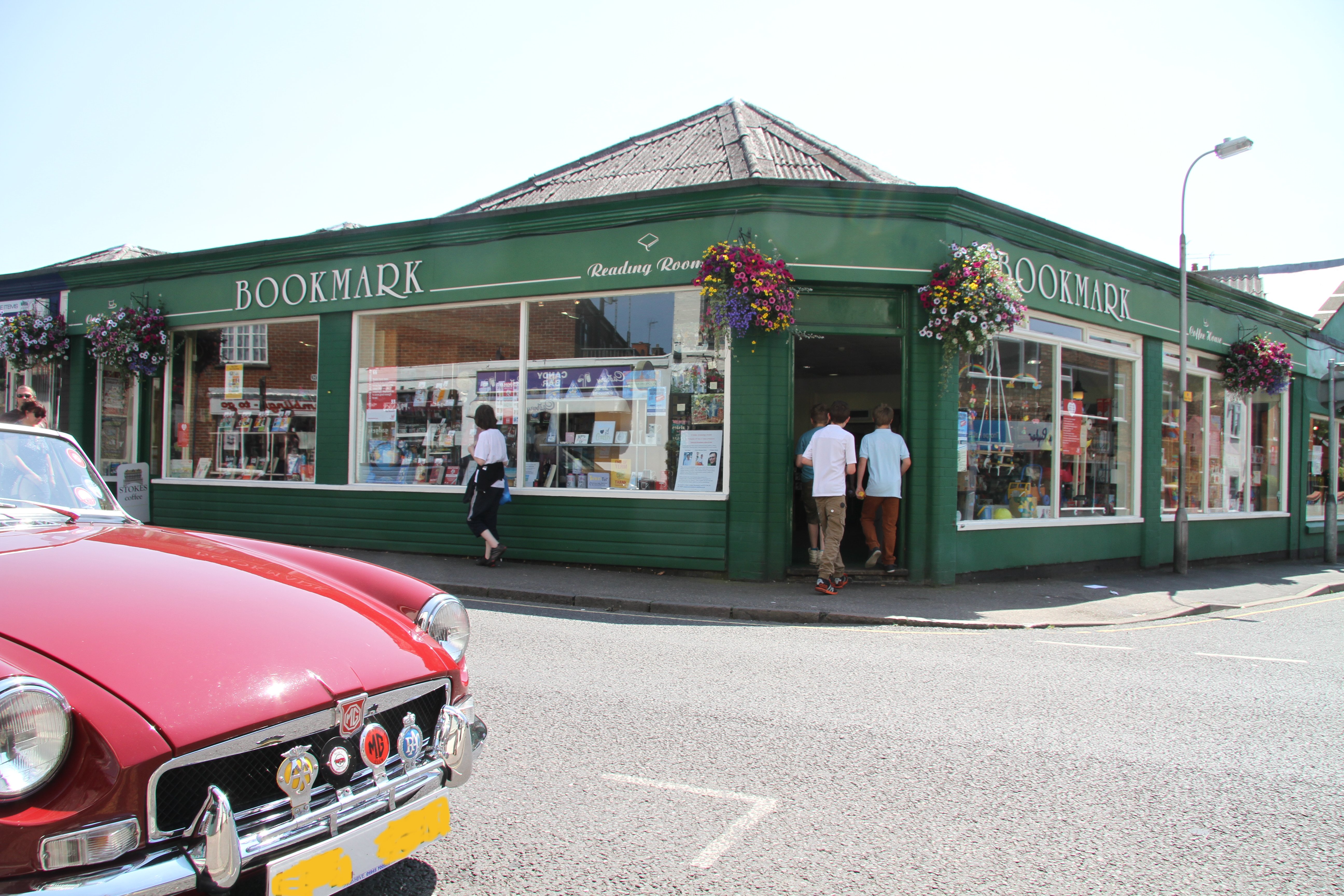
Fine car; finer bookshop

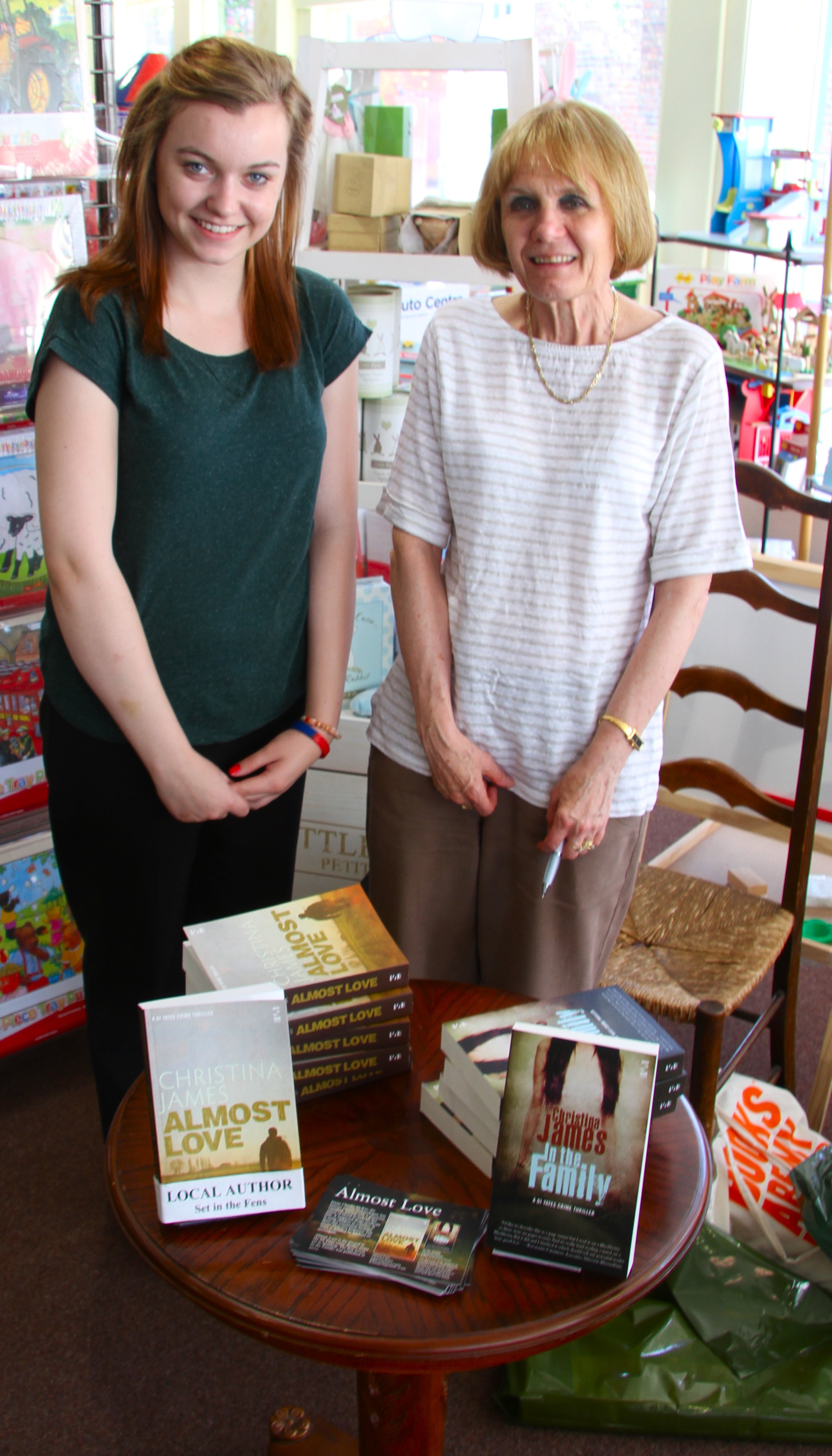
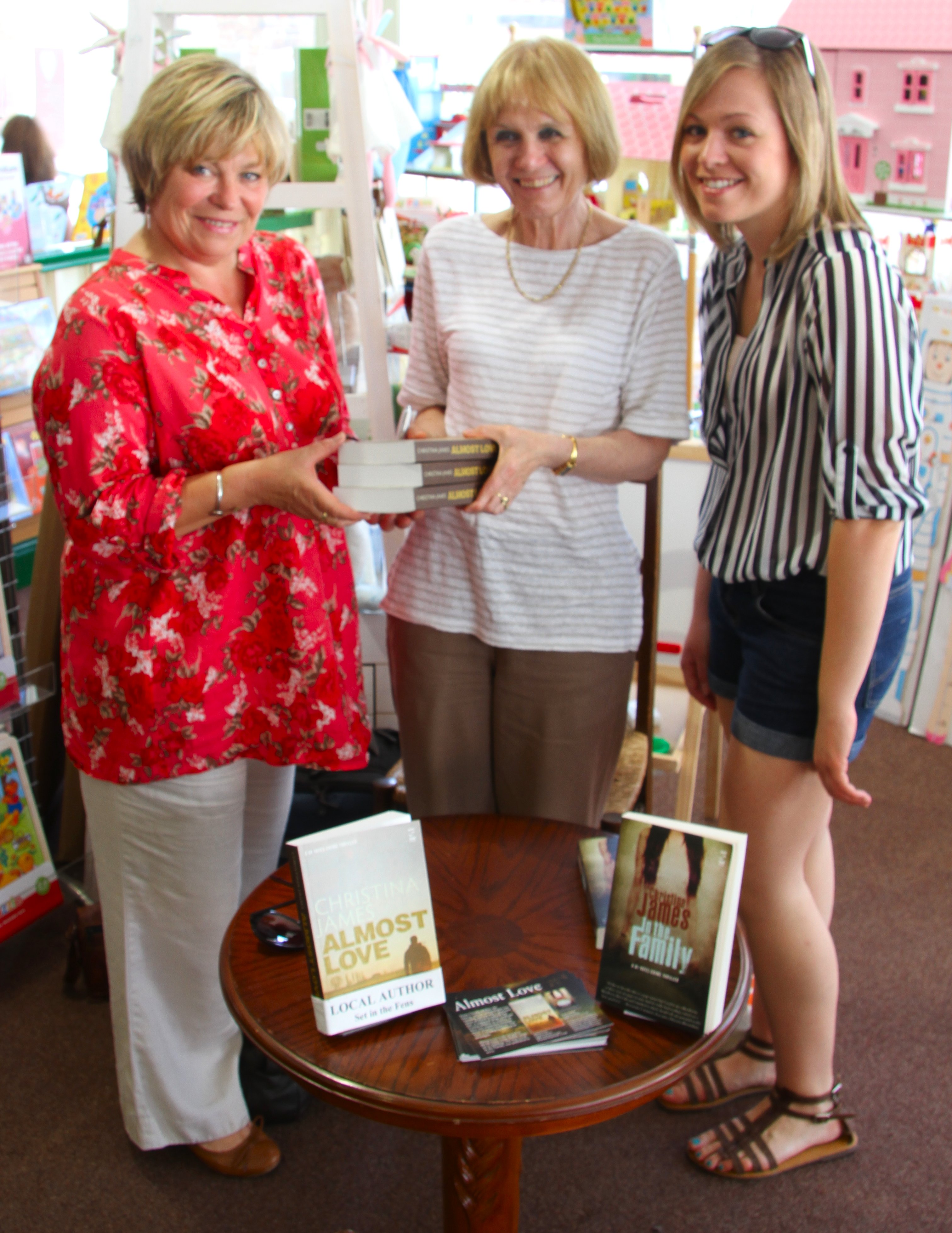


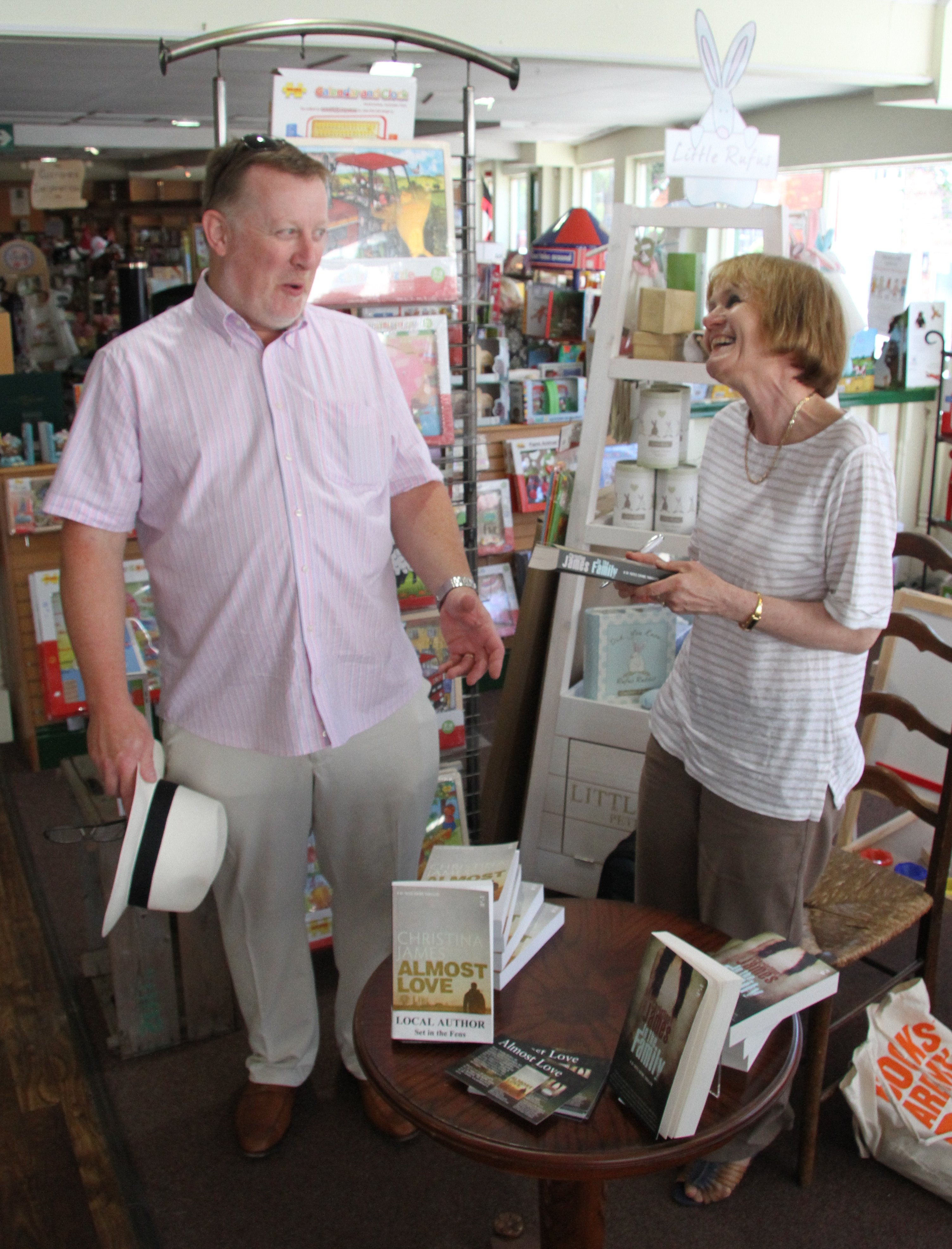


Bookmark’s creative owner, Christine Hanson
Yesterday was one of those perfect days that become legendary in memory. I had travelled to Spalding, having been invited to give a signing session at Bookmark, a very distinguished bookshop which I also visited and wrote about just before Christmas last year.
There was a carnival atmosphere in the town. Christine Hanson, Bookmark’s owner, was feeling particularly happy, because hers and other businesses in Spalding had banded together to offer fun activities to passers-by in one of the yards in the Hole-in-the-Wall passageway. Christine said that it marked a significant step forward in the town’s initiative not only to save the high street but also to ensure that it thrives. She flitted back and forth between the shop and the Hole-in-the-Wall all afternoon and, despite being so busy, still provided my husband and me with her customary wonderful hospitality.
My signing session began with a remarkable and totally unexpected coincidence. Two ladies who had been paying for books at the till came over to speak to me. Noticing their accents, I asked if they were American. One of them said that she’d been born in Spalding, but had lived in America for twenty-five years. She now teaches environmental science at the University of California. Judging her to be about my age, I asked if I knew her. She said that her name was Carol Shennan. I knew the name immediately; she had lived about five doors away from me in Chestnut Avenue when we were both growing up. She said that her mother, who is eighty-nine, still lives in Spalding, and that she was just there for the week to visit her. It was an unbelievable stroke of luck that we should meet in Bookmark. Carol bought In the Family, and I look forward very much to receiving a future contribution to this blog from her when she’s read it.
Several babies came into the shop. I was introduced to Oliver, who arrived with his grandmother and aunt, who each kindly bought both books, and Harry, who came with his grandparents. His grandfather (I’m sorry that I can’t remember his name: his wife’s name is Carole) is a keen local historian and said that he doubted that my novels would cover villages as remote as Sutterton, which is where he was born and still lives. By another strange quirk of coincidence, I was able to tell him that my third novel, which I’ve just started writing, is set in Sutterton. I hope that Harry’s grandparents also will contribute to the blog when they’ve read the copy of In the Family that they bought.
My very dear old friend Mandy came in and bought an armful of books to give other friends as presents, just as she did at Christmas. At the end of the afternoon, she returned to guide us to her house, where we spent an idyllic evening eating supper and drinking wine in her garden with her husband Marc and her friends Anthony and Marcus. We ate new potatoes, broad beans and strawberries from her allotment and talked about books, teaching and cooking (Marcus is a chef). Afterwards, we drove home through the twilight. The fields of South Lincolnshire were looking at their best: the corn was just turning, and in one place acres of linseed coloured the landscape blue-mauve. The skies were as big and beautiful as always.
An idyllic day, as I said. I’d especially like to thank Sam at Bookmark for arranging the signing session, and Christine, Sally and Shelby for looking after me so well and for providing a great welcome: I heartily recommend the café at Bookmark, if you’re ever in the area. Many thanks also to the many people who stopped to speak to me – the conversations were fascinating – and for buying the books. And thank you, Mandy and Marc, for being amazing hosts and for introducing us to Anthony and Marcus, who provided me with their suggestion for DI Yates 4!
Crime Fiction Month and National Group Reading Day in Wakefield, West Yorkshire
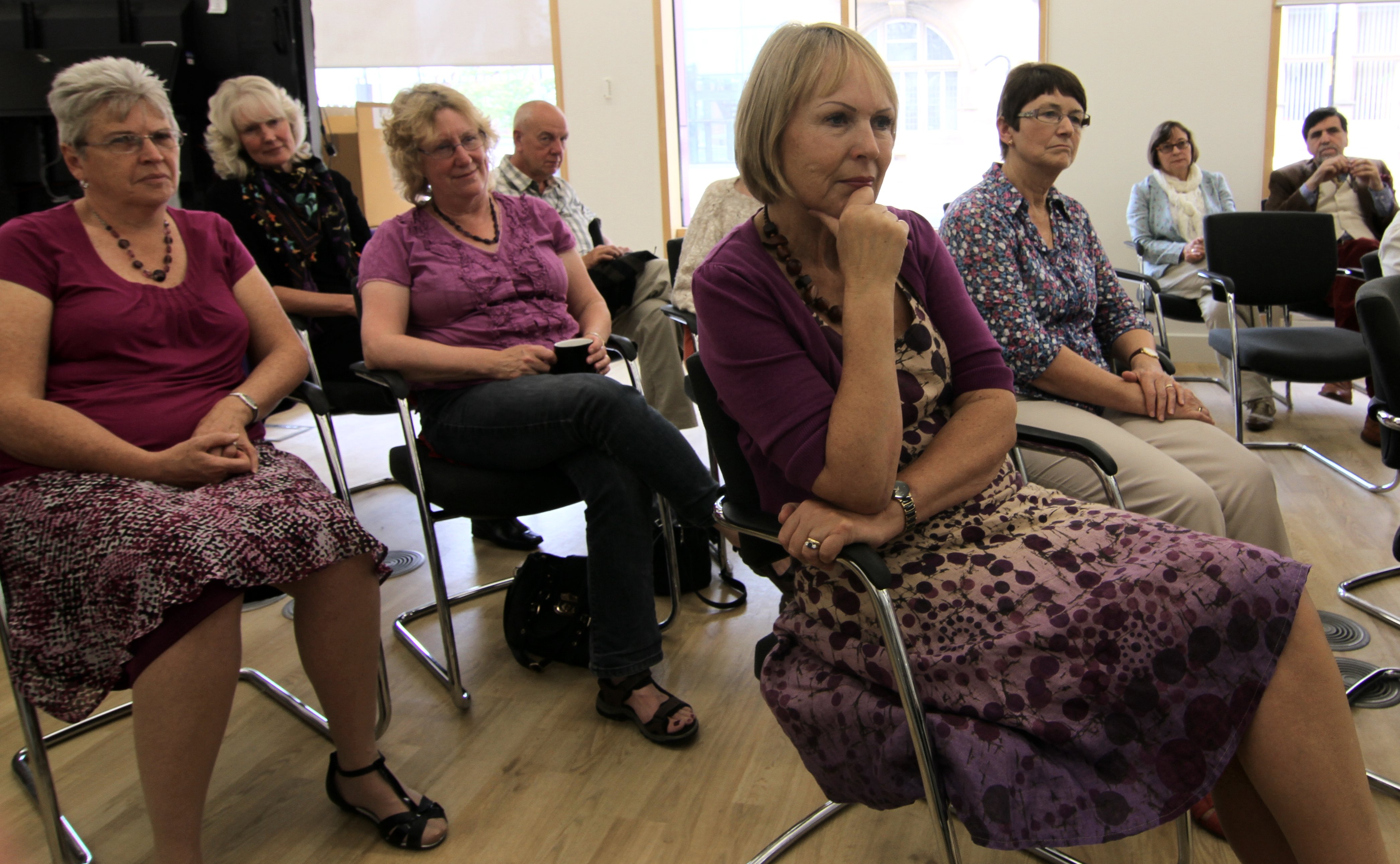
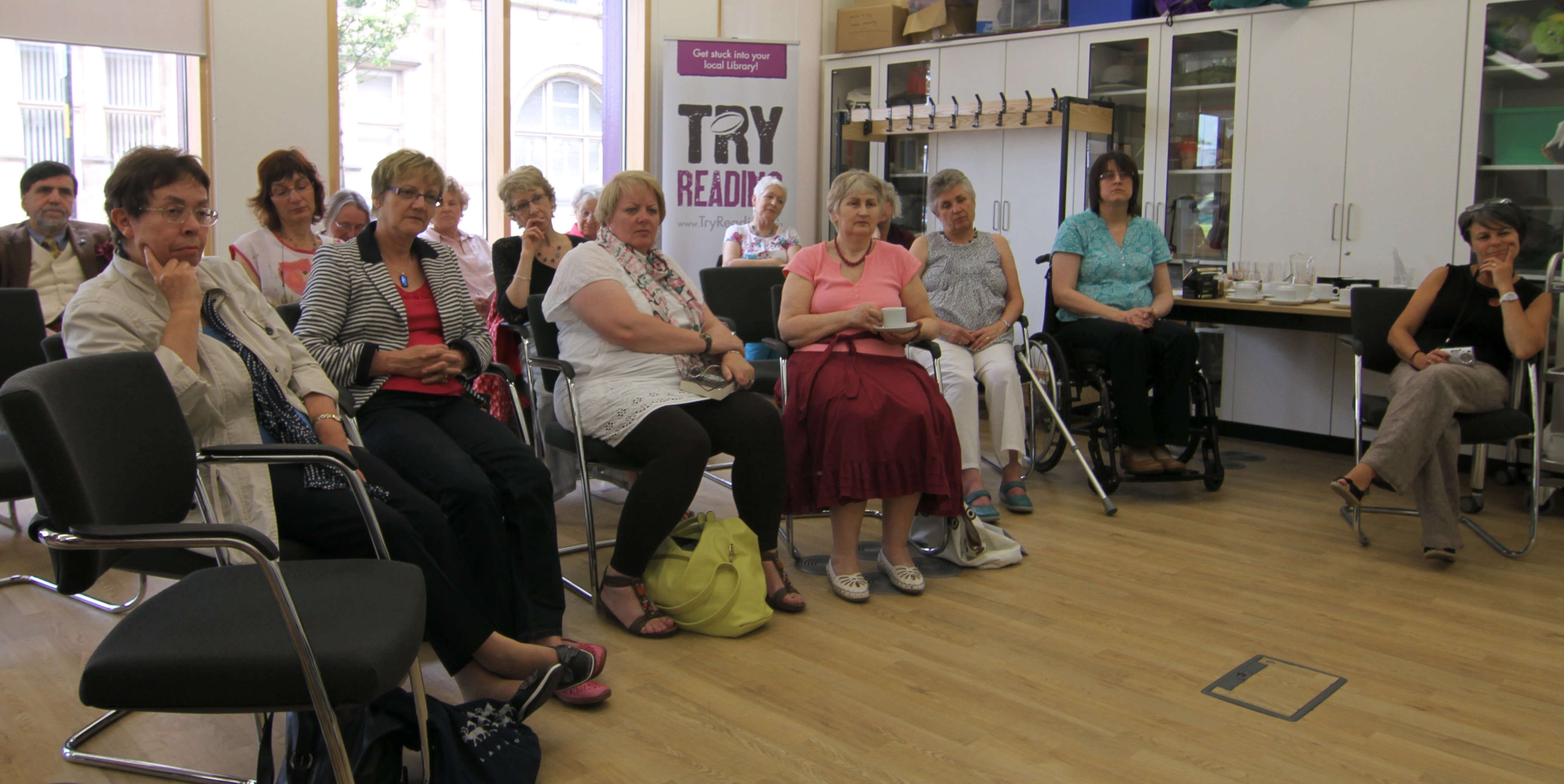
Wakefield Library audience listening to
a reading from ‘In the Family’
I was very privileged yesterday to have been invited to the event arranged by Wakefield Library Service as a joint celebration of National Reading Group Day and Crime Fiction Month. It was organised by Alison Cassels, Library Officer for Reading at Wakefield, and lasted almost the whole day. It was held at Wakefield One, the wonderful new library and museum complex which was opened last November by Jarvis Cocker. The day’s activities were built around the interests of Wakefield Libraries’ eighteen reading groups. When they are in everyday mode, the reading groups choose books that they wish to read from a selection provided; the library service then buys sets of these and distributes them. In itself, this must constitute an impressive feat of complex organisation and canny budget allocation.
About twenty members from various Wakefield reading groups attended. The morning began with refreshments, during which participants were given the opportunity to examine the next round of suggested titles and make their choices. We then split into three groups. Three books were being discussed, Peter May’s The Blackhouse, Wilkie Collins’ The Moonstone and my own In the Family. The facilitators were Alison Cassels’ colleague, Lynn, Julie Walker, Operations and Development Manager for Kirklees Library Service, and myself.
It turned out that so many of the participants had read all three novels that I and my fellow facilitators led consecutive sessions with all three groups. At the end of the morning, Julie chaired a wrap-up session about crime fiction more generally and we discussed our favourite books in the genre. We then broke for lunch. In the afternoon, more people joined the groups to listen to my reading of two short excerpts from In the Family and Almost Love, as part of a session during which we discussed how I write and how I originally managed to get published; the audience put to me more questions (some of them very searching indeed) about my novels. At the close, Richard Knowles of Rickaro Books, in Horbury, sold copies of both books.
I don’t recall having enjoyed an event – whether or not it featured other authors or myself and my own writing – more than I enjoyed yesterday’s. I say this, not from reasons of vanity, but because I have never before had the opportunity to get as close to readers and what they really think. The eloquence and perceptiveness of the reading group members, and the fact that they had spent so much time on really engaging with In the Family, was truly humbling. I took much pleasure in listening to Pauline when she explained why she enjoyed the passages of dialogue – particularly that which takes place during Hedley Atkins’ and Peter Prance’s train journey to Scotland – and how much she identified with Hedley’s frustration when he missed the train to Liverpool, in spite of his sinister intent; and to Jane, for taking the trouble to create a family tree for the Atkins family. Other reading group members quizzed me for more information about Salt Publishing, about the history of Lincolnshire, about how DI Tim Yates will develop in subsequent books and – in true, straightforwardly friendly, Yorkshire fashion – about what I could say to persuade them to buy Almost Love! I said that it does develop Tim’s character further, as they’d hoped, and that it contains quite a lot of history and more of the dialogue that they’d obviously enjoyed.
If any of yesterday’s participants are reading this, I’d like you to know that I think you are amazing. I was grateful beyond words for your generosity in investing so much time, both in the event itself and in reading the books, as well as, of course, for your buying them. I do hope that I shall have the opportunity to meet you again.
I’d like to conclude with a special thank-you to Alison, who provided me with excellent hospitality. Wakefield Library Service is an old friend, with which I first became acquainted in the late 1970s. It has always enjoyed a fine reputation as a distinguished and innovative library authority. From the start, therefore, I knew that yesterday would succeed, but the magic of the day, created by a combination of impeccable organisation by Alison, Lynn and their colleagues and the wonderful enthusiasm of all the participants involved, both from the reading groups and other members of the public, made it truly unforgettable.
Congratulations, Wakefield!

Pauline and I continue our discussion after the event
 Christina James, crime novelist