In my novel In the Family, Hedley Atkins speaks for himself, his monologue providing an insight into his character and psychology. I remember first being transfixed as a school pupil by the monologue of Browning’s Porphyria’s Lover, a powerfully atmospheric poem in which the speaker sits with Porphyria, strangled by him with her own hair, upon his knee and reveals (with the delicacy of touch that Browning also deploys in My Last Duchess, a poem about a very powerful man who has his wife done away with) how he has quite matter-of-factly ensured that she will be entirely his. A combination of scene-setting (a contrast between the storm outside and the cosy cottage atmosphere created by Porphyria) and the brooding personality of the lover heightens the sense of menace. The horror is achieved in an understated way, not by graphic depiction of blood and guts. The power of monologue is well-known in drama, too: for example, Alan Bennett’s Talking Heads characters brilliantly demonstrate how apparently incidental details cohere to develop our engagement and to surprise us.
Are we so hardened by our exposure to the prevalent and unsubtle presentation of graphic violence on film and in books that we are no longer absorbed and excited by suggestion? I hope not.

So, Will Self (Times2 2012-11-21) mourns the end of the typewriter era, does he?
Sorry, Will, I can’t share your sentimentality; you may compare the ‘pure invention’ of the typewriter to that of the bicycle (‘all it requires is human power and it can take you anywhere’), but this is nonsense, really. Lots of us like riding bikes, but are thankful that there are faster modes of transport. Some of us still like using fountain pens, but only for the shorter missives. Even with pen- and pedal-pushing power, we don’t travel far on our fictional and literal journeys. You may feel that your words are ‘floating somewhere off in the electronic void’, but you know that they are not – and if you’re that worried about them you can always print hard copy to fondle. Frankly, I don’t believe you; as a writer, you know full well that you ‘think the sentences out in your head before you hit the keys’ with a computer as well as with a typewriter, so you don’t kid me that you don’t value the editing facility of the former. You admit to being fetishistic about the typewriters you’ve acquired; here are two pictures of mine – thank heavens they are just there to be ‘a cool, solid presence’ of a purely ornamental kind. Give me the computer, screen and keyboard – clunky isn’t funky and it’s definitely not cool.

The well-known quotation from Jane Austen’s 1816 letter to her nephew, Edward [“the little bit (two inches wide) of ivory on which I work with so fine a brush, as produces little effect after much labour”] seems to have been a metaphor comparing the fashion for painting miniature portraits of people upon small sections of ivory to the delicate depiction of characters in Jane Austen’s own writing. There is (Don’t we know it!) author frustration here, as well as an acknowledgement that creating characters who are convincingly real is a lengthy and laborious business. Readers often ask if fictional characters are based on real people, especially when their delineation is complex; the beauty of fiction is that our contact with humanity provides not only a splendid range of interesting individuals, but also (much more useful!) unlimited character traits and mannerisms to drum into service in a book. Bits of this and bits of that may be merrily joined together into a fictional original; ‘larger than life’ is an apt way of describing such a one. In these days of (sadly) increasing conformity to society’s norms, what is really exciting is to meet real larger-than-life characters, as they spring uniquely fully formed, with glorious individualities and eccentricities, out of the amorphous mass of the majority.
As a writer, I might take the ‘idea’ of a Boris Johnson, but, even with all his astonishing absurdities, I shouldn’t have a place for him in my book; he wouldn’t fit. He is much better left where he is, in reality, for people to enjoy there.

Ooops, not much left of this one!
An article in yesterday’s BBC online magazine describes ‘scientific’ evidence that chocolate makes you clever. This is based on the theory that rats and snails live longer and have better cognitive function when they eat chocolate. More tenuously, the authors link chocolate consumption with human intelligence, especially of the prize-winning variety. Apparently the number of Nobel prize-winners per thousands of population is highest in countries where the per capita consumption of chocolate is also highest. Unsurprisingly, Switzerland takes the (chocolate) biscuit, whilst Sweden is the odd one out, because although it has the second-highest number of Nobel prizes for its population size, chocolate consumption is low there. (The authors say, somewhat archly, that ‘this may be because Sweden has a patriotic bias’ when awarding Nobel prizes.) Speaking for myself, this is good news indeed: if I keep on eating chocolate at my present rate, I should be sweeping the literary board in no time: not only the Nobel prize for literature, but the Man Booker, the Pulitzer and even the Theakston’s Old Peculier Award all seem well within my grasp! A thought strikes me, however: Is my chocolate-eating prowess above average, average, or – whisper it quietly – possibly lower than the norm? I can’t do the maths!
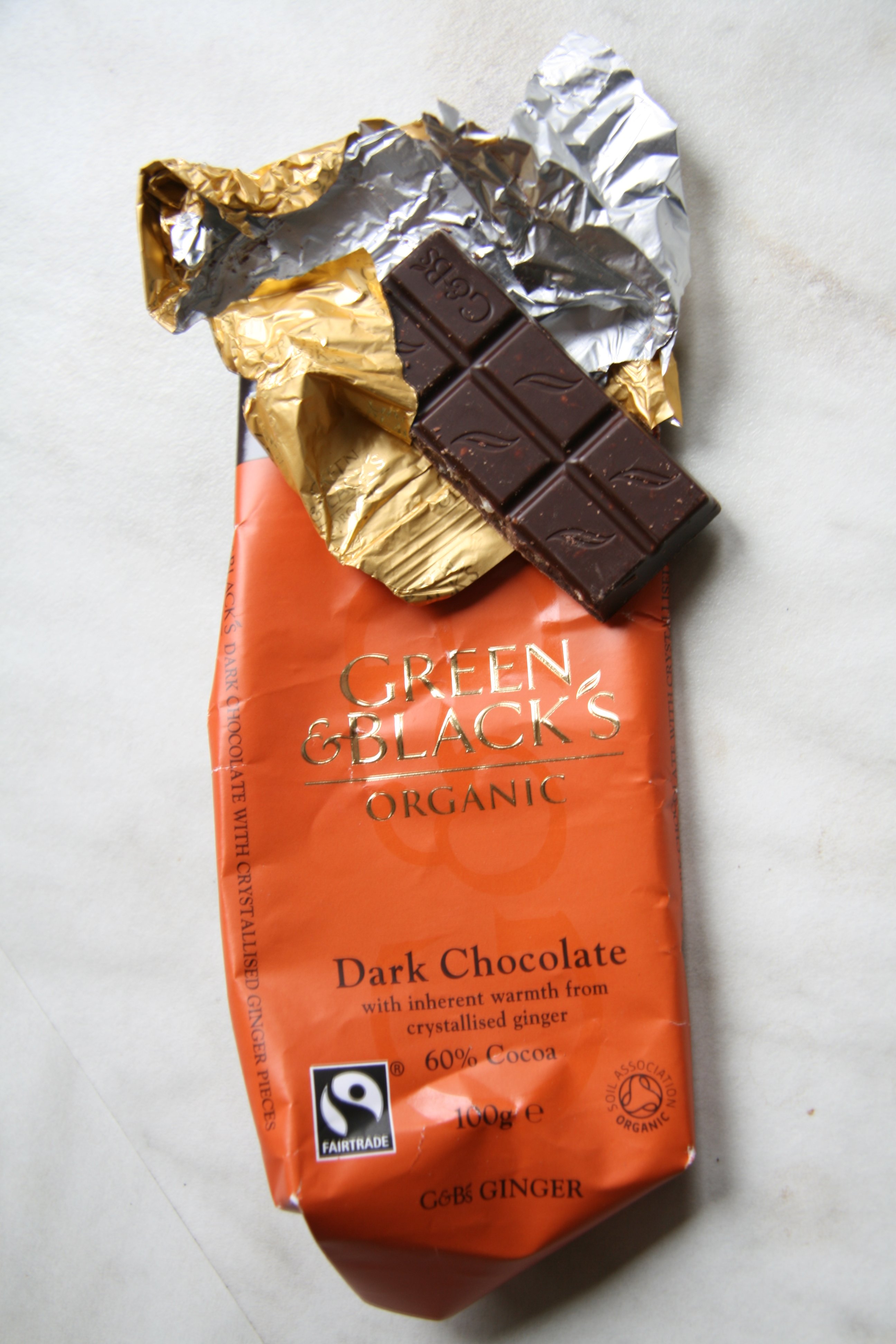
Now the alpha male in the house (not a chocolate eater) is feeding the snails chocolate on his vegetable patch to win them over from his greens. He clearly needs to discover Green and Black’s for himself.
 In true Leadbelly fashion, I woke up this morning convinced that the blues had got me; it must have been the impact of too much noir in books and on television over the weekend. What is it in human nature that always pushes us towards ever-darker stimulation? I am reminded of the fashion for gothic in the late eighteenth century, when there was plenty of noir about to titillate readers ever more hungry for the gruesome, the erotic and the oneiric. Fortunately for sanity, there is always an antidote to this and parodies of noir inevitably follow too great an emphasis on the nastier, seamier side of life. Jane Austen’s splendid satire on the gothic novel, Northanger Abbey, must have been very refreshing to readers suffering too much of a bad thing.
When I have had enough of the mean streets of the gritty city and the jaundiced and jaded detective soured by too much corruption amongst criminals and police superiors, I start looking for something lighter to compensate. Too much Philip Kerr? Perhaps I’ll come up with some Birmingham Blanc. Nothing like a bit of fun when the blues get you.
We used to go for walks in the wild and leave our tracks, like Pooh and Piglet and the Woozles; you could mark our progress, if you were a tracker, by the broken twigs or the thread of cotton caught on a bush. If we were really anti-social, you would find evidence of us in the bits of litter we left in our wake.
Now we walk in an ethereal world and we leave a trail of trivia in the tangled pathways of the digital web, by which we may be noticed and identified… or hunted. The trouble is, that we incriminate ourselves by what might once have been quickly overwhelmed by weather or overgrown by nature, but which is now non-biodegradable and there in perpetuity, for anyone to discover. And, if we happen to drop a tweet wrapper, the wet noses of the lawyers will sniff us out and pad inexorably along until we find ourselves surrounded by snapping, salivating jaw-suits.
We should have more respect for the world in which we now wander and treat it with care and goodwill; above all, we need to think about the possible consequences of thoughtless disregard for our environment and close properly other people’s gates and take our offensive twitter home with us.

November morning over Nottingham
Some wonderful skyscapes have been recently circulated on Twitter – and enjoyable comments, too, about the sky and the weather, such as: ‘Sky the colour of boredom.’ (@CathStaincliffe) Those of us who live in the British Isles, quite understandably, talk, think, eat, sleep and dream weather; it’s part of our psyche. Hardly surprising, then, that writers should use weather to reflect human feelings or to create mood or to set a scene. Ruskin coined the term ‘pathetic fallacy’ for the way human feelings falsely find themselves attributed to non-human things, personifying them, in effect. There is the poet in us who makes a connection between feelings and (especially) weather – and the hard scientific or meteorological reality can go hang. A sky can threaten rain, of course, but a threatening sky can become a powerful symbol of human danger: Banquo: ‘It will be rain tonight.’ 1st Murderer: ‘Let it come down.’ The Brontës were not unacquainted with the technique (Well, they lived in Haworth, after all!) and you don’t have to go far into crime fiction to come across it. We love it and exploit it and it would be a dismally humdrum realist who would take issue with its authenticity!
@EMAldred has kindly allowed me to use a Nottingham skyscape to illustrate this post. I hope, too, that visitors here will contribute their favourite crime fiction weather moments as illustrations.
That Kenneth Branagh will play Macbeth at next July’s Manchester International Festival is, I don’t mind saying, wonderful news for those of us who love him in Shakespearean roles. He must be relishing this one already, for there is something special about a villain who has all the makings of a very good man indeed, but who succumbs to the temptation of absolute power. To kill a king to become a king in a world where ruthlessness rules would not be, in itself, much of a story, but to have a man in whom a good king might place ‘absolute trust’ turn into a veritable devil of blood and darkness is the gutsy psychological stuff that I enjoy. A king of the present day, who makes war on his own people through a weak desire to perpetuate his power, is not an interesting villain, whatever the violence he wreaks, but just a feeble and cowardly character. Give me the man, Kenneth Branagh, who has all the goodness of a true, loyal and astonishingly brave subject and a massive potential for self-interest and viciousness. Then there is some real awe to be had.
Oh, yes, there is a Lady Macbeth too, but that’s another story. The mind of a great man sucked into evil is what this crime thriller is all about for me and I predict that Branagh will be a great Macbeth.
 Today is the day that my book has been published. When In the Family was little more than the glint of an idea, I dreamed of this day. I don’t know what I expected – certainly not some kind of red carpet event! Hundreds of booksellers beating a path to my door? Having been a bookseller myself, hardly that! The best that I can hope for is that booksellers in all sorts of places are very kindly getting sweaty and grubby opening boxes which contain my book among others. Booksellers are the great unsung heroes of the publishing industry and they deserve a separate blog entry to themselves about that.
So what is happening today? A mellow autumn sun is shining palely; the leaves continue to fall. I’ve been to the local farm shop to order a goose for Christmas and was lucky enough to find the ‘fish lady’ there, so bought a crab for dinner. All of this feels like a celebration – the kind of celebration I like best, just appreciating the good things as they come and knowing the book is there, like a warm glow in the background. Thank you for your support along the way. I hope that you will find a way of celebrating with me, too.
Available from Salt Publishing at:
http://www.saltpublishing.com/shop/proddetail.php?prod=9781907773242
Laura Thompson’s Daily Telegraph article, Emma and the detectives, http://www.telegraph.co.uk/culture/books/booknews/9672296/Emma-and-the-detectives.html today poses the question ‘Is crime the new literary fiction?’, in advance of tonight’s Kings Place debate on the topic. Having considered whether crime fiction provides contemporary relevance (Of course, some of it does!), Laura Thompson moves to her central thesis, that it is the superior entertainment value that causes its popularity, rather than its presentation of life in today’s world. Daringly, she offers this: “I would go so far as to say that, in a sense, all novels should aspire to the condition of crime writing: that the genre showcases what is desirable, even necessary, in a book.” To which I should reply, “If any novel is good, it will inevitably contain features characteristic of good literature; its genre is irrelevant.”
She goes on to cite Emma as a literary example of a crime novel; I have no argument with this self-evident truth. What worries me is that she goes on to say: “At the end of the book, when Emma realises, ‘with the speed of an arrow, that Mr Knightley must marry no one but herself’, the solution has all the satisfying ‘Oh, of course!’ that one gets when a murderer is identified.” Perhaps my reading of Emma is different, but Laura Thompson might like to consider that the ‘speed of an arrow’ moment is in fact the ultimate irony for alert readers who have guessed this outcome almost from the beginning of the book.
I agree with her about the entertainment value of crime fiction; however, what for me makes the best crime fiction makes the best fiction: plot, characterisation, mood, setting, suspense and to crown the lot, fine use of language.
I’m sure that a great deal of good sense will be talked tonight.