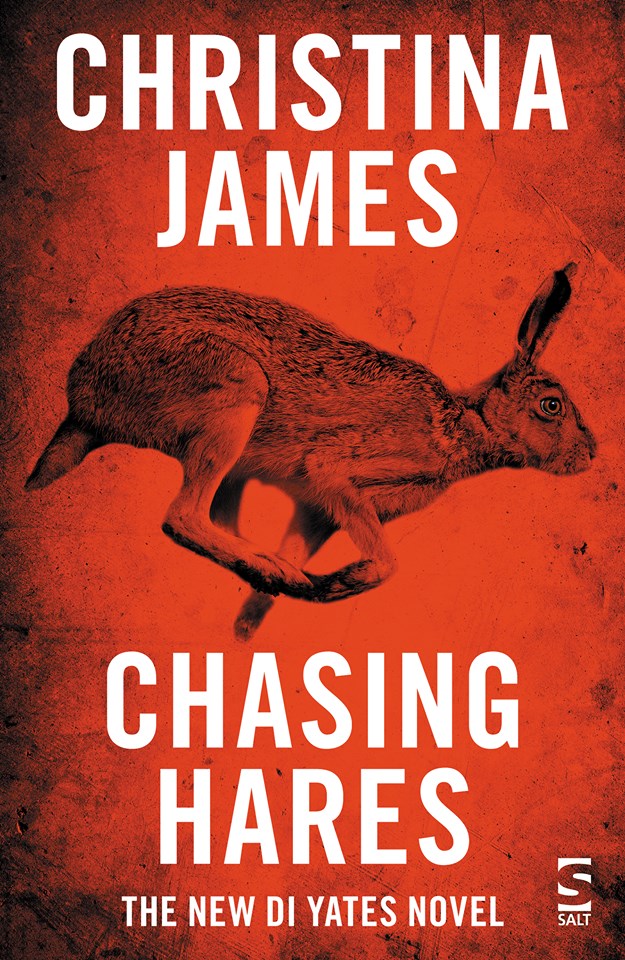


The flavour of Salt crime fiction…


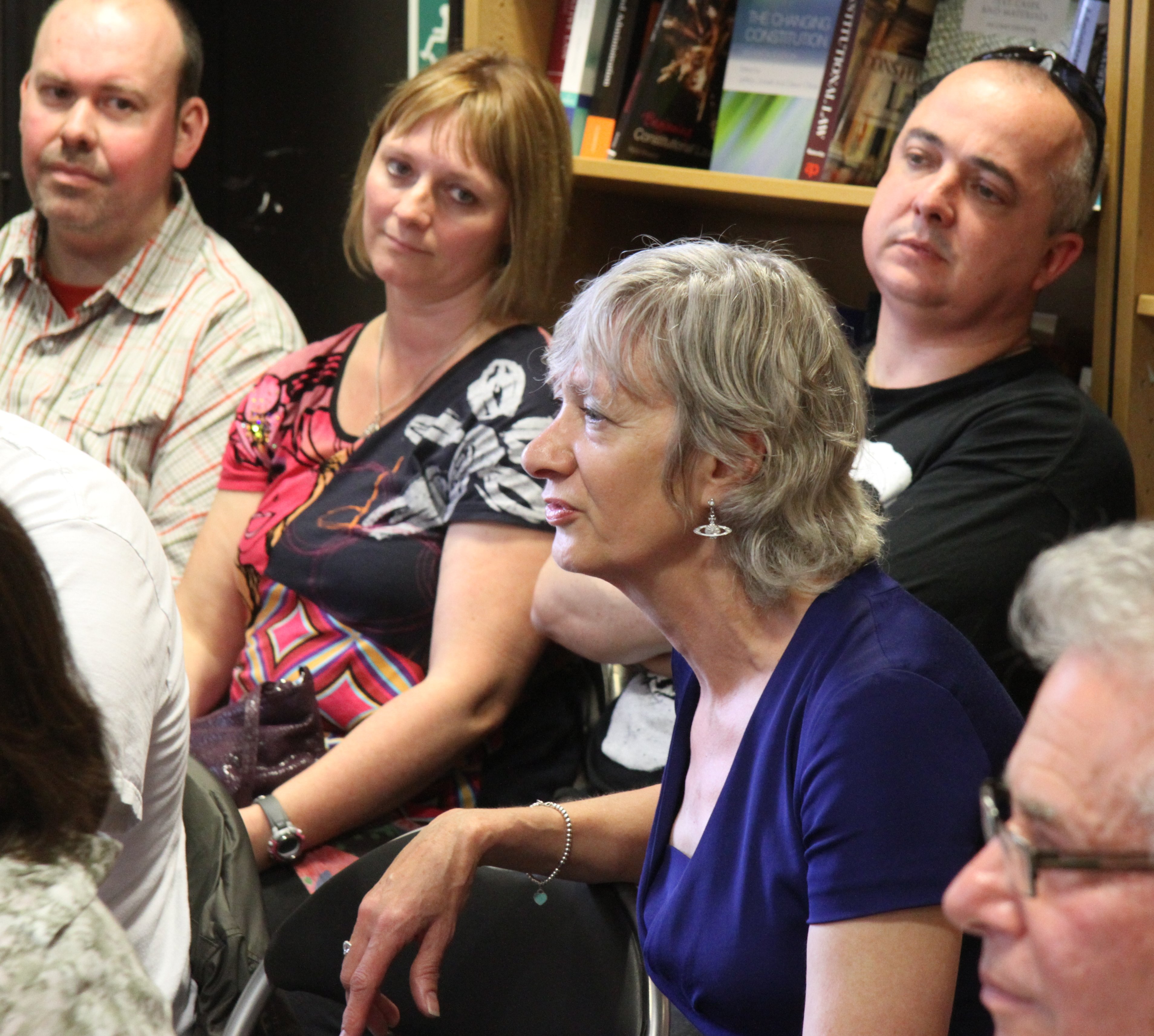
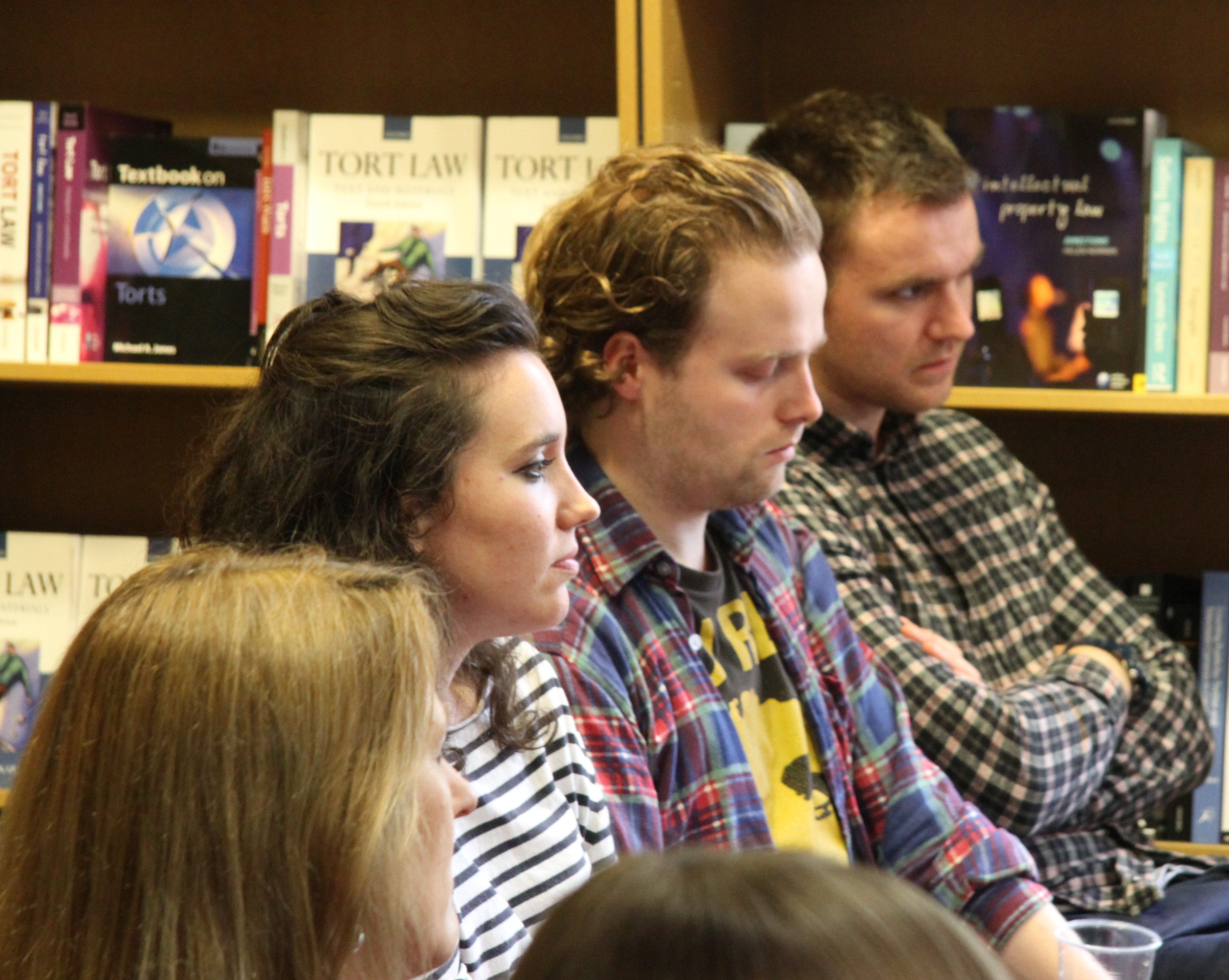
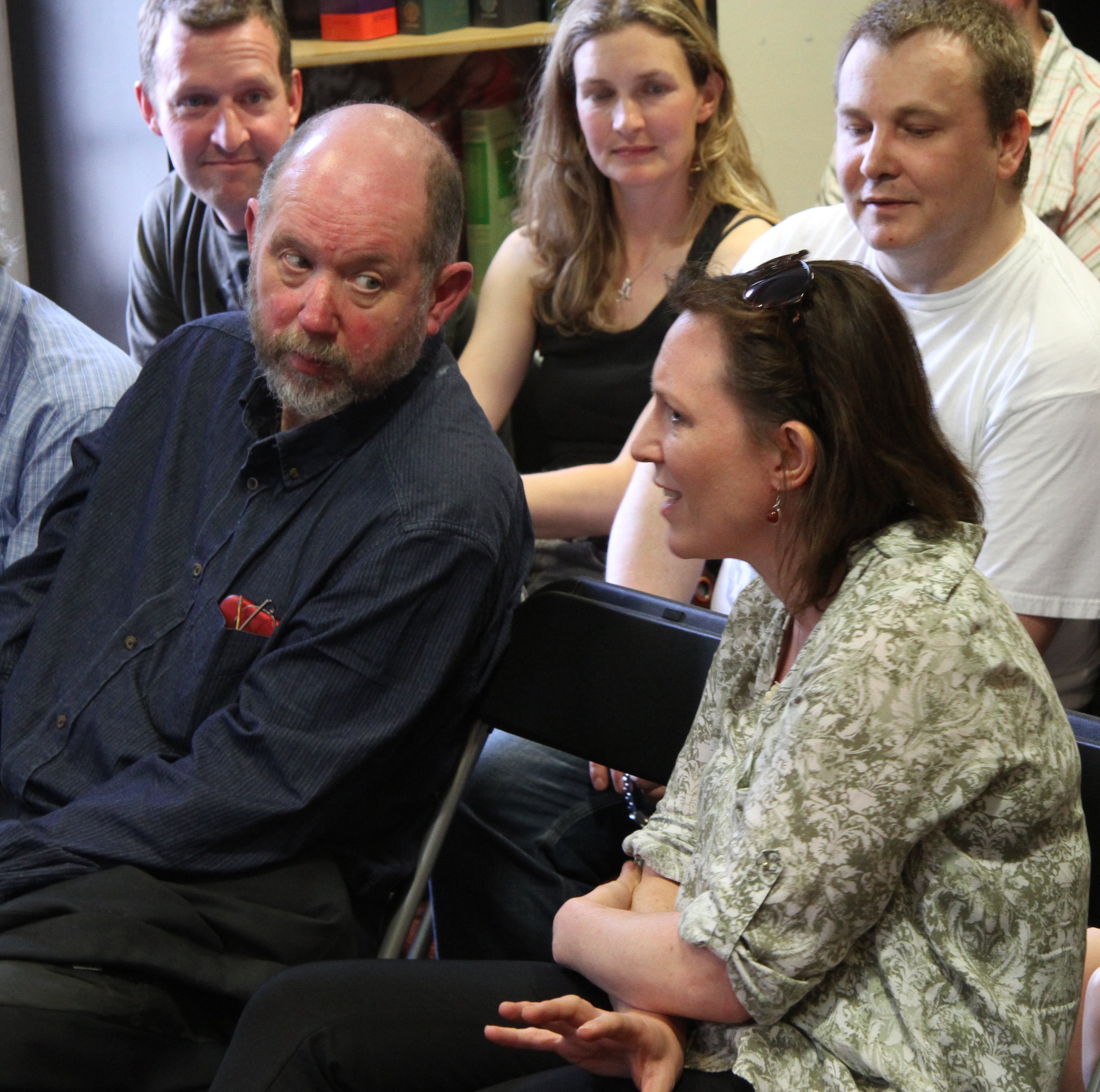


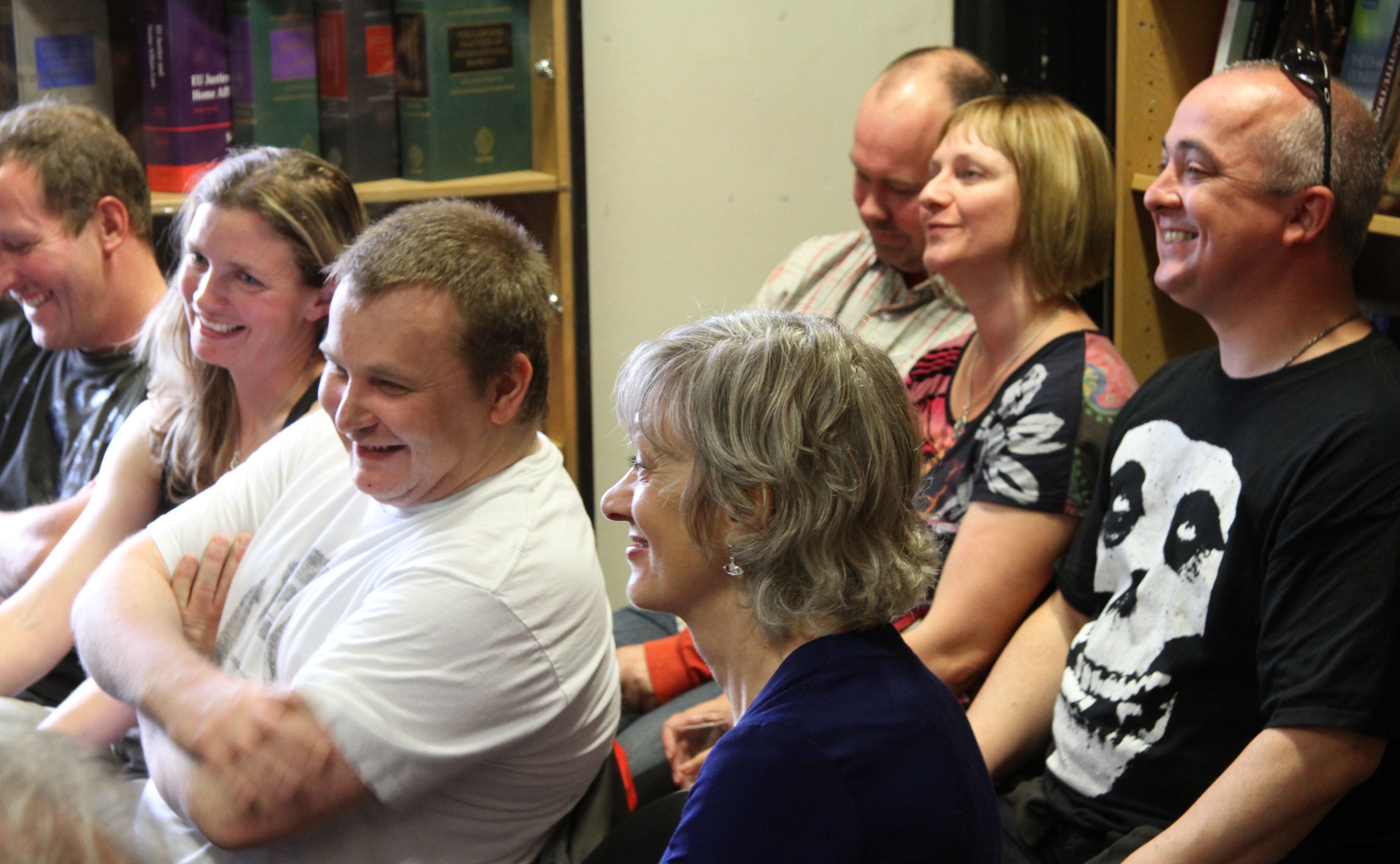

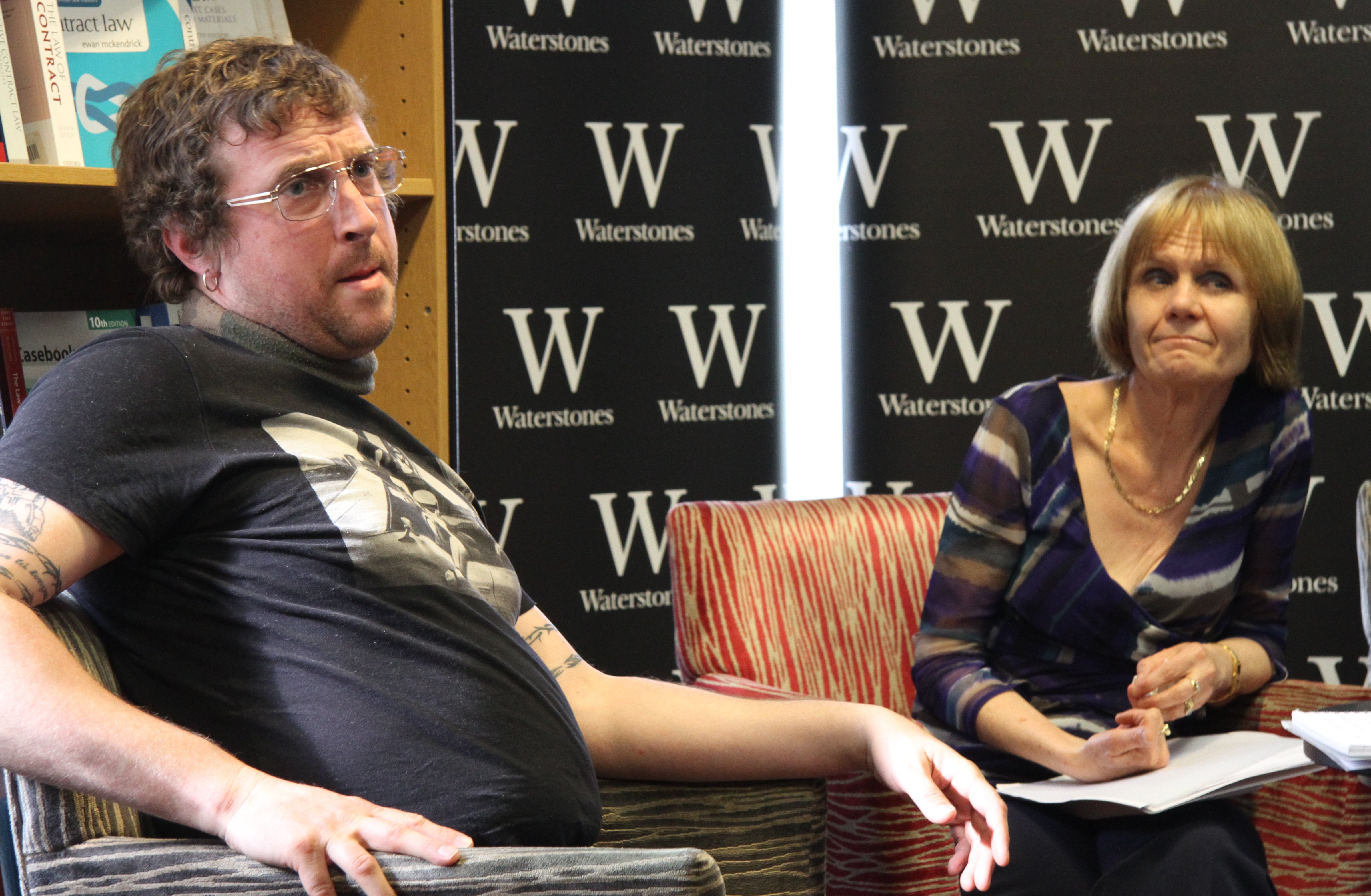


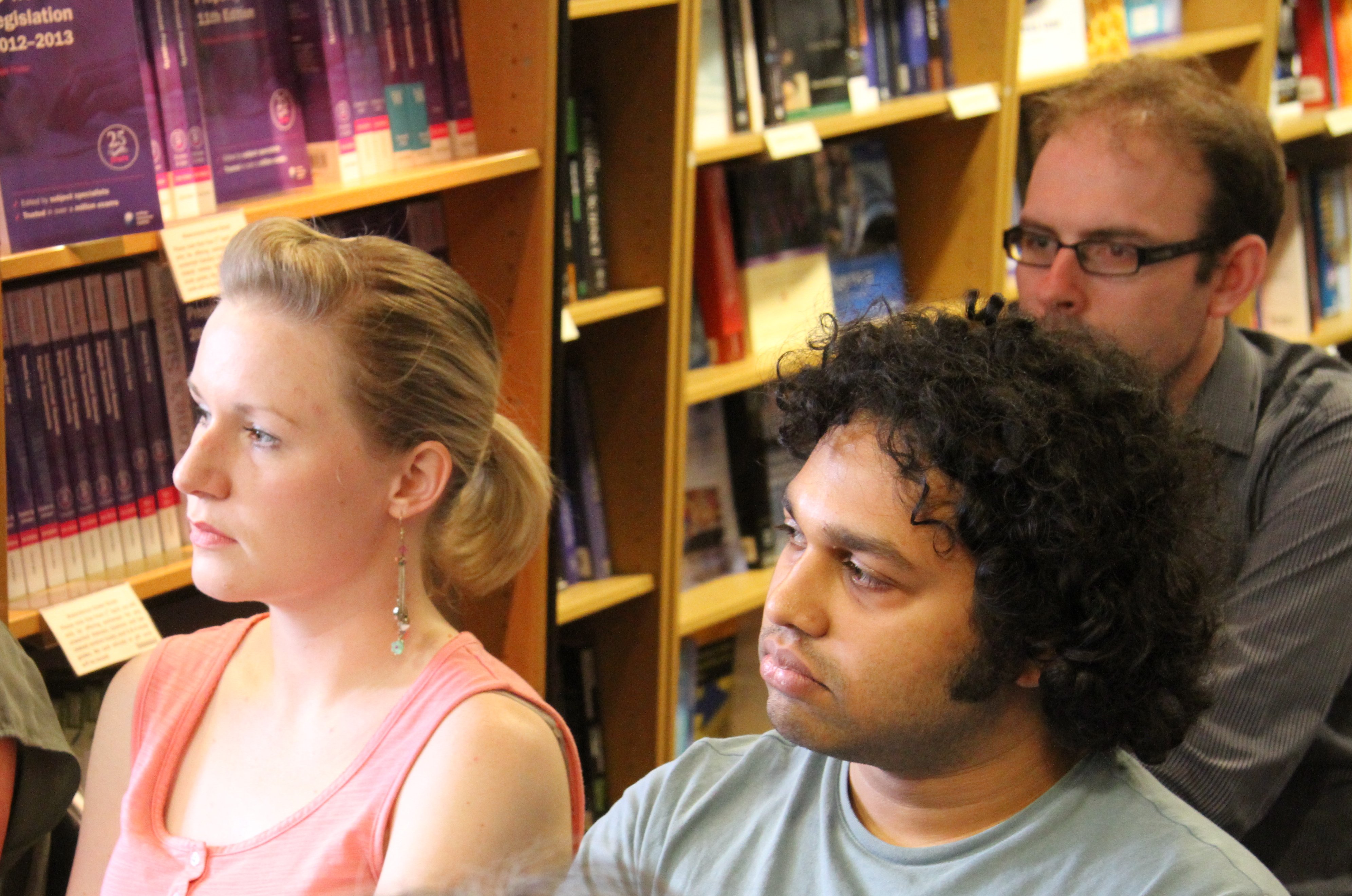


The Salt crime writing event that took place at Waterstones Gower Street yesterday was a very festive occasion. Sam Rahman, the Events Manager at the shop, her colleagues and a large and appreciative audience combined to make it a great success.
Laura Ellen Joyce, Matthew Pritchard and I each gave readings from our books. Laura read from The Museum of Atheism, which (jointly with In the Family) launched the Salt crime list last November. I read from Almost Love and Matthew from Scarecrow, which Salt will publish in September. Afterwards, I chaired a discussion with Laura and Matthew about their writing. The audience joined in, offering many lively and perceptive comments.
Both Matthew and Laura agreed that a sense of place was important to their writing. Laura chose to set her book in small-town America in the dead of winter – there is no daylight in the novel – to epitomise the corruption that it portrays. Matthew writes powerfully about Andalucia, which he knows well, having lived and worked there for twelve years. Laura agreed with the suggestion that she describes a rudderless society in which no character is able to provide a moral yardstick or compass. Matthew said that the corruption captured in his work derives more directly from his knowledge of shady Spanish officialdom. Danny Sanchez, the protagonist of Scarecrow, is a journalist who bravely tries to expose the fraudulence and self-interest upon which he sees that Spanish politics is based.
Laura had deliberately left vague the identity of the killer in her book, because, in a sense, she was indicating that society as a whole was to blame. Matthew had had the intention right from the start to write about a serial killer, but the character of the killer took shape in his mind gradually as he worked on the book and continued to read about real-life murders. An account of how the head of one of Fred and Rosemary West’s victims had been swathed in gaffer tape had left a particularly lasting impression on his imagination.
There was much laughter from the audience at Matthew’s anecdote about how, when the shop below his flat caught fire recently, the police broke into the flat and discovered his large collection of books about serial killers and Nazism scattered over the floor. There was even more laughter when I persistently made the mistake of calling him ‘Danny’, after his hero, rather than Matthew! (Apparently, it is a mistake that his agent makes, too!)
Laura confirmed that she will continue to write crime because she has a profound interest in why people commit evil or anti-social acts. She’s also interested in pushing out the boundaries of fiction. When, in response to a question from one of the audience about what I thought the ‘next big thing’ in crime writing would be, I said that I’ve seen several books lately that mix genres and I’m not sure that it works, Laura said that this idea appealed to her and that she would like to experiment with it. I do think that it would take a very good writer to pull it off, but Laura is so accomplished that she is one of the few people I know who might succeed at it.
I was asked why most crime novels are about murder, rather than other types of crime, such as theft or fraud. I said that there are some novels based on theft – there is quite a strong sub-genre relating to crimes associated with works of fine art, for example – but it is difficult to write about crimes other than murder unless you are a police procedural author. This sub-genre has never appealed to me; I’m more interested in the psychological aspect of crime-writing.
We were all asked whether we’d come to writing ‘lately’, or whether we’ve always been writers. We agreed that we’ve all been writing ever since we can remember. Asked also whether we had to let a novel ‘fade’ from our imaginations after we’d finished it before we could embark upon another, we each offered different responses: Matthew writes all the time and is usually working on several books at once – he knocks out 2,000 words a day, even if sometimes he knows it is rubbish and he will have to discard some of it; Laura writes regularly, but in different genres – she writes short stories between novels and also said that she was very organised when writing The Museum of Atheism which, with a detailed outline on a spreadsheet, she wrote in twenty-four days, a chapter a day, all in November, following the NaNoWriMo concept; I usually take a brief break after completing a novel, but I’ve started on the next DI Yates book now. I feel that being an author is a bit like being a member of the fashion industry: your mind is already on the next season’s work while your readers are still consuming this season’s product.
We all paid tribute to Salt Publishing, which we agreed is an uncompromising publisher setting high standards. We were also united in saying that we aren’t interested in the ‘blood-and-guts’ style of crime writing.
On behalf of the three of us, I’d like to thank Sam and the staff at Gower Street for their wonderful hospitality. I’d especially like to thank all of you who attended for being such a generous and receptive audience, for making such constructive contributions to the discussion and, of course, for buying or ordering our books! It was good to meet some new friends – some of whom I’ve only previously ‘met’ through Twitter. Finally, a big thank-you to numerous well-wishers who were unable to come (some of you based in countries very far away), but who sent kind and encouraging messages and helped to advertise the occasion. We hope to meet you all one day at future events.
All in all, it was a very memorable evening indeed!
A lovely Friday conversation with Jan Smedh, joint proprietor of The English Bookshop in Uppsala, a thriving independent business…

I’m delighted and very proud to discover that Almost Love has been chosen as the British Crime novel of the month by The English Bookshop in Uppsala. I asked Jan Smedh, who, with his business partner Christer, is joint proprietor of the shop, if I could call him. He kindly agreed to talk to me today, although he was busy making final preparations for his absence: he and his wife and three sons are about to leave for a holiday in Greece.
Jan told me that every month he chooses books for his reading groups and his book club. There are three reading groups: one for the Book of the Month, one for classics and (in Stockholm – he and Christer have just opened another shop there) one for children’s books. The book club operates as a subscription service. It has between fifty and sixty members scattered throughout Sweden. They choose the category to which they wish to subscribe and are each month sent a book in that category that Jan has chosen. They do not know in advance what the title will be.
He chooses titles from six categories altogether: the Book of the Month, which is always a literary novel; British Crime, ‘Tough’ Crime, Paranormal, Fantasy and Science Fiction. He tries to introduce a spread of themes and to get a balance between male and female authors and authors from different countries; for example, he has featured Asian authors who write in English. His choices are pretty unerring: his customers always seem to like them.
Jan said that when he read the description of Almost Love, he ‘loved it at once’. (I’m blushing as I write!) He tries to pick books by authors from small publishers that aren’t necessarily well-known, rather than blockbusters. The subject of Almost Love seems to be exactly what his readers are looking for: it has a bit of history, a bit of archaeology, some local background, a good plot and a strong psychological element. He says that his favourite customer is ‘someone who leaves the shop with a book that they didn’t know that they wanted.’ His copies of Almost Love have yet to arrive (there has been a slight delay in the printing, caused by MPG’s having gone into receivership two weeks ago), but they should reach the shop next Monday, so he didn’t know until I told him that there is also a Scandinavian element to the plot. He was delighted about this.
Jan learned about Almost Love from a Scottish publishers’ rep who carries titles from several independent publishers. His name is Stuart Siddall. I had not heard of him before, but I shall certainly get in touch with him now and I should like to take this opportunity to thank him.
I asked Jan about the inspiration for The English Bookshop. He said that he and Christer came up with the idea for it in 1995. They received no financial backing; they raised all the money themselves. Christer was already working in the bookselling industry (largely in the academic sector), so he had the contacts with UK publishing companies, who were therefore prepared to set up accounts for the new venture. It would not have been possible without their support. Jan’s own background is in communications and the business has benefited a great deal from this. It is he who designs the graphics for the website. He is prolific on the social networks and the shop has very active Facebook and Twitter accounts. He says that the key thing with social networking is to be consistent. He has worked hard to build up a loyal customer following and he knows he must maintain their interest by continually being there for them. His own love of books goes back to his childhood. He also speaks impeccable English: he explained that he has lived in Cork and has also visited the UK (he would like to see much more of it) and the USA.
95% of The English Bookshop’s customers are Swedish, though there is an ex-pat community in Uppsala, which is a university town (Jan describes it as ‘the Oxbridge of Sweden’). Most Swedes read English, and Jan’s customers are getting younger: some twelve-year-olds now buy books in English. Uppsala is also Sweden’s religious centre and the city in which the Monarch is crowned. It is Sweden’s fourth largest city and not huge, but it has the weight of history behind it and is home to many very well-educated people. Jan and Christer made the conscious decision to stay away from university course texts: they wanted their bookshop to provide leisure reading. By this, he doesn’t mean that all the books he sells are ‘light’: his readers like books about many subjects, as well as fiction. British history, books about war and books about psychology are all popular. Sales of non-fiction titles are growing; also crime fiction and children’s titles. The Swedish government has now set up English language schools, which means that parents are looking for books in English for their children. The English Bookshop tries hard to keep abreast of the continually changing interests of the local community and its unique stockholding reflects this. Jan says that ‘other bookshops aren’t doing this any more; there’s often a drab uniformity about what’s available from the big chains.’ Smaller publishers often complain that it’s difficult to get a proper presence in them. This view would certainly resonate with Salt, whose many distinguished authors often struggle to get adequate shelf-space in chain bookshops. It would also be endorsed by the UK’s many excellent independent booksellers, some of whom Jan knows. He has met Jane Streeter, a former President of the Booksellers Association, and is himself a member of the BA, for which he has a high regard.
In the last six years the turnover of The English Bookshop in Uppsala has doubled, enabling it to open the second shop in Stockholm. Jan says that this ‘goes against the grain’ of Swedish bookselling generally, so he feels that he and Christer ‘must be doing something right.’ I’d say they were doing a great deal right! The business is now eighteen years old.
It was delightful to have the opportunity to talk to Jan, and I am very grateful to him for giving me so much of his time and as well, of course, for choosing Almost Love. I now have an open invitation to visit The English Bookshop, which I am determined to take up. I’d like to visit the one in Stockholm, too! I wish Jan and his family a very happy holiday indeed in Greece. If any of his customers should read this, I’d also like offer you a big thank you and to say that I very much hope that you will enjoy Almost Love. Perhaps we may meet in the bookshop one day.

One month to publication!

So here I am, one month away from the publication day for Almost Love, which has reached the proof stage. I have marked the day by putting the ‘milestone’ countdown widget here (as if I needed it!), because that seems a celebratory thing to do, as well as adding the clickable cover picture and link to an interview about Almost Love, both of which are to your right on the sidebar. It’s enormously exciting, and humbling, for me to be able to visit the Salt Publishing home page and to see my second novel there, whirling on the carousel amongst those other glorious titles, including Alison Moore’s latest (The Pre-War House and Other Stories, launching tonight at Waterstones Nottingham), David Gaffney’s More Sawn-Off Tales and Alice Thompson’s new novel, Burnt Island, not forgetting my fellow crimewriter Matthew Pritchard’s Scarecrow (to be published in the autumn).
So much has happened since November 2012, when In the Family came out to face the world, and I am very grateful indeed to the many readers of that book who took the trouble not only to read it but also to comment so favourably on it. I have made many online friends since then, via Facebook, Twitter and this blog; they have been stalwart in their support and their sharing and retweeting has sometimes been so vigorous that I have barely been able to keep up with it. If I missed passing on my thanks to you, please forgive me and accept them from me now.
I’d like to express my appreciation, too, to all those readers who have visited here, pressed the ‘like’ and r.t. buttons, followed and commented. This opportunity to engage with you and your thoughtful comments has been beyond helpful to me in more ways than I could ever have imagined when I started blogging last October. It has also been a lot of fun!
I am indebted to Jen and Chris at Salt Publishing for all their support, which is unfailing and ever-present, as I’m sure all their authors will readily confirm. Their incredible creativity, their capacity for managing the impossible in no time at all and their long-suffering, good-humoured indulgence of human failings are what make them truly top publishers.
May I complete this post by announcing four events connected to the launch of Almost Love:
Waterstones Gower Street
Thursday June 20th, 18.30 – 19.30
An evening with Salt crime writers
Christina James, who reads from her new novel, Almost Love
Laura Joyce, who reads from The Museum of Atheism (published November 2012)
Matthew Pritchard, who reads from Scarecrow (to be published September 2013)
Admission by ticket or at the door. Wine will be served. Books will be on sale.
Bawtry Community Library
Thursday June 27th, 18.30 – 19.30
Christina James gives readings and speaks about crime-writing
Tea, coffee, refreshments. Books will be on sale.
Co-ordinated by Claire Holcroft and George Spencer, Doncaster Library Service
Wakefield City Library, Burton Street, Wakefield
Alison Cassels, Library Officer in Charge of Promoting Reading, writes:
As well as Crime Writing Month, 29th June is National Readers Group day, so we’ll be promoting it to our readers groups too. What we have planned for the day is our Readers Group morning, with coffee 11.00-11.30, then discussion groups 11.30-12.00, discussing three books (including In the Family), then 12.00-12.30 a general discussion on crime novels, followed by people recommending books they love until 13.00. After lunch, Christina James will be presenting her second novel, Almost Love, in a public session, from 14.00-15.00.
Event at Adult Education Centre, North Lincolnshire Libraries
Date and time to be confirmed.
A publication date and a tribute to two very good friends…
In this blog, I try to write mostly about crime-related topics, people, places and things that interest me, aspects of writing and other writers and their work. It isn’t intended merely as a vehicle to promote my own work; this was a conscious decision that I made right at the start, because I quickly tire of blogs by authors who use them too blatantly for this purpose.
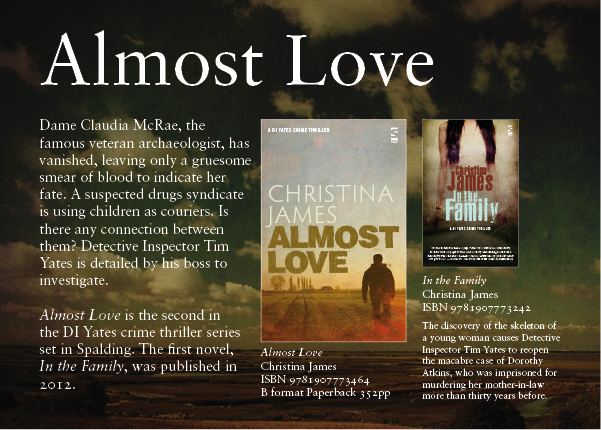
However, I hope that you will look upon today’s post indulgently, because I have to confess that it is indeed about promoting my next book, Almost Love, which will be published on June 15th 2013. It is a promotional piece with a difference, however, because it also celebrates a gift to me by my publisher, Chris Hamilton-Emery of Salt. Before In the Family was published, Chris designed a postcard based on the jacket; I sent this, with a short personal message, to as many people (friends, booksellers, librarians, colleagues) as I thought might be interested in it. I received some lovely replies; it may have helped to generate some interest in the book.
Today, Chris sent a similar promotional postcard for Almost Love. In fact, it features both the novels. I am delighted with it and I think that it is a thing of beauty. I’d like to share it with you; that is why it is the subject of today’s post.
I’d also like to say how much I appreciate Chris and Jen Hamilton-Emery, for their unfailing good-humour and encouragement and also for all their hard work on my behalf. Thank you, both!
A London Book Fair 13 seminar about using social networking to create author presence


I cannot miss the opportunity to comment in today’s post on the social networking session yesterday morning at the London Book Fair. First, may I thank the very many people who attended and made the event very special indeed; you were a lovely, attentive audience and we all valued your interest and contributions.
Secondly, I should like to thank Elaine Aldred (@EMAldred, Strange Alliances blog), who very generously agreed some time ago to chair this session and, with her characteristic attention to detail, introduced the panel and provided a succinct summary of the key points arising, as well as modestly managing us and our timekeeping!
I was very pleased to meet and honoured to join my much more experienced social networking fellow panellists, Katy Evans-Bush @KatyEvansBush) and Elizabeth Baines (@ElizabethBaines), and to be able to listen to the social networking supremo, Chris Hamilton-Emery, Director of Salt Publishing (@saltpublishing), all of whom provided different perspectives from my own. However, though we may have addressed in various ways the topic of how to make the most of the best of social networking, I felt that we were un
 animous about the terrific value of what Chris called ‘the confluence’ of such media as Twitter, Facebook and personal blogs in creating author presence and profile. I believe that we also affirmed the essential need to be ourselves (however uncomfortable it may initially feel to present our private side, as Elizabeth very pertinently explained) and to interact with the people we ‘meet’ in a genuine way. We shared the view that ramming our books down the throats of our online audience in a ‘hard sell’, as some people do, is counter-productive; it is much better for us to engage with others in discussion of the things which matter to us, such as the business of writing, literature, topical issues and so on. Katy pinpointed the effectiveness of social networking in creating a global family of friends and followers, something we also all felt.
All in all, the session emphasised that participation, helping others, reciprocating generosity and showing real interest in people whom we come to know online are crucial to creating a lasting author presence. It is really important that authors recognise that they need to have such a profile; with it, books certainly do sell and, as Chris put it, without it they don’t.
Finally, we all accepted the inevitable consequence of managing all of the personal interactions online: it is extremely time-consuming and we have to find our own ways of handling that; if we succeed, the benefits are very clear to see.
My thanks again to all concerned in what was for me a very memorable occasion.

It’s tomorrow! Making the most of the best of social networking…

Today’s post is a repeated ‘shout-out’ about tomorrow’s Salt Publishing seminar at this year’s London Book Fair, when there will be an opportunity to listen to Chris Hamilton-Emery, founding director of this world-renowned independent publisher, and three of its authors talk about how to use social networking to promote books and good writing. There will be a question-and-answer session to develop discussion about the topic How to Build Social and Brand Equity on a Shoestring. Elaine Aldred, an independent online reviewer, will chair the occasion.
Date: Tuesday 16th April 2013
Time: 11.30-12.30
Place: Cromwell Room, EC1, Earls Court
I’ll be joining Katy Evans-Bush, writer and editor, and Elizabeth Baines, novelist and short story writer, to offer some personal experiences of social networking as a means to achieving an online bookworld presence. Readers of this blog will already guess from previous posts here about both Salt and social networking, how much I personally value the opportunities provided by the Internet to meet and mingle with booklovers across the world. I have also made it very clear just how proud and privileged I am to be supported as a writer by Chris Hamilton-Emery and how exciting it is to be associated with an independent publisher with the finest of literary lists.
I hope to become real to at least some of my ethereal friends at the London Book Fair this year!
Putting a person to a name… Waterstones Gower Street
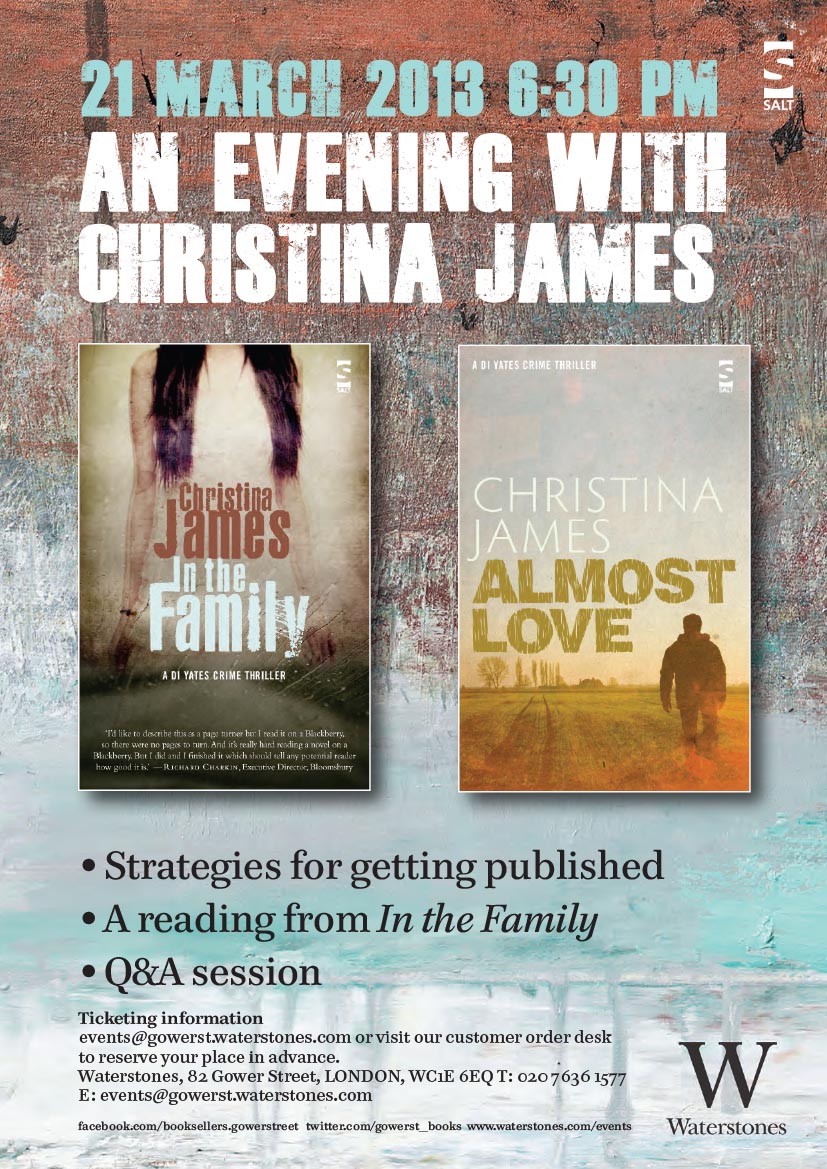
As readers of this blog have often kindly expressed an interest in my books, I thought you might like to know that an event has generously been organised for me by Sam, the wonderful Events Manager at Waterstones Gower Street, on Thursday 21st March 2013. It will start at 6.30 p.m. and last for perhaps an hour. I shall be reading a short excerpt from In the Family and perhaps also one from Almost Love (which will be published in June), and offering a few tips, from a personal perspective, on how to get published. After this, there will be a short Q & A – and a glass of wine! The event is a sort of forerunner of a larger Salt crime event that will be hosted by Gower Street on 23rd May 2013.
I know that readers of the blog are scattered far and wide and that some of you don’t live in Europe. Wherever you are, I am very grateful to you for your interest and have been delighted to ‘meet’ you on these pages. For those of you who happen to be in London next Thursday or can travel there easily (and would like to, of course!), I should be delighted to have the opportunity to meet you in person.
Fiona Malby (@FCMalby) offers me the chance to post on her blog today!

Author FC Malby (‘Take Me to the Castle’) has given me a precious place on her blog today, March 11th 2013, to write about something very special to me: The Fine Art of Bookselling. Sincere thanks to her for this hospitality!
Making the most of the best of social networking!
Today’s post is, in fact, a ‘shout-out’ about a Salt Publishing seminar at this year’s London Book Fair, giving an opportunity to listen to Chris Hamilton-Emery, founding director of this world-renowned independent publisher, and three of its authors talk about how to use social networking to promote books and good writing. There will be a question-and-answer session to develop discussion about the topic How to Build Social and Brand Equity on a Shoestring. Elaine Aldred, an independent online reviewer, will chair the occasion.
Date: Tuesday 16th April 2013
Time: 11.30-12.30
Place: Cromwell Room, EC1, Earls Court
I’ll be joining Katy Evans-Bush, writer and editor, and Elizabeth Baines, novelist and short story writer, to offer some personal experiences of social networking as a means to achieving an online bookworld presence. Readers of this blog will already guess from previous posts here about both Salt and social networking, how much I personally value the opportunities provided by the Internet to meet and mingle with booklovers across the world. I have also made it very clear just how proud and privileged I am to be supported as a writer by Chris Hamilton-Emery and how exciting it is to be associated with an independent publisher with the finest of literary lists.
I hope to become real to at least some of my ethereal friends at the London Book Fair this year!
“btw you do ‘street’ so well!”

In the wonderful wordy world of Twitter, I have discovered wit and wisdom as well as utter tripe; philosophical musings and mundane mutterings; verbal zeniths and linguistic nadirs. I arrived on this astonishing ethereal plane only last October, armed with a mighty prejudice against it, but told that it was essential to the contemporary writer’s existence. I still don’t know whether this latter is true, but I have, contrary to my biased expectations, had a fun time of it! I was certainly delighted to receive the above compliment about my idiomatic use of language from ‘The Grumbling Gargoyle’ (@LynnGerrard), who, btw, does a well bad tweet.
‘Fun time of it ? That’s a bit colloquial, Christina! Are you letting your standards slip? That’s the trouble with Twitter: it’s full of acronyms and slang. It’s like television, appealing to the lowest common denominator and debasing your every utterance…’ Oh, dear: the voice of a high school mistress, prim and proper and insisting on perfect phrasing and enunciation.
One of the really interesting (to me, at least) ironic things about having received a ‘formal’ education in grammar is the fact that it was a straitjacket that for many years constrained my own writing, even if it ensured that my expression was ‘correct’. Over time, however, I let my creative hair down and played… and played. I broke rules and loved being a linguistic iconoclast; the results were so much more interesting and original. However, I do remain firmly of the belief that this works only if the rules to be broken are understood and the ungrammatical is deliberate.
An English teacher I know was bewailing the fact that her pupils in their conversation almost universally use street slang, such as ‘sick’ and ‘wicked’ and ‘evil’ and ‘bad’, all degrees of approbation; I’m not sure why anyone, least of all English teachers, should mind this, as pupils are consciously employing and enjoying irony in their daily interactions. What’s wrong with that? Revelling in opposites seems like fun and kids like fun and learn from it; they are playing. Give me a wicked (not ‘wickedly’!) ironic conversation rather than a formal Govean lesson on what irony is, any day. I expect that most teachers are still doing their best (Rock on!) to provide a strong grammatical foundation and I can understand why they might be frustrated by the prevalence of, say, ‘could of ’ in pupils’ formal writing, as it reveals lack of understanding of the spoken corruption of ’ve, but I hope that they are also broad-minded enough to enjoy the verbal devilment of children’s experimentation with words.
Thank you, Twitter, for the best of your frivolity. U iz well cool.
 Christina James, crime novelist