

Doing away with your wife…

I have written before on this blog on the subject of dramatic monologues and of Browning’s use of them in his poem Porphyria’s Lover. I make no apology for turning once more to Browning’s poetry, which I love (even though Oscar Wilde damned him as a poet: ‘Meredith is a prose Browning, and so is Browning.’), for a glance at the literature which has influenced my own writing and its portrayal of the criminal mind.
My Last Duchess is a poem which works subtly on a psychological level. I remember reading it for the first time and being astonished at the way in which it made me engage with the situation it depicts, a powerful duke’s receiving an emissary and showing him a painting of his previous wife. (It is commonly thought that this man was the fifth Duke of Ferrara, seeking to marry a daughter of the Holy Roman Emperor, Ferdinand I, and coming to marriage terms via her brother, Count of Tyrol, Ferdinand II.) I didn’t need factual historical background to understand the poem, which itself, line by line, gradually led me along a trail of suggestions and clues to the horrified realisation that he had had his wife ‘done away with’.
In fact, the first thing that struck me as I read the opening lines (‘That’s my last Duchess painted on the wall, Looking as if she were alive.’) was that this was like Paulina’s presentation, in The Winter’s Tale, of Queen Hermione’s ‘statue’ (it is really Hermione herself) to the king, Leontes, who believes that his jealousy caused her death. Leontes says, in astonishment at the sculptor’s skill, “The fixture of her eye has motion in’t, As we are mocked with art.” The portraiture of the Italian Renaissance was, of course, sublime in its depiction of looks and character and I was initially lulled by my reading of The Winter’s Tale into thinking that this poem would similarly celebrate artistic achievement. I could not have been more mistaken.
The monologue forces the reader into the shoes of the emissary, listening to the Duke and drawing conclusions about his attitudes, opinions and personality, just as we might upon meeting someone for the first time in real life. Browning’s power lies in his understated use of speech; it is all so matter-of-fact! Line by line, we receive the duke’s description of the cheerful friendliness of this young woman, who smiled on all alike, and we gradually realise that he thought that she should smile for no-one but himself and preserve for the rest a haughty reserve. Then comes the shock: ‘I gave commands; Then all smiles stopped together.’ Now, with a hammer’s clang, we see why only he may draw the curtains which conceal her lifelike, smiling face: he has ensured that she will smile only for him. He passes on, leading the emissary, and talking of another artwork with equal lack of emotion.
I have read this poem countless times and it has itself the freshness of a new painting whenever I come back to it. I look for this psychological detail in the presentation of villains in crime novels and I am delighted when I find it. There is, for me, far less enjoyment in more stereotypical portrayals, which rely more for impact upon the brutality of actions than upon the workings of minds.
The murky world of the bookshop…

Top-slicing the profit
I have interviewed many would-be booksellers… and appointed quite a few. Candidates often have a misconception of what bookselling is about. Every bookshop manager will have experienced that sinking feeling when an enthusiastic prospect earnestly says, ‘I love books.’ Most bookshop-lovers will have had at least one experience of waiting patiently for service while the bookseller sits back from the till, absorbed in a good read. I’m not knocking booksellers, though – far from it. I’ve known very many excellent ones and one or two who could be described only as geniuses. Yet, without exception, however much they have loved books, their passion has been for serving real people from all walks of life, often by providing the book that is being sought, but also frequently by suggesting one that the customer would never have found without their expert skill and intuition. Good bookselling is all about caring for the customer.
I’m digressing a little, however, because I meant to begin by saying that the popular perception of a bookshop is probably that it is a quiet haven of peace where nothing much happens, a place in which to relax and browse and take a little time out from the humdrum demands of everyday life. And this is how it should be; I know many bookshops that can create such an ambience and I’d be proud to own one myself.
However, as with any other organisation or enterprise, within the inner life of bookshops is concealed – and sometimes, unfortunately, revealed – a maelstrom of human emotions and behaviour. I think that it is likely that there is more intrigue going on in bookshops than in any other kind of retail business, because most booksellers are well-educated and well-read and excel at being creative with their time. Mostly, this wealth of ideas and inspiration is channelled into supporting the shop and making it unique. Very much more rarely, it assumes a deviant quality.
Theft is a despicable crime. It isn’t much written about by crime writers, perhaps because it isn’t ‘glamorous’ enough. Persistent theft from a bookshop will kill it as surely as acute oak decline will fell a mighty tree. The reason for this is that bookshops operate on wafer-thin margins. Therefore activity that persistently undermines the profit of the shop will not only hasten it towards closure, but also demoralise the staff. In most bookshop chains, the staff (not paid a fortune in the first place) are disqualified from receiving bonuses if so-called ‘shrinkage’ reaches a certain figure – usually three-quarters of one percent of turnover. Some book theft is casual and opportunist; some is highly-organised. One of the bookshops in East London that came under my aegis suffered for months from the carried-out-to-order stealing of the textbooks that supported certain courses at the local university.
Of course, there are sophisticated systems available which help to reduce the risk of theft, but it is surprising how wily some thieves can be. A bookseller in another of ‘my’ shops apprehended a man who was wearing a specially-adapted overcoat that could hold twelve average-sized volumes at a time. He was spotted spending an undue amount of time riding the lift, where he had gone to rip out the security tags.
Some bookshop theft, the saddest kind, is ‘internal’, i.e. carried out by one of the members of staff. I hasten to add that it is comparatively rare, but when it happens it is the most difficult kind to discover, because the perpetrator is familiar with the shop’s systems and routines. The largest bookshop that came within my remit, one that turned over millions of pounds a year, had been suffering from serious shrinkage for some time when we decided to fit tiny security cameras over some of the tills. We quickly discovered that one of the cashiers had been operating an elaborate scam. (I won’t say what it was, as it would still work now, if someone were prepared to try it again.) She was brought to the manager’s office, told that the police would be called and asked if she wanted anyone to be with her when they arrived. She asked for her husband and he was summoned.
I had thought that perhaps he had been her partner in crime, but when he arrived he was genuinely stunned to discover that his wife was a thief. The police had yet to turn up. We waited rather tensely. I asked her if there was anything else that she wanted to tell us.
To my utter astonishment, she said that there was. There has been a handful of occasions in my life when I have been truly gobsmacked, rendered speechless, shocked to the core, whatever the appropriate term is. This was certainly one of them. The shop was adjacent to a large university and an intranet had recently been set up to allow academics to place orders and ask for advice without having to leave their desks. The woman standing in front of me now confessed that she had been using this facility in order to run a brothel. Most (but not all) of the clients worked at the university. Perhaps at this point I should pause to say that I am not exaggerating a word of this and, when an investigation was carried out, all of the details that she gave proved to be true.
The intranet was closed down immediately, though, on police advice, no further action was taken about the ‘business’ that it had been used to support, because the complications, notably the risk of implicating innocent people, were too great. The bookseller was charged with grand larceny (far too aristocratic a name for such a tawdry crime) and, because she had stolen a large amount of money over many months, received a custodial sentence.
I still think of this quite often. She was a pretty, vivacious young woman who had a presentable husband, himself with a very good job. It came out in court that she was not in debt and enjoyed good health and a comfortable lifestyle. Why did she do it? Why did she expend her considerable intelligence on working out two quite ingenious ways of making money illegally (one of which directly harmed her colleagues), instead of concentrating on developing her career or retraining if she felt dissatisfied with it? Perversely, perhaps, there was something about her that stirred pity in me, too. Did she survive prison well? Was her husband waiting for her when she came out? Did she succeed in rebuilding her life? I shall never know the answers.
Finally, before you worry that I have taken to cutting up my own novels, this one was a stray proof. I was asserting an author’s editorial privilege.
What my books might say about me…

Since I have heard it said that you can find out a lot about people’s characters from their bookshelves, I thought it would be interesting to put it to the test. Books have always formed a kind of parallel universe in my life; I can usually remember how I came by them and what else I was doing when I read them. This is probably why I find it so difficult to discard them; a recent cull produced only four volumes to send to the jumble sale.
I have homed in on one of my bookshelves at random to see if the books that it contains say anything about me. I should perhaps add that it is one of thirty-six bookshelves in my dining-room, some of them stacked two deep, and there are others in most of the other rooms. This may dilute my objective somewhat, but still it provides a bit of fun on a snowy Saturday! I should also confess that, despite my husband’s best efforts, there is no logical order to the way in which my books are arranged.
Here goes:
- The Gunpowder Plot, Antonia Fraser. I read this in a hotel in Scotland, just after I handed in my notice to go to another job and my old boss was trying to persuade me not to leave. Great account, well-told, in which I was able to lose myself completely.
- Mrs Keppel and her daughter, Diana Souhami. Took this on holiday to France in 1996 and read it in the garden of a gite miles from anywhere (a place called Measnes). Excellent period piece that answered some of my questions about Violet Trefusis (a writer who intrigues me).
- The Bicycle Book, Geoff Apps. Not mine! Bought to support one of my son’s enthusiasms, circa 1999 (at a time when the author could have had no idea how topical his last name would become!).
- Condition Black, Gerald Seymour, and eleven other Gerald Seymours, all dutifully signed by the author, who presented them to me after I organised an author event for him (as a library supplier) in 1991. I have to confess that I haven’t read any of them, though my husband now tells me he has read them all, and I know that they have been popular with visitors.
- Waking: An Irish Protestant Upbringing, Hugh Maxton. I bought this in the late ‘90s from the bookshop at Goldsmith’s College (London) and read it on the train on the way home. My old supervisor, Bill McCormack (see Sheridan Le Fanu article) was teaching at Goldsmith’s at the time. He writes poetry as Hugh Maxton.
- In Praise of Folly, Erasmus. Given to me as a sample by Wordsworth Classics when the imprint was launched. I haven’t read this, either.
- Nothing Except My Genius, Oscar Wilde. A slim volume containing a selection of Wilde’s sayings and aphorisms, for dipping into. Not sure where it came from – maybe a Booksellers Association Conference ‘goody-bag’? Precious wit from one of my favourite writers.
- Restoration, Rose Tremain. In my view, the best novel by another author whom I much admire. A present from colleagues. I read some of it when I couldn’t sleep while staying in a dive of a hotel after a party to celebrate Hatchard’s 200th birthday (which both Princess Margaret and Salman Rushdie, at the time under the threat of the fatwa, attended. Security was tight!).
- Damned to Fame: the Life of Samuel Beckett, James Knowlson. A long and sombre book; well-researched, but for me it fails to capture the essence of Beckett’s genius. I have certainly read all of it, but (unusually) I don’t remember when.
- The Battle of Bosworth, Michael Bennett. One of a small collection of titles published by Alan Sutton about the Wars of the Roses, all of which I have devoured. I acquired them in the 1990s but have read them all again much more recently.
- Nature is Your Guide, Harold Gatty; Dowsing, Tom Graves; Flowering Bulbs, Eva Petrova: None of these is mine. With the exception of Dowsing (an interest of my husband’s for a while) I have no idea where they came from.
- The House, Deborah Devonshire. This is an account of Chatsworth by the Duchess of Devonshire and was given to me in at the launch which took place at Chatsworth. The occasion was memorable for two reasons: Harold Macmillan, the Duchess’s uncle, then a nonagenarian, gave a very witty speech; I fainted – it was a hot thunderstormy day – and had to be carried outside and deposited on one of those pieces of Victorian wicker garden furniture that is half chaise-longue, half bath-chair. (My son was born eight months later.)
- Back to Bologna, Michael Dibdin. A recent read that I much enjoyed, by a favourite author.
- Balzac, by Graham Robb. I was reading this book in 2006 when, by a wonderful piece of serendipity, I found myself sitting next to his wife, at the British Book Awards ceremony (she is a librarian).
- British Greats, John Mitchinson. Another BA Conference goody-bag acquisition. I’ve not opened it before; now I come to do so, it is interesting, in a coffee-table, lazy-afternoon sort of way.
- Kennedy’s Brain, Henning Mankell. I read this while in bed with ‘flu, Christmas 2008. One of Mankell’s most serious novels, it is about Africa, a continent on whose behalf he is a well-known crusader. I enjoy and admire all of his books.
This row of books gives a fragmentary account of some of the things that have happened to me. I’m not sure what it says about my character or brain, except that it certainly exposes me as a magpie! It also suggests that my husband and son are inextricably entwined, for better or worse.
Wicked Uncle Dick

Yesterday I mentioned that I have recently bought several books about South Lincolnshire to aid my research. One of these is Aspects of Spalding Villages, by Michael J. Elsden. It is a book of photographs with quite an extensive accompanying text drawn from contemporary newspapers and other documents, such as old trade directories.
Among the many fascinating sections is one on Pode Hole, a hamlet between Pinchbeck and Spalding, which became important when a pumping station was set up there in the late eighteenth century to reduce the threat of flooding. It was a place to which I often headed when out on bike rides. Its system of sluices represents a complex and quite awe-inspiring feat of engineering. However, of more interest to me were the rather quaint by-laws relating to the pumping station, which were posted in full on a board in front of the main building. When I visited Spalding shortly before last Christmas, I was intrigued to see that the by-laws notice is still there. It’s a sturdy production, set in stone like a fenlands version of the Ten Commandments.
The section in Michael Elsden’s book that is headed ‘Trades and Business People in Pode Hole in 1937’ includes the entry ‘Sherrard, Rd. Albert, haulage contractor, Pode Hole’. It leapt out at me because Richard Sherrard (whose middle name was also his father’s – I had not previously known that he also bore it) was my Great-Uncle Dick. When I knew him, he led a fairly down-and-out existence. He scraped a living by farming a small-holding at Spalding Common and lived in one of the short streets of council houses there. I don’t recollect having had any meaningful conversations with him as a child; the Sherrard men were not particularly interested in girls. However, my brother, the only boy of our generation, was regaled with all sorts of treats and confidences. When we were both adults, he told me some of the family history that he had gleaned from Uncle Dick and his two surviving brothers (the eldest brother, John, had been gassed in the Great War and died in the 1920s). He said that Uncle Dick had told him that he was once the owner of a thriving haulage business, with a fleet of lorries that carried vegetables and livestock across the Fens. More roguishly, he admitted that he had plied a flourishing black market side-line during the Second World War.
I only half-believed this tale, because the Uncle Dick that I knew was anything but a prosperous businessman. I therefore rather assumed that it had been invented to satisfy a small child’s curiosity and also to imbue his old uncle with a touch of glamour. (‘What did you do in the war, Uncle Dick?’ ‘Oh – ha, ha, ha – I was a bit of a scoundrel; I sold stuff on the black market. It didn’t harm anyone; I just helped people to get the things that they needed.’) Now, however, I have found proof that at least some of Uncle Dick’s story was true: he was indeed a haulage contractor. The question is, did he really own a fleet of lorries, or just one antiquated, clapped-out lorry that was pressed into service for the war effort? And, if the former, what happened to them all? Might they have been confiscated because his nefarious activities were found out? Might the haulage business even have gone downhill because he was disgraced, or sent to prison? I don’t suppose that I shall ever find out and, since my own version of events is probably more colourful than the truth, I’m not sure that I really want to!
Into the Fens again!

Parish Church of St. Mary and St. Nicholas, Spalding
Yesterday, I made my second East Anglian excursion of the year, this time to Cambridge. It was a bitterly cold day and, although it was dawn by the time that I reached Peterborough, the light remained subdued by one of those swirling mists that often accompanies sub-zero winter days. I did not enjoy the cold (it was impossible to get warm, even by wearing a coat on a heated train), but I was delighted by the mist, as it enhanced the jolt of surprise that Ely Cathedral always springs when it sails suddenly into view. Not for nothing is it called the ‘Ship of the Fens’ and yesterday it truly looked like a huge galleon that had just weighed anchor on a white-capped sea.
Whilst Ely is one of the country’s oldest cathedrals (parts of it date back to the seventh century), the Fens as a whole are famous for their beautiful churches. When I was a child, every shopping expedition to Peterborough included a visit to Peterborough Cathedral. It was here that I first learned of the beheading of Mary Queen of Scots at Fotheringhay. She was originally buried in Peterborough Cathedral, though later exhumed and reinterred, by order of James I, in Westminster Abbey.
However, some of the finest Fenland churches are not cathedrals, but the more modest – although still magnificent – parish churches. I was both baptised and married in the Parish Church of St. Mary and St. Nicholas in Spalding; I was a pupil at Spalding Parish Church Day School, affiliated to this church.
I have recently acquired several books about South Lincolnshire in order to research Almost Love, my next novel. Among these is Geese, Gowts and Galligaskins, by Judith Withyman, a history of life in a fenland village from the mid-sixteenth to the mid-seventeenth centuries. (I shall review it when I’ve finished reading it.) Most of the papers that she draws on, in this vivid re-creation of how people lived in the Fens three or four hundred years ago, were discovered by her in the 1970s, in a chest kept in St. Mary’s Church at Pinchbeck, a large village that has become almost a ‘suburb’ of Spalding.
Such records are treasures and I wonder how many other Lincolnshire churches contain such secrets that are silently waiting to be yielded up to the interested and observant?
Outings…

My family and I visited Robin Hood’s Bay and Whitby today – both favourite haunts of long standing – to celebrate my son’s birthday. While we were having lunch in The Dolphin, an ancient fishermen’s pub in Robin Hood’s Bay, the array of real beer bottles decorating the bar triggered reminiscences of staff trips to the East Coast when I first started bookselling. (There was also an association here with Beryl Bainbridge’s Booker-shortlisted, Guardian Fiction Prize-winning novel, The Bottle Factory Outing.)
I was bemused when I first learnt of the annual ritual of the staff trip. It seemed to me to belong to the period of charabancs and bathing huts – and to be about as outdated. Every year, our small library supply company would close for one day in June or early July, and the whole staff, of about thirty-five people, would climb on to a specially-hired coach.
My first staff trip was to Scarborough; later ones focused on walled cities – Chester, Lincoln, York, Durham – and the last of all, some fourteen years after the first, was to the Beamish Museum. Scarborough was the most popular destination; we went there at least four times. The company paid for the coach, a stop for coffee en route and a slap-up lunch in a hotel. Everyone was then free to spend the afternoon as she or he chose before piling back on to the coach in the early evening. The venues for coffee and lunch were chosen by the boss, a redoubtable connoisseur of hostelries across the country. He didn’t travel on the coach with the rest of us, but followed close behind in his latest Jaguar (except for the year that he was persuaded to leave the car behind, when somehow we managed to abandon him at a motorway service station; he was not amused!). Each trip brought its own adventure. That first far-off time in Scarborough featured the stock clerk, lying prone, very much the worse for wear, on the floor of the lunch hotel, while the boss prodded him with his umbrella and shouted, Captain Mainwaring-style: ‘Get up, you stupid boy!’
To be honest, I thought that these staff trips were paternalistic and more than a little condescending. When eventually I became managing director, I abolished them and gave everyone an extra day’s holiday instead. I was surprised and somewhat humbled when the following year I received a small delegation of fellow employees imploring me to reinstate the annual expedition. I did as they asked, but I didn’t claw back the additional day’s holiday, allowing them to keep it as well. I shall never know whether the outing satisfied some primeval need for a bonding ritual or whether this outcome was just an instance of canny Yorkshire folk managing to have their cake and eat it.
Need a good villain? I have one in mind…

A Shakespearean villain I’ve never had much time for is Don John in Much Ado About Nothing. He’s a stock character drafted in to do mischief and to foul up the relationship between the fairly uninspiring Hero and her bland lover Claudio. His villainy is never convincing, though he himself and other characters do their best to establish him in it. The fact is, of course, that the real sparkle of this rollicking romp of a play is the battle between the confirmed bachelor Benedick and the verbally-adversarial Beatrice, whose developing relationship steals the hearts of the audience. Aided by his henchmen, Don John does his worst, runs away and ends up caught; his punishment is postponed beyond the end of the play. I can’t help but feel that Shakespeare missed a trick with him, considering the potential he has in this comedy as a serious knot to be untied. Perhaps the playwright lacked an actor in the company to turn Don John into something much more compelling. I have such a person in mind!
Yesterday, I travelled to London to meet my friend James. He is an entrepreneur, bursting with business ideas, most of them relating to the publishing industry. He’s had the odd failure, but mostly he succeeds. He’s a millionaire several times over, but he keeps on working. I think that this is not only because of his prodigious energy and industriousness (both of which I admire), but because he is addicted to the thrills and spills that each new (ad)venture brings. He is a piratical sort of man. I don’t think that he would break the law, but he certainly isn’t a ‘suit’. He may be obliged to wear one, but I’m sure he’d be happier with long hair and a beard, parading in lace and velvet, hung about with ornaments in the manner of Johnny Depp in Pirates of the Caribbean.
What does he have to do with crime writing? Apart from having sold a great many e-books, some of them fiction, some undoubtedly belonging to the crime genre, nothing, as far as I know. Not yet, anyway. But I feel that it is my duty as a crime fiction writer not to pass up the opportunity offered by such promising raw material. He’s such an extraordinary character that he’d make an excellent hero in an action novel; on the other hand, he’d be an equally good villain.
I know that I said in an earlier post that I wouldn’t betray my friends by making them into recognisable characters, but the fact is that James would love it. (I mentioned the idea to him in passing and he latched on to it at once.) He would dine out for months on telling the tale and, in the process, sell many copies of the book to his extensive circle of friends and many more to readers worldwide on his e-books platform (though, knowing James, he’d extract a keen discount for this service).
And the headline of ‘James, by James’ would be bound to intrigue!
A view of ourselves… in the northern landscape.
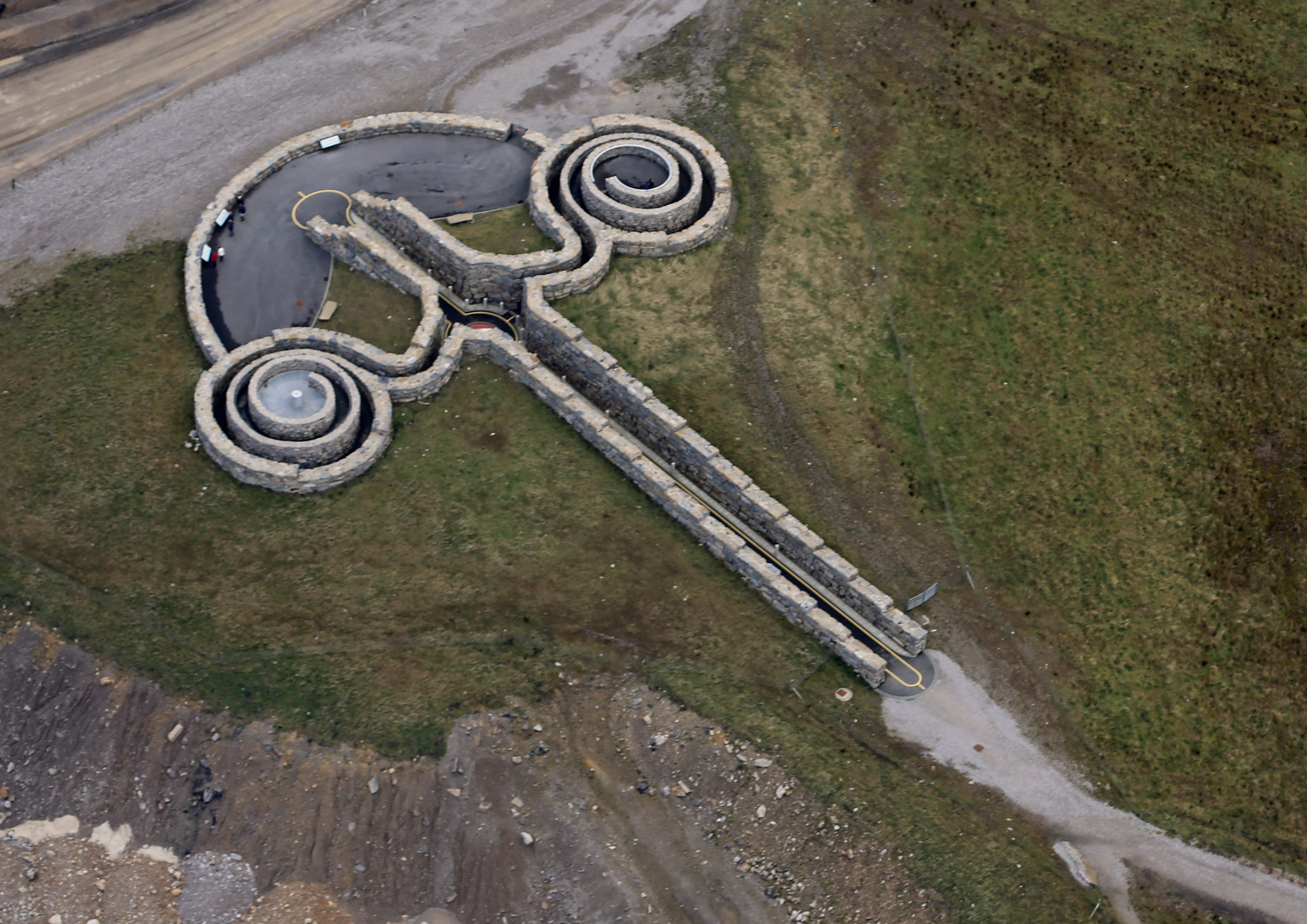
Andy Goldsworthy, Charles Jencks, Anthony Gormley and Andrew Sabin have all changed the way we look at the world, thanks to their vision and landscape-changing sculpture on a monumental scale. Whether we look at the huge tree trunks incorporated into dry-stone walls that Goldsworthy created at the Yorkshire Sculpture Park, the ‘Goddess of the North’, into which Jencks transformed the debris of Shotton surface mine in Northumberland, the ‘Angel of the North’ that Gormley raised upon on a hill near Gateshead or ‘Coldstones Cut’, Sabin’s sculptural symbol overlooking a Nidderdale limestone quarry, we cannot fail to be moved. There is something elemental about the work of these men, which returns us to a land of ancient myth and to stories told around fires from generation to generation; their impact upon our psyche is immeasurable, though we may try to quantify it. We are thrust deep into the earth, forced to look upon the wild ocean’s swelling rages, inspired to peer out from our little world into the universe, led to contemplate the natural processes of time and conjured into the mysteries of legends that have haunted our race over millennia.
I visited ‘Coldstones Cut’ yesterday, on a clear, cold and brutally windy day. I followed the footsteps of the (already!) more than forty thousand visitors that the Sabin sculpture has attracted, although it was completed only two and a half years ago; practically speaking, it is the viewing platform for a stone quarry otherwise visible only from the air, so skilfully has it been hidden in the Pennine landscape. As I took advantage of the chance to view the magnificently clear 360-degree landscape from the tips of the twin ramshorn curls that shake themselves at the sky, I could understand the artist’s presentation of an internal ‘street’ (complete with bollards, yellow lines and humped roundabout) to demonstrate the purpose to which the quarry’s materials are put and, much more beguiling to me, draw my own conclusions about a shape which for me evokes male and female organs and the myths of fertility gods and goddesses. How imaginative the minds which first conceived of this project! How lucky for all of us that there were others to plan and argue for its completion! How monumental the task to bring such a sculptural idea into being!
Here we are, in the 21st Century, still desperately in need of the same sense of purpose as those who, in the far-off lands of our past, cut horses into hills and drew wild beasts on walls of caves. We are one humanity, living with the creative urge of our ancestors and looking for the same answers as they. We may carve, build, draw, paint… or write, but our need is the same: to place ourselves somewhere and to make sense of why we are here.
Thank you, Andrew Sabin and the many people it took to deliver this wonderful artwork to us. It is a living, life-affirming and awe-inspiring emblem of stark, brutal beauty and significance.
The old curiosity shop…
I’ve been asked by several readers of In the Family about the shop where Doris Atkins lived; it was also, of course, the place where she was murdered. As I’ve written in a previous post, this shop was drawn almost entirely from my memories of the establishment that my great-uncle kept when I was a child. My grandmother lived there, too, and was effectively the housekeeper. It was the house in which they’d both grown up. My great-grandfather died in the 1930s, but my great-grandmother was still alive when I was born. I have a very vague memory of her sitting up in bed, a tiny frail old lady with waist-length snow-white hair. She died a horrible death by falling on an electric fire.
The shop itself had been the front room of the fairly substantial family home, built, I’d say, in the mid-nineteenth century. It would be incorrect to call it a terraced house; it was rather one of those houses that you still find in some old towns: detached, but snuggling right up to its neighbour. The neighbouring building on one side was a much smaller, newer house; on the other, the Punch Bowl pub (where dancing lessons were held on Saturday mornings: my grandmother tried in vain to persuade me to learn tap-dancing). The address was Westlode Street, as in the novel. I’ve since discovered that this is the only street in the country bearing this name.
The shop itself was relatively modern. Although my great-uncle was a Scrooge-like character (he would give my brother and me packets of out-of-date jelly babies and dolly mixtures at birthdays and Christmas), he had spent some money on modernising it, possibly because he’d once run foul of the environmental health department at Spalding Council. My grandmother was certainly an obsessive cleaner and scrubbed the floor and all the surfaces in the shop every day. The bay windows on either side of the door had been converted into ‘picture windows’ that took displays. There was a tall, glass-fronted cupboard which was filled up every day by the Sunblest man with loaves of bread, tea-cakes and currant loaves. He usually also brought a tray of cream cakes. The cream was all the colours of the rainbow; I shudder now to think of the dyes that must have been used in these creations. Another daily visitor was the pop man: my father told me that his visits had removed the need for the shop to make its own carbonated drinks; as a schoolboy, he and his friends had had fun making fruit sodas three times as effervescent as they should have been!
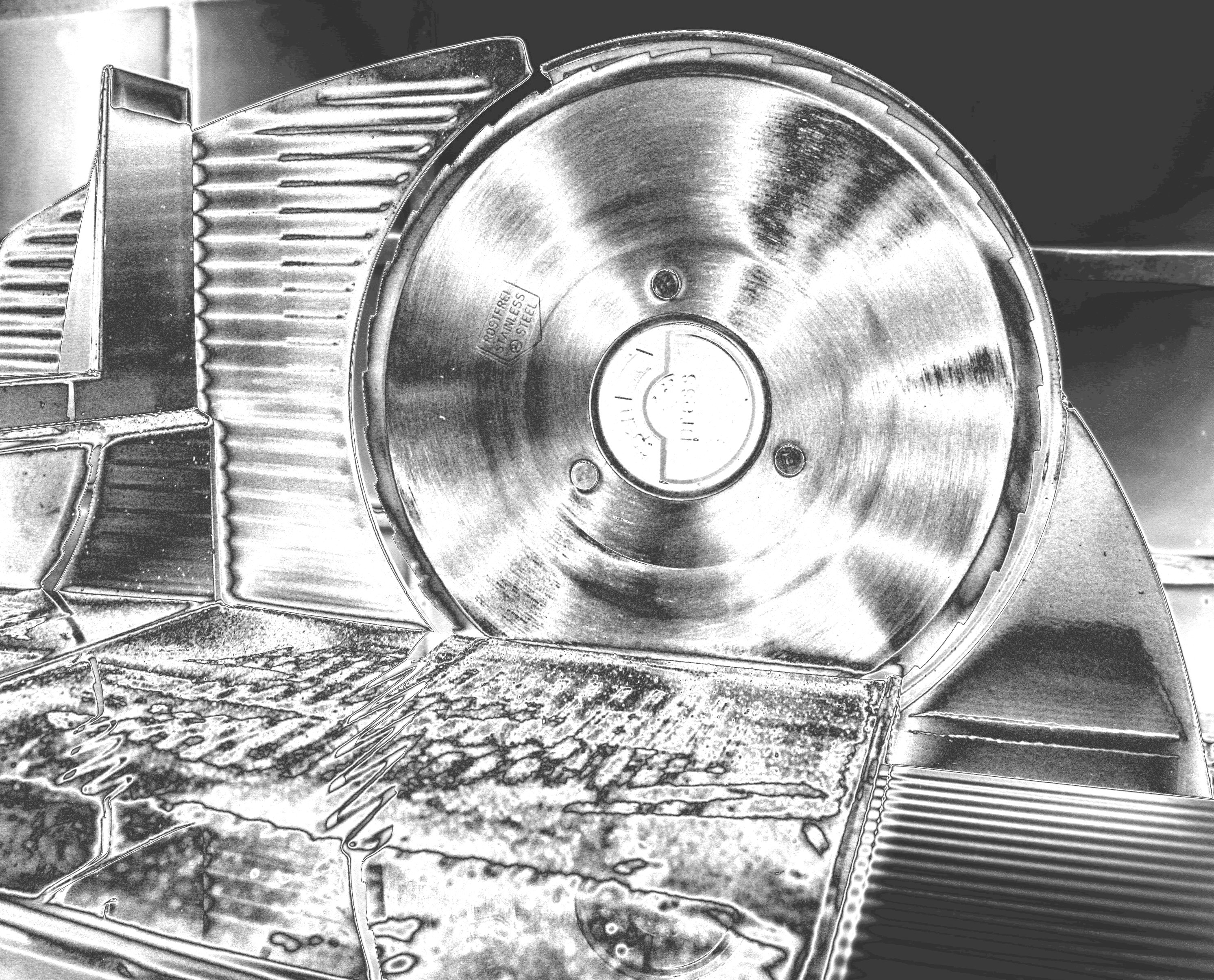
The shop also had a manual ham and bacon slicer – one of those fire-engine red machines with a lethal circular cutting blade to be seen in most general shops of the time – and several fridges, including a shiny rectangular-shaped Frigidaire with a glass display front that was great-uncle’s pride and joy. It did not impress me as much as the squat, square fridge in which he kept ice-cream. I was intrigued less by the contents than by the mystery of its black rubber lid; this was several inches thick – presumably for insulation purposes – and too heavy for a child to lift (which may have been part of its attraction for its owner – there was no risk that his great-nephews and -nieces would plunder the stock).
Pocket-money sweets were laid out in trays near the till, right under great-uncle’s nose. He always wore a long, dun-coloured shopman’s coat and was rarely seen without his trilby hat. When he wasn’t busy serving, he sat in the shop on a tall stool, painstakingly writing out the price-tags that were stuck into meat and vegetables on vicious-looking skewers. He had a few secrets under the counter, too. For years I wondered what the box labelled ‘ONO’ contained and why my mother was so cross when I tried to look inside it. It was only after I had left home that I read in a novel that this was the brand-name of a type of contraceptive.
But the crown jewels of the place, for me and for all children who visited, were the serried ranks of tall sweet jars that stood on shelves along the back wall. They were uniform in size and shape, with thick lids of many colours – perhaps made not of plastic, but of one of its predecessors, such as Bakelite. They contained bulls’ eyes; mint imperials; Fox’s Glacier Mints; Nuttall’s Mintoes; Bluebird liquorice toffee; Milk Maid dairy toffees; aniseed balls; gobstoppers; red liquorice strands; black liquorice strands; winter mixture; chocolate Brazils; Liquorice Allsorts; Payne’s Poppets. I could go on. They looked so beautiful standing there together, a hymn to the confectioner’s craft. Choose a quarter of any of them – it would be conveyed by a tin trowel to a narrow, trough-like pair of scales – and their spell was broken. Their real charm was collective; it resided in their magnificent diversity of shape, colour and size. They inspired a sort of sensory holy grail quest that making no single choice could ever satisfy, because their pull was visual as well as visceral.
I had hoped to write about the house behind the shop, but I’ve probably said enough for now. I’ll come back to it in a future post!
Murder on the Grand Central Express

Yesterday, making my first real foray from home since the snow came, I travelled by train to London.
I boarded at Wakefield Kirkgate, once a proud Victorian station of almost Downton Abbey proportions, now a sad and sinister derelict shell. It is quite a frightening place, especially after dark, and has been the scene of various robberies and at least one violent rape. However, it is also the station at which the magnificent Grand Central trains halt on their way to London King’s Cross. It is therefore well worth press-ganging my husband into temporary service as bodyguard. He waits on the platform with me so that, later, I can enjoy the luxury of the first class carriage, with coffee, biscuits, newspapers and wifi included, for the modest price of £60.
Perhaps because these trains are so luxurious, I began to think of Murder on the Orient Express, in which Agatha Christie skilfully shows that any of the passengers could have been capable of murder, before inviting the reader to identify who dunnit. I had to invent both a victim and also a motive for each suspect when I began to scrutinise my fellow passengers to guess what their favoured modus operandi for murder might be. Like Agatha Christie, I assumed that every one of them would be capable of the deed.
The man sitting diagonally opposite me was a businessman from Halifax. I know this, because, in a loud voice, he was telling the man sitting directly opposite (evidently a very new buddy) about his various boardroom coups and how he spent the money that he made: Mr. Conspicuous Consumption with a county veneer; he’d kill, to prove that he could do it, and want to ensure that both murder and weapon were as ostentatious as possible; and he’d wriggle out of punishment afterwards. An antique Purdey shotgun and a faked hunting accident would be his choice.
The new buddy, when he could get a word in, proved to be a genial and mellifluous Irishman: short cropped hair, John Lennon spec.s, shabby grey suit; one of the original sleeve buttons had evidently been lost and incongruously replaced with a bright pink one, slightly larger than the others. Conspicuous Consumption should be wary of him if they leave the train together. Mellifluous Irishman’d be capable of taking CC to a deserted spot, withdrawing a long, slender stiletto from one of the baggy inner pockets of that suit and thrusting it into CC’s heart, all the time keeping up the cheerful chatter about dead cert horses and racing greyhounds. Money would be his motive. Afterwards, MI would slip away through the wet and silent streets and fling his stiletto into the canal. The police would never track him down.
What about the Chinese Yummy Mummy, glamorously dressed to keep out the cold in champagne-coloured Rab jacket, fur-lined hood and aubergine leggings, her small feet shod in tiny suede boots? She was accompanied by a little girl of five or six, a mini-version of herself. Her immaculately made-up face had a wary, shut-in look. Once married to a rich man, perhaps; now a single mum determined to preserve their former lifestyle for herself and the child. If the rich man didn’t play ball, he would cop it before the divorce came through, while she was still legally the main beneficiary of his will. She’d have to be careful, though; she wouldn’t want to upset the child and, for her, there would be a double imperative to avoid prison. Poison would be CYM’s agent of choice, administered through some item of food delivered to defaulting rich husband when she was many miles from the scene. The police would suspect her, but they’d never find the proof.
Several seats behind me, an elderly woman wearing a long red coat (which she had not removed, though the carriage was well-heated) lay alternately dozing and looking round her with shrewd blue eyes. She had a mannish face and thick grey hair cut in a cropped, no-nonsense hairstyle; it was relieved from being a short-back-and-sides only by the crimped quiff swept back from her forehead. Mrs. Well-Upholstered Lady. She was a past mistress at her art. She’d had a long and eventful life: plotting her murders carefully; moving all obstacles as she continued on her relentless journey. She would have brooked no opposition along the way, whether it had come from troublesome lovers in her youth, her timid but irritating husband in middle age, or, more recently, the ancient aunt of whom she had been quite fond, but who’d already lived far too long when she’d begun to dissipate Mrs. W-UL’s inheritance on nursing home fees. A different MO every time for her: one of the lovers had been dispatched after she’d tampered with the brakes on his car; the husband had died from carbon monoxide poisoning from a faulty gas fire – she’d happened to be away at the time; she’d visited the aunt in the nursing-home every day, tenderly administering food and medicine, increasing the dose just a little bit on each occasion. Hers were all ‘perfect’ crimes: never suspected; never investigated.
According to my imaginings so far, every one of my train murderers would have got off scot free. Although in my novels not all the perpetrators pay the penalty, some are always caught. Otherwise, that all’s-right-with-the-world denouement of which I’ve previously written could not be achieved; so, I’ll have to re-visit. Which of the train murderers might be apprehended, and by whom? I’d put my money on CC and CYM: he, because he wouldn’t be able to resist boasting of his plans; she, because she’s a nervous novice who’s never committed a crime before (she is overheard on her mobile, spilling her heart out to a friend). MI and Mrs. W-UL? Too fly by far.
And who would catch CC and CYM? The guy serving the free coffees, of course: a detective in disguise all along. They made a fatal mistake: they should have travelled standard class.
My journey to London with Grand Central passed very quickly…
 Christina James, crime novelist