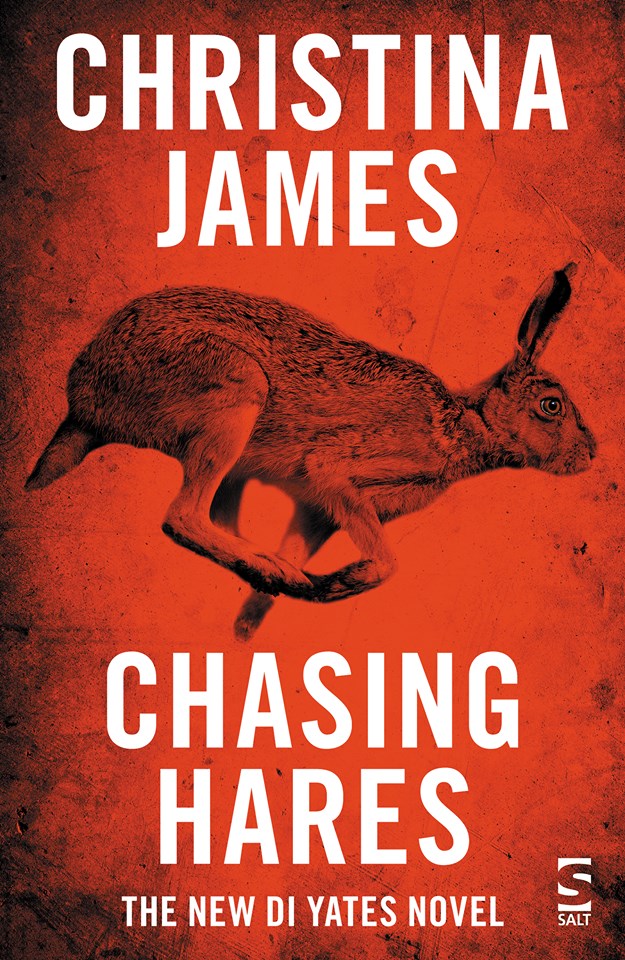


A flat cap is not just for t’ ‘ead, tha knows…

Nowt like a reet wild book signin’…
Ian McMillan, South Yorkshire’s own shrewd and very funny poet (the ‘bard of Barnsley’ and ‘poet in residence’ at Barnsley FC), gave a book launch and signing session at Rickaro Books in Horbury yesterday evening. It was an event that I’d been looking forward to for a long time, having heard Ian perform once before, at a school. He is a performance poet second to none.
I arrived early at the shop with my husband. Ian was already there, entertaining all the other early arrivals. Even Richard Knowles, the owner of Rickaro Books, seemed excited. Richard is professionally lugubrious: his catch-phrase when I worked with him a quarter of a century ago was ‘Life is Cricklewood, not Hollywood.’ Yet he’d invested in a big box of Cadbury’s Celebrations (only slightly dimming the gesture by explaining that they were left over from Trick or Treat night and also instructing his guests to take the Snickers chocolates first, as he doesn’t like them) and shared his special ‘bookseller’s provender’- malted milk chocolate biscuits – with Ian. He had even brought along his flat cap for the occasion.
At this point, I should perhaps explain that Ian’s new book, a collaboration with eminent cartoonist Tony Husband, is entitled 101 Uses for a Flat Cap. Published by Dalesman, whose account manager was also at the meeting – he’d kindly brought along copies of all Ian’s books – this latest offering from Ian and Tony does exactly what it says on the tin… er, sorry, book. It consists of 101 pieces about the trademark Yorkshire flat cap, inserted by its author into every possible historical and practical situation: ‘All made up! Every one of them!’ Ian kept on cheerfully insisting. He read several of these poems as well as, with passion, a more poignant extract from another recent title, The Tale of Walter the Pencil Man. Dedicated to his great uncle, Joseph Fletcher, who died at the Somme aged twenty-four, this is the reflective and touching tale of a Yorkshire pit village lad who tries with his pencil and paper to cope with what is happening around him as he fights on the First World War battlefields. It’s very topical, of course, and I’m sure will enjoy many sales this year and next, as we approach the centenary of the start of the Great War.
Tony Husband, Ian’s illustrator, accompanied him. It was a real thrill to meet him: he’s a very accomplished, not to say distinguished, artist, who draws for several famous publications, including Private Eye (Yobs), and has been Cartoonist of the Year several times. He told me that he and Ian Hislop arrived at the Eye at about the same time, twenty-five years ago (about the same time that Richard and I ceased to be colleagues!). Tony worked fast and incredibly hard all evening: he not only signed every book that was purchased, but drew a picture in it as well; he also drew a picture to accompany each of the poems, simultaneously with Ian’s recitation, and distributed them among members of the audience afterwards. The picture he gave to me, which I shall certainly have framed, illustrates the poem entitled ‘The Flat Cap Scene from King Lear (now lost)’. It’s my particular favourite, not least because it’s arch about Lincolnshire (my home county) and Norfolk (home of my publisher, Salt), though Ian did qualify his comments by saying that he loved South Lincolnshire and even recollected an event that he’d given at ‘one of the Gedneys’ – impressive, as the Gedneys are very small villages in the back of beyond.
Here’s a taster of the poem; the rest is hilarious, but you’ll need to buy the book to find out! (Plug, plug…)
Lear: Oh fool, what dost sport upon thy head?
It seems exceeding flat and dull, i’faith,
As Lincolnshire and Norfolk, two flat places in the East.
This occasion was everything that an event in a bookshop should be: convivial, hospitable (Richard’s wife Carole provided a delicious and warming mulled wine) and humorous, with a great deal of ad libbing from both Ian McMillan and Tony Husband, as well as from members of the audience. It was extremely well attended and I’m sure that, like us, everyone who was there went home happy and enriched by all the pleasures that it brought. Richard also used the occasion to promote BOOKS ARE MY BAG, an initiative that is close to my heart, as readers of this blog will know.
And there was no charge for attending: certain chain booksellers, please take note!
Very many thanks to Rickaro Books, Tony and Ian, for an evening to remember:

The fabulous Tony Husband, putting me in the picture…

Richard Knowles, of Rickaro Books, looking for the 102nd use of a flat cap…

Visual and verbal, speaking ‘louder than a gun’…

Tony Husband, finding himself in no-man’s-land…

The Flat Cap Scene from ‘King Lear’ (now lost)
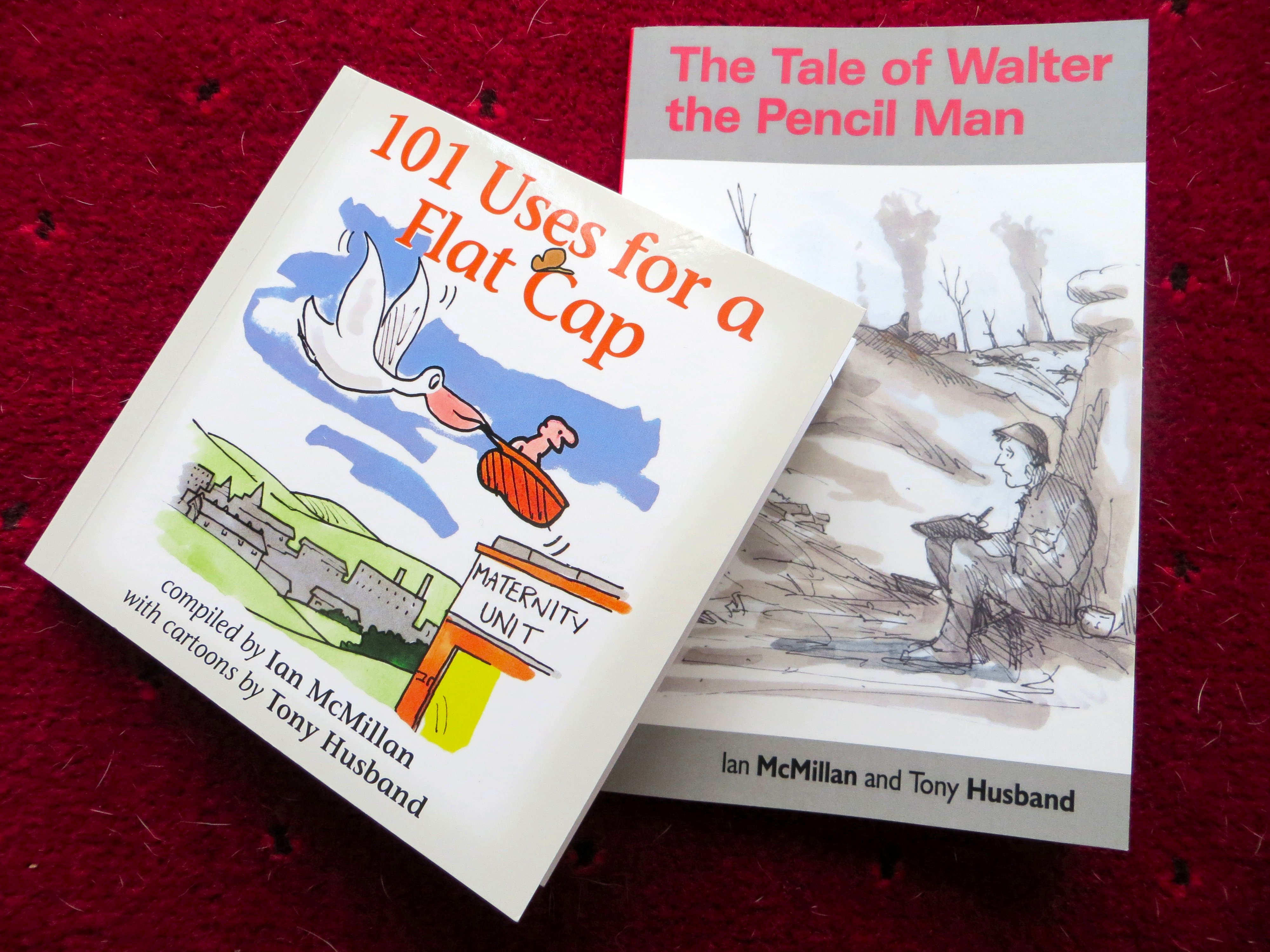
A couple of lovely collaborations, by a couple of lovely collaborators…

A precious signed first edition! Love you, Tony and Ian! 🙂
Perhaps sadly, Uggle wasn’t…

I’ve written several times about the importance of place in my novels and how much I admire writers who can evoke a specific place (whether real or fictional) and imbue it with its own particular character and atmosphere. Fictional places that I love include Margaret Mitchell’s Tara, Daphne du Maurier’s Manderley, Evelyn Waugh’s Brideshead and Gerald Durrell’s Corfu (the last perhaps not strictly speaking fictional, but still, I’m certain, an embroidered and selective portrayal of the island as it existed when he moved there with his family).
Towns, villages and hamlets in the area of South Lincolnshire where I grew up have some wonderful names: Spalding itself (named after a sixth century Anglian tribe called the Spaldingas), Whaplode, Quadring Eaudyke, Gosberton Risegate, and, perhaps the one I like best, Pode Hole (which, apparently, is Anglo-Saxon for ‘the place of the toad’). Today Pode Hole is a very small village, best known for the pumping station which was opened in 1965 and is already a Grade II listed building. It connects two waterways to Vernatt’s Drain, an astonishing feat of late seventeenth century engineering which began the long, slow process of draining the Fens. (I’ve read that Vernatt’s real name was Baron Philibert Vernatti, and that he was ‘an adventurer’. I’d certainly like to have met him!)
Place names in South Yorkshire are also evocative. There is Silkstone (which sounds beautiful, but was once quite a grim mining village); Hoylandswaine, which reads like the name of a bucolic lover but more prosaically means ‘a spur of land jutting out from a hill’; Durkar (which means ‘grit marsh’, but to me has always sounded Asian: a rather exotic cross between ‘durbar’ and ‘gurkha’) and Goldthorpe and Grimethorpe (the Danish ‘thorp’ referring to a small new settlement next to a larger village).
Many of these Yorkshire place-names are Norse or Danish in origin. There is an even greater concentration of such Scandinavian names on the East coast, particularly in the Scarborough – Robin Hood’s Bay area and its hinterland. My all-time favourite is Ugglebarnby.
As a family, we’ve passed through Ugglebarnby many times on our way to a day out at the coast. Knowing that ‘-by’ is the Norse suffix for ‘the place of’, we’ve always assumed that Ugglebarnby meant ‘the place of Uggle’s barn’. We’ve had fun speculating about Uggle: we’ve discussed how he probably came storming inland, straight off his dragon-prowed longboat, saw a likely-looking Saxon barn and laid claim to it and the adjoining village, thereafter fighting off all challengers and making it quite clear to whom the barn belonged by emphatically slapping his name on it. My husband and son, both tall and red-haired, and with ancestors in the female line whose surname was definitely of Norse origins, like to imagine themselves as modern incarnations of fierce manly Vikings – sailing the oceans, whirling sharp battleaxes and certainly getting their own way (the desire to do this is still a pronounced family trait) in claiming new territories. They’ve therefore always felt a strong affinity with Uggle. Perhaps because of my own Saxon origins, I’ve imagined him as quite a sinister character, probably reclusive, a hulking, brooding giant emerging like a Rottweiler from his homestead (plus barn) to defend it against all comers.
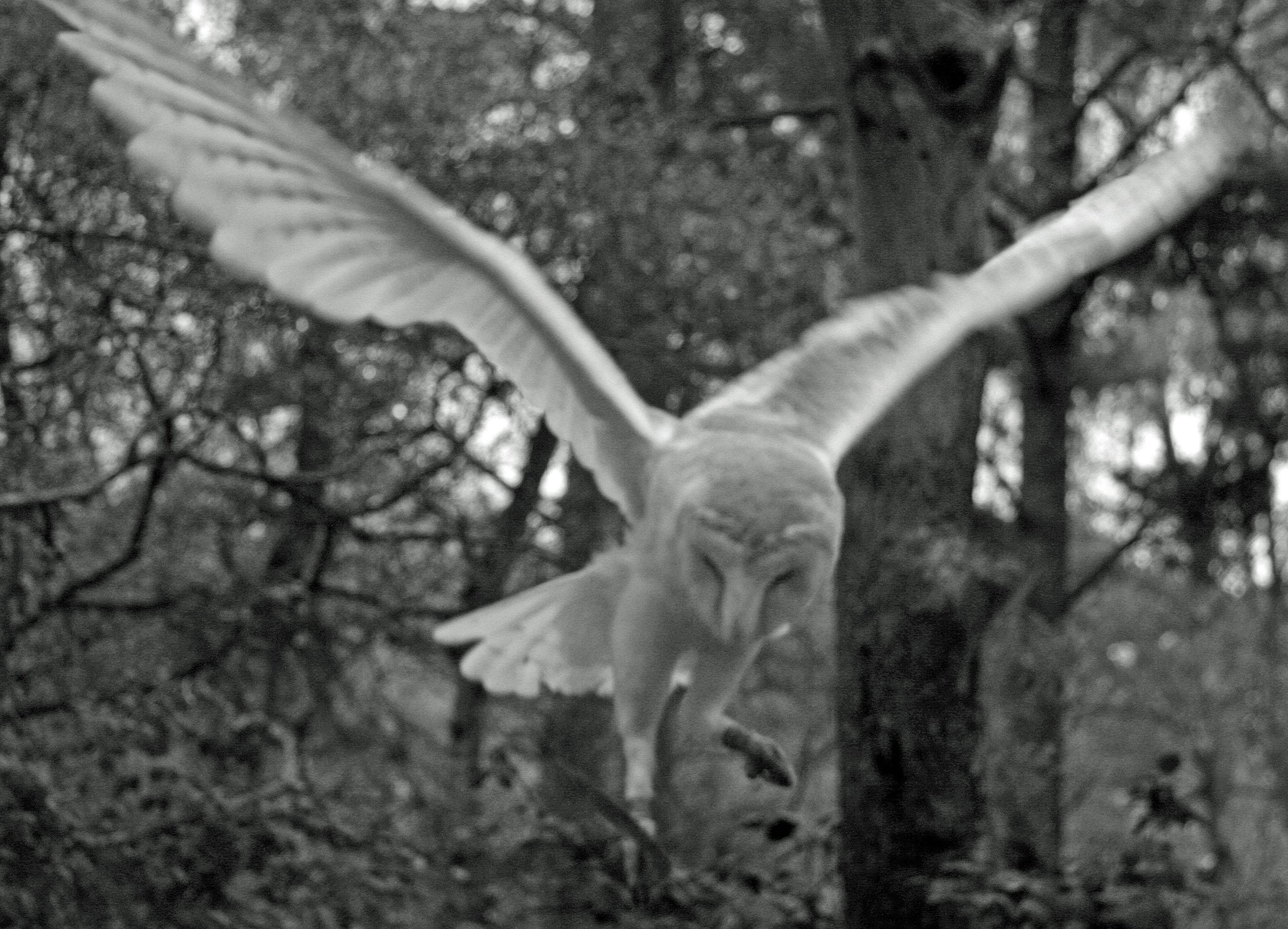
Today I’ve disappointed myself a little, therefore, by looking up Ugglebarnby in The Concise Oxford Dictionary of English Place-Names, only to discover that its meaning is ‘the owl at Bardi’s place’. Now Bardi might have been just as bloodthirsty and truculent as Uggle, but somehow I doubt it: he was obviously nice to owls, and whether or not he had a barn is not recorded. A bit of a let-down!
We could have looked up the name years ago – The Concise Oxford Dictionary of English Place-Names was left to my husband by his first boss, who died at some point in the 1980s – but I’m glad that we didn’t. If we had, all those fantastical conversations on the way to the coast would never have happened. But one crucial thing hasn’t changed: Ugglebarnby is still a peerless place-name!
[Click on photographs to enlarge them.]
Perhaps you have your own favourite place names; if so, I should very much like to hear of them.
All text and photographs on this website © Christina James
Into Lincolnshire, for the Wolds Words Writers’ Workshop…

Louth Library, Lincolnshire
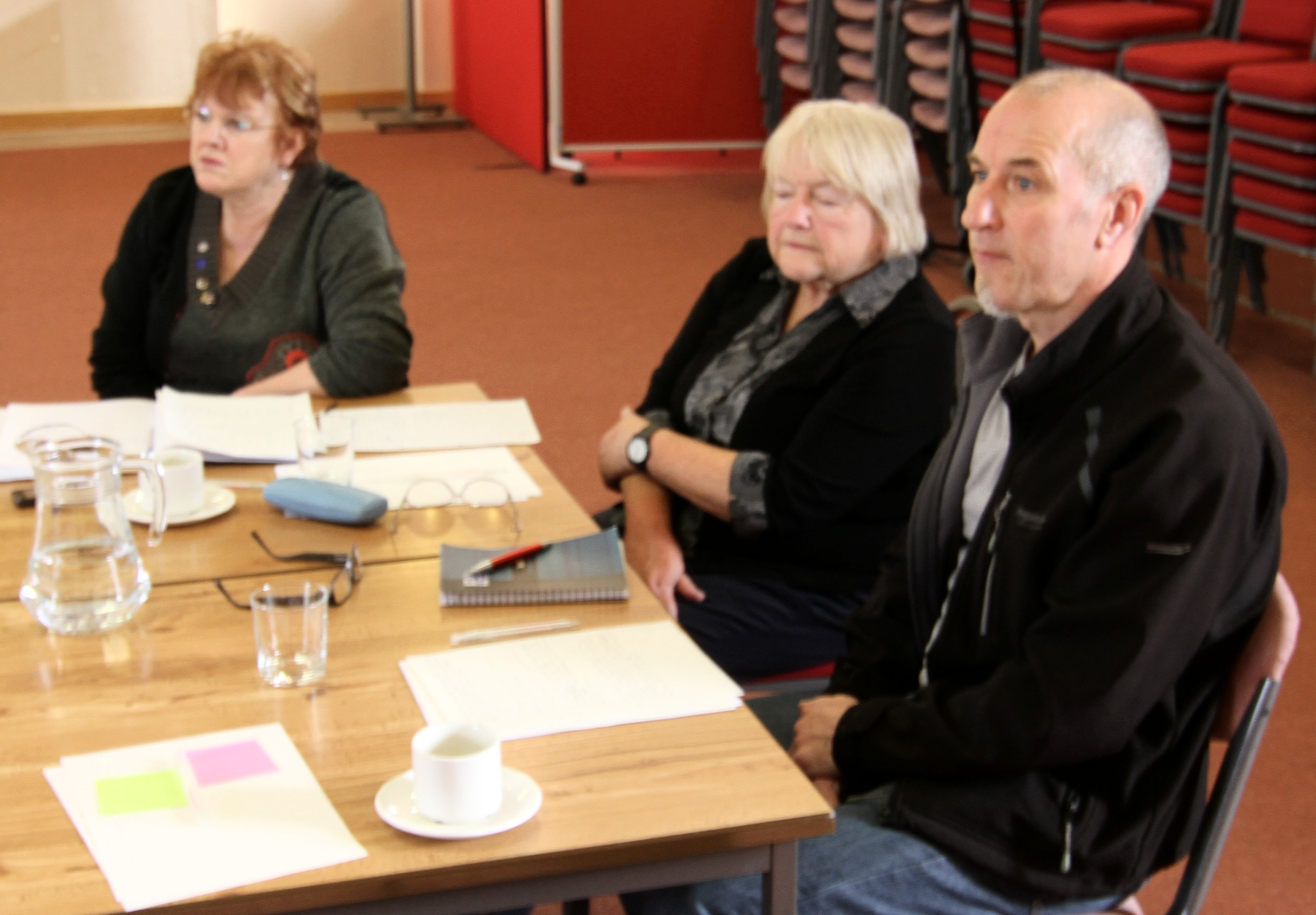
The writers’ workshop that my husband and I jointly led on Friday 18th October was part of the thirteenth Wolds Words Festival. It is a flourishing event that takes place annually in and around the pretty market town of Louth. The workshop was scheduled in the library, an impressively busy place in which the considerable bookstock was displayed most invitingly. The library staff were all great: extremely helpful, both to those attending the workshop and to their regular library users. It’s one of the most successful small libraries I’ve ever visited and clearly the librarians work hard to achieve this.
We said that we would work with up to twelve participants and the workshop quickly sold out (though not everyone actually made it on the day). We were asked to focus on two aspects of writing: crime and using local history in fiction. We heard that a workshop on plot construction that had taken place on the previous day had also been very successful.
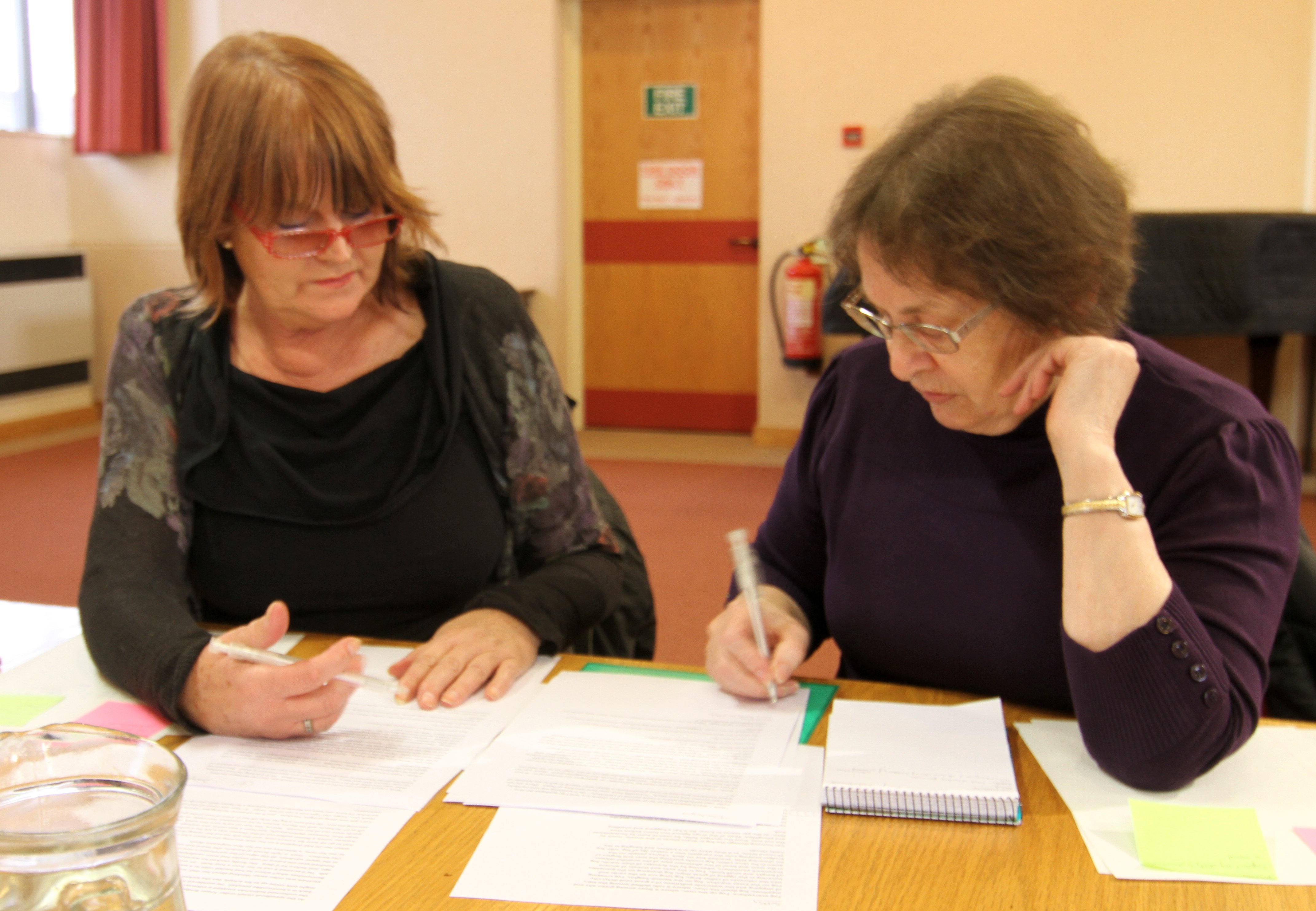
Wolds Writers’ Workshop
Wolds Writers’ Workshop
As a warming-up exercise, I gave the group some of my own tips on how to get published. As I’ve already offered some of these in this blog and shall be writing about others in more detail in future posts, I’m not covering them again here. Similarly, I’m not including my tips on how to incorporate local history into fiction here, saving them for a separate post.

Wolds Writers’ Workshop
We moved on to discussing why the participants had chosen the workshop and what they hoped to get out of it. Their answers were, perhaps not too surprisingly, very similar, and boiled down to a single joint ambition with three further ‘sub-wishes’. The over-arching goal of everyone present was to see their work published. One of the writers had already had poems published in anthologies; one had published a factual account of the sea some twenty years before and one had contributed short stories to an online magazine. None of the others had had work published. Two had written novels, but neither had been successful in finding a publisher.
The ‘sub-wishes’ were perhaps even more interesting: they each concerned confidence, or the lack of it. They included the expressed desire to write something that was worth reading ‘at all’; the fear that a certain flaw – in one case, an inability to write convincing dialogue – was an insurmountable stumbling-block; and the suspicion that the author’s take on life was too left-field ever to find a publisher. To these doubts, I replied that almost everyone can write something worth reading if they work at it hard enough; that ‘flaws’ can be overcome or minimised, again with hard work; and that many readers prefer a more unusual viewpoint to something more conventional, though I agreed that this may make it more difficult to attract a traditional publisher.

Wolds Writers’ Workshop
Next we read and explored four short passages from very different novels, each demonstrating some particular aspect of writing. We looked at the ‘fog’ passage from Bleak House as an example of creating atmosphere; Virginia Woolf’s description of the Ramsays’ holiday house in To the Lighthouse to establish a sense of place; a passage from Where the Devil Can’t Go, a novel by Anya Lipska, a talented new crime writer whom I’ve written about previously in the blog, that depicts her heroine’s character; and finally a piece of dialogue from my own novel, In the Family. We each took forty minutes to write a short passage following on from one of these, or alternatively any short fictional piece of our own choosing. The writings were shuffled and passed around until we had each read all of the passages; no-one knew who had written which. Each of us then told the others what we liked about the piece that we had in front of us at the end. We all found plenty to praise, which I think confirmed resoundingly that there is a writer in almost everyone. I should very much like to thank all the writers for their really enthusiastic and participative response to the occasion.

Wrights of Louth, Bookshop
Copies of my books were sold at the event by the local bookshop in Louth, which I also visited afterwards. One of its distinguishing features is that its sign hangs upside down! There is a story behind this: The shop used to be a general grocery store of the kind that I remember as a child, but which has completely disappeared now. Its owner, a man called Bill Platt, who ran it for many years from 1913 until he was in his seventies, was famed for his knowledge of local history as well as for the quality of his shop in Little Eastgate. He had business acumen, too. When the sign over his shop doorway blew down in a storm, it was affixed by accident the wrong way up; Bill recognised that it quickly became a talking point and therefore a good advert and simply left it like that. A local businessman, Mick Wright, who, with his wife Carol, turned the store into a newsagent’s and bookshop, has continued the tradition!

In conversation with bookshop owner Dean Wright
I had a long and pleasant conversation with Mick and his joint owner son Dean, and was extremely impressed by their can-do attitude towards running a bookshop in modern times. Their strategy is to diversify without abandoning the bookshop’s essential character and to provide exemplary service; they specialise in books about Lincolnshire. I purchased several by local authors, and was extremely grateful to be given a discount!
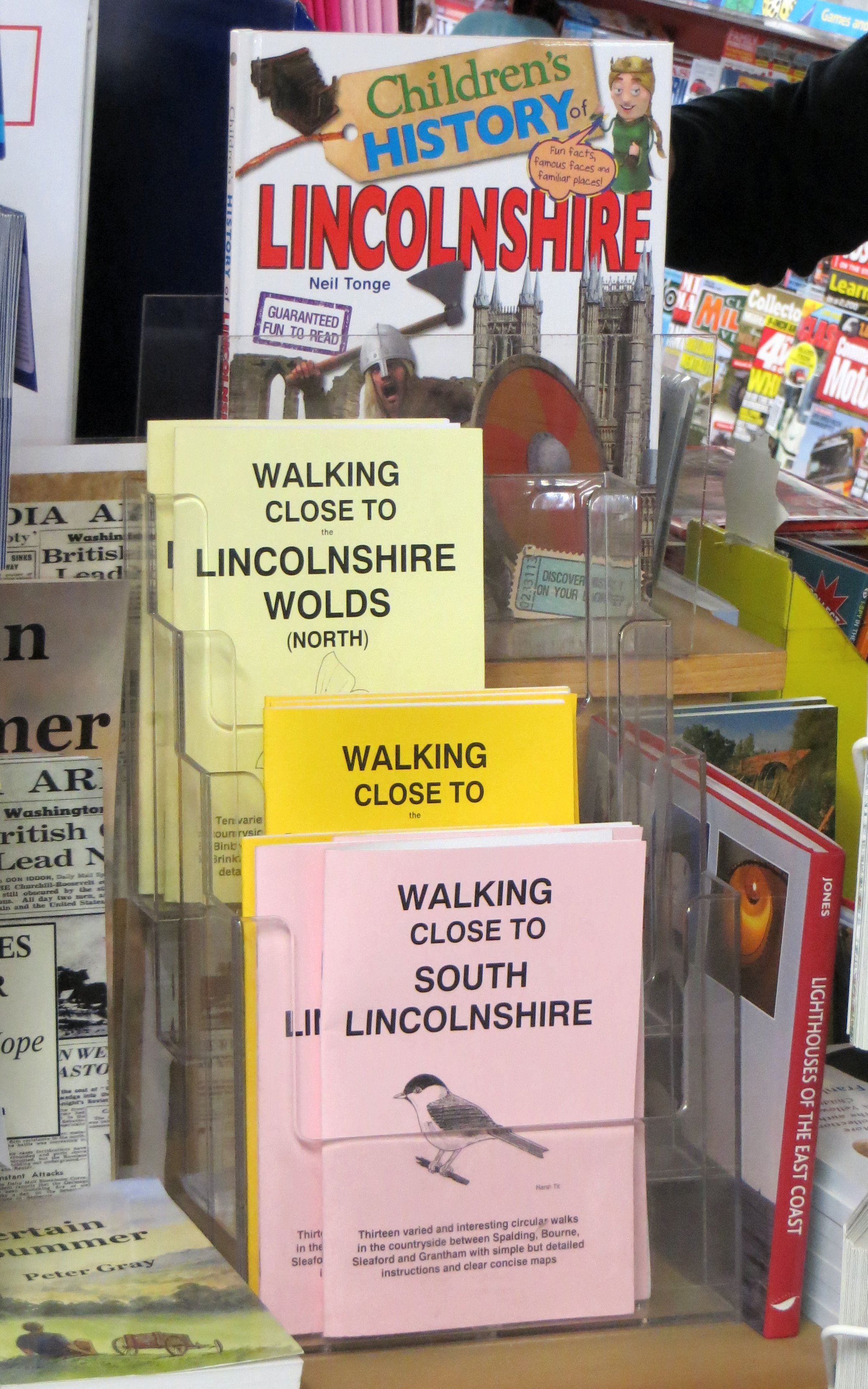
Speciality: Lincolnshire!
As you can see, I’ve included a few pictures of the event, the library and the bookshop. I’d never been to Louth before: it is quite a distance from Spalding. It is a lovely old market town; having now discovered it, I certainly plan to return. If you are ever in the area, it is well worth a visit – and don’t forget to take in the library and the bookshop while you’re there!
Privileged to tour the Jagiellonian Library, Kraków

Copernicus’ original autographed manuscript of ‘De revolutionibus’
The last of my Kraków posts is the one that recalls for me the most special time of my visit. I should explain that I went to Kraków in order to facilitate the meetings of an international librarian advisory panel. We were very privileged to have as our host Marek Krośniak, the Serials Acquisitions Librarian at the Jagiellonian University Library in Kraków. Marek not only allowed us to hold our meetings at the library, but also arranged for us to take a tour of some of its priceless treasures.
The Jagiellonian University, founded in 1364, is one of the oldest academic foundations in Europe. Its collection of manuscripts, incunabulae and other rare printed books dates from every period of its existence and is incomparable. It includes an extensive collection of handwritten scores by famous composers. Also amazing is the knowledge of the librarians who curate this collection. No less than four specialist librarians explained the rarest treasures to us. (Understandably, security was tight: the door to the room holding these volumes was locked behind us and each of the books was stored in a locked glass case. There were also security guards in attendance.)
I have a fairly large collection of photographs taken during the tour (all without using flash, as requested). It was difficult to make the choice, but I have selected four that I hope will illustrate the distinction and diversity of the whole collection. First is the original manuscript of Copernicus’ De revolutionibus, in which he presents his theory of the heliocentric system of the universe. This autographed manuscript never left his possession in his lifetime and the first printed edition of the work was from a copy made by his pupil, Georg Joachim Rheticus. Famous throughout the world, it was acquired by the Jagiellonian in 1956 and is possibly the library’s pièce de résistance, though there are many other contenders for this crown. Second is the first missal with an illuminated flower border to have been produced in Kraków. It belongs to the high mediaeval period (and is reminiscent of some of the early books that I saw in the University of Barcelona library and wrote about earlier this year).

Krakovian missal 1494

Krakovian missal 1494
Third is the earliest known book to have been printed in Cyrillic characters. Fascinatingly, it is also one of the earliest extant proof copies: in the photograph, you can see the printer’s corrections on the pages.
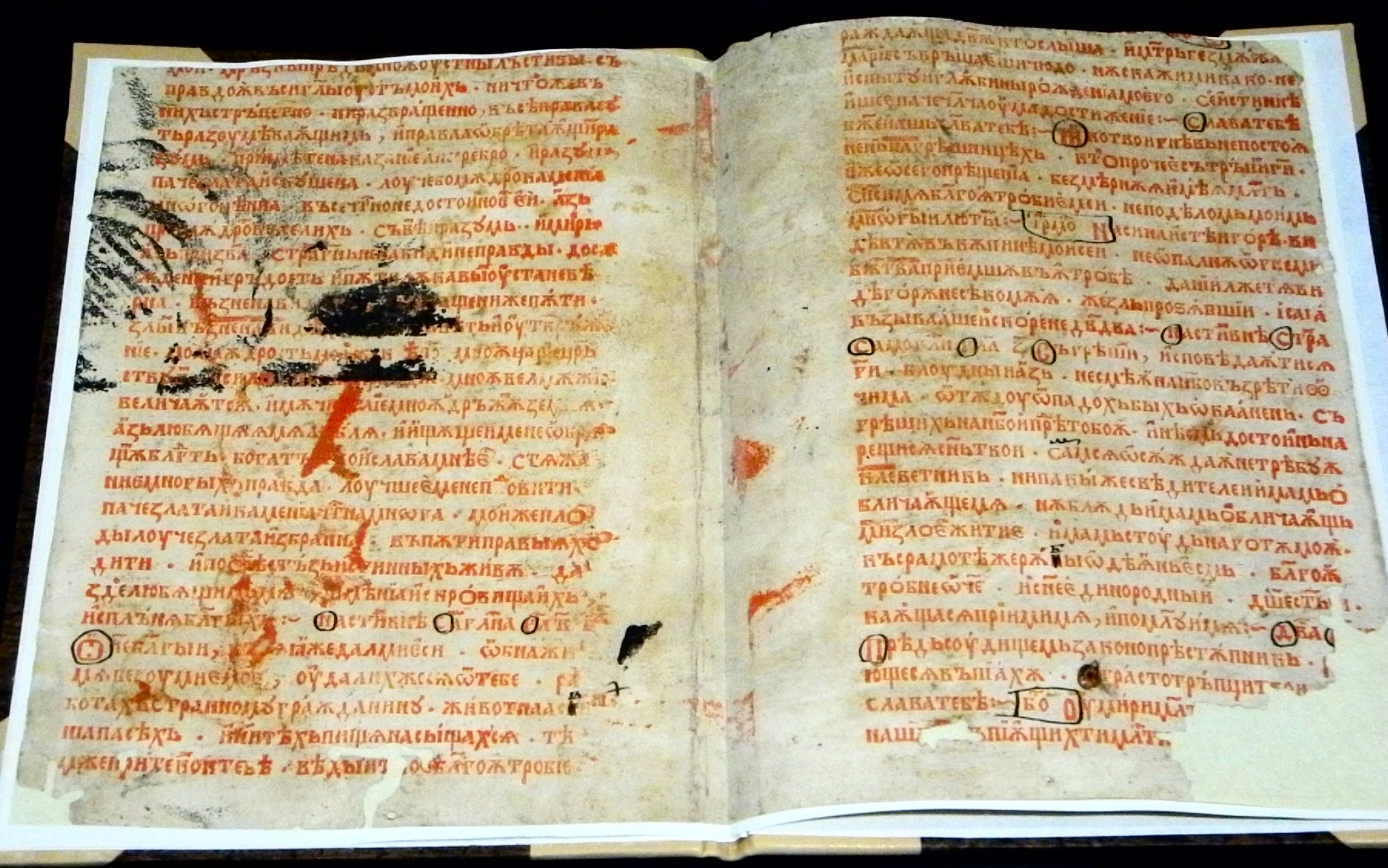
First known example of Cyrillic printing 1491
Finally, there is one of Mozart’s handwritten scores, this a one-act Singspiel, or comic opera, called Bastien and Bastienne, written when he was a boy and performed in the open air in 1768. The library’s large collection of original scores includes works by Berlioz, Chopin, Bach, Beethoven, Mendelssohn Bartholdy and other famous musicians, but Mozart had a special relationship with Kraków (and is possibly the world’s favourite composer), so that’s why I have chosen to feature his work here.

Mozart’s score for ‘Bastien and Bastienne’
It is difficult, if not impossible, to convey how exciting it was to be allowed to see these beautiful books and to learn their history from experts. I hope that I have managed to share a little of the excitement with you. And I’d like to thank Marek Krośniak and his colleagues very much indeed for providing all of our party with this wonderful opportunity.
All text and photographs on this website © Christina James
Salt… How appropriate!

Salt mine headstock
This is the second of my Polish pieces. I’m sorry that it follows on from the first after quite a gap – I’ve been hi-jacked by a nasty cold this week. I’ll try to be a bit more punctual from now on.
Cold notwithstanding, I should have preferred to get this post out earlier, because its main purpose is to share with you some photographs of our visit to the famous Wieliczka salt mine some seventeen kilometres outside Kraków. The chambers and carvings in the mine are spectacular – as you can see. Discovering them was an opportunity that we almost passed up, because we’re pretty averse to joining any kind of organised tour, and the salt mine is obviously not a place where tourists can be allowed to wander around on their own; indeed, so many tunnels are there, it would be very easy to get lost. We were persuaded to make the visit only the evening before, by some Danish people dining in the same restaurant. I suppose that making holiday plans on the advice of complete strangers about whom you know nothing and whom you’re never likely to see again is as good a way as any! In any case, I’m published by Salt and it therefore seems an appropriate kind of tribute to Chris and Jen Hamilton-Emery.
Determined not to be an entire pushover to the tourist industry, we travelled to the mine on an ordinary service bus instead of one of the special tour buses. For me, one of the highlights of the day was encountering people from the suburbs as they travelled on this bus, though I was much less enthusiastic about the return journey in the afternoon, when the driver was clearly behind schedule and rattled along at such a speed that I had to face the back of my seat and hang onto it in order not to be thrown into the aisle. I was grateful that I hadn’t had lunch! I was also fascinated to note that, beyond the suburbs, Kraków has quite an industrial hinterland.
Tours at the mine are extremely regimented and quite expensive – entry costs about as much as a visit to the Tower of London, which is extortionate by Polish standards. The experience was also shot through with a slightly bizarre streak: for example, our tour was called a ‘non-tour tour’ (we worked out that this meant that we were not part of a pre-booked group). Endearing rather than annoying was how the enterprise running the mine tried to make money out of absolutely everything, from coffees and ice-creams to printed guides, knick-knacks made of rock salt and ‘genuine miners’ soup’, but in a slightly amateurish way. It is noticeable in Poland that everyone is desperate to make money, but in a friendly, almost apologetic, manner. The same thought struck me when I was watching the drivers of the horse-drawn carriages in the main square in Kraków trying to cajole tourists into taking rides.
The non-tour tour guide was a young woman immaculately dressed in uniform. She was extremely professional and her English near perfect. She was obviously highly educated and very knowledgeable about the history of the mine, which has existed since mediaeval times. Rock salt was quarried there for seven hundred years, until 2002, after which the mine was devoted entirely to tourism. Engagingly, the guide explained that this was because more money could be made out of tourists than digging for salt. There is another commercial salt mine elsewhere in Poland, with much lower extraction costs, and that provides the supply.
I was almost as interested in my fellow tourists as the mine itself. We were a jovial bunch from many countries; the only thing we had in common was that we had chosen an English-speaking guide, rather than one who spoke the other languages on offer: Polish, German, Dutch, French or Italian. Our group therefore included people from India, Japan, China and the USA, as well as several other Brits. I particularly admired the Indian couple, who gamely negotiated with two quite small children the up-and-down kilometres that we had to walk within the mine.
The initial descent, down many short flights of wooden stairs within a vertical shaft, was neither frightening nor particularly taxing, if dizzily repetitive. Walking back up all of those stairs would have been a challenge, and might have caused a few heart attacks. Nevertheless, I didn’t enjoy the return to the surface, which had to be made in a small miners’ cage, crammed in with seven others. I was delighted to reach the exit and emerge into the warm autumn sunshine again.
I’ve already written more than I intended, so I’ll leave the pictures to speak for themselves now, just adding that all the sculptures and carvings – and indeed all the floors – in the mine have been fashioned from rock salt and that (although it is probably self-evident) Polish salt miners were very devout, some of the chambers having been turned into chapels, the most impressive being the Chapel of St. Kinga, which, with its altarpieces, wall-friezes and statuary, as well as carved floor, all in rock salt, is like a cathedral. The caverns are astonishing in scale (the Staszic Chamber has a ceiling thirty-six metres high), in some cases with self-supporting ceiling, in others prevented from collapse by elaborate wooden prop systems or by much more modern metal rods, inserted into drilled holes and therefore much less obtrusive to the eye.
I hope that you’ve got the taste of the salt from all this, if not a taste for a salt mine visit; you can lick the walls of the tunnels if you like (visitors are encouraged to do so)! Alternatively, you can read a Salt book…
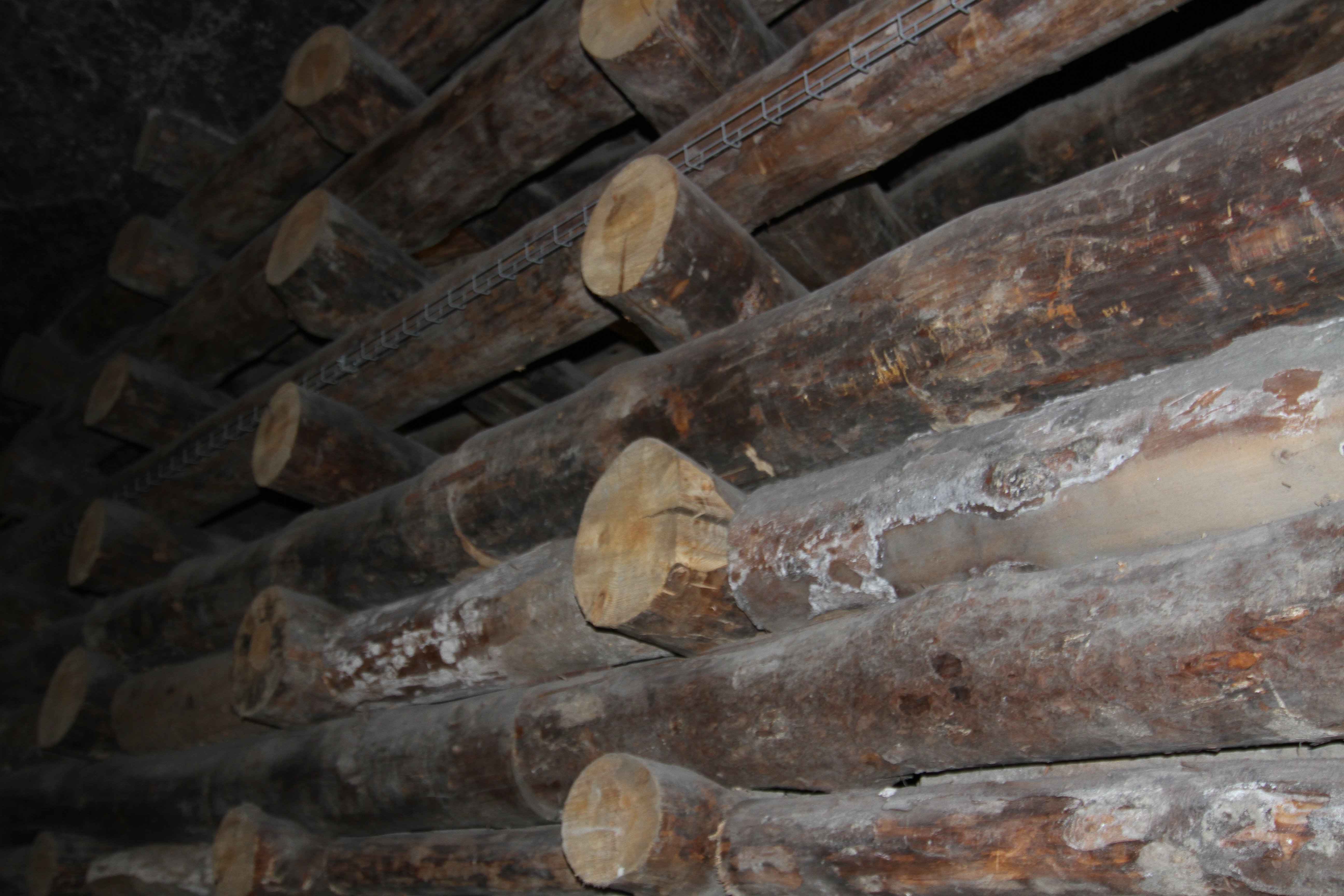
Traditional timber supports

Tribute, in salt

Raising the salt

Gnome from gnome?

Flight into Egypt, Kinga Chapel

Pulpit, Kinga Chapel

Solid salt floor ’tiles’, Kinga Chapel

Roof support system
Kraków Planty in golden October…
When I consulted the BBC online weather forecast in advance of our trip to Kraków, I learnt that the night-time temperatures there the previous week had been zero and, during the day, had barely climbed to ten degrees Celsius. On arrival early in the evening on the Friday before last, I was therefore pleasantly surprised to find that, although there was a nip in the air, it was nowhere near as cold as I’d expected. The atmosphere was extremely festive: well wrapped up in colourful winter clothes, people were parading the streets, arms linked, talking and laughing, much as they promenade in Spanish towns and cities before dinner; and, unlike in some other eastern European cities I have visited, dinner was served at the restaurants until a reasonably late hour.
The festive mood continued on the following day.
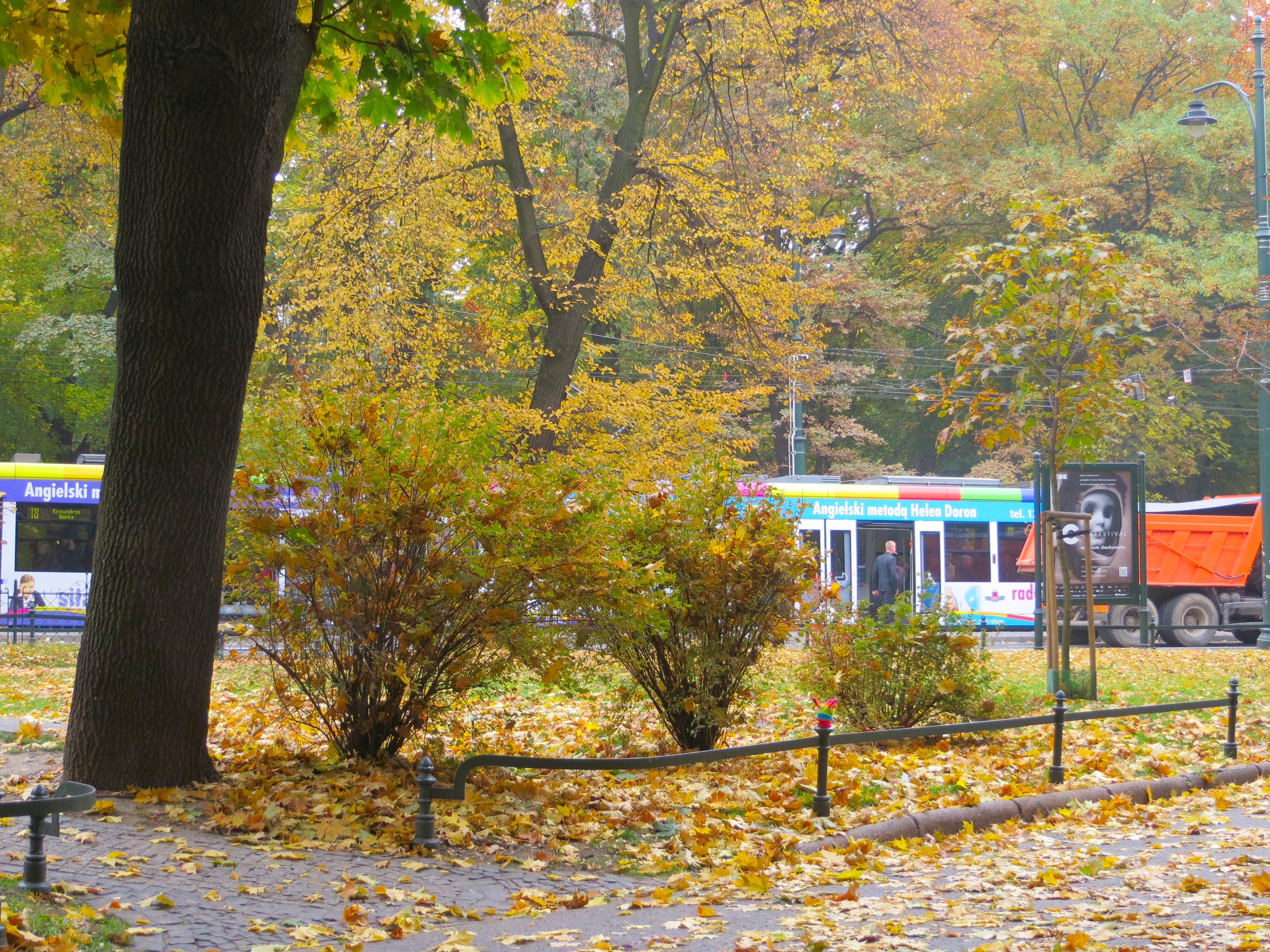
Kraków is a beautiful place. The Stare Miasto, or ‘Old Town’, is entirely circumscribed by a park (or rather a series of them, divided by the radial roads) called Planty, which runs around the line of the old city walls. Sometimes, this is just a narrow strip of land dividing the pavement from the road, but often it broadens into large tree-scattered areas of grass containing children’s playgrounds, statues and benches. Always there is a wide path to walk along, so there is no hazard to pedestrians from motor vehicles (though the cyclists are pretty manic and don’t seem to have discovered either bells or horns!). There are some distinguished museums and other significant tourist attractions in Kraków, but many residents and visitors to the city seemed to me to spend a great deal of time just walking around Planty.
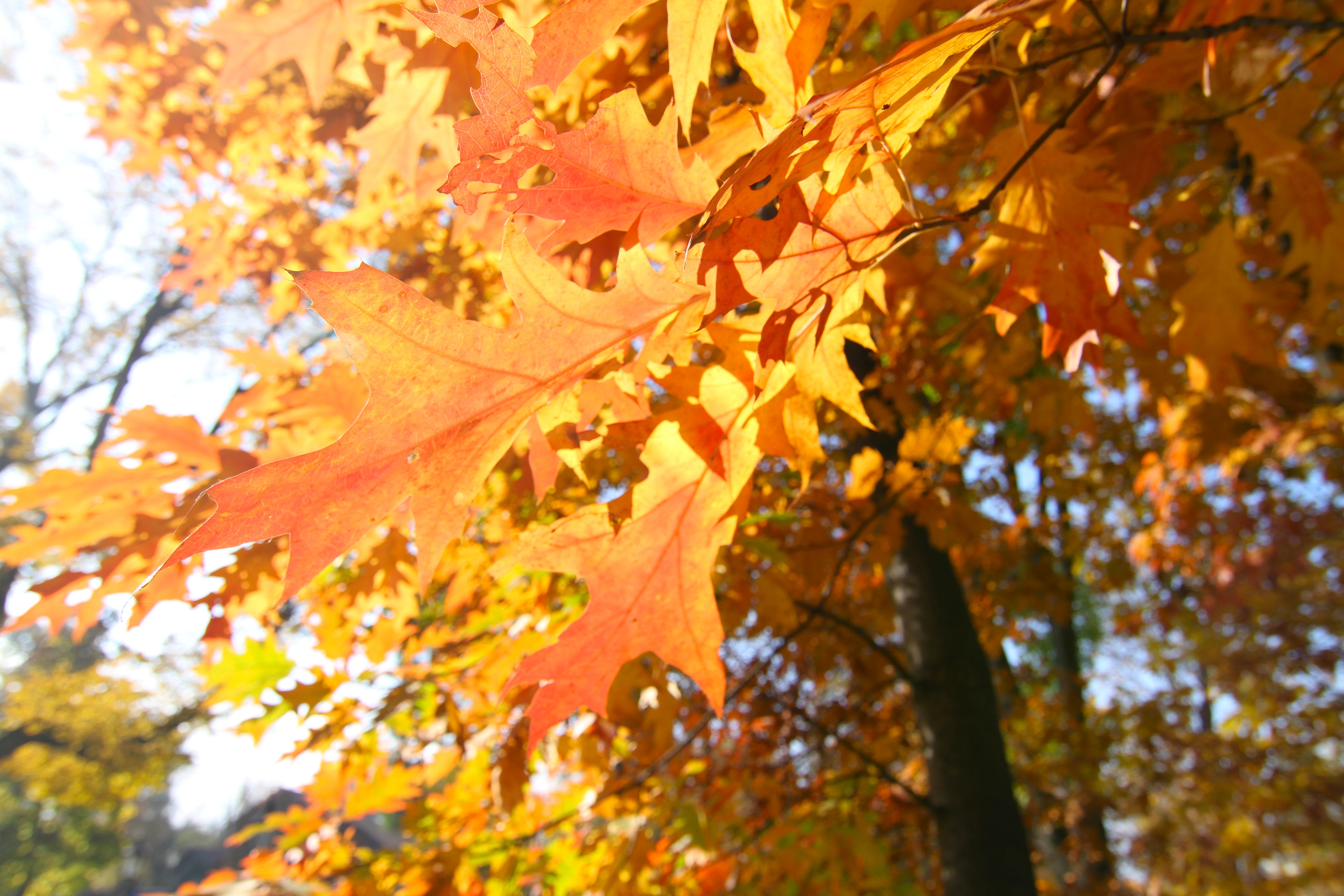
On the Saturday of our visit the park was particularly lovely. Because of the cold spell the week before, the trees had all changed colour and were presenting a glorious display of gold, russet and tawny brown. Most striking, however, was the rapidity with which the leaves were falling: a gentle burnished leafstorm was constantly swirling to the ground and people were catching the colours as they walked along.
Although we never discovered its exact nature, there exists some special relationship between the citizens of Kraków and the falling of the leaves. This may have something to do with the rapidity of the ‘fall’, which we were very fortunate to experience. At our hotel, the staff had placed richly-coloured fallen leaves on the tables and in alcoves on the stairs. In the streets, whole families were collecting the leaves in sheaves and walking along holding them as if they were bouquets of flowers. At the open market in the main square several stalls were selling autumn posies made up of leaves, berries and nuts and, although these were priced between 12 and 20 zlotys (quite a lot in that part of the world for a perishable decoration), they were selling well and being carried around like Elizabethan nosegays.

The fantasia of falling leaves continued for the next three days. On Tuesday we awoke to heavy rain. There had been a storm in the night, and the trees had now been laid almost bare, the rich carpet of leaves on the ground sodden and trampled underfoot. In Kraków, it is autumn’s lease that hath all too short a date. The golden leaves have almost all gone now. It will be a whole year before they make their brief appearance once more.
An author to assuage hunger…

Discovering Rose Tremain
I remember exactly when I first discovered Rose Tremain. I had very recently joined Dillons (destined to merge with Waterstones within a year, though none of us knew that then) and had been invited to attend a party at Hatchard’s (a fine old bookselling business that had been acquired by Dillons some years previously) to celebrate its 200th birthday. Along with many colleagues, I accepted. As Dillons HQ was in Solihull, Teresa, one of our administrative assistants, was asked to find hotel accommodation in London overnight for those of us who requested it. Teresa had been supplied with a directory of hotels ‘approved’ by the company for use by its staff and, as I was to discover, had an unerring knack for picking out those that were most dismal and unwelcoming. Most of my colleagues made alternative arrangements. New to the company, I put my trust in Teresa’s mercy.
The party was the most glittering book trade bash I’ve ever attended. Princess Margaret was there, resplendent in elbow-length gloves and drinking something from a tall glass wrapped around with a linen napkin. Salman Rushdie had dared to attend, even though it was only a year or so after the fatwa against him had been issued. The other guests included dozens of well-known writers and publishers. As you can imagine, security was very tight.
The evening was ‘elegant’. I use the term in a way that was new to me then, but in which I’ve had other occasion to use it since. As I’ve previously mentioned, the first bookselling company that I worked for was in Yorkshire and the second in Scotland. Both hosted many literary events and all of these shared a single prominent common feature: we ensured that our guests were served a plentiful repast of excellent food. We believed in feeding the body just as much as the mind. In Yorkshire, we favoured sides of salmon, roast hams, salads, pizzas and quiches and generally included a selection of gooey puddings; in Scotland the food was usually hot and hearty: soups, pies, lasagnes, stews and curries. But always food, ‘proper’ food, and plenty of it. And drinks, too, of course, though the food was paramount.
At the party at Hatchard’s, on the other hand, the wine flowed but the food was sparse. Exquisite, but sparse. It consisted of tiny canapés that were delivered individually at long intervals by uniformed waiters and waitresses who bore them aloft on circular trays. There were miniature salmon rolls, morsels of pastry stuffed with even smaller slivers of meat and cheese, the babiest of baby sausages skewered with eighths of tomato and Lilliputian biscuits bearing deftly-placed dots of pâté, each one garnished with a parsley feather. The waiting staff weren’t particularly keen to distribute these fairy victuals, either: sometimes it was impossible to snatch one before it continued on its airborne journey through the crowd.
The upshot of this was that, when eventually I arrived by taxi at my hotel, which belatedly I had discovered was situated in the further reaches of Camden, at around 10 p.m., slightly tipsy and completely famished, I found that not only did the establishment serve no food (it would not even be providing breakfast on the following day), but that there was no restaurant or even a takeaway within a radius of at least a mile. I took one look at the dark and dingy street beyond its none-too-hospitable doors, and decided that I would be foolish to risk venturing forth in quest of sustenance now. I therefore toiled up the three flights of stairs to my room (it wasn’t the sort of hotel that offered to help with luggage) where I found a narrow single bed in a cheerless room with no bedside lamp and an ‘en suite’ shower behind a plastic curtain in an alcove. The lavatory was outside, shared with the occupants of the other rooms on the same floor.
Mercifully, my room did contain a kettle and some sachets of coffee and tea (the brand-names of both were unfamiliar) and two or three of those little bucket-shaped plastic containers of UHT milk. Too cold and hungry to go straight to bed, I made myself a cup of indifferent but scalding coffee, groped in my bag in the hope that I hadn’t absent-mindedly eaten the cereal bar that I’d placed there some weeks before (I hadn’t) and fished in it again for the book that I’d snatched from a stash at Dillons HQ for staff to help themselves to before I’d caught the train to London many hours earlier. It was Restoration, by Rose Tremain. Immediately, I was enthralled. I drank my coffee, ate my cereal bar and read. And read. I went to bed some hours later, my hunger forgotten, and slept soundly until the following morning, when I rose early in order to find breakfast and get another quick fix of Restoration before the day’s work started. I had become a Rose Tremain addict.
I had intended this post to be a review of Merivel: a man of his time, by Rose Tremain, which I have just completed, but I’ve probably written as much as you want to read for now, so will save that for another day.
Auschwitz-Birkenau butterfly, from the husband of Christina James…

Peacock butterfly on the steps to the death chamber, Birkenau
I asked for a riposte to Christina’s cider-pressing post, but that was not to be! However, by way of recompense, she has allowed me space to comment on what must be one of the greatest crimes inflicted by man upon man. While she has been busy with what she calls ‘the day job’, which has been, on this occasion, a publisher-librarian conference held in Krakow (for the pedantic, this is pronounced by Poles as KrakOUF, with the stress on the second syllable), I visited Auschwitz and Birkenau, one hour and forty minutes away by bus.
On the face of humanity, a carbuncle, perhaps now healing slowly, but sensitive to the touch and destined to leave a permanent scar. Yet the body politic suffers still and continues to break out in boils symptomatic of the same underlying disease. Mankind, disfigured, cannot find a cure and treats, always too late, the symptoms alone. These gross and scabbing reminders of our failure as a race to reach the root of our ills do not make comfortable our self-examination in the mirror of consciousness, but I found, on this, my second visit after some years, that the experience was already becoming, for the latest visitors, too organised, desensitising.
Brick, concrete, iron, steel, stone and dust, all strung about with the twisted barbarous wires; original timbers are gradually disintegrating or have gone. All about, the millions of October leaves are falling, falling. Summer’s beauty choked by approaching winter cold, they are gathered up in heaps, loaded into barrows and trucks and taken away for burning or to rot down. Colour and life turned to ashes. Shorn of their tresses, the trunks and branches are emaciated, twiggy fragile limbs starkly outlined against the sky.
Irony in the bus loads of tour groups disgorging their cargoes and delivering them into the hands of the camp guides. Selection by language. An industry in itself. The cameras click; the iPads embrace the scenes as each former terror is re-hashed for public consumption. Work makes free. Tourism makes realism – ‘No photographs here’ signs ignored as every shred of individual dignity is wrenched from the heaps of human history and saved for later: ‘I was there; it was awful; look at my pictures.’ I have to step away, unable to stem emotion. My leaves fall like tears, like lives.
Symbolism of railway lines, stretching through the gate to infinity. The sleepers are relinquishing their hold upon the rails, wasting from within. Will those be replaced, like wooden huts, to show what it was like? The other sleepers are softly breathing their message to us, the words falling as gently as leaves, and we strain to hear against the sound of the narrative of the guide. Their language is universal. The guide says that we are now walking the same way as the doomed, but we are not. Once more I break away, this time for good, and let imagination tell the story. And then, on the cracked steps to those underground chambers, now guarded by a staunch metal grid, a delicate beauty opens wings amongst the many fallen leaves and flies into the air. The loveliness of lost lives is captured for me in a butterfly.
All text and photographs on this website © Christina James
To bend with apples the moss’d cottage-trees…
And fill all fruit with ripeness to the core
In my youth I was fairly impervious to the seasons, but in recent years I have come to dread the winter months. It’s not so much the cold that I dislike as the long hours of darkness and the even more dismal short hours of fuggy daylight. I particularly hate the murkiness of late November and December and always rejoice when the New Year brings a better quality of light. My husband once pointed out to me that January 21st marks the end of the two darkest months of the year, and now I always have a mini-celebration on that date.
It is therefore with mixed feelings that I welcome the autumn, even such a warm and mellow one as we have been enjoying this year. We’re already more than a week into October and, at the end of the month, the dark mornings will descend in a brutal rush when the clocks are changed. Now the shades of winter are hiding in the trees, making the first leaves fall. Soon all the branches will be bleakly bare. Although we’ve had a good summer, no-one in Yorkshire has forgotten last winter, which managed to extend itself almost into April: here, we had eight-foot snow drifts at the end of March.
There are some good things to look forward to, however. This has been an excellent year for crops of all kinds – the combination of a wet, late spring and warm early summer seems to have suited almost every species of fruit and vegetable. I’ve already written about freezing our bonanzas of beans and peas, and the exceptional blackberry harvest that we’ve enjoyed. The plums have been prolific, too. And now there is a bumper crop of apples.

I had a crush on this
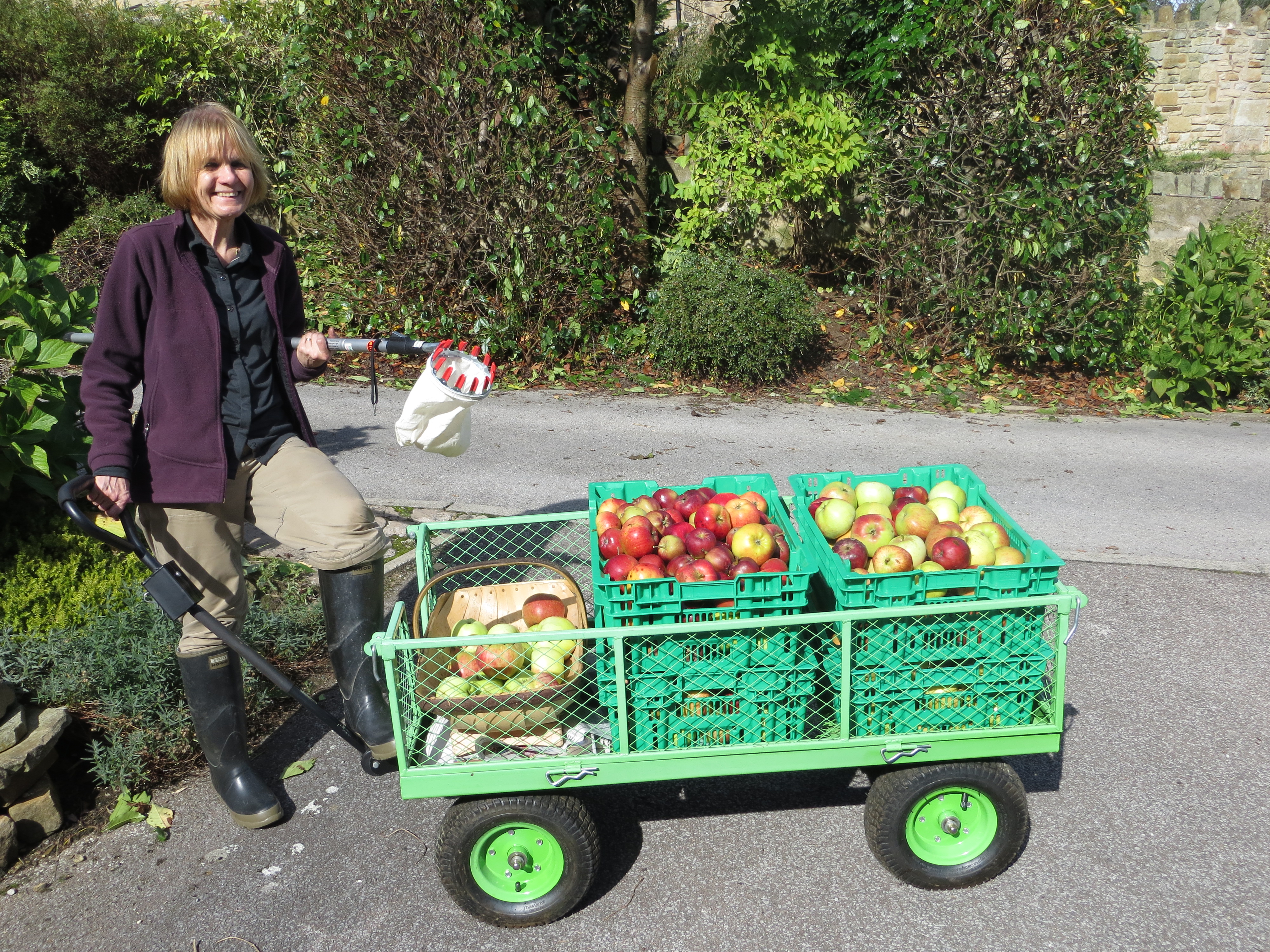
We have two apple trees, one an eater, the other a cooker – a Cox’s Orange Pippin and a Beauty of Kent; our neighbours own four, theirs all varieties of eaters. The Cox rarely produces enough apples to last us until Christmas, but the Beauty of Kent is a stalwart yielder – we collected ten trays of apples last year and did not manage to eat all of them or give them away before they began to rot at Easter – and the neighbours rarely get around to harvesting the significant yields that their trees produce in any kind of systematic way. The waste has been regrettable, but hard to address. This year, my husband decided that we should countenance it no longer and suggested that we should try our hand at making cider.

Pomace face
Correction: that isn’t what he originally suggested. At first he said that we should try making apple juice, and accordingly we bought the equipment. My husband loves embarking on projects of this kind and they all have one feature in common: they are always more expensive than he says they will be, often by many times – the pond, for example; then the beehive ‘starter kit’ (£450 would give us all we needed to maintain two colonies of bees, but we soon needed another hive and a very strange miscellany of costly equipment that looked as if it had been knocked up by Heath Robinson, not to mention the cost of the bees themselves, which turned out not to have been included in the initial figure). I don’t for a minute believe that this is because my husband has a poor head for figures or is incapable of adding up the costs of his enterprises; in fact, I’m quite certain that it’s his way of getting me to agree to them. Once he’s pointed out the entirely reasonable price attached to whatever is his latest enthusiasm, and I’ve agreed to this outlay, we have reached the point of no return and further investment, when it is needed, becomes impossible to refuse.

The turn of the screw
So it has been with the apples venture. The cheapest press proved, on closer inspection, too inferior to contemplate; the screw cap bottles that we’d saved possibly not suitable for the pasteuriser (pasteuriser? I don’t remember that being part of the discussion!), so two boxes of matching shiny new ones have been purchased; and, it turns out, we also needed a host of small tools – a bottle-drying gadget, a thermometer, muslin bags, ‘food grade’ plastic buckets, etc., etc. However, I had agreed that it was a wicked waste not to do something with the apples, so I totted up the cost (about £800) and dug out the credit card. Expensive, I thought, but a real quality-of-life-project, and at least there was nothing more we could possibly need.

And by a cider press, with patient look
Wrong!
I’ve met my husband before, so in retrospect I’m a little astonished at my own naiveté. The equipment duly came, we picked up a couple of trays of windfalls and spent a happy afternoon chopping, pressing and bottling them. I was particularly impressed with the pasteuriser, which bubbles away, and apparently doubles as a tea urn – so if we decide to hold a village fete on our lawn, no further financial outlay will be required. Enthusiastic about our success – we now had eight bottles of de luxe quality apple juice (I tried not to cost out the price of each) – I asked my husband if we’d be making another batch the following weekend.
He assumed a look that I know well: a mixture of foxy evasiveness and guileless bonhomie unique to himself. “I’ve been thinking,” he said. “There are so many apples this year, that perhaps we should have a go at making cider, too.” I shrugged. “Sure,” I said. “Why not? We’ve got all the equipment now.”
“Well, the thing is,” he said, “there are one or two other items that we need…”

Plop!

The last oozings
Upshot: we spent a further happy day in glorious sunshine on Sunday gathering up windfalls and plucking marked or damaged apples. The cider-making extras came yesterday – the additional cost was a mere £122 – and we spent the day chopping and squeezing eight trays of apples (in my case this activity was punctuated by several telephone calls to a restaurant in Krakow, of which more in a later post). We now have thirty litres of cider bubbling away in the garage, and five of the bottles of apple juice still to drink. And all of this for less than £1,000!

All that, for all this!
I must admit, though, that the experience has been so enjoyable that the outlay has been worth it and, as my husband so sagely remarked, the apple press is a beautiful piece of machinery that will last us for many more years, and eventually become an heirloom. Thinking a little more short-term, the cider should be ready by Easter and I’m sure the anticipation of it will help us through the dreary darkest days.
[Having read all this and, he says, ‘appreciated’ the tone of it, my husband requests the opportunity for a re-post riposte (guest), from his perspective. Hmmm.]
All text and photographs on this website © Christina James
“I’ve been a wild rover for many a year, and spent all my money on bleep and bleep…”
“Dost thou think, because thou art virtuous, there shall be no more cakes and ale?”
The crazy topics for which researchers are awarded grants are often a source of great amusement to me. During the past year I’ve read about a project that, after many months of expensive labour, ‘successfully’ created a formula for the ‘ideal’ slice of toast and marmalade (it wouldn’t succeed in our household, where some of us like our toast burnt and others don’t); a study that ‘proved’ that there is a link between depression and being unhappy at work; and, just this week, a piece of research that shows that the pop songs of today contain twice as many references to alcohol as the ones of twenty years ago.
At first I thought that the last of these was very funny indeed. Good on the researchers who have persuaded whomever awarded their grant that it would be a good use of scarce resources to pay them to sit around endlessly listening to pop music. More power to their (drinking?) elbow. But now I’ve had time to consider, I’ve begun to wonder if there isn’t something more sinister afoot here. Assuming that this study is not entirely mindless and redundant, to what use is it intended to be put? Is the government going to start censoring pop songs? If so, it would very decidedly be the thin end of the wedge. It’s not just about pop music: from the earliest times, alcohol has been a part of almost all cultures, as is reflected in their art and literature. Just imagine what would happen if a Nahum Tate style of censorship were to be applied to books. Offending works would have to be covered in brown paper, and an approximation of their titles offered instead:
• Tizer with Rosie, by Laurie Lee
• Irn Bru Galore, by Compton Mackenzie
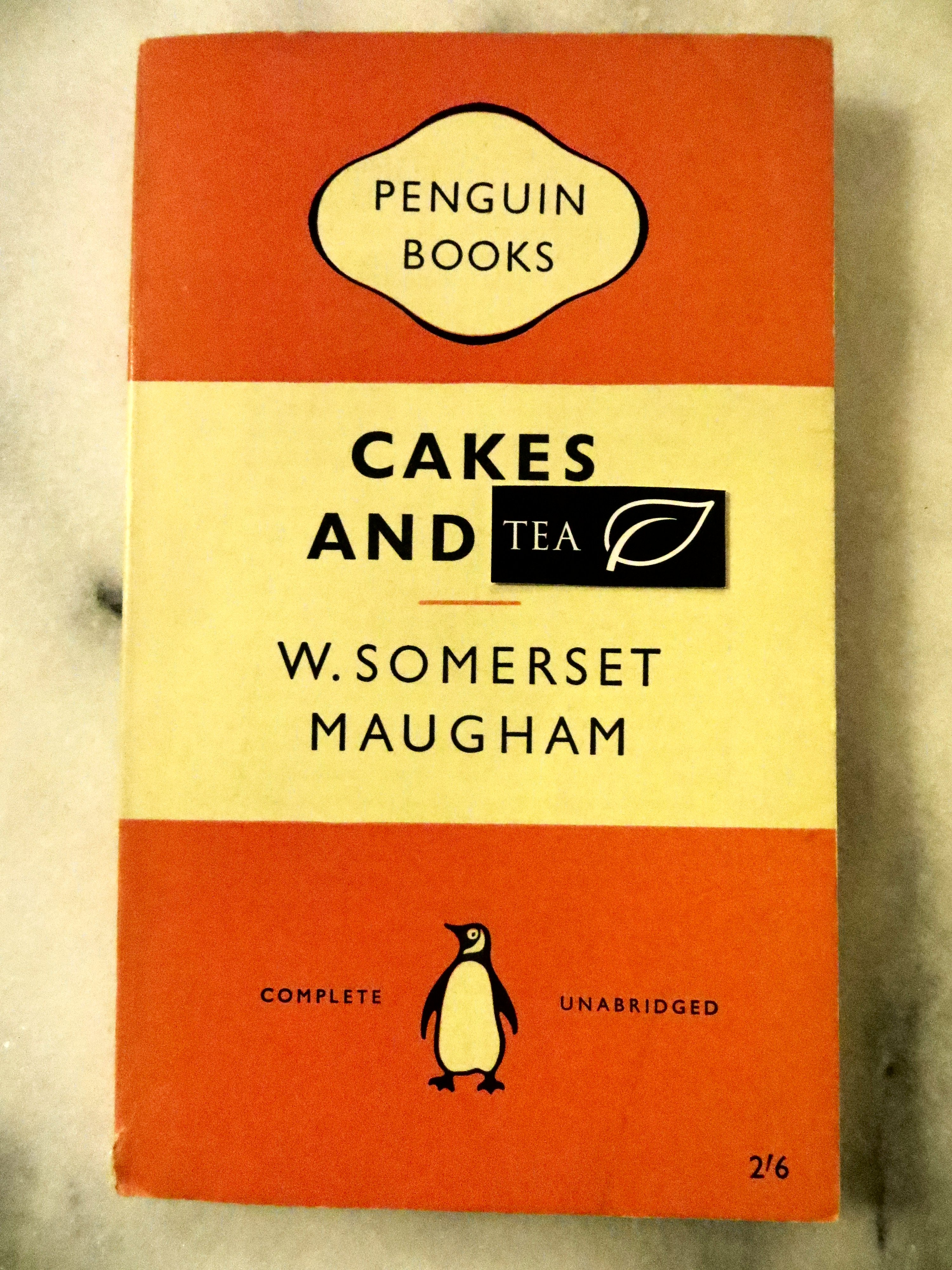
• Cakes and Tea, by Somerset Maugham
• Dandelion Juice, by Ray Bradbury
However, having to alter the titles would be a mere bagatelle compared to the changes that would have to be made to the works themselves. Homer’s ‘wine-dark sea’, almost his trademark description, would have to become the ‘grape-juice dark sea’; Lady Macbeth would have been stuffed if, instead of being able to observe, as the grooms slipped into a drunken stupor, ‘that which hath made them drunk hath made me bold’, they’d all been swigging elderflower water and sitting up playing cards, as lively as crickets; and ‘wine, women and song’ (which I’ve just looked up, and find, to my amazement, that it is a saying usually attributed to Martin Luther) would not have the same ring to it if it became ‘water, women and song’.
I jest, but I am also being serious. This type of statistical analysis is not only nonsense, but also very dangerous. Cultures cannot be manipulated, and even if this particular statistic is true, it doesn’t necessarily mean that society is becoming more decadent. One interpretation might be that, at present, writers of pop songs are going through a very literal phase, which may mean that there are fewer double entendres to pick up on and correspondingly more overt references to be spotted by the earnest conductors of surveys. The pop songs of my youth were full of allusions to drugs, drinks and sex, but many of these were disguised. I wonder if present-day researchers would have spotted them? Self-evidently, also, my generation survived and turned out to be no more or less decadent than any other. Culture must be allowed to regulate itself.
If the government interferes in this, you may find me in my local singeasy.
 Christina James, crime novelist