

The Village: Short story opening 1.
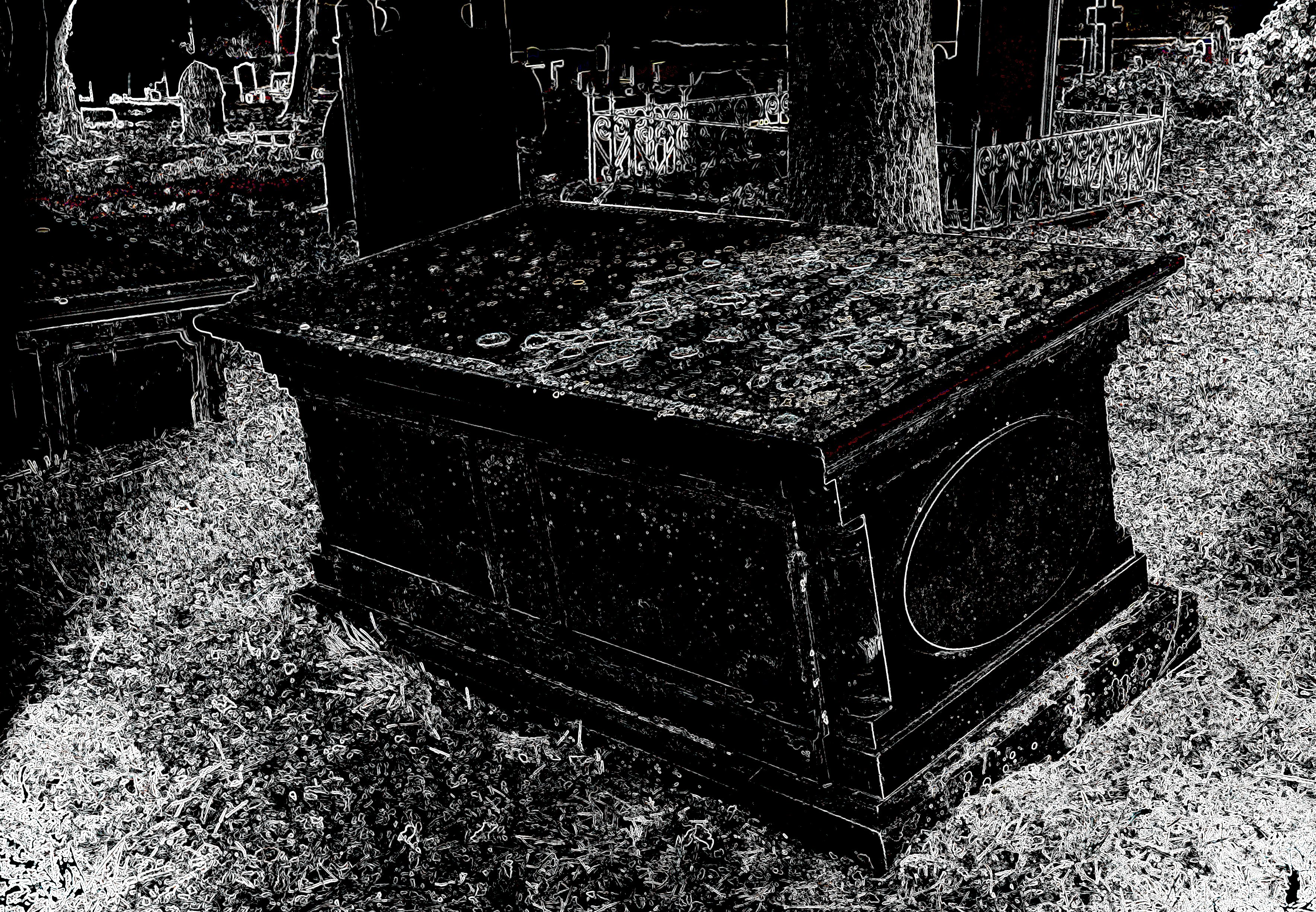
It was a long walk through the village. She paused at every entrance, every house. Dogs barked as she passed. The wind was high and there was a full moon, so that she could see the grim storm clouds sweeping by. Her leg was hurting.
Light winked palely from one or two of the houses. Odd that they were not shuttered. She paused at the junction and braced herself to climb the steep hill to the church. She hoped her leg would bear it. She passed the Hall and then the home farm. She had put every vestige of light behind her now. There was nothing but the long dark stretch past the yew hedge to the churchyard.
She was walking more slowly… and not only because of the pain in her leg. She was not afraid of the churchyard, certainly not of death or the dead, but she felt an intense loathing for the place, a terror of returning. It had been a very long time since she was last there, or so she thought; her memory played tricks on her occasionally; she knew that.
The path was bumpy. The yews huddled together, dense gatekeepers of the consecrated ground. A car rounded the corner suddenly, raking her with its headlights. She could see the driver’s face; she thought that he looked startled.
She rested against the low wall next to the yews. When she was a girl, people had said that they’d been planted here by Druids; that they had been here long before the church and were the reason that it had been built here.
She rubbed her leg; it did not help the pain. She crossed the road, so that she was standing under the lych-gate. She heard a strange noise – a squeak or a suppressed laugh – and it alerted her. She peered into the grey of the churchyard. The broken table tombs nearest the church door loomed out at her, but she could see nothing else.
Miry March in South Holland
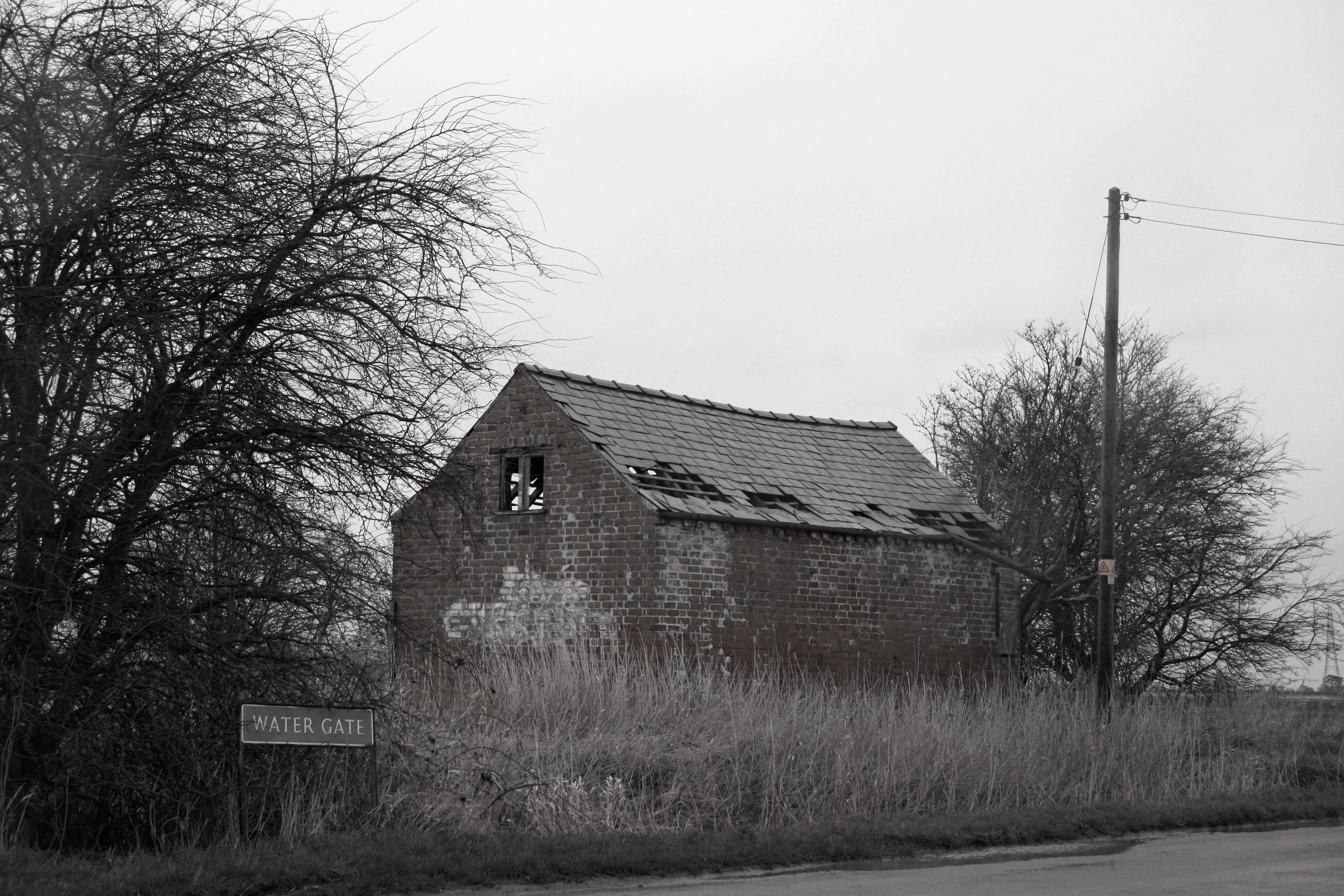
At Quadring Eaudyke the drains run, easing the water from the earth. Watergate and Rushy Drove sing their names of fen and farm to the listening land. Lincs Pumps and Pipelines are in business. Now muddy, mid-March Lincolnshire leans to the spring as tractors tread the acres, their mighty ploughs furling multi-shared furrows, bright with gleaming soil and screaming gulls following to feed, heads black with breeding splendour. Close to the dyke, a fancy pheasant fluffs a whirr of wings and ruffles up a creck-creck call to hens, subsides and pecks again.
Everywhere, home-made ‘Mud on road’ signs celebrate the gloriously spreading feast of mire, while ‘Leeks for sale’ promote the remaining winter crop, with a field half-plucked and batteries of trimmed, pale white and green vegetable bounty on boxes on the verge. The cabbages are past their best: sheep graze the leftovers of leaves and stalks or browse the dedicated crops of roots.
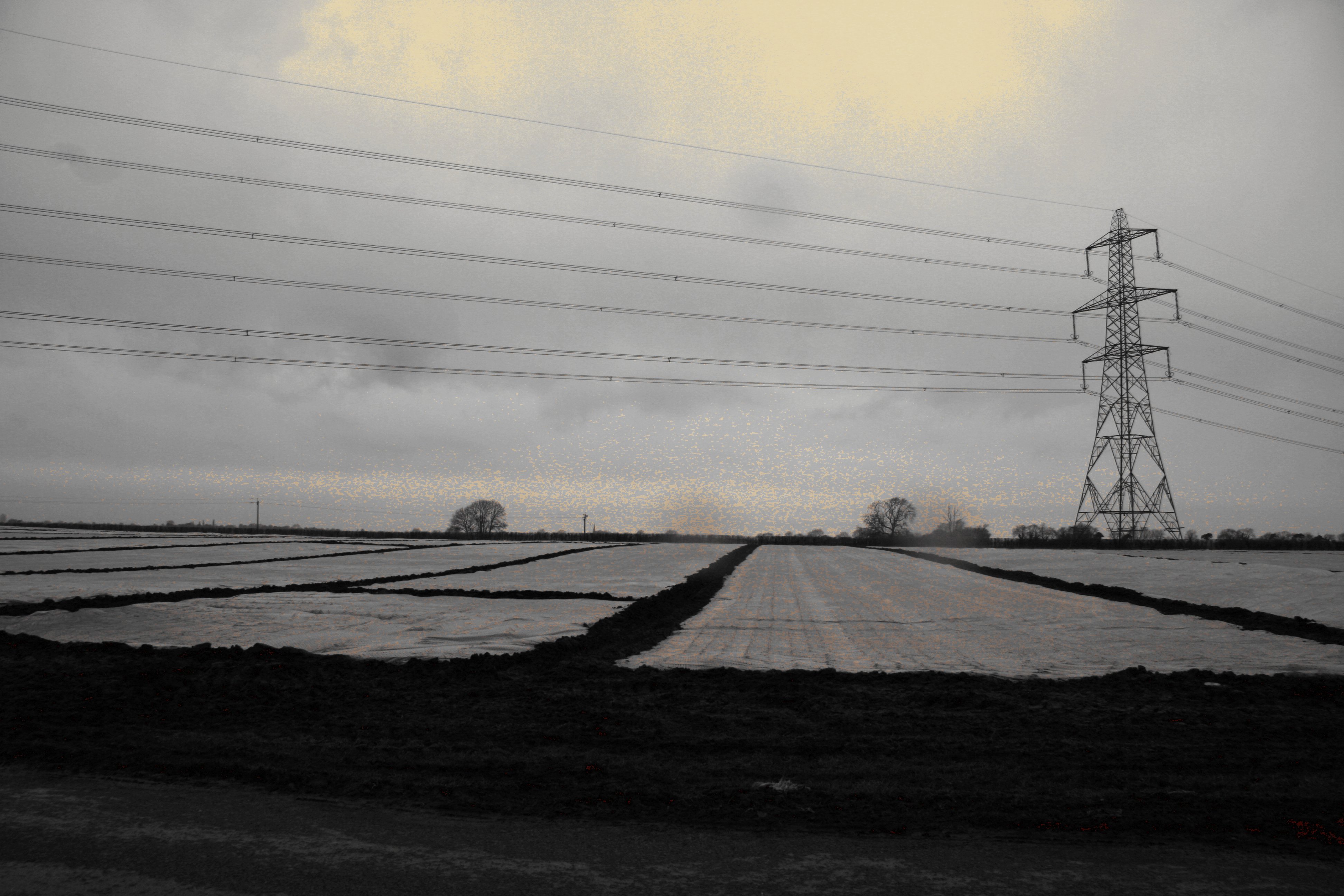
And now, against horizons of leaning spires of churches, metal frames of pylons and grey skies that don’t just threaten but pelt with slanting rain or driven snow, so fickle is the season, roll in the rippling tides of plastic sheeting spread on soil and seed to speed new growth.
And further south, where Surfleet Seas End and Moulton Seas End mark where once the real tides washed ashore, down towards Peppermint Junction, vast swathes of Taylors Bulbs are already deep green and undulate in windy waves; glass houses feed the nation’s supermarkets and those abroad with tonnes of early daffs, with millions of blooms to follow from the open fields. It might be Holland, and is named so, the land reclaimed and drained by dykes twenty feet wide and plenty deep. Here the banks of smaller dykes, protected from cold North Sea winds, have daffodils and periwinkles full in flower, with snowdrops hanging on in drifts of white. Above them, weeping willows are bright yellow with swelling buds and pussy willow catkins grey with fur.
It is spring in the Fens, though the harshest of winter weather still beats in from the east, and the casual passing eye might miss the signs that tell people here that the dark season is done.

Here’s one I prepared earlier…
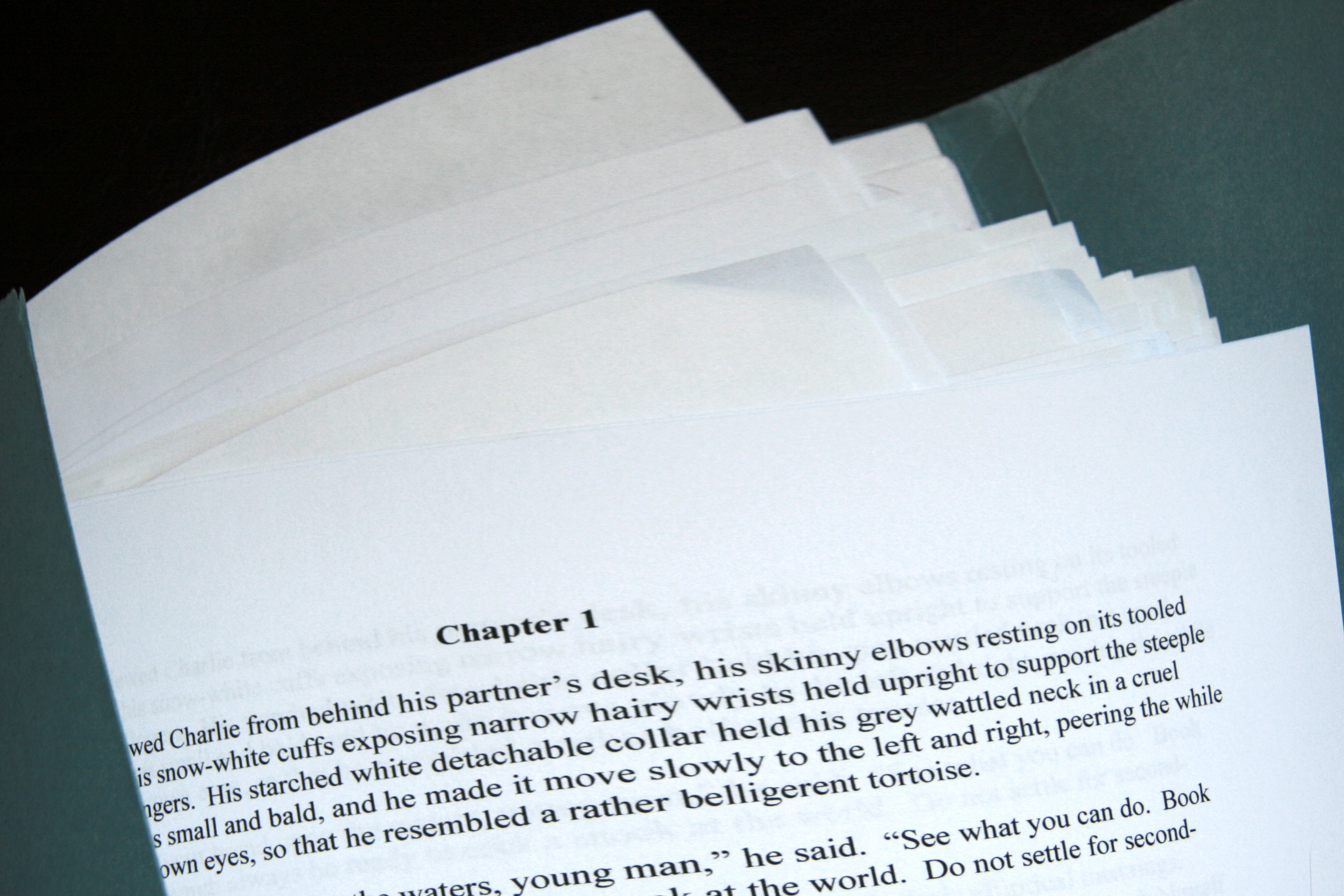
Many published novelists have as many as five or six books which have never made it to the wide open spaces of the reading landscape. They often refer to them, accompanying their remarks with jokes about where the manuscripts now languish, but, unless as authors they achieve mountain stature, that is all the world will know of them. Rather than bewail the fact that this one of mine didn’t ‘make it’, I thought that you might like to rummage in my reject pile for fun. This one, in fact, I never tried to publish; it’s based on the life of my old boss, whom in the novel I call ‘Charlie’, and here are the opening paragraphs:
Uncle Henry viewed Charlie from behind his partner’s desk, his skinny elbows resting on its tooled leather surface, his snow-white cuffs exposing narrow hairy wrists held upright to support the steeple of his wrinkled fingers. His starched white detachable collar held his grey wattled neck in a cruel grip. His head was small and bald, and he made it move slowly to the left and right, peering the while through his dull brown eyes, so that he resembled a rather belligerent tortoise.
“Go forth and cast your bread upon the waters, young man,” he said. “See what you can do. Book yourself into The Grand: always be ready to cock a snook at the world. Do not settle for second-best.”
Charlie was growing used to Uncle Henry’s disjointed homilies, with their elliptical meanings. Working for the old man was actually quite good fun, because he hardly ever did any work himself and left Charlie to get on with the job as best he thought fit. Not to put too fine a point upon it, despite his respectable exterior, Uncle Henry was often blind drunk.
Uncle Henry was a profoundly depressed man who did not see why his depression should get in the way of making lots of money. The causes of his depression were irreproachable: his unspeakable experiences during the First World War, which he still refused to discuss with anyone, though he threw out opaque hints occasionally, and the fact that he and Evadne had no children. Evadne was Charlie’s mother’s eldest sister, and since adulthood had been an invalid in a wheelchair. Charlie did not know why she was unable to walk, nor if her indisposition was related to her childlessness. She was a fearsome woman. She had the heavy Stanningley face and masses of dyed black hair. Charlie disliked going to see her, though he found her liberally-applied make-up quite fascinating.
Uncle Henry, who had already made two fortunes, one running a private school for boys and the other running an hotel (both had now been sold), thought that times were propitious for making a third. The war had been over for almost three years. The wives of the young men who had returned were busy having children and the government was even busier investing in houses, hospitals, clinics, schools and libraries to make the country a better place for these children as they were growing up. The old man did not necessarily approve of the social egalitarianism towards which all this effort seemed to be tending, but he did like the idea of the investment… particularly in libraries.
Uncle Henry had begun to take an interest in libraries before the war, when he was still a headmaster. A councillor friend of his had tipped him the wink, telling him that new reforms would mean that the post of chief librarian in the county would become a proper salaried one, instead of a sinecure with token gratuity attached. As was customary since the library service had been set up in the early years of the century, this post was currently held by a well-connected local lady who did not need to work. Of course, this lady would not be suitable to hold the well-paid position that it was about to become and Uncle Henry was invited to apply.
February Fenland


Somewhere, in the middle distance, there is the sound of sighing, the susurration of dry reedbeds in the breaths of the first, softer, south-westerly winds of the year. Zephyr-mild and whispering the warmth of a climbing sun, these breezes are the harbingers of a brighter time to come. The colours of the February Fens are muted yet, with the fawns of stubble acres and last year’s broken sedges; the raw umbers and charcoals of the turned soil; the sky is still ice-blue.
The dykes are snow-melt bright, surface-painted by the leaning lines of power poles that disappear into distance. Mallard, pochard and teal splash to landings on open water; the geese are already on the move. South-facing banks and scrubby corners by tumbling corrugated sheds are stirring with life; a dandelion blooms; the cheerful, chirpy two-tone of great tits rings from the elders and the wren whirrs amongst the brambles. The blackbirds are already building in the holly hedge by the farmyard wall. Look closely and the sap green spears are thrusting; round village ponds the daffodil buds are clustering. More cold may come, but, inexorably, the Fens are swelling with warmth and light and water, a hope-filled harmony of growth and life. The land is rich with promise, with gilded silt.
February swings its way between the seasons, but the farmer eyes the sky and sniffs the air, kicks the drying turf and sees the scales dip into Spring; the Fens will soon open again to the ploughshares and the seed-drills. Soon… soon…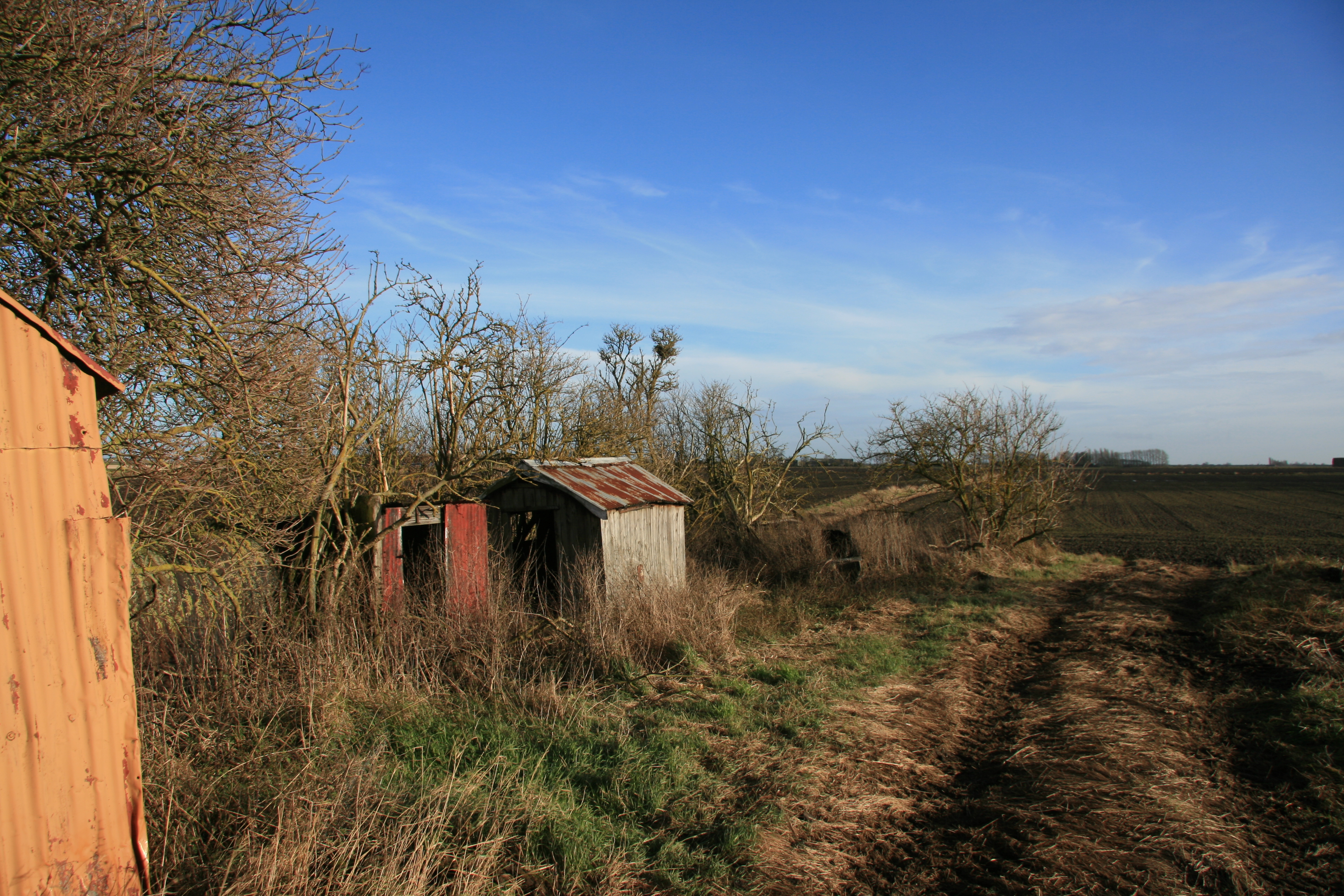
Murder on the Grand Central Express

Yesterday, making my first real foray from home since the snow came, I travelled by train to London.
I boarded at Wakefield Kirkgate, once a proud Victorian station of almost Downton Abbey proportions, now a sad and sinister derelict shell. It is quite a frightening place, especially after dark, and has been the scene of various robberies and at least one violent rape. However, it is also the station at which the magnificent Grand Central trains halt on their way to London King’s Cross. It is therefore well worth press-ganging my husband into temporary service as bodyguard. He waits on the platform with me so that, later, I can enjoy the luxury of the first class carriage, with coffee, biscuits, newspapers and wifi included, for the modest price of £60.
Perhaps because these trains are so luxurious, I began to think of Murder on the Orient Express, in which Agatha Christie skilfully shows that any of the passengers could have been capable of murder, before inviting the reader to identify who dunnit. I had to invent both a victim and also a motive for each suspect when I began to scrutinise my fellow passengers to guess what their favoured modus operandi for murder might be. Like Agatha Christie, I assumed that every one of them would be capable of the deed.
The man sitting diagonally opposite me was a businessman from Halifax. I know this, because, in a loud voice, he was telling the man sitting directly opposite (evidently a very new buddy) about his various boardroom coups and how he spent the money that he made: Mr. Conspicuous Consumption with a county veneer; he’d kill, to prove that he could do it, and want to ensure that both murder and weapon were as ostentatious as possible; and he’d wriggle out of punishment afterwards. An antique Purdey shotgun and a faked hunting accident would be his choice.
The new buddy, when he could get a word in, proved to be a genial and mellifluous Irishman: short cropped hair, John Lennon spec.s, shabby grey suit; one of the original sleeve buttons had evidently been lost and incongruously replaced with a bright pink one, slightly larger than the others. Conspicuous Consumption should be wary of him if they leave the train together. Mellifluous Irishman’d be capable of taking CC to a deserted spot, withdrawing a long, slender stiletto from one of the baggy inner pockets of that suit and thrusting it into CC’s heart, all the time keeping up the cheerful chatter about dead cert horses and racing greyhounds. Money would be his motive. Afterwards, MI would slip away through the wet and silent streets and fling his stiletto into the canal. The police would never track him down.
What about the Chinese Yummy Mummy, glamorously dressed to keep out the cold in champagne-coloured Rab jacket, fur-lined hood and aubergine leggings, her small feet shod in tiny suede boots? She was accompanied by a little girl of five or six, a mini-version of herself. Her immaculately made-up face had a wary, shut-in look. Once married to a rich man, perhaps; now a single mum determined to preserve their former lifestyle for herself and the child. If the rich man didn’t play ball, he would cop it before the divorce came through, while she was still legally the main beneficiary of his will. She’d have to be careful, though; she wouldn’t want to upset the child and, for her, there would be a double imperative to avoid prison. Poison would be CYM’s agent of choice, administered through some item of food delivered to defaulting rich husband when she was many miles from the scene. The police would suspect her, but they’d never find the proof.
Several seats behind me, an elderly woman wearing a long red coat (which she had not removed, though the carriage was well-heated) lay alternately dozing and looking round her with shrewd blue eyes. She had a mannish face and thick grey hair cut in a cropped, no-nonsense hairstyle; it was relieved from being a short-back-and-sides only by the crimped quiff swept back from her forehead. Mrs. Well-Upholstered Lady. She was a past mistress at her art. She’d had a long and eventful life: plotting her murders carefully; moving all obstacles as she continued on her relentless journey. She would have brooked no opposition along the way, whether it had come from troublesome lovers in her youth, her timid but irritating husband in middle age, or, more recently, the ancient aunt of whom she had been quite fond, but who’d already lived far too long when she’d begun to dissipate Mrs. W-UL’s inheritance on nursing home fees. A different MO every time for her: one of the lovers had been dispatched after she’d tampered with the brakes on his car; the husband had died from carbon monoxide poisoning from a faulty gas fire – she’d happened to be away at the time; she’d visited the aunt in the nursing-home every day, tenderly administering food and medicine, increasing the dose just a little bit on each occasion. Hers were all ‘perfect’ crimes: never suspected; never investigated.
According to my imaginings so far, every one of my train murderers would have got off scot free. Although in my novels not all the perpetrators pay the penalty, some are always caught. Otherwise, that all’s-right-with-the-world denouement of which I’ve previously written could not be achieved; so, I’ll have to re-visit. Which of the train murderers might be apprehended, and by whom? I’d put my money on CC and CYM: he, because he wouldn’t be able to resist boasting of his plans; she, because she’s a nervous novice who’s never committed a crime before (she is overheard on her mobile, spilling her heart out to a friend). MI and Mrs. W-UL? Too fly by far.
And who would catch CC and CYM? The guy serving the free coffees, of course: a detective in disguise all along. They made a fatal mistake: they should have travelled standard class.
My journey to London with Grand Central passed very quickly…
Fenland January

The curved blade of the weather front slices across the land; the air is Atlantic grey; a scimitar’s shining sweep from Biscay to Malin clangs with cold continental iron and the snow swirls and falls, whirling in the wild eddies of the sky and smoothing the humps and hollows of the ground. The curved blades of the ploughs bite into the drifts and fling furls to the roadsides, filling the dykes and walling the verges to the height of a man. Daylight is delirious, hurled raving into the enveloping dark, its face stinging and burning with blown ice; there is no respite.
Communities huddle indoors and peer out at the powdered flecks flowing past dim streetlights. The enormity of the sky hangs over them; the outside closes round them; they are excited… and awed. The need for food and warmth and shelter has primal significance and ancient firelight flickers in their eyes.
Morning is still, with no sun. In every direction, flat fields stretch into a gloomy distance. Trunks and branches of solitary trees are black, and white with snow and rime. More snow will come.
Silence enfolds the January Fenlands.
Fiction is always popular at Christmas.

Not a cliché in sight…
And so (thankfully), with Santa, arrives the end of whatever insanity there was in 2012; the nation turns its attention to sincere goodwill, especially within the family, which gathers itself for its annual affirmation of mutual affection. The family cat, never happier than when the visiting throng appears, admires the tree at close range and wonders why its usual spraying spot has moved indoors (a convenience, indeed!), before admiring every wonderful bauble at very close range; the family dog, always willing to share the festive joys, has quietly disappeared Auntie Sheila’s present of special diabetic chocolate to a quiet place behind the armchair, to keep it safe.
Everywhere outside, good taste is measured by the colour and quantity of festive lights. Nowhere is more friendly than the supermarket checkout, though the car park outside comes close. Road peace on the M1 near the Meadowhall mall prevails. The weather does its best.
Everything bodes well: television listings are inspirational; not a cliché in sight. There is peace in heaven and on earth and all is well.
Enjoy the break. Enjoy the total cessation of crime and violence. Enjoy the sanity, and Santa. If all else fails, there’s always fiction!
(Oh, and this blog!)
1979: Who will be next?
Bus-stop
The bus-stop in Rothwell, outside Leeds, at seven-thirty on a gloomy December morning. Bus to work at a library supply firm. No-one around. Passing cars loom and lighten the interior, then pass into the greyness of the day. Drizzle. No-one around. The woman waits and watches for the bright interior of relief that the bus will bring: the friendly exchange with the driver and the lurch into the seat; familiar travelling faces and forms; the comfort of not being alone in the bus shelter on a lonely strip of dual carriageway… No bus. No-one around. The cars and the time pass by. She glances up and down the dark pavement; peers through the road grime of the window at the outline of the van in the lay-by: fifty yards of a woman’s fear are one step for the out-sized monster of imagination, heart beating, with hammer blows. Van door opens; burly shape steps down and to the rear doors. No-one else around. Her heart is banging in her; her grip on her bag-strap is knuckle pale in the gloom, but she has no eyes for that. A door slams; an engine churns into life and an ordinary van man’s day goes on. The bus stops; she gets on, with the over-the-shoulder dread of every woman in Yorkshire. It is 1979 and each murder takes its toll on the collective consciousness. I am that woman.
A novel landscape, painted
 To put them in perspective, fen fields spread themselves across the soaking canvas of the day and dwindle to a vanishing point where telegraph poles lead. Dykes drip heavy with the wash of weeks of wet, whilst rooks, their nests in the bare tops smudges on the sky, are flung in tattered black splendour by a flick of the wind’s brush. Tireless turbines turn their silhouetted blades above the clumps of tiled farms, spattered across the silvery dark soil. Laid on with nature’s knife and worked by man, the texture of the ploughed and fallow acres is rough as tractor ruts and as harsh to the eye as to the boot. Walk the landscape and feel the centuries soaking through from
  swamp to sown and pastured plains, where the reeds whistle and the unrelenting pressure of the air hurts the eardrums and vibrates.
It is December here, painted in my head, a Lincolnshire land in me, inbred. I’ll write about it.
The Cold Caller: a very cool crime novel (in brief – the antidote to NaNoWriMo!)
 Streaming cold… cold medicine… stream-of-consciousness cold… cold front… Coldstream Guard… cold war… out in the cold… in cold water… cold feet… cold woman… cold-hearted… cold comfort… cold meal… cold meat… cold turkey… cold sweat… cold cuts… cold steel… in cold blood… out cold… stone cold… ice cold… deathly cold… dead cold… dead, cold… laid out cold… in cold storage… trail cold… cold crime… cold-shouldered… cold case… cold facts… in from the cold… case solved.
Chilling.
Hot stuff!
 Christina James, crime novelist