

All in the mix and the muddle

Plotting the plants
I was amused to read that the judge’s direction to the jury in the Vicky Pryce case included an instruction to avoid taking notice of irrelevant detail so that they ‘could see the wood for the trees’ and therefore ‘avoid red herrings’ when deciding upon their verdict. Mr. Justice Sweeney had good cause for making the point, having already had to discharge one jury for incompetence, even though his use of the English language might have been open to debate. It made me wonder if judges are often guilty of introducing mixed metaphors into their summings-up or directions to juries.
A Google search reveals that, in July 2011 in the USA, Kenton Circuit Court judge Martin Sheehan summed up with the following words his feelings about a trial during which a new (potentially harmonious) development had emerged:
‘Such news of an amicable settlement [has] made this Court happier than a tick on a fat dog because it is otherwise busier than a one-legged cat in a sand box and, quite frankly, would have rather jumped naked off a twelve-foot step ladder into a five-gallon bucket of porcupines than have presided over a two-week trial of the herein dispute, a trial which, no doubt, would have made the jury more confused than a hungry baby in a topless bar and made the parties and their attorneys madder than mosquitoes in a mannequin factory.’
No doubt this judge spent some time on crafting his words in order to achieve the courtroom-stopping hilarity with which he was rewarded. Almost certainly, his mixed metaphors were constructed deliberately, which shows that, pace the correct usage that was taught at grammar schools like my own, the mixed metaphor can be legitimately deployed for colourful and arresting self-expression and, by extension, permitted, if used carefully, in ‘serious’ fiction.
I’m even more inclined to champion my last point after looking up ‘mixed metaphor’ on a scholarly publishing site. Here I found the following:
‘The paper explores the phenomenon of metaphors that occur in a close textual adjacency, i.e. as metaphor clusters, but do not share a similar cognitive basis. Clusters frequently mix ontologies and are thus devoid of coherence that can be explained as emerging from a single conceptual metaphor. Evidence to that effect comes from a British corpus (Sun and Guardian) or 675 newspaper commentaries covering the 2004/05 EU referenda (in all, 2574 metaphors).’
Wow! And what I have quoted is only one third of the abstract of the article! I have not read the full article (a full download has to be paid for with sweat and brass), but it might be worth the subscription price, as it would appear to prove the meat and drift of my argument. Furthermore, I’d be very intrigued to read the author’s comparisons between the texts of two newspapers that have until now (because of the rich and fertile loam of their respective word wombs) seemed to me to occupy the opposing poles of the literary spectrum! Could this be the equivalent of mixing bullshit with champagne? Or a blend of codswallop and caviar? Or the gutter and the galaxy?
Too much lead and levity for one day. Must get back to plotting the plants in my next crime novel.
The oddest book title…
I’ve just read that the shortlist of six titles has been chosen for this year’s Diagram Prize for Oddest Book Title of the Year. This is the thirty-fifth year that the prize will have been awarded, although I became aware of it myself only a few years ago.
I’m not sure about the candidacy of Was Hitler Ill?, by Henrik Eberle and Hans-Joachim Neumann [Polity]. As I’ve read several books about Hitler’s state of health and his bizarre use of both conventional drugs and quack remedies, this seems to me to be a perfectly logical choice of title – and I’d guess that the authors intend it to convey irony as well (Was Hitler Sane? might make me sit up more).
Lofts of North America: Pigeon Lofts, by Jerry Gagne [Foy’s Pet Supplies], is perhaps quite amusing, but anyone familiar with the many minority publications that America’s huge population is able to support will know that it is not out-of-the way extraordinary; for example, when I was a bookseller, I remember deciding that the title How to Raise Your Own Barn was unlikely to thrill the UK public library community that I served at the time.
I am slightly disdainful of God’s Doodle: The Life and Times of the Penis, by Tom Hickman [Square Peg], as being a bit of a boys’ snigger title (I remember I once attended an author event at which Claire Rayner was speaking, when she amused the audience by saying that she was convinced that ‘every man was born with a ruler in his hot little hand’). I’m sure that Carol Midgley (The Times) would comment very bluntly on this particular choice!
How Tea Cosies Changed the World, by Loani Prior [Murdoch], succeeds with its juxtaposition of the mundane and the all-encompassing, but it doesn’t make me fall about; and Goblinproofing One’s Chicken Coop, by Reginald Bakeley [Conari], is an arresting title, but (as one who lives in an area richly populated by foxes can testify), if ‘Goblin’ is taken as a pseudonym for Mr. Tod, it becomes a perfectly plausible one.
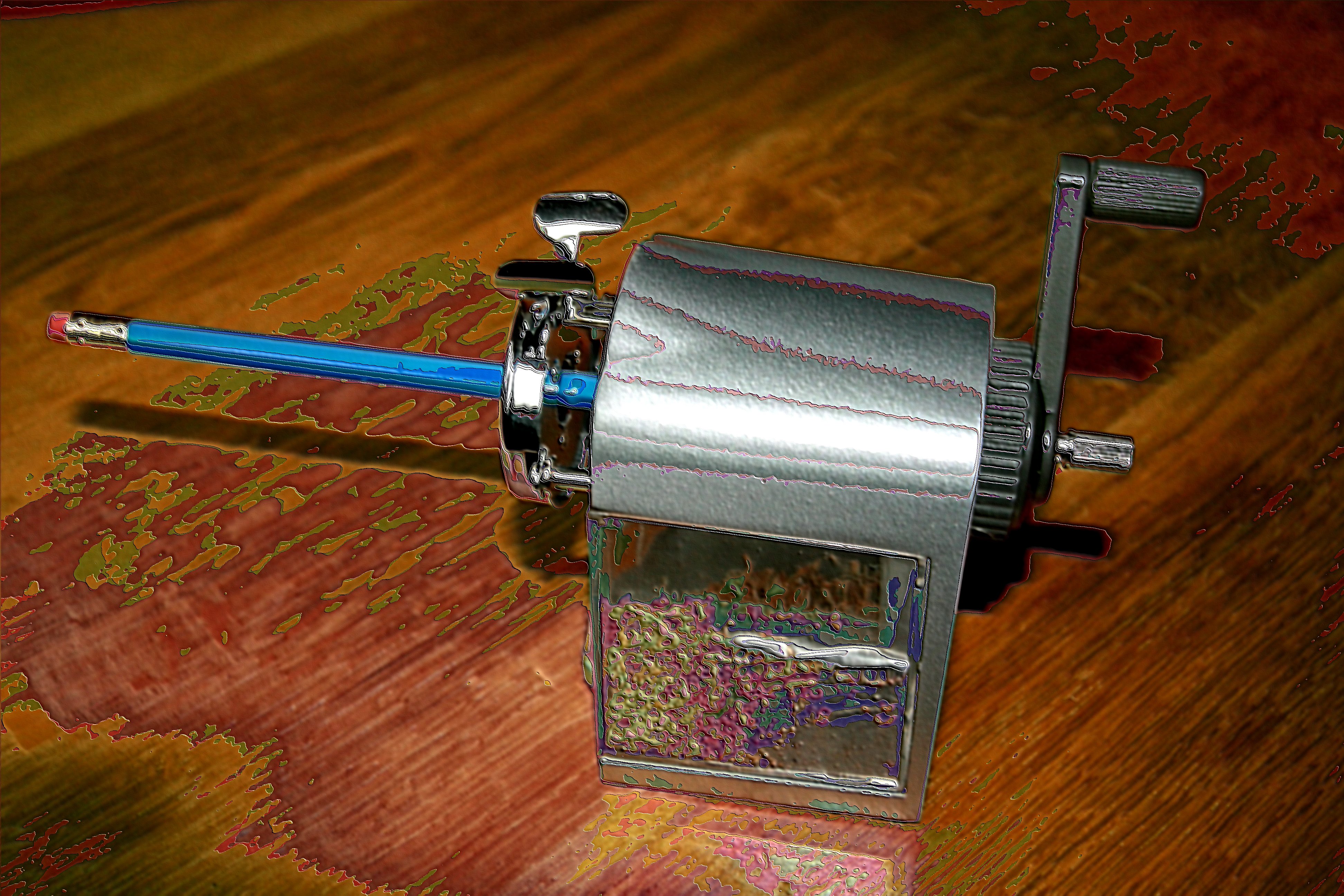
So what is my tip for the award? I’d give the prize to How to Sharpen Pencils, by David Rees [Melville House]. I take my hat off to anyone who can write a whole book on this topic… And now my quirky memory takes me back more than a couple of decades, to the bossy, humourless teacher of my son’s reception class, who told me with great condemnatory contempt that he spent all of his time sharpening pencils. So sadly uninspiring (by comparison with the many vital, enthusiastic and creative teachers he subsequently had the good fortune to know) was her manner that I could quite understand his interest in playing with a pencil-sharpener, especially (for him) as it was one of those desk-mounted ones, with an exciting handle to turn. I should like to make her a present of this book!
Gosh. I hadn’t realised just how much she still rankles in my memory!
Richard III: ‘a serviceable villain’?

My interest in Richard III was kindled when I was a young bookseller, because my boss was a member of the Richard III Society. I’ve subsequently read several books about the Wars of the Roses and also visited Richard’s castle at Middleham. That he had strong links with Yorkshire has increased his fascination for me.
Few English kings have inspired such intense posthumous opinion as Richard. Henry VIII, Charles II and George III have all had their fierce supporters and detractors, but none has had vitriol heaped upon him as Richard has. He could hardly have been as wicked as he was reputed to be; his shimmeringly evil reputation, much enhanced by the distorted character that Shakespeare created to please his Tudor mistress, even had the unintentional effect of giving him the same kind of glamour as Milton’s Satan. Shakespeare was also responsible for exaggerating his physical deformities; unlike Dorian Gray three hundred years later, the fictional Richard’s evil soul was supposed to have been made manifest in an ugly face and twisted body.
The Richard III Society was founded to put the record straight, but, like almost all societies that support the memory of controversial historical and literary characters, it quickly became so partisan that some of its published ‘research’ stretched the facts. Nevertheless, it is to one of its present-day members that we are indebted for the discovery of Richard’s remains under a car park in Leicester. Amazingly, modern science, in particular miraculous DNA matching techniques, proves conclusively that the bones did belong to this last Plantagenet king. I am sure that a great book will come out of the story of their discovery and testing (which, as last night’s Channel 4 programme showed, has been meticulous).
In the popular imagination, Richard’s worst act has always been his reputed murder of his two nephews, the so-called ‘princes in the tower’. They were the heirs of Edward IV. The elder of them, Edward V, was never crowned king, but the title was reserved for him, even so; the next King Edward was crowned Edward VI. There is no proof that Richard killed the two princes. It is known that they lived in the Tower of London for many months and gradually disappeared from view; first they were seen playing frequently, then infrequently, then not at all. Although it is fairly certain that bones discovered in the tower in the late 1990s belonged to the princes, there is no conclusive proof of who murdered them. Was it indeed Richard? Or did the order come from Henry VII (the preferred candidate of the Richard III Society) after his accession? Of course, I don’t know, though I’d rather like to think it was Henry myself, partly because Richard has always been such an underdog, partly because Henry was a cruel cold fish of a man. He was certainly capable of killing them.
Whoever it was, the outpouring of emotion that this murderous act has generated is illogical. Perhaps it is because they were children; perhaps because one of them was a king and kings were sacred. Yet there can have been no king between William I and Richard III who did not commit murder, except, perhaps, Henry VI, who was himself murdered for the national good; and, although the Tudors themselves considered the murder of kings to be taboo, Shakespeare’s own queen, Elizabeth I, herself killed an anointed queen, Mary Queen of Scots. I conclude that Richard’s infamy stuck because of the genius of Shakespeare himself. The beauty and the irony of these famous lines have touched every generation since they were written in 1592:
Now is the winter of our discontent
Made glorious summer by this sun of York;
And all the clouds that low’r’d upon our house
In the deep bosom of the ocean buried.
The bones retrieved from the car park were of a slight and delicately-formed man; he did, indeed, suffer from scoliosis, but it probably only made one shoulder appear slightly higher than the other; otherwise, he may have cut an attractive, even a refined, figure. I should never want to lose Shakespeare’s magnificent villain, but perhaps now that the real Richard has been found, he can co-exist with his alter ego. There is surely room in our heritage for both of them.
My literary perspective of ‘Life in the United Kingdom’…

I’m not usually a big drum banger, but the announcement yesterday of a new version of Life in the United Kingdom, the handbook for would-be British citizens, has got under my skin. I’m familiar with the previous version of this publication, because my daughter-in-law bought it last year to prepare herself for her (successful) bid to become a British national. In the process, she learnt and understood much more about British law and customs (according to the handbook, that is) than any of the born-British members of the family and we were amused and slightly alarmed by the number of hoops through which we should have been unable to jump if we’d had to renew our own citizenship. The sports questions would have been a particular nightmare for me, who eschews ball games and much appreciates walking in deserted local woods and parks on Saturday afternoons when there is a ‘big match’ on. Love of the countryside would seem not to qualify me for being a fine, upstanding Briton.
However, as I’ve said, all that was quite funny. What is not funny is the selection of British authors that, according to Mark Harper, the Immigration Minister, aspiring British citizens are supposed to familiarise themselves with. Prominent among these are Sir Kingsley Amis, Sir Arthur Conan Doyle and J.K. Rowling. I have no quibble with the inclusion of J.K. Rowling, but it doesn’t escape my notice that the two male authors have together been dead for a total of almost 100 years. Conan Doyle died in 1930, which was seventeen years before the British handed India back to the Indians; Kingsley Amis in 1995, the year in which this year’s first-time voters were born. I’m not sure what they have to teach newcomers to the UK about being British today. Conan Doyle is famous for Sherlock Holmes and a dogged belief in the existence of fairies; Kingsley Amis for an admittedly well-crafted series of novels which proclaim the benefits of casual sex, adultery and the flippant flouting of the institution of marriage.
But even this is not what makes me want to bang my drum. What I find really indefensible is that these literary choices take no account of the wonderfully-rich range of cultures and social backgrounds that British authors have come from and drawn upon in the past fifty years. I’m thinking of Monica Ali and Brick Lane; Kazuo Ishiguro and The Remains of the Day; Salman Rushdie and Midnight’s Children: all books by British writers from different ethnic origins. Surely novels like these are more relevant to the aspirations of today’s immigrants and offer more to admire in our ethnically-diverse British culture and literature than fairies and infidelity? Besides, in the view of this reader at least, they are much finer works of art.
And now for something completely different…

Jonathan Pinnock managed to get a brief, but positive, mention in The Independent last week for Dot Dash. He was delighted at this, but also a bit sorry that Mrs Darcy versus the Aliens did not attract media reviews. Though Mrs Darcy is not a crime novel, it is a crime that newspaper reviewers passed over it. I here redress the balance, for a story in which George Wickham’s character is somewhat redeemed. I should also point out, on this happy 200th anniversary of Pride and Prejudice, that no Jane Austen romance was harmed in the writing of Mrs Darcy versus the Aliens.
This book is to anachronism what well-rotted farmyard manure is to plants: in its fertile whimsical compost , you can expect to find flourishing together such conventionally-unrelated references as Natalie Imbruglia’s Torn and Sir Humphry Davy’s scientific experiments; Colin Firth’s damp Darcy shirt and Kurt Cobain’s Maggot; text (tux’d) messaging (oh-so-beautifully phrased) and carrier pigeons on the ‘superflyway’. If you are a Jane Austen purist, this book may not be for you, but don’t rush to damn it, for it is an ingenious blend of such varied stimuli as the tentacular spectacular Species film, the BBC’s Pride and Prejudice, the Keira Knightley/Matthew Macfadyen Pride and Prejudice, Jane Austen’s Pride and Prejudice, Monty Python’s Flying Circus and The Fast Show, together with a pungent flavour of The Hitchhiker’s Guide to the Galaxy, Ghostbusters and Dr Who. Its wit sparkles, whether echoing (and/or making fun of) the language, characterisation and settings of Jane Austen’s novel, or making satirical references to the absurdities of our contemporary world and its preoccupations. The language of its characters, evoking the streetwalkers of Whitechapel, the rustics of rural England, the servants of big houses and their betters, is splendidly risqué and quite deliberately bad-pun-infested; it is full of sauce.
You can go spotting other references if you wish, for they are there a-plenty, such as a hint of The Good, The Bad and The Ugly’s Lee Van Cleef, merrily moulded into an anachronistic ‘Lee Van Enfield’ rifle, or you can pick up on Jane Austen’s Mr. Bennet’s minor reference to the likely failure of Jane and Bingley to conserve their wealth and to avoid being cheated by their servants, developed into a major outpouring of their resources to scamsters; and, talking of money, Bradford and Bingley and Northern Rock step up to the author’s line to salute us. The dialogue in the dirigible (don’t ask!) has echoes of Sherlock Holmes and Dr. Watson. A satirical swipe at the annual costumed Jane Austen Parade in Bath (and, thereby, at the Janeites of the world as a bunch of zombies) is a pleasing touch to those who value Jane Austen’s work as it is, not as her ‘fans’ would have it be. Jane Austen tourism comes under a blistering attack, too, and an in-joke (with lovely irony at the author’s own expense) slaughters all of us wordmongers: ‘Best to stay clear of them writer types in future – nutters the whole lot of them, apparently.’ Even the cheating tactics of car hire companies come under fire. Glastonbury Festival and its mud is sent wallowing in a cutting thrust at our society’s modern attitudes to drugs, sex and relationships, as well as at the establishment. The two pièces de résistance of the whole book for me, however, are Mrs. Darcy’s eventually wonderfully-assertive and liberated character and, if you’ll forgive a touch of irony from a genuine lover of Jane Austen’s novels, Colin, Lieutenant Pigeon: I didn’t need a satnav ghost to take me back to the seventies and Mouldy old dough (I can hear that gravelly enunciation clearly!).
Like Species, the way is left open for Mrs Darcy II and it will be funny and absurd, like this one: ‘Too, too silly’, but a complete romp. If you haven’t read Mrs Darcy versus the Aliens, you should; it’s a frolic to enjoy on Pride and Prejudice’s birthday.
Oh, I didn’t mention Byron…
A moral question on wheels…
 According to an article by Rosemary Bennett in yesterday’s The Times, ‘An ICM poll commissioned by LV= [insurers] found that 7 per cent of families with children under 5 have had a buggy stolen, which is equivalent to 340,000 families.’ As you might expect, articles about criminal activity always grab my attention, even if, as with this one, the time for personal interest in baby buggies has passed. Time was, when opportunist vagabonds and tinkers roamed the highways and byways of England, valuable sheets put out on the hedges to dry tended to vanish, so not much changes. The rogue Autolycus sings of this in The Winter’s Tale:
The white sheet bleaching on the hedge,
With hey! the sweet birds, O, how they sing!
Doth set my pugging tooth on edge;
For a quart of ale is a dish for a king.
‘Pugging’ is a splendid word that probably refers to the tendency to steal and the quart of ale suggests what Autolycus might have bought with the proceeds from his ill-gotten gains. Today, those casual thieves with an eye to the main chance are no doubt responsible for the appearance of nearly-new buggies on online sites, where someone desperate for a Bugaboo or a Maclaren (with go-faster stripes) but unable to afford a new one may not care very much where it came from. I’m intrigued by human nature and behaviour and even more by that delicate borderline between honesty and dishonesty. The Times article says that the same poll ‘found that 5 per cent of parents admit they would buy a buggy they suspected had been stolen if the price was right,’ but I suspect that that figure is much lower than reality: Of course, we are all very moral, aren’t we? We never do anything illegal; we buy but just don’t question provenance – that’s not a crime!
Forgetting the inconvenience to the owners of a stolen buggy, which is not inconsiderable, this wavering personal morality is actually very damning; put in the position of an easy and quite cheap personal gain, we might not be quite so absolutely honest, might we? I don’t see baby-buggies making it into crime fiction any time soon, but there is a huge potential for the novelist in the portrayal of uncertain honesty, whether in members of the public or in officers of the law!
As for the proud owners of the upmarket buggy, the simple message of a full-page article is: Don’t leave it unattended.
Where There is Evil (Sandra Brown)

I have been both fascinated and appalled by the news this week that police have opened the grave of a man buried in Coatbridge, just east of Glasgow, because they think that it may contain the remains of Moira Anderson. She was a schoolgirl who disappeared late one bitterly cold afternoon in 1957, when she was out buying a birthday card for her mother. I am particularly interested in this new development because a couple of years ago, when I was unexpectedly stranded for some time at Peterborough station, I bought Where There is Evil, by Sandra Brown. Sandra Brown is the daughter of Alexander Gartshore, a Glaswegian bus driver and serial rapist and paedophile. The book was published immediately after his death in 2006 and makes a strong case for his having sexually abused and killed Moira Anderson. Moira’s disappearance was noticed immediately, because she belonged to the tight-knit community in which Sandra herself grew up; a large-scale search was mounted for her. Her body was never found. Chillingly, Sandra says that she suspects that Gartshore also killed children who came from the fringes of society; consequently, some of them may never have been reported as missing. Since the news about the exhumation was announced three days ago, she has also compared her father with Jimmy Savile, saying that the number of crimes that he committed was probably comparable. As Savile is suspected of having been, she thinks that her father was probably part of a paedophile ring.
This book made a huge impression on me. I couldn’t get it out of my mind for a long time after I read it. A key reason for this was the sheer matter-of-fact way in which it is written. There is no need for Sandra Brown to sensationalise what she has to say: her horrific story needs no embroidery. Her account of the casual brutality of life in a working-class Glaswegian community also shocks; it goes a long way towards explaining how men like Gartshore managed to hide, like Savile, ‘in plain sight’. As a child, Sandra spent much of her time protecting and supporting her downtrodden mother. She tells the heart-rending story of her mother’s pathetic gratitude when Gartshore gives her the money to buy a new grate for the fire. Sandra’s innocent puzzlement and embarrassment when her friends are forbidden to visit her house (she never finds out why; the implication is that Gartshore has made some kind of obscene overture) also sticks in the mind, as does her recollection of being sent to the bus depot with her father’s packed lunch, to find him on the floor at the back of his bus with a conductress whose knickers are protruding from his back pocket. Sandra herself eventually escapes by winning a place at university and the full maintenance grant (which she shares with her mother and still manages to survive) that accompanies it. She goes on to become an eminent teacher and patron of a charity that helps abused children.
If the remains of Moira Anderson are found in the grave at Coatbridge, I suppose that it may bring some kind of ‘closure’ (that word so well-worn by the media) to her now elderly siblings. But Gartshore, like Savile, will never now be made to face the reckoning. All the signs were there; even his own father said that he thought that his son had committed the murder. How many more children were abused and killed after Moira died because no-one in authority really wanted to listen?
Excellent women
As the New Year is a time of nostalgia and of looking back as well as forward, my husband suggested that I wrote a blog post about my old schoolteachers and how they inspired me. Although several of them were indeed inspirational and I have kept in touch with the best of them (who deserves a blog post to herself one day for her influence on my writing and enjoyment of books), I have long realised, pace Mr Gove’s pompous and destructive brand of nostalgia for old-style grammar schools, that three quarters of the teachers at my school were neither inspiring nor, in some cases, competent and most would not have survived in the outstanding comprehensive school at which my son was a pupil.
I have therefore decided instead to celebrate some of the excellent women that I knew as a child and student, in particular the mothers of my friends. My parents separated when I was in my teens – a relatively unusual event in those days and not one that they handled well – so several of these women took me under their wing and included me as if I were one of the family.
Each of them partly expressed her love by producing excellent food. It is therefore with a vivid pleasure undimmed by the passage of time that I remember Marjorie’s fish and chips, Freda’s freshly-cut sandwiches and the whole cornucopia of goodies that Florence supplied, from home-grown chicken casserole to home-made lemon curd. When I became a mother myself, I began to understand the profundity of the food / love equation. However much today’s women might achieve, they are likely to be judged by their children on the quality of their spaghetti Bolognese.
Now that women are accomplishing so much, however – including the spaghetti, which they have learned to ‘juggle’ with nappies and spreadsheets and stilettos – some rather gloomy predictions have been made about the redundancy of the male. So where do men fit into this virtuous circle of food and love? Well, the ones I know are without exception much better at a fry-up than any woman I know and each also has a signature dish that he produces with pride at times of female fatigue or temporary lack of fortitude. They’re also quite good at finding nice restaurants. They can therefore safely bask in the knowledge that their relevance is undiminished.
However, it would appear that not all men are safe. It was with considerable alarm on his behalf that I read Will Self’s BBC magazine article on the nation’s obsession with food and how we should all try to put it behind us this year. I’d be careful if I were you, Mr. Self. Measured by the food / love criterion, your relevance is looking uncertain!
Marjorie, Freda and Florence, I salute you – and all upstanding male cooks and restaurant-finders, as well!
Enjoy your food with gusto in 2013, everyone!
The magic of Christmas, in wordsales…

I looked in disbelief at the BBC online news article about the queues for the sales at the Oxford Street Selfridges, as shoppers waited to buy, by their own admission, anything that might be a bargain. Forgive me for being a Philistine about sales, as they seem to me to be artificially created to appeal to that quite basic instinct, greed, in the consumer. I’m not unhappy about a bargain, when one crops up by chance, but to devote sometimes hours to the pursuit of only a possibility seems absurd.
Of course, there are amazing book bargains to be had online for pence, trumpeted on Twitter and, for me, a worrying debasing of the real value of the works concerned. There seems to be something terribly ironic in pursuing a Kindle top rating by selling at incredible knock-down rates. I feel that a novel one has ‘bust a gut’ over deserves better treatment and more respect than this. Does the reader of a cut-cut-cut-price book have a sense of what has gone into it, or care?
I’m inclined not to tout for business in this way and, though I have metaphorically compared Twitter to a busy market where one may rub shoulders and converse with friends and strangers alike, I don’t see it as a place for selling my wares. I’m much more interested in the exchange of ideas and humour and in meeting people I’d never otherwise have a chance of engaging in conversation. Some of them might, as a result, buy my work, but because they have a sense of the person I am, not because my book is cheap.
Nostalgia: a misrepresentation of the past?
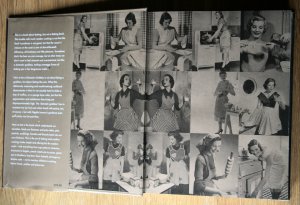 Time and again these days, I come upon newspaper articles which extol the virtues of the food of the late fifties and sixties. I find that publishers of modern cookery books (which, incidentally, are my second love, after crime fiction, and why, in this festive season, I am embracing a less noiry topic!) are very prone to printing black-and-white photographs of slender, glamorous fifties housewives wearing gingham pinnies over their full skirts and strutting in improbably high heels as they remove perfect fairy cakes and Victoria sponges from the oven. I realise that such photographs were probably originally circulated as part of a plan by the governments of the day to re-establish, post war, the rightful (hah!) place of women in the home and thereby to massage the employment figures, but what of the food itself?
I have mixed memories of it: although it was not uniformly terrible, it undoubtedly had its limitations. Lack of variety was one of them; being a victim of the first wave of processing was another. Tinned peas were emerald green – as a student in the seventies, I worked in a canning factory and can testify that they were dyed with the green equivalent of Reckitt’s Blue. Although we ate perfectly acceptable ham or cheese sandwiches at home, ‘meat paste’ (a kind of sludge composed of goodness knows what trimmings and offals) was always on the menu at picnics. So-called ‘cling’ peaches were interred in an opaque swamp of sugar solution. Custard – which was bright yellow, presumably because it also had been subject to a dyeing procedure – always came out of a tin labelled Bird’s; gravy was a more restrained pale brown and produced from a packet with two impish children on the side (one wearing a red, the other a green, hat) who were sniffing at what looked like a waft of cigarette smoke and proclaiming ‘Ah, Bisto!’
As I say, it wasn’t all bad. To a small child, snatching a taste of Camp coffee (actually, essence of chicory) was all the more delicious for being forbidden (even pseudo-coffee, it was well-known, stunted growth in children). In an era when no-one thought that children were damaging their teeth by eating sugar, provided that they cleaned them twice a day, Christmas was marked by a Saturnalia of unrationed chocolate bars from the many selection boxes supplied by relatives and Easter by an almost-equally-magnificent bonanza of chocolate eggs. Dried fruit (a handful was allowed as a treat on baking day) came in mysterious plain blue paper packets labelled in long-hand by the grocer.
What I remember most, however, was the monotony of it all: no fruit but oranges and apples in the winter; no vegetables but what my father grew at any time (I was astounded when I discovered that some people actually bought vegetables!); Sunday’s joint re-hashed on Monday because it was washing day; always fish on Fridays when my grandmother came. If, as a nation, we were slimmer and fitter then, it was because, aside from the odd splurge, we ate to live. Food was an essential, not always a pleasure. I’m sure that this is not what the publishers of today’s cookery books, somewhat over-burdened as they are with nostalgia, intend to convey.
 Christina James, crime novelist