

Mighty river…

Across the Huangpu from the Bund
On my travels in other countries, some of the most evocative moments have been spent contemplating rivers. I’ve stood on O’Connell Bridge in Dublin and watched the (on that occasion very murky) waters of the Liffey and remember thinking, as I looked into its Guinness-coloured depths, that it must have been entirely James Joyce’s poetic imagination that produced such a beautiful name as Anna Livia Plurabelle. I’ve seen dhows swooping along the Nile, their single white sails bending gracefully to the breeze. I’ve marvelled at the massive businesslike barges speeding along the Danube, powerful and swift as crocodiles on the move. The bridges and embankments of the Seine are still vividly precious for their romance on our honeymoon. Closer to home, as I’ve written in a previous post, I’ve admired the spectacular night-time views from Waterloo Bridge in London as the Thames makes its sudden sweep to the East. And I still feel great affection for the dear, dirty River Welland that threads its way through the town of Spalding, much humbler than these great waterways, though still, in its day, a significant bringer of prosperity to the people who dwelt nearby, just like all the great rivers of the world.
Unsurprising then, that I should have been captivated by the magic of the great Yangtze, the fourth longest river in the world, as it pours itself at Shanghai into the East China Sea. Wide and fast-flowing, the Yangtze has brought traders to Shanghai for thousands of years, making it one of the world’s great cosmopolitan cities long before the rest of China emerged from its self-imposed insularity.
Even the Yangtze’s much smaller tributary, the Huangpu River that cuts right through the city centre, is a majestic waterway, which I visited first on a cold but sunny Sunday afternoon when people were promenading along the Bund, the waterfront area opposite Pudong, on a built-up walkway that enables walkers to get close to the river’s banks and where festive street food stalls abound.

All lit up on the river!
Two days later, on a bitterly frosty but fine, clear evening, I was taken to the Huangpu’s junction with the Yangtze. On both occasions I was able to watch barge after nimble barge (they are longer and slenderer than the ones on the Danube) power by, almost as if in convoy, while the waters displaced by their passage lapped energetically against the shore. The barges and other ships are lit up in the evening, as is the spectacular Shanghai skyline that forms a backdrop to the Yangtze. The result is a profusion of golden lights that disport themselves against the inky blackness of the waters. The scene is dynamic, full of energy and passion, the legacy of very many years of trade, hard-won prosperity, daring, risk and chance and, I’m certain, not a little skulduggery and murder. The effect is by no means cosy, but it is exhilarating! At the back of my mind lurked the half-remembered knowledge that, in years gone by, to be ‘Shanghaied’ meant to be kidnapped and forced to serve as a sailor on board one of the many ships that plied their trade to the East and, ultimately, to Shanghai. I could imagine someone creeping up on a strong young man as he stood, unsuspecting, and rendering him unconscious; imagine his anguish as he awoke, his head sore, far out at sea, unable to tell his family and friends what had befallen him… that he was on his way to China.
Every river has a personality, which I think was James Joyce’s point about the Liffey. The Yangtze’s is particularly complex: on the one hand, it courses past Shanghai, bearing its gift to this great city of enterprise and generations of toleration for many creeds and cultures; on the other, it penetrates deep into a country that until recent times was secret, withdrawn, enclosed and shut away from all outside influence.
All text and photographs on this website © Christina James
Salt and I inextricably linked, even on holiday…

Salzach River, Salzburg
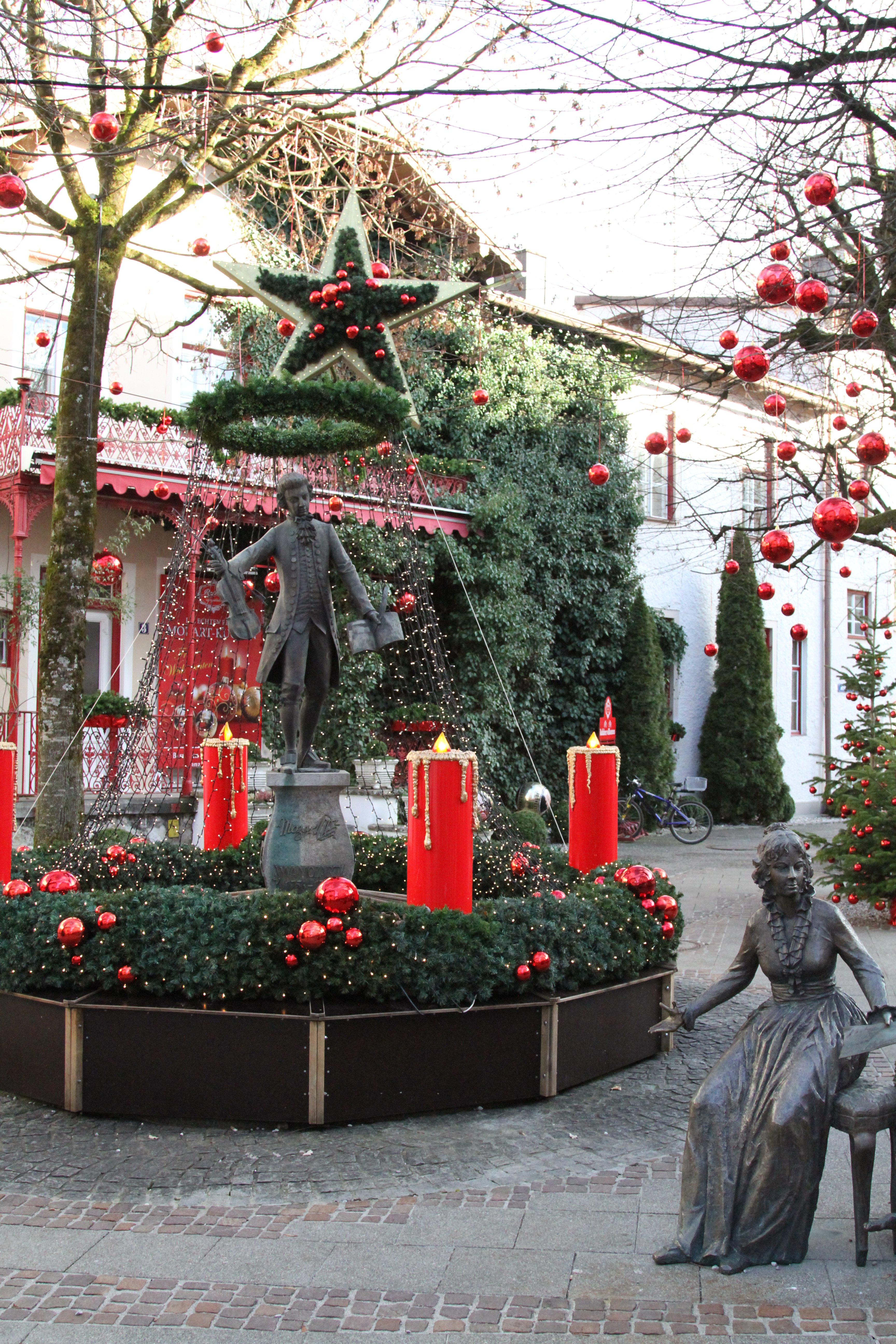
Chocolatiers’ Mozart Christmas grotto, Bad Reichenhall

Salzburg skyline in December
Salzburg is a breathtakingly beautiful city that seems to exist mainly to ensure the immortality of one man: the child prodigy composer Wolfgang Amadeus Mozart. There are Mozart cafés, Mozart restaurants and Mozart museums – and even tourist gift shops where you can buy Mozart rubber ducks and flying birds with Mozart’s face, all wearing powdered wigs. There is a spectacular concert hall where the programme includes the work of many composers, foremost among whom is – Mozart. There are Mozart chocolates, made by two rival companies: the original chocolatiers, whose business is very small and still confined mainly to the Salzburg region, and a younger, upstart firm whose aggressive marketing has been so successful that its distinctive round, filled chocolates, individually-wrapped in red foil, can now be purchased in many countries besides Austria. This company has created a Mozart grotto next to its main shop over the border in Bad Reichenhall, which features a statue of the composer, a fountain and bushes hung with winking red lights and huge baubles in its trademark silvery red.
Today, the city’s prosperity depends very much on Mozart tourism, but it was a wealthy place long before the composer’s birth. As its name suggests, its fortune was built on salt. This, of course, resonates with me, because Salt, good fortune and creativity are very much linked in my mental map. There is a famous salt mine close by the city which offers tours to visitors. We decided not to visit, as we have recently been to a similar attraction in Kraków. The Austrian one, apparently, makes a particular attempt to please family parties: its offers include enabling children to dress up as eighteenth-century peasant salt-workers.
The river that runs through the city also takes its name from salt: tolls on the salt-carrying barges created some of its wealth. Walking along the boulder-strewn riverside is a pleasing experience and there are several picturesque bridges, one of which is hung all the way along with lovers’ padlocks.
The Salzburg area has been unseasonably warm between Christmas and the New Year. There is snow here, but only high in the mountains. The local people are amazed at how mild the weather has been. Nevertheless, the people in the streets all wear hats, scarves, boots and quilted jackets or loden coats. Babies in buggies are muffled to the eyebrows. It is possible to stand in the sun and feel real warmth on your face, but as soon as you step into one of the many alleyways or just enter the shadows of the tall terraced buildings, the cold bites. There may be no snow at the moment, but you feel that it is only biding its time. February is the coldest month here: the Austrian mountain winter has really only just begun.
What does Salzburg have to offer in the way of inspiration for a crime fiction writer? On the face of it, this bright, industrious city, peopled with serene residents and laughing holidaymakers, does not seem a promising setting for dark deeds. However, in the alleyway marked ‘Juden Gasse’, with its stolpersteine or brass commemorative cobblestones, we stumble upon some of the darkest deeds that man has ever perpetrated upon man; and, not many kilometres away, lurks the Eagle’s Nest, mountain retreat of one of the world’s most sinister fantasists and almost the most prolific murderer of all time.
Sorry, Michael, for my previous prejudice… may I make amends!
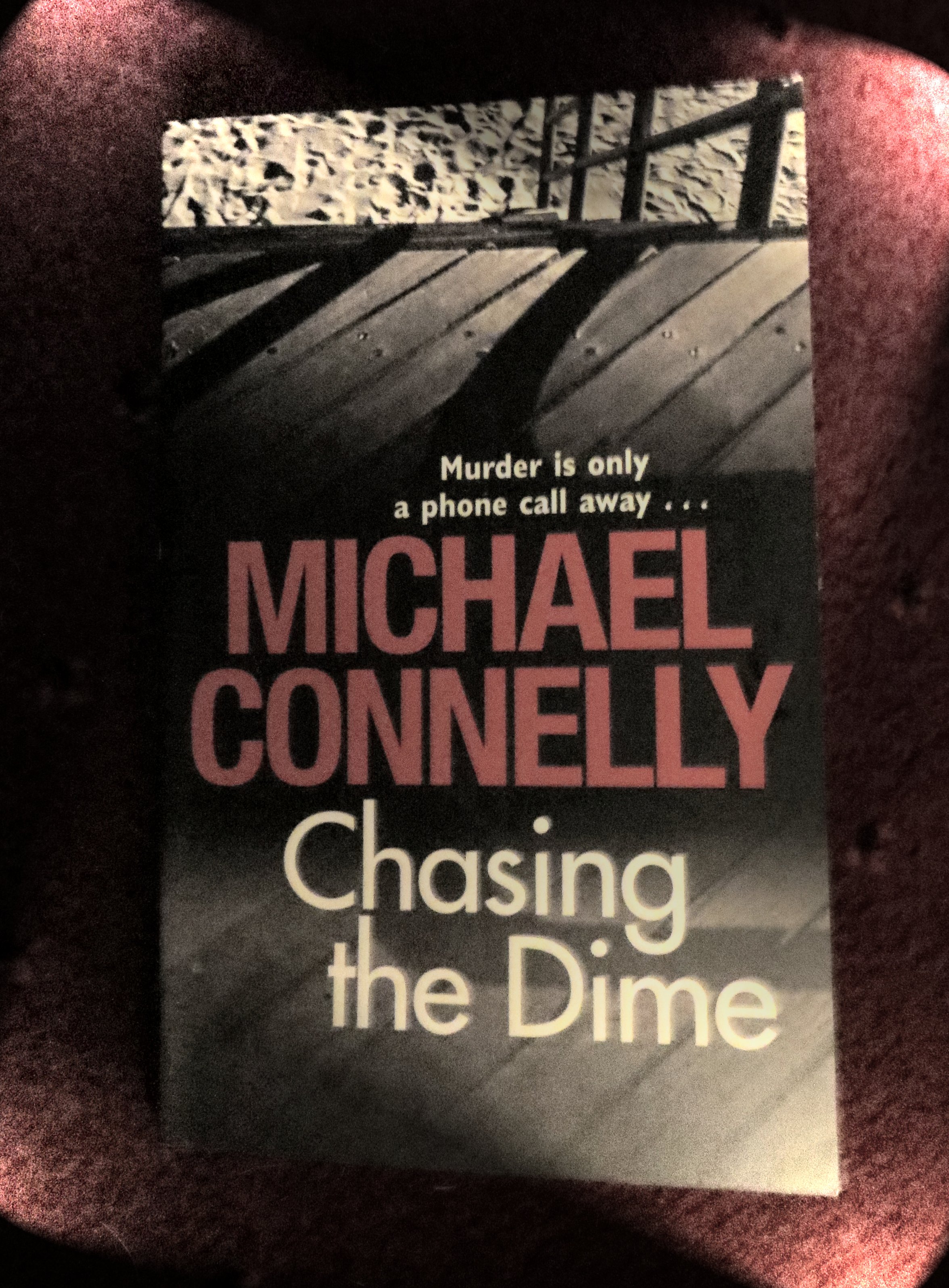
I am going to start this review with a confession: although I have been given several books written by Michael Connelly and even lent them to my friends, Chasing the Dime is the first one that I have read – and, ironically enough, I bought it at a book sale in a Co-op supermarket near Oxford, because I’d run out of things to read. Normally, I wouldn’t buy books from a supermarket because I believe in supporting local bookshops. So, two firsts in one go!
The reason I’ve not read a Connelly novel until now is that, and my ignorance is pretty unpardonable, I’d been led to believe him to be the kind of blockbuster author in whom I’m least interested: big-picture, change-the-world sort of stuff (x saved the world single-handed from the next atom bomb, Hermann Göring, Nuremberg and suicide notwithstanding, has been alive and well in South America for the last sixty years and running drug rings, that sort of thing). Chasing the Dime is not like that at all. Instead, it is one of the most perfectly-crafted murder stories that I’ve ever read.
There’s the background, for a start. The hero, Henry Pierce, runs his own R & D company. It is conducting research into molecular computing, in a highly competitive sector where several other companies are also in the race to crack the conundrum. Their mission: to create a computer the size of a dime. Hence the title – but the title also reflects the company’s need to find sponsors and also, sadly, refers to why beautiful young women are forced to prostitute themselves. (The title is one of many aspects of the book that works on several levels.) I’m sure that when Connelly wrote this novel (it’s now well over ten years old), there was a race to bring such a molecular computer to the market in just the way that he describes, but it says a lot about his talent as a writer that, although during the course of the novel he reveals many facts about the complex technology involved (and has clearly mastered what these are), he never obtrudes knowledge on the reader in such a way that this information seems to be anything other than an integral part of the story. Few writers can pull this off.
Then there’s the plot. Henry’s obsessive research has just caused his girlfriend to break with him. Henry moves into a new flat, for which his PA acquires a new telephone number. The problems start straight away: the number had obviously previously been allocated to a call-girl. Because of certain facts in his past – which Connelly allows to emerge at enigmatic intervals throughout the story – Henry decides to find out the identity of the call-girl and what has happened to her. Owing to several rash but perfectly understandable (from the reader’s point of view) decisions, he quickly becomes a murder suspect.
I won’t say any more, for obvious reasons. However, I’d add one further thing: nothing in the plot is incredible; there are no fantastic twists or turns and not much transpires in a way that the reader can’t guess; yet, because of Connelly’s psychological insights and his fast-paced but not too whacky writing, the reader is held, spellbound, until the last page.
I owe Michael Connelly an apology for doubting him for so long. As it is, I shall do ‘penance’ in the most pleasurable of ways: by reading the rest of his novels in short order. You will, I’m sure, be lining up to tell me that his Harry Bosch series is a must-read and roundly ticking me off for my shocking prejudice.
It is Christmas Eve, so I’d like to take the opportunity to thank everyone who has read this blog and supported it with so many kind, helpful and insightful comments over the past year. It has been my very great pleasure to have ‘met’ you in this way and I feel extraordinarily humbled that you have spared the time to take so much interest in me and my writing. For those of you who celebrate Christmas and for those of you who don’t, I’d like to wish you a very happy and relaxing time and a spectacularly successful New Year – wherever you are and whatever you are doing. If you are a writer, I wish you some of that elusive luck that all writers need.
P.S. The blog-posts have been a little erratic in recent weeks, as I’ve been away a lot. I shall try to do better as my main New Year’s resolution! However, I’d like to share with you that the day-job is taking me to China in the first full week of the new year, so they may be a bit thin on the ground then – though you can be sure that I shall recount my experiences in as much detail as you can take afterwards!
I’m on the train! Again… :(
Once again I am on a train travelling south to London, and once again it is winter. I’ve made this journey many times since I last wrote about my fellow-travellers in January, but today it is quite cold outside and the people who have crowded on to this train are much more reminiscent of my January acquaintances than any I’ve encountered since.
Today, the people travelling in first class (it is very cheap on this service) are lively and cheerful. Most are talking to each other animatedly, so there is less scope for me to guess about their backgrounds or attribute murderous motives to them. Some are clearly business people, but many are going to London for a day out, to shop for Christmas. Several appear to be families engaged in both activities: the man (or woman) poring over spreadsheets or reports while other family members chat noisily over his or her head. One conspicuous difference at this time of year is that all the blocks of four seats around the large tables are taken. The ‘airliner’ seats for one, each with a smaller table, have mostly been shunned. I love the airliner seats, which are usually in heavy demand, but today I feel anti-social, sitting here in solitary splendour tapping away at my laptop.
The most extraordinary thing about these pre-Christmas travellers is that not one of them is glued to a mobile phone. There are no raised voices enunciating “I’m on the train”, intruding upon others’ thoughts with infuriating penetration; no ever-so-busy women spending the time from when they board the train at Doncaster to when they get off it at King’s Cross systematically calling everyone in their address book (it’s surprising how often my journeys have fallen victim to one of these); no raucous men calling their mates to reminisce about having had a few too many the night before.
The only thing that disappoints about this group – and the disappointment is a big one – is that not a single one of them seems to me to be likely murderer material. I realise that murderers come in all shapes and guises, but they have one thing in common: if they’re not being paid to kill, they exhibit some kind of negative excess. All are excessively desperate, or vengeful , or greedy, or deranged. It is hard to believe that any of these joyful, excited people now sharing the carriage with me harbours such qualities with sufficient intensity to be transformed to a killer.
So what shall I say about them? Guessing what they’d like for Christmas might be fun.
I’ll start with the easy ones. The two femmes d’un certain age sitting opposite me are both swathed in expensive scarves: one sports a bright red pashmina-style creation with tassels, the other a svelte black velvet cravat discreetly patterned in silver. If they buy presents for each other, I’m sure that it will be festive scarves again. Again? Well, the ones they’re wearing were probably last year’s reciprocated presents.
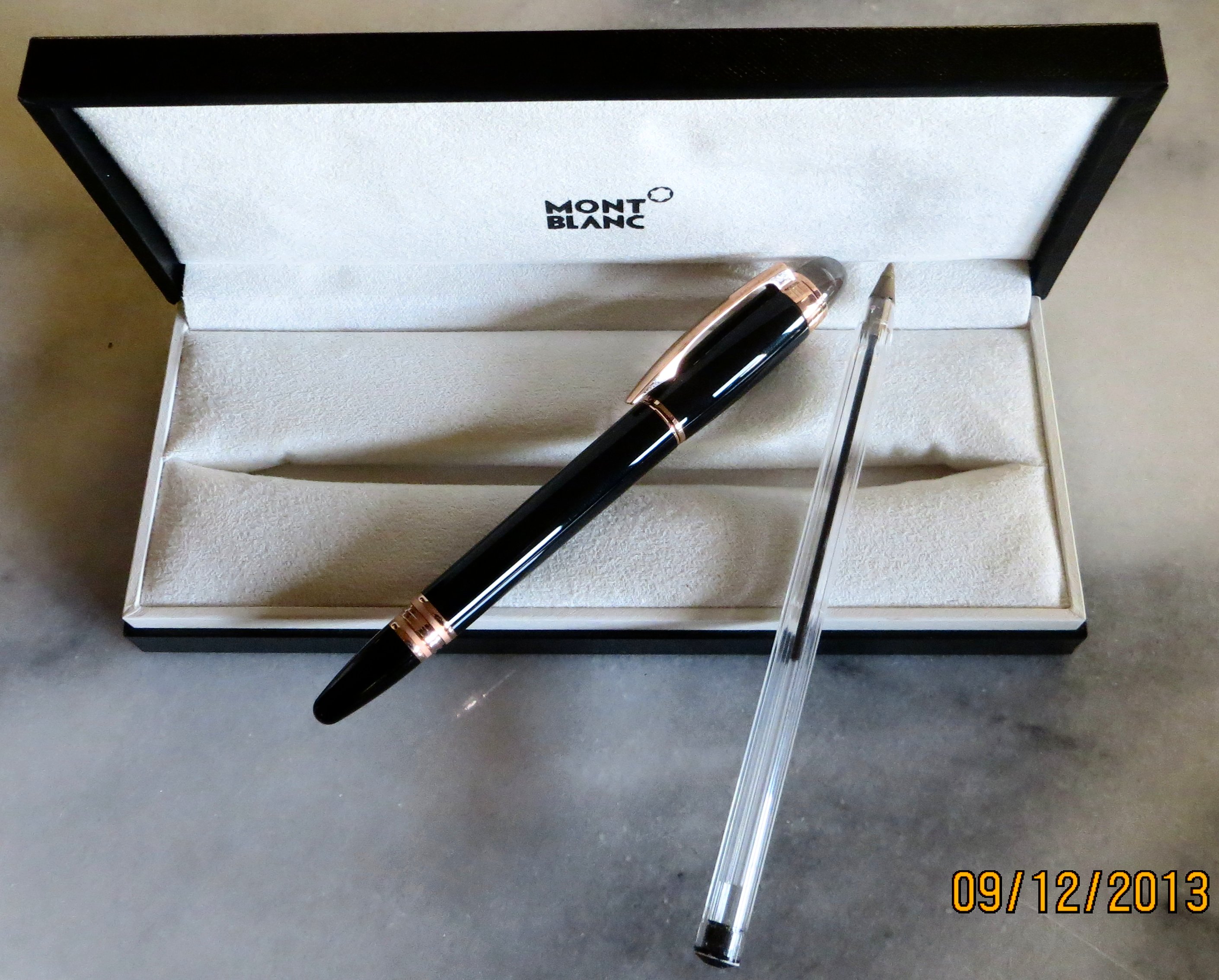
The man at the next table, still hunched over his report as his wife and two teenage daughters chatter and wave their arms, is making occasional notes with an ancient, chewed biro that looks as if it might have started life as a promotional gift from Kwik-Fit. If he really has to toil so hard for the whole journey (and is not just taking the soft option by ignoring his family), I feel that he deserves a decent pen. A Waterman, at least, if not a Mont Blanc. The two girls, both dressed in gauzy tops with lots of silver jewellery, huge eyes accentuated with expertly-applied make-up, are probably expecting to receive more of all of these things… and a lot more besides. The elder looks old enough to drive …. so Dad probably does need to keep on with the grafting. His wife, fingertips nail-barred to perfection, is sporadically reading on her Kindle between joining in the laughter and the chat. I doubt that Kindle vouchers will hack it for her, though. She, too, is wearing jewellery, much less than her daughters, but items of a different order from theirs: two sleek rings, one with a diamond embedded; a slender gold necklet; studs in her ears, which look suspiciously like diamonds. Her watch is probably gold, though mounted on a plain black leather strap. I’m sure she’d like an upgrade: a new gold watch for her, complete with a gold bracelet this time, please.
Time to hazard a guess at the tastes of the more inscrutable passengers now. The three companionable men sitting together: what would they like? They don’t look like football fans and, mercifully, aren’t discussing sport. One is reading the paper; one (I’m pleased to say, silently) listening to music; one sipping coffee and looking out of the window. No clues there. I could award them all new boxers and socks, but it wouldn’t be very enterprising of me. I think I’ll take a risk and give them all tickets for a murder mystery weekend. I know that Walton Hall, near Wakefield, has a couple coming up. I might even go to one of them myself. I may not be able to spot any latent murderers on this train, but there’s no harm in getting some of its occupants into the right frame of mind.
For me, as fascinating as crime and certainly great to read on dark winter evenings…

I’ve always thought it a great paradox that there’s no better way of relaxing than with a good crime novel. I don’t know why this should be; it is perhaps because reading about murder and mayhem, trickery and treachery helps you to appreciate the safety and security of your own world and to put all the people who’ve annoyed you during the course of the working day into perspective: a perspective reinforced also by all the ones who’ve been especially helpful or kind (as there are many more lovely people in the world than crime writers acknowledge).
I read voraciously all the time and I like to alternate reading fiction with non-fiction, sometimes having two novels and two non-fiction books simultaneously on the go. My preferred non-fiction subject categories are biography, memoirs, natural history, (more selectively) geography, particularly of Lincolnshire and Yorkshire, archaeology and history. Especially history. I love local history (again, particularly of ‘my’ two counties, as I’ve mentioned before), but I read history books about all periods and places, all of the time. Coming back to what is most relaxing, I think that nothing can beat history books about the high middle ages – perhaps because, just like crime novels, they tell of appalling acts that are remote enough to reassure the reader that he or she is unlikely to experience them first-hand, whilst offering the opportunity to drink up the excitement that they offer.
I’ve read many more books about the Wars of the Roses than any other mediaeval period, so in my most recent expedition to a bookshop (it was Waterstones in Leeds) I decided to buy Dan Jones’ The Plantagenets: the kings who made England. I have read accounts of individual reigns in the Plantagenet period, but until now I’ve had no broad overview of it. Jones’ book turned out to be the ideal choice for this purpose. He succeeds superbly well at explaining how each Plantagenet king built on the heritage of his predecessor to make England a strong, united country (they also enjoyed modest successes in Wales, made almost no headway in Scotland and none at all in Ireland) with well-defined laws. Despite the fact that, at the beginning of the Plantagenet period, in the mid-twelfth century, the English king and nobles also held vast swathes of land in France and by the end of it, two and a half centuries later, almost all of these had been lost, the Plantagenets also transformed England from being an impoverished country largely ignored by its European counterparts to a prosperous land and international force to be reckoned with, whether for peaceful trading or highly aggressive warfare.
As with all dynasties that span long periods of time, the Plantagenets had their failures as well as their successes. The greatest Plantagenet kings were Henry III and Edward III; the weakest were Edward II (who was spectacularly incompetent) and Richard II (who was less so, but like Edward II failed to understand the dangers of empowering his favourites). It was directly owing to Richard II’s shortcomings that the great Plantagenet dynasty fell. No less fascinating are the Plantagenet queens: they may have been consorts rather than rulers in their own right, but such royal wives as Eleanor of Aquitaine, Eleanor of Castile and Isabella of France were every bit as colourful, determined – and fierce – as their husbands; in each case, they were the de facto monarchs of England for significant periods of their husbands’ reigns; and in each case they defied their husbands at crucial junctures, often changing the course of history in the process: for example, Isabella of France was directly responsible for deposing the insipid and unkingly Edward II and placing Edward III on the throne instead. She and her lover Roger Mortimer then tried to manipulate the new king, a ploy that failed because Edward reasserted the power and pride of the Plantagenet line in all its pomp and glory. Mortimer was executed; but Isabella carried on enjoying full regal honours as the king’s esteemed mother. One queen for whom I did feel pity as I was reading was Berengaria of Navarre, Richard I’s plain and neglected wife. He seems to have married her simply because he was determined not to marry Alice of France, to whom he had been betrothed as a child but who had probably been seduced by his father, Henry II. They had no children: there is some evidence that Richard was a latent homosexual (though Jones does not subscribe to this theory).
I enjoyed this long book hugely. I have a few reservations about it: one is the portrayal of Richard I himself. Jones seems to have accepted the version of him traditionally peddled to primary school children, of a brave and warlike king who brought honour and renown on his country by fighting against Saladin in the crusades. Most works of scholarship now concur that it was irresponsible of Richard to abandon his country and run up huge debts, especially as he knew that his brother John would make a weak, self-interested king. Jones also uses certain phrases irritatingly frequently: the one that grated on me the most was ‘smacks of’, which he uses in the sense of ‘seems to be’. This is not how I would use this phrase myself, but, even if I agreed with Jones’ usage, I’d still like to see this figure of speech appear less frequently.
But these are minor quibbles. The dark, cold winter nights are upon us now. If you want to take a break from crime, but still want something thrilling to read that will absorb you totally in adventure and happenings stranger than fiction, this book is for you.
Cut-throat Charlie? No, far more sophisticated than that!

This photograph is of my dentist, Charlie. He’s been my dentist for about five years; before that, it was a colleague of his, called Dave. If I had a picture of Dave to post as well, you’d see that he was quite unlike Charlie. In fact, Dave struck me as being an almost archetypal specimen of the genus dentist: he was slight, wiry, nervy, cerebral and doing his bit to save the earth (a vegetarian, his main mode of transport was by bicycle and he once sang in a choir with my husband).
Charlie, on the other hand, although I consider him to be exceptionally skilled and an ornament to his profession, is no-one’s idea of a dentist. If I’d been shown a photo of him before I met him and asked to guess what he did for a living, I might have said that he was probably a bookmaker; or an estate agent; or a very burly jockey; or a rather emaciated sumo wrestler. If he’d been an actor, he would have made an ideal Magwitch in a dramatised version of Great Expectations.
Charlie obviously enjoys life. His main mode of transport is a motorbike in the summer, a substantial car (forgive me, I’m no good at brands) in winter. For a dentist, he dresses unconventionally, in leather jackets, jeans and trainers.
As my readers know, I like to write occasional pieces about interesting people and I’ve always found Charlie interesting. He’s fascinating to talk to, and I enjoy listening to his take on life while he pokes and pummels at my teeth. When I visited him yesterday, therefore (in tandem with my husband – we try to make our visits to the dentist two for the price of one), I asked if I might take his photograph, and explained about the blog. I gave him one of my Christina James postcards so that he could look up its url.
To my surprise and delight, I struck gold! Charlie is an avid reader of crime novels and was only too happy to have his photo taken. Better than that, he offered me an idea for a plot for my next novel. Not only was it excellent, but it was also based on his own scientific expertise: he trained as a biochemist before becoming a dentist. I promised him that I would use the plot and he said that he had several more up his sleeve when I’d exploited that one. I shan’t forget. Future visits to this dentist will be looked forward to with great anticipation, rather than with dread!
By this time, my husband had taken my place in the chair, but, since Charlie and I were still deep in conversation, I didn’t return to the waiting-room. We started talking about trust in professionals and how people always expect professional men and women to have unimpeachable moral standards, which is why the exposure of serial murderers such as Harold Shipman and Beverley Allitt shocks us to the core. (The Hannibal Lecter novels are actually based on this norm.)
With his eye twinkling and with his customary geniality, Charlie announced that he’d once thought of how to commit the perfect murder. It would be based on his scientific knowledge and next to impossible to detect. (I won’t give away any more, as the plot that he offered me makes use of the same information.) By this time, I was completely rapt. My husband, however, was still lying prone in the surgery chair and showing some signs of nerves.
“Do you think we should change our dentist?” he asked, once we were back out in the street.
Into Lincolnshire, for the Wolds Words Writers’ Workshop…

Louth Library, Lincolnshire
The writers’ workshop that my husband and I jointly led on Friday 18th October was part of the thirteenth Wolds Words Festival. It is a flourishing event that takes place annually in and around the pretty market town of Louth. The workshop was scheduled in the library, an impressively busy place in which the considerable bookstock was displayed most invitingly. The library staff were all great: extremely helpful, both to those attending the workshop and to their regular library users. It’s one of the most successful small libraries I’ve ever visited and clearly the librarians work hard to achieve this.
We said that we would work with up to twelve participants and the workshop quickly sold out (though not everyone actually made it on the day). We were asked to focus on two aspects of writing: crime and using local history in fiction. We heard that a workshop on plot construction that had taken place on the previous day had also been very successful.
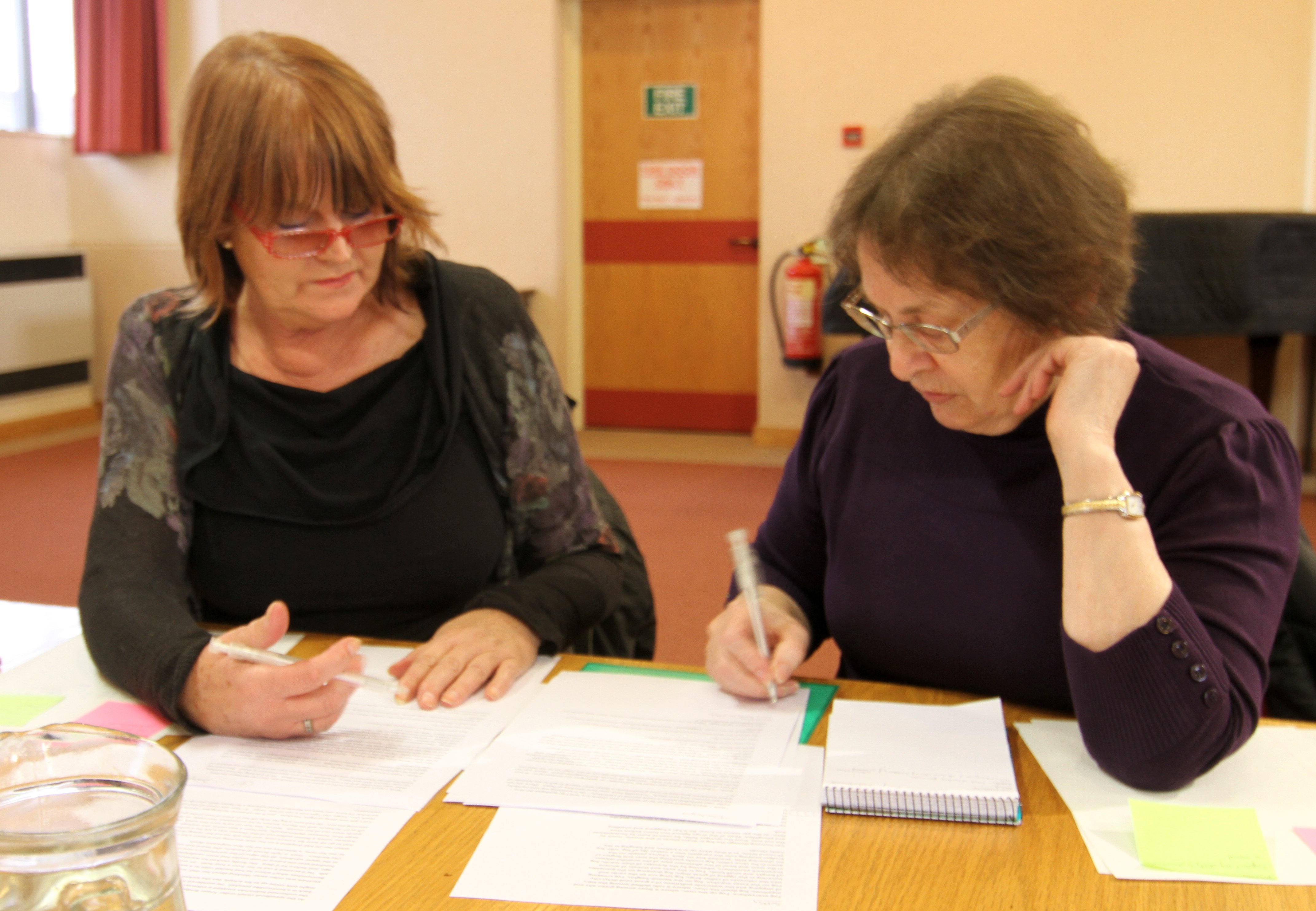
Wolds Writers’ Workshop
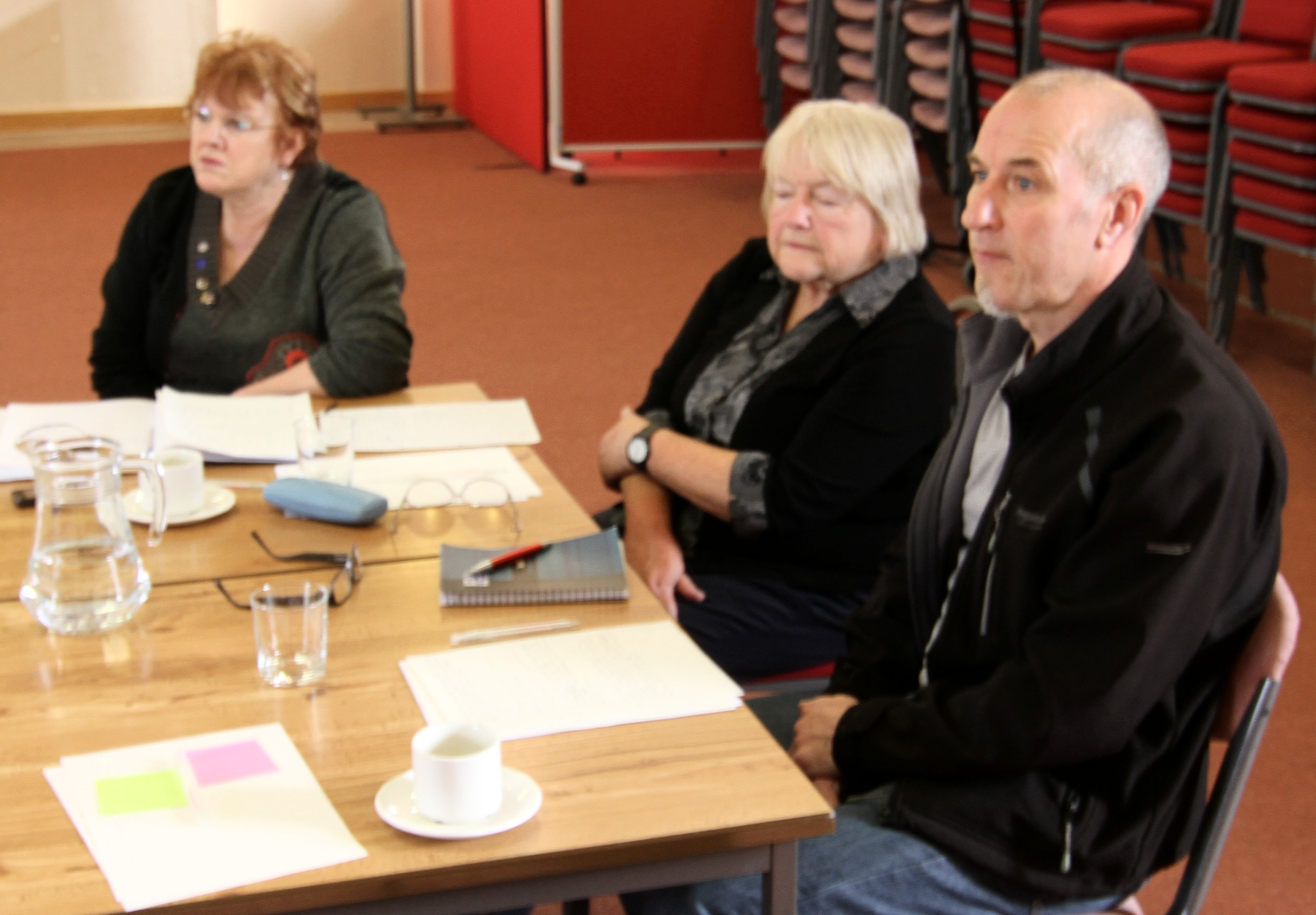
Wolds Writers’ Workshop
As a warming-up exercise, I gave the group some of my own tips on how to get published. As I’ve already offered some of these in this blog and shall be writing about others in more detail in future posts, I’m not covering them again here. Similarly, I’m not including my tips on how to incorporate local history into fiction here, saving them for a separate post.

Wolds Writers’ Workshop
We moved on to discussing why the participants had chosen the workshop and what they hoped to get out of it. Their answers were, perhaps not too surprisingly, very similar, and boiled down to a single joint ambition with three further ‘sub-wishes’. The over-arching goal of everyone present was to see their work published. One of the writers had already had poems published in anthologies; one had published a factual account of the sea some twenty years before and one had contributed short stories to an online magazine. None of the others had had work published. Two had written novels, but neither had been successful in finding a publisher.
The ‘sub-wishes’ were perhaps even more interesting: they each concerned confidence, or the lack of it. They included the expressed desire to write something that was worth reading ‘at all’; the fear that a certain flaw – in one case, an inability to write convincing dialogue – was an insurmountable stumbling-block; and the suspicion that the author’s take on life was too left-field ever to find a publisher. To these doubts, I replied that almost everyone can write something worth reading if they work at it hard enough; that ‘flaws’ can be overcome or minimised, again with hard work; and that many readers prefer a more unusual viewpoint to something more conventional, though I agreed that this may make it more difficult to attract a traditional publisher.

Wolds Writers’ Workshop
Next we read and explored four short passages from very different novels, each demonstrating some particular aspect of writing. We looked at the ‘fog’ passage from Bleak House as an example of creating atmosphere; Virginia Woolf’s description of the Ramsays’ holiday house in To the Lighthouse to establish a sense of place; a passage from Where the Devil Can’t Go, a novel by Anya Lipska, a talented new crime writer whom I’ve written about previously in the blog, that depicts her heroine’s character; and finally a piece of dialogue from my own novel, In the Family. We each took forty minutes to write a short passage following on from one of these, or alternatively any short fictional piece of our own choosing. The writings were shuffled and passed around until we had each read all of the passages; no-one knew who had written which. Each of us then told the others what we liked about the piece that we had in front of us at the end. We all found plenty to praise, which I think confirmed resoundingly that there is a writer in almost everyone. I should very much like to thank all the writers for their really enthusiastic and participative response to the occasion.

Wrights of Louth, Bookshop
Copies of my books were sold at the event by the local bookshop in Louth, which I also visited afterwards. One of its distinguishing features is that its sign hangs upside down! There is a story behind this: The shop used to be a general grocery store of the kind that I remember as a child, but which has completely disappeared now. Its owner, a man called Bill Platt, who ran it for many years from 1913 until he was in his seventies, was famed for his knowledge of local history as well as for the quality of his shop in Little Eastgate. He had business acumen, too. When the sign over his shop doorway blew down in a storm, it was affixed by accident the wrong way up; Bill recognised that it quickly became a talking point and therefore a good advert and simply left it like that. A local businessman, Mick Wright, who, with his wife Carol, turned the store into a newsagent’s and bookshop, has continued the tradition!

In conversation with bookshop owner Dean Wright
I had a long and pleasant conversation with Mick and his joint owner son Dean, and was extremely impressed by their can-do attitude towards running a bookshop in modern times. Their strategy is to diversify without abandoning the bookshop’s essential character and to provide exemplary service; they specialise in books about Lincolnshire. I purchased several by local authors, and was extremely grateful to be given a discount!
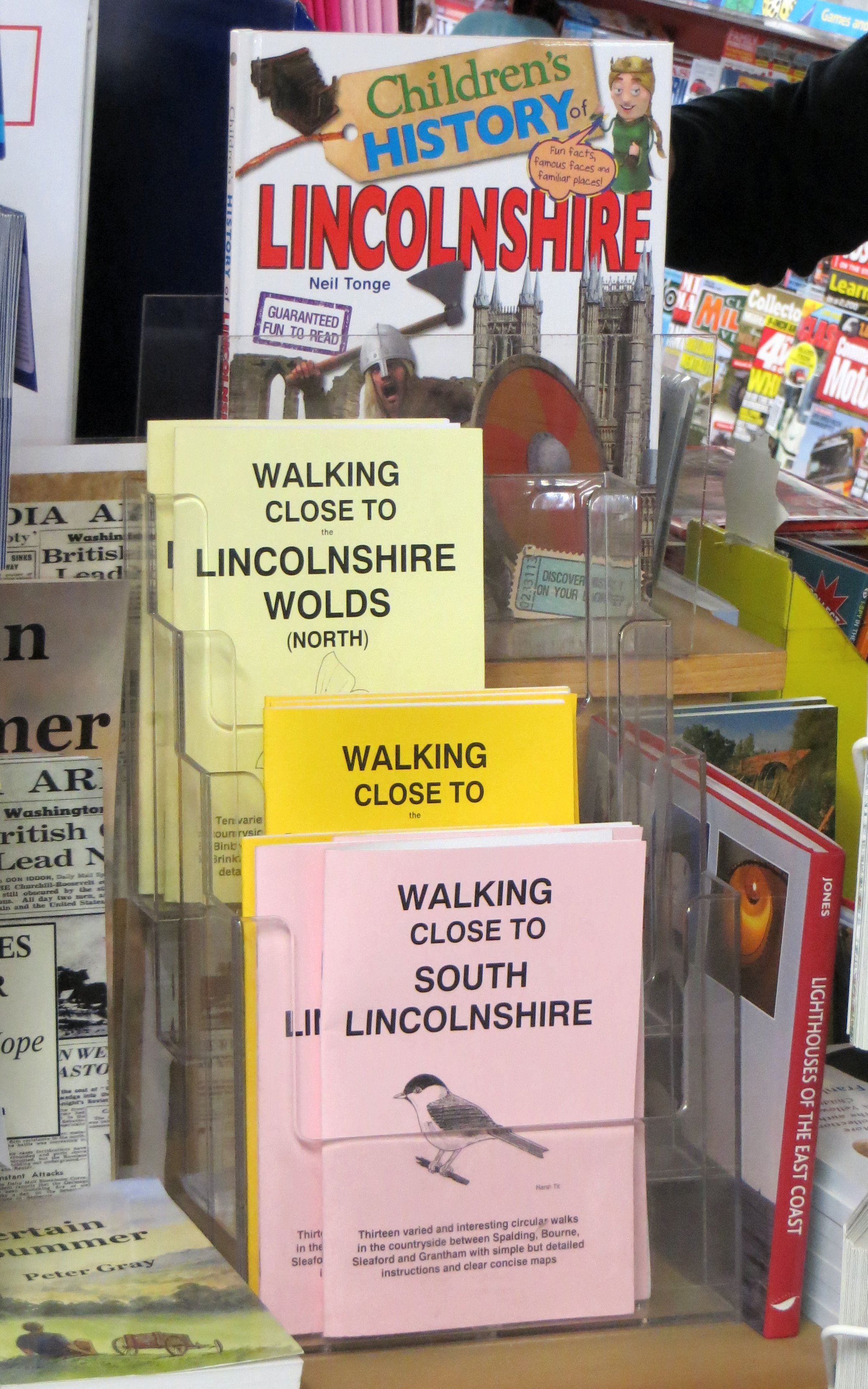
Speciality: Lincolnshire!
As you can see, I’ve included a few pictures of the event, the library and the bookshop. I’d never been to Louth before: it is quite a distance from Spalding. It is a lovely old market town; having now discovered it, I certainly plan to return. If you are ever in the area, it is well worth a visit – and don’t forget to take in the library and the bookshop while you’re there!
Auschwitz-Birkenau butterfly, from the husband of Christina James…

Peacock butterfly on the steps to the death chamber, Birkenau
I asked for a riposte to Christina’s cider-pressing post, but that was not to be! However, by way of recompense, she has allowed me space to comment on what must be one of the greatest crimes inflicted by man upon man. While she has been busy with what she calls ‘the day job’, which has been, on this occasion, a publisher-librarian conference held in Krakow (for the pedantic, this is pronounced by Poles as KrakOUF, with the stress on the second syllable), I visited Auschwitz and Birkenau, one hour and forty minutes away by bus.
On the face of humanity, a carbuncle, perhaps now healing slowly, but sensitive to the touch and destined to leave a permanent scar. Yet the body politic suffers still and continues to break out in boils symptomatic of the same underlying disease. Mankind, disfigured, cannot find a cure and treats, always too late, the symptoms alone. These gross and scabbing reminders of our failure as a race to reach the root of our ills do not make comfortable our self-examination in the mirror of consciousness, but I found, on this, my second visit after some years, that the experience was already becoming, for the latest visitors, too organised, desensitising.
Brick, concrete, iron, steel, stone and dust, all strung about with the twisted barbarous wires; original timbers are gradually disintegrating or have gone. All about, the millions of October leaves are falling, falling. Summer’s beauty choked by approaching winter cold, they are gathered up in heaps, loaded into barrows and trucks and taken away for burning or to rot down. Colour and life turned to ashes. Shorn of their tresses, the trunks and branches are emaciated, twiggy fragile limbs starkly outlined against the sky.
Irony in the bus loads of tour groups disgorging their cargoes and delivering them into the hands of the camp guides. Selection by language. An industry in itself. The cameras click; the iPads embrace the scenes as each former terror is re-hashed for public consumption. Work makes free. Tourism makes realism – ‘No photographs here’ signs ignored as every shred of individual dignity is wrenched from the heaps of human history and saved for later: ‘I was there; it was awful; look at my pictures.’ I have to step away, unable to stem emotion. My leaves fall like tears, like lives.
Symbolism of railway lines, stretching through the gate to infinity. The sleepers are relinquishing their hold upon the rails, wasting from within. Will those be replaced, like wooden huts, to show what it was like? The other sleepers are softly breathing their message to us, the words falling as gently as leaves, and we strain to hear against the sound of the narrative of the guide. Their language is universal. The guide says that we are now walking the same way as the doomed, but we are not. Once more I break away, this time for good, and let imagination tell the story. And then, on the cracked steps to those underground chambers, now guarded by a staunch metal grid, a delicate beauty opens wings amongst the many fallen leaves and flies into the air. The loveliness of lost lives is captured for me in a butterfly.
All text and photographs on this website © Christina James
When the Devil Drives… plenty to enjoy in the passenger seat!

There are many things about this novel, the first of Chris Brookmyre’s that I’ve read, that I admire. The novel is set in Scotland and the author successfully conveys that country’s rawness and beauty without descending into shortbread and Bannockburn lyricism. The plot is brilliantly crafted, with believable twists and turns until the very last sentence; it explores the dynamics of relationships on several different levels; and one of the protagonists, a private investigator named Jasmine Sharp, who inherits her uncle’s private investigation agency, Sharp Investigations, is only twenty-one years old, which makes her unique amongst the fiction detectives of my experience. She’s also an actress manqué, which helps her considerably in her adoption of a career that she has literally fallen into by accident. In When the devil drives, Jasmine’s pursuit of a long-disappeared missing person collides with the investigation of a present-day crime being conducted by Catherine Macleod, a senior police officer. Parallels and contrasts are drawn between the two women in both their professional and personal lives.
Jasmine’s relationship with Fallan, the man who confesses to having killed her father, is the most compelling of the many relationships that Brookmyre portrays. Fallan is an enigmatic character; still barely operating on this side of the law (in at least one instance he commits a criminal act, though there is the underlying suggestion that this is morally justified), he is an ex-con who, by his own admission, owes Jasmine an unpayable debt. She should shun and despise him, but she becomes ever more fascinated with him, while it becomes even clearer that she needs his help. To the end of the novel, however, his true character and, the reader suspects, his true relationship to her remain ambiguous. (When the devil drives contains an extract from Brookmyre’s next novel, Flesh Wounds, and I therefore know that Fallan features in it. I shall be happy to buy Flesh Wounds just to find out more about him.)
Catherine has a similarly edgy but not hopelessly antagonistic relationship with her husband. More bohemian than she, he clearly thinks that she is over-protective towards their two sons – a natural result, we are encouraged to conclude, from what she sees and suffers daily as a policewoman. I have to confess that I find the portrayal of Catherine the weakest facet of this novel. Her assured public role – she is almost brutally terse in her treatment of colleagues – sits ill with the neurotic wife and mother that she becomes at home. However, the main problem with Catherine is that her character fails to engage the reader to the same degree that Jasmine’s does. Many crime writers develop two characters to act as foils to each other: Stephen Booth’s Fry and Cooper and Anya Lipski’s Kiszka and Kershaw spring immediately to mind – but their success lies in making each character as appealing as the other, despite their very obvious differences. By contrast, in When the devil drives, I found myself impatient to get back to Jasmine during the Catherine scenes.
This is a realtively minor blemish, however. I won’t say too much about the intricate plot of this novel, as I don’t want to spoil it – and I should like to encourage anyone who is reading this to get hold of a copy of the book. Brookmyre has an original style and I’m sure will write many more such successful and entertaining novels.
Barry Forshaw, @CrimeTimeUK, interviews Christina James


Today, I’m honoured to be given space on Barry Forshaw’s CrimeTime site. He has interviewed me about myself and Almost Love. Very many thanks, Barry! 🙂
Follow CrimeTime on Twitter
Follow @CrimeTimeUK
Visit the CrimeTime site!
 Christina James, crime novelist