

Every word stabs…
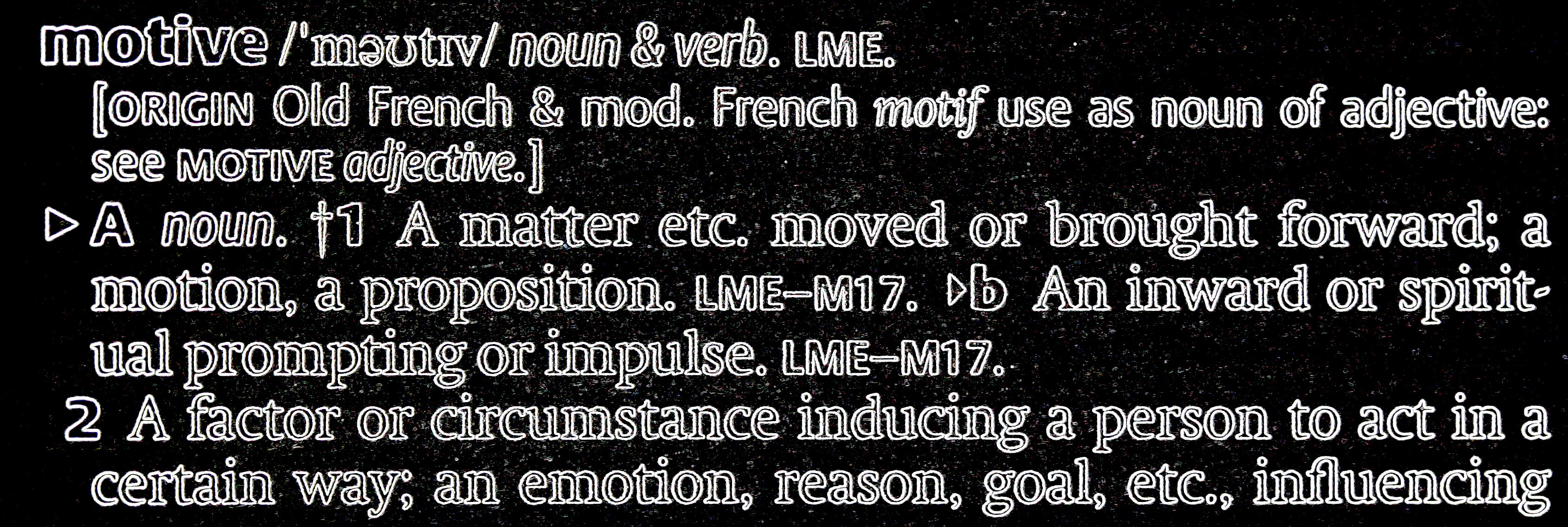
Motive is a fascinating part of murder, because it is bound up with the psychology of the killer. I find myself thinking of the motives that have driven people to dispose of others: resentment, hatred, envy, greed, retaliation, revenge, fear, anger… very human emotions that we all experience at one time or another, thankfully without fatalities. But what is it that pushes someone beyond the self-control that limits the majority? If we are to believe some crime fiction and the apparent evidence of real cases, there is sometimes the desire for fame, or notoriety, but this is perhaps very rare, if true at all.
Of course, investigators of murder cases think very closely indeed about motive, as that may well point to the perpetrator, or at least narrow down the possibilities: Who might have had a grudge? Who was close to the victim, by kin- or friendship? Who might have gained from the death?
These days, unfortunately, there are more frequently political motives for murder, when reason is overpowered by belief, and we might well gasp in astonishment that anyone could be fanatical enough to take a life in so public a way as last week in Woolwich. Most murderers seek anonymity.
It’s common to hear people say, “I’d kill for a… beer, a smoke, a cup of tea, a Mars Bar”, but the statement’s intentional hyperbole confirms its lack of seriousness. However, I have heard one person say, quite matter-of-factly and without any obvious intent to shock, that he could kill, full stop. Needless to say, I found his comment quite unnerving and, after considering the kind of person he seemed to be, not beyond the bounds of possibility. I have also turned the focus upon myself and asked myself if I could kill and, if yes, under what circumstances and with what motive? Crime of passion? Maternal defence of child? Revenge for abuse? Being for some reason or another at wits’ end? And if I were to commit murder, would I do it in a calculated way so as to minimise the risk of detection? Here I am, essentially a very pacific person, heading the way madness lies; however, as a crime writer, I do spend time on self-analysis, the better to understand the minds of my fictional characters.
Regular readers of this blog will see a link here with my recent rhubarb post, which of course was tongue-in-cheek stuff, and might now be determining never to cross my path. Fear not, whatever murderous intentions I have will be sated with words.
Something that I look forward to…

It’s just occurred to me that it’s been a long time since the last Crimewatch programme, so I’ve looked it up on the BBC website and discovered that the next episode will be on Thursday. Something to look forward to later in the week! For visitors from overseas, this appeal programme features real unsolved crimes and asks for help from the public to pinpoint the perpetrators.
I’ve been a Crimewatch fan almost since it began. In the early days, I was attending quite a demanding evening class and would rush home afterwards to see it. I always missed the first twenty minutes or so, which made the remainder of the programme all the more enjoyable. I don’t like the glitzier image of recent years as much as the more straightforward regime presided over by Nick Ross, but I still hate to miss it. This week’s episode is on the rise of mobile phone thefts, apparently, which doesn’t sound riveting… but we shall see!
I haven’t often been bored by Crimewatch, but I do favour some of the regular sections over others. I like the rogues’ gallery, because it’s fun to speculate and put the face to the crime – though I realise that such games are purely subjective, for one thing, and, for another, fail to take into account the fact that police mugshots, like passport photographs, are bound to look sinister, because the subject is forbidden to smile. I’m always absorbed by the reconstructions, which tend to feature murder or rape. Sometimes I wish I could call out to the victims, tell them not to take that shortcut or forget to lock their door. Clips that I like least tend to feature CCTV footage of mindless violence – although I know that it is right to highlight this – or what can perhaps be best described as a dark sister of the Antiques Roadshow: the parade of artefacts discovered by police to be in the possession of criminals who can’t or won’t say how they came by them. I know at first hand that theft is a foul crime: my house has been burgled twice and I’ve also (as you may have read here) had my purse stolen. But somehow this collection of inanimate objects doesn’t engage the attention in the same way. Clips that show those bereft of treasured items and asking for their return are a different matter; I can empathise with the victims completely.
Best of all, though, are the retrospectives. Sometimes a whole programme is devoted to these. If this programme is additional to the season’s schedule, that’s a bonus. What’s so fascinating about the retrospectives is the way in which they provide step-by-step documentation of how the villains in a previously featured case have been caught. (Understandably, crimes which Crimewatch itself has helped to solve are most frequently chosen.) I’m not a police procedural writer, as my readers know, although this is a very palatable way of finding out how the police operate, but it’s the insight into the criminal mind offered by the retrospectives that really grabs me. Sometimes the perpetrator has shown such Machiavellian cunning that I’m full of admiration for the police in outwitting him or her; sometimes s/he seems to have behaved in such a stupid or reckless way that it’s surprising that they weren’t apprehended immediately.
If you have access to British TV (I know that this doesn’t apply to everyone who will read this) and you haven’t seen Crimewatch before, I invite you to join me on Thursday evening, 30th May, BBC1 at 9 p.m. If you are already a fan, I look forward to keeping you company! Perhaps we can compare notes afterwards.
Ms James, in the dining room, with the rhubarb crumble…

I’ve spent a great deal of the bank holiday weekend cooking: two types of muffin, cheesecake, bread, meringues, fish pie, quiche and barbecue sauces, since you ask. And today, Sunday-style lunch for my guests before they depart, with rhubarb crumble.
I live just outside what is known as the ‘rhubarb triangle’, a smallish area near Wakefield in West Yorkshire famous for early ‘forced’ rhubarb. In Lincolnshire, too, rhubarb has always thrived. It seems to like cold, wet regions with severe winters. When I was growing up, every garden had a crown or two of rhubarb. The forced rhubarb industry uses heated, dark, forcing sheds to encourage the rhubarb plants to mature early and pickers have traditionally harvested the stalks by candlelight to preserve their sweetness; but generations of amateurs have employed the simpler method of planting it in a sheltered spot and placing an old tin bucket or a more picturesque terracotta bell over one of the crowns.
Rhubarb was a family staple; even though my mother detested it, she would cook it for everyone else. Her first job, in 1945, was quality control technician at the local canning factory, where rhubarb was processed in bulk. (It was war-time, and jobs were plentiful: I believe her main qualification for this was that her school leaving certificate said that she’d studied biology!) Years later she confessed that she’d never had known if there was something wrong with the rhubarb, because it all tasted poisonous to her. I think that it’s one of those foods, like Marmite and peanut butter, that you either adore or loathe.
I’ve always found it rather an enigmatic – fruit or vegetable? I’m not sure which it is. To me, there’s always been something rather mysterious and exotic about it. There’s even poetry in the names of many of the varieties: German Wine, Riverside Giant, Valentine, Sunrise.
One thing’s certain: you eat the stalks and not the leaves, which contain such poisons as oxalic acid. You’d have to eat a lot of very unpalatable leaves to die, however, though boiling the leaves with soda apparently increases their toxicity.
My imagination is caught: the means by which a murderer might do away with someone by serving up a tasty crumble, laced with pulped rhubarb leaves and soda. Ms. James, in the dining room, with neither rope nor lead piping in sight. 😉
I admit it: I do like Harry…
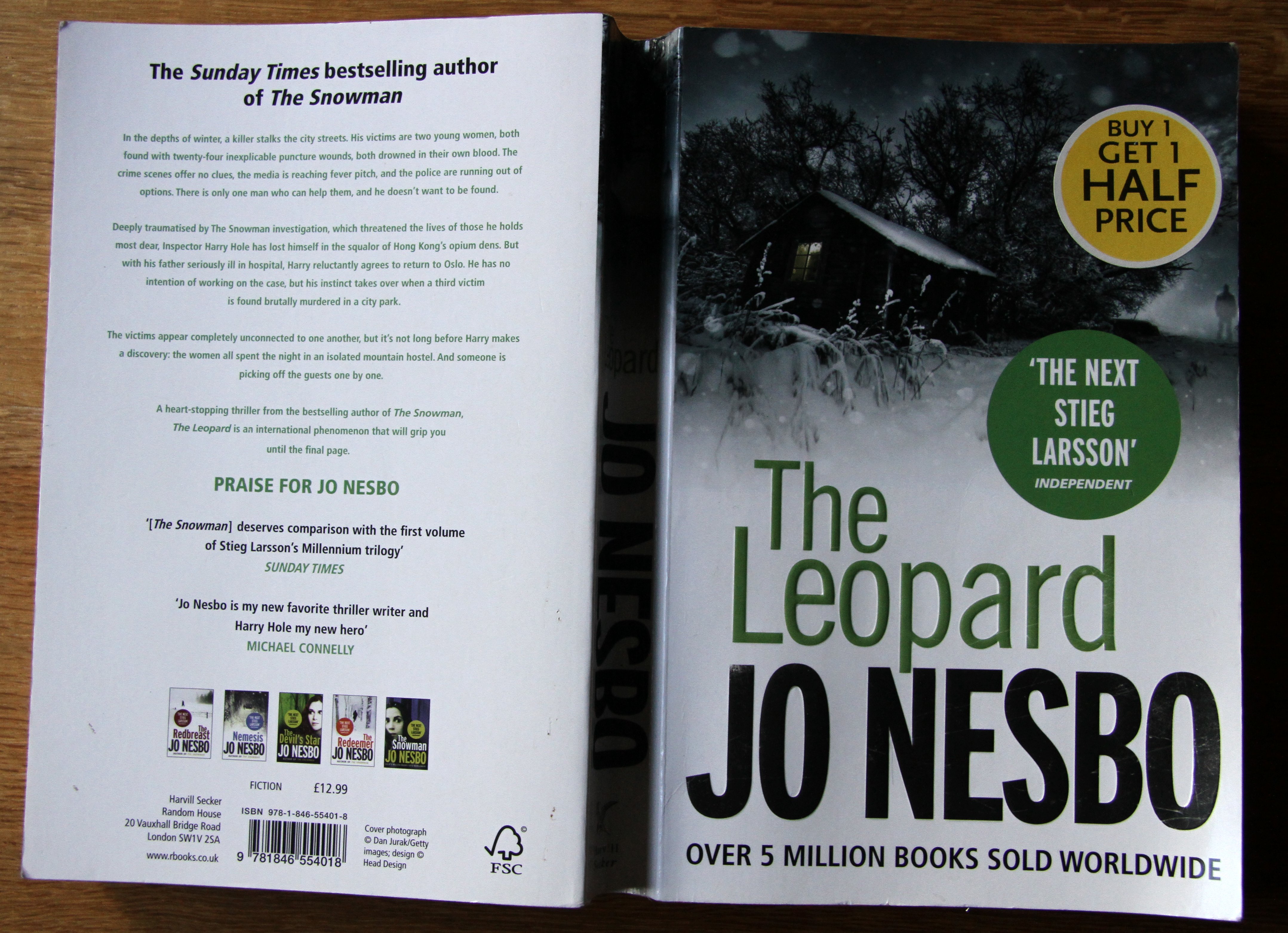
What is it that grabs in a Jo Nesbo? Harry Hole has been very carefully conceived. Part of the strong tradition of flawed heroes, Harry has a Dirty Harry quality which was bound to impress me as soon as I read my first Nesbo. What is it that makes him both insufferable and dead sexy at the same time? He has the capacity to love, to remember, to feel, to empathise, to anticipate, but sacrifices his relationships on the altar of his determination to track down and defeat serial killers; he is scarcely attractive, but lithe and angular, case-hardened, rough – an alcoholic, a loner and an oddball; yet he has integrity, understanding, commitment. He is every thinking girl’s dream bit of rough. And he’s a wizard with the ’cuffs! Nesbo knows that a character who stands up for the morality of honest policing and opposes deceit and hypocrisy in the force has the captivating appeal of Robin Hood, a renegade against the corruption of power. He comes to us with a carefully-wrought family background which makes him essentially human, for he cannot escape his sense of kinship duty; he has inner anger and a wealth of inconsolable regrets; his past haunts him. He is doomed and slowly abusing his body to death.
I could wax lyrical about Nesbo’s plots, but, as regular readers here know, I’m not so struck on the meticulous detail of killer method. Nevertheless, it is Harry I come back to, mesmerised by the depth and range of authorial characterisation that makes him credible and, for fiction, a brilliant creation.
You pronounce Hole ‘Hoola’, by the way; a Norwegian friend told me. But ‘hole’ seems somehow appropriate; he always seems to be in one!
I can’t help myself: when I read Nesbo, I’m a Rakel or a Kaja; nothing like immersion in a good novel… and willing suspension of disbelief!
Salt Publishing crime writer event

May I use today’s post to flag up a Salt Publishing event at Gower Street Waterstones, an evening with Salt’s crime authors, Laura Ellen Joyce, Matthew Pritchard and myself, at which we’ll be sharing both our books and experiences. For those new to this blog, here are some earlier posts which may interest you in relation to the authors and the venue:
Meeting Matthew Pritchard at BAFTA 195
I do hope that you will join us on this occasion, if you are able to do so; all three of us are very much looking forward to meeting you in this very lovely bookshop.
When right seems wrong…

The farmers I knew in Lincolnshire were mostly millionaires. They lived in huge houses, set proudly in the midst of their many acres, and were rarely seen on tractors; they drove luxury limousines with personalised number-plates; they made their money from growing crops on what is perhaps the richest arable land in the country.
Farming is quite different where I live now, in the foothills of the Pennines. Most of the farmers are tenants, the land they hold carved from estates that were parcelled up generations ago. Today, the farms are small by modern standards; mostly devoted to animal husbandry, they are barely large enough to sustain the families owning them, some of whom have been working them for many years. One farmer told me that his lease entitles the family to hold the land for five generations, of which he represents the fourth. I am impressed by this family’s loyalty both to its landlord and to farming as an occupation, and fearful for its future. What will happen to it when the present incumbent’s son dies?
In reality, the family may have to quit long before then. Modern farming is a scientific business. Farmers are not, in the main, scientists; therefore, as farming methods become more sophisticated, they have to rely on the trained representatives of, say, the feed manufacturing companies to give them advice. A couple of years ago the farmer I have mentioned (who is still in his twenties) was rebuilding his dairy herd after inadvertently buying two tubercular cows from a neighbour and consequently having to slaughter his whole herd (in accordance with DEFRA regulations). Building up a new herd was expensive. He had always farmed in the traditional way, keeping the cows in byres in the winter and allowing them into the fields to graze in the late spring and summer months. The feed manufacturer advised him that this was inefficient, because cows use up energy wandering about and trample much of what they feed on. The modern way is to improve milk yields by keeping them in the byres the year round and feeding them on corn. The company’s representative paid visits to advise him on the quality of the corn he should use and how much to give each cow. The cows were kept in.
Yesterday, I was therefore surprised – but delighted – to see that the whole herd was out in the fields. Anyone who has seen a cow skip and dance when it is first released into a meadow after a long winter can be in no doubt that, although fastening them up in byres may not actually be cruel, they surely value their freedom.
When the farmer is about he usually stops for a chat. He was there yesterday and told me that he’d had to abandon the corn-feeding regime over the summer months because the cost of the corn was bankrupting him. Milk yields had dropped, too. During the winter, his milk cheque had covered barely half the amount he’d had to pay for feed. As he commented in his laconic way, “Something’s not right here.”
If he is right, this sounds to me like a case of legitimised fraud. It reminds me of how communities in Africa have been devastated after being persuaded by large companies to grow cash crops, destroying traditional self-sufficiency and yoking people to an artificial dependency. This Pennine farmer’s case is not as irrevocable, of course: he has still the option of going back to more conventional farming methods, which he’s chosen to do. Nevertheless, he is still repaying the loan to replace his herd, which is not yet back to its former size, and now has to bear the additional millstone of debt for the corn. The investment in the extra feed has been counter-productive; his business has taken a big step backwards. No-one will be brought to account for this, except, perhaps, the farmer himself, if he is unable to pay the debt quickly enough. The feed manufacturer will have all the weight of the law – and of ‘science’ – on its side.
Crime and legality are sometimes difficult to distinguish.

One month to publication!

So here I am, one month away from the publication day for Almost Love, which has reached the proof stage. I have marked the day by putting the ‘milestone’ countdown widget here (as if I needed it!), because that seems a celebratory thing to do, as well as adding the clickable cover picture and link to an interview about Almost Love, both of which are to your right on the sidebar. It’s enormously exciting, and humbling, for me to be able to visit the Salt Publishing home page and to see my second novel there, whirling on the carousel amongst those other glorious titles, including Alison Moore’s latest (The Pre-War House and Other Stories, launching tonight at Waterstones Nottingham), David Gaffney’s More Sawn-Off Tales and Alice Thompson’s new novel, Burnt Island, not forgetting my fellow crimewriter Matthew Pritchard’s Scarecrow (to be published in the autumn).
So much has happened since November 2012, when In the Family came out to face the world, and I am very grateful indeed to the many readers of that book who took the trouble not only to read it but also to comment so favourably on it. I have made many online friends since then, via Facebook, Twitter and this blog; they have been stalwart in their support and their sharing and retweeting has sometimes been so vigorous that I have barely been able to keep up with it. If I missed passing on my thanks to you, please forgive me and accept them from me now.
I’d like to express my appreciation, too, to all those readers who have visited here, pressed the ‘like’ and r.t. buttons, followed and commented. This opportunity to engage with you and your thoughtful comments has been beyond helpful to me in more ways than I could ever have imagined when I started blogging last October. It has also been a lot of fun!
I am indebted to Jen and Chris at Salt Publishing for all their support, which is unfailing and ever-present, as I’m sure all their authors will readily confirm. Their incredible creativity, their capacity for managing the impossible in no time at all and their long-suffering, good-humoured indulgence of human failings are what make them truly top publishers.
May I complete this post by announcing four events connected to the launch of Almost Love:
Waterstones Gower Street
Thursday June 20th, 18.30 – 19.30
An evening with Salt crime writers
Christina James, who reads from her new novel, Almost Love
Laura Joyce, who reads from The Museum of Atheism (published November 2012)
Matthew Pritchard, who reads from Scarecrow (to be published September 2013)
Admission by ticket or at the door. Wine will be served. Books will be on sale.
Bawtry Community Library
Thursday June 27th, 18.30 – 19.30
Christina James gives readings and speaks about crime-writing
Tea, coffee, refreshments. Books will be on sale.
Co-ordinated by Claire Holcroft and George Spencer, Doncaster Library Service
Wakefield City Library, Burton Street, Wakefield
Alison Cassels, Library Officer in Charge of Promoting Reading, writes:
As well as Crime Writing Month, 29th June is National Readers Group day, so we’ll be promoting it to our readers groups too. What we have planned for the day is our Readers Group morning, with coffee 11.00-11.30, then discussion groups 11.30-12.00, discussing three books (including In the Family), then 12.00-12.30 a general discussion on crime novels, followed by people recommending books they love until 13.00. After lunch, Christina James will be presenting her second novel, Almost Love, in a public session, from 14.00-15.00.
Event at Adult Education Centre, North Lincolnshire Libraries
Date and time to be confirmed.
An ethical question…
From The Sunday Times May 12th 2013
One of my big treats is to read the book reviews in the Sunday newspapers. I’m always slightly sulky if, as occasionally happens, the review pages have been given over to the programme of a forthcoming literary festival or, worse, column after column of disappointingly brief paragraphs on ‘holiday reading’ or ‘books for Christmas’.
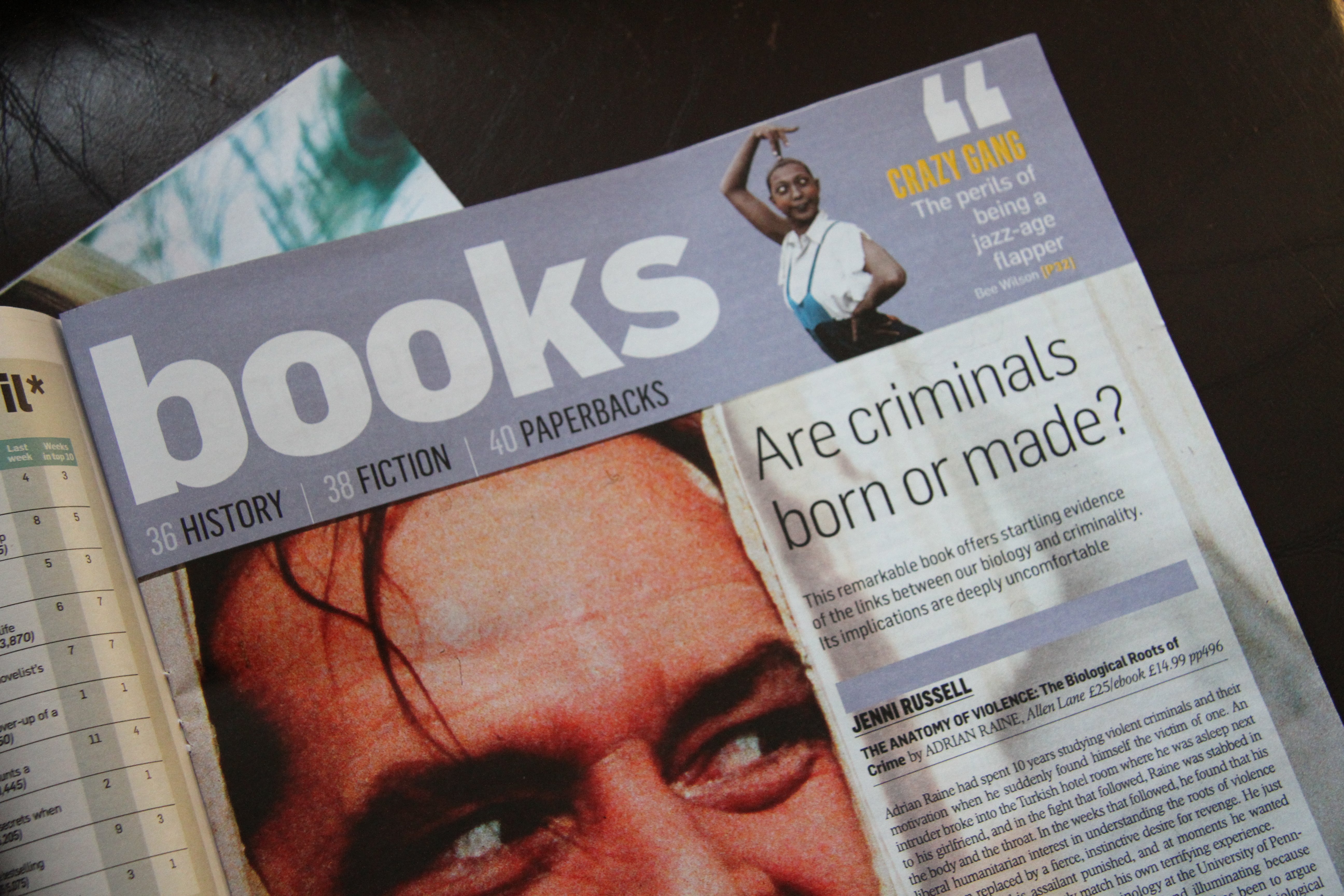
Yesterday’s review pages in The Sunday Times were particularly entertaining. Most of the reviews were interesting and several books were featured that I’ve made a mental note to buy. I’m not sure that this will include the lead title, however: The Anatomy of Violence: the Biological Roots of Crime, by Adrian Raine, reviewed by Jenni Russell. Raine, now a professor at an American university, has spent ten years studying violent criminals and their motivation and concludes that they are shaped by a combination of biological and social factors that are beyond their control. He is particularly keen to emphasise the ungovernableness of the biological factors that are at work, claiming that the brains of psychopaths and sociopaths are actually different from those of ‘normal’ people (though he confounds his argument somewhat by saying that the children of criminals, even if they are adopted, are more likely to commit crimes than other children).
As someone who is also interested in how the criminal mind works, though without the medical background, my instinct is to find this argument repellent. To me, it seems to be too closely related to the specious ‘insanity’ plea to which murderers and rapists often resort in order to obtain a lighter sentence or treatment at a secure hospital instead of jail, and to deserve about as much credence. I think that it is very dangerous indeed to suggest that sane adults are not responsible for their actions. As a girl, I had a close relative who would fly into terrible rages over some trivial mishap, such as when one of his children accidentally dropped a jar of honey on the floor, or the fire went out and he had to relight it. His frequent complaint would be: ‘I was in a good mood until you upset me!’ or: ‘I was perfectly all right until that happened!’ Even as a very young child, I remember the disdain that I felt that a grown man would try to duck responsibility for his vicious temper in this way.
I’m also more than a little disturbed by some of the experiments that Professor Raine describes. The review states (without comment): ‘In an experiment on almost 1,800 three-year-olds in Mauritius, children were measured on their bodies’ ability to anticipate that a particular tone would be followed by an unpleasant sound. It took only three trials for most children to sweat in anticipation of the harsh noise.’ I don’t like the sound of this at all. It raises all sorts of questions about the ethics of carrying out experiments with children, especially experiments that involve pain or fear. I realise that the experimentation described in Raine’s book involved fairly mild discomfort, yet it registers on a spectrum at whose extremity looms the terrible spectre of Mengele. I am reminded also of the ethical questions that arose concerning the Milgram experiment.
Professor Raine is more engaging when he writes about himself. From the review, it is not clear whether he is writing in a spirit of wry self-knowledge or simply being matter-of-fact when he reveals that, when he was seriously injured by an intruder while staying in a hotel room in Turkey, he felt a fierce, instinctive desire for revenge. Jenni Russell tells us: ‘He just wanted to see his assailant punished, and at moments he wanted that punishment to exactly match his own terrifying experience.’
I’d say that this eclipsing of Raine’s humanitarian tendencies by his more universally human ones is completely normal. It also illustrates why we need laws: in a civilised country, a judge and jury will dispassionately apply the law that prescribes fit punishment for the crime. Usually, it won’t be of the ‘an eye for an eye, a tooth for a tooth’ variety that injured parties like Raine sometimes passionately, and perfectly understandably, desire. Conversely, although a case may certainly be made for using the results of research into the criminal’s brain – and his or her background – in order to provide therapy, I don’t think that it should count as ‘mitigating evidence’. Anyone can try to justify appalling behaviour – from childish rages to much more serious crimes – by blaming circumstance, biological or otherwise. The fact that most of us don’t is what makes society work.
A gripping read with topical interest…

I’ve written about Michael Robotham before. Say You’re Sorry is the third of his books that I’ve read, all supplied by my son. In my opinion, this is the best of the three. By a strange quirk of coincidence, it is about two women who have been held captive for three years; I started reading it last weekend, before the story of the Ohio captives broke. The women in Robotham’s story are not being held ‘in plain sight’, however, but in an isolated building.
The story has two narrators, Joe O’Loughlin, Robotham’s now familiar lugubrious and slightly self-pitying, borderline misfit clinical psychologist hero and Piper Hadley, one of the two teenage victims, who manages to keep a diary throughout her captivity. Piper herself is a bit of a misfit and so lacking in self-confidence that she fails to realise that their captor distinguishes between her and ‘Tash’, the other captive, in ways that become vital to her survival.
This is a much more ambitious novel than the other Robothams I have read; both the plot and the character portrayals are at once more complex and more subtle. Robotham is still working on his trademark theme of the ‘woman at risk’, but these women are more than passive victims. Each has demons of her own that are unrelated to her captivity. There are a few jarring notes. Most conspicuous among these is (in my view) Robotham’s relatively weak power of conveying a sense of place. The book is supposed to be set in and around Oxford, an area with which I am familiar – it even mentions Branca, a restaurant in which I have eaten – but the descriptions do not convince. This is partly because the culture and language of the community from which Piper and Tash come does not seem very English. In both the norms and expressions that the people living there use (and, indeed, in Robotham’s choice of names like ‘Piper’ and ‘Augie’), they seem much more to belong to small-town America.
This is a minor, if recurrent, annoyance, however. I was gripped by this book. I did guess who the perpetrator was before a final twist in the plot revealed it, but only a few pages before he was unmasked. Robotham is particularly skilful at planting red herrings in Say You’re Sorry. The novel’s distinction doesn’t just come from the clever plot and the reader’s on-tenterhooks sympathy for Piper, however. It comes from the author’s success in getting inside the heads of both captives and captor in a totally convincing and believable way. There might have been a time when the plot itself could have been criticised for being far-fetched. Unfortunately, the stories of Elizabeth Fritzl, Natascha Kampusch, Elizabeth Smart (and now of Amanda Berry, Gina DeJesus and Michelle Knight in Ohio who have just escaped from ten years or more of alleged imprisonment and rape by Ariel Castro) prove that Robotham’s plot is not only capable of happening in real life, but also relatively restrained. As for what has happened in real life, the truth has turned out far stranger than fiction.
The Queen of railway stations…
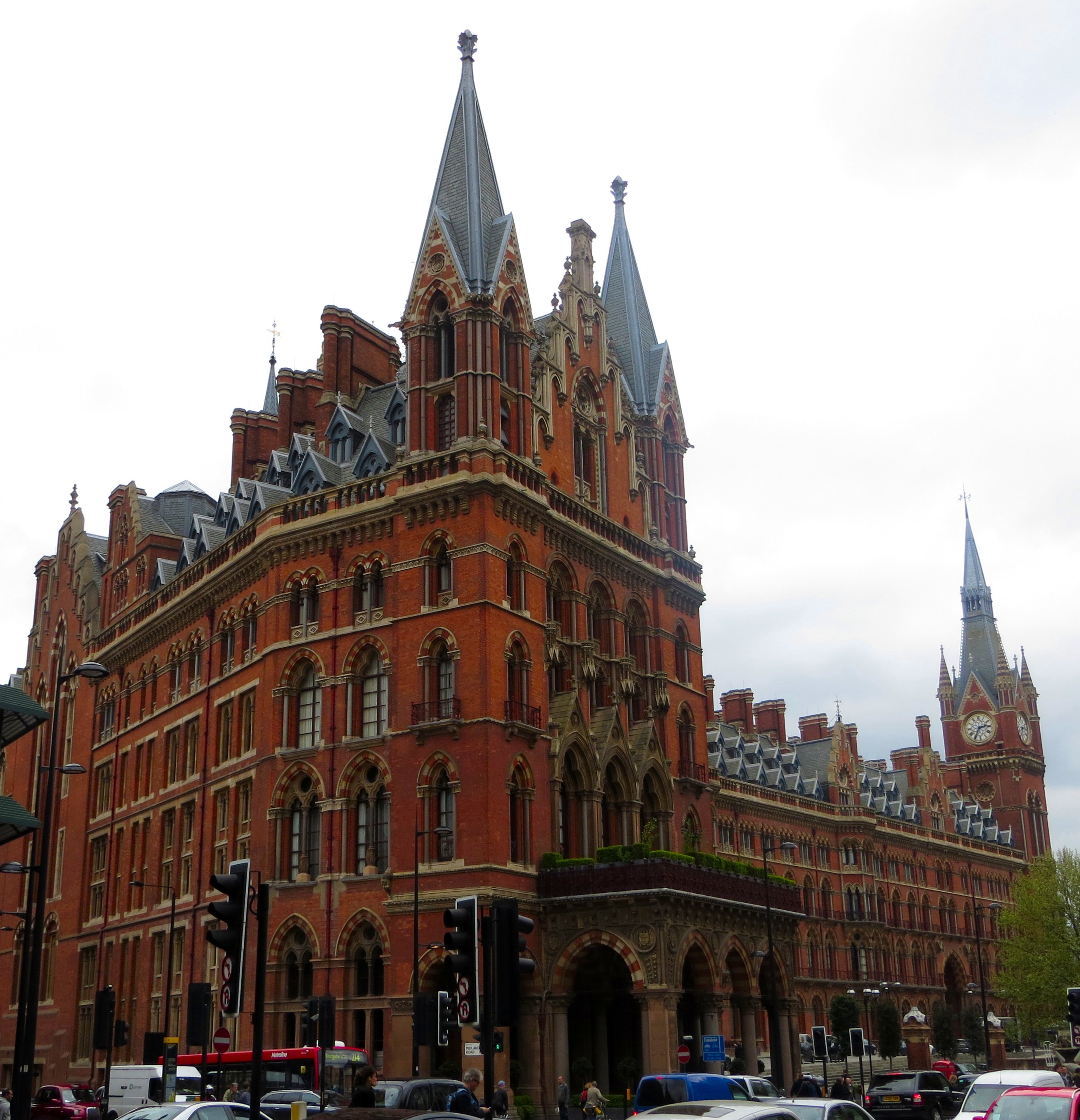
In London again for meetings, I pause as usual to admire the neo-Gothic grandeur of St Pancras Station. More whimsical than a church, as dramatic as if it were a castle towering over some fastness in a remote and mysterious land, it stands, a monument that celebrates the best of Victorian confidence and imagination. Taken as a whole, it could be the setting for a novel by Mervyn Peake; the former Midland Grand Hotel part of it would be the ideal backdrop for a modern take on the country house murder. Each time I see it, I also pay silent tribute to Sir John Betjeman, who was able to perceive its beauty and the poetry of its George Gilbert Scott and William Henry Barlow architecture and who fought to save it from the institutionalised vandalism that caused the original Euston station to vanish – save for its rather forlorn and redundant triumphal arch. Martin Jennings’ marvellous statue of Betjeman conjures both the poet’s and a universal sense of awe at Barlow’s glorious single-span train-shed roof.
Inside, today, St Pancras is a thriving modern business hub. Skilfully renovated, it contains a fascinating parade of shops, cafés and restaurants cunningly chosen to help travellers to pass their time – and relieve their wallets – while they wait for trains. Some of these trains depart for workaday Midlands places such as Birmingham, Wellingborough and Coventry; some go south to Brighton and other holiday destinations. But what really makes this station an exciting place is that it is the main UK terminus for the Channel Tunnel train – ‘Le Shuttle’. Passengers en route for Europe walk with extra purpose in their gait; they carry their luggage with more panache; they wear lighter, brighter clothes. Business-men and -women bound for Lille look less grey and crumpled than those heading for the City; holidaymakers travelling to Paris are glossier than those putting a brave face on going to Eastbourne in the rain. This festive atmosphere is augmented by people playing impromptu on the piano that has been left in the middle of the shopping precinct for the purpose. And – the final touch – announcements through the tannoy system are always relayed in French as well as English.
I wonder how much criminal activity takes place here. There are the usual signs warning passengers to be vigilant against pickpockets; but that isn’t what I’m really thinking of. In what kinds of business activity are the be-suited, glamorous commuters engaged? Are the man and woman dodging through the crowds, she stumbling in four-inch stilettos, he dragging a large case, merely late for a train that will carry them to a romantic destination, or have they just pulled off a lucrative scam and plan to escape by boarding train after train until they have journeyed far to the east?
All stations, even the most prosaically-built, contain a whiff of adventure, of the non-routine that travel implies. In this country, St Pancras is now queen over all the others. If he had lived to dine in the Grand restaurant there, Betjeman would have been happy and proud – and well-fed.
King’s Cross is now enjoying a similar loving makeover. I await the result with impatience and anticipation. It is not difficult to imagine that murder and mayhem took place many times in the murky, disreputable place that it used to be. It was like a malevolent old man in a dirty raincoat. I look forward to seeing a handsome king emerge from all the burnishing, fit consort for the queen next door.
 Christina James, crime novelist