

I happen upon a murder… in a very grand place…
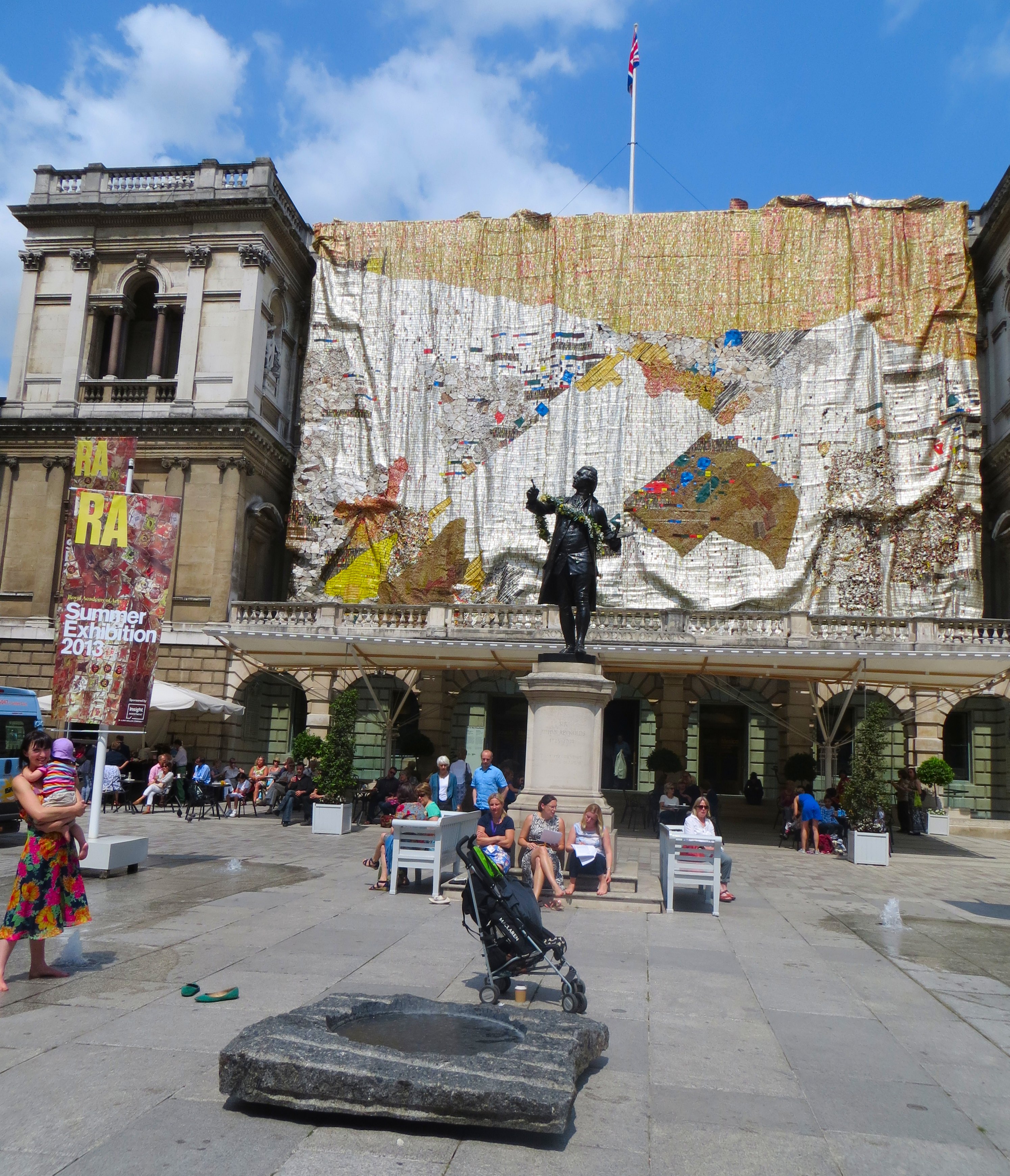
Burlington House courtyard
Over the past week I’ve spent three days (day job) at the Royal Society of Chemistry’s HQ, Burlington House, in Piccadilly. The building is also the home of the Royal Academy of Arts, the Society of Antiquaries, the Linnean Society, the Geological Society and the Royal Astronomical Society. It is an amazing place: turning your back on the dust and roaring traffic of Piccadilly, you enter an archway and are immediately transported into an enchanted world that carries with it all the grace and serenity of the finest seventeenth-century architecture – a mini-Versailles in the heart of London.
Intrigued by its splendour, when I was there yesterday I asked if there were any record of its history. I was given several pamphlets and leaflets and discovered on the first page of one of them, The Story of Burlington House, by Dennis Arnold, that in earlier days it was the scene of what was almost certainly a domestic murder.
The original Burlington House was built by Sir John Denham, a wealthy lawyer and poet (he was also Surveyor General to the Crown) for his new bride, Margaret Brooke. She was eighteen and he was fifty (and apparently limped). Margaret very quickly became the mistress of James, Duke of York, who had attended their wedding (and was later to become King James II). Their affair was common knowledge, as certain salacious entries in Pepys’ diaries make clear.
Margaret was found dead at Burlington House, evidently from some kind of overdose. Everyone assumed that Sir John was responsible for her death, though he wasn’t brought to trial. Despite her infidelity, public feeling ran high and Sir John’s life was threatened by the mob if he tried to leave the building. He managed to achieve the complete about-turn of the populace’s emotion by providing Margaret with a magnificent funeral, with ‘four times as much burnt wine as had been drunk at any funeral in England.’
Sir John did not stay long at the house after his wife’s death, however. Perhaps he could not bear this constant reminder of the collapse of the domestic idyll that he had planned; perhaps he was haunted by guilt every time he saw the place where she died. In 1668, Burlington House was bought by the first Earl and Countess of Burlington, who gave it its name.
I’ve never considered writing historical fiction, even if it’s about crime, but this story has captured my imagination. Perhaps I’m destined to write about Lady Denham, who I’m sure would have had a great deal to say in her own defence – married as she was to a (probably nasty) old man and (probably) unable to refuse the overtures of a future king.
I’ll write some more about Burlington House in a future post. I’ve not yet even started to describe its wonderful literary legacy, or the fascinating new acquaintance whom I met there yesterday.
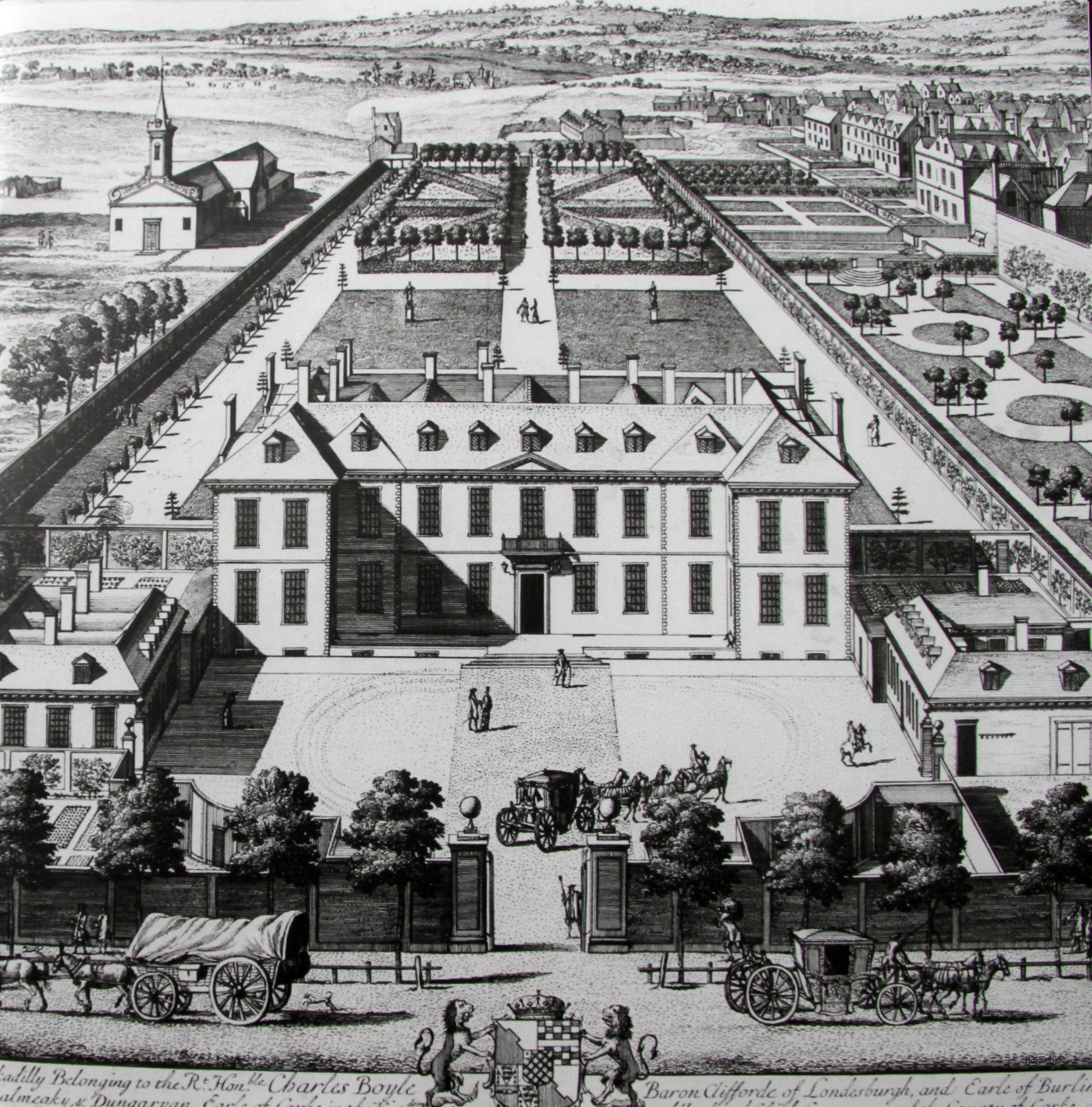
Burlington House c. 1700
Oh, poison again… in my blog, just a little at a time!
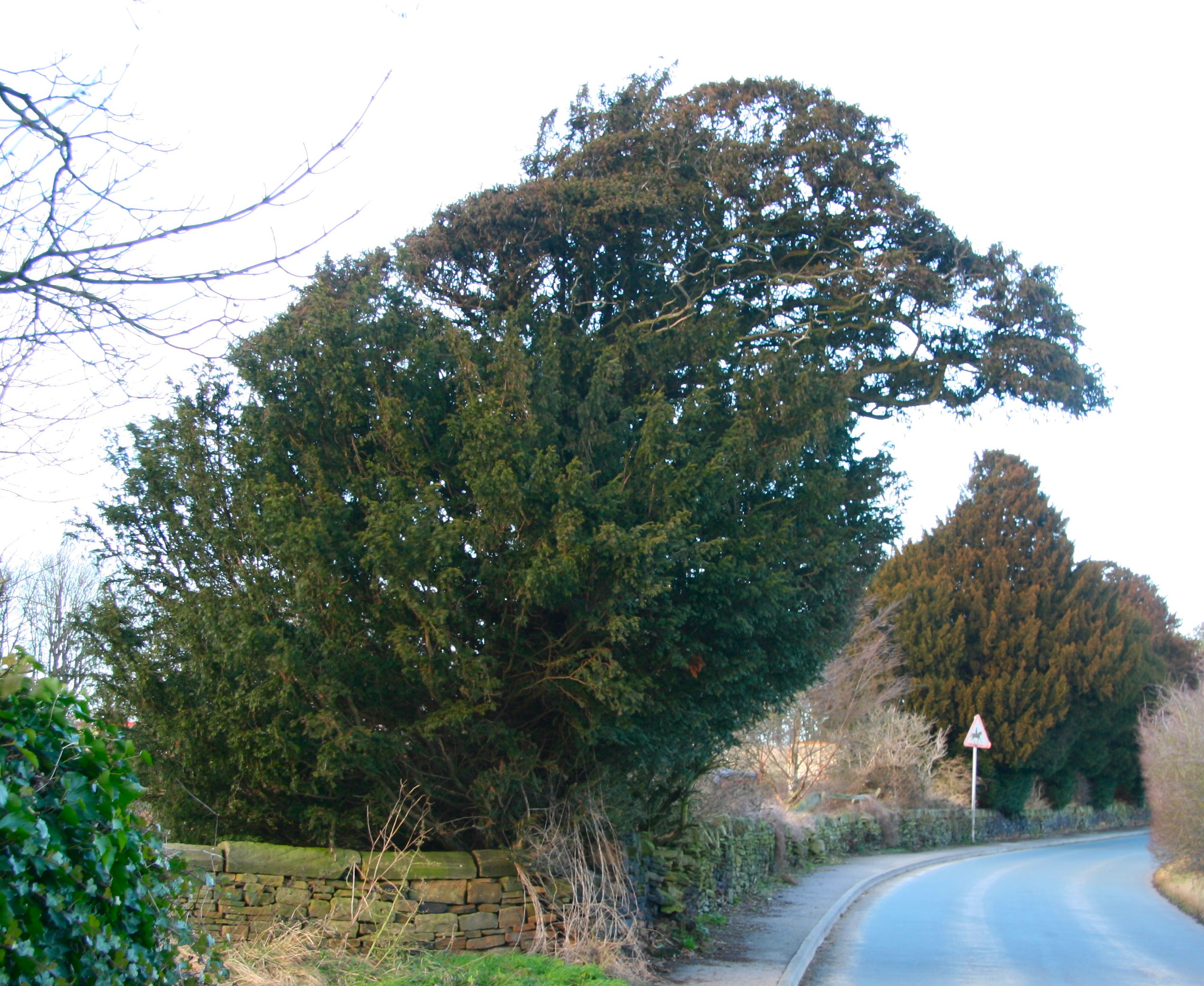
The yew, source of very poisonous seeds and leaves
I had such interest yesterday in the post about digitalis that I hope you will indulge my taking the subject of poison a little further today; poison little and often, then!
I’ve said several times that I’m not a blood-and-guts writer. Most of the murders in my books take place off-stage. Sometimes, if it is a cold case crime, the method that the murderer has chosen cannot be established. When murders do happen on set, as it were, I don’t dwell on the details: I don’t describe the brutal physiological results of a stabbing or shooting. I choose not to do this from personal preference and have recently had my choice endorsed by the reading groups whose meetings I have had the privilege to attend. I’m certain that there are readers who enjoy graphic accounts of violence, but I haven’t met many and, in this respect at least, my novels don’t cater for them.
Murders have to come about by some means, even so, and there are many methods I have yet to explore. I guess that if I were to put my imagination to work on them full-time, the possibilities would be endless. The literary canon is studded with outlandish murders, from George Duke of Clarence’s drowning in a butt of Malmsey wine to Hannibal Lecter’s grotesque destruction of his guards and Jo Nesbø’s Leopard’s inventive use of a ‘Leopold’s apple’. Murders tend to fall into categories, nevertheless. And one of them is poison.
Of course there are some famous male poisoners, both in fact and fiction, but, used as an instrument for plotting and arranging death, poisoning is supposed to be a peculiarly feminine choice; think arsenic and old lace as the stereotype. I’m not quite sure why. It’s true that it doesn’t require the force that stabbing, strangling and bludgeoning dictate, nor is it as a rule as messy (though this isn’t inevitable: nux vomica is very aptly named). Yet, if remoteness from the deed is the most prized attribute when the murderer is considering the best MO, shooting wins outright. The victim and murderer don’t have to speak, touch or engage with each other in any way for a fatal shooting to take place. If s/he is careful, the shooter leaves no forensic evidence except the bullet itself; the gun that fired the bullet can be matched to it if discovered, but disposing of a gun is not difficult. This is obviously why shooting is favoured by contract killers, but it demands both a particular skill-set and the possession of a gun, which can be daunting, if you’re not a member of the underworld.
By contrast, poisons are all around us. The average household must contain several dozen potentially murderous poisons, from items that only become dangerous if taken in excess, such as analgesics and alcohol, to paraquat (Susan Barber’s weapon of choice for disposing of her husband, Michael, in 1981), bleach and the multitude of cleaning fluids which are only safe in a domestic setting because the average adult would not dream either of ingesting them or of putting them in the way of the naïve or unsuspecting. Then there is the garden, a veritable hotbed of powerful poisons, from the tall and handsome purple and white foxgloves I wrote about yesterday to the exquisite scarlet yew berries or arils, the seeds in which are highly poisonous, as are the yew’s leaves. One of the best television crime series that I’ve seen was Mother Love, which featured Diana Rigg as the spurned first wife who killed her husband’s second wife with home-made biscuits sandwiched together with mashed yew-berries.
Perhaps I’ve just hit on why there seems to be a particular affinity between poison and female killers. It requires premeditation: a master-plan that is ruthlessly adhered to even as the victim is suffering terrible agonies and could perhaps still be saved by a would-be killer overcome by compassion. The poisoner has to have nerves of steel and a strong motive to murder, as well as excellent organisational powers. Revenge is the most likely motive to have spawned the crime, a revenge born of a long and brooding grievance that the perpetrator has fed and nurtured until the murder seems to be not only an act of justice, but unavoidable. Poisoning is an act of pure malice. No mitigating circumstances can be offered: it is never spur-of-the-moment. It cannot be attributed to a sudden access of anger, outrage or grief, unlike the more ‘masculine’ crimes of shooting and stabbing. In order to get away with the deed, poisoners need to be reflective, good at research, possessed of a chillingly high order of intelligence. I’ve listed some common poisons in the paragraph that precedes this one. Identifying poison is not difficult, but choosing and applying the one that achieves the desired effect before the victim seeks medical help, one that also cannot be traced back to the poisoner, may be tricky. It demands sustained effort, application of knowledge, scrupulous attention to detail and a high IQ.
Consider this for a moment. It is an apt description of many a multi-tasking mother and wife who is running a home and at the same time successfully holding down a job. The only difference is that, typically, she has neither the time nor the inclination to murder. In short, it’s a good thing that most of us don’t carry the murder gene in our DNA. If we did, there would be a population implosion!
Beauty and death…
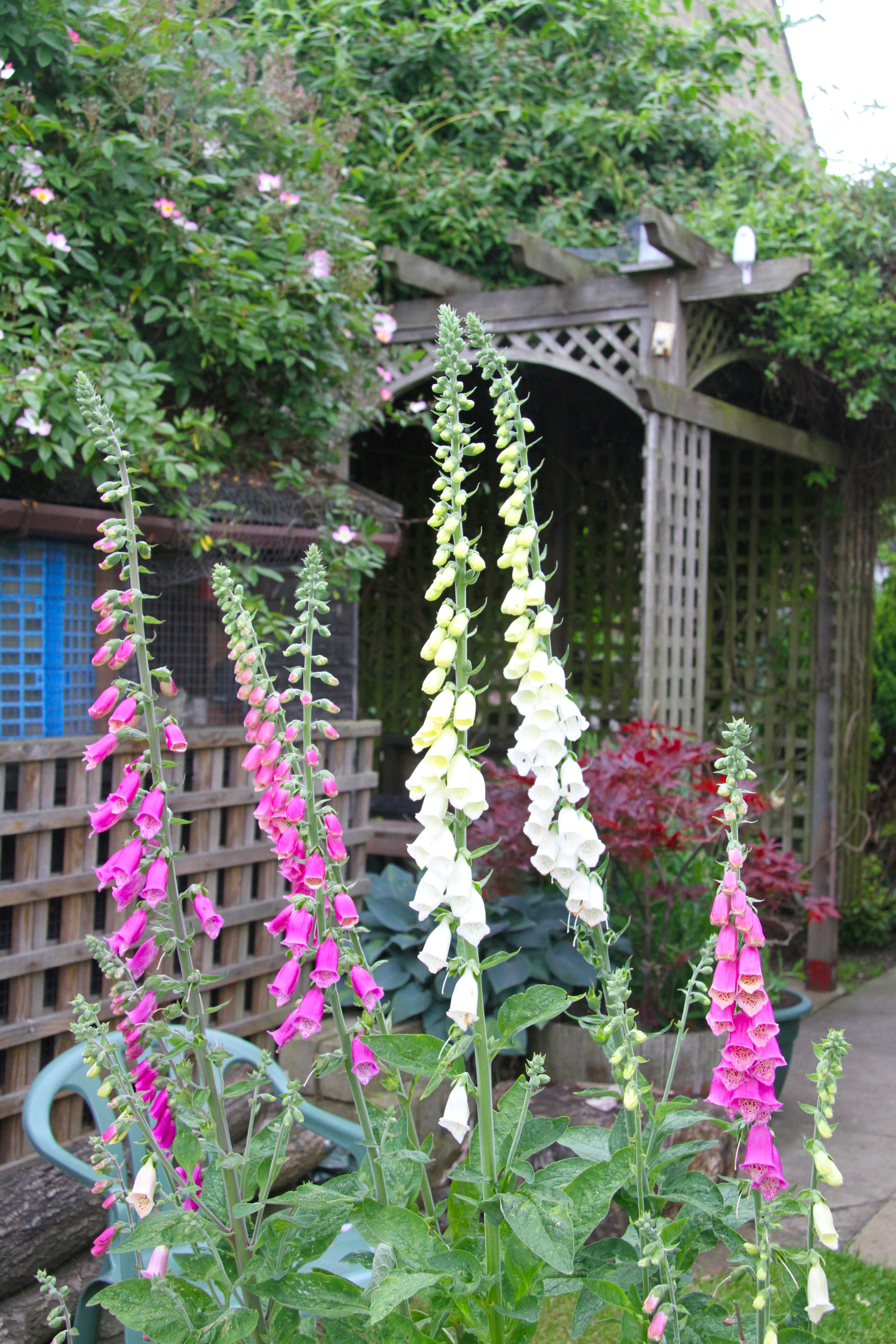
Digitalis, the foxglove
After rain and sun, the garden is a gloriously abundant and colourful mini-paradise; great wafts of scent sweep in through the open windows and still evenings are a sumptuous sensory banquet as I wander and fondle leaves and taste the herbs, sniff the honeysuckle and roses, listen to the chatter of the housemartins under the eaves and have my eyes caught and held by bee and moth and bird and flower.
Most striking of all, at this time of year, are the self-seeded digitalis, foxgloves, their pink and white spires climbing to the sky out of the dense green foliage at their feet, graceful forms in the dusk, their finger-fitting flowers even this late sucking in the bumble bees. I recall that every single part of this ‘witch’s gloves’ plant is toxic, with poisonous leaves, stem, flowers, roots and seeds, and find myself thinking of belladonna, the deadly nightshade, and strychnos nux-vomica, the strychnine tree of India, both of which also have the ability in all or most of their parts to kill humans and animals. There are two superbly symbolic passages about the deadly nightshade in L.P. Hartley’s The Go-Between, where the young and naïve Leo finds himself fascinated by and drawn to a rampant specimen in a ruined outhouse, an emblem of the enduring destructive power of the fabulously-seductive and forbidden adult relationship to which Leo plays pander.
It is interesting, however, that all of these plants, though lethal, are amongst the most potent and efficacious remedies for the homeopath, their toxicity refined almost out of existence by a shaking process called succussion. I consult my materia medica, and remind myself of what I did already know, that, in its homeopathic form, digitalis can be an effective remedy for diseases of the heart, while belladonna works on the nervous system and nux vomica has wide-ranging impact, especially on men!
A crime writer with an interest in natural poisons – in past centuries, I might have been burned as a witch! Now, I might weave such plants into a plot, as L.P. Hartley did so cleverly, and harness the evil within them for a good purpose, like a homeopath. Crime novels are packed with death-dealing stuff, but they clearly have a cathartic purpose and, as a result, are very popular.
Excuse me while I get out my pestle and mortar and crush a bit of digitalis into a story.

Crime Fiction Month and National Group Reading Day in Wakefield, West Yorkshire
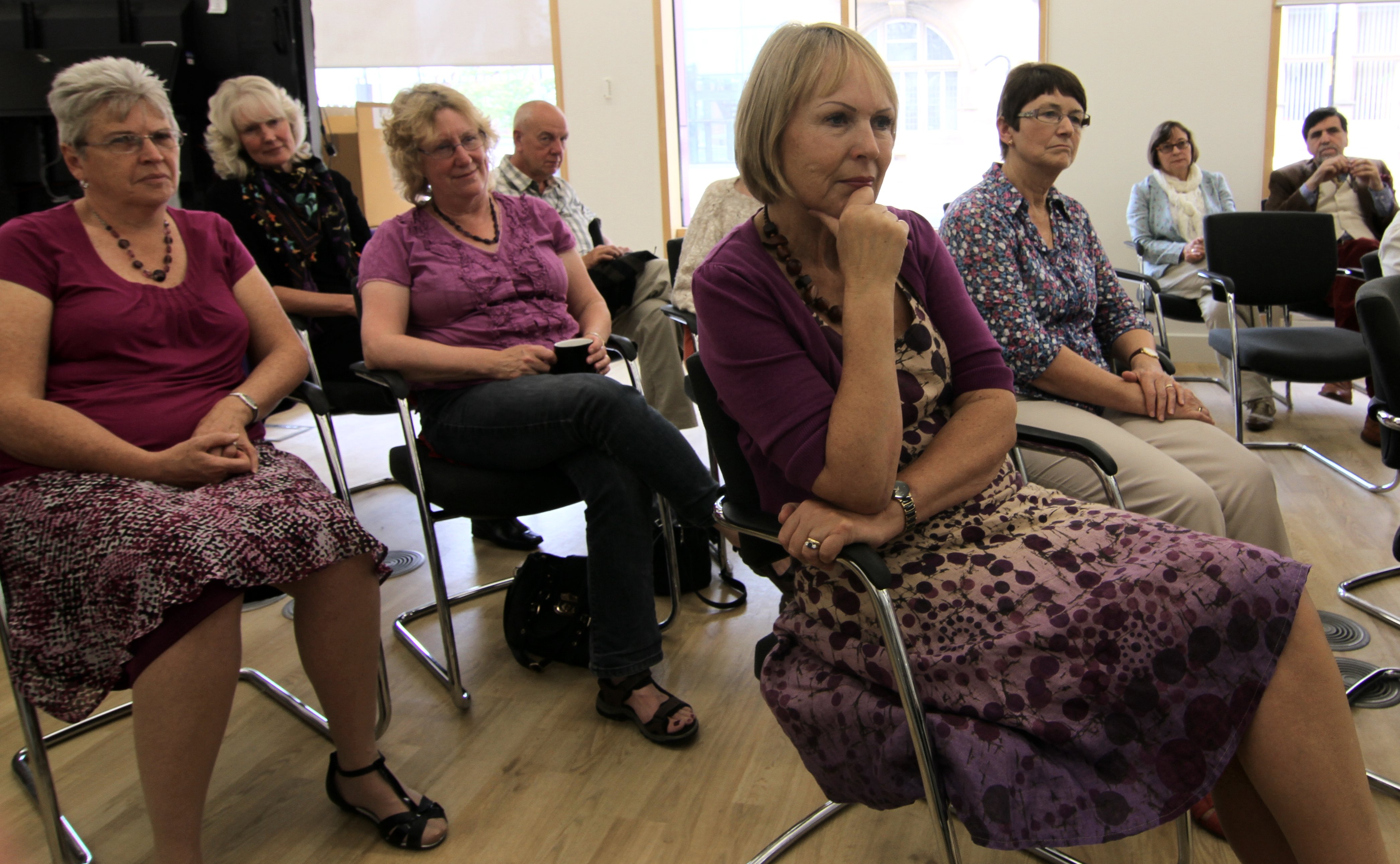
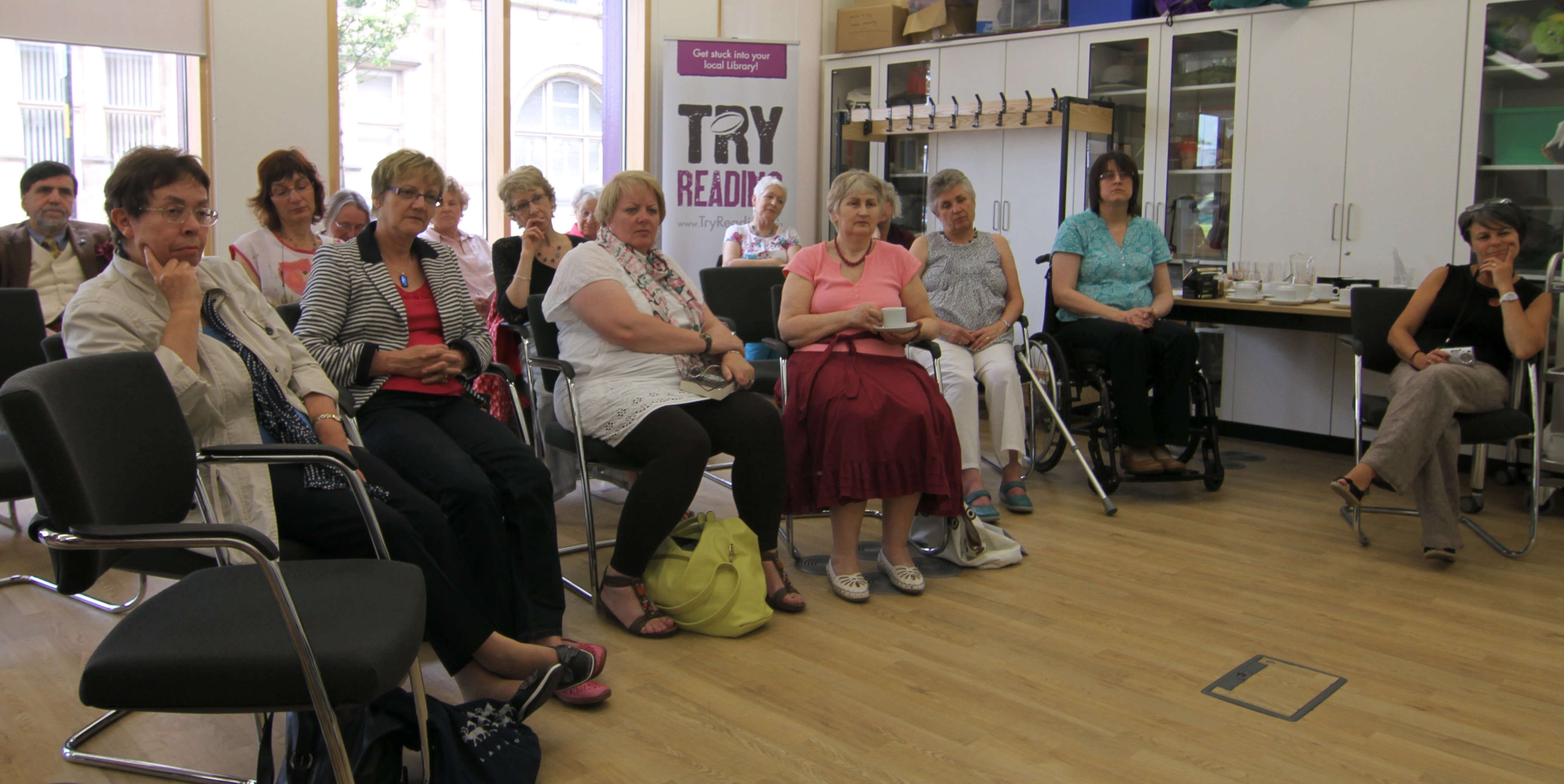
Wakefield Library audience listening to
a reading from ‘In the Family’
I was very privileged yesterday to have been invited to the event arranged by Wakefield Library Service as a joint celebration of National Reading Group Day and Crime Fiction Month. It was organised by Alison Cassels, Library Officer for Reading at Wakefield, and lasted almost the whole day. It was held at Wakefield One, the wonderful new library and museum complex which was opened last November by Jarvis Cocker. The day’s activities were built around the interests of Wakefield Libraries’ eighteen reading groups. When they are in everyday mode, the reading groups choose books that they wish to read from a selection provided; the library service then buys sets of these and distributes them. In itself, this must constitute an impressive feat of complex organisation and canny budget allocation.
About twenty members from various Wakefield reading groups attended. The morning began with refreshments, during which participants were given the opportunity to examine the next round of suggested titles and make their choices. We then split into three groups. Three books were being discussed, Peter May’s The Blackhouse, Wilkie Collins’ The Moonstone and my own In the Family. The facilitators were Alison Cassels’ colleague, Lynn, Julie Walker, Operations and Development Manager for Kirklees Library Service, and myself.
It turned out that so many of the participants had read all three novels that I and my fellow facilitators led consecutive sessions with all three groups. At the end of the morning, Julie chaired a wrap-up session about crime fiction more generally and we discussed our favourite books in the genre. We then broke for lunch. In the afternoon, more people joined the groups to listen to my reading of two short excerpts from In the Family and Almost Love, as part of a session during which we discussed how I write and how I originally managed to get published; the audience put to me more questions (some of them very searching indeed) about my novels. At the close, Richard Knowles of Rickaro Books, in Horbury, sold copies of both books.
I don’t recall having enjoyed an event – whether or not it featured other authors or myself and my own writing – more than I enjoyed yesterday’s. I say this, not from reasons of vanity, but because I have never before had the opportunity to get as close to readers and what they really think. The eloquence and perceptiveness of the reading group members, and the fact that they had spent so much time on really engaging with In the Family, was truly humbling. I took much pleasure in listening to Pauline when she explained why she enjoyed the passages of dialogue – particularly that which takes place during Hedley Atkins’ and Peter Prance’s train journey to Scotland – and how much she identified with Hedley’s frustration when he missed the train to Liverpool, in spite of his sinister intent; and to Jane, for taking the trouble to create a family tree for the Atkins family. Other reading group members quizzed me for more information about Salt Publishing, about the history of Lincolnshire, about how DI Tim Yates will develop in subsequent books and – in true, straightforwardly friendly, Yorkshire fashion – about what I could say to persuade them to buy Almost Love! I said that it does develop Tim’s character further, as they’d hoped, and that it contains quite a lot of history and more of the dialogue that they’d obviously enjoyed.
If any of yesterday’s participants are reading this, I’d like you to know that I think you are amazing. I was grateful beyond words for your generosity in investing so much time, both in the event itself and in reading the books, as well as, of course, for your buying them. I do hope that I shall have the opportunity to meet you again.
I’d like to conclude with a special thank-you to Alison, who provided me with excellent hospitality. Wakefield Library Service is an old friend, with which I first became acquainted in the late 1970s. It has always enjoyed a fine reputation as a distinguished and innovative library authority. From the start, therefore, I knew that yesterday would succeed, but the magic of the day, created by a combination of impeccable organisation by Alison, Lynn and their colleagues and the wonderful enthusiasm of all the participants involved, both from the reading groups and other members of the public, made it truly unforgettable.
Congratulations, Wakefield!

Pauline and I continue our discussion after the event
I commit a few putative murders…

In January, I wrote about a train journey to London during which I observed my fellow passengers and assessed them for potential as fictional murderers.
Yesterday, I made another train journey, this time to Cambridge. I didn’t set out with this intention, but, by the journey’s conclusion, I had been compelled by an uncharacteristic bout of Swiftian disgust to appraise the potential of some of my travelling companions as murder victims.
The journey from Wakefield began in a civilised manner, until the train pulled into Grantham. There, a group of schoolchildren boarded, evidently bound for some kind of daytrip destination (possibly London – this was the King’s Cross train). I say ‘schoolchildren’ – they were fifteen or sixteen, possibly first-year sixth formers. Until that point, I had been occupying a table to myself. Three of them joined me, two girls taking the seats opposite and a boy the one beside me.
The boy was very polite. The girls were shrill horrors, bred on a diet of Hello and reality TV. One of them was particularly inane. She made it quite obvious that she fancied the boy. She asked him what time he’d got up that morning. He replied 5.30 a.m. – he’d had to do his paper round before setting out. She said that she herself had got up at 6.30 a.m. – and it was a good thing that she did, because she, like, put on the T-shirt she meant to wear today and there were, like, two inches of bra sticking out at the top. Cue: shrieks of laughter from both girls. She then asked which of her companions would like to play ‘I-Spy’. (I was astonished at this choice of game, which most self-respecting ten-year-olds of my acquaintance would have scorned.) The other girl declined. The boy – still patiently polite – agreed. ‘I spy with my little eye something beginning with t,’ said the first girl. ‘Train!’ said the boy. Another burst of giggles. ‘I don’t believe it!’ she said. ‘However did you, like, guess that first time around?’
I was joined on the Cambridge connection by a tall young man with Jesus hair and a Tonto headband. He was dressed in an Afghan-style coat and was reading a book on philosophy. He seemed a pleasant enough travelling companion until he yawned. I was assaulted by breath fouler than could have poured from the mouths of half a dozen dragons after a brimstone-eating spree. I moved to the seat beside mine so that he and I were diagonally opposite each other. A middle-aged woman then boarded and sat next to him. She was immaculately dressed, all her golden curls sprayed firmly into place. She was clutching a cup of Costa coffee. I looked up a few minutes later: The white plastic lid of the coffee was smeared all over with her red-orange lipstick; so was her face. She took a packet of Monster Munchies from her bag; they were pickled onion flavour!
At Ely, another tall young man joined us. I stood up so that he could take the seat opposite dragon-breath. Their long legs clashed. The newcomer smelt even worse than his counterpart. It wasn’t just his breath: he had an all-over aroma of mingled mould and sweat.
I was delighted and relieved when I could finally disembark. Cambridge station, drab at the best of times, had never seemed so inviting. Jonathan Swift, I am sure, would have imagined eloquent and appropriate comeuppances for their various vile traits. I could think only about who might murder them and how. Motive would not have been a problem… but engaging the reader’s sympathy for the victims? Perhaps a little more of a challenge!
With how sad steps, O Moon…

I read that the moon would come unusually close to the northern hemisphere last night. As it was also the day after the summer solstice, I thought I’d have to wait until quite late before being able to see it properly. In fact, like many another midsummer evening, yesterday’s was squally and darkness fell relatively early. An ominously large moon revealed itself, a huge silver-yellow disk in the sky, shadowed in places, and getting ever larger, as if it might keep on coming closer until it crashed into the Earth. That it was repeatedly occluded by rapidly scudding clouds made it the more sinister, a laughing witch at her games.
Regardless of culture or creed, the moon has dominated as one of the great motifs of literature. From earliest times, she has been celebrated in religion and ritual, often as the gentle feminine foil to the sun’s aggressive masculinity, but sometimes with a stronger and more violent persona. Implacable, she demanded sacrifice from the Incas and other ancient societies. She was Diana the Huntress, among the fiercer goddesses of the Roman pantheon and symbol of assertive virginity. She is the subject of the contemporary Wiccan practice of ‘drawing down the moon’, said to derive from a picture of two women and the moon which was painted on an ancient Greek vase. It is the moon that controls the tides and therefore influences shipwrecks. No wonder that so many old sailors’ superstitions are about her. Eighteenth century smugglers waited for the full moon to give them enough light to bring their goods ashore, though sometimes she was a fickle friend, enabling the customs officers to spot them as clearly as they could themselves see their contraband crates of rum and bales of silk. “Watch the wall, my darling, while the gentlemen go by.”
There is a long list of books and films that I’ve enjoyed that have the word ‘moon’ in the title. Here are some of them: The Moon and Sixpence, The Moon’s a Balloon, Moon Tiger, Paper Moon, Moonfleet, Moonraker, and, of course, The Moonstone, arguably the first English detective novel and also, many readers of crime would claim, still the finest. Mine is a disparate and eclectic list; no doubt you could produce one that is equally idiosyncratic. What all these titles – and the many others – have in common is that none of them is directly about the moon. Instead, their authors have invoked her name to convey that their books engage with one or more of her many qualities: mystique, exoticism, ambition, cruelty, the fickle, the unattainable, the preternaturally beautiful.
Looking at my photographs of last night, one of which I am now sharing with you, I am reminded of the elusive nature of the moon so brilliantly and humorously conveyed in Charles Laughton’s drunken puddle sequence in the 1954 David Lean Hobson’s Choice film; I madly toy with the idea of her in the word ‘lunacy’; quotations from many poems about the moon flit amongst the clouds of my mind; I feel that the moon is a deserving mistress and I catch glimpses of all her qualities as she dips her face towards the earth and holds me in her thrall. By tonight, she will have retreated a little; apparently, she won’t stoop to kiss us again until August 2014.
Now that’s fickle.
The flavour of Salt crime fiction…


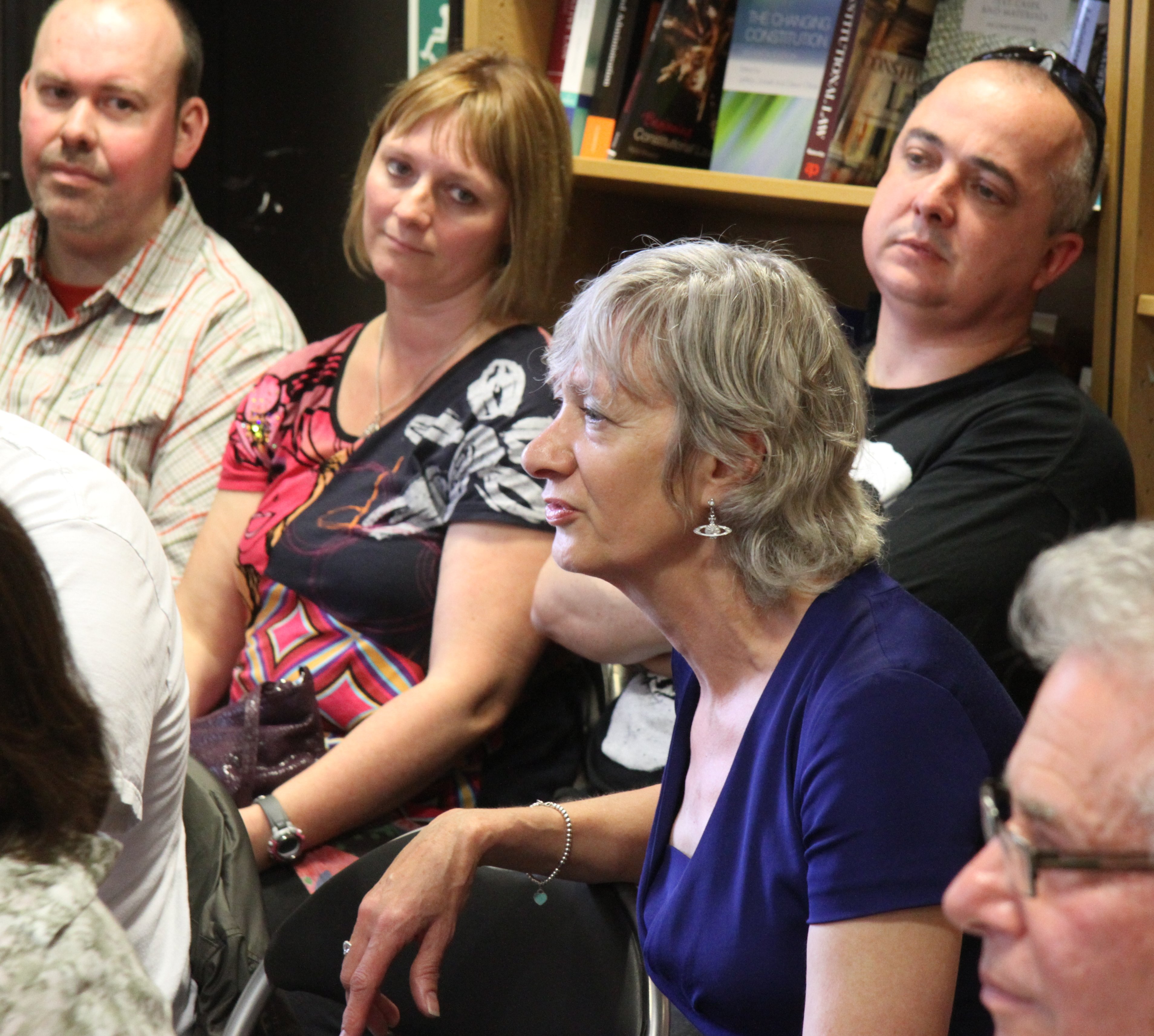
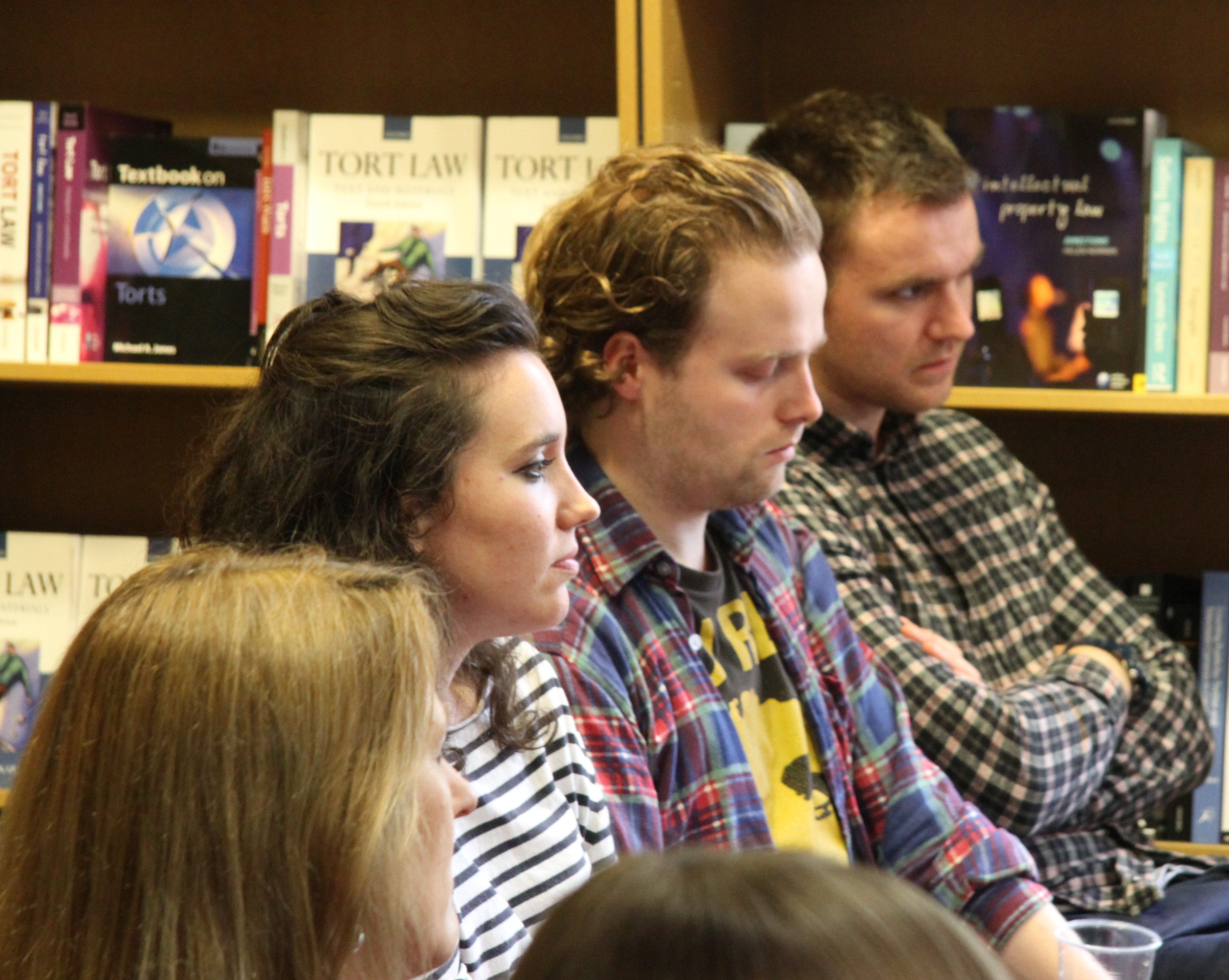
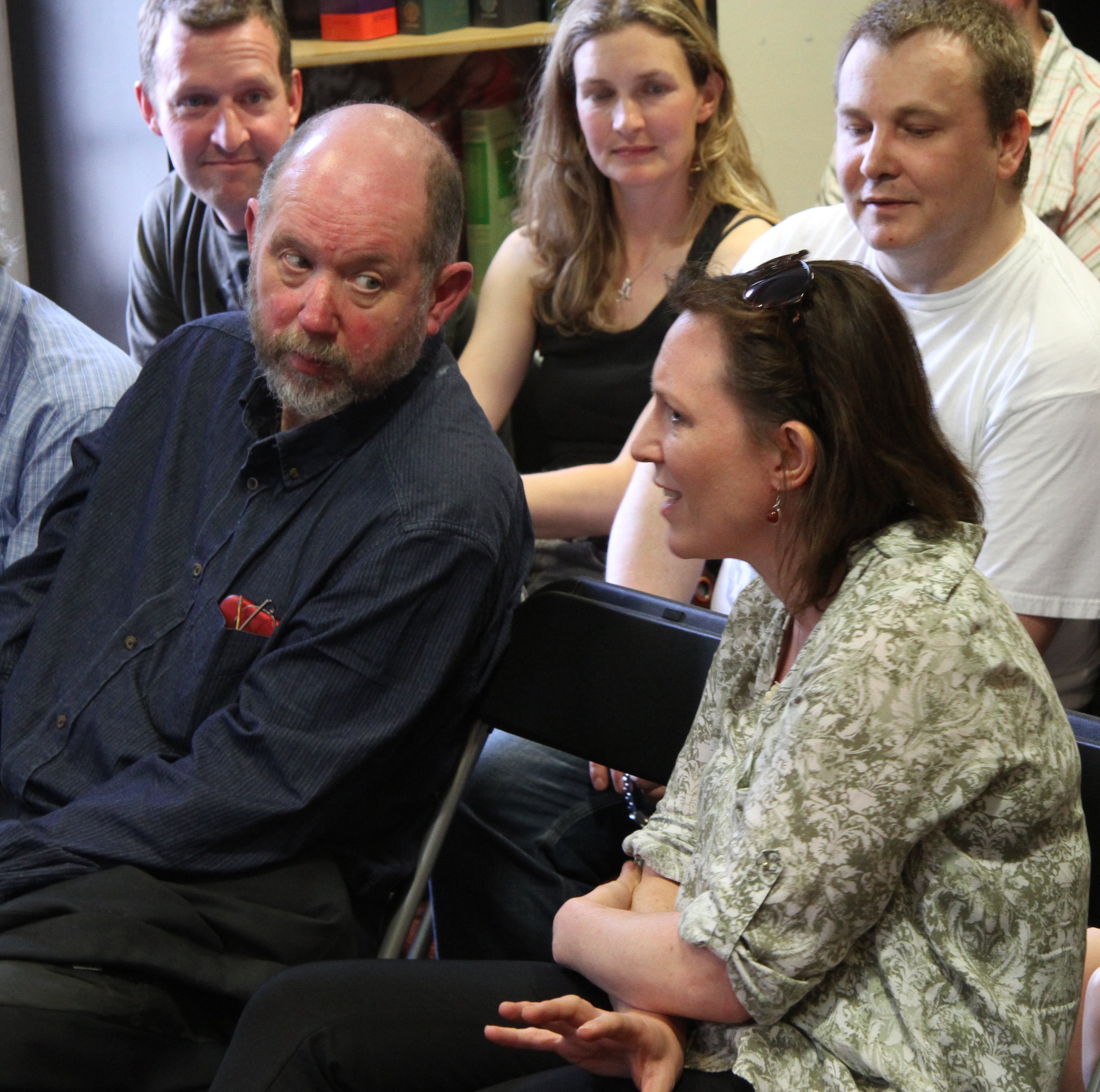


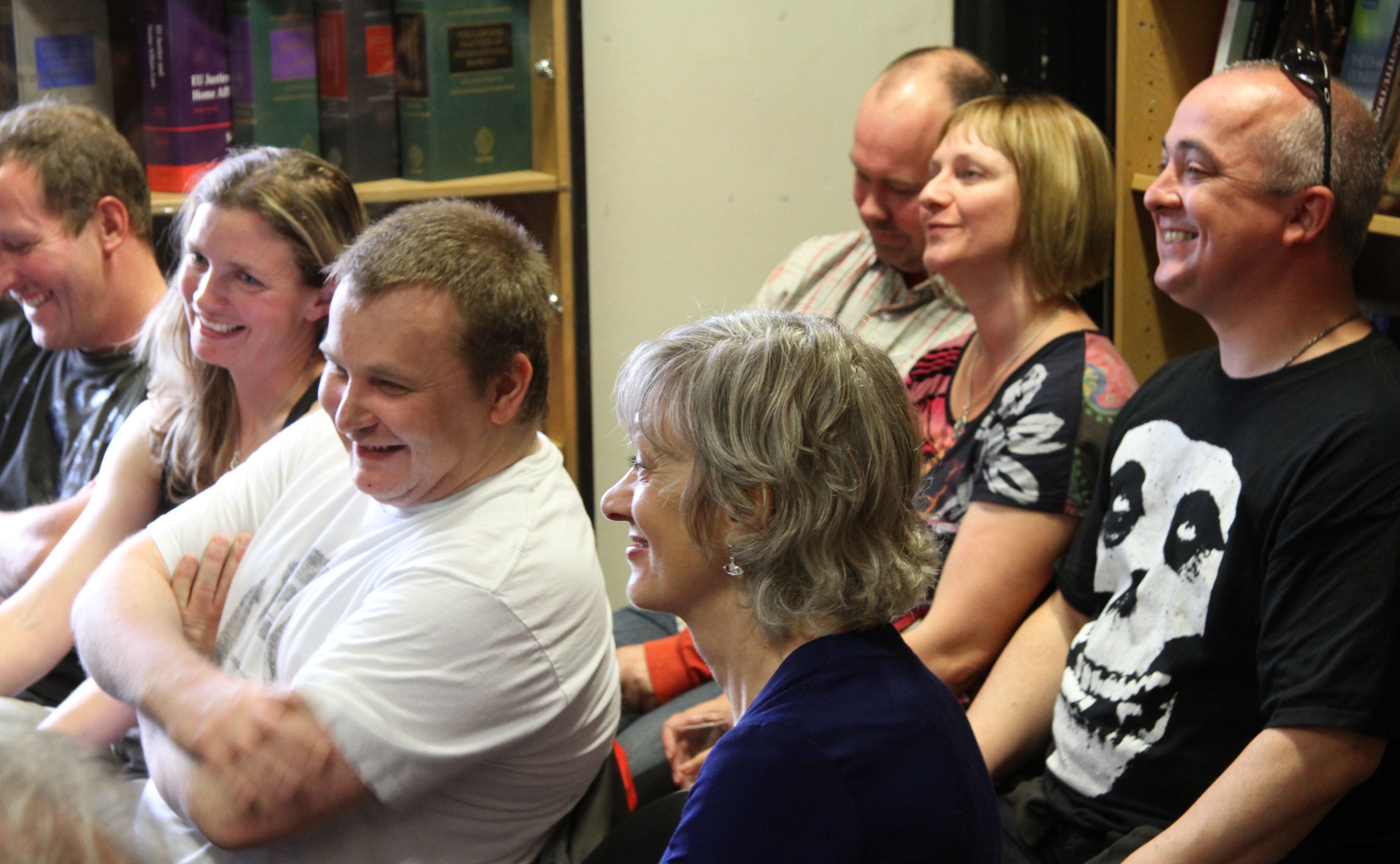

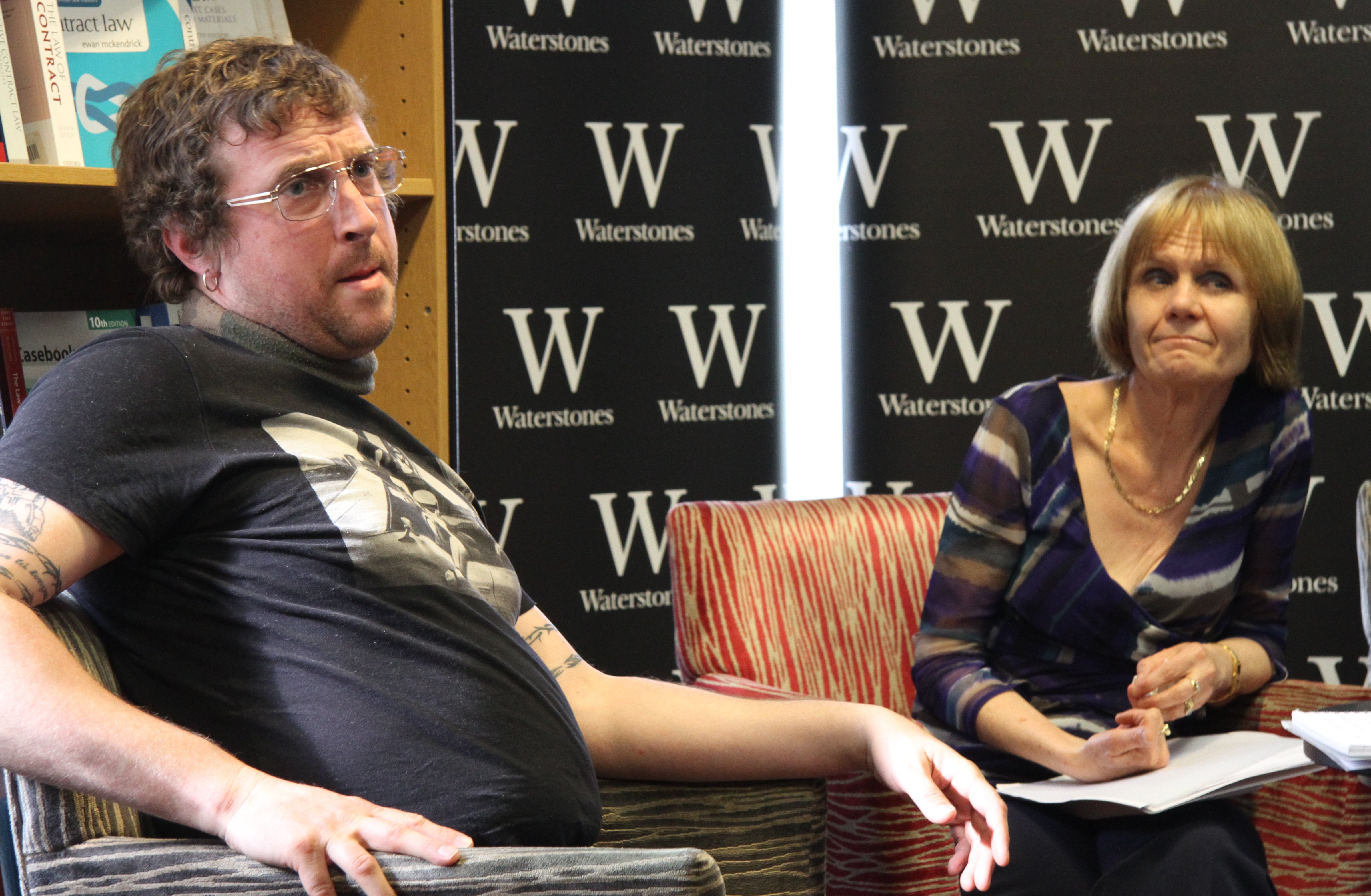


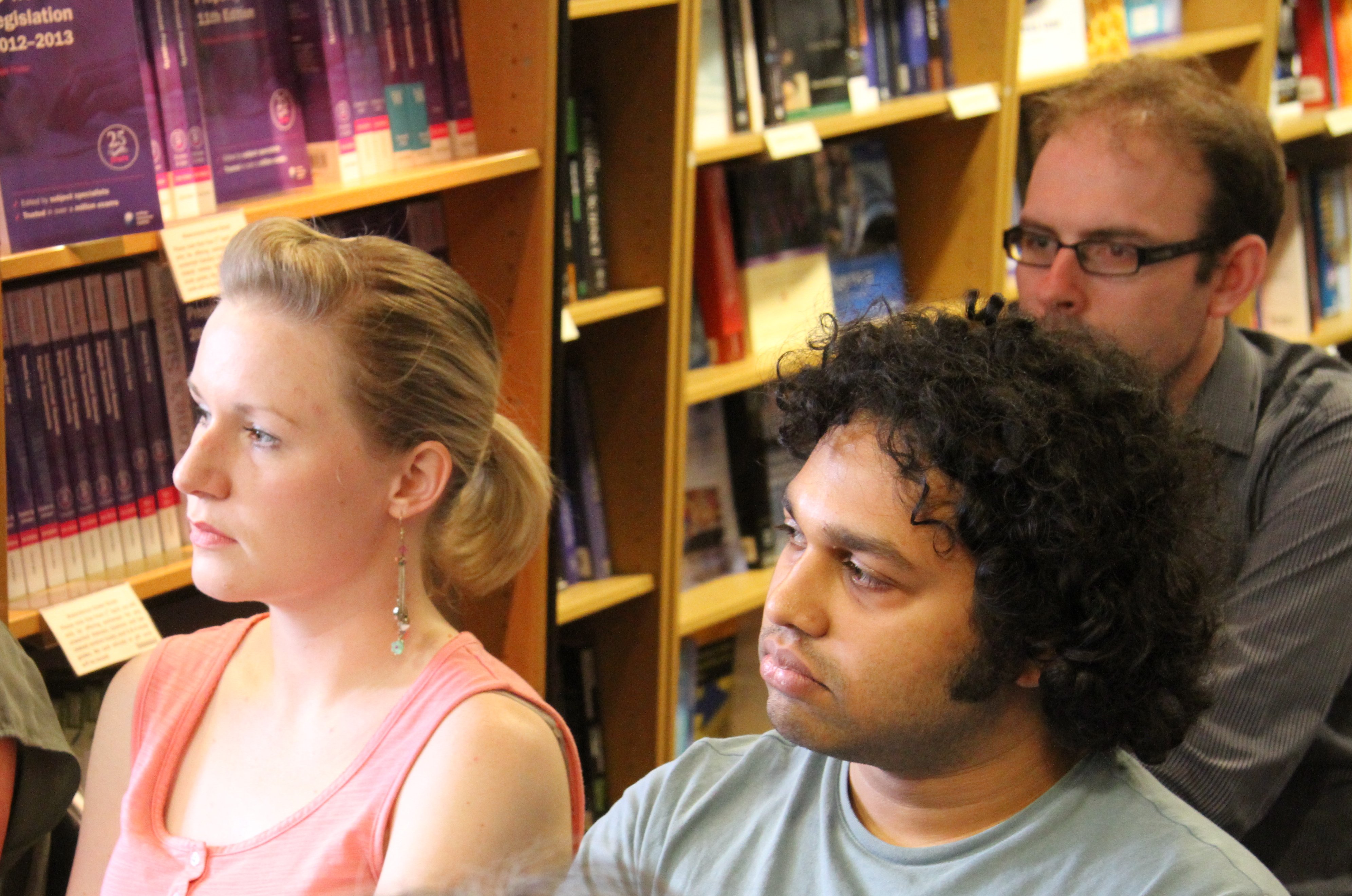


The Salt crime writing event that took place at Waterstones Gower Street yesterday was a very festive occasion. Sam Rahman, the Events Manager at the shop, her colleagues and a large and appreciative audience combined to make it a great success.
Laura Ellen Joyce, Matthew Pritchard and I each gave readings from our books. Laura read from The Museum of Atheism, which (jointly with In the Family) launched the Salt crime list last November. I read from Almost Love and Matthew from Scarecrow, which Salt will publish in September. Afterwards, I chaired a discussion with Laura and Matthew about their writing. The audience joined in, offering many lively and perceptive comments.
Both Matthew and Laura agreed that a sense of place was important to their writing. Laura chose to set her book in small-town America in the dead of winter – there is no daylight in the novel – to epitomise the corruption that it portrays. Matthew writes powerfully about Andalucia, which he knows well, having lived and worked there for twelve years. Laura agreed with the suggestion that she describes a rudderless society in which no character is able to provide a moral yardstick or compass. Matthew said that the corruption captured in his work derives more directly from his knowledge of shady Spanish officialdom. Danny Sanchez, the protagonist of Scarecrow, is a journalist who bravely tries to expose the fraudulence and self-interest upon which he sees that Spanish politics is based.
Laura had deliberately left vague the identity of the killer in her book, because, in a sense, she was indicating that society as a whole was to blame. Matthew had had the intention right from the start to write about a serial killer, but the character of the killer took shape in his mind gradually as he worked on the book and continued to read about real-life murders. An account of how the head of one of Fred and Rosemary West’s victims had been swathed in gaffer tape had left a particularly lasting impression on his imagination.
There was much laughter from the audience at Matthew’s anecdote about how, when the shop below his flat caught fire recently, the police broke into the flat and discovered his large collection of books about serial killers and Nazism scattered over the floor. There was even more laughter when I persistently made the mistake of calling him ‘Danny’, after his hero, rather than Matthew! (Apparently, it is a mistake that his agent makes, too!)
Laura confirmed that she will continue to write crime because she has a profound interest in why people commit evil or anti-social acts. She’s also interested in pushing out the boundaries of fiction. When, in response to a question from one of the audience about what I thought the ‘next big thing’ in crime writing would be, I said that I’ve seen several books lately that mix genres and I’m not sure that it works, Laura said that this idea appealed to her and that she would like to experiment with it. I do think that it would take a very good writer to pull it off, but Laura is so accomplished that she is one of the few people I know who might succeed at it.
I was asked why most crime novels are about murder, rather than other types of crime, such as theft or fraud. I said that there are some novels based on theft – there is quite a strong sub-genre relating to crimes associated with works of fine art, for example – but it is difficult to write about crimes other than murder unless you are a police procedural author. This sub-genre has never appealed to me; I’m more interested in the psychological aspect of crime-writing.
We were all asked whether we’d come to writing ‘lately’, or whether we’ve always been writers. We agreed that we’ve all been writing ever since we can remember. Asked also whether we had to let a novel ‘fade’ from our imaginations after we’d finished it before we could embark upon another, we each offered different responses: Matthew writes all the time and is usually working on several books at once – he knocks out 2,000 words a day, even if sometimes he knows it is rubbish and he will have to discard some of it; Laura writes regularly, but in different genres – she writes short stories between novels and also said that she was very organised when writing The Museum of Atheism which, with a detailed outline on a spreadsheet, she wrote in twenty-four days, a chapter a day, all in November, following the NaNoWriMo concept; I usually take a brief break after completing a novel, but I’ve started on the next DI Yates book now. I feel that being an author is a bit like being a member of the fashion industry: your mind is already on the next season’s work while your readers are still consuming this season’s product.
We all paid tribute to Salt Publishing, which we agreed is an uncompromising publisher setting high standards. We were also united in saying that we aren’t interested in the ‘blood-and-guts’ style of crime writing.
On behalf of the three of us, I’d like to thank Sam and the staff at Gower Street for their wonderful hospitality. I’d especially like to thank all of you who attended for being such a generous and receptive audience, for making such constructive contributions to the discussion and, of course, for buying or ordering our books! It was good to meet some new friends – some of whom I’ve only previously ‘met’ through Twitter. Finally, a big thank-you to numerous well-wishers who were unable to come (some of you based in countries very far away), but who sent kind and encouraging messages and helped to advertise the occasion. We hope to meet you all one day at future events.
All in all, it was a very memorable evening indeed!
A lovely Friday conversation with Jan Smedh, joint proprietor of The English Bookshop in Uppsala, a thriving independent business…

I’m delighted and very proud to discover that Almost Love has been chosen as the British Crime novel of the month by The English Bookshop in Uppsala. I asked Jan Smedh, who, with his business partner Christer, is joint proprietor of the shop, if I could call him. He kindly agreed to talk to me today, although he was busy making final preparations for his absence: he and his wife and three sons are about to leave for a holiday in Greece.
Jan told me that every month he chooses books for his reading groups and his book club. There are three reading groups: one for the Book of the Month, one for classics and (in Stockholm – he and Christer have just opened another shop there) one for children’s books. The book club operates as a subscription service. It has between fifty and sixty members scattered throughout Sweden. They choose the category to which they wish to subscribe and are each month sent a book in that category that Jan has chosen. They do not know in advance what the title will be.
He chooses titles from six categories altogether: the Book of the Month, which is always a literary novel; British Crime, ‘Tough’ Crime, Paranormal, Fantasy and Science Fiction. He tries to introduce a spread of themes and to get a balance between male and female authors and authors from different countries; for example, he has featured Asian authors who write in English. His choices are pretty unerring: his customers always seem to like them.
Jan said that when he read the description of Almost Love, he ‘loved it at once’. (I’m blushing as I write!) He tries to pick books by authors from small publishers that aren’t necessarily well-known, rather than blockbusters. The subject of Almost Love seems to be exactly what his readers are looking for: it has a bit of history, a bit of archaeology, some local background, a good plot and a strong psychological element. He says that his favourite customer is ‘someone who leaves the shop with a book that they didn’t know that they wanted.’ His copies of Almost Love have yet to arrive (there has been a slight delay in the printing, caused by MPG’s having gone into receivership two weeks ago), but they should reach the shop next Monday, so he didn’t know until I told him that there is also a Scandinavian element to the plot. He was delighted about this.
Jan learned about Almost Love from a Scottish publishers’ rep who carries titles from several independent publishers. His name is Stuart Siddall. I had not heard of him before, but I shall certainly get in touch with him now and I should like to take this opportunity to thank him.
I asked Jan about the inspiration for The English Bookshop. He said that he and Christer came up with the idea for it in 1995. They received no financial backing; they raised all the money themselves. Christer was already working in the bookselling industry (largely in the academic sector), so he had the contacts with UK publishing companies, who were therefore prepared to set up accounts for the new venture. It would not have been possible without their support. Jan’s own background is in communications and the business has benefited a great deal from this. It is he who designs the graphics for the website. He is prolific on the social networks and the shop has very active Facebook and Twitter accounts. He says that the key thing with social networking is to be consistent. He has worked hard to build up a loyal customer following and he knows he must maintain their interest by continually being there for them. His own love of books goes back to his childhood. He also speaks impeccable English: he explained that he has lived in Cork and has also visited the UK (he would like to see much more of it) and the USA.
95% of The English Bookshop’s customers are Swedish, though there is an ex-pat community in Uppsala, which is a university town (Jan describes it as ‘the Oxbridge of Sweden’). Most Swedes read English, and Jan’s customers are getting younger: some twelve-year-olds now buy books in English. Uppsala is also Sweden’s religious centre and the city in which the Monarch is crowned. It is Sweden’s fourth largest city and not huge, but it has the weight of history behind it and is home to many very well-educated people. Jan and Christer made the conscious decision to stay away from university course texts: they wanted their bookshop to provide leisure reading. By this, he doesn’t mean that all the books he sells are ‘light’: his readers like books about many subjects, as well as fiction. British history, books about war and books about psychology are all popular. Sales of non-fiction titles are growing; also crime fiction and children’s titles. The Swedish government has now set up English language schools, which means that parents are looking for books in English for their children. The English Bookshop tries hard to keep abreast of the continually changing interests of the local community and its unique stockholding reflects this. Jan says that ‘other bookshops aren’t doing this any more; there’s often a drab uniformity about what’s available from the big chains.’ Smaller publishers often complain that it’s difficult to get a proper presence in them. This view would certainly resonate with Salt, whose many distinguished authors often struggle to get adequate shelf-space in chain bookshops. It would also be endorsed by the UK’s many excellent independent booksellers, some of whom Jan knows. He has met Jane Streeter, a former President of the Booksellers Association, and is himself a member of the BA, for which he has a high regard.
In the last six years the turnover of The English Bookshop in Uppsala has doubled, enabling it to open the second shop in Stockholm. Jan says that this ‘goes against the grain’ of Swedish bookselling generally, so he feels that he and Christer ‘must be doing something right.’ I’d say they were doing a great deal right! The business is now eighteen years old.
It was delightful to have the opportunity to talk to Jan, and I am very grateful to him for giving me so much of his time and as well, of course, for choosing Almost Love. I now have an open invitation to visit The English Bookshop, which I am determined to take up. I’d like to visit the one in Stockholm, too! I wish Jan and his family a very happy holiday indeed in Greece. If any of his customers should read this, I’d also like offer you a big thank you and to say that I very much hope that you will enjoy Almost Love. Perhaps we may meet in the bookshop one day.

Prince Charles and I are not of one mind…

From Ordnance Survey Landranger 110 map
I love old houses and have been visiting stately homes since I was a child. I celebrate them as a unique part of our English heritage and I am always fascinated to read about the people who lived in them and to gaze upon their portraits. I’m making this clear at the outset, because what I’m about to write may seem a little out of character, not to say controversial.
I read in last Sunday’s Times that Prince Charles is throwing his considerable weight behind the fight to save Wentworth Woodhouse, which requires £100m to be spent on it to conserve the building and reverse subsidence. By a strange coincidence, some years ago, the Prince intervened even more directly to save Dumfries House, by spending £20m from the Prince’s Trust on its renovation. I say coincidence, because for three years I worked in Dumfries and had a flat there, so I’m familiar with and have lived near both the old piles in which he has taken an interest. (If he starts campaigning for any more such buildings near me, I shall begin to think that he is stalking me!)
Wentworth Woodhouse is not so very far away, though I’ve only visited it once, and then only the grounds, because until recently the house wasn’t open to the public. At the time of my visit, about five years ago, it wasn’t possible to get close to it: it had to be viewed from a public footpath on the other side of the boundary fence. I didn’t in fact know of its existence until the publication of Black Diamonds, by Catherine Bailey, which I bought after reading rave reviews when the book came out in 2008 and which is a meticulously-researched account of one of the families that lived in the house – so it doesn’t cover the whole of its history, but I found Bailey’s account gripping and it inspired me to want to see the mansion for myself.
Wentworth Woodhouse has been described as Britain’s finest Georgian house. It is certainly its largest. The main front of the house is 606 feet long, twice the length of Buckingham Palace. It has more than 1,000 windows. The newspaper article says that the nursery was situated an eighth of a mile from the dining room. Guests were given different-coloured confetti so that they could find their rooms again when they retired to bed (I remember reading this in Bailey’s book, as well). Even the stables are huge: in common with many other visitors, I mistook them for the house itself when first I came upon them. In fact, huge is the best word that I can think of to describe Wentworth Woodhouse itself: or gigantic, or enormous, or gargantuan, or outsize. In my view, it is both a monster and a monstrosity. It is gratuitously massive just for the sake of it. It has been symmetrically constructed, with two elongated wings, but is not otherwise architecturally distinguished. It actually gives the impression of being rather squat, even though the main building is three storeys high, because of its preposterous length. If it had been built today, say by an oil sheikh or a Silicon Valley magnate, I’m sure that it would be denounced for its vulgarity. Wentworth Woodhouse is a white elephant. I do not think that it merits the expenditure of £100m to preserve it, especially as I’m sure that this would be just the beginning. Despite the present owner’s ambitious plans to develop several commercial ventures there, I cannot imagine that it could ever be self-sustaining. £100m is a colossal sum of money and would, I feel, be better spent on saving many ‘lesser’ buildings instead.
There is another reason why I hold this view. Wentworth Woodhouse has been one of the most bitterly socially-divisive buildings in our history. I don’t mean the usual upstairs-downstairs disparities illustrated by soap operas like Downton Abbey, about which we probably feel far more uneasy than the people who lived and worked in such houses at the time. Wentworth Woodhouse was built on coal – both literally and metaphorically. The house sits on what was once a rich coal seam. Generations of its owners met the massive expenses of its upkeep by selling the mining rights to the coal that lay deep below its lands. The nearby village of Elsecar was a coal-mining village. Its inhabitants either mined the coal or worked at the house itself. It is still a pleasant but modest village that contains no large properties; the only large property for miles around was Wentworth Woodhouse itself.
The Fitzwilliam family, which owned the house for most of its history and whose story Catherine Bailey tells, were on the whole kind employers, even though the sons sometimes exerted droit de seigneur and fathered a few bastards on the local girls. By the time of the Second World War, its glory days were long over. After the war, it fell victim to what can only be described as an act of vandalism fuelled by class hatred. In 1946, Emmanuel Shinwell, the ruling Labour Party’s Minister of Fuel and Power and a man of extreme proletarian views, insisted that open cast mining should take place on the estate, even though the richest of the coal seams were not close to the surface. He stopped short at demolishing the house itself, but the debris from the mining was actually banked up against its windows. The grounds and gardens were completely wrecked.
Wentworth Woodhouse is now owned by one Clifford Newbold, who bought it for £1.5m some years ago and has since spent more than £5m on carrying out as much repair work as he says he can afford. He is now seeking to sue the Coal Authority for £100m for the depredations to the house and estate that resulted from Shinwell’s instructions. This is the initiative that Prince Charles is supporting. To me, it seems like an invidious and depressing resurrection of a vengeful class war that played itself out almost seventy years ago and from which I should prefer to believe that we have learned and moved on. In addition to this, whether or not the lawsuit is successful or funds are raised to restore the house by some other means – for example, via the National Lottery – it will be the nation itself that pays. One way or another, that £100m will ‘belong’ to us. Do we want to spend it on Wentworth Woodhouse? I suggest that we don’t. This not-so-old, not-so-beautiful, enormous house has been the scene of many past crimes on both sides of the class divide: generations have toiled below the ground there in inhuman conditions, and many miners lost their lives working the Barnsley coal seam; young girls had their lives ruined by the stigma of bearing illegitimate children to an elite of young men impossible to refuse and the upper class occupants of the house suffered the trauma and indignity of being reviled and trapped in their pile by the evangelical social engineering of a scion of the Glasgow working classes. It has not been a happy place, nor a place where greatness has flourished.
It is my belief that, like other places that have been the scene of great pain and suffering, Wentworth Woodhouse should be allowed to die, not a death by a thousand cuts, as money is successively raised and then exhausted, but in one final burst of theatre, one last grand gesture. I think that Wentworth Woodhouse, like many another ageing building, should make its exit via a blast of dynamite and tumble to the ground with dignity, like a huge beast that has now lived out its natural span.
Controversial, maybe. In some ways, I am surprised at myself. But I do believe this, strongly.
Cuculus canorus, a welcome criminal…

This spring continues to be extraordinary. Yesterday evening, I was out walking the dog and had almost reached home again when I heard my first cuckoo of the year. In farming communities, it’s traditional to note down when this happens, so, to be precise, the time was 19.10 on May 30th 2013. I heard it again in the early hours of this morning, just as the dawn was breaking. (In the one day left of May, ‘he sings all day’!) Every year cuckoos come to call around the village, but this must be my latest first hearing in all the twenty years of my residence. I wonder if cuckoos are also behindhand because of the late spring and whether their June ‘changed tune’ (with an extra ‘cuk’) will be delayed until July?
Cuckoos are fascinating. The name itself, so precise in its onomatopoeic evocation of the call, is exotic. They are beautiful arboreal birds, shy of humans: I’ve seen them on only a few occasions, years apart. They’re pale grey in colour, with a gorgeous dark barred pale underbelly, and have a hawk-like flight and perching posture. What captured my imagination as a primary school child and still beguiles me is their anti-social behaviour. They are the vandals and parasites of the bird world, each one performing its own microcosmic act of ethnic cleansing. The females plant a single egg in the nest of a (usually) much smaller bird, such as a dunnock or a pipit; then, when the chick hatches, it dominates proceedings, diverting with a huge and gaping maw the host parents’ attention from their own offspring before turfing the latter, eggs and/or nestlings, out of the nest, thereby guaranteeing itself a monopoly on the food supply. What is strange is that the foster parents don’t seem to notice, instead running themselves ragged to feed a chick that soon grows to be much bigger than they are.
‘A cuckoo in the nest’ was an expression that I heard a lot when I was a child. It was used to describe someone – often male – whose self-indulgent behaviour and habits were spoiling things for the rest of the family or community: a heavy drinker or a work shirker, for example. It had various gradations of meaning: it was a bit like ‘fly in the ointment’, only more so; it also had overtones of the now over-used ‘the elephant in the room’ – although the latter saying implies that no-one is prepared to mention whatever it is that the elephant represents, which is not typical of forthright Lincolnshire folk. ‘Cuckoo’ is slang (particularly in America) for ‘crazy’, hence the title of the book and film ‘One Flew Over the Cuckoo’s Nest’; but in Lincolnshire dialect, someone saying ‘You’re a cuckoo’ (as opposed to ‘You’re cuckoo’), was paying you the compliment of calling you witty, or was amused by something that you’d just said. (A variant of this was ‘You’re a caution’.)
So, are cuckoos lovable or not? I think that they remain a puzzle: an enigmatic variant of Nature that has got by without obeying the rules. Like people who live by their wits, they expend a great deal of energy on not paying their way: energy that could equally well be expended on working within society instead of preying on it. Instead, once they’ve deposited their eggs – each female lays up to twelve – they swan off (so to speak!) to tropical Africa, where they spend nine months sunning themselves, the ornithological equivalent of the idle rich. I realise that I’m straying into dangerously anthropomorphic territory here, but it strikes me that the cuckoo is the Raffles of the bird world.
Cuckoos are fast declining in number and I am the more excited, therefore, when I hear their call; they are so traditionally part of an English spring that I hope we don’t lose them.
 Christina James, crime novelist