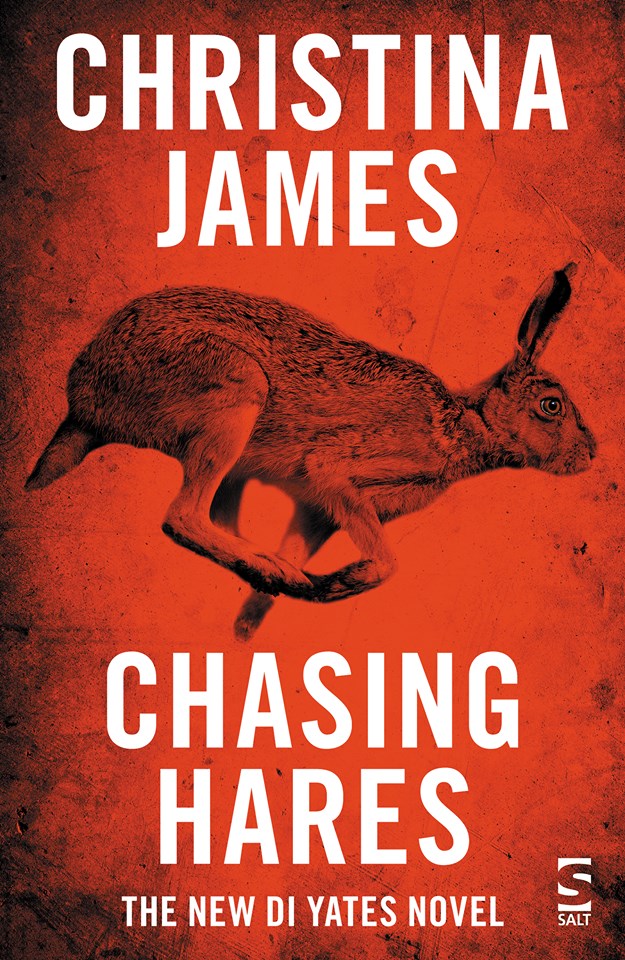


Knitted up? Some criminal stereotyping in all this?
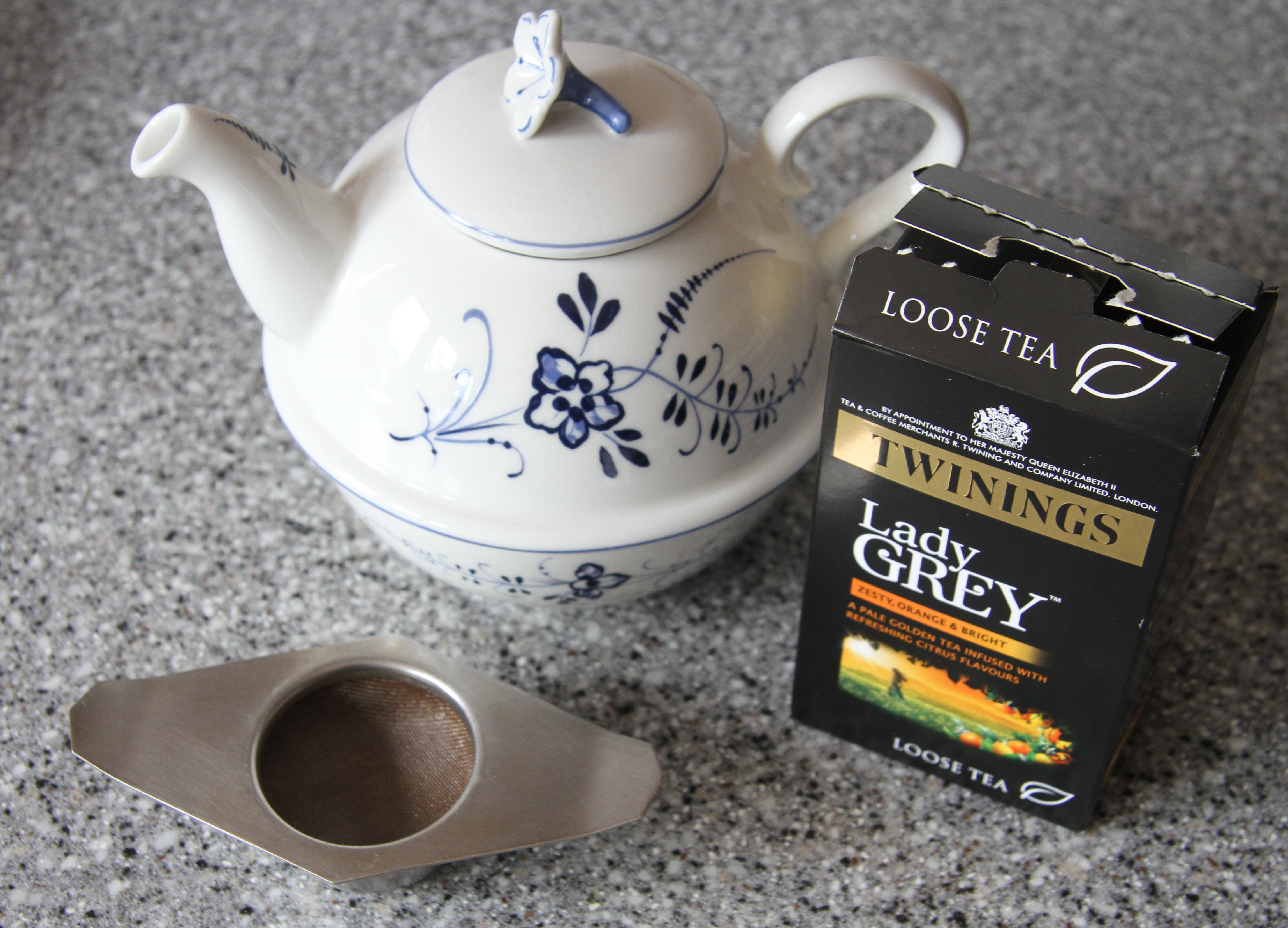
I read in yesterday’s paper that Julia Gillard, the outgoing Australian PM, thinks that knitting can save the world, because of its therapeutic qualities, and that a (male) spin doctor thought it was a good idea for her to appear in domestic knitting bliss on the cover of The Australian Women’s Weekly. If, by this means, she intended her knitophile confession to demonstrate her hominess and thus save her career, she failed spectacularly, but I hope that she is consoled by knowing that now she will have much more time to knit and that she may thus reap all of knitting’s health-giving benefits.
As an acknowledged world-saver, knitting is one of the more unlikely contenders. I’d say that, by some distance, the thing most commonly claimed to be a universal restorative and peacemaker is tea. I offer the following literary samples to take with tea:
- Typhoo [after Joseph Conrad]
- Under the Green Tea Tree [after Thomas Hardy]
- Take tea or not take tea, that is the question! [after Shakespeare, Hamlet]
- I will arise and go now, to make a cup of tea [after W.B. Yeats]
- Of man’s first disobedience and the fruit of Whittard’s mango tea [after John Milton]
- Earl Grey’s Anatomy [after Henry Gray]
- Darjeeling Buds of May [after H.E. Bates]
- The Gunpowder Tea Plot [after Antonia Fraser et al]
- The time is spent, her object will away, but from her Twinings tea there’s no releasing [after Shakespeare, Venus and Adonis]
- Ode on a Grecian Urn [John Keats]
However, there is the Boston tea party, proving both that truth is stranger than fiction and that, in reality, although tea may sometimes be a peacemaker, it can also start wars!
Perhaps it might be better to put cake on the tea table, too, whilst we all sit knitting for our lives… Men make cakes as well, you know… and knit.
I commit a few putative murders…

In January, I wrote about a train journey to London during which I observed my fellow passengers and assessed them for potential as fictional murderers.
Yesterday, I made another train journey, this time to Cambridge. I didn’t set out with this intention, but, by the journey’s conclusion, I had been compelled by an uncharacteristic bout of Swiftian disgust to appraise the potential of some of my travelling companions as murder victims.
The journey from Wakefield began in a civilised manner, until the train pulled into Grantham. There, a group of schoolchildren boarded, evidently bound for some kind of daytrip destination (possibly London – this was the King’s Cross train). I say ‘schoolchildren’ – they were fifteen or sixteen, possibly first-year sixth formers. Until that point, I had been occupying a table to myself. Three of them joined me, two girls taking the seats opposite and a boy the one beside me.
The boy was very polite. The girls were shrill horrors, bred on a diet of Hello and reality TV. One of them was particularly inane. She made it quite obvious that she fancied the boy. She asked him what time he’d got up that morning. He replied 5.30 a.m. – he’d had to do his paper round before setting out. She said that she herself had got up at 6.30 a.m. – and it was a good thing that she did, because she, like, put on the T-shirt she meant to wear today and there were, like, two inches of bra sticking out at the top. Cue: shrieks of laughter from both girls. She then asked which of her companions would like to play ‘I-Spy’. (I was astonished at this choice of game, which most self-respecting ten-year-olds of my acquaintance would have scorned.) The other girl declined. The boy – still patiently polite – agreed. ‘I spy with my little eye something beginning with t,’ said the first girl. ‘Train!’ said the boy. Another burst of giggles. ‘I don’t believe it!’ she said. ‘However did you, like, guess that first time around?’
I was joined on the Cambridge connection by a tall young man with Jesus hair and a Tonto headband. He was dressed in an Afghan-style coat and was reading a book on philosophy. He seemed a pleasant enough travelling companion until he yawned. I was assaulted by breath fouler than could have poured from the mouths of half a dozen dragons after a brimstone-eating spree. I moved to the seat beside mine so that he and I were diagonally opposite each other. A middle-aged woman then boarded and sat next to him. She was immaculately dressed, all her golden curls sprayed firmly into place. She was clutching a cup of Costa coffee. I looked up a few minutes later: The white plastic lid of the coffee was smeared all over with her red-orange lipstick; so was her face. She took a packet of Monster Munchies from her bag; they were pickled onion flavour!
At Ely, another tall young man joined us. I stood up so that he could take the seat opposite dragon-breath. Their long legs clashed. The newcomer smelt even worse than his counterpart. It wasn’t just his breath: he had an all-over aroma of mingled mould and sweat.
I was delighted and relieved when I could finally disembark. Cambridge station, drab at the best of times, had never seemed so inviting. Jonathan Swift, I am sure, would have imagined eloquent and appropriate comeuppances for their various vile traits. I could think only about who might murder them and how. Motive would not have been a problem… but engaging the reader’s sympathy for the victims? Perhaps a little more of a challenge!
With how sad steps, O Moon…

I read that the moon would come unusually close to the northern hemisphere last night. As it was also the day after the summer solstice, I thought I’d have to wait until quite late before being able to see it properly. In fact, like many another midsummer evening, yesterday’s was squally and darkness fell relatively early. An ominously large moon revealed itself, a huge silver-yellow disk in the sky, shadowed in places, and getting ever larger, as if it might keep on coming closer until it crashed into the Earth. That it was repeatedly occluded by rapidly scudding clouds made it the more sinister, a laughing witch at her games.
Regardless of culture or creed, the moon has dominated as one of the great motifs of literature. From earliest times, she has been celebrated in religion and ritual, often as the gentle feminine foil to the sun’s aggressive masculinity, but sometimes with a stronger and more violent persona. Implacable, she demanded sacrifice from the Incas and other ancient societies. She was Diana the Huntress, among the fiercer goddesses of the Roman pantheon and symbol of assertive virginity. She is the subject of the contemporary Wiccan practice of ‘drawing down the moon’, said to derive from a picture of two women and the moon which was painted on an ancient Greek vase. It is the moon that controls the tides and therefore influences shipwrecks. No wonder that so many old sailors’ superstitions are about her. Eighteenth century smugglers waited for the full moon to give them enough light to bring their goods ashore, though sometimes she was a fickle friend, enabling the customs officers to spot them as clearly as they could themselves see their contraband crates of rum and bales of silk. “Watch the wall, my darling, while the gentlemen go by.”
There is a long list of books and films that I’ve enjoyed that have the word ‘moon’ in the title. Here are some of them: The Moon and Sixpence, The Moon’s a Balloon, Moon Tiger, Paper Moon, Moonfleet, Moonraker, and, of course, The Moonstone, arguably the first English detective novel and also, many readers of crime would claim, still the finest. Mine is a disparate and eclectic list; no doubt you could produce one that is equally idiosyncratic. What all these titles – and the many others – have in common is that none of them is directly about the moon. Instead, their authors have invoked her name to convey that their books engage with one or more of her many qualities: mystique, exoticism, ambition, cruelty, the fickle, the unattainable, the preternaturally beautiful.
Looking at my photographs of last night, one of which I am now sharing with you, I am reminded of the elusive nature of the moon so brilliantly and humorously conveyed in Charles Laughton’s drunken puddle sequence in the 1954 David Lean Hobson’s Choice film; I madly toy with the idea of her in the word ‘lunacy’; quotations from many poems about the moon flit amongst the clouds of my mind; I feel that the moon is a deserving mistress and I catch glimpses of all her qualities as she dips her face towards the earth and holds me in her thrall. By tonight, she will have retreated a little; apparently, she won’t stoop to kiss us again until August 2014.
Now that’s fickle.
The flavour of Salt crime fiction…


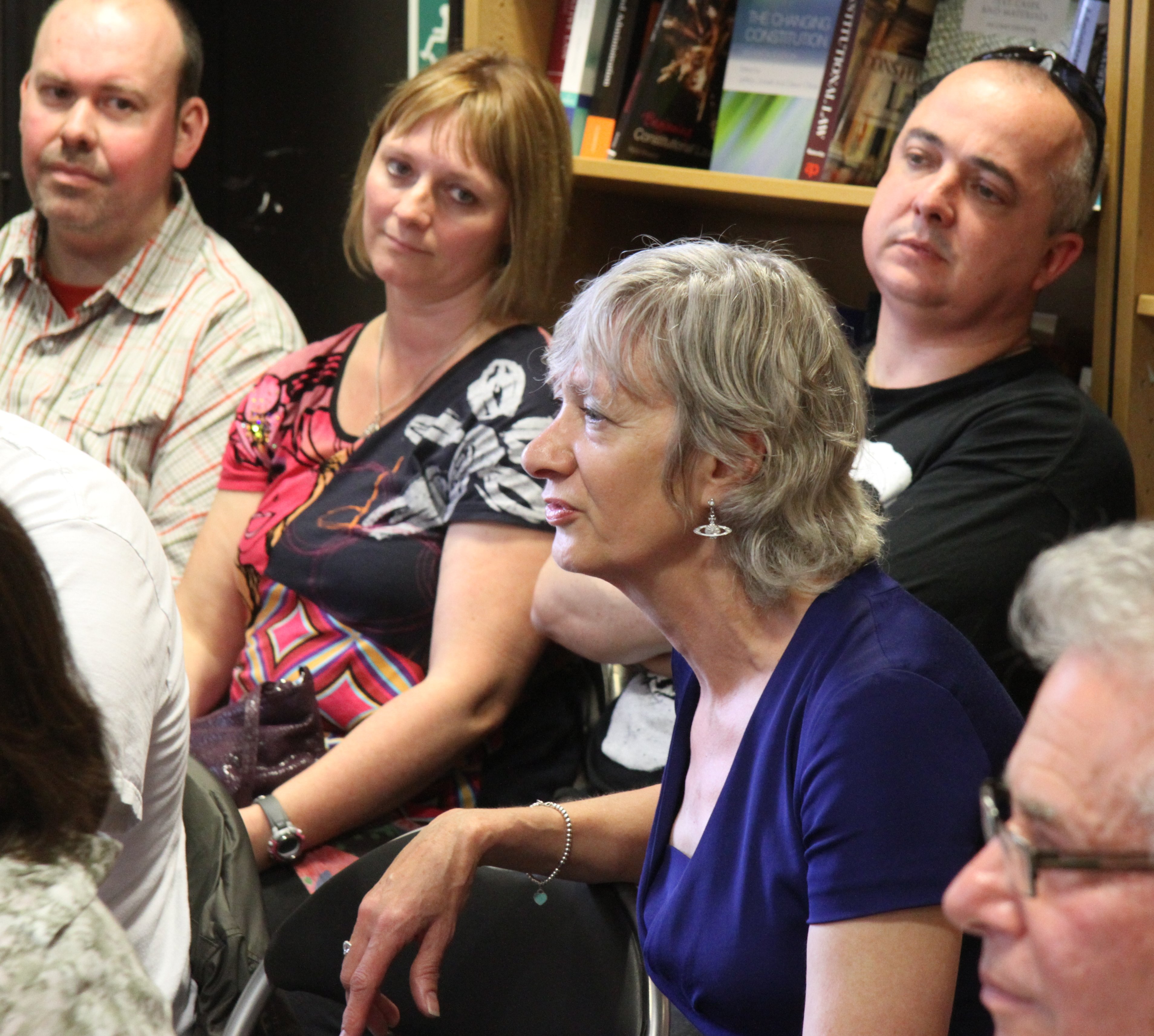
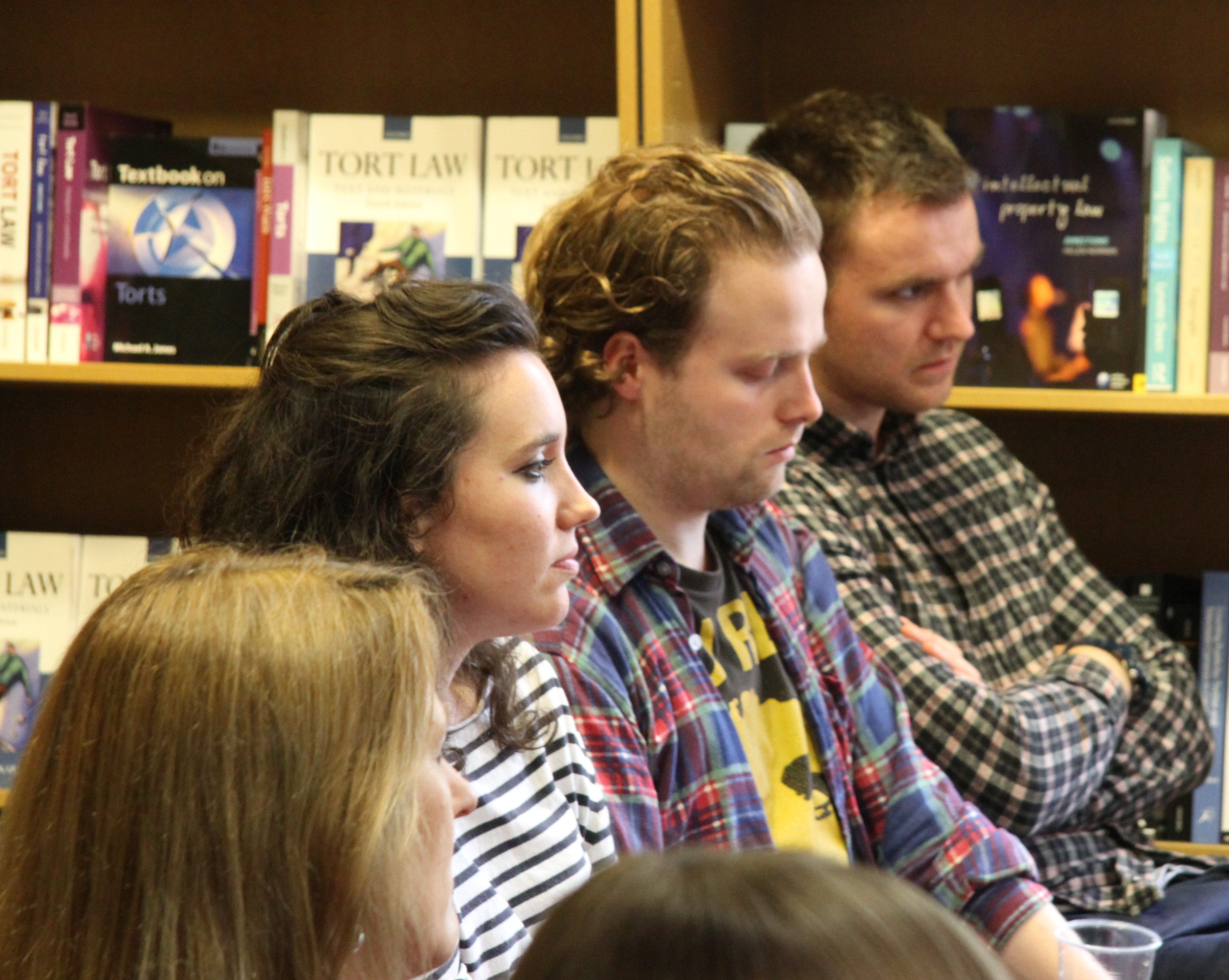
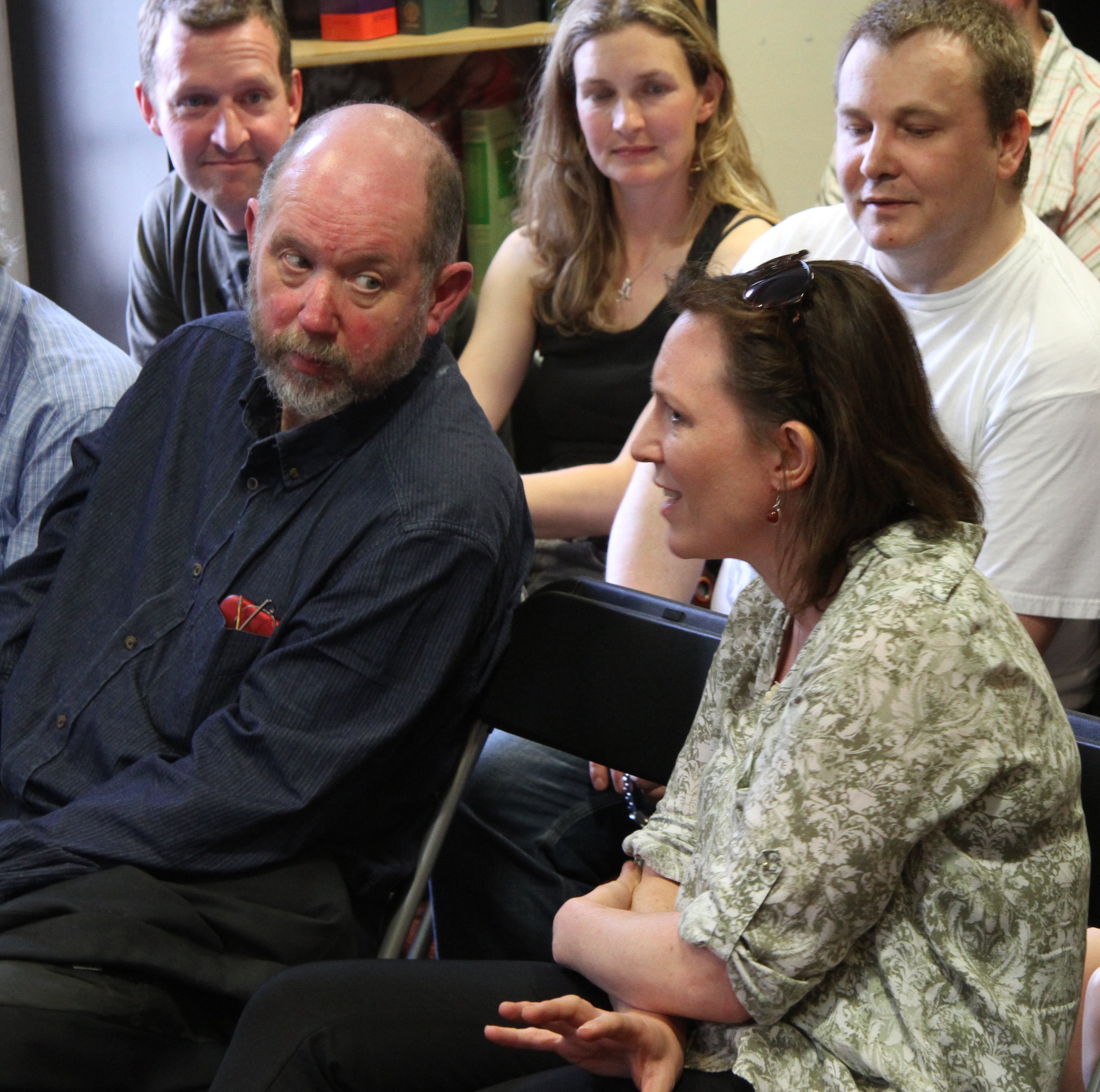


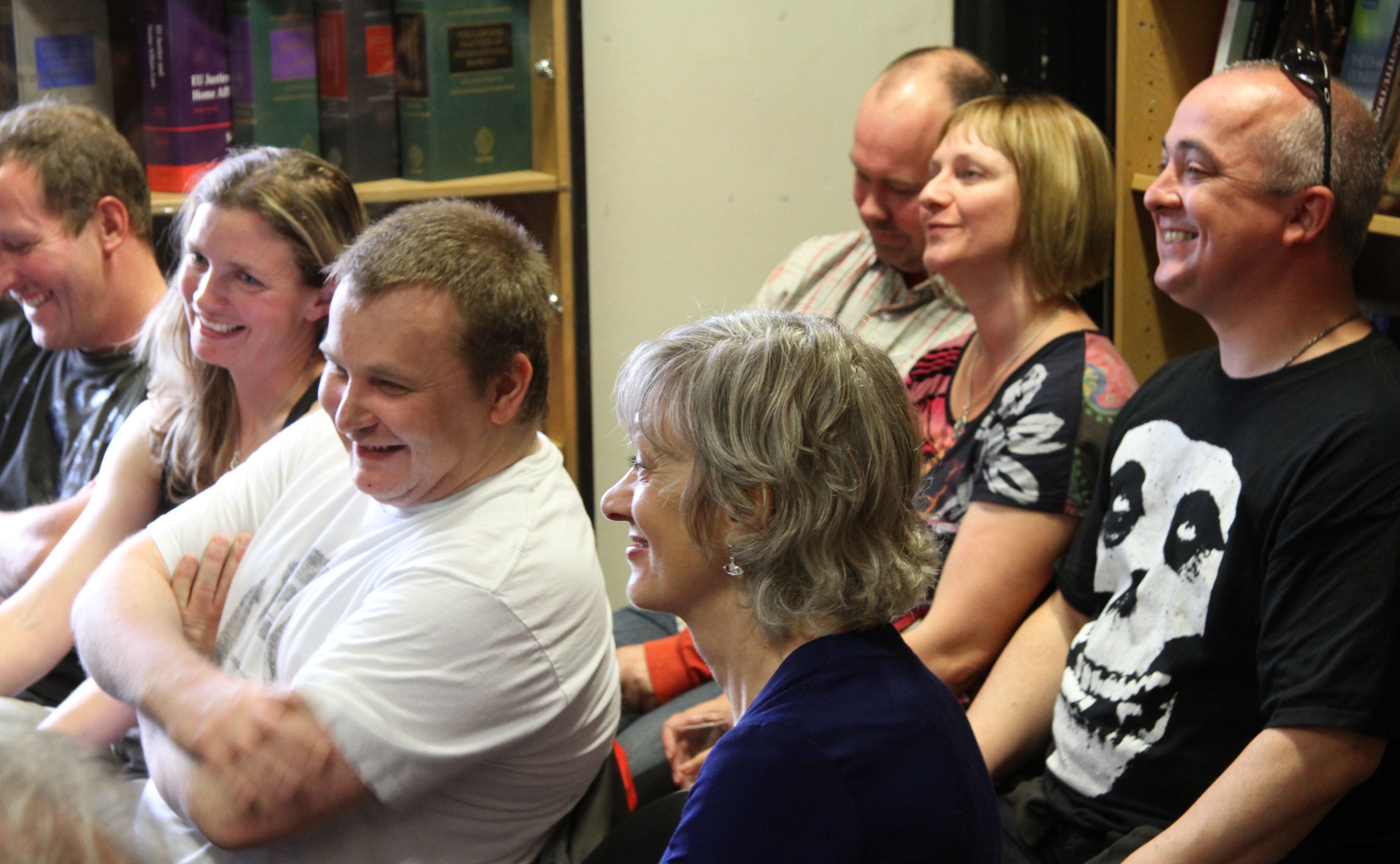

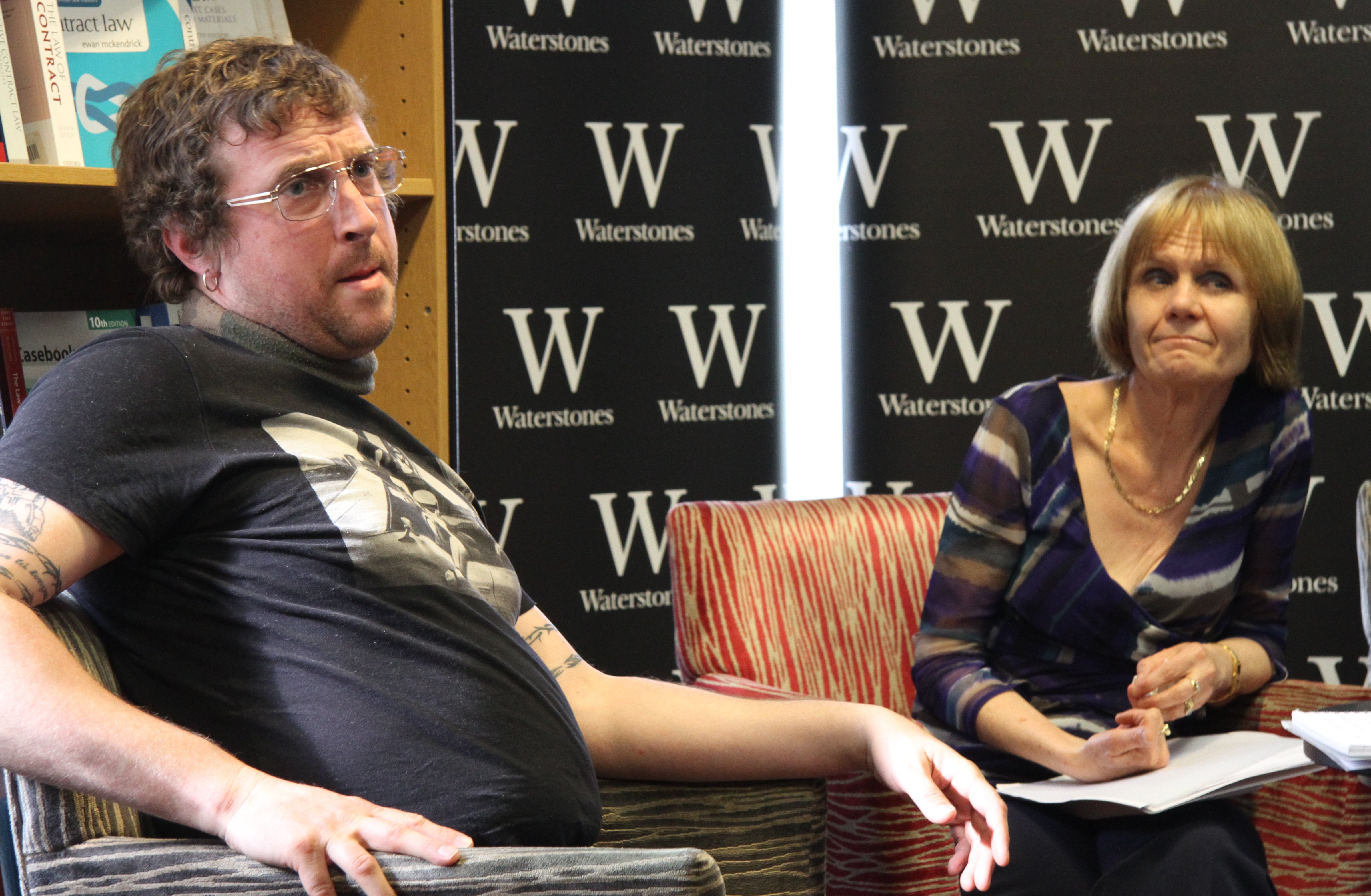


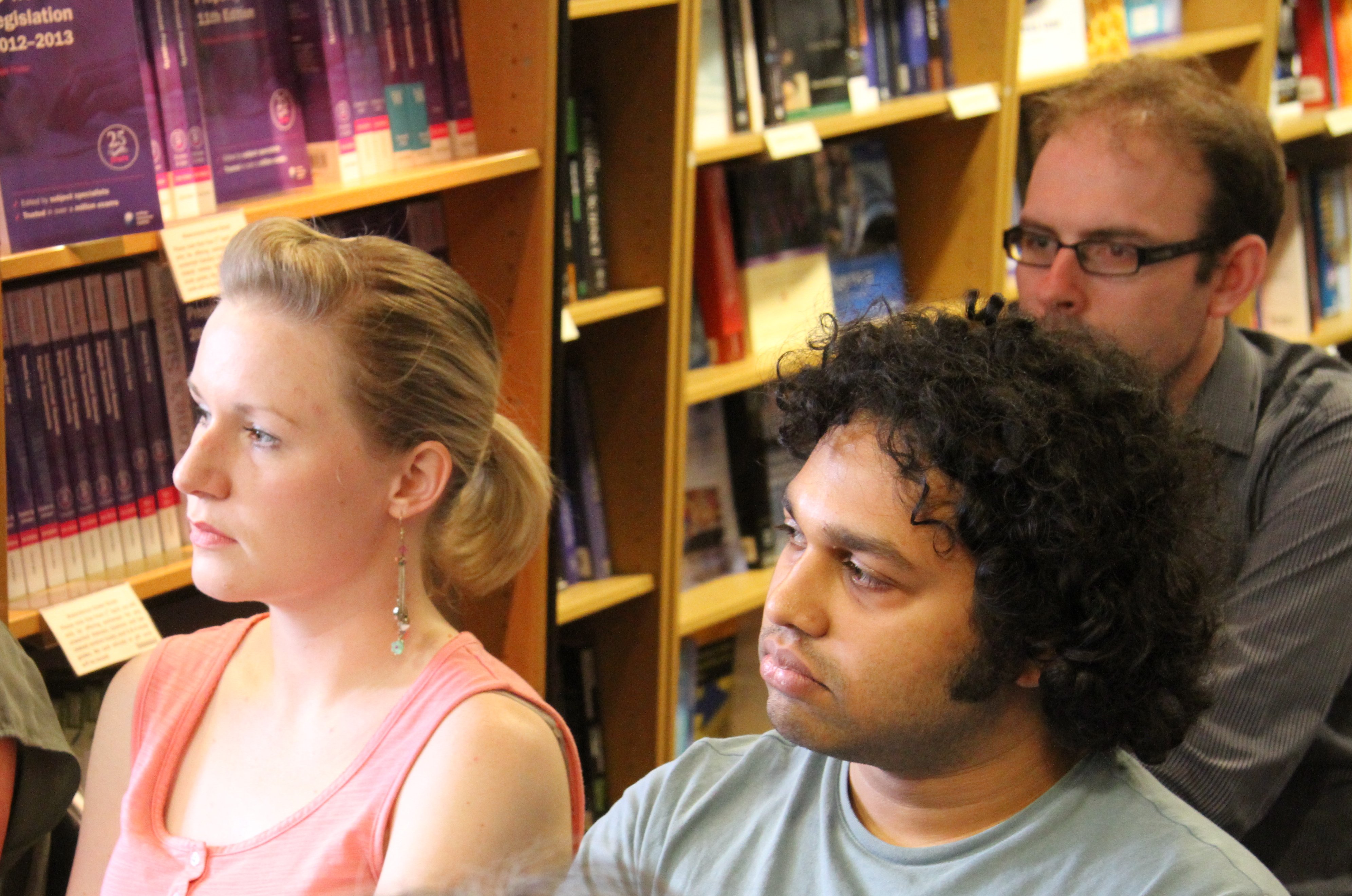


The Salt crime writing event that took place at Waterstones Gower Street yesterday was a very festive occasion. Sam Rahman, the Events Manager at the shop, her colleagues and a large and appreciative audience combined to make it a great success.
Laura Ellen Joyce, Matthew Pritchard and I each gave readings from our books. Laura read from The Museum of Atheism, which (jointly with In the Family) launched the Salt crime list last November. I read from Almost Love and Matthew from Scarecrow, which Salt will publish in September. Afterwards, I chaired a discussion with Laura and Matthew about their writing. The audience joined in, offering many lively and perceptive comments.
Both Matthew and Laura agreed that a sense of place was important to their writing. Laura chose to set her book in small-town America in the dead of winter – there is no daylight in the novel – to epitomise the corruption that it portrays. Matthew writes powerfully about Andalucia, which he knows well, having lived and worked there for twelve years. Laura agreed with the suggestion that she describes a rudderless society in which no character is able to provide a moral yardstick or compass. Matthew said that the corruption captured in his work derives more directly from his knowledge of shady Spanish officialdom. Danny Sanchez, the protagonist of Scarecrow, is a journalist who bravely tries to expose the fraudulence and self-interest upon which he sees that Spanish politics is based.
Laura had deliberately left vague the identity of the killer in her book, because, in a sense, she was indicating that society as a whole was to blame. Matthew had had the intention right from the start to write about a serial killer, but the character of the killer took shape in his mind gradually as he worked on the book and continued to read about real-life murders. An account of how the head of one of Fred and Rosemary West’s victims had been swathed in gaffer tape had left a particularly lasting impression on his imagination.
There was much laughter from the audience at Matthew’s anecdote about how, when the shop below his flat caught fire recently, the police broke into the flat and discovered his large collection of books about serial killers and Nazism scattered over the floor. There was even more laughter when I persistently made the mistake of calling him ‘Danny’, after his hero, rather than Matthew! (Apparently, it is a mistake that his agent makes, too!)
Laura confirmed that she will continue to write crime because she has a profound interest in why people commit evil or anti-social acts. She’s also interested in pushing out the boundaries of fiction. When, in response to a question from one of the audience about what I thought the ‘next big thing’ in crime writing would be, I said that I’ve seen several books lately that mix genres and I’m not sure that it works, Laura said that this idea appealed to her and that she would like to experiment with it. I do think that it would take a very good writer to pull it off, but Laura is so accomplished that she is one of the few people I know who might succeed at it.
I was asked why most crime novels are about murder, rather than other types of crime, such as theft or fraud. I said that there are some novels based on theft – there is quite a strong sub-genre relating to crimes associated with works of fine art, for example – but it is difficult to write about crimes other than murder unless you are a police procedural author. This sub-genre has never appealed to me; I’m more interested in the psychological aspect of crime-writing.
We were all asked whether we’d come to writing ‘lately’, or whether we’ve always been writers. We agreed that we’ve all been writing ever since we can remember. Asked also whether we had to let a novel ‘fade’ from our imaginations after we’d finished it before we could embark upon another, we each offered different responses: Matthew writes all the time and is usually working on several books at once – he knocks out 2,000 words a day, even if sometimes he knows it is rubbish and he will have to discard some of it; Laura writes regularly, but in different genres – she writes short stories between novels and also said that she was very organised when writing The Museum of Atheism which, with a detailed outline on a spreadsheet, she wrote in twenty-four days, a chapter a day, all in November, following the NaNoWriMo concept; I usually take a brief break after completing a novel, but I’ve started on the next DI Yates book now. I feel that being an author is a bit like being a member of the fashion industry: your mind is already on the next season’s work while your readers are still consuming this season’s product.
We all paid tribute to Salt Publishing, which we agreed is an uncompromising publisher setting high standards. We were also united in saying that we aren’t interested in the ‘blood-and-guts’ style of crime writing.
On behalf of the three of us, I’d like to thank Sam and the staff at Gower Street for their wonderful hospitality. I’d especially like to thank all of you who attended for being such a generous and receptive audience, for making such constructive contributions to the discussion and, of course, for buying or ordering our books! It was good to meet some new friends – some of whom I’ve only previously ‘met’ through Twitter. Finally, a big thank-you to numerous well-wishers who were unable to come (some of you based in countries very far away), but who sent kind and encouraging messages and helped to advertise the occasion. We hope to meet you all one day at future events.
All in all, it was a very memorable evening indeed!
A towering giant of a book on a special day…

I tend not to write down dates of birthdays, wedding anniversaries etc., but I think I’m quite good at remembering them – although I have just had to ask one of my friends the date on which her daughter was born. One date that I never forget each year, however, is a fictional one: Bloomsday. As all James Joyce aficionados will know, it is today, June 16th. It was on this date in 1904 that Leopold Bloom made his day-long perambulations around Dublin and, by describing it in Ulysses, first published in Paris in 1922, Joyce captured the history, customs, beliefs and prejudices, not only of his own country, but of the whole of European culture. His masterstroke was to present it from the viewpoint of the perennial outsider, a modern version of the Wandering Jew. A life in the day, indeed! There was a personal irony in the choice of date, too, as it was on this day that Joyce’s liaison with Nora Barnacle, who was to become his long-suffering common law wife and eventually his legal wife, began.
Picking up my tattered Penguin edition of the book, I resolve to read it again very soon. Because of the range and depth of the literary styles that it covers, and Joyce’s wonderful manipulation of language, it is a complete writer’s handbook in itself. It needs no gloss or laboriously explained sets of rules – although the book can be read at many levels and is amazingly erudite. I don’t usually write in books, but I see that against one passage my younger and more studious self has written ‘Traherne: Centuries of Meditation. 3rd Century’. It’s impossible for anyone else to write like Joyce, but admiring and appreciating his work certainly makes you think about how to use language.
It was Joyce who first taught me the magic of lists. The ones that he creates appear to be off-the-cuff, but I’m sure their sparkling apparent spontaneity cost him many hours of effort. Take this one, for example, which is only a third of one in a series that appears towards the end of the book to sum up Bloom’s condition: Mendicancy: that of the fraudulent bankrupt with negligible assets paying 1s 4d in the £, sandwichman, distributor of throwaways, nocturnal vagrant, insinuating sycophant, maimed sailor, blind stripling, superannuated bailiff’s man, marfeast, lickplate, spoilsport, pickthank, eccentric public laughing stock seated on bench of public park under discarded perforated umbrella. It was through Joyce’s work also that I came to realise the importance of evoking all of the senses, not just the visual: his description of Leopold Bloom’s lunchtime cheese sandwich is a classic still to be surpassed, in my experience. Then there is his satirical juxtaposition of the sacrosanct (and, he indicates, probably humbug) with the absurd: And they beheld Him, even Him, ben Bloom Elijah, amid clouds of angels ascend to the glory of the brightness at an angle of fortyfive degrees over Donohoe’s in Little Green Street like a shot off a shovel. Like avid readers both before and after him, Joyce read everything: cereal packets, handbills, magazines and potboilers as well as more European literature than almost anyone else could cram into a lifetime. Unlike other learned writers, however, he didn’t make judgments about the ‘quality’ of what he read. The Nausicaa episode (Chapter 13 of Ulysses) is not only a brilliant pastiche of the style of writing of women’s magazines of the time, but also reveals Joyce’s sneaking admiration for a genre that could get away with so much hyperbole. Gerty MacDowell, its naïve and rather tragic heroine, is a fine portrait of a dreamy young woman whose head is filled with romantic notions of how she can shape her life. Although she is portrayed only once, in a tiny snapshot of time, Joyce conveys to the reader through this medium of ‘magazinese’ that her life will be much bleaker than she supposes. Today’s ‘filmstar for a day’ brides are her modern equivalents.
It’s difficult to say what I like best about Ulysses, but, if pushed, I’d say that it’s the portrait of Molly Bloom. Hers is a timeless portrait of almost everything that it has meant to be a woman through the ages: she is a sensuous earth mother, fascinating femme fatale, sexy but not a whore, capable of great sympathy but also self-centred, perceptive, ‘genteel’ and coarse. She belongs to a long tradition of female characters that stretches back in time, even beyond Cleopatra, to Homer’s sorceress Scylla. Molly lives through her senses; the one attribute that she doesn’t possess is intelligence of the formal, schooled kind. In this, she is the antithesis of Leopold, who thinks about everything, applies his knowledge to everything, and therefore, like Hamlet, is unable to act. Apparently she was modelled at least in part on Nora Barnacle. Some feminist readers have found her portrayal insulting to women and, mixing life with fiction again for a moment, it’s true that Joyce held some curious views about the female sex. But Molly is above all the great force for the positive in the novel. It is she who has the very last word. It is, simply, Yes.
The book’s title is pronounced YouLISSease, by the way, not YOUlissease. I was taught this by an Irish professor, who said that I could mispronounce it if I liked, but, if so, I’d never get to grips with Finnegans Wake, which is all about pronunciation. I’ve found this to be true. Although still a difficult work, ‘the Wake’ becomes comprehensible if you read it aloud in a Dublin accent.
Joyce eventually stretched language to the point at which all but his most determined supporters find his work too much of an effort to read. He may perhaps have been a genius on the verge of madness. Nevertheless, what he managed to wrest from language changed the course of fiction writing forever. A much more insignificant James salutes the author – and you all – on Bloomsday 2013!
An unashamedly anecdotal account of a visit to the House of Commons…

Yesterday, I was in London again for the day job. I had four meetings, all of which went according to plan, and topped off the day by attending the Author Publisher Dialogues, sponsored by the All Party Publishing Group and the All Party Writers Group, which took place at Portcullis House in the early evening. I have attended author events in the House of Commons before, but I hadn’t previously visited Portcullis House. It is an ultra-modern construction of steel and glass that faces the House, apparently used as a kind of overflow building.
Unsurprisingly, security was tight. There was an airport-style scanner, through which my bags and jacket had to be passed, and several security officials were on duty. (I wonder what they made of the contents of my laptop bag, which by that stage in the day contained not only the computer, but also three books acquired from the wonderful help-yourself stash that sits permanently in the basement of one of the publishers I visit, an assortment of toiletries from Boots, some greetings cards from a nice shop that I know and two packets of apple and cinnamon hot cross buns from the Marks and Spencers in Chancery Lane.) Belongings retrieved, I was asked to wear a lanyard with a time-stamped badge proclaiming that I had been checked. Now labelled with this cross between kitemark and sell-by date, I was directed upstairs to a sort of glass-enclosed gallery, the walls of which were decorated with portraits of eminent politicians. I recognised Harold Wilson, Margaret Thatcher and Shirley Williams, all painted to look remarkably like each other, if that doesn’t sound too far-fetched.
The event took place in the Macmillan Room, named presumably after Harold Macmillan, who was both publisher and politician (I met him once, but that’s a different story!). It was chaired by Tristram Hunt MP, who is Chair of the APPG; he’s also a journalist and broadcaster. One of the speakers, Kwasi Kwarteng, is also an MP as well as being a published author: his most recent book is entitled Ghosts of Empire. (The two other author speakers were Professor Peter Atkins and Susan Standring, who has been responsible for several of the most recent editions of Gray’s Anatomy.) Hunt is a Labour politician and Kwarteng a Tory, but they seemed to be fairly united in their views on how much government should contribute to publishing. They were careful to say that the publishing industry is so successful that it needs no financial help from government, but they also indicated that they are staunch supporters of copyright law. As both are published writers, this was to be expected, but also what the audience wanted to hear. One of the reasons why publishers have stepped up their presence at such events in recent years is that there are certain factions in government which would like to pass legislation distinctly threatening to copyright as we know it. I shall write about this in a separate post and I’ll also report on the event itself at a later date, too. This is meant to be a light-hearted account!
As in the House of Commons itself, each room in Portcullis House is fitted with a television screen that tells the occupants which MP is speaking and on what subject. A shrill bell rings for several minutes when it is time for them to vote. Our two MPs rushed off when this happened, leaving the other speakers to hold the fort. Stoically, they kept on speaking throughout the din and, although it was impossible to hear what they said, their Dunkirk spirit filled me with pride. Theirs was such a very British approach.
The end of the event coincided with a mass exodus of MPs. When I emerged from the Macmillan Room, there was a long crocodile of them walking two-by-two down the glass corridor at funereal pace, feet turned outwards, murmuring inaudibly to each other. Young or old, each was exhibiting this same distinctive behaviour. It reminded me of the sequences in Jurassic Park of the dinosaur herbivores moving peacefully and slowly through the undergrowth. I wondered if MPs need training to walk in this way or whether it comes naturally when you are Running the Country.
It was unsettling on my way out to encounter, standing at the exit, a policeman who was carrying what looked like a small Kalashnikov (sorry, I’m not well up on guns). That policemen in European countries are routinely armed seems unexceptional – it helps that sometimes their guns look like toys – but I’ve always found it disquieting to see officials on UK soil bearing arms. I remember the sense of shock I felt when I bumped into a group of paratroopers in Northern Ireland once, their weapons at the ready. This policeman was friendly, though. When I said, ‘Don’t shoot!’, he replied, ‘No, I won’t, I’m not in the mood tonight!’
The government has been claiming that the recession is ending for so long now that its statistics have lost every shred of credibility as far as I’m concerned. However, I do have my own very scientific way of taking the temperature of the economic climate. It involves London taxi drivers. For at least the past two years, hailing a taxi in London has been easier than falling off a log. You’ve only needed to step out into the road and six have appeared, their yellow ‘cab free’ lights twinkling. The successful cabbie has then regaled me for the entire journey with his views on the direness of the economy and his considered opinion that Armageddon has arrived. It may have been partly because I was in the, for me, more chi-chi than normal environs of Westminster that a good two dozen cabs passed me in the space of fifteen minutes, all with their lights switched firmly off. I nevertheless conclude that taxi firms are booming once again – and therefore also the businesses that they serve.
Panicking that I would miss my train, I was forced to double back to the underground. The tube train I boarded chugged along imperturbably, with extra delays at Victoria and Green Park. Eventually I reached King’s Cross with three minutes to spare and sprinted across the concourse before collapsing in my reserved seat in a most unladylike fashion. I was so much revived by a steward bearing tea (and, eventually, a gin-and-tonic) that I was even able to attempt a bit of writing on the two-hour journey home.
It was quite an exhilarating day. At its conclusion, the animals lay in wait, each reacting in his own way to my absence: the dog greeted me ecstatically; the cat turned his back to punish me for my desertion.
Who is your ‘key’ customer?
E reader
I’m not always in agreement with received opinion that what happens in publishing in the USA happens here eighteen months to two years later. However, properly-gathered statistics are always fascinating and it would be foolhardy for a book market watcher such as myself to ignore the results of the latest US consumer survey that’s been carried out by Nielsen BookData. Called the ‘US Entertainment Report’, it publishes information about games, films and music as well as books, but I shall confine myself here to the findings on books. If you’re interested in the other categories, you can find a summary here.
The survey finds that e-book buyers are 21% more likely to be female. The age-groups buying the most e-books are those aged 35-44 and those aged 55-64. (I’m not sure why there’s a dip in the 45 – 54 age group: perhaps they’re so broke paying for their children to go to university that they can’t afford to buy an e-reader!) What’s amazing is that the 18-24 age group buys least e-books, even fewer than the 65+ group. Perhaps the reasons for this are also financial. Or, since the academic e-book market is now well-developed in the USA, it may be that young Americans associate e-books with study and print with relaxation. An amusing thought, but of course based purely on speculation on my part!
What is undoubtedly of significance is that print book buyers are more likely to be female, too: 18% more likely, in fact (highest sales are again to the 55-64 age group, followed by the 65+ group). This is not a surprise, because print book consumer surveys have consistently shown women to be heavier book buyers than men for at least the last thirty years. Received wisdom has always been that women buy more books because they’re buying for the whole family. However, unless e-book sales models change, we may have to revise our opinion about who is actually reading the books, as well as who’s buying them, since at present it is not possible to share an e-book unless you also share your e-reader with someone else (not a very practical arrangement). There is considerable pressure among consumer groups, especially in the USA, to introduce models that allow sharing of the same e-book among a limited group of people, on the principle that print books have always been shared among family members. In the meantime, as writers, we have a golden opportunity to consider what these female-biased statistics mean.
All my life, I’ve disapproved of the so-called ‘woman’s read’; as a bookseller, I’d give publishers short shrift if they tried to promote a book by saying that it appealed to the ‘women’s market’. How piquant it would be to discover that they were barking up the wrong tree and that the real niche market belonged to men! And how well it pinpoints the absurdity of gender-based promotion: clearly women have been reading war stories, thrillers and science fiction all along and I wouldn’t mind betting that, at the same time, more than a few men have been reading romances and bodice rippers. In fact, one of the earliest e-book surveys undertaken, way back in 2001, suggested that there was a big market for romances among long distance truckers!
As a writer, therefore, whom should you regard as your ‘key’ customer? I’d say everyone! In the last analysis, it’s the quality of the writing that counts. But you might like to think a little more about formats: the more flexibility there, the more copies you are likely to sell.
Warning, this post is not for the prudish…

Don’t read this – it is a very hard and naughty bit…
A physics professor from the University of Cambridge has objected to a sexually-explicit passage from Ovid’s Amores that was set as part of this year’s Cambridge OCR Board AS-level paper (the candidates sitting the exam will therefore mostly have been 16 or 17). Apparently, he thinks that the piece was unsuitable for students of this age, because the examination rubric states that ‘candidates should be able to … produce personal responses to Latin literature, showing an understanding of the Latin text’.
As an aside, I’d be prepared to hazard a guess that at least some of the examinees were not as innocent as the professor supposes. However, I do not need to speculate on how knowledgeable they may have been on the subject of the piece – an adulterous liaison between the poet and a married woman – because that is not the issue. If it were, then examinations would also have to exclude literary works that refer to all crimes, including murder, and all works set either in the past or in foreign countries unknown to the candidates. That would rule out the whole of Shakespeare, the whole of Jane Austen and most modern masterpieces. Surely the point of great literature is that it has the power to evoke an imaginative response in the reader that transcends his or her actual experiences. It achieves a fusion between art and life that yet maintains intact the distinction between the two. As Orhan Pamuk puts it so eloquently in The Naïve and Sentimental Novelist, “We dream assuming dreams to be real; such is the definition of dreams. And so we read novels assuming them to be real – but somewhere in our mind we also know very well that our assumption is false.”
What is depressing about the good professor’s comments, however, is not their patent absurdity (he is a professor of Physics, after all, not of Literature), but the fact that they signal a deadening retrogressive trend that is in danger of spreading beyond the confines of the classroom. I was a schoolgirl during the tail end of a period when some school texts still in circulation were described as ‘abridged’ or even ‘expurgated’: for example, my rather old-fashioned grammar school still had many sets of the Warwick Shakespeares. They had been relieved of all scenes of a sexual nature and any words that could be construed as ‘blasphemous’. However, by then, these texts were still in use for reasons of economy, rather than to preserve the pupils’ innocence. When we came to the examinations, we were expected to have read the full-fat versions. Teachers advised us to refer to these in the Collected Works, or sometimes reproduced the excised passages on separate cyclostyled sheets of paper.
To my knowledge, the Latin texts that we studied had never been subjected to the same cleansing process: my Latin ‘A’ Level syllabus included the original works by Juvenal and Catullus – much racier than Ovid – as well as Ovid himself. I cannot remember having had any difficulty in understanding them or of their having caused offence or difficulty in the classroom. What I do recall is how fresh and original they still seemed, two millennia after they were first published, and the brilliance of the teacher who helped us to appreciate them.
I’m delighted that Mary Beard, Professor of Classics at Cambridge, has robustly defended the choice of excerpt in the Latin exam paper, because I’d hate us to slide backwards into a kind of dark age of political correctness in literature. Today we are scornful of Nahum Tate’s version of King Lear, in which Cordelia marries Edgar and all the ‘good’ characters live happily ever after. We are positively amused by the efforts of Thomas Bowdler, who not only supervised the production of a ‘family edition’ of Shakespeare, but also considered that Edward Gibbon’s The History of the Decline and Fall of the Roman Empire was too risqué for polite society, and ‘improved’ it accordingly. More recently, my generation was exasperated by Mary Whitehouse’s well-meaning but narrow-minded attempts to clean up television.
We flatter ourselves that we live in a more sophisticated age than Tate or Bowdler. Many of their contemporaries, in fact, looked askance at what they were trying to achieve, just as my generation ridiculed Mary Whitehouse. Yet fashions in morality and what is ‘acceptable’ often don’t progress in linear fashion, making the next more discerning than its predecessor. In the nineteenth century, English literature was propelled at first slowly, then ever more rapidly, from the exceptionally daring creativity of the Regency era to a decades-long period that celebrated anodyne writings in which sexuality had to be conveyed in the strange telegraphese of young girls’ blushes and young gentlemen riding hard to hounds to quell their natural yearnings. Alternatively, these characters just faded away, blissful in the knowledge that their virtue had not been compromised. Woe betide the ‘fallen woman’, whose plight was not recognised until the end of the century, when Thomas Hardy wrote Tess of the d’Ubervilles.
When I was at school, it was a commonly-held belief that Physics was a finite subject: that mankind had ‘cracked’ it and had discovered all that there was to it. I know very little indeed about science, but I have read that today Physics is an incredibly exciting as well as very complex subject, one which attracts the finest minds as scientists push back the boundaries of knowledge all the time. I both respect and am in awe of them. I would suggest that they have at least one thing in common with those who choose to make literature their life’s work: they build on the creativity of the generations that preceded them. As far as I know, there is no expurgated version of Newton or Einstein: the only limitations placed on their students concern the latters’ capacity for understanding. The same restriction, and this restriction only, should apply to those who study Shakespeare, Catullus, Juvenal – and Ovid.
An admission of ignorance…
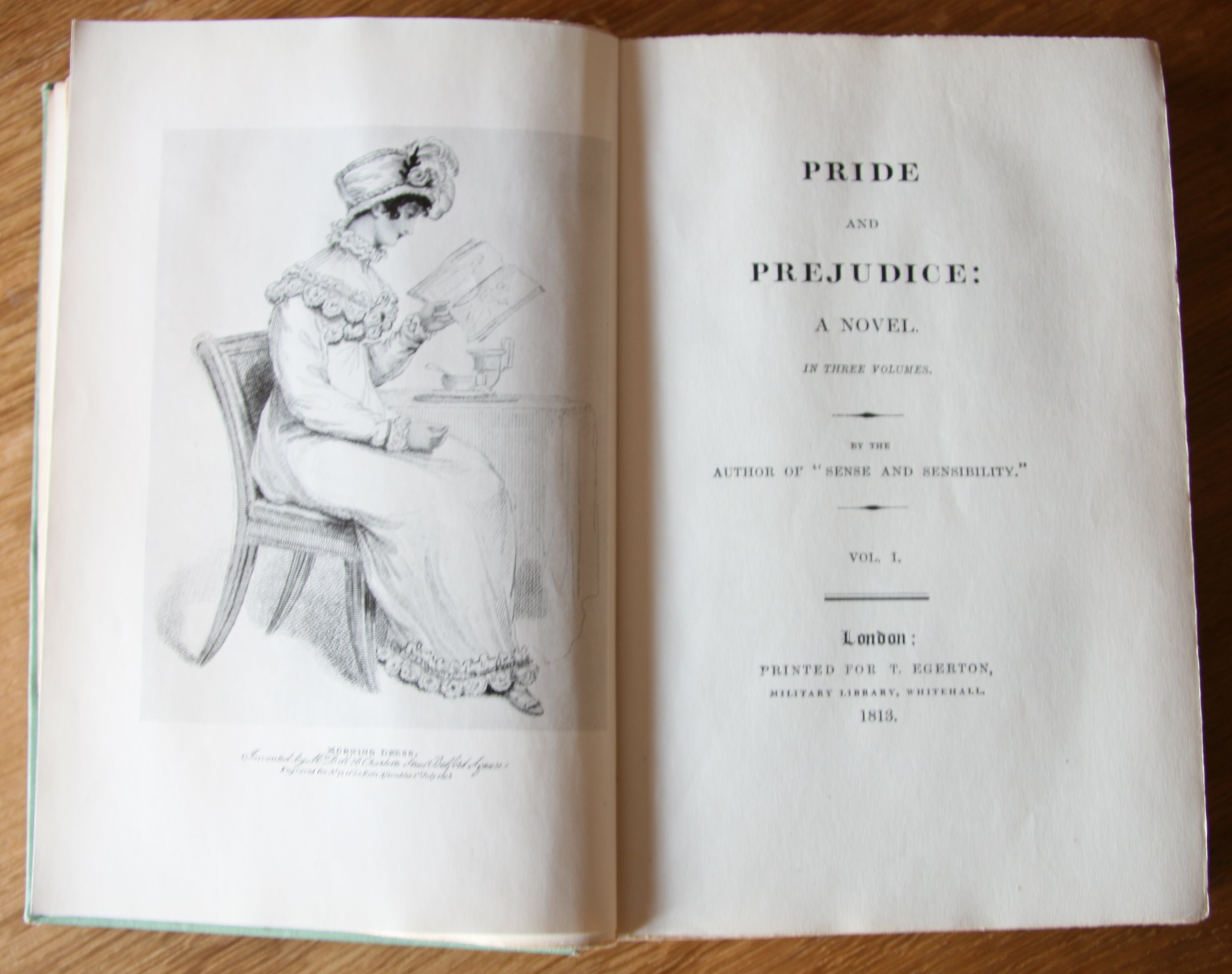
Top of the Gutenberg pops!
A web-developer named Christopher Pound has carried out a text data mining trawl (I shall write about text data mining in another post – it is a bit of a hot topic in some publishing sectors at the moment) to reveal the 100 most popular books by different authors to be accessed via the Project Gutenberg free e-book site. Books for both adults and children are included. The top 10 from both categories are:
1 Pride and Prejudice (Austen, Jane)
2 Jane Eyre (Brontë, Charlotte)
3 Little Women (Alcott, Louisa May)
4 Anne of Green Gables (Montgomery, L. M. [Lucy Maud])
5 The Count of Monte Cristo (Dumas, Alexandre)
6 The Secret Garden (Burnett, Frances Hodgson)
7 Les Misérables (Hugo, Victor)
8 Crime and Punishment (Dostoyevsky, Fyodor)
9 The Velveteen Rabbit (Bianco, Margery Williams)
10 Adventures of Huckleberry Finn (Twain, Mark)
Can you spot the odd one out? Or am I just revealing my own crass ignorance when I say that I have never heard of The Velveteen Rabbit? According to Wikipedia, this book, which was published in 1922, was selected as one of ‘Teachers’ Top 100 Books for Children’ by the (American) National Education Association in 2007. Apparently it has also been the subject of numerous film adaptations, talking books, etc. Wikipedia sums up the plot as follows: A stuffed rabbit sewn from velveteen is given as a Christmas present to a small boy, but is neglected for toys of higher quality or function, which shun him in response. The rabbit is informed of magically becoming Real by the wisest and oldest toy in the nursery as a result of extreme adoration and love from children, and he is awed by this concept; however, his chances of achieving this wish are slight.
Peter Rabbit, Alice in Wonderland, Heidi and Uncle Tom’s Cabin all appear in the Top 100, but considerably lower down in the list.
Statistics like these always make me want to know more. Why has The Velveteen Rabbit proved so popular, at least when accessed via Project Gutenberg? It isn’t because it’s not available in print: Amazon lists it and states that there are both print and talking book versions available. Is it because American teachers are more likely to direct pupils to e-book sites than teachers in other countries? Do they perhaps even download it and arrange for it to be printed for their classes via a Print on Demand company? Or, as I’ve suggested, is it just that there’s been a blip in my education? In fact, several blips, because in all my years as a bookseller and library supplier, I have never come across either this book or its author.
Here is Christopher Pound’s full list.
Prince Charles and I are not of one mind…

From Ordnance Survey Landranger 110 map
I love old houses and have been visiting stately homes since I was a child. I celebrate them as a unique part of our English heritage and I am always fascinated to read about the people who lived in them and to gaze upon their portraits. I’m making this clear at the outset, because what I’m about to write may seem a little out of character, not to say controversial.
I read in last Sunday’s Times that Prince Charles is throwing his considerable weight behind the fight to save Wentworth Woodhouse, which requires £100m to be spent on it to conserve the building and reverse subsidence. By a strange coincidence, some years ago, the Prince intervened even more directly to save Dumfries House, by spending £20m from the Prince’s Trust on its renovation. I say coincidence, because for three years I worked in Dumfries and had a flat there, so I’m familiar with and have lived near both the old piles in which he has taken an interest. (If he starts campaigning for any more such buildings near me, I shall begin to think that he is stalking me!)
Wentworth Woodhouse is not so very far away, though I’ve only visited it once, and then only the grounds, because until recently the house wasn’t open to the public. At the time of my visit, about five years ago, it wasn’t possible to get close to it: it had to be viewed from a public footpath on the other side of the boundary fence. I didn’t in fact know of its existence until the publication of Black Diamonds, by Catherine Bailey, which I bought after reading rave reviews when the book came out in 2008 and which is a meticulously-researched account of one of the families that lived in the house – so it doesn’t cover the whole of its history, but I found Bailey’s account gripping and it inspired me to want to see the mansion for myself.
Wentworth Woodhouse has been described as Britain’s finest Georgian house. It is certainly its largest. The main front of the house is 606 feet long, twice the length of Buckingham Palace. It has more than 1,000 windows. The newspaper article says that the nursery was situated an eighth of a mile from the dining room. Guests were given different-coloured confetti so that they could find their rooms again when they retired to bed (I remember reading this in Bailey’s book, as well). Even the stables are huge: in common with many other visitors, I mistook them for the house itself when first I came upon them. In fact, huge is the best word that I can think of to describe Wentworth Woodhouse itself: or gigantic, or enormous, or gargantuan, or outsize. In my view, it is both a monster and a monstrosity. It is gratuitously massive just for the sake of it. It has been symmetrically constructed, with two elongated wings, but is not otherwise architecturally distinguished. It actually gives the impression of being rather squat, even though the main building is three storeys high, because of its preposterous length. If it had been built today, say by an oil sheikh or a Silicon Valley magnate, I’m sure that it would be denounced for its vulgarity. Wentworth Woodhouse is a white elephant. I do not think that it merits the expenditure of £100m to preserve it, especially as I’m sure that this would be just the beginning. Despite the present owner’s ambitious plans to develop several commercial ventures there, I cannot imagine that it could ever be self-sustaining. £100m is a colossal sum of money and would, I feel, be better spent on saving many ‘lesser’ buildings instead.
There is another reason why I hold this view. Wentworth Woodhouse has been one of the most bitterly socially-divisive buildings in our history. I don’t mean the usual upstairs-downstairs disparities illustrated by soap operas like Downton Abbey, about which we probably feel far more uneasy than the people who lived and worked in such houses at the time. Wentworth Woodhouse was built on coal – both literally and metaphorically. The house sits on what was once a rich coal seam. Generations of its owners met the massive expenses of its upkeep by selling the mining rights to the coal that lay deep below its lands. The nearby village of Elsecar was a coal-mining village. Its inhabitants either mined the coal or worked at the house itself. It is still a pleasant but modest village that contains no large properties; the only large property for miles around was Wentworth Woodhouse itself.
The Fitzwilliam family, which owned the house for most of its history and whose story Catherine Bailey tells, were on the whole kind employers, even though the sons sometimes exerted droit de seigneur and fathered a few bastards on the local girls. By the time of the Second World War, its glory days were long over. After the war, it fell victim to what can only be described as an act of vandalism fuelled by class hatred. In 1946, Emmanuel Shinwell, the ruling Labour Party’s Minister of Fuel and Power and a man of extreme proletarian views, insisted that open cast mining should take place on the estate, even though the richest of the coal seams were not close to the surface. He stopped short at demolishing the house itself, but the debris from the mining was actually banked up against its windows. The grounds and gardens were completely wrecked.
Wentworth Woodhouse is now owned by one Clifford Newbold, who bought it for £1.5m some years ago and has since spent more than £5m on carrying out as much repair work as he says he can afford. He is now seeking to sue the Coal Authority for £100m for the depredations to the house and estate that resulted from Shinwell’s instructions. This is the initiative that Prince Charles is supporting. To me, it seems like an invidious and depressing resurrection of a vengeful class war that played itself out almost seventy years ago and from which I should prefer to believe that we have learned and moved on. In addition to this, whether or not the lawsuit is successful or funds are raised to restore the house by some other means – for example, via the National Lottery – it will be the nation itself that pays. One way or another, that £100m will ‘belong’ to us. Do we want to spend it on Wentworth Woodhouse? I suggest that we don’t. This not-so-old, not-so-beautiful, enormous house has been the scene of many past crimes on both sides of the class divide: generations have toiled below the ground there in inhuman conditions, and many miners lost their lives working the Barnsley coal seam; young girls had their lives ruined by the stigma of bearing illegitimate children to an elite of young men impossible to refuse and the upper class occupants of the house suffered the trauma and indignity of being reviled and trapped in their pile by the evangelical social engineering of a scion of the Glasgow working classes. It has not been a happy place, nor a place where greatness has flourished.
It is my belief that, like other places that have been the scene of great pain and suffering, Wentworth Woodhouse should be allowed to die, not a death by a thousand cuts, as money is successively raised and then exhausted, but in one final burst of theatre, one last grand gesture. I think that Wentworth Woodhouse, like many another ageing building, should make its exit via a blast of dynamite and tumble to the ground with dignity, like a huge beast that has now lived out its natural span.
Controversial, maybe. In some ways, I am surprised at myself. But I do believe this, strongly.
 Christina James, crime novelist