

Salt… How appropriate!

Salt mine headstock
This is the second of my Polish pieces. I’m sorry that it follows on from the first after quite a gap – I’ve been hi-jacked by a nasty cold this week. I’ll try to be a bit more punctual from now on.
Cold notwithstanding, I should have preferred to get this post out earlier, because its main purpose is to share with you some photographs of our visit to the famous Wieliczka salt mine some seventeen kilometres outside Kraków. The chambers and carvings in the mine are spectacular – as you can see. Discovering them was an opportunity that we almost passed up, because we’re pretty averse to joining any kind of organised tour, and the salt mine is obviously not a place where tourists can be allowed to wander around on their own; indeed, so many tunnels are there, it would be very easy to get lost. We were persuaded to make the visit only the evening before, by some Danish people dining in the same restaurant. I suppose that making holiday plans on the advice of complete strangers about whom you know nothing and whom you’re never likely to see again is as good a way as any! In any case, I’m published by Salt and it therefore seems an appropriate kind of tribute to Chris and Jen Hamilton-Emery.
Determined not to be an entire pushover to the tourist industry, we travelled to the mine on an ordinary service bus instead of one of the special tour buses. For me, one of the highlights of the day was encountering people from the suburbs as they travelled on this bus, though I was much less enthusiastic about the return journey in the afternoon, when the driver was clearly behind schedule and rattled along at such a speed that I had to face the back of my seat and hang onto it in order not to be thrown into the aisle. I was grateful that I hadn’t had lunch! I was also fascinated to note that, beyond the suburbs, Kraków has quite an industrial hinterland.
Tours at the mine are extremely regimented and quite expensive – entry costs about as much as a visit to the Tower of London, which is extortionate by Polish standards. The experience was also shot through with a slightly bizarre streak: for example, our tour was called a ‘non-tour tour’ (we worked out that this meant that we were not part of a pre-booked group). Endearing rather than annoying was how the enterprise running the mine tried to make money out of absolutely everything, from coffees and ice-creams to printed guides, knick-knacks made of rock salt and ‘genuine miners’ soup’, but in a slightly amateurish way. It is noticeable in Poland that everyone is desperate to make money, but in a friendly, almost apologetic, manner. The same thought struck me when I was watching the drivers of the horse-drawn carriages in the main square in Kraków trying to cajole tourists into taking rides.
The non-tour tour guide was a young woman immaculately dressed in uniform. She was extremely professional and her English near perfect. She was obviously highly educated and very knowledgeable about the history of the mine, which has existed since mediaeval times. Rock salt was quarried there for seven hundred years, until 2002, after which the mine was devoted entirely to tourism. Engagingly, the guide explained that this was because more money could be made out of tourists than digging for salt. There is another commercial salt mine elsewhere in Poland, with much lower extraction costs, and that provides the supply.
I was almost as interested in my fellow tourists as the mine itself. We were a jovial bunch from many countries; the only thing we had in common was that we had chosen an English-speaking guide, rather than one who spoke the other languages on offer: Polish, German, Dutch, French or Italian. Our group therefore included people from India, Japan, China and the USA, as well as several other Brits. I particularly admired the Indian couple, who gamely negotiated with two quite small children the up-and-down kilometres that we had to walk within the mine.
The initial descent, down many short flights of wooden stairs within a vertical shaft, was neither frightening nor particularly taxing, if dizzily repetitive. Walking back up all of those stairs would have been a challenge, and might have caused a few heart attacks. Nevertheless, I didn’t enjoy the return to the surface, which had to be made in a small miners’ cage, crammed in with seven others. I was delighted to reach the exit and emerge into the warm autumn sunshine again.
I’ve already written more than I intended, so I’ll leave the pictures to speak for themselves now, just adding that all the sculptures and carvings – and indeed all the floors – in the mine have been fashioned from rock salt and that (although it is probably self-evident) Polish salt miners were very devout, some of the chambers having been turned into chapels, the most impressive being the Chapel of St. Kinga, which, with its altarpieces, wall-friezes and statuary, as well as carved floor, all in rock salt, is like a cathedral. The caverns are astonishing in scale (the Staszic Chamber has a ceiling thirty-six metres high), in some cases with self-supporting ceiling, in others prevented from collapse by elaborate wooden prop systems or by much more modern metal rods, inserted into drilled holes and therefore much less obtrusive to the eye.
I hope that you’ve got the taste of the salt from all this, if not a taste for a salt mine visit; you can lick the walls of the tunnels if you like (visitors are encouraged to do so)! Alternatively, you can read a Salt book…
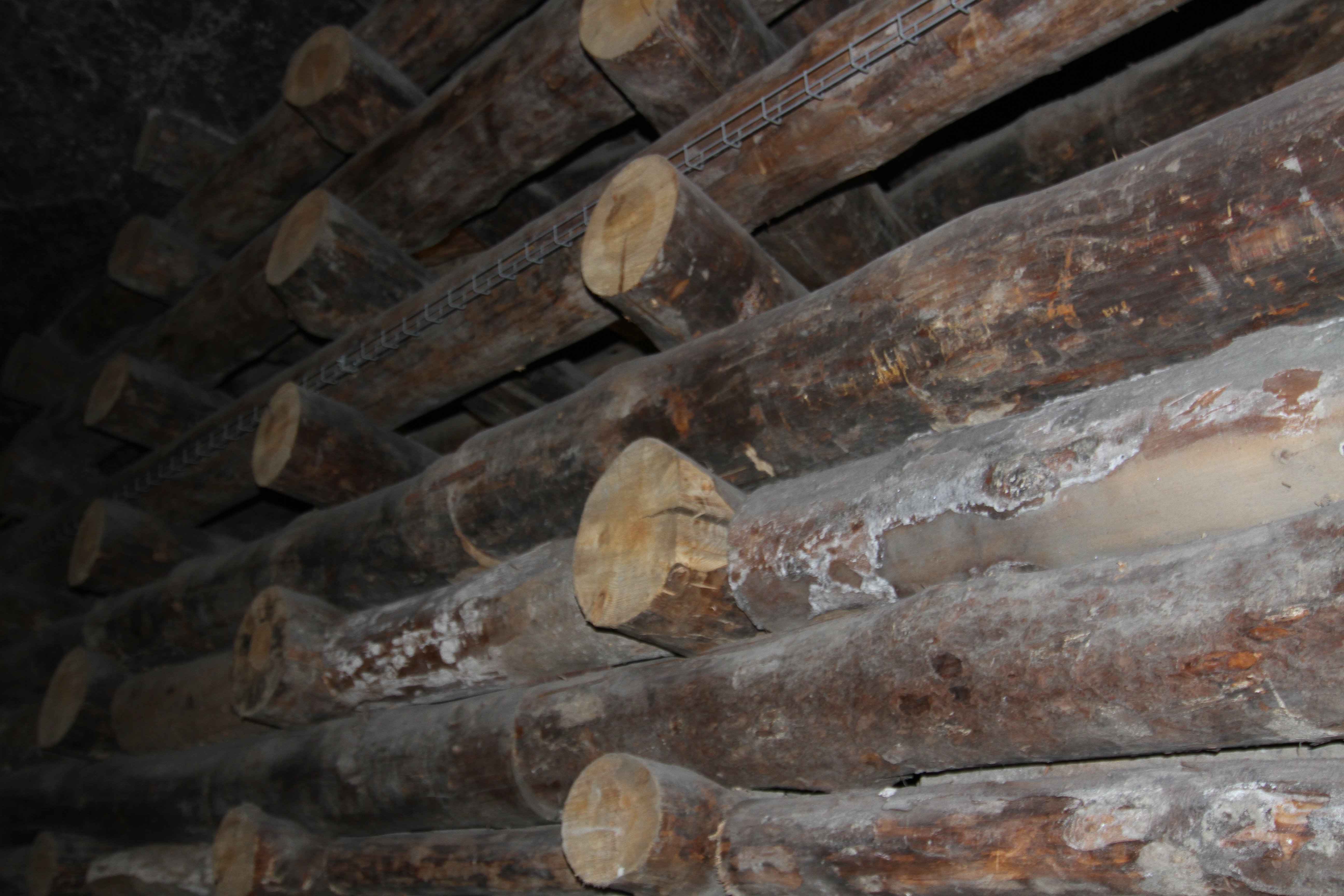
Traditional timber supports

Tribute, in salt

Raising the salt

Gnome from gnome?

Flight into Egypt, Kinga Chapel

Pulpit, Kinga Chapel

Solid salt floor ’tiles’, Kinga Chapel

Roof support system
An author to assuage hunger…

Discovering Rose Tremain
I remember exactly when I first discovered Rose Tremain. I had very recently joined Dillons (destined to merge with Waterstones within a year, though none of us knew that then) and had been invited to attend a party at Hatchard’s (a fine old bookselling business that had been acquired by Dillons some years previously) to celebrate its 200th birthday. Along with many colleagues, I accepted. As Dillons HQ was in Solihull, Teresa, one of our administrative assistants, was asked to find hotel accommodation in London overnight for those of us who requested it. Teresa had been supplied with a directory of hotels ‘approved’ by the company for use by its staff and, as I was to discover, had an unerring knack for picking out those that were most dismal and unwelcoming. Most of my colleagues made alternative arrangements. New to the company, I put my trust in Teresa’s mercy.
The party was the most glittering book trade bash I’ve ever attended. Princess Margaret was there, resplendent in elbow-length gloves and drinking something from a tall glass wrapped around with a linen napkin. Salman Rushdie had dared to attend, even though it was only a year or so after the fatwa against him had been issued. The other guests included dozens of well-known writers and publishers. As you can imagine, security was very tight.
The evening was ‘elegant’. I use the term in a way that was new to me then, but in which I’ve had other occasion to use it since. As I’ve previously mentioned, the first bookselling company that I worked for was in Yorkshire and the second in Scotland. Both hosted many literary events and all of these shared a single prominent common feature: we ensured that our guests were served a plentiful repast of excellent food. We believed in feeding the body just as much as the mind. In Yorkshire, we favoured sides of salmon, roast hams, salads, pizzas and quiches and generally included a selection of gooey puddings; in Scotland the food was usually hot and hearty: soups, pies, lasagnes, stews and curries. But always food, ‘proper’ food, and plenty of it. And drinks, too, of course, though the food was paramount.
At the party at Hatchard’s, on the other hand, the wine flowed but the food was sparse. Exquisite, but sparse. It consisted of tiny canapés that were delivered individually at long intervals by uniformed waiters and waitresses who bore them aloft on circular trays. There were miniature salmon rolls, morsels of pastry stuffed with even smaller slivers of meat and cheese, the babiest of baby sausages skewered with eighths of tomato and Lilliputian biscuits bearing deftly-placed dots of pâté, each one garnished with a parsley feather. The waiting staff weren’t particularly keen to distribute these fairy victuals, either: sometimes it was impossible to snatch one before it continued on its airborne journey through the crowd.
The upshot of this was that, when eventually I arrived by taxi at my hotel, which belatedly I had discovered was situated in the further reaches of Camden, at around 10 p.m., slightly tipsy and completely famished, I found that not only did the establishment serve no food (it would not even be providing breakfast on the following day), but that there was no restaurant or even a takeaway within a radius of at least a mile. I took one look at the dark and dingy street beyond its none-too-hospitable doors, and decided that I would be foolish to risk venturing forth in quest of sustenance now. I therefore toiled up the three flights of stairs to my room (it wasn’t the sort of hotel that offered to help with luggage) where I found a narrow single bed in a cheerless room with no bedside lamp and an ‘en suite’ shower behind a plastic curtain in an alcove. The lavatory was outside, shared with the occupants of the other rooms on the same floor.
Mercifully, my room did contain a kettle and some sachets of coffee and tea (the brand-names of both were unfamiliar) and two or three of those little bucket-shaped plastic containers of UHT milk. Too cold and hungry to go straight to bed, I made myself a cup of indifferent but scalding coffee, groped in my bag in the hope that I hadn’t absent-mindedly eaten the cereal bar that I’d placed there some weeks before (I hadn’t) and fished in it again for the book that I’d snatched from a stash at Dillons HQ for staff to help themselves to before I’d caught the train to London many hours earlier. It was Restoration, by Rose Tremain. Immediately, I was enthralled. I drank my coffee, ate my cereal bar and read. And read. I went to bed some hours later, my hunger forgotten, and slept soundly until the following morning, when I rose early in order to find breakfast and get another quick fix of Restoration before the day’s work started. I had become a Rose Tremain addict.
I had intended this post to be a review of Merivel: a man of his time, by Rose Tremain, which I have just completed, but I’ve probably written as much as you want to read for now, so will save that for another day.
Auschwitz-Birkenau butterfly, from the husband of Christina James…

Peacock butterfly on the steps to the death chamber, Birkenau
I asked for a riposte to Christina’s cider-pressing post, but that was not to be! However, by way of recompense, she has allowed me space to comment on what must be one of the greatest crimes inflicted by man upon man. While she has been busy with what she calls ‘the day job’, which has been, on this occasion, a publisher-librarian conference held in Krakow (for the pedantic, this is pronounced by Poles as KrakOUF, with the stress on the second syllable), I visited Auschwitz and Birkenau, one hour and forty minutes away by bus.
On the face of humanity, a carbuncle, perhaps now healing slowly, but sensitive to the touch and destined to leave a permanent scar. Yet the body politic suffers still and continues to break out in boils symptomatic of the same underlying disease. Mankind, disfigured, cannot find a cure and treats, always too late, the symptoms alone. These gross and scabbing reminders of our failure as a race to reach the root of our ills do not make comfortable our self-examination in the mirror of consciousness, but I found, on this, my second visit after some years, that the experience was already becoming, for the latest visitors, too organised, desensitising.
Brick, concrete, iron, steel, stone and dust, all strung about with the twisted barbarous wires; original timbers are gradually disintegrating or have gone. All about, the millions of October leaves are falling, falling. Summer’s beauty choked by approaching winter cold, they are gathered up in heaps, loaded into barrows and trucks and taken away for burning or to rot down. Colour and life turned to ashes. Shorn of their tresses, the trunks and branches are emaciated, twiggy fragile limbs starkly outlined against the sky.
Irony in the bus loads of tour groups disgorging their cargoes and delivering them into the hands of the camp guides. Selection by language. An industry in itself. The cameras click; the iPads embrace the scenes as each former terror is re-hashed for public consumption. Work makes free. Tourism makes realism – ‘No photographs here’ signs ignored as every shred of individual dignity is wrenched from the heaps of human history and saved for later: ‘I was there; it was awful; look at my pictures.’ I have to step away, unable to stem emotion. My leaves fall like tears, like lives.
Symbolism of railway lines, stretching through the gate to infinity. The sleepers are relinquishing their hold upon the rails, wasting from within. Will those be replaced, like wooden huts, to show what it was like? The other sleepers are softly breathing their message to us, the words falling as gently as leaves, and we strain to hear against the sound of the narrative of the guide. Their language is universal. The guide says that we are now walking the same way as the doomed, but we are not. Once more I break away, this time for good, and let imagination tell the story. And then, on the cracked steps to those underground chambers, now guarded by a staunch metal grid, a delicate beauty opens wings amongst the many fallen leaves and flies into the air. The loveliness of lost lives is captured for me in a butterfly.
All text and photographs on this website © Christina James
To bend with apples the moss’d cottage-trees…
And fill all fruit with ripeness to the core
In my youth I was fairly impervious to the seasons, but in recent years I have come to dread the winter months. It’s not so much the cold that I dislike as the long hours of darkness and the even more dismal short hours of fuggy daylight. I particularly hate the murkiness of late November and December and always rejoice when the New Year brings a better quality of light. My husband once pointed out to me that January 21st marks the end of the two darkest months of the year, and now I always have a mini-celebration on that date.
It is therefore with mixed feelings that I welcome the autumn, even such a warm and mellow one as we have been enjoying this year. We’re already more than a week into October and, at the end of the month, the dark mornings will descend in a brutal rush when the clocks are changed. Now the shades of winter are hiding in the trees, making the first leaves fall. Soon all the branches will be bleakly bare. Although we’ve had a good summer, no-one in Yorkshire has forgotten last winter, which managed to extend itself almost into April: here, we had eight-foot snow drifts at the end of March.
There are some good things to look forward to, however. This has been an excellent year for crops of all kinds – the combination of a wet, late spring and warm early summer seems to have suited almost every species of fruit and vegetable. I’ve already written about freezing our bonanzas of beans and peas, and the exceptional blackberry harvest that we’ve enjoyed. The plums have been prolific, too. And now there is a bumper crop of apples.

I had a crush on this
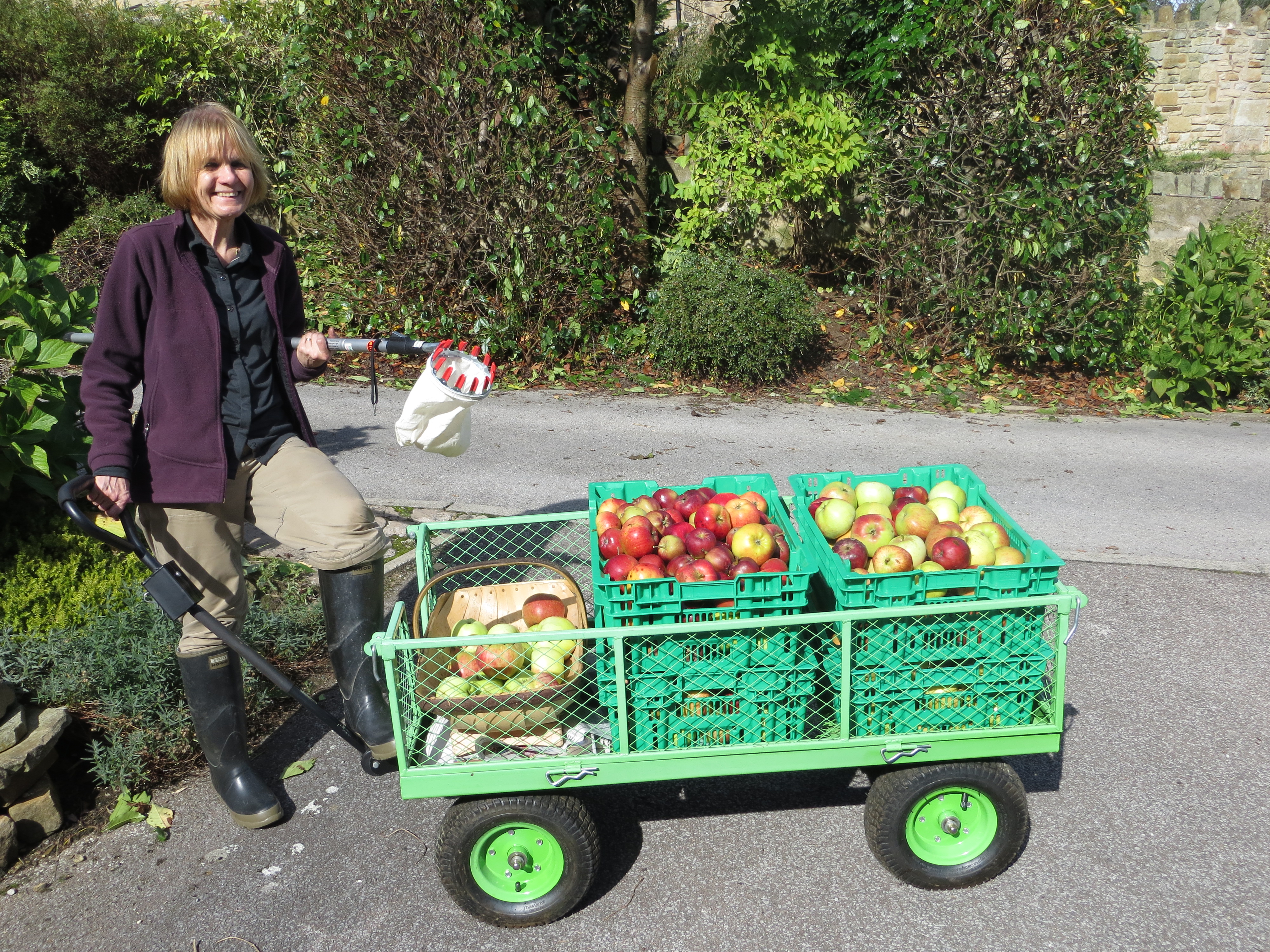
We have two apple trees, one an eater, the other a cooker – a Cox’s Orange Pippin and a Beauty of Kent; our neighbours own four, theirs all varieties of eaters. The Cox rarely produces enough apples to last us until Christmas, but the Beauty of Kent is a stalwart yielder – we collected ten trays of apples last year and did not manage to eat all of them or give them away before they began to rot at Easter – and the neighbours rarely get around to harvesting the significant yields that their trees produce in any kind of systematic way. The waste has been regrettable, but hard to address. This year, my husband decided that we should countenance it no longer and suggested that we should try our hand at making cider.

Pomace face
Correction: that isn’t what he originally suggested. At first he said that we should try making apple juice, and accordingly we bought the equipment. My husband loves embarking on projects of this kind and they all have one feature in common: they are always more expensive than he says they will be, often by many times – the pond, for example; then the beehive ‘starter kit’ (£450 would give us all we needed to maintain two colonies of bees, but we soon needed another hive and a very strange miscellany of costly equipment that looked as if it had been knocked up by Heath Robinson, not to mention the cost of the bees themselves, which turned out not to have been included in the initial figure). I don’t for a minute believe that this is because my husband has a poor head for figures or is incapable of adding up the costs of his enterprises; in fact, I’m quite certain that it’s his way of getting me to agree to them. Once he’s pointed out the entirely reasonable price attached to whatever is his latest enthusiasm, and I’ve agreed to this outlay, we have reached the point of no return and further investment, when it is needed, becomes impossible to refuse.

The turn of the screw
So it has been with the apples venture. The cheapest press proved, on closer inspection, too inferior to contemplate; the screw cap bottles that we’d saved possibly not suitable for the pasteuriser (pasteuriser? I don’t remember that being part of the discussion!), so two boxes of matching shiny new ones have been purchased; and, it turns out, we also needed a host of small tools – a bottle-drying gadget, a thermometer, muslin bags, ‘food grade’ plastic buckets, etc., etc. However, I had agreed that it was a wicked waste not to do something with the apples, so I totted up the cost (about £800) and dug out the credit card. Expensive, I thought, but a real quality-of-life-project, and at least there was nothing more we could possibly need.

And by a cider press, with patient look
Wrong!
I’ve met my husband before, so in retrospect I’m a little astonished at my own naiveté. The equipment duly came, we picked up a couple of trays of windfalls and spent a happy afternoon chopping, pressing and bottling them. I was particularly impressed with the pasteuriser, which bubbles away, and apparently doubles as a tea urn – so if we decide to hold a village fete on our lawn, no further financial outlay will be required. Enthusiastic about our success – we now had eight bottles of de luxe quality apple juice (I tried not to cost out the price of each) – I asked my husband if we’d be making another batch the following weekend.
He assumed a look that I know well: a mixture of foxy evasiveness and guileless bonhomie unique to himself. “I’ve been thinking,” he said. “There are so many apples this year, that perhaps we should have a go at making cider, too.” I shrugged. “Sure,” I said. “Why not? We’ve got all the equipment now.”
“Well, the thing is,” he said, “there are one or two other items that we need…”

Plop!

The last oozings
Upshot: we spent a further happy day in glorious sunshine on Sunday gathering up windfalls and plucking marked or damaged apples. The cider-making extras came yesterday – the additional cost was a mere £122 – and we spent the day chopping and squeezing eight trays of apples (in my case this activity was punctuated by several telephone calls to a restaurant in Krakow, of which more in a later post). We now have thirty litres of cider bubbling away in the garage, and five of the bottles of apple juice still to drink. And all of this for less than £1,000!

All that, for all this!
I must admit, though, that the experience has been so enjoyable that the outlay has been worth it and, as my husband so sagely remarked, the apple press is a beautiful piece of machinery that will last us for many more years, and eventually become an heirloom. Thinking a little more short-term, the cider should be ready by Easter and I’m sure the anticipation of it will help us through the dreary darkest days.
[Having read all this and, he says, ‘appreciated’ the tone of it, my husband requests the opportunity for a re-post riposte (guest), from his perspective. Hmmm.]
All text and photographs on this website © Christina James
“I’ve been a wild rover for many a year, and spent all my money on bleep and bleep…”
“Dost thou think, because thou art virtuous, there shall be no more cakes and ale?”
The crazy topics for which researchers are awarded grants are often a source of great amusement to me. During the past year I’ve read about a project that, after many months of expensive labour, ‘successfully’ created a formula for the ‘ideal’ slice of toast and marmalade (it wouldn’t succeed in our household, where some of us like our toast burnt and others don’t); a study that ‘proved’ that there is a link between depression and being unhappy at work; and, just this week, a piece of research that shows that the pop songs of today contain twice as many references to alcohol as the ones of twenty years ago.
At first I thought that the last of these was very funny indeed. Good on the researchers who have persuaded whomever awarded their grant that it would be a good use of scarce resources to pay them to sit around endlessly listening to pop music. More power to their (drinking?) elbow. But now I’ve had time to consider, I’ve begun to wonder if there isn’t something more sinister afoot here. Assuming that this study is not entirely mindless and redundant, to what use is it intended to be put? Is the government going to start censoring pop songs? If so, it would very decidedly be the thin end of the wedge. It’s not just about pop music: from the earliest times, alcohol has been a part of almost all cultures, as is reflected in their art and literature. Just imagine what would happen if a Nahum Tate style of censorship were to be applied to books. Offending works would have to be covered in brown paper, and an approximation of their titles offered instead:
• Tizer with Rosie, by Laurie Lee
• Irn Bru Galore, by Compton Mackenzie
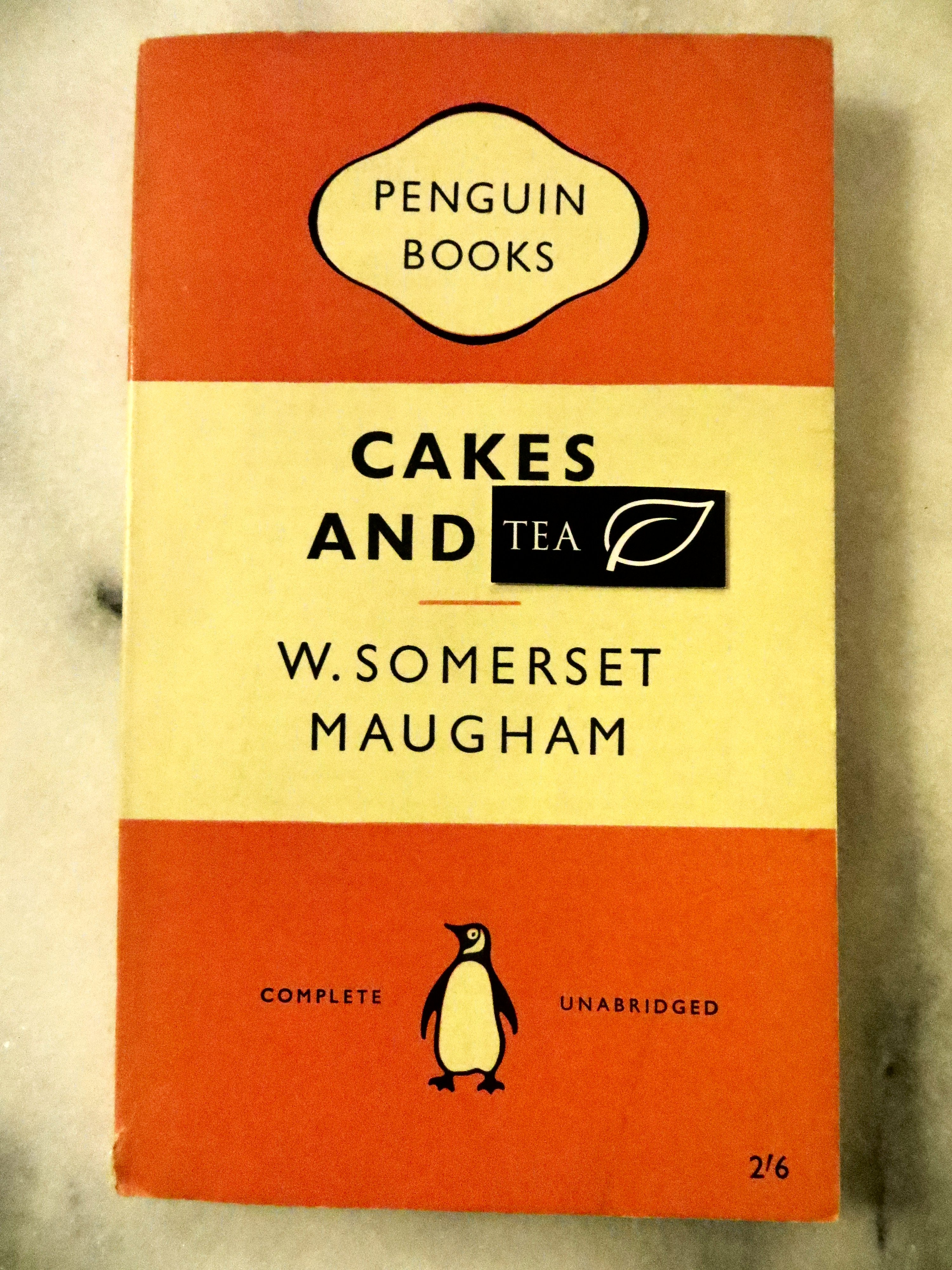
• Cakes and Tea, by Somerset Maugham
• Dandelion Juice, by Ray Bradbury
However, having to alter the titles would be a mere bagatelle compared to the changes that would have to be made to the works themselves. Homer’s ‘wine-dark sea’, almost his trademark description, would have to become the ‘grape-juice dark sea’; Lady Macbeth would have been stuffed if, instead of being able to observe, as the grooms slipped into a drunken stupor, ‘that which hath made them drunk hath made me bold’, they’d all been swigging elderflower water and sitting up playing cards, as lively as crickets; and ‘wine, women and song’ (which I’ve just looked up, and find, to my amazement, that it is a saying usually attributed to Martin Luther) would not have the same ring to it if it became ‘water, women and song’.
I jest, but I am also being serious. This type of statistical analysis is not only nonsense, but also very dangerous. Cultures cannot be manipulated, and even if this particular statistic is true, it doesn’t necessarily mean that society is becoming more decadent. One interpretation might be that, at present, writers of pop songs are going through a very literal phase, which may mean that there are fewer double entendres to pick up on and correspondingly more overt references to be spotted by the earnest conductors of surveys. The pop songs of my youth were full of allusions to drugs, drinks and sex, but many of these were disguised. I wonder if present-day researchers would have spotted them? Self-evidently, also, my generation survived and turned out to be no more or less decadent than any other. Culture must be allowed to regulate itself.
If the government interferes in this, you may find me in my local singeasy.
The mystery, madness and magic of memory…

Which buttons? In which order? Aieeeee!
My friend Priscilla, visiting recently, said that my memory was remarkable. This is only partly true: I can never remember how to get into my online banking account and dread the mandatory six-monthly tussle to open it, a necessary process to stop the bank from discontinuing access via my chosen password (that I also can’t remember); I never know which of the buttons on the dashboard of my car releases the locking petrol-cap and have on at least one occasion had to resort to asking a complete stranger, the obliging but clearly exasperated man waiting behind me on the garage forecourt, for help; and, somewhat to my shame, I admit that I can’t turn on my own television. I hasten to point out that, in our household, this isn’t a simple case of clicking one button and then a channel number on a remote: my husband, who is practicality personified, insists that its performance and picture are better if the controls are run through the DVD player. This involves pressing manually a button at the back of the set and using the controls of two separate remotes in the right order to bring up a channel. On the only occasion that I have managed to switch it on, all but a two-inch border at the edge of the screen was obscured by a giant bright green rectangle, as if the programme had been censored by a Martian.
However, Priscilla, who was my flat-mate and closest friend during my university years, is correct that, when it comes to people and what they wore and said, even decades ago, my memory tends not to let me down. I can remember, for example, almost all the clothes that she owned at that period: the turquoise reversible cape; the beautiful green and black floor-length dress she wore to parties the year that everyone turned twenty-one; the red belted sweater that she was wearing on the day that we first met (out of character, this – I don’t think I’ve ever seen her wearing anything else in red); the pink checked Marks and Spencer shirt that she took home for her mother to repair when she ripped the sleeve and many other of her garments.
I’m not sure why I have this kind of selective memory. It’s certainly not something that I’ve tried to cultivate. It may have something to do with the fact that, from a young age, I’ve always intended to write and have therefore sub-consciously filed away a ragbag of material (this is not a pejorative representation of Priscilla’s student wardrobe, I hasten to add!) that might come in useful one day, whereas it’s highly unlikely that I shall ever want to introduce into my novels the mechanics of online banking, filling the car with petrol or turning on the television; yet I think it might also be related to the way that the two generations before my own spoke and behaved. I grew up in the last few years before the half-generation ahead of mine decided that it was a good idea to ‘let it all hang out’. My childhood was dominated by my grandmothers’, rather than my parents’ generation, simply because there were so many of them: one of my grandmothers had six sisters and a brother and the other four brothers (and both had had other siblings who had died in infancy). By contrast, my mother was an only child and my father had one sister, who emigrated while I was still at primary school. There were many family gatherings and I also spent quite a lot of time with each of my grandmothers on her own.
People of that generation – the last to be born before the First World War – didn’t tell you what they thought in so many words, particularly if it was something disagreeable. You had to figure it out for yourself. For example, I very clearly remember standing on the landing of my father’s mother’s house – it had a big oval window edged with squares of coloured glass in blue, red and green, and the sunlight was streaming through it – while my grandmother folded sheets and stowed them in the linen cupboard with the deft efficiency of an automaton. Standing on the windowsill was a black and white photograph of my parents on their wedding day. It was very familiar to me: the same picture, in various frames, adorned mantle-pieces and windowsills in the homes of all my great-uncles and great-aunts, my other grandmother and, of course, my own home. My father was wearing a dapper double-breasted suit; my mother, slightly taller than he in her white platform soles, a drooping full-length white dress (it certainly wasn’t a meringue) which looked as if it might originally have had quite a low neckline but had been primly filled in with a layer of net that almost reached my mother’s chin. Her hair was parted in the middle and almost concealed by the heavy headdress that anchored her floor-length veil. My father was grinning from ear to ear, but my mother wasn’t quite smiling. On the spur of the moment, I asked my grandmother whether she thought my mother had looked pretty on her wedding day.
My grandmother pursed her lips.
“Different folk thought different things. It was all a long time ago, and I’m not going to drag it up again now,” she said, folding the linen ever more ferociously. I was astonished at this remark, but I knew better than to pursue it further: I’d simply have been ‘put in my place’ and certainly would not have elicited a more enlightening comment. However, I still ponder what she said and wonder what it meant. Did my grandmother not like the dress? Was it she who had insisted on doing something about the ‘immodest’ neckline? Did she think my mother should have worn flatter shoes, so as not to emphasise my father’s shortness? An outsider might think that it was just a typical bitchy mother-in-law remark, but my mother and grandmother always seemed to get on well together: in fact, I observed that often they were allies and knew that my grandmother was naturally a generous, not a spiteful, woman.
For a writer, though, these two sentences are like gold. It’s been worth filing them away in my memory for more than four decades. I still enjoy working out possible solutions to the puzzle that they represent. I may even base a whole book on them at some point, whereas I’m unlikely to get much mileage (sorry!) out of a petrol cap. But the man who helped me with that, now, he’s of an entirely different ranking in the memory stakes: he was thick-set, slightly balding and wore a Huddersfield Town shirt with grey jogging bottoms. He had a Barnsley accent. “Now, lass,” he said ….
When the Devil Drives… plenty to enjoy in the passenger seat!

There are many things about this novel, the first of Chris Brookmyre’s that I’ve read, that I admire. The novel is set in Scotland and the author successfully conveys that country’s rawness and beauty without descending into shortbread and Bannockburn lyricism. The plot is brilliantly crafted, with believable twists and turns until the very last sentence; it explores the dynamics of relationships on several different levels; and one of the protagonists, a private investigator named Jasmine Sharp, who inherits her uncle’s private investigation agency, Sharp Investigations, is only twenty-one years old, which makes her unique amongst the fiction detectives of my experience. She’s also an actress manqué, which helps her considerably in her adoption of a career that she has literally fallen into by accident. In When the devil drives, Jasmine’s pursuit of a long-disappeared missing person collides with the investigation of a present-day crime being conducted by Catherine Macleod, a senior police officer. Parallels and contrasts are drawn between the two women in both their professional and personal lives.
Jasmine’s relationship with Fallan, the man who confesses to having killed her father, is the most compelling of the many relationships that Brookmyre portrays. Fallan is an enigmatic character; still barely operating on this side of the law (in at least one instance he commits a criminal act, though there is the underlying suggestion that this is morally justified), he is an ex-con who, by his own admission, owes Jasmine an unpayable debt. She should shun and despise him, but she becomes ever more fascinated with him, while it becomes even clearer that she needs his help. To the end of the novel, however, his true character and, the reader suspects, his true relationship to her remain ambiguous. (When the devil drives contains an extract from Brookmyre’s next novel, Flesh Wounds, and I therefore know that Fallan features in it. I shall be happy to buy Flesh Wounds just to find out more about him.)
Catherine has a similarly edgy but not hopelessly antagonistic relationship with her husband. More bohemian than she, he clearly thinks that she is over-protective towards their two sons – a natural result, we are encouraged to conclude, from what she sees and suffers daily as a policewoman. I have to confess that I find the portrayal of Catherine the weakest facet of this novel. Her assured public role – she is almost brutally terse in her treatment of colleagues – sits ill with the neurotic wife and mother that she becomes at home. However, the main problem with Catherine is that her character fails to engage the reader to the same degree that Jasmine’s does. Many crime writers develop two characters to act as foils to each other: Stephen Booth’s Fry and Cooper and Anya Lipski’s Kiszka and Kershaw spring immediately to mind – but their success lies in making each character as appealing as the other, despite their very obvious differences. By contrast, in When the devil drives, I found myself impatient to get back to Jasmine during the Catherine scenes.
This is a realtively minor blemish, however. I won’t say too much about the intricate plot of this novel, as I don’t want to spoil it – and I should like to encourage anyone who is reading this to get hold of a copy of the book. Brookmyre has an original style and I’m sure will write many more such successful and entertaining novels.
Cheek to cheek with London at night…

Waterloo midnight’s fine…
I’ve just been in London for three days. It was mostly for the day job: I’m afraid the lazy days of August are now a distant dream. Autumn, with its increased workload and vigorous round of conferences and exhibitions, has now kicked in with a vengeance. The nights are also getting longer, of course, and on Wednesday evening there was a decided nip in the air. Nevertheless, I was having a wonderful time. After five meetings with colleagues and friends (none of them arduous, it should be said, and all of them interesting), I rounded off the day in style by meeting my friend Sally, with whom, as I’ve mentioned before, I stay when I’m in London, and going to see Top Hat at the Aldwych.
Although I’ve seen many (probably too many!) amateur musical productions, I don’t think I’ve ever been to one in the West End before. It was truly breathtaking. Top Hat was made famous by Fred Astaire and Ginger Rogers, for whom it was written, and first produced in 1935. The Aldwych version is faithful to the original – I’m glad to say that it’s not a spiky modern take on what has always been intended to be a slice of sumptuous fantasia – and I’d guess, although I don’t know, probably even follows the same choreography. The dancing was superb. The lead roles were played by Kristen Beth Williams and Gavin Lee, and to my eye – although I daresay this will be considered sacrilege in some quarters – their dancing was every bit as fluid, graceful and amazing as Fred’s and Ginger’s (which I’ve seen on film). The dancing by every member of the cast was of the same high standard. The costumes were magnificent – Williams wore at least ten outfits on stage, each one more glamorous than the last – and the two-tiered set was extremely clever, a brilliant way of making the most out of what is in fact quite a small early twentieth century stage.
The theatre was packed, and not just with people of a certain age. It set me wondering why a musical with no ‘hidden message’, whose appeal resides in the extravagance of everything about it, from the virtuoso performances to the clothes and make-up, should be so popular. I thought that it might be because we’re all fed up with so-called austerity, and seeking a break from it. Spending the evening in a make-believe world where money is no object and everyone is talented and beautiful certainly did the trick for me. I guess that this may be the reason why the original Top Hat went down such a storm, too. The glamour and genius of Fred and Ginger were obviously powerless to dispel the dark shadows that were gathering over Europe in 1935, but they must have given their audiences a night off from thinking about them.
Understandably, the Aldwych doesn’t allow photographs to be taken during performances, so I hope that my words and your imagination will supply the deficit. I have, however, included a photograph of another heart-stirrer, the view from Waterloo Bridge. It was approaching midnight when I was walking over the bridge to catch the train back to Sally’s, so I managed to capture only a fraction of its magic. It’s a place that never ceases to delight me when I’m there. The sweeping views of the Thames, the elegant and floodlit buildings, the reflection of the lights on the water and the London Eye (which is larger and more substantial than the other Ferris wheels I’ve written about) always make me feel proud of our capital city. London can be grey and dingy, mean and impoverished, just like all big cities, I suppose: but on Waterloo Bridge it twinkles and shimmers with the same aplomb and grace that the dancers showed in Top Hat.
Golf and a gnomic utterance
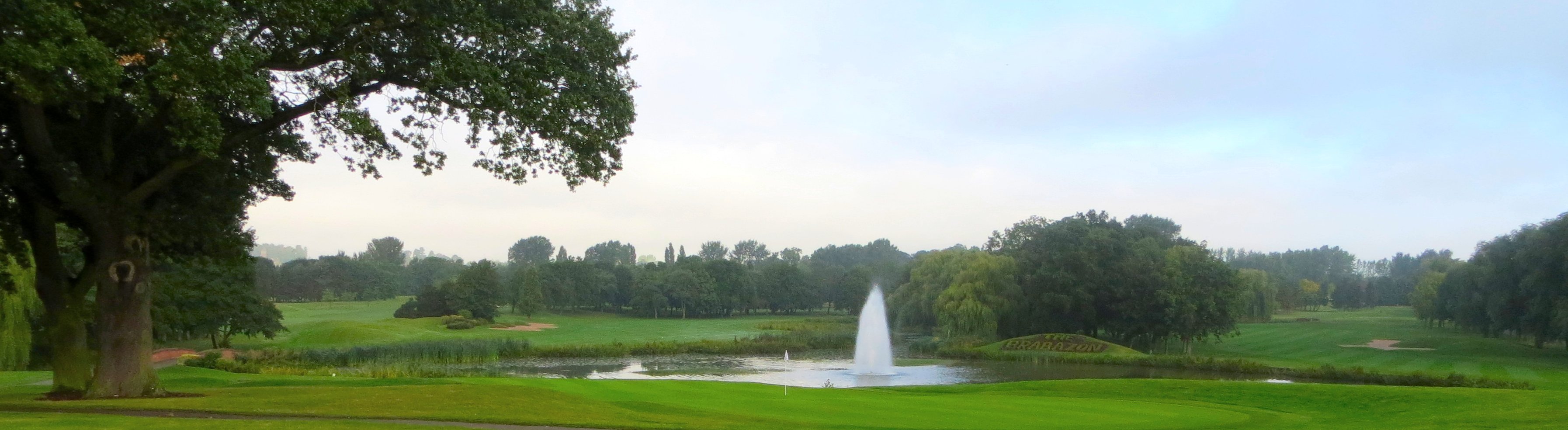
The conference that I attended last week was held at The Belfry, the hotel and golf complex situated close to Birmingham and venue, quick internet research tells me, for at least four Ryder Cup tournaments. I know little about golf, so this was quite an experience, enhanced even further by the fact that the hotel was undergoing some refurbishment, with the result that the conference itself was held in a marquee. As someone who put her foot down about camping about a quarter of a century ago, I viewed this latter development with some trepidation; however, despite intermittent rain, the marquee was neither damp nor draughty (rather the reverse) and in fact quite luxuriously appointed. It even had a small ante-room that had been kitted out with proper flushing loos.
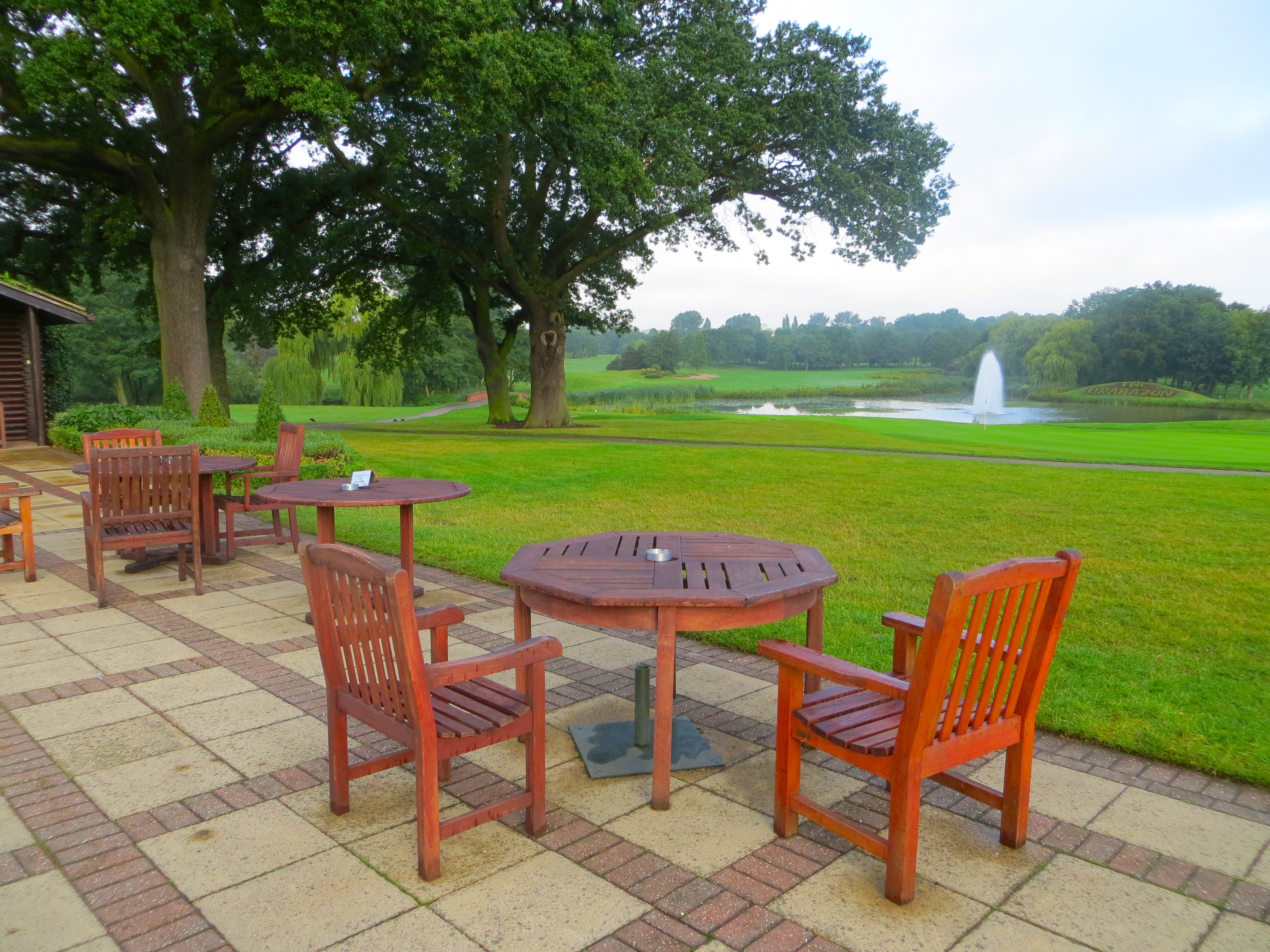
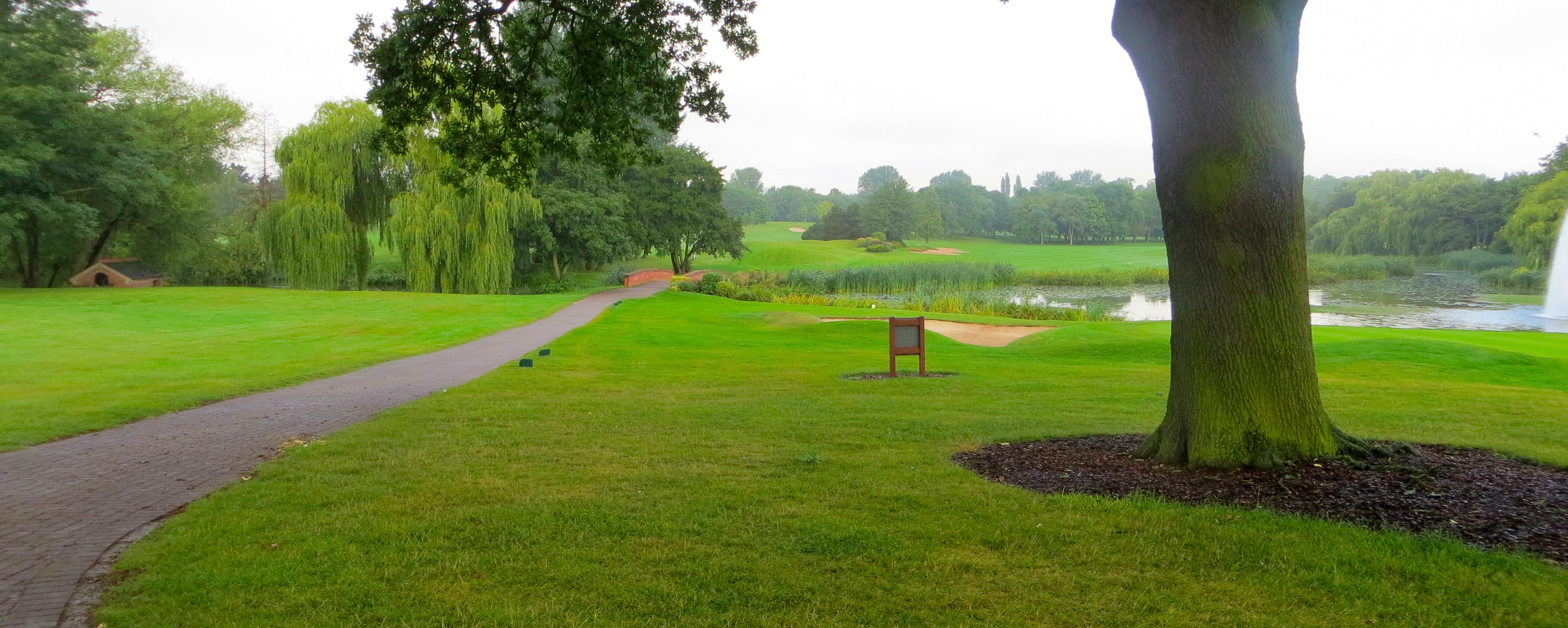
I still felt that I was the temporary inhabitant of a somewhat alien landscape, however. The golf course (It is actually three golf courses, the most difficult of which, the ‘Brabazon’, I was reliably informed, is a legend of its kind; this must have been true, as assorted men could at most times be seen gazing across at it, some taking photographs, others just lost in a trance of admiration) is perfect in every way. The acres of lush grass are flawless, manicured and bright green. The trees are symmetrical, the fountains crystal clear, the pathways pristine. It looks like a film set, rather than a managed slice of English countryside, but for a particular kind of film. It’s not the sort of place where you might encounter Mr Darcy striding across the greensward (though there would be some convenient lakes for him to jump into if he were so inclined) and you’d certainly not be able to imagine the muffled screams of a madwoman in the attic (in any case, the hotel itself is rather a low-lying, stubby building and may not have attics). It would probably be most suitable as the backdrop of a romantic comedy. I could conceive of Cameron Diaz, running across the course in a pair of Jimmy Choos to get to her lover, a posse of infuriated golfers in her wake; or Pop Larkin, annoying the staider representatives of middle England by turning up with his noisy and unpredictable brood. (Several golfers staying at the hotel were accompanied by young families, but all the children seemed to be behaving impeccably.)
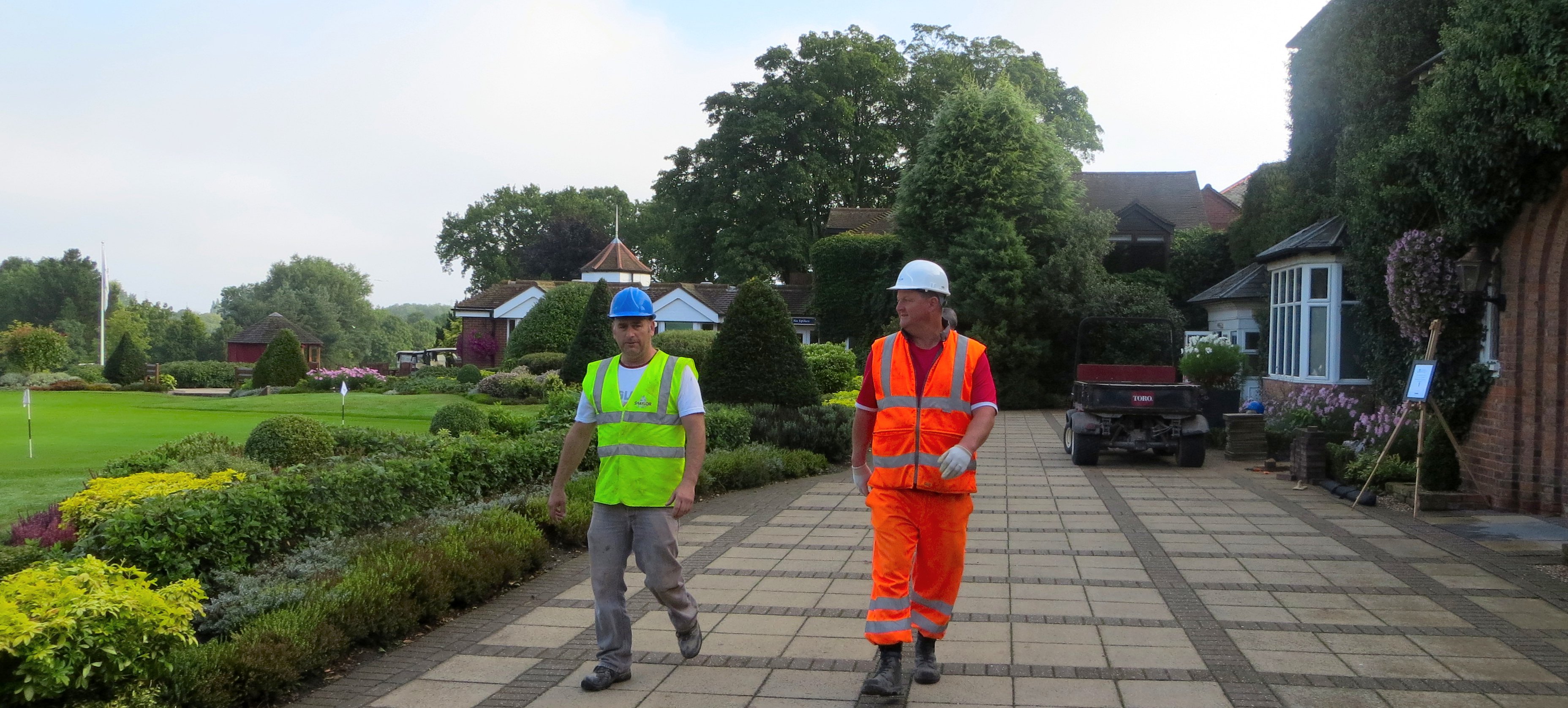
This is not to say that no dangers are to be encountered in a place that exists largely for golf. The Belfry boasts a whole fleet of motorised golfing buggies. To me, they seemed to be extra large, a type of off-road version of the ones I’ve seen in Yorkshire. They came bowling round the pathways at some speed, making walking hazardous for the unsuspecting. Either one of the hotel’s attractions is the fringe sport of potting conference-goers, or the drink-driving laws don’t apply in its grounds. An additional, temporary, danger was caused by the gangs of workmen employed on the renovations. They were frequently to be encountered striding about purposefully, balancing what looked like iron girders on their shoulders. I tried to photograph two of them engaged in this activity, but a bevy of passing buggies got in the way. I did manage to snap them on their way back for more girders, however. The one on the left stuck his tongue out at me, too late for my picture: I felt like Just William, establishing good relations by means of a skirmish.
What is beyond dispute is that The Belfry is a very photogenic place. This whole blog-post is therefore just an excuse to show you some pictures of it. I won’t say anything about the conference, as that belongs firmly in the compartment of my life marked ‘day-job’ – except to offer you a rather extraordinary sentence delivered by one of the speakers, which may amuse you and has already sown the seeds of a possible plot in my mind: “We uncover the discordant voice of dentistry – all dentists hate each other!”
Happy golfing!
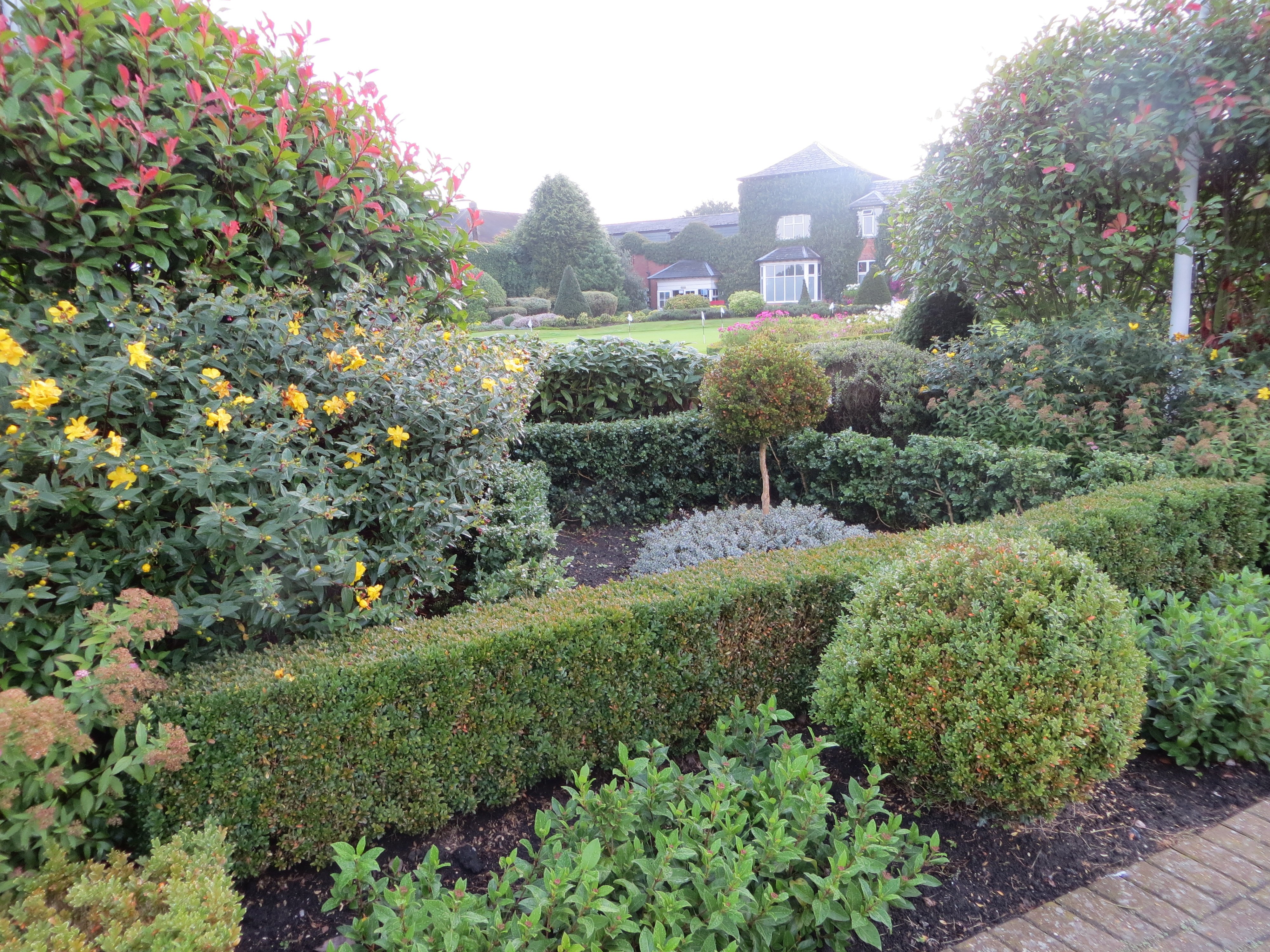
An extraordinary woman

Bess of Hardwick
Last Saturday we had visitors and the weather looked very uncertain. We therefore abandoned plans to take them to the cotton mill at Styal (which involves quite a lot of walking about outside) and instead headed for Hardwick Hall.
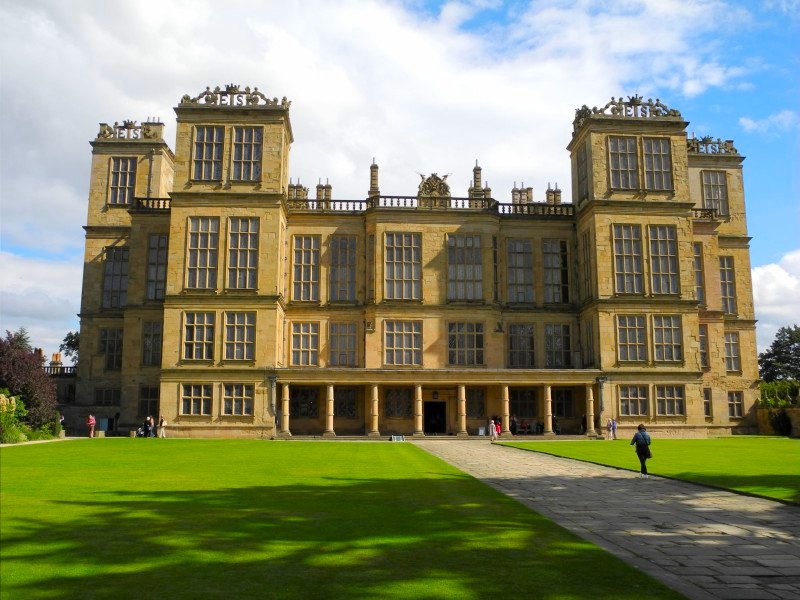
Hardwick Hall
As it happens, this is one of my favourite old houses. I’ve visited it several times, on the first occasion as a schoolgirl. I was surprised on this latest visit to learn that it was acquired by the National Trust shortly after its last domestic resident, the Duchess Evelyn, died in 1960, as I had assumed that I’d originally seen it before the Trust got to work on it (it was very run-down and gloomy then), but I must have been wrong. I suppose it must take years to restore an old house as large as this. Actually, I loved it when it was a bit dirty and dilapidated, though I appreciate that it couldn’t have been left like that. Yet it was very atmospheric; I really felt as if I might have met Bess of Hardwick herself coming down the stairs.
Bess would have been an extraordinary woman at any time, but her achievement was unique in the Elizabethan age during which she flourished (she died when she was 81, and actually spanned almost the whole of the Tudor period). She was born during the early years of Henry VIII’s reign and died five years after James I succeeded to the throne. Of relatively humble background – her family were minor gentry – she gradually made herself one of the most powerful women in England through her four marriages, each husband being richer and more influential than the previous one. I’m not sure how she managed to circumvent the laws about women’s property actually belonging to their husbands that pertained at the time (and for centuries afterwards), but I suppose it must have been something to do with the terms of her widow’s jointures. However she managed it, by middle age she was a very wealthy woman in her own right, with an income of £9,500 p.a., of which we are told that she spent £8,500. By comparison, the humblest labourers on her estate were paid a penny a day.
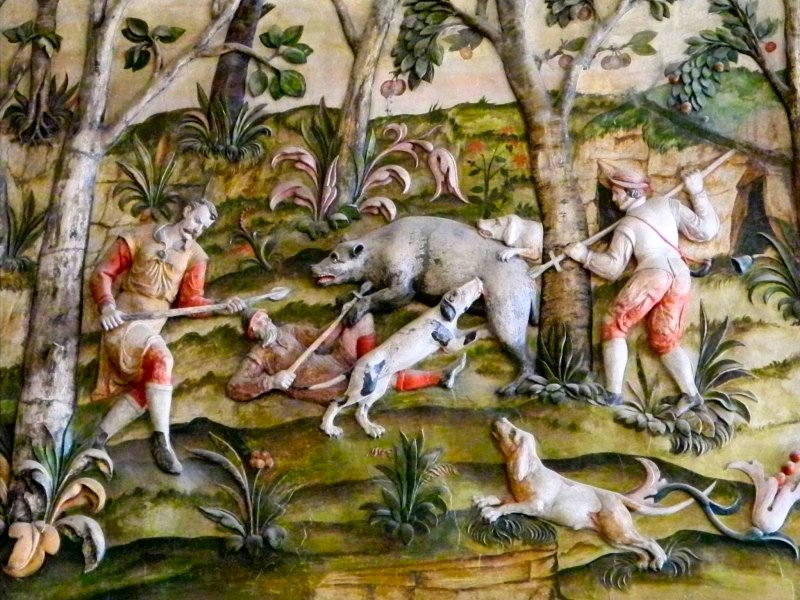
A graphic detail from the frieze around the grand reception room
Bess’s last husband, George Talbot, the Earl of Shrewsbury, was for many years gaoler to Mary Stuart (an unenviable task), and Hardwick contains examples of embroideries that Bess and the exiled Scottish queen worked on together. She and Mary clearly got on well. One of the most famous portraits of Mary hangs in the gallery at Hardwick. Bess also succeeded in maintaining good relations with Elizabeth I. There is another portrait there of Elizabeth, wearing an elaborate dress that Bess presented to her as a New Year’s gift.
I’m certain that Bess would have been a very difficult woman to live with. Obviously always a strong-minded character, by the time she married Talbot her character had hardened into obduracy. Hardwick Hall was indisputably her house, not her husband’s (they also owned the forerunner of Chatsworth). She proclaimed this by having the initials ‘ES’ (for Elizabeth Shrewsbury) carved on its castellations. Hardwick was built right next to the old Hardwick Hall, a much less splendid house, where she had lived as a child. Although she took some of the stone from the old hall to use in the new one, the old one was never demolished: its ruin still stands. She and George Talbot (he also proud and intransigent) did not enjoy a happy marriage and at one point were formally separated. Elizabeth I instructed them to live together again, to set a good example, but it is doubtful if this instruction was carried out in the spirit, if indeed it was observed in the letter.
Bess eventually became the grandmother of Arbella Stuart, who had strong claims to the throne and grew up at Hardwick. As a young woman, she was a semi-prisoner there. Recent excavations have discovered an Elizabethan exercise book which may have belonged to Arbella. This item, obviously, had lain concealed for very many years, but almost everything there is contemporary with the building of the house. The reason that I like Hardwick Hall so much is that the wall-hangings, artefacts and furnishings are more or less as they were in Bess’s time. This is because it was successively used as a hunting-lodge and to accommodate a younger branch of the family, especially after the later Chatsworth was built.
Hardwick is evidently one of the most popular of the National Trust houses; it is almost always thronged with visitors and has been impressively restored by the Trust over the last half century; the loss, especially to me, of its former compelling ambience is a very small price to pay for preserving such a beautiful old house. And I’m certain that, if it were possible to visit it late on a dark winter’s night, it would still be easy to imagine Bess moving down the broad, shallow stone stairs, her rich silk dress swishing slightly as she went.

I really felt as if I might have met Bess of Hardwick herself coming down the stairs.
 Christina James, crime novelist