

Salt and I inextricably linked, even on holiday…

Salzach River, Salzburg
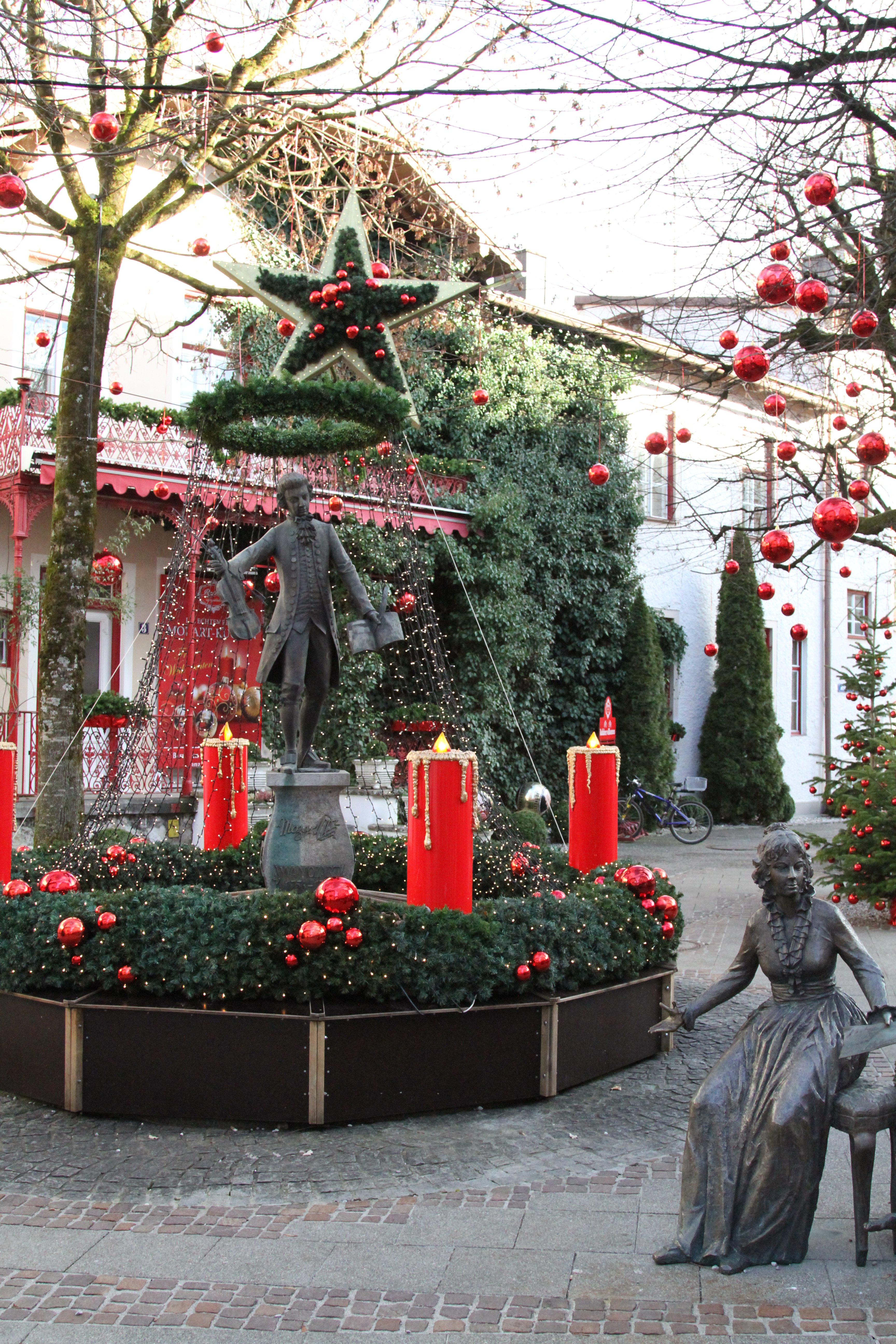
Chocolatiers’ Mozart Christmas grotto, Bad Reichenhall

Salzburg skyline in December
Salzburg is a breathtakingly beautiful city that seems to exist mainly to ensure the immortality of one man: the child prodigy composer Wolfgang Amadeus Mozart. There are Mozart cafés, Mozart restaurants and Mozart museums – and even tourist gift shops where you can buy Mozart rubber ducks and flying birds with Mozart’s face, all wearing powdered wigs. There is a spectacular concert hall where the programme includes the work of many composers, foremost among whom is – Mozart. There are Mozart chocolates, made by two rival companies: the original chocolatiers, whose business is very small and still confined mainly to the Salzburg region, and a younger, upstart firm whose aggressive marketing has been so successful that its distinctive round, filled chocolates, individually-wrapped in red foil, can now be purchased in many countries besides Austria. This company has created a Mozart grotto next to its main shop over the border in Bad Reichenhall, which features a statue of the composer, a fountain and bushes hung with winking red lights and huge baubles in its trademark silvery red.
Today, the city’s prosperity depends very much on Mozart tourism, but it was a wealthy place long before the composer’s birth. As its name suggests, its fortune was built on salt. This, of course, resonates with me, because Salt, good fortune and creativity are very much linked in my mental map. There is a famous salt mine close by the city which offers tours to visitors. We decided not to visit, as we have recently been to a similar attraction in Kraków. The Austrian one, apparently, makes a particular attempt to please family parties: its offers include enabling children to dress up as eighteenth-century peasant salt-workers.
The river that runs through the city also takes its name from salt: tolls on the salt-carrying barges created some of its wealth. Walking along the boulder-strewn riverside is a pleasing experience and there are several picturesque bridges, one of which is hung all the way along with lovers’ padlocks.
The Salzburg area has been unseasonably warm between Christmas and the New Year. There is snow here, but only high in the mountains. The local people are amazed at how mild the weather has been. Nevertheless, the people in the streets all wear hats, scarves, boots and quilted jackets or loden coats. Babies in buggies are muffled to the eyebrows. It is possible to stand in the sun and feel real warmth on your face, but as soon as you step into one of the many alleyways or just enter the shadows of the tall terraced buildings, the cold bites. There may be no snow at the moment, but you feel that it is only biding its time. February is the coldest month here: the Austrian mountain winter has really only just begun.
What does Salzburg have to offer in the way of inspiration for a crime fiction writer? On the face of it, this bright, industrious city, peopled with serene residents and laughing holidaymakers, does not seem a promising setting for dark deeds. However, in the alleyway marked ‘Juden Gasse’, with its stolpersteine or brass commemorative cobblestones, we stumble upon some of the darkest deeds that man has ever perpetrated upon man; and, not many kilometres away, lurks the Eagle’s Nest, mountain retreat of one of the world’s most sinister fantasists and almost the most prolific murderer of all time.
Rummaging in the rooms, cupboards and fireplaces of my past…

Visiting friends just before Christmas, we came to talk about how buildings change and the feeling of dislocation that this sometimes brings. The building we were actually discussing was a special case: my husband had worked there for most of his career before it was knocked down and rebuilt. Responding to local pressure, however, the organisation that owned it was constrained to preserve carefully the original early twentieth-century façade (which I’d always thought was very second empire, but was certainly more imposing than any modern constrained-by-budget counterpart would have been), even as it created an entirely new structure behind. Therefore, the new building is quite different from its predecessor in every respect except one: to enter it you have to climb the same flight of steps and pass through the same solid door, flanked by two storeys of massive man-sized sash windows, that gave access to the old one. Beyond, if you remember the old building as clearly as I do, and aren’t very familiar with the new one, you encounter a true Alice-through-the-looking-glass experience.
As I’ve said, this rebuilt building presents a special case, but talking about it has made me think about all the buildings I’ve lived in during my life: the three houses in Spalding that were my family homes until I was respectively nine, sixteen and eighteen; my hall of residence at Leeds University and the run-down student flat in Leeds that I subsequently shared with my closest friend; the rather grand flat where my husband and I lived during the first few months of our marriage, before we were ousted by a greedy estate agent who wanted to triple the rent; and the subsequent three houses that became our own family homes – the humble two-up, two-down 1939 brick box in Chapel Allerton, the much more substantial Edwardian semi in Halton and our present house that is tucked away in a picturesque Pennine village.
All of these buildings are still standing. Some will have known many owners or tenants since I lived in them; some have been refurbished; others have sunk yet further into dilapidation. As far as I know, none except my present home still contains any imprint or vestige of myself. I have revisited most of them at long intervals, but I haven’t been inside a single one of them since they ceased to be ‘mine’. Recently, after I began to write the Tim Yates stories, I deliberately went back to the site of the shop in Westlode Street, Spalding, where my great uncle David worked for his whole life (it is now a café, run by eastern European immigrants) and also parked for a few minutes outside the mid-nineteenth century house in Sutterton where my grandmother lived and worked as a paid companion when I was a child and where most of the third novel in the Tim Yates series – the one I am still writing – takes place. I didn’t go into the café for a coffee because I wanted to remember the shop as it was. I almost (but not quite) plucked up courage to ring the doorbell of the house in Sutterton (it was, after all, more than forty years since I was last inside it), but again I decided not to, and not only because I realised that the present occupants might not appreciate having to entertain an eccentric woman brimming with nostalgia on their doorstep. It was also because I’m still writing about this house and I want to remember it exactly as it was.
I don’t subscribe to theories that represent time as anything other than a linear continuum (though I know that serious scientists have begun to argue otherwise); nor do I have conclusive proof that buildings have memories (though I could be persuaded to believe this: I’m certainly convinced that some buildings exude a powerful sense of atmosphere). Yet still I am intrigued by the fact that all of these buildings have continued to lead parallel lives to mine: they have grown older as I have grown older; like me, they have made friends, good, bad and indifferent, who have treated them with kindness, indifference or malice along the way. If I could return to them now – really return, to be given the opportunity to explore every room, every cupboard, every fireplace – or, in some instances, either to wonder or lament at ‘improvements’ that have meant that the rooms and cupboards and fireplaces that I knew are no more – that would be a looking-glass experience much more fundamental to what has shaped me as a person than my occasional, albeit eerie, walking beyond the façade of the building that became my husband’s new workplace. As I’ve said before, place is important to me… and one of the lynchpins of my writing. I remember the places I’ve lived at, stayed at and passed through very clearly. If I could have alternative, updated views of what, for me, have been the most significant of these, I wonder if I would find it an unsettling or an enriching experience, or both of these things? And, even more, I wonder what effect it might have on the store of memories on which I rely when I am writing.
‘The Lord is a shoving leopard’: the humour of Gervase Phinn

With Gervase Phinn
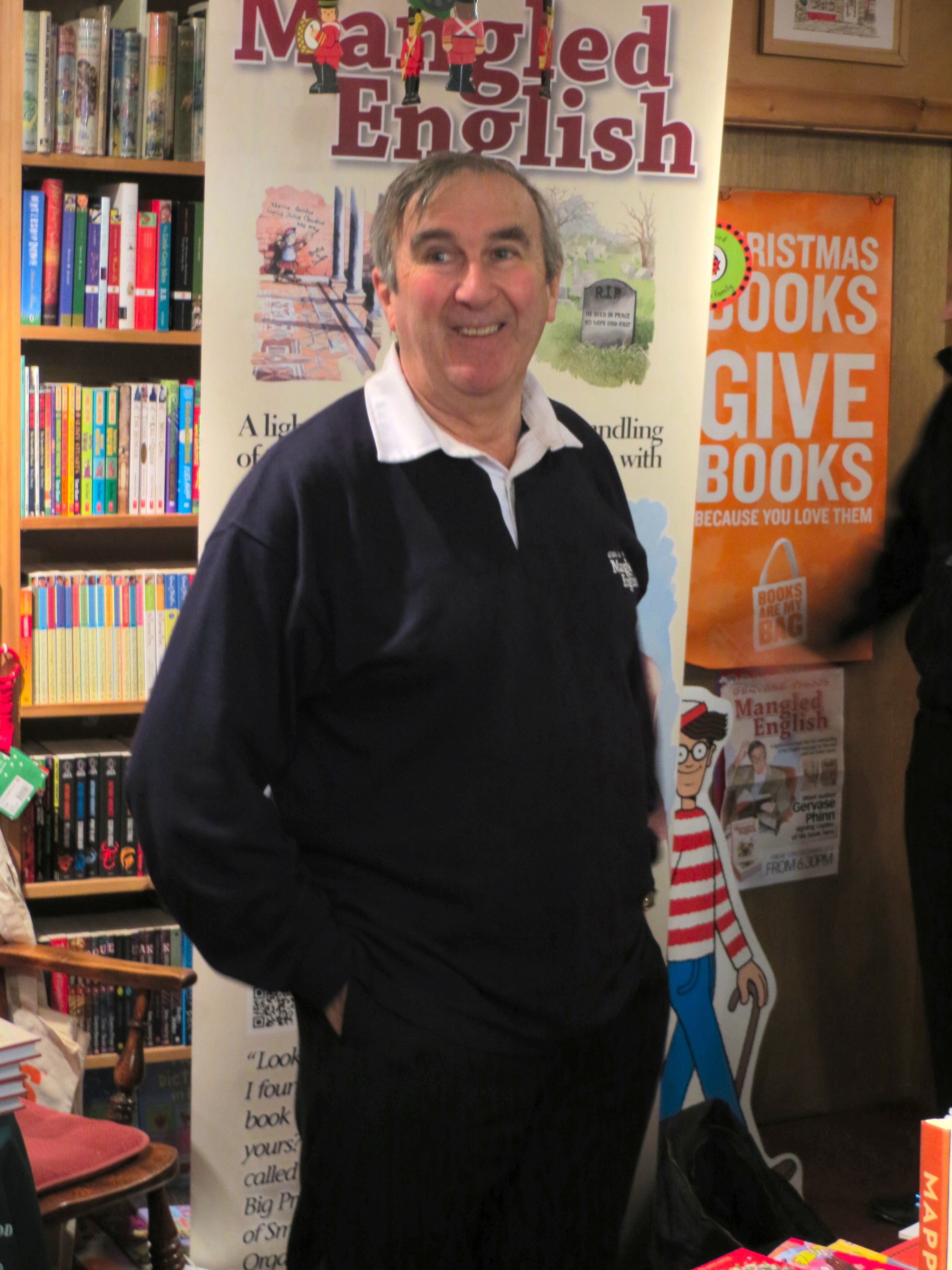
Gervase Phinn at Rickaro Books
Last Friday, I spent another fascinating evening at Rickaro Books. I’d been looking forward to it with great anticipation since the Ian McMillan / Tony Husband event that took place several weeks ago. This time, the author was Gervase Phinn. I hadn’t met him before – though my husband is very familiar with his books – and he did not disappoint. The event was extremely well attended: I calculate that at least forty people managed to squeeze into this distinguished but pocket-sized bookshop.
He focused upon his latest book, Mangled English, which delights in highlighting the way we all misuse the language (I certainly do!), and touched upon such matters as mis-spellings, Spoonerisms, Malapropisms and howlingly bad verse (guilty!). He also told many amusing anecdotes about people he’d met. He now spends some of his time as a performing artist on cruise ships, so the tales he had to tell were varied. However, the one that I liked best – although it was also one of the most poignant – was the one about the old people in a care home. One of them was actually his mother-in-law. She was obviously out of the conversation (he was very sensitive in the way that he talked about her dementia), but he derived real humour from recounting the reaction of the old man who was sitting next to her when he was asked his name. He wouldn’t give it and, when asked whether he had played any part in ‘the war’, would only reply ‘I might have done’. Getting no other response from him, Gervase turned to his mother-in-law and asked her name. While she was struggling to remember it, the old man suddenly burst out: “Don’t tell him, Pikey!”
In a more serious vein, Gervase extolled the virtues of encouraging children to read at a young age – as he had himself been encouraged as a boy – and deplored the government’s ever-changing education strategy. As a former inspector of schools, he is better qualified than most to do so. He took an especial interest in the children at the event.
It was a privilege to meet him and I had two opportunities to talk to him. However, the best part of the evening for me was actually being at Rickaro Books itself, looking at the excellent rare books collection that is on sale there and drinking mulled wine – it was the gateway to Christmas for me, in fact. The experience was made even better by being invited to join Richard and Carole Knowles, the proprietors of the bookshop, for dinner afterwards in their local Italian restaurant . As I’ve said in a previous post, Richard and I go back a long way, and it was very good to have the opportunity to listen once more to his (sometimes elliptical, always amusing) take on life, the universe and bookselling… and to get to know Carole a little better.
Watch this space: I’m sure that there will be more posts about Rickaro Books in the future. Should you ever be in Horbury, I wholeheartedly recommend that you take a detour (it won’t be much of one, as the bookshop is in the very heart of the town) to pay a visit.
I’m on the train! Again… :(
Once again I am on a train travelling south to London, and once again it is winter. I’ve made this journey many times since I last wrote about my fellow-travellers in January, but today it is quite cold outside and the people who have crowded on to this train are much more reminiscent of my January acquaintances than any I’ve encountered since.
Today, the people travelling in first class (it is very cheap on this service) are lively and cheerful. Most are talking to each other animatedly, so there is less scope for me to guess about their backgrounds or attribute murderous motives to them. Some are clearly business people, but many are going to London for a day out, to shop for Christmas. Several appear to be families engaged in both activities: the man (or woman) poring over spreadsheets or reports while other family members chat noisily over his or her head. One conspicuous difference at this time of year is that all the blocks of four seats around the large tables are taken. The ‘airliner’ seats for one, each with a smaller table, have mostly been shunned. I love the airliner seats, which are usually in heavy demand, but today I feel anti-social, sitting here in solitary splendour tapping away at my laptop.
The most extraordinary thing about these pre-Christmas travellers is that not one of them is glued to a mobile phone. There are no raised voices enunciating “I’m on the train”, intruding upon others’ thoughts with infuriating penetration; no ever-so-busy women spending the time from when they board the train at Doncaster to when they get off it at King’s Cross systematically calling everyone in their address book (it’s surprising how often my journeys have fallen victim to one of these); no raucous men calling their mates to reminisce about having had a few too many the night before.
The only thing that disappoints about this group – and the disappointment is a big one – is that not a single one of them seems to me to be likely murderer material. I realise that murderers come in all shapes and guises, but they have one thing in common: if they’re not being paid to kill, they exhibit some kind of negative excess. All are excessively desperate, or vengeful , or greedy, or deranged. It is hard to believe that any of these joyful, excited people now sharing the carriage with me harbours such qualities with sufficient intensity to be transformed to a killer.
So what shall I say about them? Guessing what they’d like for Christmas might be fun.
I’ll start with the easy ones. The two femmes d’un certain age sitting opposite me are both swathed in expensive scarves: one sports a bright red pashmina-style creation with tassels, the other a svelte black velvet cravat discreetly patterned in silver. If they buy presents for each other, I’m sure that it will be festive scarves again. Again? Well, the ones they’re wearing were probably last year’s reciprocated presents.
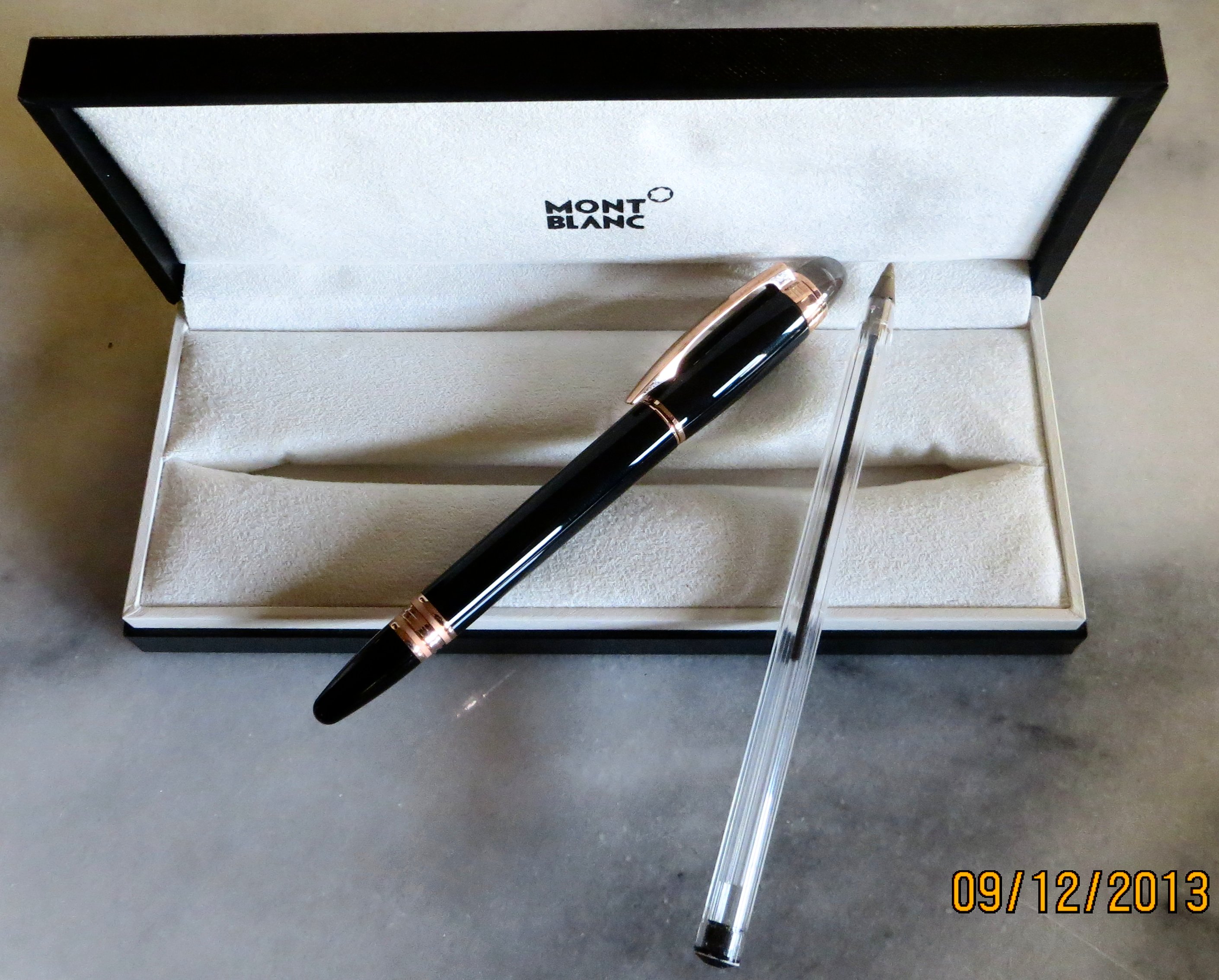
The man at the next table, still hunched over his report as his wife and two teenage daughters chatter and wave their arms, is making occasional notes with an ancient, chewed biro that looks as if it might have started life as a promotional gift from Kwik-Fit. If he really has to toil so hard for the whole journey (and is not just taking the soft option by ignoring his family), I feel that he deserves a decent pen. A Waterman, at least, if not a Mont Blanc. The two girls, both dressed in gauzy tops with lots of silver jewellery, huge eyes accentuated with expertly-applied make-up, are probably expecting to receive more of all of these things… and a lot more besides. The elder looks old enough to drive …. so Dad probably does need to keep on with the grafting. His wife, fingertips nail-barred to perfection, is sporadically reading on her Kindle between joining in the laughter and the chat. I doubt that Kindle vouchers will hack it for her, though. She, too, is wearing jewellery, much less than her daughters, but items of a different order from theirs: two sleek rings, one with a diamond embedded; a slender gold necklet; studs in her ears, which look suspiciously like diamonds. Her watch is probably gold, though mounted on a plain black leather strap. I’m sure she’d like an upgrade: a new gold watch for her, complete with a gold bracelet this time, please.
Time to hazard a guess at the tastes of the more inscrutable passengers now. The three companionable men sitting together: what would they like? They don’t look like football fans and, mercifully, aren’t discussing sport. One is reading the paper; one (I’m pleased to say, silently) listening to music; one sipping coffee and looking out of the window. No clues there. I could award them all new boxers and socks, but it wouldn’t be very enterprising of me. I think I’ll take a risk and give them all tickets for a murder mystery weekend. I know that Walton Hall, near Wakefield, has a couple coming up. I might even go to one of them myself. I may not be able to spot any latent murderers on this train, but there’s no harm in getting some of its occupants into the right frame of mind.
For me, as fascinating as crime and certainly great to read on dark winter evenings…

I’ve always thought it a great paradox that there’s no better way of relaxing than with a good crime novel. I don’t know why this should be; it is perhaps because reading about murder and mayhem, trickery and treachery helps you to appreciate the safety and security of your own world and to put all the people who’ve annoyed you during the course of the working day into perspective: a perspective reinforced also by all the ones who’ve been especially helpful or kind (as there are many more lovely people in the world than crime writers acknowledge).
I read voraciously all the time and I like to alternate reading fiction with non-fiction, sometimes having two novels and two non-fiction books simultaneously on the go. My preferred non-fiction subject categories are biography, memoirs, natural history, (more selectively) geography, particularly of Lincolnshire and Yorkshire, archaeology and history. Especially history. I love local history (again, particularly of ‘my’ two counties, as I’ve mentioned before), but I read history books about all periods and places, all of the time. Coming back to what is most relaxing, I think that nothing can beat history books about the high middle ages – perhaps because, just like crime novels, they tell of appalling acts that are remote enough to reassure the reader that he or she is unlikely to experience them first-hand, whilst offering the opportunity to drink up the excitement that they offer.
I’ve read many more books about the Wars of the Roses than any other mediaeval period, so in my most recent expedition to a bookshop (it was Waterstones in Leeds) I decided to buy Dan Jones’ The Plantagenets: the kings who made England. I have read accounts of individual reigns in the Plantagenet period, but until now I’ve had no broad overview of it. Jones’ book turned out to be the ideal choice for this purpose. He succeeds superbly well at explaining how each Plantagenet king built on the heritage of his predecessor to make England a strong, united country (they also enjoyed modest successes in Wales, made almost no headway in Scotland and none at all in Ireland) with well-defined laws. Despite the fact that, at the beginning of the Plantagenet period, in the mid-twelfth century, the English king and nobles also held vast swathes of land in France and by the end of it, two and a half centuries later, almost all of these had been lost, the Plantagenets also transformed England from being an impoverished country largely ignored by its European counterparts to a prosperous land and international force to be reckoned with, whether for peaceful trading or highly aggressive warfare.
As with all dynasties that span long periods of time, the Plantagenets had their failures as well as their successes. The greatest Plantagenet kings were Henry III and Edward III; the weakest were Edward II (who was spectacularly incompetent) and Richard II (who was less so, but like Edward II failed to understand the dangers of empowering his favourites). It was directly owing to Richard II’s shortcomings that the great Plantagenet dynasty fell. No less fascinating are the Plantagenet queens: they may have been consorts rather than rulers in their own right, but such royal wives as Eleanor of Aquitaine, Eleanor of Castile and Isabella of France were every bit as colourful, determined – and fierce – as their husbands; in each case, they were the de facto monarchs of England for significant periods of their husbands’ reigns; and in each case they defied their husbands at crucial junctures, often changing the course of history in the process: for example, Isabella of France was directly responsible for deposing the insipid and unkingly Edward II and placing Edward III on the throne instead. She and her lover Roger Mortimer then tried to manipulate the new king, a ploy that failed because Edward reasserted the power and pride of the Plantagenet line in all its pomp and glory. Mortimer was executed; but Isabella carried on enjoying full regal honours as the king’s esteemed mother. One queen for whom I did feel pity as I was reading was Berengaria of Navarre, Richard I’s plain and neglected wife. He seems to have married her simply because he was determined not to marry Alice of France, to whom he had been betrothed as a child but who had probably been seduced by his father, Henry II. They had no children: there is some evidence that Richard was a latent homosexual (though Jones does not subscribe to this theory).
I enjoyed this long book hugely. I have a few reservations about it: one is the portrayal of Richard I himself. Jones seems to have accepted the version of him traditionally peddled to primary school children, of a brave and warlike king who brought honour and renown on his country by fighting against Saladin in the crusades. Most works of scholarship now concur that it was irresponsible of Richard to abandon his country and run up huge debts, especially as he knew that his brother John would make a weak, self-interested king. Jones also uses certain phrases irritatingly frequently: the one that grated on me the most was ‘smacks of’, which he uses in the sense of ‘seems to be’. This is not how I would use this phrase myself, but, even if I agreed with Jones’ usage, I’d still like to see this figure of speech appear less frequently.
But these are minor quibbles. The dark, cold winter nights are upon us now. If you want to take a break from crime, but still want something thrilling to read that will absorb you totally in adventure and happenings stranger than fiction, this book is for you.
An evening in Leeds… full of atmosphere!

A smoke-scented, misty and magical Leeds Christkindlmarkt
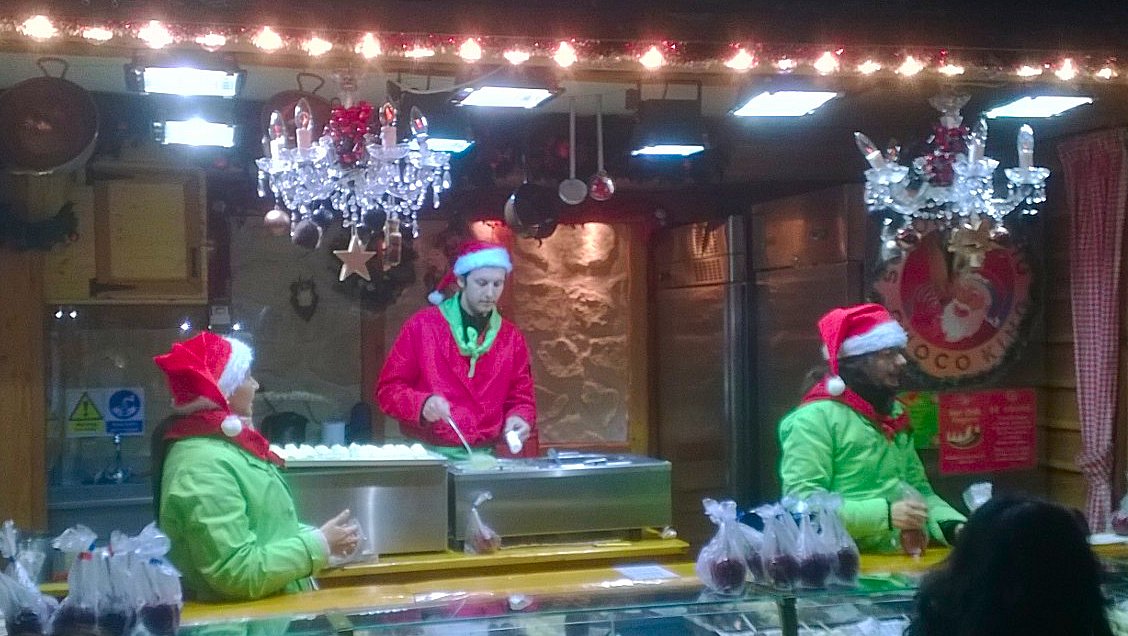
All things sweet on sale at Leeds Christkindlmarkt
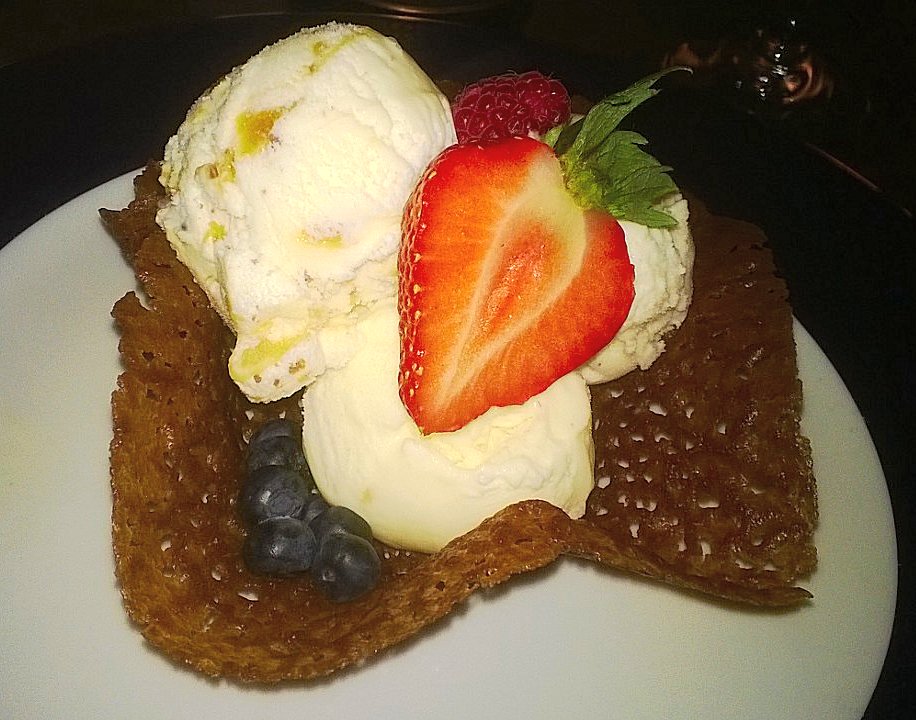
Ice cream brandy basket with berries, Brasserie Forty 4
The day job has encroached more than it should have done these past few weeks, as my lovely loyal regular readers will know. As a result, Christmas has been steadily creeping up, almost without my noticing, and certainly without my feeling at all ‘Christmassy’. However, this weekend my daughter-in-law came to stay and we decided to celebrate by visiting Brasserie Forty 4, otherwise known as 44 The Calls, in Leeds. (More about this shortly.) My daughter-in-law discovered that the German Christmas market in Leeds had opened last weekend. It’s been a regular Advent feature in Leeds for several years, but I hadn’t visited it since (I think) 2010. We decided to make a detour.
Leeds is one of my favourite cities and I’ve always loved Leeds crowds. They’re good-humoured, not pushy, and enter into the spirit of things. I was therefore delighted suddenly to find myself in the midst of one in the Christmas market and astounded at the number of people who were there. We had a very happy hour wandering around the stalls, watching people taking rides on the beautiful Victorian manège* or, if they felt more adventurous, on a sort of super-cakewalk that lifted them high in the air and juddered up and down before finally releasing them; as my husband remarked rather dourly, “I hope none of them has been drinking the beer.”
German Christmas markets are renowned for the beautiful artefacts that are sold at them – hand-carved Christmas tree decorations, wind-chimes made from naturally polished stones and all kinds of intricate small gifts fashioned from beeswax. But, more than anything, they are about the food. It is street food at its best: currywurst of improbable length unashamedly greedy, tea-breads, candy-floss, giant ginger biscuits (lebkuchen) proclaiming “ich liebe dich” in brightly-coloured icing-sugar and, of course, the drinks: Weissbier or fruit beers, gluhwein or coffee laced with liqueurs. One stall was selling gluhwein with amaretto, rum and cream: a heady drink, I’m certain, and probably one that would have a more significant effect on your head than intended, the following day.
As we were eating at Brasserie Forty 4, reluctantly we confined ourselves to a gluhwein each before going on our way. The restaurant , which has a Michelin star, is located in a wonderful old warehouse that was originally built to serve the Leeds – Liverpool canal. The area was developed in the eighteenth century. Later, The Calls became the city’s red light district. Today, the whole area has been redeveloped and is home to some very swish but tastefully-constructed flats, as well as being one of the centres of the city’s vibrant night life. The restaurant has been there since 1975 – well before the redevelopment took place – and has always had an excellent reputation. Its owner was responsible for creating the restaurant at Pool Court, another of Yorkshire’s famous restaurants. Dining there is a rare treat; in fact, I think yesterday was only my fourth occasion. (I remember the first one well: it was a launch lunch to celebrate the publication of Howard Jacobson’s first novel.)
So: Christmas is coming and it’s on my radar at last. If you happen to be in Leeds at some point during the next four weeks, I recommend a visit to the Christmas market and, if you have something special to celebrate, or just want to get into the mood for the festivities, you could top it with lunch or dinner at Brasserie Forty 4 (but book first!).
*carousel
Cut-throat Charlie? No, far more sophisticated than that!

This photograph is of my dentist, Charlie. He’s been my dentist for about five years; before that, it was a colleague of his, called Dave. If I had a picture of Dave to post as well, you’d see that he was quite unlike Charlie. In fact, Dave struck me as being an almost archetypal specimen of the genus dentist: he was slight, wiry, nervy, cerebral and doing his bit to save the earth (a vegetarian, his main mode of transport was by bicycle and he once sang in a choir with my husband).
Charlie, on the other hand, although I consider him to be exceptionally skilled and an ornament to his profession, is no-one’s idea of a dentist. If I’d been shown a photo of him before I met him and asked to guess what he did for a living, I might have said that he was probably a bookmaker; or an estate agent; or a very burly jockey; or a rather emaciated sumo wrestler. If he’d been an actor, he would have made an ideal Magwitch in a dramatised version of Great Expectations.
Charlie obviously enjoys life. His main mode of transport is a motorbike in the summer, a substantial car (forgive me, I’m no good at brands) in winter. For a dentist, he dresses unconventionally, in leather jackets, jeans and trainers.
As my readers know, I like to write occasional pieces about interesting people and I’ve always found Charlie interesting. He’s fascinating to talk to, and I enjoy listening to his take on life while he pokes and pummels at my teeth. When I visited him yesterday, therefore (in tandem with my husband – we try to make our visits to the dentist two for the price of one), I asked if I might take his photograph, and explained about the blog. I gave him one of my Christina James postcards so that he could look up its url.
To my surprise and delight, I struck gold! Charlie is an avid reader of crime novels and was only too happy to have his photo taken. Better than that, he offered me an idea for a plot for my next novel. Not only was it excellent, but it was also based on his own scientific expertise: he trained as a biochemist before becoming a dentist. I promised him that I would use the plot and he said that he had several more up his sleeve when I’d exploited that one. I shan’t forget. Future visits to this dentist will be looked forward to with great anticipation, rather than with dread!
By this time, my husband had taken my place in the chair, but, since Charlie and I were still deep in conversation, I didn’t return to the waiting-room. We started talking about trust in professionals and how people always expect professional men and women to have unimpeachable moral standards, which is why the exposure of serial murderers such as Harold Shipman and Beverley Allitt shocks us to the core. (The Hannibal Lecter novels are actually based on this norm.)
With his eye twinkling and with his customary geniality, Charlie announced that he’d once thought of how to commit the perfect murder. It would be based on his scientific knowledge and next to impossible to detect. (I won’t give away any more, as the plot that he offered me makes use of the same information.) By this time, I was completely rapt. My husband, however, was still lying prone in the surgery chair and showing some signs of nerves.
“Do you think we should change our dentist?” he asked, once we were back out in the street.
A flat cap is not just for t’ ‘ead, tha knows…

Nowt like a reet wild book signin’…
Ian McMillan, South Yorkshire’s own shrewd and very funny poet (the ‘bard of Barnsley’ and ‘poet in residence’ at Barnsley FC), gave a book launch and signing session at Rickaro Books in Horbury yesterday evening. It was an event that I’d been looking forward to for a long time, having heard Ian perform once before, at a school. He is a performance poet second to none.
I arrived early at the shop with my husband. Ian was already there, entertaining all the other early arrivals. Even Richard Knowles, the owner of Rickaro Books, seemed excited. Richard is professionally lugubrious: his catch-phrase when I worked with him a quarter of a century ago was ‘Life is Cricklewood, not Hollywood.’ Yet he’d invested in a big box of Cadbury’s Celebrations (only slightly dimming the gesture by explaining that they were left over from Trick or Treat night and also instructing his guests to take the Snickers chocolates first, as he doesn’t like them) and shared his special ‘bookseller’s provender’- malted milk chocolate biscuits – with Ian. He had even brought along his flat cap for the occasion.
At this point, I should perhaps explain that Ian’s new book, a collaboration with eminent cartoonist Tony Husband, is entitled 101 Uses for a Flat Cap. Published by Dalesman, whose account manager was also at the meeting – he’d kindly brought along copies of all Ian’s books – this latest offering from Ian and Tony does exactly what it says on the tin… er, sorry, book. It consists of 101 pieces about the trademark Yorkshire flat cap, inserted by its author into every possible historical and practical situation: ‘All made up! Every one of them!’ Ian kept on cheerfully insisting. He read several of these poems as well as, with passion, a more poignant extract from another recent title, The Tale of Walter the Pencil Man. Dedicated to his great uncle, Joseph Fletcher, who died at the Somme aged twenty-four, this is the reflective and touching tale of a Yorkshire pit village lad who tries with his pencil and paper to cope with what is happening around him as he fights on the First World War battlefields. It’s very topical, of course, and I’m sure will enjoy many sales this year and next, as we approach the centenary of the start of the Great War.
Tony Husband, Ian’s illustrator, accompanied him. It was a real thrill to meet him: he’s a very accomplished, not to say distinguished, artist, who draws for several famous publications, including Private Eye (Yobs), and has been Cartoonist of the Year several times. He told me that he and Ian Hislop arrived at the Eye at about the same time, twenty-five years ago (about the same time that Richard and I ceased to be colleagues!). Tony worked fast and incredibly hard all evening: he not only signed every book that was purchased, but drew a picture in it as well; he also drew a picture to accompany each of the poems, simultaneously with Ian’s recitation, and distributed them among members of the audience afterwards. The picture he gave to me, which I shall certainly have framed, illustrates the poem entitled ‘The Flat Cap Scene from King Lear (now lost)’. It’s my particular favourite, not least because it’s arch about Lincolnshire (my home county) and Norfolk (home of my publisher, Salt), though Ian did qualify his comments by saying that he loved South Lincolnshire and even recollected an event that he’d given at ‘one of the Gedneys’ – impressive, as the Gedneys are very small villages in the back of beyond.
Here’s a taster of the poem; the rest is hilarious, but you’ll need to buy the book to find out! (Plug, plug…)
Lear: Oh fool, what dost sport upon thy head?
It seems exceeding flat and dull, i’faith,
As Lincolnshire and Norfolk, two flat places in the East.
This occasion was everything that an event in a bookshop should be: convivial, hospitable (Richard’s wife Carole provided a delicious and warming mulled wine) and humorous, with a great deal of ad libbing from both Ian McMillan and Tony Husband, as well as from members of the audience. It was extremely well attended and I’m sure that, like us, everyone who was there went home happy and enriched by all the pleasures that it brought. Richard also used the occasion to promote BOOKS ARE MY BAG, an initiative that is close to my heart, as readers of this blog will know.
And there was no charge for attending: certain chain booksellers, please take note!
Very many thanks to Rickaro Books, Tony and Ian, for an evening to remember:

The fabulous Tony Husband, putting me in the picture…

Richard Knowles, of Rickaro Books, looking for the 102nd use of a flat cap…

Visual and verbal, speaking ‘louder than a gun’…

Tony Husband, finding himself in no-man’s-land…

The Flat Cap Scene from ‘King Lear’ (now lost)
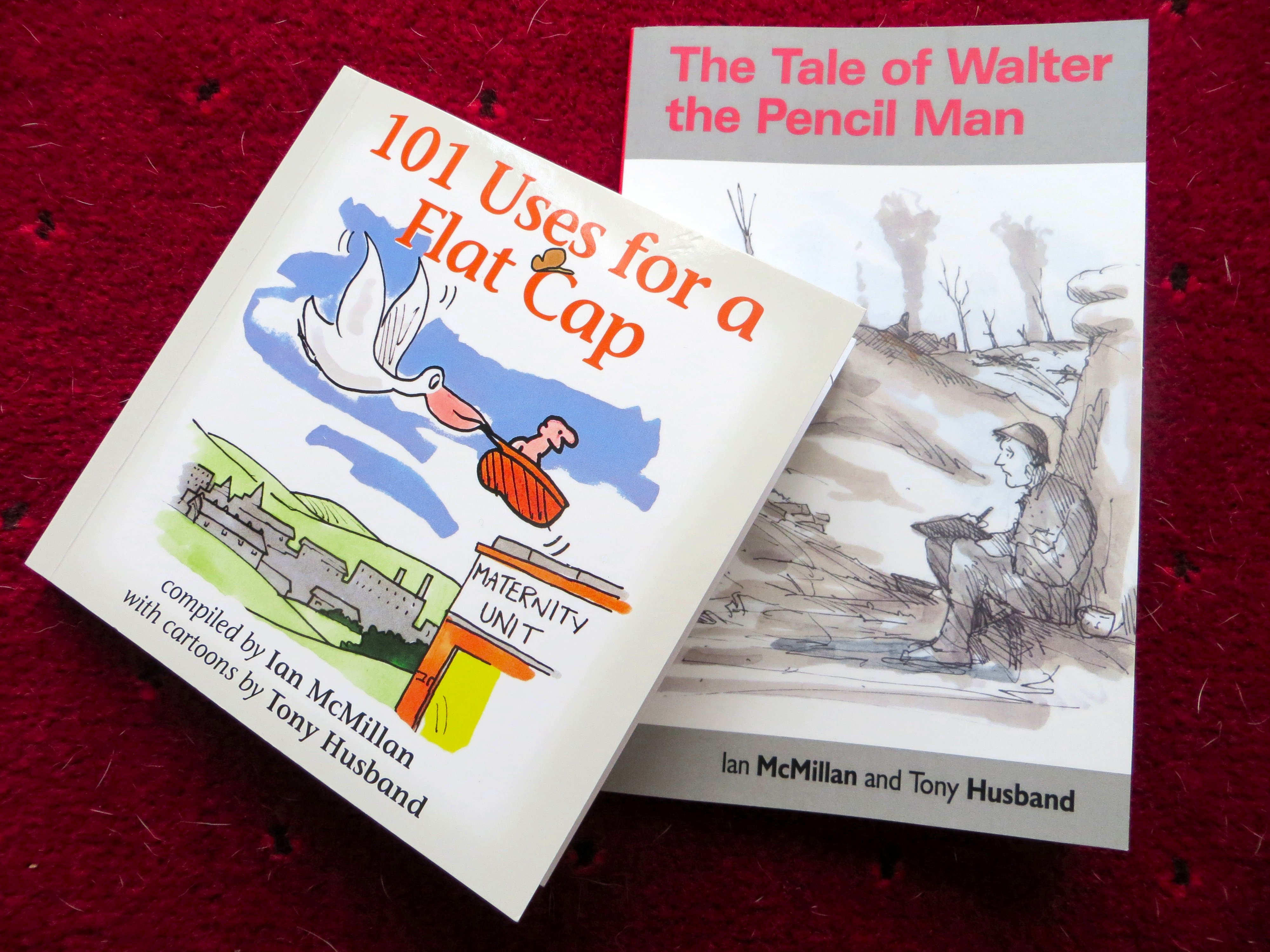
A couple of lovely collaborations, by a couple of lovely collaborators…

A precious signed first edition! Love you, Tony and Ian! 🙂
Perhaps sadly, Uggle wasn’t…

I’ve written several times about the importance of place in my novels and how much I admire writers who can evoke a specific place (whether real or fictional) and imbue it with its own particular character and atmosphere. Fictional places that I love include Margaret Mitchell’s Tara, Daphne du Maurier’s Manderley, Evelyn Waugh’s Brideshead and Gerald Durrell’s Corfu (the last perhaps not strictly speaking fictional, but still, I’m certain, an embroidered and selective portrayal of the island as it existed when he moved there with his family).
Towns, villages and hamlets in the area of South Lincolnshire where I grew up have some wonderful names: Spalding itself (named after a sixth century Anglian tribe called the Spaldingas), Whaplode, Quadring Eaudyke, Gosberton Risegate, and, perhaps the one I like best, Pode Hole (which, apparently, is Anglo-Saxon for ‘the place of the toad’). Today Pode Hole is a very small village, best known for the pumping station which was opened in 1965 and is already a Grade II listed building. It connects two waterways to Vernatt’s Drain, an astonishing feat of late seventeenth century engineering which began the long, slow process of draining the Fens. (I’ve read that Vernatt’s real name was Baron Philibert Vernatti, and that he was ‘an adventurer’. I’d certainly like to have met him!)
Place names in South Yorkshire are also evocative. There is Silkstone (which sounds beautiful, but was once quite a grim mining village); Hoylandswaine, which reads like the name of a bucolic lover but more prosaically means ‘a spur of land jutting out from a hill’; Durkar (which means ‘grit marsh’, but to me has always sounded Asian: a rather exotic cross between ‘durbar’ and ‘gurkha’) and Goldthorpe and Grimethorpe (the Danish ‘thorp’ referring to a small new settlement next to a larger village).
Many of these Yorkshire place-names are Norse or Danish in origin. There is an even greater concentration of such Scandinavian names on the East coast, particularly in the Scarborough – Robin Hood’s Bay area and its hinterland. My all-time favourite is Ugglebarnby.
As a family, we’ve passed through Ugglebarnby many times on our way to a day out at the coast. Knowing that ‘-by’ is the Norse suffix for ‘the place of’, we’ve always assumed that Ugglebarnby meant ‘the place of Uggle’s barn’. We’ve had fun speculating about Uggle: we’ve discussed how he probably came storming inland, straight off his dragon-prowed longboat, saw a likely-looking Saxon barn and laid claim to it and the adjoining village, thereafter fighting off all challengers and making it quite clear to whom the barn belonged by emphatically slapping his name on it. My husband and son, both tall and red-haired, and with ancestors in the female line whose surname was definitely of Norse origins, like to imagine themselves as modern incarnations of fierce manly Vikings – sailing the oceans, whirling sharp battleaxes and certainly getting their own way (the desire to do this is still a pronounced family trait) in claiming new territories. They’ve therefore always felt a strong affinity with Uggle. Perhaps because of my own Saxon origins, I’ve imagined him as quite a sinister character, probably reclusive, a hulking, brooding giant emerging like a Rottweiler from his homestead (plus barn) to defend it against all comers.
Today I’ve disappointed myself a little, therefore, by looking up Ugglebarnby in The Concise Oxford Dictionary of English Place-Names, only to discover that its meaning is ‘the owl at Bardi’s place’. Now Bardi might have been just as bloodthirsty and truculent as Uggle, but somehow I doubt it: he was obviously nice to owls, and whether or not he had a barn is not recorded. A bit of a let-down!
We could have looked up the name years ago – The Concise Oxford Dictionary of English Place-Names was left to my husband by his first boss, who died at some point in the 1980s – but I’m glad that we didn’t. If we had, all those fantastical conversations on the way to the coast would never have happened. But one crucial thing hasn’t changed: Ugglebarnby is still a peerless place-name!
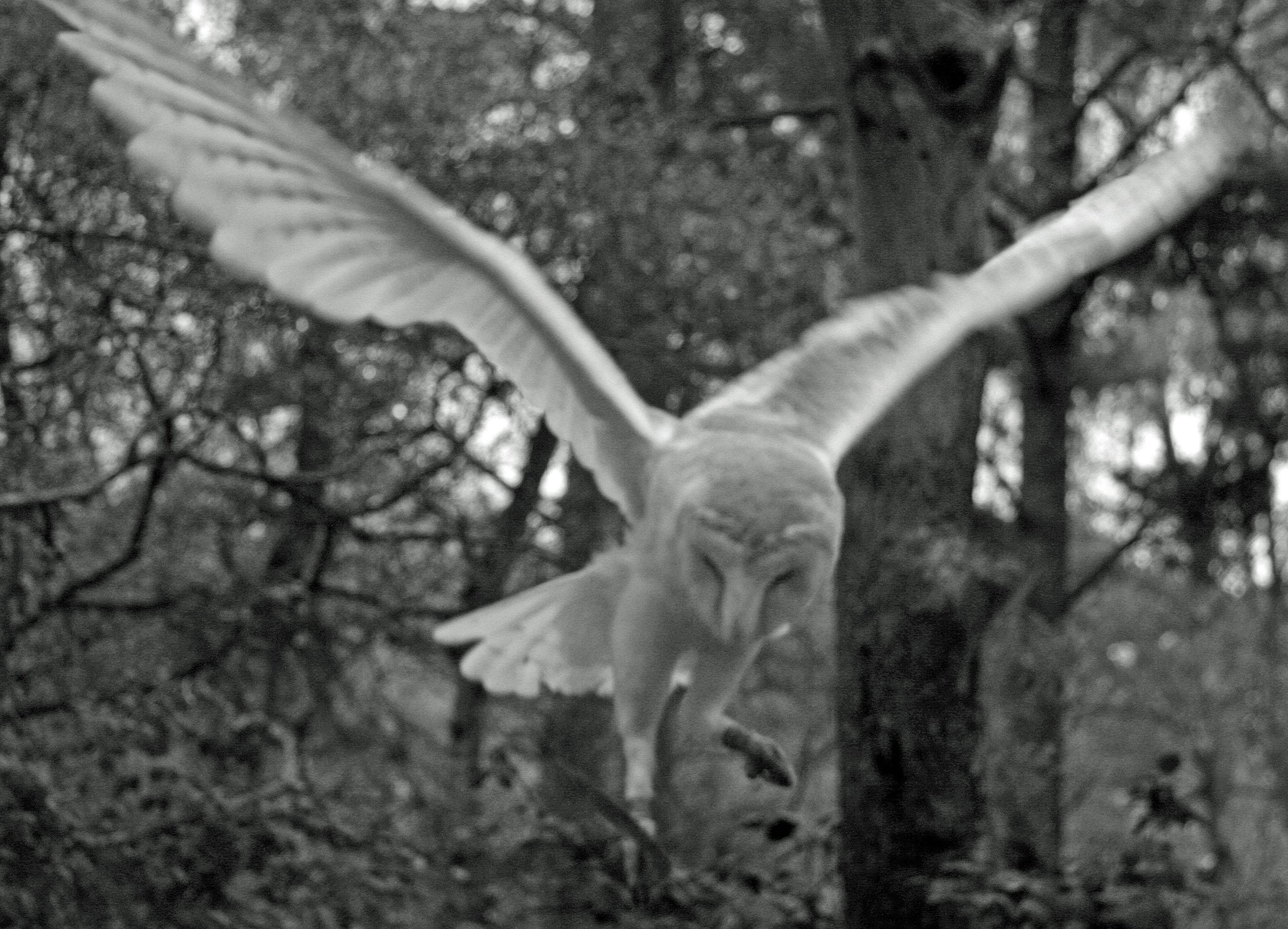
[Click on photographs to enlarge them.]
Perhaps you have your own favourite place names; if so, I should very much like to hear of them.
All text and photographs on this website © Christina James
Into Lincolnshire, for the Wolds Words Writers’ Workshop…

Louth Library, Lincolnshire
The writers’ workshop that my husband and I jointly led on Friday 18th October was part of the thirteenth Wolds Words Festival. It is a flourishing event that takes place annually in and around the pretty market town of Louth. The workshop was scheduled in the library, an impressively busy place in which the considerable bookstock was displayed most invitingly. The library staff were all great: extremely helpful, both to those attending the workshop and to their regular library users. It’s one of the most successful small libraries I’ve ever visited and clearly the librarians work hard to achieve this.
We said that we would work with up to twelve participants and the workshop quickly sold out (though not everyone actually made it on the day). We were asked to focus on two aspects of writing: crime and using local history in fiction. We heard that a workshop on plot construction that had taken place on the previous day had also been very successful.
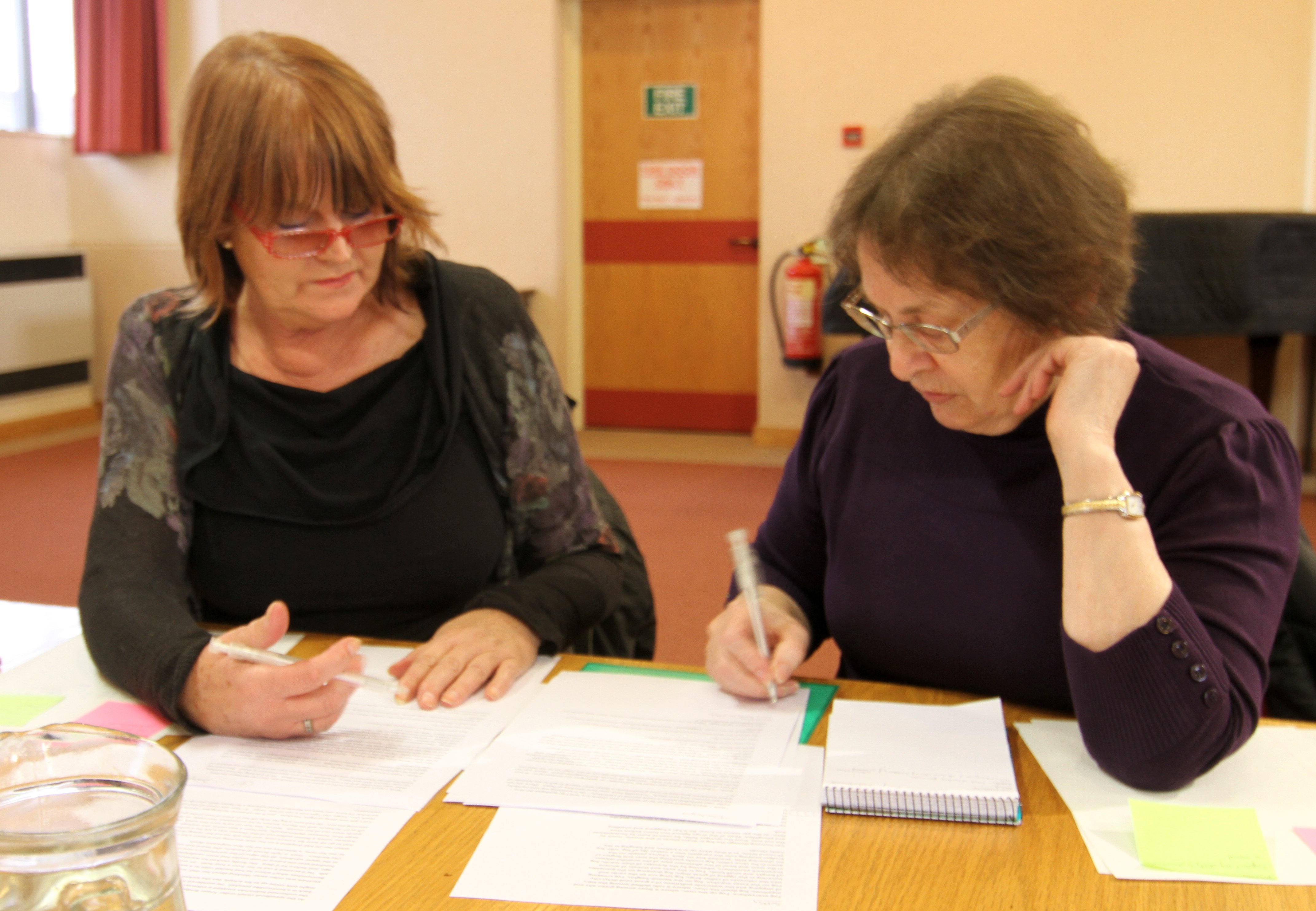
Wolds Writers’ Workshop
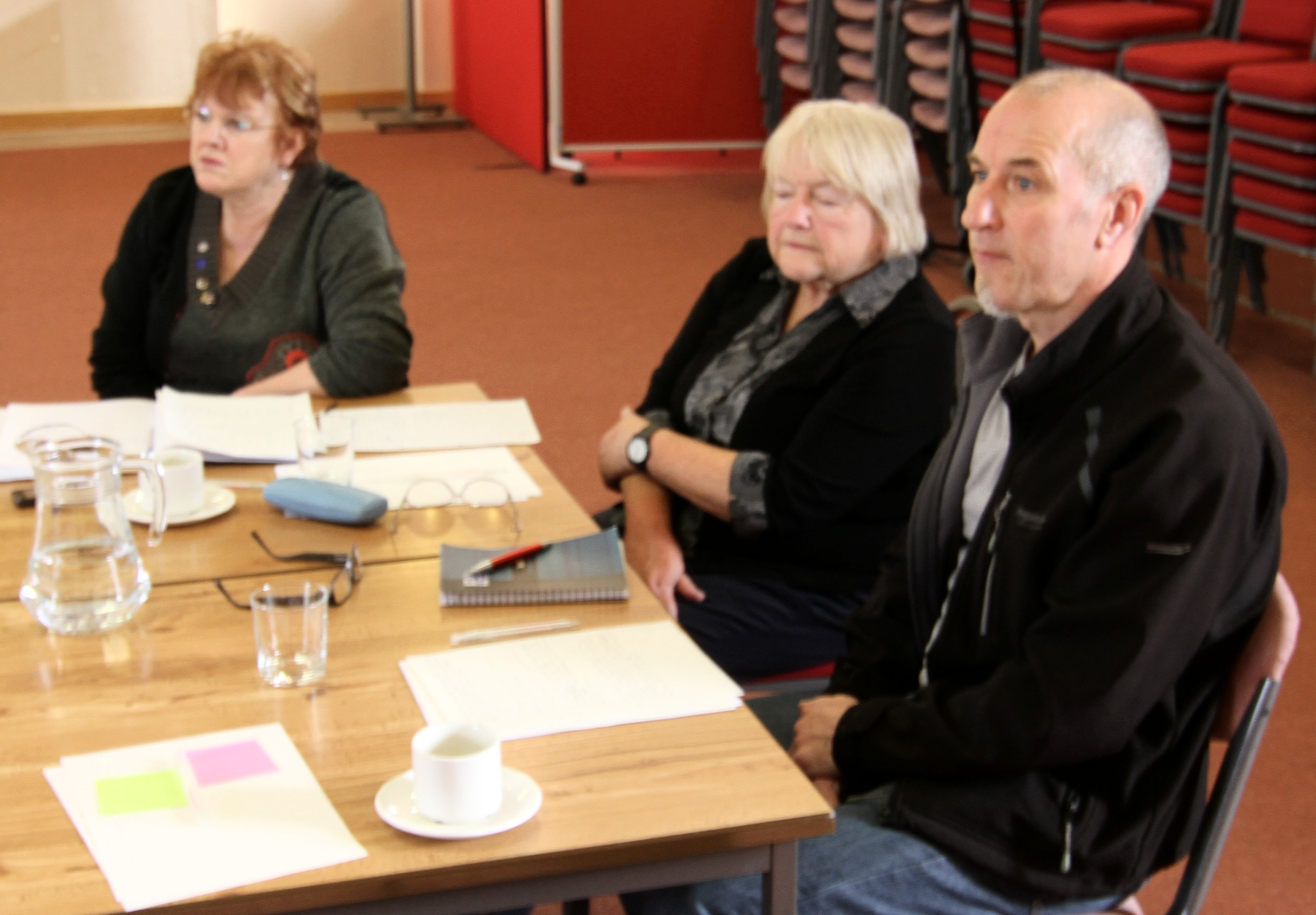
Wolds Writers’ Workshop
As a warming-up exercise, I gave the group some of my own tips on how to get published. As I’ve already offered some of these in this blog and shall be writing about others in more detail in future posts, I’m not covering them again here. Similarly, I’m not including my tips on how to incorporate local history into fiction here, saving them for a separate post.

Wolds Writers’ Workshop
We moved on to discussing why the participants had chosen the workshop and what they hoped to get out of it. Their answers were, perhaps not too surprisingly, very similar, and boiled down to a single joint ambition with three further ‘sub-wishes’. The over-arching goal of everyone present was to see their work published. One of the writers had already had poems published in anthologies; one had published a factual account of the sea some twenty years before and one had contributed short stories to an online magazine. None of the others had had work published. Two had written novels, but neither had been successful in finding a publisher.
The ‘sub-wishes’ were perhaps even more interesting: they each concerned confidence, or the lack of it. They included the expressed desire to write something that was worth reading ‘at all’; the fear that a certain flaw – in one case, an inability to write convincing dialogue – was an insurmountable stumbling-block; and the suspicion that the author’s take on life was too left-field ever to find a publisher. To these doubts, I replied that almost everyone can write something worth reading if they work at it hard enough; that ‘flaws’ can be overcome or minimised, again with hard work; and that many readers prefer a more unusual viewpoint to something more conventional, though I agreed that this may make it more difficult to attract a traditional publisher.

Wolds Writers’ Workshop
Next we read and explored four short passages from very different novels, each demonstrating some particular aspect of writing. We looked at the ‘fog’ passage from Bleak House as an example of creating atmosphere; Virginia Woolf’s description of the Ramsays’ holiday house in To the Lighthouse to establish a sense of place; a passage from Where the Devil Can’t Go, a novel by Anya Lipska, a talented new crime writer whom I’ve written about previously in the blog, that depicts her heroine’s character; and finally a piece of dialogue from my own novel, In the Family. We each took forty minutes to write a short passage following on from one of these, or alternatively any short fictional piece of our own choosing. The writings were shuffled and passed around until we had each read all of the passages; no-one knew who had written which. Each of us then told the others what we liked about the piece that we had in front of us at the end. We all found plenty to praise, which I think confirmed resoundingly that there is a writer in almost everyone. I should very much like to thank all the writers for their really enthusiastic and participative response to the occasion.

Wrights of Louth, Bookshop
Copies of my books were sold at the event by the local bookshop in Louth, which I also visited afterwards. One of its distinguishing features is that its sign hangs upside down! There is a story behind this: The shop used to be a general grocery store of the kind that I remember as a child, but which has completely disappeared now. Its owner, a man called Bill Platt, who ran it for many years from 1913 until he was in his seventies, was famed for his knowledge of local history as well as for the quality of his shop in Little Eastgate. He had business acumen, too. When the sign over his shop doorway blew down in a storm, it was affixed by accident the wrong way up; Bill recognised that it quickly became a talking point and therefore a good advert and simply left it like that. A local businessman, Mick Wright, who, with his wife Carol, turned the store into a newsagent’s and bookshop, has continued the tradition!

In conversation with bookshop owner Dean Wright
I had a long and pleasant conversation with Mick and his joint owner son Dean, and was extremely impressed by their can-do attitude towards running a bookshop in modern times. Their strategy is to diversify without abandoning the bookshop’s essential character and to provide exemplary service; they specialise in books about Lincolnshire. I purchased several by local authors, and was extremely grateful to be given a discount!
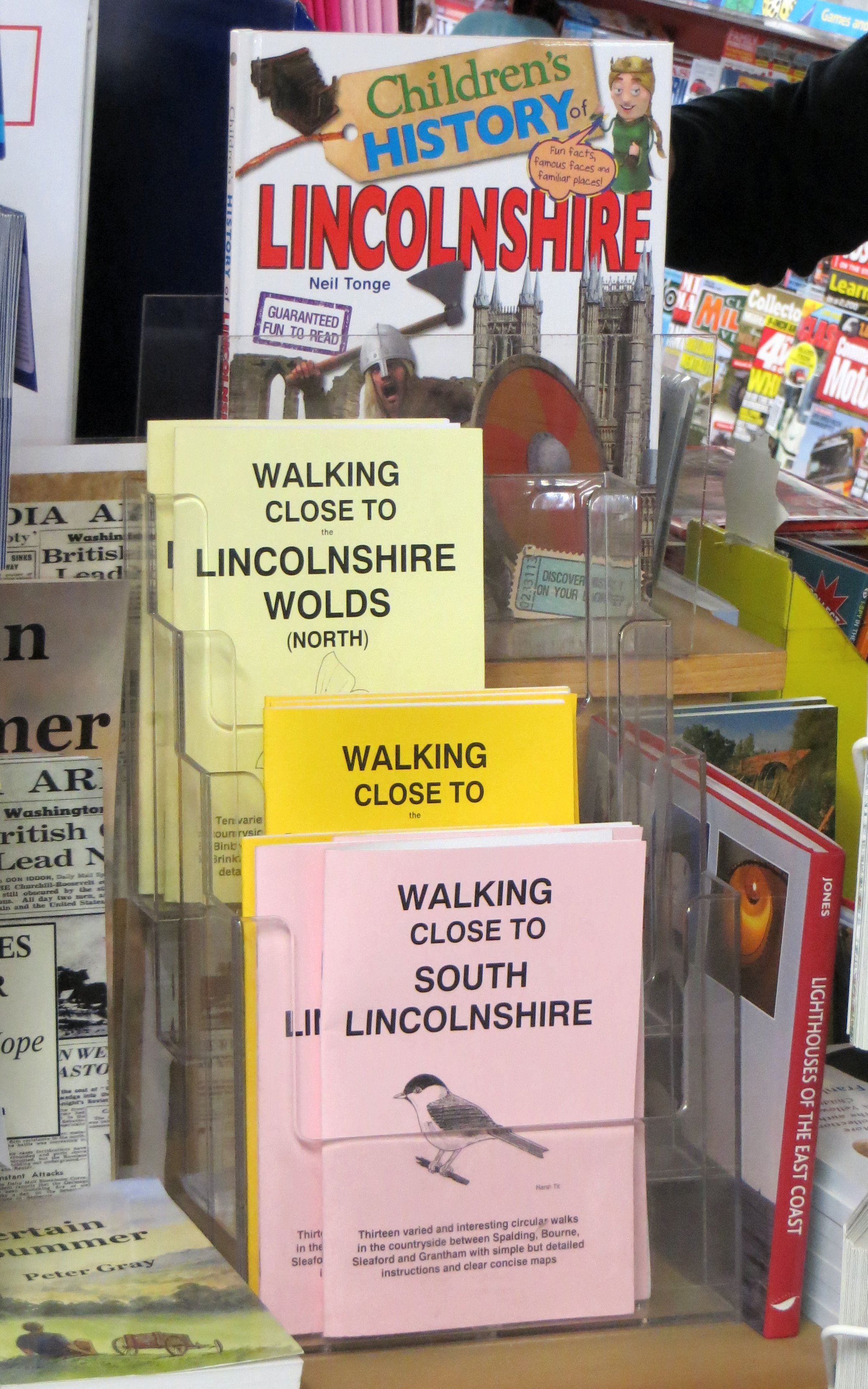
Speciality: Lincolnshire!
As you can see, I’ve included a few pictures of the event, the library and the bookshop. I’d never been to Louth before: it is quite a distance from Spalding. It is a lovely old market town; having now discovered it, I certainly plan to return. If you are ever in the area, it is well worth a visit – and don’t forget to take in the library and the bookshop while you’re there!
 Christina James, crime novelist