

A perspective of Priory LSST Academy, Lincoln: Supporting creative writing talent!

Low-rise school with covered ways, fountains and flowers
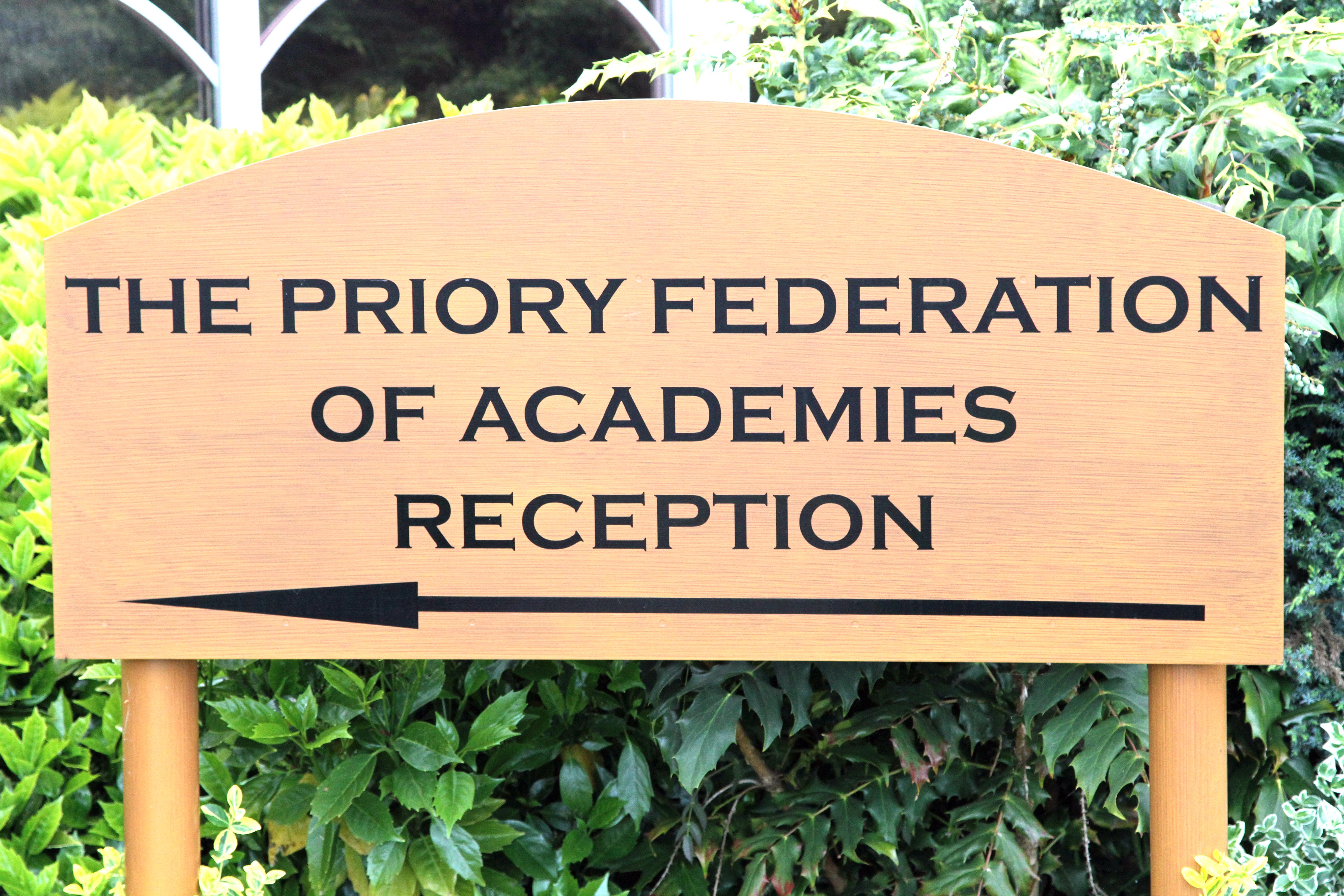
A warm reception at Priory LSST

Played into school!
I was extremely privileged last Wednesday to have been invited to join the first literary festival to be launched at the Priory LSST Academy in Lincoln. It was actually a festival within a festival, arranged by Mrs. Sarah Oliver, the energetic and enthusiastic writer-in-residence at the Academy, with the help of the very talented Sara Bullimore, who is one of the organisers of Lincoln Inspired, the city’s arts and literature festival. My contribution was to offer creative writing students feedback on the work they had submitted for a crime-writing competition, organise and take part in two writing workshops for younger students
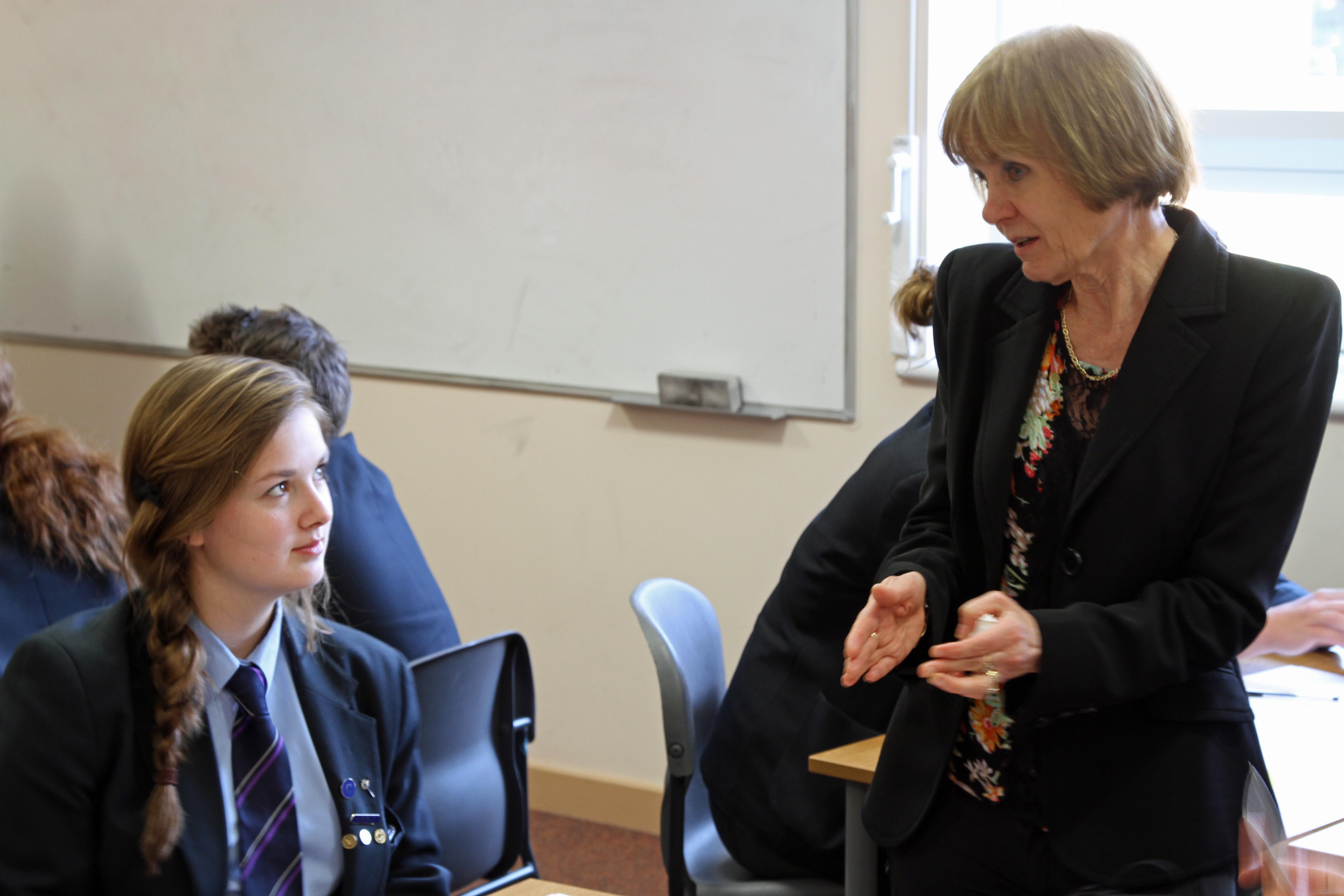
Year 10 crime writer workshop

Absolute concentration in the crime writer workshop
and deliver the festival keynote talk later in the afternoon. Members of the public were admitted to the latter.
Before I go on to describe the day in more detail, I’d just like to pause to say what an amazing place the Priory Academy is. One of the first academies to have been set up after the government announced its support for them, it is situated on a sprawling site with several buildings and many beautifully laid-out gardens, distinguished particularly by their modern sculptures and water features. Students move from one building to another via a series of covered walkways. The academy also has a planetarium, an Olympic-standard running track, an incredibly well-equipped gym and a swimming pool. Although it is a state school, it takes sixth-form boarders (they are usually either students from overseas or from armed services families). Those who attend it are greatly privileged and keenly aware of this. All of the students I met were impeccably polite; several of them told me how passionate they were about the Academy itself.
The sixth-form creative writing course was set up by Sarah Oliver at the beginning of the current academic year; it is voluntary and after school. Many more students wished to take the course than she could accommodate. Eventually fourteen were selected, of whom twelve entered the creative writing competition. They were asked to write the opening chapter of a crime novel (with a 500-word limit) and a synopsis of the whole novel (with a 300-word limit). This in itself was a pretty tall order, but they succeeded admirably. It is no exaggeration to say that I believe that every one of those students could go on to be a successful writer. The prize was for the student who wrote the winning entry to have his or her chapter published in the Lincolnshire Echo and the two runners-up to have theirs published in the online version of the same newspaper.
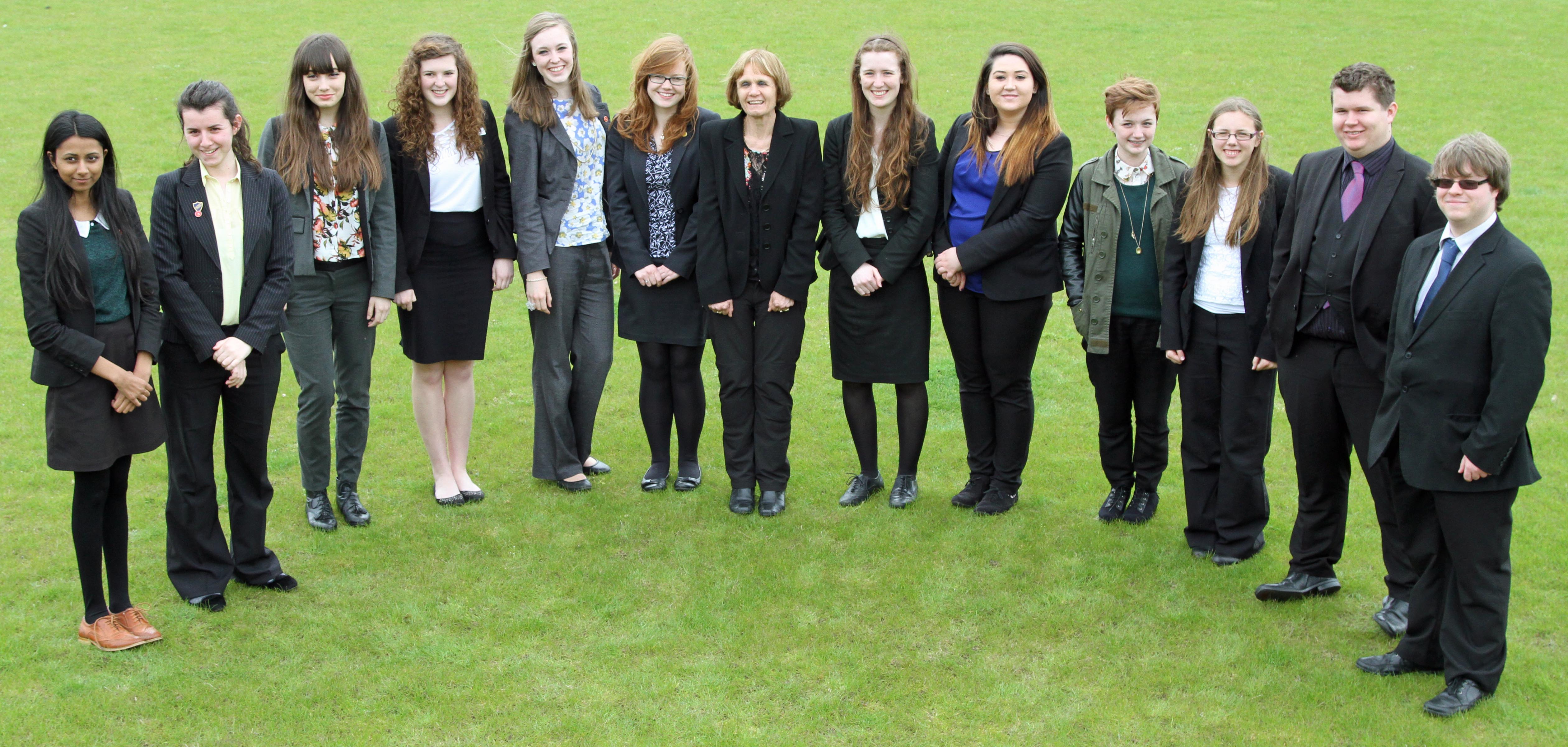
Priory creative writers
Choosing the winner was a daunting task. I asked my husband, who also acts as my copy-editor, to help. We decided to evaluate each entry on the following seven attributes: the opening sentence; consistency (did the chapter match the synopsis?); how compelling we found the writing; the quality of the plot; characterisation; the accuracy of the writing; the quality of the writing. It’s of course impossible for me to describe all of the entries in detail here, but to give my readers some idea of the quality of the entries, I’ve listed below a few of the opening sentences from the students’ submissions:
Bryant’s breath condensed in the plastic of his gas mask before fading away, only to be replaced every time he exhaled. It was stifling.
It’s the screech of the tyres that haunts, and the sickening crunch of metal splintering on bone.
Peer pressure. It was always peer pressure to blame when we got caught.
A myriad of birds shot out of the trees as loud sirens blazed past and a blur of blue lights blinded the night sky.
Sally heard the breathing in the darkness. The short gasps of air slowly faded into the inky night as she crouched, frozen, behind a wild hedge.
My job as judge was made more difficult because the opening chapter and synopses that we both considered to be the best ones were not written by the same person. Furthermore, there was a third entrant who, while she wrote neither the best chapter nor the best synopsis, had the best stab at both put together.
The rules of the competition organised by Sarah Oliver in conjunction with the Lincolnshire Echo were clear-cut. The best chapter was undoubtedly written by James, so we awarded the prize to him. Fatmira and Katie therefore became the runners-up.

With James, Fatmira and Katie, crime writer winners
The constraints of the competition were, however, considerable, and I knew that I wanted to see more of these students’ work. By great good fortune, Jean Roberts, Business Development Director at PrintOnDemandWorldWide, had very generously said that, if the winner wanted to complete his or her novel within a year of entering the competition, she would print ten copies of it free of charge and also put it into legal deposit, PODWW’s distributor channels and its own new online bookselling venture, The Great British Bookshop. I decided that James, Fatmira and Katie all deserved to be eligible for this new prize, so I have now set up a further contest for the three of them. If they can get their completed novels to me by the end of this year, I’ll choose the best of them and send it on to Jean. PrintOnDemandWorldWide also very generously gave all the students a Great British Bookshop notebook, pen and box of Union Jack sweets. Both the students and all those who attended the afternoon keynote also received PODWW’s pamphlet giving advice and writing tips to would-be authors.
I shall write more on this blog at intervals about James, Fatmira and Katie and the progress that they are making. I hope that you will join me in following their journey, perhaps also offering your own support and encouragement along the way. In the meantime, I’d like to celebrate the achievement of all the student writers at the Priory Academy. I’m certain that we shall be hearing more of at least some of them in years to come.
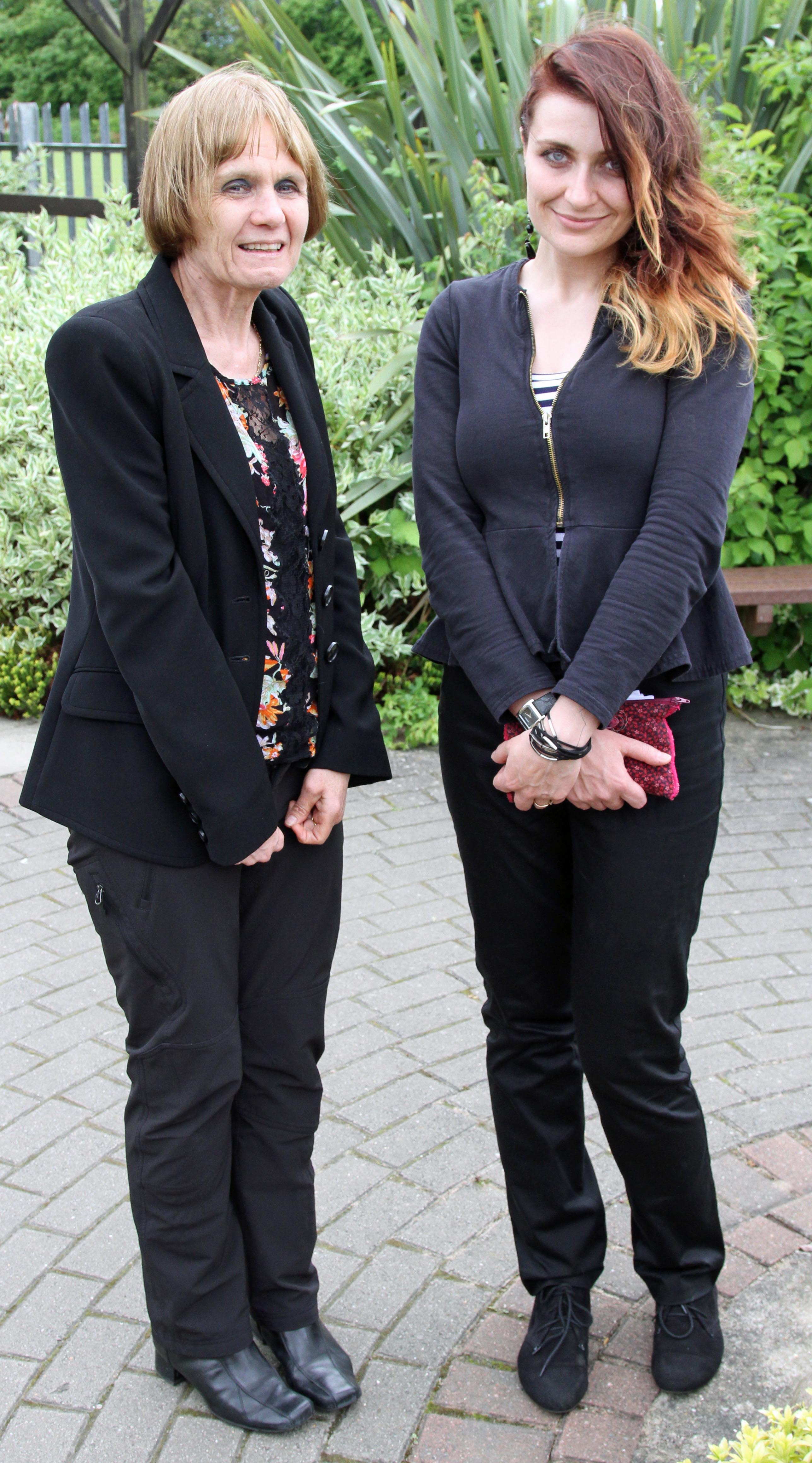
With Sarah Oliver, Priory’s writer in residence and literary festival organiser
Bank on books and invest in public libraries – do it, David!

I know that some of the readers of this blog have been following my contribution to the ‘Save Lincolnshire Libraries’ campaign. I thought, therefore, that you might also be interested in an article that appeared in The Times last Thursday, which says:
“Economists have calculated the monetary value of sporting and cultural activities and found that going to the library frequently was – in satisfaction terms – worth the same as a pay rise of £1,359.”
Playing team sports came close behind – but still it was behind – at a value of £1,127.
Now, I’m not naïve enough to expect anyone to swallow this without a little pinch of salt. How do you put a monetary value on any activity? It could be taken to extreme limits: for example, I could estimate that the monetary value of my husband is £5,000 per annum, but only if he does the hoovering. If he doesn’t do the hoovering, it drops to -£5; and either figure would have to be offset by the amount that he ratchets up on my credit card buying stuff for his greenhouse. I jest, of course, though some of the assumptions made by the research team at the London School of Economics strike me as equally far-fetched. The article continues: “The authors … speculated that … the sort of person who went to a gym was probably already tired of life and unhappy with their lot.” I have no idea how they arrived at this conclusion. Most of the people I know who attend gyms are irritatingly bouncy, dripping their endorphins and their self-righteous early morning starts all over everyone else. I’m quite grateful for this observation, nevertheless, as it obviously lets me off ever setting foot in a gym again for the rest of my life.
But let me get back to the point. If libraries are worth so much to the well-being of the individual, you’d think that, by now, the government – and especially David Cameron, with his slightly suspect ‘well-being index’ – would have latched on to this and decided that it was a bad idea to keep on closing libraries and cutting their services. Just think how they could keep inflation down if every time someone asked for a pay-rise, they could be told that £1,359 of it would be paid in library benefits! By the by, the Prime Minister has responded to the splendid petition and letter given to him by ‘Save Lincolnshire Libraries’ campaigner Julie Harrison by passing them on to the Department for Culture, Media and Sport, as being rather too hot to handle himself. He should realise just how much libraries mean to, especially rural, communities in the county of my birth and elsewhere and take a lead on this at least.
I know that the government is struggling to see the value of libraries in today’s society and that it can’t get away from the idea that they are ‘old hat’. In reply, I’d like to tell them to dust off their history books a little. Recently, I have been reading David Kynaston’s Austerity Britain. If you haven’t come across David Kynaston’s three books, which at present cover the years 1945 – 1959 (there are more in the pipeline), you should rush out and buy them immediately, because they are the most brilliant evocation of post-war society you are ever likely to come across. Austerity Britain chronicles the years 1945 – 1951 and, by chance also on Thursday, I reached the section on public libraries. Kynaston quotes some Mass Observation opinions on why public libraries were so little used in 1947 and why people preferred magazines:
–None of them subjects is interesting to me. All I like is gangster stories, though there’s precious much chance of reading here. Three rooms we got and three kids knocking around. No convenience, no water. I’m glad to get out of the house, I can tell you.
– Cos I ain’t got no interest in them [books] – they all apparently lead up to the same thing.
– I’m not very good at reading, I never was. I’ve never liked it some’ow.
– Too long. I have started books and I have to read through the first pages two or three times. I like to get stuck straight into a story – there’s too much preliminary, if you see what I mean.
You might have expected public libraries to be more appreciated at this time of austerity, when wages were low and almost everything was rationed. Apparently they weren’t. But ten years later, when the nation was back on the road to prosperity, public libraries were enjoying the start of their heyday. This lasted for at least three decades. When I started work as a young library supplier at the end of the 1970s, public libraries were still highly regarded and librarians enjoyed considerable prestige. They were also extremely well-supported by both local and national government.
Is there a moral here? I’d say that if the experience of the past can teach us anything, it is that people are more interested in culture, including cultural services, when their lives are financially stable. It makes sense, if you think about it, for people who are happy and settled in their jobs and home life to ‘make time’ to go to the library. It is also understandable if people who are unemployed and desperately looking for work don’t feel able to find space for using the free public library service. That is my take on it, anyway, and I think that the government should note the facts. If Mr Gove is as worried as he says he is about standards of literacy among the young, he should encourage his colleagues at the Culture Department to stick up for public libraries. There can be no cheaper or more effective way of encouraging high standards of literacy than to get children interested in books at an early age and to make as many books as they can read available to them, regardless of their social background.
When I was a child growing up in Spalding, the public library was on the ground floor of Ayscoughfee Hall. (It subsequently moved to a purpose-built building in Henrietta Street and it was while taking a gap year to work as an assistant at this library that my friend Mandy brought me the book about Jack the Ripper when I was working in the Chinese restaurant with the putatively murderous cook called Moon.) There were only a few shelves of children’s books, and I had exhausted these long before the end of my primary school years. The librarian there, a kindly lady, used her discretion and allowed me to join the adult section of the library, even though the rules stated that this was not possible for children under twelve. There exists a very stereotypical idea of librarians as mousy, unhumorous and devoted to regulations (especially ‘no talking’); I’m certain that this is unfair and that librarians like the one I knew in Spalding quietly go the extra mile all of the time in order to help people read and enjoy books. We should celebrate librarians as well as libraries: along with booksellers, they are the great unsung heroes and heroines of civilised society.
(But before I get too eulogistic, I’d like to add that I’m now planning a future blog-post called Librarians I Have Known. I won’t pre-empt it by offering more than a glimpse here, but, suffice it to say, it will include tales of red shoes, prostitutes, Spirella corsets and Sanderson sofas. I may just have been lucky, but many of the librarians I’ve encountered have been very far removed from the stereotype.)
The best of the London Book Fair 2014

LBF bag and mag
This year’s London Book Fair and the Digital Minds Conference that preceded it were characterised for me by two related issues that recurred time and again: the importance of preserving copyright and the need for publishers to experiment and be flexible about formats, business models and sustainable pricing. Associated with the latter, in particular, were several inspired talks and presentations that demonstrated the opportunities that can be harvested from adopting an intelligent approach towards print and electronic content and therefore finding ways to enable them to complement, rather than compete with, each other.
I was particularly impressed by Martha Lane Fox, the former Internet entrepreneur recently made Chancellor of the Open University, who gave the afternoon keynote talk at the Digital Minds Conference. She said that she was ‘crazy about the Web every single day because of the power it can bring to people’s lives,’ sometimes in very complex situations. She was referring particularly to countries where strict censorship is practised, or where women have not yet achieved equality of opportunity. She said that publishers should continue to fight for basic digital skills to be introduced across all communities. “The consumer has an incredible time of it right now. It is the duty of the publisher to help the consumer on his or her journey.”
Also fascinating was the panel session at the conference entitled Hybrid and Author Publishing, which was essentially about self-publishing. Orna Ross, of the Alliance of Independent Authors, was a particularly compelling speaker, because she has both published with an eminent publisher (Penguin) and published her own works, and she said that she infinitely preferred the latter experience. Her reason? She feels that self-publishing gives her greater freedom of expression and the ability to experiment: for example, this year she has set herself the task of publishing nine short books (one a month, with some break months). She said that she ‘absolutely didn’t want her first self-published book to be taken up by a traditional publisher.’ However, she acknowledged that her writing career had been supported by the initial successes that she had gained through traditional publishing. Hugh Howey, another author who took part in this session, said that audiobooks were under-valued by authors and highly sought after by the reading public. Having spotted this, he has ensured that all of his books are available in audio format and revealed that he ‘could live off his audio sales.’ Food for thought!
Another panel session was entitled Subscription Models: Pros and Cons. It discussed the relatively new trend of selling trade e-books via subscription models. Andrew Weinstein, of Scribd, said that it had been launched as a dedicated subscription service for consumers. Subscribers pay $1 per month and publishers are paid per download. Scribd works closely with HarperCollins, which has promoted its growth by making many HarperCollins backlist titles available in e-format. Nick Perrett of HarperCollins said that there is a rapid shift taking place in publishing from what was essentially a trade-focused structure to what is now becoming a consumer structure. The best outcome for the publisher is to have multiple points at which consumers can access content. After this, their core job is to maximise the royalties that go back to authors. Good analytics are therefore vital: one of the advantages that HarperCollins has gained from working with Scribd is that it obtains a rich data set which can be used to inform both marketing and publishing decisions. There is more about Scribd here.
Among the speakers at the digital seminars that take place throughout the Fair was Rebecca McNally, Publishing Director at Bloomsbury UK, who described the genesis of Bloomsbury Spark, a born-digital imprint for Young Adults. She said that Spark is a one-of-a-kind global imprint for Young Adult literature which publishes across all fiction genres. Bloomsbury has particularly focused on the YA market because it has a burgeoning online reading and writing community. It is also less susceptible to market variation across geographical regions than, for example, picture books. It has some powerful informal advocates among the blogging community and, as a result, is migrating to digital faster than any other fiction sector. Young Adult in digital format actually has a broader constituency than it has in print.
Authors benefit from Spark because Bloomsbury is able to offer a global publishing structure accompanied by local marketing support; it has a fair e-book deal that includes a print option; the translation rights are sold for p and e formats; the list is highly selective and distinguished. Bloomsbury carries out a massive cross-promotional campaign across the Spark publications; it encourages authors to send submissions direct to the Bloomsbury website, rather than operating through agents. Rebecca cautioned would-be Spark authors to remember the target reader (so far 180 submissions out of about 3,000 have been considered ‘too porny’) and to read the submission guidelines (she estimated that 30% of submissions had been disqualified because they weren’t followed). More information about Bloomsbury Spark can be found here.
Continuing with the copyright / flexibility in publishing themes, this year’s Charles Clark lecture was delivered by Shira Perlmutter, Acting Administrator for Policy and External Affairs at the United States Patent and Trademark Office [USPTO]. Her talk set out the differences between recent legislation on copyright in the USA and Europe and indicated the areas in which each could claim to be ahead of the other. She said that, given the shared interests and concerns of both communities, close transatlantic co-operation in the future would be vital. There were three main issues to consider: to ensure that the development of international markets be allowed to continue without jeopardising copyright; that specific legal rules, although they might have to be rigid, should be embedded where possible in a more flexible framework; that more legislation should be developed to set boundaries and limits, rather than addressing specific copyright infringement issues.
After several years at Earls Court, in 2015 the London Book Fair will move back to the Olympia conference centre, which has been refurbished in its absence. Those of us who remember many earlier book fairs are quite pleased about this, as, although Olympia is harder to reach than Earls Court, it seems like an old friend. I think that most of us are also hugely grateful that an earlier plan to give the Excel Conference Centre, in East London, another chance has been rejected. Those who attended LBF 2006 there have not forgotten the almost total lack of ladies’ toilets, the absolutely total lack of anywhere decent to eat, the stands labelled back-to-front as if we’d just walked through Alice’s looking-glass, the unfortunate proximity of London Junior Fashion Week (half-naked giggling teenagers wandering by accident amongst the books) and the nightmare of the first day, when we were riding round and round on the unmanned Docklands Light Railway with no clue about when to get off the train or where we were meant to be heading when we did! Whereas next year, if I can’t be bothered to wait for the spur railway to Olympia, at least I’ll know that if I turn left out of Kensington High Street station and keep walking, eventually I’ll arrive at the exhibition centre, where there will be toilets, civilised cafés, a proper floor plan and no accidental captives!
Under way and making way at Greenwich University…
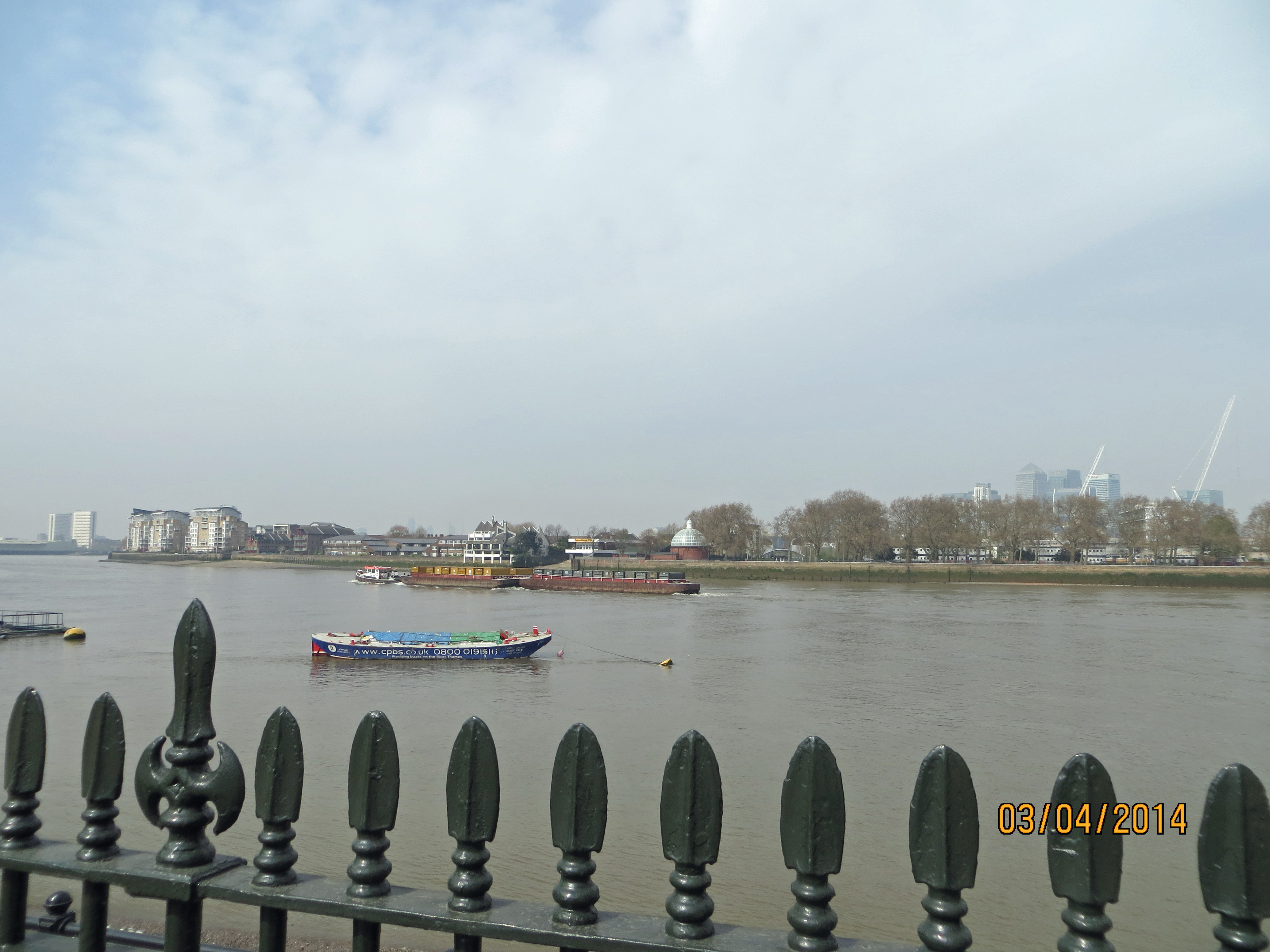
The Thames at Greenwich

Old Royal Naval College, Greenwich
Greenwich University is a vibrant place. It has long been the home of the Maritime College: there have been naval buildings there since Elizabethan times. Adjacent is Deptford, famous for its docks and as the place where Christopher Marlowe, allegedly a spy for the Elizabethan government, was murdered. Greenwich itself is the final resting place of the Cutty Sark. The university dates from the mid-nineteenth century, though some of the buildings are much older. It stands proudly against a steep curve of the Thames, alongside a stretch of the river that is uncompromisingly wide and majestic. This is frequented by both barges and pleasure boats, which reminded me a little of the river traffic in Shanghai.
The university is housed in a series of white stone buildings with evocative names such as Queen Anne Court, Queen Mary Court, King William Court and the Dreadnought Library. Much more recently, one of the buildings has been dedicated to the memory of Stephen Lawrence. There is a maritime museum, admission to which is free, and across the road another museum which is currently hosting an exhibition of J.M.W. Turner’s sea paintings. Unfortunately, I had no time to visit either of them, but I shall be returning later in the summer and plan to be much better-organised then.
I know from personal experience that, as well as being cosmopolitan, Greenwich students are extremely switched on, because for the last several years I have recruited student panels from among their ranks for some of the conferences and seminars that I have organised. Like students everywhere, they seem to prefer to wear a uniform. This spring, for the girls, it is cropped tops and pale (very short) denim shorts, these worn with thick tights and brightly-coloured canvas ankle boots, and, for the boys (many of whom sport Pete Doherty-style pork pie hats), skinny jeans with long plaid shirts.
Not to be confused with the ‘real’ students was the seemingly endless procession of secondary school parties that were doing a tour of the campus and its attractions. Each was (more or less) in the care of two or three harassed teachers, though the pupils were without exception doing their best to ignore the latter; they were slouching along at a snail’s pace, spread out across the pathways two or three abreast, just like the pupils I have seen dawdling to and from our local secondary school. The real-deal students, by contrast, were marching along rapidly and purposefully, busy, busy, busy, laughing and chatting, with too much to do but taking it all in their stride. A couple of years ago they were probably staunch members of the slow-stroll brigade. Is university really so effective at inspiring them to action, I wonder, or are those having to endure the ignominy of supervision just trying to drive their teachers berserk by taking the longest possible time to trail from A to B?
Despite the somewhat alarmist weather reports about the ‘Stage 10’ smog in London which I heard being discussed on the Tube and elsewhere during my journey, it was a beautiful, clear, sunny spring day in Greenwich and at least five degrees warmer than the dank and misty Yorkshire that I’d left at 7 a.m. Spring may be coming slowly, if surely, to the North, but I can bear witness that in London and environs it is now full-on.
My meeting about the journal slid by all too quickly, three hours gone in an Augenblick. I’d hoped to have time for at least a quick peek at the Cutty Sark before I left, but my watch told me that I had less than an hour to get back to King’s Cross if I were not to endure the combined wrath and triumph of the ticket collector as he rejected my fixed-time ticket and forced me to buy another. I’ll therefore have to save that pleasure for next time, too.
However, as I was waiting at the traffic lights in one of the busy main streets that threads through the old town of Greenwich, I happened to look back and see the masts of this historic ship rising surreally above the buildings and a row of buses, as if it had just joined the queue of local available public transport. I took a quick snap before I hurried on.

Cutty Sark
Surprises come in threes at Oadby Library!

During the latter part of last Thursday afternoon, after a sun-splashed if chilly week, the heavens opened and the rain came bouncing down. The gate that leads into our garden was sodden in no time. The M1, which we had just joined to begin our journey to the event at Oadby Library, quickly became waterlogged: there were treacherous sheets of water to negotiate as the traffic on the approaches to the various cities that we passed built up towards rush hour. By the time that we reached the Leicester ring-road, we’d encountered virtual gridlock. Irate drivers were crawling along for a few yards at five mph before juddering once again to a standstill, their progress and tempers not helped by the rain, Leicester’s amazingly laid-back traffic lights system and the fact that in several places on the dual carriageway two lanes merge into one (every driver being reluctant to yield to another).
This was not an auspicious start to an event that had been planned months in advance and strenuously published, by Chris and Jen at Salt Publishing, by myself and by various other kind tweeters along the way. I had known not to expect too much, as the library had already warned me that only three tickets had been sold – and indeed would have ‘pulled’ the event had I not insisted that I should be happy to speak even if only one person turned up to hear me.
I arrived precisely on time, at 6.30 p.m., later than intended, and my audience – consisting indeed of just three people – had all got there before me. I barely had time to notice that Oadby has a lovely library before I hastened into the ante-room where they had assembled, together with the librarian, Anne Sharpe. However, by this time I had already experienced the first of several wonderful surprises. The first person that I met after Anne was Rosalind Adam. We are mutual bloggers and Twitter friends – I’ve been enjoying Rosalind’s blog for some time, though we had not met before. It was a delight to be able to talk to Rosalind in the flesh. We each agreed that the other was exactly what we had expected – and that this was not always the case when meeting someone previously encountered only through the ether. At the moment, I’m particularly excited about a book for children on Richard III that Ros has just finished writing and hope to be able to review it on this blog in due course.
I was a bit slow on the uptake at registering the second surprise. I’ll have to excuse myself by offering the explanation that I was busy sorting out my books and papers for the readings. I’m also quite short-sighted, but I prefer to wear my spectacles only when I’m driving. Anyway, the event was about to start when I looked up and recognised that the only male member of the audience was Colin Marshall, for many years the manager of the campus bookshop at Leicester University and still employed by the university today, although he has now ascended to a higher plane and is in charge of all the retail operations on the campus there. Colin’s presence introduced one of those occasions when my life as a novelist collides with the day job – and this time it was the most enjoyable collision imaginable. Colin has for several decades attended the conference for which I have organised for some fourteen years the speaker programme. He was also awarded the Booksellers Association’s Lifetime Achievement Award in 2013. His presence at the event was not entirely a coincidence, as he had been kindly told about it by Professor Christine Fyfe, the Pro-Vice-Chancellor in charge of Teaching and Learning – and the Library – at Leicester University, whom we both know. However, there was also a real coincidence at work: Colin and his wife Sandra live in Oadby and she had quite separately seen the event advertised by the library and decided that she would like to attend. Having the opportunity to meet Sandra was the third lovely surprise of the evening: she’s funny, sensitive, extremely well-read, loves dogs and cats (she told me that she and Colin have managed to organise their lives with such symmetry that they have four children, three dogs and two cats), is a great companion and raconteur and furthermore is living proof that Colin is a dark horse!
Ros, Colin, Sandra and Anne therefore constituted my audience at Oadby. It was the smallest audience I’ve ever had. I’ve attended other writers’ events that have managed to attract only small audiences and I’ve found that they divide into two categories: small and dismal, and small and select. I’d like to state unequivocally that, thanks to Ros, Colin, Sandra and Anne, this event was of the latter type. It began quite formally with a reading from In the Family and a Q & A session, but before long had turned into a lively debate about writing, literature, other crime writers and future events at Oadby Library. We overshot the allotted time by half an hour, so that I had barely time to conclude with my ‘world première’ reading of the first chapter of Sausage Hall, third title in the DI Yates series, which I’m grateful to be able to say was very well-received.
At the end of the evening, we took a quick look round the library and had our photograph taken there. Ros had to leave at this point: she has kindly already written about the evening on her blog. We said goodbye to Anne, our charming and extremely well-read hostess, and retired to the car park to release our dog, who had accompanied us for the ride. Then Sandra, Colin, my husband, the dog and I adjourned to the pub down the road (The Fox) to continue the conversation. Eventually, Sandra and Colin went home and we headed back North through the rain-sodden night.
There are some evenings, unfortunately all too rare, when, as a writer, you really feel that you are making progress in the most worthwhile of ways, by talking to a group of sympathetic and interested readers. (The size of the group is immaterial.) For me, the event at Oadby Library was such an occasion. Anne said that she would invite me back again later in the year. I’m looking forward to it already. I’d like to thank her for her wonderful hospitality, and to thank Ros, Sandra and Colin for braving the elements to visit the library last Thursday and for contributing to the marvellous conversation that took place there.
Copyright and Clark

I’ve just written a review of Clark’s Publishing Agreements: A Book of Precedents (Ninth Edition). It’s been published by Bloomsbury and costs £130 (you get a CD for this as well). I’m not expecting many of my readers to be interested in buying it, but, in case you are, you can obtain a 35% discount off the cover price if you’re attending the London Book Fair. The ISBN is 978 1 78043 220 5.
The General Editor is Lynette Owen, a colleague and acquaintance whom I admire greatly. She picked up the baton when Charles Clark, the doyen of copyright law in publishing, died in 2006. I never met him, but I’ve met people who did and I’ve also seen photos of him. I picture him as a sort of Rumpole character, a larger-than-life man of what used to be called ‘breeding’ and great intellect, who was both as sharp as a tack and tenacious as a street Arab when it came to defending authors’ and publishers’ right to get paid for their labours.
In fact, although copyright has always needed to be defended, Charles Clark died before the real squeeze began. Beginning with the Digital Economy Act (2010), which was closely followed by the Hargreaves Report (2011), Richard Hooper’s work on the Copyright Hub (2012) and the Finch Report on Open Access (also 2012), UK copyright law has come under strenuous attack from a government that seems neither to appreciate that the intellectual property of writers and their publishers needs to be protected as much by law as, say, design patents protect pioneering engineers, nor fully to realise just how much of the national income is generated by a flourishing publishing industry. That industry has, of course, responded with vigour, but in clear-headed fashion. It is to the credit of both publishers and authors that, on the whole, they have not lost their cool over this. Instead, they have worked hard together – along with various trade organisations and lawyers – to modify copyright law so that it is accepted as fit for purpose in a digital age without allowing it to be dismantled to the extent that large-scale publishing becomes unsustainable. (I’m not talking about self-publishing here: it has its own micro-economy that is distinctly related to the efforts of the individual author. But self-publishing is not viable for many types of book, including multi-author works and the numerous academic or non-fiction works that need high levels of pre-publication investment.) Richard Hooper’s collaborative work demonstrates this patient, reasoned approach at its best.
The backbone of the 9th edition of Clark consists of a series of ‘model’ contracts pertaining to most of the different types of publishing situation – print and digital, individual and collective, direct and through third parties – for publishers and authors to consult. Most of them can be amended according to individual needs and circumstances. The ‘precedents’ therefore collectively represent an up-to-date compendium of best practice in publishing which takes into account all of the recent legislation and the industry’s informed responses to it.
The book offers much more than that, however. The prefaces to the precedents, the introduction and the nine extensive appendices together explain the context in which the precedents have been set – i.e., the complex world in which writers and publishers have to operate today. I found Appendix G, which explains exactly what an author’s ‘moral rights’ are, particularly fascinating. I’d go further, and say that this book has yet more significance: for the collected precedents, commentaries and articles which it contains together demonstrate why copyright is valuable and why everyone who is active in the creative industries should fight to keep it.
Each year since his death, Charles Clark’s family has sponsored the Charles Clark Memorial Lecture. It always addresses some aspect of copyright and I always try to attend. The lecture is organised by the Publishers Licensing Society [PLS] and delivered at the London Book Fair. Two years ago, the guest speaker was Maria Martin-Prat, Head of the Copyright Unit at the European Commission Internal Market Directorate General. Her speech was eloquent and well-reasoned. She said many things that resonated with her audience – and undeniably, since it largely comprised publishers and authors, she was preaching to the converted. However, just one point that she made, towards the end of her presentation, has really stuck in my mind. Speaking of Open Access, she said that she could understand why the talented and ambitious young people currently studying at universities or working for professional qualifications appreciated being able to obtain yet more and more content free of charge and were therefore vociferous supporters of the ‘free at the point of access’ principle on which Open Access is based; but, in a few years’ time, a considerable proportion of those same young people will have themselves become authors. If they fail to understand copyright now, and therefore do not help to protect it, they will discover, too late, that they can demand no financial reward for their work nor claim any right to its ownership. Maria Martin-Prat’s message to her audience was that, if all types of writing are to continue to flourish and to delight, there can be no more important task that demonstrating to the young that copyright is precious and should be treasured. It is a point that I make as often as I can when I am speaking to young audiences.
I can’t conclude without congratulating Lynette Owen on her flawless work as editor. I’m sure that Charles Clark is resting in peace, knowing that his work continues to live on under her capable tutelage.
The writer and her blog: Dr Lucy Robinson

Dr Lucy Robinson, from the University of Sussex website
I’ve been in Brighton for most of this week, attending the academic bookselling and publishing conference for which I’ve been organising the speaker programme for the past fourteen years. I shall eventually write about the whole of this conference, but in a different forum and for a different audience: I don’t think that a detailed account of the present hot topics in academic publishing would greatly appeal to most of the readers of this blog! However, I do think – and hope – that you’ll be interested in the following account of the comments made by Dr Lucy Robinson, lecturer in Modern History at the University of Sussex and published historian, during a fascinating panel session for authors that took place on the first day of the conference.
Lucy said that there was sometimes a tension between writing her blog and writing her book (she has already published a book with Manchester University Press and is currently working on another). Sometimes, she almost feels that there is a competition going on between them and wonders which is the right way to go: should she focus more on the book or concentrate on the blog? But she also said that a smart author could create a ‘virtuous circle’ in which the blog could feed creatively into the book.
She said that she disseminates her research via a number of social networks, but at the same time wants to publish her history of the 1980s in a conventional publishing format. She explained that the challenges facing a contemporary historian are different from those that a historian of, say, the early modern period has to address. For the latter, the main difficulty lies in getting his or her hands on the small amount of material that now survives. Lucy’s challenge is that her material is ‘everywhere’ and that it is important to tell a version of everyone’s story, down to, for example, the cakes that people in the ’80s made or ate. The format that she uses is therefore to a large extent the product of the particular time that she writes about. To organise the material in a conventional book with the same effectiveness that the digital format allows is difficult. Nevertheless, she wants to see her work in both formats.
One of her reasons for this is that, although she values the internet as a medium, she also loves books. Another is that, for an academic, getting a book published by a recognised publisher is an ‘esteem marker’. Academic careers depend upon producing ‘globally significant research in academic form.’ The object is to influence others – fellow academics, researchers, students – to do or think something differently as a result of the research. This goal of impact cannot be achieved unless the research has been published in a traditional, authenticated format. This does not mean that she does not value the blog, however. She said that “the blog helps you to keep up-to-date. It allows you to change your mind. It is little. It is safe. I can best describe it as a way of being ecological with your work: then you can write it up in your book afterwards to give the work authority.”
She added that writers are now on a journey and it is a tricky one. Social networking enables a sort of autobiographical build-up of identity. Parallel to this is the other persona of the academic writing the book, ‘saying clever stuff and selling it to people.’ She repeated that there is a tension there. One of the audience asked her why the print output of her work was so important to her. She replied that she simply wanted to write a book called ‘The History of the 1980s’.
I found this really interesting, because I think that fiction writers often experience the same kind of dichotomy. We, too, value both formats; most of us also seek validation via the printed word. We understand the value of reaching our readers online, via social networking and blogs, and we don’t begrudge the time and effort spent producing work for them to consume free of charge, work that we hope that they will enjoy. There can be few greater rewards for a writer than to gain a following of loyal online readers who are under no compulsion to read our work but nevertheless return to it time and again because they appreciate it. At the same time, most of us also want to write more formally and there can be few writers who don’t mind whether or not they are paid for their formal creative output. Payment is itself a kind of validation. I said this to Lucy over a cup of tea after her presentation and also mentioned that, for me, there was the further dilemma of not having the energy – or, sometimes, merely the ‘bandwidth’ – to write both blog and book and do the day job as well. She agreed, and said that, although for the conference she had distilled her experiences as an academic writer, many of the things of which she spoke had come from the world of fiction writing originally. Academic writers had picked up on some of the digital initiatives that fiction writers had developed and adapted them to their own writing.
Food for thought, and fascinating, I hope you’ll agree. Lucy’s blog may be found here. I hope that perhaps she will become an occasional visitor to this blog now. I’d also welcome comments from other writers who would like to join this debate.
To Brighton again, with spring in step…

As you can tell from the date of the picture I took from the train window just over a week ago, this post is a little behindhand. I was then, and am now, heading south on East Coast rail. What a lot has changed in one week! The temperatures have soared, high pressure has established itself over the whole of the UK and the train Wifi is working for once! I’m conference-bound today, with all the lightness of heart that good weather brings. Here’s what I wrote last week:
I’m on the train to London again, for the first time in quite a while. It’s just after 7 a.m. and broad daylight – a luxury that I haven’t experienced on this journey at this time since last October. It’s chilly: the fields are damp, still drying out after the rains, and a low mist rises from the earth as it warms up for the day. The sky is oyster-coloured and fretted with a complex pattern of clouds that seem to form the shape of the skeleton of a whale, or some long-dead prehistoric beast; I see a dog running across the grass, but can’t spot its owner. Mostly the land in this area is flat and arable, but occasional huddles of cows or solitary horses tethered in a paddock, grazing peacefully, flash by.
As usual, there is a problem with the train’s WiFi, but mercifully the electrical sockets are working, so I can still use my laptop. This is just as well, because, try as I might, I’m struggling to find my fellow passengers interesting. Opposite me sits a burly man reading the Metro newspaper. He licks his finger to get a purchase every time he turns the page, an unhygienic habit that I’ve always found irritating (particularly when employed by bank tellers counting out notes that I must then grasp). I wonder how much newsprint he swallows each week? The man sitting opposite is slenderer, younger and quite geeky. He’s wearing square, heavy-framed spectacles and is immersed in his iPad. I can just see that he is reading the Financial Times (and can tell that he is familiar with East Coast – he’s downloaded the paper before getting on the train!). At least there’s not much prospect of his sucking on his thumb and index finger as he scrolls down the articles!
Looking round, I see that all my fellow passengers are men. The ones behind me, each seated at a separate table, are all reading documents and making notes: weekend work that didn’t get done, I guess.
Now the train is approaching Newark Northgate. The sun is riding quite high in the sky, but is still watery and pale. Newark is this train’s last stop before King’s Cross. Quite a crowd of people is waiting to embark, but again not a woman in sight. Smarter than I, perhaps – they’ve managed to stay at home to enjoy what promises to be a bright early spring day.
Breakfast arrives (I’m travelling first class, though on a very cheap ticket, because I ordered it weeks ago). It’s a smoked salmon omelette. Porridge and fruit compote, which was what I really wanted, has apparently ‘sold out’. I’m sceptical about how this could happen on a Monday morning. Someone forgot to fill in an order form, perhaps? The omelette is OK, but the half-bagel on which it sits looks tough and rubbery. I decide to give it a miss.
All of this, I’m sure you’ll agree, is quite humdrum. The journey is one that I’ve made scores of times before, usually, but not always, with more promising travelling companions. (I’m hoping that the rest of it will be as uneventful and that the train will arrive on time, as I have only forty minutes to cross the city to get my connection at Victoria.) But my spirits are lifting. I feel the old magic that I’ve always associated with train journeys since I was a child. It’s been dulled by the dreariness of winter, but today it has returned, in full strength.
It’s 8.10 a.m. and the sunlight is streaming through the train window, flinging a glare of orange across the computer screen so that I can hardly see these words. Spring is here. When I arrive in London, spring will be burgeoning there, too. It is the beginning of March and at last it seems as if the year has really started. There is the whole of the spring to sip at as if it were a delicacy and the almost-certainty that it will be followed by the feast of summer. It will be eight whole months before we shall arrive at the end of October and watch with dismay the withering of the trees and the light as winter approaches again.
Today, I am travelling to London, then on to Eastbourne: an ordinary work-day expedition. But it is part of a much bigger, more exciting journey: my odyssey into 2014.
Today, I am travelling to Brighton, where this year there will be no heaps of snow on the promenade and I’ll be interested to see just how little the storms have left of the West Pier skeleton, which I wrote about and photographed twelve months ago.
Have a lovely week of spring weather, everyone.
Sweet and sour: sugar and our nanny state…
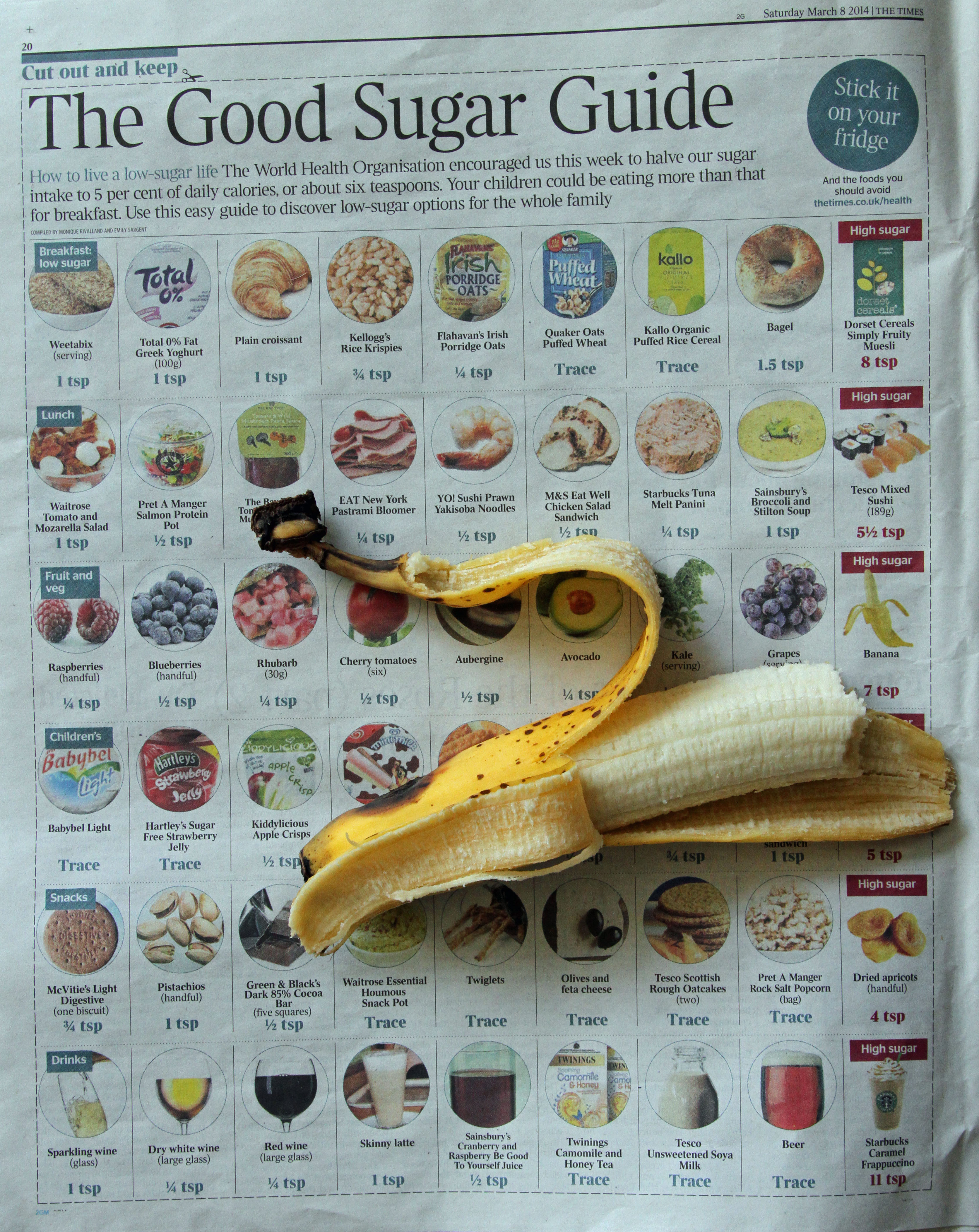
From ‘The Times’, Saturday March 8th 2014
It’s a beautiful spring day and I’m luxuriating in the winter’s departure – though still with a wary eye on the sky, as I’m mindful that this time last year there were hedge-high snowdrifts in the lanes near my house. When I arrived in Brighton in March 2013 for the conference at which I annually organise the speaker programme (and for which I am departing again tomorrow), the promenade was deep in snow and Brighton, that gaudy seaside princess accustomed only to balmy springs and mild winters, had stamped her foot and gone on strike: nothing was operating; not trains, buses or cafés, and the lone taxi driver who had ventured out deposited me at my hotel with all the air of a Himalayan Sherpa supporting a winter expedition. But tomorrow, I’m told, the sun will be shining, the temperatures unusually warm for the time of year.
It’s perhaps a little unseasonal of me, therefore, to embark upon a rant. Rants are normally reserved for foggy November days and chill winter evenings, when the humours are out of sorts and venting one’s chagrin upon the world is, if not de rigeur, then at least condoned. However, I haven’t had a rant for ages, so perhaps may be allowed a little leeway now. It is also unusual for me to comment on political issues, but I’m going to do that, too.
If you read the newspapers regularly, you will have noticed that the government’s latest frenzied preoccupation is with sugar. Yes, sugar. Not tobacco or marijuana or alcohol or ‘hard’ drugs or even prescription drugs, all of which we know to be major killers in the UK, but sugar. The government is considering the imposition of an extra tax on foods and drinks that contain high sugar content – whatever that means (the cynic in me whispers that this might – incidentally, of course – turn out to be a nice little earner). Meantime, the World Health Organisation (THE WHO?!) has suggested that sugar should form no more than 5% of our diet.
Now, I am not a scientist: in fact, if you were to line up twenty random people and assess their ignorance-of-science credentials, I reckon I would get the top slot, or certainly the runner-up’s. Because I needed a science subject in order to get into university, I studied Biology – that traditional ‘soft option’ for arts and languages students – and, after much labour, succeeded in obtaining a moderately respectable grade which was, incidentally, the worst of all my examination results, ever. However, I do remember quite a lot of the information from my ‘O’ Level Biology course, having managed to din it into myself by rote, and since then I have taken more than a passing interest in nutrition – particularly when I was a new mother – and food generally, as I like cooking. I can therefore state with some confidence that there are simple and complex carbohydrates and that both are absorbed into the digestive system as sugar. Yes, sugar. The difference is that simple carbohydrates don’t take any breaking down – they can more or less be absorbed in the form in which they are ingested, meaning that the person eating them feels satisfied for less time than if he or she is eating complex carbohydrates – which take longer to break down. Therefore, if you eat lots of simple carbohydrates – such as sweets, biscuits and soft drinks – you are more likely to feel hungry again sooner and therefore to get fat, especially if the next lot of food that you eat also consists of simple carbohydrates. Simple, isn’t it? (If I haven’t got this right, I invite those of you with a firmer grounding than mine in science to correct me.)
So far, so good. I have no quarrel with any of that, except to point out that simple carbohydrates are not always ‘bad’ – they can be very useful if, for example, you are out on a hike and need an extra boost. Think Kendal Mint Cake or Dextrosol tablets. And not all simple carbohydrates contain only ‘empty’ calories: some have vitamins, minerals and electrolytes that aid recovery from strenuous activity or illness – Lucozade, for example (though I accept that the same benefits can also be acquired through the consumption of more natural products, such as milk).
What I really want to contest is that the current witch-hunt to track down and vilify sugar seems to me to have confused simple with complex carbohydrates to such an extent that natural foods as well as manufactured ones are now being targeted. And, as I’ve indicated at the beginning of this post, the newspapers, which can often be relied on to counterbalance the government’s more ludicrous excesses with a little cod-wisdom of their own, have on this occasion jumped on to the same bandwagon. Take last Saturday’s edition of The Times, which contained a full-page illustrated feature called ‘The Good Sugar Guide’. At the top of the page, it says that the WHO recommends that we don’t eat more than six teaspoons of sugar per day. If you look down the chart, you will see that one of the biggest sugar ‘culprits’ is the banana. A banana contains, on average, seven teaspoons of sugar.
Exactly what kind of advice is being offered here? Are we being exhorted to give up bananas, that mainstay of just-weaned babies, children’s teas, lunch-boxes and commuters’ breakfasts on the hoof? Bananas, which have in some regions been a foodstuff since the dawn of mankind, and which are known to have a wide range of nutritional and medicinal benefits? (If you’re interested, some of these are listed at http://www.botanical-online.com/platanos1angles.htm.) Or are we supposed to eat six-sevenths of a banana today and save the rest of it for tomorrow, not minding that the remaining seventh is now brown and sludgy and possibly contaminated with bacteria? Or perhaps eat six-sevenths of the banana today and throw the rest away? Nothing else with sugar to be eaten, mind!
The chart proclaims, conversely, that a large glass of red or white wine contains only one quarter of a teaspoon of sugar. Now, I like a glass of wine as much as anybody – I’d say I am definitely in the top quartile of oenophiles. But even I baulk at the prospect of drinking twenty-four glasses of wine to meet my daily sugar requirement.
I’m exaggerating the case to the point of absurdity here, of course – but only so that I can point out that so is the government. I’d like to suggest that there can be no more futile a waste of time, and no more dangerous an exercise, than to confuse and worry people with a chart that lists a heterogeneous collection of foods of widely varying nutritional value with the sole purpose of isolating the sugar content and, on top of that, to fail to distinguish between added sugar and sugar that occurs naturally. We don’t need a nanny state to poke its nose in in this very unhelpful way. And we certainly don’t want to start paying tax on bananas. May I also suggest (if you’ll forgive the pun!) that bananas are low-hanging fruit as far as the government is concerned? Almost everyone eats them: all the major supermarkets rank them in their top five bestsellers. What the government needs to concentrate on instead are the thornier and more serious challenges: tobacco, marijuana, alcohol, ‘hard’ drugs, abuse of prescription drugs, and the rest, and leave us to take care of the sugar, in its various forms.
I feel an urgent need to wolf down a banana. I might have a glass of wine (gosh, alcohol), too. Excuse me.
And then… there’s cake…
The verse venue: Matthew Hedley Stoppard and Ralph Dartford at Rickaro Books

Matthew at Rickaro Books

Ralph at Rickaro Books
Rickaro Books, of Horbury, is one of our most distinguished independent bookshops and, like all distinguished independent booksellers, Richard Knowles knows that events don’t just happen: you have to work at them. Therefore, although World Book Day – and, by extension, World Book Week – is getting a huge amount of support from the Booksellers Association and individual publishers, with lots of media coverage, whether or not a bookseller succeeds in making it work is down in the end to himself or herself.
Richard has arranged events for almost every day of this week, leading up to World Book Day itself, which is tomorrow, Thursday March 6th. (If you’re interested in finding out more, please click here.) Tomorrow, he is entertaining a group of schoolchildren in the shop, all wearing fancy dress, and is even going to dress up himself! (I find this amusing: Richard has obviously mellowed since I worked with him all those years ago, when, if not exactly child-unfriendly, he was certainly selective about the children that he liked!)
However, when I read about Richard’s celebrations for World Book Week, the Rickaro Books event that most intrigued me was the one that took place yesterday. I made plans to attend it immediately. It was a live poetry evening, with Ralph Dartford and Matthew Hedley Stoppard (who refers to himself on Twitter as ‘the poor man’s Benedict Cumberbatch’, a soubriquet that immediately endeared him to me). The shop has an excellent track record at organising poetry readings (I’ve written about them on this blog before) and I knew that yesterday’s would not disappoint.
The two poets recited alternately with the fluency and skill which comes from complete command of the material. Both were consummate performance artists, but what really impressed me was the quality of the poetry itself. It is my experience that many live poets are performers first, poets second, but both Ralph and Matthew are exceptional poets as well as being brilliant at engaging with a bookshop audience. The latter was pretty special, too, and included a small boy named George who was dressed as Peter Pan.
If you are not familiar with Ralph’s and Matthew’s work and you like poetry, I recommend that you invest in the two books (AND Matthew’s lovely green vinyl record!) that I bought last night. Cigarettes, Beer and Love, by Ralph, takes the form of a chapbook that has been beautifully produced by the Ossett Observer on hand-made paper. Matthew’s A Family Behind Glass, published by Valley Press, has all the elegance of a classic ‘slim volume’. Which poems did I enjoy most last night?
Well, the Co-op store in Ossett will never be quite the same to me again, now that Ralph has given me ‘Co-op Live Art Fiasco’, which describes his effort to show the individuals in the checkout queue that their investment in the Lottery pays for art (and his wages)… by stripping stark naked and doing some ‘live art’ with a Lucozade bottle. The constable summoned to the event says: “I once saw something like this in Berlin. A scratch card paid for the trip. I quite liked it.” (Ralph was led away at 08.46.) As readers of this blog know well, I’m game for a laugh, but there’s serious stuff behind Ralph’s humour.
Ralph describes Matthew as the ‘cerebral’ one of the pair (but all their poems last night were ‘thinky’, even the most superficially frivolous of them!). In fact, one poem of Matthew’s touched me a lot and spoke to me very clearly from my own past in our first rented marital flat in Leeds.
He set the context of a rented house in Rothwell, his and his wife’s first home, at a time when, he said, they weren’t really ready to be adults, yet. I’ll give you the first stanza, so that you may be touched as well:
Now that the streetlamps have stolen the stars
From the afternoon sky, sleep, content
And lovely as custard, pours over us. We sit
With winter on the settee, arm in arm –
Our legs interlaced like denim snakes,
Bedlam pressed between our palms. [From ‘The Wendy House’]
Matthew is about to take up a post with Leeds City Libraries: I’d like to wish him well with this. Ralph works for the Arts Council, and knows Chris and Jen Hamilton-Emery of Salt Publishing. He observed, unsurprisingly, that they are both ‘lovely people’. He kindly bought In the Family before he left the shop, which gave what had already been a very enjoyable evening a considerable extra fillip for me!
I wish Richard every success with World Book Day. (I’d love to be a fly on the wall when he receives the schoolchildren tomorrow, but unfortunately I have to travel to London instead.) And I hope very much indeed that I shall meet Matthew and Ralph again. In the meantime, I shall enjoy reading their poetry for myself. Thanks to them for introducing me so beautifully to it.
 Precious poetry pack
 How to get a book signed by two priceless poets
 Christina James, crime novelist