

Surprises come in threes at Oadby Library!

During the latter part of last Thursday afternoon, after a sun-splashed if chilly week, the heavens opened and the rain came bouncing down. The gate that leads into our garden was sodden in no time. The M1, which we had just joined to begin our journey to the event at Oadby Library, quickly became waterlogged: there were treacherous sheets of water to negotiate as the traffic on the approaches to the various cities that we passed built up towards rush hour. By the time that we reached the Leicester ring-road, we’d encountered virtual gridlock. Irate drivers were crawling along for a few yards at five mph before juddering once again to a standstill, their progress and tempers not helped by the rain, Leicester’s amazingly laid-back traffic lights system and the fact that in several places on the dual carriageway two lanes merge into one (every driver being reluctant to yield to another).
This was not an auspicious start to an event that had been planned months in advance and strenuously published, by Chris and Jen at Salt Publishing, by myself and by various other kind tweeters along the way. I had known not to expect too much, as the library had already warned me that only three tickets had been sold – and indeed would have ‘pulled’ the event had I not insisted that I should be happy to speak even if only one person turned up to hear me.
I arrived precisely on time, at 6.30 p.m., later than intended, and my audience – consisting indeed of just three people – had all got there before me. I barely had time to notice that Oadby has a lovely library before I hastened into the ante-room where they had assembled, together with the librarian, Anne Sharpe. However, by this time I had already experienced the first of several wonderful surprises. The first person that I met after Anne was Rosalind Adam. We are mutual bloggers and Twitter friends – I’ve been enjoying Rosalind’s blog for some time, though we had not met before. It was a delight to be able to talk to Rosalind in the flesh. We each agreed that the other was exactly what we had expected – and that this was not always the case when meeting someone previously encountered only through the ether. At the moment, I’m particularly excited about a book for children on Richard III that Ros has just finished writing and hope to be able to review it on this blog in due course.
I was a bit slow on the uptake at registering the second surprise. I’ll have to excuse myself by offering the explanation that I was busy sorting out my books and papers for the readings. I’m also quite short-sighted, but I prefer to wear my spectacles only when I’m driving. Anyway, the event was about to start when I looked up and recognised that the only male member of the audience was Colin Marshall, for many years the manager of the campus bookshop at Leicester University and still employed by the university today, although he has now ascended to a higher plane and is in charge of all the retail operations on the campus there. Colin’s presence introduced one of those occasions when my life as a novelist collides with the day job – and this time it was the most enjoyable collision imaginable. Colin has for several decades attended the conference for which I have organised for some fourteen years the speaker programme. He was also awarded the Booksellers Association’s Lifetime Achievement Award in 2013. His presence at the event was not entirely a coincidence, as he had been kindly told about it by Professor Christine Fyfe, the Pro-Vice-Chancellor in charge of Teaching and Learning – and the Library – at Leicester University, whom we both know. However, there was also a real coincidence at work: Colin and his wife Sandra live in Oadby and she had quite separately seen the event advertised by the library and decided that she would like to attend. Having the opportunity to meet Sandra was the third lovely surprise of the evening: she’s funny, sensitive, extremely well-read, loves dogs and cats (she told me that she and Colin have managed to organise their lives with such symmetry that they have four children, three dogs and two cats), is a great companion and raconteur and furthermore is living proof that Colin is a dark horse!
Ros, Colin, Sandra and Anne therefore constituted my audience at Oadby. It was the smallest audience I’ve ever had. I’ve attended other writers’ events that have managed to attract only small audiences and I’ve found that they divide into two categories: small and dismal, and small and select. I’d like to state unequivocally that, thanks to Ros, Colin, Sandra and Anne, this event was of the latter type. It began quite formally with a reading from In the Family and a Q & A session, but before long had turned into a lively debate about writing, literature, other crime writers and future events at Oadby Library. We overshot the allotted time by half an hour, so that I had barely time to conclude with my ‘world première’ reading of the first chapter of Sausage Hall, third title in the DI Yates series, which I’m grateful to be able to say was very well-received.
At the end of the evening, we took a quick look round the library and had our photograph taken there. Ros had to leave at this point: she has kindly already written about the evening on her blog. We said goodbye to Anne, our charming and extremely well-read hostess, and retired to the car park to release our dog, who had accompanied us for the ride. Then Sandra, Colin, my husband, the dog and I adjourned to the pub down the road (The Fox) to continue the conversation. Eventually, Sandra and Colin went home and we headed back North through the rain-sodden night.
There are some evenings, unfortunately all too rare, when, as a writer, you really feel that you are making progress in the most worthwhile of ways, by talking to a group of sympathetic and interested readers. (The size of the group is immaterial.) For me, the event at Oadby Library was such an occasion. Anne said that she would invite me back again later in the year. I’m looking forward to it already. I’d like to thank her for her wonderful hospitality, and to thank Ros, Sandra and Colin for braving the elements to visit the library last Thursday and for contributing to the marvellous conversation that took place there.
Copyright and Clark

I’ve just written a review of Clark’s Publishing Agreements: A Book of Precedents (Ninth Edition). It’s been published by Bloomsbury and costs £130 (you get a CD for this as well). I’m not expecting many of my readers to be interested in buying it, but, in case you are, you can obtain a 35% discount off the cover price if you’re attending the London Book Fair. The ISBN is 978 1 78043 220 5.
The General Editor is Lynette Owen, a colleague and acquaintance whom I admire greatly. She picked up the baton when Charles Clark, the doyen of copyright law in publishing, died in 2006. I never met him, but I’ve met people who did and I’ve also seen photos of him. I picture him as a sort of Rumpole character, a larger-than-life man of what used to be called ‘breeding’ and great intellect, who was both as sharp as a tack and tenacious as a street Arab when it came to defending authors’ and publishers’ right to get paid for their labours.
In fact, although copyright has always needed to be defended, Charles Clark died before the real squeeze began. Beginning with the Digital Economy Act (2010), which was closely followed by the Hargreaves Report (2011), Richard Hooper’s work on the Copyright Hub (2012) and the Finch Report on Open Access (also 2012), UK copyright law has come under strenuous attack from a government that seems neither to appreciate that the intellectual property of writers and their publishers needs to be protected as much by law as, say, design patents protect pioneering engineers, nor fully to realise just how much of the national income is generated by a flourishing publishing industry. That industry has, of course, responded with vigour, but in clear-headed fashion. It is to the credit of both publishers and authors that, on the whole, they have not lost their cool over this. Instead, they have worked hard together – along with various trade organisations and lawyers – to modify copyright law so that it is accepted as fit for purpose in a digital age without allowing it to be dismantled to the extent that large-scale publishing becomes unsustainable. (I’m not talking about self-publishing here: it has its own micro-economy that is distinctly related to the efforts of the individual author. But self-publishing is not viable for many types of book, including multi-author works and the numerous academic or non-fiction works that need high levels of pre-publication investment.) Richard Hooper’s collaborative work demonstrates this patient, reasoned approach at its best.
The backbone of the 9th edition of Clark consists of a series of ‘model’ contracts pertaining to most of the different types of publishing situation – print and digital, individual and collective, direct and through third parties – for publishers and authors to consult. Most of them can be amended according to individual needs and circumstances. The ‘precedents’ therefore collectively represent an up-to-date compendium of best practice in publishing which takes into account all of the recent legislation and the industry’s informed responses to it.
The book offers much more than that, however. The prefaces to the precedents, the introduction and the nine extensive appendices together explain the context in which the precedents have been set – i.e., the complex world in which writers and publishers have to operate today. I found Appendix G, which explains exactly what an author’s ‘moral rights’ are, particularly fascinating. I’d go further, and say that this book has yet more significance: for the collected precedents, commentaries and articles which it contains together demonstrate why copyright is valuable and why everyone who is active in the creative industries should fight to keep it.
Each year since his death, Charles Clark’s family has sponsored the Charles Clark Memorial Lecture. It always addresses some aspect of copyright and I always try to attend. The lecture is organised by the Publishers Licensing Society [PLS] and delivered at the London Book Fair. Two years ago, the guest speaker was Maria Martin-Prat, Head of the Copyright Unit at the European Commission Internal Market Directorate General. Her speech was eloquent and well-reasoned. She said many things that resonated with her audience – and undeniably, since it largely comprised publishers and authors, she was preaching to the converted. However, just one point that she made, towards the end of her presentation, has really stuck in my mind. Speaking of Open Access, she said that she could understand why the talented and ambitious young people currently studying at universities or working for professional qualifications appreciated being able to obtain yet more and more content free of charge and were therefore vociferous supporters of the ‘free at the point of access’ principle on which Open Access is based; but, in a few years’ time, a considerable proportion of those same young people will have themselves become authors. If they fail to understand copyright now, and therefore do not help to protect it, they will discover, too late, that they can demand no financial reward for their work nor claim any right to its ownership. Maria Martin-Prat’s message to her audience was that, if all types of writing are to continue to flourish and to delight, there can be no more important task that demonstrating to the young that copyright is precious and should be treasured. It is a point that I make as often as I can when I am speaking to young audiences.
I can’t conclude without congratulating Lynette Owen on her flawless work as editor. I’m sure that Charles Clark is resting in peace, knowing that his work continues to live on under her capable tutelage.
Turning the eye upon our selfies…
I was struck by the appearance in Monday’s The Times of the Jan Van Eyck ‘Arnolfini Portrait’, a painting I have always found fascinating for its depiction of a wealthy merchant and his wife. The detail to be explored in this marvellous creation of character and setting has not only human but also symbolic value, suggestive of the real existence, aspirations and lifestyle of this couple in their Bruges home. It cries out: ‘Here we are! We are rich and wonderful people! Look at us!’ The most intriguing aspect for me is the reflection in the convex mirror on the wall behind the couple, depicting two figures, one of whom is commonly assumed to be Van Eyck himself. Velázquez later did much the same thing in ‘Las Meninas’, showing himself as painter of the scene. It’s a clever way of putting your personal stamp on your work. As well as that, Van Eyck painted boldly on the wall (in the style, popular at the time, of a maxim or moral text): ‘Johannes de eyck fuit hic 1434’ or ‘Jan Van Eyck was here 1434’. I’ve always found it pleasantly ironic that the painter should have muscled in on the proud self-declaration of the Arnolfini couple, in a kind of portrait-bombing that elbows aside the intended subject.
My mind jumped quickly to the concept of self, as presented by ‘Kilroy was here’ and graffiti tags: ‘Notice me – I’m everywhere – I can get into the most unlikely and bizarre places… because I’m wonderful!’ That too seems pretty ironic to me, as I feel that shouting out about myself or my achievements is de trop and immodest; creating a ‘Christina James’ brand and promoting my writing here on the social media, I confess, does make me feel uncomfortable, even though I accept the need for it in the current bookselling market and therefore join in. However, I know how I feel about those who simply churn out plugs for their books without any engagement with others – it’s so much spam. Van Eyck’s skill sold itself and I suppose all writers and artists and craftspeople hope that the quality of their handiwork will do the same and that people will notice; in the meantime, they give it what they consider a helpful push. Shakespeare definitely, with his choice of the word ‘powerful’ in Sonnet 55, knew the value of his own words in outlasting even the hardest stone (‘Not marble, nor the gilded monuments of princes, shall outlive this powerful rhyme.’) and was clearly right to say so: his sonnet certainly seems to be standing the test of time. So… we turn the words and polish them, with ‘perhaps’ floating in our heads… and promote them.
Which in turn leads me to the ‘selfie’, a bizarre bi-product of the technological society in which we live. We have a ‘smart’ phone (there’s a misnomer) which we can turn upon ourselves with no skill or effort whatsoever and take our own picture. Why? Narcissus fell in love with his reflected image, because Nemesis, having noticed his overweening pride in himself, led him to the pool in which he saw himself and he couldn’t drag himself away from the image in its surface; he therefore died, his hubris preventing him from seeing reality. Messrs Obama and Cameron, perhaps flattered by the photographic attentions of the personable Danish PM, fell into much the same trap, losing their sense of reality in the process. Not only did they use no art in the creation of the resulting silly picture, but also failed to use even the most basic commonsense, and Mrs Obama and the rest of the world clearly eyed them with the sharp vision of objectivity. Oh dear. The ‘selfie’ doesn’t work very well as a self-promotional tool.
I didn’t set out to be moralistic, but this is beginning to feel that way. We care about what we create and care about how others view it; there is ‘self’ in that! I have been privileged to receive positive reviews about Almost Love from writers whose own work I value and enjoy and I’m therefore sharply aware of how important it is to celebrate what I find successful and admirable in what others do; there is joy to be had in reviewing books that stand scrutiny. I’m also very much aware of how selflessly many of the people with whom I interact on the social networks behave; they deserve to feel proud of themselves for making someone else’s day. I’m glad, too, that the social media allow all of us to find our way to what we like; we’d miss out on some gems if their creators were utterly selfless!
‘The Lord is a shoving leopard’: the humour of Gervase Phinn

With Gervase Phinn
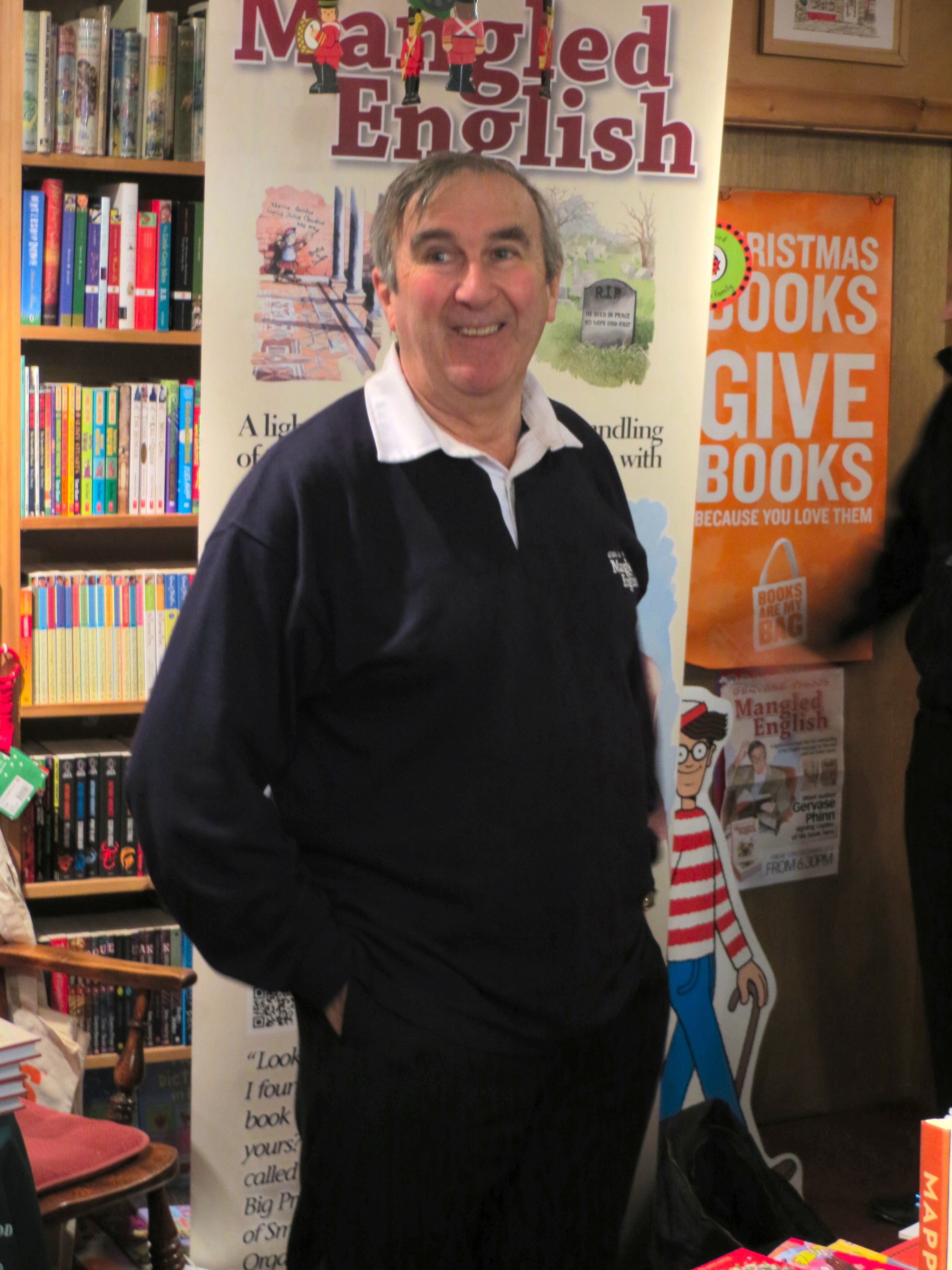
Gervase Phinn at Rickaro Books
Last Friday, I spent another fascinating evening at Rickaro Books. I’d been looking forward to it with great anticipation since the Ian McMillan / Tony Husband event that took place several weeks ago. This time, the author was Gervase Phinn. I hadn’t met him before – though my husband is very familiar with his books – and he did not disappoint. The event was extremely well attended: I calculate that at least forty people managed to squeeze into this distinguished but pocket-sized bookshop.
He focused upon his latest book, Mangled English, which delights in highlighting the way we all misuse the language (I certainly do!), and touched upon such matters as mis-spellings, Spoonerisms, Malapropisms and howlingly bad verse (guilty!). He also told many amusing anecdotes about people he’d met. He now spends some of his time as a performing artist on cruise ships, so the tales he had to tell were varied. However, the one that I liked best – although it was also one of the most poignant – was the one about the old people in a care home. One of them was actually his mother-in-law. She was obviously out of the conversation (he was very sensitive in the way that he talked about her dementia), but he derived real humour from recounting the reaction of the old man who was sitting next to her when he was asked his name. He wouldn’t give it and, when asked whether he had played any part in ‘the war’, would only reply ‘I might have done’. Getting no other response from him, Gervase turned to his mother-in-law and asked her name. While she was struggling to remember it, the old man suddenly burst out: “Don’t tell him, Pikey!”
In a more serious vein, Gervase extolled the virtues of encouraging children to read at a young age – as he had himself been encouraged as a boy – and deplored the government’s ever-changing education strategy. As a former inspector of schools, he is better qualified than most to do so. He took an especial interest in the children at the event.
It was a privilege to meet him and I had two opportunities to talk to him. However, the best part of the evening for me was actually being at Rickaro Books itself, looking at the excellent rare books collection that is on sale there and drinking mulled wine – it was the gateway to Christmas for me, in fact. The experience was made even better by being invited to join Richard and Carole Knowles, the proprietors of the bookshop, for dinner afterwards in their local Italian restaurant . As I’ve said in a previous post, Richard and I go back a long way, and it was very good to have the opportunity to listen once more to his (sometimes elliptical, always amusing) take on life, the universe and bookselling… and to get to know Carole a little better.
Watch this space: I’m sure that there will be more posts about Rickaro Books in the future. Should you ever be in Horbury, I wholeheartedly recommend that you take a detour (it won’t be much of one, as the bookshop is in the very heart of the town) to pay a visit.
A happy afternoon in Hunstanton, with friends old and new…

With Sue Renwick and the Mayor of King’s Lynn and West Norfolk

On the platform
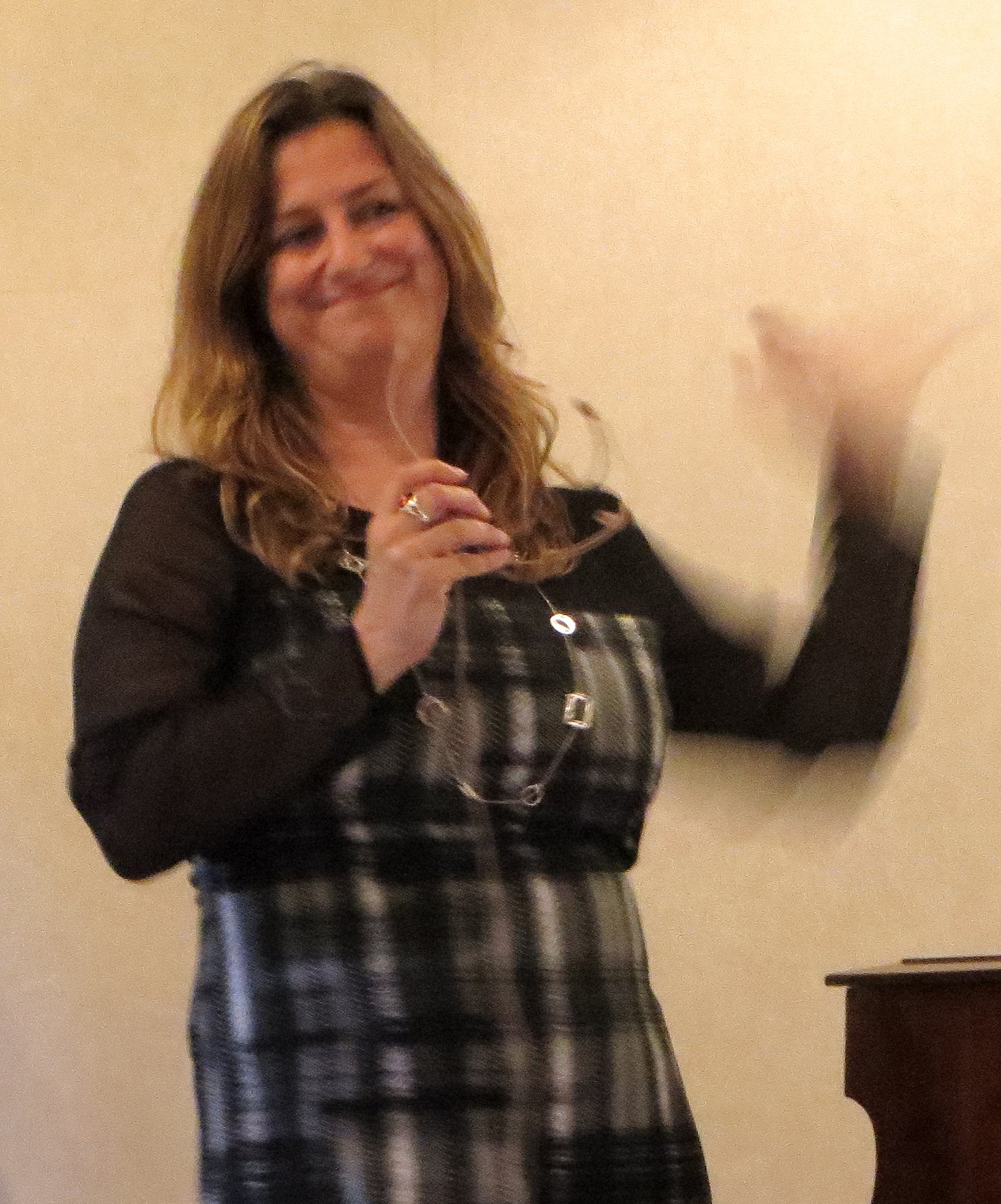
Fellow speaker, the ever-lively Elly Griffiths
Yesterday was a real red-letter day for me. I had been invited to give one of two after-lunch talks at Soroptimist International King’s Lynn annual fund-raising lunch, which was held at the Best Western Le Strange Arms Hotel at Old Hunstanton. I was invited to speak by Sue Renwick, this year’s King’s Lynn Soroptimist President, and her colleague, June Muir. I discovered that my name had been suggested by two of my old school friends, Lyn Lord and Mandy North. Both have been enthusiastic promoters of my books and Mandy has attended both of the signing sessions held at Bookmark in Spalding. I was chosen because my books are set in Spalding – not too far away from King’s Lynn (in fact, my brother was born in the Queen Elizabeth Hospital there) – and the group particularly likes to listen to authors whose books have a local flavour.
This literary lunch was the fourth one held by the King’s Lynn Soroptimists. The speaker at last year’s event was Stella Rimington (who has a house in Norfolk), so I felt honoured indeed! The audience consisted of ninety-nine lunchers, mostly Soroptimists, with a sprinkling of husbands. The Worshipful the Mayor of King’s Lynn and West Norfolk, Councillor Mrs Elizabeth Watson, was there, and I much enjoyed talking to her. I was privileged to be seated next to Sue Renwick’s husband and had a fascinating conversation with him about migrant workers in Norfolk (a topic in which I’m currently immersed as I write my third DI Yates novel). The local press was in attendance: I shall post links to their photographs when I have them.
I had heard of the Soroptimists before, but I didn’t know much about them until I received the invitation, when I made it my business to find out a little more. The first group was set up in the USA, quickly followed by others in the UK. The organisation is now worldwide. Its website explains its mission: We are committed to a world where women and girls together achieve their individual and collective potential, realise aspirations and have an equal voice in creating strong, peaceful communities worldwide. The fund-raising events support particular causes. The money raised from yesterday’s lunch will contribute to respite holidays for Norfolk’s young carers: heartbreakingly, there are children as young as seven looking after infirm or disabled parents.
My fellow-speaker was Elly Griffiths, whom I had already met earlier this year at a very successful literary festival event held at Watton Library. Elly spoke first. I know her to be a witty and eloquent speaker (and therefore a tough act to follow!). She told the audience how she came to create her academic archaeologist, Ruth Galloway, and read an excerpt from the next Ruth Galloway novel. She said that the inspiration for these books had come from her husband, who exchanged a high-profile, lucrative career as a city ‘suit’ to become an archaeologist. The Galloway novels are set in Norfolk because Elly’s aunt lives there and Elly spent holidays there as a child; she also pointed out that Norfolk is full of bones!
My brief asked me how I came to develop the characters in the DI Yates novels. I’ve reproduced some of what I said here in the hope that it may interest readers of this blog, as several of you have asked me similar questions.
When I was thinking about where to set the novels, I revisited the Spalding of my childhood (and incidentally some of my most memorable holidays as a girl were spent in Hunstanton). DI Yates’ Spalding is therefore a ‘perfect’ place in the sense that it exists only in my memory and imagination. Among the many riches that Spalding and the Fens offer to me as a writer is their wonderful place-names – Pode Hole, Quadring Eaudyke, Gosberton Risegate, Pinchbeck: I know that many readers are intrigued by the promise of romance and mystery implicit in the names of these villages.
None of the characters is entirely based on people I know or have known, though they have been influenced by traits I saw in certain individuals or by real events and customs. For example, my great uncle kept a general shop in in Spalding, in Westlode Street. It was the family business for many years: he’d inherited it from his father. My grandmother – my father’s mother – acted as his housekeeper. More or less accurately, this is the shop in which Doris Atkins is murdered in In the Family. Her daughter-in-law, Dorothy Atkins, also known as Tirzah, is convicted of the crime. But Doris Atkins is not a portrayal of my grandmother, nor is Dorothy a portrayal of my mother. Uncle Colin, the hunchback who keeps the shop, is a little more closely based on my own great-uncle, but only in the physical sense: my great-uncle did indeed suffer from curvature of the spine. He did make forays on a grocer’s bicycle to collect cigarettes and bananas to sell in the shop. He did wear a long shopman’s coat and a trilby. But Colin’s character is not his character. (Just as well, considering what Colin gets up to in the novel!)
Moving on to Almost Love, I talked about Alex Tarrant and her role in the novel. Alex is the secretary of the Archaeological Society, a prestigious institution very loosely modelled on Spalding Gentlemen’s Society. Some of my readers have told me that they feel that the Archaeological Society is almost like another character in this novel. The story begins with the unexplained disappearance of a famous archaeologist. Several murders take place during the course of the novel and, although she isn’t involved in them directly, Alex is inadvertently the person who provides the links between the various perpetrators; this is in part because she embarks upon an ill-considered affair. I was interested in exploring the disintegration of character of Edmund Baker, the County Heritage Officer and the instigator of this illicit alliance, as he undoubtedly suffers the guilt of betraying his wife.
I also spoke about my grandmothers and the extraordinary houses they lived in. I’ve already mentioned the shop at Westlode Street where my father’s mother lived. My mother’s mother was employed in domestic service from the age of fourteen to seventy-four, at first (a bit like Hardy’s Tess!) as a poultry maid. Her second employer sent her to Bart’s Hospital to train as a nursery nurse and from this she worked her way up to become housekeeper to Samuel Frear, last of the great Lincolnshire sheep farmers. She was widowed young, so my mother grew up at The Yews, the Frear family home at Surfleet. Just after I was born, my grandmother, now aged sixty, moved to Sutterton, to become companion to a very old lady who lived at a substantial house called The Laurels. She had been the wife of a gentleman farmer who was twenty years her senior, so he must have been born in the mid-nineteenth century.
Like Westlode Street, The Laurels was packed with quaint furnishings, but the most astounding thing about it (though as a child I just accepted it as normal) was that the walls were decorated with many sepia photographs of the old lady’s husband when he’d been on safari in Africa as a young man. These photographs must have been taken in the 1870s or 1880s and in many of them he was accompanied by several black women wearing very little except strings of beads. The book I’m working on now is set in this house. When I began writing it, I had also just discovered that a very famous person was living in the area at the same time, which helped me to construct the plot. It’s about a murder that happens in the present, but is strongly influenced by what happened in the house in the past.
I think that both our talks were well-received: many of the Soroptimists came and spoke to us with great warmth and enthusiasm afterwards, and they were extremely generous in their purchases of our books. We were each presented with a pen in a beautifully crafted wooden box that Sue Renwick had made herself – an unexpected and delightful kindness.
I’d like to take this opportunity to thank most sincerely all of those present for a wonderful day. I shall certainly take a very close interest in all that they do from now on and hope perhaps to be able to help them, both as a writer and a professional woman, in the future. I hope too that they will come to visit here and perhaps comment, too.
A flat cap is not just for t’ ‘ead, tha knows…

Nowt like a reet wild book signin’…
Ian McMillan, South Yorkshire’s own shrewd and very funny poet (the ‘bard of Barnsley’ and ‘poet in residence’ at Barnsley FC), gave a book launch and signing session at Rickaro Books in Horbury yesterday evening. It was an event that I’d been looking forward to for a long time, having heard Ian perform once before, at a school. He is a performance poet second to none.
I arrived early at the shop with my husband. Ian was already there, entertaining all the other early arrivals. Even Richard Knowles, the owner of Rickaro Books, seemed excited. Richard is professionally lugubrious: his catch-phrase when I worked with him a quarter of a century ago was ‘Life is Cricklewood, not Hollywood.’ Yet he’d invested in a big box of Cadbury’s Celebrations (only slightly dimming the gesture by explaining that they were left over from Trick or Treat night and also instructing his guests to take the Snickers chocolates first, as he doesn’t like them) and shared his special ‘bookseller’s provender’- malted milk chocolate biscuits – with Ian. He had even brought along his flat cap for the occasion.
At this point, I should perhaps explain that Ian’s new book, a collaboration with eminent cartoonist Tony Husband, is entitled 101 Uses for a Flat Cap. Published by Dalesman, whose account manager was also at the meeting – he’d kindly brought along copies of all Ian’s books – this latest offering from Ian and Tony does exactly what it says on the tin… er, sorry, book. It consists of 101 pieces about the trademark Yorkshire flat cap, inserted by its author into every possible historical and practical situation: ‘All made up! Every one of them!’ Ian kept on cheerfully insisting. He read several of these poems as well as, with passion, a more poignant extract from another recent title, The Tale of Walter the Pencil Man. Dedicated to his great uncle, Joseph Fletcher, who died at the Somme aged twenty-four, this is the reflective and touching tale of a Yorkshire pit village lad who tries with his pencil and paper to cope with what is happening around him as he fights on the First World War battlefields. It’s very topical, of course, and I’m sure will enjoy many sales this year and next, as we approach the centenary of the start of the Great War.
Tony Husband, Ian’s illustrator, accompanied him. It was a real thrill to meet him: he’s a very accomplished, not to say distinguished, artist, who draws for several famous publications, including Private Eye (Yobs), and has been Cartoonist of the Year several times. He told me that he and Ian Hislop arrived at the Eye at about the same time, twenty-five years ago (about the same time that Richard and I ceased to be colleagues!). Tony worked fast and incredibly hard all evening: he not only signed every book that was purchased, but drew a picture in it as well; he also drew a picture to accompany each of the poems, simultaneously with Ian’s recitation, and distributed them among members of the audience afterwards. The picture he gave to me, which I shall certainly have framed, illustrates the poem entitled ‘The Flat Cap Scene from King Lear (now lost)’. It’s my particular favourite, not least because it’s arch about Lincolnshire (my home county) and Norfolk (home of my publisher, Salt), though Ian did qualify his comments by saying that he loved South Lincolnshire and even recollected an event that he’d given at ‘one of the Gedneys’ – impressive, as the Gedneys are very small villages in the back of beyond.
Here’s a taster of the poem; the rest is hilarious, but you’ll need to buy the book to find out! (Plug, plug…)
Lear: Oh fool, what dost sport upon thy head?
It seems exceeding flat and dull, i’faith,
As Lincolnshire and Norfolk, two flat places in the East.
This occasion was everything that an event in a bookshop should be: convivial, hospitable (Richard’s wife Carole provided a delicious and warming mulled wine) and humorous, with a great deal of ad libbing from both Ian McMillan and Tony Husband, as well as from members of the audience. It was extremely well attended and I’m sure that, like us, everyone who was there went home happy and enriched by all the pleasures that it brought. Richard also used the occasion to promote BOOKS ARE MY BAG, an initiative that is close to my heart, as readers of this blog will know.
And there was no charge for attending: certain chain booksellers, please take note!
Very many thanks to Rickaro Books, Tony and Ian, for an evening to remember:

The fabulous Tony Husband, putting me in the picture…

Richard Knowles, of Rickaro Books, looking for the 102nd use of a flat cap…

Visual and verbal, speaking ‘louder than a gun’…

Tony Husband, finding himself in no-man’s-land…

The Flat Cap Scene from ‘King Lear’ (now lost)
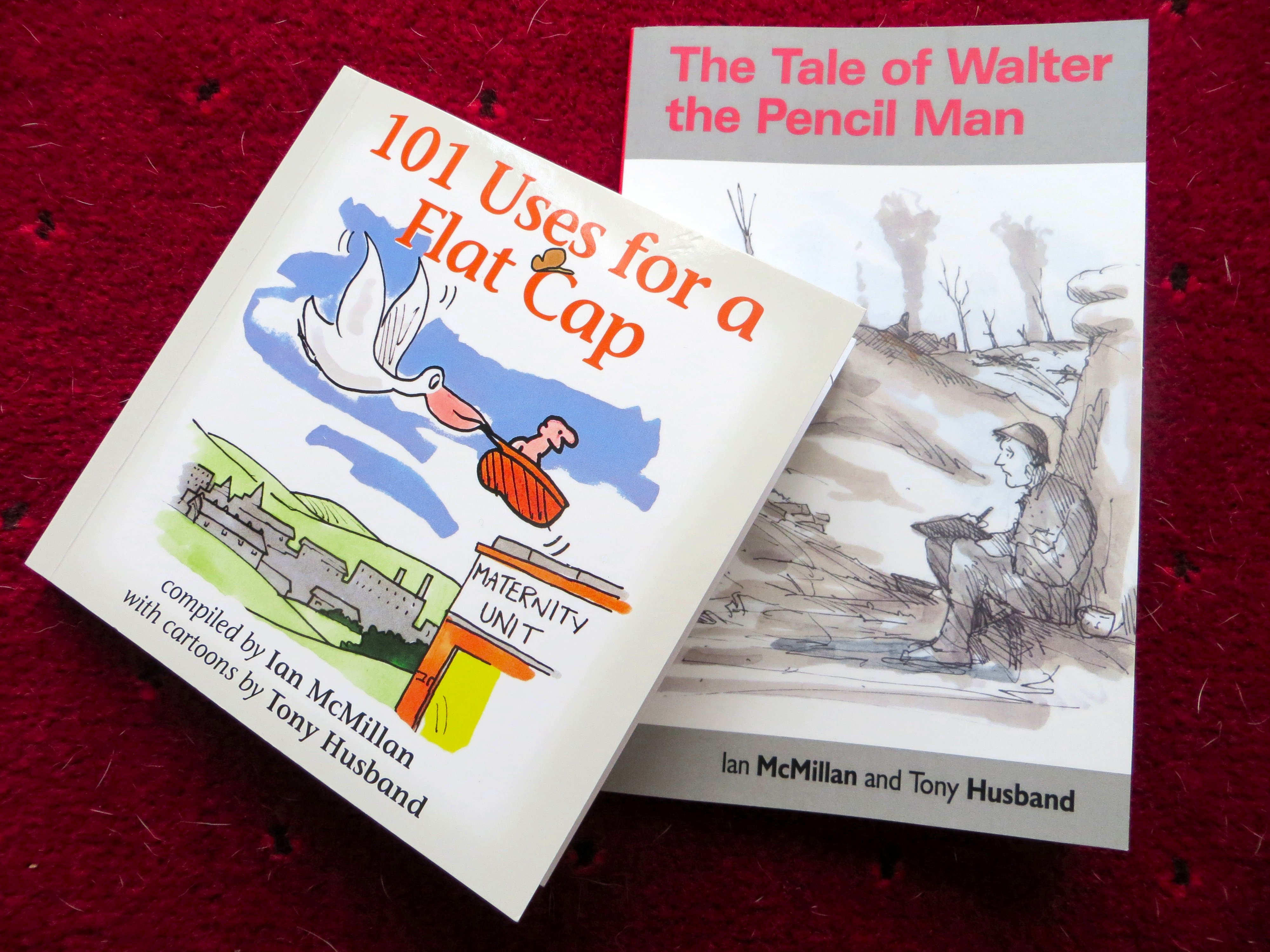
A couple of lovely collaborations, by a couple of lovely collaborators…

A precious signed first edition! Love you, Tony and Ian! 🙂
Into Lincolnshire, for the Wolds Words Writers’ Workshop…

Louth Library, Lincolnshire
The writers’ workshop that my husband and I jointly led on Friday 18th October was part of the thirteenth Wolds Words Festival. It is a flourishing event that takes place annually in and around the pretty market town of Louth. The workshop was scheduled in the library, an impressively busy place in which the considerable bookstock was displayed most invitingly. The library staff were all great: extremely helpful, both to those attending the workshop and to their regular library users. It’s one of the most successful small libraries I’ve ever visited and clearly the librarians work hard to achieve this.
We said that we would work with up to twelve participants and the workshop quickly sold out (though not everyone actually made it on the day). We were asked to focus on two aspects of writing: crime and using local history in fiction. We heard that a workshop on plot construction that had taken place on the previous day had also been very successful.
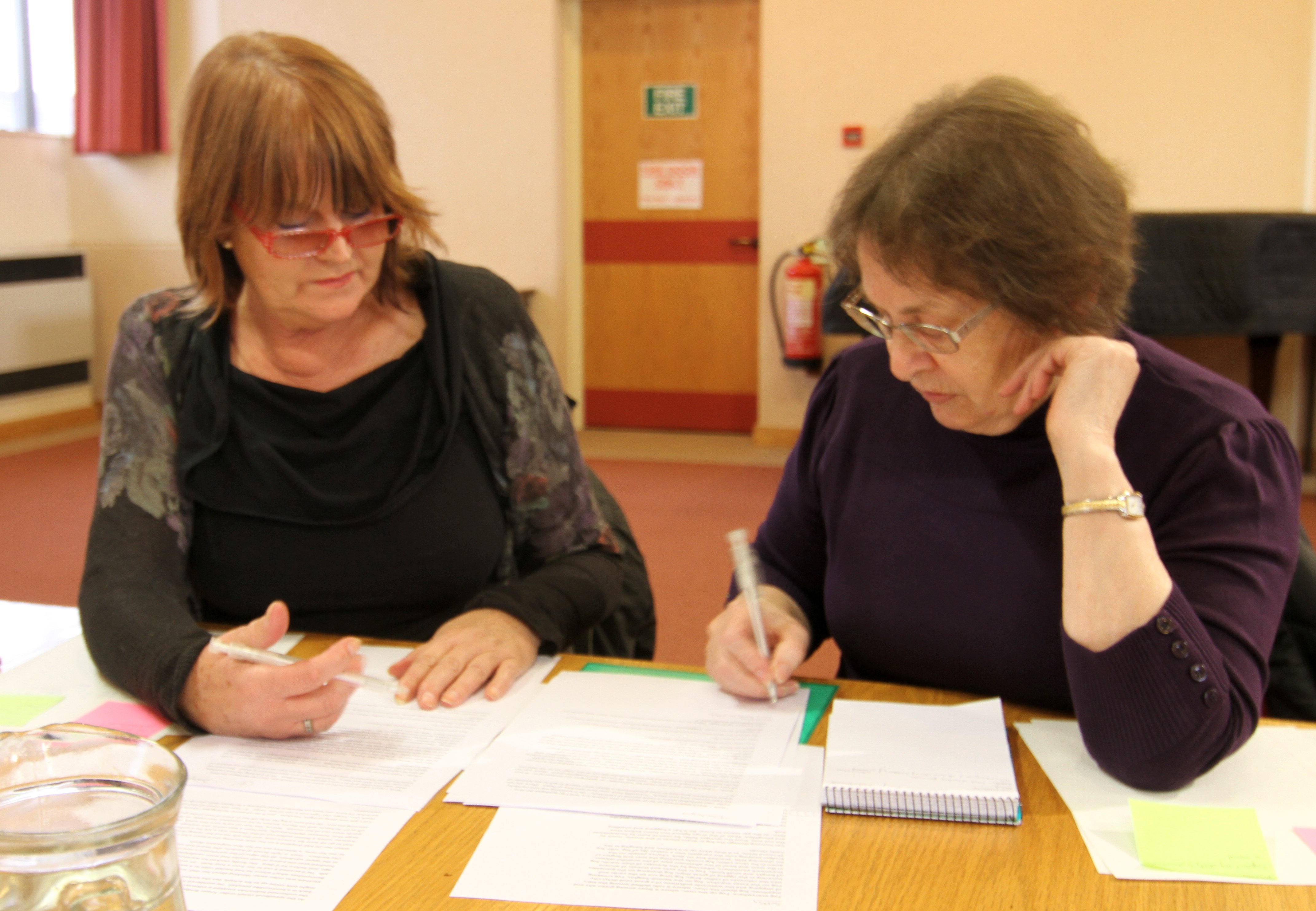
Wolds Writers’ Workshop
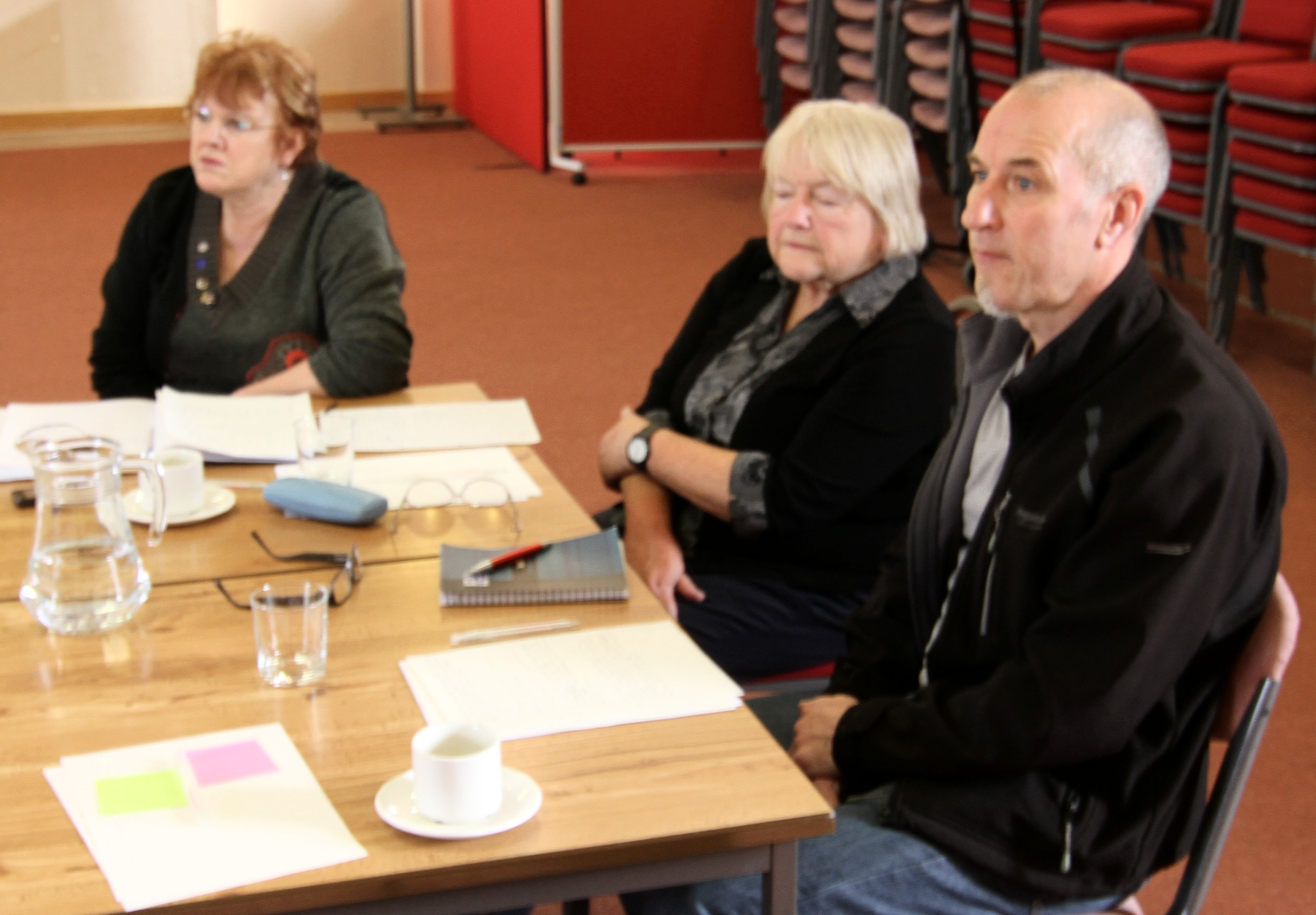
Wolds Writers’ Workshop
As a warming-up exercise, I gave the group some of my own tips on how to get published. As I’ve already offered some of these in this blog and shall be writing about others in more detail in future posts, I’m not covering them again here. Similarly, I’m not including my tips on how to incorporate local history into fiction here, saving them for a separate post.

Wolds Writers’ Workshop
We moved on to discussing why the participants had chosen the workshop and what they hoped to get out of it. Their answers were, perhaps not too surprisingly, very similar, and boiled down to a single joint ambition with three further ‘sub-wishes’. The over-arching goal of everyone present was to see their work published. One of the writers had already had poems published in anthologies; one had published a factual account of the sea some twenty years before and one had contributed short stories to an online magazine. None of the others had had work published. Two had written novels, but neither had been successful in finding a publisher.
The ‘sub-wishes’ were perhaps even more interesting: they each concerned confidence, or the lack of it. They included the expressed desire to write something that was worth reading ‘at all’; the fear that a certain flaw – in one case, an inability to write convincing dialogue – was an insurmountable stumbling-block; and the suspicion that the author’s take on life was too left-field ever to find a publisher. To these doubts, I replied that almost everyone can write something worth reading if they work at it hard enough; that ‘flaws’ can be overcome or minimised, again with hard work; and that many readers prefer a more unusual viewpoint to something more conventional, though I agreed that this may make it more difficult to attract a traditional publisher.

Wolds Writers’ Workshop
Next we read and explored four short passages from very different novels, each demonstrating some particular aspect of writing. We looked at the ‘fog’ passage from Bleak House as an example of creating atmosphere; Virginia Woolf’s description of the Ramsays’ holiday house in To the Lighthouse to establish a sense of place; a passage from Where the Devil Can’t Go, a novel by Anya Lipska, a talented new crime writer whom I’ve written about previously in the blog, that depicts her heroine’s character; and finally a piece of dialogue from my own novel, In the Family. We each took forty minutes to write a short passage following on from one of these, or alternatively any short fictional piece of our own choosing. The writings were shuffled and passed around until we had each read all of the passages; no-one knew who had written which. Each of us then told the others what we liked about the piece that we had in front of us at the end. We all found plenty to praise, which I think confirmed resoundingly that there is a writer in almost everyone. I should very much like to thank all the writers for their really enthusiastic and participative response to the occasion.

Wrights of Louth, Bookshop
Copies of my books were sold at the event by the local bookshop in Louth, which I also visited afterwards. One of its distinguishing features is that its sign hangs upside down! There is a story behind this: The shop used to be a general grocery store of the kind that I remember as a child, but which has completely disappeared now. Its owner, a man called Bill Platt, who ran it for many years from 1913 until he was in his seventies, was famed for his knowledge of local history as well as for the quality of his shop in Little Eastgate. He had business acumen, too. When the sign over his shop doorway blew down in a storm, it was affixed by accident the wrong way up; Bill recognised that it quickly became a talking point and therefore a good advert and simply left it like that. A local businessman, Mick Wright, who, with his wife Carol, turned the store into a newsagent’s and bookshop, has continued the tradition!

In conversation with bookshop owner Dean Wright
I had a long and pleasant conversation with Mick and his joint owner son Dean, and was extremely impressed by their can-do attitude towards running a bookshop in modern times. Their strategy is to diversify without abandoning the bookshop’s essential character and to provide exemplary service; they specialise in books about Lincolnshire. I purchased several by local authors, and was extremely grateful to be given a discount!
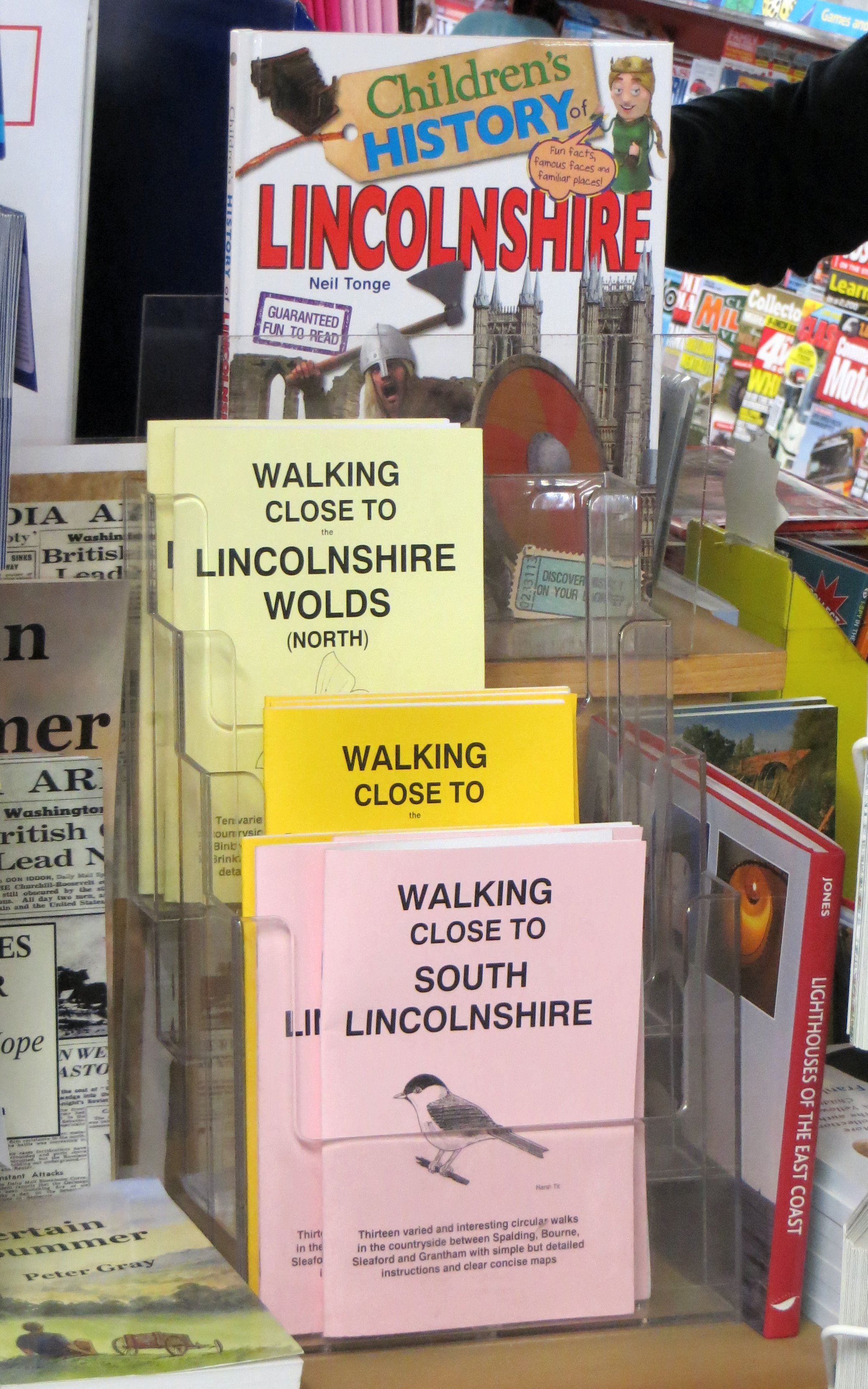
Speciality: Lincolnshire!
As you can see, I’ve included a few pictures of the event, the library and the bookshop. I’d never been to Louth before: it is quite a distance from Spalding. It is a lovely old market town; having now discovered it, I certainly plan to return. If you are ever in the area, it is well worth a visit – and don’t forget to take in the library and the bookshop while you’re there!
Privileged to tour the Jagiellonian Library, Kraków

Copernicus’ original autographed manuscript of ‘De revolutionibus’
The last of my Kraków posts is the one that recalls for me the most special time of my visit. I should explain that I went to Kraków in order to facilitate the meetings of an international librarian advisory panel. We were very privileged to have as our host Marek Krośniak, the Serials Acquisitions Librarian at the Jagiellonian University Library in Kraków. Marek not only allowed us to hold our meetings at the library, but also arranged for us to take a tour of some of its priceless treasures.
The Jagiellonian University, founded in 1364, is one of the oldest academic foundations in Europe. Its collection of manuscripts, incunabulae and other rare printed books dates from every period of its existence and is incomparable. It includes an extensive collection of handwritten scores by famous composers. Also amazing is the knowledge of the librarians who curate this collection. No less than four specialist librarians explained the rarest treasures to us. (Understandably, security was tight: the door to the room holding these volumes was locked behind us and each of the books was stored in a locked glass case. There were also security guards in attendance.)
I have a fairly large collection of photographs taken during the tour (all without using flash, as requested). It was difficult to make the choice, but I have selected four that I hope will illustrate the distinction and diversity of the whole collection. First is the original manuscript of Copernicus’ De revolutionibus, in which he presents his theory of the heliocentric system of the universe. This autographed manuscript never left his possession in his lifetime and the first printed edition of the work was from a copy made by his pupil, Georg Joachim Rheticus. Famous throughout the world, it was acquired by the Jagiellonian in 1956 and is possibly the library’s pièce de résistance, though there are many other contenders for this crown. Second is the first missal with an illuminated flower border to have been produced in Kraków. It belongs to the high mediaeval period (and is reminiscent of some of the early books that I saw in the University of Barcelona library and wrote about earlier this year).

Krakovian missal 1494

Krakovian missal 1494
Third is the earliest known book to have been printed in Cyrillic characters. Fascinatingly, it is also one of the earliest extant proof copies: in the photograph, you can see the printer’s corrections on the pages.
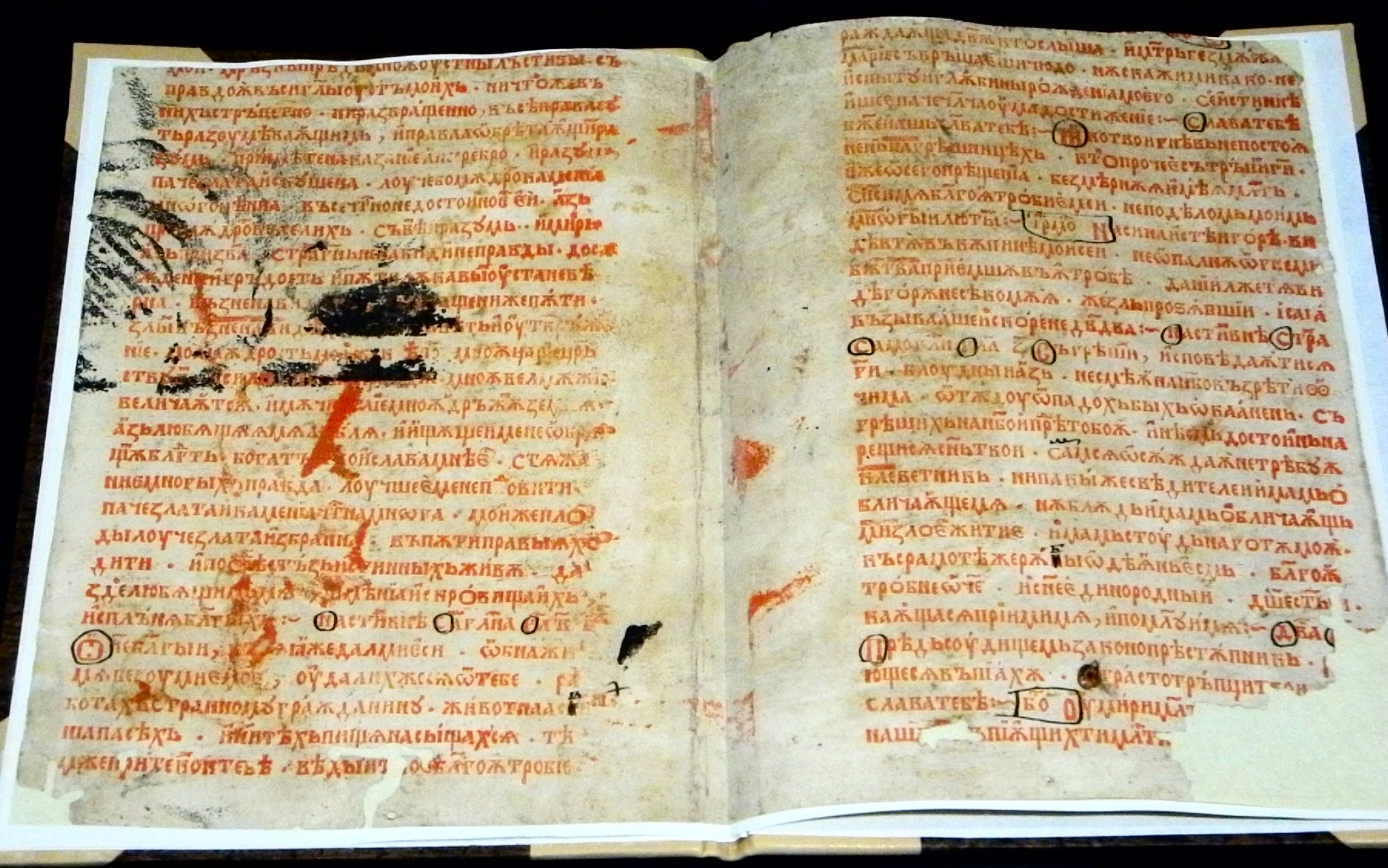
First known example of Cyrillic printing 1491
Finally, there is one of Mozart’s handwritten scores, this a one-act Singspiel, or comic opera, called Bastien and Bastienne, written when he was a boy and performed in the open air in 1768. The library’s large collection of original scores includes works by Berlioz, Chopin, Bach, Beethoven, Mendelssohn Bartholdy and other famous musicians, but Mozart had a special relationship with Kraków (and is possibly the world’s favourite composer), so that’s why I have chosen to feature his work here.

Mozart’s score for ‘Bastien and Bastienne’
It is difficult, if not impossible, to convey how exciting it was to be allowed to see these beautiful books and to learn their history from experts. I hope that I have managed to share a little of the excitement with you. And I’d like to thank Marek Krośniak and his colleagues very much indeed for providing all of our party with this wonderful opportunity.
All text and photographs on this website © Christina James
Salt… How appropriate!

Salt mine headstock
This is the second of my Polish pieces. I’m sorry that it follows on from the first after quite a gap – I’ve been hi-jacked by a nasty cold this week. I’ll try to be a bit more punctual from now on.
Cold notwithstanding, I should have preferred to get this post out earlier, because its main purpose is to share with you some photographs of our visit to the famous Wieliczka salt mine some seventeen kilometres outside Kraków. The chambers and carvings in the mine are spectacular – as you can see. Discovering them was an opportunity that we almost passed up, because we’re pretty averse to joining any kind of organised tour, and the salt mine is obviously not a place where tourists can be allowed to wander around on their own; indeed, so many tunnels are there, it would be very easy to get lost. We were persuaded to make the visit only the evening before, by some Danish people dining in the same restaurant. I suppose that making holiday plans on the advice of complete strangers about whom you know nothing and whom you’re never likely to see again is as good a way as any! In any case, I’m published by Salt and it therefore seems an appropriate kind of tribute to Chris and Jen Hamilton-Emery.
Determined not to be an entire pushover to the tourist industry, we travelled to the mine on an ordinary service bus instead of one of the special tour buses. For me, one of the highlights of the day was encountering people from the suburbs as they travelled on this bus, though I was much less enthusiastic about the return journey in the afternoon, when the driver was clearly behind schedule and rattled along at such a speed that I had to face the back of my seat and hang onto it in order not to be thrown into the aisle. I was grateful that I hadn’t had lunch! I was also fascinated to note that, beyond the suburbs, Kraków has quite an industrial hinterland.
Tours at the mine are extremely regimented and quite expensive – entry costs about as much as a visit to the Tower of London, which is extortionate by Polish standards. The experience was also shot through with a slightly bizarre streak: for example, our tour was called a ‘non-tour tour’ (we worked out that this meant that we were not part of a pre-booked group). Endearing rather than annoying was how the enterprise running the mine tried to make money out of absolutely everything, from coffees and ice-creams to printed guides, knick-knacks made of rock salt and ‘genuine miners’ soup’, but in a slightly amateurish way. It is noticeable in Poland that everyone is desperate to make money, but in a friendly, almost apologetic, manner. The same thought struck me when I was watching the drivers of the horse-drawn carriages in the main square in Kraków trying to cajole tourists into taking rides.
The non-tour tour guide was a young woman immaculately dressed in uniform. She was extremely professional and her English near perfect. She was obviously highly educated and very knowledgeable about the history of the mine, which has existed since mediaeval times. Rock salt was quarried there for seven hundred years, until 2002, after which the mine was devoted entirely to tourism. Engagingly, the guide explained that this was because more money could be made out of tourists than digging for salt. There is another commercial salt mine elsewhere in Poland, with much lower extraction costs, and that provides the supply.
I was almost as interested in my fellow tourists as the mine itself. We were a jovial bunch from many countries; the only thing we had in common was that we had chosen an English-speaking guide, rather than one who spoke the other languages on offer: Polish, German, Dutch, French or Italian. Our group therefore included people from India, Japan, China and the USA, as well as several other Brits. I particularly admired the Indian couple, who gamely negotiated with two quite small children the up-and-down kilometres that we had to walk within the mine.
The initial descent, down many short flights of wooden stairs within a vertical shaft, was neither frightening nor particularly taxing, if dizzily repetitive. Walking back up all of those stairs would have been a challenge, and might have caused a few heart attacks. Nevertheless, I didn’t enjoy the return to the surface, which had to be made in a small miners’ cage, crammed in with seven others. I was delighted to reach the exit and emerge into the warm autumn sunshine again.
I’ve already written more than I intended, so I’ll leave the pictures to speak for themselves now, just adding that all the sculptures and carvings – and indeed all the floors – in the mine have been fashioned from rock salt and that (although it is probably self-evident) Polish salt miners were very devout, some of the chambers having been turned into chapels, the most impressive being the Chapel of St. Kinga, which, with its altarpieces, wall-friezes and statuary, as well as carved floor, all in rock salt, is like a cathedral. The caverns are astonishing in scale (the Staszic Chamber has a ceiling thirty-six metres high), in some cases with self-supporting ceiling, in others prevented from collapse by elaborate wooden prop systems or by much more modern metal rods, inserted into drilled holes and therefore much less obtrusive to the eye.
I hope that you’ve got the taste of the salt from all this, if not a taste for a salt mine visit; you can lick the walls of the tunnels if you like (visitors are encouraged to do so)! Alternatively, you can read a Salt book…
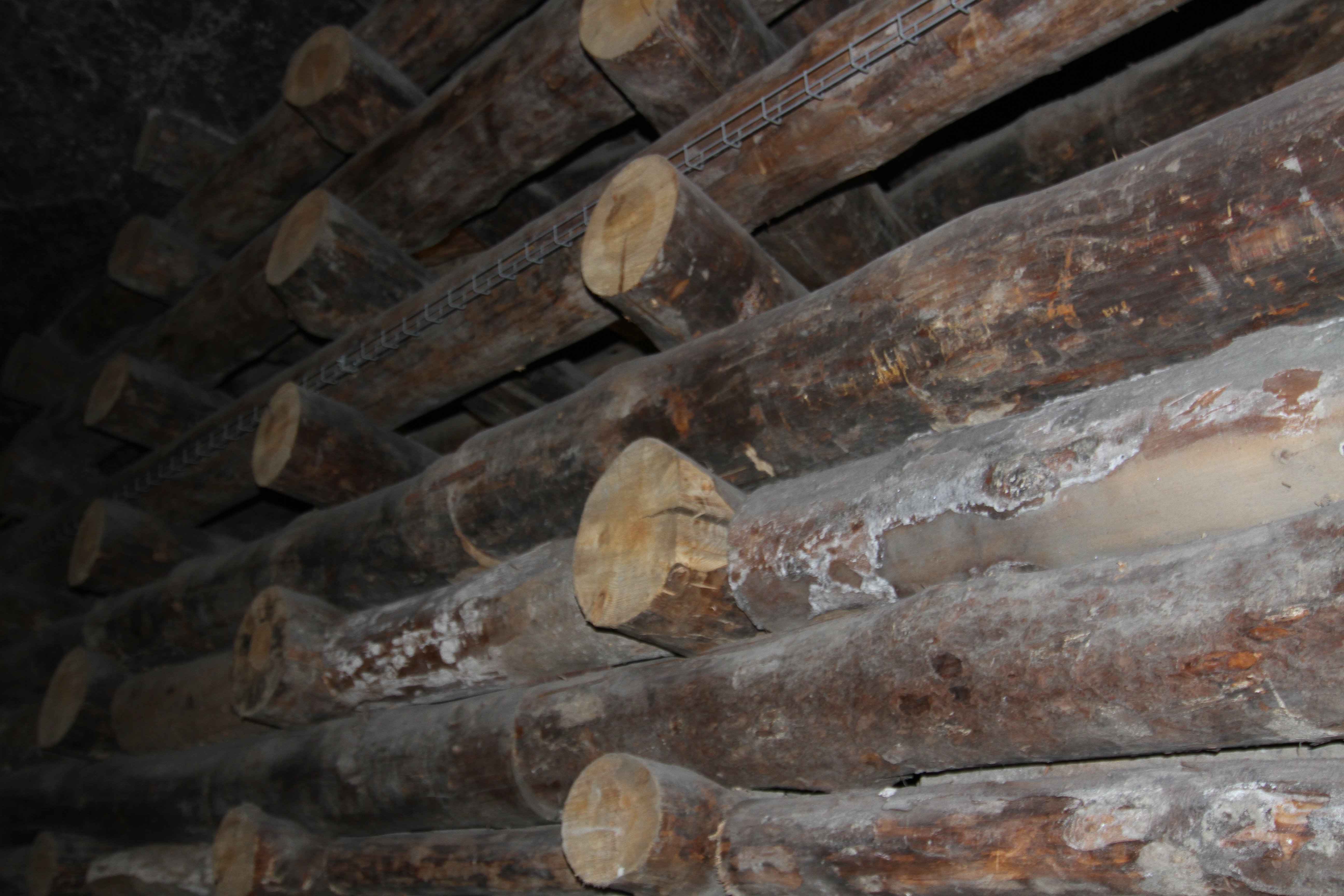
Traditional timber supports

Tribute, in salt

Raising the salt

Gnome from gnome?

Flight into Egypt, Kinga Chapel

Pulpit, Kinga Chapel

Solid salt floor ’tiles’, Kinga Chapel

Roof support system
An author to assuage hunger…

Discovering Rose Tremain
I remember exactly when I first discovered Rose Tremain. I had very recently joined Dillons (destined to merge with Waterstones within a year, though none of us knew that then) and had been invited to attend a party at Hatchard’s (a fine old bookselling business that had been acquired by Dillons some years previously) to celebrate its 200th birthday. Along with many colleagues, I accepted. As Dillons HQ was in Solihull, Teresa, one of our administrative assistants, was asked to find hotel accommodation in London overnight for those of us who requested it. Teresa had been supplied with a directory of hotels ‘approved’ by the company for use by its staff and, as I was to discover, had an unerring knack for picking out those that were most dismal and unwelcoming. Most of my colleagues made alternative arrangements. New to the company, I put my trust in Teresa’s mercy.
The party was the most glittering book trade bash I’ve ever attended. Princess Margaret was there, resplendent in elbow-length gloves and drinking something from a tall glass wrapped around with a linen napkin. Salman Rushdie had dared to attend, even though it was only a year or so after the fatwa against him had been issued. The other guests included dozens of well-known writers and publishers. As you can imagine, security was very tight.
The evening was ‘elegant’. I use the term in a way that was new to me then, but in which I’ve had other occasion to use it since. As I’ve previously mentioned, the first bookselling company that I worked for was in Yorkshire and the second in Scotland. Both hosted many literary events and all of these shared a single prominent common feature: we ensured that our guests were served a plentiful repast of excellent food. We believed in feeding the body just as much as the mind. In Yorkshire, we favoured sides of salmon, roast hams, salads, pizzas and quiches and generally included a selection of gooey puddings; in Scotland the food was usually hot and hearty: soups, pies, lasagnes, stews and curries. But always food, ‘proper’ food, and plenty of it. And drinks, too, of course, though the food was paramount.
At the party at Hatchard’s, on the other hand, the wine flowed but the food was sparse. Exquisite, but sparse. It consisted of tiny canapés that were delivered individually at long intervals by uniformed waiters and waitresses who bore them aloft on circular trays. There were miniature salmon rolls, morsels of pastry stuffed with even smaller slivers of meat and cheese, the babiest of baby sausages skewered with eighths of tomato and Lilliputian biscuits bearing deftly-placed dots of pâté, each one garnished with a parsley feather. The waiting staff weren’t particularly keen to distribute these fairy victuals, either: sometimes it was impossible to snatch one before it continued on its airborne journey through the crowd.
The upshot of this was that, when eventually I arrived by taxi at my hotel, which belatedly I had discovered was situated in the further reaches of Camden, at around 10 p.m., slightly tipsy and completely famished, I found that not only did the establishment serve no food (it would not even be providing breakfast on the following day), but that there was no restaurant or even a takeaway within a radius of at least a mile. I took one look at the dark and dingy street beyond its none-too-hospitable doors, and decided that I would be foolish to risk venturing forth in quest of sustenance now. I therefore toiled up the three flights of stairs to my room (it wasn’t the sort of hotel that offered to help with luggage) where I found a narrow single bed in a cheerless room with no bedside lamp and an ‘en suite’ shower behind a plastic curtain in an alcove. The lavatory was outside, shared with the occupants of the other rooms on the same floor.
Mercifully, my room did contain a kettle and some sachets of coffee and tea (the brand-names of both were unfamiliar) and two or three of those little bucket-shaped plastic containers of UHT milk. Too cold and hungry to go straight to bed, I made myself a cup of indifferent but scalding coffee, groped in my bag in the hope that I hadn’t absent-mindedly eaten the cereal bar that I’d placed there some weeks before (I hadn’t) and fished in it again for the book that I’d snatched from a stash at Dillons HQ for staff to help themselves to before I’d caught the train to London many hours earlier. It was Restoration, by Rose Tremain. Immediately, I was enthralled. I drank my coffee, ate my cereal bar and read. And read. I went to bed some hours later, my hunger forgotten, and slept soundly until the following morning, when I rose early in order to find breakfast and get another quick fix of Restoration before the day’s work started. I had become a Rose Tremain addict.
I had intended this post to be a review of Merivel: a man of his time, by Rose Tremain, which I have just completed, but I’ve probably written as much as you want to read for now, so will save that for another day.
 Christina James, crime novelist