

From Wakefield to Covent Garden, ‘Sausage Hall’ has found great friends!

Launching ‘Sausage Hall’ at Wakefield
This is the final post on my launch week activities for Sausage Hall. I’m covering the last two events: Tea at Sausage Hall, an imaginative tea-party given last Wednesday by Alison Cassels, Lynne Holroyd, Claire Pickering and their colleagues at the Wakefield Library at Wakefield One, which regular readers of this blog will know has provided me with granite-strength support ever since In the Family was published two years ago,

Tea at Sausage Hall (And yes, there was cake!)
and an evening of conversation and readings at the Covent Garden branch of Waterstones, rounding off the celebrations with a London launch on Thursday.
Ever resourceful, Alison and her team provided sausage rolls, cake (Yes, there was cake!) and biscuits for the tea party. (Her e-mail to me when organising the event reads ‘Can you put chocolate cake in the title of your next book?’)

Lynne Holroyd, the liveliest purveyor of refreshments I’ve ever known!
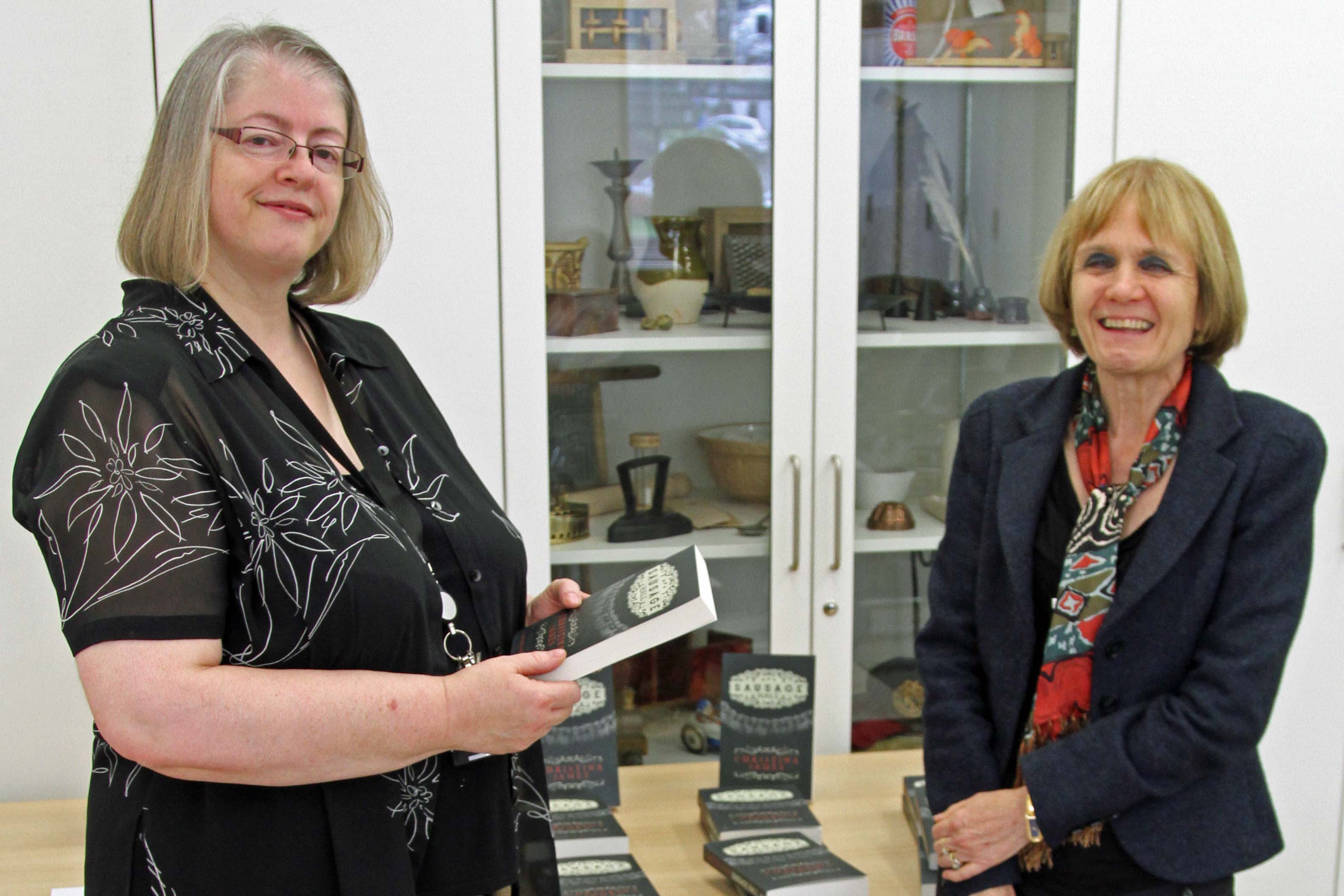
A warm welcome, as always, from Alison Cassels
As always, she promoted the occasion superlatively well and attracted a lively and engaging audience, amongst whom were old friends (such as Marjorie and Pauline – both also fab visitors to my blog) from the library’s book club, as well as many interesting new faces.
There’s obviously a lively and diverse events programme at Wakefield One: under the table bearing the tea-cups was a box containing a plastic skeleton (I was rather disappointed that someone arrived to remove it, as a suitable visual aid never goes amiss), while high on one of the shelves was a stuffed green parrot in a glass case. (My husband dared me to say ‘Norwegian Green? Is it nailed to its perch?’, but, though tempted, I’m afraid I failed to rise to the occasion, having on my mind things other than late parrots gone to meet their maker.)
Wakefield One audiences are truly wonderful.
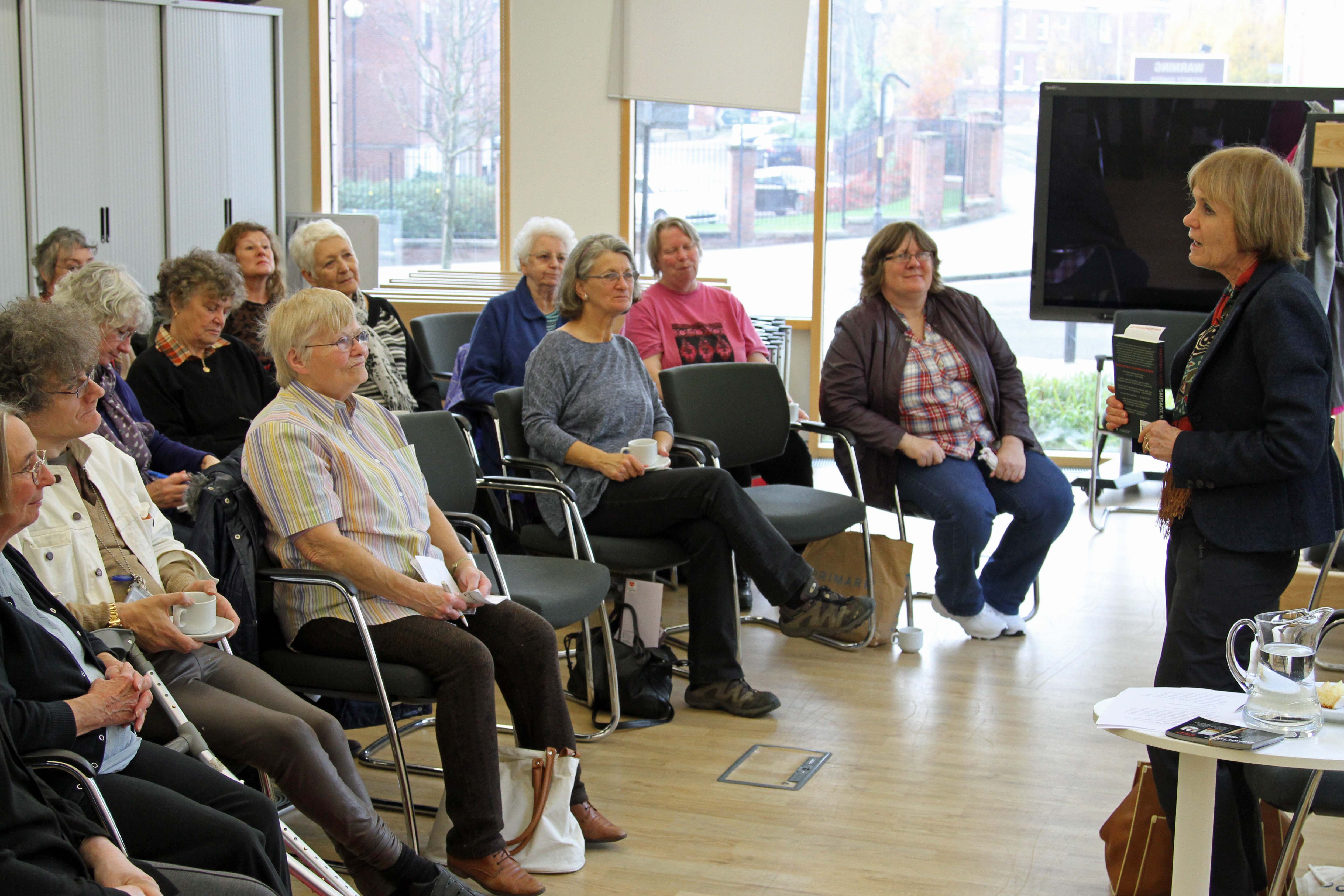

They are united in their love of books and reading, and not afraid to tell it how it is. I’m delighted that they like my novels, because they would certainly tell me if they didn’t – during the course of the afternoon, they told me exactly what they thought of the work of a writer who is much better known than I am! As well as being extremely perspicacious, they’re fun and they like to have fun.

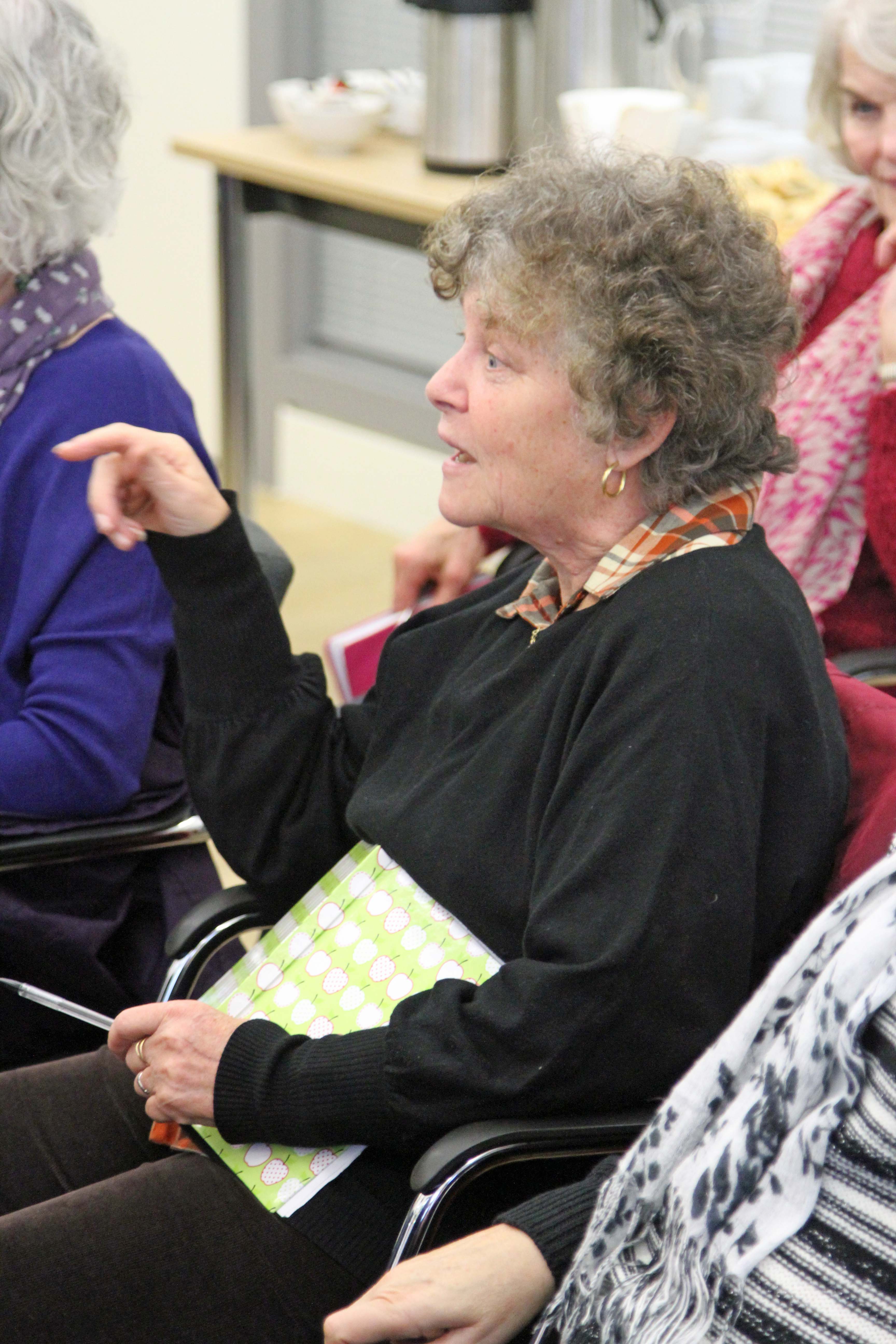
They know what they want and they want more of it: I’ve already promised to return to talk to them about DI Yates numbers 4 and 5. It was my first Wakefield audience that told me how much they enjoyed reading about Juliet Armstrong and that they’d like to see more of her. I hope that they’ll think I’ve done so in Sausage Hall, where Juliet’s story takes a new turn.
Several of the Wakefield readers had already bought Sausage Hall and came armed with it for me to sign. Others bought it during the tea-party; as at my other Wakefield events, the books were kindly supplied by Rickaro Books in Horbury. A man in the audience asked for an interesting, and very relevant, inscription (see caption): apparently, these are the nicknames of his brother and sister-in-law!
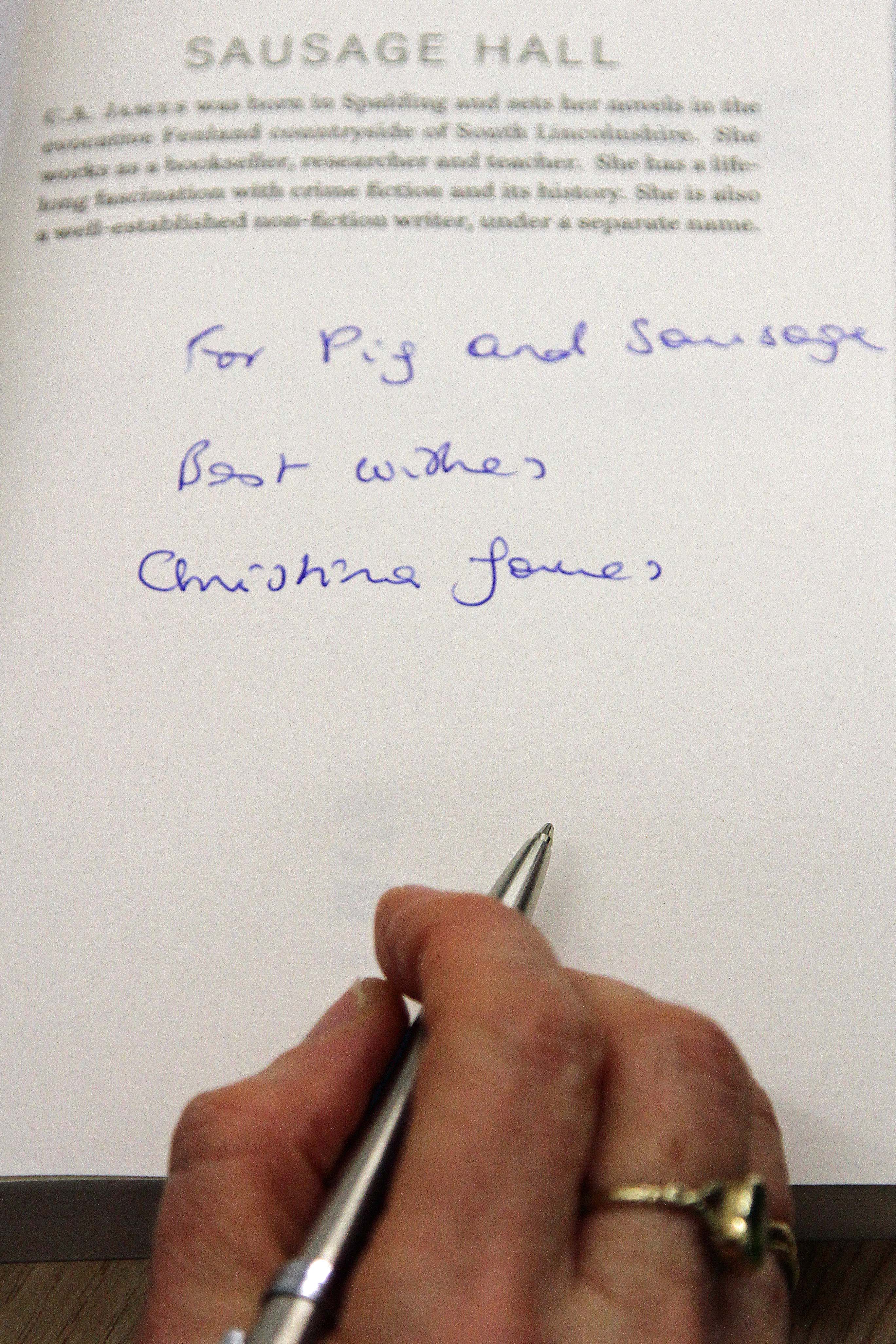
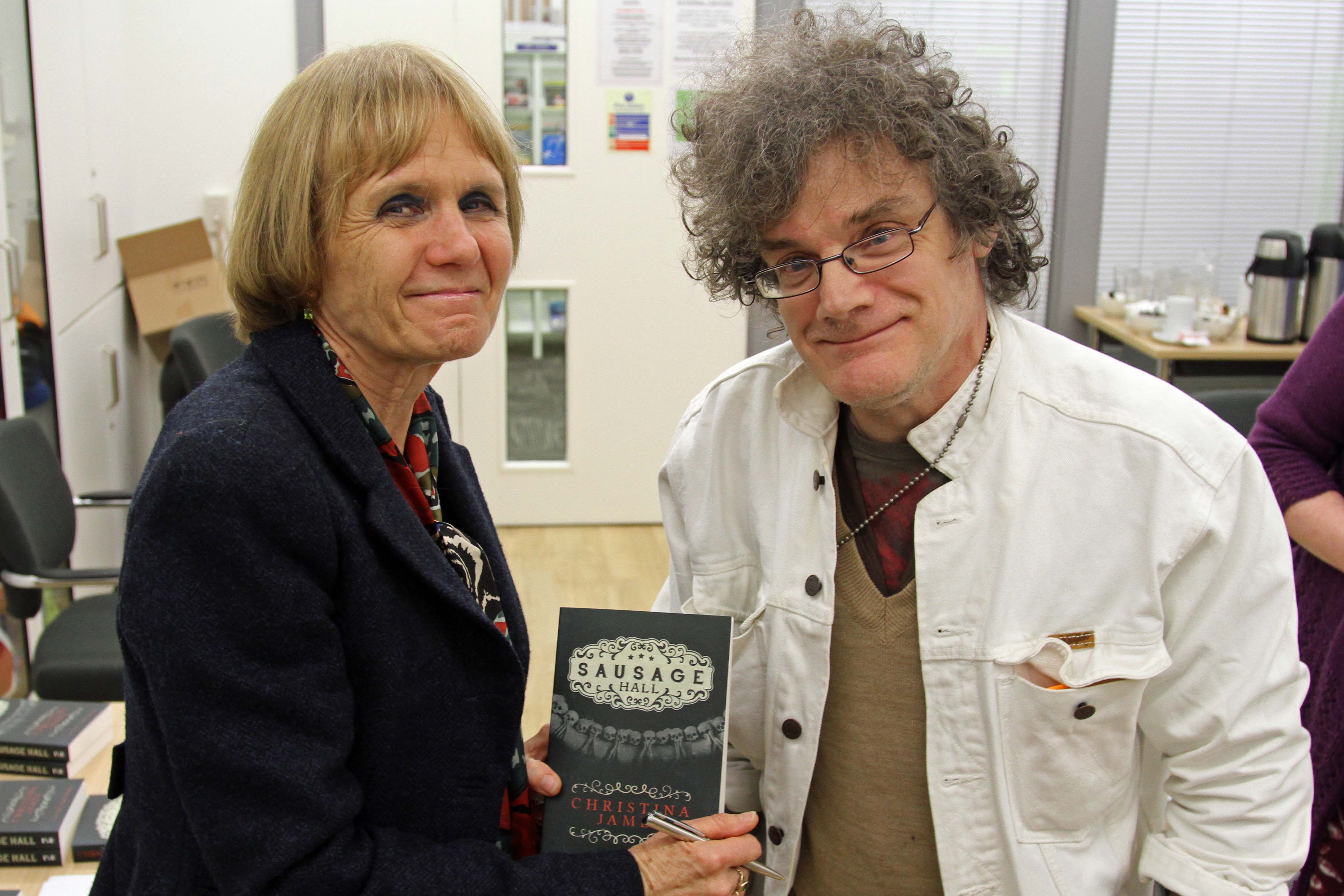
To Pig and Sausage, with love!
The event at Waterstones Covent Garden was masterminded by Jen Shenton, the bookshop’s lovely ‘can-do’ manager.
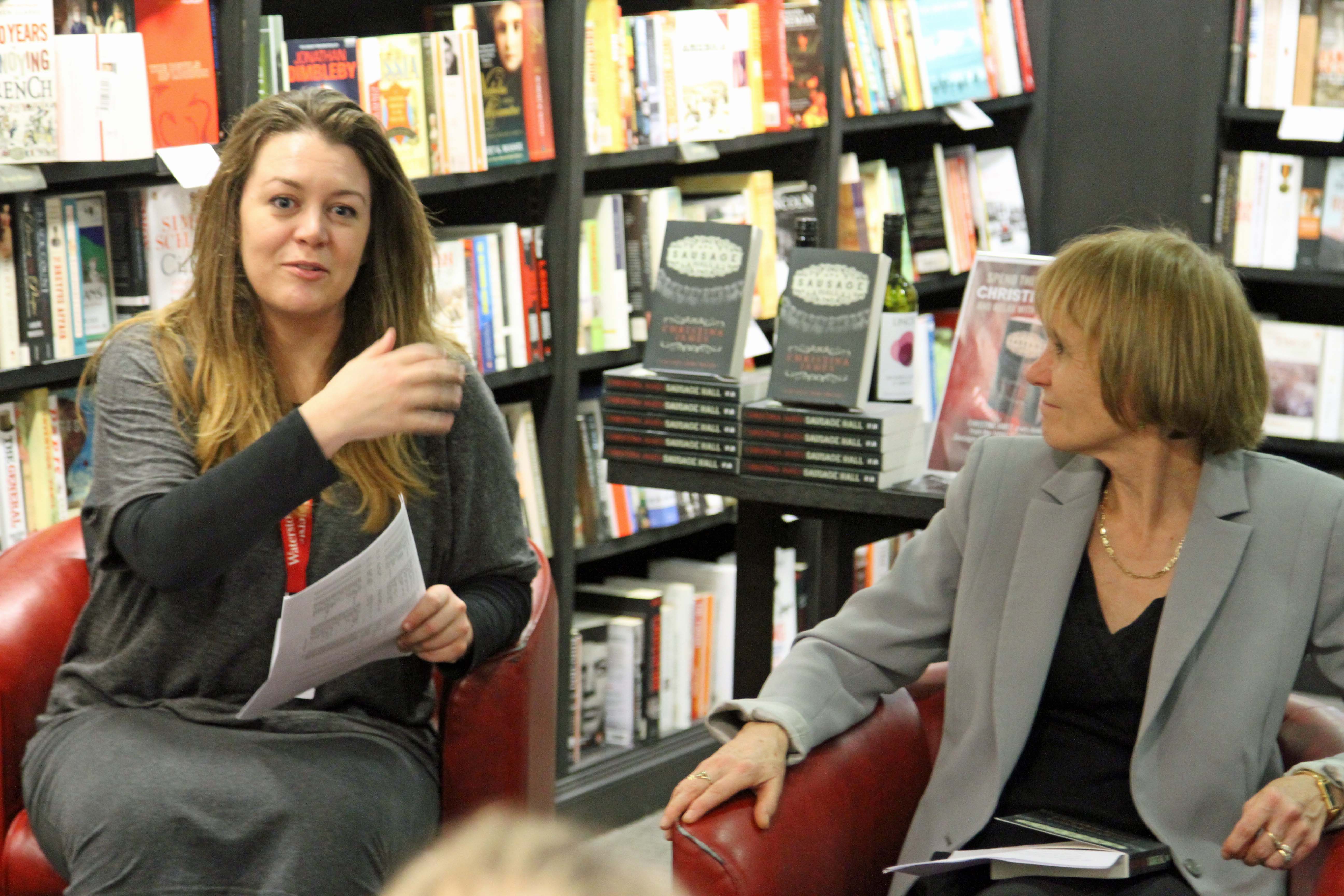
Waterstones Covent Garden Manager Jen Shenton welcomes me to her beautiful bookshop
I hadn’t met her before, but as soon as I saw her I knew what a distinguished bookseller she is. It’s something you can’t fake: I honestly believe that the best booksellers are born, not made, though that’s not to say they don’t work hard all the time in order to stay ahead. I didn’t leave Jen’s shop until almost 9 p.m., and she was still there behind the till, helping customers, smiling and looking as fresh as a daisy, even though she must have been feeling exhausted.
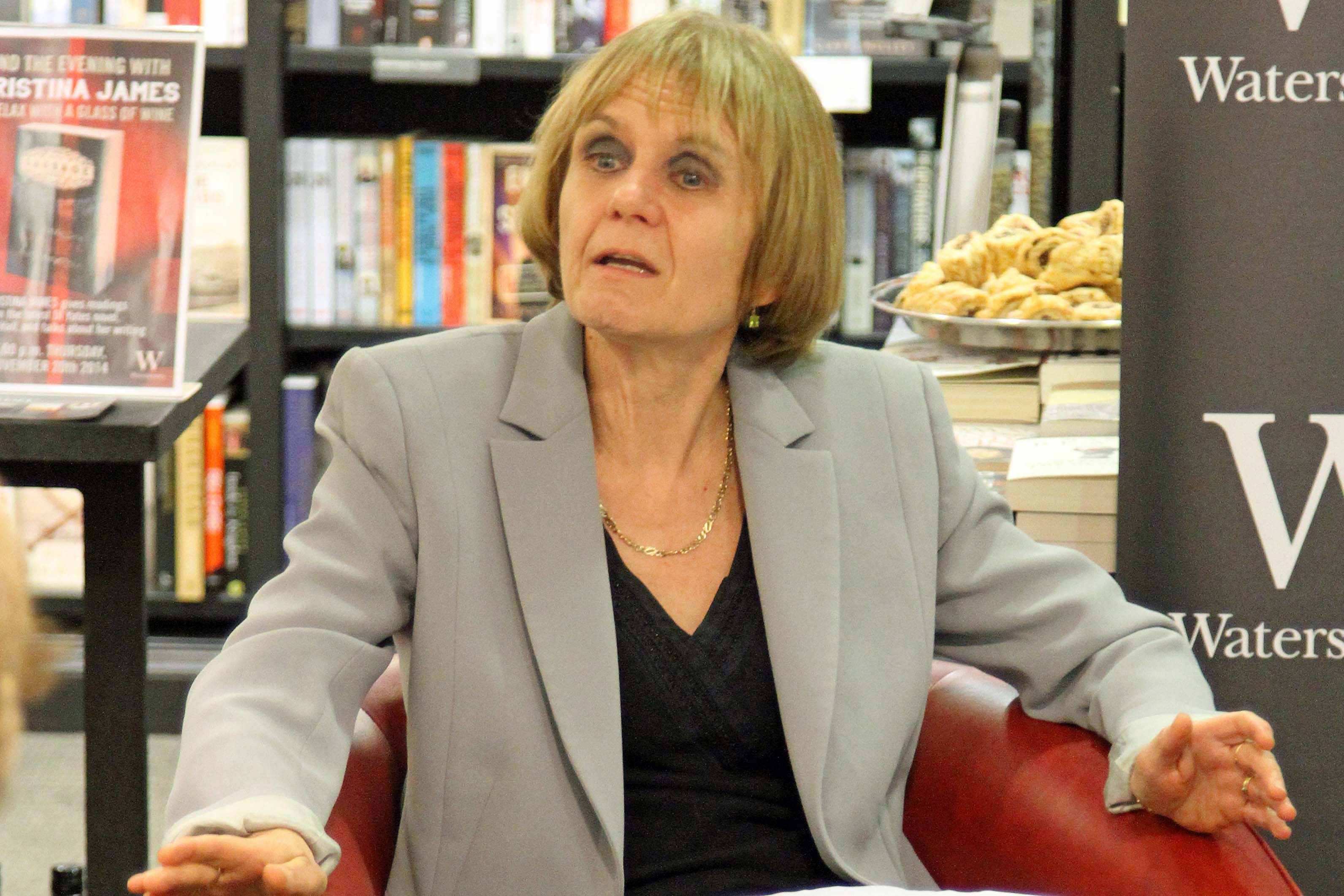
This event also had a wonderful audience.
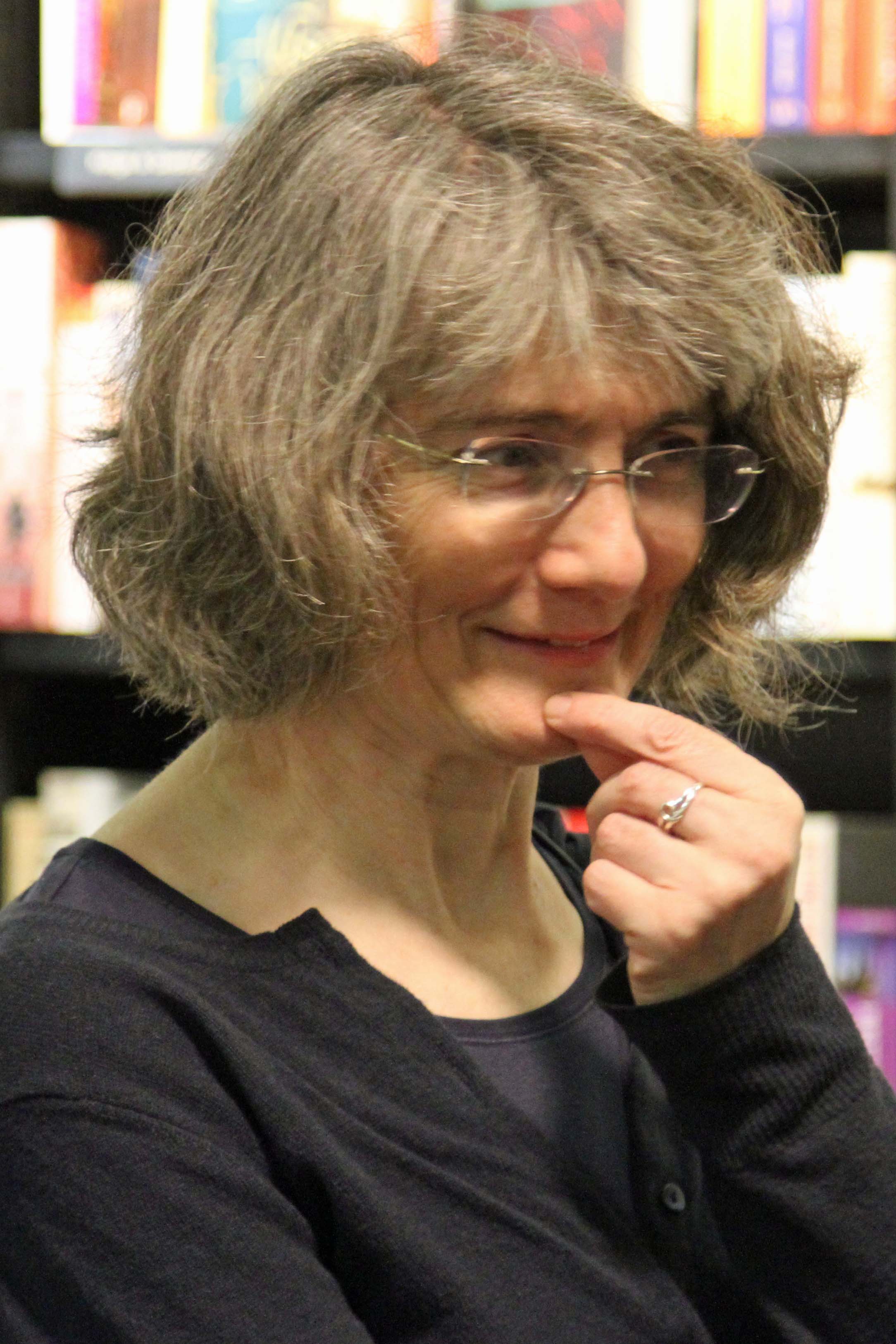


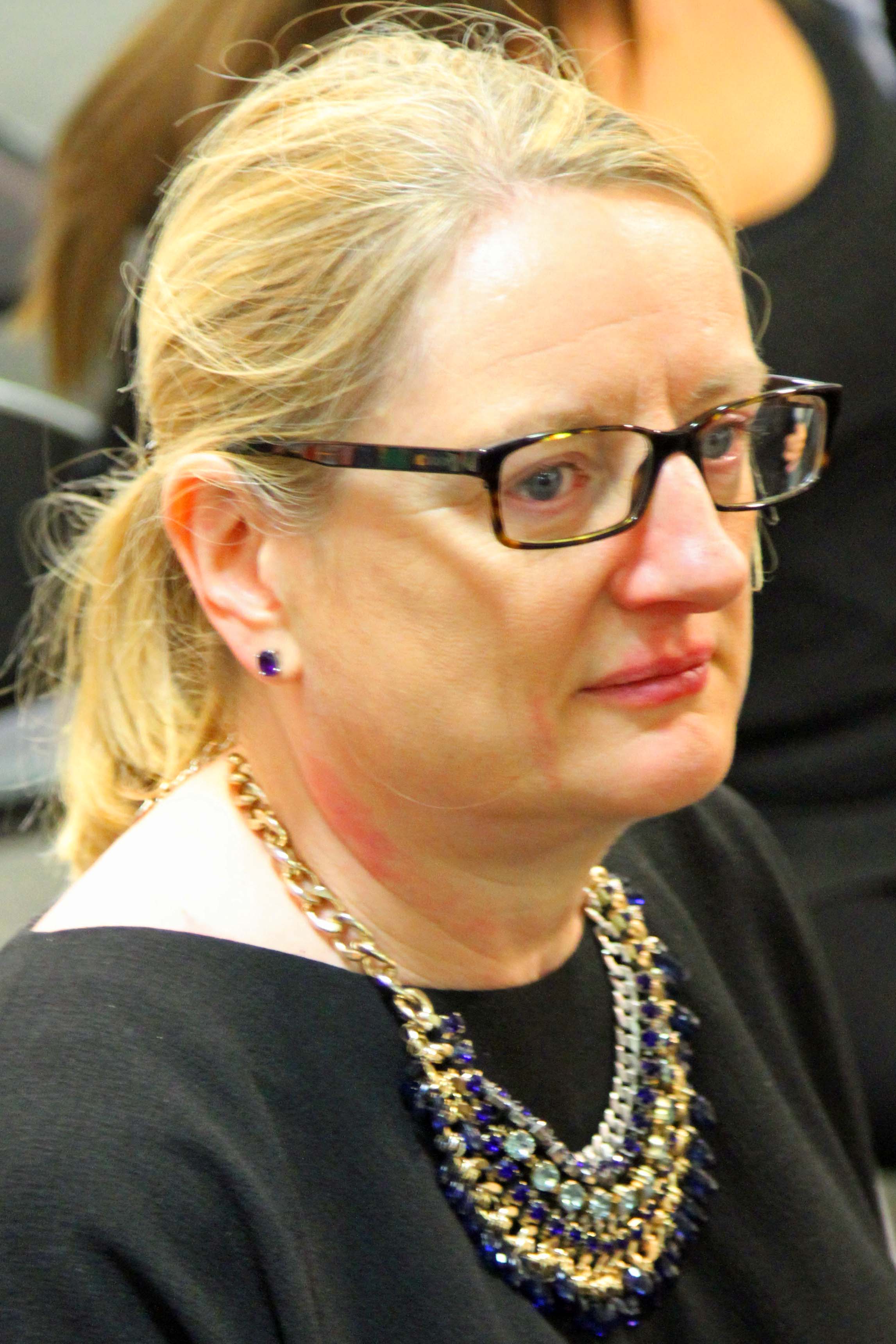

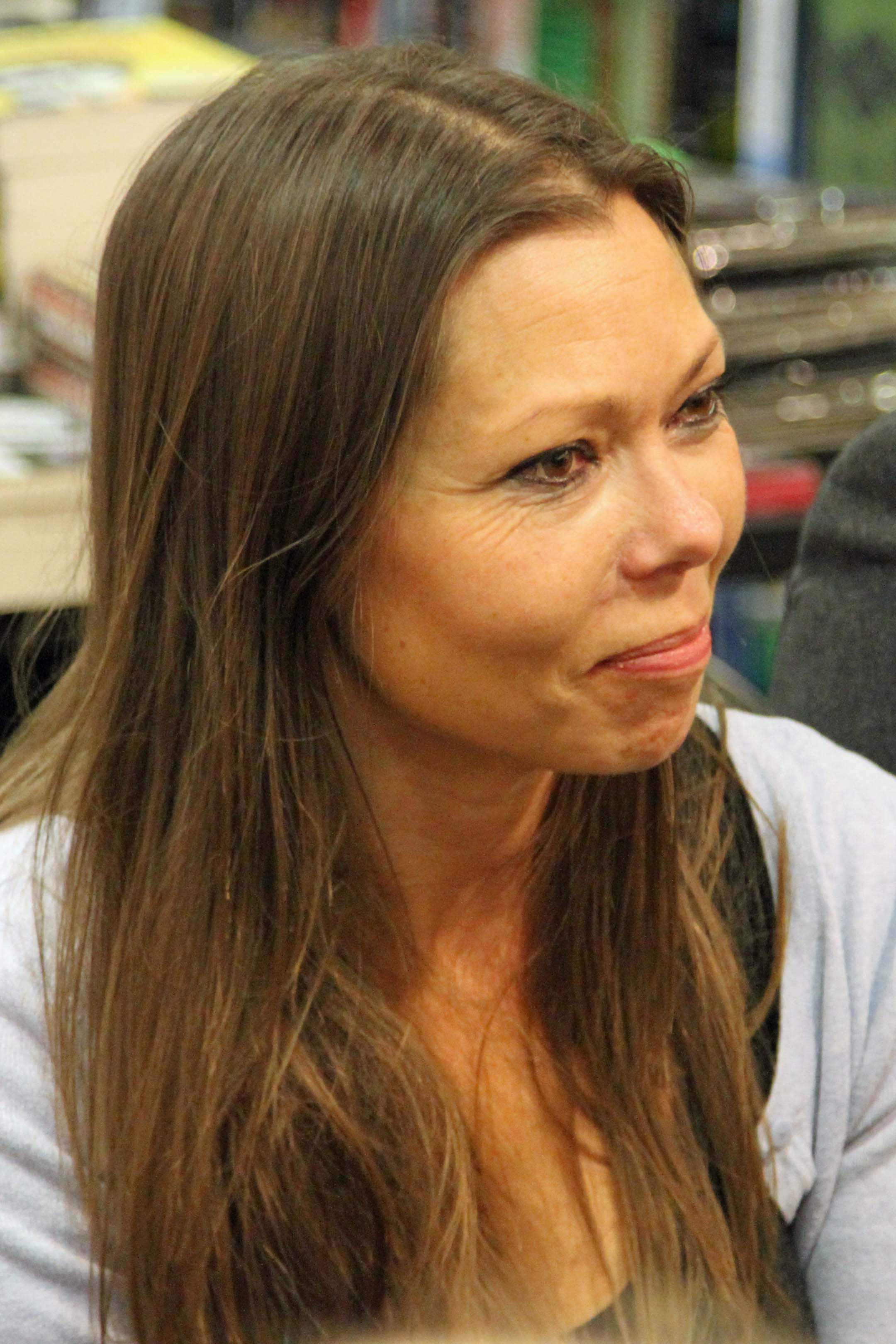


Many of my friends from the book industry came (which meant they bowled me a few googlies when it came to the questions). It was a light-hearted, laughter-filled evening, well lubricated with Waterstones wine and sustained by Adams & Harlow sausage rolls. I was delighted that Tabitha Pelly, who has worked with Salt on PR for Sausage Hall, was able to come. Like Jen Shenton, she seems never to tire or have a negative thought in her head.
I left the shop laden with some book purchases of my own and headed for King’s Cross station to catch the last train. It was the perfect end to an extraordinary week. My only sadness was that Chris and Jen Hamilton-Emery, my publishers at Salt, were unable to come. But I know that they’ve been keen followers of my progress as I’ve sprung Sausage Hall upon the world and I look forward to catching up with them next week. Today is Chris’s birthday: I’d like to take the opportunity to wish him many happy returns!

Grateful thanks, once again, to Adams and Harlow for their wonderful sponsorship of the launch of Sausage Hall.
Two events for Sausage Hall in two amazing bookshops
In this extraordinary Sausage Hall launch week, which I am enjoying so much and for which I am very grateful, I’d like to pay tribute to two amazing bookshops.
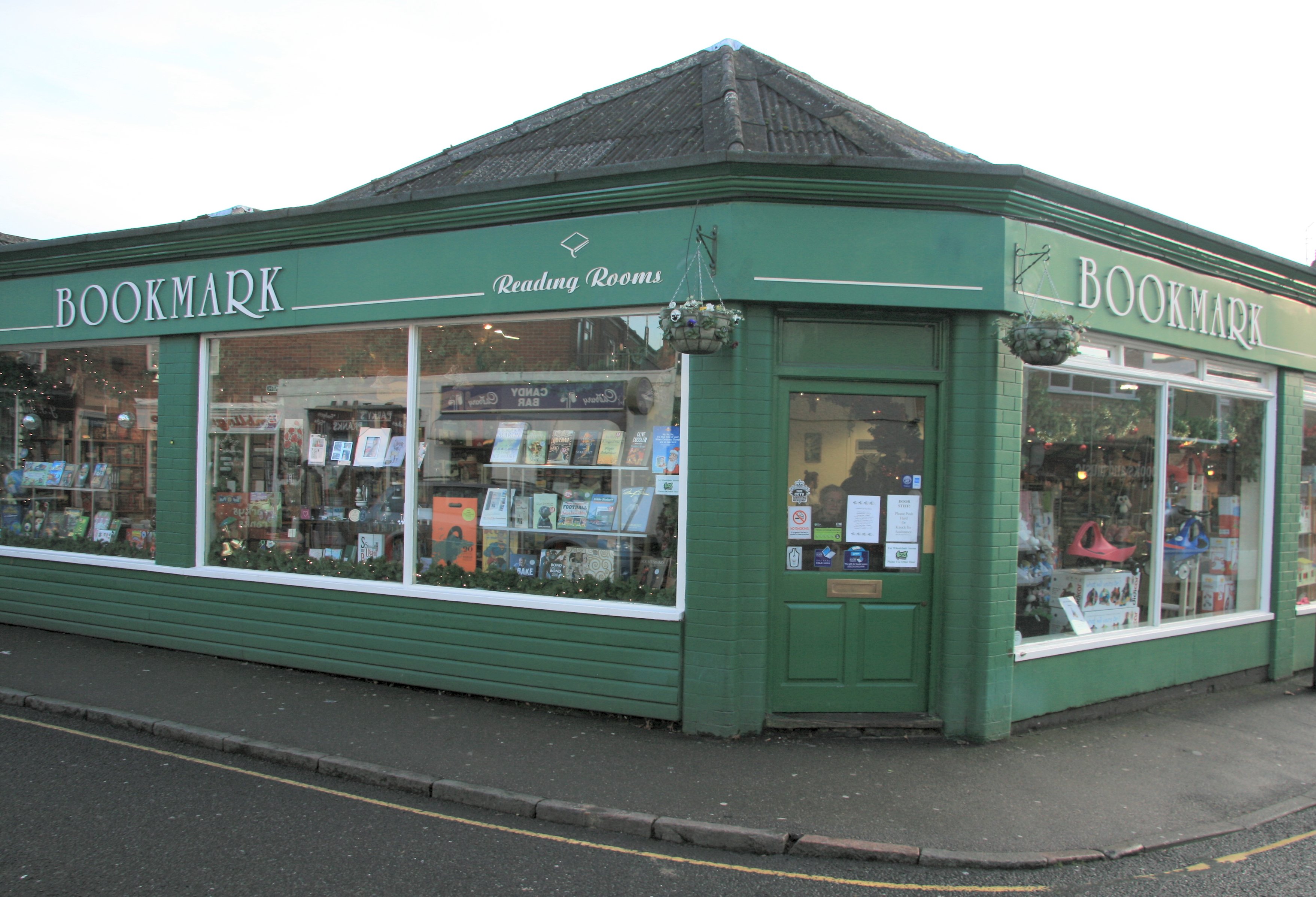
Bookmark, Spalding
The first is Bookmark, Spalding’s very distinguished bookshop (the CEO of the Booksellers Association, Tim Godfray, has even been known to serve behind the till there on occasion). Bookmark very generously offered to host the Sausage Hall publication day party, which took place in the evening of November 17th, after the day that I spent at Spalding High School. The event was masterminded by Christine Hanson, the owner of the shop (who is both practical and imaginative – she fixed both a toilet roll holder and a broken table joint within minutes of my arrival, while the shop itself, resplendent with its Christmas stock and decorations, achieved a standard that I’d have dearly liked to replicate in my bookselling days), and Sam Buckley, also a former pupil of Spalding High School, who organises author sessions at the shop. Equally generously, the launch party was sponsored by Adams and Harlow, the local pork butchers, who supplied sausage rolls for the occasion.

Having fun at Bookmark
This event was attended by members of Bookmark’s lively reading group and some old friends of my own. I was astounded to see Finola, a day-job friend – she had driven for more than an hour from Cambridge in order to support me. I was also staunchly supported by Madelaine, one of my oldest friends, and her husband, Marc, who have both offered me hospitality every time I’ve returned to Spalding as Christina James and also bought many copies of my books as presents for everyone they know who might enjoy them.
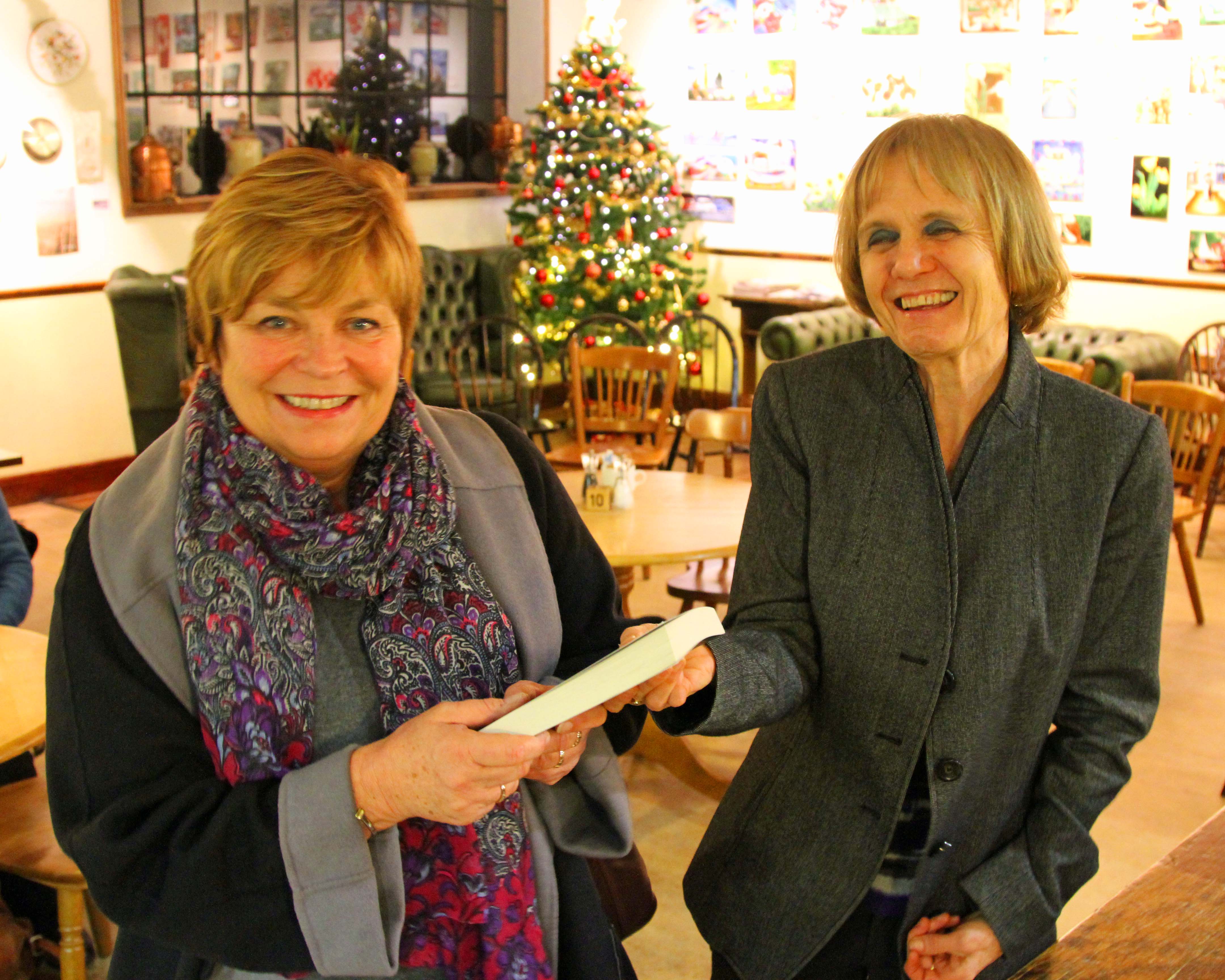
With Madelaine at Bookmark
Madelaine’s contribution to my writing is acknowledged in Sausage Hall. I was also delighted to see Sarah Oliver, whom I first met at the Priory Academy last spring and who came with her husband. The book club members, who lived up to their reputation for being engaged and vivacious, were shrewd and perceptive: as well as listening attentively to two readings from Sausage Hall, they launched into an animated discussion about all three DI Yates novels. Everyone present bought at least one of the books, some more than one. (Sam Buckley later this week let me know that one member of the audience, who had not read any of the novels and took away with her In the Family, returned within forty-eight hours, having read it, to acquire Almost Love and Sausage Hall as well!) And, of course, I couldn’t myself resist making a few purchases in this fairy-tale bookshop.
Having spent the night with my son and daughter-in-law at their house in Cambridgeshire, I arrived in good time on Tuesday November 18th for a signing session at Walkers Bookshop in Stamford. Although I first met Tim Walker, its owner, last year (he’s currently President of the Booksellers Association), I had not visited one of his bookshops before, The one in Stamford is in a listed building in the town centre; he also owns another in Oakham. I was particularly impressed by the huge range of stock in this shop, both the cards and gifts downstairs and the extensive range of books upstairs. Tim and the manager, Jenny Pugh, were respectively at the other shop and taking holiday, but everything had been set up for me and Mandy, the assistant manager on the book floor, couldn’t have made me more welcome.
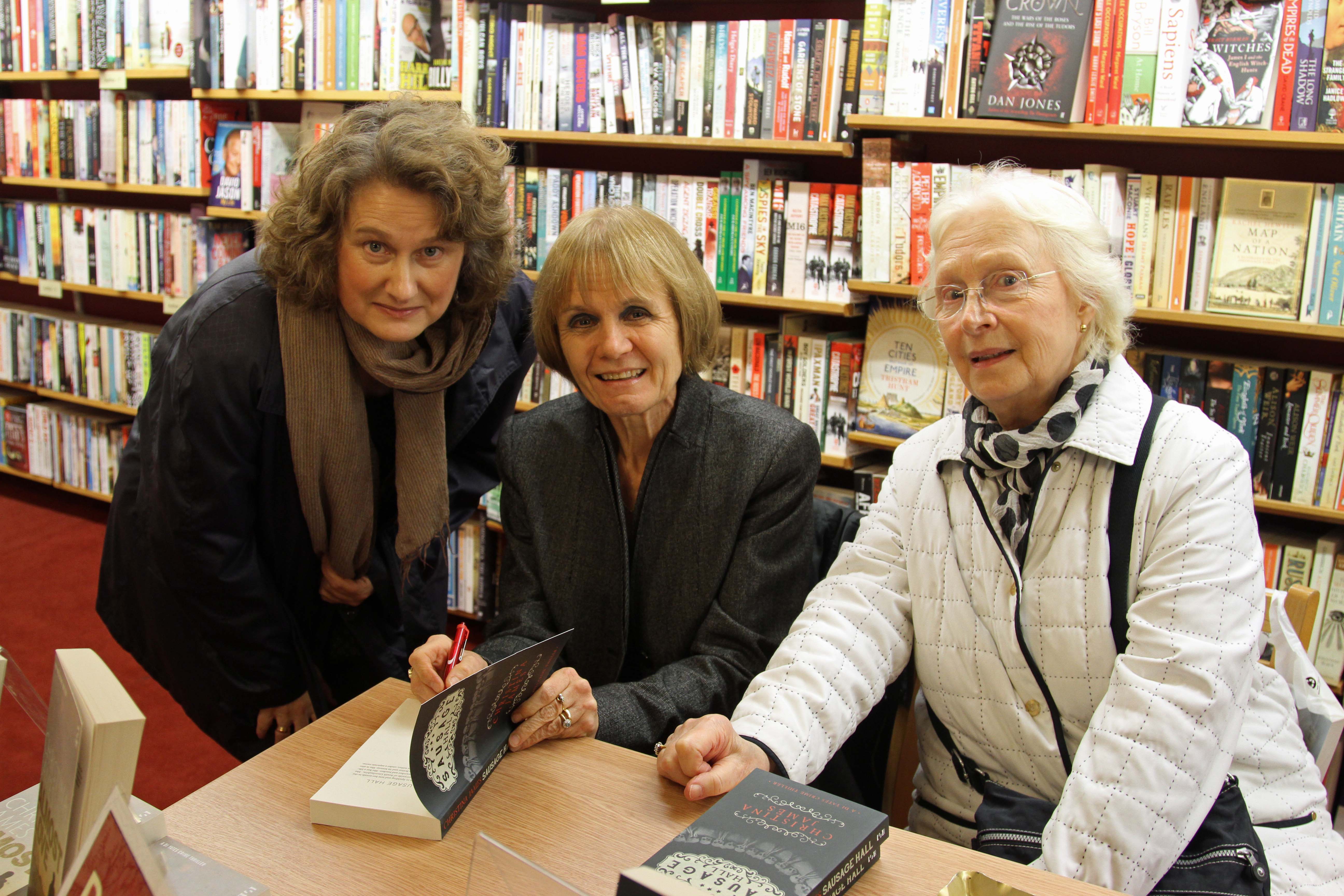
Signing Sausage Hall for Elaine and Sheila at Walkers, Stamford
Bookmark and Walkers are two fine examples of thriving independent bookshops, packed with atmosphere and individual charm and led by brilliantly creative people who understand how to serve their communities very well indeed. It was a privilege and a pleasure for me to have been able to enjoy what they had to offer and I’d very much like to thank Christine and Tim for hosting Sausage Hall events this week.

Walkers, Stamford
Adams and Harlow: Kind sponsors of ‘Sausage Hall’

As you will know from my previous post, the launch of ‘Sausage Hall’ is being sponsored by a Spalding company I grew up with. In fact, I went to Spalding High School with one of the daughters of the family! I certainly remember that their products graced the tables not only of my own household, but those of all of my friends and relatives as well. The Lincolnshire family firm of butchers, George Adams, based in Spalding, has been associated with great sausages, meat and fantastic handmade pork pies for nearly a hundred years. But now, Mary and Lizzi, the great-grand-daughters of the founder of the first shop, are launching a new brand: Adams & Harlow, which will undoubtedly be noted for the same extraordinary pork pies and sausages.
Mary and Lizzi’s pork pie heritage consists not just of George, but of their other great-grandfather too – Dick Harlow, whose family set up a butcher’s shop in Boston, Lincolnshire in 1895! So, whilst Adams & Harlow is a new venture, its two founders have extraordinary expertise and an amazing heritage with great provenance and tradition.
As was the way a hundred years ago, each Adams & Harlow pork pie is individual and made with only the finest ingredients, including 100% British meat. As each hand-raised pie takes two days to make, with sixteen different stages to complete before it even enters the oven, every one is the product of extraordinary skill passed down through the generations! Adams & Harlow pork pies taste every bit as delicious as those made by George and Dick all those years ago.
Based in the original George Adams butcher’s shop in Spalding, Adams and Harlow still make the ever-popular Lincolnshire Sausage recipe, using top-quality British pork and secret seasoning blend.
Adams and Harlow products are available at a number of regional and nationwide independent shops, details of which appear on their website; they can be ordered online from British Fine Foods and Ocado as well as bought directly from the original George Adams butcher’s shop in Spalding.
I’m delighted and honoured to have been sponsored by Mary and Lizzi, who will be providing their wonderful fare at Monday’s November 17th ‘Sausage Hall’ launch at Bookmark, Spalding, and at the London launch at Waterstones, Covent Garden, on Thursday November 20th. A fitting accompaniment to a story based in a Lincolnshire house built by a butcher!
Strong links in the chain to ‘Sausage Hall’, to be published Nov. 17th 2014

I am extremely grateful to you, the readers of this blog, both those of you whom I’ve met in person and those from countries around the world whom I’ve met ‘virtually’, for the huge welcome that you have given Sausage Hall. Thank you very much indeed.
As many of you know, Sausage Hall will be published next Monday, November 17th. My wonderful publishers, Chris and Jen Hamilton-Emery at Salt Publishing,
 their equally stellar PR consultant, Tabitha Pelly, Faber (which now represents Salt titles) and my bookselling and librarian friends have combined to make happen a series of celebration events.
The first of these is today, Thursday November 13th, when Nicola Gilroy will be interviewing me live on Radio Lincolnshire at 14.05. I hope that you will be able to listen; if not, I think the interview will be on iPlayer for twenty-four hours after broadcast.
Monday November 17th is a very special day indeed. I’m spending much of it at Spalding High School,

where I was once a student (Facebook doesn’t know this, having inexplicably assigned me to Wycliffe Senior School and Sixth Form College! I don’t intend to disabuse it!). I’m giving a young writers’ workshop and talking about how I came to write Sausage Hall, but first of all I’m being taken on a tour of the school by Adrian Isted, the present Head of English. I’m really looking forward to this, and especially to meeting the students.
Also on November 17th, in the evening, Bookmark, Spalding’s very distinguished bookshop,
is hosting the official launch event. This will begin at 19.00. I’m delighted to be able to announce that it is being sponsored by Adams and Harlow, the pork butchers, who will supply sausage-themed canapés. Wine will also be served. As well as signing copies of Sausage Hall, I’ll be giving some readings and talking about all the DI Yates novels. I’d like to offer my thanks in advance to Christine Hanson and Sam Buckley, who have supported all the novels as they’ve been published. In conjunction with Spalding Guardian, they’ve also arranged a DI Yates competition, the prizes for which will be four sets of the DI Yates titles.
On November 18th, I’m travelling to Walkers Books in Stamford,

where I’ll be signing copies of Sausage Hall and talking about it informally between 11.00 and 13.00. I’d like to thank Tim Walker and Jenny Pugh for all their support. More about this may be found here.
Wednesday November 19th finds me back at wonderful Wakefield One, where Alison Cassels has organised Tea at Sausage Hall, an informal talk-and-signing session, with refreshments, that will start at 14.30. Regular readers will know that Wakefield One has been a particularly magnificent supporter of mine. Books will be supplied by Richard Knowles of Rickaro Books, another staunch supporter.
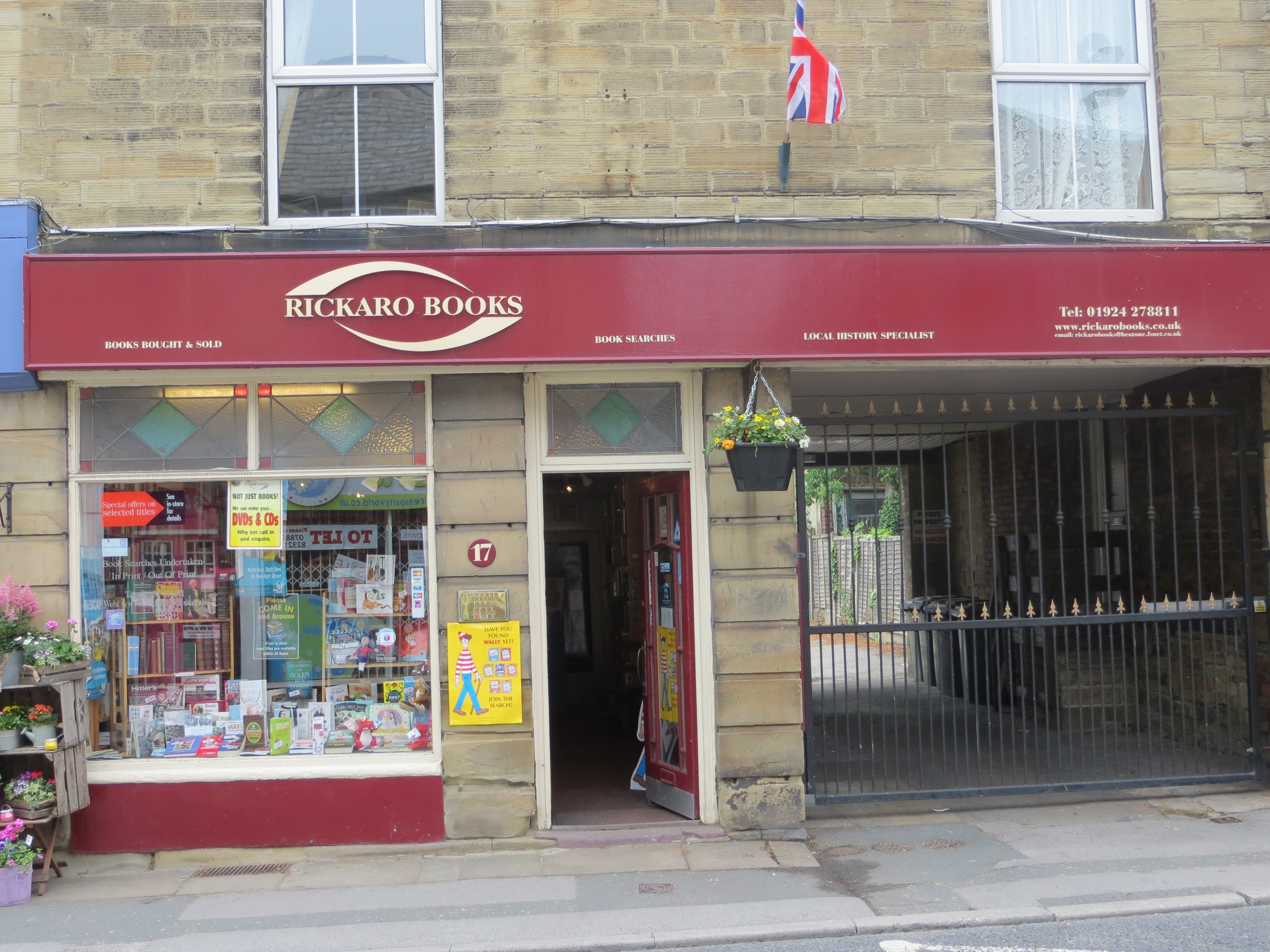
Rickaro Books, Horbury
There is more about Tea at Sausage Hall here. If you live in the Wakefield area or are visiting, it would be great to see you at this event.
On Thursday November 20th the Waterstones bookshop in Covent Garden is giving a London launch event. As Adams and Harlow are sponsoring this, too, there will be sausages as well as wine! This reading and signing session will begin at 19.00 and continue until the shop closes. It has already attracted a large audience, so it should be quite a party! The store’s brilliant manager, Jen Shenton, and I would be delighted to see you there. More information can be found here.
And Friday 21st November? At present, nothing is planned, so this will be a rest day… but I’m open to offers!
In in verse proportion: half the stress; double the delight!

Richard of Rickaro Books presents the Tracey Emin-endorsed Books Are My Bag bag
Yesterday I spent a superlative afternoon at Rickaro Books, Horbury, to celebrate three events: the launch of Holding Your Hand Through Hard Times, by A Firm Of Poets (some of whom are now also Firm Friends of this blog!) on the first day of this year’s Books Are My Bag festivities; the birthday of one of Rickaro Books’ regular customers; and last, but by no means least, the thirteenth birthday of Rickaro Books itself. Toasts were drunk in sparkling wine while it rained outside: a wonderfully cosy and pleasantly decadent way of spending a Saturday afternoon!
The four poets who performed yesterday were Ralph Dartford, a founding member of A Firm Of Poets, accounts of whose at once tongue-in-cheek and poignant performances (‘Now then! / In November 1950 / Pablo Picasso / visited Sheffield / for a hair cut, / Peace, / and some toast.’) have graced this blog before (he has a lovely wife who always supports his performances);

Ralph Dartford
Matt Abbott, a born performance poet, whose rendering of a pathetic yet comic drunk was particularly hilarious (‘I’ll have a bottle of Beck’s from the fridge / ‘cause you all might have stopped drinking / but I’m from Horbury Bridge / and I’m – yeah, I’ll have some gravy, love …’);

Matt Abbott
and, new to me but very impressive indeed, the goth poet Geneviève Walsh (‘So many love songs which compare desire to sunshine, / a practice as futile as comparing art to dust. / This is England, see, and the sunshine’s more akin / to a tax rebate / or a lottery win’).

Geneviève Walsh
The work of all these poets, as well as that of John Darwin and Matthew Hedley Stoppard (whom I’ve also met and been wowed by at an event at Rickaro Books, so I was disappointed that he couldn’t be there yesterday) appears in the beautifully-produced, chapbook-style Holding Your Hand Through Hard Times.

Holding Your Hand Through Hard Times
If you happen to be in West Yorkshire, you could do no better than to buy it from Rickaro Books and have a look round the shop at the same time – it is a very distinctive shop which sells both new and antiquarian books.
But I mentioned four poets and I’ve only described three. There was, in fact, a fourth poet present, who also performed, joining A Firm Of Poets as he regularly does; his poems (which he read from his mobile phone, having forgotten to bring the text with him!) don’t feature in Holding Your Hand Through Hard Times. His name is William Thirsk-Gaskill.
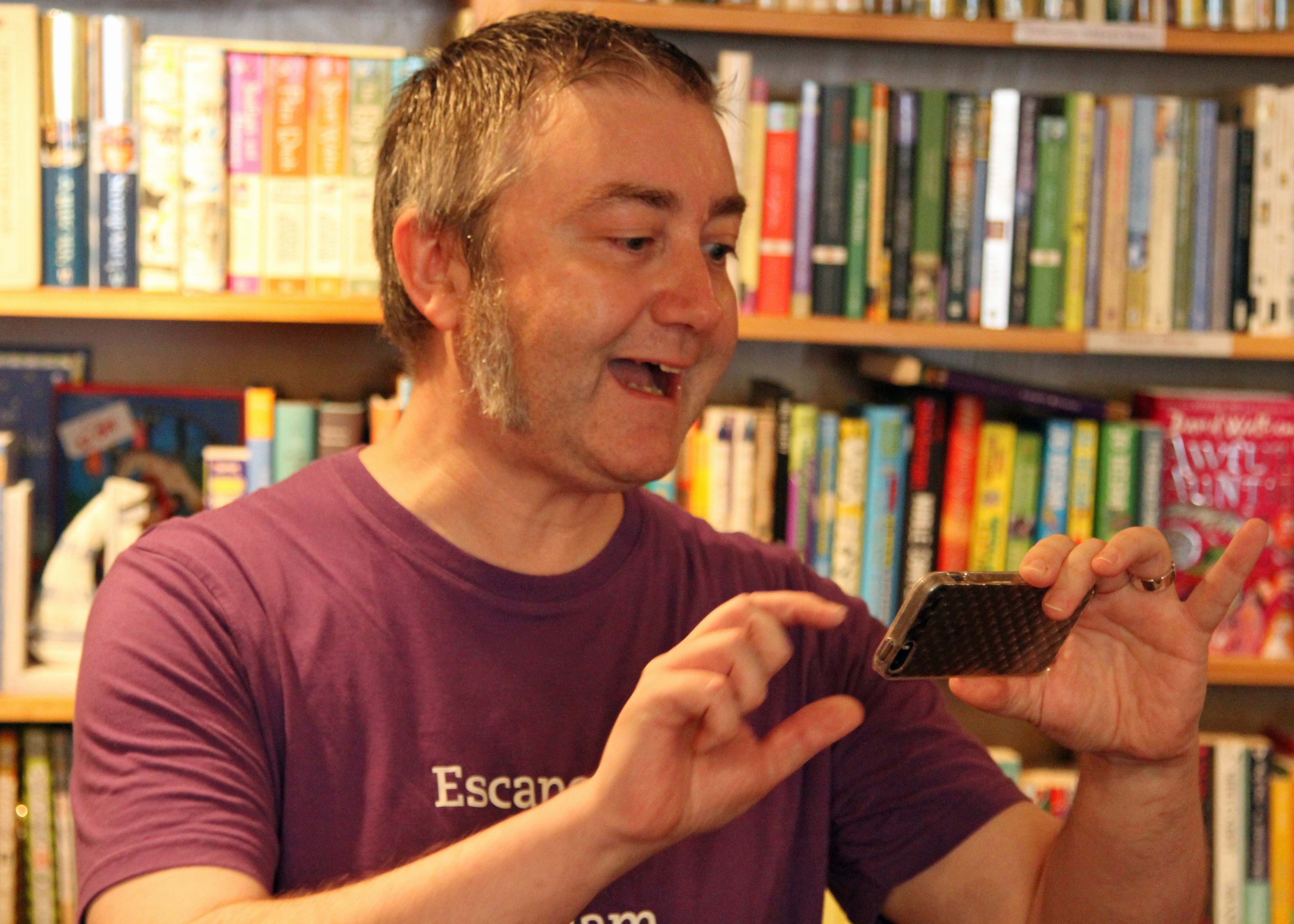
William Thirsk-Gaskill
Perhaps because he now has a double-barrelled name, my husband and I didn’t recognise the former plain William Gaskill at first – though my husband says that he knew the voice as soon as he heard William speak. When we first met, he was a very talented schoolboy and we were also young, though not as young as he was (William obligingly informed us that my husband was twenty-nine at the time, so I will have been twenty-eight!). To see him again gave the day an extra special bonus. William was also selling a book: Escape Kit, a novella, which we have bought but have yet to read. I’ll review it here when I’ve finished it.
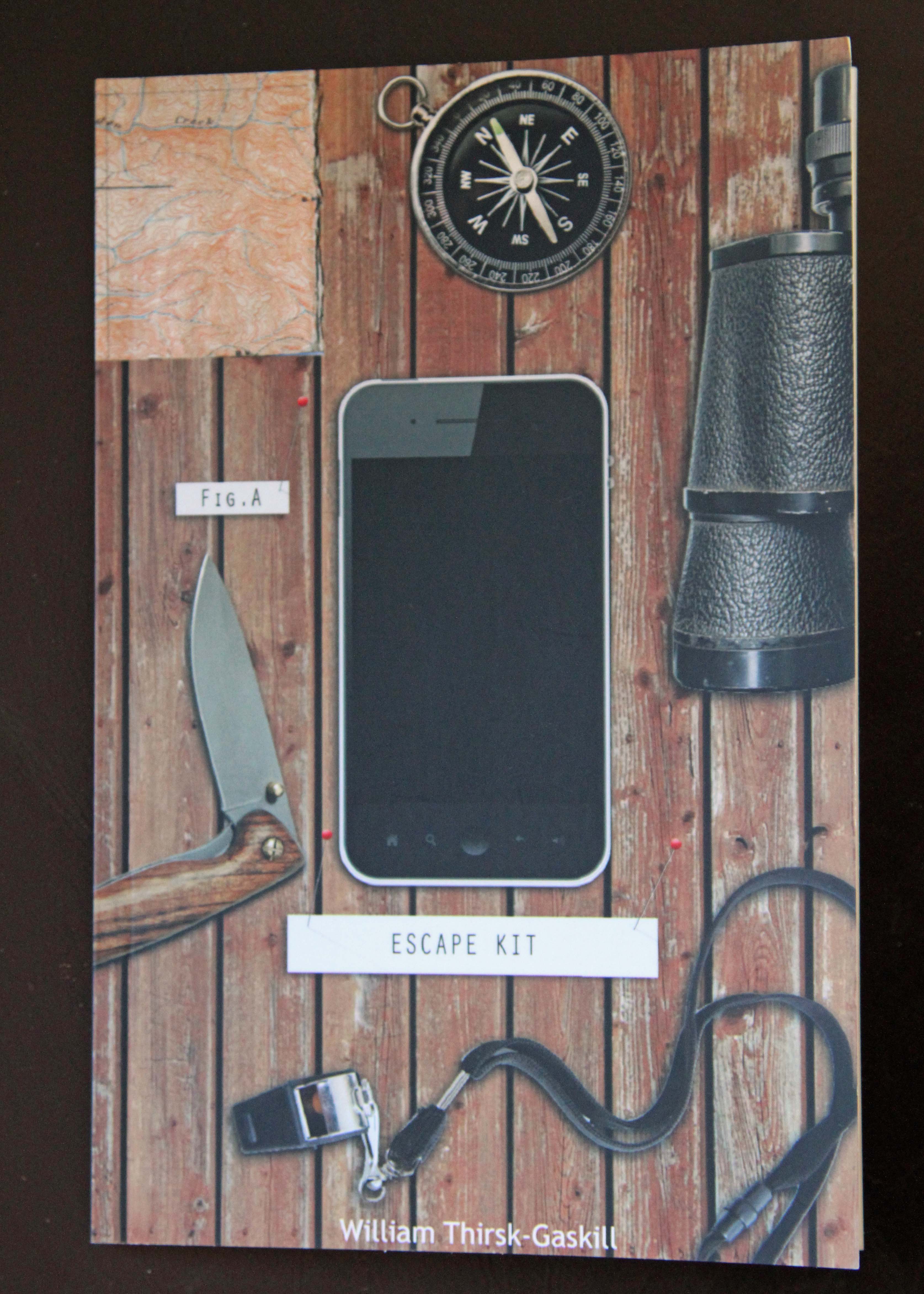
Escape KIt
Events at Rickaro Books are always distinctive, memorable and successful. It was a great privilege to be able to attend its Books Are My Bag launch and celebrate with A Firm of Poets. I am therefore extraordinarily proud to be able to tell my readers that Richard of Rickaro Books will be supplying the stock at ‘Tea at Sausage Hall’, Wakefield One’s wonderful way of celebrating the publication of the third of my DI Yates series, on November 19th. And I’m thrilled that some of A Firm of Poets have said that they will be supporting me by attending. Riches indeed! Thank you all so much. I’m looking forward to it already. Meantime, I wish you every success with your books.

Books Are My Bag 2014
WriterFest!

Yesterday Jim, my editor, and I enjoyed the immense privilege of running a writers’ workshop at Wakefield One, the City of Wakefield’s wonderful new complex that incorporates the library and other arts and community facilities. Like the event in which I took part at Wakefield One last year, it was part of Wakefield’s LitFest, and impeccably organised by Alison Cassels, who, in my experience, is second to none at enthusing and gathering in intelligent and appreciative audiences for such occasions.
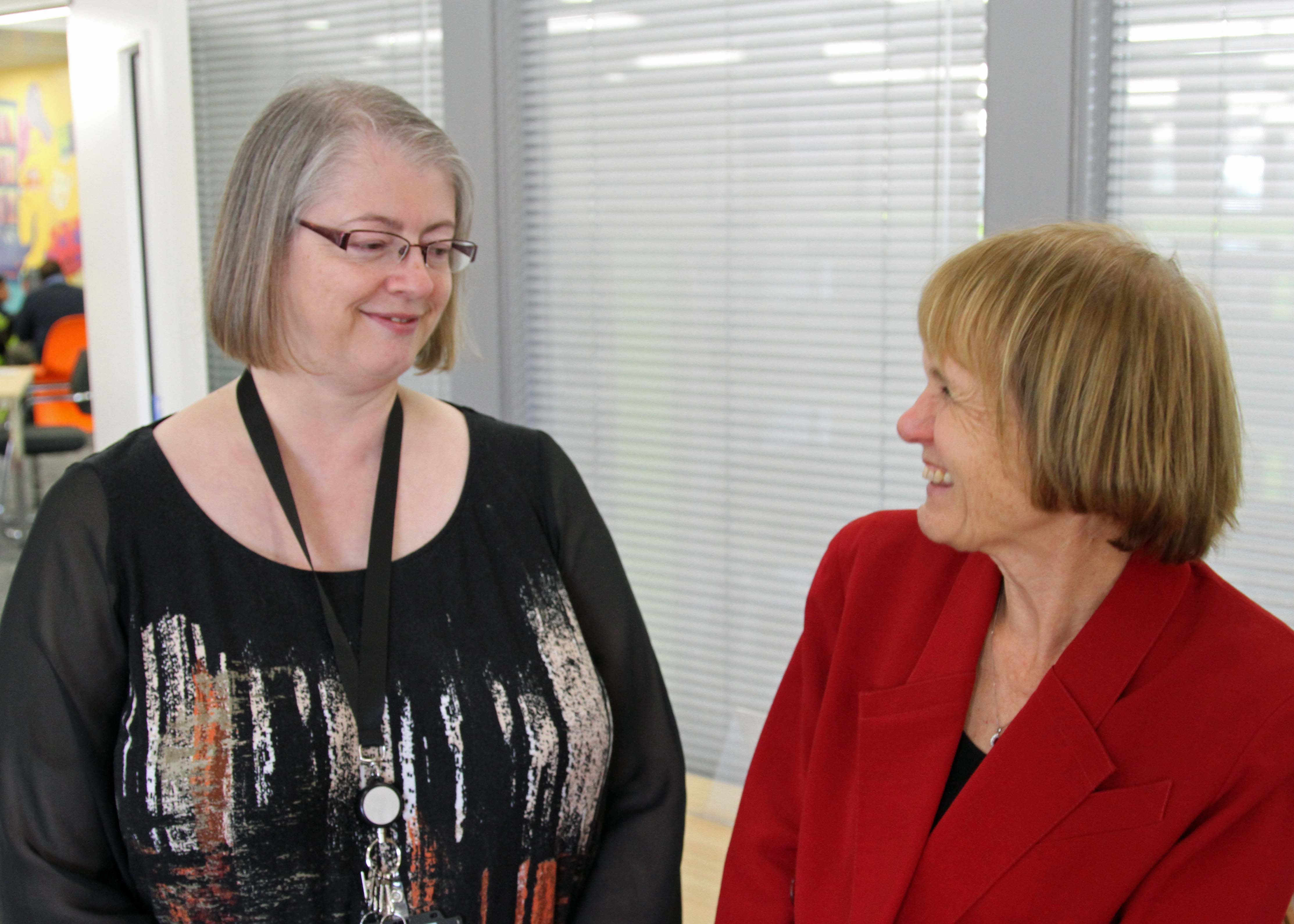
Alison Cassels, organiser par excellence
Eventually, there were twenty-two lively and responsive participants of all ages, from twenty upwards. One recent graduate came with his grandfather.

We began by giving the workshop delegates a sheet containing the opening paragraphs of six novels and asked them to take on the editor’s task of choosing (and providing justification for their selection!) just one that they would personally want to publish. The results were Illuminating: although one of the extracts (actually from a novel by Ruth Rendell) emerged as the clear winner, all six had at least one champion. Everyone was thus able to appreciate the dilemma of choice that an editor faces when sent many different manuscripts. Then, in pairs and against the clock, the group accepted the challenge of producing an opening paragraph that might persuade an editor not to reject it. The results were exceptional: all were coherent, interesting and, most impressively, cliché-free; the activity itself generated wonderful engagement, as you can see in the photographs here.


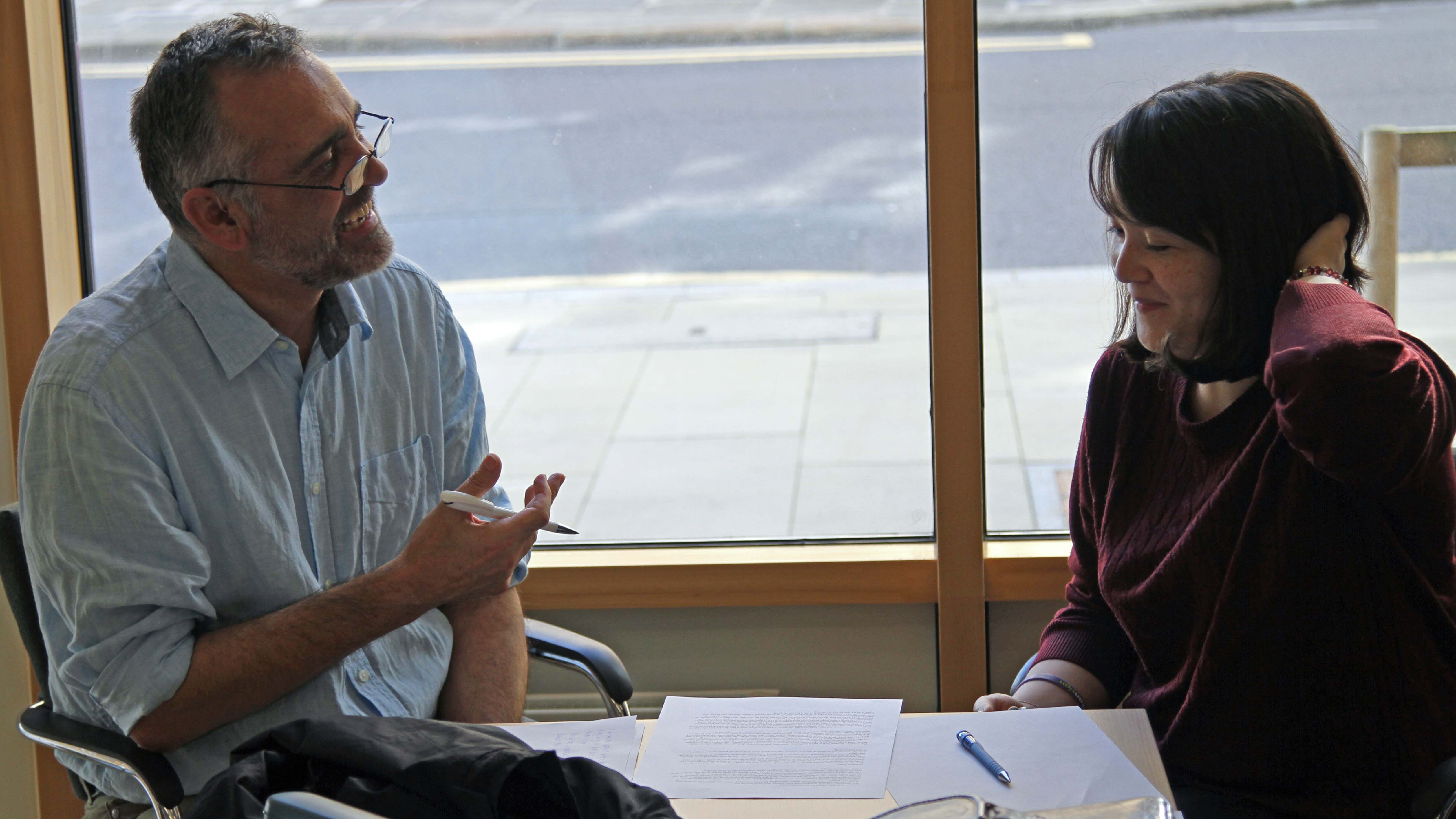

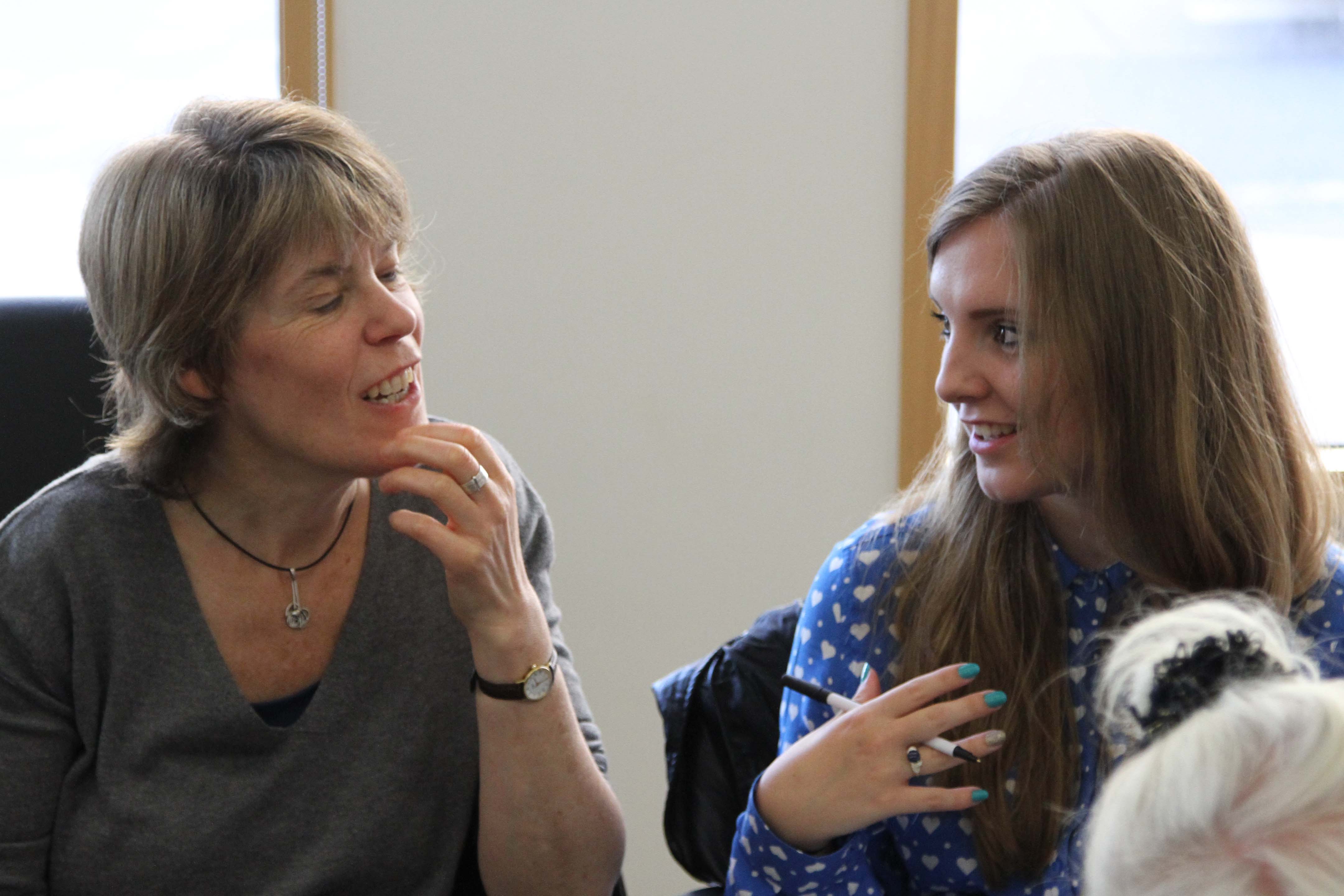
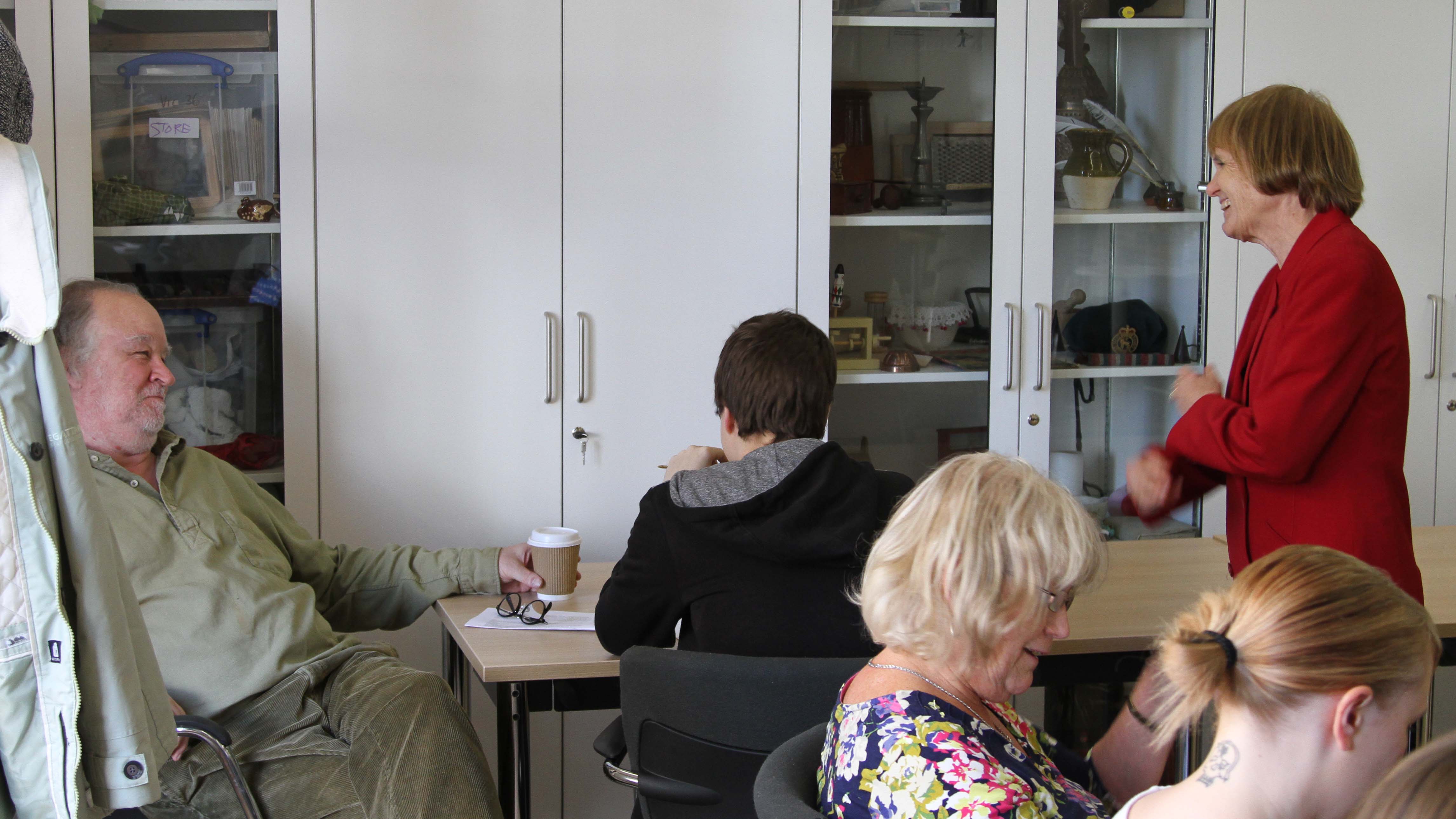


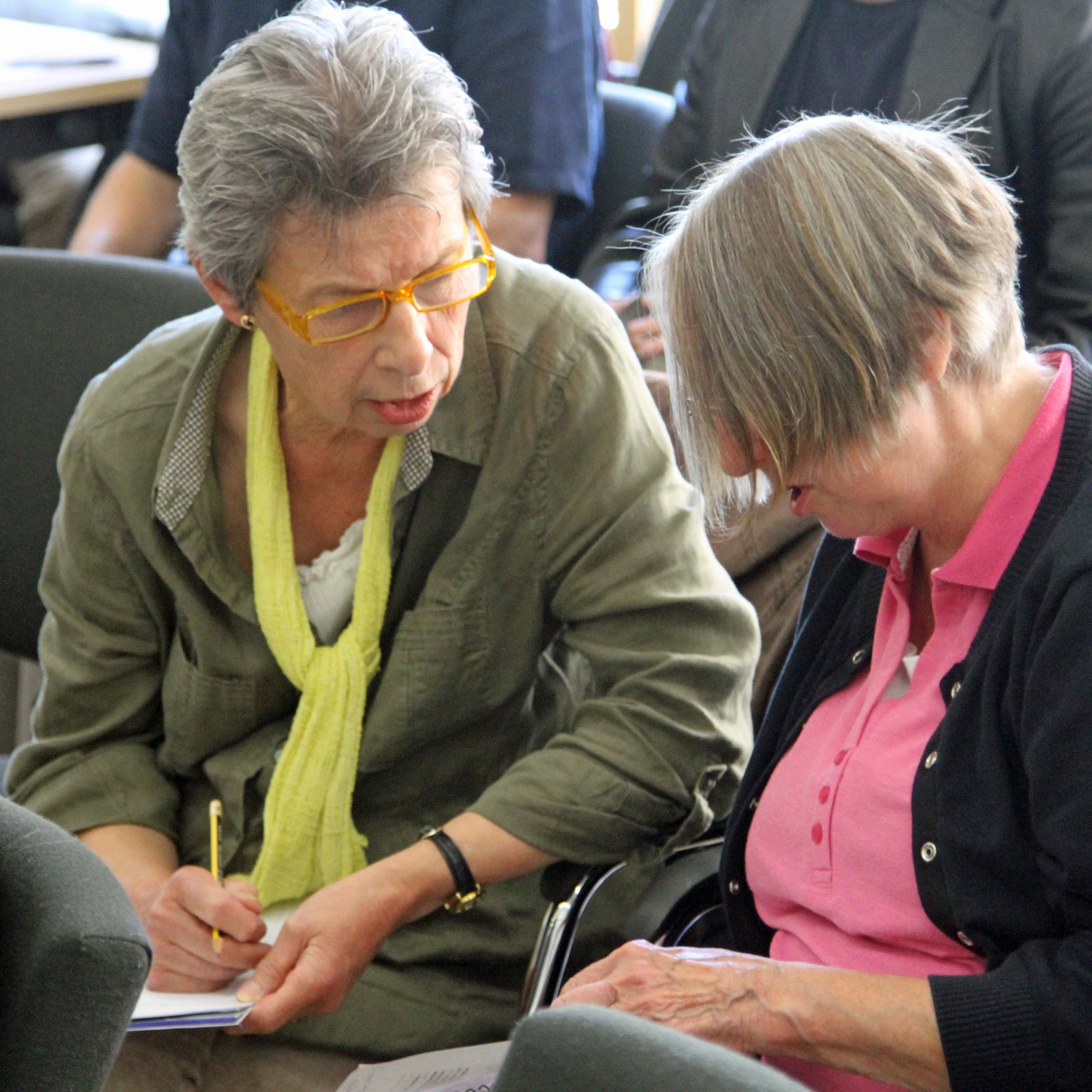


I then went on to explore some of the practicalities of getting published and what new (and, indeed, established) authors need to do in order to engage and keep their readers. This audience was thoughtful as well as appreciative and turned it into a dynamic, interactive session. Finally, I read the opening chapter of Sausage Hall, the third in the DI Yates series, which will be published on 17th November; it was well-received (I’d been holding my breath, as I’m sure all authors do when they give their new ‘baby’ its first airings). The workshop members were generous: many bought copies of In the Family and Almost Love in the signing session at the end; some were kind enough to buy both.
The informal debate continued after the workshop was officially over. Several participants said that they’d been delighted to receive Salt Publishing’s online alerts. If any of the readers of this blog would also like to obtain these, just let me know and I’ll pass on the information.
Very many thanks indeed to Alison Cassels and the rest of the staff at Wakefield One (not forgetting those who work in the Create coffee shop, which produces a mean cappuccino!) and heartfelt gratitude to all those who joined the workshop – I hope that you will become occasional or even regular visitors to this blog.
Liverpool, making virtual a reality, with panache…

Yesterday I was privileged to attend the Writing on the Wall (WoW) literary festival in Liverpool. It was held in Liverpool’s wonderful new (it opened to the public just over a year ago) central library, which has been expertly refurbished so that it combines the best of the old, classically-built library exterior with a stunning, light-filled new building, the atrium of which is awe-inspiring in its use of space and light.

Liverpool Central Library, atrium and skylight dome
Yesterday’s event was superlatively well organised by Abi Inglis, a recent graduate of Liverpool John Moores University, who runs her own online magazine (Heroine) for women and has been helping with or running literary events in the city for several years. Madeline Heneghan was the overall festival director and Mike Morris the operations director.
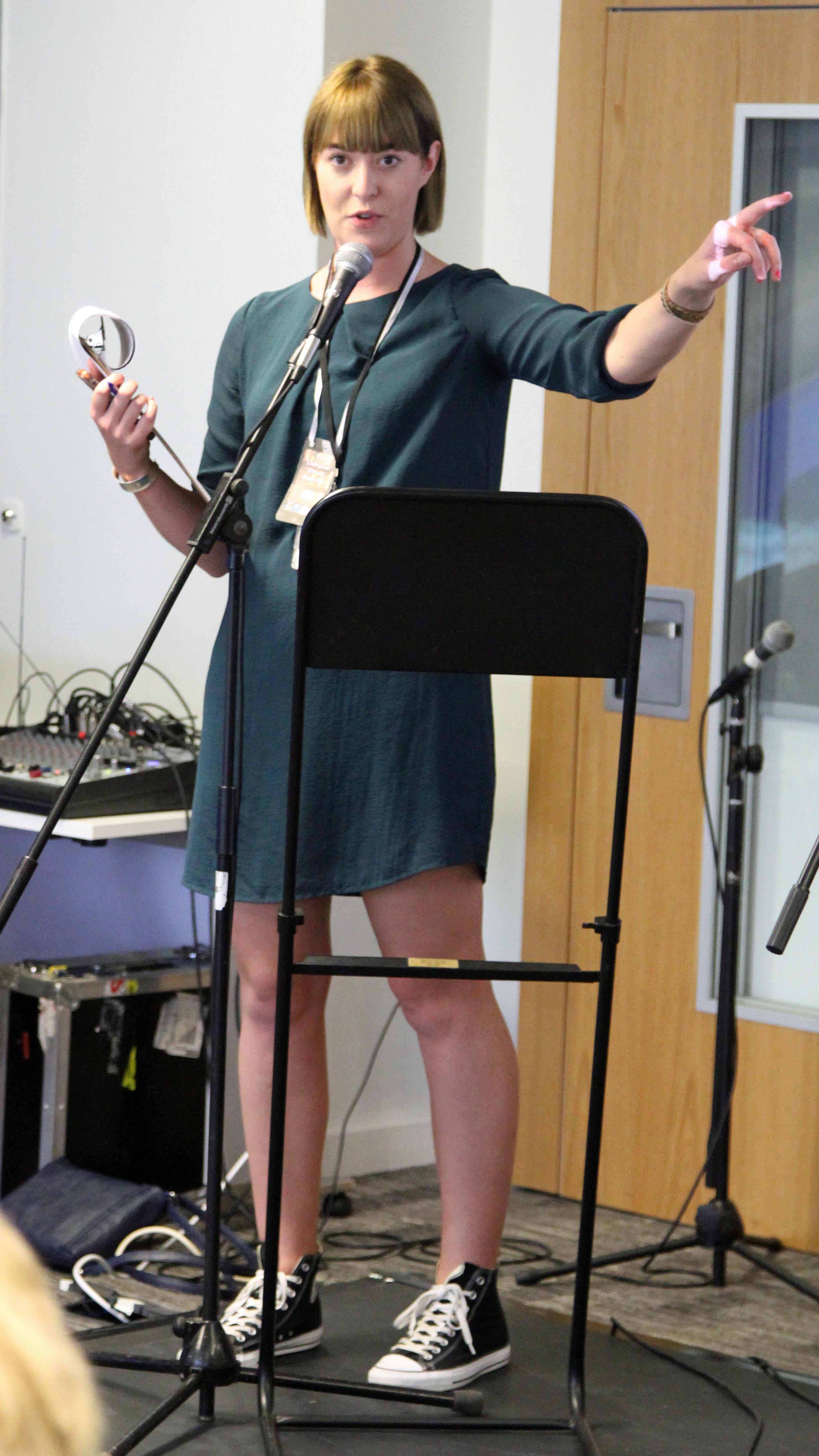
Abi Inglis, Wowfest organiser
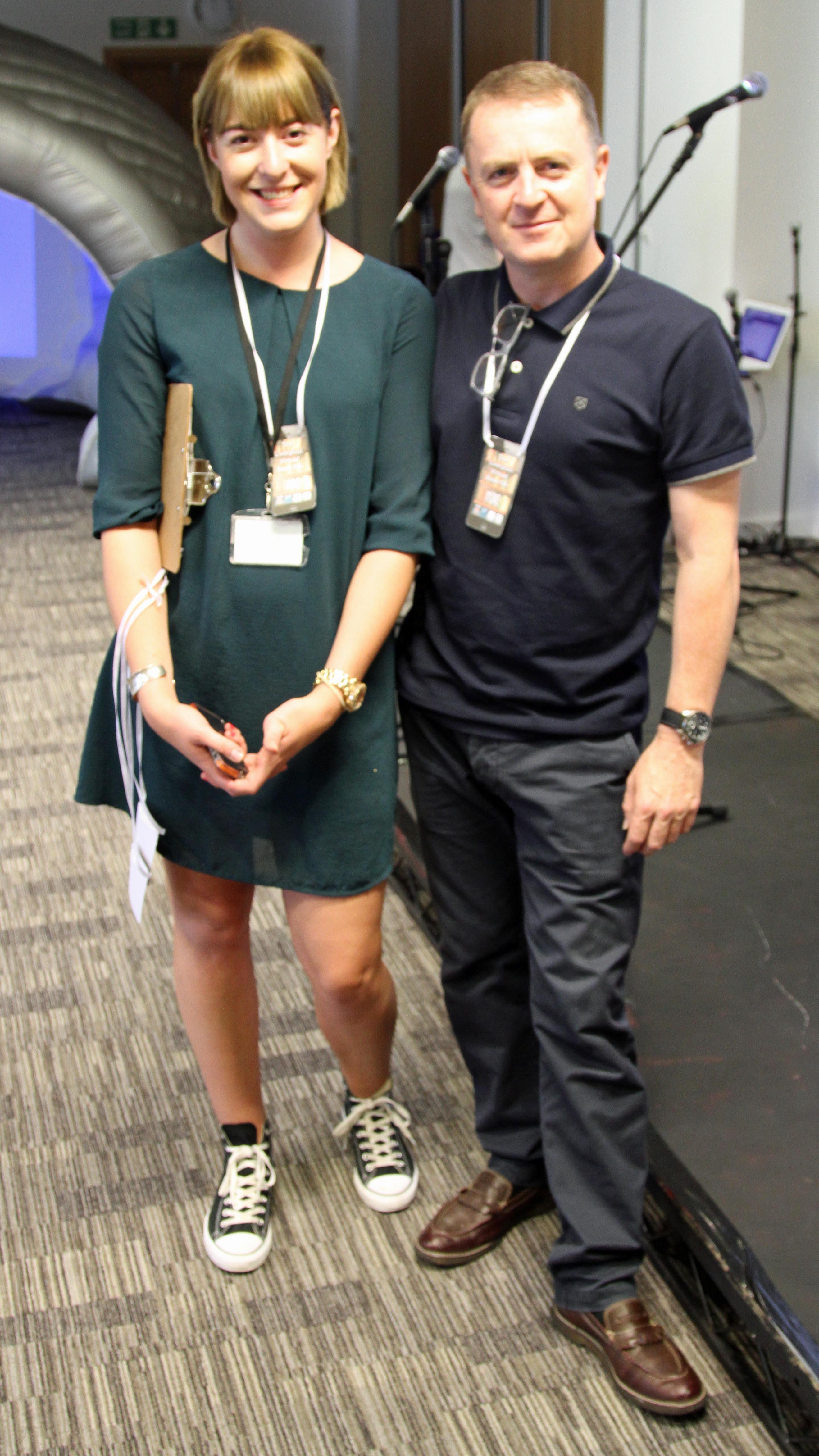
Abi Inglis and Mike Morris, completely confident of the impact of Writing on the Wall!

Festival Director Madeline Heneghan opens Wowfest
I was doubly grateful to Abi, because, as well as inviting me to talk at the festival about how to get published, she also gave me a short slot to read the opening chapter of my next DI Yates novel, Sausage Hall, which will be published on 17th November. This was Sausage Hall’s first public outing, and marks the start of a series of events that Salt and I are planning both in the lead-up to the publication date and immediately afterwards.

Giving ‘Sausage Hall’ its first outing
Even better, Abi devoted a large part of yesterday afternoon to Salt and Salt authors. Mike Morris, himself a published playwright, interviewed Jon Gale, a young Liverpudlian author whom he obviously admires greatly and whose novella Albion was recently published by Salt as part of the Modern Dreams series.
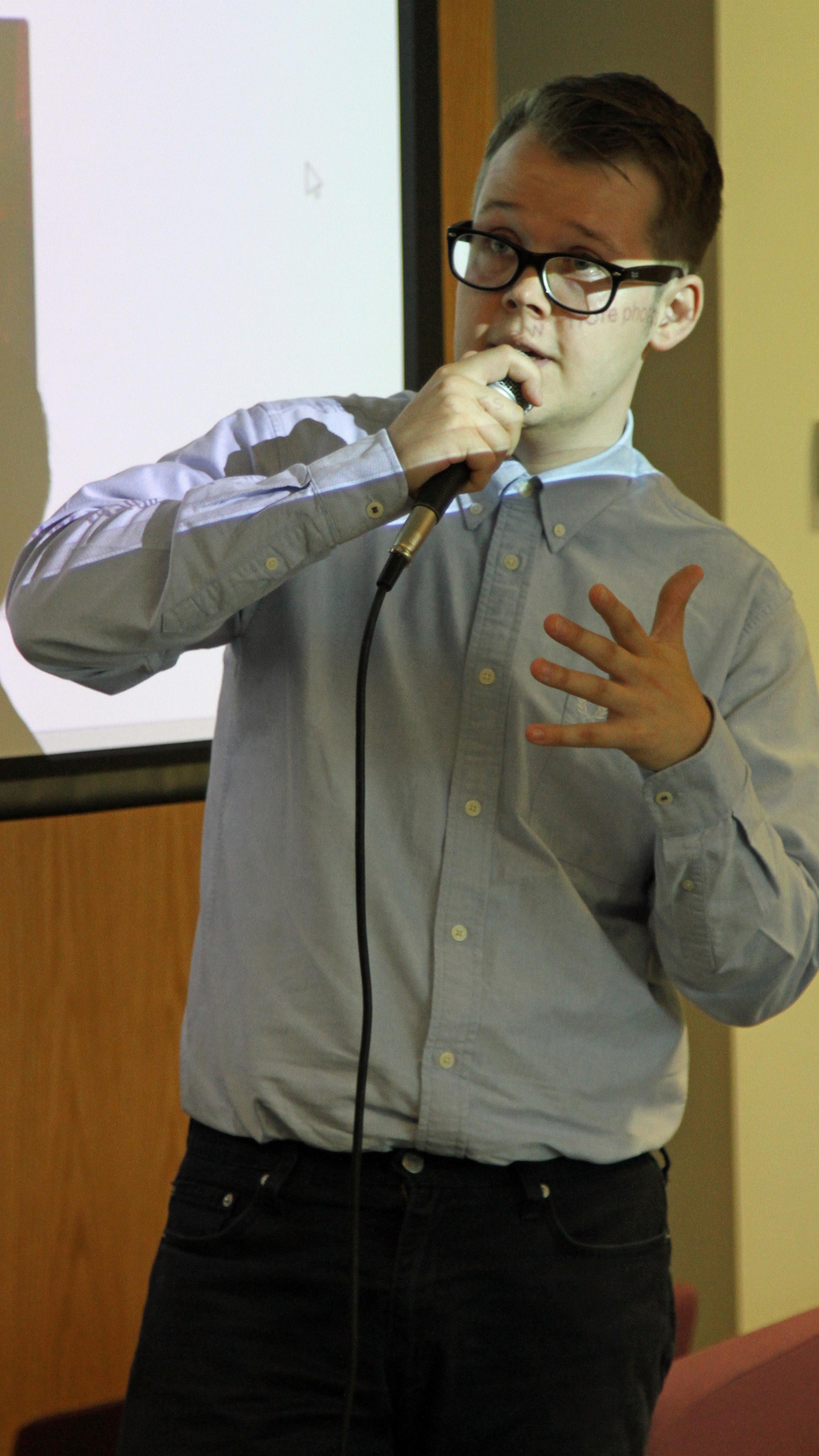
Jon Gale in animated response to Mike Morris’ questions
Mike then chaired a panel session of four Modern Dreams authors: Jon Gale, Denny Brown, Michelle Flatley and Jones Jones. This was one of the best panel sessions I’ve ever seen conducted at a literary festival. Mike elicited comments from each of the authors with great skill, giving them each an equal opportunity to talk, and they were all courteous, articulate and extremely interested in each other’s work. It was a proud day for Salt!
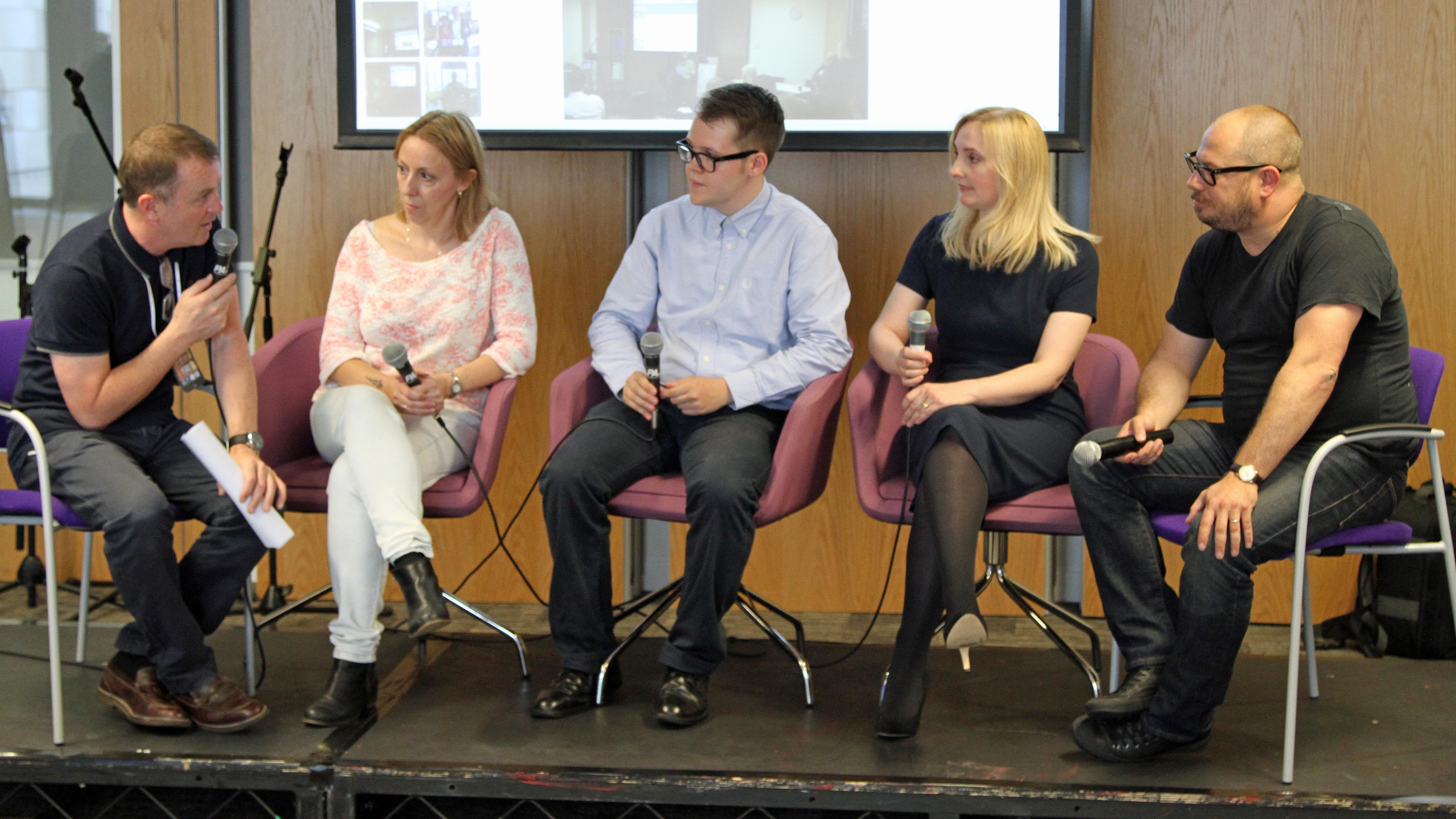
Mike Morris and the Salt Publishing ‘Modern Dreams’ panel
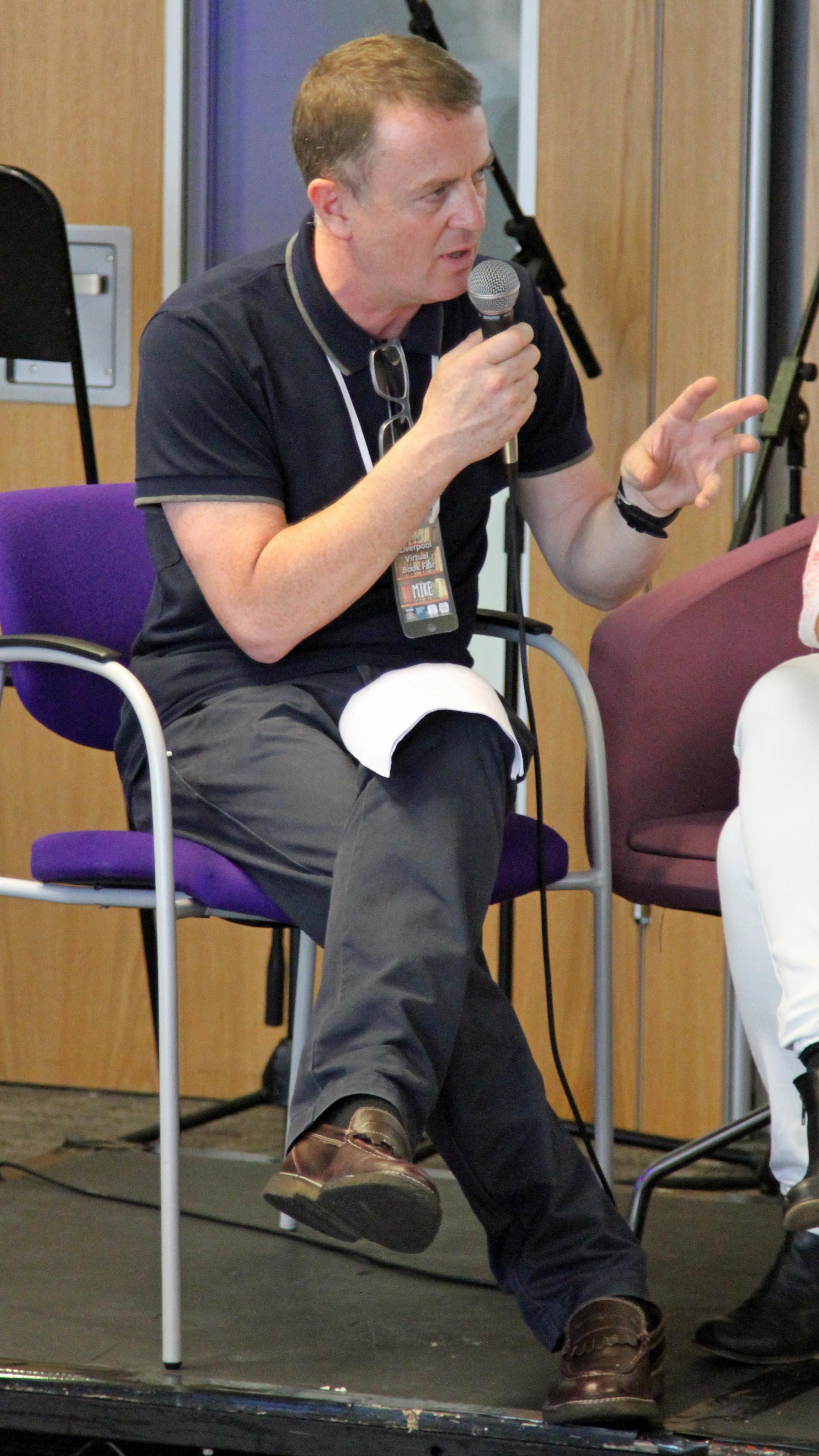
Mike in fine form, drawing out the best from the panel members
Knowing that I was going to meet them, I read each of these authors’ novellas before the event, and was hugely impressed by them (Denny Brown’s is called Devil on your Back,

Denny Brown
Michelle Flatley’s Precious Metal,

Michelle Flatley
and Jones Jones’ Marg).

Jones Jones
They all had an interesting story to tell about their journeys towards being published by Salt: Denny Brown, a mother of five, was the victim of an abusive marriage; Michelle Flatley is an artist who teaches refugees; Jones Jones is a journalist who has recently felt the compelling need to write fiction; Jon Gale has struggled for several years to find a publisher since leaving university. I recommend all their novellas: they’re ideal for commutes or train journeys, or simply for rainy evenings at home – I’m certain you’ll find that the time spent reading them will be more entertaining than watching TV. All are available as e-books from a variety of channel providers, including Amazon, which has just launched a promotion for the whole Modern Dreams series.

A privilege to sit at the feet of so much talent
I was sponsored to talk about ‘How to get Published’ by PrintonDemandWorldWide, whose new venture, The Great British Bookshop, provides authors with an alternative to Amazon if they want to self-publish but need help with sales channels.

‘How to get published’, talk sponsored by PrintonDemandWorldWide
PODWW gave me some notebooks, pens and guidelines for authors to distribute at the festival, which proved to be extremely popular.
I can’t conclude this post without mentioning what a wonderful public audience the city of Liverpool produced for this event.

Snapshot view of an ever-changing but ever-attentive and supportive Liverpudlian audience
It was one of the most diverse audiences I’ve met at a literary festival: families brought their children; there were many teenagers and young adults; quite a few senior citizens and some people with disabilities took advantage of the easy access to the library to join in the festival fun. All listened keenly, welcomed the authors enthusiastically and asked great questions. The main festival arena was packed at all times and the ante-rooms, where authors’ surgeries and DVD presentations about apps took place, were also always full. An inflatable ‘pod’, another of Abi’s brainwaves, which offered a range of activities for children, was also very popular – and frequented by children of all ages!
Well done, the festival team and the city of Liverpool, for an absolutely stunning event.

Framed by Wowfest!
Footnote: If you’re organising a literary event this autumn and would like me to give a reading from Sausage Hall and explain how I came to write it, please let me know. Salt is also offering a limited number of reading copies and there will be a competition later in the autumn to help to promote it. More details will appear here and on the Salt website.

The Liverpool Central Library roof terrace and skylight dome

One of the views from the roof terrace
At Lord’s, with open access, but not for the cricket…

Monday May 19th was a sweltering hot day and I was in St John’s Wood. I’d travelled there to visit Lord’s Cricket Ground, where a seminar on Open Access, sponsored by the publisher Taylor & Francis, was taking place. It’s the nearest that I’m likely to get to a cricket pitch while I’m able to exercise free will, as cricket is a game that has always mystified and bored me in equal measures of profundity. I had been a guest at a Lord’s hospitality suite once before, in the late 1990s, when I worked at Waterstones. Unusually for me, I can’t remember the exact purpose of this earlier meeting. I therefore conclude that it was probably about something quite unpleasant – such as redundancies, budgetary shortfall or the like – and that, accordingly, I’ve edited it from memory.
However, on this particular Monday, the sun was shining, which always puts me in a good mood. I was also pleased to have arrived in London early enough to explore a bit of St. John’s Wood en route. It’s not an area of London with which I’m familiar, but as lovers of late Victorian and Edwardian fiction will know, it was created to serve the semi-honourable purposes of aristocratic males who ‘played away’ by installing longstanding mistresses in bijou, affordable little houses not too far distant from the male clubs and the West End. St. John’s Wood thus became safe and ‘respectable’, at least on the surface, but was at the same time too humble and modest to attract dangerous interest from aristocratic wives and their friends. I’ve therefore always imagined that it would be smart and slightly exotic, with a hint of raffishness… and so it might have been a hundred years ago. Today, it has a slightly run-down air. Nevertheless, the pretty little houses are now obviously occupied by people with some means, as the expensive boutiques and upmarket coffee shops that throng the main street bear witness. I amused myself by sitting outside one of the latter, sipping a cappuccino and listening to a very young Yummy Mummy, with a designer baby on her hip, recounting the rigours of her day to two adoring older women. It was with reluctance that I tore myself away from eavesdropping on their conversation and pressed on to the cricket ground itself.
By mid-day, the conference was going well. The air conditioning was very efficient, which meant that spending the lunchtime break inside would have been a good soft option. But I knew I could not miss this rare opportunity to explore Lord’s, considered by ‘foreigners’ to be as much a national treasure as Madame Tussaud’s or the Tower of London. I therefore made the valiant effort to venture into the heat of the noonday sun (not quite a mad dog nor, clearly, an Englishman) to try to capture some of its venerated atmosphere.
I soon discovered that those who have renovated and re-designed the cricket ground in recent years have cunningly made it almost impossible for non-patrons to sneak in and spectate illicitly. Given my total failure to appreciate the charms of cricket, this didn’t worry me in the slightest, though it did mean that the only photographs I could take were extremely long shots of the pitch. I quickly also found that, although the day was perfect for snoozing in the stands, the match in progress had attracted somewhere between fifty and a hundred spectators – certainly no more. Tier upon tier of seats were standing empty.
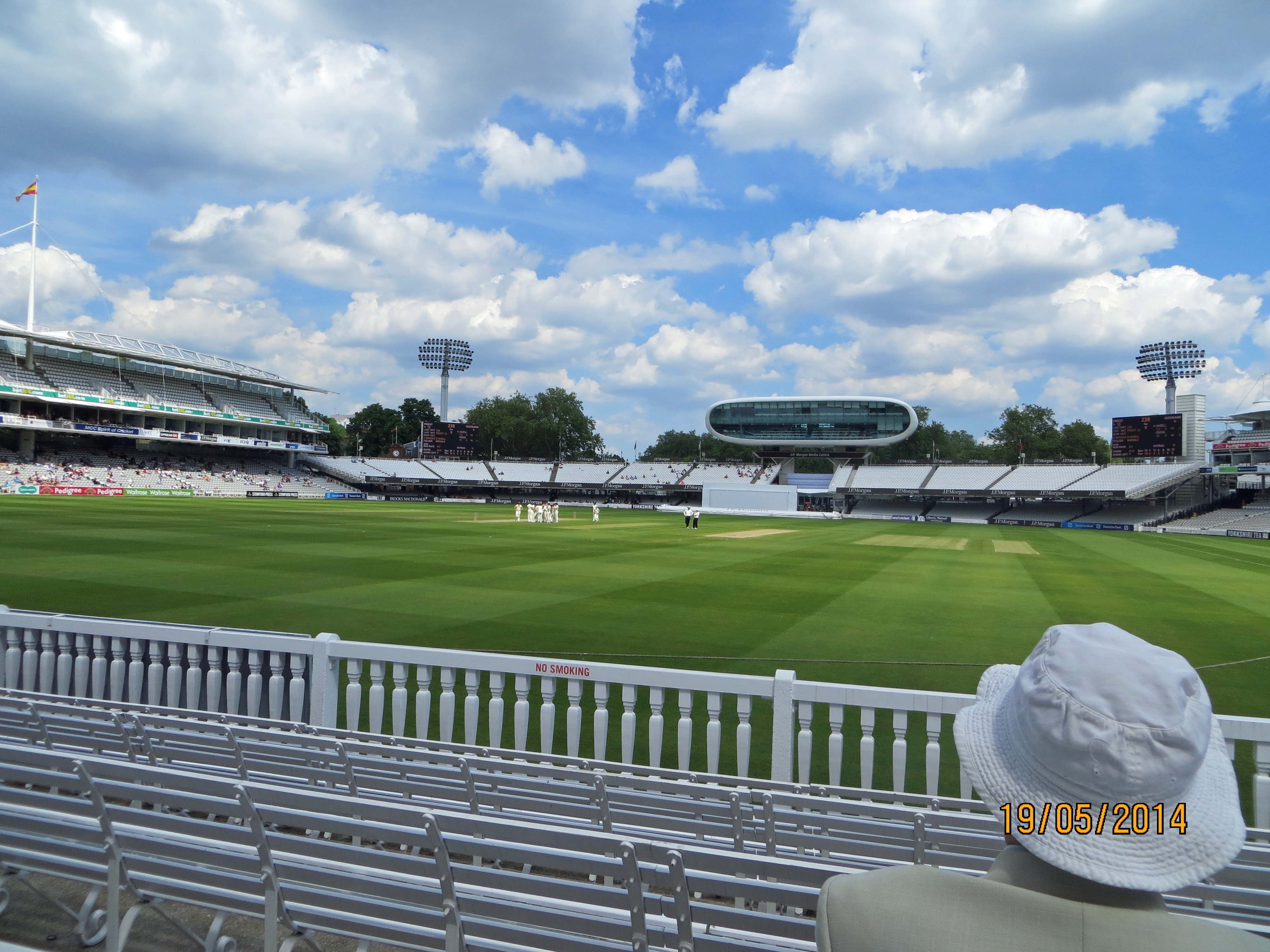
From this (rightly or wrongly!), I deduce that the great majority of the population feels roughly the same about cricket as I do and I suppose that the winter’s utter humiliation of the national side down under hasn’t helped to put bums on seats. How, then, does the game manage to perpetuate itself? I looked around me. Not only are there several hospitality suites at Lord’s, in the grandest of which my conference was taking place, but there are also some very chic bars and cafés, a shop selling ‘artisan’ ice-creams and another selling Lord’s souvenirs. It’s clearly one of those places you go to in order to be seen and say that you’ve been, and incidentally spend a significant amount of money in the process. This must be how the fine old institution of Lord’s not only survives but thrives, financially speaking. The cricket itself to me seems incidental, a charmingly eccentric pastime engaged in by a few aficionados and the equally stalwart cognoscenti who constitute their fans.
And so the quintessential Britishness of the Lord’s experience is preserved for posterity. It’s a kind of double standard, not unlike the double standard operated by those not-quite-caddish gentlemen who ‘protected’ their mistresses in St. John’s Wood whilst ensuring that they caused their wives no distress or embarrassment by letting them loose in Kensington or Belgravia. (A less generous approach, if you’ll forgive me, wouldn’t have been ‘cricket’.) How fitting that this suburb’s now old-fashioned charms should still be home to a national game that does not quite seem to have kept pace with the times.
A perspective of Priory LSST Academy, Lincoln: Supporting creative writing talent!

Low-rise school with covered ways, fountains and flowers
A warm reception at Priory LSST

Played into school!
I was extremely privileged last Wednesday to have been invited to join the first literary festival to be launched at the Priory LSST Academy in Lincoln. It was actually a festival within a festival, arranged by Mrs. Sarah Oliver, the energetic and enthusiastic writer-in-residence at the Academy, with the help of the very talented Sara Bullimore, who is one of the organisers of Lincoln Inspired, the city’s arts and literature festival. My contribution was to offer creative writing students feedback on the work they had submitted for a crime-writing competition, organise and take part in two writing workshops for younger students
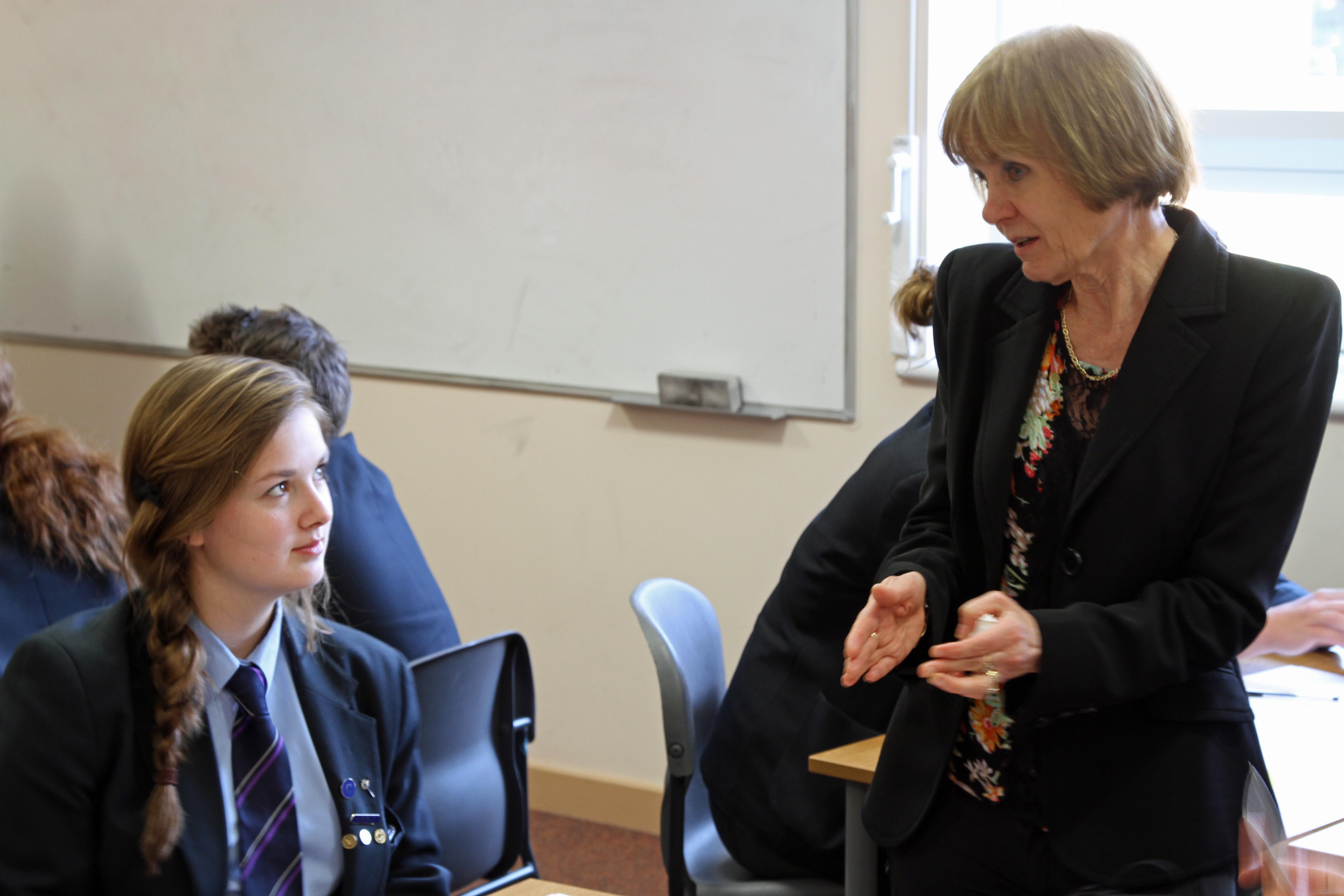
Year 10 crime writer workshop

Absolute concentration in the crime writer workshop
and deliver the festival keynote talk later in the afternoon. Members of the public were admitted to the latter.
Before I go on to describe the day in more detail, I’d just like to pause to say what an amazing place the Priory Academy is. One of the first academies to have been set up after the government announced its support for them, it is situated on a sprawling site with several buildings and many beautifully laid-out gardens, distinguished particularly by their modern sculptures and water features. Students move from one building to another via a series of covered walkways. The academy also has a planetarium, an Olympic-standard running track, an incredibly well-equipped gym and a swimming pool. Although it is a state school, it takes sixth-form boarders (they are usually either students from overseas or from armed services families). Those who attend it are greatly privileged and keenly aware of this. All of the students I met were impeccably polite; several of them told me how passionate they were about the Academy itself.
The sixth-form creative writing course was set up by Sarah Oliver at the beginning of the current academic year; it is voluntary and after school. Many more students wished to take the course than she could accommodate. Eventually fourteen were selected, of whom twelve entered the creative writing competition. They were asked to write the opening chapter of a crime novel (with a 500-word limit) and a synopsis of the whole novel (with a 300-word limit). This in itself was a pretty tall order, but they succeeded admirably. It is no exaggeration to say that I believe that every one of those students could go on to be a successful writer. The prize was for the student who wrote the winning entry to have his or her chapter published in the Lincolnshire Echo and the two runners-up to have theirs published in the online version of the same newspaper.
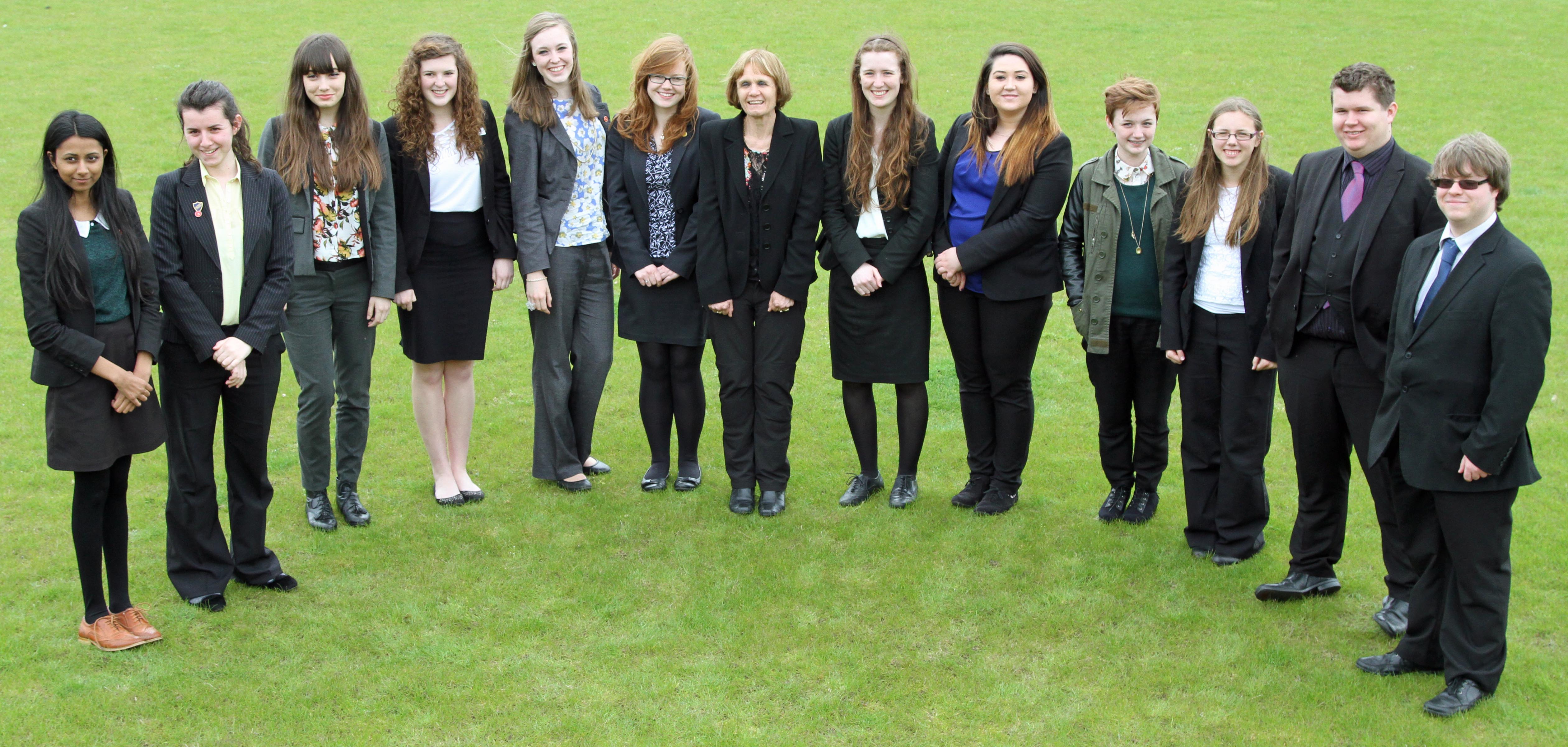
Priory creative writers
Choosing the winner was a daunting task. I asked my husband, who also acts as my copy-editor, to help. We decided to evaluate each entry on the following seven attributes: the opening sentence; consistency (did the chapter match the synopsis?); how compelling we found the writing; the quality of the plot; characterisation; the accuracy of the writing; the quality of the writing. It’s of course impossible for me to describe all of the entries in detail here, but to give my readers some idea of the quality of the entries, I’ve listed below a few of the opening sentences from the students’ submissions:
Bryant’s breath condensed in the plastic of his gas mask before fading away, only to be replaced every time he exhaled. It was stifling.
It’s the screech of the tyres that haunts, and the sickening crunch of metal splintering on bone.
Peer pressure. It was always peer pressure to blame when we got caught.
A myriad of birds shot out of the trees as loud sirens blazed past and a blur of blue lights blinded the night sky.
Sally heard the breathing in the darkness. The short gasps of air slowly faded into the inky night as she crouched, frozen, behind a wild hedge.
My job as judge was made more difficult because the opening chapter and synopses that we both considered to be the best ones were not written by the same person. Furthermore, there was a third entrant who, while she wrote neither the best chapter nor the best synopsis, had the best stab at both put together.
The rules of the competition organised by Sarah Oliver in conjunction with the Lincolnshire Echo were clear-cut. The best chapter was undoubtedly written by James, so we awarded the prize to him. Fatmira and Katie therefore became the runners-up.

With James, Fatmira and Katie, crime writer winners
The constraints of the competition were, however, considerable, and I knew that I wanted to see more of these students’ work. By great good fortune, Jean Roberts, Business Development Director at PrintOnDemandWorldWide, had very generously said that, if the winner wanted to complete his or her novel within a year of entering the competition, she would print ten copies of it free of charge and also put it into legal deposit, PODWW’s distributor channels and its own new online bookselling venture, The Great British Bookshop. I decided that James, Fatmira and Katie all deserved to be eligible for this new prize, so I have now set up a further contest for the three of them. If they can get their completed novels to me by the end of this year, I’ll choose the best of them and send it on to Jean. PrintOnDemandWorldWide also very generously gave all the students a Great British Bookshop notebook, pen and box of Union Jack sweets. Both the students and all those who attended the afternoon keynote also received PODWW’s pamphlet giving advice and writing tips to would-be authors.
I shall write more on this blog at intervals about James, Fatmira and Katie and the progress that they are making. I hope that you will join me in following their journey, perhaps also offering your own support and encouragement along the way. In the meantime, I’d like to celebrate the achievement of all the student writers at the Priory Academy. I’m certain that we shall be hearing more of at least some of them in years to come.
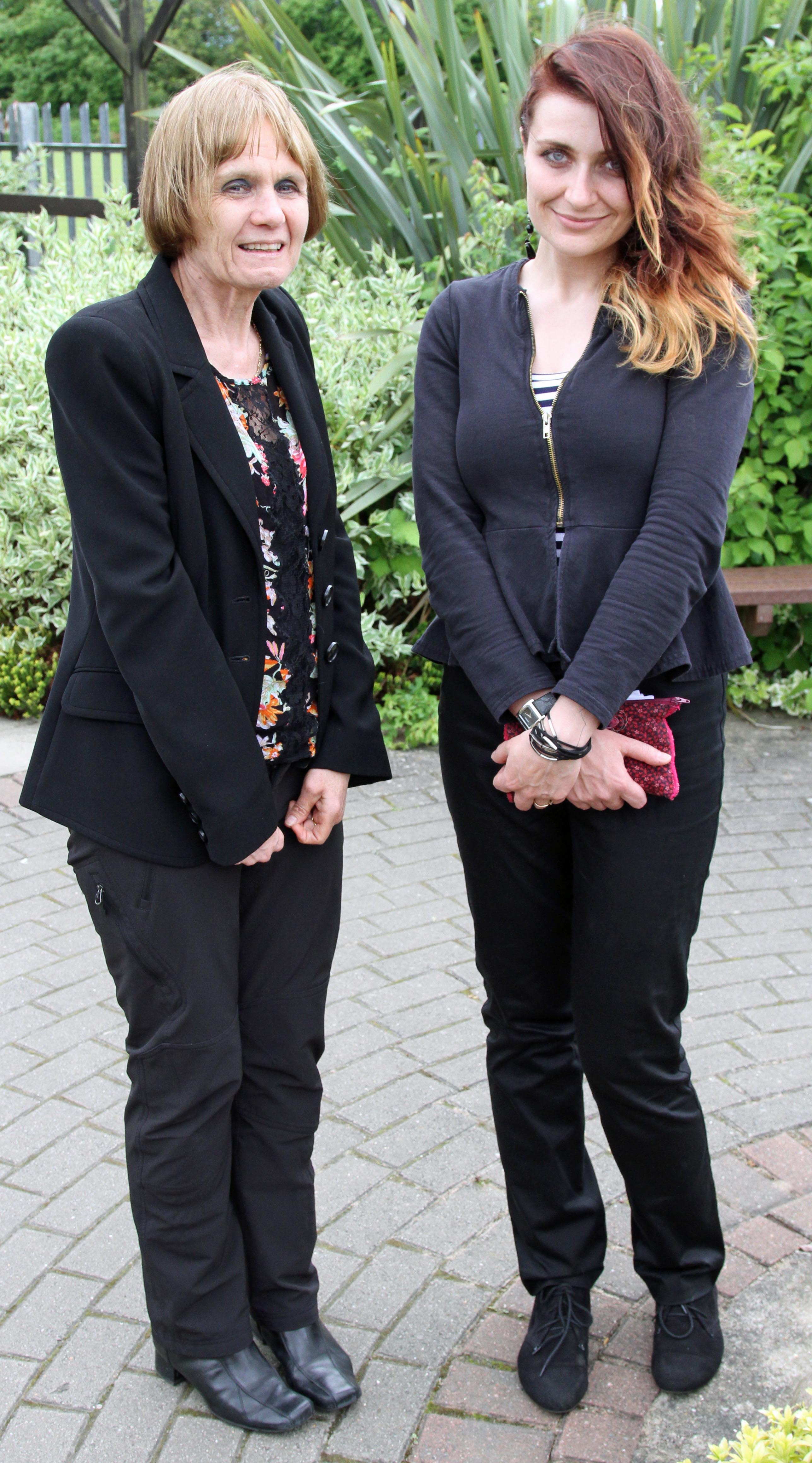
With Sarah Oliver, Priory’s writer in residence and literary festival organiser
The best of the London Book Fair 2014

LBF bag and mag
This year’s London Book Fair and the Digital Minds Conference that preceded it were characterised for me by two related issues that recurred time and again: the importance of preserving copyright and the need for publishers to experiment and be flexible about formats, business models and sustainable pricing. Associated with the latter, in particular, were several inspired talks and presentations that demonstrated the opportunities that can be harvested from adopting an intelligent approach towards print and electronic content and therefore finding ways to enable them to complement, rather than compete with, each other.
I was particularly impressed by Martha Lane Fox, the former Internet entrepreneur recently made Chancellor of the Open University, who gave the afternoon keynote talk at the Digital Minds Conference. She said that she was ‘crazy about the Web every single day because of the power it can bring to people’s lives,’ sometimes in very complex situations. She was referring particularly to countries where strict censorship is practised, or where women have not yet achieved equality of opportunity. She said that publishers should continue to fight for basic digital skills to be introduced across all communities. “The consumer has an incredible time of it right now. It is the duty of the publisher to help the consumer on his or her journey.”
Also fascinating was the panel session at the conference entitled Hybrid and Author Publishing, which was essentially about self-publishing. Orna Ross, of the Alliance of Independent Authors, was a particularly compelling speaker, because she has both published with an eminent publisher (Penguin) and published her own works, and she said that she infinitely preferred the latter experience. Her reason? She feels that self-publishing gives her greater freedom of expression and the ability to experiment: for example, this year she has set herself the task of publishing nine short books (one a month, with some break months). She said that she ‘absolutely didn’t want her first self-published book to be taken up by a traditional publisher.’ However, she acknowledged that her writing career had been supported by the initial successes that she had gained through traditional publishing. Hugh Howey, another author who took part in this session, said that audiobooks were under-valued by authors and highly sought after by the reading public. Having spotted this, he has ensured that all of his books are available in audio format and revealed that he ‘could live off his audio sales.’ Food for thought!
Another panel session was entitled Subscription Models: Pros and Cons. It discussed the relatively new trend of selling trade e-books via subscription models. Andrew Weinstein, of Scribd, said that it had been launched as a dedicated subscription service for consumers. Subscribers pay $1 per month and publishers are paid per download. Scribd works closely with HarperCollins, which has promoted its growth by making many HarperCollins backlist titles available in e-format. Nick Perrett of HarperCollins said that there is a rapid shift taking place in publishing from what was essentially a trade-focused structure to what is now becoming a consumer structure. The best outcome for the publisher is to have multiple points at which consumers can access content. After this, their core job is to maximise the royalties that go back to authors. Good analytics are therefore vital: one of the advantages that HarperCollins has gained from working with Scribd is that it obtains a rich data set which can be used to inform both marketing and publishing decisions. There is more about Scribd here.
Among the speakers at the digital seminars that take place throughout the Fair was Rebecca McNally, Publishing Director at Bloomsbury UK, who described the genesis of Bloomsbury Spark, a born-digital imprint for Young Adults. She said that Spark is a one-of-a-kind global imprint for Young Adult literature which publishes across all fiction genres. Bloomsbury has particularly focused on the YA market because it has a burgeoning online reading and writing community. It is also less susceptible to market variation across geographical regions than, for example, picture books. It has some powerful informal advocates among the blogging community and, as a result, is migrating to digital faster than any other fiction sector. Young Adult in digital format actually has a broader constituency than it has in print.
Authors benefit from Spark because Bloomsbury is able to offer a global publishing structure accompanied by local marketing support; it has a fair e-book deal that includes a print option; the translation rights are sold for p and e formats; the list is highly selective and distinguished. Bloomsbury carries out a massive cross-promotional campaign across the Spark publications; it encourages authors to send submissions direct to the Bloomsbury website, rather than operating through agents. Rebecca cautioned would-be Spark authors to remember the target reader (so far 180 submissions out of about 3,000 have been considered ‘too porny’) and to read the submission guidelines (she estimated that 30% of submissions had been disqualified because they weren’t followed). More information about Bloomsbury Spark can be found here.
Continuing with the copyright / flexibility in publishing themes, this year’s Charles Clark lecture was delivered by Shira Perlmutter, Acting Administrator for Policy and External Affairs at the United States Patent and Trademark Office [USPTO]. Her talk set out the differences between recent legislation on copyright in the USA and Europe and indicated the areas in which each could claim to be ahead of the other. She said that, given the shared interests and concerns of both communities, close transatlantic co-operation in the future would be vital. There were three main issues to consider: to ensure that the development of international markets be allowed to continue without jeopardising copyright; that specific legal rules, although they might have to be rigid, should be embedded where possible in a more flexible framework; that more legislation should be developed to set boundaries and limits, rather than addressing specific copyright infringement issues.
After several years at Earls Court, in 2015 the London Book Fair will move back to the Olympia conference centre, which has been refurbished in its absence. Those of us who remember many earlier book fairs are quite pleased about this, as, although Olympia is harder to reach than Earls Court, it seems like an old friend. I think that most of us are also hugely grateful that an earlier plan to give the Excel Conference Centre, in East London, another chance has been rejected. Those who attended LBF 2006 there have not forgotten the almost total lack of ladies’ toilets, the absolutely total lack of anywhere decent to eat, the stands labelled back-to-front as if we’d just walked through Alice’s looking-glass, the unfortunate proximity of London Junior Fashion Week (half-naked giggling teenagers wandering by accident amongst the books) and the nightmare of the first day, when we were riding round and round on the unmanned Docklands Light Railway with no clue about when to get off the train or where we were meant to be heading when we did! Whereas next year, if I can’t be bothered to wait for the spur railway to Olympia, at least I’ll know that if I turn left out of Kensington High Street station and keep walking, eventually I’ll arrive at the exhibition centre, where there will be toilets, civilised cafés, a proper floor plan and no accidental captives!
 Christina James, crime novelist