

A gem from the past – I keep finding them!

I came to Colin Dexter belatedly and, although I have admired all of the novels that I have read by him, I have never indulged in a Morsefest in the same way in which I read most of the Minette Walters’ novels – or much of Anthony Trollope’s oeuvre, for that matter – in one short consecutive burst. I was therefore recently surprised and delighted to discover a well-thumbed edition of The Way Through the Woods on my bookshelves. (Although it had certainly accommodated previous readers, probably several of them, I was not among their number and, indeed, I don’t know how I came by this copy. It may have been a present from a fellow crime fiction fan.)
I should like to heap unreserved praise on this book, which is undoubtedly the best of the Morse series that I have read. Unsurprisingly, it won the CWA Gold Dagger in the year of its publication, 1992; although I don’t know what its rivals were, I am convinced that a grave injustice would have been perpetrated had the award gone to any of them. It is Dexter at the height of his powers.
The plot is extremely complicated, with a large cast of delightfully individual characters. I guessed one of the main twists that the narrative would take about halfway through, but there is an additional twist to this twist that remains almost unguessable until the end. Like all Morse novels, it can be read on several levels and is a rich, deep evocation of how life unfolds within a certain stratum of British society. If I could sum up the plot in a few words, it would be ‘When is a victim not a victim?’ An enigmatic and gnomic observation, perhaps, but not as enigmatic and gnomic as the book itself and, if I were to offer further clues, I might inadvertently create a ‘spoiler’.
Also, as with all Morse novels, the cultural references are legion: Dexter doesn’t just quote extensively from the whole canon of English literature, but displays an impressive knowledge of classical music, jazz and fine art. In another writer, this might seem pretentious, perhaps even self-regarding, but Dexter, like Morse, endears by consistently keeping his tongue in his cheek. Another facet of the writing that keeps preciousness at bay (and I don’t recollect this in the other Morse novels, though I suspect that it must be there) is that Morse leads quite an adventurous, not to say outré, sexual life. This is kept intriguingly veiled – and unsordid, if there is such a word – by confining itself only to the arrivals and departures of Morse’s paramours. What happens during their visits is left strictly to the reader’s imagination.
I realise that I have come to this book so belatedly that I am probably speaking to the converted. However, I should still like to take this opportunity to offer my praise and to encourage you to make the same voyage of discovery if you have not done so already.
A murderer unmasked after sixty years…

I’ve been looking for some real-life murder stories set in South Lincolnshire and can’t find any; I’m not sure whether the people of Holland are unusually law-abiding, unusually cunning or just lucky. However, my search did turn up Poison Farm: a Murderer Unmasked, by David Williams. It’s set in Suffolk, not too far away from South Lincs; as it’s still East Anglia, it ‘counts’. Williams tells a fascinating story, not least because the murder – of prominent local farmer William Murfitt, who had quite a seamy private life – took place in 1938, in the village of Risby, when he was himself growing up there. He remained preoccupied with it, until he investigated more fully in 2003, after retiring from journalism.
Williams paints a graphic portrait of what village life was like just within living memory. The archaically hierarchical nature of the small but prosperous farming communities of the time is conveyed well – some of the people and situations that he describes could have come straight from the pages of a novel by Trollope. (Much of this strict adherence to the class structure would shortly be swept away by the Second World War.) He also manages to capture a fine example of a perennial female figure who, in fiction as life, has always managed to inveigle herself into the upper levels of local social hierarchy, despite its snobbishness and respect for tradition. She is the adventuress with a shadowy past. The lady in question in this story rejoices in the name of ‘Lady’ Mary Elizabeth Fernie Chandler, or some less flamboyant combination of these names, as the occasion demands. She is the literary descendant of Becky Sharp, the real-life counterpart of the Duchess of Windsor (also known as Bessie Wallis Warfield, sometime Spencer, sometime Simpson).
The murderer of William Murfitt was never charged or prosecuted, though Williams thinks that he has identified the culprit; in the course of telling the tale he builds a convincing case, based partly on a re-examination of the evidence, partly on the reminiscences of some extraordinarily long-lived survivors, already adults at the time of Murfitt’s death, whom he manages to interview. In the process, he comes to the conclusion that the perpetrator had probably also committed another murder some years previously.
Modern forensic techniques might have resulted in a conviction if Murfitt’s murder had happened today. Yet this is not necessarily the case: the two policemen sent to Risby, Detective Chief Inspector Leonard Burt and Detective Sergeant Reginald Spooner, both became celebrated later for their acumen and sureness of touch. Each went on to solve many serious crimes, including other murders. David Williams’ story illustrates perhaps that you can get away with murder, if you have the nerve to stick to your story… and a little bit of luck.
The most compelling first novel I’ve read in a long time…
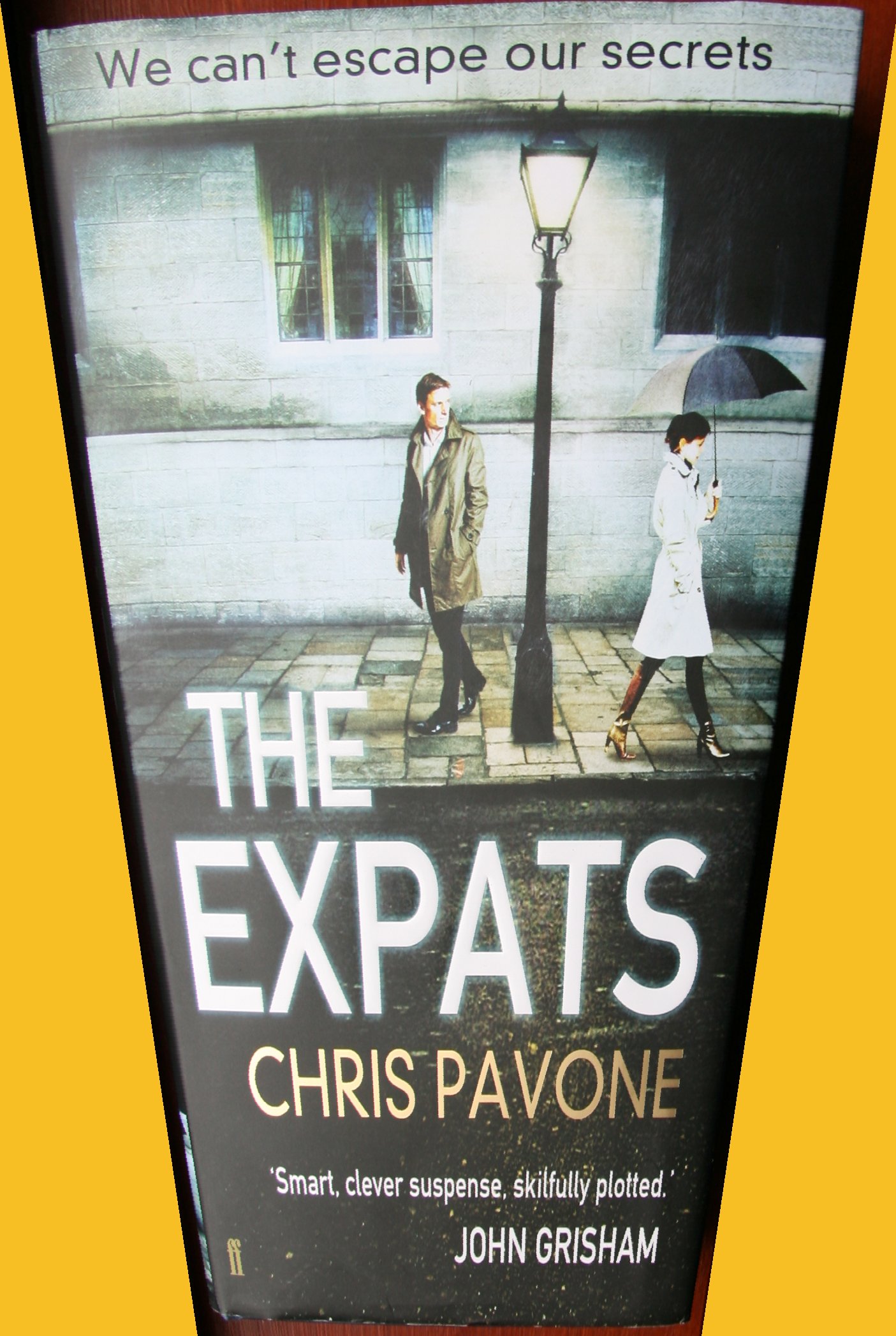
The Expats, by Chris Pavone, is undoubtedly the most compelling first novel I’ve read in a long time. Since the blurb says that the author has been a book editor for twenty years and his list of people to acknowledge includes such luminaries as Molly Stern, Angus Cargill and Stephen Page, I conclude that he had a bit of a head start over most new fiction writers, but I wouldn’t want to hint, even for a moment, that the author of this brilliant book does not deserve heaped praise.
The overall plot is a little reminiscent of that of Mr. and Mrs. Smith – and, indeed, I could imagine Angelina Jolie and Brad Pitt playing the lead roles if the novel were ever made into a film. Like the Stieg Larsson novels, it is also about an expert hacker. Pavone is more subtle than Larsson when he explores the moral issues connected with the murky worlds of undercover agents and hackers – the female protagonist, Kate Moore, especially ponders whether an illegal or dishonest action can be justified in order to promote a greater good, and does not find reassuring answers.
The characters of Kate and her husband, Dexter Moore, are especially well-drawn and the portrayal of the two ‘villains’, Bill and Julia, is very successful, because for most of the book the extent and nature of their villainy is difficult to gauge; in fact, at one stage, we are made to think that they might be good guys after all, though the reader’s gut instinct is not to trust this possibility. I also love the character of the Smiley-like Hayden, who has a rich cameo part.
The author’s descriptions of various European settings – Paris, the Alps, Amsterdam and, above all, Luxembourg – are compelling. Twists and turns of plot continue until almost the last page, but never seem far-fetched. If I have a very minor complaint, it is that Kate’s sudden access of sentimentality at the end is unconvincing.
One small sadness is that, although I should like to see more of Kate in future novels, the ending makes this unlikely (though not impossible). Whatever Chris Pavone’s plans for his next book, I await it with impatience.
Footnote: Tomorrow I am going to a conference (day-job!) and shall be away for five days. I shall continue with the blog-posts, however. Regular readers of the blog may remember that one of the early posts was about how I trained for In the Family by writing a series of short stories, at Chris Hamilton-Emery’s suggestion. There are ten stories altogether. I’ve been revising them recently and may try to publish them. For each of the next five days, I intend to post on the blog the opening paragraphs of the first five. If you’d like to make any comments, they’d be extremely welcome.
A fascinating period piece…
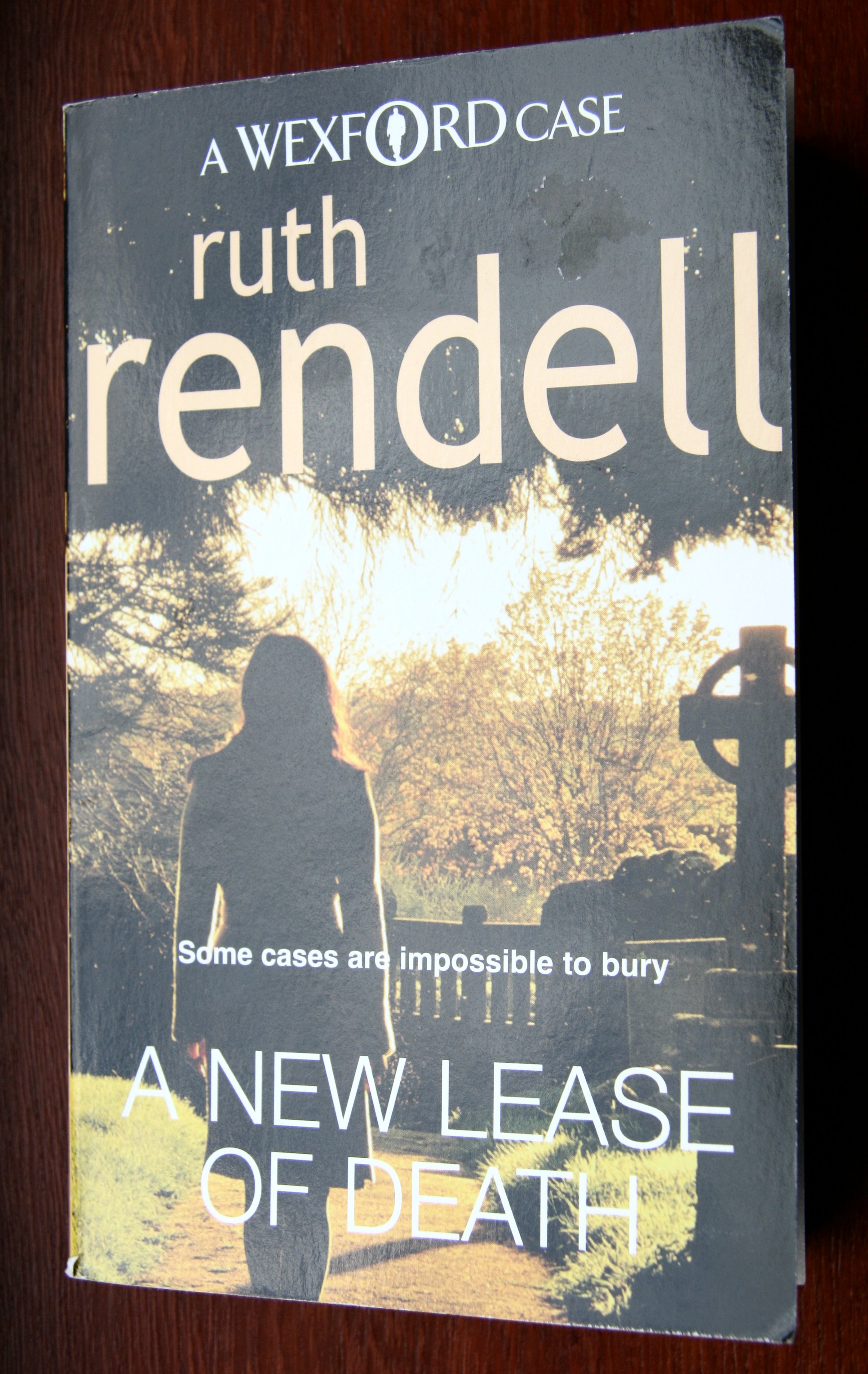
New Lease of Death is a relatively early Ruth Rendell novel, although Chief Inspector Wexford is already middle-aged and jowly. First published in 1967 and reprinted many times since, it is a fascinating period piece. It vividly describes a post-war England that is familiar to many – class-ridden, hidebound and generous only to those who obey the rules; still crime-writing territory for some authors, it has long since vanished. I’m not just talking about the topography, the clothes or the vehicles, but the outlook and mores of the characters. Without giving too much away, the plot hinges on the covering-up of an indiscretion which today would be regarded as neither shameful nor indiscreet.
All the later Rendell hallmarks are there: the cynicism yet essential decency of Wexford and Burden; the intricately-created family relationships; the credible twists of plot, the unspoken secrets. With hindsight, I’d say that one or two elements of the novel lack the sureness of touch that the author develops in her later work. What I found hardest to swallow was why Irene Painter’s second husband, Tom Kershaw, the delightful amateur polymath and full-time optimist, would ever have wanted to marry such a dreary, desiccated, sexless woman in the first place. More credible, but still jarring to the modern reader, is the busybodying intervention of the pious Reverend Archery. Nowadays he would be regarded as a prurient hypocrite whose son would have laughed him to scorn, but it is just possible that, when Rendell was writing in 1967, she intended the reader to take him at face value.
New Lease of Death is a period piece, but none the less enchanting for that. It is an undemanding good read, to be kept for cold nights on the same shelf as Agatha Christie and Ngaio Marsh.
Another fine psychological read…

I first read a book by Mark Billingham when I was given a proof copy of Scaredycat at the London Book Fair and read it on the train on the way home. I thought that it was an impressive novel, though a bit too sensational for my tastes. I’ve read at least one more of his novels since then (In the Dark, which his publisher does not class as crime), but am amazed to discover that he has now completed ten crime novels altogether.
I began Rush of Blood when I was on my own on Wednesday evening and completed it on Thursday (as we might say in Yorkshire: ‘It were that good!’). It is a very fine book indeed. I’d describe it as a psychological thriller rather than a crime novel. (Scaredycat is as well, but, as I’ve said, much more overtly violent.) It tells the story of how three British couples meet at a tawdry, manufactured beach resort in Florida. Although there are tensions between them from the start, they agree to have dinner together on their last evening at the resort. Earlier that day, a thirteen-year-old girl who is intellectually disabled goes missing. Among the many touches of genius in this book is the way by which Billington indicates that she is ‘slow’ and shows others’ reactions to her limited mental capabilities without actually applying any medical or ‘politically-correct’ terms to her condition. Her worn-down but amusing middle-aged single mother is also extremely well-drawn.
The British couples return home, but are somehow drawn to each other, perhaps because they ‘shared’ knowledge of this event. The girl’s body is not discovered until some weeks later, by which time they have set up a schedule of dinner dates at each other’s houses. Although they have given statements to the American police, the discovery of the body prompts further action. A trainee British detective, Jenny Quinlan, liaises with Jeffrey Gardner, the much more experienced black American detective on the case, and volunteers to interview the three couples again. He directs her to ask just some basic questions to fill in the gaps in his original statements, but Jenny is both keen and driven (she is a little bit reminiscent of Clarice Starling) and probes much deeper. In the process, she discovers that each of the three couples lied about their exact whereabouts at the time when the girl disappeared. The omniscient narrator (Billingham handles this technique well) reveals further flaws about each one of them and anomalies in each of their relationships, expanding on their characters just enough to tell the reader that any one of the individuals or couples could have committed the crime – or it could have been someone else altogether: the girl’s mother admitted chatting up a good-looking man several times during the days leading up to her disappearance.
I did guess who did it, but only a few pages before the end. Yet the denouement is not forced in any way: the trail of clues that Billingham lays is entirely logical when reviewed in retrospect.
I have two minor quibbles, both of which concern shortfalls in editing. Almost every time two or more people are gathered to discuss something, Billingham says that they ‘lean in’ to each other; and he uses the adjective ‘stupid’ on just about every page. At first, it is just a kind of catch-phrase of the girl’s mother and perfectly acceptable used like this, as one of her speech mannerisms, but eventually it is extended to the thoughts and actions of more or less everyone in the book. All authors have these blind spots: there is a word or phrase at the back of your mind that keeps on popping up and you have no idea how many times you have used it. A good editor will spot this. For me, these small blemishes caused a minor irritation in what is otherwise a superlative read. I now plan to read some of the crime novels that Billingham wrote after Scaredycat. Whatever impression they make, I am convinced that Rush of Blood will be the novel in which he transcends the crime genre. He will always be a great crime writer, but this novel makes him a great writer full stop, by whatever standards he is judged.
Chaos and casual brutality in Leeds…
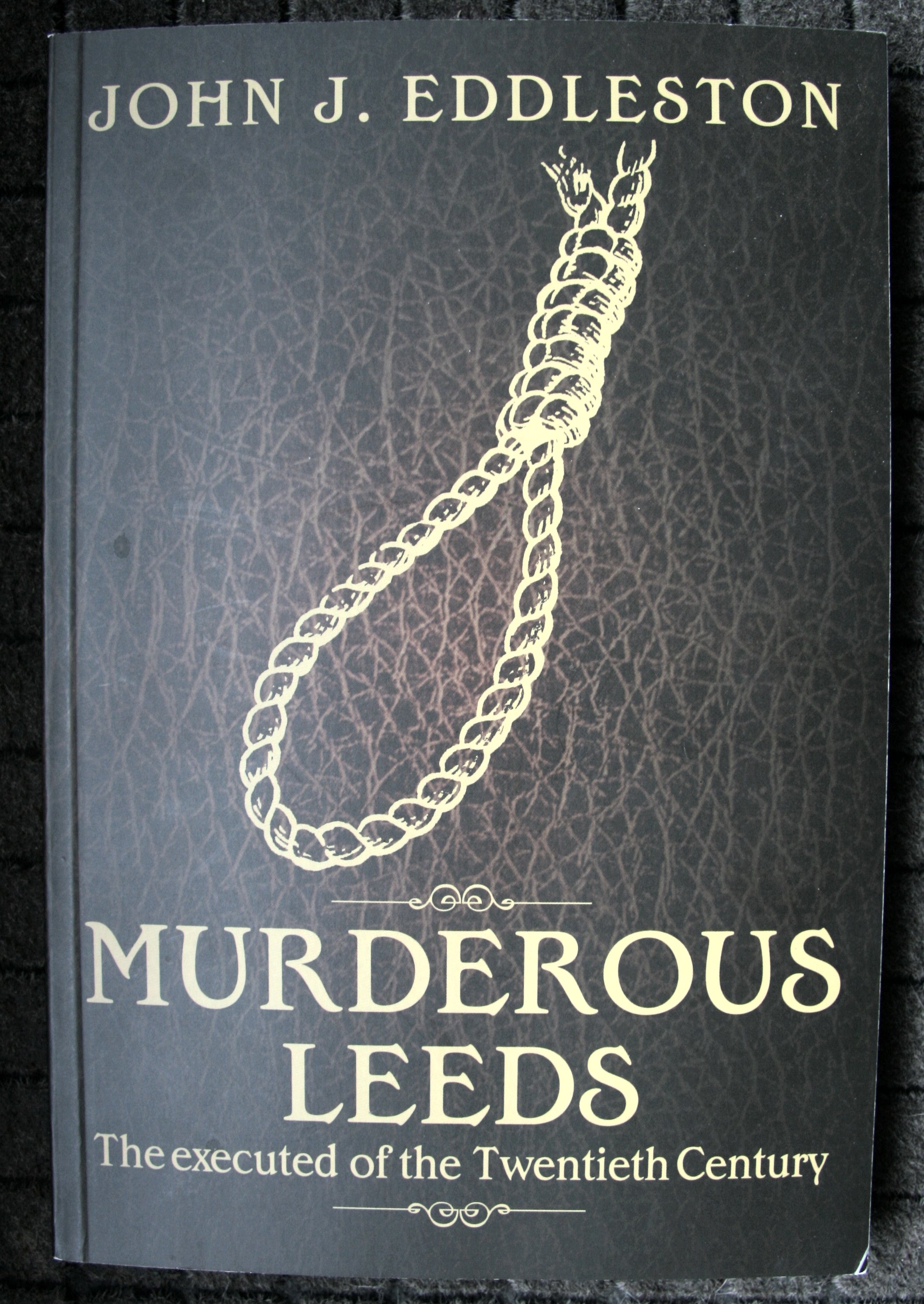
A book that I dip into occasionally is Murderous Leeds, by John J. Eddleston. Subtitled The executed of the Twentieth Century, it is a volume of short case studies, sourced from newspapers and court reports, of the trials of people convicted of murder in the first half of the twentieth century in Leeds.
Some of the murders were horrifically brutal; some were pathetic. The extreme poverty of most of those convicted was usually one of the most significant factors in their turning to crime. Many of these people – most were men, but some of the stories are about women – were of no fixed abode and drifted from one tawdry lodging-house to another or picked up women – or men – who were prepared to take them home. Some of the women paid for their generosity with their lives. Yet most of the convicted had jobs of some kind. It is hard to believe that, just two generations ago, many working men could not earn enough money to pay for a roof over their heads.
The saddest of all the stories is the first. It tells how, in 1900, a man called Thomas Mellor, aged 29, killed his two small daughters because he no longer had the means to support them. The jury that found him guilty commended him for his kindness in rescuing them from destitution in this way. He still paid for the crime with his life.
Among the most horrific tales is that of William Horsely Wardell, who persuaded a woman called Elizabeth Reaney to give him shelter and then brutally battered her to death. Attracted by the small reward on offer, her neighbours fell over themselves to ‘shop’ him.
Some of the accounts are bizarre, some are almost funny and a few exhibit a certain amount of intelligence on the part of the perpetrator. Most, however, portray a depressing picture of the grubby chaos and casual brutality of everyday urban working-class life. Many of the murders were not planned, but the result of drunken arguments, some of them ‘domestics’. The banality of these stories is one of the two reasons why I only dip into the book; I still have not read it all the way through. The other reason is that the author has decided to rely on verbatim accounts given by witnesses and judges’ summings-up. Whilst this is in many ways commendable – a treasure trove of fact of this kind is invaluable to a crime fiction writer – it has the drawback of resulting in a certain sameness if more than two or three of the stories are read in one go.
I do plan to tackle the book in one sitting at some point, though, because, as it spans the period 1900 – 1961, I know that a careful reading of it will show me how police methods improved during that time. It strikes me that, in 1900, real villains (as opposed to the desperate and probably mentally ill Thomas Mellor) could get away with almost anything; on the other hand, the forensic evidence produced in court in 1961 in order to convict Zsiga Pankotia, a Hungarian, of the murder of prosperous market trader Eli Myers was very sophisticated indeed.
When I’m walking through the streets of Leeds, especially in the market area, it often strikes me that the people I see may be the children, grandchildren and great-grandchildren of some of the victims whose fates are described in this book. Some may even be the descendants of their murderers. Sixty-seven people were hanged in Armley Gaol in the sixty-one years that the book covers. Apart from the exotically-named Pankotia and one Wilhelm Lubina (executed in 1954), almost all of them had good, sturdy Yorkshire names. I do hope that their descendants enjoy a more privileged existence than they did.
Beastly blended pleasures
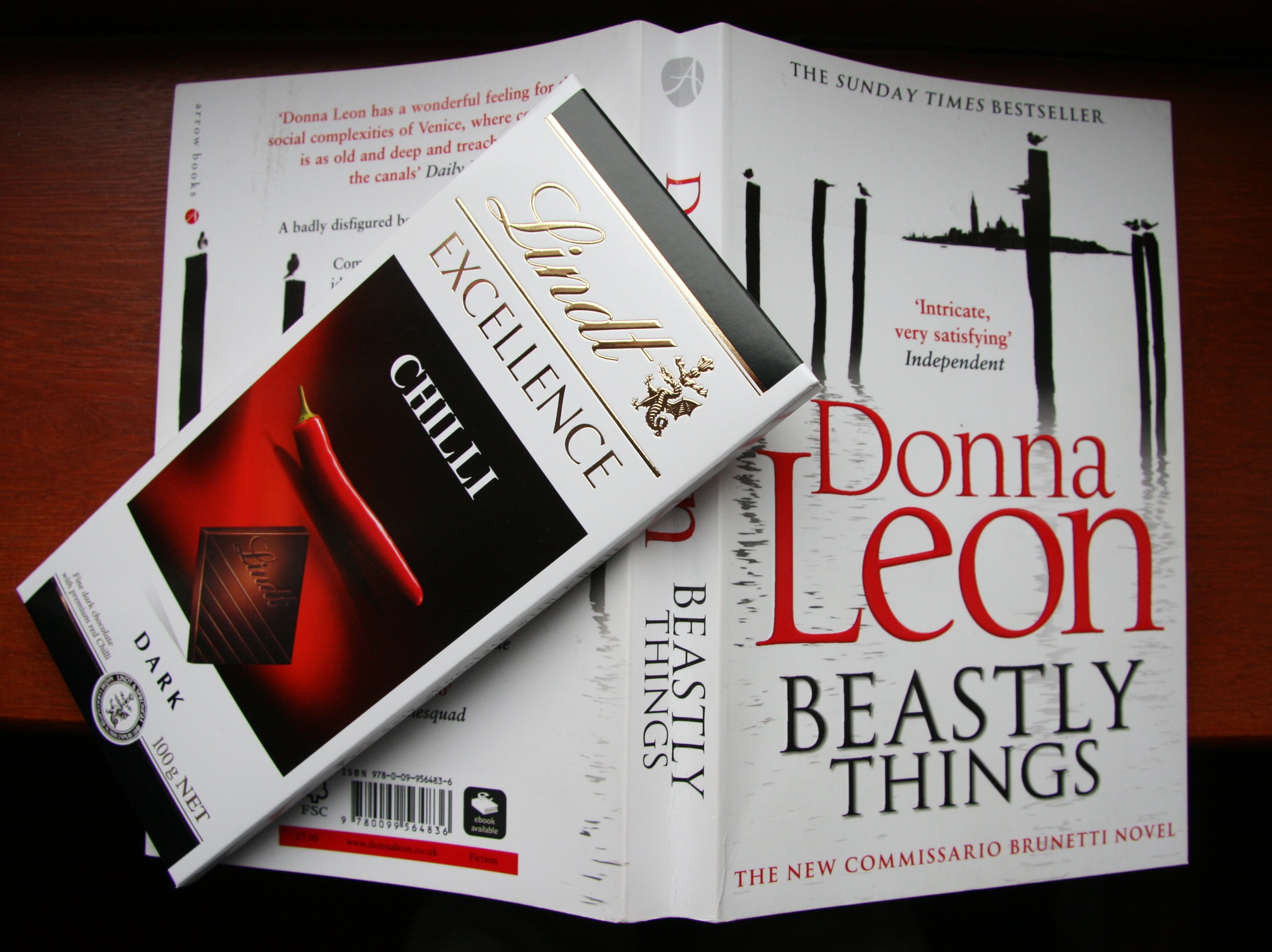
I have been a fan of Donna Leon for a long time. My respect for her redoubles now that I’ve read Beastly Things (which was one of my son’s/daughter-in-law’s Mother’s Day presents to me – no hidden comment intended, I’m sure!). This novel should be thrust in the face of all those smug, sententious critics who think that crime fiction is not ‘serious’. Without giving too much away, it is about the institutionalised abuse of animals and how substandard meat is being dishonestly introduced into the food chain. It was published before the horsemeat controversy was exposed, so it is prescient as well as topical.
Reading Beastly Things can be painful and even, at times, horrific. In addition to animal maltreatment, it explores blackmail and the corrosive effect that lying has on personal relationships. The novel begins with a murder – the result in part of the collision of all these themes – but the death is less central to it than they are (although the victim suffers from Madelung disease, clearly well-researched by the author, which makes him interesting and helps to give credibility to the plot).
Paradoxically, some of the most beautiful and memorable passages describe the carcasses of slaughtered animals. The whole book is a metaphor for the degenerative state of Italian politics. It suggests that these have so tainted public life that people no longer have a moral yardstick by which to govern their private lives. The novel would be extremely depressing were it not for the finely-crafted passages about Commissario Guido Brunetti’s relationship with his wife Paola. These run like a musical refrain through all the Brunetti books. I am not often jealous of other writers, but I really do envy the way in which Leon succeeds in presenting Brunetti’s perfect marriage to the perfect woman – Paola is beautiful, intelligent, rich and a good cook who daily prepares a delicious lunch and dinner for Brunetti and her two (fairly perfect) teenage children, as well as holding down a demanding job as a university lecturer – without being coy or cloying. She achieves this by portraying the marriage against the backdrop of Italy’s continuing ills. The implication is that the Commissario’s personal idyll is daily under threat and could be destroyed at any moment by some unseen force or miasma. And, of course, his professional life is filled with seamy horrors.
There is always a sombre undertone to Leon’s work, but this is one of her darkest novels yet – the more so because it is not in the slightest bit far-fetched. It could easily have been based on fact and, for all I know, it has been. I recommend it wholeheartedly – but if you are planning to read it, you should invest in a bar of chocolate as well, to keep up your serotonin levels!
A brief encounter with Brighton… and a book

Last week I visited Brighton for the first time in perhaps ten years. I was there because The Old Ship Hotel had been chosen as the venue for the annual academic bookselling and publishing conference for which I organise the speaker programme. I discovered that there has been an inn on the site of The Old Ship since Elizabethan times. Originally just called The Ship, it acquired its venerable epithet after another Ship hotel was built nearby – this one a mere stripling dating from the period of the Civil War. Hotels in Brighton can be evocative places. I have also stayed at The Grand, both before and after it was wrecked by the IRA bomb, on both occasions to attend the Booksellers Association Conference (I liked it better before than after) and one year spent several days in a seedy little guest house when the company I was working for forgot to book until the last minute and all the hotels were full.
Brighton itself has not changed much in ten years, although it looked very odd when I arrived, because the streets and seafront were covered in grubby snow. A moderately heavy snowfall on the day before seemed to have caused a local catastrophe in which everything – public transport, the highways, even restaurants and cafés – ground to a halt. I concluded that they’re ‘nesh’ in the South of England; we clear away snow like that in half an hour in Yorkshire! Or perhaps Brightonians – if that’s the right word – are just staggered to see the white stuff at all and it therefore strikes them down with a sort of horrified inertia.
Anyway, by midday, although it was still very cold, the snow had melted and I ventured out from The Old Ship to meet my former English teacher for lunch (more about this on another occasion). Before the conference started, I also managed to take a walk along the promenade and was saddened to see the hideous buckled corpse of the West Pier, still rising up out of the sea like a squashed daddy longlegs. The structure has suffered terminal damage since my last visit.
After presentations, drinks and speeches, dinner, more speeches and more drinks, I went to bed. I was rudely awakened at about 4 a.m. by the noise of a huge crowd outside. I exaggerate only a little when I say that it sounded like the storming of the Bastille! I began to realise that my de luxe room, with its fine view of the sea, came with mixed privileges. Looking discreetly out of the window, I saw a gang of perhaps forty youths running about on the seafront, many of them braying obscenities. And they didn’t move on – they just stayed there! Brighton has obviously degenerated since the days of Pinkie Brown, who was a better class of yob altogether.
Since it was obvious that I would get no more sleep until the mob dispersed or was moved on, I adopted my usual all-purpose tactic for dealing with adversity and took out a book. It was The Mistress of Alderley by Robert Barnard, not a novelist I’d read before. Under normal circumstances, it wasn’t the sort of novel I’d have especially enjoyed. Although the setting is meant to be contemporary, the characters seem to belong to a time warp. The mistress of Alderley herself, a retired actress called Caroline Fawley, seems to me to be straight out of the set of Brief Encounter. However, under any circumstances I should have enjoyed the detailed descriptions of Leeds which number among the novel’s strengths and, while the fracas outside continued to roar, I found the descriptions of Caroline’s genteel rural life quite soothing. The icing on the cake was that it turned out to be a sham, a pretence laid bare by the murder of Caroline’s slippery millionaire lover.
I had almost completed The Mistress of Alderley by breakfast, by which time the louts had melted away and a rosy dawn was launching itself above the dead pier.

True crime… beautifully executed.
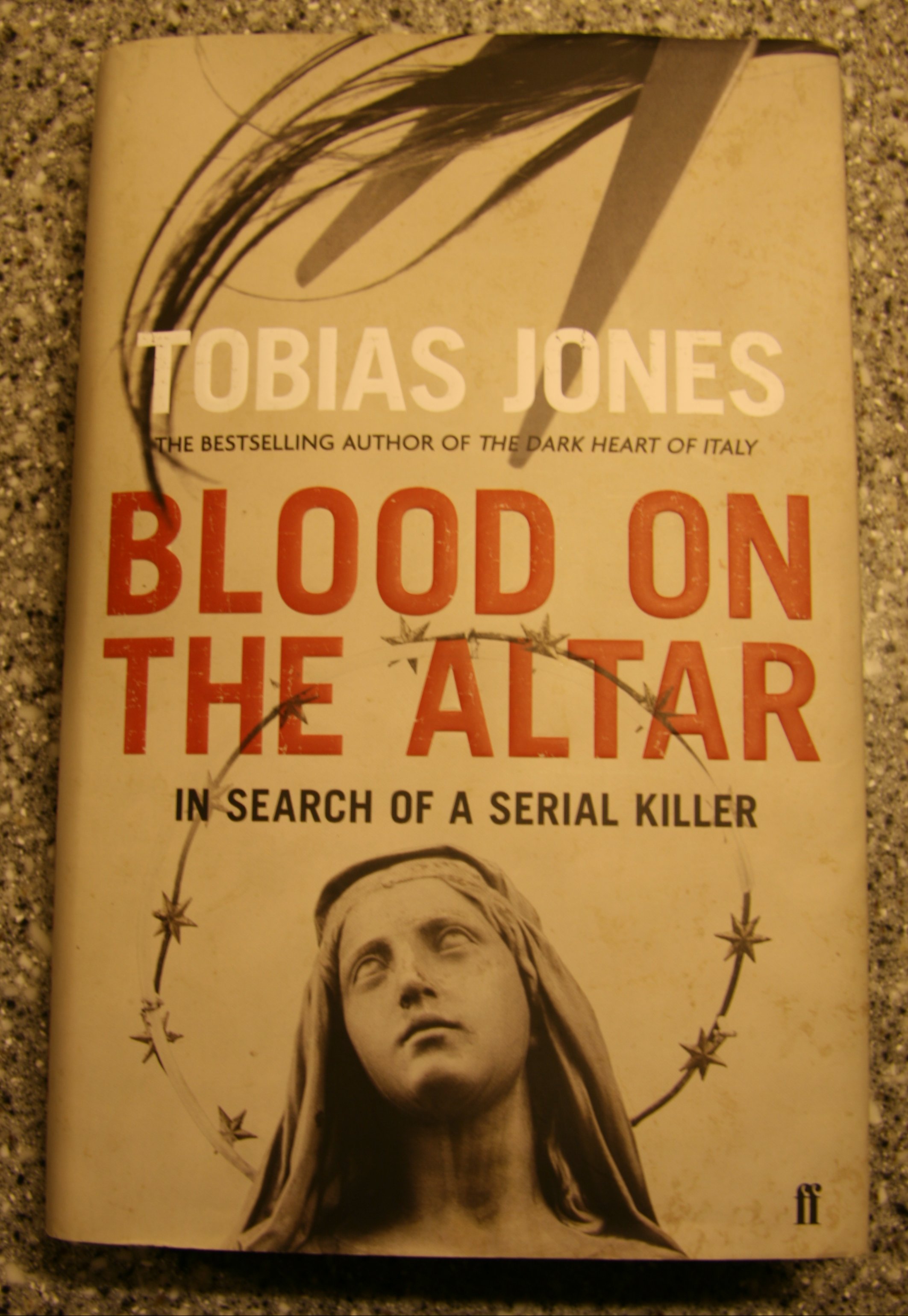
Blood on the Altar (faber & faber), by Tobias Jones, is undoubtedly the most unusual true crime account I have ever read, and one of the most disturbing. Jones was an investigative journalist living in Italy when he heard of the case of Elisa Claps, a sixteen-year-old schoolgirl who disappeared after attending church one Sunday morning in her home town of Potenza, deep in the south of the country. Jones befriended the Claps family; from the outset, they suspected that Danilo Restivo, a strange young man prone to exhibiting an unhealthy interest in certain local women and also, apparently, a stalker of Elisa, had murdered her. Among Restivo’s unsettling habits was a fetishistic obsession with female hair. However, his family was more eminent than the Claps family and his father undoubtedly able to influence such local officials as the public prosecutor and others in authority, like the priest in charge of the church where Elisa disappeared. As a result, although all the evidence pointed towards his guilt, he was not brought to justice. The evidence itself became obscured by a tissue of lies, evasions and half-truths in which many people, including some of Elisa’s own friends, appeared to be complicit.
Elisa’s brother, Gildo, spent almost twenty years trying to get at the truth of what happened, helped at intervals by Jones. Eventually, Jones became depressed by the corruption that seemed to be endemic in the region and returned to England to start a new life. He had been pursuing his new interests for some years when the case of Heather Barnett made the headlines. She was a seamstress living in Bournemouth and she had been brutally murdered and disfigured. In her hands were clumps of hair, not all of it belonging to her. It transpired that Danilo Restivo, who pretended to comfort her children after they discovered her body, was the neighbour who lived opposite her house. From his window, he could see into her bedroom window.
Eventually the police charged Restivo with Barnett’s murder. While the case was progressing, the remains of Elisa Claps were discovered high in the rafters of the church in Potenza where she had disappeared and Restivo was at last charged with this murder, too. Jones speculates that, since there was a gap of nine years between the two murders, it is likely that Restivo killed other women in the interim. In particular, the murder of a young Korean girl in Bournemouth about eighteen months before Heather Barnett’s death shows many similarities to the later crime. (Another man was found guilty of this murder, but the police have reopened this case recently, following the publication of Jones’ book.)
Like a well-plotted crime novel, Blood on the Altar tells two stories. The ‘main plot’ recounts the murders and offers a psychological profile of Restivo; the ‘sub-plot’ explores the remote region of Italy where the first crime takes place and tries to explain the collective psyche of its inhabitants. In the process, Jones gives the reader some evocative descriptions of the Italian countryside and of local customs. All of this is of relevance both to an understanding of Restivo’s character and to how he managed to evade the law, which in turn allowed him to commit the second murder (and probably others). However, the approach that Jones has taken has one drawback: it relegates Heather Barnett to a kind of bit-part in the book. Jones does not engage with her tragedy and that of her family as he engages with the tragedy of Elisa and the Claps family. This has the effect of making the story a bit lop-sided; however, that is a minor quibble about what is a fascinating, unsettling and beautifully-written book.
Banks on form – opinion from a regular investor…

I am a Peter Robinson addict – I think that I have read all of his books and I’ve certainly read all of the Banks novels. I’ve just completed Watching the Dark, which was one of the books that I bought during my trip to Gower Street last week.
This is Banks back on track, after what I felt was a slight dip in performance with Bad Boy. The novel is set partly in Yorkshire, partly in Tallinn, and involves a cold case murder that is reopened after an Estonian investigative journalist is found dead in a remote ruined Yorkshire farmhouse that has been used as accommodation for immigrant workers. The novel explores the vicious exploitation of guest workers by employment agencies and loan sharks, as well as highlighting the dangers to young girls of getting drunk when alone in foreign cities. The descriptions of Tallinn are evocative and convincing; in his Afterword, Robinson says that he visited the city in order to research the novel and pays tribute to several of its inhabitants who helped him.
Banks has had a chequered romantic career. Robinson has now chronicled the good years, the ultimate disintegration of his marriage to Sandra and his affairs with several other women, especially the on-off relationship with his colleague Annie Cabbot. He is possibly indicating that the Annie relationship has completely run its course by introducing a new, glamorous policewoman, Inspector Joanna Passero, in this novel. The relationship between her and Banks gets off to a rocky start and there is no sexual element to it – yet. However, the signs are there: by the end of the novel, she has confessed to him that she is worried that her (Italian) husband is being unfaithful to her. My guess is that the scene is now set for some torrid episodes with Banks in the next of the series!
I enjoyed Watching the Dark hugely. However, I have to admit that reading the Banks novels has become for me the equivalent of eating a box of chocolates – something to be devoured almost without thinking, for the sheer comforting pleasure of knowing exactly what will be delivered. Perhaps because they are so predictable, I don’t think that the latest two Banks books have come anywhere near another recent Robinson title in which Banks doesn’t feature: Before the Poison. I read this almost a year ago, and thought that it was masterly.
 Christina James, crime novelist