

I finally get around to reading an author I should have read before…

I’d heard a lot about Ann Cleeves; I had followed her on Twitter, to a kind reciprocation; the reading groups that I joined at Wakefield One had heaped glowing praise upon her work. Yet I had never read her – it was therefore high time that I rectified matters.
I bought two of her books from Rickaro: The Crow Trap, which is set in the Pennines, and Red Bones, one of her Shetland Isles stories (I know that these have been televised, but I haven’t seen any of the programmes). I chose novels set in two different locations, because, as I’ve said before, topography is important to me. I know that Ann Cleeves has a reputation for creating fine atmospheric settings – as one of the reading group members said, Shetland ‘almost becomes a person’ in the books set there – and I wanted to see how she achieved it.
I’m not, however, going to write here about her use of setting, because, although I endorse everything that has been said about it by others, I have nothing new to add. What I’d like to focus on especially, therefore, is her skill at character portrayal, particularly of women. I find her female characters fascinating, not only because of the way she draws them, but because she captures with subtle and skilful nuances some of the ways by which women are still exploited by men – though she is by no means a militant feminist and the male characters in her novels suffer from certain injustices, too. Some of her women characters find their own ways of fighting back: Anne Preece in The Crow Trap tries to make use of both her husband and Godfrey Waugh to provide her with the lifestyle that she craves, although both in their turn exploit her as part of the chess-like game of shifting relationships that forms a fine sub-plot to this novel; and Jimmy Perez, the policeman hero of Red Bones, is continually kept guessing about the depth of feeling that his vivacious, unconventional girlfriend Fran entertains for him.
I enjoyed both of these novels immensely. Ann Cleeves writes quite unlike any other crime novelist whose work I know. If I had to choose between them, I’d say that The Crow Trap has the edge on Red Bones, mainly because, although both are set in remote areas, the Shetland novel offers less scope for variety in characterisation. Both are rural variants of the country house murder convention, each with its own subtle twists that bring new life to this sub-genre. However, Red Bones has a strong archaeological theme, which was of special interest to me because when I read it I had just completed Almost Love, which is in part about the disappearance of a famous female archaeologist and set against the activities of the members of a famous archaeological society.
I see that Ann Cleeves is a prolific writer who has written many books. I can therefore look forward to many more hours of happy reading in her company.
A book to take on holiday… by someone I knew before she became a writer

I first learnt of Murielle’s Angel on the social networks. It is the debut novel of Mary Jane Howell, who is married to one of my husband’s university friends. Though I don’t know Mary Jane well, this is the first novel I have read by someone who was an acquaintance before she became a writer. I have friends who are writers, but that is because they are writers, if I may make the distinction.
It is piquant to read a book by someone whom you not only know but of whose circumstances you also have a little knowledge. The book is about Rosemary, a middle-aged woman who undertakes the pilgrimage of Santiago di Compostella. I am aware that the author herself made this pilgrimage some years ago; there are also other aspects of Rosemary’s personal life that seem to coincide with Mary Jane’s. The novel, however, is described as a fictionalised account of the pilgrimage and I won’t therefore be foolish enough to fall into the trap of assuming that it is thinly-disguised autobiography! I recognise from my own writing that characters can display certain traits or characteristics of people that I know, including myself, whilst remaining fictional creations nevertheless, and I’ve been much amused by readers who’ve told me with great certainty that they ‘knew’ who some of my characters were based on. For example, someone told me that she recognised the original of Henry Bevelton in In the Family. To my knowledge, Henry is entirely fictitious and not based on anyone at all!
Cinnamon Press, its publisher, describes Murielle’s Angel as a modern take on The Canterbury Tales. This is true in the sense that it tells of how a disparate group of people are thrown together, united only by the common purpose of making the pilgrimage; but, unlike Chaucer’s, these pilgrims don’t entertain each other by whiling away evenings and rest periods telling stories; instead, each has a story which the author herself outlines and pursues cleverly, drawing out the threads with admirable economy of detail. There is Stefan, who was brought up in an orphanage and has staked his whole career and possessions on producing a film; Ria, a doctor who is a workaholic seeking to restore some balance to her life and using the temporary separation to re-evaluate her relationship with her partner (interesting parallels and contrasts are drawn between her life and Rosemary’s); Dominic, who is a bit of a chancer and of dubious morality – he is a type, someone we have all met on campsites and ferries, the kind of person who latches on to others in a hail-fellow-well-met sort of way and wants something in return – but for Dominic, too, there is a sad story behind the bravado; then there is a host of minor characters who criss-cross the narrative at intervals – two Canadian nurses, a grotesquely amorous widower, two groups of Germans.
Like Chaucer’s, these modern pilgrims have many reasons for committing to the pilgrimage, none of them overtly religious. Each is trying to ‘find’ himself or herself through the combined abandonment of routine and the privations that the journey entails. There is a strong sexual undercurrent throughout, although only one description of sexual consummation, and that between two minor characters. The author shows that the unfamiliarly liberal circumstances created by a group of strangers being thrown together encourages an often unwelcome removal of inhibitions. Rosemary herself is propositioned on several occasions and is sometimes disgusted, sometimes flattered, by these attentions.
For me, the novel dips briefly about two thirds of the way through, when the combination of apparent moral aimlessness and the dissatisfaction of several of the characters with what they are achieving as pilgrims suddenly tipped me into, if not boredom, at least a bewildered questioning of where it was all leading. But I was too impatient, because it is at this point that Murielle, who has been hovering around the periphery for some time, now takes centre stage. Terminally ill, she is unable to continue further on foot (even with the help of a little cheating on public transport) and takes refuge in the house of a priest. The relationship between Murielle and the priest is exquisitely drawn. He is her spiritual guide as she prepares for death, but also, the author hints delicately, totally (although of course hopelessly) in love with her. It is an act of love that unites all the characters of the novel, as they admire the mural that Murielle has painted on the side of the priest’s house to thank him for his care. Their reaction is unanimously of joy and laughter. It is the priest who teaches Murielle that you owe service especially to those who love you more than you love them. It is a lesson that each of the main characters takes on board, each in his or her own way.
Murielle’s Angel is beautifully written; it is sad, yet uplifting; it is a brilliant achievement, one of the best debut novels that I have read. I’d not heard of Cinnamon Press before I bought it, but it is a publisher whose books I shall look out for now. If you’re looking for some fine writing and an extraordinary narrative to take on holiday, I wholeheartedly recommend this book.
A towering giant of a book on a special day…

I tend not to write down dates of birthdays, wedding anniversaries etc., but I think I’m quite good at remembering them – although I have just had to ask one of my friends the date on which her daughter was born. One date that I never forget each year, however, is a fictional one: Bloomsday. As all James Joyce aficionados will know, it is today, June 16th. It was on this date in 1904 that Leopold Bloom made his day-long perambulations around Dublin and, by describing it in Ulysses, first published in Paris in 1922, Joyce captured the history, customs, beliefs and prejudices, not only of his own country, but of the whole of European culture. His masterstroke was to present it from the viewpoint of the perennial outsider, a modern version of the Wandering Jew. A life in the day, indeed! There was a personal irony in the choice of date, too, as it was on this day that Joyce’s liaison with Nora Barnacle, who was to become his long-suffering common law wife and eventually his legal wife, began.
Picking up my tattered Penguin edition of the book, I resolve to read it again very soon. Because of the range and depth of the literary styles that it covers, and Joyce’s wonderful manipulation of language, it is a complete writer’s handbook in itself. It needs no gloss or laboriously explained sets of rules – although the book can be read at many levels and is amazingly erudite. I don’t usually write in books, but I see that against one passage my younger and more studious self has written ‘Traherne: Centuries of Meditation. 3rd Century’. It’s impossible for anyone else to write like Joyce, but admiring and appreciating his work certainly makes you think about how to use language.
It was Joyce who first taught me the magic of lists. The ones that he creates appear to be off-the-cuff, but I’m sure their sparkling apparent spontaneity cost him many hours of effort. Take this one, for example, which is only a third of one in a series that appears towards the end of the book to sum up Bloom’s condition: Mendicancy: that of the fraudulent bankrupt with negligible assets paying 1s 4d in the £, sandwichman, distributor of throwaways, nocturnal vagrant, insinuating sycophant, maimed sailor, blind stripling, superannuated bailiff’s man, marfeast, lickplate, spoilsport, pickthank, eccentric public laughing stock seated on bench of public park under discarded perforated umbrella. It was through Joyce’s work also that I came to realise the importance of evoking all of the senses, not just the visual: his description of Leopold Bloom’s lunchtime cheese sandwich is a classic still to be surpassed, in my experience. Then there is his satirical juxtaposition of the sacrosanct (and, he indicates, probably humbug) with the absurd: And they beheld Him, even Him, ben Bloom Elijah, amid clouds of angels ascend to the glory of the brightness at an angle of fortyfive degrees over Donohoe’s in Little Green Street like a shot off a shovel. Like avid readers both before and after him, Joyce read everything: cereal packets, handbills, magazines and potboilers as well as more European literature than almost anyone else could cram into a lifetime. Unlike other learned writers, however, he didn’t make judgments about the ‘quality’ of what he read. The Nausicaa episode (Chapter 13 of Ulysses) is not only a brilliant pastiche of the style of writing of women’s magazines of the time, but also reveals Joyce’s sneaking admiration for a genre that could get away with so much hyperbole. Gerty MacDowell, its naïve and rather tragic heroine, is a fine portrait of a dreamy young woman whose head is filled with romantic notions of how she can shape her life. Although she is portrayed only once, in a tiny snapshot of time, Joyce conveys to the reader through this medium of ‘magazinese’ that her life will be much bleaker than she supposes. Today’s ‘filmstar for a day’ brides are her modern equivalents.
It’s difficult to say what I like best about Ulysses, but, if pushed, I’d say that it’s the portrait of Molly Bloom. Hers is a timeless portrait of almost everything that it has meant to be a woman through the ages: she is a sensuous earth mother, fascinating femme fatale, sexy but not a whore, capable of great sympathy but also self-centred, perceptive, ‘genteel’ and coarse. She belongs to a long tradition of female characters that stretches back in time, even beyond Cleopatra, to Homer’s sorceress Scylla. Molly lives through her senses; the one attribute that she doesn’t possess is intelligence of the formal, schooled kind. In this, she is the antithesis of Leopold, who thinks about everything, applies his knowledge to everything, and therefore, like Hamlet, is unable to act. Apparently she was modelled at least in part on Nora Barnacle. Some feminist readers have found her portrayal insulting to women and, mixing life with fiction again for a moment, it’s true that Joyce held some curious views about the female sex. But Molly is above all the great force for the positive in the novel. It is she who has the very last word. It is, simply, Yes.
The book’s title is pronounced YouLISSease, by the way, not YOUlissease. I was taught this by an Irish professor, who said that I could mispronounce it if I liked, but, if so, I’d never get to grips with Finnegans Wake, which is all about pronunciation. I’ve found this to be true. Although still a difficult work, ‘the Wake’ becomes comprehensible if you read it aloud in a Dublin accent.
Joyce eventually stretched language to the point at which all but his most determined supporters find his work too much of an effort to read. He may perhaps have been a genius on the verge of madness. Nevertheless, what he managed to wrest from language changed the course of fiction writing forever. A much more insignificant James salutes the author – and you all – on Bloomsday 2013!
Anya Lipska – @AnyaLipska – in compelling command…

I bought this book because it has had some excellent reviews and also because I’ve met Anya Lipska on social networks, where she always speaks with great courtesy and perspicacity. I knew, therefore, that buying it would involve little risk!
The front of the jacket carries a quote from Emlyn Rees: ‘RIP Nordic crime. Here come the Poles’. That in itself is interesting, because I’ve read several novels this year that, like this one, are set partly in the UK and partly in Poland, the protagonists of which are either Polish ex-pats or the children of Polish ex-pats. I went overboard on the first of them, because the subject seemed to me to be so unusual and appealing. However, after I’d read two or three, I realised that they all focus on Poland’s recent troubled political past, especially the Soviet occupation. This actually gives them a much more limited appeal than that of Nordic crime, which deals with the many facets of modern society in the Nordic countries, not just one aspect of it. That first one, especially, was, upon a second reading, disappointing in terms of both technique and its author’s command of language.
Where the Devil Can’t Go is in a different league. It’s true that it touches on the Soviet occupation and dwells at length on Solidarity and its aftermath, but in a very sophisticated way. This is not a tub-thumping work. Anya Lipska demonstrates an impressive knowledge of Poland’s post-war political history and its residual effects, yet she does not parade her knowledge or make sweeping comments about a martyred state. Instead, she offers a wise, balanced and yet hard-hitting narrative. If I may say so in all humility, this is a very accomplished book indeed. It contains sinners, but no saints… and even the sinners are complicated characters. Lipska holds no truck with two-dimensional villains.
The hero, Janusz Kiszka, is decidedly flawed. He works as a builder, not always on the right side of the law. He has a very uncertain temper and is prone to bouts of despair. In some ways, he is the stereotypical Polish incomer – so much so that, given the quality of her writing, I suspect that at the beginning of the book Lipska is gently mocking her readers, leading them to the slightly smug but erroneous belief that they’ve come across this type before – perhaps in real life – and have got him taped. But Kiszka is full of surprises – and not contrived ones, either. Gradually, he is revealed as a complex, tragic and even noble character, who, although he is sometimes forced by circumstance to engage in James Bond-like escapades, possesses qualities to which Bond is a stranger: fear, remorse, reflectiveness and sensitivity. He is also an intellectual manqué. Yet he remains a bit of a rogue.
The minor characters are equally well-drawn. I particularly like the old priest, Father Pietruski, who, if not a rogue himself (a point that is never dwelt on too much) certainly understands rogues and can separate the ‘good’ ones from those with black hearts. He’s not averse to drinking with the former. Kasia, Janusz’s girlfriend, is also well-drawn. Married to a worthless man, she refuses to leave him because she takes her marriage vows seriously. She works as a stripper and her greatest aspiration is to own a nail bar. It is a tribute to Lipska’s talent that she is able to generate great sympathy for this woman and her drab, sleazy life. The novel also gets my vote because of the way in which it vividly and accurately captures local topographies: I can’t speak for the Polish scenes, but the London ones, with which I am familiar, are completely convincing.
Where the Devil Can’t Go is shot through with politics, but its core subject is something deeper: it is about the human condition itself. In this respect, as in many others, it resembles the work of the best of the Nordic writers; Henning Mankell springs to mind. Yet the authorial voice is Lipska’s own, unique and original.
I’m impressed by the young female detective, Natalie Kershaw, but it is Kiszka who steals the show; I’m not sure if this novel is the first of a series, and therefore whether more are planned, but I do hope so. I should very much like to encounter Janusz Kiszka again.
Under way and making way in Rotterdam…
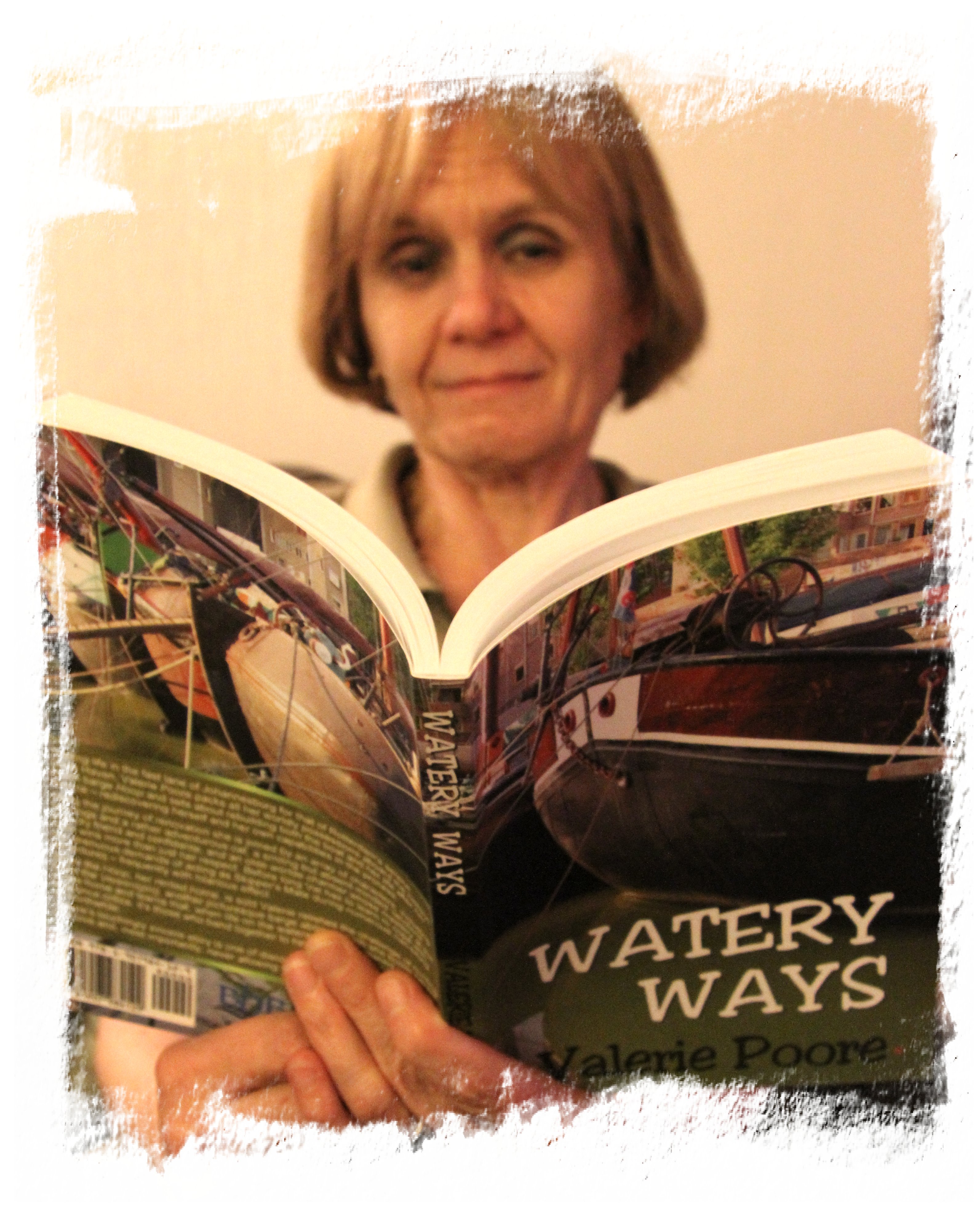
Valerie Poore’s Watery Ways is a book of three love affairs. Each has its highs and lows, pleasures and pains. The human one seems to be the least anguished and captures well a true meeting of minds and hearts; the others are much more fraught with complete cargoes of crises, one being the development of the author’s passion for life on the water, with its close-knit harbour community, and the other her embarkation upon an emotional journey to her own live-aboard barge.
Having enjoyed narrow-boating on canals and rivers in the UK and sailed around the Western Isles of Scotland, I knew that this book would have much to interest me. I came upon Val and her books during my own voyages of discovery into social networking. She is active on Twitter and Facebook and I quickly realised that, in addition to being a generous supporter of other authors and an astute literary commentator, she has the ability to write captivatingly of her wide-ranging experiences and many practical skills.
Watery Ways charts her experiences as a new member of the nautical family of Oude Haven, the oldest harbour in Rotterdam and home now to a collection of vintage boats, lovingly restored by their owners to standards established by a commission of experts set up by the harbour’s special Foundation. As a tenant aboard one of these barges, Val found her personal background of self-sufficiency and expertise in the restoration of wooden artefacts well-suited to the task of refurbishing and maintaining her ‘new’ accommodation.
Using a present tense narrative and both factual and imaginative description, Val enables the reader to enjoy the immediacy of the moment and presents a graphic picture of places, people and events. The atmosphere of the harbour and the characters of its quirky inhabitants are evoked in unfussy but very personal prose. The technical detail, essential for an autobiographical account such as this, is explained in terms that present no problems to the lay reader: Val’s style is precise and lucid. Though there is sentiment, her matter-of-fact manner never allows it to become cloying; we are able to empathise easily with her feelings. Her capacity to interest a non-boating audience is considerable, not least because of her self-depreciating sense of humour and her willingness to share her many discomforts and mistakes, and the occasional success. For me, she doesn’t create an over-romanticised idyll that might seduce the reader into wanting to buy a boat, but does provide insight into the delights of ‘faring’ along urban, industrial and completely rural canals. She succeeds in transmitting the strange time-warp sensation that voyagers on such waterways experience as they move along at a pace of life that belongs to ages gone by, taking days to cover distances that modern road and rail transport completes in hours. There is a magic here, for the relationship of bargee to barge is very real and just as much of an affair as one between human lover and human lover. The boats themselves seem to have individual temperaments and eccentricities.
Watery Ways provides a very reassuring and positive image of human nature, a contrast to the violence of international events such as the 9/11 atrocity, which took place during Val’s first long boat trip with her partner Koos to Lille and to which she refers with great sensitivity.
I very much enjoyed reading this book. I know that Val is working on a sequel, telling of the next instalment of her life afloat and of the complete renovation of her own pakschuit (local delivery barge), the Vereeniging. The present book concludes by describing how she acquired this vesseI and I am very much looking forward to her account of her work to make it habitable and to meet Oude Haven’s rigorous historic criteria.
Follow Valerie on Twitter: Follow @vallypee and visit her website.
Watery Ways is published by Boathooks Books, ISBN 978-1-907984-12-9
Don’t you love it when a book has personal resonance!

Stone Cradle is the second novel that I’ve read by Louise Doughty. The first, Whatever You Love, was an entirely different kind of book: a contemporary novel about child bereavement. Stone Cradle is a historical novel set in the Fens at the turn of the twentieth century, about a Traveller family. I bought it both because I’m interested in the Lincolnshire of that period and because it resonates with me personally, for reasons that I shall explain later, but first I’d like to say that any writer who can produce two such completely different, yet equally compelling, novels ticks several boxes for me straight away.
Stone Cradle is in part about the bleakness of being a working-class woman living in a predominantly farming community of the period. The story is told in the first person, alternately by a female Traveller, Clementina, and her daughter-in-law, Rose, a farmer’s adopted daughter who renounces the harsh life on the farm for the spurious glamour of running away to marry Clementina’s son, Elijah. It is one of the poignant ironies of the book that, although they share a great deal in common (including the fact that Elijah is illegitimate and Rose herself the illegitimate daughter of a mother who, like Clementina, worked hard to keep her), she and Clementina detest each other from the moment that they first meet. This is partly because they are rivals for Elijah’s affections, even though he is more often absent than present from their lives and both know that he is a ne’er-do-well, but even more because the norms and values of each are incomprehensible to the other. The dual first-person narrative captures this cleverly and is the more accomplished for going over the same events twice, through the eyes of each, without being repetitive. As someone who is experimenting with this technique at the moment, I know how difficult it is to pull off!
Rose persuades Elijah to live in a house in Cambridge (where Clementina presents herself as an uninvited guest and never moves out) for several years after their marriage, but Elijah’s fecklessness and their consequent poverty force them eventually to re-join the Travelling community. Rose never fits in. She dies twenty years before Clementina. At the beginning of the novel, Elijah, himself now an old man, is shown burying his aged mother. To save a few shillings, he has Rose’s grave opened and Clementina’s coffin laid on hers. Had they known, both women would have been appalled; the act epitomises both Elijah’s insensitivity and the privation that has followed them throughout their lives.
Two further qualities make this novel exceptional: the brilliant way in which Louise Doughty captures what it was like to be a member of the nineteenth-century Travelling community and her depiction of the period itself. The book has obviously been extensively researched, yet nowhere does the author parade her knowledge. One of the reasons for my being more often than not equivocal about historical novels is that, unless the author is very skilled indeed, the reader is presented with an outside-looking-in narrative: in other words, the author’s fictional take on what s/he has gained from the history books. Worse, this is sometimes accompanied by what I call the costume drama factor, i.e., a stereotypically ‘olde worlde’ way of making the characters think and speak, probably based on watching too many films. It takes a very talented writer not to fall into these traps, but Louise Doughty is such a writer.
Now I come to the personal resonance bit. In her acknowledgments, the author pays tribute to the Romany museum in Spalding (of which I was hitherto unaware) and the Boswell family. She actually gives the most noble of the Romany families in the book the name ‘Boswell’. It is another of the novel’s distinctions that the Traveller characters are not over-sentimentalised. There are rough and feckless Travellers, as well as ‘good’ ones, just as there are good and bad ‘gorjers’ (non-Travellers) living in and around Cambridge. The Boswell family was well-known in the Spalding of my youth. Their patriarch, whose first name I don’t know, because he was always referred to as ‘Bozzie’, had ceased to travel and built up a profitable scrap-metal business just outside the town. By the time I was born, he was reputed to be a millionaire and lived in a very nice house. I went with my father to see him on several occasions. In those days, I think that at least some of his family were still Travellers, and some may be still. Louise Doughty seems to indicate, however, that there is still a permanent Boswell presence in Spalding and evidently the Boswells were the inspiration behind the museum. I am determined to visit it next time I go to Spalding.
Harsh!

I confess that I had considerable difficulty in continuing with Capture, by Roger Smith, after I’d read the first forty pages or so. The quote on the front jacket (from The Times) says: ‘Smith grabs readers and plunges them into his nightmare visions’. I have probably never seen ten words used with such accuracy to sum up a novel.
Capture is set in South Africa. All of its characters are indeed plunged into a nightmare of betrayal, violence and murder. For the reader, the nightmare is exacerbated by the fact that none of these characters seems to possess noble or redeeming qualities. It is as if society itself has squashed all goodness out of them, so that they are left like zombies, wandering in a broken civilisation, intent upon nothing but their own survival and ruthless about how they achieve it. As well as practising routine violence, they make their sordid lives bearable by indulging in other vices: drink, drugs, abuse of power. At the beginning of the novel, Nick, who comes closest to being its hero, ignores his four-year-old daughter Sunny’s cries for help as she drowns just yards from where he stands with one of his cronies, smoking a joint. Before this, he appears to be obsessed with her in a creepily unhealthy way – until it is made apparent that his obsession lies, not with her, but with the imaging paraphernalia on which he has built his career. Things matter more than people. His daughter is pressed unwillingly into performing for him daily, as if she were the organ-grinder’s monkey. Meanwhile Caroline, her mother, who has never recovered from post-natal depression, survives on a cocktail of anti-depressants and hatred.
Into their lives comes Vernon, the most sinister character in the novel, Dawn, the ex-prostitute and recently-sacked stripper whom he is ‘protecting’, and Brittany, her daughter. Vernon has no sexual relationship with Dawn but he is obsessed with Brittany – we never quite find out why. The unhappy triangle of Nick, Sunny and Caroline is reflected in a kind of literary distorting mirror by the unholy one of Vernon, Brittany and Dawn. Yet this comparison is too simplistic: Vernon and Dawn are both badly traumatised characters who can’t break free mentally from the privations they have endured in the past. United in their wish to protect Brittany from the sort of childhood they each suffered, they almost lose her to the depravity of Dawn’s junkie neighbours. Nick and Caroline are being damaged in the present, especially by the toxic fall-out from their failing marriage.
At least five murders result from the mess created by Sunny’s death, in which Vernon has been complicit in order to gain power over Nick. By the end of the novel, all but one of the adult protagonists has committed murder or been accessory to it. The ending offers catharsis of a kind, but it does not convince that the new life opening up for the survivors will turn out to be anything other than a sick mirage.
Why did I steel myself to finish it? In the first place, it is beautifully written. The accounts of the murders are brutal, but, given their context, not gratuitously violent: the violence is in accordance with the rest of Smith’s weird, fractured world. One also senses that his portrayal of life in urban South Africa is pretty accurate. Secondly, it raises some very big questions about what it means to be human and the nature of crime and punishment. At its heart lies a conundrum: can human beings be brutalised into depravity, or is the depravity always there, waiting for a propitious circumstance to show itself? In other words, is there any true nobility or selflessness to be found at all in the human condition? Smith addresses these questions through his skilful handling of characterisation and plot. The answers that he provides are profoundly disturbing. Capture does not make good bedtime reading, but it is a very grown-up novel.
An ethical question…
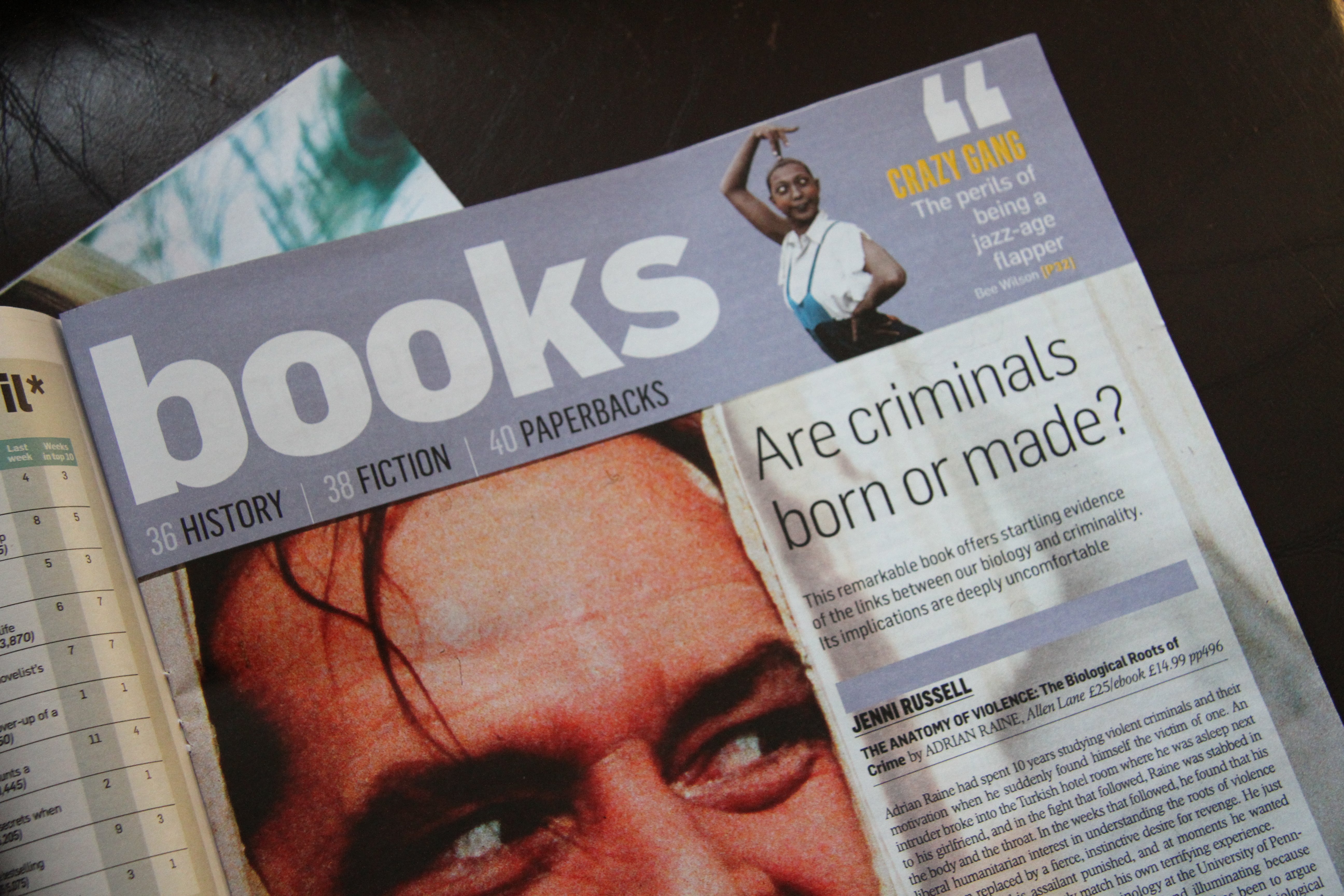
From The Sunday Times May 12th 2013
One of my big treats is to read the book reviews in the Sunday newspapers. I’m always slightly sulky if, as occasionally happens, the review pages have been given over to the programme of a forthcoming literary festival or, worse, column after column of disappointingly brief paragraphs on ‘holiday reading’ or ‘books for Christmas’.
Yesterday’s review pages in The Sunday Times were particularly entertaining. Most of the reviews were interesting and several books were featured that I’ve made a mental note to buy. I’m not sure that this will include the lead title, however: The Anatomy of Violence: the Biological Roots of Crime, by Adrian Raine, reviewed by Jenni Russell. Raine, now a professor at an American university, has spent ten years studying violent criminals and their motivation and concludes that they are shaped by a combination of biological and social factors that are beyond their control. He is particularly keen to emphasise the ungovernableness of the biological factors that are at work, claiming that the brains of psychopaths and sociopaths are actually different from those of ‘normal’ people (though he confounds his argument somewhat by saying that the children of criminals, even if they are adopted, are more likely to commit crimes than other children).
As someone who is also interested in how the criminal mind works, though without the medical background, my instinct is to find this argument repellent. To me, it seems to be too closely related to the specious ‘insanity’ plea to which murderers and rapists often resort in order to obtain a lighter sentence or treatment at a secure hospital instead of jail, and to deserve about as much credence. I think that it is very dangerous indeed to suggest that sane adults are not responsible for their actions. As a girl, I had a close relative who would fly into terrible rages over some trivial mishap, such as when one of his children accidentally dropped a jar of honey on the floor, or the fire went out and he had to relight it. His frequent complaint would be: ‘I was in a good mood until you upset me!’ or: ‘I was perfectly all right until that happened!’ Even as a very young child, I remember the disdain that I felt that a grown man would try to duck responsibility for his vicious temper in this way.
I’m also more than a little disturbed by some of the experiments that Professor Raine describes. The review states (without comment): ‘In an experiment on almost 1,800 three-year-olds in Mauritius, children were measured on their bodies’ ability to anticipate that a particular tone would be followed by an unpleasant sound. It took only three trials for most children to sweat in anticipation of the harsh noise.’ I don’t like the sound of this at all. It raises all sorts of questions about the ethics of carrying out experiments with children, especially experiments that involve pain or fear. I realise that the experimentation described in Raine’s book involved fairly mild discomfort, yet it registers on a spectrum at whose extremity looms the terrible spectre of Mengele. I am reminded also of the ethical questions that arose concerning the Milgram experiment.
Professor Raine is more engaging when he writes about himself. From the review, it is not clear whether he is writing in a spirit of wry self-knowledge or simply being matter-of-fact when he reveals that, when he was seriously injured by an intruder while staying in a hotel room in Turkey, he felt a fierce, instinctive desire for revenge. Jenni Russell tells us: ‘He just wanted to see his assailant punished, and at moments he wanted that punishment to exactly match his own terrifying experience.’
I’d say that this eclipsing of Raine’s humanitarian tendencies by his more universally human ones is completely normal. It also illustrates why we need laws: in a civilised country, a judge and jury will dispassionately apply the law that prescribes fit punishment for the crime. Usually, it won’t be of the ‘an eye for an eye, a tooth for a tooth’ variety that injured parties like Raine sometimes passionately, and perfectly understandably, desire. Conversely, although a case may certainly be made for using the results of research into the criminal’s brain – and his or her background – in order to provide therapy, I don’t think that it should count as ‘mitigating evidence’. Anyone can try to justify appalling behaviour – from childish rages to much more serious crimes – by blaming circumstance, biological or otherwise. The fact that most of us don’t is what makes society work.
A gripping read with topical interest…

I’ve written about Michael Robotham before. Say You’re Sorry is the third of his books that I’ve read, all supplied by my son. In my opinion, this is the best of the three. By a strange quirk of coincidence, it is about two women who have been held captive for three years; I started reading it last weekend, before the story of the Ohio captives broke. The women in Robotham’s story are not being held ‘in plain sight’, however, but in an isolated building.
The story has two narrators, Joe O’Loughlin, Robotham’s now familiar lugubrious and slightly self-pitying, borderline misfit clinical psychologist hero and Piper Hadley, one of the two teenage victims, who manages to keep a diary throughout her captivity. Piper herself is a bit of a misfit and so lacking in self-confidence that she fails to realise that their captor distinguishes between her and ‘Tash’, the other captive, in ways that become vital to her survival.
This is a much more ambitious novel than the other Robothams I have read; both the plot and the character portrayals are at once more complex and more subtle. Robotham is still working on his trademark theme of the ‘woman at risk’, but these women are more than passive victims. Each has demons of her own that are unrelated to her captivity. There are a few jarring notes. Most conspicuous among these is (in my view) Robotham’s relatively weak power of conveying a sense of place. The book is supposed to be set in and around Oxford, an area with which I am familiar – it even mentions Branca, a restaurant in which I have eaten – but the descriptions do not convince. This is partly because the culture and language of the community from which Piper and Tash come does not seem very English. In both the norms and expressions that the people living there use (and, indeed, in Robotham’s choice of names like ‘Piper’ and ‘Augie’), they seem much more to belong to small-town America.
This is a minor, if recurrent, annoyance, however. I was gripped by this book. I did guess who the perpetrator was before a final twist in the plot revealed it, but only a few pages before he was unmasked. Robotham is particularly skilful at planting red herrings in Say You’re Sorry. The novel’s distinction doesn’t just come from the clever plot and the reader’s on-tenterhooks sympathy for Piper, however. It comes from the author’s success in getting inside the heads of both captives and captor in a totally convincing and believable way. There might have been a time when the plot itself could have been criticised for being far-fetched. Unfortunately, the stories of Elizabeth Fritzl, Natascha Kampusch, Elizabeth Smart (and now of Amanda Berry, Gina DeJesus and Michelle Knight in Ohio who have just escaped from ten years or more of alleged imprisonment and rape by Ariel Castro) prove that Robotham’s plot is not only capable of happening in real life, but also relatively restrained. As for what has happened in real life, the truth has turned out far stranger than fiction.
This book held me spellbound from start to finish…
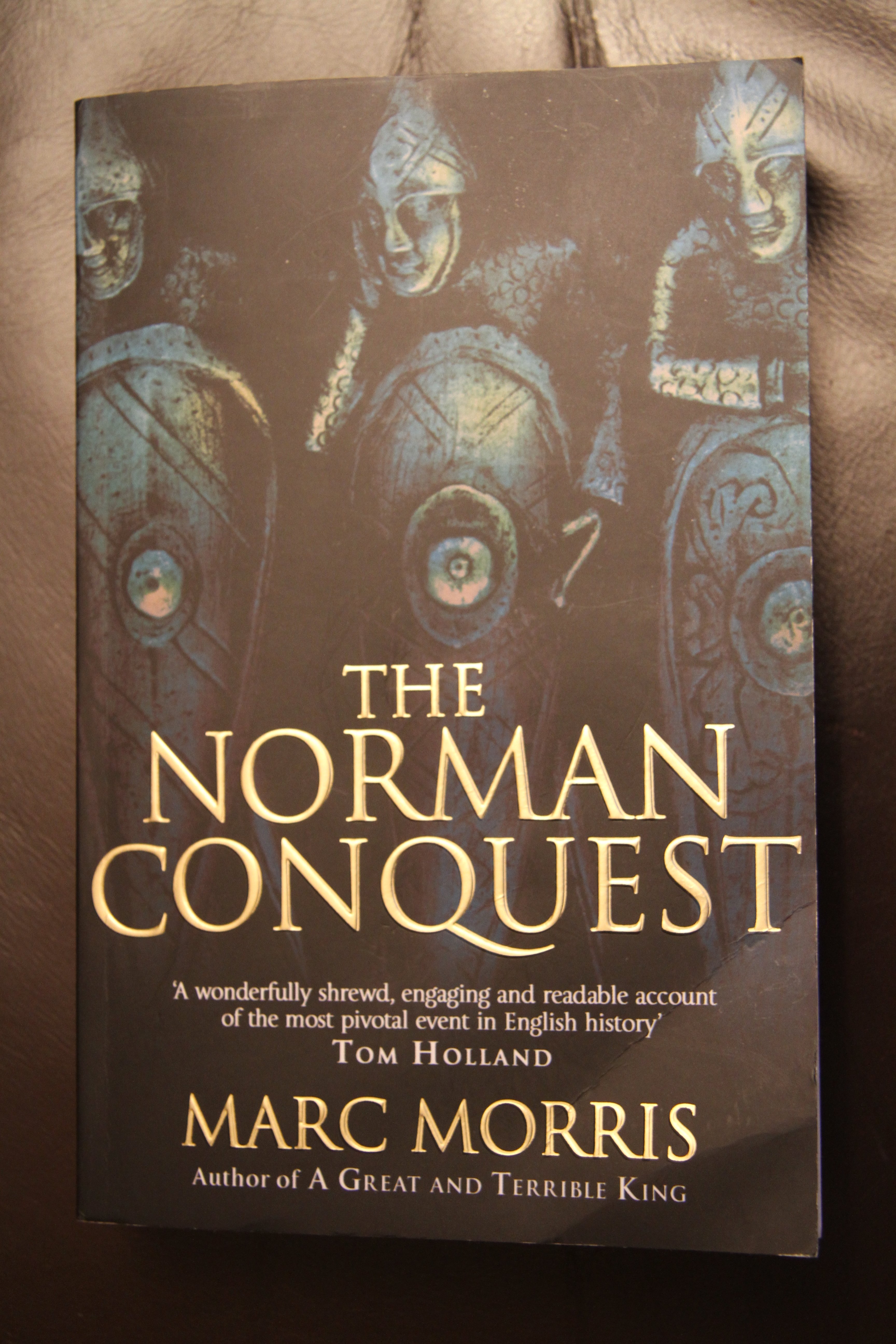
I like reading history almost as much as reading fiction, as readers of this blog have probably gathered. My favourite periods are the later middle ages and the sixteenth and eighteenth centuries (the seventeenth century is too bloody and dismal unless I’m in a really upbeat mood). However, I enjoy history books from all periods and about most countries.
I’ve just completed The Norman Conquest, by Marc Morris and, although I’ve read accounts of the later Saxon period, the Domesday Book and the reign of Henry I, I’m almost certain that I haven’t previously covered the Norman Conquest itself. Morris’s work could actually be more accurately described as a biography of William the Conqueror: it covers the whole of his life and finishes with his death in 1087. However, it also gives detailed information about how Edward the Confessor ruled England and the events that took place immediately after his death that helped to precipitate the Conquest. The book is extremely well-researched and put me right about several common misconceptions. For example, William was actually Edward the Confessor’s chosen successor, so less of an upstart than earlier historians have implied; Harold was the son of Godwine, his treacherous leading aristocrat and eventual enemy, and had less right to the throne than William (though the claims of both were, strictly speaking, eclipsed by that of Edgar Atheling, Edward’s nephew); it was not unusual for bastards to inherit under Norman law; Harold did not march from Stamford Bridge to Hastings after he defeated Harold Hardrada, because he did not know of William’s invasion at that point and, in any case, it was impractical to move armies over vast distances unless in a foreign country where the land could be plundered with impunity – instead, the Northern army was dispersed and a fresh one mustered in the South after news of William’s invasion reached Harold; and, although the Battle of Hastings gave William a decisive victory in the sense that Harold, the anointed king, had been killed and therefore a power vacuum had been created for William to step into, William had but a precarious hold on the throne for many years after the Conquest and had to quell many risings and rebellions in all parts of the country, as well as hostile attacks from the Welsh, Scots and Irish.
Relatively little is known of William the Conqueror the man, but Morris takes what there is to paint a compelling picture of an early mediaeval magnate. When I wrote about Richard III, I pointed out that almost all mediaeval kings were murderers; William stood head and shoulders above most of them for his achievements in this respect. He was the archetypal soldier-monarch, slashing and maiming and killing, engaging in mass slaughter every year of his adult life. His worst murderous excess did not involve the use of any of these types of atrocity, however, but straightforward – if that’s the right word – starvation. When there was an uprising in the North, William simply laid waste the lands and left the people to starve. Pathetic accounts survive of whole communities, including children, dying en masse and of how some people took to the roads and walked hundreds of miles until they could find charity – one group walked from Yorkshire to Worcester, for example – only to die because their digestive systems could not cope with the food after so many months of enforced fasting. (Morris compares their condition with that of concentration camp survivors.) Dubbed the Harrying of the North, this is the one event in William’s career that even his most fervent apologists can find no excuse for. Morris, who on the whole seems to be pro-William, does not try. He confines himself to the observation that the calculation of the Anglo-Saxon Chronicle that 100,000 people perished in this way may be exaggerated, but of course there is no way of telling. William himself was said to be haunted by the Harrying on his deathbed.
However, somewhat surprisingly, but arguably justifiably, Morris makes some claim for certain civilising influences that stemmed from the Norman invasion. The Normans disapproved of slavery, and although it had been common practice in late Saxon England, it quickly died out after the Conquest. The Saxons took no prisoners, whereas the Normans believed that soldiers who had been fighting honourably on the other side should be captured (though they were more likely to treat well noble prisoners or those who could be ransomed, and their ‘clemency’ often did not prevent them from maiming their captives). Almost 500 years before Henry VIII, they tried to curb the power of the church; they also made it clean up its act, at a period when clergy were frequently promiscuous or co-habiting with women who had borne them children and nepotism and simony were widespread. Apropos of the church, this book has explained to me something that has puzzled me for years (although it might just show how slow on the uptake I am!), which is the role of the church in society. Because the book covers the very early Norman period, before the church had assumed many of the customs and ceremonies of the later mediaeval period, and because it was an unspiritual and pragmatic age, Morris is able to demonstrate clearly that senior clergy did not exist to promote the spiritual welfare of the populace. They did not even pretend to. They were administrators, some of them very capable and powerful ones, four centuries before Henry VII created posts for key councillors who effectively became the earliest civil servants.
William came to rather a sticky end. In his late fifties, grotesquely fat, and riding once again to battle – in France, where he spent 60% of his time even after the Conquest – he is said to have jolted violently against the pommel of his saddle, so that it became embedded in his overhanging gut. Alternatively, he had been sick of a stomach ailment for some time and may have died of natural causes. I love the extreme differences of the truth that these ancient chroniclers offer their readers: what they actually say is often less important than the moral intent that lies behind it. Thus there is a sub-text that William, the fat murderous bastard who had caused so many to suffer misery and horrible deaths, deserved a horrible death himself. And so the chronicler obligingly provides one… or perhaps he is telling the truth. These early historians would have made excellent novelists, if only the medium had been invented in their day.
Marc Morris, conversely, is an excellent historian who also tells a good story, but who is scrupulous in giving alternative versions where he finds them and indicating to the reader how likely it is that the truth has been exaggerated. Although I’m not enthralled by battles, blood and guts, there is so much more going on in this book that it held me spellbound from start to finish.
 Christina James, crime novelist