

Fiction is always popular at Christmas.

Not a cliché in sight…
And so (thankfully), with Santa, arrives the end of whatever insanity there was in 2012; the nation turns its attention to sincere goodwill, especially within the family, which gathers itself for its annual affirmation of mutual affection. The family cat, never happier than when the visiting throng appears, admires the tree at close range and wonders why its usual spraying spot has moved indoors (a convenience, indeed!), before admiring every wonderful bauble at very close range; the family dog, always willing to share the festive joys, has quietly disappeared Auntie Sheila’s present of special diabetic chocolate to a quiet place behind the armchair, to keep it safe.
Everywhere outside, good taste is measured by the colour and quantity of festive lights. Nowhere is more friendly than the supermarket checkout, though the car park outside comes close. Road peace on the M1 near the Meadowhall mall prevails. The weather does its best.
Everything bodes well: television listings are inspirational; not a cliché in sight. There is peace in heaven and on earth and all is well.
Enjoy the break. Enjoy the total cessation of crime and violence. Enjoy the sanity, and Santa. If all else fails, there’s always fiction!
(Oh, and this blog!)
1979: Who will be next?

Bus-stop
The bus-stop in Rothwell, outside Leeds, at seven-thirty on a gloomy December morning. Bus to work at a library supply firm. No-one around. Passing cars loom and lighten the interior, then pass into the greyness of the day. Drizzle. No-one around. The woman waits and watches for the bright interior of relief that the bus will bring: the friendly exchange with the driver and the lurch into the seat; familiar travelling faces and forms; the comfort of not being alone in the bus shelter on a lonely strip of dual carriageway… No bus. No-one around. The cars and the time pass by. She glances up and down the dark pavement; peers through the road grime of the window at the outline of the van in the lay-by: fifty yards of a woman’s fear are one step for the out-sized monster of imagination, heart beating, with hammer blows. Van door opens; burly shape steps down and to the rear doors. No-one else around. Her heart is banging in her; her grip on her bag-strap is knuckle pale in the gloom, but she has no eyes for that. A door slams; an engine churns into life and an ordinary van man’s day goes on. The bus stops; she gets on, with the over-the-shoulder dread of every woman in Yorkshire. It is 1979 and each murder takes its toll on the collective consciousness. I am that woman.
Murderous thoughts? Maybe, but more of amusement…
 I laughed at a recent comment on Twitter, about how Christmas shopping inspires murderous thoughts. I forged through the crowds in Leeds yesterday and, in the process, discovered a few candidates for murder myself: there was the woman at Debenham’s who stood opposite the queue at the counter and pushed her way in by pleading ignorance of the system (the rest of us were too polite to protest); another in the Ladies’ there, who dried her hands on a strip of toilet roll and tossed it to the floor before sashaying out of the swing door and bouncing it back in my face; and, rather incredibly, the man who appeared to be a sales representative, who was hogging both the sofa and the staff on the first floor of Maturi’s, my favourite kitchen shop, with the result that customers could neither sit down nor get served.
However, overall, my spirits were more lightened than lowered, as I also stumbled upon some scenes to savour: There was the greying middle-aged man in Costa Coffee, consoling a beautiful but emotional young Indian woman with whom he was clearly more than a little in love; the portly man, also in Costa, surreptitiously eating what appeared to be pickled onion sandwiches from a lunch box when he thought that the staff weren’t looking; the fierce female official at the information kiosk at Leeds station who, when asked when the next train to Huddersfield would be leaving, triumphantly announced that it had ‘just gone’ (Think about it!).
Before I sign off, I should like to pay a tribute to all the many salespeople that I encountered or saw at work during my somewhat frenzied tour of the shops. Without exception, they were friendly, good-humoured, smiling and efficient. If their customers, many of us vague, boorish, noisy, impatient or simply inept, were exasperating them and they were longing for closing time and a cuppa (or something stronger), not one of them showed it.
That Summer (Andrew Greig)
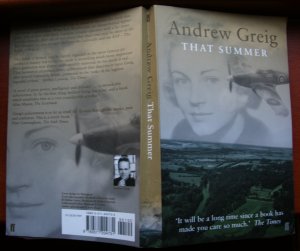 Last week I was laid low with ’flu, which meant that working in more than short stretches was difficult. I didn’t feel well enough to be able to luxuriate in the orgy of reading that can sometimes be the consolation prize of illness, but I did manage to complete one book, That Summer, by Andrew Greig. It is one of the most evocative and delicate accounts of the development of a relationship under shadow of threat (the summer in question is 1941 and the lovers are a Hurricane fighter pilot and a radio intelligence officer) that I have read. Among the many things that Andrew Greig succeeds in doing incredibly well is writing about sex without making it over-sensational, coy or grotesque. The accounts of the doubts and minor disloyalties experienced by the couple as they fall ever more deeply in love are executed with the light stroke of genius. As the book draws to an end, so does the Battle of Britain, and the reader is almost lulled into believing that Len, the male protagonist, will survive …
It is a book that defies genre – it is about a romance, but the novel is certainly not ‘romantic’ in the accepted sense. Nor is it self-consciously literary. It strikes me as being extremely well-researched, but its main thrust is not to capture history, except in the sense of subtly pointing out the perennial destructiveness of human nature. It is not a crime novel, but in some respects it reads like one, with war itself the fearsome psychopath that is made to stalk real people with hopes, ambitions and love, on both sides of the Channel.
It helped me through the week!
BOOKMARK, very much a shop around a corner, but making a go of it!
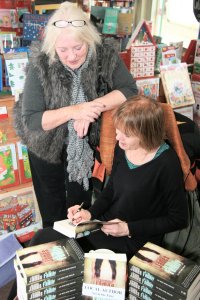
Signing for a customer
Meg Ryan put ‘The Shop Around the Corner’ on the map of the world’s best-known bookshops and profiled the conflict between the small independent and the large chain. Plus ça change, these days, though the large chain has, ironically, itself been threatened by the power of the internet. How is it, then, that the small independents are still there, serving their local communities, in spite of the fact that many members of those communities happily support the atmosphere of their friendly store to browse and seek information before going home to buy online what they’ve been looking at? It’s a cruel retail world.
On Saturday, I spent a wonderful afternoon in Bookmark (itself, as you can see, a shop around a corner), signing copies of In the Family and meeting the friendly people of Spalding, many of whom do still like the experience of buying over the cou nter. Though times are challenging for Christine Hanson, the proprietor, she, as a shrewd businesswoman, has diversified stock beyond books and cards and has made her bookshop coffee shop a place to love to be. Hers is indeed a bright and colourful, adult-and-child-friendly place of discovery, staffed by a team of excellently-trained and knowledgeable booksellers, who go the extra mile to respond to customer needs, keep the stock in tip-top order and make ‘buying a book’ a very special experience indeed. Yet the biceps of the competition are bulging and flexing and Bookmark’s very existence will depend on both the choice of customers to support their bookshop in word and in wallet and upon the need for all booksellers to play at the same street level as in Spalding and around the world.
A novel landscape, painted
 To put them in perspective, fen fields spread themselves across the soaking canvas of the day and dwindle to a vanishing point where telegraph poles lead. Dykes drip heavy with the wash of weeks of wet, whilst rooks, their nests in the bare tops smudges on the sky, are flung in tattered black splendour by a flick of the wind’s brush. Tireless turbines turn their silhouetted blades above the clumps of tiled farms, spattered across the silvery dark soil. Laid on with nature’s knife and worked by man, the texture of the ploughed and fallow acres is rough as tractor ruts and as harsh to the eye as to the boot. Walk the landscape and feel the centuries soaking through from
  swamp to sown and pastured plains, where the reeds whistle and the unrelenting pressure of the air hurts the eardrums and vibrates.
It is December here, painted in my head, a Lincolnshire land in me, inbred. I’ll write about it.
Blogs I follow: Are you on my list?
 Someone I know in the real world asked me why I had chosen to follow the bloggers who feature on my homepage. In fact there are more of them than appear, but they are not WordPress bloggers and the widget doesn’t display their avatars.
As you know, I’m a novice wordwright in the blogosphere and I had to start somewhere, so I set out to choose bloggers who interested me for one reason or another. It was a natural thing to follow Laura Ellen Joyce (Bloody Mary Bloody Mary Bloody Mary), as she is a fellow debut crime writer on the Salt Publishing list; her site is all about necrophilia and other horrors, so I was lost in that from the word ‘go’!
I wanted a spread of bloggers who would keep me up to date with crime fiction I would otherwise miss and the two journalists who set up Crime Fiction Lover do just that, as does Petrona*, who provides a monthly and very insightful account of her personal global crime reading, and Sarah Ward, whose Crimepieces site does not preclude interesting dips into other genres (I like a rogue blogger!) and provides intelligent reviews. As you know from a previous post here, I admire skill in reviewer writing and Laura Wilkinson earned my regard with her focus upon Carys Bray’s Sweet Home; she also does quality writer interviews, as does the site Best Selling Crime Thrillers, which does exactly what is says on the tin!
Then there are my top bloggers, for different reasons, but not in any hierarchy: I was touched by the fact that Rhian Davies, It’s a crime! (Or a mystery…), gives profile to debut authors; I now have come to love her witty tweets and hilarious pictures on Twitter (She’s a cat lover, too!). Elaine Aldridge’s Strange Alliances immediately struck me for her very skilled reading, of books such as Alison Moore’s The Lighthouse and Jane Rusbridge’s Rook, which produces author interview questions that guarantee an incisive portrayal of authors out of their own mouths! Mel Sherratt, self-published, successful and proud of it, and her killer heels, is a wonderful example to new writers who can’t find a publisher; deserved joy to her! I have profiled Carol Hedges in a recent post, but I only had to see her pink 2CV and read her zany, ironic posts and ‘Pink Sofa’ interviews to be hooked. Finally, there is Rosalind Adam, an incurable nostalgic, who delights with her memories and her insights into the City of Leicester – a woman after my own heart!
I could have found others, but the range needed to be manageable and I can safely say that they have made my ingress into blogging more than a little exciting and piquant! Thanks to them all! Sorry if you haven’t featured here; I may find you in due course…
*I learned on Monday December 17th of the death of Maxine, @Petrona_. May I offer my sympathy and condolence to all who were close to her. I know from both Sarah Ward and Rhian Davies that she will be much mourned and missed.
Blogger reaches 50!
 So here is blogpost 50; for this, at the cricket wicket, I might get applause, but as a blogger, I’m a realist and I’m certainly not oh-so-modestly holding my keyboard up in acknowledgement. ‘Blogger’: what a distinctly unpoetic word! From this point forward, I shall call myself ‘wordwright’, which has a much more traditional craft ring to it (in fact, it might well suit someone as a pen-name), because that’s what this is all really about: finding a voice where none was before, in the lonely ethereal novice-blogger desert where only the odd flower blooms to waste its fragrance on the air (a brazen borrow). I’ve seen myself through the eyes of hardened desert denizens, watching with amusement from atop a dune or a mountain as I have gone wandering round in circles and loops and along crazy tangents, calling out to anyone who might be there to listen to my voice and mostly not getting a reply, even when heard. Directionless.
Yet, bit by bit, post by post, I think I’ve found my voice, which is not the same one I use as a novelist, nor as a twittering tweep, nor, indeed, in real life. That is the wonder of being a wordwright; you can project different voices to suit the place and the time. (I’m saving my verbal ballgown for a red-carpet day!) Here, at christinajamesblog.com, I did say on my ‘About’ page that you, my welcome visitor, could piece together clues to put on the transparent crime board in the incident room; since then, I’ve been carelessly dropping all kinds of clues about me in front of you, as I’ve selfishly pursued my writing interests. It has been interesting to me, all this, for to post a daily blog is a challenge and has now become a need, for me. Unlike a diary, a blog can have an audience (occasionally, thank you, you’ve made yourself known!), even if I can’t see it or interact with it; consequently, each post must be carefully wrought and turned on the wordwheel into as perfect a piece as possible. My view of you is as of those unseen natives of the desert, who can see so clearly and judge so finely my efforts to find my way, and your very high standards put me on my mettle to meet them.
If you are a regular visitor here (my upwardly mobile site stats tell me you’re there), please do materialise from time to time. You have no idea how welcome you are! You know I’m not going to alarm you with: “OMG, this crime fiction is sooooooooooo awesome!” It’s not my voice.
Hamlet – a masterclass in making the audience think
 If you’re looking for the essentials of a classic crime thriller, Hamlet has the lot, including a touch of the supernatural! There are the obvious elements, of course, not least of which is the splendidly-outrageous line-up of dead bodies. For me, however, what makes this, of all Shakespeare’s plays, special is not its bloodthirsty aspects, nor the suspense, nor the sacrifice of a young and beautiful woman, nor even (my own usual delight and preference!) the astonishing psychological portrayal of the protagonist, but the delicately-poised opposition of the villain and the hero.
In what must be one of the most subtle presentations ever of the opposing forces of a story, the court scene near the beginning of the play, Claudius and Hamlet are contrasted in such a way that our feelings about each are always uncertain. The former, having seized power, perhaps by nefarious means (his brother, Hamlet’s father the king, having been found dead), and grabbed the throne, is in supreme political control of the court, deftly balancing and managing the foreign and domestic affairs of state, assessing the risk of war, making decisions, showing personal interest in and generosity towards his Lord Chamberlain’s son’s intentions AND adroitly attending to the inwardly-seething hatred and outwardly-sulking presence of his nephew, the rightful heir. Of course, contemporary expectations were that the most suitable (i.e. most powerful) person should be king, not necessarily the next-in-blood, and Claudius shows himself to be a much more authoritative monarch than Hamlet might have been at this point and for some time to come. What are we to make of them both?
We probably have sympathy for Hamlet, with his obviously moody feelings of bereavement, and empathy with his bitterness that his mother has married his uncle only a month after his father’s death (he does not yet know – and nor do we – that his uncle murdered his father), but he doesn’t come across well, being introverted and inconsolable. Claudius, on the other hand, is slick and assured in speech and behaviour; but is his smooth talk too perfect? Nothing predictable here; just the beginning of a fascinating contrast which challenges our understanding of both characters throughout the action of the whole drama, making us question more and more what is really going on.
Challenging and playing with audience perceptions: the mark of the excellent crime thriller writer.
Nostalgia: a misrepresentation of the past?
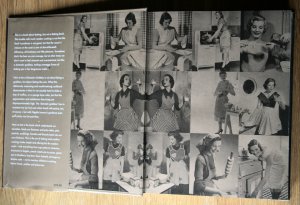 Time and again these days, I come upon newspaper articles which extol the virtues of the food of the late fifties and sixties. I find that publishers of modern cookery books (which, incidentally, are my second love, after crime fiction, and why, in this festive season, I am embracing a less noiry topic!) are very prone to printing black-and-white photographs of slender, glamorous fifties housewives wearing gingham pinnies over their full skirts and strutting in improbably high heels as they remove perfect fairy cakes and Victoria sponges from the oven. I realise that such photographs were probably originally circulated as part of a plan by the governments of the day to re-establish, post war, the rightful (hah!) place of women in the home and thereby to massage the employment figures, but what of the food itself?
I have mixed memories of it: although it was not uniformly terrible, it undoubtedly had its limitations. Lack of variety was one of them; being a victim of the first wave of processing was another. Tinned peas were emerald green – as a student in the seventies, I worked in a canning factory and can testify that they were dyed with the green equivalent of Reckitt’s Blue. Although we ate perfectly acceptable ham or cheese sandwiches at home, ‘meat paste’ (a kind of sludge composed of goodness knows what trimmings and offals) was always on the menu at picnics. So-called ‘cling’ peaches were interred in an opaque swamp of sugar solution. Custard – which was bright yellow, presumably because it also had been subject to a dyeing procedure – always came out of a tin labelled Bird’s; gravy was a more restrained pale brown and produced from a packet with two impish children on the side (one wearing a red, the other a green, hat) who were sniffing at what looked like a waft of cigarette smoke and proclaiming ‘Ah, Bisto!’
As I say, it wasn’t all bad. To a small child, snatching a taste of Camp coffee (actually, essence of chicory) was all the more delicious for being forbidden (even pseudo-coffee, it was well-known, stunted growth in children). In an era when no-one thought that children were damaging their teeth by eating sugar, provided that they cleaned them twice a day, Christmas was marked by a Saturnalia of unrationed chocolate bars from the many selection boxes supplied by relatives and Easter by an almost-equally-magnificent bonanza of chocolate eggs. Dried fruit (a handful was allowed as a treat on baking day) came in mysterious plain blue paper packets labelled in long-hand by the grocer.
What I remember most, however, was the monotony of it all: no fruit but oranges and apples in the winter; no vegetables but what my father grew at any time (I was astounded when I discovered that some people actually bought vegetables!); Sunday’s joint re-hashed on Monday because it was washing day; always fish on Fridays when my grandmother came. If, as a nation, we were slimmer and fitter then, it was because, aside from the odd splurge, we ate to live. Food was an essential, not always a pleasure. I’m sure that this is not what the publishers of today’s cookery books, somewhat over-burdened as they are with nostalgia, intend to convey.
 Christina James, crime novelist