

Author friendships and a fine novel: The Physics of Grief

One of the best things about being a writer is the unexpected opportunities you get to meet and correspond with other writers. I use the word ‘meet’ in its widest (post-COVID) sense, which may mean Zoom or Teams meetings, webinars or online chat as well as face-to-face encounters.
I first met Mickey J Corrigan digitally – we have never met in person – in my capacity as an editor for Salt Publishing in 2016. Mickey, an American author, had written a book entitled Project XX, subsequently published by Salt in 2017. I was privileged to edit it – the book required minimal alteration from me – and the long email correspondence that ensued – and continues – has mainly been about sharing our ideas and experiences as writers. Project XX is an incisive satire about America’s gun culture, high school shootings and materialism. Sadly, it is as relevant today as it was when it was first published, as the recent Texas school massacre shows.
This single-sentence blurb describes it so eloquently that, although I can’t remember who wrote it, I am certain it must have been Mickey: “A darkly humorous story of girls on the rampage that will grip you by the throat and won’t let go until you gasp for breath on the final page.”
The main purpose of this post is not to review Project XX, however. Instead – with permission – it is primarily a page-long quotation from Mickey’s The Physics of Grief, a crime noir novel which is sadly no longer in print. Another powerful satire on the American way of life, it describes the career of Seymour Allan, a man in late middle age who is offered the job of professional griever by the mysterious Raymond C. Dasher. Seymour embarks on the strange occupation of being paid to ‘mourn’ at the wakes and funerals of some very unpopular people. He cares for a dying criminal who tries to murder him; he attends unorthodox funerals in the Florida Everglades that are probably illegal; he encounters trigger-happy gangsters and an alligator and meets Yvonne, a sexy redhead mourning her mobster boyfriend.
The Physics of Grief is beautifully written, quirky, erudite – though it wears its learning lightly – and profoundly funny. If you are a publisher and think it may appeal, please contact me and I will put you in touch with Mickey.
There were seven of us not counting the one in drag. Together but with much difficulty we managed to lift, shove and roll the massive body into the deep and muddy hole. After he had landed – with a resounding splat – we high-fived each other. It took us another hour to fill in the hole and pack down the wet dirt. Finally we covered the fresh grave with branches and brush, leaves and acorns, pebbles and small rocks, until the burial area blended in nicely with the surrounding environment.
Very much a natural burial. Except for the fact the gravediggers were most likely murderers, and the body that of a murder victim.
Also, in this case, there was no marker. Obviously, no one would be coming here to mourn their loss. Their very big loss.
As we worked, the night had closed in around us. The hum of mosquitos had died down and the crickets were singing from the trees while tiny bats swooped overhead. An arc of juvenile egrets swept upwards with a whoosh and flew off together. The moon rose in a silver sliver and bright stars popped out across the black sky.
The men talked among themselves, joking around and laughing. When I finished up I stood off to the side, scratching my bug bites while they smoked cigarettes and chatted. I tuned them out. I didn’t want to know. All I wanted was to get away from them in one piece. But I was afraid to leave. What if they didn’t let me go? What if they saw me as an outsider, a witness to their crime?
I needn’t have worried. My friend in drag pointed to me and reminded his peers, “This guy’s on the clock. He’s gotta go.”
All the men shook my sore hand and a few slugged me on my sore shoulders. They were dirty, sweaty, rough-looking gangsters, but okay guys.
My guide and I retraced our steps over the trail to the lot. We halted once to allow a hunching bobcat to scurry past, a fresh-killed rabbit in its mouth. Barred owls swooped down, capturing rodents in the tall prairie grass. The hooting of great horned owls, their deadliest enemies, was seriously creepy.
When we arrived back at the well-lit parking area I still felt nervous. I headed for the SUV, hoping my new mobster pal wouldn’t shoot me in the back before I reached the safety it offered.
He didn’t. He did call out to me, however. “Hey! Aren’t you gonna ask me?”
When I turned around, he was standing with his hands on his hips, head cocked to the side. The wig hair shone a brilliant gold in the light of the street-lamp overhead.
Did he want me to ask him who the dead guy was? How he’d died? If they’d murdered him? Why they were allowing me to leave after witnessing what they’d done?
My legs felt weak and I stuttered for a few seconds before he interrupted me.
“I’m transitioning, bro. But it’s early yet. I got a long ways to go.”
All rights reserved © Mickey J Corrigan 2021
Salt and I inextricably linked, even on holiday…

Salzach River, Salzburg
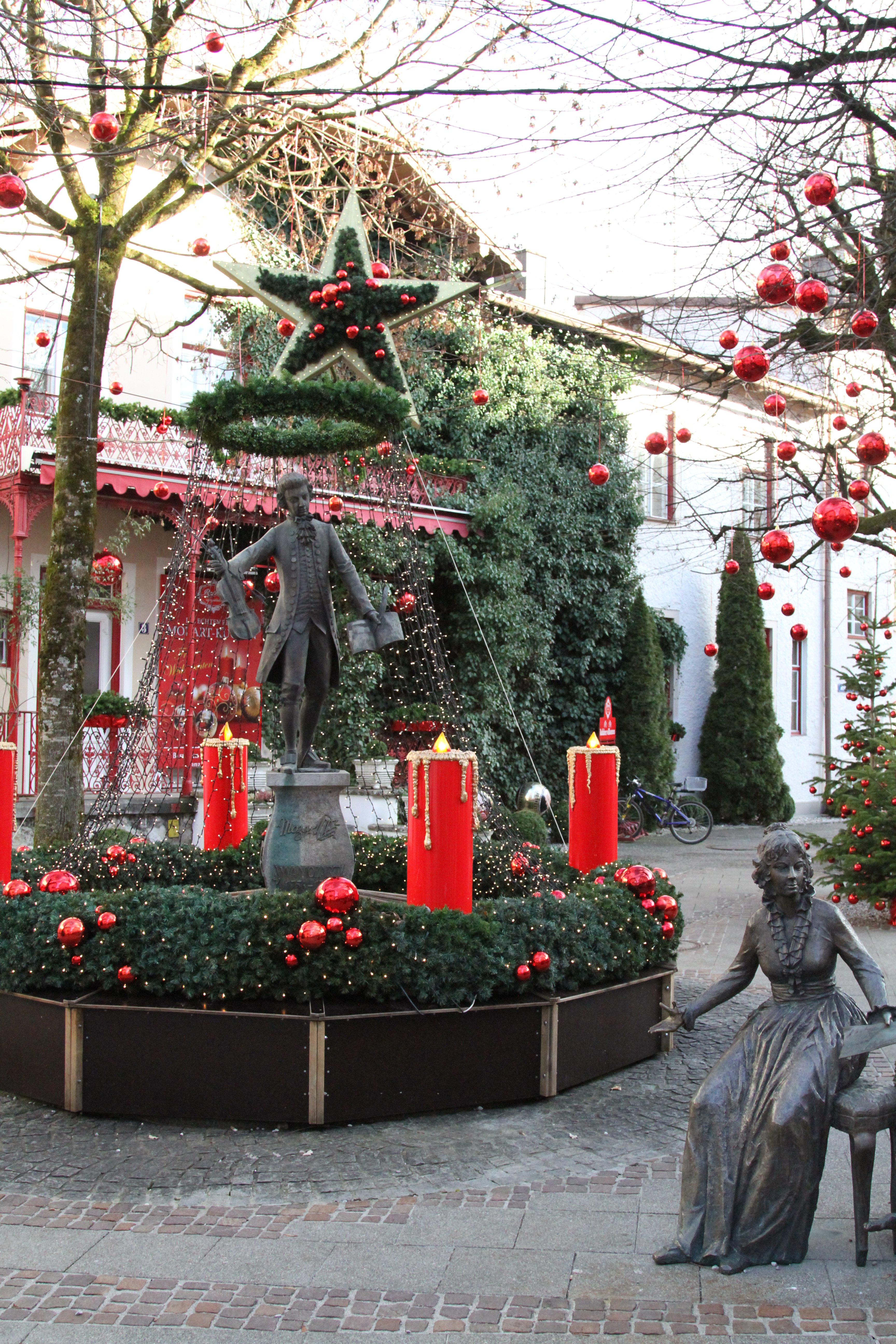
Chocolatiers’ Mozart Christmas grotto, Bad Reichenhall

Salzburg skyline in December
Salzburg is a breathtakingly beautiful city that seems to exist mainly to ensure the immortality of one man: the child prodigy composer Wolfgang Amadeus Mozart. There are Mozart cafés, Mozart restaurants and Mozart museums – and even tourist gift shops where you can buy Mozart rubber ducks and flying birds with Mozart’s face, all wearing powdered wigs. There is a spectacular concert hall where the programme includes the work of many composers, foremost among whom is – Mozart. There are Mozart chocolates, made by two rival companies: the original chocolatiers, whose business is very small and still confined mainly to the Salzburg region, and a younger, upstart firm whose aggressive marketing has been so successful that its distinctive round, filled chocolates, individually-wrapped in red foil, can now be purchased in many countries besides Austria. This company has created a Mozart grotto next to its main shop over the border in Bad Reichenhall, which features a statue of the composer, a fountain and bushes hung with winking red lights and huge baubles in its trademark silvery red.
Today, the city’s prosperity depends very much on Mozart tourism, but it was a wealthy place long before the composer’s birth. As its name suggests, its fortune was built on salt. This, of course, resonates with me, because Salt, good fortune and creativity are very much linked in my mental map. There is a famous salt mine close by the city which offers tours to visitors. We decided not to visit, as we have recently been to a similar attraction in Kraków. The Austrian one, apparently, makes a particular attempt to please family parties: its offers include enabling children to dress up as eighteenth-century peasant salt-workers.
The river that runs through the city also takes its name from salt: tolls on the salt-carrying barges created some of its wealth. Walking along the boulder-strewn riverside is a pleasing experience and there are several picturesque bridges, one of which is hung all the way along with lovers’ padlocks.
The Salzburg area has been unseasonably warm between Christmas and the New Year. There is snow here, but only high in the mountains. The local people are amazed at how mild the weather has been. Nevertheless, the people in the streets all wear hats, scarves, boots and quilted jackets or loden coats. Babies in buggies are muffled to the eyebrows. It is possible to stand in the sun and feel real warmth on your face, but as soon as you step into one of the many alleyways or just enter the shadows of the tall terraced buildings, the cold bites. There may be no snow at the moment, but you feel that it is only biding its time. February is the coldest month here: the Austrian mountain winter has really only just begun.
What does Salzburg have to offer in the way of inspiration for a crime fiction writer? On the face of it, this bright, industrious city, peopled with serene residents and laughing holidaymakers, does not seem a promising setting for dark deeds. However, in the alleyway marked ‘Juden Gasse’, with its stolpersteine or brass commemorative cobblestones, we stumble upon some of the darkest deeds that man has ever perpetrated upon man; and, not many kilometres away, lurks the Eagle’s Nest, mountain retreat of one of the world’s most sinister fantasists and almost the most prolific murderer of all time.
 Christina James, crime novelist