

Richard Reynolds: the pure genius

As John Aubrey, the seventeenth century polymath, bibliophile – and bookseller – observed, “to read a book is demanding, for one must stay awake; to write a book is more demanding, for one must stay awake and think; but to sell a book – ah, that is a work of pure genius!”
I’m starting this series of celebratory posts with a piece about Richard Reynolds, the undisputed doyen of crime booksellers. Why begin with a bookseller? Because without the services of the bookseller, the entire creative process that concludes with the finished book would be pointless. Bookselling is an art under-rated by everyone who has not practised it.
Richard began his working life in September 1976 as a ‘classical music consultant’ at Hardman Radio in Manchester. He loved reading and would trawl new and secondhand bookshops and market stalls in the city. In early 1980 he spotted a job advert in Jardine’s bookshop, applied for it and began his bookselling career a few months later. In 1981, he was appointed buyer for the sports section at the famous Heffer’s bookshop in Cambridge, progressing to travel and biography and then to the literature department, which boasted an impressive twenty-five standard book ‘drops’ (book cases).
Richard’s manager knew he was a crime fiction buff and encouraged him to use a small space under the ledge near to the stairs to develop a crime fiction section. As sales took off, crime was promoted to more prestigious areas in the shop.
Heffer’s is famous for its crime fiction events. Richard explains that these began in a small way in 1990 with Bodies in the Bookshop. Heffer’s put on “a wonderful display of crime fiction titles and ephemera on the platform halfway down the central staircase. Penguin Crime Classics sponsored a competition: the winner to supply the scream in Agatha Christie’s The Mousetrap. I still have the poster! Heffer’s first crime fiction catalogue was produced at the same time. Five authors came to sign books on the last Saturday of the month: Colin Dexter, Lindsay Davis, Reginald Hill, Minette Walters and Michael Dibdin.”
Sixty authors took part in the last of these events, for which, for seventeen years, Richard compiled the catalogues. He still receives ‘heartening’ requests for copies from readers trying to fill gaps in their collections. As the numbers of authors increased, what had been a single annual event became three separate ones: What’s Your Poison, Murder under the Mistletoe and Murder Will Out, now organised by events manager Kate Fleet.
Since the COVID restrictions were lifted, events have resumed but been smaller: a launch party for After Agatha, by Sally Cline, Kate Rhodes in conversation with Sarah Vaughan about her book Reputation, and a launch party (with jazz quartet!) for Peter Morfoot’s Essence of Murder. On June 23rd, Financial Times reviewer Barry Forshaw and Kate Rhodes will discuss Simenon: The Man, The Books, The Films and The Devil’s Table, the fifth of Kate’s Scilly Islands series.
Richard finds it very difficult to name an individual crime writer as his favourite. During lockdown, he re-read the whole Scilly Isles series, as well as books by Nicola Upson, Rennie Airth, Barry Maitland and Charles Todd. In 2019, as he approached his fortieth year as a bookseller, he compiled his personal list of 100 Favourite Crime Novels. If pushed to choose he says his favourite book would be The Murder of Roger Ackroyd and his favourite author Agatha Christie.


Richard is still a bookseller, but he now combines this with editorial and publishing activities. This began when he suggested to Penguin Random House which authors they should reissue under the Vintage Crime imprint. He has acted in a similar capacity for Ostara Books, Oleander Press and Clerical Crime and assisted with the publication of six Gold Age titles under Oleander Press’s Oreon imprint. More reissues are planned in the coming months.
He says he is grateful to his wife, Sally, for tolerating a house full of books! His small attic study is stacked high with collections of Penguin Green Crime, Gollancz yellow jackets, Golden Age titles, Cambridgeshire crime fiction, translated crime fiction, historical whodunnits, much recent detective fiction, a substantial collection of crime reference books and… and… and..!
Musing on his career, he says, “I suppose specialising in crime fiction is like being paid to pursue a hobby. Badgering publishers to re-publish good authors is a privilege. I enjoy working out the best fit between the author and the publisher. I serve as chairman of the CWA Gold Dagger Award for best crime novel of the year, for which there have been 260 submissions this year, making it hard to create the long list. The winner will be announced on 29th June.”
For aspiring booksellers, he offers the following message: “The late John Cheshire, a chatty, encouraging and supportive Heffer’s shop manager, told me not to spend my small salary on books but instead ask reps for proof/reading copies so that I could help publicise them. I have kept to that advice – and I’d like to thank all the reps and publishers who’ve kindly kept me supplied with reading material. And it’s important for booksellers to keep on reading ephemera about books: articles, reviews, blogs, information on publishers’ and authors’ websites.”
Asked what his advice to someone just starting out on a crime fiction writing career would be, he says that as writing is a solitary occupation it is important to chat to local booksellers and meet other authors, especially at events or festivals such as Crimefest and the Harrogate International Festival or one of the many good smaller festivals that now exist. It’s also a good idea to attend other writers’ launch parties, read widely – and try not to overwrite! Having some bookmarks printed is an inexpensive way of getting noticed – it’s easy to underestimate how useful they can be.
As an author, I am inexpressibly grateful to Richard and all the booksellers who make it their life’s work to support writing and reading. He is a man who practises sheer genius every day! If he were still alive, I know John Aubrey would be the first to agree.

Tomorrow’s post will be about an aspiring crime fiction writer, Fraser Massey, who is already a distinguished journalist.
The most atmospheric of writers…
One of the great pleasures to be obtained from reading crime fiction is that most crime writers are acutely aware of both the geography and the mood of the communities that they write about. I won’t claim that there is such a thing as national character – I know that I shall immediately be shot down in flames if I even hint at it – but I’m certain that the massive popularity that Scandinavian crime writers have achieved owes a significant debt to the ambience of their work: the dark nights and cold days that they evoke, which in turn inspire brooding and melancholy characters who seem determined always to spot the worm in the bud, despite the consummate beauty of their surroundings. Similarly, the novels of Donna Leon and Michael Dibdin, which are set in Italy, skilfully succeed in communicating the rich cultural heritage of that country.
No-one, however, captures the essence or psyche of a country better than Barbara Nadel. Perhaps I should say city, rather than country, as all of her novels that I’ve read have been set in Istanbul. With apparent ease, she captures the contradictions of a city that has always looked both East and West: its exoticism and squalor; the brutality of some of its people and the sophisticated philosophical outlook of others; the thrusting modernity that jostles but does not oust more ancient superstitions. Other writers have written eloquently about this city, especially Orhan Pamuk, whose Nobel prize-winning work, so exquisitely wrought, seems to derive its depth from these very contradictions; yet, in my opinion, no-one, not even Pamuk, surpasses Nadel’s descriptions of Istanbul’s mean streets and boisterous crowds when she is writing at her best.
I’ve read three or four of her books now. I particularly admire her depiction of her world-weary but wise and humorous detective, Çetin Ikmen, who is beleaguered not only by the absurdities of red tape and the inefficiency and bigotry of his colleagues at work, but also by his large, unruly and ever-growing extended family at home. The latter is presided over by his ebullient and chaotic, much less well-educated wife, Fatma.
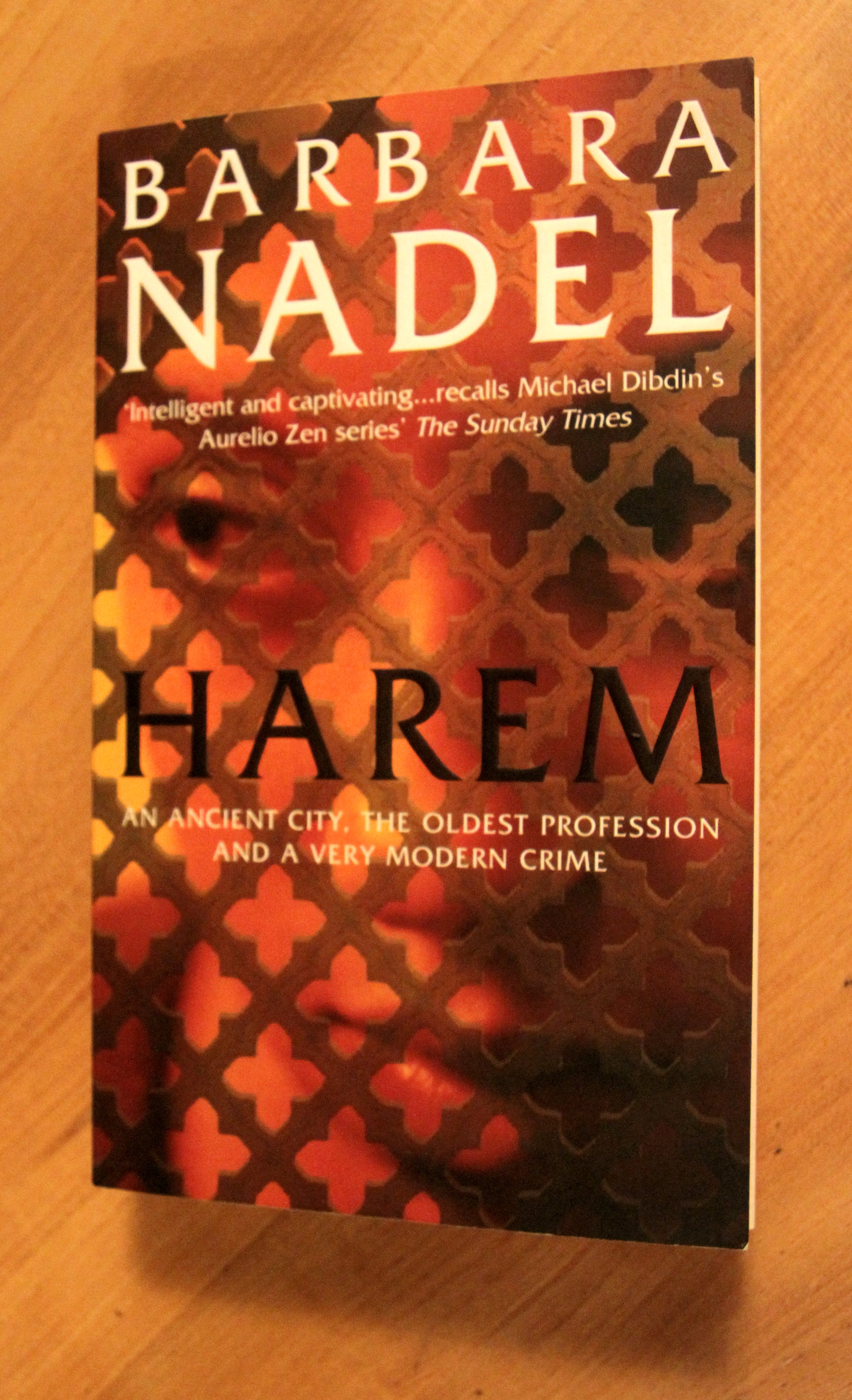
Harem is a particularly accomplished novel, because it examines issues of profound significance in Western countries through the filter of setting them in Istanbul. This not only makes it easier for the Western European reader to read about them, but also points up the dual thinking still prevalent in almost all countries by presenting it as a peculiarly Turkish phenomenon. This provokes the immediate response: ‘That couldn’t happen here!’, followed soon afterwards by: ‘Or could it?’ The original crimes committed in Harem are rape and the exploitation of women, leading in some instances to murder. The first of the murder victims is Hatice, a friend of Ikmen’s teenage daughter Hulya. Nadel’s account of Ikmen’s boss’s reluctance to pursue the girl’s murderers and bring them to justice because she evidently was not a virgin before they attacked her is particularly poignant. We might try to flatter ourselves that such an attitude could not prevail in our country, were it not that only in the last few days a British barrister has described a thirteen-year-old girl against whom sexual offences were committed as ‘predatory’. Nor does Nadel pull her punches when it comes to describing the perpetrators of rape. Hatice had unwittingly become involved with a group of people practising organised depravity, but her case is mirrored by one even closer to home for Ikmen, that of the abusive relationship that exists between two of his own police officers. As one would expect from a writer of Nadel’s talent, the moral conclusions that she draws are complex, but she is quite clear that women should never suffer from sexual abuse, whatever their personal moral code. This message may seem obvious, yet it is one that societies everywhere seem to be taking a long time to digest. Harem makes a very valuable contribution to the debate.
Of the other characters, several old friends feature in this novel. My particular favourite is Mehmet Suleyman, Ikmen’s disdainfully aristocratic colleague, who in this book finds himself less able than usual to sail, cosseted and immaculate, through his life, as if the teeming, grubby throng of humanity that it is his job to police does not really exist. Suleyman’s volatile Irish wife is suffering from post-natal depression and he has to run the gauntlet of her tantrums and her misery. And then there is Fatma, impossible but lovable, weaving her idiosyncratic magic on her weary but essentially adoring husband.
I wholeheartedly recommend Harem. If you’re new to Barbara Nadel, you won’t lose anything by starting with this book, as, despite being one of a series, it stands completely on its own, as such novels should. However, I’m certain that, if you do read Harem first, it will make you also want to sample some of the others.
 Christina James, crime novelist