

Doing it differently…
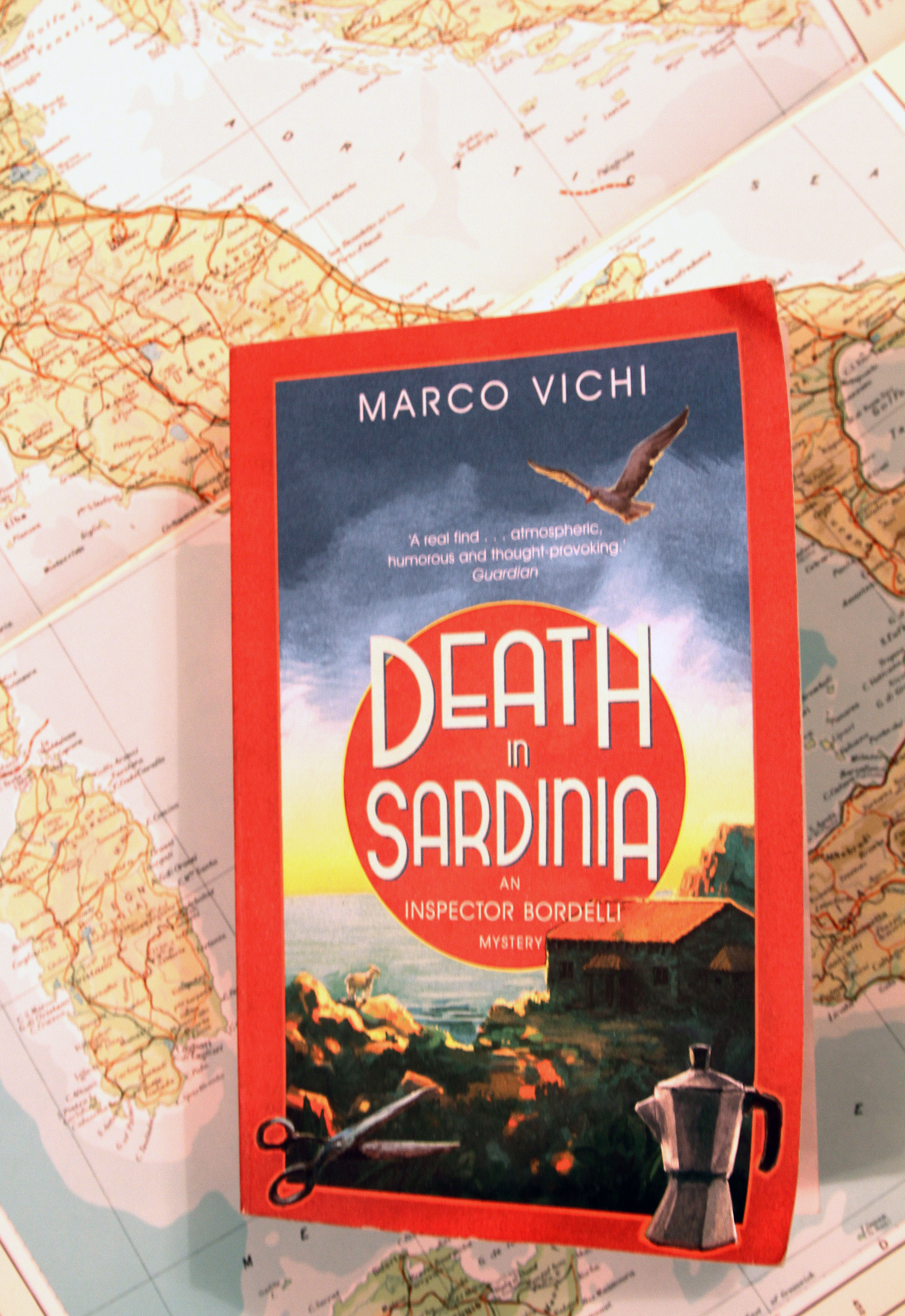
I know from the blurb on the back of this crime novel and the short reviews that accompany it that it is one of a series, but – like the anonymous Guardian reviewer who is quoted on the front cover – I’d never come across this author or his work until I found Death in Sardinia in a bookseller’s warehouse just before Christmas. The Guardian reviewer says: ‘A real find… atmospheric, humorous and thought-provoking.’
I agree with all of these adjectives and to them I’d add, ‘highly original’. One of the most appealing things about this novel from my point of view is that it is set in the Italy of the 1960s, in the aftermath of the Fascist régime, when the country was still reeling from the effects of its Second World War defeat. That the author presents Italy from the perspective of a policeman who formerly served as a soldier in a defeated army gives it both depth and substance. Partly because of the background to its setting and partly because the main action in the novel takes place fifty years ago, Vichi is able to create a springboard for some serious – but never over-weighty or didactic – reflections on morality. (For example, Inspector Bordelli recalls an occasion during the war when he and some fellow soldiers came upon an isolated detachment of Americans who were shaving, and decided not to kill them because they were thus rendered defenceless.) The murder investigation that is central to the novel – it is the killing of a very unpleasant debt collector, stabbed in the neck by a pair of scissors – also raises some knotty moral issues, which increase in complexity as Bordelli closes in on the killer.
But above all, it is the glorious cast of characters that makes this novel special. All are originals; some, like Rosa, the ex-whore who is one of Bordelli’s ill-assorted menagerie of friends, are highly eccentric, yet none lacks credibility. Then there is Bordelli himself, a highly-principled, slightly lonely character who doesn’t exactly live for his job yet often ponders on what he will do without it, now that his retirement looms. His repeated invitation that acquaintances should join him for dinner on Christmas Eve gathers poignancy as none of them quite refuses, but – until very late in the day – none of them gives him a firm acceptance, either. He is very susceptible to the charms of the women and girls that he meets during the course of his work, sometimes dangerously so, but he always manages to wrestle down temptation and allow his professionalism to win the day. His solicitude for his dying colleague Baragli particularly arouses the reader’s sympathy.
Three quarters of the way through the book, the narrative temporarily takes on a picaresque style, as several of the characters relate in detail stories that have been of key influence in their lives. Despite the almost Chaucerian vitality and immediacy of these stories, on a first reading they have the annoying effect of stalling the plot, but eventually the relevance of each of them becomes apparent and I’m certain that, if I were to read the book again, I should be less impatient of them and enjoy them to the full for the minor masterpieces that they are.
Death in Sardinia is a crime novel, but it is much more than that. It is a perceptive distillation of the human condition that captures many of its foibles as well as the depravity into which it is capable of sinking and the acts of nobility to which it can sometimes rise. This novel apparently comes third in the Inspector Bordelli sequence; I am now determined to seek out some of its companion works and enjoy them, too.
True crime… beautifully executed.
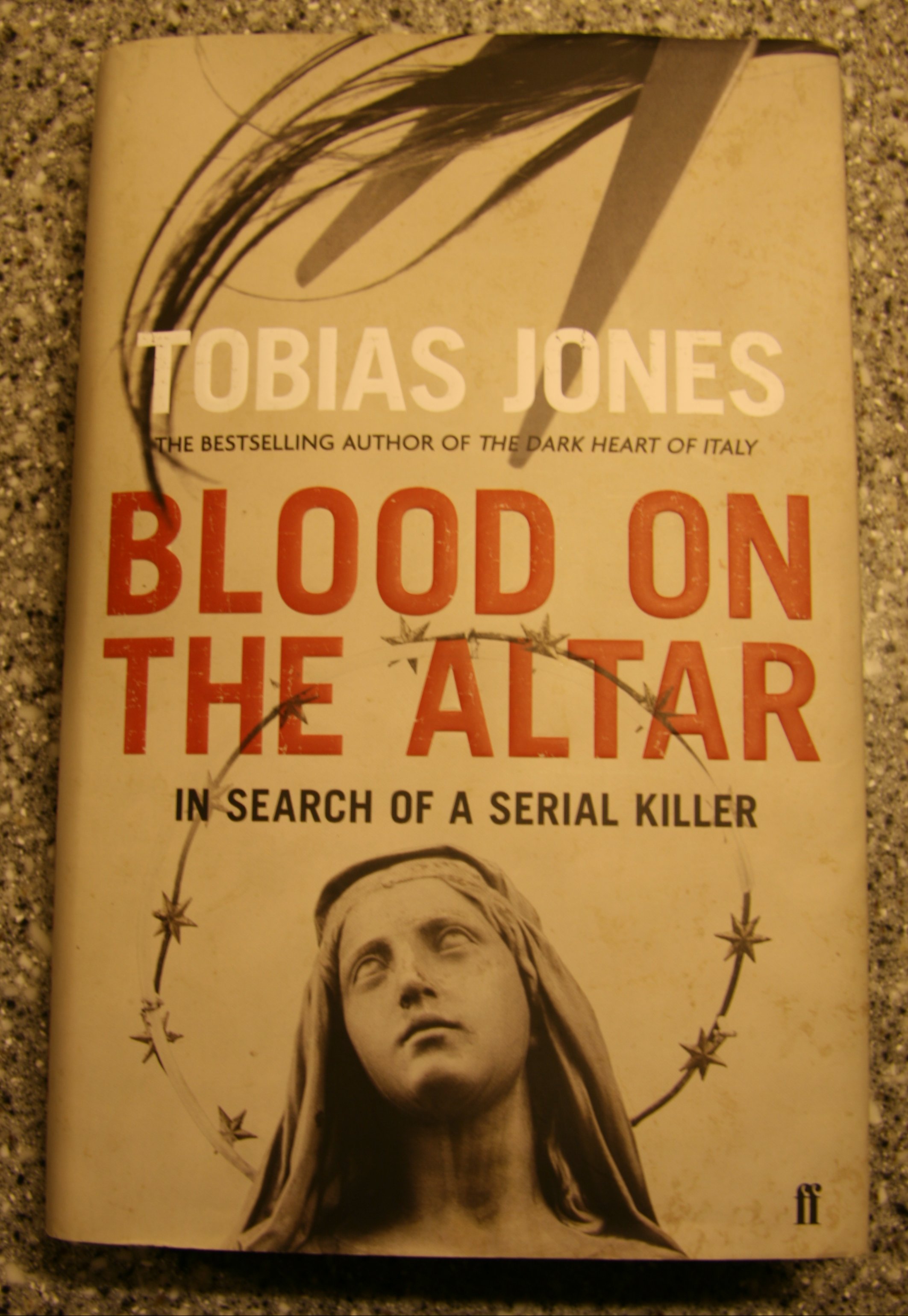
Blood on the Altar (faber & faber), by Tobias Jones, is undoubtedly the most unusual true crime account I have ever read, and one of the most disturbing. Jones was an investigative journalist living in Italy when he heard of the case of Elisa Claps, a sixteen-year-old schoolgirl who disappeared after attending church one Sunday morning in her home town of Potenza, deep in the south of the country. Jones befriended the Claps family; from the outset, they suspected that Danilo Restivo, a strange young man prone to exhibiting an unhealthy interest in certain local women and also, apparently, a stalker of Elisa, had murdered her. Among Restivo’s unsettling habits was a fetishistic obsession with female hair. However, his family was more eminent than the Claps family and his father undoubtedly able to influence such local officials as the public prosecutor and others in authority, like the priest in charge of the church where Elisa disappeared. As a result, although all the evidence pointed towards his guilt, he was not brought to justice. The evidence itself became obscured by a tissue of lies, evasions and half-truths in which many people, including some of Elisa’s own friends, appeared to be complicit.
Elisa’s brother, Gildo, spent almost twenty years trying to get at the truth of what happened, helped at intervals by Jones. Eventually, Jones became depressed by the corruption that seemed to be endemic in the region and returned to England to start a new life. He had been pursuing his new interests for some years when the case of Heather Barnett made the headlines. She was a seamstress living in Bournemouth and she had been brutally murdered and disfigured. In her hands were clumps of hair, not all of it belonging to her. It transpired that Danilo Restivo, who pretended to comfort her children after they discovered her body, was the neighbour who lived opposite her house. From his window, he could see into her bedroom window.
Eventually the police charged Restivo with Barnett’s murder. While the case was progressing, the remains of Elisa Claps were discovered high in the rafters of the church in Potenza where she had disappeared and Restivo was at last charged with this murder, too. Jones speculates that, since there was a gap of nine years between the two murders, it is likely that Restivo killed other women in the interim. In particular, the murder of a young Korean girl in Bournemouth about eighteen months before Heather Barnett’s death shows many similarities to the later crime. (Another man was found guilty of this murder, but the police have reopened this case recently, following the publication of Jones’ book.)
Like a well-plotted crime novel, Blood on the Altar tells two stories. The ‘main plot’ recounts the murders and offers a psychological profile of Restivo; the ‘sub-plot’ explores the remote region of Italy where the first crime takes place and tries to explain the collective psyche of its inhabitants. In the process, Jones gives the reader some evocative descriptions of the Italian countryside and of local customs. All of this is of relevance both to an understanding of Restivo’s character and to how he managed to evade the law, which in turn allowed him to commit the second murder (and probably others). However, the approach that Jones has taken has one drawback: it relegates Heather Barnett to a kind of bit-part in the book. Jones does not engage with her tragedy and that of her family as he engages with the tragedy of Elisa and the Claps family. This has the effect of making the story a bit lop-sided; however, that is a minor quibble about what is a fascinating, unsettling and beautifully-written book.
 Christina James, crime novelist