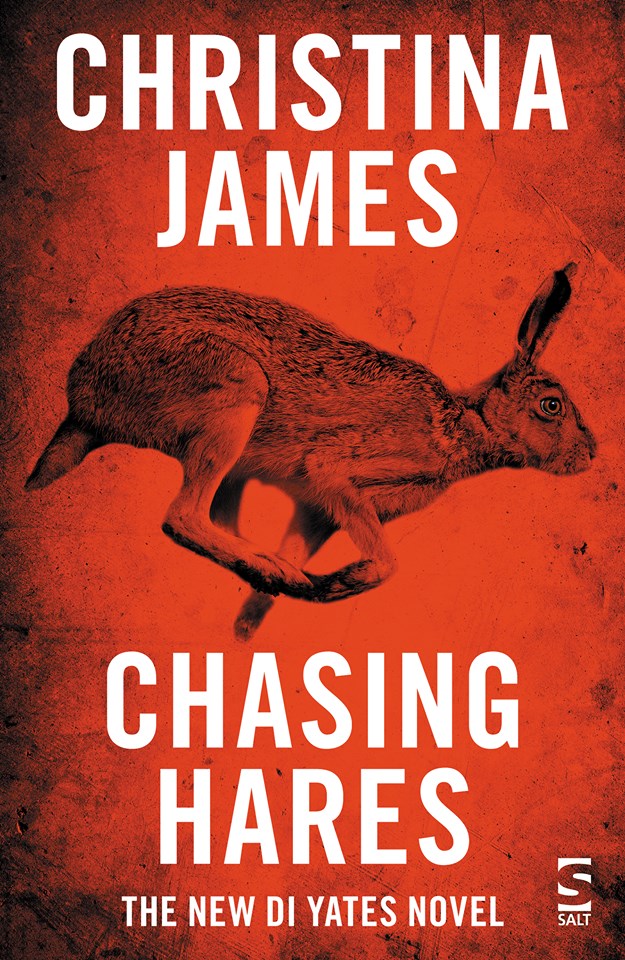


Next Thursday, 2nd May 2013: An Evening with Christina James at Waterstones Gower Street

Sam, the wonderful Events Manager at Waterstones Gower Street, has organised ‘An Evening with Christina James’ on Thursday 2nd May 2013. It will start at 6.30 p.m. and last for perhaps an hour. I shall be reading a short excerpt from In the Family and perhaps also one from Almost Love (which will be published in June), and offering a few tips, from a personal perspective, on how to get published. After this, there will be a short Q & A – and a glass of wine! The event is a sort of forerunner of a larger Salt crime event that will be hosted by Gower Street on 23rd May 2013.
I know that readers of the blog are scattered far and wide and that some of you don’t live in Europe. Wherever you are, I am very grateful to you for your interest and have been delighted to ‘meet’ you on these pages. For those of you who happen to be in London next Thursday or can travel there easily (and would like to, of course!), I should be delighted to have the opportunity to meet you in person.
I’d kill for a slice of coffee and walnut cake…

Get stuck in to a good book…
On Thursday, I had a conversation with a librarian in Doncaster who would like me to take part in a literary festival that will be run in May by the Doncaster Library Service. After further discussion, we decided that it would probably be more effective for everyone if, instead of participating in one of the library-based events, I were to run a couple of writers’ workshops, one at a local school and one at an open prison. I warmed to this idea immediately; as a bookseller, I have supplied books to two open prisons; more recently, I have read the MS of a fascinating memoir written by a writer-in-residence who works in a prison in the North-East. I shall be happy to work further with the prison community if I can be of use. I’ll write more about these two events nearer the time.
Before we decided on this plan of action, when the idea was still that I should participate in a library-focused event, our chat had been about what sort of writer we should choose to present with me. To my initial surprise, she suggested a cookery writer, but, the more I thought about it, the more appropriate I thought that this was. Aside from the interest in food (among many other subjects) that both this blog and the many other crime-writing blogs to which it has been introduced (and introduced itself) have expressed, now that I’ve thought about it, I think that a crime writer and a cookery writer have a lot in common.
The similarities are there if you look for them. Firstly, and of most importance, we are both genuinely interested in the craft of writing: although the crime writer’s main purpose is to devise an interesting plot peopled with intriguing characters and the cookery writer’s is to develop practical recipes that people really want to try out, the means, for both of us, is as important as the end. In a certain sense, we are both genre writers, but the style and standard of the writing is important to us; mostly we don’t deserve to have the word ‘genre’ applied to us in a condescending or pejorative way (though we have both suffered from this). I don’t deny that there is huge variation in the quality of writing accomplished by both crime writers and cookery writers, but at our best we produce classics. When my friend Sally gave me How to Eat and The Domestic Goddess as a very generous birthday present ten years ago, I was both amazed and entranced by Nigella Lawson’s wonderfully fresh and funny prose style. You may gorge yourself upon her books both literally and metaphorically, delighting in the sensual language and wonderful photographs even as you assemble the ingredients for a luscious cake and anticipate eating it later. The best crime novels are like this, too: each page not to be gobbled down quickly because it gets you a little closer to the denouement, but lingered over and savoured for the pleasure that the words bring of themselves.
Similarly, a well-set-out recipe is like a well-crafted short story. It tells a tale, from the beginning, when there might be a note on some kind of utensil – a springform cake tin, for example, or a coeur à la crème ramekin – to the afterword, which might offer serving suggestions or other tips once the culinary masterpiece has been completed. Conversely, a poorly-conceived recipe, one which perhaps is not clear about quantities or method, disappoints and exasperates just as much as a badly-written thriller. And, whilst I don’t think that it is possible to ‘learn’ writing step-by-step in quite the way in which you follow a recipe, writers can certainly give others pointers to how their writing can be developed – hence the workshop idea. Conversely, an inspired cook will add some special twist or variation to a recipe to make it more delicious and uniquely his or her own.
There is one point on which we will always be at opposite poles, however: cookery-writing is about celebrating life and that which sustains it. Food and the sharing of food is a civilising influence. Almost every great nation has developed its own cuisine. Crime writing, on the other hand, is about what threatens a civilised existence, sometimes including life itself: a sobering thought, yet, as I’ve said before, the end of a crime novel usually brings with it some kind of catharsis and a feeling that all is right with the world again. And along the way, both heroes and villains can enjoy some excellent food. From the Victorian victuals described by Wilkie Collins to DI Banks’ pub lunches and Paola Brunetti’s elegant meals en famille, crime-writing owes a lot to cookery. I’d better not embark upon a consideration of how cookery-writing might be indebted to crime; otherwise my imagination might run riot!
The most compelling first novel I’ve read in a long time…
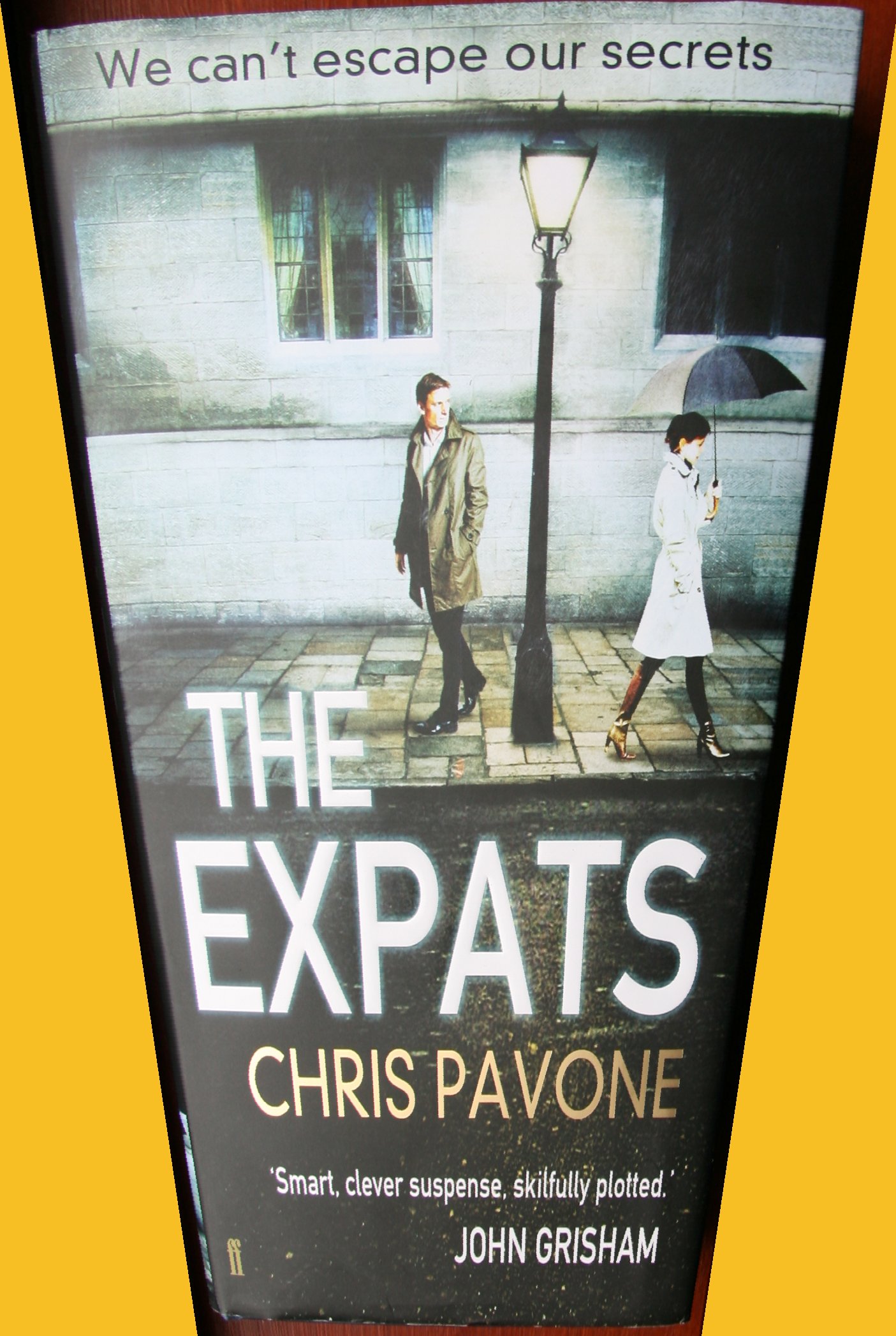
The Expats, by Chris Pavone, is undoubtedly the most compelling first novel I’ve read in a long time. Since the blurb says that the author has been a book editor for twenty years and his list of people to acknowledge includes such luminaries as Molly Stern, Angus Cargill and Stephen Page, I conclude that he had a bit of a head start over most new fiction writers, but I wouldn’t want to hint, even for a moment, that the author of this brilliant book does not deserve heaped praise.
The overall plot is a little reminiscent of that of Mr. and Mrs. Smith – and, indeed, I could imagine Angelina Jolie and Brad Pitt playing the lead roles if the novel were ever made into a film. Like the Stieg Larsson novels, it is also about an expert hacker. Pavone is more subtle than Larsson when he explores the moral issues connected with the murky worlds of undercover agents and hackers – the female protagonist, Kate Moore, especially ponders whether an illegal or dishonest action can be justified in order to promote a greater good, and does not find reassuring answers.
The characters of Kate and her husband, Dexter Moore, are especially well-drawn and the portrayal of the two ‘villains’, Bill and Julia, is very successful, because for most of the book the extent and nature of their villainy is difficult to gauge; in fact, at one stage, we are made to think that they might be good guys after all, though the reader’s gut instinct is not to trust this possibility. I also love the character of the Smiley-like Hayden, who has a rich cameo part.
The author’s descriptions of various European settings – Paris, the Alps, Amsterdam and, above all, Luxembourg – are compelling. Twists and turns of plot continue until almost the last page, but never seem far-fetched. If I have a very minor complaint, it is that Kate’s sudden access of sentimentality at the end is unconvincing.
One small sadness is that, although I should like to see more of Kate in future novels, the ending makes this unlikely (though not impossible). Whatever Chris Pavone’s plans for his next book, I await it with impatience.
Footnote: Tomorrow I am going to a conference (day-job!) and shall be away for five days. I shall continue with the blog-posts, however. Regular readers of the blog may remember that one of the early posts was about how I trained for In the Family by writing a series of short stories, at Chris Hamilton-Emery’s suggestion. There are ten stories altogether. I’ve been revising them recently and may try to publish them. For each of the next five days, I intend to post on the blog the opening paragraphs of the first five. If you’d like to make any comments, they’d be extremely welcome.
In love with Cromer…

It seems fitting to write about Cromer on World Poetry Day. If you are new to the blog, please don’t be baffled by this! Regular readers will know that Cromer is the adopted home of Salt Publishing, which is becoming ever more renowned for its fiction. Last year it achieved international fame with The Lighthouse, Alison Moore’s debut novel, which was shortlisted for the 2012 Man Booker prize. (Its crime list includes In the Family, my first crime novel, and will shortly also feature Almost Love, the second in the DI Yates series.)
However, Salt built its reputation for literary excellence on its superb poetry list; in my view it is the greatest current British publisher of contemporary poetry. Some Salt poets are poets’ poets, though most are very accessible. I believe that perhaps, of all its achievements, Salt’s greatest has been to develop its ‘Best of’ lists, especially the Best of British Poetry series, and the Salt Book of Younger Poets. Now widely adopted by undergraduate courses in English literature and creative writing, these books bring contemporary poetry alive to a new generation, as well as supply more mature readers with an impeccable selection of great poems. The Best of British Short Stories series achieves a similar effect in a different genre. And, not to spare his blushes, Chris Emery, the founding inspiration behind Salt, now publishes his own poetry under the Salt imprint. If you have not yet read The Departure, I recommend it wholeheartedly.
Back to Cromer. I was there for a long weekend because, as I mentioned on Sunday, I was asked to play a small part in the Breckland Book Festival. I stayed at The Barn, one of the cottages owned by The Grove Hotel (itself steeped in history – parts of it are eighteenth-century and its original owners were the founders of Barclays Bank). I called in on Chris and Jen Hamilton-Emery after the Breckland event and my husband and I were kindly invited to have dinner with them. They were brimful of ideas as usual and delighted that Chris has been appointed writer-in-residence at Roehampton University, as well as looking forward to celebrating Jen’s birthday today (that it is on World Poetry day is a poetic thing in itself!).
The rest of our time in Cromer was spent exploring the beaches and the streets of the town. Twice we walked along the beach in the dark and, on Monday morning, we took our dog for a very early morning run there. Even in bitterly cold weather, the town itself is enchanting. Developed in the mid-nineteenth century to cater for the emerging middle classes, who could for the first time afford holidays away from home, it seems to have been preserved intact from any attempted depredations by the twentieth century. There are not even many Second World War fortifications in evidence, though a pill-box languishes in the sand of the west beach, its cliff-top site long since eaten by the sea. The pier retains its pristine Victorian originality – it is well-maintained but has not been ‘improved’. Some of the hotels, again ‘unreconstructed’, are quite grand and all serve superb food at reasonable prices, as do the many cafés and restaurants. It is true that some of the shops seem to exist in a time warp. My favourite is the ladies’ underwear shop that does not appear to stock anything designed after 1950; it even displays ‘directoire’ knickers – much favoured by my grandmother – in one of its windows.
Cromer has a literary past, too. Winston Churchill stayed there as a boy and Elizabeth Gaskell was a visitor, as the pavement of the seafront testifies. (Churchill apparently wrote to a friend: ‘I am not enjoying myself very much.’) That Tennyson also came here, even if I had not already decided that I loved it, alone would have served to set my final stamp of approval upon the town: Lincolnshire’s greatest poet, he is also one of my favourites. (I’ve always considered James Joyce’s ‘LawnTennyson’ jibe to be undeserved.) I know that Tennyson would have been fascinated by Salt if he had been able to visit Cromer today. I can picture him perfectly, sitting in Chris’ and Jen’s Victorian front room, sharing his thoughts about poetry – as one fine poet to another – in his wonderfully gruff, unashamedly Lincolnshire voice.
And so, Jen, Chris and Salt, have a very happy Cromer day, listening to the lulling rhythm of the rolling, scouring waves and painting salty pictures in the sky.

Putting a person to a name… Waterstones Gower Street
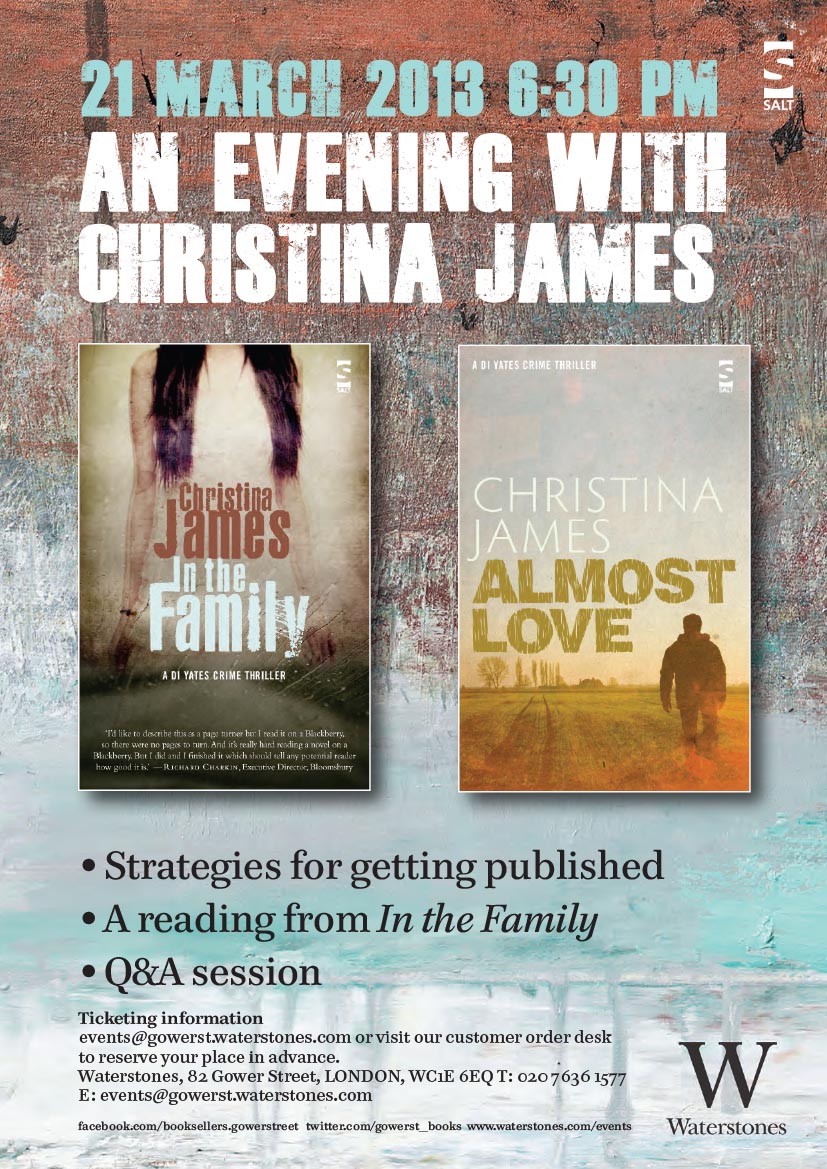
As readers of this blog have often kindly expressed an interest in my books, I thought you might like to know that an event has generously been organised for me by Sam, the wonderful Events Manager at Waterstones Gower Street, on Thursday 21st March 2013. It will start at 6.30 p.m. and last for perhaps an hour. I shall be reading a short excerpt from In the Family and perhaps also one from Almost Love (which will be published in June), and offering a few tips, from a personal perspective, on how to get published. After this, there will be a short Q & A – and a glass of wine! The event is a sort of forerunner of a larger Salt crime event that will be hosted by Gower Street on 23rd May 2013.
I know that readers of the blog are scattered far and wide and that some of you don’t live in Europe. Wherever you are, I am very grateful to you for your interest and have been delighted to ‘meet’ you on these pages. For those of you who happen to be in London next Thursday or can travel there easily (and would like to, of course!), I should be delighted to have the opportunity to meet you in person.
Proofs positive…
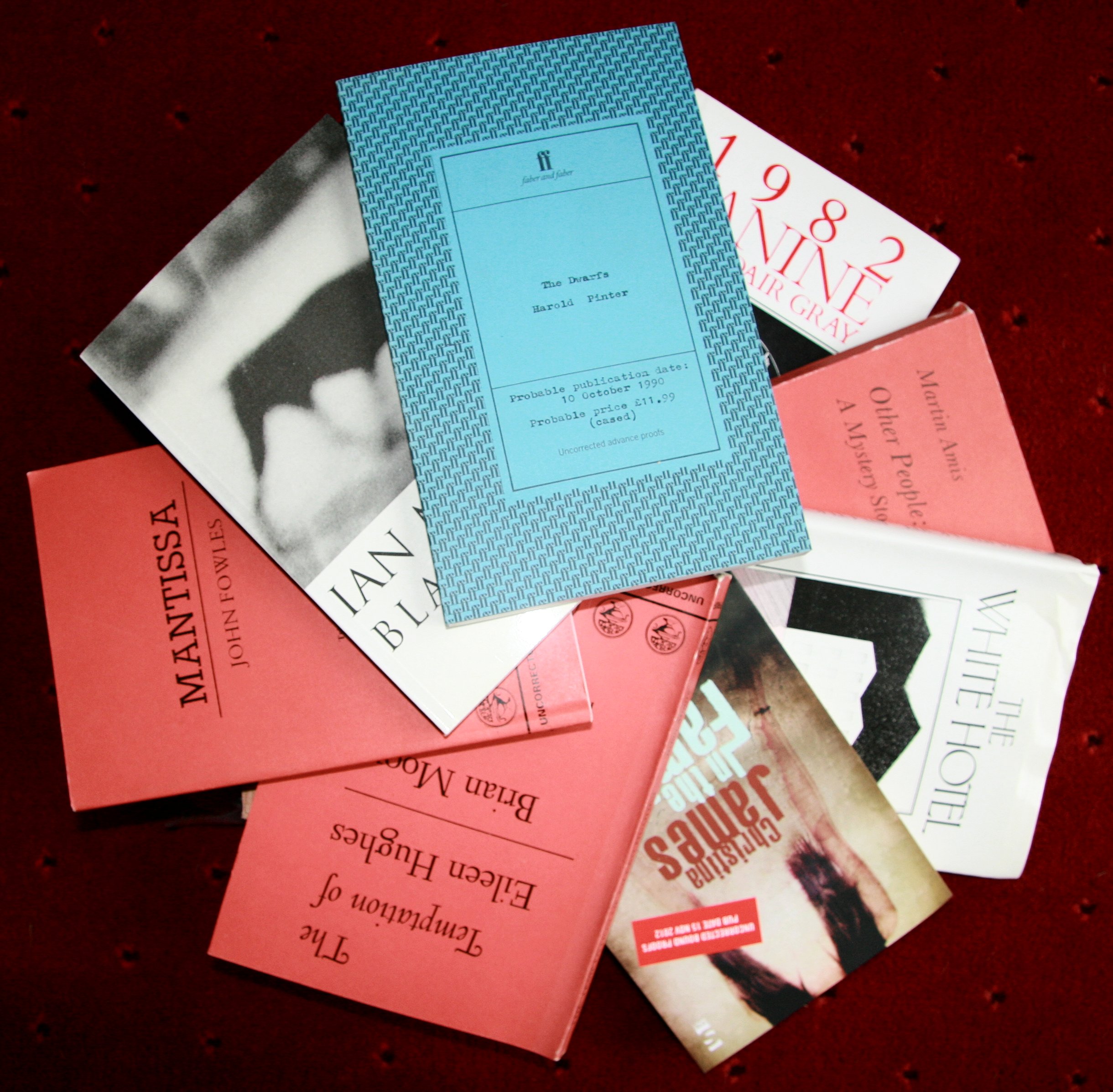
One of the most interesting things about proof copies is that you don’t own them. Most have printed on the cover that they cannot be sold. Some publishers also say: ‘This is the property of the publisher and not for sale.’ Yet I have never heard of a publisher who asked for a proof to be returned. The ones that I have, which represent some of my happiest years, working as the purchaser for a library supplier, will probably stay on my shelves until I die. Then they will be my son’s problem: will he ‘own’ them, or not? I suppose that he will take them on and become their guardian, just as I have been their châtelaine since they were young and untried.
I remember how I acquired some of them. Publishers’ reps get to know their customers’ tastes in literature, of course, and often they would produce two or three proofs from their bags and give them to me; or I would be sent one by post in advance of a launch. The biggest haul always came from Cape, Chatto and Bodley Head. These three companies (which were later swallowed up by Random House) jointly used the same sales team. For a number of years, the representative whom I saw, David Moore, used to drive across the Pennines from his home in Lytham St Annes, spend the night at a hotel in Wakefield and ‘travel’ the Leeds bookshops the next day. As my office was close to the hotel, he would call on me towards the end of the afternoon, just after he’d completed his journey (and in time for a cup of tea). When I’d given him his order, I’d ask if I could have a look in the boot of his car, which always contained two or three boxes of the next season’s titles in proof. I would come away with a rich haul; I was never disappointed.
I keep the proofs on the bookshelves in my study, not downstairs with the finished books. They are actually more precious to me than their suaver counterparts – I have finished copies of some of the titles as well. I have just lifted some of them down. Strange to think that, when they were printed, some of them were obscure titles from young unknown authors who have since become very famous. Of course, some of the authors were famous then: my collection includes The Dwarfs, by Harold Pinter, Mantissa, by John Fowles, Black Dogs, by Ian McEwan and The Temptation of Eileen Hughes, by Brian Moore. I think that all of these writers were well-established at the time. However, I also have 1982, Janine by Alasdair Gray and The White Hotel, by D M Thomas; each of these books catapulted its author into acclaim. Curious to think that I read and liked these brilliant but then unknown works and myself made a small contribution towards launching them upon the world.
I still have a couple of proof copies of In the Family. I don’t flatter myself that in years to come they will be sought after in the way in which some of the titles in my collection are. Nevertheless, it amuses me to allow them to rub shoulders with the great and famous, in some cases in the augenblick before fame came. It is almost like putting In the Family into a time machine.
‘Almost Love’ almost flowering…
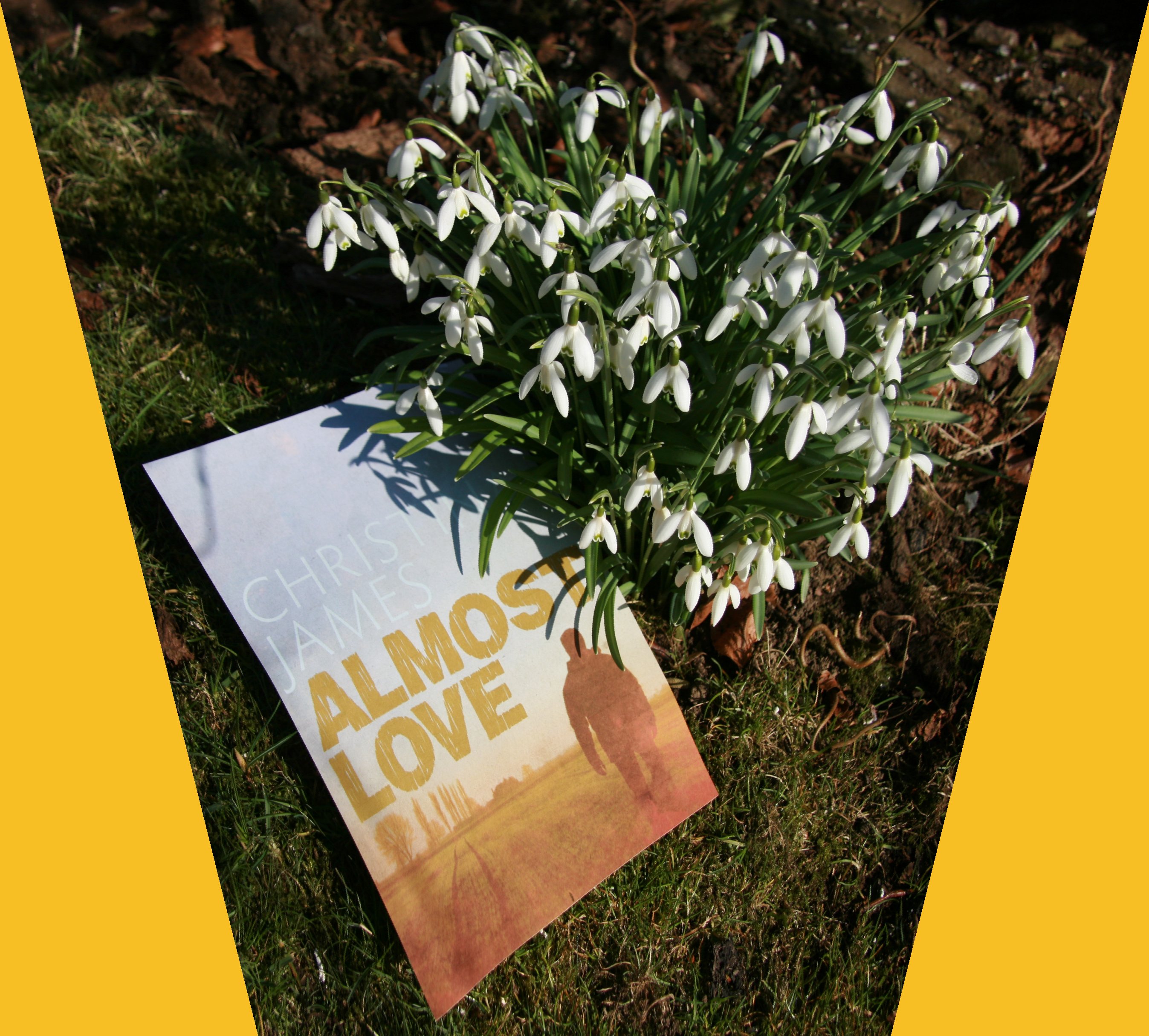
Yesterday was the first of March, St. David’s Day. Although there was frost on the ground, the sun, when it broke through the cloud, was shining brightly and with real warmth. The snowdrops and primulas have already been in flower for some time and yesterday I noticed that the dwarf daffodil buds are swelling. When I drove out at 6.15 p.m., there was still some daylight left. Spring is pushing aside a bleak winter!
Yesterday was also the day on which I wrote the last few sentences of Almost Love. Because of the non-sequential way in which I write (a habit that I am trying to break), they belong to a chapter about one hundred pages from the end; it was a chapter that I’d been trying to finalise for some time. Then, when there was nothing else left to work on (and therefore no way out of attending to it), it almost sorted itself, quietly and relatively quickly.
There’s still revision to be done, of course, although I revise all the time while I’m writing, but rounding off this novel has been quite different from finishing In the Family, which left me feeling battered and dazed. (I remember it well, partly because it was completed on the day of the royal wedding, which gave me more time to myself than usual.) This time I just felt happy in an understated sort of way.
The next novel is germinating at the back of my mind. It will need quite a lot of research, which I shall enjoy. For the moment, however, I shall focus on tending to Almost Love and enjoying the time before it bursts into bloom in June.
The ‘Next Big Thing’ for me…

I’d like to thank Anne Zouroudi for nominating me as one of her choices when she completed the ‘Next Big Thing’ questions. I am a keen admirer of Anne’s novels and also greatly respect her as a writer with a genuine desire to help less established authors than herself. Most readers of this blog will already be familiar with the ‘Next Big Thing’, a blog-hop that spreads the news about what new book authors are working on, via a common set of ten questions. So here I go:
What’s the title of your next book?
It’s Almost Love, to be published in June 2013. There is more information about it here.
Where did the idea come from for the book?
It came partly from the extraordinary venue used for a conference that I attended – a house that had once been owned by Liberace – and partly from my discovery of an unlikely liaison between two people I know.
What genre does your book fall under?
It is a crime novel. Elaine Aldred has kindly described me as a ‘literary’ crime writer. I don’t really like categorising books, but, as a Salt writer, I do try to pay as much attention to the characters and the language that I use as to the plot.
What actors would you choose to play the part of your characters in a movie rendition?
It depends on which characters! Rupert Penry-Jones fits the bill almost exactly for DI Yates; Franka Potente would be excellent as Katrin; Ralph Fiennes would play Guy Maichment, one of the villains, to perfection.
What is the one-sentence synopsis of your book?
The disappearance of an elderly eminent female archaeologist and the simultaneous, but apparently unrelated, start of an illicit love affair between two colleagues together set off a chain of events that results in several murders; as the aspirations of a macabre right wing political group are also re-ignited, catastrophe threatens.
Will your book be self-published or represented by an agency?
Like In the Family, it will be published by Salt Publishing. I don’t have an agent. I’m proud to be a Salt author.
How long did it take you to write the first draft of the manuscript?
I’m still tidying it up in places. I started writing it when on holiday in France in August 2011.
What other books would you compare this story to within your genre?
That’s a very difficult question! I honestly haven’t read anything that resembles it much, partly because, as with In the Family, the South Lincolnshire setting is very important. I suppose it could be described as Michael Dibdin meets Henning Mankell in South Lincs, though that sounds terribly pretentious and more than a little absurd!
Who or what inspired you to write this book?
It was always my intention to write several DI Yates stories. The first seeds of Almost Love were sown by a telephone conversation; it was a piece of gossip, really.
What else about your book might pique the reader’s interest?
I’ve taken a lot of trouble with the archaeological background, which is inspired in part by the existence of the Spalding Gentlemen’s Society, a fascinating three-centuries-old organisation. Readers who’ve already met Tim Yates may be intrigued by some additional complications in his personal life.
I’d now like to pass the Next Big Thing baton to Laura Joyce, a fellow Salt author who has greatly impressed me with her debut novel, The Museum of Atheism.
Your good name and character are safe with me!

Today’s photograph shows an extra Christmas present that I received from my daughter-in-law. I am very pleased indeed with it and have just taken it out of its Cellophane wrapper, as it will be going on its first outing tomorrow.
It has made me think about fictional characters and to what extent they are (or should be) drawn from life. There have been some famous court cases in which certain authors’ character portrayals, or their exact use of the names of real people, have been challenged by the ‘victims’. I remember that the first edition of Richard Adams’ The Girl in a Swing had to be withdrawn, because one of the characters had been given the precise name of someone that Adams knew. (I was deeply involved in this, as it meant my having to call just about every public library in the country with the request to return for credit any copies that they held!)
Do most friends of novelists mind seeing themselves portrayed in their work? On the whole, I should hope that they would find it quite flattering (depending on the nature of the portrayal and the quality of the writing!), though I have not asked this question of any of my friends directly, as I don’t wish to alarm them. None of the characters in In the Family is based on a ‘real’ person, though some of them, of course, show the feelings, use the mannerisms and even, on occasion, utter the same words and phrases of people whom I know. I feel that this is an inevitable part of the creative process; otherwise, all my characters would resemble Martians!
Literary works that incorporate ‘real’ authors are always fascinating – at least to other authors. Aldous Huxley, W.B. Yeats, Lady Ottoline Morrell and Nancy Cunard all appeared many times in the fictional works of their large circles of literary friends and acquaintances, sometimes wittily disguised, sometimes barely disguised at all. Some of these portraits have hit home in quite a cruel way. Ottoline Morrell, in particular, was the instantly-recognisable butt of several less-than-generous satirical sketches, though to my knowledge she never resorted to litigation. It is harder for crime writers to ‘steal’ characters in this way, especially for the role of villain! However, Dorothy L. Sayers’ biographer makes a convincing case for Lord Peter Wimsey’s having been based on a man whom she had loved in vain.
You would think it would be easy to avoid taking names from life, as it seems straightforward enough to invent them. However, unless you are a latter-day Charles Dickens and choose your characters’ names to reflect their personalities, it is harder than you might think. They have to sound convincing and be interesting but not banal. J.K. Rowling has said that the name ‘Harry Potter’ originally belonged to someone that she knew at school. In the Family contains the names of several people who lived in Spalding when I was a child, though they have been taken completely out of context in the novel: Atkins, Bertolasso, Frear and Armstrong are all names from that era, as is the first name Giash, which belonged to the only Pakistani I’d met at the time. I knew several Dorises, Elizas and Kathryns; no Bryony, but it is a name that my mother considered giving to me when I was born (I had a lucky escape there, I feel!); no Tirzah, either, but one of my ancestors rejoiced in that name (two others were called Hezekiah and Jeremiah, according to the family bible).
I have yet to mine some of the more picturesque old Lincolnshire surnames: Gotobed, Withyman, Sentance and Berrill. Perhaps they will appear in later books. In scenes I’ve set outside Lincolnshire, I tend to choose the names of real places that I know well. For example, Tim Yates has a sister (who will surface at some point!) who lives in a street in Surbiton that in real life is home to one of my dearest friends, but that is where the similarity will end: Tim’s sister’s appearance and personality will not be stolen from my friend.
So, I think I have answered my own question! I love my new bag, because its message is so witty, but my own message – to all my friends – is that you are safe. I value your friendship too much to try to plunder your character, even for the sake of DI Yates!
 Christina James, crime novelist