

The crime writers’ heroine: Dea Parkin, Secretary of the CWA

In a previous post, I described Agatha Christie as the ‘Queen of Crime’. This post features an interview with Dea Parkin, Secretary of the CWA, and the (often unsung) heroine of crime writers.
Q: Please describe your job. What does it entail? What do you like best about it? What do you find most challenging?
A: I’m the central point of contact for the CWA and co-ordinate all the different elements. I implement strategy decided by the Board and make day-to-day decisions on anything from website copy to competition process for the Debut Dagger and the Margery Allingham Short Mystery competitions. I liaise with members, external organisations and individuals, and the other officers and board members, as well as our hard-working admin and accounts departments. I’m the lead editor of the CRA Newsletter.
I enjoy the communication with our members, helping them with questions, benefit awareness and encouraging them to make the most of their membership. That’s very rewarding and it’s especially good to meet face to face, at the Daggers, Chapter meetings, festivals and above all the annual CWA conference.
I also enjoy encouraging would-be authors through the Debut Dagger competition and overseeing our Criminal Critiques service and carrying the torch for the CWA at events such as CrimeFest and Harrogate. There is a lot about the job I absolutely love!
The most challenging aspect is keeping up with all the emails, especially when there are big projects that need to be seen through, such as organising material for the AGM, proofing Dagger shortlists or writing reports. There is always more to do and my assistant, Fiona Veitch Smith, is invaluable, as is Joint Vice Chair Antony Johnston in particular.
Q: Why did you want the job? What was your inspiration? What was your previous job?
A: Well, I was asked in early 2016 by Martin Edwards, who was Vice-Chair at the time, if I could help out when the former director resigned. I’ve always worked freelance and had capacity at the time, and I’d been an associate member of the CWA through my editorial consultancy since 2012. In a past life, Martin had been a client of the PR firm I freelanced for and he knew a little about my organisational skills as well as my love of writing and editing – skills he thought the CWA might be able to use.
My editing work continues on days when I’m not working for the CWA and until the pandemic I also continued as a copywriter and marketing consultant for private companies. Working in the publishing industry was a dream come true; I feel I have finally found myself in the sphere I wish I’d discovered much earlier in my career.
Q: When you were appointed six years ago, you quickly transformed the CWA, which had perhaps been quite a fractured organisation previously. How did you manage to achieve this, and in so short a period of time?
A: I can take no credit for improvements the CWA has made in the last six or seven years or so. It’s been down to a board, comprising almost all volunteers, appreciating what needed to be done to make the CWA a cohesive and accessible organisation offering many benefits to all members. Membership has shot up since 2010 and it was a matter of putting a structure and people in place who could manage that growth and keep the CWA relevant and useful to authors, enhancing existing benefits such as the social networking through the Chapters and introducing new ones, especially online. This process continues as our dynamic Board find different ways of addressing this central issue, while always bearing in mind our responsibilities to crime writing in general, especially through the Daggers, and our members in particular.
Q: It seems to me that running an organisation for authors who, although they co-operate, are also essentially rivals, must bring its own peculiar difficulties. How do you manage to be equitable?
A: Interestingly, no crime writer I’ve met through the CWA has mentioned viewing their fellow writers as competitors. They generally appreciate that what helps one, helps all and that contributing to the popularity of crime writing, fiction and non-fiction alike, is a good thing for all crime writers. I have personally found the CWA to be a warm, friendly and welcoming organisation and the members delightful. I enjoy reading as many of their books as I possibly can! I encourage everyone to write articles for the CRA Newsletter and blog, and the CWA Debuts web pages, and love to help anyone who submits these or events for the websites. Yet my job is to help all members, whether they’re interested in those opportunities or not, and together with our excellent CWA team I’m very keen on doing exactly that, with everyone offered the same courtesies and friendly service.
Q: What are your future aspirations for the CWA? Where would you like it to be in the next two years? And next five years?
A: I’m not sure this is really for me to say, as it’s more for the board and the members themselves. I’d hope it continues to grow, attracting more members while offering a high quality of service to all. We appointed a PR company a few years ago now, Cause PR, and they have helped us to raise our profile within the industry, together with our hard-working Library Champions and Bookseller Champions. The stronger we are, the more good we can do for more writers.
Q: Are you a crime fan yourself? Do you have favourite crime authors? Outside the crime genre, who are your favourite authors?
A: I am a huge crime fan! However, this is where I prefer to be equitable, as you describe it, and not name any live crime writers. My tastes are very wide; I enjoy everything from historical mysteries to psychological noir, 1930s spy stories to cutting edge cyber thrillers. I enjoy a gentle touch of the supernatural. I grew up reading Agatha Christie, Josephine Tey and Ian Fleming and later Reginald Hill, Ruth Rendell and PD James. Nowadays my favourite-author list would spill over many pages and many CWA members feature there.
Outside crime, I love Hilary Mantel, Maggie O’Farrell, Paul Torday and Joanne Harris. Tolkien has always been a big favourite together with many of the classics, and Philip Pullman and Terry Pratchett books also have a space on my furniture and floors. (Bookshelves are inadequate to the book-holding task!) I buy history books and sometimes get round to reading them. Alison Weir and Helen Castor are amazing!
Q: A few personal details. What do you do to relax, apart from reading?
A: I live in Chorley, Lancashire, though I’m from Yorkshire and still get teased, Wars-of-the-Roses style, from friends at both sides of the Pennines. My other work as a developmental and copy editor takes up a lot of time, but I love helping writers to achieve their full potential. For leisure, I both play tennis and watch it on TV, which accounts for almost all my viewing, and I’m secretary of my local drama group. I write poetry, one-act plays and short stories, and struggle with several novels I dare show no one. Beyond tennis and stories, as a history graduate I don’t get more satisfaction than looking round a castle or historic monument, though rambling in the hills is something I could wish I had more time for. Next week I’m walking the Tolkien Trail with a book-loving friend, so that’s a perfect leisure combination!
Q: Do you have a message for struggling new crime writers who are just starting out?
A: Keep going. Take the time to learn your craft and develop a professional business approach too. Above all, enjoy your writing. Keep perspective.
Richard Reynolds: the pure genius

As John Aubrey, the seventeenth century polymath, bibliophile – and bookseller – observed, “to read a book is demanding, for one must stay awake; to write a book is more demanding, for one must stay awake and think; but to sell a book – ah, that is a work of pure genius!”
I’m starting this series of celebratory posts with a piece about Richard Reynolds, the undisputed doyen of crime booksellers. Why begin with a bookseller? Because without the services of the bookseller, the entire creative process that concludes with the finished book would be pointless. Bookselling is an art under-rated by everyone who has not practised it.
Richard began his working life in September 1976 as a ‘classical music consultant’ at Hardman Radio in Manchester. He loved reading and would trawl new and secondhand bookshops and market stalls in the city. In early 1980 he spotted a job advert in Jardine’s bookshop, applied for it and began his bookselling career a few months later. In 1981, he was appointed buyer for the sports section at the famous Heffer’s bookshop in Cambridge, progressing to travel and biography and then to the literature department, which boasted an impressive twenty-five standard book ‘drops’ (book cases).
Richard’s manager knew he was a crime fiction buff and encouraged him to use a small space under the ledge near to the stairs to develop a crime fiction section. As sales took off, crime was promoted to more prestigious areas in the shop.
Heffer’s is famous for its crime fiction events. Richard explains that these began in a small way in 1990 with Bodies in the Bookshop. Heffer’s put on “a wonderful display of crime fiction titles and ephemera on the platform halfway down the central staircase. Penguin Crime Classics sponsored a competition: the winner to supply the scream in Agatha Christie’s The Mousetrap. I still have the poster! Heffer’s first crime fiction catalogue was produced at the same time. Five authors came to sign books on the last Saturday of the month: Colin Dexter, Lindsay Davis, Reginald Hill, Minette Walters and Michael Dibdin.”
Sixty authors took part in the last of these events, for which, for seventeen years, Richard compiled the catalogues. He still receives ‘heartening’ requests for copies from readers trying to fill gaps in their collections. As the numbers of authors increased, what had been a single annual event became three separate ones: What’s Your Poison, Murder under the Mistletoe and Murder Will Out, now organised by events manager Kate Fleet.
Since the COVID restrictions were lifted, events have resumed but been smaller: a launch party for After Agatha, by Sally Cline, Kate Rhodes in conversation with Sarah Vaughan about her book Reputation, and a launch party (with jazz quartet!) for Peter Morfoot’s Essence of Murder. On June 23rd, Financial Times reviewer Barry Forshaw and Kate Rhodes will discuss Simenon: The Man, The Books, The Films and The Devil’s Table, the fifth of Kate’s Scilly Islands series.
Richard finds it very difficult to name an individual crime writer as his favourite. During lockdown, he re-read the whole Scilly Isles series, as well as books by Nicola Upson, Rennie Airth, Barry Maitland and Charles Todd. In 2019, as he approached his fortieth year as a bookseller, he compiled his personal list of 100 Favourite Crime Novels. If pushed to choose he says his favourite book would be The Murder of Roger Ackroyd and his favourite author Agatha Christie.


Richard is still a bookseller, but he now combines this with editorial and publishing activities. This began when he suggested to Penguin Random House which authors they should reissue under the Vintage Crime imprint. He has acted in a similar capacity for Ostara Books, Oleander Press and Clerical Crime and assisted with the publication of six Gold Age titles under Oleander Press’s Oreon imprint. More reissues are planned in the coming months.
He says he is grateful to his wife, Sally, for tolerating a house full of books! His small attic study is stacked high with collections of Penguin Green Crime, Gollancz yellow jackets, Golden Age titles, Cambridgeshire crime fiction, translated crime fiction, historical whodunnits, much recent detective fiction, a substantial collection of crime reference books and… and… and..!
Musing on his career, he says, “I suppose specialising in crime fiction is like being paid to pursue a hobby. Badgering publishers to re-publish good authors is a privilege. I enjoy working out the best fit between the author and the publisher. I serve as chairman of the CWA Gold Dagger Award for best crime novel of the year, for which there have been 260 submissions this year, making it hard to create the long list. The winner will be announced on 29th June.”
For aspiring booksellers, he offers the following message: “The late John Cheshire, a chatty, encouraging and supportive Heffer’s shop manager, told me not to spend my small salary on books but instead ask reps for proof/reading copies so that I could help publicise them. I have kept to that advice – and I’d like to thank all the reps and publishers who’ve kindly kept me supplied with reading material. And it’s important for booksellers to keep on reading ephemera about books: articles, reviews, blogs, information on publishers’ and authors’ websites.”
Asked what his advice to someone just starting out on a crime fiction writing career would be, he says that as writing is a solitary occupation it is important to chat to local booksellers and meet other authors, especially at events or festivals such as Crimefest and the Harrogate International Festival or one of the many good smaller festivals that now exist. It’s also a good idea to attend other writers’ launch parties, read widely – and try not to overwrite! Having some bookmarks printed is an inexpensive way of getting noticed – it’s easy to underestimate how useful they can be.
As an author, I am inexpressibly grateful to Richard and all the booksellers who make it their life’s work to support writing and reading. He is a man who practises sheer genius every day! If he were still alive, I know John Aubrey would be the first to agree.

Tomorrow’s post will be about an aspiring crime fiction writer, Fraser Massey, who is already a distinguished journalist.
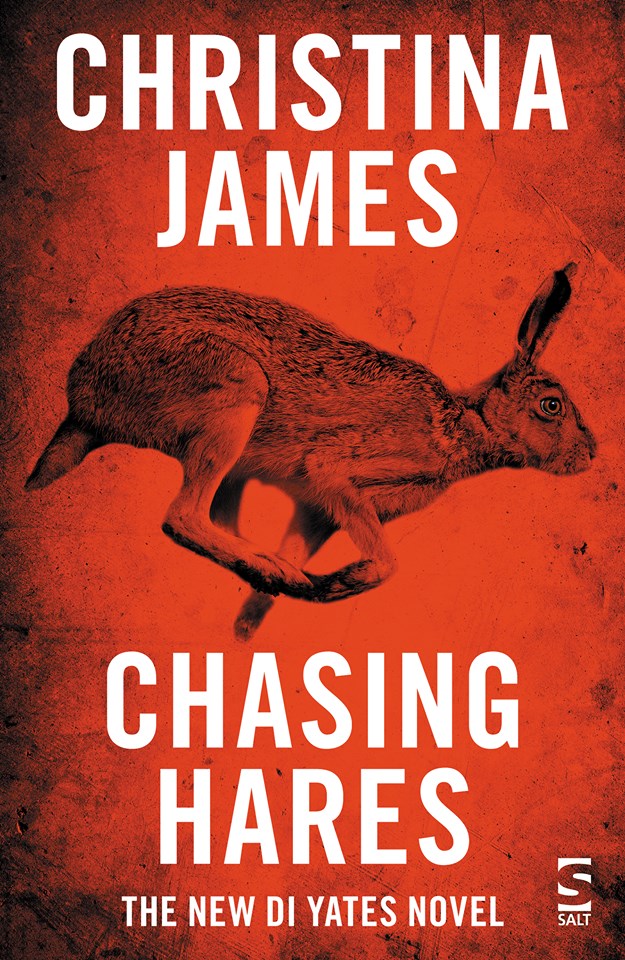
 Christina James, crime novelist