Snapshot of a diner in Barcelona…

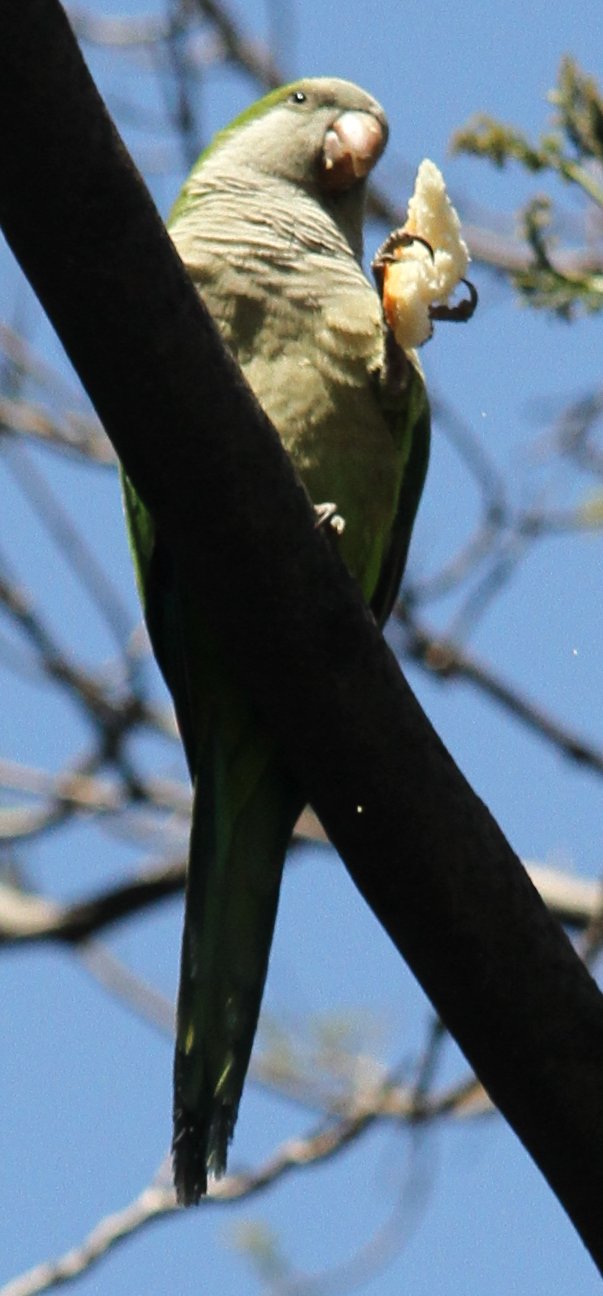
Monk parakeet

As someone who has written at some length about birds – the herons and curlews of Lincolnshire; the pheasants that go in fear of their lives during the winter months in the Pennine village in which I live – I’ve been very interested in the bird life of Barcelona. Most of the birds here are exactly what you would expect to find in a major city with lots of parks which is also a Mediterranean sea-port. I’ve seen gulls and feral pigeons, sparrows and ducks a-plenty; swifts swirling around the buildings: in other words, the same birds that I should encounter in similar habitats in England at appropriate times of year. I have, however, been amazed that the many palm trees of Barcelona are filled, not with the melodious song of the blackbird and song-thrush, but with the raucous cry of the parakeet. These piratical birds swoop screeching down upon the crusts and pizza-ends discarded by tourists and, despite their inferior size, give the pigeons a fairly vicious dusting down if they try to put up a fight. They’re nothing but semi-tropical thugs, really, but I can’t help feeling a sneaking admiration for them, even so. It’s not just that they live by their wits, but also because they do it in such a brazen way. I suppose that in one sense they have no option: gorgeous in luminous lime green, they can hardly make their livelihoods by stealth. There is something entertaining about the fact that they carry their finds up to a safe branch and, clutching the morsel in one foot, nibble delicately at it like over-dressed and picky diners on the terrasses beneath them.

Exquisitely conceived…

IMG_0284

As it has been some time since I posted about a grand sculptural project, I have decided to take advantage of a current opportunity to rectify matters. I’m enjoying a brief respite from the pressures of work and find myself in Barcelona, where today I have visited the remarkable Casa Milà, better known perhaps as La Pedrera, the apartment building designed by Antoni Gaudí and finished in 1910.
For someone who spends a great deal of time reading and thinking about the dark side of life, walking into this magnificent architectural accomplishment is a spirit-lifting contrast like the gladdening of the heart that comes with the warmth of the sun after one of the bleakest winters I have ever known. And Barcelona is blissfully warm, too, its trees already covered in fresh green leaves and its beaches full of sunbathers.
Those of my readers who have toured La Pedrera will, I hope, indulge my hugely enthusiastic response to Gaudí’s work here. All ripples and curves and fanciful challenges to the dismal straight line, the building is, in fact, a temple to the harmony of art and practical purpose. Its roof, a miraculous sculptural garden of delights, tuIMG_0196rns chimneys, stairways, ventilation ducts and water-management into elegant figures and organic forms, rising and falling above the exquisite catenary arches of the loft beneath. Gaudí designed this latter to be insulation for the apartments from both the heat of summer and the cold of winter. Following the loft galleries around the two internal courtyards (which, lower down, allow natural light to enter the rooms), has the feeling of walking around the caves of some grand champagne house, though windows at intervals permit light and air to enter.
The apartments themselves, one level of which is open as a museum to visitors, are still occupied by private families and various businesses, in keeping with the original intention. I could live here! Original parquet and marble flooring, completely flexible space (the pillar and steel beam structure means that none of the internal walls is load-bearing) and an almost complete absence of four-square normality, together with calm natural lighting, all inspire a sense of peace and joy. I do not exaggerate.
The views from the roof are spectacular panoramas over Barcelona, to the hills and to the sea; those from the windows are down to either the cool interior courtyards or along the bustling streets outside. Balconies, with their hallmark black and scrolled wrought iron balustrades, encourage a desire to watch the world go by below.
I spent some happy hours there today, leaving with a lightened heart and the strong sense of well-being that comes from exposure to something incredibly beautiful and superbly designed. La Pedrera is a marvel.

IMG_0270

A gem from the past – I keep finding them!

The Way Through The Woods

I came to Colin Dexter belatedly and, although I have admired all of the novels that I have read by him, I have never indulged in a Morsefest in the same way in which I read most of the Minette Walters’ novels – or much of Anthony Trollope’s oeuvre, for that matter –  in one short consecutive burst.  I was therefore recently surprised and delighted to discover a well-thumbed edition of The Way Through the Woods on my bookshelves.  (Although it had certainly accommodated previous readers, probably several of them, I was not among their number and, indeed, I don’t know how I came by this copy.  It may have been a present from a fellow crime fiction fan.)

I should like to heap unreserved praise on this book, which is undoubtedly the best of the Morse series that I have read.  Unsurprisingly, it won the CWA Gold Dagger in the year of its publication, 1992; although I don’t know what its rivals were, I am convinced that a grave injustice would have been perpetrated had the award gone to any of them.  It is Dexter at the height of his powers.

The plot is extremely complicated, with a large cast of delightfully individual characters.  I guessed one of the main twists that the narrative would take about halfway through, but there is an additional twist to this twist that remains almost unguessable until the end.  Like all Morse novels, it can be read on several levels and is a rich, deep evocation of how life unfolds within a certain stratum of British society.  If I could sum up the plot in a few words, it would be ‘When is a victim not a victim?’  An enigmatic and gnomic observation, perhaps, but not as enigmatic and gnomic as the book itself and, if I were to offer further clues, I might inadvertently create a ‘spoiler’.

Also, as with all Morse novels, the cultural references are legion: Dexter doesn’t just quote extensively from the whole canon of English literature, but displays an impressive knowledge of classical music, jazz and fine art.  In another writer, this might seem pretentious, perhaps even self-regarding, but Dexter, like Morse, endears by consistently keeping his tongue in his cheek.  Another facet of the writing that keeps preciousness at bay (and I don’t recollect this in the other Morse novels, though I suspect that it must be there) is that Morse leads quite an adventurous, not to say outré, sexual life.  This is kept intriguingly veiled – and unsordid, if there is such a word – by confining itself only to the arrivals and departures of Morse’s paramours.  What happens during their visits is left strictly to the reader’s imagination.

I realise that I have come to this book so belatedly that I am probably speaking to the converted.  However, I should still like to take this opportunity to offer my praise and to encourage you to make the same voyage of discovery if you have not done so already.


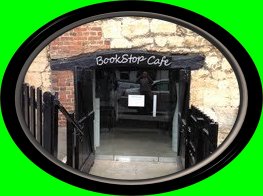
Just look at this: a new café bookshop in Lincoln!

BookStop Cafe 4

I’ve used the word ‘serendipity’ several times just lately and, since style matters to me, I’m troubled by tedious repetition; yet Twitter is rather generous with serendipitous moments and another one (thanks to my writer friend Carol Hedges @carolJhedges for the information) popped up in the feed on Thursday last.  It was the start of something big and it was, is and will be in Lincoln.

Living in this city are siblings Joff and Becky, who are taking the brave step into the wonderful world of independent bookselling, with a special emphasis upon supporting local and independent authors.  On Saturday 4th May, BookStop Café will be opened to the discerning readers and the tea, coffee and cake addicts of Lincoln.

Where?  At 46-47 Steep Hill and 7 Christ’s Hospital Terrace, the new home of BookStop Café is also a very old home, an example of Norman domestic architecture and, according to many references, known as ‘Aaron the Jew’s House’ (where Aaron of Lincoln, who died in 1186, lived – he was then the greatest Jewish financier of England).  The building has been a shop for many years and is currently where, up above the new bookshop/café, tea importer Imperial Teas conducts its business: an atmospheric venue indeed, ready for a new development in its very long history.

Joff (self-published author Joff Gainey) and Becky have always dreamed of combining a café with books and now their vision is becoming reality: BookStop Café will, at weekends only to start with, be a place for readers to enjoy new and secondhand books in comfortable surroundings.  Before very long, it will be a place where children can listen to storytelling and where artists can display their works.  Keep up to date with its progress on Twitter at @BookStopCafe .

I am delighted to have come across this new venture and hope that you will join me in wishing it well.  The lucky people of Lincoln will be able to settle down to good reading on Saturdays and Sundays from 4th May, 10.00 a.m – 4.00 p.m.  My guess is that they will be settling down to some very fine cake, coffee and tea too.

I know where I’ll be heading, next time I’m in Lincoln.

BookStop Cafe 5

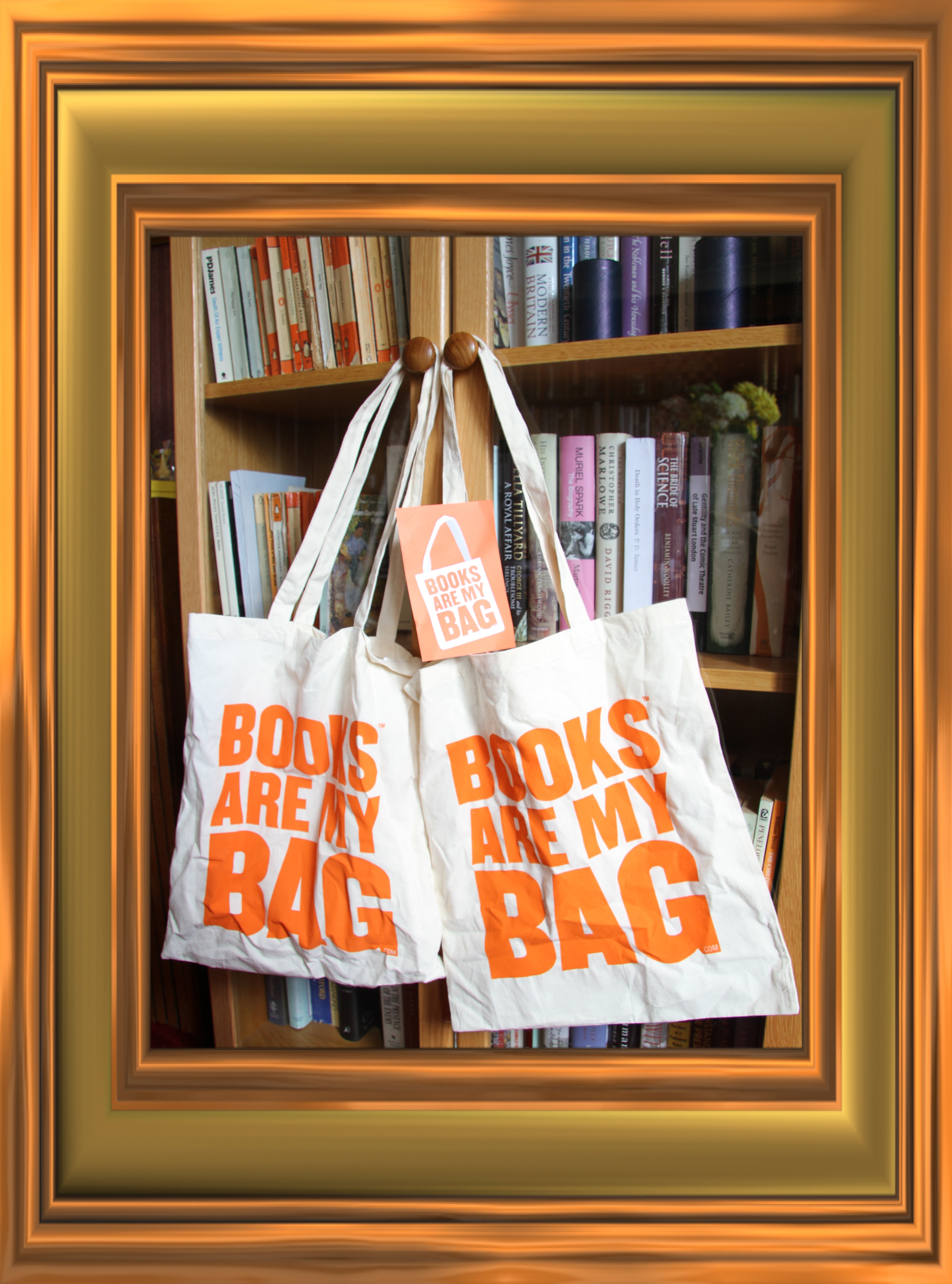
BOOKS ARE MY BAG: WOW!

BOOKS ARE MY BAG

As a former bookseller, my heart was gladdened by attending the announcement of the Books are My Bag campaign, which for me was the most exciting single event held at the London Book Fair this year.  The campaign has been devised by M & C Saatchi and is entirely based on a single, simple, very effective message: that the passion for books and bookshops is a precious part of our national heritage and something that we should cherish, celebrate and promote.  It is a campaign of perfect solidarity: all booksellers (whether they belong to chains or independents) and publishers are uniting with one voice to celebrate the pleasures and cultural importance of the high street bookshop.

Tim Godfray, CEO of The Booksellers Association and Richard Mollet, CEO of the Publishers Association, both spoke at the event.  They were joined by some industry legends, including Patrick Neale, currently President of the Booksellers Association and joint owner of the marvellous Jaffé Bookshop in Oxfordshire (in a previous life he was the inspiration behind the equally wonderful Waterstone’s Sauchiehall Street bookshop in Glasgow) and Gail Rebuck, Chair and CEO of Random House (who, like Dame Marjorie Scardino, has proved that women can get to the top of large corporate publishing houses and stay there).

Patrick’s message was strong and direct.  He made the point perfectly that there is far more to the experience of buying a book than receiving a brown cardboard parcel through the post: “We all know that there are many ways to buy and sell books, but what Books are My Bag captures and celebrates is the physical; the simple truth that bookshops do more physically to let people enjoy their passion for books.”  Gail Rebuck said: “In these challenging times for the UK High Street, it is terrific that a world-renowned advertising company – M & C Saatchi – has devised such a positive campaign for all booksellers.”

In keeping with its message about the physical presence of bookshops, the campaign will feature strong branding and a very distinctive prop: a cloth bag with the words BOOKS ARE MY BAG printed on it in capitals in neon orange.  These bags will be given to customers by bookshops across the country when the campaign is launched on 14th September.  I wasn’t sure about the colour when I first saw it – and I was hugely impressed that Tim Godfray was prepared to spend the whole day wearing a matching T-shirt emblazoned with the orange slogan.  However, throughout the Book Fair, I spotted people carrying these bags (the BA gave them out daily) and I concluded that they are very effective indeed.  As Patrick put it, “This is the first time anyone has needed sun-glasses when inside the London Book Fair.”  I have acquired two of them, one from the BA stand and one from the event, and I shall carry them with pride throughout the summer.

Anyone reading this blog who is interested in knowing more about this, here is your link  Books are My Bag  to its dedicated website.

I love bookshops!

A London Book Fair 13 seminar about using social networking to create author presence

Elizabeth Baines LBF13  3Chris Hamilton-Emery LBF13  4

I cannot miss the opportunity to comment in today’s post on the social networking session yesterday morning at the London Book Fair.  First, may I thank the very many people who attended and made the event very special indeed; you were a lovely, attentive audience and we all valued your interest and contributions.

Secondly, I should like to thank Elaine Aldred (@EMAldred, Strange Alliances blog), who very generously agreed some time ago to chair this session and, with her characteristic attention to detail, introduced the panel and provided a succinct summary of the key points arising, as well as modestly managing us and our timekeeping!

I was very pleased to meet and honoured to join my much more experienced social networking fellow panellists, Katy Evans-Bush  @KatyEvansBush) and Elizabeth Baines (@ElizabethBaines), and to be able to listen to the social networking supremo, Chris Hamilton-Emery, Director of Salt Publishing (@saltpublishing), all of whom provided different perspectives from my own.  However, though we may have addressed in various ways the topic of how to make the most of the best of social networking, I felt that we were unKaty Evans-Bush LBF13  5Elaine Aldred LBF13 2animous about the terrific value of what Chris called ‘the confluence’ of such media as Twitter, Facebook and personal blogs in creating author presence and profile.    I believe that we also affirmed the essential need to be ourselves (however uncomfortable it may initially feel to present our private side, as Elizabeth very pertinently explained) and to interact with the people we ‘meet’ in a genuine way.  We shared the view that ramming our books down the throats of our online audience in a ‘hard sell’, as some people do, is counter-productive; it is much better for us to engage with others in discussion of the things which matter to us, such as the business of writing, literature, topical issues and so on.  Katy pinpointed the effectiveness of social networking in creating a global family of friends and followers, something we also all felt.

All in all, the session emphasised that participation, helping others, reciprocating generosity and showing real interest in people whom we come to know online are crucial to creating a lasting author presence.  It is really important that authors recognise that they need to have such a profile; with it, books certainly do sell and, as Chris put it, without it they don’t.

Finally, we all accepted the inevitable consequence of managing all of the personal interactions online: it is extremely time-consuming and we have to find our own ways of handling that; if we succeed, the benefits are very clear to see.

My thanks again to all concerned in what was for me a very memorable occasion.

Christina James LBF13  6

I’d like to knock down that Victorian edifice…

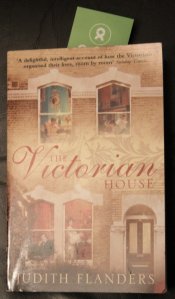
The Victorian House

Taking up the theme of food again, I’m still reading about Victorian houses and customs in order to get a feel for how the very old people whom I knew in my youth grew up.  One of the things that strikes is me is how indelibly the Victorian age made its mark on those who were born within it.  My grandmother was born in 1892 and was nine when Queen Victoria died, yet all her life she was a Victorian.  She even dressed like one, in ankle-length skirts and pastel-coloured blouses trimmed in lace, with high collars.

Not only did Queen Victoria’s reign seem to imbue everyone who lived in it with norms and values that were immediately spurned by the next generation, but it succeeded in erecting an almost insuperable barrier between itself and the age which preceded it.  The most alarming thing of all is how women seemed to become walled up as part of this process.

They were literally walled up: condemned to stay in the house almost all of the time, maintaining and cleaning it or supervising its cleaning and maintenance, depending on their class; spending each day of their lives ensuring that the master of the house returned to a perfectly-kept residence.  This in itself would have been irksome enough, but social aspirations added to women’s domestic workload in the most intolerable way.  In an age when the middle classes were burgeoning, so that many people had more of what is now called ‘disposable income’, and when, for the first time, machinery could churn out materials and finished goods very cheaply, houses became filled with all kinds of artefacts, many of them quite useless.  Whether they were bought or made at home, all of these things also needed care and maintenance – the latter involving a great deal of washing and cleaning when houses were warmed by coal fires and lit by candles or gas.  Clothes and food became much more elaborate.  Women were not only not allowed to go out to work, they felt compelled to spend every waking hour carrying out tasks which today we would regard as of minimal value or even futile.  Meals in middle-class households consisted of many dishes.  When providing food, the housewife was expected to achieve an illogical combination of outward show – especially when there were guests at the table – and the practice of frugality.  This often meant that the same food appeared on the table several times running before it was finally consumed, each time ingeniously and time-consumingly served up in a slightly different way.

I’ve often reflected that, to a greater or lesser extent, all except the very young spend some of their time living in the past.  Although my own and my husband’s tastes in furniture are quite traditional, and therefore most of our possessions have not dated all that much, I know that the décor and soft furnishings in my house are very much of the period at which we moved in to it in 1994, and that visitors will recognise this. It is a phenomenon that was yet more true of previous generations: they thriftily kept the same furniture until it had, quite literally, worn out.  And it wasn’t just the surroundings that belonged in the past; attitudes, values and points of reference were also behind the times.  Exactly how far behind often depended on location, sometimes also on education.  In London at the turn of the twentieth century, the Bloomsbury Group famously rejected the lifestyle and morals of their Victorian parents; however, Victorian lifestyles and morals were still alive and well in the Spalding of the 1950s and 1960s.  It took the combination of the pop scene (I don’t just mean the music, but everything that went with it) and the advent of the first working-class generation to be university-educated to instigate real change.

In some ways I feel privileged to have lived through all of this and, through aligning my reading with my own memories, to have come, belatedly, to some kind of understanding of it.  Women today still complain about glass ceilings and the impossibility of ‘having it all’.  True equality has been a long time coming and is not quite here yet.  The journey was started by those Victorian girls who were allowed just enough education to understand what they were missing.  Some nineteenth century women were so frustrated, or so badly treated by their husbands, that they turned to murder (the weapon of choice was poison), knowing that the death penalty would surely be their fate if they were caught.

What I’d really like to be able to do would be to travel back to the past and knock down that huge Victorian edifice, as the Berlin Wall was knocked down, in order to be able to see beyond it to the Georgian age that preceded Victoria’s.  I wonder what those women, in their lighter, brighter, more sparsely-furnished houses, were like; whether they led happier lives than their Victorian descendants; whether knowing them better would prove the hypothesis that civilisation develops, not in linear fashion, but in loops and curlicues, like oxbow lakes.  The Victorians, so enterprising in so many ways, were out there in their boats, not realising that they were grounded in a swamp.
 

It’s tomorrow! Making the most of the best of social networking…

Salt


Today’s post is a repeated ‘shout-out’ about tomorrow’s Salt Publishing seminar at this year’s London Book Fair, when there will be an opportunity to listen to Chris Hamilton-Emery, founding director of this world-renowned independent publisher, and three of its authors talk about how to use social networking to promote books and good writing.   There will be a question-and-answer session to develop discussion about the topic How to Build Social and Brand Equity on a ShoestringElaine Aldred, an independent online reviewer, will chair the occasion. 

Date:  Tuesday 16th April 2013

Time: 11.30-12.30

Place:  Cromwell Room, EC1, Earls Court

I’ll be joining Katy Evans-Bush, writer and editor, and Elizabeth Baines, novelist and short story writer, to offer some personal experiences of social networking as a means to achieving an online bookworld presence.   Readers of this blog will already guess from previous posts here about both Salt and social networking, how much I personally value the opportunities provided by the Internet to meet and mingle with booklovers across the world.  I have also made it very clear just how proud and privileged I am to be supported as a writer by Chris Hamilton-Emery and how exciting it is to be associated with an independent publisher with the finest of literary lists.

I hope to become real to at least some of my ethereal friends at the London Book Fair this year!

I’d kill for a slice of coffee and walnut cake…

Get stuck in to a good book...

Get stuck in to a good book…

On Thursday, I had a conversation with a librarian in Doncaster who would like me to take part in a literary festival that will be run in May by the Doncaster Library Service.  After further discussion, we decided that it would probably be more effective for everyone if, instead of participating in one of the library-based events, I were to run a couple of writers’ workshops, one at a local school and one at an open prison.  I warmed to this idea immediately; as a bookseller, I have supplied books to two open prisons; more recently, I have read the MS of a fascinating memoir written by a writer-in-residence who works in a prison in the North-East.  I shall be happy to work further with the prison community if I can be of use. I’ll write more about these two events nearer the time.

Before we decided on this plan of action, when the idea was still that I should participate in a library-focused event, our chat had been about what sort of writer we should choose to present with me.  To my initial surprise, she suggested a cookery writer, but, the more I thought about it, the more appropriate I thought that this was.  Aside from the interest in food (among many other subjects) that both this blog and the many other crime-writing blogs to which it has been introduced (and introduced itself) have expressed, now that I’ve thought about it, I think that a crime writer and a cookery writer have a lot in common.

The similarities are there if you look for them.  Firstly, and of most importance, we are both genuinely interested in the craft of writing: although the crime writer’s main purpose is to devise an interesting plot peopled with intriguing characters and the cookery writer’s is to develop practical recipes that people really want to try out, the means, for both of us, is as important as the end.  In a certain sense, we are both genre writers, but the style and standard of the writing is important to us; mostly we don’t deserve to have the word ‘genre’ applied to us in a condescending or pejorative way (though we have both suffered from this).  I don’t deny that there is huge variation in the quality of writing accomplished by both crime writers and cookery writers, but at our best we produce classics.  When my friend Sally gave me How to Eat and The Domestic Goddess as a very generous birthday present ten years ago, I was both amazed and entranced by Nigella Lawson’s wonderfully fresh and funny prose style.  You may gorge yourself upon her books both literally and metaphorically, delighting in the sensual language and wonderful photographs even as you assemble the ingredients for a luscious cake and anticipate eating it later.  The best crime novels are like this, too: each page not to be gobbled down quickly because it gets you a little closer to the denouement, but lingered over and savoured for the pleasure that the words bring of themselves.

Similarly, a well-set-out recipe is like a well-crafted short story.  It tells a tale, from the beginning, when there might be a note on some kind of utensil – a springform cake tin, for example, or a coeur à la crème ramekin – to the afterword, which might offer serving suggestions or other tips once the culinary masterpiece has been completed.  Conversely, a poorly-conceived recipe, one which perhaps is not clear about quantities or method, disappoints and exasperates just as much as a badly-written thriller.  And, whilst I don’t think that it is possible to ‘learn’ writing step-by-step in quite the way in which you follow a recipe, writers can certainly give others pointers to how their writing can be developed – hence the workshop idea.  Conversely, an inspired cook will add some special twist or variation to a recipe to make it more delicious and uniquely his or her own.

There is one point on which we will always be at opposite poles, however: cookery-writing is about celebrating life and that which sustains it.  Food and the sharing of food is a civilising influence.  Almost every great nation has developed its own cuisine.  Crime writing, on the other hand, is about what threatens a civilised existence, sometimes including life itself: a sobering thought, yet, as I’ve said before, the end of a crime novel usually brings with it some kind of catharsis and a feeling that all is right with the world again.  And along the way, both heroes and villains can enjoy some excellent food.  From the Victorian victuals described by Wilkie Collins to DI Banks’ pub lunches and Paola Brunetti’s elegant meals en famille, crime-writing owes a lot to cookery.  I’d better not embark upon a consideration of how cookery-writing might be indebted to crime; otherwise my imagination might run riot!


A murderer unmasked after sixty years…

Poison Farm

I’ve been looking for some real-life murder stories set in South Lincolnshire and can’t find any; I’m not sure whether the people of Holland are unusually law-abiding, unusually cunning or just lucky.  However, my search did turn up Poison Farm: a Murderer Unmasked, by David Williams.  It’s set in Suffolk, not too far away from South Lincs; as it’s still East Anglia, it ‘counts’.  Williams tells a fascinating story, not least because the murder – of prominent local farmer William Murfitt, who had quite a seamy private life – took place in 1938, in the village of Risby, when he was himself growing up there.  He remained preoccupied with it, until he investigated more fully in 2003, after retiring from journalism.

Williams paints a graphic portrait of what village life was like just within living memory.  The archaically hierarchical nature of the small but prosperous farming communities of the time is conveyed well – some of the people and situations that he describes could have come straight from the pages of a novel by Trollope.  (Much of this strict adherence to the class structure would shortly be swept away by the Second World War.)  He also manages to capture a fine example of a perennial female figure who, in fiction as life, has always managed to inveigle herself into the upper levels of local social hierarchy, despite its snobbishness and respect for tradition.  She is the adventuress with a shadowy past.  The lady in question in this story rejoices in the name of ‘Lady’ Mary Elizabeth Fernie Chandler, or some less flamboyant combination of these names, as the occasion demands.  She is the literary descendant of Becky Sharp, the real-life counterpart of the Duchess of Windsor (also known as Bessie Wallis Warfield, sometime Spencer, sometime Simpson).

The murderer of William Murfitt was never charged or prosecuted, though Williams thinks that he has identified the culprit; in the course of telling the tale he builds a convincing case, based partly on a re-examination of the evidence, partly on the reminiscences of some extraordinarily long-lived survivors, already adults at the time of Murfitt’s death, whom he manages to interview.  In the process, he comes to the conclusion that the perpetrator had probably also committed another murder some years previously.

Modern forensic techniques might have resulted in a conviction if Murfitt’s murder had happened today.  Yet this is not necessarily the case: the two policemen sent to Risby, Detective Chief Inspector Leonard Burt and Detective Sergeant Reginald Spooner, both became celebrated later for their acumen and sureness of touch.  Each went on to solve many serious crimes, including other murders.  David Williams’ story illustrates perhaps that you can get away with murder, if you have the nerve to stick to your story… and a little bit of luck.

O' Canada

Reflections on Canadian Culture From Below the Border

oliverstansfieldpoetry

A collection of free verse poetry.

Easy Michigan

Moving back home

Narrowboat Mum

Fun, Frugal and Floating somewhere in the country!

Maria Haskins

Writer & Translator

lucianacavallaro

Myths are more than stories

Murielle's Angel

A novel set on the Camino de Santiago

jennylloydwriter

Jenny Lloyd, Welsh author of the Megan Jones trilogy; social history, genealogy, Welsh social history, travel tales from Wales.

Chris Hill, Author

I'm Chris Hill - author of novels Song of the Sea God and The Pick-Up Artist

littlelise's journey

Sharing experiences of writing

unpublishedwriterblog

Just another WordPress.com site

Les Reveries de Rowena

Now I see the storm clouds in your waking eyes: the thunder , the wonder, and the young surprise - Langston Hughes

Diary of a Wimpy Writer

The story of a writer who didn't like to disturb.

Rebecca Bradley

Murder Down To A Tea

Helen Carey Books

Helen Carey Books