
One month to publication!

9781907773464frcvr.indd

So here I am, one month away from the publication day for Almost Love, which has reached the proof stage.  I have marked the day by putting the ‘milestone’ countdown widget here (as if I needed it!), because that seems a celebratory thing to do, as well as adding the clickable cover picture and link to an interview about Almost Love, both of which are to your right on the sidebar.  It’s enormously exciting, and humbling, for me to be able to visit the Salt Publishing home page and to see my second novel there, whirling on the carousel amongst those other glorious titles, including Alison Moore’s latest (The Pre-War House and Other Stories, launching tonight at Waterstones Nottingham), David Gaffney’s More Sawn-Off Tales and Alice Thompson’s new novel, Burnt Island, not forgetting my fellow crimewriter Matthew Pritchard’s Scarecrow (to be published in the autumn).

So much has happened since November 2012, when In the Family came out to face the world, and I am very grateful indeed to the many readers of that book who took the trouble not only to read it but also to comment so favourably on it.  I have made many online friends since then, via Facebook, Twitter and this blog; they have been stalwart in their support and their sharing and retweeting has sometimes been so vigorous that I have barely been able to keep up with it.  If I missed passing on my thanks to you, please forgive me and accept them from me now.

I’d like to express my appreciation, too, to all those readers who have visited here, pressed the ‘like’ and r.t. buttons, followed and commented.  This opportunity to engage with you and your thoughtful comments has been beyond helpful to me in more ways than I could ever have imagined when I started blogging last October.   It has also been a lot of fun!

I am indebted to Jen and Chris at Salt Publishing for all their support, which is unfailing and ever-present, as I’m sure all their authors will readily confirm.  Their incredible creativity, their capacity for managing the impossible in no time at all and their long-suffering, good-humoured indulgence of human failings are what make them truly top publishers.

May I complete this post by announcing four events connected to the launch of Almost Love

Waterstones Gower Street

Thursday June 20th, 18.30 – 19.30

An evening with Salt crime writers

Christina James, who reads from her new novel, Almost Love

Laura Joyce, who reads from The Museum of Atheism (published November 2012)

Matthew Pritchard, who reads from Scarecrow (to be published September 2013)

Admission by ticket or at the door.  Wine will be served.  Books will be on sale.


Bawtry Community Library 

Thursday June 27th, 18.30 – 19.30

Christina James gives readings and speaks about crime-writing

Tea, coffee, refreshments.  Books will be on sale.

Co-ordinated by Claire Holcroft and George Spencer, Doncaster Library Service


Wakefield City Library, Burton Street, Wakefield

Alison Cassels, Library Officer in Charge of Promoting Reading, writes:

As well as Crime Writing Month, 29th June is National Readers Group day, so we’ll be promoting it to our readers groups too.  What we have planned for the day is our  Readers Group morning, with coffee 11.00-11.30, then discussion groups 11.30-12.00, discussing three books (including In the Family), then 12.00-12.30 a general discussion on crime novels, followed by people recommending books they love until 13.00. After lunch, Christina James will be presenting her second novel, Almost Love, in a public session, from 14.00-15.00. 


Event at Adult Education Centre, North Lincolnshire Libraries

Date and time to be confirmed.

Slaughtered before their time?

Light thickens
As I walked down in the woods today, there were no bears, but dark forces were threatening beauty, as they do every year at this time… but this May is different, for the beauty is still young.

The cold, snowy winter and even snowier March, following a brief spell of mild weather that fooled both the birds and the very early flowers, upset the order of the usual harbingers of spring, as many are late: the daffodils have collided with the tulips; flowering currant and cherry are blooming together. Perhaps ironically, the fruit trees are full of promise; up here in the hills, they often succumb to the devious daggers of frost, but their blossom has arrived so late that it has dodged the devastating chill. I’m anticipating a late summer and early autumn laden with bounty.

Anyway, back to the woods, where normality is not well: the bluebells, one of my favourite wild flowers, have been cautious, dithering in the cold and arriving at least two weeks later than usual. The trees, by contrast, are embracing the spring in a rush. Perhaps nurtured by the continuous snow and rain of the endless winter months, their green leaves are burgeoning unusually thickly and very fast for the time of year. The bluebells, in their huge swathes, have yet to reach perfection, that moment when the understorey is carpeted so richly with their violet-blue that all the trees appear to be floating in an indigo haze. This year, however, they will have to make haste if they are to work their customary mood magic, for the woodland canopy is fast closing over. It seems that they will be slaughtered before their time, starved of light and stifled. In most years, by mid-May, they are bedraggled by a month in flower, their loveliness fulfilled and their seeds set. But not this year.

The phases of woodland plant life are delicately juxtaposed, each species adapted to take advantage of the moment. But now the time is out of joint and there is nothing to be done to set it right.

An ethical question…

From The Sunday Times May 12th 2013

From The Sunday Times May 12th 2013


One of my big treats is to read the book reviews in the Sunday newspapers. I’m always slightly sulky if, as occasionally happens, the review pages have been given over to the programme of a forthcoming literary festival or, worse, column after column of disappointingly brief paragraphs on ‘holiday reading’ or ‘books for Christmas’.

Yesterday’s review pages in The Sunday Times were particularly entertaining. Most of the reviews were interesting and several books were featured that I’ve made a mental note to buy. I’m not sure that this will include the lead title, however: The Anatomy of Violence: the Biological Roots of Crime, by Adrian Raine, reviewed by Jenni Russell. Raine, now a professor at an American university, has spent ten years studying violent criminals and their motivation and concludes that they are shaped by a combination of biological and social factors that are beyond their control. He is particularly keen to emphasise the ungovernableness of the biological factors that are at work, claiming that the brains of psychopaths and sociopaths are actually different from those of ‘normal’ people (though he confounds his argument somewhat by saying that the children of criminals, even if they are adopted, are more likely to commit crimes than other children).

As someone who is also interested in how the criminal mind works, though without the medical background, my instinct is to find this argument repellent. To me, it seems to be too closely related to the specious ‘insanity’ plea to which murderers and rapists often resort in order to obtain a lighter sentence or treatment at a secure hospital instead of jail, and to deserve about as much credence. I think that it is very dangerous indeed to suggest that sane adults are not responsible for their actions. As a girl, I had a close relative who would fly into terrible rages over some trivial mishap, such as when one of his children accidentally dropped a jar of honey on the floor, or the fire went out and he had to relight it. His frequent complaint would be: ‘I was in a good mood until you upset me!’ or: ‘I was perfectly all right until that happened!’ Even as a very young child, I remember the disdain that I felt that a grown man would try to duck responsibility for his vicious temper in this way.

I’m also more than a little disturbed by some of the experiments that Professor Raine describes. The review states (without comment): ‘In an experiment on almost 1,800 three-year-olds in Mauritius, children were measured on their bodies’ ability to anticipate that a particular tone would be followed by an unpleasant sound. It took only three trials for most children to sweat in anticipation of the harsh noise.’ I don’t like the sound of this at all. It raises all sorts of questions about the ethics of carrying out experiments with children, especially experiments that involve pain or fear. I realise that the experimentation described in Raine’s book involved fairly mild discomfort, yet it registers on a spectrum at whose extremity looms the terrible spectre of Mengele. I am reminded also of the ethical questions that arose concerning the Milgram experiment.

Professor Raine is more engaging when he writes about himself. From the review, it is not clear whether he is writing in a spirit of wry self-knowledge or simply being matter-of-fact when he reveals that, when he was seriously injured by an intruder while staying in a hotel room in Turkey, he felt a fierce, instinctive desire for revenge. Jenni Russell tells us: ‘He just wanted to see his assailant punished, and at moments he wanted that punishment to exactly match his own terrifying experience.’

I’d say that this eclipsing of Raine’s humanitarian tendencies by his more universally human ones is completely normal. It also illustrates why we need laws: in a civilised country, a judge and jury will dispassionately apply the law that prescribes fit punishment for the crime. Usually, it won’t be of the ‘an eye for an eye, a tooth for a tooth’ variety that injured parties like Raine sometimes passionately, and perfectly understandably, desire. Conversely, although a case may certainly be made for using the results of research into the criminal’s brain – and his or her background – in order to provide therapy, I don’t think that it should count as ‘mitigating evidence’. Anyone can try to justify appalling behaviour – from childish rages to much more serious crimes – by blaming circumstance, biological or otherwise. The fact that most of us don’t is what makes society work.

An admission of guilt…

Loyal retainers
How time changes our attitudes!

My husband’s father had a rather posh employer, a titled aristocrat with a substantial estate in the south of England; his ancestors genuinely did arrive with William the Conqueror – he had (still has) the family tree and the lands (albeit diminished over the centuries) to prove it.

My father-in-law was an absolutely loyal retainer of the old school. Totally committed to the ‘big house’, he would brook no criticism of its inmates. His children were of a different mould. They looked across the class divide that separated the aristocrat’s mansion and the pretty tied cottage where they lived more surely than if there had been a ten-foot fence between them and, as well-educated young people of the sixties, viewed their neighbours with amiable scepticism.

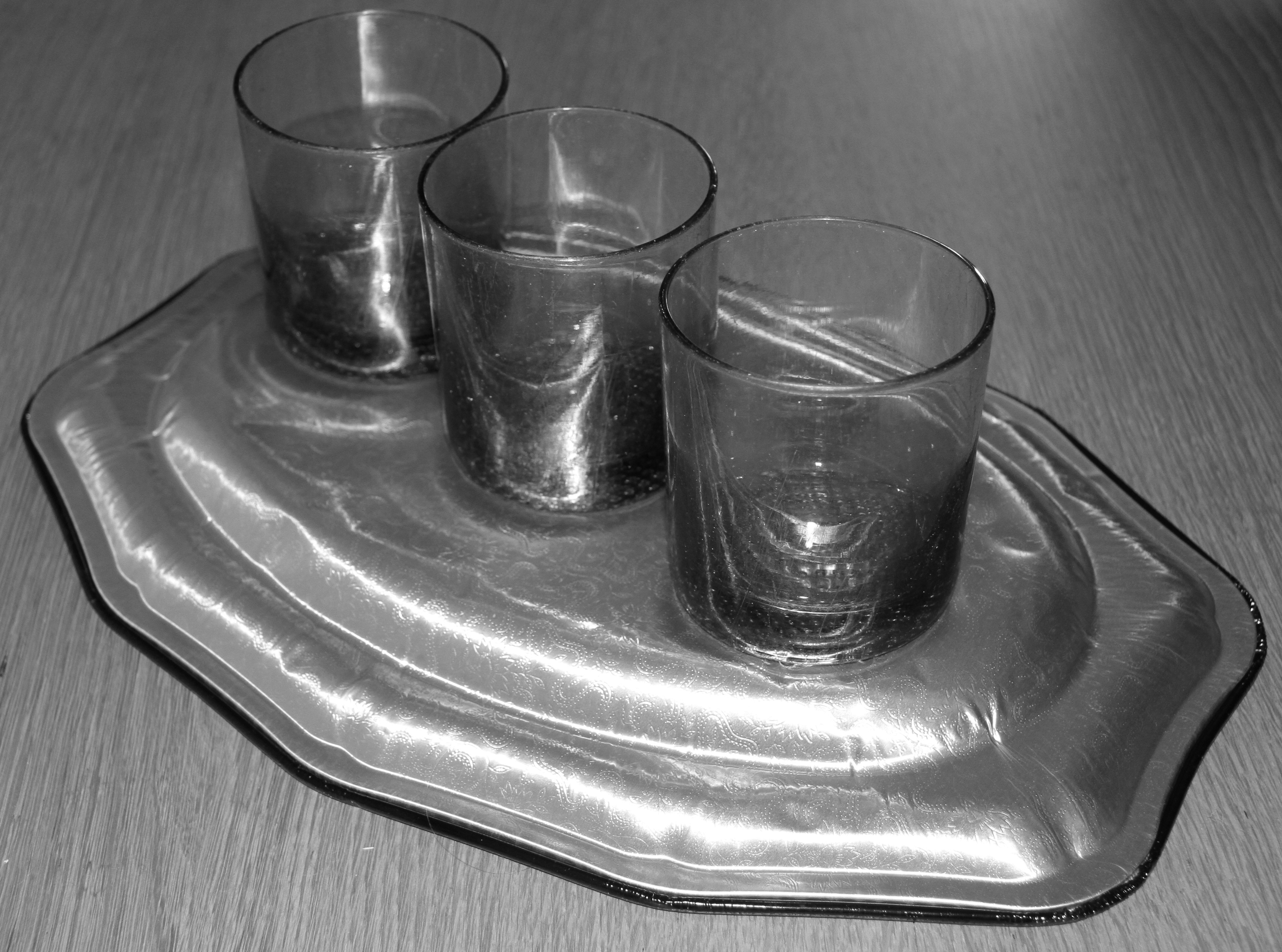
When we were married, perhaps more out of a sense of duty to a loyal servant than a genuine regard for his child, the aristocrat and his wife (also from a titled family) presented us with a set of eighteen tumblers. They were tinted a smoky grey, fashionable for glassware then. My husband, a principled opponent of the landed classes, laughed with some cynicism when he saw them, because they bore a very close resemblance to the glasses that were being given away as part of a well-known petrol promotion of the time, though the glasses did come packaged in a box bearing the logo of a local department store. My own reaction, unused to the aristocracy as I was, was one of astonishment that anyone could think that a couple starting life with only the meagre collection of mismatched cups and plates that they had gathered as students could possibly have need of eighteen of anything!

But of course we did use the tumblers. And continued to use them over the decades. Unloading the dishwasher the other day, I realised that only three of them are now left, scarred and pitted, loyal old servants who have borne witness to many years of family life and always been stalwart in their duty. They have obliged as water glasses at both family suppers and more festive dinners; held my son’s breakfast milk when he outgrew his feeding-cup; done service at children’s parties once plastic beakers were rejected as too babyish; been used to mix Lem-sip, stomach powders and other medicines; hosted the occasional late-night whisky and even been pressed into tasks beyond normal expectations: singly, they have stood in as a makeshift vase for a solitary torn-off rose, a storage receptacle for leftovers, a pot for germinating seeds.

And so it turns out that this once rather naughtily despised present has become more a part of the everyday fabric of our lives than almost anything else that we own and certainly more than any of the other wedding presents that we received. Coming over sentimental, I feel inclined to retire these last three ageing retainers, and let them live out the rest of their lives – which would then, probably, equate to the rest of our lives – in peace. (I can imagine that whoever clears away our possessions when we’ve ‘passed on’ will get rid of these three precipitately.) However, when I remember my father-in-law, who served with pride and continued to serve until his death, aged seventy-five, I think perhaps that, if they could speak, these glasses would tell me that they don’t want to be relegated to the top of the cupboard and left, literally, on the shelf. Like old soldiers, they will want to carry on until, one by one, they disappear.

We are both, my husband and I, very much aware of our early crime of ingratitude and quite probably of injustice to the actual sentiments of the givers, who may never discover just how attached to these incredibly loyal retainers we are, nor (irony of ironies) that their nephew and our son followed the same course at university together, without knowing each other’s origins.

A gripping read with topical interest…

Say You're Sorry
I’ve written about Michael Robotham before. Say You’re Sorry is the third of his books that I’ve read, all supplied by my son. In my opinion, this is the best of the three. By a strange quirk of coincidence, it is about two women who have been held captive for three years; I started reading it last weekend, before the story of the Ohio captives broke. The women in Robotham’s story are not being held ‘in plain sight’, however, but in an isolated building.

The story has two narrators, Joe O’Loughlin, Robotham’s now familiar lugubrious and slightly self-pitying, borderline misfit clinical psychologist hero and Piper Hadley, one of the two teenage victims, who manages to keep a diary throughout her captivity. Piper herself is a bit of a misfit and so lacking in self-confidence that she fails to realise that their captor distinguishes between her and ‘Tash’, the other captive, in ways that become vital to her survival.

This is a much more ambitious novel than the other Robothams I have read; both the plot and the character portrayals are at once more complex and more subtle. Robotham is still working on his trademark theme of the ‘woman at risk’, but these women are more than passive victims. Each has demons of her own that are unrelated to her captivity. There are a few jarring notes. Most conspicuous among these is (in my view) Robotham’s relatively weak power of conveying a sense of place. The book is supposed to be set in and around Oxford, an area with which I am familiar – it even mentions Branca, a restaurant in which I have eaten – but the descriptions do not convince. This is partly because the culture and language of the community from which Piper and Tash come does not seem very English. In both the norms and expressions that the people living there use (and, indeed, in Robotham’s choice of names like ‘Piper’ and ‘Augie’), they seem much more to belong to small-town America.

This is a minor, if recurrent, annoyance, however. I was gripped by this book. I did guess who the perpetrator was before a final twist in the plot revealed it, but only a few pages before he was unmasked. Robotham is particularly skilful at planting red herrings in Say You’re Sorry. The novel’s distinction doesn’t just come from the clever plot and the reader’s on-tenterhooks sympathy for Piper, however. It comes from the author’s success in getting inside the heads of both captives and captor in a totally convincing and believable way. There might have been a time when the plot itself could have been criticised for being far-fetched. Unfortunately, the stories of Elizabeth Fritzl, Natascha Kampusch, Elizabeth Smart (and now of Amanda Berry, Gina DeJesus and Michelle Knight in Ohio who have just escaped from ten years or more of alleged imprisonment and rape by Ariel Castro) prove that Robotham’s plot is not only capable of happening in real life, but also relatively restrained. As for what has happened in real life, the truth has turned out far stranger than fiction.

A publication date and a tribute to two very good friends…

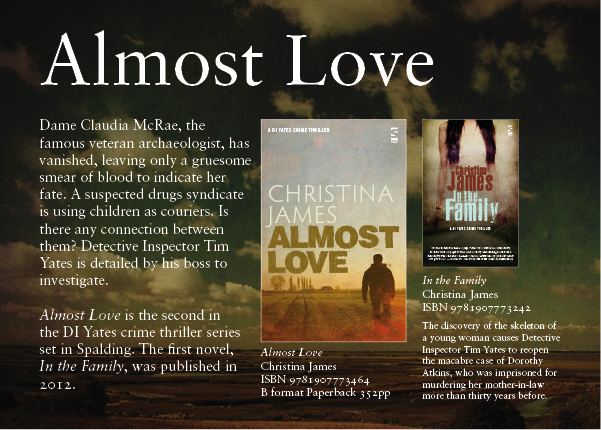
Promotional postcard
In this blog, I try to write mostly about crime-related topics, people, places and things that interest me, aspects of writing and other writers and their work. It isn’t intended merely as a vehicle to promote my own work; this was a conscious decision that I made right at the start, because I quickly tire of blogs by authors who use them too blatantly for this purpose.

However, I hope that you will look upon today’s post indulgently, because I have to confess that it is indeed about promoting my next book, Almost Love, which will be published on June 15th 2013. It is a promotional piece with a difference, however, because it also celebrates a gift to me by my publisher, Chris Hamilton-Emery of Salt. Before In the Family was published, Chris designed a postcard based on the jacket; I sent this, with a short personal message, to as many people (friends, booksellers, librarians, colleagues) as I thought might be interested in it. I received some lovely replies; it may have helped to generate some interest in the book.

Today, Chris sent a similar promotional postcard for Almost Love. In fact, it features both the novels. I am delighted with it and I think that it is a thing of beauty. I’d like to share it with you; that is why it is the subject of today’s post.

I’d also like to say how much I appreciate Chris and Jen Hamilton-Emery, for their unfailing good-humour and encouragement and also for all their hard work on my behalf. Thank you, both!

The Queen of railway stations…

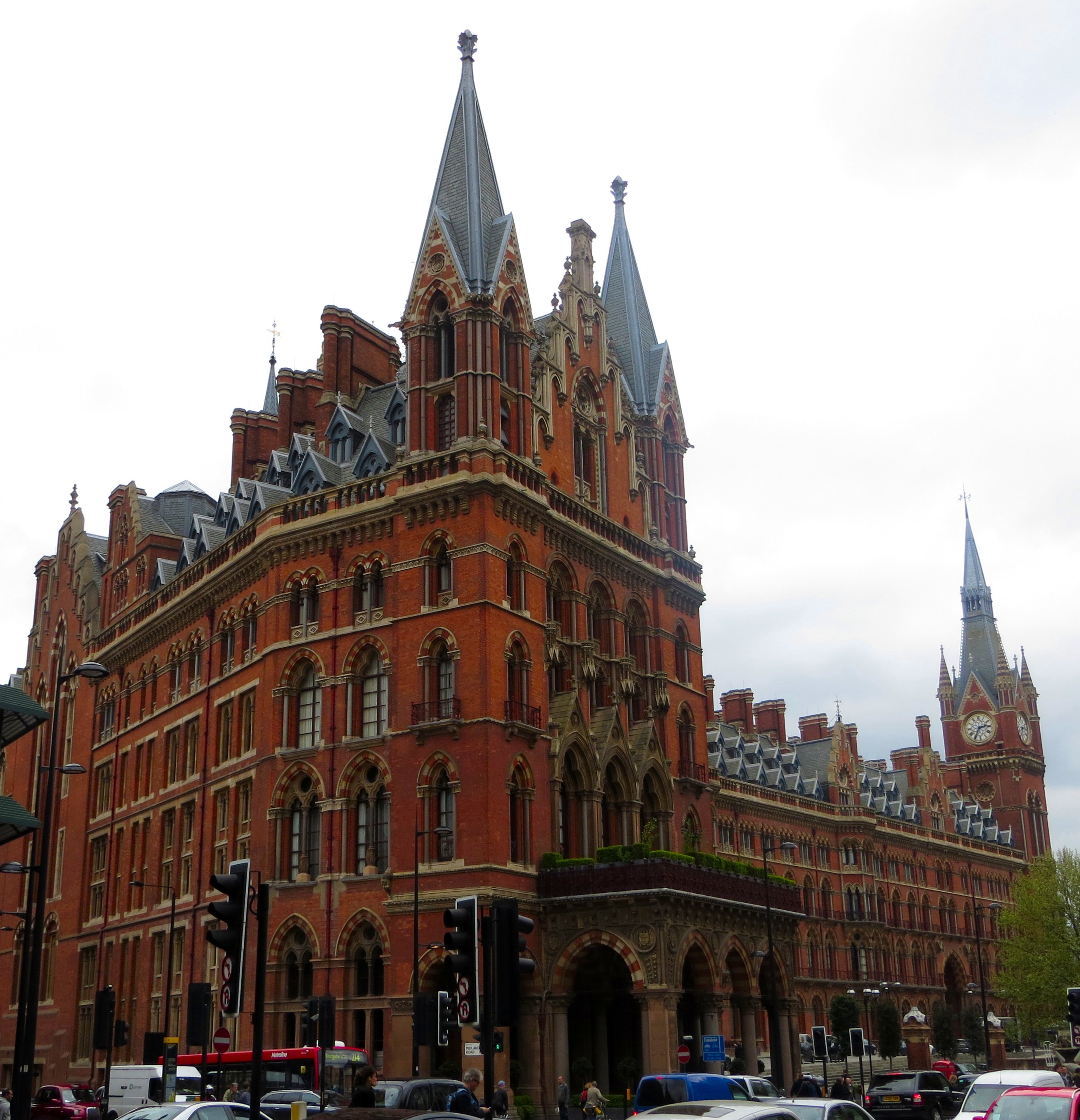
The former Midland Grand Hotel, St Pancras
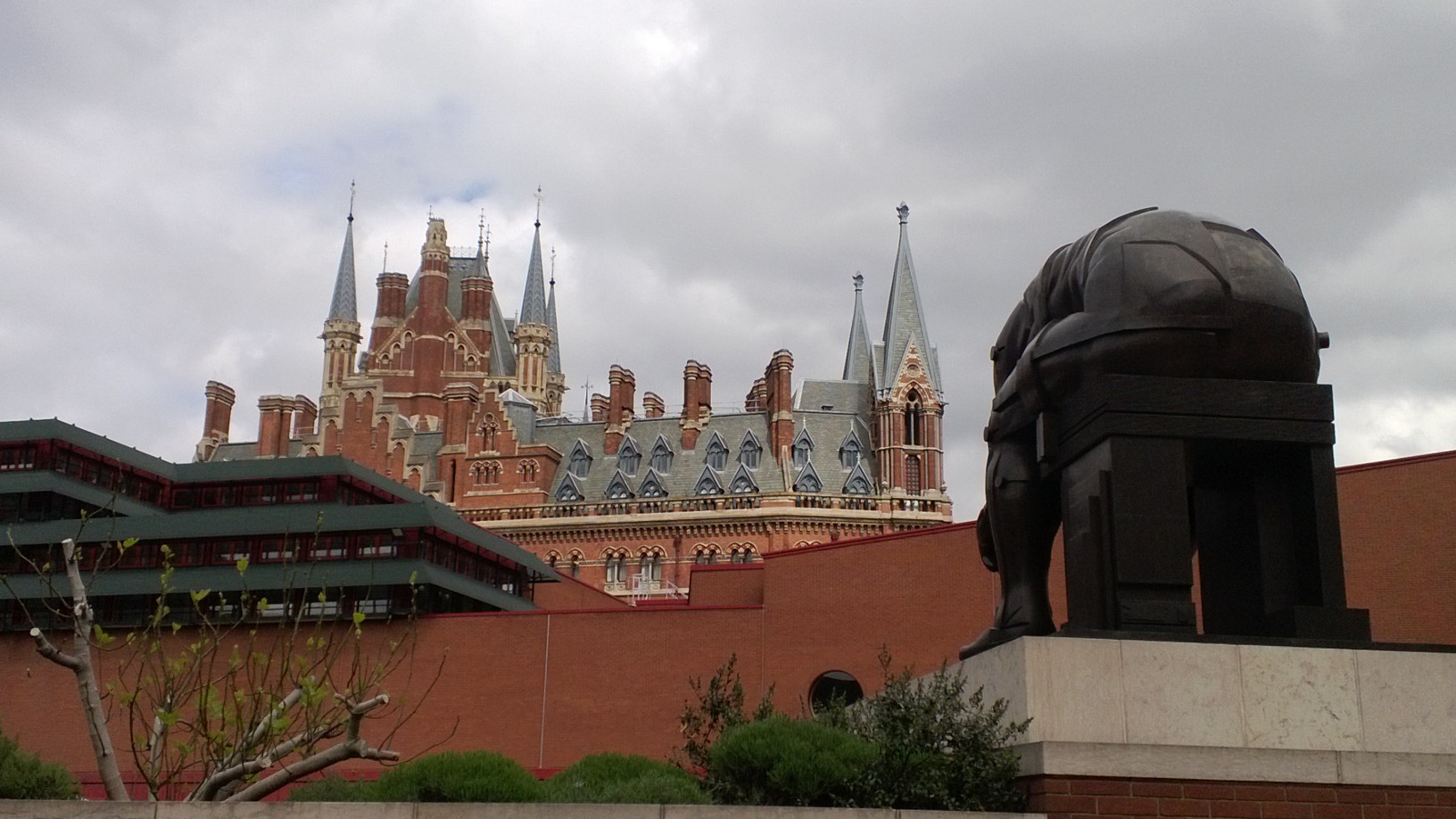
In London again for meetings, I pause as usual to admire the neo-Gothic grandeur of St Pancras Station. More whimsical than a church, as dramatic as if it were a castle towering over some fastness in a remote and mysterious land, it stands, a monument that celebrates the best of Victorian confidence and imagination. Taken as a whole, it could be the setting for a novel by Mervyn Peake; the former Midland Grand Hotel part of it would be the ideal backdrop for a modern take on the country house murder. Each time I see it, I also pay silent tribute to Sir John Betjeman, who was able to perceive its beauty and the poetry of its George Gilbert Scott and William Henry Barlow architecture and who fought to save it from the institutionalised vandalism that caused the original Euston station to vanish – save for its rather forlorn and redundant triumphal arch. Martin Jennings’ marvellous statue of Betjeman conjures both the poet’s and a universal sense of awe at Barlow’s glorious single-span train-shed roof.

Inside, today, St Pancras is a thriving modern business hub. Skilfully renovated, it contains a fascinating parade of shops, cafés and restaurants cunningly chosen to help travellers to pass their time – and relieve their wallets – while they wait for trains. Some of these trains depart for workaday Midlands places such as Birmingham, Wellingborough and Coventry; some go south to Brighton and other holiday destinations. But what really makes this station an exciting place is that it is the main UK terminus for the Channel Tunnel train – ‘Le Shuttle’. Passengers en route for Europe walk with extra purpose in their gait; they carry their luggage with more panache; they wear lighter, brighter clothes. Business-men and -women bound for Lille look less grey and crumpled than those heading for the City; holidaymakers travelling to Paris are glossier than those putting a brave face on going to Eastbourne in the rain. This festive atmosphere is augmented by people playing impromptu on the piano that has been left in the middle of the shopping precinct for the purpose. And – the final touch – announcements through the tannoy system are always relayed in French as well as English.

I wonder how much criminal activity takes place here. There are the usual signs warning passengers to be vigilant against pickpockets; but that isn’t what I’m really thinking of. In what kinds of business activity are the be-suited, glamorous commuters engaged? Are the man and woman dodging through the crowds, she stumbling in four-inch stilettos, he dragging a large case, merely late for a train that will carry them to a romantic destination, or have they just pulled off a lucrative scam and plan to escape by boarding train after train until they have journeyed far to the east?

All stations, even the most prosaically-built, contain a whiff of adventure, of the non-routine that travel implies. In this country, St Pancras is now queen over all the others. If he had lived to dine in the Grand restaurant there, Betjeman would have been happy and proud – and well-fed.

King’s Cross is now enjoying a similar loving makeover. I await the result with impatience and anticipation. It is not difficult to imagine that murder and mayhem took place many times in the murky, disreputable place that it used to be. It was like a malevolent old man in a dirty raincoat. I look forward to seeing a handsome king emerge from all the burnishing, fit consort for the queen next door.

St Pancras from the British Library

One place, two misfortunes…

Goodbye purse...
In preparation for the weekend festivities, I paid my customary visit to the local farm shop. Situated about three miles from my house, it is a genuine establishment of the genus (i.e., it doesn’t sell tights or sliced bread). It has rather a wonderful selection of local foods, including organically-farmed meat, local cheeses, dairy products and fresh produce. There is also a delicatessen that sells pies, cakes and ready-made dishes from the shop’s own kitchen, as well as more exotic items from further afield – continental sausages and Parma ham, for example, and unusual oils and vinegars. There is a small kiosk between the shop and the delicatessen which opens in summer to dispense Yorkshire-made ice-creams. A recent innovation has been the Thursday morning appearances of the ‘fish lady’, a peripatetic fishmonger who has made an arrangement to park her van next to the shop to sell an impressive variety of fish freshly caught off the east coast. Sometimes she has edible seaweed for sale; it is a particular family weakness.

This is my favourite type of shopping and I realise that, so far, I’ve made it sound pretty idyllic. To strike a more discordant note, the shop has also been the scene of two dramatic episodes in my life, one of which also involved a crime.

The first event happened about six years ago, when I had just finished some work and was in a hurry to prepare for a self-catering holiday due to start the following day. I made it to the shop for provisions about ten minutes before closing time, leapt out of my car, and promptly fell flat on my face. I’d managed to park on the sleeping policeman that encourages drivers to slow down before they reach the car park. I injured my right arm quite badly and had to persevere with many months of physiotherapy before it worked properly again (it still protests if I carry heavy bags). I mention this mishap lightheartedly, though, because I remember it chiefly for teaching me a lesson about language. My doctor at the time was German. Although her professional English was pretty flawless, her understanding of idiomatic terms wasn’t perfect. I spent a good ten minutes having a thoroughly cross-purpose conversation with her before she suddenly burst out, “Well, what was he doing, lying in the road?” I realised with some shame that I had misled her into thinking that I had tripped over an actual, flesh-and-blood copper lying down in the shop’s driveway (perhaps even one under the influence?!)

The second event was darker. It happened at the beginning of the second week of Wimbledon last year. As is my custom during Wimbledon fortnight, I’d got up very early in the morning in order to fit in a day’s work before the tennis started. I was also worried about the fact that, mysteriously, I’d completely lost internet access. I was therefore probably not paying proper attention when I visited first the delicatessen and then the main shop, hoping to make my purchases quickly so that I could tune in to SW19. However, I did notice that, aside from two elderly ladies who were examining packets of bacon, the only other people in the shop besides myself were an ill-assorted couple pushing one of those big buggies with three wheels. I couldn’t see the child inside it: despite the fact that it was a hot summer’s day and we were indoors, they had the apron of the buggy fastened as high as it would go. If there was a child, it made no noise. I say that they were ill-assorted, because although the woman’s glossy black shoulder-length hair persuaded me at first that she was in her twenties, I realised when they came closer that she must have been nearer fifty. The man was much younger – I’d guess not more than thirty. He was slightly-built with sandy hair. She was quite buxom.

The shop has three aisles. It did strike me as peculiar that, whichever aisle I was walking along, I kept on meeting this couple coming towards me. They didn’t appear to buy very much, but each was carrying a plastic basket containing a few items. They made it to the check-out just before me. I met the woman’s eye, and she responded to my smile with what I can only describe as a smirk. What was even odder was that when the cashier, seeing a small queue forming, requested that a colleague open the second till, the man adroitly slipped across with his basket instead of allowing me to go next. The couple paid and left the shop quickly. It was at this point that I realised that my purse was missing.

I asked the cashiers to call the couple back in, lock the doors and call the police (this from my training as a bookseller), but they were totally flummoxed by the whole thing and, by the time they’d taken action, the couple had long gone. I subsequently discovered that, although the shop has CCTV, it does not reach the back area where the fridges containing produce stand. I had spent some time looking in these fridges and conclude that my purse must have been taken then. So the couple were probably professional thieves.

I can’t prove that it was them, of course, and the police were simply impatient when they discovered that there was no concrete evidence of the theft. I knew immediately that they wouldn’t try to pursue it. What I lost was relatively trivial: about £40 in cash and an almost new Radley purse that had been given to me as a present; plus my credit cards, of course: I spent a dismal afternoon making sure that they were all cancelled, instead of watching Federer, as I’d planned. I can testify, however, that the damage caused by theft goes much deeper than the loss of the stolen items. I felt as if I’d been personally assaulted and it took a good three months before I felt able to return to the shop.

You could say that it was mostly my fault. I’d travelled the world without being robbed and then let down my guard just three miles from home! It was a hard punishment for a moment’s absent-mindedness. I’ve said this before in a different context: theft is a despicable crime.

Scheherazade… oh, yes!

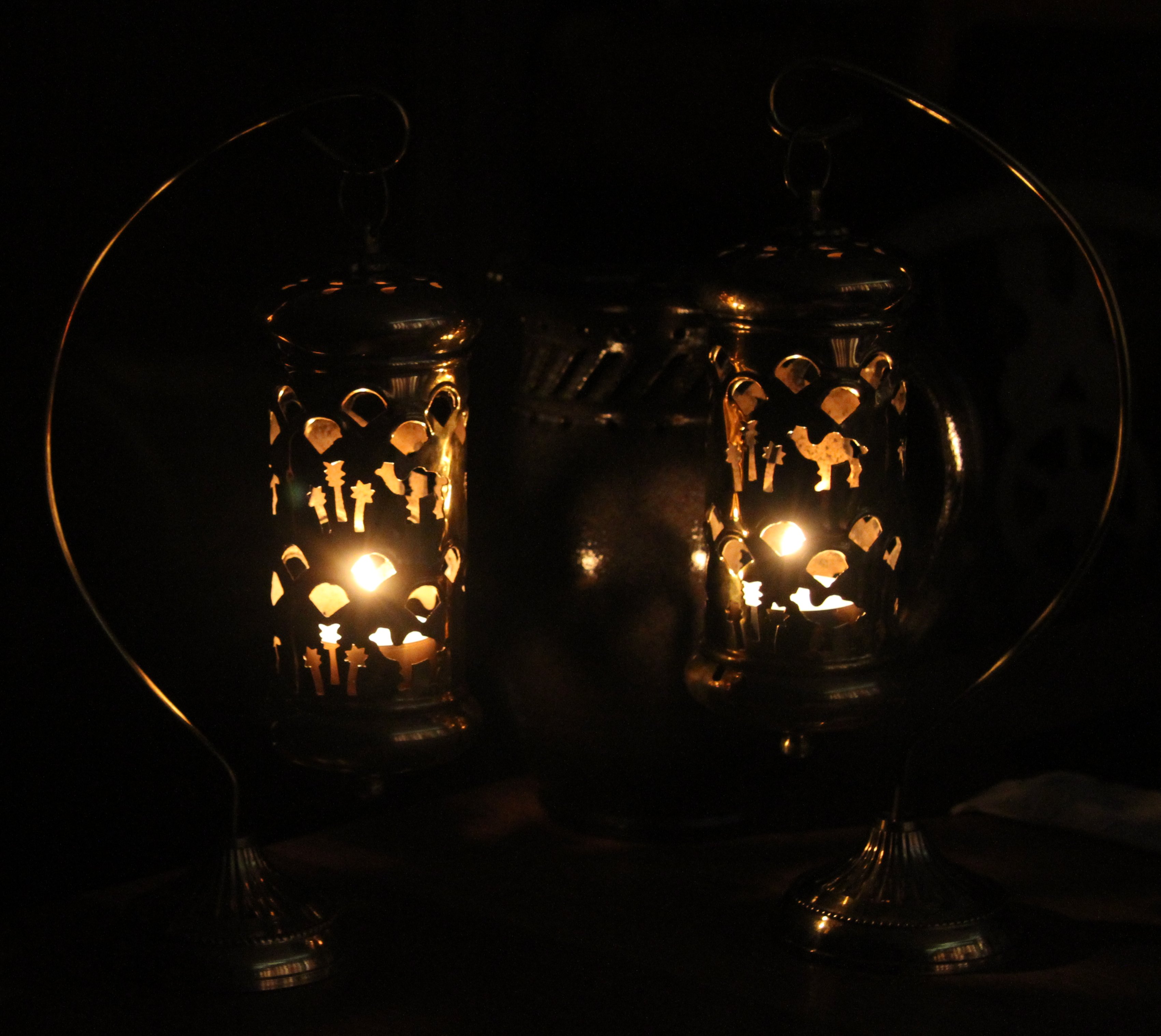
Arabian lamps
In the course of doing his job, my son visits many countries. Often, all he sees is the inside of airports, offices and hotels, but, if he has a few hours to spare, he always tries to bring back a present. In consequence, I am the appreciative owner of a wide variety of gifts from diverse parts of the world. They include a dressing-gown of old gold silk, beautifully embroidered in blues and reds, from China, and a compelling kingfisher-swallowing-catch, made of pieces of scrap metal, from South Africa.

Before he came to visit this weekend, I had barely registered that his most recent trip away had been to the United Arab Emirates and he told me that in fact he had spent barely forty-eight hours there. Nevertheless, he managed to carve out a few minutes to discover and purchase a very fine pair of brass lamps. Shaped not unlike miners’ lamps, they are decorated with cut-outs, and designed to take household candles.

When I saw them, I was immediately reminded of the smoky corridors and dusky but splendidly-furnished lamp-lit private rooms of the King in One Thousand and One Nights to whom Scheherazade spun her nightly tale, each time leaving the King spellbound until she resumed her narrative the next evening. This is an art that has been somewhat lost to modern storytelling, though it was, of course, practised to perfection by Dickens and other famous Victorian writers who serialised their work in newspapers and magazines. I’ve read that Dickens and Thackeray were often still scribbling frantically while a boy from the magazine in question waited for copy on the other side of the door. I’d love to be able to write a crime novel in this fashion, but I suspect that it would be beyond my powers. I wonder if these writers plotted each work out in its entirety, or just made it up as they went along? And, if the latter, how did they manage to avoid the litany of inconsistencies and anachronisms that I have to iron out of my own novels once the first draft has been completed?

As for Scheherazade, what an example of a very clever woman, refined, charming, witty, knowledgeable across the disciplines and multi-talented! But her most remarkable skill was in her storytelling!

A location I have used in Almost Love… and there’s no ‘almost’ in my feelings about it!

El Parador
It was a glorious spring day when I was in London in advance of my visit to Gower Street last Thursday. People were sitting or lying on the grass in the parks. The grounds of the British Museum were packed with museum staff, office workers and tourists, all getting their first proper burst of vitamin D from this year’s English sunshine. The mobile refreshments van parked just inside its wall was doing a roaring trade.

I didn’t need to take advantage of its services, because I had already visited one of my favourite London restaurants, an unassuming Spanish-owned eatery called El Parador. It is a brisk ten-minute walk from Euston station; the restaurant stands in the middle of the last parade of shops before Eversholt Street reaches Mornington Crescent (now there’s a name to conjure with!). On Thursday, I noticed for the first time that it is also immediately opposite the imposing edifice from which Levertons, London’s foremost undertaker, plies its sombre trade.

A family-owned restaurant, El Parador can lift your spirits with a burst of fine cooking on even the dreariest winter day. In the spring and summer, it is a festive place. Tables are laid in the garden. Both restaurant and garden are busy – there’s rarely a spare table after 1 p.m. – and the whole place buzzes with laughter, conversation and the tinkling of glasses. The staff – there are usually only two or three on duty – almost run between the tables, nimbly delivering a continuous stream of hot tapas dishes as they are ordered. Unequivocally, it serves the best tapas that I have ever eaten anywhere. My husband accompanied me there for the first time on Thursday and has already become an enthusiastic champion of the place.

I have another reason for liking it, though. The décor is plain, even homely. The tables are plain deal, the chairs of the simple round-backed wooden type still found in a few old-fashioned pubs. The walls are painted dark cream and, aside from a few small mirrors, there is little other decoration. Save for one thing: the bar, a glorious suggestion of a boat, is decorated with a flamboyant mosaic of pieces of tile, ceramics and mirror, all in shades of turquoise and black. It draws your eye as soon as you walk through the door. Pure 1960s, there is something lethal about its splendour. You feel as if a character played by one of the sex sirens of the ’60s – Jayne Mansfield, say, or Barbara Windsor – might come sashaying out from behind it and break off one of the pieces of mosaic to stab an errant lover through the heart.

I’ve written about this bar in Almost Love.

O' Canada

Reflections on Canadian Culture From Below the Border

oliverstansfieldpoetry

A collection of free verse poetry.

Easy Michigan

Moving back home

Narrowboat Mum

Fun, Frugal and Floating somewhere in the country!

Maria Haskins

Writer & Translator

lucianacavallaro

Myths are more than stories

Murielle's Angel

A novel set on the Camino de Santiago

jennylloydwriter

Jenny Lloyd, Welsh author of the Megan Jones trilogy; social history, genealogy, Welsh social history, travel tales from Wales.

Chris Hill, Author

I'm Chris Hill - author of novels Song of the Sea God and The Pick-Up Artist

littlelise's journey

Sharing experiences of writing

unpublishedwriterblog

Just another WordPress.com site

Les Reveries de Rowena

Now I see the storm clouds in your waking eyes: the thunder , the wonder, and the young surprise - Langston Hughes

Diary of a Wimpy Writer

The story of a writer who didn't like to disturb.

Rebecca Bradley

Murder Down To A Tea

Helen Carey Books

Helen Carey Books