In quest of the soul of South Korea

Seoul 4

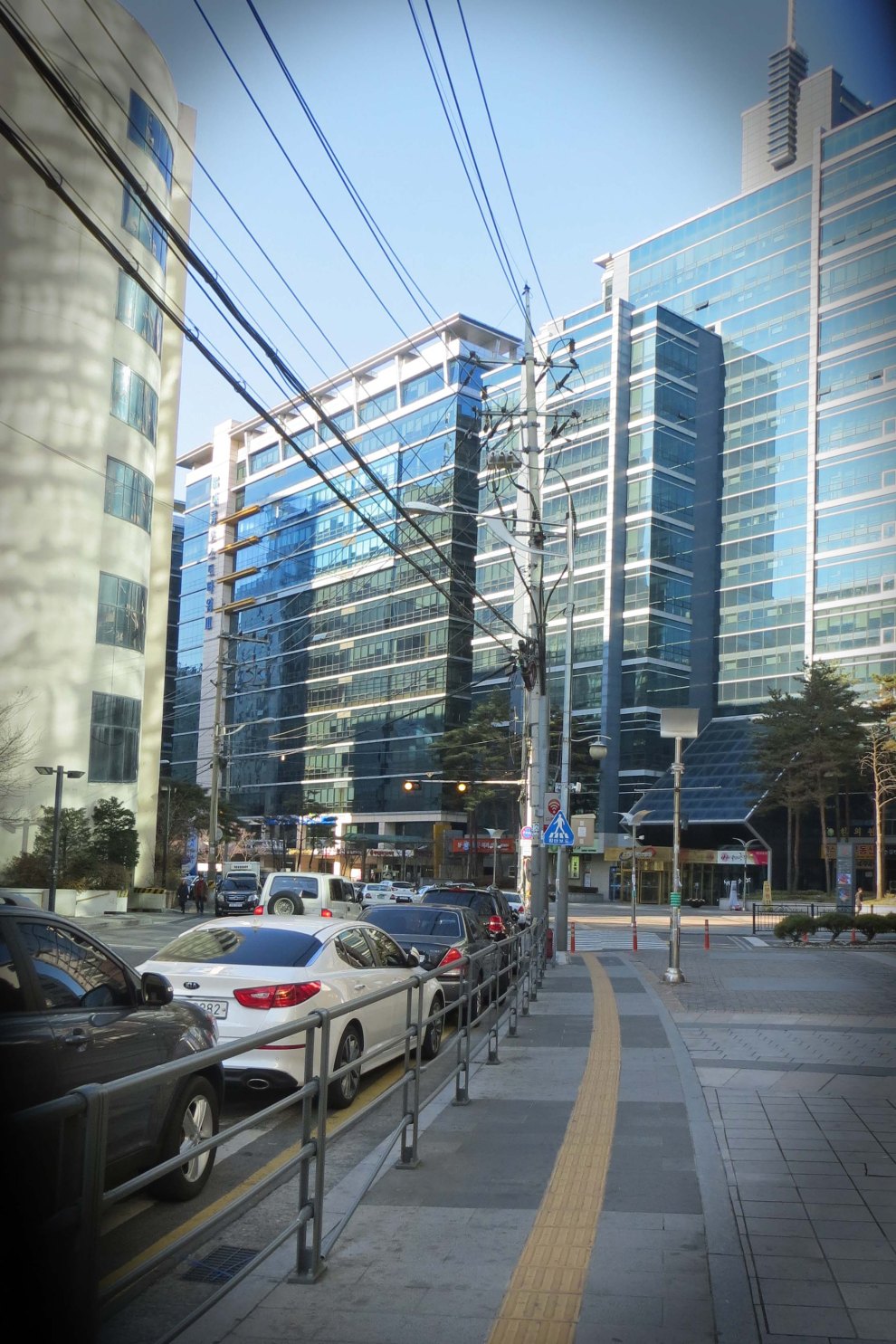
Last week, the day job took me to Seoul, the capital of South Korea. I didn’t have very much time to explore this city, as, for family reasons, I had to cut my visit as short as possible. These impressions are therefore based on two walks that I made within about a one-mile radius from my hotel, my visit to the (amazing) library at Seoul National University, several evening trips to restaurants and what I could see from two one-hour taxi rides.

Library reading room

Seoul is a massive, sprawling city set within a giant curve of the Han River. If you land at Incheon Airport, the city appears to be ahead to the east and to your left. Gradually, the road sweeps round until you hit the city centre quite suddenly. There is a lot of traffic, with bottlenecks and impatient queues clogging the arterial roads at either end of the day.

The city centre had a slightly odd look when I was there, because many shops and hotels had removed only some of their Christmas decorations. Many still sported Christmas trees (the ones at my hotel were adorned with little placards announcing ‘Danger of Electric Shock’). I’ve no idea why Christmas disappears from Seoul in stages in this way; my Asian colleagues were equally baffled.

Although there are many cars, the streets teem with pedestrians. On the Sunday afternoon, many young people, in particular, were out walking, muffled against the cold (it varied from -1 to -10 degrees) in thick padded clothes. What immediately struck me as a Western observer was how the young women continually try to please their male partners, laughing up into their faces when the latter make jokes and hanging on to their arms as if unable to support themselves. To me, it seemed as if there was something formal, almost ritualistic, about this behaviour. It didn’t appear to be spontaneous.

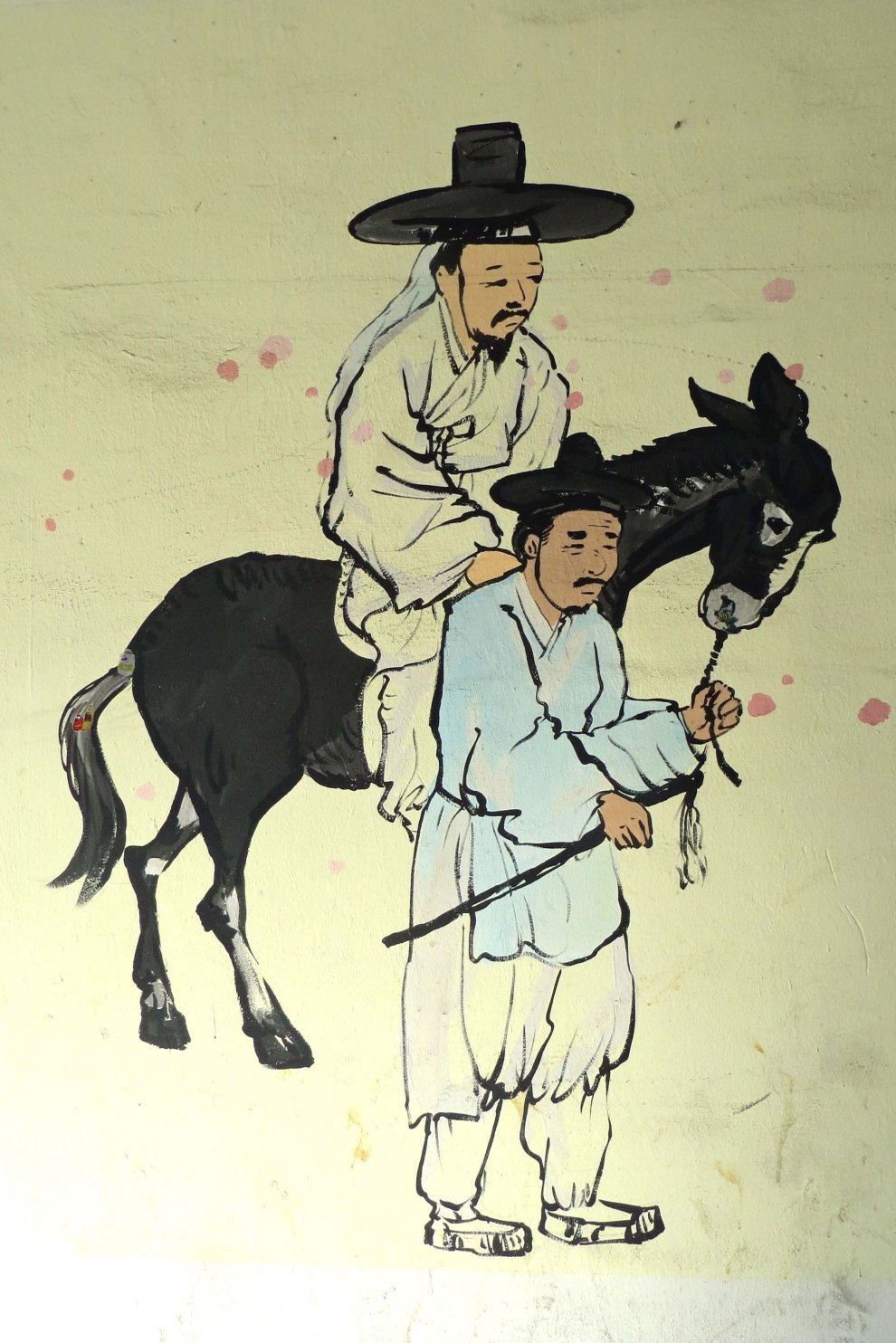
The crowds on weekdays are quite different. They stream purposefully along the pavements, obviously on their way to work. The main streets are broad, often with traffic islands in the middle. ‘Jay walking’ is strictly not allowed: there are notices banning it. Just a few yards down from my hotel, a policeman with a whistle was stationed near a spot where the pavement narrowed each morning. He blew his whistle and waved a kind of luminous wand (reminiscent of a battery-powered Darth Vader light sabre that my son owned as a child) if anyone stepped off it in an attempt to circumnavigate the throng. In the evening, you see the people surging forth again, sometimes stopping at one of the many street food stands that occupy the lanes and alleys branching off from the main thoroughfares. Some of these alleys and passageways are decorated with murals that celebrate Korea’s ancient past.
Seoul 1

Seoul 2

Food seems to be the national passion. In the network of streets and alleys that I explored, almost every business was a restaurant, café or bar. Some have fish tanks standing in the street outside, from which you can choose the fish you fancy for dinner. (I assume that, once they’re removed from the tank, they’re taken out of sight to be dispatched.)

Seoul 8

As well as these individual premises, there are whole malls devoted to every type of cuisine – in addition to Korean restaurants, there are Japanese sushi bars, Italian pizzeria, Swiss chocolate houses, and even an approximation of a British pub, sporting the sign ‘HAND COOKED DINING PUB’ – though, as I found when my hosts took me to an Italian restaurant, most practise ‘fusion’ cookery.

Seoul 5

Whether you order a pizza, spaghetti, pie and peas or a hot chocolate, you’re likely to be offered a dish that, although it resembles its national original, is also redolent of Korean herbs and spices. My favourite restaurant, which I visited on my last evening, was a Korean B-B-Q restaurant. (This is how it is always spelt: these restaurants appear to be nationally celebrated.) It had charcoal braziers set into the tables. Patrons order raw meat from a selection on the menu (my own party chose a mixture of beef and pork), together with a range of salad and sauce accompaniments, and cook their own food. The main course was followed by two kinds of soup, one meat and vegetable based, one fish and seafood based, both very spicy. Koreans usually drink beer with this kind of meal, though there was also a strong white wine on offer (you drink it in sherry-type glasses, in very small quantities, and it tastes a bit like saké).

What else do Koreans like besides food? I was keen to find out so that I could buy presents, but even Koreans were at a loss to tell me. I discovered that Korea is home to a renowned type of ginseng and very good for silk ties. There are whole shops devoted to candles (though, on closer inspection, I found that the candles are imports from New York and Paris) and chemists’ shops, often selling vast ranges of foreign make-up, are popular. Otherwise, the main passions do indeed seem to be food and drink. This impression was borne out by the wares at the airport shops, where I saw very little on display except extensive pyramids of food and alcohol and an impressive range of electronic products. I couldn’t even find postcards, either at the airport or anywhere else.

Would I like to return? As I said at the beginning, my stay was very short and I can’t claim to have formed an accurate opinion of Seoul. I certainly liked the people: they were courteous and fun-loving, hard-working but not over-serious: I’d like to go back to become better acquainted with some of them. But I didn’t find Seoul itself as interesting as some of the other Asian cities I’ve visited. I’d be very happy, though, to be told that I’ve completely missed the point.

Seoul 3

Seoul 6

Participation? Always, at Wakefield One!

W1 11
Monday was a horrible day in West Yorkshire. Torrential rain and high winds were battering the city when I arrived at Wakefield One for my afternoon of reading and discussion with some of the lovely members of the reading groups run by Alison Cassels. My husband dropped me off opposite the library complex and I got soaked – and nearly blown away – just crossing the road.

Nevertheless, I felt both philosophical and optimistic. As I’ve already noted, every event for The Crossing so far has taken place when the weather outside has been appalling, and every one has been a success. I knew that the gallant and stalwart members of the Wakefield reading groups would not let me down by preferring their firesides to the library.

Alison, as impeccable in the welcome as in the organisation!

Alison, as impeccable in the welcome as in the organisation!

Reader, I was not wrong! An extremely lively audience arrived punctually, some having regaled themselves with hot soup in the café to start with, and we all enjoyed a couple of hours of reading, writing and sleuthing, handsomely fortified by the Christmas cake, mince pies and stollen and tea and coffee supplied as generously and thoughtfully as usual by Alison and Lynn.

Lynn, quietly making it all happen (and she tweets!)

Lynn, quietly making it all happen (and she tweets!)

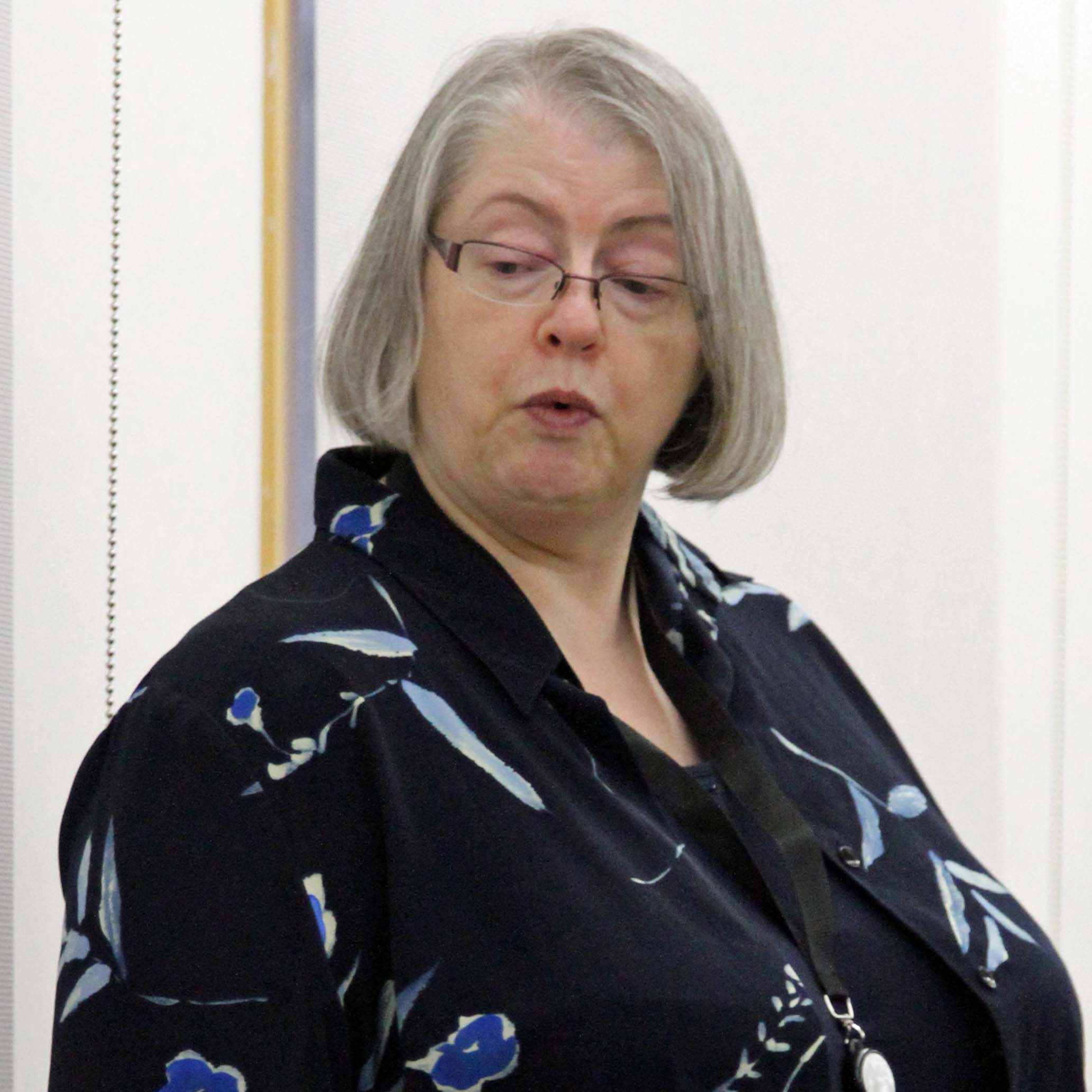
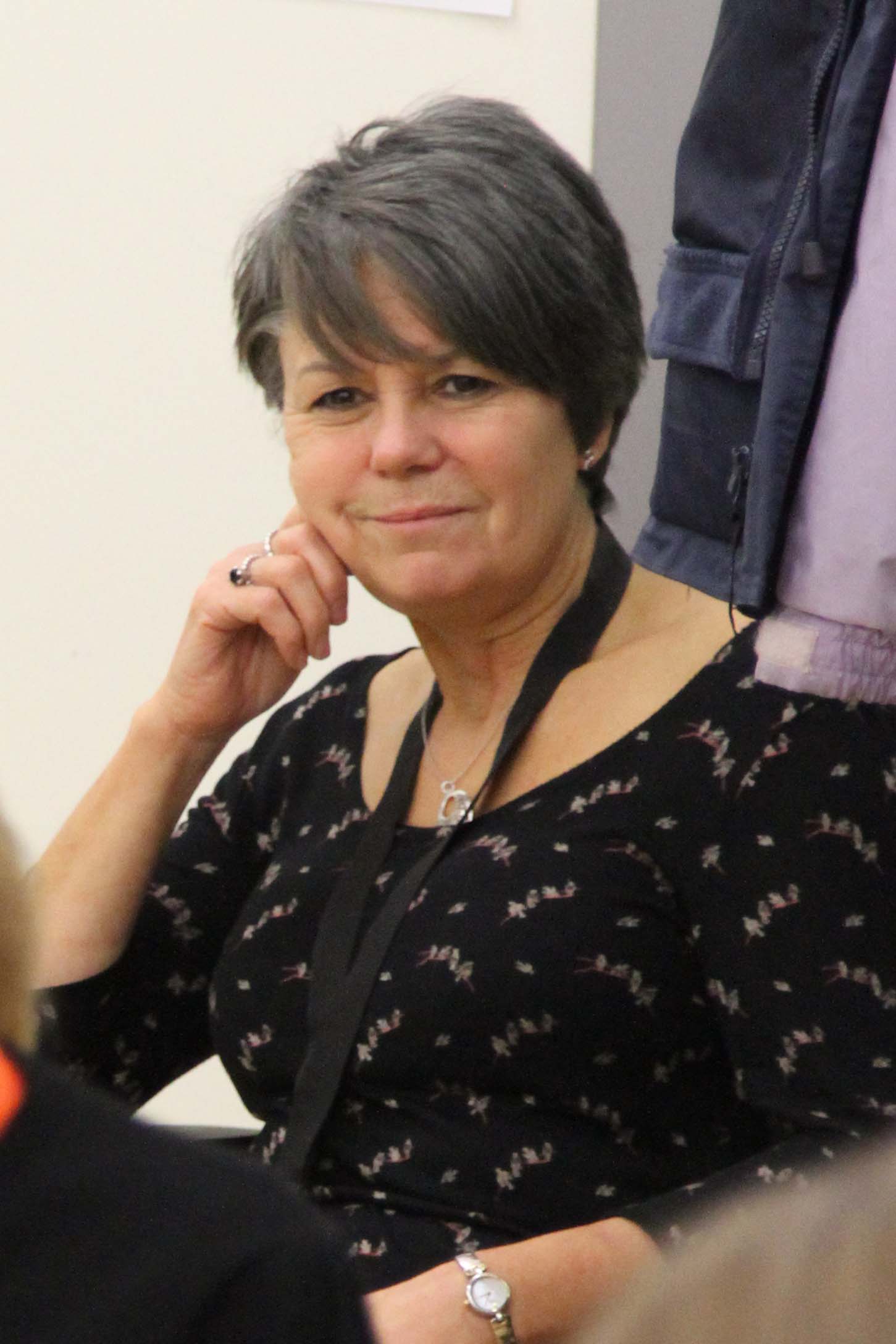
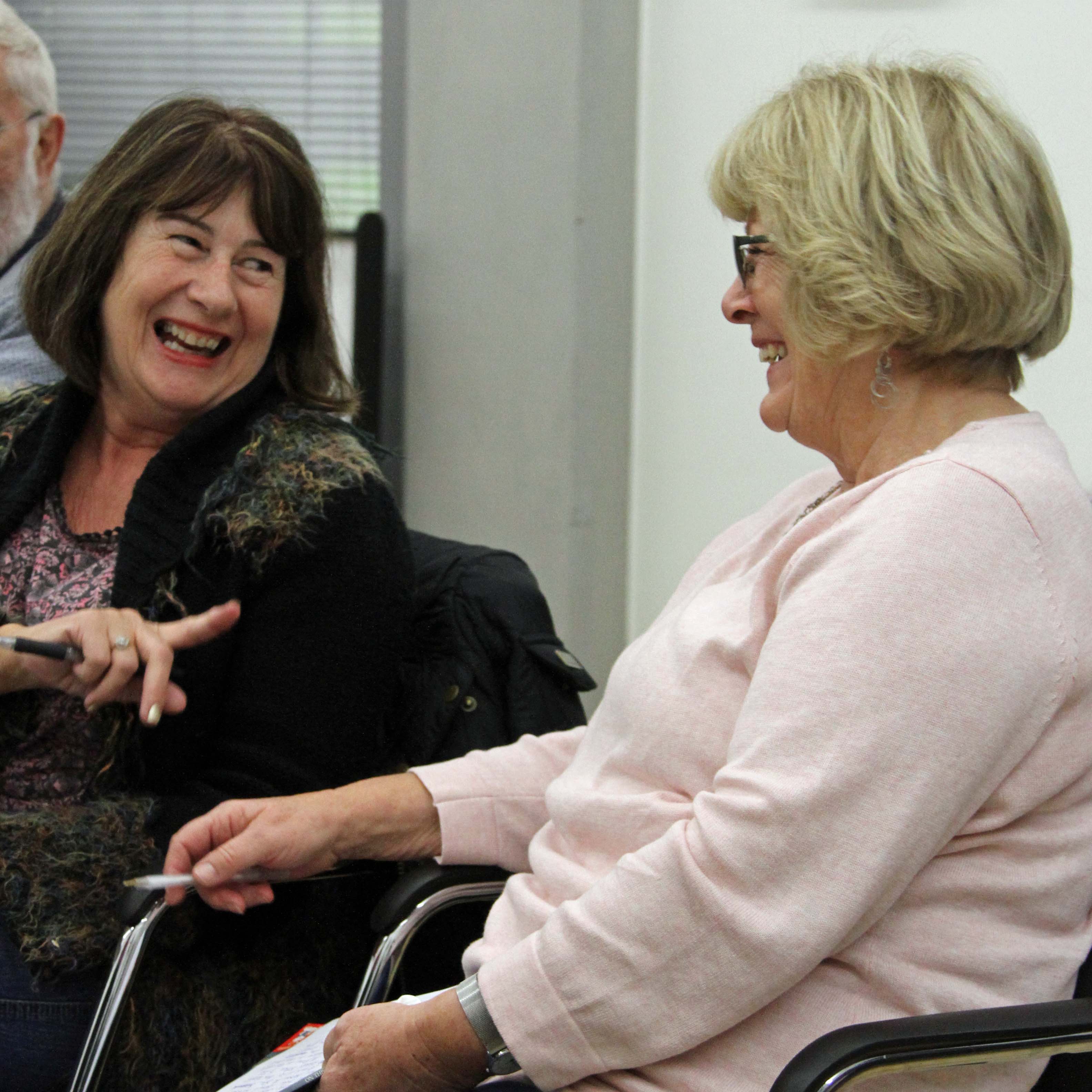
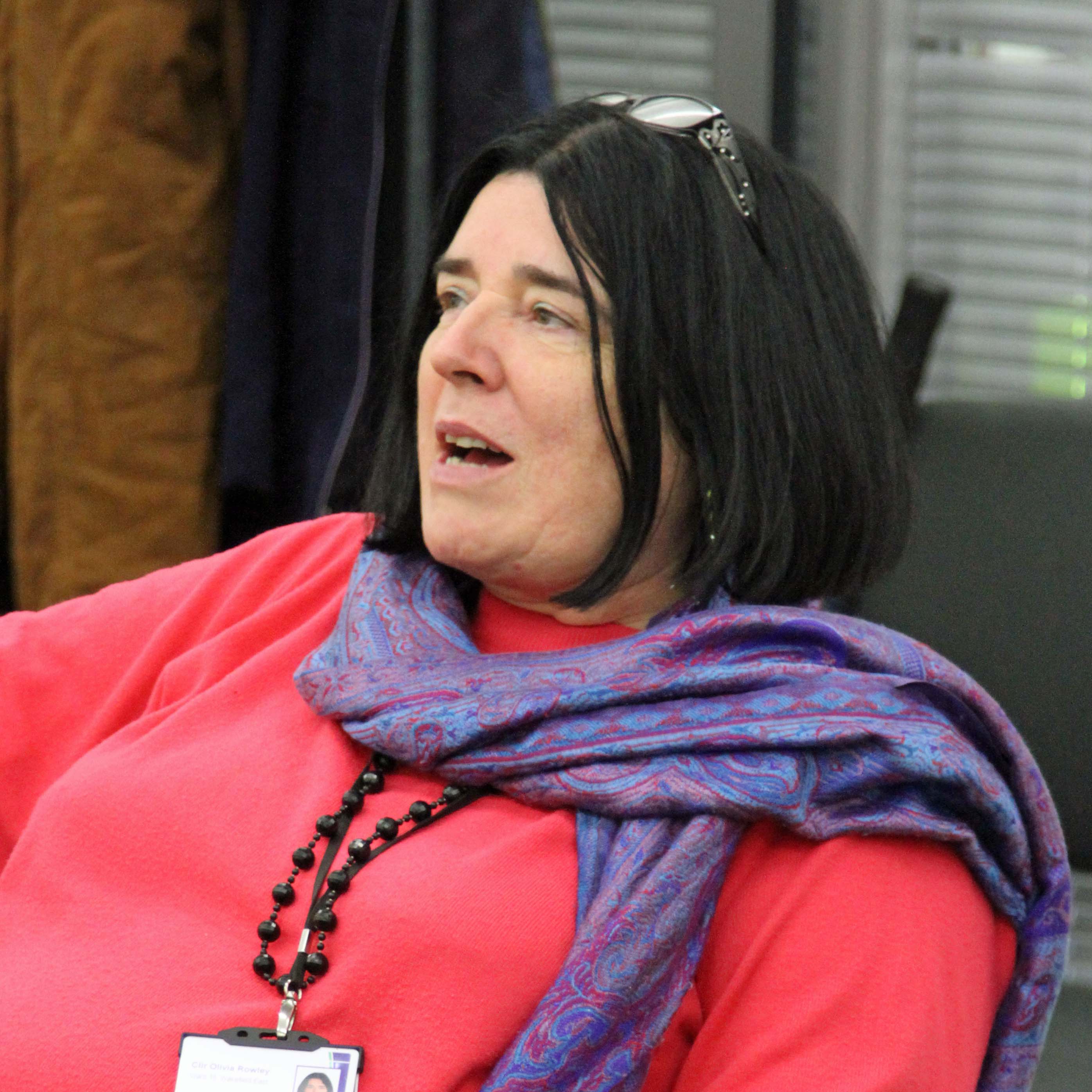
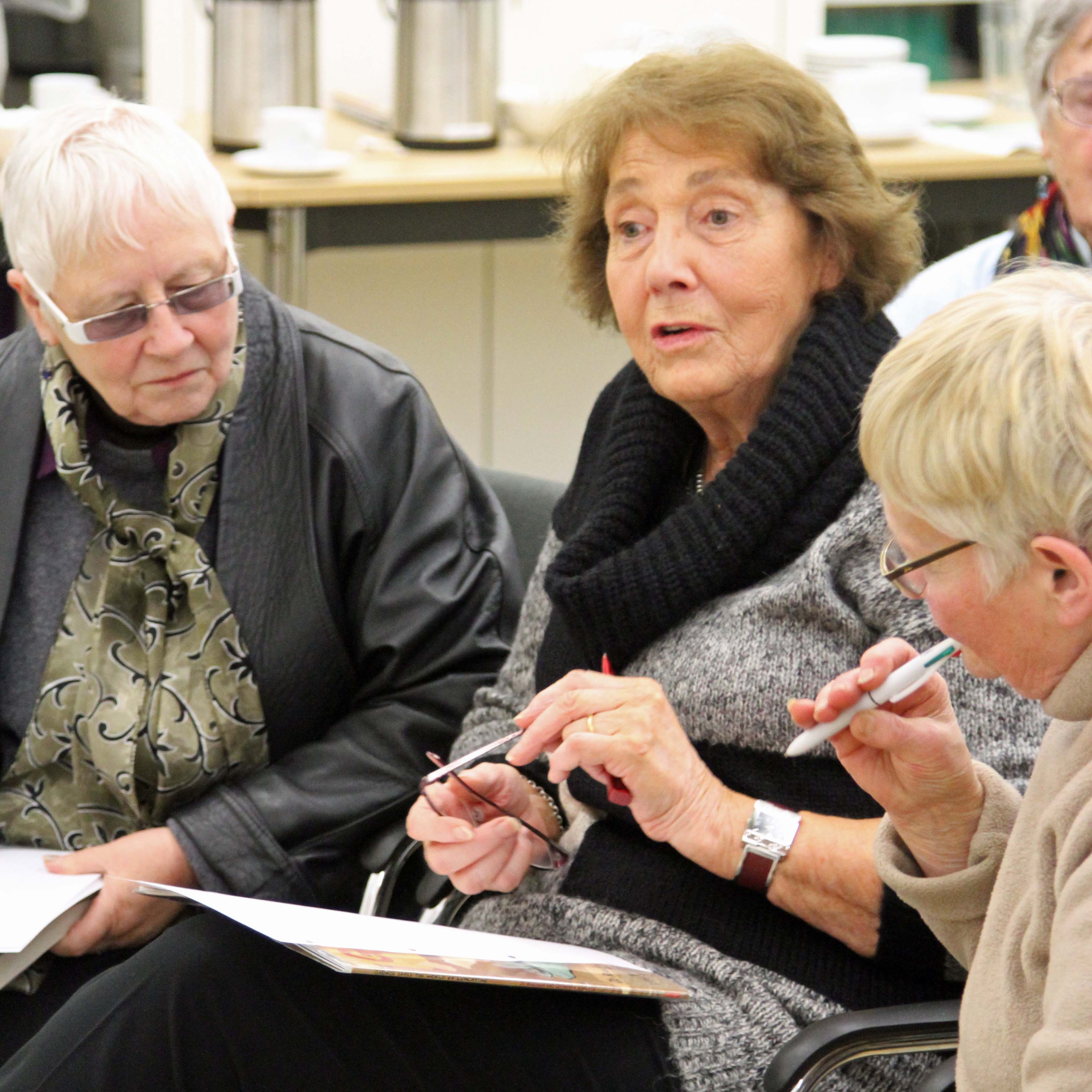
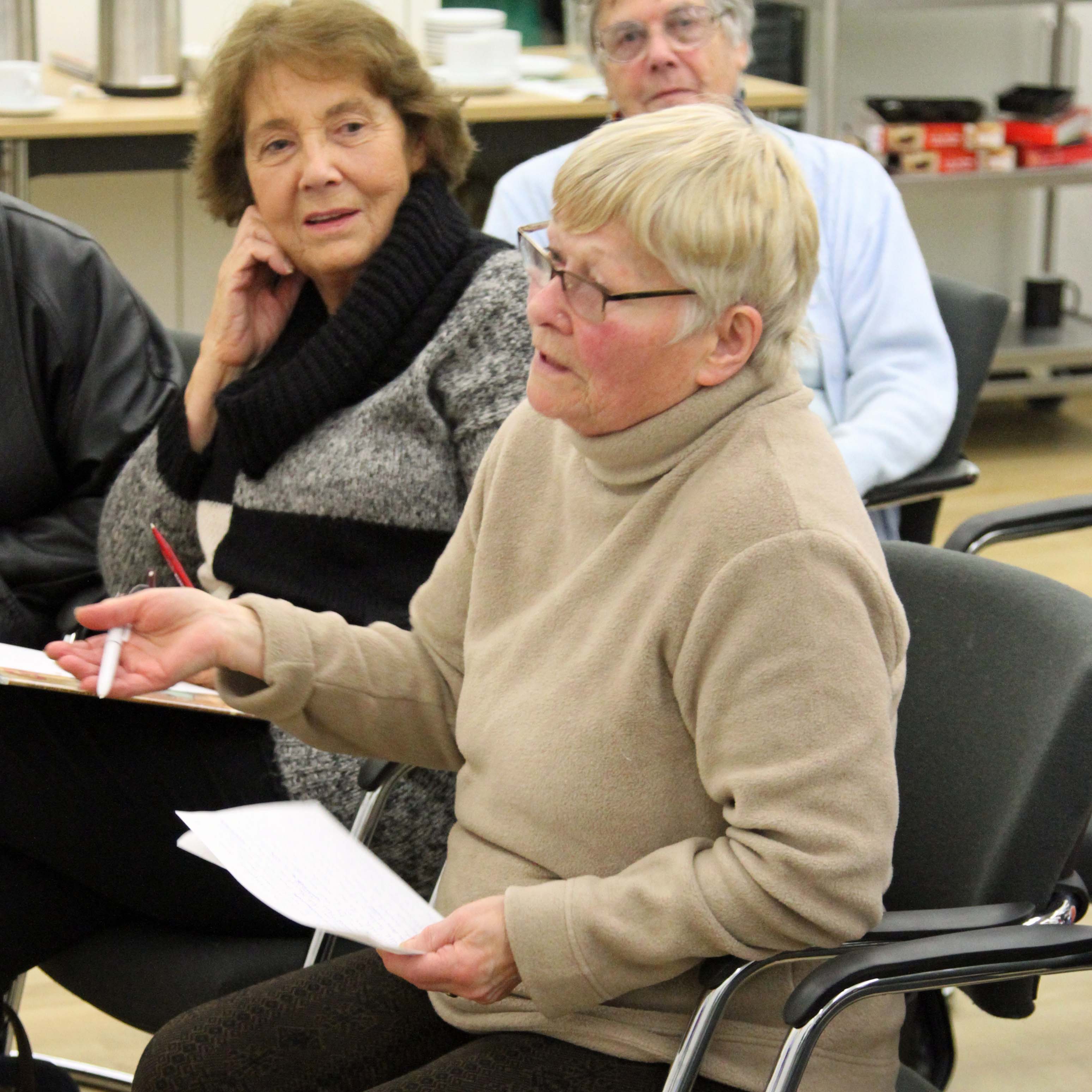
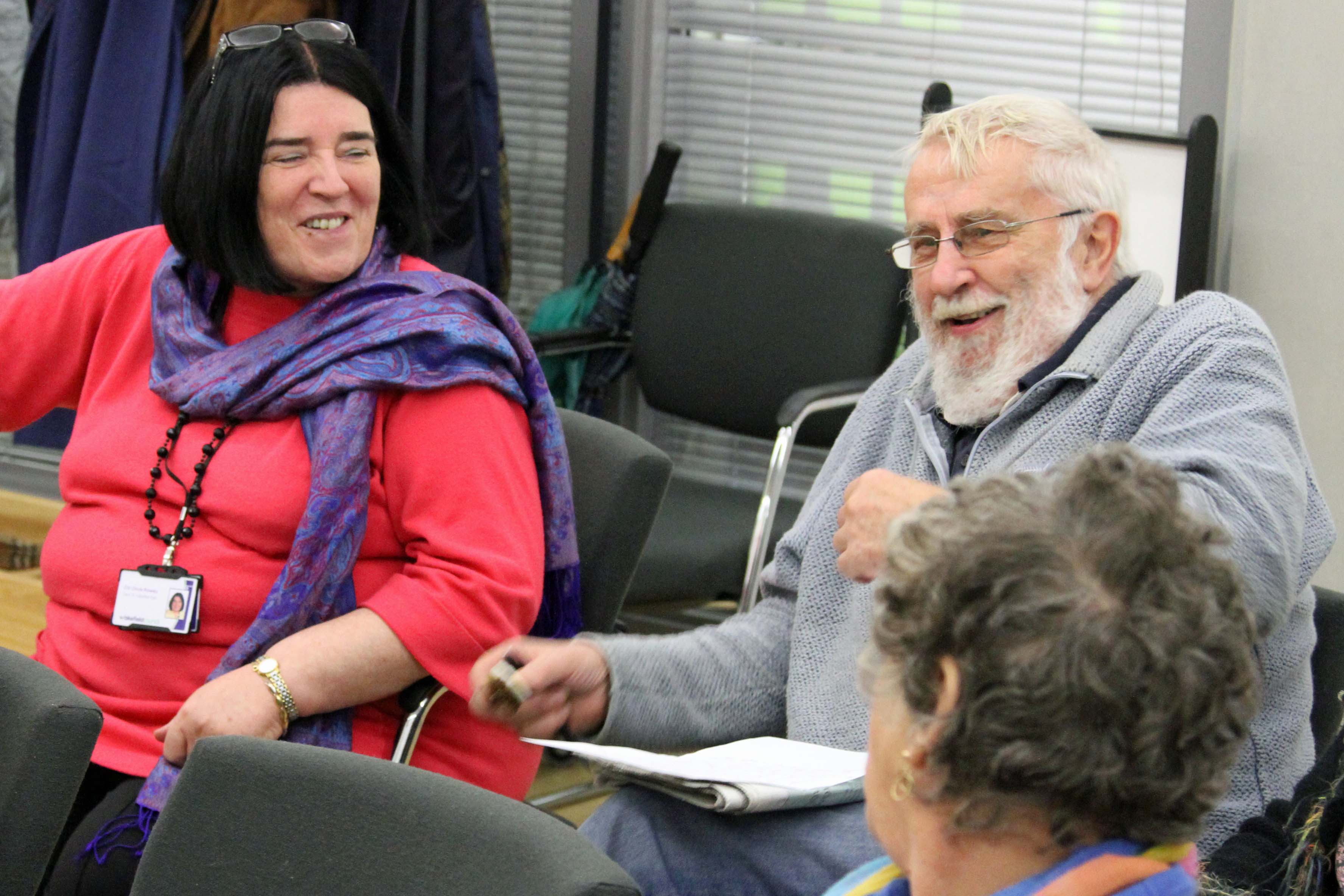
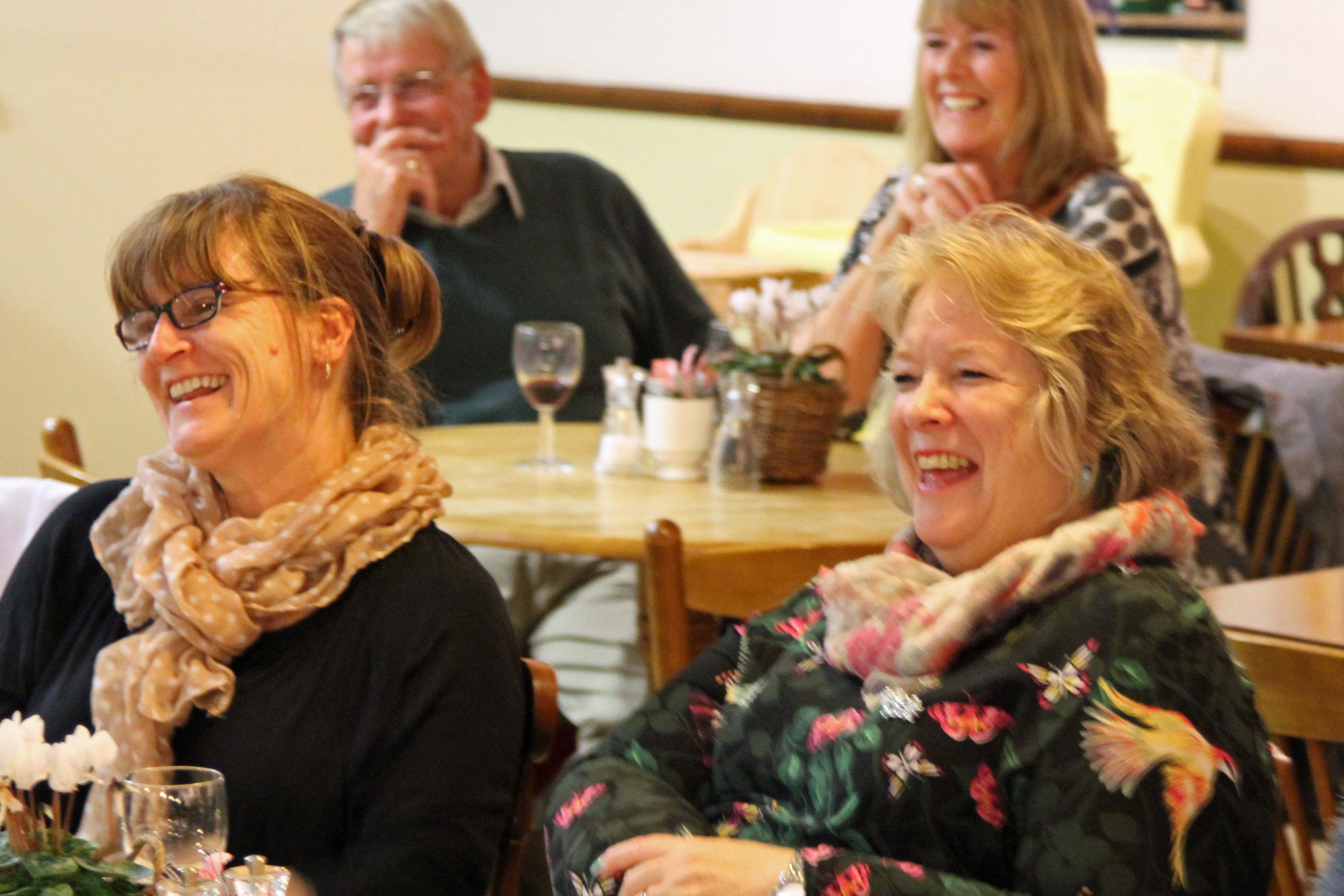
After listening to and providing feedback on the readings as only Wakefield audiences know how to do, when invited to take inspiration from the first chapter of The Crossing, each of the group members wrote a short sketch of an event that had happened to them and had stayed with them vividly, one that might be used as the opening scene of a novel. I hope the photographs capture the lively and committed participation that has come to be the hallmark of Wakefield One events: some read their own sketches, others asked their immediate neighbour to read for them. Everyone was spellbound by what was on offer. The accounts were fascinating and included bell-ringing for the first time and soaring unintentionally upwards on the rope, riding to London on The Flying Scotsman, walking to school through the snow in the Arctic winter of 1947 and the tale of how an uncle had pawned his wife’s hard-saved-for furniture to buy a red sports car. Novels in the making, every one – and the quality of the writing was of a very high standard.

The afternoon was rounded off by a quiz prepared by Alison. She’d found the photographs of twenty famous crime writers and asked the group to put names to them while I signed some books. It was a brilliant idea, and quite a hard task: no-one got more than half of the answers correct. (I’m going to ask Alison if she’ll let me have the quiz to post on this blog, as I’m sure some of my readers will enjoy it, too!).

The time slid away very rapidly. Braced by a final cup of tea, we ventured out into the cold again before we were trapped by the notorious end-of-day Wakefield traffic bottlenecks. I’d like to thank everyone who took part: the reading group members for giving me so much support (as they always do; it was also good to see several new faces this time), Alison and Lynn for arranging it all so impeccably, the Wakefield Libraries tweeter who, together with them, ensured that the event gained plenty of publicity, and Richard Knowles of Rickaro Books for supplying copies of The Crossing for sale. I hope to see you all again soon!

W1 2
W1 3
W1 4
W1 5
W1 7
W1 8
W1 9
W1 10
W1 14
W1 6

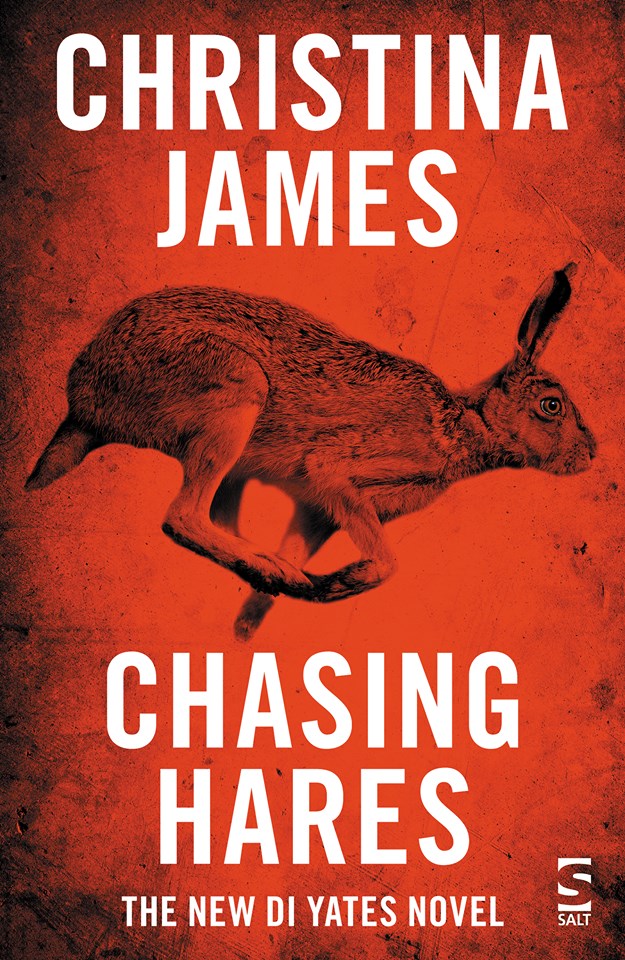
The Crossing at Stamford

WB 4
Stamford in Lincolnshire bestrides the River Welland (which also flows through the Spalding of the DI Yates books) and marks the ancient ford across the river where the Romans chose to route Ermine Street on its way north. Going there to sign copies of The Crossing, the fourth DI Yates book, seemed very appropriate!
It seems to be a continuing theme of The Crossing events that they are fated to happen in extreme weather. Harlow Carr was squally, Spalding was tempestuous and yesterday Stamford was bitterly cold! The cold hit me as soon as I got up yesterday morning. Venturing out with the dog before dawn, I noticed that a clutch of flowerpots outside the back door seemed to have sprouted a mysterious white substance. Closer inspection revealed it to be snow. Once clear of the parking area in front of my house (treacherous with black ice), I saw that all the rooftops and hedgerows in the village were twinkling with crisp snow.
WB 3
It’s a two-hour drive to Stamford and, although my husband and I were heading due south, it seemed to get colder as the sun rose higher in the sky. Stamford itself was in the grip of a vicious north wind which, the weather forecast informed us, was blowing straight down from the Arctic. It didn’t seem to deter the citizens of the town: wrapped up in thick coats, hats and scarves, all seemed to be going about their business cheerfully. The Christmas decorations had been put up, most of the shop windows now carried Christmas displays and the cold served only to make the atmosphere more festive.
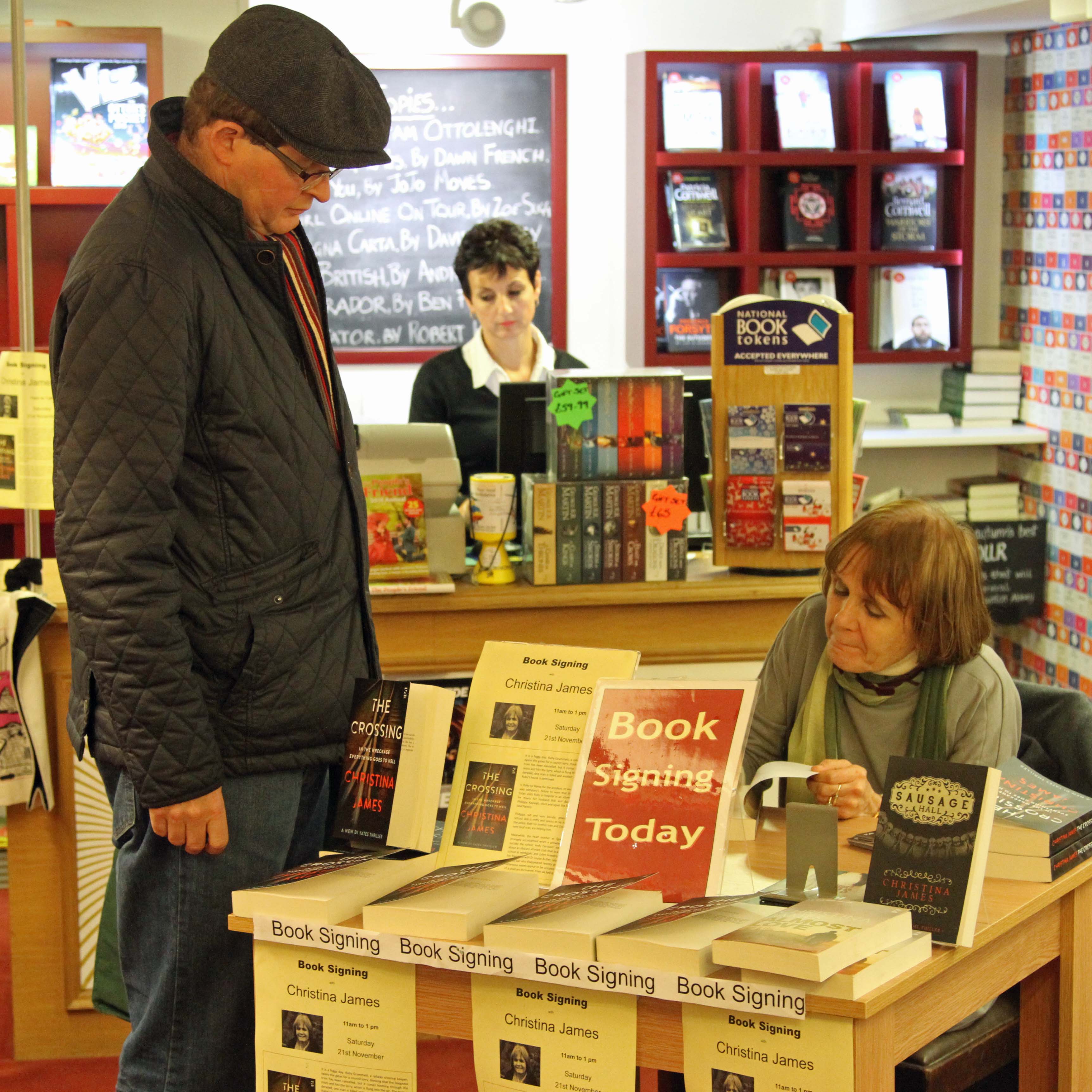
My destination, Walker’s Bookshop in the town centre, was as warm and welcoming as always. Its Christmas stock had been laid out beautifully and customers came, sometimes in droves, sometimes in flurries, to admire it and to browse and buy. I’d been allocated a table near to the cash desk to sign copies of The Crossing and we did a brisk trade throughout my allotted time there.
WB 2
I’d like to thank both the people of Stamford and the several visitors to the town whom I met not only for buying the book, but also for the fascinating conversations in which we engaged throughout the day. There was the lady whose father had owned some of the gravel pits that I write about in Almost Love. She told me that when she was a child they’d found many things in the pits, including a mammoth’s tooth (I mention the mammoth’s remains in the book), a pewter salver and several skeletons, some of which had been buried face down, perhaps because they belonged to murderers or suicides. The artefacts had all been given to a local museum, but the bones were removed by police who ‘just put them into bags and carted them away. It was the sixties and seventies. They didn’t bother to reinter them or find out how old they were.’ Shades of Sausage Hall! It is tantalising to think that some may have been the result of more recent murders: if so, the murderer(s) got off scot free! There was another lady from Cornwall who said her neighbour was Dawn French. She asked me about my writing routine. I said that although most of my writing is done in my office, I can also write on trains and in cafes. Dawn, apparently, must have absolute solitude and silence when she writes. Several men made purchases: they tended to be more interested in the series and how the novels relate to each other than more general information about the South Lincolnshire setting or how they came to be written. People of all ages stopped to talk to me. My youngest buyer was still at school. I was delighted that so many young people were interested, including a young woman who would have bought the whole set if we hadn’t run out of Sausage Hall and said, while buying the other three, that she’d order it. Some old friends also made the considerable journey from Nottingham to give their support.
The time flew by, as it always does for me when I’m in a bookshop. I had a truly wonderful day. I’d like to thank Tim Walker and Jenny Pugh for arranging the signing session and Mandy and Karen for looking after me so brilliantly while I was in the shop. It’s a very distinguished bookshop indeed and well worth the short detour off the A1 if you happen to be passing that way.
On the way home, it didn’t seem so cold, but perhaps that was just because I was enveloped in the rosy glow of having been able to meet so many new enthusiasts.
WB 1

In its launch week, a wonderful review of ‘The Crossing’!

The Crossing

“… when we’re pretty sure we have the whole picture and are reflecting on the roller coaster nail biter of a journey as the end approaches, the author punches us in the stomach. Once again we’re treated to a big last minute shock in the same way she shook us in Sausage Hall.”

May I express here my sincere thanks to @TheBookbag’s Ani Johnson. The review may be found in full here.

Ani Johnson

Ani Johnson

.

Forget the storm – the welcome in Bookmark is beautifully warm!

A warm welcome from Christine Hanson, owner of Bookmark

A warm welcome from Christine Hanson, owner of Bookmark

The Crossing seems fated to attract stormy weather! Recently, I described travelling through squalls and heavy rain to reach the pre-launch event at Harlow Carr. Yesterday, the day of the launch proper, a dual event organised by Bookmark in Spalding (Christine and Sam were wonderful as always!) dawned bright and clear, but by the time I’d arrived in Spalding it was starting to rain. The showers rapidly exploded into a torrential downpour which deterred all but the most stalwart shoppers, even though it was market day. By the evening, the rain had slackened but been replaced by gale force winds.

The day-time signing session had been as successful as possible under the circumstances. I enjoyed talking to some interesting people and was fascinated by what they had to say, but I was very nervous about the evening event. Though I knew the shop had sold a lot of tickets, I doubted that many members of my audience would want to venture out. Some, I knew, would have to travel quite a distance to get there.
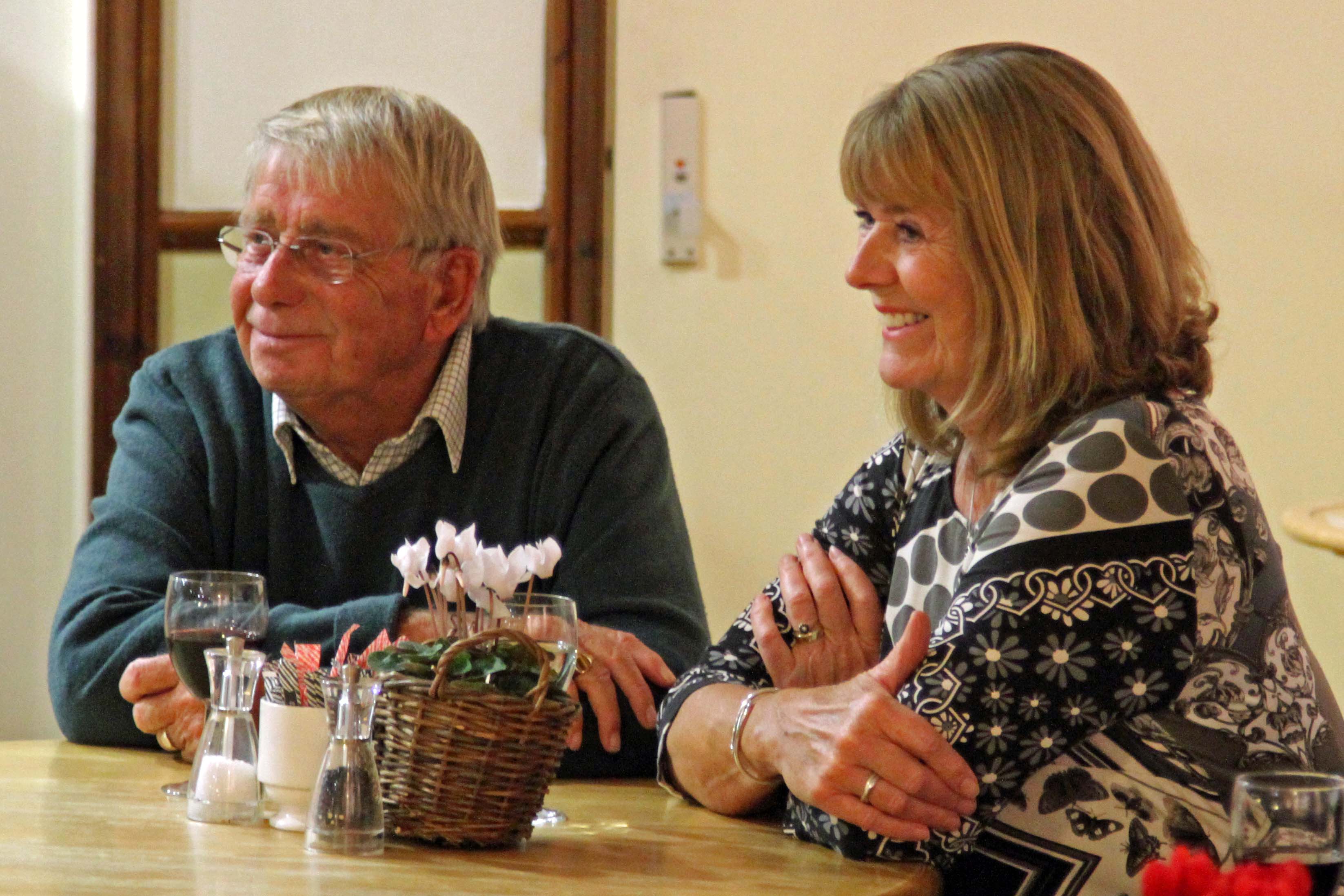
Inexcusably, considering my antecedents, I had reckoned without the influence of true Lincolnshire grit! Everyone who had bought a ticket showed up, and there were a few on-spec visitors as well. No-one even bothered to mention the weather. The audience was among the best I have ever had: lively, engaged, perceptive and eloquent. Several of them had already bought The Crossing, even though it was first displayed in the shop only on Monday, and many more bought it at the event (and some of my other books, as well). I was impressed by the stamina shown by Peter, a member of Bookmark’s flourishing book club, who had sat down to read The Crossing solidly all day, finally finishing it a couple of hours before the event, so that he could talk about it.

Peter, having read The Crossing in a day!

Peter, having read The Crossing in a day!

I was both delighted and grateful to learn that the book club has chosen The Crossing as its next title, apparently the second time it has opted for a DI Yates novel.

A couple of readings

A couple of readings

I told them a bit about how I’d come to write the book, especially the real-life event on which the opening chapter is based.

Background to the story of the first chapter

Background to the story of the first chapter

I think I’ve already mentioned it on this blog, but, for new visitors, here are a few details: When my great aunt was the crossing-keeper at a remote hamlet called Sutterton Dowdyke, there was a terrible railway accident. The Peterborough to Skegness train, in heavy fog, ploughed into a lorry standing on the crossing, derailing some of the carriages, which crashed into my great aunt’s tied lodge-house and turned it round on its foundations. She was physically unhurt, but her mind was affected for the rest of her life. In the novel, the accident is the catalyst for the whole chain of events that follows. A strong theme throughout is imprisonment and how a person’s character is affected when completely subjugated to someone else’s will: what integrity compromises must such a prisoner be obliged to make in order to survive?
Bookmark 13Bookmark 7Bookmark 6
The Bookmark audience and I talked about this. We also discussed memory, place, old Spalding, what sort of research I carry out when writing the books, books in prisons, other books we like to read and the relationship between fact, memory and fiction. We concluded by discussing significant events in their lives that perhaps they’d like to write about.
Bookmark 15

add

add


Bookmark 1
Bookmark 12
Bookmark 11
Bookmark 10
Bookmark 14

One very enjoyable moment stands out: a question from the floor to put the speaker on the spot! “What do you like to read?” Now I simply can’t resist buying books when I find myself in a bookshop and, since I had my purchases from Bookmark tucked under the table, I enjoyed sharing my tastes with a group of very like-minded people – interaction doesn’t get much better than that. Bookmark 8

I’d like to say how grateful I am to everyone who came yesterday evening, both for braving the elements and for all your wonderful contributions to the conversation. And heartfelt thanks, of course, to Christine and Sam.
I shall be popping in to Bookmark briefly again to sign a few more books on 17th December, if any of my readers is interested. If so, I look forward to meeting you then.
Bookmark 9

The bird in the house

A wonderfully atmospheric post. A magic melange of images.

Mary J Howell's avatarMurielle's Angel

image

‘There was a bird flying round the house,’ the Boxer told me.  She had no answer for what happened to it?or, how did it get in and out.

‘I don’t know,’ she said, ‘but it looked quite startled.’

‘i expect you were startled too.’

‘I expect I was,’ she said vaguely, ‘but it was early.’

These days I suspect a slight detachment from reality. Lost in her thoughts she will not answer plain questions deflecting them with vague answers like, I can’t think right now, or I don’t know, you decide. Till I’m unsure whether this is simply because of the effort needed to answer or decide, or whether she actually doesn’t know anymore.
Things have slipped that once were sacrosanct. Take reading the newspaper cover to cover and marking up television programmes not to be missed.
Now, not only are the TV choices not made, but the ability to…

View original post 155 more words

Harlow Carr: just the spot for a signing session!

IMG_6452

Yesterday, I felt amazingly lucky to have been invited to launch The Crossing at the bookshop at Harlow Carr Gardens, near Harrogate in North Yorkshire. (Strictly speaking, it was a pre-launch, my first ever!) I’ve been to Harlow Carr before, but a long time ago, and I think my first visit pre-dated the shop. It’s certainly well-established and flourishing now: it’s one of the loveliest bookshops I’ve visited and, some of its customers told me, undoubtedly the best one in the Harrogate area. Far from hiding its light under a bushel (or perhaps a pergola), it has succeeded in building up a huge clientele from many miles around. If you are ever in the vicinity, it’s well worth making a detour.
Yesterday dawned late. The weather was cold and squally, with sharp downbursts of torrential rain. As I drove further north, fewer and fewer leaves were clinging to the tress, while the roads and pavements were a whirling mass of auburn, chestnut and brown as the less tenacious ones came tumbling down and as rapidly began to disintegrate into sogginess.

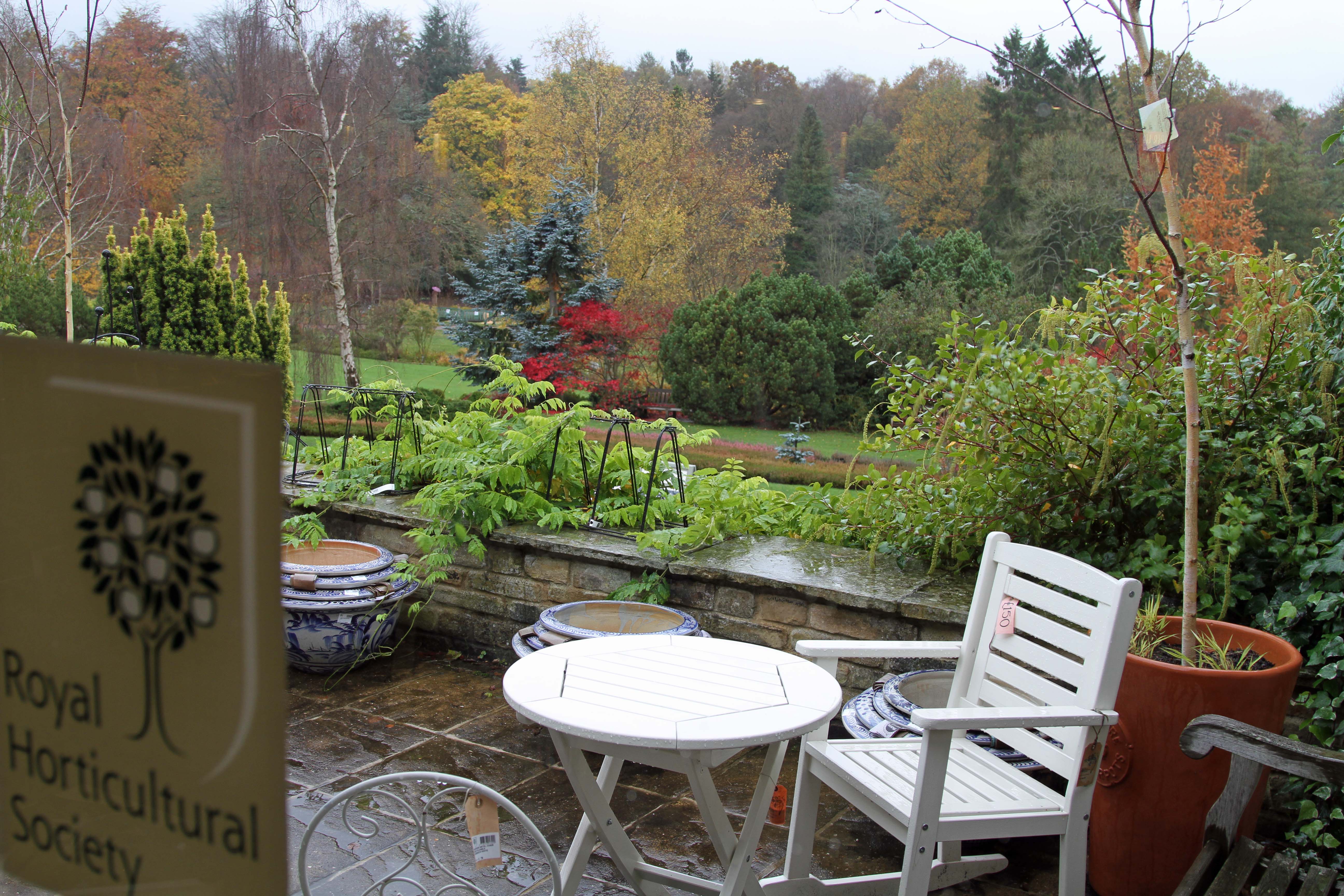
My view of patio, gardens and woodland

My view of patio, gardens and woodland

At Harlow Carr, the rain was thick and steady. The place is in quite a sheltered spot, in a hollow after a hilly climb on winding roads, so the trees that line the walks and the woods that form a backdrop to the formal gardens were still respectably clothed in gold and russet (though a vicious wind in the afternoon dislodged many of their leaves and set them swirling and eddying around the patio outside the shop). The shop itself was a haven of warmth and hospitality. Yesterday marked the launch of its Christmas stock: the bookshelves were heaving with tempting new titles and the rest of the shop was equally festive, a cornucopia of beautiful displays of cards, toiletries, accessories, seasonal decorations and all things Yorkshire.

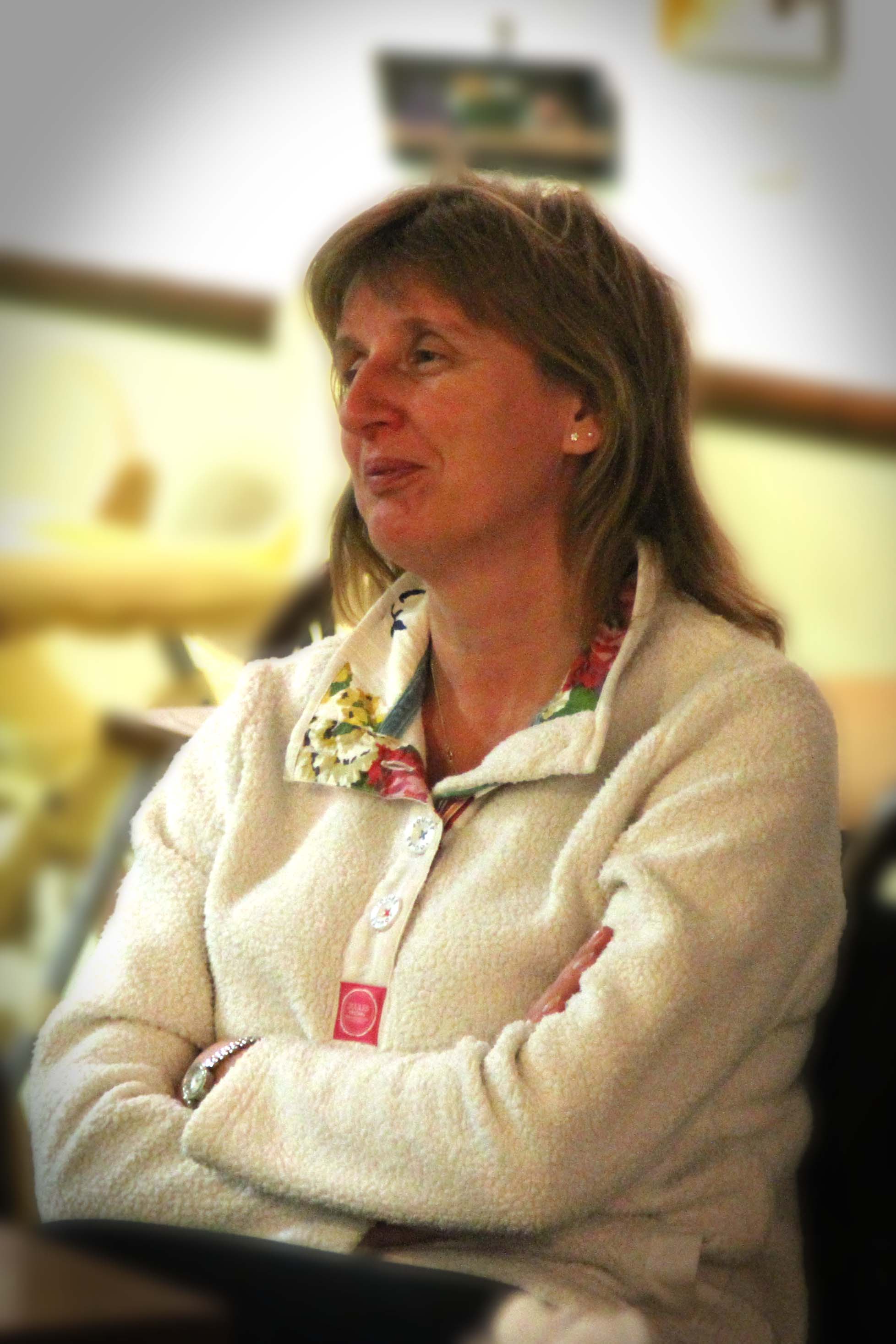
Isabel, a truly professional bookseller

Isabel, a truly professional bookseller

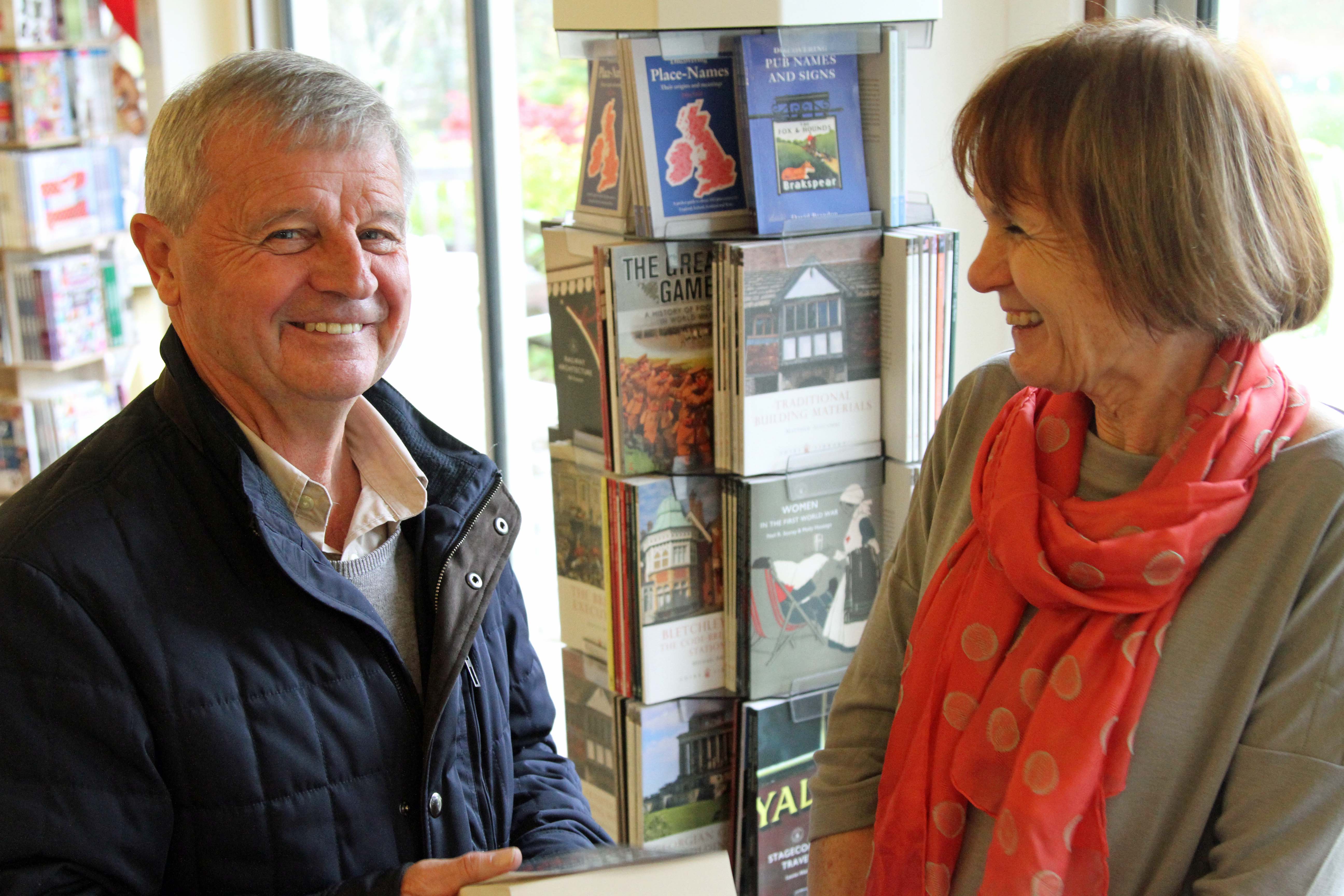
I was welcomed by Isabel and Nige, who showed me one of the best displays of my books I’ve ever encountered (helped, of course, by the fact that there are now four of them, clad in the distinguished Salt covers designed by Chris Hamilton-Emery, of which I am always so proud). My signing session was scheduled from 13.00 to 16.00 and, as it was already after 12.30, Isabel whisked me and my husband to Betty’s (Yes, Harlow Carr has a Betty’s as well! For the uninitiated, Betty’s tea-rooms are second to none on the planet.) to choose a delicious sandwich lunch. Then it was back to the staff room in the bookshop for a cup of tea. This was actually one of my favourite parts of the day. There are similarities between the staff rooms in bookshops the world over, so new ones are always reminiscent of my bookselling days and whenever I’m invited into one I immediately feel at home.
My three-hour signing stint passed all too rapidly. I met some very nice people and engaged in conversations on a huge variety of topics, from tractor seats to the novels of Peter Robinson and how I schedule my own writing. It was a new kind of audience for me: practical, engaged, leisurely. Almost everyone was wearing wellingtons or hiking boots. Many pushed children in buggies. All were wrapped up in glistening waterproofs against the rain.

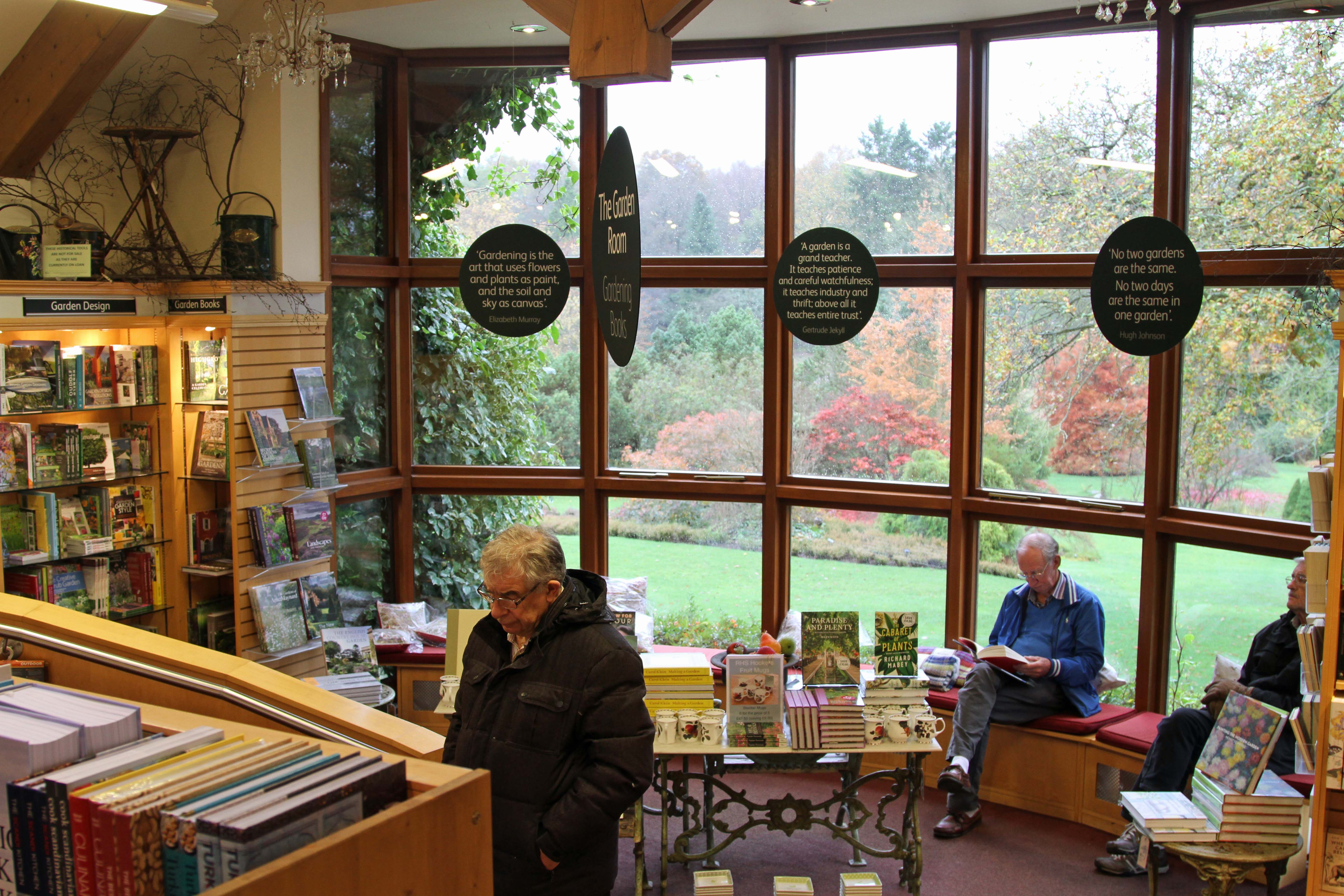
The lovely bookshop reading area

The lovely bookshop reading area

And very many people stayed in the shop for long periods of time, some of them upwards of an hour. I don’t think that it was just because they were sheltering from the rain: there is a rich variety of other places within the Harlow Carr complex where they could have done that. They were genuinely interested in (all kinds of) books and writing and also extremely careful when it came to choosing the ones they were going to buy. Every sale was the result of considered deliberation, whether of my books or those of other writers. It made me very proud and appreciative when the choice fell on one of the DI Yates novels!
I loved this shop immediately and appreciated the many kindnesses and efficiencies offered by all of its staff, especially Isabel, who continued to look after me for the whole afternoon until, off duty, I was able to roam the floors and make some purchases of my own. Isabel and Nige said that they’d only just started arranging author events (though you wouldn’t have known it from their professionalism) and kindly offered to keep in touch and invite me again. I shall be there like a shot!
I left one small present of my own: a complete set of the four DI Yates novels for the shop to raffle. Everyone who buys one of my books over the next month will be offered a raffle ticket, and the winner will receive the full set of books after the draw. If you live in Yorkshire or are planning to visit the county between now and the first week in December, perhaps this might provide a further small temptation for you to track down a very great bookshop!

Harlow Carr 1

The bells, the bells…

Universiteitsbibliotheek, Leuven

Universiteitsbibliotheek, Leuven

The day job recently took me to Belgium, a country I first visited as a schoolgirl, but which has since seen me only fleetingly, passing through it on my way south from Rotterdam. It deserves far greater and closer scrutiny from me and I’m delighted now to be able to share a particular highspot of my all-too-brief stay.

KU Leuven is the largest university in Belgium. Founded in 1425, it today enjoys a formidable reputation as a leading and innovative European research establishment, having itself co-founded the League of European Research Universities.

My visit to its wonderful academic library, the Universiteitsbibliotheek, not far from the centre of Leuven, included a chance to see in use its imposing and spacious reading room

One half of the lovely library reading room

One half of the lovely library reading room

and a private guided group tour of its 73.5 metre bell tower, which now is open to the public (tickets from here). Access to the lower four floors of the tower, the square bit, is by spiral

The spiral tower staircase, viewed from the Grand Staircase

The spiral tower staircase, viewed from the Grand Staircase

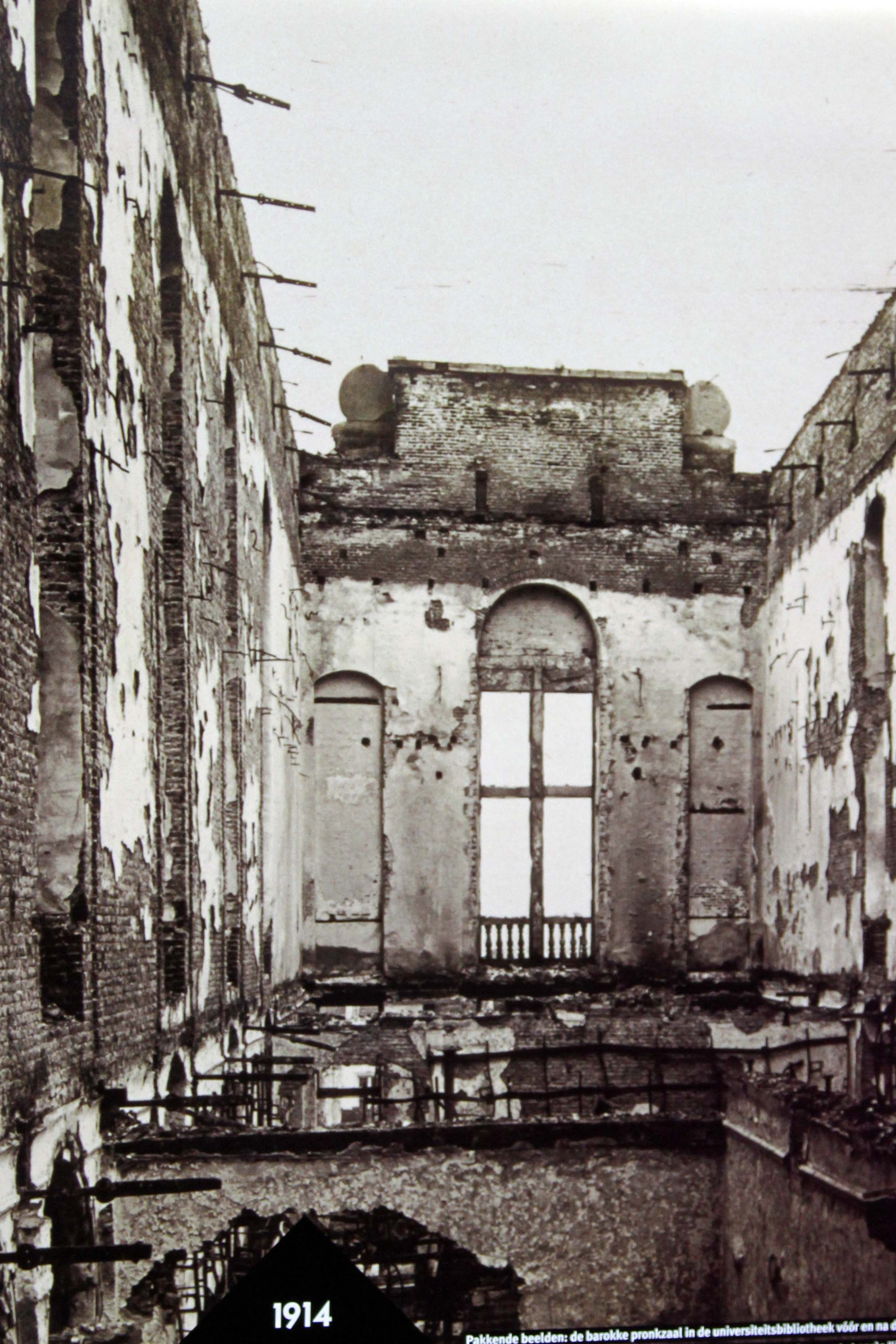
staircase and these floors house an exhibition depicting the story of the double destruction by fire, in each of the two World Wars, of the library’s collections in two buildings, the old University Hall in the Oude Markt and this one.

Oude Markt, in 1913

Oude Markt, in 1913

Oude Markt in 1914

Oude Markt in 1914

University Library in 1913

University Library in 1913

University Library in 1914

University Library in 1914

We were guided by beiaardier/carilloneur Luc Rombouts. Under the tower’s stone cupola, he plays its carillon, one of the most beautiful in the world and donated by US engineers as a war memorial. Indeed, the whole of this 1928 Flemish Renaissance-style library was built with American funding.

US architect vision of the new library post WWI.

US architect vision of the new library post WWI.

The exhibition itself, a collection of still and moving images, proved to be a fascinating insight into the power of a library destroyed to excite outrage and generate propaganda. It is generally accepted that the 1914 fire was the work of German soldiers, but it is not completely clear which side was responsible for the one in 1940, though each blamed the other.

The Nazi propaganda machine swings into action in 1940. Recognise anyone?

The Nazi propaganda machine swings into action in 1940. Recognise anyone?

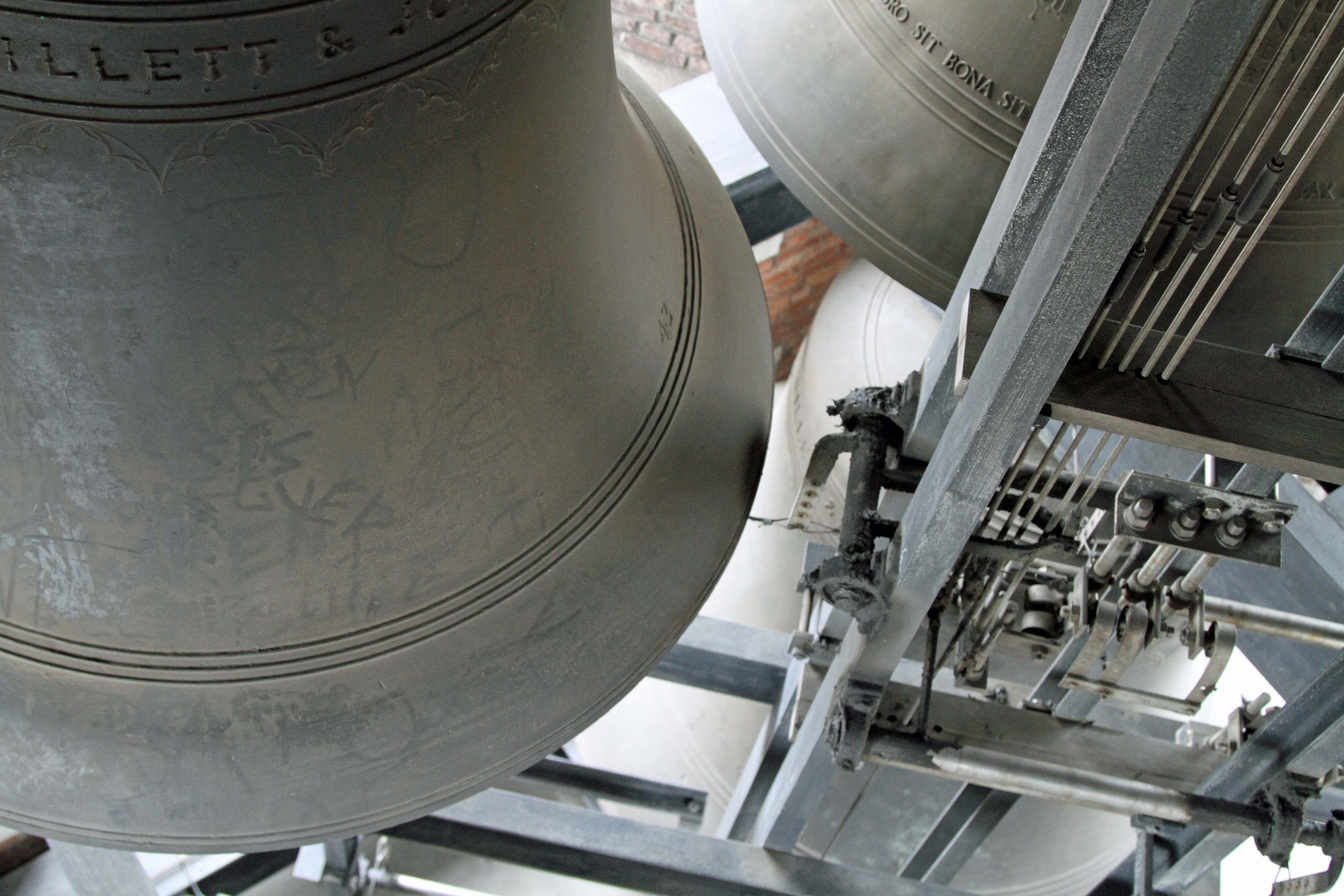
Fortunately, the forty-eight bells of the 1928 carillon, because of the design of the tower, could not be removed for munitions as they were elsewhere during WWII and survived, being added to in 1983 (again with US support) with a further fifteen bells.

Gillett and Johnston carillon bells

Gillett and Johnston carillon bells

Automated mechanism for playing the bells on the hours and quarters

Automated mechanism for playing the bells on the hours and quarters

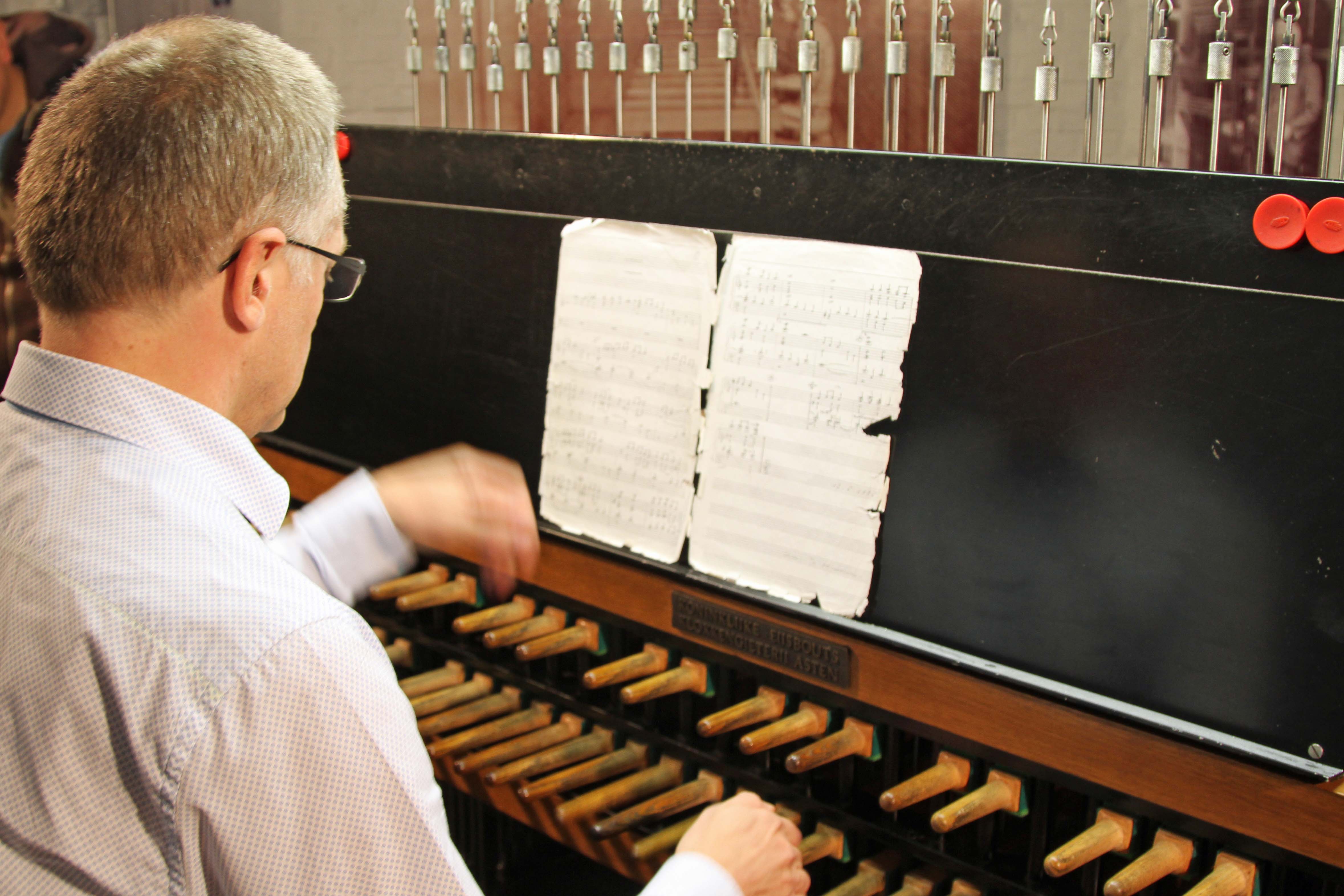
Luc Rombouts at the baton keyboard

Luc Rombouts at the baton keyboard

Luc playing 'Yesterday'

Luc playing ‘Yesterday’

Luc playing 'Streets of London'

Luc playing ‘Streets of London’

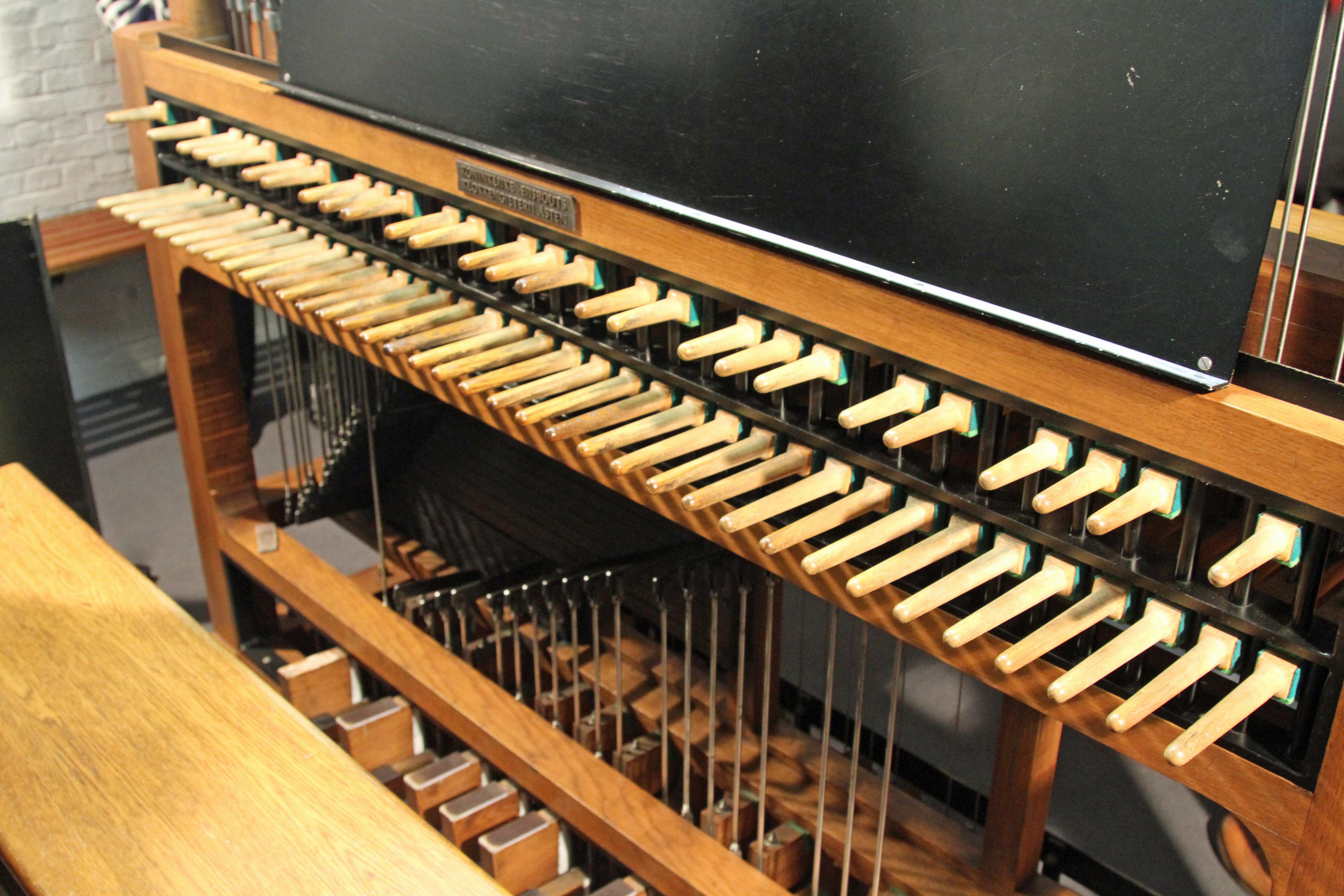
The carillon instrument

The carillon instrument

Luc not only allowed us to see the carillon instrument, but brought time – the normal quarter-hour Reuzegom, a Flemish folk song – to a halt, in order to play for us; the sounds of the Beatles’ ‘Yesterday’ were soon filling the air around us, the square in front of the library and the lovely city of Leuven itself. He demonstrated on this organ-like machine skills which had taken him four years to learn, banging his fists on the baton keyboard and pumping the pedals with his feet; he also told us about the bells themselves – they were ordered from the Croydon foundry of Gillett and Johnston, because English bells had the finest, most accurate pitch; he made the whole visit interesting, personal and friendly and our sincere thanks are due to him for all of this.

View of Sint-Pieterskerk, in the centre oLeuven, from the bell tower balcony

View of Sint-Pieterskerk, in the centre of Leuven, from the bell tower balcony

All text, photographs and video on this website © Christina James

Why I love France

I’ve recently returned from a holiday in France, a sojourn in recent years devoted to the planning of my next novel. I’ve tried to work out how many times I’ve been there and failed, but it’s certainly more than twenty, probably approaching forty. Altogether, I must have spent at least eighteen months of my life in France, beginning with our honeymoon in Paris (a shoestring affair – we had very little money and went there in an old minivan with four remoulded tyres, three of which had bulges in their side-walls – but none the less magical for that: eating packet curries that you’ve just cooked on a Primus stove on the banks of the Seine has a certain frisson that couldn’t be captured, say, sitting beside the Manchester Ship Canal).

I’ve had great holidays in other countries, of course, so why does France remain special? In an attempt to work this out, I’ve listed ten things unique to France and very endearing to me.

  1. The roads. It’s true that France now has some brilliant (if péage-pricey) motorways; but turn off them and you’ll quickly come to bumpy lanes occasionally sprinkled with battered signs announcing that the chaussée is deformée, the accotements non stabilisés. And they don’t just mean a little bit, either. ‘Non stabilisés’ means that, if you drive on to the verge, you’re likely to be pitched into the ditch or sink up to the top of your chassis in mud. And where else in the world could drivers be exhorted to take heed that there are ‘betteraves sur la route’?

    Road signs warn of just about anything

    Road signs warn of just about anything

  2. The produce. Almost every gîte owner I’ve ever met has supplied produce from his or her garden – usually tomatoes, often plums, apples, greengages, courgettes, fat elephant garlic and other vegetables, too. The tomatoes, in particular, are a gastronomic delight: outsize and eccentrically-shaped, they’ve been warmed by a fiercer sun than the ones we grow here and ooze juice when sliced and left to steep in olive oil, creating a salad that is a special occasion in itself.Gite owner generosity
  3. The restaurants. Even in the tiniest, most out-of-the-way place it’s likely that you’ll stumble on an immaculately-kept restaurant serving several sumptuous courses for a very modest sum, sometimes with wine included. How these places make enough money to survive is a continuing mystery – but perhaps they don’t need to. Maybe they are sidelines run by farmers’ wives or millionaire philanthropists?   Conversely (you might not think I’d find this endearing, but it is so French that it tickles me) I’ve frequently stopped at a restaurant in a French town in July or August, only to find ‘Fermé pour les vacances’ posted on the door. English restaurateurs take their holidays in February. French ones? Certainly not. Nothing is allowed to interrupt the rhythm of their lives.
  4. Two-hour lunches. Speaking of the rhythm of life, French lunches are another case in point. Although, tragically, I see some evidence in large cities of the quickly-grabbed sandwiches and takeaway salads that you encounter in almost every urban environment outside France, the two-hour lunch still dominates and most French people seem prepared to work daily until 7 p.m. rather than sacrifice it. When you’re on holiday, of course, there’s no need to rush!
  5. The wine. No need to elaborate further, I think.
  6. Shops in small towns. Practically every town in France, however tiny, supports one each of the following: a boulangerie (often, more than one),
    La boulangerie

    La boulangerie

    a florist’s and a hairdresser’s. If the town is even slightly bigger, there’s usually a pharmacy as well. The baker’s I can understand, and to a certain extent the pharmacy, but florists and hairdressers, in a place containing perhaps fifty houses? Wonderful, but an economic mystery.

  7. Low entry prices for tourist attractions and low or no parking costs. The UK could certainly learn from the French here. During my recent holiday I revisited Versailles for the first time in decades, and was pleasantly surprised to find that entry to the whole shebang (the chateau, the gardens, the Petit Trianon, the Grand Trianon and the Queen’s Estate) costs a modest €25.
    Anish Kapoor mirror balloon, included in the entry price to Versailles

    Anish Kapoor mirror balloon, included in the entry price to Versailles

    And car parks, if they charge at all, usually cost somewhere between one and three euros for the whole day.

  8. French trains. A newish experience for us in our most recent holidays. Aside from the phenomenal TGVs, they’re suave two-decker trains. Even the local ones glide smoothly through the countryside at great speed and seem to be as punctual as their counterparts in Germany and the Netherlands. And, again, they’re so cheap!
  9. Wonderful old buildings that have been dragged into the twenty-first century. I once read that one in every forty-nine buildings in the UK is listed or had some kind of preservation order slapped on it. Whilst I understand the principle of this and broadly agree with it, we do seem to do to death preoccupation with our built heritage (As a bookseller, I’ve been on the other side of the fence: it’s virtually impossible even to knock a nail into the wall if your bookshop’s in a listed building). The French must have even more old buildings than we do; they’ve survived better because of the climate. Mediaeval barns and pigeonniers and other ancient agricultural buildings abound; many holiday houses are hundreds of years old. The town nearest the gîte I’ve just stayed in is dominated by a donjon built in the early eleventh century. It had a fifteenth century church and many Tudor-style buildings (a timber and mortar architecture I’d not encountered in other parts of France). Listed - hah!The French don’t ruin these buildings (I don’t actually think they go overboard on bricolage), but they aren’t precious about them, either. On my way back to the UK, I stopped in an old market town for breakfast at an old-fashioned bar, complete with plastic tables and pinball machine, where several old men were playing dominoes. The fascias, at street level, were of plastic, too, but if you looked upwards the windows were mullioned, the gables (I’d guess) sixteenth century. A building spoilt or a building kept alive because people still enjoy using it? (As an aside, this bar, like many I’ve encountered, sells coffee to patrons and encourages them to buy their own pastries from the boulangerie next door. No ‘please do not consume food not bought on the premises’ nonsense!)
  10. The people. I’ve already said quite a lot about them in this piece. Self-evidently, they are responsible for making France what it is. The current sick man of Europe? I’m sure they’d disagree with this smug recent IMF assessment of their economy, but even if they were to acknowledge there’s some truth in it, they’re clearly intent on having a ball while they convalesce.

Stimulus for a story…

The Crossing

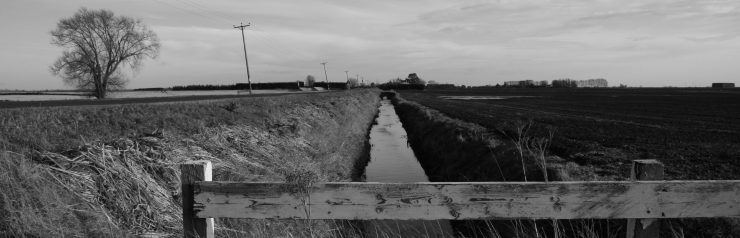
In South Lincolnshire on the afternoon of 28th January 1970, the countryside was enveloped in thick, freezing fog. It made the roads treacherous and there were protracted delays on the trains. Driving in country lanes was especially hazardous. Although some level crossings had already been fitted with so-called ‘continental barriers’, with relatively sophisticated warning systems, most were still simple five-barred gates operated manually. The practice in country districts where there wasn’t much traffic was to leave the gates closed against the road. Vehicles wishing to cross had to summon the crossing-keeper, who usually resided in an adjacent lodge-house tied to the job. Such an arrangement existed at Sutterton Dowdyke, a tiny hamlet a few miles south of Boston and east of the A16.

On 28th January, the regular Peterborough to Skegness train was considerably delayed by the fog. The driver of a tanker lorry owned by the council who regularly travelled on Dowdyke Road rang the bell to summon the crossing keeper to open the gates. The driver and his mate had been sent to empty a cesspit in the area and, task completed, were now returning to their depot. The crossing keeper, a woman in late middle age, came out and chatted with them briefly before opening the gates. The driver eased the lorry onto the crossing (most crossings at the time were notoriously bumpy) and was sitting right in the middle of it when the train came thundering through the fog, which had muffled the noise it was making until this moment, and flung the lorry into the air. The train was derailed. It ploughed into the lodge-house and turned the building one hundred and eighty degrees on its foundations. The lorry driver’s mate was killed instantly; the lorry driver himself was taken to hospital, critically injured.

Miraculously, the crossing-keeper was not hurt, but collapsed at the scene and was also taken to hospital, badly shocked.

My family and I first learned of the accident when watching the nine o’clock news that evening. The site of the accident wasn’t named, but my father recognised the lodge-house. We drove there immediately and then on to the Pilgrim Hospital to visit the crossing keeper. She was my father’s aunt and my own great-aunt.
My memories of that night sowed the first seeds of the plot of The Crossing, the fourth DI Yates novel, which I have just completed.
O' Canada

Reflections on Canadian Culture From Below the Border

oliverstansfieldpoetry

A collection of free verse poetry.

Easy Michigan

Moving back home

Narrowboat Mum

Fun, Frugal and Floating somewhere in the country!

Maria Haskins

Writer & Translator

lucianacavallaro

Myths are more than stories

Murielle's Angel

A novel set on the Camino de Santiago

jennylloydwriter

Jenny Lloyd, Welsh author of the Megan Jones trilogy; social history, genealogy, Welsh social history, travel tales from Wales.

Chris Hill, Author

I'm Chris Hill - author of novels Song of the Sea God and The Pick-Up Artist

littlelise's journey

Sharing experiences of writing

unpublishedwriterblog

Just another WordPress.com site

Les Reveries de Rowena

Now I see the storm clouds in your waking eyes: the thunder , the wonder, and the young surprise - Langston Hughes

Diary of a Wimpy Writer

The story of a writer who didn't like to disturb.

Rebecca Bradley

Murder Down To A Tea

Helen Carey Books

Helen Carey Books