

Excellent women
As the New Year is a time of nostalgia and of looking back as well as forward, my husband suggested that I wrote a blog post about my old schoolteachers and how they inspired me. Although several of them were indeed inspirational and I have kept in touch with the best of them (who deserves a blog post to herself one day for her influence on my writing and enjoyment of books), I have long realised, pace Mr Gove’s pompous and destructive brand of nostalgia for old-style grammar schools, that three quarters of the teachers at my school were neither inspiring nor, in some cases, competent and most would not have survived in the outstanding comprehensive school at which my son was a pupil.
I have therefore decided instead to celebrate some of the excellent women that I knew as a child and student, in particular the mothers of my friends. My parents separated when I was in my teens – a relatively unusual event in those days and not one that they handled well – so several of these women took me under their wing and included me as if I were one of the family.
Each of them partly expressed her love by producing excellent food. It is therefore with a vivid pleasure undimmed by the passage of time that I remember Marjorie’s fish and chips, Freda’s freshly-cut sandwiches and the whole cornucopia of goodies that Florence supplied, from home-grown chicken casserole to home-made lemon curd. When I became a mother myself, I began to understand the profundity of the food / love equation. However much today’s women might achieve, they are likely to be judged by their children on the quality of their spaghetti Bolognese.
Now that women are accomplishing so much, however – including the spaghetti, which they have learned to ‘juggle’ with nappies and spreadsheets and stilettos – some rather gloomy predictions have been made about the redundancy of the male. So where do men fit into this virtuous circle of food and love? Well, the ones I know are without exception much better at a fry-up than any woman I know and each also has a signature dish that he produces with pride at times of female fatigue or temporary lack of fortitude. They’re also quite good at finding nice restaurants. They can therefore safely bask in the knowledge that their relevance is undiminished.
However, it would appear that not all men are safe. It was with considerable alarm on his behalf that I read Will Self’s BBC magazine article on the nation’s obsession with food and how we should all try to put it behind us this year. I’d be careful if I were you, Mr. Self. Measured by the food / love criterion, your relevance is looking uncertain!
Marjorie, Freda and Florence, I salute you – and all upstanding male cooks and restaurant-finders, as well!
Enjoy your food with gusto in 2013, everyone!
Bond: My take on Skyfall

Skyfall showed to a packed audience at the Leeds Showcase yesterday evening, despite the fact that it had already been part of that cinema’s programme for several weeks. It was a very mixed audience, too: it included groups of teenagers, canoodling couples, families with children, pensioners and singletons, indicating, I suppose, that MGM knows how to draw support from across the whole demographic spectrum (as it exists in Leeds, anyway).
It’s a film impossible to critique sensibly; it contains an example of just about every pulse-raising set-piece from all the thrillers ever made: the car chase, the train chase, the helicopter chase (even something of Apocalypse Now here), the chase along subterranean passages, the fight in a tall building, the fight in a casino complete with man-eating dragons, the fight in a deserted city, the denouement in a spooky old ancestral mansion which is blown up in the process. The smaller cameos are equally classic: there is Bond’s walk along an exotic beach while he recovers from his wounds, his effortless entry into M’s high-security flat where he waits to surprise her with a visit, his uneasy relationship with the geek who acts as his ‘quartermaster’, his dalliance with two beautiful women (though the sex scenes are kept to a minimum – probably to secure the 12A rating), one of whom – she turns out to be Miss Moneypenny – even shaves him with a cut-throat razor; and all the time Ralph Fiennes is hovering in the background, waiting to take over from Judi Dench.
Traditional Bond bons mots and motifs are scattered throughout, though subtly: ‘The name’s Bond, James Bond’ etc. He never actually says ‘shaken, not stirred’, but looks on approvingly as this action is taking place. The good old Aston Martin puts in an immaculate appearance, though sadly (I’m sure it was ‘only a model’!) is finally destroyed by the villain – who can smile and smile and be a villain if ever actor could. I should have liked a little more irony here – the opportunity was ripe for it – but perhaps this was expecting too much.
So, am I describing a giant cliché? Surprisingly, the answer is no. The film succeeds in putting all this thriller stock-in-trade together in such a way that it impresses, if not with its originality, then with its superb virtuosity. It is a film that achieves perfection down to the last detail, from the quality of the acting (smiling villain notwithstanding) to the impeccably-choreographed fight scenes and the eye-popping special effects. However, it is because of the latter that I don’t think it will stand the test of time to become a great classic. Special effects improve constantly, with the result that what impresses today tends to seem hopelessly jejune tomorrow – think of Jurassic Park or Titanic. However, if what you’re looking for is a thrilling night out with the bonus of keeping your deeper thoughts well off-limits, this is your film.
As a footnote, may I conjecture that I must be the only woman in the country who doesn’t find Daniel Craig attractive. (I’ve never fancied Colin Firth, either!)
For the muddy-minded!

A boot-sucking quagmire
It is now official that 2012 has been the wettest year in my part of the world since records began (and in most other parts of England – it is apparently only because Scotland and Northern Ireland have been drier that this dubious distinction has not been earned by the UK as a whole). As I look back on it, I remember it less as a year of rain than a year of mud: mud squelching underfoot every day on the dog walk; the banks of streams reduced to treacherous muddy jellies after continually being breached by waters in spate; mud topped by thick blankets of leaves plastered together like papier mâché, creating involuntary ski runs down the hillside for the unwary; mud-caked wellies, mud-spattered trousers and trails of mud every day on the kitchen floor as boots and paws traverse it; even mud on my handbag once, as I carelessly rested it in the footwell, having already clambered into the car with mud on my boots. Mud, mud, mud.
I’m always on the look-out for new experiences and situations to write about, but, until yesterday, mud seemed an unpromising material for a crime-writer to work with. Bodies are often hidden under snow, lie obscured by drifts of crisp chestnut-coloured leaves or are tossed into miraculously-dry ravines to dry for years so that they become mummified. But mud? Only a manic or very foolish murderer would try to dig in sodden mud to conceal a body: there would be tell-tale boot-prints everywhere; the hole would keep on filling with water; the whole business would be a muddle!
Then, yesterday, as I was toiling back up the hill, my feet slipping and sliding on a path made smooth by running water and wading through patches of boot-sucking quagmire, my heart leapt as the grinning visage of a skull confronted me. It was re-emerging from the mud, its head turned towards me, the teeth grimacing, the backbones arching clear of the water. It took me a moment to realise that it had belonged to a sheep, presumably one that had got caught in the blackthorn hedge last summer or even the summer before that, and died.
So mud could hold copy for a crime-writer, because inexorably, over time, it might yield up its grisly secrets.
Joan Miró at the Yorkshire Sculpture Park

Yesterday I visited the Joan Miró exhibition at the Yorkshire Sculpture Park. I was captivated by his fascination with people and things and how they interact. There is a recurring theme of motherhood and its trappings in the sculptures exhibited – and not all the mothers seem to be benign, which also resonated with me. Most of all, I was amazed by the sheer technical virtuosity of his work; in particular, his ability to use one material to represent another – for example, one bronze sculpture bears creases as if it has been constructed from a sheet of paper.
Some of the pieces seemed to me to have an Aztec-like quality and therefore to reach back deep into our artistic heritage. Literature, of course, has a much shorter history than art and I can think of no work in words that could be described as being ‘perfect’ in the same way that the finest paintings and sculptures can be. It may be because of the relative youth of the written word that technical perfection still eludes the writer, but I don’t think that this is the true reason. I believe that the explanation may be that a painting or a sculpture captures one moment or temporary state and freezes it in that act of being. The greatest artists therefore succeed in encapsulating timelessly some core element as the world moves inexorably on; writers, on the other hand, work with a fluid canvas and have to keep on wrestling with multiple imperfect states of change.
Perhaps you have an example of the written word that you regard as perfect?
The power of a ferret!

Flicker, son’s ferret, 1995
We all have our favourite stories, from childhood onwards, and some of them have an almost religious significance in our memories, their words ringing in our minds like learned responses in church, that meant little to us as children, but had a resonance and a magic that almost overpowered literal meaning. One such for me is Sredni Vashtar, by Saki (H.H. Munro), the tale of a boy, his polecat ferret and revenge. Saki’s storytelling is legendary; it has the power to touch the imagination. In this story, it is the imagination of the ten-year-old Conradin which enables him to challenge the overbearing and unloving supervision of his cousin-guardian, Mrs. De Ropp. The boy is weak and not expected to live for more than five years, but he devises a way of eliminating her from his imagination, which is sacred and clean territory, and ultimately from his life. In a shed hidden away from Mrs. De Ropp’s prying eyes, he keeps a hen and a ferret, both of which he loves, but the latter in particular becomes, in his own created religion, a god with appropriate powers of authority. His guardian, noticing his fascination with the shed, aims to thwart him by disposing of the hen (not noticing the ferret hutch in the darkness at the back), the severity of which loss he silently turns into vengeance, appealing to Sredni Vashtar to do ‘one thing’ for him.
As a school pupil reading this story for the first time, I was utterly convinced of the power of Sredni Vashtar, who represented for me the reality of justice for suffered wrongs and the way by which a child could deal with unpleasantly dictatorial adults! Much more influential, however, was the strong focus of the tale upon imagination, which I understood implicitly and which has always underpinned my writing. When my son started keeping a huge hob ferret, which went out with him, sat upon his shoulder and eyed strangers with steady suspicion, I never worried for his safety! I still love the story.
(The Project Gutenberg text of the story is available online.)
The significance of trees
 In Norway, they do Christmas trees rather well. One of these comes every year to Trafalgar Square as a gift from the people of Oslo to express their nation’s gratitude for Britain’s support during WWII. The tree is obviously symbolic and reminds me of other trees with mythological associations, such as Yggdrasil, the great holy ash tree of Norse myth, and the yew and the oak, with their capacity to live for centuries and to link peoples and places with their ancestral roots.
I was delighted to come across two pictures posted on the Facebook page of a friend, a librarian in the Norwegian city of Tromsø, who has given me permission to use them. She tells me that these trees are very useful, since they do not shed needles and, as a bonus, people with allergic reactions to real spruce trees can come fearlessly into the library! As I admired the efforts of the tree-makers, it occurred to me that books, being  made of paper, were an appropriate material for turning into trees! That thought led to another, that it might be a trifle tricky to make a Christmas tree out of Kindles and that, in spite of the obvious advantages of the latter (especially when travelling), I still love the look and feel of a ‘proper’ book when I am reading. Our household collection of real books has the power of myth for us: the books are touched with memories and associations which could never be replicated by anything electronic. We are lucky to be able to take advantage of both real and e books; lucky that our literary ancestry is happily available in both. The symbolic significance of books is undeniable.
I hope that your Christmas book wish list is fulfilled! Have a lovely day tomorrow!
Before and beyond the grave…
 Yesterday, I learned belatedly of the death of someone to whom I was once close. Although I had not seen him for many years, I felt sad about the conversations that will now never take place and the questions that will now never be asked or answered.
Death is one of the stocks-in-trade of crime writers. Do we write about it carelessly or frivolously? I don’t think so. Murder stories tend to begin with one or more innocent deaths that have to be avenged – usually, but not always, according to the law – in order to restore the moral balance and demonstrate to the reader that all is right with the world again. Often the perpetrator dies or is killed; a good writer will shape this death into a kind of catharsis, so that the survivors can ‘move on’.
Real life is messier. Humans are creatures governed by memory. An individual’s ‘life’ therefore neither begins with his or her birth, nor ends with his or her death.
When I was a child, I listened to a radio programme in which was interviewed a very old lady whose great aunt had once met Jane Austen. The great aunt had recounted to her the conversation that had taken place and she was repeating it for the benefit of listeners in the 1960s. It had therefore been passed on at just one remove from an author whose life had ended in 1817. Why are we fascinated by such things? I think it is because we like to believe that we are part of a continuum that is greater than one person. It is more modest than a quest for immortality, but contains a strong element of the desire to survive for some time in memory.
As a baby, I was held by each of my great-grandmothers, both of whom were born in the 1870s. Both died before I started school, but I have hazy memories of them. I hope that, in my turn, I shall be remembered by my as-yet-unborn grandchildren, who, by the law of averages, are likely to live into the twenty-second century. This represents almost a quarter of a millennium of ‘immortality’. Can we ask for more?
Rest in peace, John.
Murderous thoughts? Maybe, but more of amusement…
 I laughed at a recent comment on Twitter, about how Christmas shopping inspires murderous thoughts. I forged through the crowds in Leeds yesterday and, in the process, discovered a few candidates for murder myself: there was the woman at Debenham’s who stood opposite the queue at the counter and pushed her way in by pleading ignorance of the system (the rest of us were too polite to protest); another in the Ladies’ there, who dried her hands on a strip of toilet roll and tossed it to the floor before sashaying out of the swing door and bouncing it back in my face; and, rather incredibly, the man who appeared to be a sales representative, who was hogging both the sofa and the staff on the first floor of Maturi’s, my favourite kitchen shop, with the result that customers could neither sit down nor get served.
However, overall, my spirits were more lightened than lowered, as I also stumbled upon some scenes to savour: There was the greying middle-aged man in Costa Coffee, consoling a beautiful but emotional young Indian woman with whom he was clearly more than a little in love; the portly man, also in Costa, surreptitiously eating what appeared to be pickled onion sandwiches from a lunch box when he thought that the staff weren’t looking; the fierce female official at the information kiosk at Leeds station who, when asked when the next train to Huddersfield would be leaving, triumphantly announced that it had ‘just gone’ (Think about it!).
Before I sign off, I should like to pay a tribute to all the many salespeople that I encountered or saw at work during my somewhat frenzied tour of the shops. Without exception, they were friendly, good-humoured, smiling and efficient. If their customers, many of us vague, boorish, noisy, impatient or simply inept, were exasperating them and they were longing for closing time and a cuppa (or something stronger), not one of them showed it.
Nostalgia: a misrepresentation of the past?
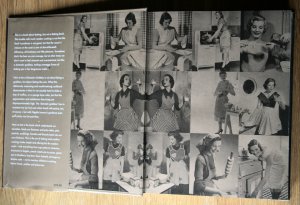 Time and again these days, I come upon newspaper articles which extol the virtues of the food of the late fifties and sixties. I find that publishers of modern cookery books (which, incidentally, are my second love, after crime fiction, and why, in this festive season, I am embracing a less noiry topic!) are very prone to printing black-and-white photographs of slender, glamorous fifties housewives wearing gingham pinnies over their full skirts and strutting in improbably high heels as they remove perfect fairy cakes and Victoria sponges from the oven. I realise that such photographs were probably originally circulated as part of a plan by the governments of the day to re-establish, post war, the rightful (hah!) place of women in the home and thereby to massage the employment figures, but what of the food itself?
I have mixed memories of it: although it was not uniformly terrible, it undoubtedly had its limitations. Lack of variety was one of them; being a victim of the first wave of processing was another. Tinned peas were emerald green – as a student in the seventies, I worked in a canning factory and can testify that they were dyed with the green equivalent of Reckitt’s Blue. Although we ate perfectly acceptable ham or cheese sandwiches at home, ‘meat paste’ (a kind of sludge composed of goodness knows what trimmings and offals) was always on the menu at picnics. So-called ‘cling’ peaches were interred in an opaque swamp of sugar solution. Custard – which was bright yellow, presumably because it also had been subject to a dyeing procedure – always came out of a tin labelled Bird’s; gravy was a more restrained pale brown and produced from a packet with two impish children on the side (one wearing a red, the other a green, hat) who were sniffing at what looked like a waft of cigarette smoke and proclaiming ‘Ah, Bisto!’
As I say, it wasn’t all bad. To a small child, snatching a taste of Camp coffee (actually, essence of chicory) was all the more delicious for being forbidden (even pseudo-coffee, it was well-known, stunted growth in children). In an era when no-one thought that children were damaging their teeth by eating sugar, provided that they cleaned them twice a day, Christmas was marked by a Saturnalia of unrationed chocolate bars from the many selection boxes supplied by relatives and Easter by an almost-equally-magnificent bonanza of chocolate eggs. Dried fruit (a handful was allowed as a treat on baking day) came in mysterious plain blue paper packets labelled in long-hand by the grocer.
What I remember most, however, was the monotony of it all: no fruit but oranges and apples in the winter; no vegetables but what my father grew at any time (I was astounded when I discovered that some people actually bought vegetables!); Sunday’s joint re-hashed on Monday because it was washing day; always fish on Fridays when my grandmother came. If, as a nation, we were slimmer and fitter then, it was because, aside from the odd splurge, we ate to live. Food was an essential, not always a pleasure. I’m sure that this is not what the publishers of today’s cookery books, somewhat over-burdened as they are with nostalgia, intend to convey.
Voices that sound loudly in my head
I don’t have a good memory for faces – it may be because I’m quite short-sighted – but voices stay in my head for decades after I’ve heard them. (No… I don’t mean I hear voices telling me to do things!) My grandmothers died in 1966 and 1979 respectively and I can still hear both of their voices clearly. One of them had quite a strong Lincolnshire accent, with flat vowels and little modulation. “That’s what you do” was one of her customary expressions, as in: “You need to be more careful; that’s what you do.” The other, who came from Kent, had spent all her life ‘in service’, so the way in which she spoke was more genteel, but I suspect that her long-drawn-out vowels and rather slow way of speaking were Kentish in origin. She often coloured her speech with proverbs and other regularly-used sayings: “Never say die; up man and try!” (used for both sexes) and “Red hat… no drawers!” (pleasantly spicy!) were two of her favourites. As a schoolgirl, I had a permanently exasperated teacher who prefaced almost every sentence with “Yes, but …” – another Lincolnshire voice, this one crackling and rising with irritation.

Our otnineen!
Harder to remember are the childhood voices of people, now adult, with whom I have always stayed in touch. I can still remember many of the things my son said when he was small, but hearing the exact voice in which he said them, though not impossible, requires quite a lot of concentration as I work back through the layers of adult and teenage years. “Building socite” and “Arndale socentre” were entertaining confusions, whilst “clothes-banger” and “otnineen” (see image) were two words he minted as a toddler, his voice high and piping and full of laughter.
People with no voice – as far as I am concerned – are intriguing. Their mystique is partly owing to the fact that I can’t hear them. Margaret Thatcher was in power during a period in my life when I owned no television and rarely listened to the radio, so she was years into her premiership before I first actually heard her. The result was disappointing; she sounded just like what she was: a Lincolnshire lady who had had elocution lessons, a type from my own childhood.
I feel teased and frustrated by never being able to know how authors spoke in the past. I have listened to recordings of writers who have died relatively recently – Tennyson, for example, and Virginia Woolf – but it is impossible to be able to tell whether they really spoke like that, or whether the sound has been corrupted by primitive technology or the passing of time.
And, of course, no-one will ever be able to do more than guess about the myriads who died before the end of the nineteenth century. Do we think of William Shakespeare with a colourful Brummy accent or are we seduced by the voices of actors who deliver his ‘immortal verse’ into thinking he sounded like royalty?
One thing I am sure of: the voices of my fictional characters sound loudly in my head.
 Christina James, crime novelist