

Snapshot of a diner in Barcelona…

As someone who has written at some length about birds – the herons and curlews of Lincolnshire; the pheasants that go in fear of their lives during the winter months in the Pennine village in which I live – I’ve been very interested in the bird life of Barcelona. Most of the birds here are exactly what you would expect to find in a major city with lots of parks which is also a Mediterranean sea-port. I’ve seen gulls and feral pigeons, sparrows and ducks a-plenty; swifts swirling around the buildings: in other words, the same birds that I should encounter in similar habitats in England at appropriate times of year. I have, however, been amazed that the many palm trees of Barcelona are filled, not with the melodious song of the blackbird and song-thrush, but with the raucous cry of the parakeet. These piratical birds swoop screeching down upon the crusts and pizza-ends discarded by tourists and, despite their inferior size, give the pigeons a fairly vicious dusting down if they try to put up a fight. They’re nothing but semi-tropical thugs, really, but I can’t help feeling a sneaking admiration for them, even so. It’s not just that they live by their wits, but also because they do it in such a brazen way. I suppose that in one sense they have no option: gorgeous in luminous lime green, they can hardly make their livelihoods by stealth. There is something entertaining about the fact that they carry their finds up to a safe branch and, clutching the morsel in one foot, nibble delicately at it like over-dressed and picky diners on the terrasses beneath them.
Exquisitely conceived…

As it has been some time since I posted about a grand sculptural project, I have decided to take advantage of a current opportunity to rectify matters. I’m enjoying a brief respite from the pressures of work and find myself in Barcelona, where today I have visited the remarkable Casa Milà, better known perhaps as La Pedrera, the apartment building designed by Antoni Gaudí and finished in 1910.
For someone who spends a great deal of time reading and thinking about the dark side of life, walking into this magnificent architectural accomplishment is a spirit-lifting contrast like the gladdening of the heart that comes with the warmth of the sun after one of the bleakest winters I have ever known. And Barcelona is blissfully warm, too, its trees already covered in fresh green leaves and its beaches full of sunbathers.
Those of my readers who have toured La Pedrera will, I hope, indulge my hugely enthusiastic response to Gaudí’s work here. All ripples and curves and fanciful challenges to the dismal straight line, the building is, in fact, a temple to the harmony of art and practical purpose. Its roof, a miraculous sculptural garden of delights, tu rns chimneys, stairways, ventilation ducts and water-management into elegant figures and organic forms, rising and falling above the exquisite catenary arches of the loft beneath. Gaudí designed this latter to be insulation for the apartments from both the heat of summer and the cold of winter. Following the loft galleries around the two internal courtyards (which, lower down, allow natural light to enter the rooms), has the feeling of walking around the caves of some grand champagne house, though windows at intervals permit light and air to enter.
The apartments themselves, one level of which is open as a museum to visitors, are still occupied by private families and various businesses, in keeping with the original intention. I could live here! Original parquet and marble flooring, completely flexible space (the pillar and steel beam structure means that none of the internal walls is load-bearing) and an almost complete absence of four-square normality, together with calm natural lighting, all inspire a sense of peace and joy. I do not exaggerate.
The views from the roof are spectacular panoramas over Barcelona, to the hills and to the sea; those from the windows are down to either the cool interior courtyards or along the bustling streets outside. Balconies, with their hallmark black and scrolled wrought iron balustrades, encourage a desire to watch the world go by below.
I spent some happy hours there today, leaving with a lightened heart and the strong sense of well-being that comes from exposure to something incredibly beautiful and superbly designed. La Pedrera is a marvel.

Just look at this: a new café bookshop in Lincoln!

I’ve used the word ‘serendipity’ several times just lately and, since style matters to me, I’m troubled by tedious repetition; yet Twitter is rather generous with serendipitous moments and another one (thanks to my writer friend Carol Hedges @carolJhedges for the information) popped up in the feed on Thursday last. It was the start of something big and it was, is and will be in Lincoln.
Living in this city are siblings Joff and Becky, who are taking the brave step into the wonderful world of independent bookselling, with a special emphasis upon supporting local and independent authors. On Saturday 4th May, BookStop Café will be opened to the discerning readers and the tea, coffee and cake addicts of Lincoln.
Where? At 46-47 Steep Hill and 7 Christ’s Hospital Terrace, the new home of BookStop Café is also a very old home, an example of Norman domestic architecture and, according to many references, known as ‘Aaron the Jew’s House’ (where Aaron of Lincoln, who died in 1186, lived – he was then the greatest Jewish financier of England). The building has been a shop for many years and is currently where, up above the new bookshop/café, tea importer Imperial Teas conducts its business: an atmospheric venue indeed, ready for a new development in its very long history.
Joff (self-published author Joff Gainey) and Becky have always dreamed of combining a café with books and now their vision is becoming reality: BookStop Café will, at weekends only to start with, be a place for readers to enjoy new and secondhand books in comfortable surroundings. Before very long, it will be a place where children can listen to storytelling and where artists can display their works. Keep up to date with its progress on Twitter at @BookStopCafe .
I am delighted to have come across this new venture and hope that you will join me in wishing it well. The lucky people of Lincoln will be able to settle down to good reading on Saturdays and Sundays from 4th May, 10.00 a.m – 4.00 p.m. My guess is that they will be settling down to some very fine cake, coffee and tea too.
I know where I’ll be heading, next time I’m in Lincoln.

It’s tomorrow! Making the most of the best of social networking…

Today’s post is a repeated ‘shout-out’ about tomorrow’s Salt Publishing seminar at this year’s London Book Fair, when there will be an opportunity to listen to Chris Hamilton-Emery, founding director of this world-renowned independent publisher, and three of its authors talk about how to use social networking to promote books and good writing. There will be a question-and-answer session to develop discussion about the topic How to Build Social and Brand Equity on a Shoestring. Elaine Aldred, an independent online reviewer, will chair the occasion.
Date: Tuesday 16th April 2013
Time: 11.30-12.30
Place: Cromwell Room, EC1, Earls Court
I’ll be joining Katy Evans-Bush, writer and editor, and Elizabeth Baines, novelist and short story writer, to offer some personal experiences of social networking as a means to achieving an online bookworld presence. Readers of this blog will already guess from previous posts here about both Salt and social networking, how much I personally value the opportunities provided by the Internet to meet and mingle with booklovers across the world. I have also made it very clear just how proud and privileged I am to be supported as a writer by Chris Hamilton-Emery and how exciting it is to be associated with an independent publisher with the finest of literary lists.
I hope to become real to at least some of my ethereal friends at the London Book Fair this year!
I’d kill for a slice of coffee and walnut cake…

Get stuck in to a good book…
On Thursday, I had a conversation with a librarian in Doncaster who would like me to take part in a literary festival that will be run in May by the Doncaster Library Service. After further discussion, we decided that it would probably be more effective for everyone if, instead of participating in one of the library-based events, I were to run a couple of writers’ workshops, one at a local school and one at an open prison. I warmed to this idea immediately; as a bookseller, I have supplied books to two open prisons; more recently, I have read the MS of a fascinating memoir written by a writer-in-residence who works in a prison in the North-East. I shall be happy to work further with the prison community if I can be of use. I’ll write more about these two events nearer the time.
Before we decided on this plan of action, when the idea was still that I should participate in a library-focused event, our chat had been about what sort of writer we should choose to present with me. To my initial surprise, she suggested a cookery writer, but, the more I thought about it, the more appropriate I thought that this was. Aside from the interest in food (among many other subjects) that both this blog and the many other crime-writing blogs to which it has been introduced (and introduced itself) have expressed, now that I’ve thought about it, I think that a crime writer and a cookery writer have a lot in common.
The similarities are there if you look for them. Firstly, and of most importance, we are both genuinely interested in the craft of writing: although the crime writer’s main purpose is to devise an interesting plot peopled with intriguing characters and the cookery writer’s is to develop practical recipes that people really want to try out, the means, for both of us, is as important as the end. In a certain sense, we are both genre writers, but the style and standard of the writing is important to us; mostly we don’t deserve to have the word ‘genre’ applied to us in a condescending or pejorative way (though we have both suffered from this). I don’t deny that there is huge variation in the quality of writing accomplished by both crime writers and cookery writers, but at our best we produce classics. When my friend Sally gave me How to Eat and The Domestic Goddess as a very generous birthday present ten years ago, I was both amazed and entranced by Nigella Lawson’s wonderfully fresh and funny prose style. You may gorge yourself upon her books both literally and metaphorically, delighting in the sensual language and wonderful photographs even as you assemble the ingredients for a luscious cake and anticipate eating it later. The best crime novels are like this, too: each page not to be gobbled down quickly because it gets you a little closer to the denouement, but lingered over and savoured for the pleasure that the words bring of themselves.
Similarly, a well-set-out recipe is like a well-crafted short story. It tells a tale, from the beginning, when there might be a note on some kind of utensil – a springform cake tin, for example, or a coeur à la crème ramekin – to the afterword, which might offer serving suggestions or other tips once the culinary masterpiece has been completed. Conversely, a poorly-conceived recipe, one which perhaps is not clear about quantities or method, disappoints and exasperates just as much as a badly-written thriller. And, whilst I don’t think that it is possible to ‘learn’ writing step-by-step in quite the way in which you follow a recipe, writers can certainly give others pointers to how their writing can be developed – hence the workshop idea. Conversely, an inspired cook will add some special twist or variation to a recipe to make it more delicious and uniquely his or her own.
There is one point on which we will always be at opposite poles, however: cookery-writing is about celebrating life and that which sustains it. Food and the sharing of food is a civilising influence. Almost every great nation has developed its own cuisine. Crime writing, on the other hand, is about what threatens a civilised existence, sometimes including life itself: a sobering thought, yet, as I’ve said before, the end of a crime novel usually brings with it some kind of catharsis and a feeling that all is right with the world again. And along the way, both heroes and villains can enjoy some excellent food. From the Victorian victuals described by Wilkie Collins to DI Banks’ pub lunches and Paola Brunetti’s elegant meals en famille, crime-writing owes a lot to cookery. I’d better not embark upon a consideration of how cookery-writing might be indebted to crime; otherwise my imagination might run riot!
A murderer unmasked after sixty years…

I’ve been looking for some real-life murder stories set in South Lincolnshire and can’t find any; I’m not sure whether the people of Holland are unusually law-abiding, unusually cunning or just lucky. However, my search did turn up Poison Farm: a Murderer Unmasked, by David Williams. It’s set in Suffolk, not too far away from South Lincs; as it’s still East Anglia, it ‘counts’. Williams tells a fascinating story, not least because the murder – of prominent local farmer William Murfitt, who had quite a seamy private life – took place in 1938, in the village of Risby, when he was himself growing up there. He remained preoccupied with it, until he investigated more fully in 2003, after retiring from journalism.
Williams paints a graphic portrait of what village life was like just within living memory. The archaically hierarchical nature of the small but prosperous farming communities of the time is conveyed well – some of the people and situations that he describes could have come straight from the pages of a novel by Trollope. (Much of this strict adherence to the class structure would shortly be swept away by the Second World War.) He also manages to capture a fine example of a perennial female figure who, in fiction as life, has always managed to inveigle herself into the upper levels of local social hierarchy, despite its snobbishness and respect for tradition. She is the adventuress with a shadowy past. The lady in question in this story rejoices in the name of ‘Lady’ Mary Elizabeth Fernie Chandler, or some less flamboyant combination of these names, as the occasion demands. She is the literary descendant of Becky Sharp, the real-life counterpart of the Duchess of Windsor (also known as Bessie Wallis Warfield, sometime Spencer, sometime Simpson).
The murderer of William Murfitt was never charged or prosecuted, though Williams thinks that he has identified the culprit; in the course of telling the tale he builds a convincing case, based partly on a re-examination of the evidence, partly on the reminiscences of some extraordinarily long-lived survivors, already adults at the time of Murfitt’s death, whom he manages to interview. In the process, he comes to the conclusion that the perpetrator had probably also committed another murder some years previously.
Modern forensic techniques might have resulted in a conviction if Murfitt’s murder had happened today. Yet this is not necessarily the case: the two policemen sent to Risby, Detective Chief Inspector Leonard Burt and Detective Sergeant Reginald Spooner, both became celebrated later for their acumen and sureness of touch. Each went on to solve many serious crimes, including other murders. David Williams’ story illustrates perhaps that you can get away with murder, if you have the nerve to stick to your story… and a little bit of luck.
Balmy Bournemouth: edgy enough for murder? At the weekend, maybe…

Classy Bournemouth
I find it ironical that, in one of the coldest springs on record, I have already visited five seaside resorts: Robin Hood’s Bay, Whitby, Brighton, Cromer and now Bournemouth. Temperatures were low during all of these visits, but cold comes in many guises, each one having a different effect upon enjoyment. Robin Hood’s Bay and Whitby were bracing and sunny; Brighton snowy, with a vicious wind whipping in from the East; the similarly cutting wind in Cromer was accompanied by some sunny intervals; and, at Bournemouth, where I have just spent four days, there was initial bright sunshine, followed by cloud, followed by two days of driving rain and then, just as I was departing, bright sunshine once again, this time accompanied by some real warmth.
By circumstance now something of a 2013 seaside connoisseuse, I’ve had the opportunity to discover that I much prefer the rugged east coast to the smoother, more luxuriant yellow sands and vast bays of the south. To my amusement, I have also been able to verify a colleague’s observation that Bournemouth has two faces: one for the weekend; another for the working week. I’ve stayed there several times before when attending conferences, but this was the first time that I’d needed to arrive at the weekend. I’d previously considered Bournemouth to be a refined sort of place, but I now know that weekend Bournemouth is much edgier.
Arriving last Saturday just before 6 p.m., I decided to make the best of the bright sunshine and still light evening by going straight out for a walk along the promenade. For a while, this was fine: families on the beach were just packing up, a few beach-hut owners were still relaxing in their doorways in deck chairs. Then, suddenly, all of these people had gone and I realised that there was no-one in sight except for perhaps twenty skateboarders, all young men, who had suddenly appeared and were performing expert manoeuvres all along the prom. I probably read too many crime reports in the newspapers, but the thought struck me forcibly that if one of them were to swoop down on me and snatch my handbag and then either sail away or pass it on to one of his friends, I’d have no chance of getting it back. I beat a hasty retreat to the hotel. (Apologies to all honest skateboarders everywhere for this shocking stereotyping!)
This hotel had been booked at the last minute, when I realised that Sunday travel would be impossible. It was all I could get and not of the standard of the conference hotel, to which I moved at the end of the weekend. It turned out to be the sister hotel of the hotel in Torquay on which Fawlty Towers was based. I have also stayed in the latter, and I can say only that both hotels live up to their reputation. The bucket in the corridor, to catch drips from the ceiling (someone had probably let their bath overflow) was dispiriting; the room itself was tiny – I could lie in bed and touch both walls with my elbows. (I smiled at the child’s Z-bed in the corridor: any parents who could get their offspring as well as themselves into such a room must have been contortionists!)
My colleagues were arriving very late, so I ate dinner alone, an uncanny backward time travel to the first restaurant meals that I experienced as an adolescent. The set menu was filled with culinary clichés: prawn cocktail, toasted grapefruit, melon boat, gammon and pineapple, coronation chicken, apple pie and baked Alaska. The couples dining seemed to have passed through some invisible looking-glass from the 1970s. The dining-room was vast: half a football pitch away, a very large group (the waiter called them ‘the tour’ – I think he meant ‘coach party’) erupted into song at intervals. They sang ‘Happy birthday to you’, ‘For he’s a jolly good fellow’, and, for good measure, ‘You’ll never walk alone’. The dining couples stolidly ignored them, the men sipping beer with their food, the women drinking coke.
Outside in the foyer, a group of very young women, obviously members of a hen-party, were about to embark upon a night on the town. They were brightly and uniformly dressed in what appeared to be clinging T-shirt dresses (shorter even than ‘pelmet’ skirts). The bride was instantly recognisable, because she was wearing a veil anchored by a crown of artificial flowers. Two of the other girls were carrying the lower half (i.e., the waist, hips and legs) of a shop-window mannequin, its modesty preserved by the addition of a pair of scarlet lace knickers. They all thought that this was hilariously funny and burst into incontrollable giggles as they carried it out through the door. By chance I saw them returning to the hotel some hours later, by which time the legs seemed to have been mislaid, if you’ll forgive the pun.
I retired to my room to read until my colleagues arrived. When they came, they suggested that we met for a drink, but by this time ‘the tour’ had filled the hotel bar. They were still singing traditional crowd songs, while heavy metal music pounded in the background. We decided to escape to the bar of the hotel next door. The music there was, if not understated, more schmaltzy, and our fellow drinkers consisted mainly of the members of a fairly decorous wedding party. The mother of the bride, dressed head to toe in leopardskin-printed chiffon, was a little the worse for wear. She was semi-recumbent upon a banquette, her eyes closed, her killer stilettoes kicked off. We paid through the nose for cocktails and managed to have a civilised conversation (in the sense that we could hear each other speak) before deciding to return to our own hotel, hoping that it would not be too noisy to get a decent night’s sleep.
Outside it was bitterly cold and very dark. A pergola had been erected between the two hotels, and something was glowing red inside it. Coming nearer, I saw that the bride and groom were sitting there, she still wearing her sleeveless, strapless dress with not even a wrap to keep her warm. Each was smoking a cigarette.
On Sunday, I moved to the conference hotel and the Bournemouth that I have always known sprang back into place again. What does all of this have to do with crime fiction? I’m not sure, but I think there may be the seed of a plot forming in the back of my mind. A silent killer moving between hotels, perhaps, inhabiting two worlds.
Edgy place, Bournemouth…
Gangs on the land…

Still reading about rural life, I was interested that the history of nineteenth century Lincolnshire that I have just completed and a more general book about farm labourers both mention gang labour. Gangs were self-assembled groups, sometimes of both sexes, sometimes consisting entirely of men or of women, who hired themselves out to farmers as an entity. The advantage to them was that, as a group, they were less likely to be exploited; some gangs also contained children (I suspect that, although the gang may have saved these minors from exploitation by the farmer, it was probably less punctilious about appropriating their wages!). However, they were often troublesome and, in Lincolnshire in the later nineteenth century, by-laws were introduced to attempt to curb their excesses of behaviour and to set out clearly the terms under which they could be employed.
Both books say that the practice of developing and employing gangs had become obsolete by the turn of the twentieth century. However, when I was a student in the 1970s, taking summer holiday jobs working in the local canning factory, gangs were certainly still being employed there. They were of three kinds:
A group of twenty or so Maltese women was taken on in the key fruit and vegetable harvesting months of June, July, August and September and they lived in trailers on the factory site. I remember that when I was cycling home in the evening, having worked the four hours’ overtime allowed, I would sometimes meet two of them carrying a crate of beer to share with the others.
Then there was a group of Irish women of all ages, many of them well-educated and some also students. They were boarded with regular factory workers who were prepared to take them in, their keep being paid for by the company.
Finally, there were local agricultural gangs, I imagine of exactly the kind that these history books refer to, who, like other local casual labour, turned up each day and were not provided with accommodation.
The gangs I knew consisted entirely of women. They were extremely rough and foul-mouthed and were usually put to work together; they were shunned by everyone else on the factory floor because they would pick a fight at the drop of a hat. One year, the forewoman (whose name was Dulcie – she had a voice like a squeaking gate) made the mistake of hiring two rival gangs. I vividly remember a woman from each of them fighting one Friday lunchtime, thrashing it out on the concrete floor. It was the most vicious event I have ever witnessed. They tore out handfuls of each other’s hair and scratched faces with fingernails, as well as landing punches. Eventually they were rolling on the ground, pulling at each other’s clothes. One of them ended up shirtless, her white bra bloodied and dusty. Dulcie and one of the male supervisors eventually succeeded in separating them and both gangs were dismissed. I guess that they spent the rest of the summer working on the land: at the time it was still possible to turn up at most farms and work at bean-pulling, potato-picking or bulb-cleaning for cash in hand at the end of the day. With hindsight, my guess is that most gang members were the virtual slaves of a single gang-master, or perhaps a few ‘élite’ overseers. I hope that the practice of gang employment has finally ceased now, but I suspect that the recent influx of immigrants to the agricultural communities of East Anglia may mean that it has ‘enjoyed’ an ignominious revival.
Whose jurisdiction? Cops and the county boundary…
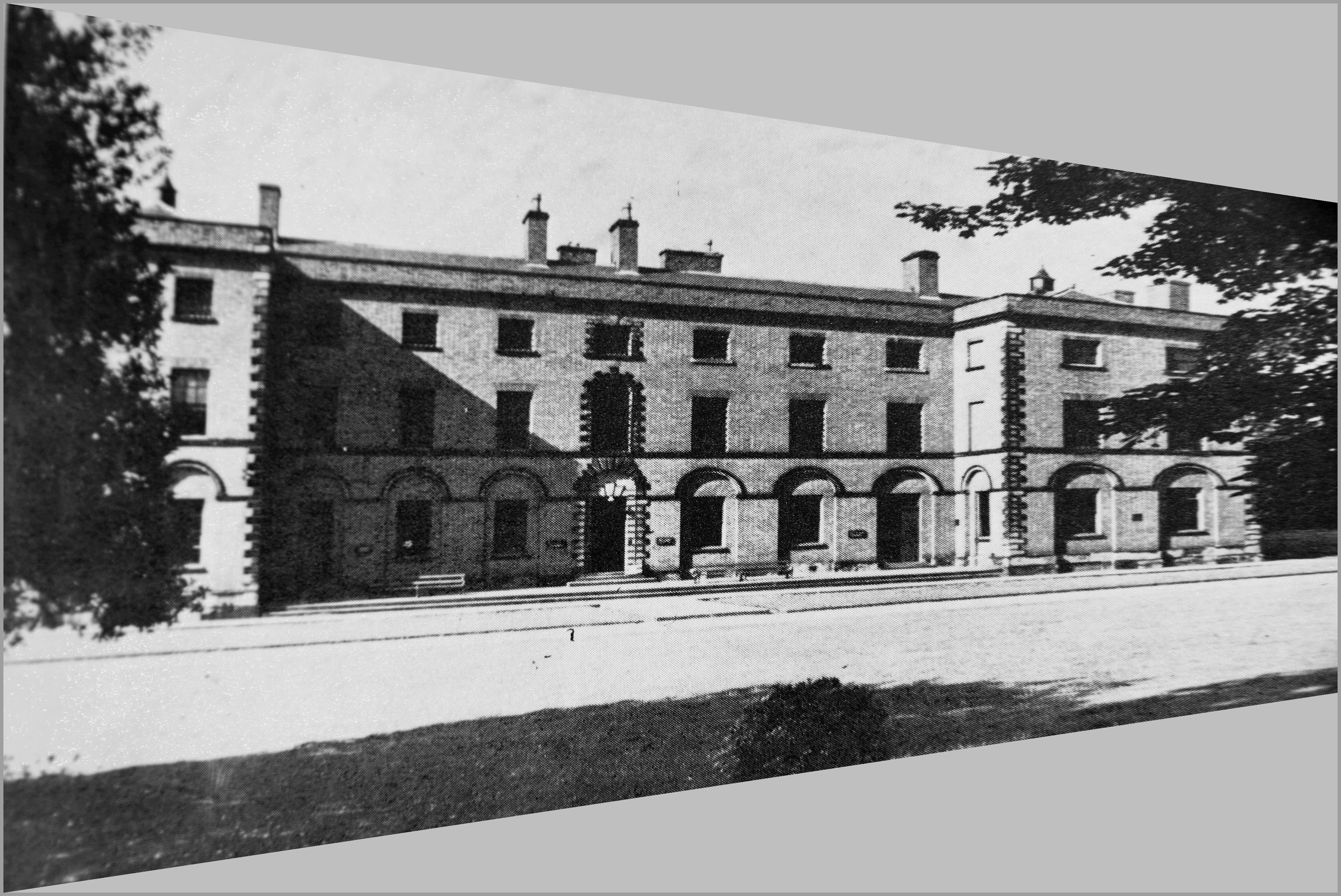
Lincoln County Gaol
My husband is an aficionado of Traffic Cops, a television programme that I abhor. It’s an extraordinary thing, but I’ve yet to meet a woman who likes it and, similarly, to meet a man who doesn’t. (No doubt I shall soon be hearing contradictions from both sexes!) For me, it illustrates far more reliably than football the adage that men are from Mars and women are from Venus; ours is a strictly non-football-supporting household, regardless of gender, and I know many others where both husband and wife are football enthusiasts (although not always rooting for the same team!). Yet Traffic Cops seems to appeal exclusively to males – apparently all of them. Why do they like it? When I’ve glanced at it, it has featured two burly no-nonsense coppers of limited vocabulary driving along the motorway until they manage to apprehend some idiot who is doing something particularly stupid while at the controls of a car. After they’ve stopped him (or her, but it is most often a he), they’re filmed saying, with music hall politeness,‘Would you mind sitting in the back of our car for a few minutes, sir?’ One of them then winks at the camera and says to viewers out of the corner of his mouth ‘We’ve got a right one ’ere.’ And so it goes on.
On the few occasions that I’ve been persuaded to watch these snippets, I’ve felt particular disdain when the cops have reached the county boundary without managing to catch their quarry and turned back. This has seemed to me to be nimby officialdom at its worst! My husband, however, assures me that it must be some time since I watched it, as they don’t do this any more – the different police forces now co-operate with each other across county divides and have even celebrated on the programme their newly-established collaboration.
I was reminded of this yesterday when I began reading about nineteenth-century Lincolnshire in preparation for my next novel. It will be set in the twentieth century, but I want to understand what the background and values of some of the older characters would have been; in other words, the kind of place it was when they were growing up. I was fascinated to read that felons who were arrested on the Great North Road (today’s A1) were often acquitted because the exact spot on which they were arrested was in dispute. If it could not be established whether it was in Holland, Kesteven or Lindsey (Lincolnshire’s equivalent to the Yorkshire Ridings), they were released. Police from Holland weren’t supposed to ‘trespass’ in Kesteven in the line of duty; police from Kesteven didn’t venture into Lindsey, etc. – a rule apparently observed by their modern-day counterparts until very recently. In the earlier part of the nineteenth century, when more than a score of offences carried the death penalty, my guess is that this meant that criminals were pretty hot on their Fenland geography.
None of the three districts of the county had adequate prison facilities until Lincoln Gaol was built. Lincoln is situated in Lindsey, the largest and most ancient of these districts (once a kingdom in its own right). It was agreed that all three districts could avail themselves of Lincoln’s new ‘house of correction’: Lindsey would pay half the costs, Kesteven two thirds of the remainder, and Holland the rest. I was amused to read that after some years it was suggested that the salary of the ‘chief gaoler’ (today he would be called the prison governor) should be raised by £16. The councils of Lindsey and Kesteven agreed to pay, but Holland – the region in which I grew up – demurred. It used to be said that the people of Holland were ‘tighter even than Yorkshire folk’ and, on this occasion, they did not disappoint. Their refusal to pay a little more than £3 extra annually to this no doubt very hard-working gentleman was exactly true to form. Reading it gave me not a feeling of pride, but certainly a warm glow of understanding. I can just imagine my great uncles arguing the toss over such an issue and prudently deciding to keep their wallets closed.
I’m glad that police forces are co-operating now and have ceased to observe artificial boundaries. I know that this is a loophole that has been exploited many times in the past, sometimes allowing people to get away with murder – literally.
Miry March in South Holland

At Quadring Eaudyke the drains run, easing the water from the earth. Watergate and Rushy Drove sing their names of fen and farm to the listening land. Lincs Pumps and Pipelines are in business. Now muddy, mid-March Lincolnshire leans to the spring as tractors tread the acres, their mighty ploughs furling multi-shared furrows, bright with gleaming soil and screaming gulls following to feed, heads black with breeding splendour. Close to the dyke, a fancy pheasant fluffs a whirr of wings and ruffles up a creck-creck call to hens, subsides and pecks again.
Everywhere, home-made ‘Mud on road’ signs celebrate the gloriously spreading feast of mire, while ‘Leeks for sale’ promote the remaining winter crop, with a field half-plucked and batteries of trimmed, pale white and green vegetable bounty on boxes on the verge. The cabbages are past their best: sheep graze the leftovers of leaves and stalks or browse the dedicated crops of roots.
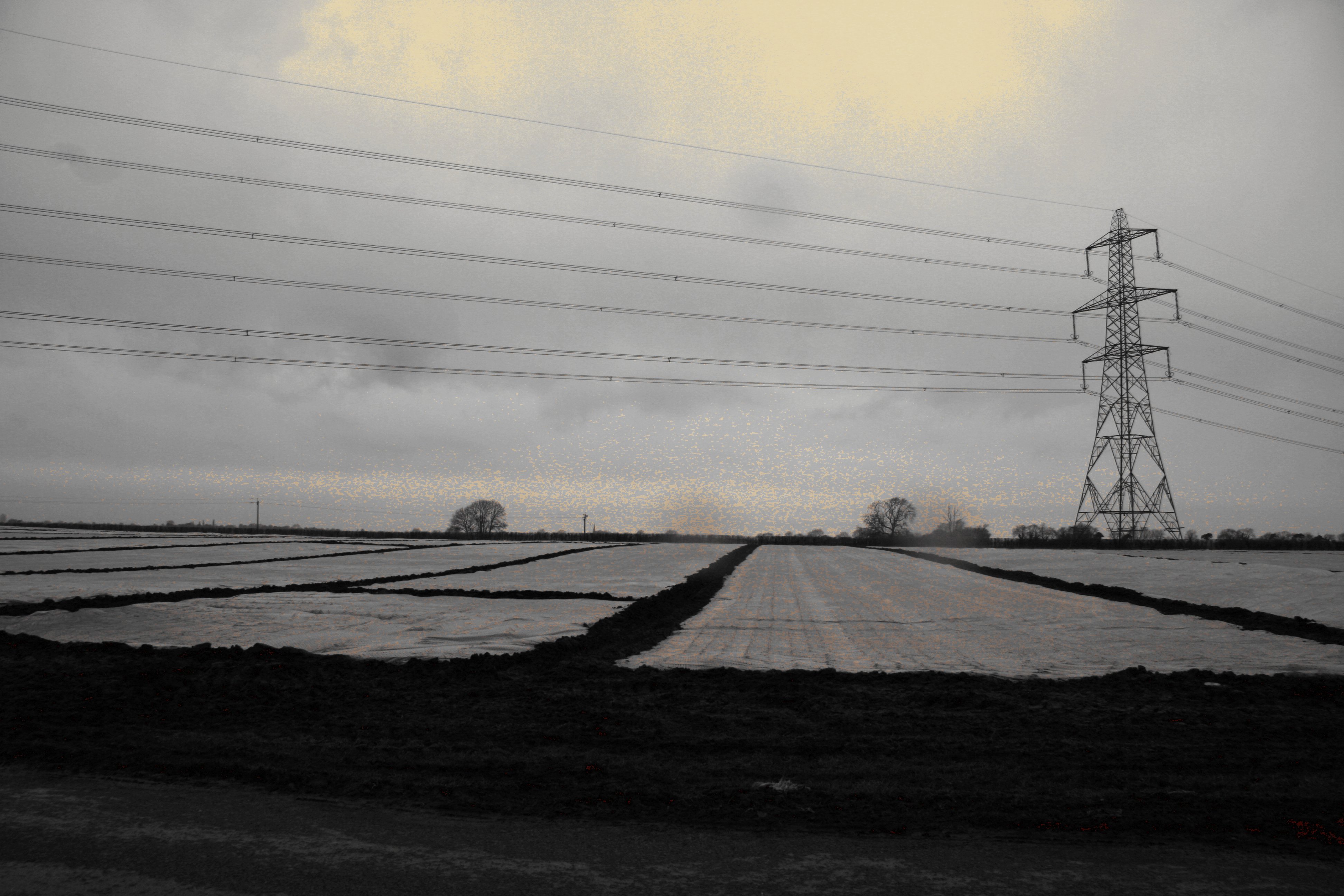
And now, against horizons of leaning spires of churches, metal frames of pylons and grey skies that don’t just threaten but pelt with slanting rain or driven snow, so fickle is the season, roll in the rippling tides of plastic sheeting spread on soil and seed to speed new growth.
And further south, where Surfleet Seas End and Moulton Seas End mark where once the real tides washed ashore, down towards Peppermint Junction, vast swathes of Taylors Bulbs are already deep green and undulate in windy waves; glass houses feed the nation’s supermarkets and those abroad with tonnes of early daffs, with millions of blooms to follow from the open fields. It might be Holland, and is named so, the land reclaimed and drained by dykes twenty feet wide and plenty deep. Here the banks of smaller dykes, protected from cold North Sea winds, have daffodils and periwinkles full in flower, with snowdrops hanging on in drifts of white. Above them, weeping willows are bright yellow with swelling buds and pussy willow catkins grey with fur.
It is spring in the Fens, though the harshest of winter weather still beats in from the east, and the casual passing eye might miss the signs that tell people here that the dark season is done.

 Christina James, crime novelist