

The King’s plunder: magical manuscripts and the earliest printing…
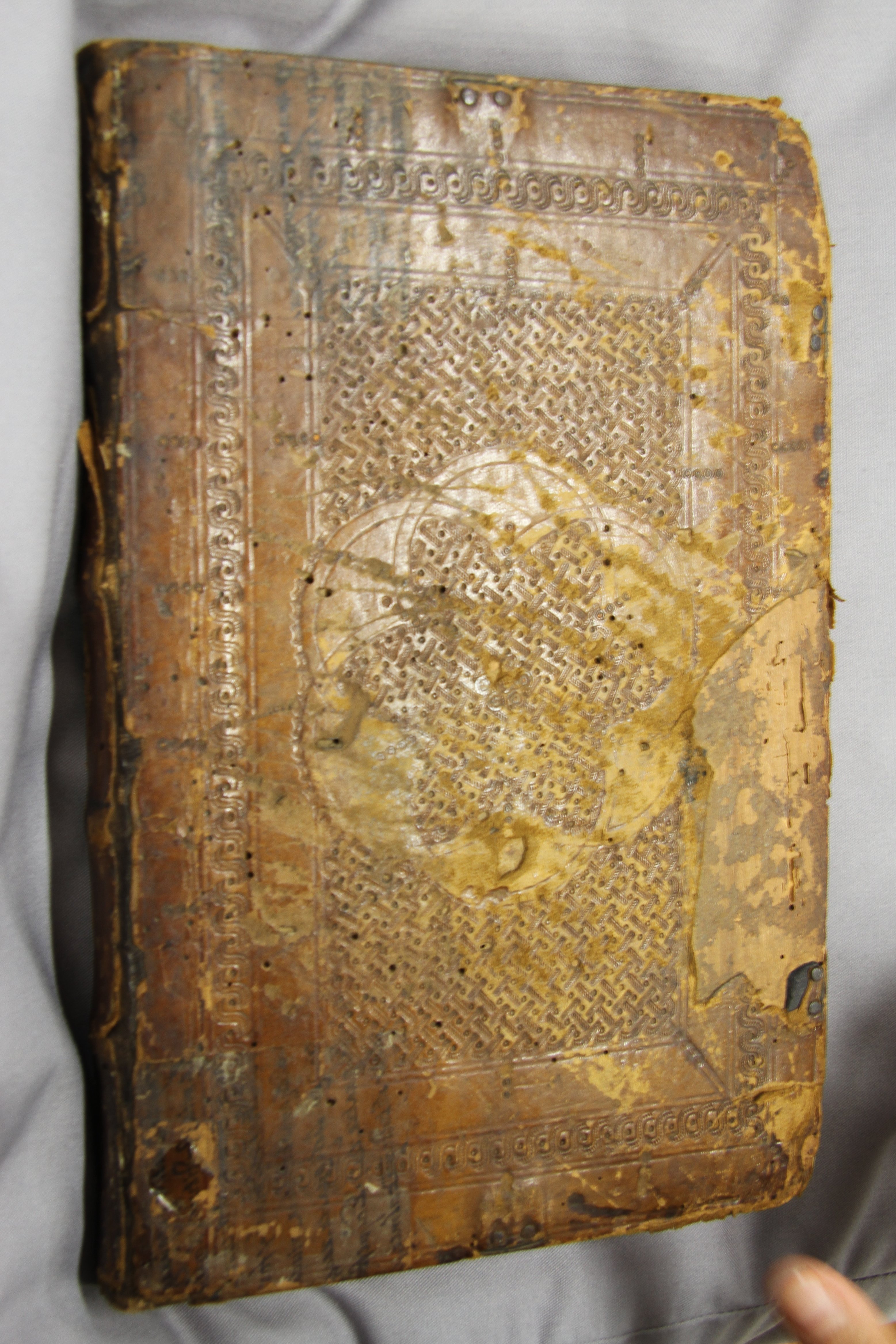
14C leather-bound vellum ms
My recent short holiday in Barcelona was inspired by a brief visit that I made to the city in October 2011, when I facilitated a two-day international librarians’ advisory group hosted by the University of Barcelona. Not only did this previous occasion help to delay having to grapple with the onset of winter for a few more days (in the last week of October, the temperature in the city was around 24 degrees celsius, just a little higher than it was last week towards the end of April), but it provided me with an opportunity to see the library of an ancient university from the inside, because the advisory group meeting concluded with our being shown some of the library’s most prized possessions.
In the 1830s, this library was given a unique privilege by the then King of Spain. He wanted to loosen the grip of the church on the country; he also saw that most of the nation’s ancient manuscripts, incunabula and early printed texts were being held in convents and monasteries. This meant that not only were they inaccessible to scholars and students unless they were also inmates of these foundations, but also, in many cases, the books were not being adequately curated. Gradually, these priceless texts were being destroyed by insects, vermin, damp and, sometimes, acts of vandalism (in the sense that those who coveted particular illustrations might remove them from the work concerned). He therefore ordered that all of these rare manuscripts and books should be given to the University of Barcelona. I imagine that there were some grim ecclesiastical mutterings at the time and I strongly suspect that not every last text was relinquished. Nevertheless, the king’s dictat has resulted in a treasure trove that stands shoulder-to-shoulder with the great library collections of the world. For the university, it has been a joyful trouble: the work of preservation and curation goes on to this day. The books are kept in rooms where the temperature is constant and the university has a continuous restoration programme.

14C illuminated vellum
Having heard about these wonderful works of art, my husband wanted to see them too, so I contacted Carmen Cambrodi, the acquisitions librarian at the university, and asked her if it would be possible for us to make a short visit during our stay. She very kindly arranged for one of her colleagues to show us some of the collection and we spent an enthralling hour in her company. She was very knowledgeable about all of the books in her care. Appropriately, we made the visit on St George’s Day, when the streets outside were full of books of modern provenance.

14C illuminated page
The first book she showed us was an illuminated manuscript dating from the fourteenth century. I have included a photograph of it here. As you will see, all the letters are impeccably formed; it is so perfect that it looks typeset. It was written on vellum, which has stood up to the test of time remarkably well. I’d like to know how many hours it took to complete. It is certainly the result of many months’ work. I wonder if the monk who crafted it with such professional care was pleased or sad when his work was done? The illustrations take your breath away.

15C incunable
The second book is an incunable, or a book printed before the year 1501. It is strikingly similar to the manuscript: it demonstrates clearly that the earliest printed books tried to emulate their handwritten forbears in every detail. Interesting are the gaps left for illustrated letters, which were never completed, and the stamps of the religious institution from which the book came. Finally, there was a sixteenth-century example of a botanical encyclopaedia. This book was remarkable, not only for its accurate and beautiful illustrations (the vegetable dyes used to colour them have hardly dimmed with the passage of almost five hundred years), but also because it concludes with portraits of the three men who, respectively, wrote the text, painted the illustrations and cut the engravings for the printing press. Apparently such celebration of the author and other contributors – and especially inclusion of their pictures – was very rare at this date. You can see that these aren’t stereotyped portraits, either, but real likenesses: you feel as if you would be happy to meet these characters in a tavern and listen to them discoursing sagely on the problems of printing and book illustration, or perhaps the political issues of their day. They look as if they could be fun, too.

16C makers of the book
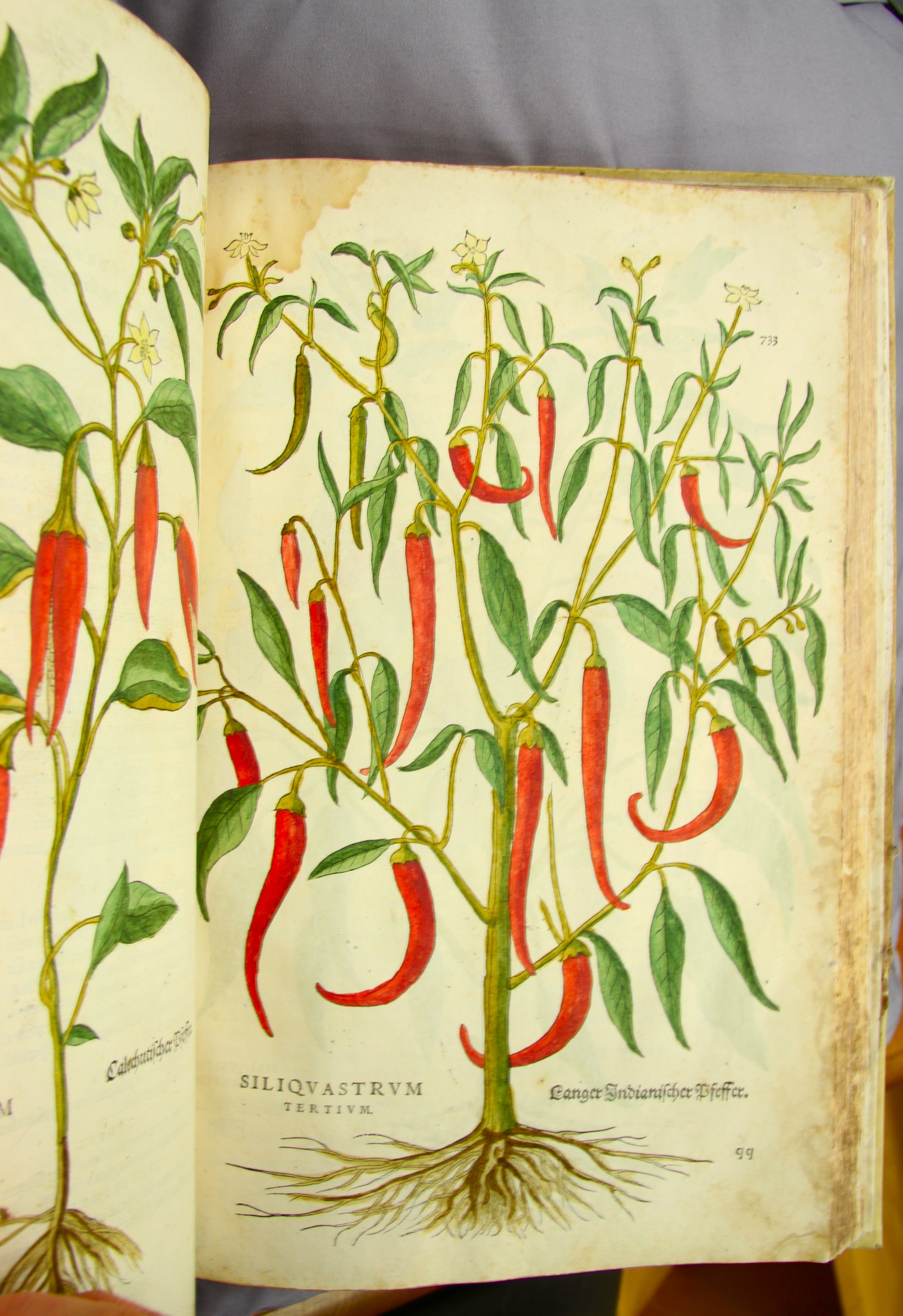
16C chillis
The librarian, Mrs Neus Verger, told us that the paper that was produced in the sixteenth and seventeenth centuries for early printed books was of much better quality than that which followed in the eighteenth, nineteenth and twentieth centuries, with the result that priority for conservation work often has to be given to ‘younger’ books. She made her point by showing us some holes created by insects in some of the pages of the botanical book. The insects had bored through the paper completely, but these small pinprick holes constituted the only damage: the surrounding paper was completely untouched. The insect depredations had caused no further decay.
My husband and I will treasure memories of this visit and hope that one day we shall be allowed to return in order to glimpse again these jewels from bygone ages. I’d like to record here our heartfelt thanks to Carmen Cambrodi and Mrs Neus Verger, a wonderfully erudite but very modest colleague, and to pay tribute more generally to the University of Barcelona, an oasis of calm and of serious learning set in the centre of a bustling and vibrant city.

14C illuminated page
[Text and photographs © Christina James 2013]
Surbiton – potential (for me) as a crime novel location…

As some of my readers with good memories may recall, DI Tim Yates has a sister who lives in Surbiton. So far, his sister has appeared only in In the Family and has no name; she makes no appearance in Almost Love. However, she is a benign, if shadowy, presence waiting in the wings and (I am certain) will crop up in a more central role in a future book.
As I’ve said before, topography and a sense of place are important to me, both in my own writing and in that of others, and I therefore try to place my characters in settings that I know well. I’m familiar with Surbiton because my long-suffering friend Sally lives there. She has allowed me to stay in her lovely turn-of-the-twentieth-century house on almost all of my visits to London over the past fourteen years and she makes strenuous occasions like the London Book Fair tolerable during the day and a joy when I return to her house in the evenings for conversation, wine and good food.
Surbiton is itself an interesting place. It is the quintessential English suburb – even its name suggests it. If you were to hear of it without knowing its location, you would not conjure up an image of a Fenland village or a rugged Scottish town. It sounds like what it is; it even has an equally suburban twin: Norbiton. The twins have mellowed together, their streets laid out and their houses and gardens maintained much as they were in late Victorian times. Even the shops have old-fashioned façades. You feel you might meet Mr Pooter coming round the corner, or see Jerome K Jerome and his friends boating on Surbiton’s stretch of the Thames. Many of the gardens in the street where Sally lives contain beautiful magnolia trees, a feature I think also of the time when they were first laid out, when magnolias were very popular. I love to see them in bloom and am always glad when the Book Fair coincides with their flowering, as it did this year.
Even Surbiton has to move a little with the times, however. On my latest visit, I was amused to see a sign directing would-be purchasers to a new housing development; amused, because the developers have called it Red Square. Now that is a brave step! I don’t know how established residents of Surbiton might feel about this designation, but, as someone who has visited its more famous Russian namesake, I have to confess I see few points of similarity.
I’ve not yet decided upon the exact street in which Tim’s sister lives. Originally, I had conceived of a rather genteel existence for her, perhaps working as a lecturer at nearby Kingston University and living in one of the pretty, solid, semi-detached houses within walking distance of the station. But perhaps she is not like this at all. Younger than Tim, perhaps she is an undercover agent working for MI5. She may even be about to move into a safe house in Red Square.

The book and the rose…

My St. George’s Day roses
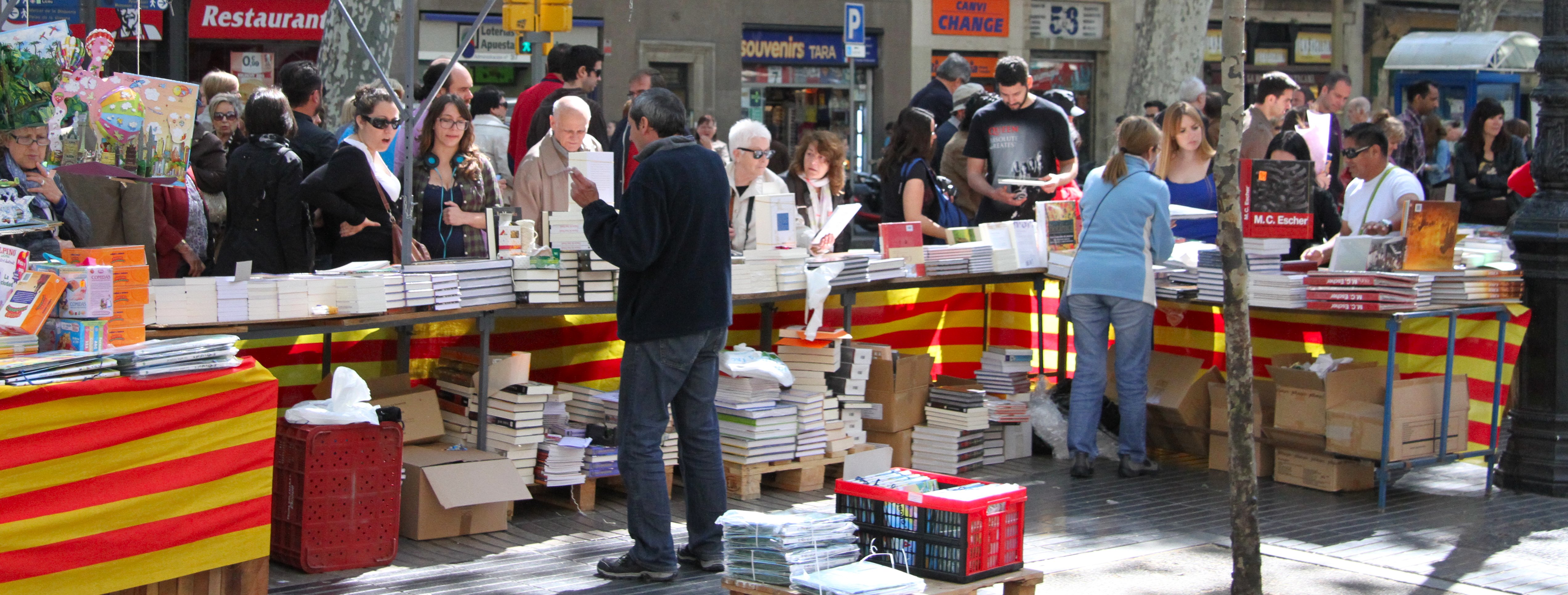
Happily my visit to Barcelona coincided with the celebration of St. George’s Day (on Tuesday 23rd April); ‘Sant Jordi’ is big in this city, which honours him with a much higher profile than we extend to him as our national patron saint. It was, of course, also World Book Day. I’m not sure whether it was owing to Spanish influence that the UK and the USA have chosen this date for their annual bookfest, but I am certain that the people of Catalonia got there first. In Barcelona, it is an ancient tradition to celebrate St George’s role as the patron saint of books. Booksellers bring book stalls out on to the pavements and everyone enters into the spirit of celebrating the book. Sales throughout the day are brisk; almost everyone I saw travelling on the Metro in the evening was carrying a bag of books. There is a carnival atmosphere. St George is remembered by a rose and an ear of corn, symbolising the damsel that he rescued and himself as her rescuer. Traditionally, the Spanish man of honour presented his lady with a rose accompanied by a corn stalk, to which she responded by giving him a book. Christina James, I am proud to say, received her rose (well, three, in fact!) and, for pleasure’s sake, not duty’s, gave her man a book. (For the romantics amongst you – and to the smiles of Catalan onlookers – kisses were exchanged…)

To walk the streets, roses in hand, amid the throng of local people intent on having a good time, was to share in a general joie-de-vivre and to have a precious opportunity to talk to enthusiastic lovers of books. Beautiful displays of roses and red and yellow striped ribbons and flags adorned street corners and pavements everywhere. Music filled the air and the sun shone.
On a more business-like level, I feel that there may be something for us to learn from this. It did strike me at the time that Catalan booksellers are fortunate in being able to place such confidence in the weather; I could imagine a similar event in London or Leeds being suddenly dampened (in every sense of the word) by a sharp shower. And World Book Day is a remarkable achievement, a miracle of co-operation and generosity between all the elements of the book industry and a huge army of volunteers. Nevertheless, no-one was being given anything in Barcelona: roses came at €3 each; books were sold at full price. In a sense, it was all about celebrating the skills of booksellers themselves and the pleasures that they bring… and showing that they are worth paying for. We in the UK should honour our booksellers more and they should learn to expect and accept our homage gracefully and with attitude.
Dog eat dog on the street…

Life can be raw on the mean streets of Barcelona. Down La Rambla, in spite of the police presence, teams of pickpockets roam, taking advantage of the tourists’ distraction to coax valuables out of pockets and purses from handbags. ‘Three-cup-where’s-the-ball?’ hoodwinks naïve player and unwitting audience alike (not all are audience). Along the pavements, with heads and shoulders bent into four-wheeled municipal refuse bins, scavengers of everything from metal to cardboard sift and sort the unwanted detritus of urban life and load it into supermarket trolleys, selling it on later at street corners where, next level up, men with vans pay only low denominations in return. Beggars with appealing canine companions or a pair of crutches play to the emotions of passers-by. Buskers in teams work the subway trains, as does the ‘poet’ with his single learned verse. Tuneless extroverts invade bars and restaurants to serenade diners, prodding shoulders with a nudge and placing an empty bowl on the table. The homeless sleep in parks.
A separate economy is operating beneath the tourist world and it is hard-bitten and single-minded; it has its own hierarchy and its own rules. Though the casual observer may see nothing much of it, careful scrutiny of just a small portion of a street or a tube station unveils the surreptitious transfer of illicit packages, information or cash; eyes that are everywhere and nowhere, looking for gain or Guardia with equal determination. There is a quality in shiftiness that singles out its owner from the rest of the urban swirl and it’s always interesting to use the invisibility of a café vantage point to sift out bad from good. Crowds down the ages have been the haven of criminals, cutpurses and vagabonds, the noise and crush and apparently innocent jostle enabling skilful sleight of hand and surreptitious, instant disappearance.
Too much mistrust springing from too much reading of crime? Not so: watch the hands and eyes and see for yourself. It’s a dog-eat-dog dogfight on the streets.
Don’t get me wrong. I love Barcelona, its lovely Catalan people and its edge. I’m just playing with reality…
Exquisitely conceived…

As it has been some time since I posted about a grand sculptural project, I have decided to take advantage of a current opportunity to rectify matters. I’m enjoying a brief respite from the pressures of work and find myself in Barcelona, where today I have visited the remarkable Casa Milà, better known perhaps as La Pedrera, the apartment building designed by Antoni Gaudí and finished in 1910.
For someone who spends a great deal of time reading and thinking about the dark side of life, walking into this magnificent architectural accomplishment is a spirit-lifting contrast like the gladdening of the heart that comes with the warmth of the sun after one of the bleakest winters I have ever known. And Barcelona is blissfully warm, too, its trees already covered in fresh green leaves and its beaches full of sunbathers.
Those of my readers who have toured La Pedrera will, I hope, indulge my hugely enthusiastic response to Gaudí’s work here. All ripples and curves and fanciful challenges to the dismal straight line, the building is, in fact, a temple to the harmony of art and practical purpose. Its roof, a miraculous sculptural garden of delights, tu rns chimneys, stairways, ventilation ducts and water-management into elegant figures and organic forms, rising and falling above the exquisite catenary arches of the loft beneath. Gaudí designed this latter to be insulation for the apartments from both the heat of summer and the cold of winter. Following the loft galleries around the two internal courtyards (which, lower down, allow natural light to enter the rooms), has the feeling of walking around the caves of some grand champagne house, though windows at intervals permit light and air to enter.
The apartments themselves, one level of which is open as a museum to visitors, are still occupied by private families and various businesses, in keeping with the original intention. I could live here! Original parquet and marble flooring, completely flexible space (the pillar and steel beam structure means that none of the internal walls is load-bearing) and an almost complete absence of four-square normality, together with calm natural lighting, all inspire a sense of peace and joy. I do not exaggerate.
The views from the roof are spectacular panoramas over Barcelona, to the hills and to the sea; those from the windows are down to either the cool interior courtyards or along the bustling streets outside. Balconies, with their hallmark black and scrolled wrought iron balustrades, encourage a desire to watch the world go by below.
I spent some happy hours there today, leaving with a lightened heart and the strong sense of well-being that comes from exposure to something incredibly beautiful and superbly designed. La Pedrera is a marvel.

Just look at this: a new café bookshop in Lincoln!

I’ve used the word ‘serendipity’ several times just lately and, since style matters to me, I’m troubled by tedious repetition; yet Twitter is rather generous with serendipitous moments and another one (thanks to my writer friend Carol Hedges @carolJhedges for the information) popped up in the feed on Thursday last. It was the start of something big and it was, is and will be in Lincoln.
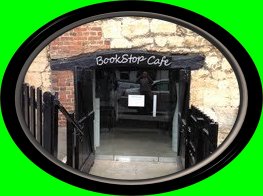
Living in this city are siblings Joff and Becky, who are taking the brave step into the wonderful world of independent bookselling, with a special emphasis upon supporting local and independent authors. On Saturday 4th May, BookStop Café will be opened to the discerning readers and the tea, coffee and cake addicts of Lincoln.
Where? At 46-47 Steep Hill and 7 Christ’s Hospital Terrace, the new home of BookStop Café is also a very old home, an example of Norman domestic architecture and, according to many references, known as ‘Aaron the Jew’s House’ (where Aaron of Lincoln, who died in 1186, lived – he was then the greatest Jewish financier of England). The building has been a shop for many years and is currently where, up above the new bookshop/café, tea importer Imperial Teas conducts its business: an atmospheric venue indeed, ready for a new development in its very long history.
Joff (self-published author Joff Gainey) and Becky have always dreamed of combining a café with books and now their vision is becoming reality: BookStop Café will, at weekends only to start with, be a place for readers to enjoy new and secondhand books in comfortable surroundings. Before very long, it will be a place where children can listen to storytelling and where artists can display their works. Keep up to date with its progress on Twitter at @BookStopCafe .
I am delighted to have come across this new venture and hope that you will join me in wishing it well. The lucky people of Lincoln will be able to settle down to good reading on Saturdays and Sundays from 4th May, 10.00 a.m – 4.00 p.m. My guess is that they will be settling down to some very fine cake, coffee and tea too.
I know where I’ll be heading, next time I’m in Lincoln.
BOOKS ARE MY BAG: WOW!
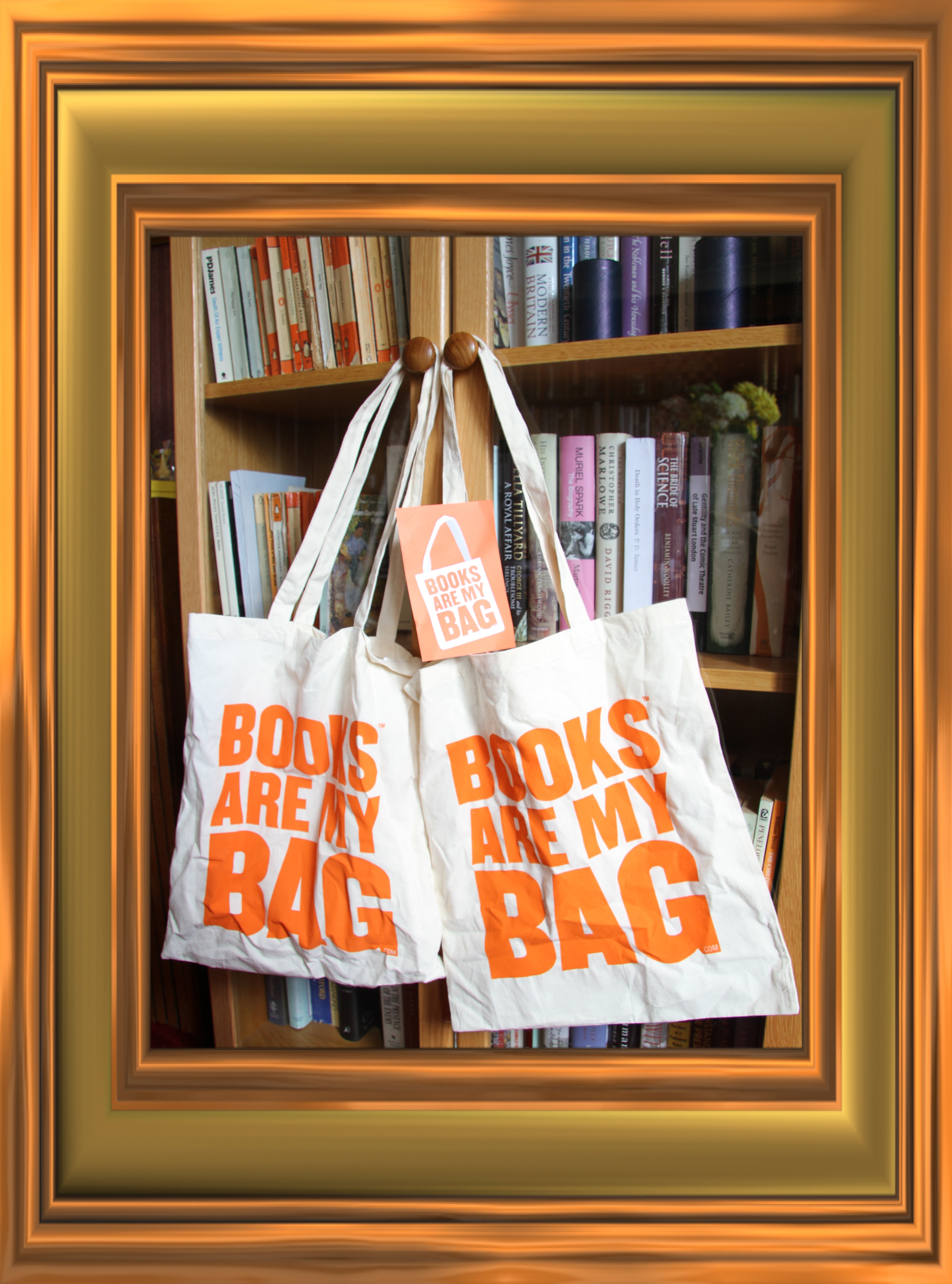
As a former bookseller, my heart was gladdened by attending the announcement of the Books are My Bag campaign, which for me was the most exciting single event held at the London Book Fair this year. The campaign has been devised by M & C Saatchi and is entirely based on a single, simple, very effective message: that the passion for books and bookshops is a precious part of our national heritage and something that we should cherish, celebrate and promote. It is a campaign of perfect solidarity: all booksellers (whether they belong to chains or independents) and publishers are uniting with one voice to celebrate the pleasures and cultural importance of the high street bookshop.
Tim Godfray, CEO of The Booksellers Association and Richard Mollet, CEO of the Publishers Association, both spoke at the event. They were joined by some industry legends, including Patrick Neale, currently President of the Booksellers Association and joint owner of the marvellous Jaffé Bookshop in Oxfordshire (in a previous life he was the inspiration behind the equally wonderful Waterstone’s Sauchiehall Street bookshop in Glasgow) and Gail Rebuck, Chair and CEO of Random House (who, like Dame Marjorie Scardino, has proved that women can get to the top of large corporate publishing houses and stay there).
Patrick’s message was strong and direct. He made the point perfectly that there is far more to the experience of buying a book than receiving a brown cardboard parcel through the post: “We all know that there are many ways to buy and sell books, but what Books are My Bag captures and celebrates is the physical; the simple truth that bookshops do more physically to let people enjoy their passion for books.” Gail Rebuck said: “In these challenging times for the UK High Street, it is terrific that a world-renowned advertising company – M & C Saatchi – has devised such a positive campaign for all booksellers.”
In keeping with its message about the physical presence of bookshops, the campaign will feature strong branding and a very distinctive prop: a cloth bag with the words BOOKS ARE MY BAG printed on it in capitals in neon orange. These bags will be given to customers by bookshops across the country when the campaign is launched on 14th September. I wasn’t sure about the colour when I first saw it – and I was hugely impressed that Tim Godfray was prepared to spend the whole day wearing a matching T-shirt emblazoned with the orange slogan. However, throughout the Book Fair, I spotted people carrying these bags (the BA gave them out daily) and I concluded that they are very effective indeed. As Patrick put it, “This is the first time anyone has needed sun-glasses when inside the London Book Fair.” I have acquired two of them, one from the BA stand and one from the event, and I shall carry them with pride throughout the summer.
Anyone reading this blog who is interested in knowing more about this, here is your link Books are My Bag to its dedicated website.
I love bookshops!
A London Book Fair 13 seminar about using social networking to create author presence


I cannot miss the opportunity to comment in today’s post on the social networking session yesterday morning at the London Book Fair. First, may I thank the very many people who attended and made the event very special indeed; you were a lovely, attentive audience and we all valued your interest and contributions.
Secondly, I should like to thank Elaine Aldred (@EMAldred, Strange Alliances blog), who very generously agreed some time ago to chair this session and, with her characteristic attention to detail, introduced the panel and provided a succinct summary of the key points arising, as well as modestly managing us and our timekeeping!
I was very pleased to meet and honoured to join my much more experienced social networking fellow panellists, Katy Evans-Bush @KatyEvansBush) and Elizabeth Baines (@ElizabethBaines), and to be able to listen to the social networking supremo, Chris Hamilton-Emery, Director of Salt Publishing (@saltpublishing), all of whom provided different perspectives from my own. However, though we may have addressed in various ways the topic of how to make the most of the best of social networking, I felt that we were un
 animous about the terrific value of what Chris called ‘the confluence’ of such media as Twitter, Facebook and personal blogs in creating author presence and profile. I believe that we also affirmed the essential need to be ourselves (however uncomfortable it may initially feel to present our private side, as Elizabeth very pertinently explained) and to interact with the people we ‘meet’ in a genuine way. We shared the view that ramming our books down the throats of our online audience in a ‘hard sell’, as some people do, is counter-productive; it is much better for us to engage with others in discussion of the things which matter to us, such as the business of writing, literature, topical issues and so on. Katy pinpointed the effectiveness of social networking in creating a global family of friends and followers, something we also all felt.
All in all, the session emphasised that participation, helping others, reciprocating generosity and showing real interest in people whom we come to know online are crucial to creating a lasting author presence. It is really important that authors recognise that they need to have such a profile; with it, books certainly do sell and, as Chris put it, without it they don’t.
Finally, we all accepted the inevitable consequence of managing all of the personal interactions online: it is extremely time-consuming and we have to find our own ways of handling that; if we succeed, the benefits are very clear to see.
My thanks again to all concerned in what was for me a very memorable occasion.

I’d like to knock down that Victorian edifice…

Taking up the theme of food again, I’m still reading about Victorian houses and customs in order to get a feel for how the very old people whom I knew in my youth grew up. One of the things that strikes is me is how indelibly the Victorian age made its mark on those who were born within it. My grandmother was born in 1892 and was nine when Queen Victoria died, yet all her life she was a Victorian. She even dressed like one, in ankle-length skirts and pastel-coloured blouses trimmed in lace, with high collars.
Not only did Queen Victoria’s reign seem to imbue everyone who lived in it with norms and values that were immediately spurned by the next generation, but it succeeded in erecting an almost insuperable barrier between itself and the age which preceded it. The most alarming thing of all is how women seemed to become walled up as part of this process.
They were literally walled up: condemned to stay in the house almost all of the time, maintaining and cleaning it or supervising its cleaning and maintenance, depending on their class; spending each day of their lives ensuring that the master of the house returned to a perfectly-kept residence. This in itself would have been irksome enough, but social aspirations added to women’s domestic workload in the most intolerable way. In an age when the middle classes were burgeoning, so that many people had more of what is now called ‘disposable income’, and when, for the first time, machinery could churn out materials and finished goods very cheaply, houses became filled with all kinds of artefacts, many of them quite useless. Whether they were bought or made at home, all of these things also needed care and maintenance – the latter involving a great deal of washing and cleaning when houses were warmed by coal fires and lit by candles or gas. Clothes and food became much more elaborate. Women were not only not allowed to go out to work, they felt compelled to spend every waking hour carrying out tasks which today we would regard as of minimal value or even futile. Meals in middle-class households consisted of many dishes. When providing food, the housewife was expected to achieve an illogical combination of outward show – especially when there were guests at the table – and the practice of frugality. This often meant that the same food appeared on the table several times running before it was finally consumed, each time ingeniously and time-consumingly served up in a slightly different way.
I’ve often reflected that, to a greater or lesser extent, all except the very young spend some of their time living in the past. Although my own and my husband’s tastes in furniture are quite traditional, and therefore most of our possessions have not dated all that much, I know that the décor and soft furnishings in my house are very much of the period at which we moved in to it in 1994, and that visitors will recognise this. It is a phenomenon that was yet more true of previous generations: they thriftily kept the same furniture until it had, quite literally, worn out. And it wasn’t just the surroundings that belonged in the past; attitudes, values and points of reference were also behind the times. Exactly how far behind often depended on location, sometimes also on education. In London at the turn of the twentieth century, the Bloomsbury Group famously rejected the lifestyle and morals of their Victorian parents; however, Victorian lifestyles and morals were still alive and well in the Spalding of the 1950s and 1960s. It took the combination of the pop scene (I don’t just mean the music, but everything that went with it) and the advent of the first working-class generation to be university-educated to instigate real change.
In some ways I feel privileged to have lived through all of this and, through aligning my reading with my own memories, to have come, belatedly, to some kind of understanding of it. Women today still complain about glass ceilings and the impossibility of ‘having it all’. True equality has been a long time coming and is not quite here yet. The journey was started by those Victorian girls who were allowed just enough education to understand what they were missing. Some nineteenth century women were so frustrated, or so badly treated by their husbands, that they turned to murder (the weapon of choice was poison), knowing that the death penalty would surely be their fate if they were caught.
What I’d really like to be able to do would be to travel back to the past and knock down that huge Victorian edifice, as the Berlin Wall was knocked down, in order to be able to see beyond it to the Georgian age that preceded Victoria’s. I wonder what those women, in their lighter, brighter, more sparsely-furnished houses, were like; whether they led happier lives than their Victorian descendants; whether knowing them better would prove the hypothesis that civilisation develops, not in linear fashion, but in loops and curlicues, like oxbow lakes. The Victorians, so enterprising in so many ways, were out there in their boats, not realising that they were grounded in a swamp.
Let’s consider the general good of the English-speaking world…

As I’ve mentioned, I’ve just spent several days at a conference – the sort of event where I meet people whom I haven’t seen since the last conference or, in some instances, for two or three years before that. If you’re British (as I am), good manners dictate that making the courteous enquiry ‘How are you?’ at such meetings is inescapable. Naturally, such etiquette under such circumstances tends to be more for convention than for information. The answer that I dread getting back is a prolix account of all the ailments that the acquaintance has suffered in the interim (‘My sciatica hasn’t been playing up lately, but I had ’flu really badly this winter, despite getting the injection, and I’m still not feeling …’ etc., etc.), the speaker (and listener) obliged all the time to stand in a hot, crowded, noisy room and drink outsize glasses of red wine, on the whole coping remarkably well with his or her various infirmities.
The next worst response is short but irritating: ‘I’m good’. It’s an expression that I first encountered about twelve years ago, interestingly also at an event. I had to think about what it meant for a moment. Clearly an American import, as a stock response it gained ground slowly at first and then with rapidly-increasing speed. I shall come back to it in a minute.
‘Good’ is a slippery word. Used as an interjection, it can variously signify an approving verbal nod, a comment on the speaker’s views or performance, or just something to say – a more positive alternative to ‘Oh’. Its use as an adjective is familiar to everyone (though I’m sure there are many gradations of meaning from individual to individual when saying that something is good), but I must have been about forty before I realised that good in the singular is also a noun. I discovered this in rather traumatic circumstances, having been required to teach a first-year postgraduate class basic economics as part of an MBA course, even though economics was a subject of which I had been entirely innocent until that moment. (Don’t ask – it involved university in-fighting, a topic on which I can wax at length in very bitter and twisted fashion!) I still dislike this use of the word. I don’t mind ‘goods’ in the plural – ‘goods train’, for example, is a term that appeals with its expansive connotations of plenty; but ‘a good’? It is too abstract, too pedantic, too stuffy. To me it represents a kind of emotional shorthand, like being given a plastic token instead of a gift.
Then there is ‘goody’ – as in sweets (‘goodies’) and also as someone who is sickeningly good (Goody Two-Shoes). It was Arthur Miller who taught me (in The Crucible) that Goody was originally an abbreviated version of ‘Goodwife’. The male equivalent was Goodman, but this does not seem to have survived in any modern context. I don’t like Goody as an alternative to Mrs – or Mistress, as I suppose it was then. It’s too oppressive, maybe too exclusive – it was a term that belonged to Puritanism. (Miller, of course, exploits the irony of this.)
And so I return to ‘I’m good’. What is it about this expression that makes it so objectionable to me? I think it’s because it has a number of undesirable overtones: it seems prickly (‘How impertinent of you to ask’); defiant (‘Why would you think I was anything other than fine?’) and superior (‘Everything about me is excellent. What about you?’). It also involves incorrect usage, judged by UK English standards, anyway. When offered it, I am very tempted to reply, “Oh, really? I had always considered you to be very wicked and bad!”
Good, that’s sorted. I rest my case.
 Christina James, crime novelist