

The ticking of time…

Today, August 9th, was my grandmother’s birthday. Already an old lady in my first memories of her, she was born in 1892. If she were still alive today, she would be 121, making her only slightly younger than Jeanne Calment, the longest-lived woman ever (reliably) recorded. I always remember the date of her birth when it comes round, partly because it is only a few days after my own birthday.
My grandmother was eighty-seven when she died. Although she was nine when Edward VII (whom she saw when he visited King’s Lynn shortly after his coronation) came to the throne, she remained a Victorian all her life. She dressed in high-necked blouses and ankle-length skirts. She never bought an article of clothing from a chain store; instead, she was fitted by a dressmaker twice a year for a new summer dress or a new winter dress, for ‘best’, plus two or three more of the almost-identical perennial skirts and blouses. Every few seasons, there would also be a new coat and a hat to match. She always wore a hat and gloves in the street and kept the hat on if she were visiting someone’s house. People in Spalding used to say to me, ‘Is your grandmother that old lady who’s always so beautifully dressed?’ Her shoes were handmade, too. She went to church several times a week and always twice on Sundays. She had standards.
You’d almost think that the twentieth century was an irrelevance to her, yet she was a bystander at some of its most significant events. Aged nine, she was lying in bed with rheumatic fever when her mother came in and said, ‘The Queen’s dead.’ (She meant Queen Victoria). She was working as a nursery nurse in London when her upper middle class employers told her in hushed tones of horror of the murder of the Russian royal family. Like many other young women, she knew young men who never returned from the trenches. She witnessed one of the Zeppelin raids on London, and was still living and working there during the General Strike. She remembered the suffragette processions and was flattered when she was told that she looked like Nancy Astor, the first woman MP. After she moved to Spalding (to be near her ageing parents) in the mid-1930s, she watched a rally held there in the marketplace by Oswald Mosely and his blackshirts. She and my mother were making a bed together towards the end of the Second World War when a doodlebug immediately overhead stopped buzzing; they each froze and waited, but thankfully it fell in Bourne Woods, some fifteen miles away.
These are just some of the reminiscences that she shared with me when I was a child (and I was always spellbound by her memories, never bored by them). Today, I thought it would be interesting to find out a few of the other things that happened in the year that she was born. It turned out that 1892 was a very eventful year… and, to list just a few of the significant happenings I’ve discovered that happened in that year:
- Thomas Edison received a patent for the two-way telegraph.
- Ellis Island began accommodating immigrants to the United States.
- Rudolf Diesel applied for a patent for the petrol ignition engine.
- The General Electric Company was founded.
- The Dalton Gang was apprehended by local townspeople and most of its members shot dead.
- An anarchist’s bomb killed six people in Paris.
- The Nutcracker ballet was premiered in St Petersburg.
- Andrew Carnegie (later a huge benefactor of English and Scottish libraries) amalgamated his six companies into one business and gained monopoly of the American steel industry.
- The father and mother of the suspected murderess Lizzie Borden were found dead in their Massachusetts home. It was one of the first murders to arouse widespread public interest.
- Conan Doyle published The Adventures of Sherlock Holmes.
- It was the birth year also of Oliver Hardy (of Laurel and Hardy), Haile Selassie, Pearl S. Buck, Vita Sackville-West and Hugh MacDiarmid. Hugh MacDiarmid was my grandmother’s very close contemporary: he was born just two days after her and died five months to the day before she did.
The story that this miscellaneous list of facts tells is that the seeds of the twentieth century – scientific, cultural, literary and political – were being sown by the beginning of the 1890s. There can be no period of time that has seen greater changes than the years that my grandmother’s life (1892 – 1979) spanned. When she was born, motor-cars were in their infancy and girls waited impatiently to be allowed to ‘put their hair up’; when she died, it was already eighteen years since Yuri Gagarin had been launched into space and Flower Power, The Beatles and the mini-skirt had been and gone. Yet she was not impervious to these events; rather, she seemed to take them in her stride. In the meantime, she carried on wearing long skirts, visiting her dressmaker and attending church, confident, I have no doubt, that one day the world would wake up from its madness and proper decorum would be restored.
All, apart from my memories, that I have of her are a few presents that I treasure; they include a brass carriage clock of hers, which, as it stood on her mantelpiece, and now stands on mine, seems a symbolic link of time to a bygone age of which she was very much a part.
The most atmospheric of writers…
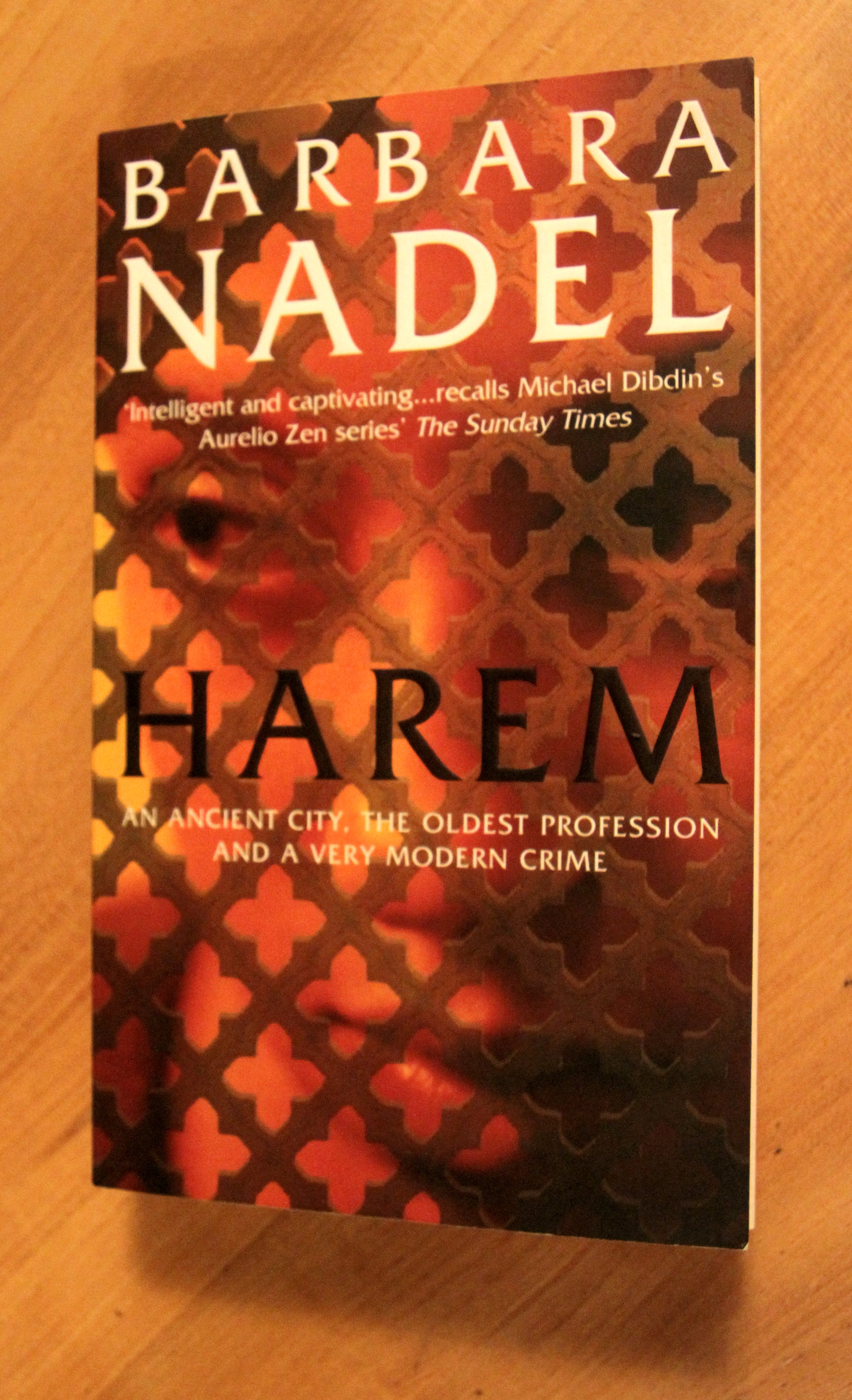
One of the great pleasures to be obtained from reading crime fiction is that most crime writers are acutely aware of both the geography and the mood of the communities that they write about. I won’t claim that there is such a thing as national character – I know that I shall immediately be shot down in flames if I even hint at it – but I’m certain that the massive popularity that Scandinavian crime writers have achieved owes a significant debt to the ambience of their work: the dark nights and cold days that they evoke, which in turn inspire brooding and melancholy characters who seem determined always to spot the worm in the bud, despite the consummate beauty of their surroundings. Similarly, the novels of Donna Leon and Michael Dibdin, which are set in Italy, skilfully succeed in communicating the rich cultural heritage of that country.
No-one, however, captures the essence or psyche of a country better than Barbara Nadel. Perhaps I should say city, rather than country, as all of her novels that I’ve read have been set in Istanbul. With apparent ease, she captures the contradictions of a city that has always looked both East and West: its exoticism and squalor; the brutality of some of its people and the sophisticated philosophical outlook of others; the thrusting modernity that jostles but does not oust more ancient superstitions. Other writers have written eloquently about this city, especially Orhan Pamuk, whose Nobel prize-winning work, so exquisitely wrought, seems to derive its depth from these very contradictions; yet, in my opinion, no-one, not even Pamuk, surpasses Nadel’s descriptions of Istanbul’s mean streets and boisterous crowds when she is writing at her best.
I’ve read three or four of her books now. I particularly admire her depiction of her world-weary but wise and humorous detective, Çetin Ikmen, who is beleaguered not only by the absurdities of red tape and the inefficiency and bigotry of his colleagues at work, but also by his large, unruly and ever-growing extended family at home. The latter is presided over by his ebullient and chaotic, much less well-educated wife, Fatma.
Harem is a particularly accomplished novel, because it examines issues of profound significance in Western countries through the filter of setting them in Istanbul. This not only makes it easier for the Western European reader to read about them, but also points up the dual thinking still prevalent in almost all countries by presenting it as a peculiarly Turkish phenomenon. This provokes the immediate response: ‘That couldn’t happen here!’, followed soon afterwards by: ‘Or could it?’ The original crimes committed in Harem are rape and the exploitation of women, leading in some instances to murder. The first of the murder victims is Hatice, a friend of Ikmen’s teenage daughter Hulya. Nadel’s account of Ikmen’s boss’s reluctance to pursue the girl’s murderers and bring them to justice because she evidently was not a virgin before they attacked her is particularly poignant. We might try to flatter ourselves that such an attitude could not prevail in our country, were it not that only in the last few days a British barrister has described a thirteen-year-old girl against whom sexual offences were committed as ‘predatory’. Nor does Nadel pull her punches when it comes to describing the perpetrators of rape. Hatice had unwittingly become involved with a group of people practising organised depravity, but her case is mirrored by one even closer to home for Ikmen, that of the abusive relationship that exists between two of his own police officers. As one would expect from a writer of Nadel’s talent, the moral conclusions that she draws are complex, but she is quite clear that women should never suffer from sexual abuse, whatever their personal moral code. This message may seem obvious, yet it is one that societies everywhere seem to be taking a long time to digest. Harem makes a very valuable contribution to the debate.
Of the other characters, several old friends feature in this novel. My particular favourite is Mehmet Suleyman, Ikmen’s disdainfully aristocratic colleague, who in this book finds himself less able than usual to sail, cosseted and immaculate, through his life, as if the teeming, grubby throng of humanity that it is his job to police does not really exist. Suleyman’s volatile Irish wife is suffering from post-natal depression and he has to run the gauntlet of her tantrums and her misery. And then there is Fatma, impossible but lovable, weaving her idiosyncratic magic on her weary but essentially adoring husband.
I wholeheartedly recommend Harem. If you’re new to Barbara Nadel, you won’t lose anything by starting with this book, as, despite being one of a series, it stands completely on its own, as such novels should. However, I’m certain that, if you do read Harem first, it will make you also want to sample some of the others.
Profile of an artisan potter


Spherical pot

Pendant lampshade with a difference!

Bird platter

Mobile mirror plate

Large water feature

Cockerel
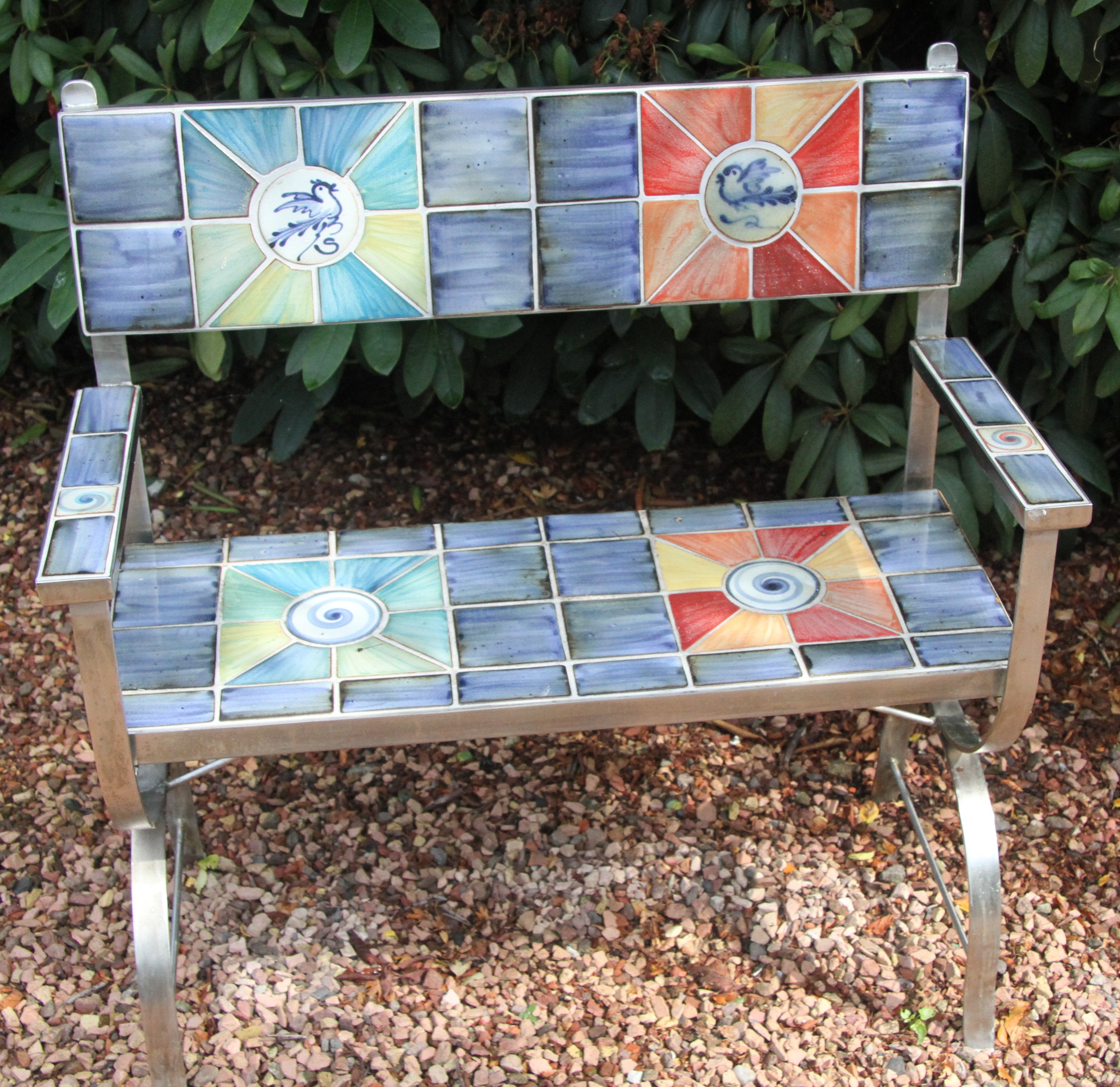
Garden bench
I have recently visited Münsterland, the area around the city of Münster in Germany, and, in particular, a triangle of prosperous villages, Havixbeck, Billerbeck and Nottuln, all associated since mediaeval times with sandstone carving, and the latter with a characteristic blue-glazed pottery. Being lovers of individual, hand-crafted products and of clayware, my husband and I tried in vain by car to find a contemporary artisan in the district, as we had seen examples locally; yet it wasn’t until, on a bike ride towards the end of our stay, we happened upon a glass display case fixed to the wall of a Nottuln hotel that we could locate the potter. The case contained some examples of the work, some photographs and, tucked away at the top, some cards with a name and an address, out in a rural hamlet called Stevern.
Good luck happened twice, as, when we found the pottery itself, Monica Stüttgen had only two hours before returned from a holiday in the Black Forest. She showed us into her house and invited us also to look around the garden, both of which are a treasure trove of beautiful examples of her handiwork. The whole of the ground floor of the house is given over to a studio and rooms displaying a remarkable range of artefacts, quite a few of them carrying her trademark, a flying bird with a fanning tail.
Monica says that she regards herself as a craftswoman, rather than an artist (coincidentally, this is also how the many generations of sandstone sculptors also viewed themselves) and feels particularly strongly that her pottery should be used, not just put on display; it is well glazed, using modern processes, and, she adds, will stand both frost and the dishwasher! Though it accords with traditional designs, it plainly reveals much of her individuality and considerable artistry.
I’ve included in this post some photographs of some of her work, from both inside the studio and out in the garden. She obviously draws some of her inspiration from Nottuln, of which she is a native, although she told me that she spent ten years making and selling pottery in France. Like many artisans – indeed many writers – that I have met, her chief problem is obtaining publicity for her work. Once people have seen it, they love it and want to come back for more, but she is struggling to find a wider public; at the moment, she does have an arrangement with the local restaurant, Gasthaus Stevertal, to display examples of her pottery (Stevertal is a fine traditional German restaurant with a menu that features the local cuisine – we ate here twice… and twice missed her display!) and the showcase in Nottuln, but these are not enough.
I found both Monica and her work fascinating and I am full of admiration for what she is trying to achieve. I suggested that she should try to extend her customer base by developing a blog for her website and new contacts via social networking; I also promised to write a blog-post myself as my own, very small, contribution to try to help. So here it is.
We bought a fruit bowl, a fish plate and two eggcups and Monica very generously also gave us a kitchen tidy in one of the traditional Nottuln designs. I’m delighted with them and doubt that I shall be taking any risk on the dishwasher front! As our daughter-in-law also comes from this area, we shall certainly visit the pottery again: there are many other pieces that we should like to buy. For example, we were particularly taken with the ceramic garden labels for herbs.
I feel very strongly that the skills of an artisan should be encouraged and supported, especially one with Monica’s obvious talent. If you happen to visit this area, you won’t be disappointed by an hour or two in her lovely studio and garden. You may like to know that she is also prepared to send items by post!
Led to a lovely real place by reading a magical book…

Het Witte Huis

Kubuswoningen

Valerie Poore’s Vereeniging

Open air workshop
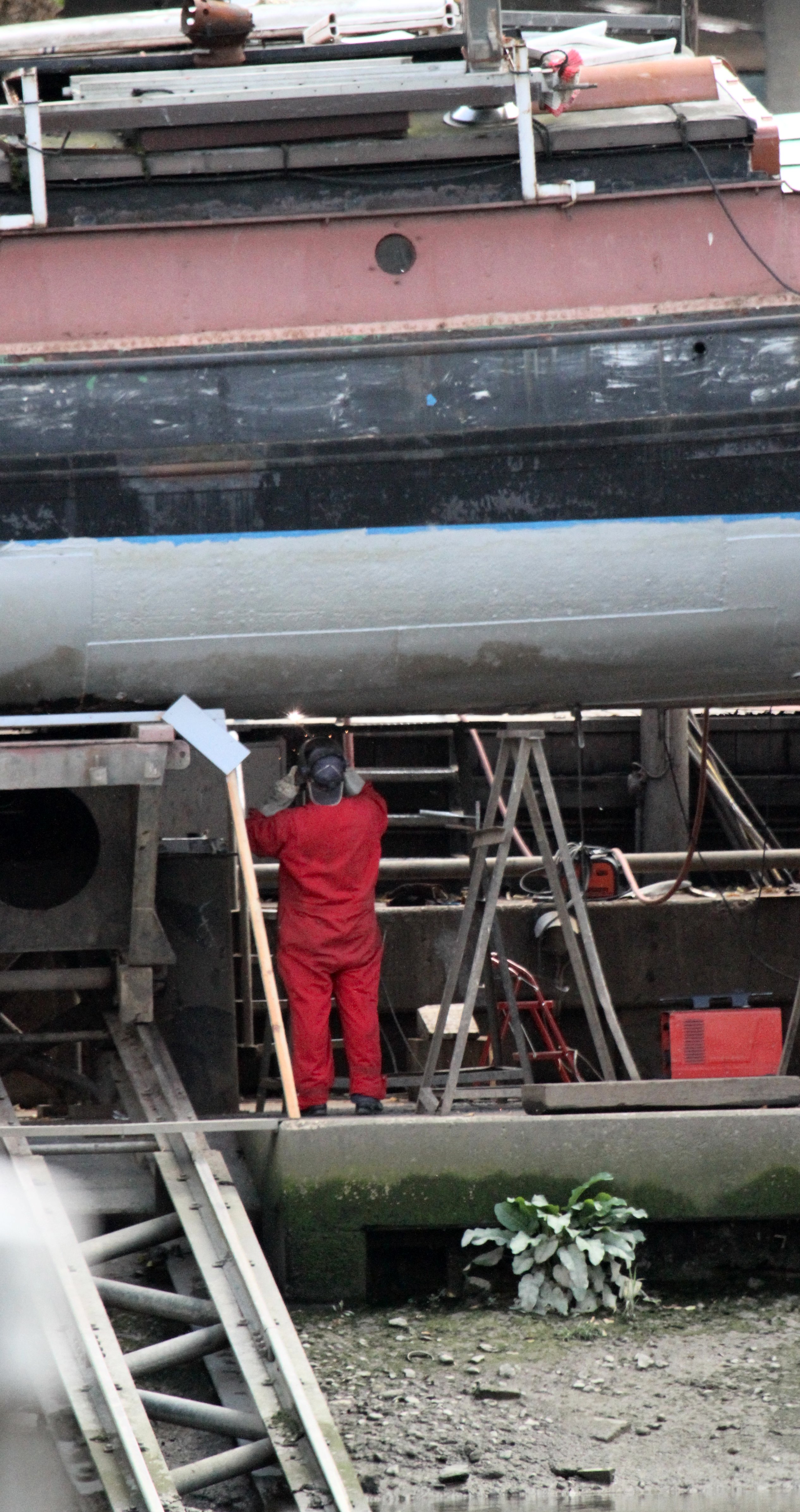
Heavy metal

Oude Haven
‘Shakin’ that ass!’
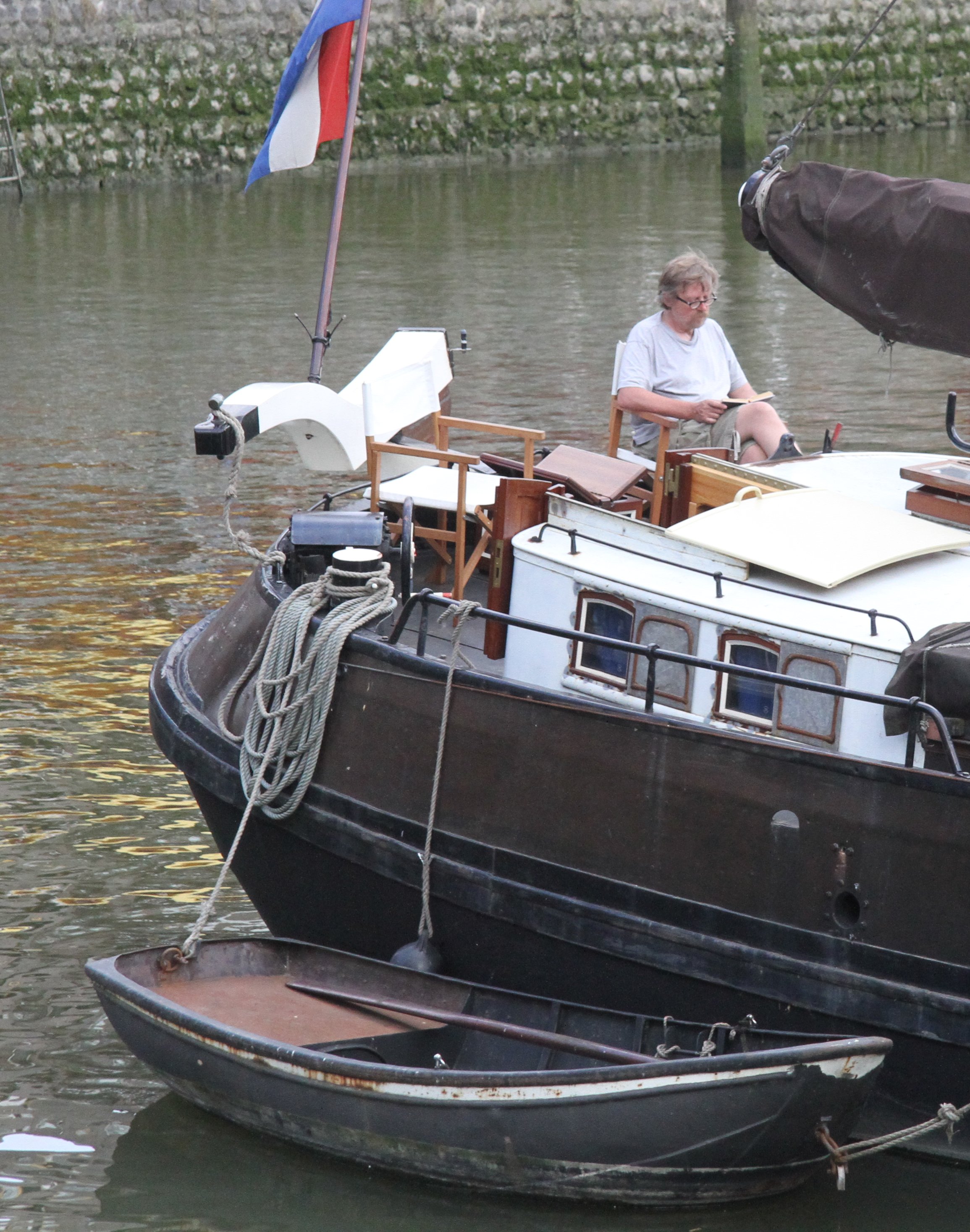
Lots of hard work and just a little rest

Raised from the mud

Along Haringvliet
[Click on pictures to enlarge them.]
Though I’m not a travel writer, I’d like to share a recent visit to a place I had previously never considered exploring, but, having read a book by a Facebook and Twitter friend and seen pictures of it on her pages, I resolved to stop and have a look at her world. I occasionally pass close to this location, but am always en route to somewhere else (Aren’t we all?), with deadlines and people to meet, and it had never before spoken to me with seductive siren tones nor even given me a glimpse of its hidden beauties and charms.
This time, I wasn’t even sure if we would manage the detour, but my husband and I started out early from Germany and covered the intervening kilometres without delay, aided by what he had always previously eschewed but which now proved absolutely essential, sat nav. Negotiating foreign cities, especially those with road systems apparently designed to doom motorists to madness, is always fraught with tension; navigating Rotterdam’s streets may be a piece of coffee and walnut to its residents, but without help or prior knowledge, the new visitor might as well be in the wilderness.
We were heading for Oude Haven, the ‘Old Port’, or the oldest harbour in the city, now home to a collection of historic Dutch barges which Valerie Poore, @vallypee, not only writes about in her books, but has lived on and restored here, for Oude Haven is a working museum with a team of enthusiastic owners, metal- and wood-working skills and the heavy gear to lift huge vessels out of the water to repair and return them to their original state.
I can tell a nightmare story of parking in Amsterdam, which perhaps I’ll relate here some other time, so we were prepared with plenty of small change to feed the greedy meters and defy the wardens, when we eventually turned into Haringvliet, which we had strolled down on Google Maps and determined as our best stopover point for the harbour; however, our research had not been thorough enough, as we discovered that the meters are not fed with money, but with prepaid cards to be got from a range of locations (however, it was a Sunday and we had no means of finding them easily). Then we discovered, by dint of guessing at the truly double Dutch meter instructions that some meters could be accessed by credit card, but we couldn’t immediately see one of those. The masts of the barges and the gorgeous array of moored boats just in front of us seemed to float off into the mists of meter mania.
Rescue came in the form of a bluff but very personable gentleman who had just been buying flowers from the stall at one end of Haringvliet, where, he said, was a credit card meter. Not only did he walk us to it, but used his own card to meet our two-hour stay and accepted our cash payment only very reluctantly. How’s that for hospitality?
The way was now open to explore, albeit quite briefly, the harbour and to locate Vereeniging, the elegant barge belonging to Valerie. The place is a marvel of architecture, considering that most of the area was flattened in WWII. Perhaps most striking is Het Witte Huis, The White House, an art-nouveau skyscraper building designed by architect Willem Molenbroek and erected in 1897-1898, which miraculously escaped destruction in 1940 and which still towers over the port, though it has long since lost its original place as the tallest multi-storey structure; the eye is then ineluctably drawn to the astonishing ‘Kubuswoningen’ or ‘Cube Houses’, the 1984 brainchild of architect Piet Blom, just along the wharf.
But we were here, as lovers of English canal boats and boating, to look at what was on the water (or, in the case of barge Luna, raised out of it to the dockside repair cradle and undergoing some heavy metal treatment – welding was well under way, if the boat wasn’t!). The barges are remarkable, with their sheer size, huge masts and characteristic leeboards (for they are sailing cargo vessels), and we should have loved to have been able to look inside them.
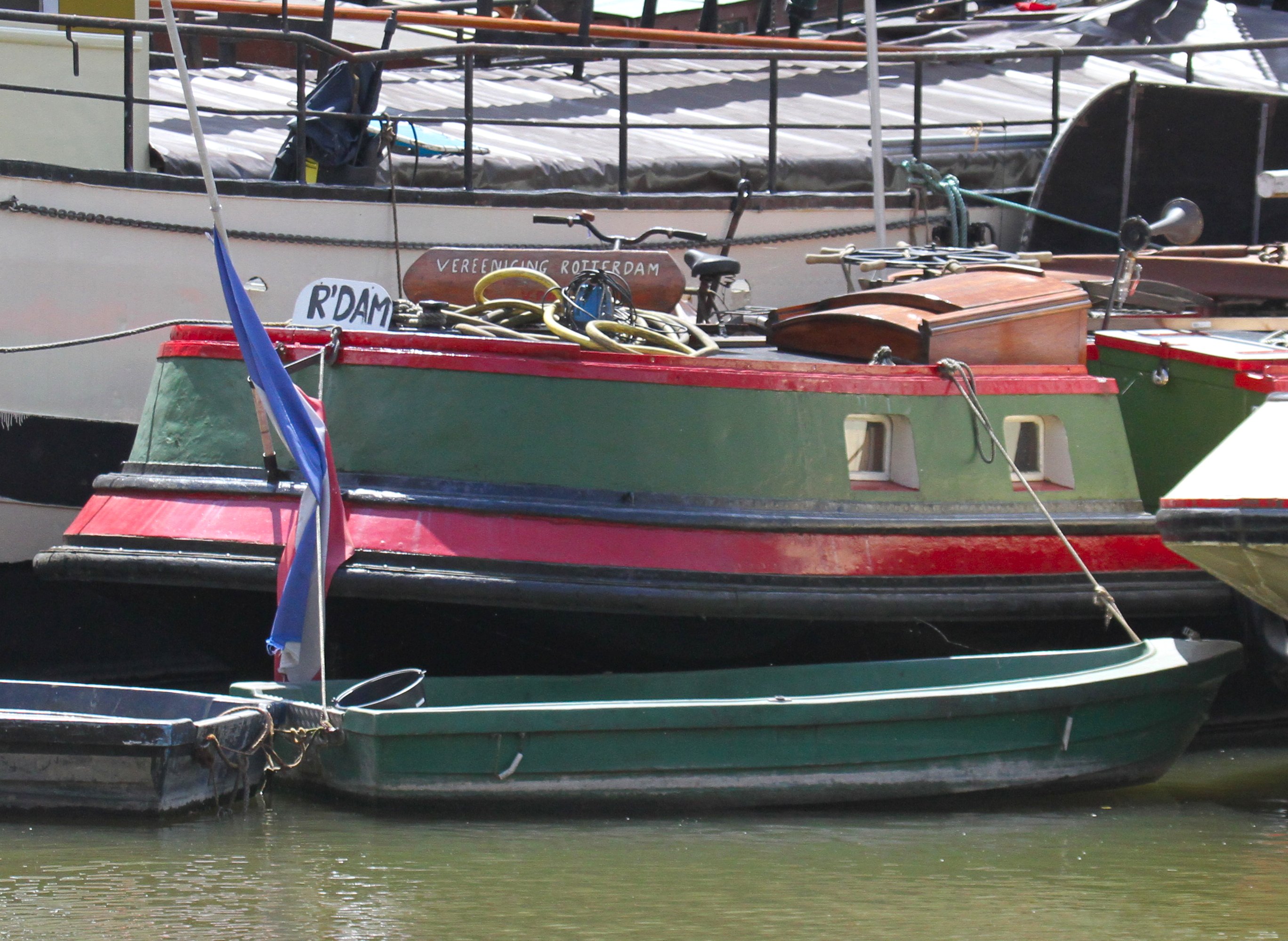
Vereeniging, just about the smallest of them all, nestled in her elegant green and red livery amongst the others… and I could see at a glance what had captured Valerie’s heart about her. She seemed so much more of a living presence, thanks to my reading of ‘Watery Ways’, and her character was buoyant and bubbly, with all the sprightliness and effervescence of a gig compared to the barouche landau sedateness of most of the other boats. I can’t wait to read the next instalment of her history, ‘Harbour Ways’, now in the making! An old bicycle stood to attention on the deck; theft of about eight others has made the owner chary of leaving a valuable machine on board.
We walked around the harbour, ate and drank local beer at one of the cafés (probably not the best one!) and captured a picture of Vereeniging’s stern from across the water. Strolling back along the other side of Haringvliet, we came upon the corpse of a once-yellow bicycle rescued from the muddy depths (but unlikely to be restored like the barges!) and said hello to a ship’s cat, a ginger pirate with the capacity to leap eight feet from deck to harbour steps and to take his ease in the sun.
But time had sadly run out for further sightseeing. We had avoided the parking police, thank goodness, and sailed away to Europoort with the powerful sensation of having travelled to somewhere very special indeed. The homeward ferry was a terribly disappointing contrast to what we had just been seeing.
Happy coincidences and old friends at Bookmark, Spalding…

Fine car; finer bookshop

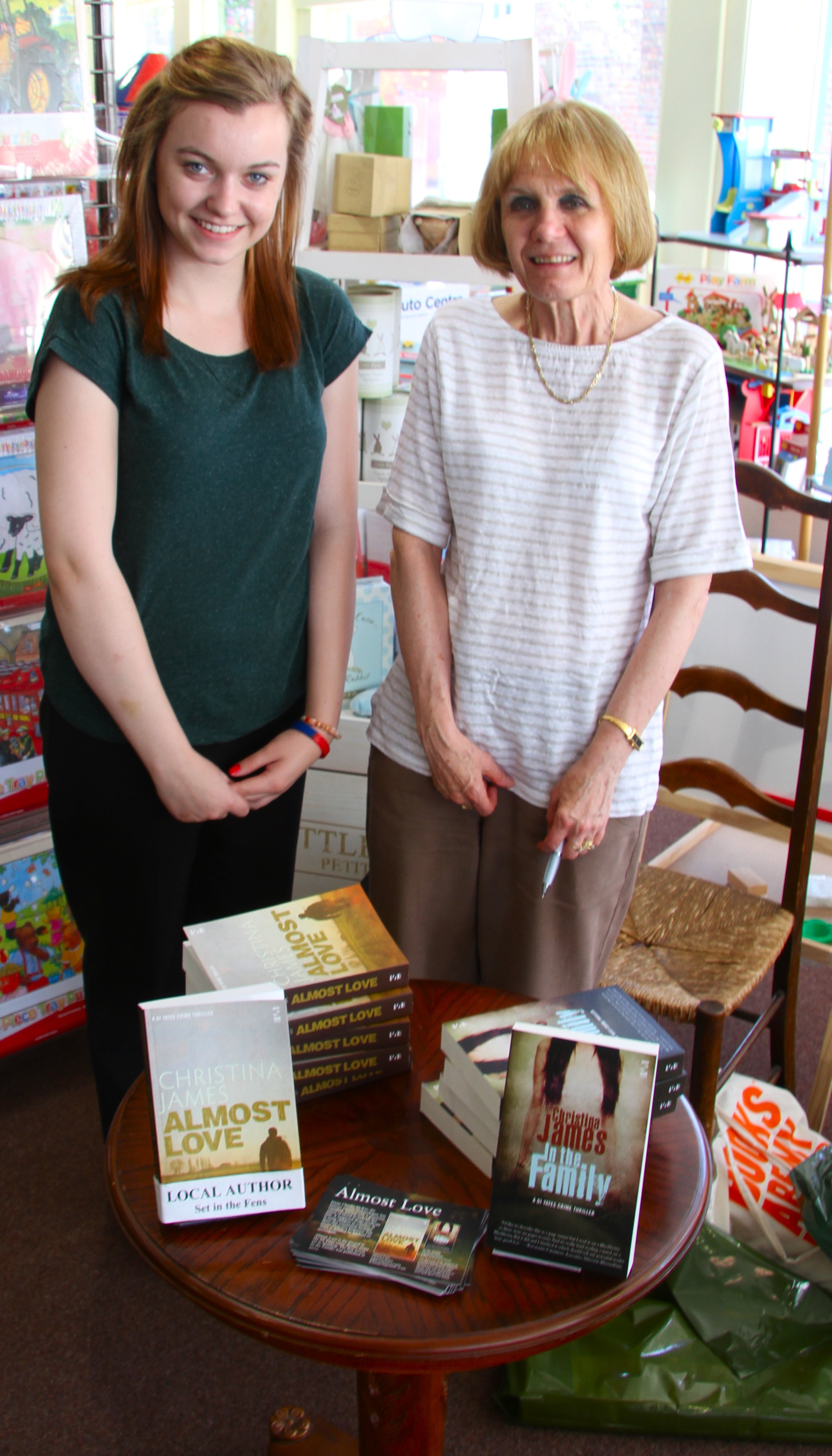
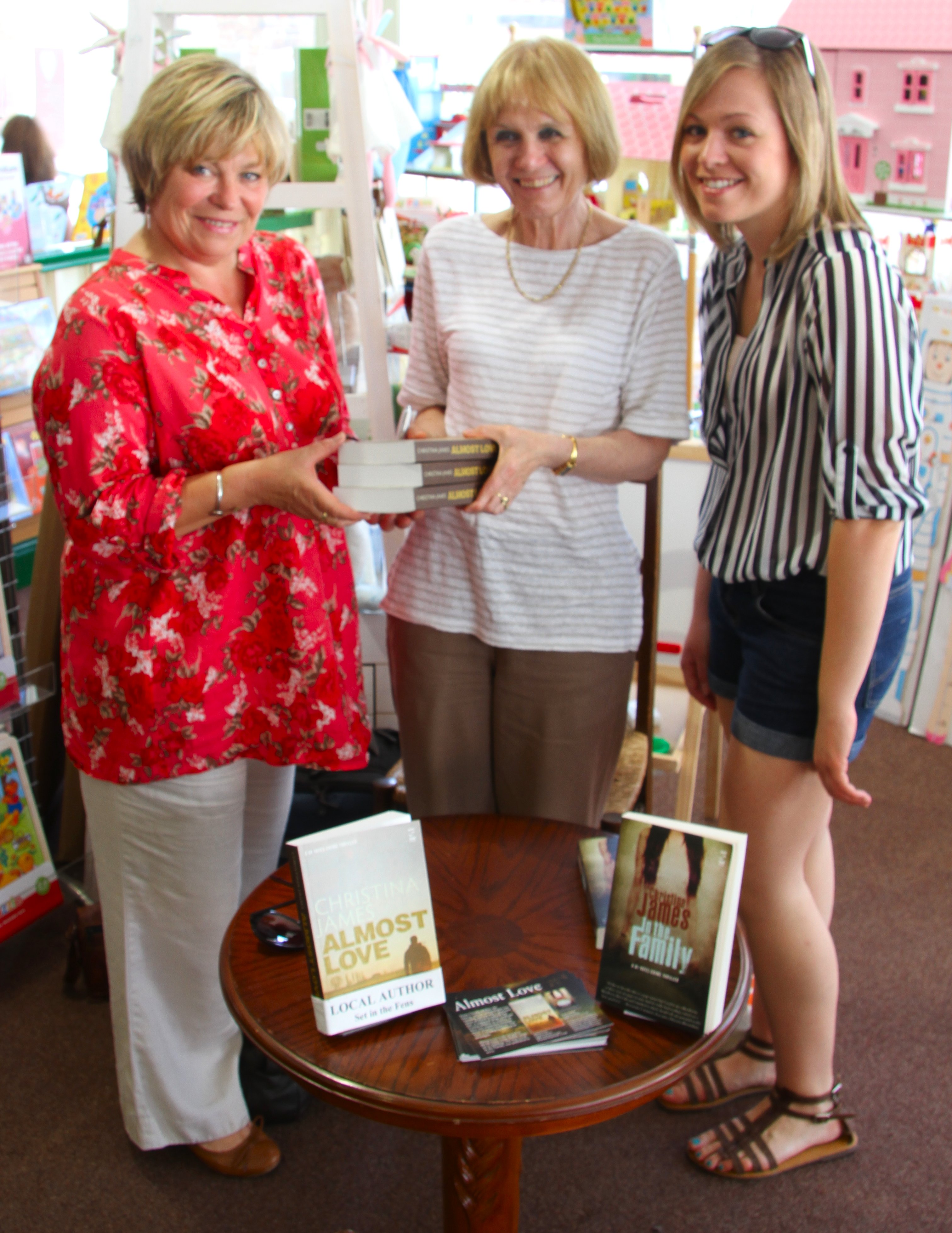


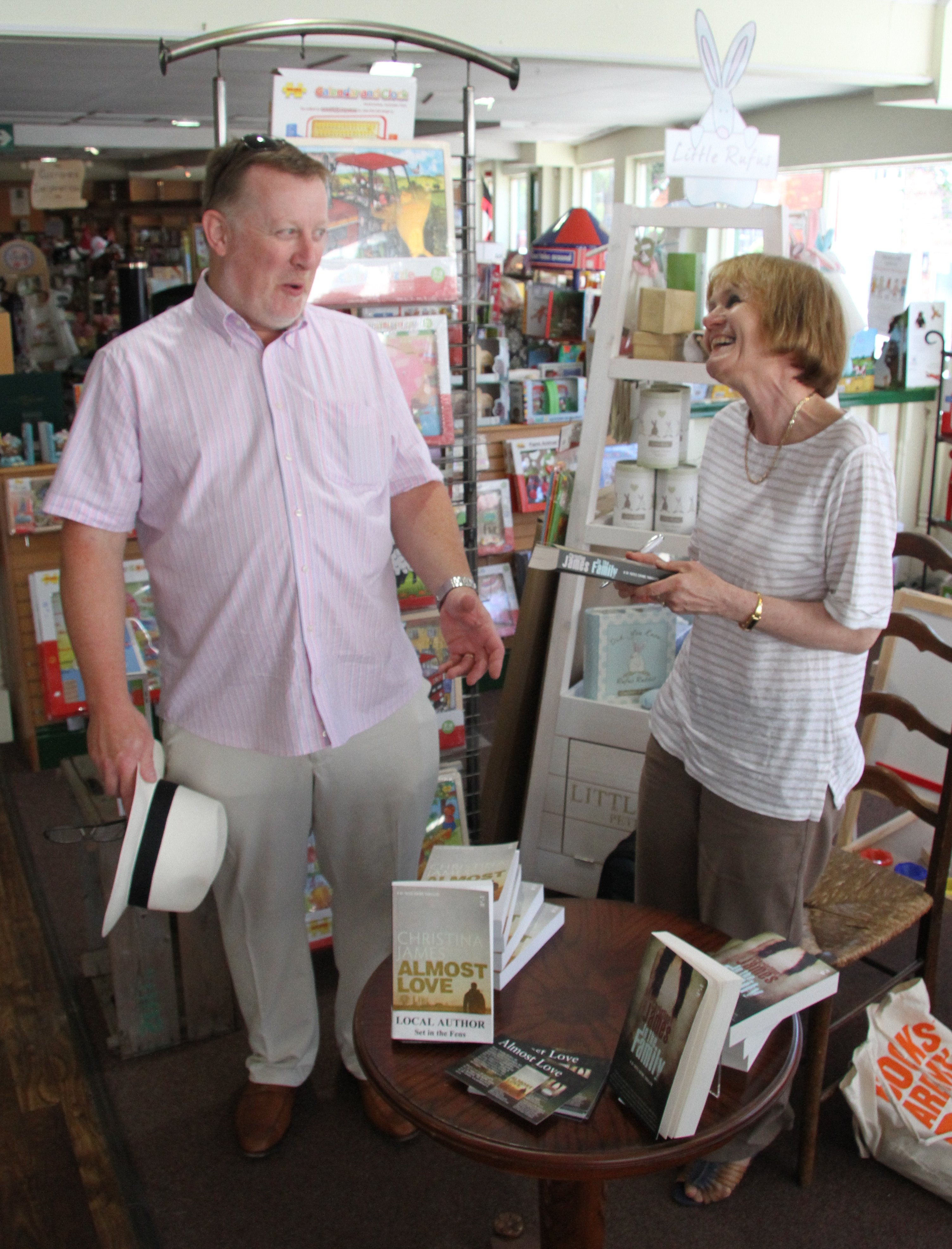


Bookmark’s creative owner, Christine Hanson
Yesterday was one of those perfect days that become legendary in memory. I had travelled to Spalding, having been invited to give a signing session at Bookmark, a very distinguished bookshop which I also visited and wrote about just before Christmas last year.
There was a carnival atmosphere in the town. Christine Hanson, Bookmark’s owner, was feeling particularly happy, because hers and other businesses in Spalding had banded together to offer fun activities to passers-by in one of the yards in the Hole-in-the-Wall passageway. Christine said that it marked a significant step forward in the town’s initiative not only to save the high street but also to ensure that it thrives. She flitted back and forth between the shop and the Hole-in-the-Wall all afternoon and, despite being so busy, still provided my husband and me with her customary wonderful hospitality.
My signing session began with a remarkable and totally unexpected coincidence. Two ladies who had been paying for books at the till came over to speak to me. Noticing their accents, I asked if they were American. One of them said that she’d been born in Spalding, but had lived in America for twenty-five years. She now teaches environmental science at the University of California. Judging her to be about my age, I asked if I knew her. She said that her name was Carol Shennan. I knew the name immediately; she had lived about five doors away from me in Chestnut Avenue when we were both growing up. She said that her mother, who is eighty-nine, still lives in Spalding, and that she was just there for the week to visit her. It was an unbelievable stroke of luck that we should meet in Bookmark. Carol bought In the Family, and I look forward very much to receiving a future contribution to this blog from her when she’s read it.
Several babies came into the shop. I was introduced to Oliver, who arrived with his grandmother and aunt, who each kindly bought both books, and Harry, who came with his grandparents. His grandfather (I’m sorry that I can’t remember his name: his wife’s name is Carole) is a keen local historian and said that he doubted that my novels would cover villages as remote as Sutterton, which is where he was born and still lives. By another strange quirk of coincidence, I was able to tell him that my third novel, which I’ve just started writing, is set in Sutterton. I hope that Harry’s grandparents also will contribute to the blog when they’ve read the copy of In the Family that they bought.
My very dear old friend Mandy came in and bought an armful of books to give other friends as presents, just as she did at Christmas. At the end of the afternoon, she returned to guide us to her house, where we spent an idyllic evening eating supper and drinking wine in her garden with her husband Marc and her friends Anthony and Marcus. We ate new potatoes, broad beans and strawberries from her allotment and talked about books, teaching and cooking (Marcus is a chef). Afterwards, we drove home through the twilight. The fields of South Lincolnshire were looking at their best: the corn was just turning, and in one place acres of linseed coloured the landscape blue-mauve. The skies were as big and beautiful as always.
An idyllic day, as I said. I’d especially like to thank Sam at Bookmark for arranging the signing session, and Christine, Sally and Shelby for looking after me so well and for providing a great welcome: I heartily recommend the café at Bookmark, if you’re ever in the area. Many thanks also to the many people who stopped to speak to me – the conversations were fascinating – and for buying the books. And thank you, Mandy and Marc, for being amazing hosts and for introducing us to Anthony and Marcus, who provided me with their suggestion for DI Yates 4!
Copyright

I’ve been in London for three days, at two conferences that have each dealt, inter alia, with copyright. I’m going to write more about copyright at intervals over the next two weeks, as it has reached a crossroads in its history. I think it vital that all writers understand what is going on and, if they wish, contribute to the debate.
Today’s post is not about opinion, however. It reports a presentation given by Ben White, Head of Intellectual Property at the British Library, last Monday afternoon at the JISC Conference on Open Access for Books. Ben was asked to summarise copyright law as it stands at the moment. Despite the fact that it is a complex subject, his talk was wonderfully succinct and clear. I’ve arranged my report in bullet-points, in an attempt to offer a step-by-step account.
• Copyright sits with the author, unless s/he is an employee (in the sense of having been paid by the publisher, for example to edit a collection of poems and contribute a preface). It is automatic and lasts for life plus seventy years.
• Since 1988, the author has also been able to assert her/his ‘Moral Right’ to be identified as author. As well as being acknowledged as the copyright-holder, this entitles the author not to be misattributed in works that quote or are about her/his work; to object to ‘derogatory treatment’ of his or her work (though what actually constitutes this is necessarily subjective); and, under UK copyright law, to ‘lend, sell, give and waive’ copyright, just as if the work were a physical possession. European jurisdictions take a slightly different approach.
• Exclusive rights would mean that the author had sole control over her/his work – that s/he would exercise de facto monopoly. In fact, few jurisdictions give the author absolute control; most allow ‘exemptions’. In the educational sphere, in particular, these are very important; they allow a specified amount of copying by schools, etc. Publishers have been criticised for interpreting what is meant by exemption too narrowly. Scholars, teachers and others have asserted that when they want to use excerpts from the works of authors for purposes of criticism, review, etc., publishers have been too restrictive in what they will allow.
• One result of the technological innovation made possible by new media is that copyright holders have become more sensitive about defending their rights.
• Copyright can be ‘simple, complex and structured however you want.’ A survey carried out by the Association of Learned, Professional and Society Publishers [ALPSP] in 2008 found that 26% of the publishers who took part no longer required authors to transfer their copyright to the publisher (the remaining 74% still enforced this requirement).
• Copyright can be assigned. This keeps it simple for the publisher.
• Moral rights cannot be assigned, but they can be waived and may or may not have been asserted by the publisher. They can also be asserted for a limited period of time – e.g. for one edition or one printing of the book.
• Creative Commons Licences have been devised in order to allow authors to make their work available free of charge if they wish. Usually, but not always, this means making the work available ‘free’ digitally. Academics may have been directed by their institution to place works created in ‘working hours’ in the institution’s digital repository.
• By making a work available free, the author is not relinquishing her/his rights. Copyright still applies for the standard duration (author’s lifetime plus seventy years); the author can still assert his or her moral right and require that the work is attributed to her/him; limitations and exceptions still apply; and the author can specify that the work is only available free for non-commercial use; anyone who wishes to use a published work in order to develop a business proposition can still be asked to pay for it. This sometimes introduces a complex tiered system of charging that can be confusing and is open to misinterpretation.
I hope that this is useful, and look forward perhaps to engaging with you in a debate on copyright issues over the next few weeks.
Oh, poison again… in my blog, just a little at a time!
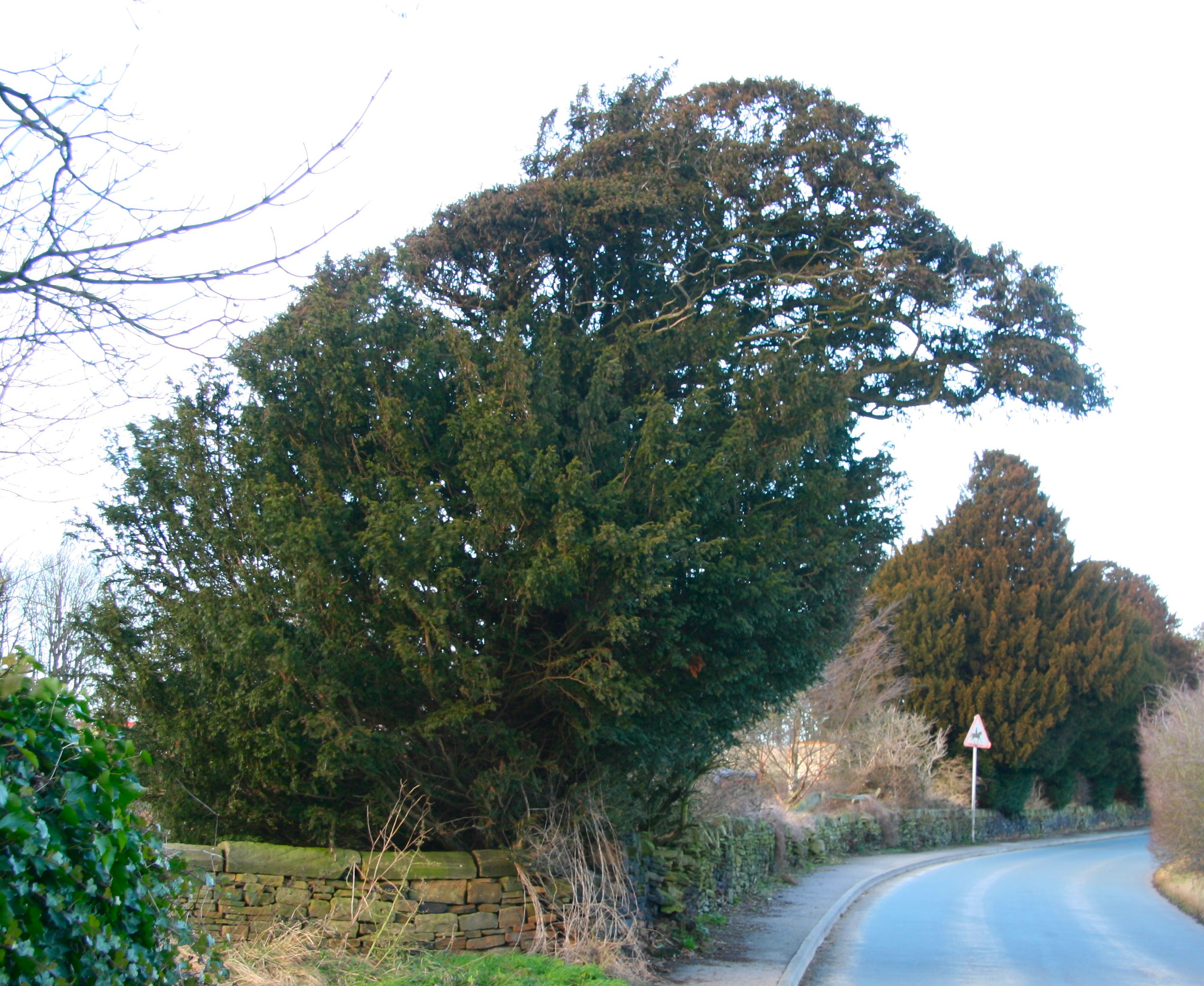
The yew, source of very poisonous seeds and leaves
I had such interest yesterday in the post about digitalis that I hope you will indulge my taking the subject of poison a little further today; poison little and often, then!
I’ve said several times that I’m not a blood-and-guts writer. Most of the murders in my books take place off-stage. Sometimes, if it is a cold case crime, the method that the murderer has chosen cannot be established. When murders do happen on set, as it were, I don’t dwell on the details: I don’t describe the brutal physiological results of a stabbing or shooting. I choose not to do this from personal preference and have recently had my choice endorsed by the reading groups whose meetings I have had the privilege to attend. I’m certain that there are readers who enjoy graphic accounts of violence, but I haven’t met many and, in this respect at least, my novels don’t cater for them.
Murders have to come about by some means, even so, and there are many methods I have yet to explore. I guess that if I were to put my imagination to work on them full-time, the possibilities would be endless. The literary canon is studded with outlandish murders, from George Duke of Clarence’s drowning in a butt of Malmsey wine to Hannibal Lecter’s grotesque destruction of his guards and Jo Nesbø’s Leopard’s inventive use of a ‘Leopold’s apple’. Murders tend to fall into categories, nevertheless. And one of them is poison.
Of course there are some famous male poisoners, both in fact and fiction, but, used as an instrument for plotting and arranging death, poisoning is supposed to be a peculiarly feminine choice; think arsenic and old lace as the stereotype. I’m not quite sure why. It’s true that it doesn’t require the force that stabbing, strangling and bludgeoning dictate, nor is it as a rule as messy (though this isn’t inevitable: nux vomica is very aptly named). Yet, if remoteness from the deed is the most prized attribute when the murderer is considering the best MO, shooting wins outright. The victim and murderer don’t have to speak, touch or engage with each other in any way for a fatal shooting to take place. If s/he is careful, the shooter leaves no forensic evidence except the bullet itself; the gun that fired the bullet can be matched to it if discovered, but disposing of a gun is not difficult. This is obviously why shooting is favoured by contract killers, but it demands both a particular skill-set and the possession of a gun, which can be daunting, if you’re not a member of the underworld.
By contrast, poisons are all around us. The average household must contain several dozen potentially murderous poisons, from items that only become dangerous if taken in excess, such as analgesics and alcohol, to paraquat (Susan Barber’s weapon of choice for disposing of her husband, Michael, in 1981), bleach and the multitude of cleaning fluids which are only safe in a domestic setting because the average adult would not dream either of ingesting them or of putting them in the way of the naïve or unsuspecting. Then there is the garden, a veritable hotbed of powerful poisons, from the tall and handsome purple and white foxgloves I wrote about yesterday to the exquisite scarlet yew berries or arils, the seeds in which are highly poisonous, as are the yew’s leaves. One of the best television crime series that I’ve seen was Mother Love, which featured Diana Rigg as the spurned first wife who killed her husband’s second wife with home-made biscuits sandwiched together with mashed yew-berries.
Perhaps I’ve just hit on why there seems to be a particular affinity between poison and female killers. It requires premeditation: a master-plan that is ruthlessly adhered to even as the victim is suffering terrible agonies and could perhaps still be saved by a would-be killer overcome by compassion. The poisoner has to have nerves of steel and a strong motive to murder, as well as excellent organisational powers. Revenge is the most likely motive to have spawned the crime, a revenge born of a long and brooding grievance that the perpetrator has fed and nurtured until the murder seems to be not only an act of justice, but unavoidable. Poisoning is an act of pure malice. No mitigating circumstances can be offered: it is never spur-of-the-moment. It cannot be attributed to a sudden access of anger, outrage or grief, unlike the more ‘masculine’ crimes of shooting and stabbing. In order to get away with the deed, poisoners need to be reflective, good at research, possessed of a chillingly high order of intelligence. I’ve listed some common poisons in the paragraph that precedes this one. Identifying poison is not difficult, but choosing and applying the one that achieves the desired effect before the victim seeks medical help, one that also cannot be traced back to the poisoner, may be tricky. It demands sustained effort, application of knowledge, scrupulous attention to detail and a high IQ.
Consider this for a moment. It is an apt description of many a multi-tasking mother and wife who is running a home and at the same time successfully holding down a job. The only difference is that, typically, she has neither the time nor the inclination to murder. In short, it’s a good thing that most of us don’t carry the murder gene in our DNA. If we did, there would be a population implosion!
Beauty and death…

Digitalis, the foxglove
After rain and sun, the garden is a gloriously abundant and colourful mini-paradise; great wafts of scent sweep in through the open windows and still evenings are a sumptuous sensory banquet as I wander and fondle leaves and taste the herbs, sniff the honeysuckle and roses, listen to the chatter of the housemartins under the eaves and have my eyes caught and held by bee and moth and bird and flower.
Most striking of all, at this time of year, are the self-seeded digitalis, foxgloves, their pink and white spires climbing to the sky out of the dense green foliage at their feet, graceful forms in the dusk, their finger-fitting flowers even this late sucking in the bumble bees. I recall that every single part of this ‘witch’s gloves’ plant is toxic, with poisonous leaves, stem, flowers, roots and seeds, and find myself thinking of belladonna, the deadly nightshade, and strychnos nux-vomica, the strychnine tree of India, both of which also have the ability in all or most of their parts to kill humans and animals. There are two superbly symbolic passages about the deadly nightshade in L.P. Hartley’s The Go-Between, where the young and naïve Leo finds himself fascinated by and drawn to a rampant specimen in a ruined outhouse, an emblem of the enduring destructive power of the fabulously-seductive and forbidden adult relationship to which Leo plays pander.
It is interesting, however, that all of these plants, though lethal, are amongst the most potent and efficacious remedies for the homeopath, their toxicity refined almost out of existence by a shaking process called succussion. I consult my materia medica, and remind myself of what I did already know, that, in its homeopathic form, digitalis can be an effective remedy for diseases of the heart, while belladonna works on the nervous system and nux vomica has wide-ranging impact, especially on men!
A crime writer with an interest in natural poisons – in past centuries, I might have been burned as a witch! Now, I might weave such plants into a plot, as L.P. Hartley did so cleverly, and harness the evil within them for a good purpose, like a homeopath. Crime novels are packed with death-dealing stuff, but they clearly have a cathartic purpose and, as a result, are very popular.
Excuse me while I get out my pestle and mortar and crush a bit of digitalis into a story.

Crime Fiction Month and National Group Reading Day in Wakefield, West Yorkshire
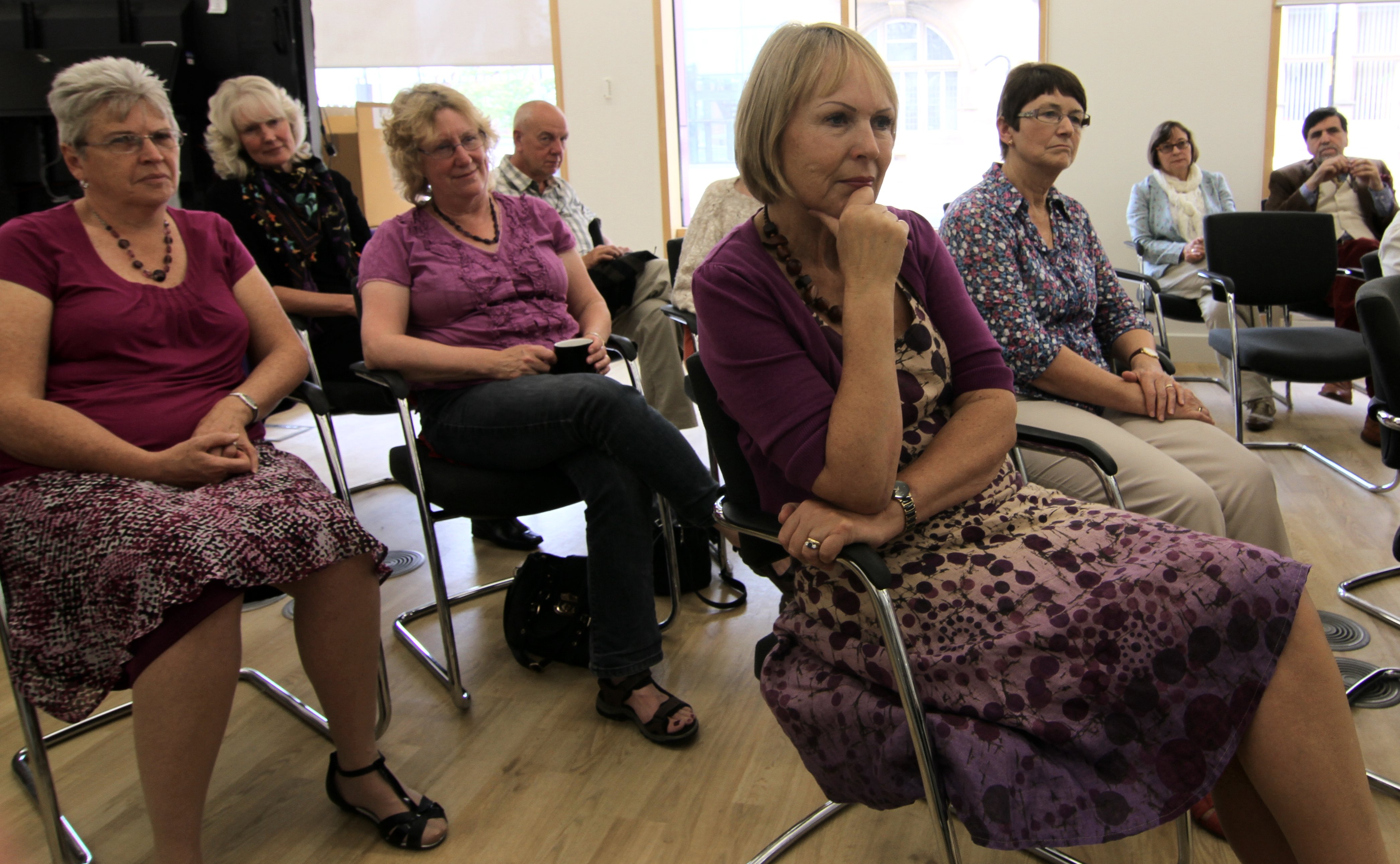
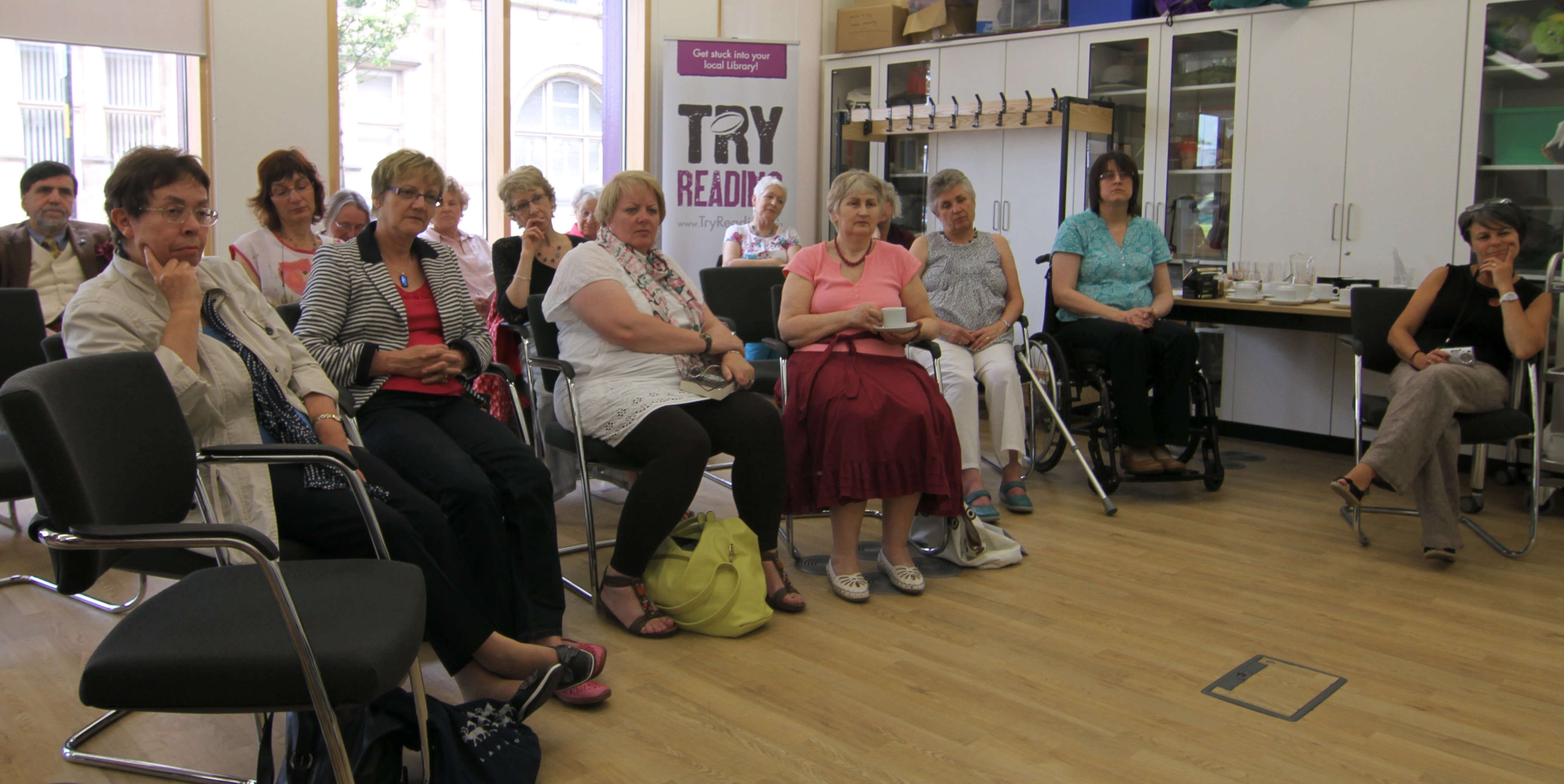
Wakefield Library audience listening to
a reading from ‘In the Family’
I was very privileged yesterday to have been invited to the event arranged by Wakefield Library Service as a joint celebration of National Reading Group Day and Crime Fiction Month. It was organised by Alison Cassels, Library Officer for Reading at Wakefield, and lasted almost the whole day. It was held at Wakefield One, the wonderful new library and museum complex which was opened last November by Jarvis Cocker. The day’s activities were built around the interests of Wakefield Libraries’ eighteen reading groups. When they are in everyday mode, the reading groups choose books that they wish to read from a selection provided; the library service then buys sets of these and distributes them. In itself, this must constitute an impressive feat of complex organisation and canny budget allocation.
About twenty members from various Wakefield reading groups attended. The morning began with refreshments, during which participants were given the opportunity to examine the next round of suggested titles and make their choices. We then split into three groups. Three books were being discussed, Peter May’s The Blackhouse, Wilkie Collins’ The Moonstone and my own In the Family. The facilitators were Alison Cassels’ colleague, Lynn, Julie Walker, Operations and Development Manager for Kirklees Library Service, and myself.
It turned out that so many of the participants had read all three novels that I and my fellow facilitators led consecutive sessions with all three groups. At the end of the morning, Julie chaired a wrap-up session about crime fiction more generally and we discussed our favourite books in the genre. We then broke for lunch. In the afternoon, more people joined the groups to listen to my reading of two short excerpts from In the Family and Almost Love, as part of a session during which we discussed how I write and how I originally managed to get published; the audience put to me more questions (some of them very searching indeed) about my novels. At the close, Richard Knowles of Rickaro Books, in Horbury, sold copies of both books.
I don’t recall having enjoyed an event – whether or not it featured other authors or myself and my own writing – more than I enjoyed yesterday’s. I say this, not from reasons of vanity, but because I have never before had the opportunity to get as close to readers and what they really think. The eloquence and perceptiveness of the reading group members, and the fact that they had spent so much time on really engaging with In the Family, was truly humbling. I took much pleasure in listening to Pauline when she explained why she enjoyed the passages of dialogue – particularly that which takes place during Hedley Atkins’ and Peter Prance’s train journey to Scotland – and how much she identified with Hedley’s frustration when he missed the train to Liverpool, in spite of his sinister intent; and to Jane, for taking the trouble to create a family tree for the Atkins family. Other reading group members quizzed me for more information about Salt Publishing, about the history of Lincolnshire, about how DI Tim Yates will develop in subsequent books and – in true, straightforwardly friendly, Yorkshire fashion – about what I could say to persuade them to buy Almost Love! I said that it does develop Tim’s character further, as they’d hoped, and that it contains quite a lot of history and more of the dialogue that they’d obviously enjoyed.
If any of yesterday’s participants are reading this, I’d like you to know that I think you are amazing. I was grateful beyond words for your generosity in investing so much time, both in the event itself and in reading the books, as well as, of course, for your buying them. I do hope that I shall have the opportunity to meet you again.
I’d like to conclude with a special thank-you to Alison, who provided me with excellent hospitality. Wakefield Library Service is an old friend, with which I first became acquainted in the late 1970s. It has always enjoyed a fine reputation as a distinguished and innovative library authority. From the start, therefore, I knew that yesterday would succeed, but the magic of the day, created by a combination of impeccable organisation by Alison, Lynn and their colleagues and the wonderful enthusiasm of all the participants involved, both from the reading groups and other members of the public, made it truly unforgettable.
Congratulations, Wakefield!

Pauline and I continue our discussion after the event
Let’s sing about the unsung volunteer staff at Bawtry Community Library…
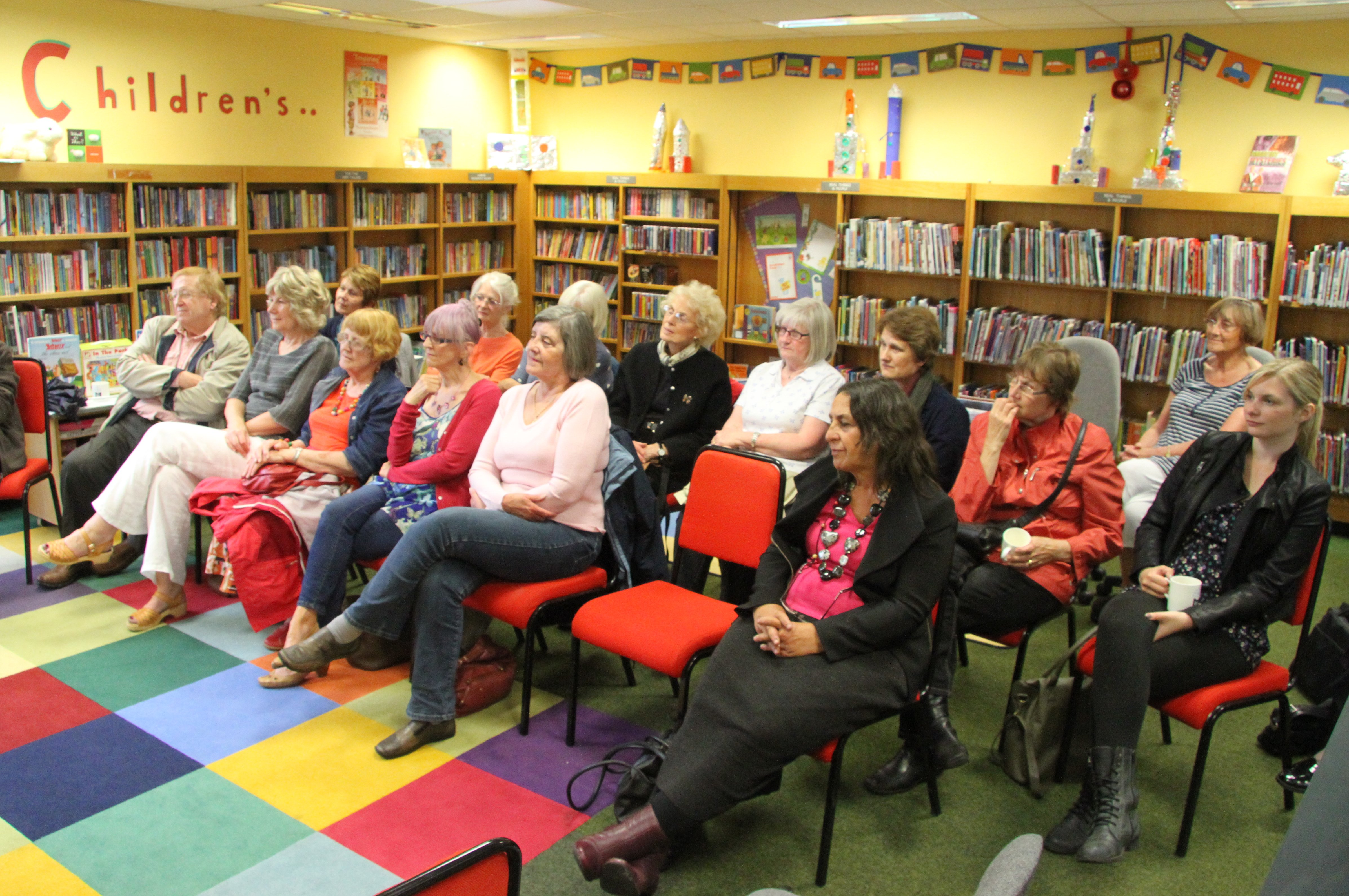
Part of the lovely audience at Bawtry Community Library
I gave my first talk in a library yesterday, at Bawtry Community Library, near Doncaster. It had been requested by Claire Holcroft and George Spencer, of Doncaster Library Service, and immaculately organised by Lesley Gilfedder at the library itself. Despite the rain and the fact that it coincided with the local school play, about twenty people attended. It was a lively and appreciative audience; most of its members had read more crime novels than I have, even though I’m a self-confessed addict, and several of them had detailed personal knowledge of the part of Lincolnshire which I write about. I felt that I learnt at least as much from them as they from me.
I gave two short readings, one from In the Family and one from Almost Love. I was asked about the characters and, especially, about why I’d chosen to make a dysfunctional family the focus of In the Family. We talked a lot about the atmospheric qualities of the Fens and about past writers who have described them, especially Charles Dickens and Dorothy L. Sayers. We discussed plots and plot construction, how to make them work, whether it’s possible to change the plot mid-novel and how to avoid inconsistencies. Several of the audience kindly bought copies of the books.
I took some cakes (I’ve decided to make this one of my trademarks!) and, when the organised part of the evening was over, no-one was in a hurry to leave. Lesley, ever efficient, made tea and coffee and we all stayed to talk.
Of course, I know about public library cutbacks, but I had no idea how swingeing they have been in some authorities or how magnificently local communities have responded in order to save their libraries. Bawtry is a lovely library: it has a cared-for look; there are bright paintings on the walls; the stock is impeccably arranged and there is a large children’s area where the floor has been carpeted in multi-coloured tiles to aid the playing of games and telling of stories. It keeps full opening hours and, as last night, is also sometimes open late. All of this is achieved by volunteers. It has about ninety of them, typically working three-hour shifts. As well as manning the library, they clean it and care for the grounds. They’ve been operating this arrangement for eighteen months and, so far, not one volunteer has dropped out. I understand that most of the other libraries that come under the aegis of the Doncaster local authority are also run in this way, though not all manage to keep such long opening hours as Bawtry.
I am amazed and full of admiration, tinged also with a little bit of shame. The public library charter entitles people to the right to borrow books from a local library, yet the people of Bawtry would not be able to do this if so many of them were not prepared to give up their own time to make it work. It is both a huge local achievement and a national scandal that this state of affairs should exist.
I’d therefore like this post to stand as a tribute to the wonderful people from Bawtry whom I met yesterday and to all their friends and colleagues who continue to make the library the vibrant hub of their community. Thank you. And especial thanks to Lesley, for all your unobtrusive hard work behind the scenes.

Elaine Aldred and Christina James at Bawtry Community Library
 Christina James, crime novelist