

Who is your ‘key’ customer?
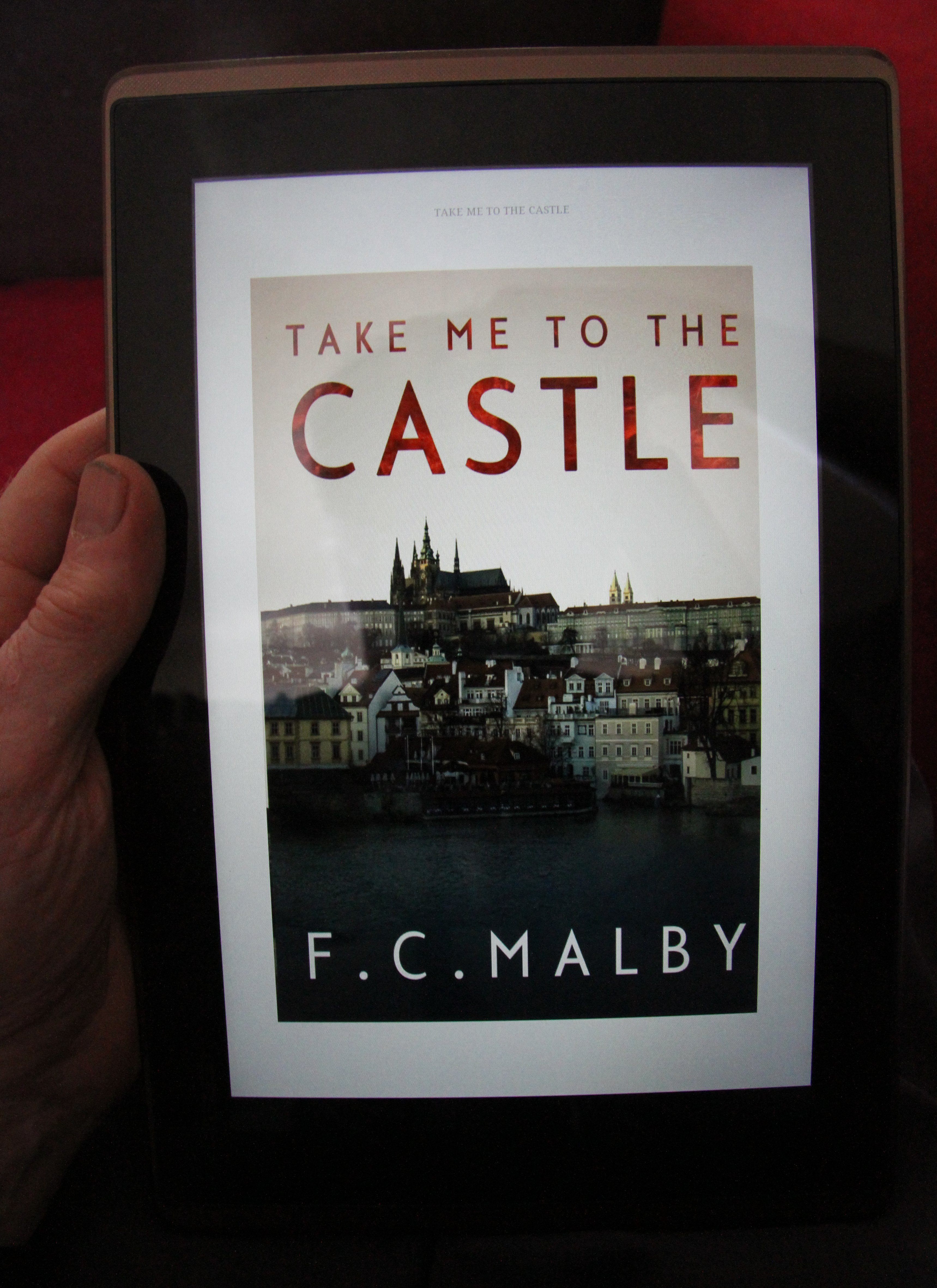
E reader
I’m not always in agreement with received opinion that what happens in publishing in the USA happens here eighteen months to two years later. However, properly-gathered statistics are always fascinating and it would be foolhardy for a book market watcher such as myself to ignore the results of the latest US consumer survey that’s been carried out by Nielsen BookData. Called the ‘US Entertainment Report’, it publishes information about games, films and music as well as books, but I shall confine myself here to the findings on books. If you’re interested in the other categories, you can find a summary here.
The survey finds that e-book buyers are 21% more likely to be female. The age-groups buying the most e-books are those aged 35-44 and those aged 55-64. (I’m not sure why there’s a dip in the 45 – 54 age group: perhaps they’re so broke paying for their children to go to university that they can’t afford to buy an e-reader!) What’s amazing is that the 18-24 age group buys least e-books, even fewer than the 65+ group. Perhaps the reasons for this are also financial. Or, since the academic e-book market is now well-developed in the USA, it may be that young Americans associate e-books with study and print with relaxation. An amusing thought, but of course based purely on speculation on my part!
What is undoubtedly of significance is that print book buyers are more likely to be female, too: 18% more likely, in fact (highest sales are again to the 55-64 age group, followed by the 65+ group). This is not a surprise, because print book consumer surveys have consistently shown women to be heavier book buyers than men for at least the last thirty years. Received wisdom has always been that women buy more books because they’re buying for the whole family. However, unless e-book sales models change, we may have to revise our opinion about who is actually reading the books, as well as who’s buying them, since at present it is not possible to share an e-book unless you also share your e-reader with someone else (not a very practical arrangement). There is considerable pressure among consumer groups, especially in the USA, to introduce models that allow sharing of the same e-book among a limited group of people, on the principle that print books have always been shared among family members. In the meantime, as writers, we have a golden opportunity to consider what these female-biased statistics mean.
All my life, I’ve disapproved of the so-called ‘woman’s read’; as a bookseller, I’d give publishers short shrift if they tried to promote a book by saying that it appealed to the ‘women’s market’. How piquant it would be to discover that they were barking up the wrong tree and that the real niche market belonged to men! And how well it pinpoints the absurdity of gender-based promotion: clearly women have been reading war stories, thrillers and science fiction all along and I wouldn’t mind betting that, at the same time, more than a few men have been reading romances and bodice rippers. In fact, one of the earliest e-book surveys undertaken, way back in 2001, suggested that there was a big market for romances among long distance truckers!
As a writer, therefore, whom should you regard as your ‘key’ customer? I’d say everyone! In the last analysis, it’s the quality of the writing that counts. But you might like to think a little more about formats: the more flexibility there, the more copies you are likely to sell.
An admission of ignorance…
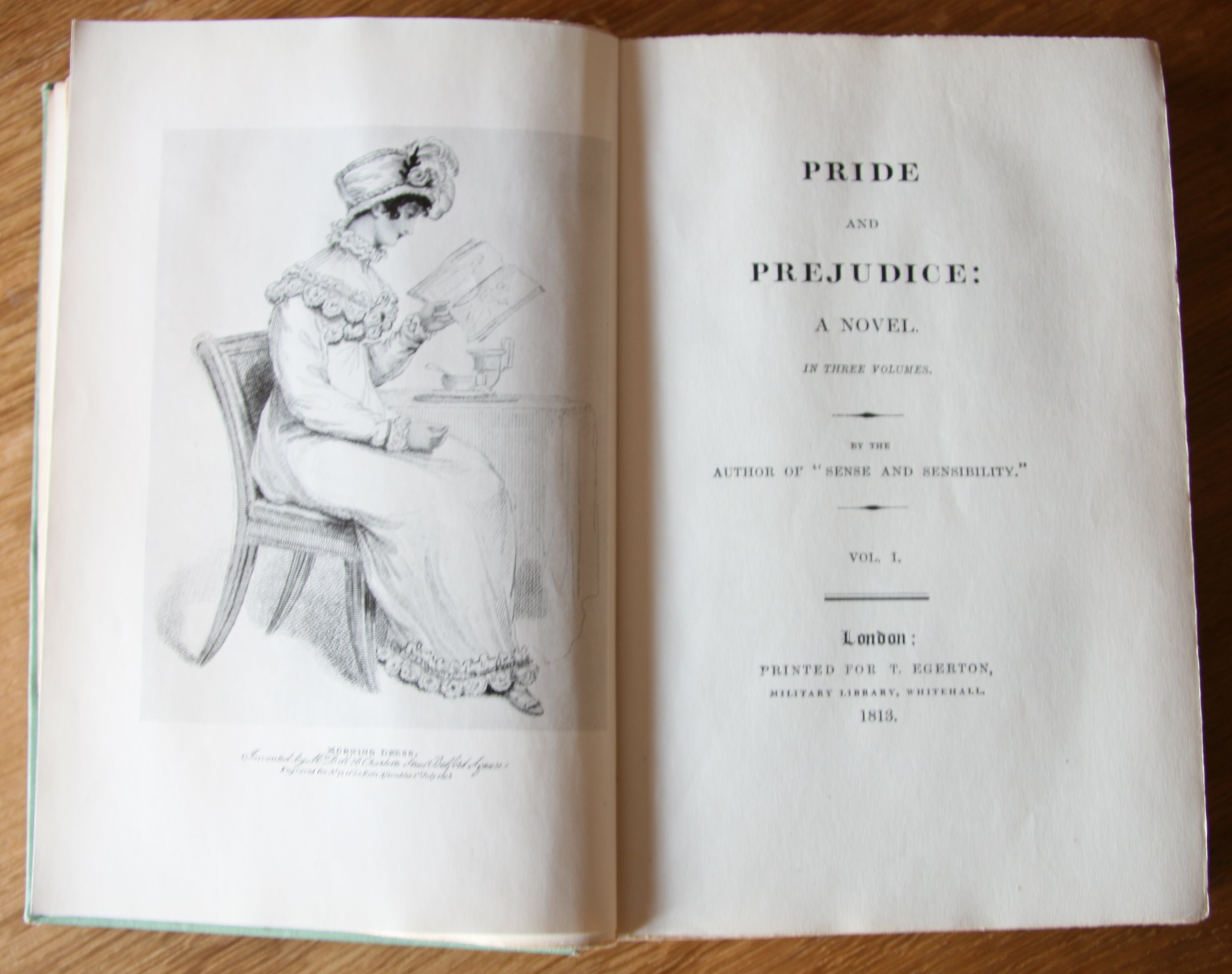
Top of the Gutenberg pops!
A web-developer named Christopher Pound has carried out a text data mining trawl (I shall write about text data mining in another post – it is a bit of a hot topic in some publishing sectors at the moment) to reveal the 100 most popular books by different authors to be accessed via the Project Gutenberg free e-book site. Books for both adults and children are included. The top 10 from both categories are:
1 Pride and Prejudice (Austen, Jane)
2 Jane Eyre (Brontë, Charlotte)
3 Little Women (Alcott, Louisa May)
4 Anne of Green Gables (Montgomery, L. M. [Lucy Maud])
5 The Count of Monte Cristo (Dumas, Alexandre)
6 The Secret Garden (Burnett, Frances Hodgson)
7 Les Misérables (Hugo, Victor)
8 Crime and Punishment (Dostoyevsky, Fyodor)
9 The Velveteen Rabbit (Bianco, Margery Williams)
10 Adventures of Huckleberry Finn (Twain, Mark)
Can you spot the odd one out? Or am I just revealing my own crass ignorance when I say that I have never heard of The Velveteen Rabbit? According to Wikipedia, this book, which was published in 1922, was selected as one of ‘Teachers’ Top 100 Books for Children’ by the (American) National Education Association in 2007. Apparently it has also been the subject of numerous film adaptations, talking books, etc. Wikipedia sums up the plot as follows: A stuffed rabbit sewn from velveteen is given as a Christmas present to a small boy, but is neglected for toys of higher quality or function, which shun him in response. The rabbit is informed of magically becoming Real by the wisest and oldest toy in the nursery as a result of extreme adoration and love from children, and he is awed by this concept; however, his chances of achieving this wish are slight.
Peter Rabbit, Alice in Wonderland, Heidi and Uncle Tom’s Cabin all appear in the Top 100, but considerably lower down in the list.
Statistics like these always make me want to know more. Why has The Velveteen Rabbit proved so popular, at least when accessed via Project Gutenberg? It isn’t because it’s not available in print: Amazon lists it and states that there are both print and talking book versions available. Is it because American teachers are more likely to direct pupils to e-book sites than teachers in other countries? Do they perhaps even download it and arrange for it to be printed for their classes via a Print on Demand company? Or, as I’ve suggested, is it just that there’s been a blip in my education? In fact, several blips, because in all my years as a bookseller and library supplier, I have never come across either this book or its author.
Here is Christopher Pound’s full list.
Salt Publishing crime writer event

May I use today’s post to flag up a Salt Publishing event at Gower Street Waterstones, an evening with Salt’s crime authors, Laura Ellen Joyce, Matthew Pritchard and myself, at which we’ll be sharing both our books and experiences. For those new to this blog, here are some earlier posts which may interest you in relation to the authors and the venue:
Meeting Matthew Pritchard at BAFTA 195
I do hope that you will join us on this occasion, if you are able to do so; all three of us are very much looking forward to meeting you in this very lovely bookshop.
Stephen King and I in perfect accord, did he but know it!

From The Times May 22nd 2013
I’m not really a Stephen King fan – horror isn’t my bag – although I admire his dedication as a writer. He himself has said that his writing gave him the will to live when he was seriously injured in a car accident in 1999. I have read a couple of his books – Carrie and one other whose title escapes me – and I can appreciate his work enough to see why it is compelling. He’s a true professional.
However, he managed to annoy me very seriously in the year 2000 (He was quite unaware of this, of course!) when he published Riding the Bullet, a short story, as an e-book and sold it from his own website. He sold more than 5,000 copies in twenty-four hours, which allowed him to claim that the role of the publisher was becoming defunct as digital publishing took hold. He took into account neither the fact that he had been supported patiently by his publisher through his early years as a writer nor that he had sold so many copies of Riding the Bullet because he was Stephen King; it was not a feat that any author could replicate.
I was therefore delighted to read in today’s Times that he has not only decided not to release the digital rights for his latest book, Joyland, but is also encouraging his fans to buy their print copies from bookshops (as opposed to online booksellers). “Support your local bookshop” seems to be his new mantra. On that point, Stephen King and I are in perfect accord. I’m sure that he’ll be relieved that I approve!
The book and the rose…

My St. George’s Day roses
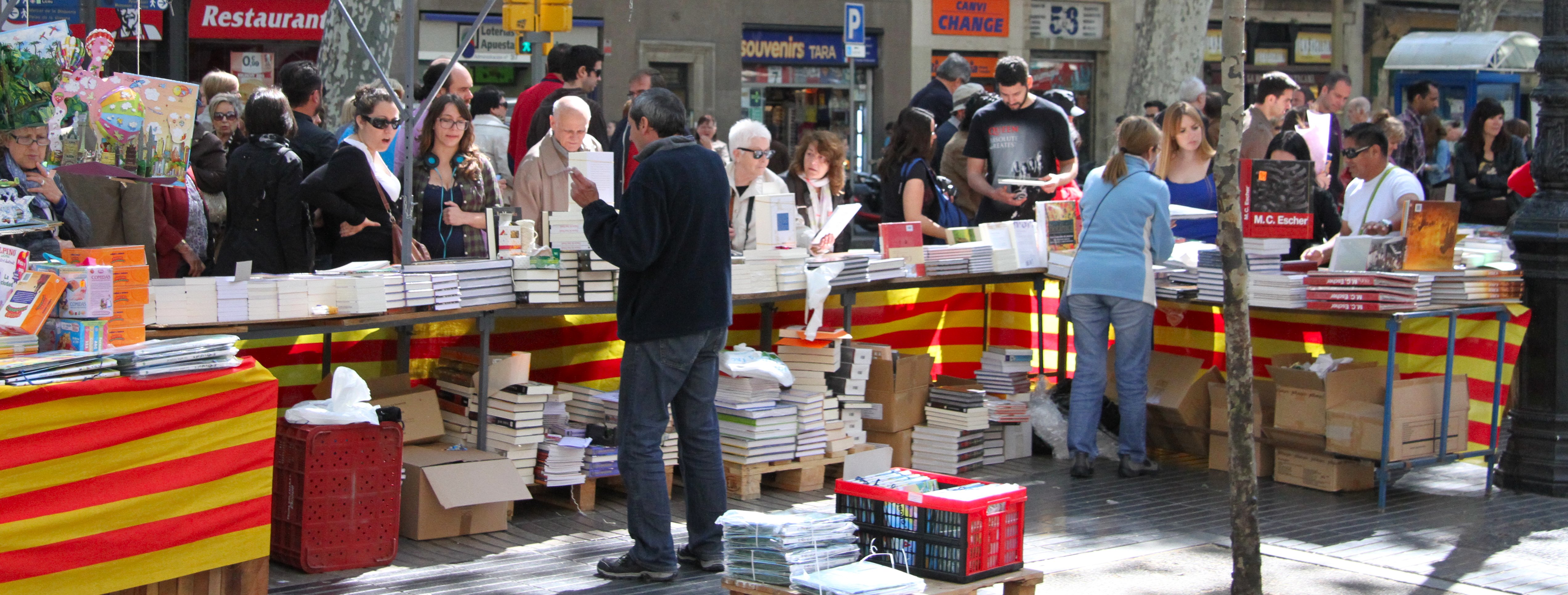
Happily my visit to Barcelona coincided with the celebration of St. George’s Day (on Tuesday 23rd April); ‘Sant Jordi’ is big in this city, which honours him with a much higher profile than we extend to him as our national patron saint. It was, of course, also World Book Day. I’m not sure whether it was owing to Spanish influence that the UK and the USA have chosen this date for their annual bookfest, but I am certain that the people of Catalonia got there first. In Barcelona, it is an ancient tradition to celebrate St George’s role as the patron saint of books. Booksellers bring book stalls out on to the pavements and everyone enters into the spirit of celebrating the book. Sales throughout the day are brisk; almost everyone I saw travelling on the Metro in the evening was carrying a bag of books. There is a carnival atmosphere. St George is remembered by a rose and an ear of corn, symbolising the damsel that he rescued and himself as her rescuer. Traditionally, the Spanish man of honour presented his lady with a rose accompanied by a corn stalk, to which she responded by giving him a book. Christina James, I am proud to say, received her rose (well, three, in fact!) and, for pleasure’s sake, not duty’s, gave her man a book. (For the romantics amongst you – and to the smiles of Catalan onlookers – kisses were exchanged…)

To walk the streets, roses in hand, amid the throng of local people intent on having a good time, was to share in a general joie-de-vivre and to have a precious opportunity to talk to enthusiastic lovers of books. Beautiful displays of roses and red and yellow striped ribbons and flags adorned street corners and pavements everywhere. Music filled the air and the sun shone.
On a more business-like level, I feel that there may be something for us to learn from this. It did strike me at the time that Catalan booksellers are fortunate in being able to place such confidence in the weather; I could imagine a similar event in London or Leeds being suddenly dampened (in every sense of the word) by a sharp shower. And World Book Day is a remarkable achievement, a miracle of co-operation and generosity between all the elements of the book industry and a huge army of volunteers. Nevertheless, no-one was being given anything in Barcelona: roses came at €3 each; books were sold at full price. In a sense, it was all about celebrating the skills of booksellers themselves and the pleasures that they bring… and showing that they are worth paying for. We in the UK should honour our booksellers more and they should learn to expect and accept our homage gracefully and with attitude.
Just look at this: a new café bookshop in Lincoln!

I’ve used the word ‘serendipity’ several times just lately and, since style matters to me, I’m troubled by tedious repetition; yet Twitter is rather generous with serendipitous moments and another one (thanks to my writer friend Carol Hedges @carolJhedges for the information) popped up in the feed on Thursday last. It was the start of something big and it was, is and will be in Lincoln.
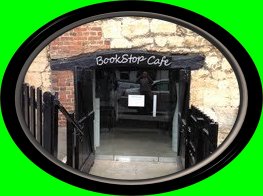
Living in this city are siblings Joff and Becky, who are taking the brave step into the wonderful world of independent bookselling, with a special emphasis upon supporting local and independent authors. On Saturday 4th May, BookStop Café will be opened to the discerning readers and the tea, coffee and cake addicts of Lincoln.
Where? At 46-47 Steep Hill and 7 Christ’s Hospital Terrace, the new home of BookStop Café is also a very old home, an example of Norman domestic architecture and, according to many references, known as ‘Aaron the Jew’s House’ (where Aaron of Lincoln, who died in 1186, lived – he was then the greatest Jewish financier of England). The building has been a shop for many years and is currently where, up above the new bookshop/café, tea importer Imperial Teas conducts its business: an atmospheric venue indeed, ready for a new development in its very long history.
Joff (self-published author Joff Gainey) and Becky have always dreamed of combining a café with books and now their vision is becoming reality: BookStop Café will, at weekends only to start with, be a place for readers to enjoy new and secondhand books in comfortable surroundings. Before very long, it will be a place where children can listen to storytelling and where artists can display their works. Keep up to date with its progress on Twitter at @BookStopCafe .
I am delighted to have come across this new venture and hope that you will join me in wishing it well. The lucky people of Lincoln will be able to settle down to good reading on Saturdays and Sundays from 4th May, 10.00 a.m – 4.00 p.m. My guess is that they will be settling down to some very fine cake, coffee and tea too.
I know where I’ll be heading, next time I’m in Lincoln.
BOOKS ARE MY BAG: WOW!
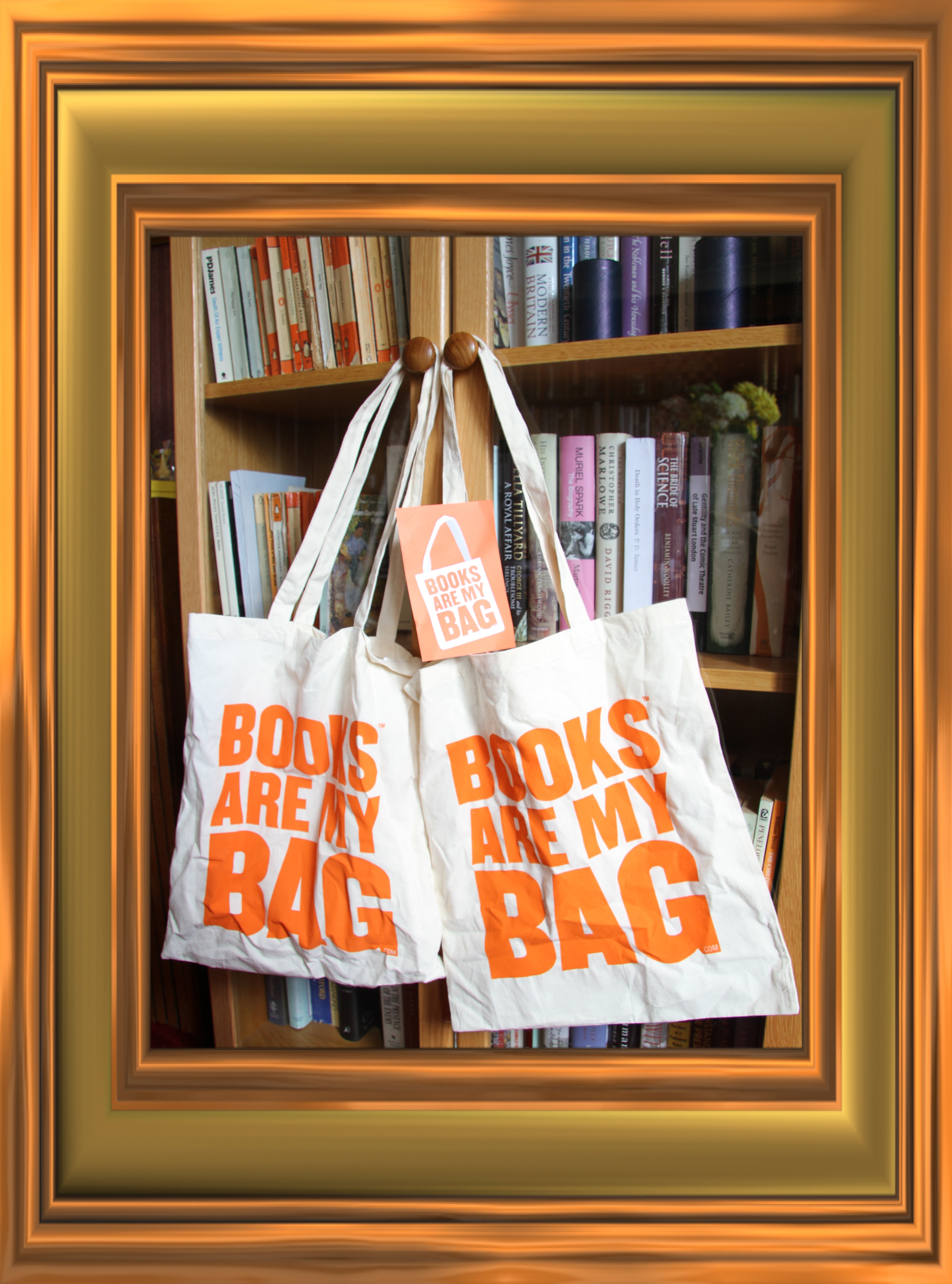
As a former bookseller, my heart was gladdened by attending the announcement of the Books are My Bag campaign, which for me was the most exciting single event held at the London Book Fair this year. The campaign has been devised by M & C Saatchi and is entirely based on a single, simple, very effective message: that the passion for books and bookshops is a precious part of our national heritage and something that we should cherish, celebrate and promote. It is a campaign of perfect solidarity: all booksellers (whether they belong to chains or independents) and publishers are uniting with one voice to celebrate the pleasures and cultural importance of the high street bookshop.
Tim Godfray, CEO of The Booksellers Association and Richard Mollet, CEO of the Publishers Association, both spoke at the event. They were joined by some industry legends, including Patrick Neale, currently President of the Booksellers Association and joint owner of the marvellous Jaffé Bookshop in Oxfordshire (in a previous life he was the inspiration behind the equally wonderful Waterstone’s Sauchiehall Street bookshop in Glasgow) and Gail Rebuck, Chair and CEO of Random House (who, like Dame Marjorie Scardino, has proved that women can get to the top of large corporate publishing houses and stay there).
Patrick’s message was strong and direct. He made the point perfectly that there is far more to the experience of buying a book than receiving a brown cardboard parcel through the post: “We all know that there are many ways to buy and sell books, but what Books are My Bag captures and celebrates is the physical; the simple truth that bookshops do more physically to let people enjoy their passion for books.” Gail Rebuck said: “In these challenging times for the UK High Street, it is terrific that a world-renowned advertising company – M & C Saatchi – has devised such a positive campaign for all booksellers.”
In keeping with its message about the physical presence of bookshops, the campaign will feature strong branding and a very distinctive prop: a cloth bag with the words BOOKS ARE MY BAG printed on it in capitals in neon orange. These bags will be given to customers by bookshops across the country when the campaign is launched on 14th September. I wasn’t sure about the colour when I first saw it – and I was hugely impressed that Tim Godfray was prepared to spend the whole day wearing a matching T-shirt emblazoned with the orange slogan. However, throughout the Book Fair, I spotted people carrying these bags (the BA gave them out daily) and I concluded that they are very effective indeed. As Patrick put it, “This is the first time anyone has needed sun-glasses when inside the London Book Fair.” I have acquired two of them, one from the BA stand and one from the event, and I shall carry them with pride throughout the summer.
Anyone reading this blog who is interested in knowing more about this, here is your link Books are My Bag to its dedicated website.
I love bookshops!
A London Book Fair 13 seminar about using social networking to create author presence


I cannot miss the opportunity to comment in today’s post on the social networking session yesterday morning at the London Book Fair. First, may I thank the very many people who attended and made the event very special indeed; you were a lovely, attentive audience and we all valued your interest and contributions.
Secondly, I should like to thank Elaine Aldred (@EMAldred, Strange Alliances blog), who very generously agreed some time ago to chair this session and, with her characteristic attention to detail, introduced the panel and provided a succinct summary of the key points arising, as well as modestly managing us and our timekeeping!
I was very pleased to meet and honoured to join my much more experienced social networking fellow panellists, Katy Evans-Bush @KatyEvansBush) and Elizabeth Baines (@ElizabethBaines), and to be able to listen to the social networking supremo, Chris Hamilton-Emery, Director of Salt Publishing (@saltpublishing), all of whom provided different perspectives from my own. However, though we may have addressed in various ways the topic of how to make the most of the best of social networking, I felt that we were un
 animous about the terrific value of what Chris called ‘the confluence’ of such media as Twitter, Facebook and personal blogs in creating author presence and profile. I believe that we also affirmed the essential need to be ourselves (however uncomfortable it may initially feel to present our private side, as Elizabeth very pertinently explained) and to interact with the people we ‘meet’ in a genuine way. We shared the view that ramming our books down the throats of our online audience in a ‘hard sell’, as some people do, is counter-productive; it is much better for us to engage with others in discussion of the things which matter to us, such as the business of writing, literature, topical issues and so on. Katy pinpointed the effectiveness of social networking in creating a global family of friends and followers, something we also all felt.
All in all, the session emphasised that participation, helping others, reciprocating generosity and showing real interest in people whom we come to know online are crucial to creating a lasting author presence. It is really important that authors recognise that they need to have such a profile; with it, books certainly do sell and, as Chris put it, without it they don’t.
Finally, we all accepted the inevitable consequence of managing all of the personal interactions online: it is extremely time-consuming and we have to find our own ways of handling that; if we succeed, the benefits are very clear to see.
My thanks again to all concerned in what was for me a very memorable occasion.

It’s tomorrow! Making the most of the best of social networking…

Today’s post is a repeated ‘shout-out’ about tomorrow’s Salt Publishing seminar at this year’s London Book Fair, when there will be an opportunity to listen to Chris Hamilton-Emery, founding director of this world-renowned independent publisher, and three of its authors talk about how to use social networking to promote books and good writing. There will be a question-and-answer session to develop discussion about the topic How to Build Social and Brand Equity on a Shoestring. Elaine Aldred, an independent online reviewer, will chair the occasion.
Date: Tuesday 16th April 2013
Time: 11.30-12.30
Place: Cromwell Room, EC1, Earls Court
I’ll be joining Katy Evans-Bush, writer and editor, and Elizabeth Baines, novelist and short story writer, to offer some personal experiences of social networking as a means to achieving an online bookworld presence. Readers of this blog will already guess from previous posts here about both Salt and social networking, how much I personally value the opportunities provided by the Internet to meet and mingle with booklovers across the world. I have also made it very clear just how proud and privileged I am to be supported as a writer by Chris Hamilton-Emery and how exciting it is to be associated with an independent publisher with the finest of literary lists.
I hope to become real to at least some of my ethereal friends at the London Book Fair this year!
In love with Cromer…

It seems fitting to write about Cromer on World Poetry Day. If you are new to the blog, please don’t be baffled by this! Regular readers will know that Cromer is the adopted home of Salt Publishing, which is becoming ever more renowned for its fiction. Last year it achieved international fame with The Lighthouse, Alison Moore’s debut novel, which was shortlisted for the 2012 Man Booker prize. (Its crime list includes In the Family, my first crime novel, and will shortly also feature Almost Love, the second in the DI Yates series.)
However, Salt built its reputation for literary excellence on its superb poetry list; in my view it is the greatest current British publisher of contemporary poetry. Some Salt poets are poets’ poets, though most are very accessible. I believe that perhaps, of all its achievements, Salt’s greatest has been to develop its ‘Best of’ lists, especially the Best of British Poetry series, and the Salt Book of Younger Poets. Now widely adopted by undergraduate courses in English literature and creative writing, these books bring contemporary poetry alive to a new generation, as well as supply more mature readers with an impeccable selection of great poems. The Best of British Short Stories series achieves a similar effect in a different genre. And, not to spare his blushes, Chris Emery, the founding inspiration behind Salt, now publishes his own poetry under the Salt imprint. If you have not yet read The Departure, I recommend it wholeheartedly.
Back to Cromer. I was there for a long weekend because, as I mentioned on Sunday, I was asked to play a small part in the Breckland Book Festival. I stayed at The Barn, one of the cottages owned by The Grove Hotel (itself steeped in history – parts of it are eighteenth-century and its original owners were the founders of Barclays Bank). I called in on Chris and Jen Hamilton-Emery after the Breckland event and my husband and I were kindly invited to have dinner with them. They were brimful of ideas as usual and delighted that Chris has been appointed writer-in-residence at Roehampton University, as well as looking forward to celebrating Jen’s birthday today (that it is on World Poetry day is a poetic thing in itself!).
The rest of our time in Cromer was spent exploring the beaches and the streets of the town. Twice we walked along the beach in the dark and, on Monday morning, we took our dog for a very early morning run there. Even in bitterly cold weather, the town itself is enchanting. Developed in the mid-nineteenth century to cater for the emerging middle classes, who could for the first time afford holidays away from home, it seems to have been preserved intact from any attempted depredations by the twentieth century. There are not even many Second World War fortifications in evidence, though a pill-box languishes in the sand of the west beach, its cliff-top site long since eaten by the sea. The pier retains its pristine Victorian originality – it is well-maintained but has not been ‘improved’. Some of the hotels, again ‘unreconstructed’, are quite grand and all serve superb food at reasonable prices, as do the many cafés and restaurants. It is true that some of the shops seem to exist in a time warp. My favourite is the ladies’ underwear shop that does not appear to stock anything designed after 1950; it even displays ‘directoire’ knickers – much favoured by my grandmother – in one of its windows.
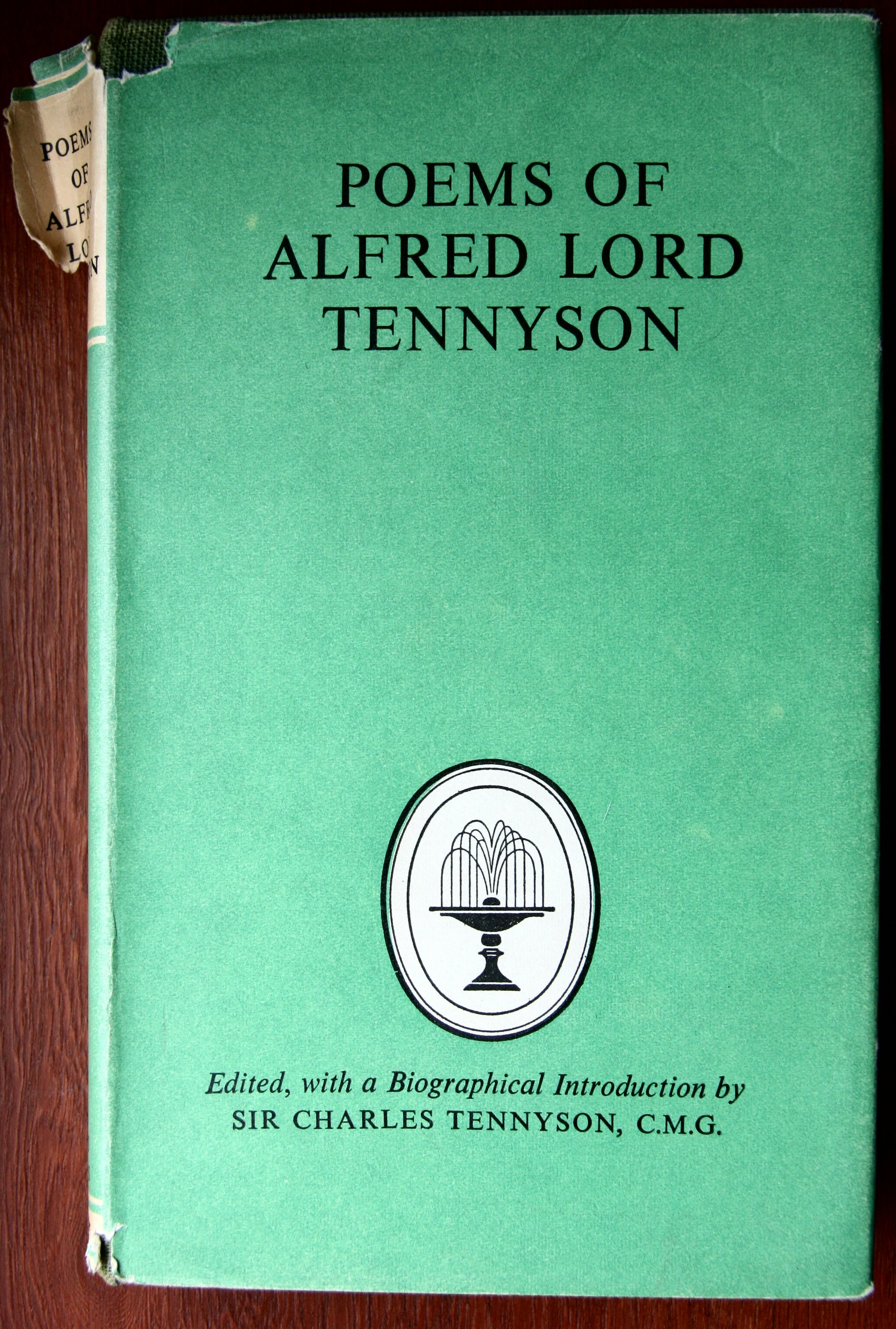
Cromer has a literary past, too. Winston Churchill stayed there as a boy and Elizabeth Gaskell was a visitor, as the pavement of the seafront testifies. (Churchill apparently wrote to a friend: ‘I am not enjoying myself very much.’) That Tennyson also came here, even if I had not already decided that I loved it, alone would have served to set my final stamp of approval upon the town: Lincolnshire’s greatest poet, he is also one of my favourites. (I’ve always considered James Joyce’s ‘LawnTennyson’ jibe to be undeserved.) I know that Tennyson would have been fascinated by Salt if he had been able to visit Cromer today. I can picture him perfectly, sitting in Chris’ and Jen’s Victorian front room, sharing his thoughts about poetry – as one fine poet to another – in his wonderfully gruff, unashamedly Lincolnshire voice.
And so, Jen, Chris and Salt, have a very happy Cromer day, listening to the lulling rhythm of the rolling, scouring waves and painting salty pictures in the sky.

 Christina James, crime novelist