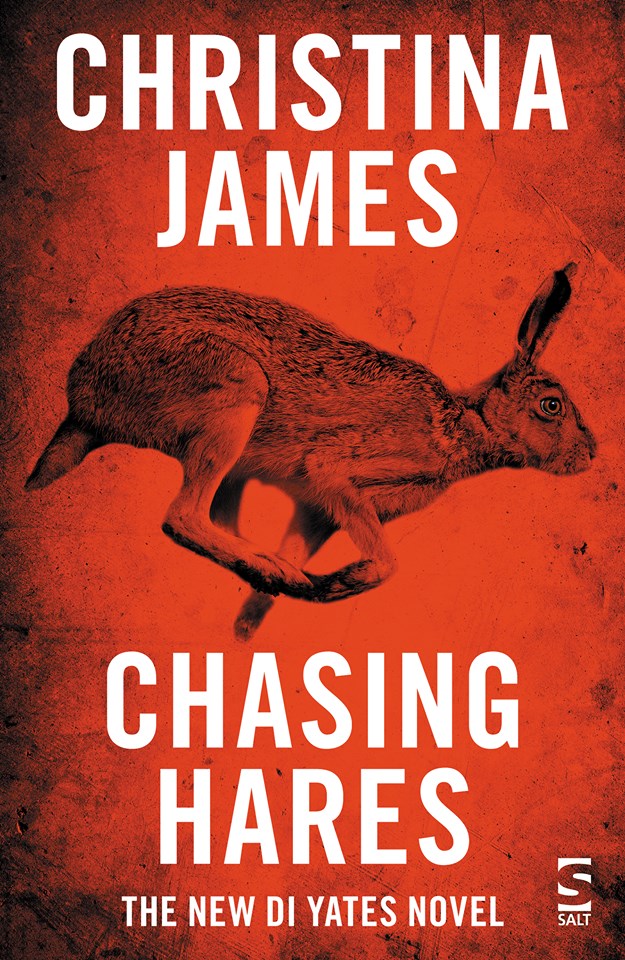


SALT: essential to human life
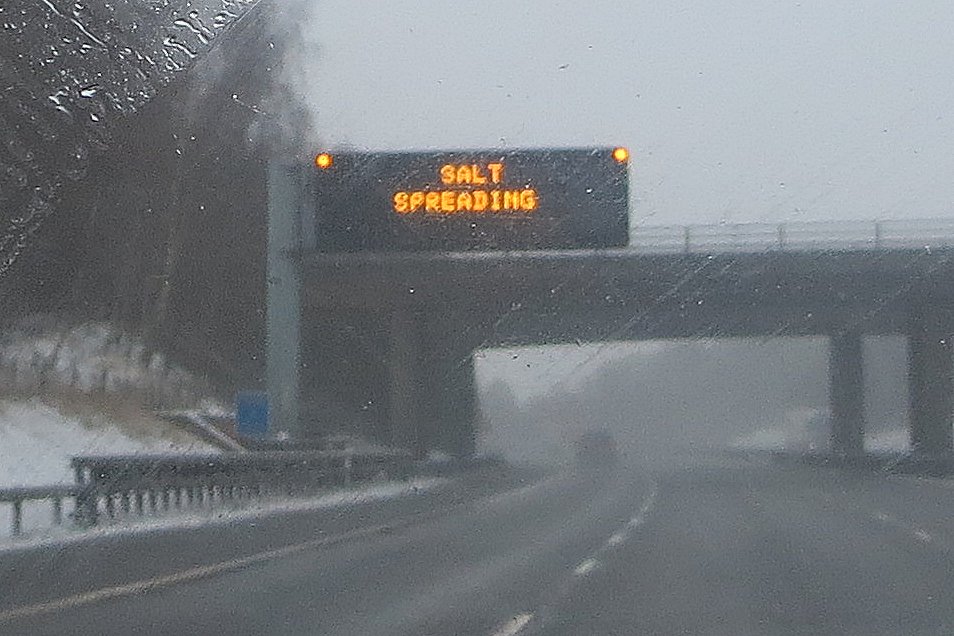
SALT SPREADING in Oxfordshire
On Friday 18th January, Chris Hamilton-Emery tweeted his surprise, excitement and satisfaction about Salt Publishing’s impressive January follower statistics: “Goodness me! 76,000 Twitter followers! Not bad for a Norfolk indie publisher …” Now this icy winter’s snow showers are blowing westwards off the continent and the North Sea, moving relentlessly inland, all across East Anglia and the Cambridgeshire and Lincolnshire Fens and thence to the Midlands, to London, the home counties and all places west and south, and northwards to the Pennines and to the wild and windswept Celtic lands, SALT is everywhere. The proof is there for all to see on the motorway gantries: SALT SPREADING. The warm centre of Salt Publishing, at ‘Salty Towers’ in Cromer, is quietly melting the hearts of the nation and of the cognoscenti beyond these shores with a constant sprinkling of poetry, short stories and novels, for SALT is essential to human life and adds a flavour to the dullest day. It preserves our sanity and we put down its stores of beautiful language for immediate use and to save for later, packaged in covers so original that our taste buds are tingling before we even tuck in to the goodness inside. No fear that supplies will run short, however great the demand! The SALT staff are working day and night to ensure that the needs of the population are met; the trucks are rolling and the deliveries are getting even to the remotest places along previously impassable routes. It’s happening: SALT is SPREADING!
SALT is not only my own publisher – it is also my favourite publisher. I have followed its fortunes since it emerged, butterfly-like, from the chrysalis of a poetry magazine thirteen years ago. I have been delighted to watch and share in its successes. Almost from the start, its poets won acclaim and prizes; when it branched out into short stories, many already distinguished authors wished their work to appear under the SALT imprint. More recently, it has developed fine literary and genre fiction lists. It won its first big fiction accolade last year, when The Lighthouse, by Alison Moore, was shortlisted for the Man Booker prize.
I am proud to see ‘SALT’ on the spine of my book. I am fascinated by its enigmatic name. I know that this derives from the salt marshes in the area of Australia where the poetry magazine was founded; but ‘salt’ is also a fundamental word. Customs and sayings relating to it are deeply embedded in our culture. Every school child is taught that the word ‘salary’ derives from ‘salarium argentum’, the salt money that was given to Roman soldiers so that they could buy the condiment that made their food palatable. Later, in mediaeval times, when everyone in the lord’s hall ate at the same long trestle table, the centrepiece was an elaborate salt cellar. Only nobles and gentry could choose to sit ‘above’ it; servants and other lesser mortals had to seat themselves ‘below the salt’. This sceptre’d isle is surrounded by the salty sea and ‘old salts’ are former venturers upon it, who may or may not be ‘the salt of the earth’! A tradition still kept in some rural societies involves throwing salt over your shoulder when you’ve sneezed, to keep the devil at bay. Bread, salt and wine are traditional gifts for newlyweds or, sometimes, new neighbours. Salt with a small ‘s’ is everywhere in our heritage.
And SALT with a big ‘S’ is continually getting stronger. Its founders, Chris and Jen Hamilton-Emery, have seen it through some tough years. With tenacity and optimism they have put their faith and energy into this fine independent publishing house which never compromises on the quality of the work that it publishes or its standards of presentation. Some wonderful SALT books were published in 2012 (see the SALT carousel) and some great ones are coming in 2013. SALT is SPREADING. The Highways Agency says so. It’s official.
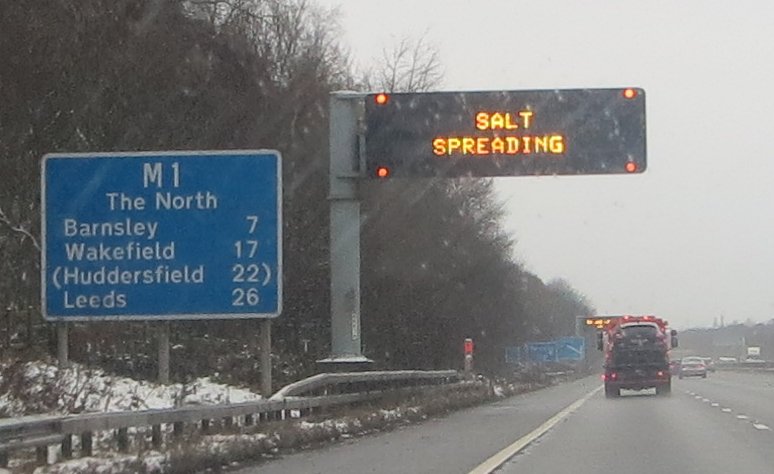
SALT SPREADING in Yorkshire
The magic of Christmas, in wordsales…

I looked in disbelief at the BBC online news article about the queues for the sales at the Oxford Street Selfridges, as shoppers waited to buy, by their own admission, anything that might be a bargain. Forgive me for being a Philistine about sales, as they seem to me to be artificially created to appeal to that quite basic instinct, greed, in the consumer. I’m not unhappy about a bargain, when one crops up by chance, but to devote sometimes hours to the pursuit of only a possibility seems absurd.
Of course, there are amazing book bargains to be had online for pence, trumpeted on Twitter and, for me, a worrying debasing of the real value of the works concerned. There seems to be something terribly ironic in pursuing a Kindle top rating by selling at incredible knock-down rates. I feel that a novel one has ‘bust a gut’ over deserves better treatment and more respect than this. Does the reader of a cut-cut-cut-price book have a sense of what has gone into it, or care?
I’m inclined not to tout for business in this way and, though I have metaphorically compared Twitter to a busy market where one may rub shoulders and converse with friends and strangers alike, I don’t see it as a place for selling my wares. I’m much more interested in the exchange of ideas and humour and in meeting people I’d never otherwise have a chance of engaging in conversation. Some of them might, as a result, buy my work, but because they have a sense of the person I am, not because my book is cheap.
BOOKMARK, very much a shop around a corner, but making a go of it!
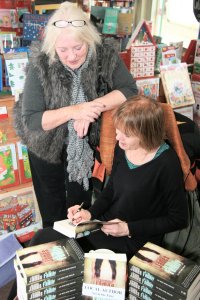
Signing for a customer
Meg Ryan put ‘The Shop Around the Corner’ on the map of the world’s best-known bookshops and profiled the conflict between the small independent and the large chain. Plus ça change, these days, though the large chain has, ironically, itself been threatened by the power of the internet. How is it, then, that the small independents are still there, serving their local communities, in spite of the fact that many members of those communities happily support the atmosphere of their friendly store to browse and seek information before going home to buy online what they’ve been looking at? It’s a cruel retail world.
On Saturday, I spent a wonderful afternoon in Bookmark (itself, as you can see, a shop around a corner), signing copies of In the Family and meeting the friendly people of Spalding, many of whom do still like the experience of buying over the cou nter. Though times are challenging for Christine Hanson, the proprietor, she, as a shrewd businesswoman, has diversified stock beyond books and cards and has made her bookshop coffee shop a place to love to be. Hers is indeed a bright and colourful, adult-and-child-friendly place of discovery, staffed by a team of excellently-trained and knowledgeable booksellers, who go the extra mile to respond to customer needs, keep the stock in tip-top order and make ‘buying a book’ a very special experience indeed. Yet the biceps of the competition are bulging and flexing and Bookmark’s very existence will depend on both the choice of customers to support their bookshop in word and in wallet and upon the need for all booksellers to play at the same street level as in Spalding and around the world.
A toast to booksellers!
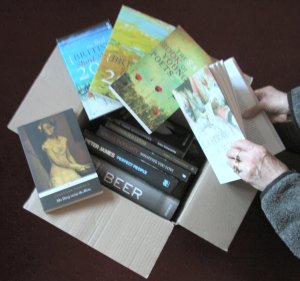 Although I am an author and also run my own research business, I have spent the greater part of my working life as a bookseller. I have been employed by two library supply companies and I’ve also been in charge of forty-two bookshops in a large retail chain. I’m very proud to have been able to call myself a bookseller and I was very sad when I realised that I could no longer describe myself as one when I renewed my passport this year. Some of the friendliest, most intelligent people I have ever met have been booksellers; I have rarely known one who was not only passionate about books but also genuinely committed to helping others to find the books that they would enjoy. Amazon did not invent ‘If you like that, you’ll like this, too’ and, whereas search engines can be frustratingly unhelpful, real live booksellers really do use their knowledge and insight to guide you to what you might like. Unfortunately, in common with most retail workers, booksellers are not well-paid. Many live in shared houses until they are well into their thirties; yet often they stay in the industry for twenty, thirty or forty years. It would be unnecessary to ask why, because the answer is obvious:
Booksellers are on a mission; a mission that brings civilisation, fulfilment and intellectual stimulus to almost everyone whom they encounter. We are lucky to have them – and local bookshops.
Open Access or open season?
Wearing my bread-and-butter hat, I went this week to a conference on Open Access [OA]. If you aren’t familiar with the term, it is a business model which involves making articles that appear in learned journals available free of charge to the ‘end-user’ (i.e. reader). Publishers are either paid direct by the author or they continue to charge subscriptions to libraries, but make the articles available free after an embargo period of six to twelve months. Academic publishers have come under a certain amount of pressure to accept this as one of their business models since it was first conceived in 2004, and most now offer some form of OA.
Following the publication of a report it commissioned this year (the ‘Finch report’), the UK government has now said that articles written about research projects funded by government grants to universities must all be made available via OA. This may not seem of much interest to crime writers or fiction writers generally; however, I think that we should be vigilant. Why? Because there is now a movement to extend OA to books. This is already happening in a small way. The argument is that publishers don’t make any money out of some books anyway, so they may as well cover their costs by making the author pay.
Speaking as a new crime writer who is currently being tenderly nurtured by my publisher (Salt Publishing), I think that if this were to be extended to fiction it would be the thin end of the wedge for both author and publisher. Why would authors trouble to write books and then pay the publisher to publish them? How would we afford it? And why would a publisher build an author’s profile – sometimes over many years – only to cover its costs, with maybe a modest ‘premium’ thrown in? Doesn’t this mean abandoning the leap of faith that all fiction publishers invest in their authors?
Finally, haven’t we all heard of this before, under a different guise? Isn’t it simply called ‘vanity publishing’?
Daisy Waugh, on what writers will do for publicity
I’m sure that many writers who read Daisy Waugh’s Sunday Times Magazine column about promoting her book will have smiled. Whimsical as ever, Daisy Waugh nevertheless touches some raw writer nerves, especially amongst those, like me, who are new to the self-promotion game. She first describes herself ‘lying on a giant polystyrene cut-out’ of her name, dressed in ‘a tight red satin skirt’ and ‘some magnificent shoes covered in velvet and jewels, on loan from Manolo Blahnik.’ This for a book cover or a poster. The thrust of her article concerns ‘Literary Death Matches’, a kind of Strictly-Come-Reading-Without-A-Partner in the pub, where writers show off a bit of verbal leg to entertain the ‘fairly drunken crowd’. Judging appears to be a touch subjective, the appearance, not the writing, of the author being crucial to success. The irony of Daisy Waugh’s final sentence (‘Whatever it takes, I’m up for it.’) not only amuses her reader, but also serves to highlight the anguish of authors who face a hostile and not necessarily objective audience scrutiny of something they have beaten brain-cells to bits for. This post is a toast to the thousands of unpublished gems that really deserved better treatment and to those publishers and reviewers who genuinely do know their stuff and employ it well for the benefit of authors and readers alike.
I’d like to think that all writers get a fair judgement, but the world isn’t fair.
The wrongs of rights?
I made a very brief appearance at the Frankfurt Book Fair this year. I was selling rights, a first for me: I fear that I have a great deal more to learn before I am properly initiated into this particular black art. Agents seem to me mainly to be inscrutable ladies of a certain age who have an elliptical view of the world accompanied by an unerring sense of authority. Publishers and authors alike are subjected to the same beady headmistress scrutiny. Intriguing.
One of them told me that she thought that authors should always avoid introducing minor characters into the first chapter of a novel. It’s not something I’d really thought about before, but my shoot-from-the hip (although polite) response to her was that I do not believe that all novels should be constructed in the same way or follow a standard set of rules. Any views?
 Christina James, crime novelist