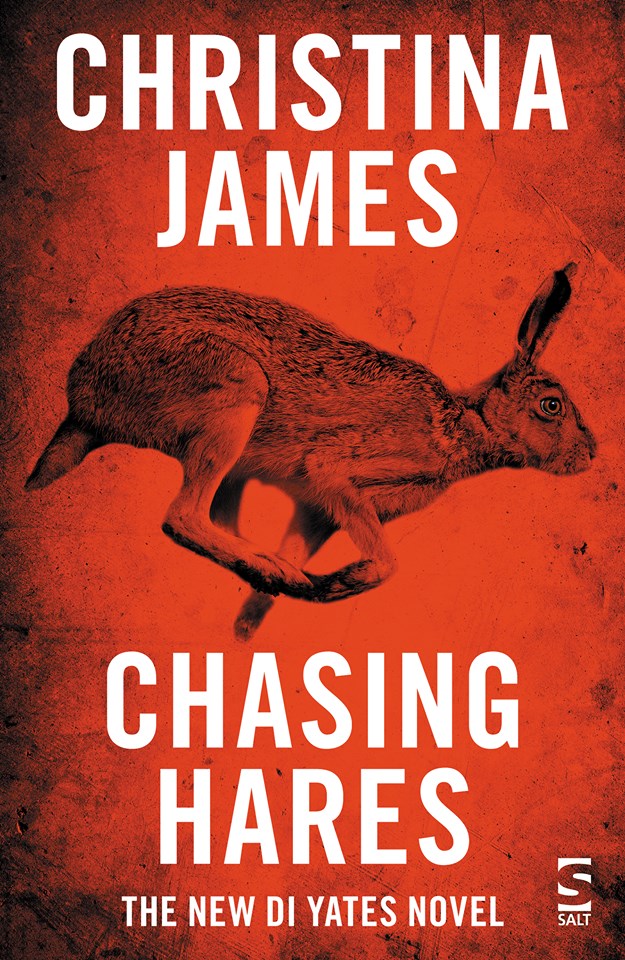


A very old bookselling friend revisited…

Richard Knowles and Christina James at Rickaro Books, Horbury
I went to Wakefield One last Friday, in order to discuss the details of the programme for 29th June with Alison Cassels, the librarian who’s in charge of events there. It’s a truly spectacular new library and events centre and well worth a visit if you’re in the area. It’s heart-warming to think that in these days of austerity and cutbacks there is still investment being made in such buildings, so important for promoting reading and holding local communities together.
During the course of our conversation, Alison mentioned that she’d ordered copies of both my books for the event. The library has itself bought copies of In the Family for its reading group (a very generous action which I applaud!) and has also ordered copies of it and Almost Love for those attending the session to purchase if they want to. I asked Alison who was supplying them and she said it was Rickaro Books of Horbury. It’s a bookshop that I’ve long been meaning to visit, because its proprietor is Richard Knowles, who many moons ago was my first boss. I e-mailed Richard to ask him if I could drop in with some Christina James postcards and he got back to me immediately. We agreed that I would call yesterday.
It seems particularly fitting that my visit should have taken place this week, which marks the thirty-fifth anniversary of my appointment to the library supply company in Normanton where my bookselling career started. Richard, then the manager, had many idiosyncratic interests which married well with bookselling: he was an authority on mediaeval armour and effigies and both wrote about and collected books on them. He liked antiquarian and private press books and had a fine collection of these, and read everything that he could lay his hands on about or by T.E. Lawrence. He was also fond of the poetry of Edward Thomas. Other interests included motor-bikes and collie dogs. He had a small child’s aversion to vegetables and liked nothing better than a currant bun filled with cheese for lunch, bought from the bakery on the corner. Main courses he could take or leave, but he loved puddings and chocolate. I once walked nine miles to work through snow drifts after the bus failed to materialise; he must have been impressed, because he gave me the chocolate bar he had earmarked for his elevenses!
I last saw him about twenty years ago (at the Scottish Library Association Conference in Peebles), but truly he hasn’t changed very much. A little more ‘distinguished’, perhaps, and now wearing spectacles, but otherwise he could have stepped straight out of 1978.
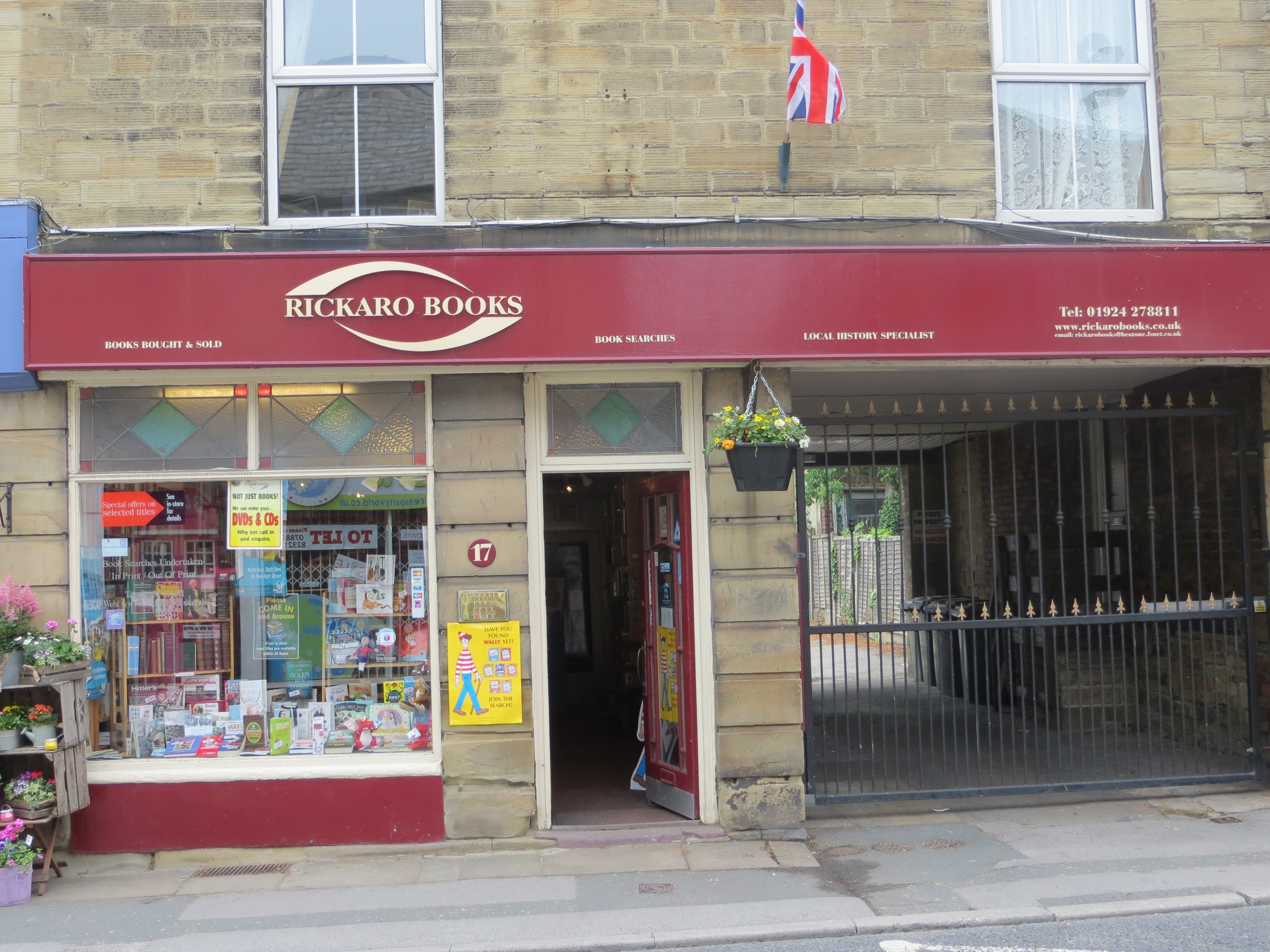
Rickaro Books, Horbury
Rickaro Books is exactly what I had expected: a deep Aladdin’s Cave of intriguing antiquarian and second-hand books, with a smaller but select stockholding of new titles. It even has a resident collie dog – Tilly – who lies under the cash desk. I didn’t ask him whether he comes to work on a motorbike; I suppose that Tilly would make this difficult, but otherwise I wouldn’t be surprised. I note with amusement that there is a baker’s shop just a few doors away and wonder whether its currant buns are up to the mark.
Richard said that he’d set up the shop thirteen years ago. He has a loyal local following and the library business, for special orders of new titles, is important to him. His customers for the antiquarian books are scattered throughout the world. He spends much of his time packing parcels to despatch to them. I didn’t buy any of the antiquarian books, but I did leave with two of Anne Cleeves’ titles, having been encouraged to read her by comments on the social networks.
Rickaro Books is a delightful place and one that I shall certainly visit again. I’ve already threatened to present myself for duty in the run-up to Christmas! It’s encouraging that booksellers like Richard can not only survive, but thrive, by building a business such as this, almost entirely on traditional lines; excellent also that Rickaro’s worth is recognised by the local library service.
Richard says that he and his wife plan to come to the event at Wakefield One on 29th June. I am pleased and touched that they are going to the trouble of rearranging their afternoon. After a gap of twenty years, two meetings in the space of two weeks! Like fine old books, old bookselling friendships mellow with age and perhaps get a little dusty, but they don’t disintegrate.
If anyone reading this would like to attend the event at Wakefield One, it starts at 2 p.m. on Saturday 29th June. I shall be giving readings from both books and talking about how I came to write them, as well as offering tips on how to get published.

Tilly, the bookshop collie
Almost Love: Publication Day
Today is the official publication date of Almost Love. It is almost midsummer and the sun is shining; the cuckoos are still here, though they’ve changed to cuk-cuk mode now (it’s been a particularly good year for cuckoos in Yorkshire this year). It’s a complete contrast to the day on which In the Family was published, when the leaves had fallen, the shooting season was in full swing and we were heading for the winter solstice. November seemed a good time to publish then, because it was still far enough away from Christmas for the book to feature (as I know it did, and am grateful) on some Christmas wish-lists. June also seems a good time, as I’m hoping that at least a few people might want to take Almost Love on holiday with them.
Some authors talk about their books as if they’re babies. This particular baby, although it’s been born today, is still in the incubator. The books were delivered to Salt and its distributor yesterday, but have yet to be despatched to the shops; this will happen on Monday. Yet I’m not impatient or disappointed that I don’t yet have a copy in my hand; on the contrary, I’m profoundly grateful to both Chris and Jen at Salt and to TJ International Printers of Padstow for pulling out the stops so quickly after MPG Printers went into receivership just as Almost Love was going through the press. Thanks to their Herculean efforts, the delay has been minimal – much slighter than we’d feared. And yesterday’s blog-post attracted so much interest that I feel that it acted as a ‘virtual’ launch. Thank you very much to everyone who read it, spread it or contributed comments.
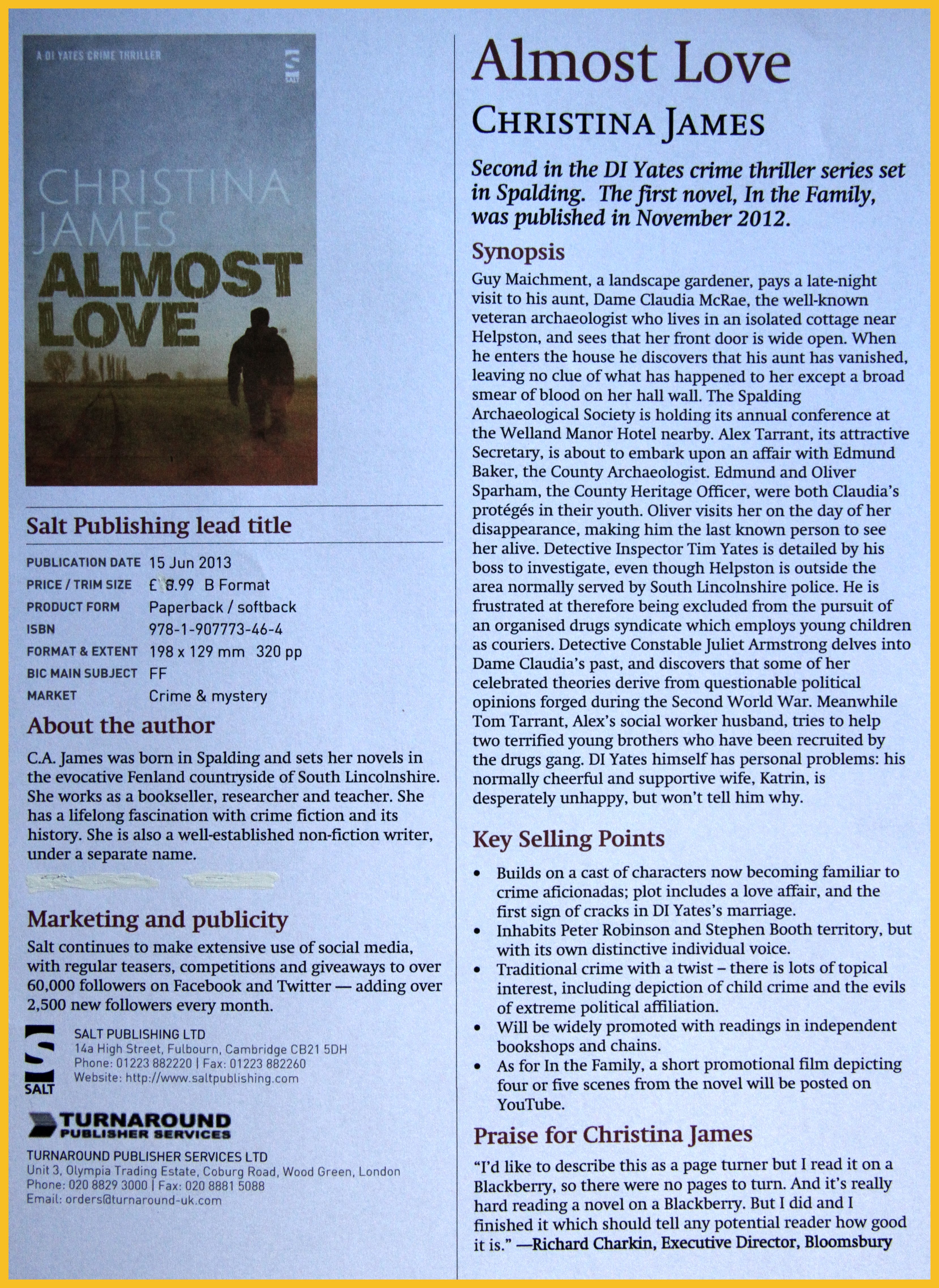
Thinking again about The English Bookshop and Jan’s explanation of why he chose Almost Love brought home to me the crucial role of Advance Information (AI) sheets in helping authors and publishers to sell their books. AIs have improved tremendously over the years. They started out as Gestetnered sheets. (Does anyone remember Gestetners? They took ages to set up and usually suffered a paper-jam within five minutes; you got ink all over your hands and, if you were unlucky, your clothes. The only good thing about them was the pink correction fluid, which could give you a temporary high if you applied it when standing in a confined space.) These were sometimes almost illegible and contained little except the ISBN, a two-sentence blurb and the publication date. There was no picture of the jacket. However, by no means all publishers used to produce AIs. Those who didn’t often sent out spares of the actual jacket with the date of publication stamped inside. Booksellers therefore never received a complete set of information: you either got an insubstantial blurb with no jacket, or the jacket and not much else.
By contrast, today’s AIs – at least the ones that Salt produces – are works of art. Author and publisher work closely together in order to wrest benefit from every centimetre of the space on a single A4 sheet. They include a fine picture of the jacket and all the information that the bookseller needs, yet can be read in less than a minute. Sometimes several hours are spent on developing an AI.
I thought that you might be interested to see the AI that was used to sell Almost Love into the shops, so I’ve included it here. I hope that you will like it.
A lovely Friday conversation with Jan Smedh, joint proprietor of The English Bookshop in Uppsala, a thriving independent business…

I’m delighted and very proud to discover that Almost Love has been chosen as the British Crime novel of the month by The English Bookshop in Uppsala. I asked Jan Smedh, who, with his business partner Christer, is joint proprietor of the shop, if I could call him. He kindly agreed to talk to me today, although he was busy making final preparations for his absence: he and his wife and three sons are about to leave for a holiday in Greece.
Jan told me that every month he chooses books for his reading groups and his book club. There are three reading groups: one for the Book of the Month, one for classics and (in Stockholm – he and Christer have just opened another shop there) one for children’s books. The book club operates as a subscription service. It has between fifty and sixty members scattered throughout Sweden. They choose the category to which they wish to subscribe and are each month sent a book in that category that Jan has chosen. They do not know in advance what the title will be.
He chooses titles from six categories altogether: the Book of the Month, which is always a literary novel; British Crime, ‘Tough’ Crime, Paranormal, Fantasy and Science Fiction. He tries to introduce a spread of themes and to get a balance between male and female authors and authors from different countries; for example, he has featured Asian authors who write in English. His choices are pretty unerring: his customers always seem to like them.
Jan said that when he read the description of Almost Love, he ‘loved it at once’. (I’m blushing as I write!) He tries to pick books by authors from small publishers that aren’t necessarily well-known, rather than blockbusters. The subject of Almost Love seems to be exactly what his readers are looking for: it has a bit of history, a bit of archaeology, some local background, a good plot and a strong psychological element. He says that his favourite customer is ‘someone who leaves the shop with a book that they didn’t know that they wanted.’ His copies of Almost Love have yet to arrive (there has been a slight delay in the printing, caused by MPG’s having gone into receivership two weeks ago), but they should reach the shop next Monday, so he didn’t know until I told him that there is also a Scandinavian element to the plot. He was delighted about this.
Jan learned about Almost Love from a Scottish publishers’ rep who carries titles from several independent publishers. His name is Stuart Siddall. I had not heard of him before, but I shall certainly get in touch with him now and I should like to take this opportunity to thank him.
I asked Jan about the inspiration for The English Bookshop. He said that he and Christer came up with the idea for it in 1995. They received no financial backing; they raised all the money themselves. Christer was already working in the bookselling industry (largely in the academic sector), so he had the contacts with UK publishing companies, who were therefore prepared to set up accounts for the new venture. It would not have been possible without their support. Jan’s own background is in communications and the business has benefited a great deal from this. It is he who designs the graphics for the website. He is prolific on the social networks and the shop has very active Facebook and Twitter accounts. He says that the key thing with social networking is to be consistent. He has worked hard to build up a loyal customer following and he knows he must maintain their interest by continually being there for them. His own love of books goes back to his childhood. He also speaks impeccable English: he explained that he has lived in Cork and has also visited the UK (he would like to see much more of it) and the USA.
95% of The English Bookshop’s customers are Swedish, though there is an ex-pat community in Uppsala, which is a university town (Jan describes it as ‘the Oxbridge of Sweden’). Most Swedes read English, and Jan’s customers are getting younger: some twelve-year-olds now buy books in English. Uppsala is also Sweden’s religious centre and the city in which the Monarch is crowned. It is Sweden’s fourth largest city and not huge, but it has the weight of history behind it and is home to many very well-educated people. Jan and Christer made the conscious decision to stay away from university course texts: they wanted their bookshop to provide leisure reading. By this, he doesn’t mean that all the books he sells are ‘light’: his readers like books about many subjects, as well as fiction. British history, books about war and books about psychology are all popular. Sales of non-fiction titles are growing; also crime fiction and children’s titles. The Swedish government has now set up English language schools, which means that parents are looking for books in English for their children. The English Bookshop tries hard to keep abreast of the continually changing interests of the local community and its unique stockholding reflects this. Jan says that ‘other bookshops aren’t doing this any more; there’s often a drab uniformity about what’s available from the big chains.’ Smaller publishers often complain that it’s difficult to get a proper presence in them. This view would certainly resonate with Salt, whose many distinguished authors often struggle to get adequate shelf-space in chain bookshops. It would also be endorsed by the UK’s many excellent independent booksellers, some of whom Jan knows. He has met Jane Streeter, a former President of the Booksellers Association, and is himself a member of the BA, for which he has a high regard.
In the last six years the turnover of The English Bookshop in Uppsala has doubled, enabling it to open the second shop in Stockholm. Jan says that this ‘goes against the grain’ of Swedish bookselling generally, so he feels that he and Christer ‘must be doing something right.’ I’d say they were doing a great deal right! The business is now eighteen years old.
It was delightful to have the opportunity to talk to Jan, and I am very grateful to him for giving me so much of his time and as well, of course, for choosing Almost Love. I now have an open invitation to visit The English Bookshop, which I am determined to take up. I’d like to visit the one in Stockholm, too! I wish Jan and his family a very happy holiday indeed in Greece. If any of his customers should read this, I’d also like offer you a big thank you and to say that I very much hope that you will enjoy Almost Love. Perhaps we may meet in the bookshop one day.

My ten top tips for revising text for publication

I was recently asked how much I revise when I’m working on a novel, and when I do it. The answer is: always several times; sometimes many times. If I’m not too tired, I look over the day’s effort again immediately I’ve finished writing. Whether I do this or not, I always scrutinise it the following day before I start writing again and make minor changes. Books usually fall into natural sections, and I’ll devote a day or two to working through a whole section in one go once I’ve finished it, to make sure that it hangs together and that I’ve been consistent. Finally, I revise the whole MS before I send it to my editor, sometimes more than once.
I’ve been asked for my ten top revision tips, so here goes!
- Make sure you get both the tense and the mood of verbs correct. This may sound easy, and it may even make me look stupid for saying it, but it’s surprising how often I read novels that have been marred by this mistake. And yes, I catch myself out sometimes.
- Scrutinise the word order in each sentence that you write. I don’t just mean taking care with words like ‘only’ which have different meanings depending on where they appear in the sentence – I believe that achieving the optimum word order is essential to good writing. If you look at the sentence structure and word order used by a writer whom you really admire, you’ll see what I mean.
- Be descriptive, but sparingly. It’s true what people say about purple passages!
- Try really hard to make the dialogue sound natural. Think your way into how the character who is speaking phrases his or her speech and listen to the voice. At the same time, be aware that making it sound natural doesn’t mean copying nature! I’ve just been reading a novel in which two of the main characters engage in the kind of desultory breakfast conversation that I often have with my husband. Not only does it not go anywhere, it unfocuses the reader’s attention and dissipates the tension that the author has built up in the preceding chapters.
- If you create an interior monologue for one or more of your main characters, ensure that you give it enough depth. It’s easy to fall into the trap of making it too brittle or superficial. It’s quite a hard technique to work with and so, if you’re not sure whether you’ve succeeded, abandon it!
- Apply my last point to all of your work, quite ruthlessly. Be your own fiercest critic. If you’re not completely happy with something, or think that it might not be working, it probably isn’t.
- Check that you have used the same names for your characters throughout and haven’t introduced some subtle changes along the way. This may sound an unlikely mistake, but it’s certainly one that I’ve made – for example, in the first complete draft of In the Family, Ronald Atkins was also called Roland and Rodney on some occasions – and, having talked to other authors about it, I’ve discovered that it’s quite a common fault. Readers are bound to be irritated by it!
- If you write a fairly detailed outline of the plot – as I usually do – you don’t have to stick to this slavishly if you’re inspired by some better ideas once you’ve started writing. However, be certain that these work within the context of the whole and don’t present you with a lot of inconsistencies that require making many changes, or force you to offer outlandish explanations that stretch credibility.
- Also on the subject of plot construction, try to write the chapters in chronological sequence, even if you plan to present them in a different order in the final version. If you don’t, you are almost bound to introduce anachronisms that will need ironing out afterwards. This is perhaps my own greatest fault. I’m trying really hard to practise what I preach, now that I’ve started my third DI Yates novel!
- Turn off the spell-checker, which has a nasty habit of introducing US spellings or unexpected quirks!
I refer to [Judith] Butcher’s Copy-editing: The Cambridge Handbook for Editors, Copy-editors and Proofreaders, which is an invaluable resource for ensuring consistency and proper presentation of material for publication.
Finally, may I add that I take very seriously the comments of readers about my writing. When I weigh them up, I find that they tend to have objectivity and honesty and I value their constructive and helpful insights.
Salt Publishing crime writer event

May I use today’s post to flag up a Salt Publishing event at Gower Street Waterstones, an evening with Salt’s crime authors, Laura Ellen Joyce, Matthew Pritchard and myself, at which we’ll be sharing both our books and experiences. For those new to this blog, here are some earlier posts which may interest you in relation to the authors and the venue:
Meeting Matthew Pritchard at BAFTA 195
I do hope that you will join us on this occasion, if you are able to do so; all three of us are very much looking forward to meeting you in this very lovely bookshop.
One month to publication!
So here I am, one month away from the publication day for Almost Love, which has reached the proof stage. I have marked the day by putting the ‘milestone’ countdown widget here (as if I needed it!), because that seems a celebratory thing to do, as well as adding the clickable cover picture and link to an interview about Almost Love, both of which are to your right on the sidebar. It’s enormously exciting, and humbling, for me to be able to visit the Salt Publishing home page and to see my second novel there, whirling on the carousel amongst those other glorious titles, including Alison Moore’s latest (The Pre-War House and Other Stories, launching tonight at Waterstones Nottingham), David Gaffney’s More Sawn-Off Tales and Alice Thompson’s new novel, Burnt Island, not forgetting my fellow crimewriter Matthew Pritchard’s Scarecrow (to be published in the autumn).
So much has happened since November 2012, when In the Family came out to face the world, and I am very grateful indeed to the many readers of that book who took the trouble not only to read it but also to comment so favourably on it. I have made many online friends since then, via Facebook, Twitter and this blog; they have been stalwart in their support and their sharing and retweeting has sometimes been so vigorous that I have barely been able to keep up with it. If I missed passing on my thanks to you, please forgive me and accept them from me now.
I’d like to express my appreciation, too, to all those readers who have visited here, pressed the ‘like’ and r.t. buttons, followed and commented. This opportunity to engage with you and your thoughtful comments has been beyond helpful to me in more ways than I could ever have imagined when I started blogging last October. It has also been a lot of fun!
I am indebted to Jen and Chris at Salt Publishing for all their support, which is unfailing and ever-present, as I’m sure all their authors will readily confirm. Their incredible creativity, their capacity for managing the impossible in no time at all and their long-suffering, good-humoured indulgence of human failings are what make them truly top publishers.
May I complete this post by announcing four events connected to the launch of Almost Love:
Waterstones Gower Street
Thursday June 20th, 18.30 – 19.30
An evening with Salt crime writers
Christina James, who reads from her new novel, Almost Love
Laura Joyce, who reads from The Museum of Atheism (published November 2012)
Matthew Pritchard, who reads from Scarecrow (to be published September 2013)
Admission by ticket or at the door. Wine will be served. Books will be on sale.
Bawtry Community Library
Thursday June 27th, 18.30 – 19.30
Christina James gives readings and speaks about crime-writing
Tea, coffee, refreshments. Books will be on sale.
Co-ordinated by Claire Holcroft and George Spencer, Doncaster Library Service
Wakefield City Library, Burton Street, Wakefield
Alison Cassels, Library Officer in Charge of Promoting Reading, writes:
As well as Crime Writing Month, 29th June is National Readers Group day, so we’ll be promoting it to our readers groups too. What we have planned for the day is our Readers Group morning, with coffee 11.00-11.30, then discussion groups 11.30-12.00, discussing three books (including In the Family), then 12.00-12.30 a general discussion on crime novels, followed by people recommending books they love until 13.00. After lunch, Christina James will be presenting her second novel, Almost Love, in a public session, from 14.00-15.00.
Event at Adult Education Centre, North Lincolnshire Libraries
Date and time to be confirmed.
A publication date and a tribute to two very good friends…
In this blog, I try to write mostly about crime-related topics, people, places and things that interest me, aspects of writing and other writers and their work. It isn’t intended merely as a vehicle to promote my own work; this was a conscious decision that I made right at the start, because I quickly tire of blogs by authors who use them too blatantly for this purpose.
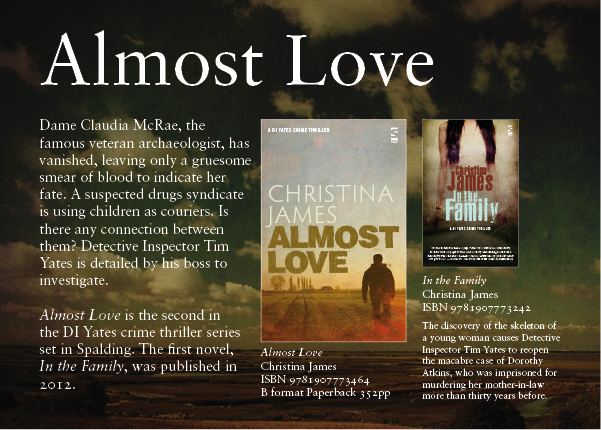
However, I hope that you will look upon today’s post indulgently, because I have to confess that it is indeed about promoting my next book, Almost Love, which will be published on June 15th 2013. It is a promotional piece with a difference, however, because it also celebrates a gift to me by my publisher, Chris Hamilton-Emery of Salt. Before In the Family was published, Chris designed a postcard based on the jacket; I sent this, with a short personal message, to as many people (friends, booksellers, librarians, colleagues) as I thought might be interested in it. I received some lovely replies; it may have helped to generate some interest in the book.
Today, Chris sent a similar promotional postcard for Almost Love. In fact, it features both the novels. I am delighted with it and I think that it is a thing of beauty. I’d like to share it with you; that is why it is the subject of today’s post.
I’d also like to say how much I appreciate Chris and Jen Hamilton-Emery, for their unfailing good-humour and encouragement and also for all their hard work on my behalf. Thank you, both!
A location I have used in Almost Love… and there’s no ‘almost’ in my feelings about it!

It was a glorious spring day when I was in London in advance of my visit to Gower Street last Thursday. People were sitting or lying on the grass in the parks. The grounds of the British Museum were packed with museum staff, office workers and tourists, all getting their first proper burst of vitamin D from this year’s English sunshine. The mobile refreshments van parked just inside its wall was doing a roaring trade.
I didn’t need to take advantage of its services, because I had already visited one of my favourite London restaurants, an unassuming Spanish-owned eatery called El Parador. It is a brisk ten-minute walk from Euston station; the restaurant stands in the middle of the last parade of shops before Eversholt Street reaches Mornington Crescent (now there’s a name to conjure with!). On Thursday, I noticed for the first time that it is also immediately opposite the imposing edifice from which Levertons, London’s foremost undertaker, plies its sombre trade.
A family-owned restaurant, El Parador can lift your spirits with a burst of fine cooking on even the dreariest winter day. In the spring and summer, it is a festive place. Tables are laid in the garden. Both restaurant and garden are busy – there’s rarely a spare table after 1 p.m. – and the whole place buzzes with laughter, conversation and the tinkling of glasses. The staff – there are usually only two or three on duty – almost run between the tables, nimbly delivering a continuous stream of hot tapas dishes as they are ordered. Unequivocally, it serves the best tapas that I have ever eaten anywhere. My husband accompanied me there for the first time on Thursday and has already become an enthusiastic champion of the place.
I have another reason for liking it, though. The décor is plain, even homely. The tables are plain deal, the chairs of the simple round-backed wooden type still found in a few old-fashioned pubs. The walls are painted dark cream and, aside from a few small mirrors, there is little other decoration. Save for one thing: the bar, a glorious suggestion of a boat, is decorated with a flamboyant mosaic of pieces of tile, ceramics and mirror, all in shades of turquoise and black. It draws your eye as soon as you walk through the door. Pure 1960s, there is something lethal about its splendour. You feel as if a character played by one of the sex sirens of the ’60s – Jayne Mansfield, say, or Barbara Windsor – might come sashaying out from behind it and break off one of the pieces of mosaic to stab an errant lover through the heart.
I’ve written about this bar in Almost Love.
A personal expression of thanks…
I should like to use today’s post to express my gratitude to the members of my audience at yesterday’s ‘An Evening With Christina James’ at Waterstones Gower Street. They proved to be attentive, responsive and interactive, as well as very friendly; I was delighted that the occasion developed into a conversation (always much more natural and comfortable) which drew upon the combined personal experiences and expertise of some extremely knowledgeable people.
It was very kind of you all to take the trouble to come to listen to a couple of readings from In the Family and Almost Love and to my personal perspective on approaches to getting published. You are old friends and new and I am privileged as an author to count you as such.
May I also give my warm thanks to Sam and the Gower Street Waterstones for hosting this event!
I’m able to confirm the date of publication of Almost Love as June 15th 2013.





Next Thursday, 2nd May 2013: An Evening with Christina James at Waterstones Gower Street

Sam, the wonderful Events Manager at Waterstones Gower Street, has organised ‘An Evening with Christina James’ on Thursday 2nd May 2013. It will start at 6.30 p.m. and last for perhaps an hour. I shall be reading a short excerpt from In the Family and perhaps also one from Almost Love (which will be published in June), and offering a few tips, from a personal perspective, on how to get published. After this, there will be a short Q & A – and a glass of wine! The event is a sort of forerunner of a larger Salt crime event that will be hosted by Gower Street on 23rd May 2013.
I know that readers of the blog are scattered far and wide and that some of you don’t live in Europe. Wherever you are, I am very grateful to you for your interest and have been delighted to ‘meet’ you on these pages. For those of you who happen to be in London next Thursday or can travel there easily (and would like to, of course!), I should be delighted to have the opportunity to meet you in person.
 Christina James, crime novelist